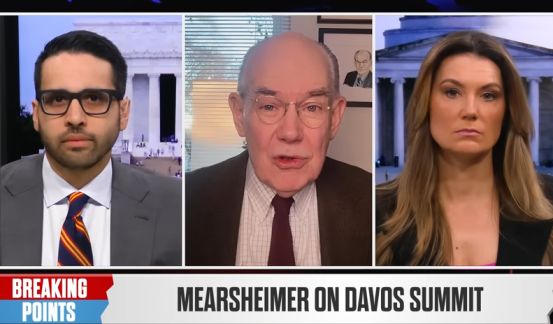
Editor’s Note: Veteran foreign policy scholar John Mearsheimer joins Krystal and Saagar to dissect how Donald Trump is reshaping the global order and shattering long-standing alliances. Drawing on Mark Carney’s stark Davos speech, they examine why middle powers like Canada feel newly vulnerable and what Trump’s threats toward Greenland reveal about NATO’s future. Mearsheimer also unpacks the latest U.S. confrontations with Iran, Venezuela, and Cuba, arguing there are sharp limits to what American military and economic power can actually achieve. This conversation offers a clear, unsparing look at where great-power politics may be headed in the coming years. (Jan 22, 2026)
TRANSCRIPT:
Introduction
SAAGAR ENJETI: Joining us now is Professor John Mearsheimer of the University of Chicago, one of our favorite guests here on the show. It’s good to see you again, sir. Thank you for joining us.
JOHN MEARSHEIMER: My pleasure. Glad to be back.
SAAGAR ENJETI: One of the things we had to get your reaction on is this now famous Mark Carney speech, the Canadian Prime Minister, about the U.S. Western-led order, about many of the fictions that belied it. Why don’t we take a listen and we’ll get your reaction.
Mark Carney’s Davos Speech
VIDEO CLIP BEGINS:
MARK CARNEY: It seems that every day we’re reminded that we live in an era of great power rivalry, that the rules-based order is fading, that the strong can do what they can and the weak must suffer what they must. And faced with this logic, there is a strong tendency for countries to go along, to get along, to accommodate, to avoid trouble, to hope that compliance will buy safety. Well, it won’t.
And the question for middle powers like Canada is not whether to adapt to the new reality—we must. The question is whether we adapt by simply building higher walls or whether we can do something more ambitious. In a world of great power rivalry, the countries in between have a choice: compete with each other for favor or to combine to create a third path with impact.
We shouldn’t allow the rise of hard power to blind us to the fact that the power of legitimacy, integrity and rules will remain strong if we choose to wield them together.
VIDEO CLIP ENDS:
SAAGAR ENJETI: Professor, your reaction to that speech in the context of this Greenland situation that now may have appeared to be resolved, but the tactics and the rhetoric from the Trump administration cannot be taken back.
Mearsheimer’s Analysis of Trump’s Threat to NATO
JOHN MEARSHEIMER: Well, you want to remember that Mark Carney is the Prime Minister of Canada and President Trump referred to his predecessor as the Governor of the 51st State of the United States. And he’s made it clear, President Trump, that he has his gun sights on Canada as well as on Greenland, although Greenland’s getting all the attention these days. So Carney is well aware of what he’s dealing with.
And Carney made what I think is in many ways a brilliant speech that made it clear that he understands that Trump represents a fundamental threat to the so-called Western order or the rules-based order. If you listen to most European leaders, they want to accommodate Trump. They think that by appeasing Trump they can get Trump to play ball with them.
I think Carney fully understands, and quite correctly, that that’s a wrong way to deal with Trump. Trump is interested basically in wrecking NATO. Trump is not interested in having good relations with the Europeans and he has a huge amount of power and he’s going to use that, number one, to take Greenland and number two, to do great damage to the Western alliance, which he has for. And basically what Carney was doing was spelling that out. He was telling brutal truths to the audience at Davos. And that’s basically what’s going on there.
KRYSTAL BALL: Do you think that this whole Greenland episode has been an effective wake-up call for European leaders as well?
JOHN MEARSHEIMER: Yes, I think there’s no question about that. The key point here is that Denmark effectively owns Greenland. Or to put it in more benign terms, Greenland is, in effect, part of Denmark. And Trump, until yesterday, was threatening to use military force to take Greenland away from Denmark and make it part of the United States.
If that were to happen, that would be one NATO member—the United States—effectively going to war against another NATO member. This is really quite shocking. Of course, you want to understand that before all of this hullabaloo about Greenland, all sorts of frictions had arisen within the alliance. Ukraine is a really good example. The Europeans and the Trump administration have long been doing battle over how to deal with Ukraine. And Trump is fed up with the Europeans for resisting his efforts to try to strike a deal with Putin.
So when you look at that past history regarding Ukraine, you can understand why Trump is willing to play hardball with the Europeans and he’s willing to facilitate some sort of divorce across the Atlantic Ocean.
The Emerging World Order
SAAGAR ENJETI: You know, professor, in the context of your overall work and looking at this, how do you see a, quote, “new world order” emerging as a result, not just of this action, but of the broad spectrum of what Donald Trump has now done in his first year in office?
JOHN MEARSHEIMER: Well, I think you want to realize that there are sort of two dimensions to Trump’s foreign policy. One is the great power politics dimension, and that’s how he deals with Russia and how he deals with China. And in terms of U.S.-China relations, things are actually quite calm these days. There’s not a lot of trouble in East Asia. And with regard to the Russians, Trump is doing everything he can to foster good relations with the Russians.
So in terms of great power politics, where we have this multipolar world, where we’ve moved from unipolarity to multipolarity, you don’t see a lot of trouble between the United States under President Trump and the Russians and the Chinese.
On the other side, it’s with middle-sized and smaller countries where Trump is really ruffling feathers and where you see Trump behaving in quite radical ways.
So, you know, he’s picking on countries like Canada, he’s picking on countries like Venezuela, Iran, he’s threatening to take Greenland, he’s playing hardball with the Europeans. And this is not great power politics.
Trump is a very smart man in the sense that he understands that he cannot beat up on the Chinese or on the Russians. He has to work out some sort of modus vivendi with them, at least for the time being. But for weaker countries, middle-sized countries, including allies, and smaller countries, including allies, he’s willing to play hardball with them, he’s willing to whipsaw them. And this is what you see taking place today.
The Limits of Middle Power Influence
KRYSTAL BALL: So if you have Prime Minister Mark Carney sort of ripping the mask off the Western-led order and acknowledging, I think what is now the present reality, that, you know, that is dead or dying, that we’re moving into something different, what are the possibilities for what that something different looks like and what are the implications specifically for America?
JOHN MEARSHEIMER: Well, if you listen to Mark Carney speak, he believes that these middle powers can pursue a third way and that they can form a non-aligned movement. He believes, and he says this very clearly, that these middle-range powers can create their own institutions. And in that regard, I think he’s wrong. It’s great powers that create institutions, it’s great powers that create international orders. And countries like Canada have remarkably little maneuver room. So I think he’s wrong in thinking that he can do that.
Now with regard to what the international order looks like moving forward, it is important to understand that President Trump is taking a sledgehammer to the international order. If you think about NATO, he is, I think, trying to wreck NATO. He has no interest in maintaining NATO. He has little interest in the alliance.
But also he’s now putting forward this Board of Peace. And as many people have argued, the Board of Peace is basically now become a substitute for the United Nations. He has no use for the United Nations either. And of course he recently withdrew from 66 international organizations. It’s really quite amazing.
So you see that President Trump, as Mark Carney makes clear, is a wrecking ball when it comes to the international order. And then when you start thinking about what’s going to replace these institutions that he’s wrecking, what is the new international order going to look like? It’s quite clear that to the extent President Trump is interested in international institutions, he wants international institutions that he runs.
This whole subject of the Board of Peace is really quite remarkable. It started out as an institution that was designed to facilitate a peace agreement, peace accord, in Gaza. It’s now morphed into this international institution, at least in his mind, that he runs and he sees it as a replacement for the United Nations. This is not going to work. This is not going to be a meaningful international institution.
So I think given that President Trump is going to be in power for three more years, international institutions are not going to have a whole heck of a lot of effect on how international politics is conducted. That’s not to say they’re going to be irrelevant. But as long as he’s in power and as long as the United States remains so powerful relative to all the other countries in the world, international law and international institutions are probably going to matter less than they have at least since 1945.
Trump’s Iran Policy
SAAGAR ENJETI: You know, professor, at the time when we’re talking about great power politics and, you know, this embrace of the Monroe Doctrine, as he would call it with Venezuela, some element at least of realism, we also saw this bizarre emergence not even two weeks ago of complete neoconservative ideology with this idea that we could just bombard the Iranian regime as a result of their alleged crackdown on protesters. And the president seems absolutely committed, you know, to this idea that if the Iranian regime executes some protesters that that would immediately bring about the bombing of the entire country. He doubled down on this in a recent interview. Let’s take a listen.
VIDEO CLIP BEGINS:
UNIDENTIFIED SPEAKER: There are reports that they are still burning thousands of protesters alive. They also issued an assassination threat against you over the weekend. I know that you can’t talk about what’s on the table, but what is your response to Iran’s leadership and their regime continuing to taunt you, threaten you, especially given over the weekend you said it’s time for new leadership in Iran?
DONALD TRUMP: Well, they shouldn’t be doing it, but I’ve left notification. Anything ever happens, we’re going to blow the hell—the whole country is going to get blown up. So we’ve, you know, originally Biden should have said something. You know, when they made a statement, we always said, why isn’t Biden saying anything? Because he didn’t. But a president has to defend a president. Like if I were here and they were making that threat to somebody, even not even a president but somebody like they did with me, I would absolutely hit them so hard. But I have very firm instructions. Anything happens, they’re going to wipe them off the face of this earth.
VIDEO CLIP ENDS:
SAAGAR ENJETI: What do you make of this, sir? You know, the American right is trying to tie this to some alleged assassination attempt. But, you know, again, the preemption is this crackdown on protesters. It just seems so totally out of step with any sort of realism or, you know, great power understanding and a complete fantastical embrace.
U.S. and Israeli Strategy in Iran
JOHN MEARSHEIMER: Well, it’s very important to understand that this is Israel and the United States working together, number one, to topple the regime in Tehran, and number two, to break the country apart the way we, the Israelis and the Turks, broke apart Syria.
And the real trouble started in late December of last year. That’s December 2025, when protests started in Iran. And we played a key role in fueling those protests. And the idea was that the protests would turn violent. And we had agents and the Israelis had agents inside of Iran that were helping to turn the protests violent.
And the idea was that once the protests gained a lot of momentum and it looked like the regime was going to topple, then the United States would move in with military force. So we were planning to move in with military force. The Iranian government cracks down on January 8th. And when the Iranian government cracks down and it looks like they’re having an effect on dampening the protests, we begin to think about moving in with military force because we want to topple that regime. And when I say we, I mean the United States and the Israelis.
But what happens is that on January 14th, Trump backs off. And the question is, why does Trump back off? And there are two reasons that he backs off. The first is his military commanders tell him that he cannot win a decisive victory if he uses military force. And the reason is that the government in Tehran has basically quelled the protests. So the protests are not swelling to the point where the American military can come in and deliver the final blow, the coup de grace. We’re not in a position to do that by January 14th. So Trump begins to cool his jets.
The second thing that happens is Netanyahu calls him and Netanyahu tells him he does not want Trump to use military force because as long as the regime is in power, and it looks like it’s going to be in power on January 14th, that means the regime will launch ballistic missiles and cruise missiles at Israel, and Israel cannot defend itself. This argument is hardly ever heard in the west.
But you have to understand that in the 12 Day War last June, what the Israelis wanted to do after 12 days was end that war because they were incapable of defending themselves. The Iranians had learned how to get lots of ballistic and cruise missiles through their defenses, and the Israelis were running out of defense missiles. So the Israelis were in real trouble and pushed Trump to end the war after 12 days.
Well, the situation has not changed. If the regime is in place in Tehran and is capable of launching ballistic missiles at Israel, Israel would really be pounded. And Netanyahu recognized that. So it’s very important to understand that the Israelis on January 14th asked us not to bomb Iran. And again, the American military said, you can bomb Iran, but you’re not going to get regime change. And in large part because the protests had failed by January 14th, because on January 8th, the government in Tehran started the crackdown.
So this is what’s going on there. But of course, as you well know, this game is not over. The United States and the Israelis will continue to look for ways to have regime change in Iran, and they will continue to look for ways to use military force to help topple that regime.
Is This Just a Pause Before a Larger Attack?
KRYSTAL BALL: Let me go ahead and put B3 up on the screen here, guys, and let me get your reaction to this, Professor Mearsheimer. So one of the theories that I’ve seen from people who are hoping that we attack Iran, frankly, is that this is just a pause while we move appropriate assets into the region, because we had a lot of things far afield to deal with the whole Venezuela situation that created. And so this is just a pause to bring more assets in. And actually, what it means is that we’re going to do something even bigger than what was potentially originally intended. Do you think that there is any credence? Do you think that is something that we should be concerned about?
JOHN MEARSHEIMER: Well, we should definitely be concerned about it. You know, we live in a very dangerous world, and President Trump makes that world increasingly dangerous by the day, by his rhetoric and by his actions. So we should be concerned.
But having said that, what are we going to do with all that military force to affect regime change in Iran? The fact is, the regime is in place, and there’s no way all that air power that we have in the region can topple the regime. You see, you want to understand that starting in late December, we and the Israelis thought that with the protests, with the protests, we could topple the regime. The protesters were going to do the heavy lifting. The protesters were going to undermine the regime, and then we were going to come in and deliver the coup de grace with American military power.
But once the protests fail between January 8th and January 14th, it doesn’t make sense to use American military power because we no longer have the protests working in our favor. So using military force just doesn’t make sense. There’s no question we can pound that country, bringing in all that firepower will definitely wreak destruction on Iran. But the question you have to ask yourself is what will the regime which remains in place do as a consequence?
And number one, as I just explained, the regime will pound Israel, and the Israelis don’t want that. Secondly, the regime will go after American military bases and American troops in the region, and we really don’t want that. And the third thing is that the regime in Tehran is likely to shut down the Straits of Hormuz and therefore shut down the flow of oil out of the Persian Gulf, which would have devastating effects on the international economy.
So the point is that as long as the regime in Tehran is in power, it doesn’t make sense to hit them with American military power or Israeli military power, because the regime in Tehran has retaliatory options. Again, what we had hoped to do was topple the regime and the American military would come in at the last moment and facilitate that outcome.
The Limits of American Military Power
SAAGAR ENJETI: Yeah, I mean, one of the things that’s really struck me, professor, is just the, I mean, I was always pessimistic about the American military, but learning about how 25% of THAAD interceptors were used just in the 12 day war, learning even in this scenario where they wanted to strike Iran or potentially and they had to bring a carrier from the South China Sea, all of our naval armada is stuck in the Caribbean and across the world, we were unable to defeat the Houthi campaign. It does seem as if there are severe limitations on American power as Trump is trying to embrace this world policeman, this like world policeman, but only in certain select areas, strategy. How do you think that will collide with reality at some point, or has it already?
JOHN MEARSHEIMER: Let me just point out that I agree with everything you just said. Very important what you just said, but just to come at it from a slightly different perspective, you want to remember that we didn’t do regime change in Venezuela. All we did was take away Maduro and elevate the Vice president to the presidency. The regime remains in place.
SAAGAR ENJETI: Yes.
JOHN MEARSHEIMER: What we tried to do in Iran was regime change. Now, when we did regime change in the past, we had boots on the ground. Remember Iraq, remember Afghanistan? The last thing Trump wants to do is have boots on the ground. He’s not interested in engaging in social engineering. That’s why the protesters are so important. They are, in effect, our boots on the ground. But once that doesn’t work, then you can’t use American military power.
All this is to say there are great limits to what you can do with military power. And this is something that I think Trump intuitively understands. His predecessors did not understand that, which is why we invaded Iraq and engaged in social engineering with boots on the ground. Trump understands you can’t do that. That’s why he didn’t pursue regime change in Venezuela, and it’s why he’s not putting boots on the ground in Iran.
But the point is that there are lots of people in the body politic who just think we can drive aircraft carriers into the region, use those aircraft carriers to topple the regime in Iran, and then march on to the next target. It doesn’t work that way. There are real limits to what you can do with military power, which, again, is why we’ve put boots on the ground in the past. And I think that Trump understands that.
And that’s why Trump, although he has used military force quite liberally since taking office, I count seven different countries that he’s attacked. And of course, he’s threatening to take Greenland with military force, or he has been threatening to take Greenland with military force. Although he uses military force liberally, he uses it in a pinprick fashion. He doesn’t invade countries and end up with boots on the ground.
And as long as he doesn’t end up with boots on the ground, he will be pretty much free to use military force here and there against weak adversaries. But the end result is not that significant because there are just real limits to what you can do with air power alone or by removing Maduro and replacing him with Ms. Rodriguez. It just doesn’t add up to that much.
Cuba: Next on the Hit List
KRYSTAL BALL: Well, let’s talk about one more country using that analysis. Put B5 up on the screen. The Wall Street Journal reporting that the US is actively seeking regime change in Cuba by the end of the year. After ousting Venezuela’s leader, the Trump administration is searching for Havana insiders who could cut a deal to end Communist rule.
Let me just read a couple of the first paragraphs here. “Emboldened by the US ouster of Venezuelan President Nicolas Maduro, the Trump administration is searching for Cuban government insiders who can help cut a deal to push out the communist regime by the end of the year. The Trump administration has assessed Cuba’s economy as being close to collapse, that the government has never been this fragile after losing a vital benefactor in Maduro. These people said officials do not have a concrete plan to end the communist government that has held power in the Caribbean island for almost seven decades. But they see Maduro’s capture and subsequent concessions from his allies left behind as a blueprint and a warning for Cuba.”
According to senior U.S. officials, quote, “I strongly suggest they make a deal before it is too late,” President Trump stated in a January 11th social media post in which he said, quote, “no more oil or money would be going to Cuba.” So what do you think the plans are for Cuba here?
JOHN MEARSHEIMER: Well, I think that the Trump administration, especially because of the influence of Secretary of State Marco Rubio, is interested in doing big time social engineering in all of Latin America. Very important to emphasize that the Americans have long been completely intolerant of left leaning governments in the Western Hemisphere. We have a rich history, as you both know very well, of toppling governments in places like Chile and Guatemala that we thought were to the left of center. We just do not like governments of that sort.
And we’ve had no greater adversary since 1900 in the Western Hemisphere than Cuba. It goes back to when Fidel Castro took over there in 1959. So we’ve long had our gun sights on Cuba. And I think that in terms of the moment, I think that the Trump administration would like to produce regime change in Cuba, Nicaragua and Venezuela. But Cuba’s definitely number two on the hit list.
And what the administration is doing is not using military power, it’s not putting boots on the ground for sure, but it’s using our tremendous economic leverage in the region to hopefully, from their point of view, topple the regime. And what we think we can do is by controlling Venezuelan oil, make sure that the Cuban economy, which is in terrible shape even when it’s getting Venezuelan oil, will be in disastrous shape when the flow of Venezuelan oil to Cuba is completely cut off, which is what we’re now in the process of doing. So we want regime change in Cuba, but it’s again another example of Trump pursuing regime change on the cheap.
KRYSTAL BALL: Is this just an ideological, I mean, I know it’s an ideological fixation for Rubio, but is there anything beyond that? I mean, with Venezuela, first we were sold this nonsense about drugs, then we were sold just like, no, we’re just taking the oil. I mean, there are a lot of natural resources in Venezuela. Cuba, not so much. So is this just purely an ideological project? Is that the rationale behind it?
American Intervention in Latin America: Ideology Over Economics
JOHN MEARSHEIMER: I think that the principal factor that explains American military intervention in Latin America since 1900 is ideology and it’s our deep-seated fear of left-wing governments. And we’re not even talking about far-left governments here, like you saw under Allende in Chile. That’s not what we’re talking about. Even moderately liberal governments really spook us. And we often do regime change, and we often do it at the end of a rifle barrel, but not always.
Now, just to go back to Venezuela and to pick up on what you were saying, Krystal, you remember in the beginning it was narco-terrorism. Then when that argument began to lose its punch, they started talking about the Monroe Doctrine, as if China and Russia were taking over the Western hemisphere. But that didn’t make any sense.
And then when Trump finally went in, the explanation became oil. But oil was not touted as the main reason for going into Venezuela for most of the period before the kidnapping. It wasn’t like oil was front and center as the argument. And I was saying on various podcasts that I thought the principal reason was ideology.
But you want to remember that ideology and oil are tied together because when you talk about oil, what bothered the Americans was the nationalization of Venezuelan oil. Who are these Venezuelans to nationalize their own oil? This is unacceptable. American oil companies should be free to come down there and exploit Venezuelan oil.
That’s basically the view of the Trump administration, and that is inextricably bound up with left-right issues. And of course, the Chavez government and now the Maduro government—these were socialist governments. Anytime you use the word socialism, you know trouble is in store for that country that identifies itself as a socialist country.
So I think the oil issue morphed into the—excuse me, the oil issue and the ideology issue were tied together. But as you point out, in the case of Cuba, there’s no oil issue.
SAAGAR ENJETI: Right.
JOHN MEARSHEIMER: Cuba doesn’t have oil. Cuba’s not Venezuela. It’s, I think, purely the ideological issue.
KRYSTAL BALL: Got it.
The Question of Blowback
SAAGAR ENJETI: Well, last question for me, for you, sir, is about potential blowback. So the Trump administration—when I talk to them—they’re basking in their glory of Iran, of Venezuela. They genuinely feel as if nothing can go wrong. I often point out that it took many years for many interventions or others to fall apart. How do you see the potential blowback or complications in all of these scenarios?
JOHN MEARSHEIMER: Well, they failed in Iran. I mean, we want to be very clear on this. The American media, the mainstream media will not say this. They will not say that this was a colossal failure, what just happened in Iran. And of course, there is a possibility that at some point in the future, the regime in Iran will be toppled. So we can’t say it will never happen. But it has not happened so far.
With regard to Venezuela, they think this was a great victory. But I think that you want to remember that after we toppled the regime in Iraq, President George W. Bush landed on an aircraft carrier, and he declared “mission accomplished.” I think that the Trump administration is duplicating what the Bush administration did back in 2003. They’re declaring that the mission has been accomplished. We’re going to live happily ever after vis-à-vis Venezuela. I would not bet a lot of money on that.
The idea that a bunch of gringos from up north can come down and run Venezuelan politics—and you want to remember that this is what President Trump said he was going to do. He said he was going to run Venezuelan politics. And furthermore, we’re going to steal their oil and we’re going to get away with that. In a country where there is a powerful sense of nationalism, I would not bet a lot of money on this.
There’s a long road ahead for the United States and Venezuela, and I believe that the “mission accomplished” argument will not look like a good one a year or two from now.
The Limits and Leverage of American Power
And with regard to blowback, there’s obviously lots of blowback in the system. The Mark Carney speech at Davos that we just talked about is an example of blowback. The Europeans are beginning to push back on us. Not very hard at the moment, but they are beginning to push back. And we’re going to have trouble in different places around the world that we don’t have to have if we would act smartly.
But the key point you want to keep in mind is that the United States is an incredibly powerful country, and it operates in an integrated international economy. The international economy is highly integrated. And that integration provides us with enormous leverage over virtually every country on the planet, except for maybe China and Russia.
So the Trump administration uses that economic leverage liberally to get its way. And also, that economic leverage causes countries to be very fearful of fighting back against us. They don’t want to get on the wrong side of us. This is why so many countries are now rushing to join the Board of Peace. President Trump wants them to join the Board of Peace. Okay, let’s join the Board of Peace, because we don’t want to anger him.
Given the power that he has and given how willing he is to use that power, we have to be very careful. So the point I’m making to you is given just how powerful the United States is, especially on the economic front, and in a funny way, more on the economic front than the military front, we are able to whipsaw countries and not face that much blowback.
KRYSTAL BALL: Yeah, well, we really appreciate your time. We know how in demand you are. Thank you so much, professor, for your analysis this morning. We’re incredibly grateful.
SAAGAR ENJETI: Thank you so much, sir.
JOHN MEARSHEIMER: You’re more than welcome. I thoroughly enjoyed talking to you.
Related Posts