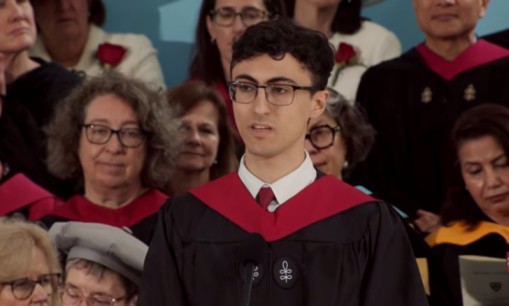
Read the full transcript of Graduate Noah Eckstein’s Senior English Address: “The Punchline” at Harvard’s 2026 Commencement Exercises on Thursday, May 28th, 2026.
Editor’s Note: In his poignant address at the Harvard Commencement 2026, graduating student Noah Eckstein shares his personal family history—a unique blend of Christian, Muslim, and Jewish heritages—to challenge the modern trend of binary thinking. Eckstein argues that in an increasingly polarized world, the antidote to division is not forced agreement, but a genuine commitment to understanding one another as fellow human beings. By sharing the lessons he learned from his grandfathers, he urges his fellow graduates to fight to understand those with whom they disagree rather than simply dismissing them.
The Punchline
NOAH ECKSTEIN: My life begins with something that could be the start of a joke, and it goes like this. A Christian, a Muslim, and a Jew walk into a bar.
I know historically the setup is a little bit dicey, but this time, this time was a little bit different. This time, the Christian married the Muslim, and they had a daughter. That daughter grew up Christian until she met the Jew, converted to Judaism, married the Jew, and had a son. 22 years later, that son is standing here with all of you, graduating from Harvard University.
I am a proud Jew. I’m also the proud grandson of a Christian, and the proud grandson of a Muslim. But that isn’t a contradiction in any sense of the word, it’s proof of a concept, and that concept is what I want to talk to you all about today, because my family taught me something I think this world could really use right now, which is that the counter to division isn’t necessarily agreement, it’s understanding.
A World of Binaries
Our world today, all the way from the global stage to right here at Harvard, has been split into two sides. There are two sides to every story, of course, only two sides. Two sides to every conflict, argument, disagreement, good and bad, give and take, right and left, progressive and conservative, capitalist and communist, oppressor and oppressed, rich and poor, U.S. and China, U.S. and Russia, Russia and Ukraine, Israel and Palestine, Israel and Iran, U.S. and Iran, U.S. and Israel and Iran. All in binaries. At least, they’re presented to us in terms of binaries.
Here’s the issue. What do you think? What side are you on? Come on, where do you stand? Who do you stand with?
My Grandfathers
In my family, well, my family wouldn’t exist with that kind of approach. My grandfathers — one, a Pakistani Muslim, who grew up in the middle of the Indo-Pakistani War of 1947. The other, a Jewish refugee of the Holocaust — met many times over the course of their lives. As you might imagine, they disagreed on a great many things.
And yet, one of the main memories I have of them growing up was seeing them sitting together at a coffee table, discussing everything under the sun. And when they weren’t in close proximity, I remember hearing their voices over the phone, as they called my parents. Always remembering, at the end of each call, to ask about the other. How they were doing, what were they up to?
Of course, there are many differences that they never resolved. But still, they acknowledged each other, they cared for each other, they stayed in contact, and they debated with each other. Their vast disparity in life experience, viewpoints, ideology, faith, and beliefs — a point of contention, yes, but not a point of division.
When the Conversation Shifted
And yet, somewhere in between their generation and ours, something in the conversation shifted. The debates got louder, the noise got louder, the listening stopped, it got harder. On the news, on your timeline, at the dinner table, people speaking without listening. People arguing, having already decided their own allegiances. People debating not to listen, understand, or to learn, but to win. To humiliate, to be right. And somewhere along the way, the person sitting across the table stopped being a person and became an obstacle.
The Most Terrifying Fact of All
Now, some would say that there are, in fact, people in this world for whom understanding is neither owed nor even worth the attempt. People whose very irredeemable actions or beliefs place them beyond the reach of dialogue. People who, indeed, have become nothing more than obstacles to the greater good. And maybe that’s true.
Well, my grandfathers survived the atrocities of war and worse. And they knew better than anyone that people can do monstrous things. They also knew the most terrifying fact of all. Which was that those people doing those monstrous things, they were human. Not forgivable, not necessarily redeemable, but human. Terrifyingly so. And it’s precisely because of that human capacity that understanding them mattered. Dialogue still mattered. Not necessarily dialogue in the sense of extending grace or providing a platform, but again, understanding.
Understanding as a Practice
Asking, how did they get to this point? How did they reach this conclusion? Why do they believe this? Asking these questions in this context holds a light up to the darkest parts of what it means to be human. And as such, we have to grapple with them.
But such questions, necessary questions, important questions, are not only reserved for the darkest parts of human history. If such questions of understanding — why do they believe this? — if such questions of understanding matter that much at that extreme of humanity, how much more do they matter for the people sitting around you right now?
For that family member at Thanksgiving that you stop bringing certain topics up around. For that person on the internet that says things from a viewpoint that seems kind of unimaginable sometimes. For that student in section that you smiled at once and said, “Interesting point,” and then went back to your dorm and complained about to your roommate.