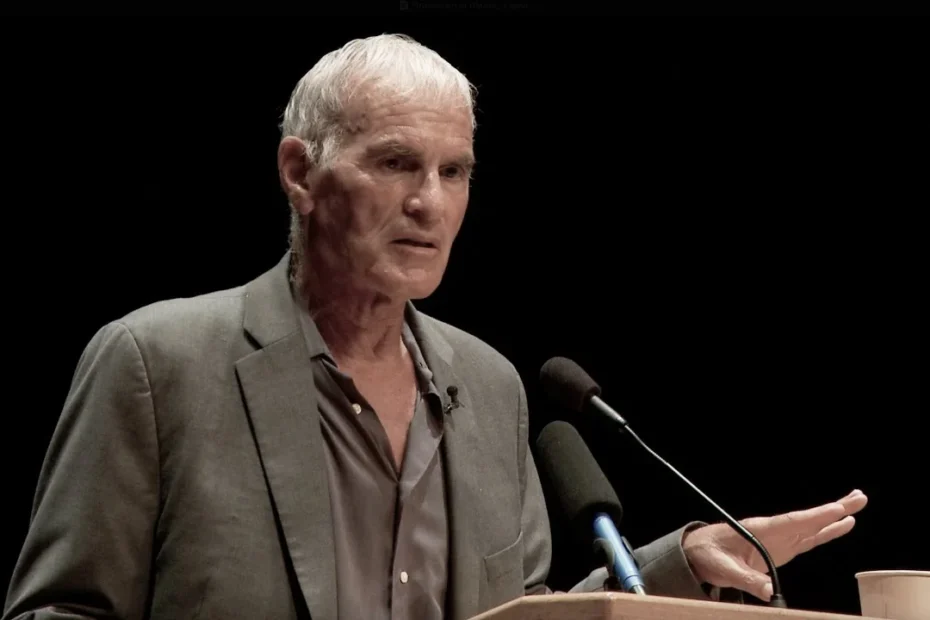
Read the full transcript of acclaimed scholar and author Norman Finkelstein’s lecture on “Gaza, Truth & the Battle for Free Speech” at the University of Massachusetts, Amherst, September 24, 2025.
Introduction
SUT JHALLY: Good evening everyone. It’s a fantastic crowd here. I think most probably close to 500 people here for this event, which is fantastic. My name is Sut Jhally. I am a professor here in the Department of Communication.
In a sane world of rationality and principle, the old adage about a speaker like Norman Finkelstein not needing an introduction would be true. His many accomplishments would speak for him. But we do not live in such a world, especially when it comes to Israel-Palestine, where Finkelstein’s work has been the target of unrelenting attack and lies. And so there is the necessity of an introduction. First, the facts.
He is the author of 13 books, including in 2000 The Holocaust Industry, which argued that a network of institutions has cheapened the memory of the Holocaust and exploited Jewish suffering to advance elite financial and political interests and shield Israel from accountability for its criminal policies towards the Palestinians.
The Tenure Denial and Academic Blacklisting
He first came to national prominence in 2008 when he was denied tenure at DePaul University in Chicago following a vicious external attack of lies and slander by Harvard law professor Alan Dershowitz. You may remember him—he is Jeffrey Epstein’s lawyer. At the time of his tenure decision, Finkelstein was already the author of five books. Five books.
That already constitutes a career, let alone a case for tenure. Despite overwhelming support from his students who adored him and his faculty colleagues, he was denied tenure by senior administrators because he was, quote, “not civil.” In other words, he hurt the feelings of the people he was criticizing, effectively blacklisting him from being hired anyplace else.
Or speaking anyplace else. He was just telling me this is his first appearance at a university since October the 7th. That should tell us something on its own.
When I hear this story of his tenure denial, I am struck not only by the cowardice of so-called academic leaders, but also their lack of imagination. At the time, there was not one college president, not one college president who had the guts or the foresight to say, quote, “Not only is this wrong, but this is a business opportunity to brand ourselves as defenders of free speech and academic freedom by offering Professor Finkelstein a job.”
That’s what I would have done if I was a university president at that time, and it would have brought instant fame. It would have been an incredible coup that would have cost almost nothing.
Actually, university leaders once thought like that, believe it or not, in case you think this is all fantasy. For instance, our own Department of Economics here at UMass has a world-class reputation as a heterodox department that is encompassing many approaches because in 1973, they hired a number of brilliant young Marxist scholars who had been denied tenure by Harvard and Yale. And when they did that, they became instantly famous for it. Instantly famous for it.
Today’s college leaders are not intellectuals, but administrators who cannot even defend themselves against the feeble-minded attacks of Republican Congresspeople, as evidenced by the so-called anti-Semitism hearings. If the American Academy is to survive the rabid savages at the gates, it is going to be up to the faculty, not administrators, to lead the fight.
Although I do have to note that we have had no pushback from the UMass administration about this event taking place, despite, as I suspect from past experience, intense pressure to cancel. We know that there have been emails going in to the president’s office pressurizing him to cancel, but we have not heard anything.
Scholarly Acclaim and Recognition
Since 2008, Professor Finkelstein has become a world-renowned independent scholar, the author of another eight books, building a global reputation as a principled forensic scholar on the issue of Israel-Palestine. For this, he has earned the admiration from the leading scholars in the field.
Raul Hilberg, founder of the academic field of Holocaust studies, hailed Finkelstein’s rigorous and fearless scholarship, declaring, quote, “It takes an enormous amount of courage to speak the truth when no one else is out there. His place in the whole history of writing history is assured.” I’m just going to repeat that from the founder of Holocaust studies: His whole place in the whole history of writing history is assured.
The distinguished Israeli historian, Avi Shlaim, says, “Finkelstein has a most impressive track record. He is known for erudition, originality, spark, meticulous attention to detail, intellectual integrity, courage, and formidable forensic skills.”
And Sara Roy of Harvard University says, “Finkelstein’s scholarship is exceptional both for its brilliance and rigor. His work is considered seminal. Disciplines would be intellectually inferior without it.”
And John Mearsheimer of the University of Chicago says simply, “No scholar has done more to shed light on Israel’s ruthless treatment of the Palestinians than Norman Finkelstein.”
His two latest books, Gaza: An Inquest into its Martyrdom and I’ll Burn That Bridge When I Get to It are both available for sale outside the hall. His forthcoming book, which unfortunately was not published in time for this event—it’s published in November—Gaza’s Great Figures turns the spotlight onto the United Nations, the International Court of Justice, and even Israel’s seemingly harshest critics, exposing how they helped shield Israel from accountability for its genocidal actions.
Holding On to the Truth
Norman Finkelstein is a fearless seeker of the truth, no matter where that may lead. Indeed, when we live in a post-truth or post-fact world, the truth is all we have.
When I teach Israel-Palestine in my classes, I normally end with a video excerpt of a speech given by Professor Finkelstein just after his tenure denial. At the time, he was working on a book on Mahatma Gandhi and he referred to the Gandhian concept of Satyagraha, a term derived from two Sanskrit words, Satya meaning truth and Agraha meaning firm insistence, which Gandhi translated as, quote, “Hold on to the truth.” Hold on to the truth.
Through everything, Norman Finkelstein has been principled and fearless in holding on to the truth.
Norman Finkelstein’s Lecture
NORMAN FINKELSTEIN: Well, thank you for having me here today. I’m asked to speak today on the question of Gaza. And I was asked this afternoon what was I going to speak on. I think everybody here at this point knows the general picture, and it doesn’t require rocket science to grasp the general picture.
Unless you have a material stake in lying to yourself or lying to others, it’s fairly clear what’s happening there. It’s pretty obvious that something horrible is unfolding in real time before our eyes.
# From “Self-Defense” to Genocide
And although at the outset on October, after, the day after October 7th, although at the outset there was a reluctance to describe or to classify what has been unfolding there as a genocide. The nomenclature at the time, we’re talking about the first few weeks, the first few weeks was basically described as, quote unquote, “Israel’s right to defend itself.”
After around the first month or two, those who were, you might say, at the furthest end of the spectrum, they were willing to acknowledge that Israel’s actions in Gaza were, quote unquote, “disproportionate.” That was basically the position of what you might call mainstream figures, but a little bit to the left of the mainstream. People like Piers Morgan, he would acknowledge, he would insist that Israel was still exercising its right of self-defense. But he was willing to qualify or caveat that statement by saying that its reaction has been disproportionate.
But we’re now well into or approaching two years into the Israeli assault on Gaza. And we have gone way past self-defense. We’ve gone way past disproportionate. And we’re now at the point of a broad consensus. It doesn’t include everyone, obviously, but it includes a large number of organizations, institutions, and prominent experts in the relevant field who are willing to acknowledge that Israel is engaging in a genocide in Gaza.
# The Importance of Correct Naming
I would just want to say at this point that the language does make a big difference. Some people say it’s become a splitting hairs or a terminological or a semantical contestation, but I don’t believe that’s correct. I think it was Confucius who said, I quote him in my forthcoming book, and I’ll do my best to get the precise words. He says, “The beginning of all wisdom is to correctly label things. The beginning of all wisdom is to correctly name things, to correctly name things.”
When I first read Confucius, which is many decades ago, it felt like reading Chinese fortune cookies. It’s something you would get when you opened up a fortune cookie, that slit of paper. And it took me quite a while to realize that that particular piece of wisdom is actually very deep. There’s real substance in it.
The point here is that to depict what’s going on, has been going on in Gaza, to depict it as a war is to convey that Israel’s principal target is the military on the other side. As it said, they’re engaged in a war of self-defense against Hamas. Now within that framework, you can say Israel’s assaults have been disproportionate. You can say Israel has engaged in indiscriminate attacks, but if you start from the framework that Israel is waging a war, even if acknowledging there have been deviations from the targeting of the military, you’re still in essence saying Israel’s target is its adversary’s military.
But that’s not been what’s happening in Gaza. It has no bearing whatsoever, zero on what’s happening in Gaza. Israel is not targeting Hamas, except in the most trivial and insignificant sense. Israel is targeting Gaza’s civilian population. That’s what’s happening in Gaza.
Sure, on the side, they may kill a militant here, they may kill a militant there, but that’s not the essence of what’s happening. The moment, and I will get to that, I promise you, the moment you hear anyone in the media, in academia, in political life, the moment you hear anyone refer to what’s going on there as, quote, “the Israel-Hamas war,” a light ought to go off in your head. This person is a propagandist. This person is purveying propaganda because there is no war in Gaza. It’s a genocide.
A genocide means that you are engaging in activities the intent of which is to destroy in whole or in part a racial, ethnic, religious group. That’s how the 1948 Genocide Convention defines genocide in Article 2. And that’s exactly what Israel is doing.
Historical Context: Gaza Since 1948
So, let’s now go backward before going forward to the future. So, where does one begin? Obviously the point at which you begin often colors what comes after. Israelis like to begin 3,000 years ago. And then of those 3,000, start 3,000 years ago, and then skip from about the year 100 AD to go up to the 19th century. They like to leave out those 2,000 years when they weren’t there. So that’s their beginning.
I think for the purposes of this evening, not at all trying to be propagandistic or tilting the scales in my favor, I think it’s reasonable, reasonable to begin in 1948 when Gaza becomes Gaza.
In the course of what’s called the First Arab-Israeli War, when Israel comes into existence, in the course of that war, roughly 750,000 Palestinians were expelled from the area that came to be called Israel. Of those 750,000, about 280,000 end up in Gaza. They’re expelled to Gaza. And that should be your first point of reference.
The first point of reference is that Gaza’s population, approximately 80 percent, consists of refugees or descendants of refugees. It’s overwhelmingly a refugee population going back to 1948.
A second critical point of reference, which will become more salient as I proceed this evening, about one half of Gaza’s population are children. So when you hear stories about Israel artificially inducing a famine in Gaza, approximately half of the victims of that famine are children.
# Gaza as a Concentration Camp: Historical Observations
Now, one of the odd things I discovered as I was writing the recent book, the new book, was already going back. I have a friend in the audience who I know from Palestine, Hebron. His name is Ahmed, and he’s in the audience, and I suspect he will know a lot of what I have to say. But I think I’ll look at him. I think he’ll be surprised at some things I have to say.
One of the things I only recently discovered, and I’ve been at it for 43 years, is that from the very beginning, Gaza came under Egyptian administrative control after the first Arab-Israeli war. Already from the very beginning, when observers traveled to Gaza, you take the case of a well-known UN administrator in Gaza. His name was E.L.M. Burns.
And E.L.M. Burns writes a book about his stay in Gaza, because right after the first Arab-Israeli war, there were facilities set up by the UN to treat the refugees, the United Nations Relief and Works Agency, UNRWA. And he headed up UNRWA. And he describes Gaza as, quote, I’m using his words, and bear in mind this is under the Egyptian administration, he describes Gaza as, quote, “a vast concentration camp.”
In 1967, Gaza comes under Israeli control in the course of the 1967 war. A senator from the United States, by coincidence, most of you in this audience, or maybe not because you would have been quite young, but in 2000, in the presidential election, the Democratic candidate was somebody named Al Gore. How many people know that name? Because you probably—oh, I’m actually surprised because most of you would not have been born then.
And since your sense of history usually goes back approximately a week, there was this civil war, there was the fall of the Roman Empire, there were dinosaurs. I like your hearty laughter. You should sign up for all my lectures.
Al Gore’s father was a famous senator, and he visits Gaza. He comes back. He speaks before the Senate, and he describes Gaza as, quote, “a vast concentration camp on the sand, if you will.”
Then you go to 2002. There’s an Israeli sociologist of top caliber. He teaches at the Hebrew University, and his name was Baruch Kimmerling. He’s since passed. He writes a book called Politicide. This is 2002. He describes Gaza as, quote, “the biggest concentration camp ever.”
Then, 2004, Israel’s head of the National Security Council.
# Gaza: A Concentration Camp Before the Blockade
His name is Giora Eiland, and Giora Eiland is still among us. He is what you might call one of the unofficial—when I’m trying to be amusing, I’ll cue you, right now I’m being literal—one of the unofficial masterminds of the current genocide in Gaza, Giora Eiland, but he’s also very sober and lucid in his judgments. And in 2004, he’s having a conversation with some Americans. How does he describe Gaza? He describes Gaza as, quote, “a huge concentration camp.”
Now that’s the former head of the National Security Council. Now bear in mind that all of these descriptives—huge concentration camp, vast concentration camp, biggest concentration camp ever—that’s all before Israel imposes its brutal blockade on Gaza. The blockade is imposed at a telling moment during the administration of George W. Bush.
How many of you remember that person? My God, we must be in the MENSA meeting at the University of… The blockade is instituted in January of 2006 because that was the era when the United States was involved in what was called democracy promotion. And one of its test cases was that George Bush, to the extent that he was cognizant of what he was saying—George Bush, which would, by the way, put him way ahead of Biden and our current president—to the extent that George Bush was cognizant of what he was saying, he called for the Palestinians to hold elections.
The 2006 Hamas Election Victory
Now, Hamas, the Islamic movement, did not want to participate in those elections. They said that these elections are part of what was called back then the Oslo process, namely the process that began in 1993, in September, I think 13th, 1993, the process which ended up co-opting a portion of the Palestinian leadership who, to put it simply, switched sides and started to work for the Israelis and the Americans. And Hamas viewed these elections as part of what they called the Oslo Process. It didn’t want to participate. But then it was cajoled and coaxed into participating. And they ran on a very non-ideological platform.
They ran on a very simple platform: Reform. The Palestinian Authority, the beneficiaries of Oslo, the Palestinians who switched sides—they were hopelessly corrupt and incompetent. So Hamas ran on a very simple platform. It wasn’t about the jihad. It wasn’t about wanting to destroy Israel. No, it was just reform. And surprising to they themselves, they won.
But it wasn’t only a surprise to them, and it wasn’t only a surprise to the Palestinian Authority. It was a surprise to the Americans and the Israelis. Later on, Hillary Clinton, when she was Secretary of State, I believe, she famously said, “We made a big mistake by letting them win the election.” That’s not how democracy is supposed to work. You’re supposed to vote for who we want, not who you want.
So, same principle in New York, in my own hometown, the billionaire class gave $30 million to Mr. Cuomo. Mr. Mamdani raised $1 million. So he’s not supposed to win. That’s not how it works in democracy. In a democracy, we decide and we determine with our money who wins. And it didn’t turn out that way in Gaza.
The Brutal Sanctions and Blockade
So immediately as Hamas came into office, first Israel, then the US, and then the EU, they slapped these brutal sanctions on Gaza. Even though Israel claimed that in 2005 it had withdrawn from Gaza, that was clearly untrue for a very simple reason. What Israel did was not withdraw from Gaza. What Israel did was it took the keys to the jail cells, threw it to those incarcerated in Gaza. That’s true. And then they withdrew. They withdrew to the perimeter of Gaza. They were no longer in sight. And then they slammed shut the prison gate.
So what Israel described, and you will often hear it described, as Israel having withdrawn from Gaza—what they did was withdraw from the inside of Gaza and then seal it hermetically shut. And that’s really not hyperbole. Israel determined who went in, who went out. Israel determined what went in, what went out.
Beginning in 2008, I believe, I think it’s 2008, Israel imposes a siege of Gaza whereby literally—I mean some of the stuff is so macabre—they calculated the caloric intake of the people of Gaza. They literally calculated the caloric intake of the population of Gaza and admitted into Gaza enough food so they don’t starve to death, what the Israelis called a “humanitarian minimum,” which might also be called a starvation-plus diet, because they knew starving the population to death at that moment, not now, at that moment, would get bad PR.
So they say in their memoranda, we are going to keep Gaza under precipice of economic collapse so that the people of Gaza will become disaffected from Hamas and will remove it from power. So that was the situation in Gaza.
The Mavi Marmara Incident
In 2010, what happened is pretty close to what’s happening right now as we speak. Namely, on May 30th or May 31st, I can’t remember, May 30th or May 31st, 2010, just like now as we speak, there was a humanitarian flotilla led by a Turkish vessel called—let’s see who in the audience knows. Then I’ll see if you’re in Mensa category. What’s the name of the flagship in that flotilla?
Good. That sounded like an older gentleman. Yes, the Mavi Marmara was then attacked by the Israelis in international waters. They killed nine passengers immediately. A tenth died later. And if you want to know the follow-up, read the appendix to Norman Finkelstein’s forthcoming book. So, the appendix goes on for 100 pages and anybody who actually reads it is not in Mensa category. That person is clearly certifiably insane. Like the person who wrote it. No.
And at that point, after the Mavi Marmara incident, and it was an incident because Turkey was a middle-level power—it wasn’t so easy, the same head of state, Erdoğan, but it wasn’t so easy to ignore—Turkey made a big deal about it at the UN. And all the leaders came forward and they said, the word they used, they always use the same word, they said, the situation in Gaza is “unsustainable.” Not that it was criminal, not that it was brutal, it was unsustainable.
And so there were some modifications made in the admission, the entry of food into Gaza, but relatively trivial. The bottom line is by October 6th, by October 6th, 2023, The Economist magazine, not exactly a Hamas mouthpiece, was describing Gaza as, quote, “a human rubbish heap.” The humanitarian chief in the UN, he described Gaza as a “toxic slum.” That was Gaza.
Life in Gaza Before October 7th
The unemployment among youth, people of the predominant people in this audience of your age and older, among young people, I shouldn’t say youth, in the 20s, maybe a little older, the unemployment was 60 percent. The only thing a young man in Gaza had to look forward to every day as he or she got up in the morning—the only thing they had to look forward to was to pace the perimeter of Gaza.
Gaza is 26 miles long, the length of a marathon. It’s five miles wide. That’s the distance I jog every morning or walk briskly at my neighborhood beach. That’s Gaza. Nobody could leave. If you had a heart condition, if you had a cancer, they wouldn’t let you leave unless you ratted on somebody in Gaza. They would ask you about your neighbors. They would ask you about your friends. Unless you were willing to be a rat, you couldn’t go. You couldn’t go. You couldn’t go to the West Bank hospital. You couldn’t go to a Jordanian hospital. Nobody could leave Gaza. And that’s what they faced on October 6th.
But it wasn’t just that. It was no hope or prospect. I know that. I’m speaking now from very personal experience. I spent since 1982 chronicling the situation in the occupied Palestinian territories. But beginning roughly in 2008, or no really, 2008 roughly, I focused, I hyper-focused on Gaza for reasons which I’ll get to in a moment.
By 2020, I had given up. I did. I don’t say it proudly. And frankly, part of me was quite ashamed because I always claimed not to be a quitter. But I quit. I started writing books which were so microscopic in detail that my last book at that time, it sold 370 copies, as my publisher liked to remind me. Liked to remind me, and truth be told, of those 370, yours truly purchased half, because I was trying to influence a court case at the International Criminal Court about which this book was devoted to.
And I decide this has become crazy. Nobody’s interested anymore. Gaza has dropped out of sight. For those of you who remember, and even though it’s just a short time ago, I’m talking about before October 6th, Gaza was—memory is tricky—Gaza was completely out of the news. All the talk at that time was about whether Saudi Arabia would join the Abraham Accords, and that meant the people of Gaza would be left to languish and die.
The “Mowings of the Lawn”
Well, that’s half the story. The other half of the story is beginning in the middle of the first decade of the 2000s, Israel launched what they called these “mowings of the lawn” in Gaza. And each of these mowings of the lawn, which were effectively high-tech killing sprees in Gaza, each of the mowings of the lawn was another compounding that siege, that medieval siege of Gaza. Each of the mowings of the lawn visited at the time, now looking back, it looks very different, at the time massive death and destruction in Gaza.
There was Operation Cast Lead in 2008-09. It began August 26, 2008, ends January 17, 2009. Amnesty International put out a report. It called it “22 Days of Death and Destruction.”
Then, skipping along, in 2014, from July 7th to August 26th, Israel launches Operation Protective Edge, 51 days. And each of these operations increases in scale the death and destruction. In Operation Cast Lead, about 350 children were killed, 6,000 homes destroyed. At that time, that was actually a shocking number. I actually wrote a book about it, and I quote an Israeli journalist who described Operation Cast Lead as, quote, “this time we went too far.”
And then comes Operation Protective Edge. Israel kills 550 children and destroys 18,000 homes. The head of the International Committee of the Red Cross, Peter Maurer—his job is to visit war zones—he walks out of Gaza after Operation Protective Edge and he says, “In all my life, I’ve never seen destruction like I saw in Gaza.” That was 2014.
The Scale of Destruction
Now to give you some sense of what’s happened to those God-forsaken people who have been living there in a concentration camp since 1948. In Operation Cast Lead, the estimate is Israel left behind 600,000 tons of rubble. In Operation Protective Edge, the estimate is they left behind 2.5 million tons of rubble.
The estimate now, and I’m quoting from before the destruction of Rafah and the destruction of Gaza City, before—the estimate was not 600,000 tons of rubble, not 2.5 million tons of rubble. The estimate is 50 million tons of rubble are now covering Gaza. Are now covering Gaza.
In Operation Cast Lead, it was 350 children. In Operation Protective Edge, it was 550 children. Now the estimate is, and I believe it’s a very low estimate, and it doesn’t include those who were killed because of lack of food, lack of medicine, lack of electricity and so forth, just killed by the munitions—the estimate is not 350 children, not 550 children, the estimate is 28,000 children. It’s something of an altogether different magnitude as compared to a situation which not too long ago, people believed Israel had already gone too far.
October 7th and Hamas’s Diplomatic Efforts
So come October 7th, Hamas and other militant groups, they attack southern Israel. So I depicted a picture where they had no future. But some people say, “But wait, of course they had an option. Why didn’t they try diplomacy, Hamas?” That’s a reasonable question. The problem is they did.
If you go back and look at the record, even the US Institute of Peace, if you look at their studies, the studies say Hamas was trying to reach some sort of diplomatic settlement with Israel. But Israel rejected it. It only wanted abject surrender.
Hamas, you can laugh and guffaw to the end of time, but facts are stubborn things. Hamas did try international law. After each of those high-tech killing sprees, the various human rights organizations, Human Rights Watch, Amnesty International, and commissions of inquiry from the Human Rights Council of the UN, they sent delegations to investigate what happened.
In each and every instance Israel refused to cooperate. In each and every instance—say what you will about Hamas, I’m speaking strictly to the facts—in each and every instance, Hamas cooperated.
Now, those commissions of inquiry and human rights organization delegations, they were very harsh on Hamas. In my opinion, unduly harsh and prejudicially harsh. But that’s a separate issue. Hamas knew, they knew they would not get a fair shake from these commissions of inquiry and human rights organization delegations. They knew that, but they were willing to take the chance, hoping against hope that some justice would be done.
The Goldstone Report
And for those of you whose memories go way back, for a moment it seemed like it might happen. After Operation Cast Lead, the Human Rights Council commissioned a body of inquiry that was headed by a South African jurist, Richard Goldstone, who also happened to be Jewish, and he also happened to be, I’m using his self-description, not my accusatory one, he described himself as a Zionist. He was on the board of trustees or board of directors of the Hebrew University in Jerusalem and had many relationships with Israel. His daughter had done aliyah, had immigrated to Israel.
And they said, okay, we’ll accept him. We’ll let him investigate. Hamas said, we’ll accept it. And lo and behold, he produced a report with his colleagues that was very tough on Israel, very tough. It ran to some 400 pages. And it was, as I said, it was brutal on Hamas. But Hamas knew that would happen. But it was also brutal on Israel.
The Goldstone Report and Its Retraction
And for those of you who remember that back that far, we thought maybe justice will be done finally. What happened? Finally, what happened was on April 1, 2011, Goldstone rescinded the report. It was really, I’ll tell you the truth, it was shattering. You believed, you believed, you hoped, you thought finally the moment of truth had come.
And when it came out on April 1st, I remember, even though it’s a while ago, it’s 2011, my memory is pretty vivid, I thought it was an April Fool’s joke. It was published in the Washington Post on April 1st. And it comes as no surprise now, but as I wrote in that book, Gaza, an Inquest into its Modernism, it was pretty clear he had been blackmailed. Exactly the nature of the blackmail, couldn’t say, could have been him. He had dirt in his closet, though I don’t think so.
Could have been a family member. But he rescinded the report. They tried Hamas, tried diplomacy, tried international law. And then come March 30th, 2018, what’s called their land day, they tried nonviolent civil resistance. It was called the Great March of Return.
The Great March of Return
What happened? We actually know exactly what happened. There was another UN commission of inquiry, and they put out a 250-page report, single-spaced. It was very dense. What did they conclude?
The Great March of Return from March until May 14th was overwhelmingly nonviolent. It was overwhelmingly nonviolent. Go back and read. What happened? Because everybody says, where is the Palestinian Gandhi?
Where is the Palestinian Gandhi? Let’s just leave aside there were many Palestinian Gandhis. That’s for later if you like. What happened? Well, Israel acknowledges.
It lined up on the perimeter fence with Gaza, what it called its death train snipers. Okay? Israel then later said, “Every bullet hit its target. Every bullet hit its target.” What was the target?
Go look at the report. There were people 300 meters from the fence separating Gaza from Israel, 300 meters away, engaged as the report says, clearly in civilian activities. For those of you who remember, the Great March of Return was a festive occasion. It was a celebration of life. There were circus acts, there was music, there was dancing, there were picnics.
They really believed, they believed in the possibility that if they carried on in a civil, dare I use the word, loving way, that maybe that brutal siege of Gaza would be lifted. Who did they kill, the Israelis? Read the report. I’m quoting it now. They targeted children hundreds of meters away from the fence.
They targeted medics. They targeted journalists. And they targeted persons with physical disabilities. They targeted double amputees. Now, as I’ll get to presently, as most of you in the audience also already know, in the past two years, it’s gone from… It’s gone, can’t find the right words.
But now, if you read the reports, for example, the most recent report from the International Commission of Inquiry, the one that came out last week, headed by Navi Pillay, the former head of the Commission of Inquiry in Rwanda. They routinely target, T-A-R-G-E-T, children, this is what the report says, and based on the testimony of foreign doctors who went to work in Gaza in the past two years. They target children in the head and in the chest. The report says that even target toddlers, T-O-D-D-L-E-R-S.
Hamas tried diplomacy, it tried international law, it tried nonviolent civil resistance. What were they supposed to do? Die peacefully and quietly in the equivalent of an elephant burial ground? Is that a reasonable expectation? Expectation is that for any of you and the people in this audience are overwhelmingly of the same age cohort of probably 90% of the young men who burst the gates of Gaza on October 7th.
And so you have to ask yourself, is that a reasonable expectation to be made of you? That you had no future. Actually, you had no past. You had no present. And you have no future.
Of that I am certain. That’s why after about 40 years, I gave up. I was certain it was hopeless. After October 7, I have to say, I personally was in a quandary about how does one think through what happened on October 7th.
Grappling with October 7th
Initially, the first day, my webmaster and close friend and comrade, Sana Qasim, a Palestinian, a chemist living in Greece now. She emailed me, I don’t own an iPhone so she couldn’t have texted me. She emailed me and she said, “Norman, open up to the news. The people have broken out of Gaza.” And I was, of course, gratified to hear the news. There were very few details at that time.
It looked like a prison break and it was said initially that about 50 Israelis were killed. That’s all that was said. And I immediately posted something on my Twitter account. I’ve never been on Twitter, but Sana Qasem is my social media person, so she posted for me. And I celebrate the moment.
And I quoted from “John Brown’s Body,” he’s like, mourning in the grave, moldering in the grave, and he looks kindly down on what happened in Gaza. The slaves have broken free. However, within the next two or three days, it was clear that something morally more complicated had happened. It wasn’t a prison escape. It wasn’t the great escape, for those of you who know the movie and the book.
It wasn’t the great escape. It was something different. I think it’s fairly clear now. I can’t say it with certitude, but I think a high level of certainty. About 1,200 Israelis were killed, and of those 1,200, 800 were civilians, and Hamas and other militant groups were clearly responsible for overwhelmingly the civilian deaths.
I know people speculate otherwise, but I don’t want to go down that rabbit hole. I look at the available information, and then I reach a conclusion. Things were said about October 7th, which in my opinion are absolutely false. There is no evidence. I don’t want to quarrel about now.
I’ll be happy during questions and answers, but I’ve written about it. There’s no evidence that Hamas committed rape on October 7th. That was just an Israeli fabrication. I’m very happy, as I said, to go through all the available evidence on the subject, but clearly putting the rape fabrications aside something pretty terrible happened. No question in my mind about that.
But that’s the factual question. But then there is the moral judgment. And the moral judgment obviously has to take into account the factual evidence, but the factual evidence in and of itself doesn’t yield a moral or a political conclusion. You have to work that through. And I’ve been at this for about, as I said, about 43 years.
And I had the good fortune as a young man when I first got involved to meet Professor Noam Chomsky. And then for the next 40 years, he was my mentor, he was my friend, he was my comrade, and he was the person who I always deferred to on questions of moral judgment. He had many spectacular qualities. He was a stupendous force of nature, and he was an inexhaustible force for good. And a kind of division of labor evolved between myself and him. I would do my research.
I would go through the documents. But when it came to making moral judgments on complex issues, I always defer to him. He was steeped in philosophy in general, moral philosophy, among many other things in particular, and he had, in my opinion, exquisite political and moral judgment. However, on October 7th, he was not available. And for the first time in my life, adult life, I had to think through what seemed to be a complicated moral question on my own.
Where did I stand on this? I’m not going to deny October 7th happened. It happened. As I said, I’m not going down that rabbit hole. And it didn’t happen.
But then what do you do with the facts? And I pondered and pondered. I sweated because I knew a lot of people were curious what my judgment would be, especially when I came to Gaza, and also because my judgments never defer to authority. I should say mainstream authority.
The Nat Turner Rebellion as Historical Parallel
And after thinking about it for probably around a week, I began to read up on the Nat Turner Rebellion in the United States. The Slave Revolt, it was the biggest slave revolt in American history. It occurs in 1831. And for those of you who know the details, when Nat Turner embarks on the rebellion, he gives the order to his confederates, so we can use that word, he gives the order, quote, “kill all white people. Kill all white people.” And that’s what they proceeded to do.
They smashed the skulls of men, they crushed the skulls of women, they hacked babies to death. It was very brutal. No question about it. When you read about Nat Turner, it kind of reminded me of the people of Gaza. Nat Turner was a very smart guy.
Everybody, if you read the histories, agree on one point. Nat Turner was very smart. His confessor, who eventually published the Confessions of Nat Turner, his confessor said, for natural aptitude and intelligence, very few people, very few people, white or black, compared to Nat Turner. And then one historian, his name is Stephen Oakes, he said about Nat Turner, he said an enormous chasm, enormous abyss, an enormous chasm separated what Nat Turner aspired to be versus what he was destined in his whole earthly existence he was going to be.
If you ever meet the people of Gaza, I don’t sing the praises of people that has a kind of element of romanticism, which I don’t particularly, it doesn’t appeal to me. But anyone will tell you the people of Gaza are very resourceful. You can give them a Coca-Cola can and in a couple of hours they’ll turn it into a Mercedes. They’re just, it’s desperation, desperation. Necessity is the mother of invention. It’s desperation. Very clever.
And that huge chasm existed for them between what they aspired to be, what they, looking at the web, knew others could be, and what they were destined to be, their whole earthly existence. If you go back and look at what the abolitionists had to say, one of the most famous, the abolitionists were an extremely impressive group of people, those who opposed slavery. And one of the best known was William Lloyd Garrison. Was William Lloyd Garrison. And Garrison edited the anti-slave, the abolitionist periodical called The Liberator.
And when the Nat Turner rebellion happened, he commented on it. And I have to say, I immediately ran to see what he had to say, because I respect a lot the abolitionists. There’s a lot to learn from them. I’ve been spending the past few months reading about one of the greatest of the abolitionists, Charles Sumner, a person of just terrifying stature, extraordinary human being. In any case, what did Garrison have to say?
He said, there’s no question what happened on the Jay and Nat Turner rebellion was horrible. It was an atrocity. It was ghastly. He freely admits that. But if you read his statement, he never condemned Nat Turner.
No. He was careful not to condemn Nat Turner. Who did he condemn? He condemned white people. He said, “We told you so, we told you so, we told you so, we told you so.”
We told you if you treat people this way, if you degrade them, if you humiliate them, if you beat them, if you treat people this way, then don’t be surprised by what happened during the Nat Turner revolt. And for me, at any rate, that seemed to be the correct way to morally reckon with October 7. There were terrible atrocities that occurred. The atrocities were inexcusable. But I won’t condemn the perpetrators.
I won’t go that far. I refused. If you remember the first… If you remember…
[Applause]
If you remember the first weeks and first months, it became a standard joke, as you know on the web. Piers Morgan’s question, “Do you condemn what Hamas did in October 7th?” And one by one, everybody lined up and they began by saying, yes, go back and see what Nekti, Hassan said and all the rest. They all condemned it. And of course, there were some people on the quote unquote radical left who wouldn’t condemn it, but those to me were mostly, you’ll excuse me, posers and posture-ers. It wasn’t people who had seriously confronted a hard moral problem, I believe.
But when I came on, when I was on Piers Morgan the first time, I said, no, I won’t go there. Now, you wouldn’t know why I didn’t go there. I’ll tell you why. Because if you were an abolitionist before the Civil War, you saw what was being done to African Americans every day of your life. You saw them walking in the streets in chains.
You saw them, it was all done in the open, them being whipped and dehumanized. You saw it was all in the open. The slave markets, where white plantation owners would examine their teeth and everything to see if they were high-grade slaves. So it was all done in the open. In the case of Gaza, it was done behind a wall.
Very few people knew what was going on there. I dare say for probably at least three quarters of this audience, they’re surprised by a lot of what I had to describe this evening. Nobody knew. But I did know, because I had spent 15 years going through those human rights documents. And having gone through it, there was no way on God’s earth I’m going to condemn the people who breached the gates of Gaza concentration camp on October 7th.
But I’m also not going to deny that atrocities of a significant magnitude occurred. You have to weigh both things, both facts, and then work your way through it. And that was the conclusion I drew. So, obviously, after October 7, something horrible unfolded in Gaza. And now the next step is to try to figure out how to make sense of that.
# Gaza, Truth & the Battle for Free Speech: Norman Finkelstein at UMass Amherst
Israel’s Three Goals After October 7th
In my view, Israel had basically three goals after October 7th, which endure to this day. The first goal, which might sound trivial, but in the case of Israel, it’s not trivial. The first goal was simply blood revenge.
One of the things that’s interesting when you look back two years later is you might recall, when the Israeli senior leadership, one after another, started to make these horrific statements. In order to extenuate, excuse those statements, the claim was made that they made these statements in the heat of October 7th. They were traumatized. They were shocked. They were enraged. But it was just momentary. That was the claim.
But when you look back, because I was just reading, as I mentioned, the UN Commission of Inquiry Report, which came out last week, it’s an okay report, 72 pages. It’s small, but it still captures the essence.
When I read it, it was very striking that every statement that was made right after prefigured exactly what happened over the next two years. If you read the statements, they said things like “we’re going to reduce Gaza to rubble.” “We are going to make Gaza unlivable.” “We are going to destroy everything in Gaza.” Those weren’t statements made in the heat of the moment. Those statements were a blueprint to what would then unfold in Gaza.
And among the better known statements, which most of you will remember, was when Prime Minister Netanyahu said on two occasions, “remember what Amalek did to you,” referring back to the Hebrew Bible, and the idea that as an act of revenge and punishment, no political content, just revenge and punishment, we are going to in the spirit of the Hebrew Bible kill every man, woman, child, ox, and so forth.
And that has proven to be a significant element, this blood thirst for revenge. And we have to bear in mind, though it’s unpopular to say it, people like Bernie Sanders, who I’m not going to say, I’m not going to be part of the lynch mob against him. He did some very impressive things, but he had his, I’ll just call it, limitations.
Bernie Sanders, even to this day, he keeps pretending that the problem is Mr. Netanyahu. That’s the problem, Netanyahu. With all due respect, Mr. Sanders, and I do respect him, with all due respect, that’s actually not true.
A National Project, Not Just Netanyahu
The bloodthirst in Gaza, the bloodthirst in Gaza, it is not a state project. That’s not true. It’s not Mr. Netanyahu, Mr. Smotrich, Mr. Ben-Gvir. No. It is a national project. And we have to be honest about that. I don’t say it gleefully. Some people do say it gleefully. I do not count myself among them. But as the British saying goes, facts are stubborn things.
When there was a poll taken in Israel, it was asked a very simple question. No place, no wiggle room for ambiguity or equivocation. The question was very straightforward. When the Israeli Defense Forces enter a city in Gaza, the question asked, should they kill everybody in the city?
Now, everybody in this room will agree that is not an ambiguous question. That is about as straightforward a genocidal question as you can ask anyone. 47% of Israel said you should kill everyone. 47% of Israeli Jews said you should kill everyone.
A poll a month later asked the question, do you believe there are any innocents in Gaza? It was asked of everyone in Israeli society, are there any innocents in Gaza? 62 percent said no innocence in Gaza. If you factor out the non-Jewish population of Israel, which is about 20%, it comes to 70% said, in response to the question, there are no innocents in Gaza.
When a main opposition leader stated publicly, and now I’m quoting him, “the IDF is killing children in Gaza as a hobby.” Killing children in Gaza as a hobby. He came under tremendous attack in Israel. He held his ground. And then finally, unpredictably, he capitulated and took back the statement.
That’s what’s happening in Gaza. Of sheer bloodlust that I for one, I have very great difficulty comprehending, apprehending. I find it very difficult to comprehend a society that has descended to a level of dementia that they kill children with glee and as target practice, aiming their weapons at the skulls and chests of children and toddlers.
And I don’t believe, judging, for example, from the sorts of stuff those folks post on their social media, gleefully celebrating their genocidal acts in Gaza, I don’t believe the sheer bloodthirst, bloodlust, is a trivial component of what has unfolded the past two years there.
Restoring Deterrence Capacity
The second objective, not just to exact revenge, “remember what Amalek did to you.” The second component is Israel wants to restore what it calls its deterrence capacity or capability, deterrence capability. And that’s just a fancy term for Israel wants to restore the Arab world’s fear of it.
Because, and I think it’s factually correct, after October 7th, many people in the Arab Muslim world, they began to think, well, if that ragtag militia called Hamas could inflict such a lethal military blow and could so outwit Israel’s redoubtable intelligence capacities, so people begin to wonder, maybe there is, after all, a military option against Israel. Maybe there is an option.
And for Israel, now the challenge became to restore its deterrence capacity, the Arab world’s fear of it. So if the thought passes through your head that maybe there is a military option against Israel, Israel would say, look at Gaza or what’s left of it. And that would very quickly dispel any illusions about there being a military option against Israel.
The Third Goal: Solving the Gaza Question
And the third goal, the third objective was pretty straightforward. Most of you know the cliché. Every crisis is also an opportunity. And there’s no question that for Israelis, October 7th was a shock, a crisis of a high magnitude. It was not unlike, and the comparison was frequently made, about the shock in the United States after September 11th.
And if you read the accounts, the secondhand accounts, of our own September 11th, yes, Mr. Bush, Mr. Cheney, Mr. Rumsfeld, they shed a few salty tears. There’s no question about that for about five minutes. And then they rubbed their hands together and they figured out what can we get out of it.
And if you read the accounts, they looked over the world’s map trying to figure out which countries to attack. And they had a large list. It was Afghanistan, obviously, first. Then it was going to be Iraq. Then it was going to be Syria. And then it was going to be Iran. That was the game plan. Things didn’t turn out quite what they hoped it would be.
And the case of Israel, the main goal, there were other goals which time won’t allow me to go into now. The main goal was to solve the Gaza question once and for all. There will be no more mowings of the lawn in Gaza. They are going to extirpate. They were going to pull out by the roots. They’re not going to cut the blades of grass in Gaza. They’re going to extirpate every blade of grass in Gaza.
And that basically took three forms. There was the attempt at the very beginning to ethnically cleanse Gaza. It was unsuccessful, but in my opinion, it remains to this day the overarching goal of the Israeli government to expel the population from Gaza, expel it by pulverizing the infrastructure and killing as many civilians as they can to achieve two goals.
One, to force the Gazans to flee, and two, to force the international community to admit them as they flee. That’s one part of the strategy.
The second part, which is part of the first, is to make Gaza unlivable. As Giora Eiland, who I mentioned to you earlier, the fellow who described Gaza as a huge concentration camp in 2004, as Giora Eiland put it, “we’re going to leave the people of Gaza with two choices, to stay and starve or to leave.” That will be their only options. And that’s basically where we stand now.
I don’t think, as I said, I don’t believe anything substantial has changed since October 7th. The same goal to expel the indigenous population and to do it by committing a genocide, intentionally targeting a part or the whole of Gaza’s population for destruction, and also making Gaza unlivable, so people will have no choice except to leave.
Right now, the estimates are it would take about till the year 2050 just to clear out the rubble from Gaza. If 100 trucks are working round the clock daily, it would take about 100 trucks because the rubble was mixed with all sorts of toxic substances and unexploded ordinance.
Heroic Moments in the Past Two Years
Now, having said that, I want to just say a few words about what can be done. I would say there were a few heroic moments in the past two years. I would say one was the South African delegation, which went to the International Court of Justice and fought, struggled there on behalf of the people of Gaza.
For those of you who haven’t watched the proceedings before the ICJ, they were deeply inspiring. Not just the competence, the dignity, but just the raw physical constitution of the delegation. There was the 88-year-old John Dugard leading the delegation. He was the Nelson Mandela family lawyer. He was Bishop Tutu’s lawyer. He’s as white as they come and just a remarkably decent fellow who I’m proud to call a friend.
Then there were on the delegation African, Indian, an Irish woman. It was a whole representation of humanity on that panel. And it showed in miniature the possibilities for humankind if it could only regain its senses.
There was, and I know this isn’t a popular thing to say, but truth is not a popularity contest. I for one celebrate or respect the willingness of the Houthis to…
Now, as you know, or some of you know, there’s a real civil war in Yemen. And most of the grocers in my neighborhood, Yemenis own almost all the groceries now in New York. They do not like the Houthis. They do not. There’s a civil war, and the Houthis are pretty ruthless. No question about it. But every one of them, every one of them, honors the nobility of the Houthis who are willing to risk limb and life for the people of Gaza. That’s very impressive.
The Student Encampments of 2024
And the other high point, and I don’t say it as in the popularity contest, the other great moment in the last two years was the student encampments in 2024. And those encampments held out a lot of promise. They did. They kept the story alive. You could not, quote unquote, move on to something else. Those encampments, day after day after day, were at the top of the news. And that’s why they have to be crushed.
And unfortunately, a class of Jewish supremacists, the billionaires, were able to use that financial power in order to unleash the most spectacular assault on academic freedom and freedom of speech in our country’s history. There’s never been anything like it.
In the course of a few months, in that period, the spring of 2024, not one, not two, but three Ivy League presidents were ousted from power. That has never happened in our country’s modern history. Nothing remotely. As some of you know, that process has not ended. The president of Northwestern University left office, and there are several other presidents who are in the firing line now.
And that was one reason and one reason alone, at least in the spring when President Biden still held office. And that’s because the Jewish supremacist billionaire class threatened to withhold their alumni money. The Bill Ackman at Harvard, Barry Steinhardt at Brown, and then there was at NYU, his name just slips my mind.
Now it’s true. The assault was broadened under President Trump, and they were using then the anti-Semitism allegation to then target DEI, ethnic studies programs, sexual studies programs. Yes, the target was broadened. That’s true. But we shouldn’t forget that during that spring, it was long before Mr. Trump had come along. It was the Biden administration that gave the green light to crush academic freedom on our college campuses and freedom of speech in our country. It did not start with Donald Trump. That is factually untrue.
The Year of Silence
After that spring, everything died. It’s hard to believe a whole academic year passed. I was just with Sut in the car, and he, in his mind, there was spring when the encampments were crushed, and then there was this year. And to me, too, it’s very hard to digest, to assimilate that whole year passed in silence.
And I get it. I know the kinds of tuition you pay. I know the loans you’ve taken out. I know about that non-existent job market. I know about the pressures exerted on you by your parents not to get expelled. I get it. And then the ball is in your court. What to do now?
The Harvard Report on Antisemitism
Now I’m going to just say two last things, and then we’re on to the audience to question me. Number one, if you read the Harvard report on antisemitism, that was the major report that’s come out. There have been other schools, obviously, that produce reports. The Harvard was the largest one, around 314 pages.
If you read the report, you can put the report under a very powerful magnifying glass. You’re not going to find any antisemitism. There just wasn’t any. The kinds of examples they gave were ludicrous. So then what did they mean by antisemitism? How did they fill 314 pages?
Well, they had this very novel definition of anti-Semitism. Their definition of anti-Semitism was, if Jewish students feel shunned, in particular, they said, Israeli Jewish students, if they feel shunned in classes or in extracurricular activities or in social activities, if they feel shunned, that constitutes, by our definition, the report said, anti-Semitism.
In other words, they said, if you are not inclusive and pluralistic of Jewish and Israeli Jewish students, you are an anti-Semite. To which I say, that is a bridge too far. I am not going to be inclusive of child killers. I am not going to be inclusive of toddler killers.
The demand to be inclusive and pluralistic of this genocidal army, that demand comes down to trying to normalize genocide. It’s in effect to say, yes, they targeted children. Yes, they blew up hospitals.
# Gaza, Truth & the Battle for Free Speech
The Moral Imperative Against Complicity
NORMAN FINKELSTEIN: Yes, they targeted journalists. Yes, they targeted medics. Yes, but let’s put that aside. Let’s all go out for a beer. No, we’re not going out for a beer.
In my opinion, it’s the most minimal, it is the most minimal moral commandment to not be inclusive of child killers. It’s a desecration of the memory of the dead. It’s a desecration of those 20,000 children that somehow, when we come to a college campus, we’re supposed to extinguish the memory of what happened.
And the second point is, what can you do now? I think that’s a tough question.
Taking Action on Campus
I think there are things you can do, set aside a day each week where everybody wears a t-shirt that just says in the front, a black t-shirt that just says, “Gaza” and the back says “genocide.” That your challenge now is to reclaim your right to free speech and the university’s sanctity as a place of academic freedom. In my opinion, that is your job now.
I listened to Sud’s introduction when he said, the burden falls on the faculty. I recognize that the faculty is much less vulnerable than the students. But on the other hand, depending on faculty is a very weak read. It just is.
And I am not going to, for a moment, dismiss the magnitude of the challenges that you face and the consequences, the sacrifices they entail. On the other hand, our country is going in a very bad direction. It’s not my future anymore, it’s your future.
Learning from the Civil Rights Movement
And I hope that not withstanding the very real threats and sacrifices confronting you, that you can find the courage, find, reclaim the courage of our own American experience. I don’t know how many of you can even grasp the kind of courage it took in the 1960s to end segregation in the American South.
Those young people, they didn’t come from privileged backgrounds. They didn’t have the protections that come with being white. These were young black folks your age in SNCC, the Student Nonviolent Coordinating Committee, they went through little hamlets in the American South.
Little hamlets in the American South, where literally, no hyperbole, the mayor Ku Klux Klan, chief of police Ku Klux Klan, Chief Judge Ku Klux Klan. And they went from door to door, knocking and asking people to sign up to vote, to come down and vote. That took stupendous or inspiring courage. It’s something to learn from. And in their case, it was their future.
The Erosion of Freedom
And now it’s your future. Your freedom, or what remains of it, is being stolen before your eyes. That’s a fact. People on college campuses now are terrified, T-E-R-R-I-F-I-E-D, terrified to mention the words Palestine, genocide, and all the rest. Your freedom is being stolen and I believe that you have to find the courage not withstanding the very real consequences to fight back.
Or you’re going to wake up very soon into a country that you are not going to feel very happy about. You already don’t feel happy about it, but you’re going to feel a lot less happy about it.
So I sympathize with the magnitude of the challenge. I still remember one of my best friends during the war in Vietnam. She wanted to become a doctor. She was in pre-med. She eventually did become a doctor. And there was the question of getting arrested at the courthouse to oppose the war in Vietnam. And she was very scared. She said, if I get arrested, it’ll be on my record, and I’m not going to get into medical school.
There were consequences even back then. Even back then and if you were black in the American South during the Civil Rights Movement, there was a good, there was a very good chance you’re not going to come back from that little hamlet where you were knocking on doors. But I don’t really see the option.
Building Political Power from the Ground Up
And one of the ways you can begin, in my opinion, is you find somebody from UMass who’s from the local community and just do your own Mamdani. You have an army here. You have 500 people. You find a person and all of you get out and get that person elected. Get that person elected and at least from the bottom up, at least there will be the beginning of a fight back.
You know all the pressure that’s being put on Zohran Mamdani now. Retract this, retract that, retract this, retract that. But he doesn’t retract. You know why? Because he looks at the polls. And you know what the polls show? New York City, a majority of New Yorkers agree with Mamdani on Israel and the Palestinians.
He knows, I really don’t have to backtrack. I have a majority on my side. And that’s across the country now. There’s a constituency ready to listen and to vote for a candidate. Come up with the right platform for your community and then on that platform you have a plank to end the genocide in Gaza and to hold response to the perpetrators.
Okay, thank you.
SUT JHALLY: Thank you. So we have time for a few questions. There are two mics on each side. Why don’t we start?
Question and Answer Session
AUDIENCE QUESTION: Thank you very much. I’m Jewish and I encounter two types generally of American Jews who are not leftists or they are not pro-Palestine. One sect says they feel offended by all kinds of pro-Palestine rhetoric. They feel, you know, offended and victimized in some way, which the American Jewish minority is the only kind which gets away with saying they feel victimized and that’s the extent of what needs to be said in order for action to be taken to assuage their feelings.
The other group is kind of a typically orthodox group. They are fairly violent or extremist. They’re the kind who go to the auctions of land and they buy up land that has been bulldozed and is now for sale. And you’ll often see them with Lehava flags, which is an extremist and violent, especially violent Israeli contingent. What is your approach to those and feelings about these two types of American Jewry today?
# The Problem with “Hurt Feelings” as a Standard
NORMAN FINKELSTEIN: Well, actually I think you accurately characterize them. This notion that a person can silence speech that makes him or her feel uncomfortable, unwelcome, and unwanted. Uncomfortable, unwelcome, and unwanted. That was one of the lamentable consequences of that phenomenon that came to be called cancel culture.
That on college campuses, some quote unquote liberal or radical groups try to impose this standard such that you can cancel a person, silence them. And in that book I wrote, called “I’ll Burn That Bridge When I Get To It,” I said not only is this standard preposterous, that you can silence speech that hurts your feelings, but I wrote it’s going to backfire.
That’s only a matter of time when pro-Israel people say a Palestinian speaker makes them feel unwelcome, unwanted, uncomfortable. And that’s exactly what happened. But there’s a big difference. When the woke brigades used that standard, they had nothing except their mouths and their bodies to back it. But when pro-Israel Jewish students used that standard, they had a Jewish supremacist billionaire class who could back them by threatening to withhold very significant sums in alumni money.
So it became a total disaster.
# Reclaiming America’s Free Speech Heritage
What I believe needs to be done is very simple. I said earlier we have to reclaim our heritage. Now I am not a flag waiver, but facts are stubborn things. We actually have a very good history on free speech in this country.
How many of you in the room know that our Supreme Court has ruled, explicitly ruled, you have the right to advocate the violent overthrow of our government. That’s our right. That’s what our court ruled. How many of you know our Supreme Court has ruled? You have the right to burn the American flag.
That’s our jurisprudence. Now, if, for example, you read the Supreme Court decision on the burning of the flag, I think it was 1989, the chief justice on the court was a fellow named William Rehnquist. And he wrote this very long dissent. And he said, my feelings are devastated by this. He said, I love the American flag.
He said, remember the Americans who hoisted the American flag at the battle of Iwo Jima? The Americans who marched into battle holding that American flag. His feelings were really hurt. It was totally authentic. It was. It was totally authentic.
But the point being, hurt feelings are not, in our jurisprudence in our country, they are not grounds for silencing speech. And we have to reclaim that heritage. It was fought for. The Supreme Court didn’t grant those immunities out of magnanimity.
Those were battles that were fought. For those of you who are older in the room, the battle for free speech in American college campuses was only won in the 1960s. How many of you have heard of the Berkeley Free Speech Movement? Raise your hand. That was a battle.
You know, in Berkeley, you were, you know, the radical hotbed Berkeley, you were not allowed to have tables out supporting a socialist party. You weren’t allowed to do that. That was the battle for free speech at Berkeley, which then spread to our country. That was a very hard fought battle. And now it’s all being reversed before our eyes.
# The Disaster of Cancel Culture
So I think that has to be the line of attack and the line of defense. We are defending rights which were already won in this country. And as you know, some people on the right are themselves saying, after the remarks following the assassination of Charlie Kirk, where there were threats made about silencing this and that speech. And I remember one commentator on the right, his name is Britt Hume, he said, wait, you can’t do that. We have those rights here.
It’s all been forgotten. And one of the reasons it’s been forgotten is because of that disaster called cancel culture and woke culture. It was, in my opinion, a disaster. I wrote a 610 page book trying to document it and I think now a lot of people have come around to we have a problem here because for so long we were saying feelings are a right to veto speech. And that’s exactly what the Jewish supremacist class ran with.
Jewish students feel unsafe, unwelcome, and uncomfortable. And people didn’t know how to answer that, because they used that standard themselves.
# The Right to Controversial Speech
You know, in our country, if you have the right to advocate the violent overthrow of our government, then a slogan like, “from the river to the sea,” it’s like small change. It’s nothing. If you compare it to the rights that have been won.
You know we had a Supreme Court case where this evangelical Christian sect was picketing outside the funeral of an American soldier who was killed. Right outside the funeral, they were picketing, holding up signs saying things like, “kill all fags,” and things of that sort. The court ruled they had the right.
So the sorts of claims that were made with regard to the encampments, they were chanting the slogan “from the river to the sea.” Personally, I don’t like the slogan, but to my thinking that’s irrelevant. They have the right to chant those slogans.
Thank you.
AUDIENCE MEMBER: You’re welcome.
SUT JHALLY: So let’s take a question over here, but we are running out of time. So if you can keep your questions short and compact, we’ll try and get to a couple.
AUDIENCE QUESTION: Yeah, I want to briefly start off by saying, forgive me for the plug, but UMass Amherst Students for Justice in Palestine is meeting tomorrow at 6:30. DM our Instagram or come find me for the location and to get plugged in.
My question is about the UN, which you cover prominently in your new book. I think many of us witnessing the Holocaust in Gaza have felt that, you know, if an institution like the UN can’t prevent this, then what is it good for? And so I want to know if you think the UN can be reformed into an institution that promotes peace and can prevent genocides like this, and if so, how?
# The UN: An Imperfect but Necessary Institution
NORMAN FINKELSTEIN: It’s no surprise to anybody in the room that the UN is an imperfect institution. On the other hand, one has to have, in my opinion, a balanced judgment. It’s under tremendous pressure. I’m not making excuses. Again, I’m just speaking factually.
A large portion of their budget comes from the United States. A large number of units now at the UN are being defunded. Large numbers of people are being laid off. Huge numbers, actually, are being laid off.
In general, you can say the following things. The senior officials of the UN, beginning with the Secretary General, Guterres, the High Commissioner for Human Rights, Martin Griffiths, the head of UNRWA, United Nations Relief and Works Agency, the main relief agency in the occupied Palestinian territories, Philippe Lazzarini. And if you go down the list, they were in bed. They did what they could do.
There were things that Guterres did which were unacceptable, and I am very harsh on him in that new book I’m writing, which basically deals with the upper echelons of the international system, the UN, the International Criminal Court, the International Court of Justice. I’m very harsh on him on certain points. I won’t go into the details now.
But I felt they did the best they could in a nearly impossible situation because of the budgetary constraints. Not unlike what the college presidents did, but I don’t think it’s the same thing.
# College Presidents vs. UN Officials
The college presidents all capitulated, even ones which had huge endowments. You know, Harvard has an endowment of $80 billion. It would have meant to take a hit if they defied the Jewish supremacist billionaire class. Yes, they would have lost significant amounts of money in contributions.
One Harvard alumni gave the school, one, just one, $200 million. A second Harvard alumni gave the school $300 million. Bill Ackman $50 million. And then there was a list of 1,200 Jewish alumni of Harvard who are threatening all to withhold their alumni contributions.
So it was money, but you have to balance that against they have an $80 billion endowment. So they can withstand. It would have been a cost. I recognize that.
This is the way I see it. You have a lot of young people in this country. They’re poor. They didn’t attend college. They joined the military not because they want to wave the American flag, but because it’s their only option, their only hope for opportunity.
And they’re sent off to all these strange countries around the world, this place called Afghanistan, and so forth. They’re sent off, and they’re sent off why? We’re told they’re sent off to fight for freedom, our freedom. That’s why they’re sent off. Okay?
Now, a lot of them don’t come back. They die. Or they come back very damaged. But it said, it’s worth the sacrifice to protect our freedom. Now, on college campuses, our freedom is under attack.
That’s not a surprise. That’s why your college was silent for a year after the spring encampments. That’s why professors are terrified to say anything. Our freedom is under attack. Now if you’re going to send some poor fellow from some little town in the South to go die in a ditch somewhere for this thing called freedom, then why aren’t our colleges, our administrators?
Why aren’t they willing to make a sacrifice? You tell all these young people to die, how about you making a sacrifice? Yes. Yes. You will take a hit here—I’m referring to the administrators.
You will be taking a hit. I get that. So what does it mean? One less wine and cheese party for the faculty. One less idiotic conference where everybody goes just to copulate.
No. Facts are stubborn things. So I just find it revoltingly hypocritical that you’re asking the poorest and the most vulnerable in our society to go die somewhere, and you’re not willing to make any sacrifice to preserve this ballyhooed academic freedom and freedom of speech. I can’t accept that. Okay.
MODERATOR: Please join me in thanking Norm. Thank you so much. Thank you.
Related Posts
- How to Stand Out in an AI World by Thinking Better, Not Faster: Sol Rashidi (Transcript)
- Modern Wisdom: w/ Alex Petkas on True Story Of The Odyssey (Transcript)
- Reconstruction: Malcolm Gladwell Interviews Barack Obama (Transcript)
- Transcript: “How to Win Without Crushing Your Soul” – Graham Weaver
- Why Early Legal Action Matters After a Cryptocurrency Investment Scam