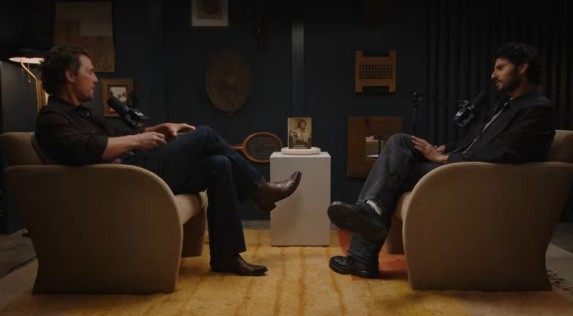
Here is the full transcript of actor Matthew McConaughey’s interview on On Purpose Podcast with host Jay Shetty, January 12, 2026.
Brief Notes: Jay Shetty sits down with Matthew McConaughey for a deep dive into the “biggest mistake” many people make in life: trying to control everything instead of learning when to let go. Through stories from his career, family, and spiritual journey, McConaughey explains how he balances ambition with surrender, responsibility with trust, and self-discipline with ease. The conversation ranges from redefining success and embracing failure to navigating midlife “opportunity” instead of midlife crisis. This interview captures a candid, reflective side of McConaughey as he shares practical mindsets for living with more meaning, presence, and courage.
Introduction
JAY SHETTY: When you think about your life right now, you do so much. You were just talking about all the projects and travel and everything. If you ever get a day that has no plan, no schedule, no timeline, no phone, no commitments, what does that look like for you?
MATTHEW MCCONAUGHEY: I don’t get many of those and I need to. My hunch is I need to learn to get more of those and when I get them I can be better at them because I have a love of accomplishment to even feel a significance for the day. You know, I sleep better when I have a purpose and I went after something even if it’s just building something and I’m still learning.
I’ve got to remind myself now. I used to be better at it actually, to just go daydream. Mosey, let’s take a mo. Everything’s going to swing by today, that’s one thing. I’ve quit calling appointments “appointments” and call them “swing bys” and all of a sudden I find I get just as much done but I’m just, it’s just in my dance of the day.
But if I have one full day off I will get my nine and a half hours sleep which is preferred. Which means maybe I sleep till 9:30. I’ll get up, take my time, mosey down. If Camila was up, my wife was up before me, she’ll have left me a matcha tea. If she wasn’t or had to rush out the door, I’ll go make that tea while the water’s boiling.
I’ll go probably do eight pieces of a puzzle which is a wonderful way. I love starting my day on that slow, simple, ah, eight little connections. You rhymed eight different things. It was very simple. Now usually head out to the, maybe the front porch, have that first tea, catch, hopefully catch 15 minutes of some morning sun face.
Then I’ll catch up on the world’s news, what’s happening. Maybe I’ll do my wordle, a couple simple little things. I’m going to try and play tennis somewhere in the day. I’m going to try and break a sweat somewhere during the day.
I’ll take some project or something that I’m working on or writing with me maybe to my gym and have one of those lazy little two and a half hour workouts where you kind of stop and write some things and then you kind of hop back into it. And then I’m probably going to cook dinner that night when I don’t have anything going on.
So either I’m going to get the ribeyes and rub them down in my rub and have everything, or I’m going to do tuna melts for the family that night. And then kids never want to come home. We’ll usually hang. I’m picking, I’m saying this day that I have off as a school day. And we’ll hang, catch up on days after that.
Maybe the family will all go catch something, one of our favorite shows. We’ll go watch an hour and if we start early enough maybe we get two episodes. Kids will go down. Then Camila and I get to hang for the last couple hours of the evening. That’d be a mosey through my day.
The Balance Between Achievement and Presence
JAY SHETTY: Nice. I love that how obviously the mindset of achievement and purpose and growth has served you so well. But there’s a part of you that sounds like I would like more days like this. Where does that come from?
MATTHEW MCCONAUGHEY: I love to be on task. I love to have something that I’m building and reaching to finish and do. I love the building of that. I’ve started a lot of the campfires in my life that I’m still building and I have plenty to fill my 24 hour days.
At the same time I want to keep learning and be inspired by something new. You know, pick up something that I didn’t like. I just picked up tennis four years ago. I didn’t have, I noticed I said you hadn’t had a hobby for 25 years. Makata. Hey, you found your first hobby. I thought writing was a hobby. And I was like no, that’s actually not a hobby. You know.
But to find, to be open to finding a new hobby. A new, to go somewhere not, I don’t know where we going. I was going for a walk to know destination in particular. You know, to lose track of time with success and with a busy life. And I got a full life and got a family and I got a career.
My hunch is that while that can fill my days completely for my own evolution and art, just to make sure I can still have that beginner’s mind where I can go daydream for nothing in particular. Go where your nose takes you. You know what I mean? Or go where your ears take you. Follow that.
To give my, to make sure I’m giving myself time to let that happen. I think is a good prayer. I think is a good, it always seems to pay off.
JAY SHETTY: Yes.
MATTHEW MCCONAUGHEY: And it never is looked at as like time not well spent. You know what I mean? But in the time I can get a little bit anxious and be like, let’s do, let’s get ahead on that thing.
JAY SHETTY: I can relate to that. I can relate to that. And I can see it, too, in how easy it is as someone who loves what they do and loves creating and building, and I fully get it.
MATTHEW MCCONAUGHEY: That’s the, I mean, there’s the upside, and I’m not over here bitching about that. I’m just happy to have things in my life that I love to build, to do. My wife knows it. I’m probably most happy. It’s probably obvious when I’m working, when I have a schedule, when I have a day that is this many hours or 12 hours, or I just got through shooting something for too much and then, boom, hopped off next day, went into shooting something for three days.
I love that. I sleep well. The food tastes a little better to me that night. That cocktail, that Patrón on ice tastes better that night. I’m actually, I think, have more time, and I’m a better father to my kids. The conversations, and I’m more present when I have that sense of accomplishment through the day.
Midlife Opportunity: Redefining the 50s
JAY SHETTY: Yeah. What’s, you’ve written so many chapters. You’ve lived so many chapters. What would this chapter of your life be called?
MATTHEW MCCONAUGHEY: That’s a great question. So I’m just turning 56 and 40s were my favorite decade. I think I really customized, and I found that to be true for a lot of people, especially a lot of the men I’ve talked to, they go, man, 40s. Oh, you get rid of all that stuff where you’re wasting your time and you’re honing in on the stuff that turns you on.
Look, 50s. I’m still in the early, the first few years of 50s were a little wobbly for me. So you go, oh, is this that midlife crisis? And I go, well, what is that? I don’t like the word crisis on that. Sounds like a midlife, for lack of a better word, opportunity.
You just, it’s a time where, for whatever reason, man looks back and goes, what have I done? And now where am I going? And I think my hunch is that most people go through what they call a midlife crisis. And if it’s hard for them or not healthy for them, it’s because maybe they’re not giving enough credit to what they actually have done to get there, you know, it’s like, oh, no, I did that. Yeah, done. Next, you know.
Like, we’re talking about me. More accomplishment. Wait a minute. Sometimes it’s all right to go, what did you do back there that actually you’re still building? What if we take that to another level? Put another log on that fire?
My goal, when I hit the 50s, my goal, it came to me was like, hey, you’re an actor. Play a character in someone else’s script that someone else wrote, directed by someone else, lensed in a camera from someone else, and edited by someone else before your performance is shared.
And I love acting, but I go, there’s four filters of my raw expression before it’s getting to you. We were talking about this before we got on camera. Today you go on stage, boom. It’s direct. This is pretty direct. But there’s still a filter here. You know what I mean?
Writing. There’s still one filter. But that’s when I headed into writing is I wanted to get rid of three of the filters. And that’s when I said, oh, what if I write the word? Can I pull off and give someone, translate the human experience where people can see themselves through words? Can I paint a picture of my own experiences which someone else can go, oh, I’ve been there. I know what you’re talking about? But that’s still a filter.
Living Without Filters: The Documentary of Life
So the challenge I’ve been, that keeps just gnawing at me since I’ve turned 50 is like, what’s your documentary? What are you doing? Are you a character in life? In the big show, the one there, or action was called the day you were born and cut will be called the day you die.
What are you doing live? Is that worth the show? Is it entertaining? Is it educational? Is inspiration? Is it fulfilling? Is it, does it turn you on? Could it turn other people? Put people on? What’s happened? That’s that. Now we’re talking. No filters.
And so I’ve started to question myself going, what, what’s your, let’s, let’s, let’s think about. Do you, is there other avenues for you to live life instead of doing someone else’s script? What’s your script?
Now that’s led me to think about different ways of leadership. It’s led me to write more. It’s also led me to go on the hard days to give myself a little amnesty and go, dude, take a little wisdom from Bob Dylan. “You are what you create yourself to be.”
Maybe if you feel more alive acting in a show through a character. Well, bravo that’s still, you don’t act like that’s not you. You didn’t get to your real self, Abby. You are to be the creation. And it’s okay.
If I’m going to go play a part. We’re all playing a part. Are we playing? If we can get to a part that is essentially close to essentially who we are, bravo for us. If we can’t, we’re having trouble doing that. If we can play a part that we’re good at and shows a piece and translates to show a piece of humanity, turns other people in and us on, even though it may not be correl who we are, well, bravo for getting away with that one too, you know.
But play one at a time is another little tip. I have to remind myself because the great performers, whether I think in life or in acting, you know, they can play any part, they can be any creation, but they’re always one at a time.
And that’s where some patience has come in. That’s where a bit of that, hey, don’t rush to accomplish, play one part at a time. But as life gets big, you’ve got a career and you got a family, there’s many parts to play. You know, father, husband, performer, you know, or writer, whatever those are.
But as you know, with practice, those all that instead of feeling like five different hats you got to wear one day, you go, that’s all part of the same story. That’s all part of the same man I am.
JAY SHETTY: So the chapter will record 1:1 at a time.
MATTHEW MCCONAUGHEY: The chapter would be called. I wish it was called sometimes. I think it should be called “One at a Time” along my long answer to what would the chapter be? Would be.
JAY SHETTY: I loved your answer.
MATTHEW MCCONAUGHEY: We’ve got a, I opened up eight lanes to about 12 lanes. When you open up to more lanes and you’ve been comfortable on these eight, and you know them well, there’s a little growing pains with getting comfortable in those other new lanes. Without disregarding my eight that I’ve built, that I’ve built, that I’m comfortable in, you know.
So I would say four more lanes. Let’s call that chapter. It’s called “Four More Lanes,” “Four More Layers.”
Honoring the Mindsets That Got Us Here
JAY SHETTY: It’s interesting listening to you because I think you’ve highlighted a really interesting human trait that we all possess where when we achieve something and it’s no longer useful, we start to denigrate it.
So, for example, if I think a certain mindset is going to help me at this point in my life, I’ll use it. It will get me to where I want to get to. And then when I get there, I’ll go, I didn’t like that mindset. I wish I was this way.
And we kind of do that time and time again and I assume decade by decade, where we reject the thing that got us here and don’t value it because now it isn’t what the new right world looks like.
It’s like, and making it very basic, a crude example is, oh, I used, I thought that was cool to wear. And now 10 years later, I look back and I think, why was I wearing? Like, I’m crazy, right?
And, but think about that on an internal soul level of the mindsets we wear and the behaviors we wear. And yeah, like taking a moment, as you said, to give yourself that amnesty.
The Power of Reframing Failure
MATTHEW MCCONAUGHEY: To say, well, yeah, and to make sense of humor, the default emotion when you look back and you’re embarrassed of something you did that actually got you what you wanted to go, you know? Yeah, to go. Instead of judging it, at least start off giggling at it. It helps with the amnesty.
It also helps change gear and go, oh, the realization, oh, I wouldn’t have learned that lesson if I wouldn’t have been such an egotistical prick at the time because I wouldn’t have had the confidence to put myself in the situation to get humbled. Yeah. You know what I mean?
You can look at all the piles of shit we step in and they lead to the clean water we get to drink from the well down the line or the truth we figure out. I mean, it’s, you know, I say that to mystery. Going forward, it’s science looking back, because if we can all connect the dots to exactly where we are right now and there’s a science to it even, and that science has to do with when we face planted and tripped ourselves and messed up or went about it the wrong way, but maybe got the outcome we wanted or went about the wrong way and didn’t get the outcome we wanted.
I think that has a lot to do with our, and I don’t know, do you think this is a Western thing, our relationship with failure? We’re embarrassed. In some ways I wish we were more embarrassed. All right. But in other ways, I’m like, we have to get a, with children, it’s like they’re afraid to fail. It’s like, no, no, no. If anything, if I look back, I always answer the question, what would you do different? I wish I would have taken more risk and fail more.
And I’m still trying to challenge myself to that today. But we have this relationship with failure. It’s like an embarrassing thing to do instead of shaking it to go, no, failure will happen. And if it doesn’t happen, you’re probably not taking enough risks or you’re not getting out of your comfort zone. So, no, failure is part of the successful path. It’s necessary, and we don’t have a good relationship with it. Is that a Western thinking?
Eastern vs. Western Views on Time and Failure
JAY SHETTY: I think it comes from the Western versus Eastern ideology of time. So in Eastern traditions, time is cyclical, and in Western traditions, time is linear.
MATTHEW MCCONAUGHEY: Yeah.
JAY SHETTY: And as soon as you make time linear, failure means a step behind. But as soon as time is cyclical, well, then it’s just repeating itself. So that concept transforms how you view failure because failure then becomes a part of a cycle.
MATTHEW MCCONAUGHEY: Yeah.
JAY SHETTY: Whereas failure in a linear journey is bad.
MATTHEW MCCONAUGHEY: Yeah.
JAY SHETTY: Because it means I’m going backwards.
MATTHEW MCCONAUGHEY: Success in the same way in the Western world. Western world, vertical, as in, oh, two steps up the ladder. Failure. Oh, you step back down the ring. Whereas in the Eastern philosophy, it’s not necessarily so vertical. Quantity.
JAY SHETTY: Yeah, I would say it’s, I would say if the Western is outwards and upwards, then the Eastern is inwards.
MATTHEW MCCONAUGHEY: Okay.
JAY SHETTY: And so the inner journey, for example, the quest to understand outer space, would not be as interesting as the inner sky. Inner sky would be more of a magnetic pull to understand. Heard if that helps.
MATTHEW MCCONAUGHEY: Yes, it does. Yeah, yeah, yeah.
JAY SHETTY: And so these little mindsets. I feel it’s what you said earlier, you change your language about midlife crisis to midlife opportunity. That language shift is revolutionary for the mind.
The Power of Words: Redefining Humility
MATTHEW MCCONAUGHEY: It’s wild, isn’t it? The vernacular, the prescriptionist definition, or just a word? I had the war. I’ve had the hardest time for 40 years dealing with the word humility. Come on. Got to be humble, Matthew. You got to be humble. Got to be more humble. My shoulders would start to cave. My head would start to go down. I was pat. I became passive.
I had the moment where it was my turn and I didn’t take the opportunity. I had a false sense of modesty, of, no, no, no, you, you. You go. Or that person that’s in front of you at the stop sign that says, no, you can go, and now it’s your turn. No, you can go to, like, no, it’s your turn to go. It’s like, don’t sit there and keep telling everything. That’s a false modesty. It’s like, there’s, they went. Now you can go. Don’t let them all go through, or I’m going to start hogging the horn. You know what I mean?
Until I heard a definition that was, “humility is admitting you have more to learn.” And soon as I heard that, oh, oh, I’m in. I purchase now. My chin’s up, my heart’s high, my shoulders are back, and I admit I’ve got a lot more to learn. But now I’ve got the confidence to move forward, and I didn’t get that click. It was just a definition.
Vulnerability is another word that kind of has a mingling definition that some people are hard to take at a, or, you know, sentimentality. Difference between sentiment and sentimentality. And we all want to be humble, but nobody wants to be humiliated. Well, aren’t they of the same word? You know, I mean. Yeah. One little flick of a definition we found.
You know what? Camilla and I, when we went to DC with the gun control after the shooting, we said, instead of calling it gun control, and we’re talking to, especially some people on the far right, the word they love, which is true, not control. Nobody wants a mandate, but we call it gun responsibility. Oh, oh, they’re raising their hand, go. I’m all for responsibility. What do you mean? But the word control. I’m not even, I’m not listening. Another word. Controls what I don’t want. Yeah, but you say call it responsibility. Oh, now I talk to you.
It’s amazing how a word sometimes, and you don’t know what someone else’s definition is. They may have a completely different definition of that by how they grew up, what they experienced, what their parents taught them, what school, how that word, what that gave them in their life when they thought they were acting that way or living that way.
JAY SHETTY: It’s so true. It’s so true. And that’s such a great example with humility. My favorite definition that I learned about humility was always being honest with yourself. And so it’s like humility is being honest with yourself. So I’m good at this, and I’m…
MATTHEW MCCONAUGHEY: Not so good at this.
JAY SHETTY: I’m great at this, and I can be confident about it, and, nah, this needs a bit of work, you know, and so…
MATTHEW MCCONAUGHEY: Right.
JAY SHETTY: If I can be honest with myself, then that’s humility, because I’m accepting that there’s more I need to learn.
MATTHEW MCCONAUGHEY: Yeah.
JAY SHETTY: But there is something that I have to offer.
MATTHEW MCCONAUGHEY: Yeah.
JAY SHETTY: And it’s…
Certainty, Selfishness, and Taking Yourself Seriously
MATTHEW MCCONAUGHEY: I love the word, you know, I love to be certain.
JAY SHETTY: Yes.
MATTHEW MCCONAUGHEY: Sometimes I mistake my, I love to be. I’m a big fan of the word selfish. And I’m still into redefining this. My pastor told me, God, hey, you’re pushing a large square rock up a very steep hill. But you know, even biblically speaking, to unto others as you would have them do unto you, love your neighbor as you love yourself. That’s the self. That seems to me purely selfish, I believe.
Seems to me that real religion is extremely selfish. Living away now, if we believe that you will, whether it’s karma wise in life or whether it’s life after this life, that you will be rewarded later. That projection, that delayed gratification, sacrifices and consequences we make. Maybe it’s when we make now to give our children a better life two decades from now, isn’t that the most self. Isn’t that more selfish than doing only for I at the sake of my neighbor or my loved one’s future? Seems to me that’s, yeah, maybe I’m using the wrong, maybe I’m using the wrong word. I’m told sometimes. But I’m sticking with it. Yeah.
But you know, the certainty. I like to know. I want to be in the know. I also want to damn well be in the know about what I don’t know.
JAY SHETTY: Yeah.
MATTHEW MCCONAUGHEY: Humility is what I mean. Like, I mean, you know, they say don’t take yourself serious. No. Take yourself real seriously. Yeah. And also take sense of humor seriously.
JAY SHETTY: Yes.
MATTHEW MCCONAUGHEY: And also take comedy very seriously. Yeah. Take guffaws very seriously. They happen.
JAY SHETTY: Yeah.
MATTHEW MCCONAUGHEY: You know.
Redefining Karma
JAY SHETTY: Yeah. I loved your, you just referenced it. You were talking about karma. I loved your redefinition of how karma works. So in the book you write, when you don’t do good to others, it’s guaranteed, basically, that they won’t do good to you. But if you do good to others…
MATTHEW MCCONAUGHEY: Not a guarantee.
JAY SHETTY: It’s not a guarantee that’s good to you, but the universe will respond.
MATTHEW MCCONAUGHEY: Yeah.
JAY SHETTY: Along those lines.
MATTHEW MCCONAUGHEY: Yeah.
JAY SHETTY: And I’m doing it from memory.
MATTHEW MCCONAUGHEY: That’s right.
JAY SHETTY: But talking about redefinitions, it stayed with me because I thought you’ve just pierced the veil of our false understanding with karma, which is if I do good to people, they do good to me, and if I do bad people, they do bad to me. So I’m expecting that when I do good to you, you’ll do good to me. And we all know that doesn’t work like that and I thought, wow, this really pierces the point because now I can still choose to be good to others, knowing that good comes to me in other ways.
MATTHEW MCCONAUGHEY: Right.
JAY SHETTY: But I don’t have to find it through that person.
Delayed Gratification and the Luxury of Long-Term Thinking
MATTHEW MCCONAUGHEY: Can you, can we trust that? Can we trust that unconditionally for ourselves again, that goes back to selfish for me. For ourselves again, the projection, it seems like delayed gratification. The thing that we really try to teach our children is what we still have the most to learn about as adults.
What are the consequences? Can we believe more in the consequences of our choices today? Can we have more trust and belief in, you know, that what I, the choice I make today, if I make the better choice, it’s going to reap rewards on others, including myself down the line. But we don’t like to think past. Now if you’re successful and you’re fluent in life, you have the luxury of thinking of long term thinking. Yes.
Some people in misery, which, this would be fun to talk about. Some of the misery, they’re delayed gratification, my ass. What you talking about? I’m trying to, I’m hoping, I’m trying to get something tonight. I hope we can wake up tomorrow and put some food on the table.
JAY SHETTY: Yeah.
MATTHEW MCCONAUGHEY: Is it a luxurious thing to talk about? Delayed gratification is a luxurious thing to talk about making sacrifices and doing what’s well for yourself, but also well for the most amount of others. Is that a luxury to someone in misery? Because they sure as hell have a hard time understanding. And I’m with you going, I understand.
You want me to talk about what we can do, peace in the world and you’re trying to pay your rent. You’re on. I don’t want to hear about that. I’ve got a household here. I got two bedrooms, I got five kids. I just got fired. And you want to talk to me about what the best idea would be for the most amount of people right here?
JAY SHETTY: Yeah.
MATTHEW MCCONAUGHEY: You know what I mean? I understand that.
JAY SHETTY: Yes, absolutely, I agree. And then what do you do about that then? So you understand it. But…
The Balance Between Faith and Action
MATTHEW MCCONAUGHEY: Well, I try to be humble with it and go, you can’t just speak trying to come across as speaking from on high. I think, you know, you talk about someone in a position who’s lost or in pain. Again, you talk to them about projection and projecting further in life, they’re like, what are you talking about?
But to those people, and when I myself have been there and trying to, and confused and frustrated and don’t have the luxury or the bandwidth to think that far ahead and try to go, what, all right, so what’s the next best right decision? What’s… And you don’t know what that is? Yeah, well, I don’t know. That’s one of the problems.
All right, what do you, what are you most faithful to do? That one. Just one. Let’s just go one in a row. We ain’t thinking about, and if, then. No, just should do one in a row. You know, just start with one and just stop there.
I remember being down in, after Katrina, we were in Gulf in Mississippi, and we’re on this property where all these houses were wiped out, and we were in this one place and there’s this lady’s house was just a slate of cement with some rubbish and stuff. It had been completely knocked down. And she came back and she was about 80 years old and she was still in a nightgown. And she saw it for the first time. She was just like…
And we asked her, what are you looking for? She goes, “Well, I just want to find a picture, maybe in a scrapbook, so my grandchildren say, don’t live it, but that’s, that will, that will help me.”
And then I was sitting there talking to her and I was like, what are you feeling right now? She goes, “I just, I just, can you tell me where to put my right foot if I take a step? I just need, is it solid? Is it going to cave? Am I going to trip? Can you just tell me, I don’t even want to look right now. We can, I can trust you to tell me that this, if I step this way, one step, my foot will be solid and flat and I won’t slip and it won’t be dangerous. I don’t step on a piece of glass. I’m not, it’s not going to…”
And that’s just wanted one step. That’s a person in misery going, just show me one solid step. I don’t want to know what’s going on. No, I don’t, not, not what’s happening in an hour, not what’s happening in 30 minutes. Just give me one solid step.
That seems to be a place to start for someone in misery that doesn’t have the ability to project or so confused and you feel it’s got too much coming down on you. Too much pain to think down the, down the line. And if you do that once, then you reset and you bring up the same question.
All right, what’s the next one step, one in a row, over and over. Instead of, oh, I’m going to put a string together. No, do one in a row over and over and look up and maybe you can go look at that. Yeah, ten in a row we got somewhere. But that’s easier said than done, you know. What do you think?
JAY SHETTY: No, I love that. I think you hit the nail on the head. It’s how we teach children to take one step at a time. It’s how we build new habits as people. We do one day at a time.
I think as soon as we start thinking, it’s why New Year’s resolutions fail. It’s why these big claims of “I’m going to do this for the rest of my life” or “I’m going to do this for the rest of the year,” why people struggle with vows and commitments or whatever it may be. It’s because you’re making this long term decision based on small amounts of information.
And you’re spot on that. I think it’s not compassionate to challenge someone beyond that one step, that footing that they just… I love that answer. I think it’s the most empathetic, compassionate and loving thing you can do is to teach someone how to take the next step without any pressure to climb the whole mountain.
Balancing the Big Picture with Small Steps
MATTHEW MCCONAUGHEY: So what then would you say is the balance between keeping the big picture in mind but taking one step at a time? The urge, the will, the incentive, the being to go, no, I’m chasing my transcendent self. I’m trying to be more godlike, whatever that is, which is a big, big picture.
I’m trying living as if I want to get to heaven or whatever. I want to act in a way that I have good karma. Those are big ideas. So how do you, what’s the, what’s in your mind? What’s the dance between that and, yes, but put your head down, one step at a time?
JAY SHETTY: As you’re saying, I’m reminded of a beautiful line in scripture. This comes from the Bhagavad Gita, the eastern text. And the text is not a rule book or a principle book. It’s based on a battlefield. And the character is the greatest archer of his time. And he’s having a crisis of faith and the bow slipping from his hands.
He’s going to have to fight his family, who are the bad side and he’s the good side. And he doesn’t feel capable of taking the lives of people that he grew up with. And that’s the scene. And he’s talking to God, who happens to be his charioteer. So God’s actually riding his chariot, and he pauses in between the two armies.
And they have this dialogue which is 700 verses, 45 minutes long in time. And God’s number one instruction is, “Think of me and fight.” It’s like, think of me and fight. It’s like, I want you to think of me and then do your duty and take that step.
And so, you know, talking about what you’re saying, it’s like this paradox where we think we have to choose, but actually the instruction in and of itself, he repeats that twice. God repeats that twice in the text. It’s like, think of me and fight. So think of me and do. You do think of me and take the step.
Because if you think of me and take the step, you’ll have faith and trust, but you’ll also feel your action and the confidence. But if you only think of me and you just sit there, that’s not going to work.
The Two Extremes: Fatalism vs. Total Control
MATTHEW MCCONAUGHEY: Yeah. Let’s explore those two extremes that, where we don’t get it. One are the fatalists. Yeah. I don’t know. Inshallah. Wait a minute. We got to have our hands on a wheel. You know what I mean? You know, we, it is, we have our freedom of choice. And, you know, so where is it that we go rely on fate too much?
And where is it we’re like, no, I am fully responsible for everything. The next step is all that matters. Head, you don’t see any horizon. You don’t see any, you’re not pursuing anything. You’re just, you’re, you know, not Air Force, Navy or Marines. You’re Army. You’re dealing with the ground only. Talk about space, you know.
That, that’s the two extremes, when it feels like they can be out of balance. But that paradox in the middle, it’s what so many of us are seeking and pursue and try to live that. But what are practical ways to, to, to, to keep that in the, in the middle, where we’re feeling both at the same time? Where we’re thinking of God and fight and fighting.
You know, the old, what’s that old Southern adage, the old man and the boy walking. Here comes the tornado and the boy drops on his knees to pray. And as a, “Get your butt up. What? Scared. Prayer ain’t worth a damn right now. We got to go get shelter.”
You know, and then other times, and I’ve had my Nietzsche and agnostic years where I was like, it all me. It is all about my hands on the damn wheel now. I don’t regret those. And as a believer, I don’t, I didn’t feel spiritually, God was mad at me for that.
I thought he had a wry smile on his face. He was like, “Way to get your hands on the wheel. I could use some more of that from some more of y’all.” But at the same time, you thought you had it. I thought it was all up to you.
But I, I appreciate the effort. But it was, it was a, it was, I remember the feeling of appreciation, and I needed it at the time because I was giving myself too much amnesty in places. And I was getting, my chassis was a little loose on the edges, and I was like, you got to look in the mirror, McConaughey. Grab jam, will, man. Like, just let it, let it all slide on faith. You know what I mean?
The Importance of Third Spaces
JAY SHETTY: Yes, yes, absolutely. I think there’s a reason why so many spiritual and faith traditions, you went to church on Sunday or a temple or whatever. It’s like that was the day where you were fully dedicated in faith, aligned in trust. And then you went and worked six days, and you carried that with you, and you tried to practice it as a reminder, but then you went back and then you got reminded, and then you did six days of yourself.
MATTHEW MCCONAUGHEY: About Thursday evening, you were like, I need Sunday to come.
JAY SHETTY: Yeah, exactly. And I feel like that’s where that third space has been lost. It’s like, you know, 100 years ago, third space theory, we had three spaces. We had church, work, and home. And then fast forward as time went on, you had work and home, and then fast forward after the pandemic, and you just had home.
And they all had a purpose. It was like church or temple or community or whatever it was. It was a place that gave you the space to look back on your life and take a step back. Because at home, you have to be dad or mom.
MATTHEW MCCONAUGHEY: It was a physical place.
JAY SHETTY: It was a physical place that gave you space to ask different questions. Because at work, you’re just asking, how do I make more money? At home, you’re asking, how do I be a better mom or dad? But then what about, how do I do all the other, where’s the space for that question?
MATTHEW MCCONAUGHEY: So in this age where most people less than going to church less are going to the temples less, is it possible, do you think, or how can we improve? If you do think it’s possible without the ritual of that third space. Because I understand the concept, man. When I feel most spiritually strong, I’m all days of prayer. My every interaction is a give and take and a rhythm of, oh, I didn’t have to close my eyes now.
But that Sunday ritual where I did need to get my heart above my head in humility and bow in humility, I saw, I got objective and saw myself from an eye in the sky and was like, oh, are you doing? You need to, you’re not, you’re not quite doing. Or you could do this thing you think you’re doing a little more. Truly, you could have been more benevolent in that. Oh, that was… But I needed that.
But then a lot of times, I mean, without the ritual and so many people now go, “I’m not religious, I’m spiritual. I’m not religious, I’m spiritual.” I think there’s people that are a lot more religious than they think they are. I think they’re a lot of, that is that term that’s coming from what mankind has done with religion, which in the Bible Jesus fought against was like, “Ah, that’s not what I’m talking about, guys. This is not, it’s not, it’s not, it’s not religion in a capitalist thing. It’s not a material.”
But what we’ve done with it, that I think a lot of people are fighting against, absolutely, in fairness. The word means, from re legare. The Latin root legare means to bind together and remains again. So a lot of people that I hear saying, “I’m spiritual and I’m for unity,” I’m like going, that’s religion. To bind together again, that’s to unify.
JAY SHETTY: Yeah. But going back to our earlier thought, language is limiting. And once a word is scarred and wounded with battle wounds of the past, it becomes less prominent.
MATTHEW MCCONAUGHEY: I’m a prescriptionist. I keep going back. Like, let’s not, yeah. I’m not ready to give up on original definitions so quickly.
JAY SHETTY: Yes.
The Power of Human Adaptation
MATTHEW MCCONAUGHEY: And I can get, sometimes I’m pushing that square rock up the hill. Other times they just go, adapt. Don’t be caught as a dinosaur. Right. So how do we again, where do we hold on to time and tested truths, spiritual ones in this sense, and still say, no, let’s adapt and evolve.
People move around in society differently now. Maybe we don’t need the third space on a Sunday, but we take the time every day to meditate, to pray, and church is where you are. It’s in nature that’s where I find my church. Are those, are you think these are good supplements? What do you think?
JAY SHETTY: I want to know what you think.
MATTHEW MCCONAUGHEY: I’d like to say they are, but I’m not sure where that evolved. I still think we need and want the responsibility, the hand, the hold. Oh, this is the day, this is the place. This is where I go. This is what we do.
I try to short sheet that bed all the time myself. Might I know better. And I’ve never followed through on, go forward with the ritual. Go. I’ve never followed through on it and come away going, ah, six or eight. I’m always like, yep, yep, got to keep doing that, man.
And I’m trying to do that more as a father and, you know, head of the family. And I’m not doing the best job of it. And I’m understanding this thing about, yeah, it’s where we are, it’s how we think, it’s how we’re gracious, it’s how we’re, how we’re thankful.
Before meals, we talk about our day or we talk about philosophy or stoicism. I’m like, yeah, these are some of the same things, but are they. I’m kind of making an excuse, I think, because philosophy is different than religion. Although my favorite parts of what I’ve studied is religion is the stuff I can go, oh, I can take that into the week. Oh, I can use that practically.
JAY SHETTY: Yeah.
MATTHEW MCCONAUGHEY: And I still have trouble with burning bushes and parted seas and stuff like that. But that may be a failure of my own true faith. That’s, that seems to be. Maybe that’s my own pride or my own pragmatism or my own belief in philosophy and the way we live life, which I’m eternally interested in.
But I’m, I don’t believe I’m going far enough. Yeah, I think I’m short sheeting myself. I think there’s a gap there. And I do, I think God’s going, I appreciate you trying. You hadn’t, you had too much pride. You’re not going far enough yet. You haven’t fully surrendered to the faith.
JAY SHETTY: Yeah.
MATTHEW MCCONAUGHEY: To belief in faith. That’s my, and I think you do need that. My, my hunch is I don’t care how tired you are Sunday morning, you, that’s, that’s where you should, in order, and you know it. Yeah. Go for that reason. So that’s my hunch.
JAY SHETTY: Yeah. We’re, we’re aligned.
MATTHEW MCCONAUGHEY: Yeah.
Building Bridges to Faith
JAY SHETTY: I, I think that what we have available today are poor conduits of a far greater depth that you get from the physical community. The connection, the communion of a direct message that feels really clear and is from source. Like there’s a, there’s a power in that that I’ve personally experienced too, and I’ve dabbled in.
But by the way, I’m the same. I’m, I’m the same as you. I live in a place where I don’t have that community as I’ve had in other places that have lived. I constantly make excuses and find other ways to justify my, my practice because I can’t fully be at the depth that I’d like to be.
And it’s, and so I’m doing it, too, to survive and to stay connected. But there’s a difference between surviving and thriving. And I know that when I’m thriving in my practice and my faith, it’s when I’m doing it the way it was done.
Now, this doesn’t, going back and just add the caveat, I think we all know it, is that I’m not saying that the way it was done in all ways, was done well. I’m saying that the form of connecting, communion, reflecting connection, that you can’t substitute that with anything else.
But we’re living in a world today where we need new tools and we need things that are more accessible and people need them and are available to them. And I see them as a beginning of the journey and a bridge, not the destination.
MATTHEW MCCONAUGHEY: Okay.
JAY SHETTY: So I think if we’re building a longer bridge, then that’s healthy. Because if someone never starts the journey on the bridge, will they ever make it to the place?
MATTHEW MCCONAUGHEY: What are we building the bridge with? So, for example, brick and mortar.
JAY SHETTY: I guess what I mean, like, if people are trying to do their daily meditation, they’re trying to, maybe they’re meditating through an app. Maybe they are trying to work out with an online workout.
MATTHEW MCCONAUGHEY: Right. Yeah.
JAY SHETTY: Like if they were in the gym at a class, maybe that would be a more fun atmosphere for them.
MATTHEW MCCONAUGHEY: Right.
JAY SHETTY: Maybe people are reading a book about poems and prayers inspired by, but not directly from the source, but that’s their beginning bridge of their journey.
MATTHEW MCCONAUGHEY: Yeah. Yeah.
JAY SHETTY: To that direction. In their own pace, at their own time, whenever, if and when they want to go. And I, I feel like that’s what, what you do and what I try and do and what so many do is we’re trying to build bridges, hopefully, that are not the home. I think the problem is when the bridge becomes the home.
MATTHEW MCCONAUGHEY: Amen.
JAY SHETTY: You don’t want to live on the bridge.
MATTHEW MCCONAUGHEY: Yeah.
JAY SHETTY: Right. I can’t remember who said it. There’s a famous quote that says the world is like a bridge. Don’t build your house on it, cross over it. And I don’t know, I think all of these platforms and apps and tools, they’re all bridges. Yeah, but don’t live there.
MATTHEW MCCONAUGHEY: Yeah. Don’t live or don’t feel that that’s home. That’s it. I mean, let me ask you this, though, because, like, in the Bible, it talks about we’re all, you know, we’re strangers here. We never, we don’t find a home here in some version.
And I may be theologically messing this up, but what I get from it is, you know, but you try your pursuit to try and make heaven on Earth, which you will not, because you will never find it here till you get there. That’s, that’s as good as you can do.
But you will always be a stranger, you always be an immigrant, you will always be looking for a home here on Earth. Yes. Now, how does that necessarily mean that, that doesn’t mean you’re, we’re living on a bridge. Yeah. Or does it?
JAY SHETTY: I believe so. I feel like the, it’s like an airport terminal. It just feels like home because we feel like it’s a long time, but because it’s not eternal, it can’t possibly be the destination.
MATTHEW MCCONAUGHEY: Right.
JAY SHETTY: From a, from a religious, spiritual.
MATTHEW MCCONAUGHEY: If you’re trying to make home or the pursuit of home. Yeah. What you see. Home. Trying to, trying to bring it here.
JAY SHETTY: Yes.
MATTHEW MCCONAUGHEY: Trying to emulate as much as possible, live in the light of that.
JAY SHETTY: It’s like I’m going to France next year, so I’m going to practice French now.
MATTHEW MCCONAUGHEY: Right.
JAY SHETTY: Like, that, I think, is the, the big picture and the daily step at a time. It’s like I’m trying to, I’m trying to aspire to live. I’m going to move country next year, but I’m going to practice the rules, the rituals, the language of that country this year, because then I’ll be prepared.
So I don’t not have a great life now. I’m not postponing joy. I’m not postponing happiness or love. I’m practicing that culture that I believe is better for me now. If that makes any sense.
MATTHEW MCCONAUGHEY: Yes, it does.
Observing Human Nature
JAY SHETTY: What’s been, I feel like you’re such a, I feel like your mind is like you’re constantly observing patterns and observing even, like, language as we’ve been talking. What’s something that you’ve observed about humans that fascinates you? That surprises you? Maybe.
MATTHEW MCCONAUGHEY: One, our ability to adapt when there’s not another option. Wow, that’s a good one. We’re elastic, man. We are elastic. More elastic than I like to practically think. But boy, when we’re put to it, I’m amazed how quickly we can change, adapt, evolve, come to understand the other side when we’re put to it.
You give us the option, we take the out, man, and we argue. And really, I’m not, I ain’t budging. Nuh. You know what I mean?
And then on the flip side of that, somewhat is how we seem to find in this pursuit of the ideal, we seem to almost say, well, that is our home. That is who we are. And then go, okay, so therefore. And then we, we, our practice is not as evolved as we think it is. But we keep saying, and I love the, we can tap into the 11th percent of our mind, which we don’t tap into. We can be greater, we can transcend.
But practically every day I think there’s some great wisdom in going, we’re not as evolved as you think we are. Let’s quit acting like we are. I love the pursuit. It’s like rehabilitation and justice. I’m for rehabilitation, man. I mean, I love the New Testament, you know what I mean?
At the same time, we are repeat offending son of a guns over and over and over. And if I’ve done you wrong and you’ve allowed me to come to you and ask for forgiveness, the first order on the docket should be me. If you choose to forgive me, the first order on the docket should be me. From now on, doing anything I can to not have to come apologize to you again.
It’s not just that you forgave and gave me the chance to be forgiven. I got some sweat equity on my side to quit doing the actions that caused me to have you forgive me, to have me apologize again. And we don’t forget. We seem to not forget that side.
I love Kumbaya. This is the ideal place we can go. But I feel like we relax and kind of almost take for granted thinking we’re that evolved. And no, we’re not. That’s the constant pursuit. We ain’t there. So let’s deal with the hard math right here.
And one thing we can depend on people being is people. Nothing we do is unbelievable. We do stupid s* all the time. We break our own noses because we tripped ourselves running downhill. We steal, we’re jealous, we covet. We talk blue and vote red. We talk New Testament and act old. We’re entrenched in some ideas now.
Go back to that, the first half of what surprised me about people when I was talking about the adaptive flexibility of adaptation. I remember it was probably 12 years ago. I was in Alabama. I was doing research for a film down there, Free State of Jones. And in Mobile, Alabama, on the docket that night, the next morning, the vote had gone through about whether Alabama was going to allow gay marriage.
And I’m sitting, I’m in Alabama. And I was like, I don’t think that’s going to pass. Deep south Alabama. I mean, it sounds like that’s a very progressive idea to them. I’m judging it. I’m just saying as an anthropologist and sociologist, I’m like, the next morning it passed 53% to 47%.
I was like, wow. I talked to my friends. A lot of them on the left were abhorred. I can’t believe that those bigots only 53. And I was like, only 53. I thought it was going to be 80, 20 the other way. That was a massive amount. Talking about meeting people where they are. Massive flexibility. That surprised me. And that was just 12 years ago.
So we have to understand where people are come from. I write about it in the book about, I wish more crimes were from ignorance. And what I mean by that is, if I know the right thing to do and I know the wrong thing to do and I still do the wrong crime, shame on me. I knew better.
But there’s certain crimes we commit that someone just goes, I didn’t know.
JAY SHETTY: Yeah.
MATTHEW MCCONAUGHEY: Okay, now let’s talk about some real rehab because you didn’t make the wrong choice. You just didn’t know. Yeah. Now talk about some amnesty. Yeah, I’ve got to meet you in a different place. We have to deal with solving the problem differently than I do with the guy that knew better and did it anyway. Yeah.
JAY SHETTY: Do we expect too much from people?
The Pursuit of Perfection
MATTHEW MCCONAUGHEY: Practically speaking, yes. I mean, we underwhelm and underserve and under show a lot, but we all have different expectations of ourselves and of others. So again, part of that, expect the worst versus the best. I don’t like that. I like, actually expect the absolute best. And when it comes in under that, you know, shoot for the A, make a C is better than shoot for C, make an F.
How quickly when you deal with reality and go, okay, well, that’s a hell of a lot better outcome. And I got more out of you and you got more out of me than we would have if we’d come in going, like, let’s just make a C. You know what I mean? We went for the perfection and we came in under it, but it was still pretty doggone good. Well done. That’s where I call it an over show theory.
JAY SHETTY: How do you deal with when someone disappoints you based on your expectation?
MATTHEW MCCONAUGHEY: I’m quicker to say, yep, that was reality. That’s able to do, whether it’s forgiveness or amnesty, whatever you call it, with others than I am for myself.
JAY SHETTY: Explain.
MATTHEW MCCONAUGHEY: I expect perfection for myself a lot, and I don’t reach it. And I know I can. Or I believe I can. That’s a better word. I believe I can, and I don’t want to quit believing I can. That’s sort of where I find myself in approaching life. Keep going for perfection. Keep finding that reality comes in under that. And you will have climbed more stairs. If we’re going to have a vertical by the end, you will have had more quality, your roots will have been deeper and wider inside and out, vertically and to the south than if you didn’t chase that perfection.
The challenge for me is when reality comes in and it’s served and the bell’s rung and there’s no more time to take the test. When you see that you didn’t make 100 and you made an 88, how quickly can you go, instead of going, oh, dude, or how quickly can you go, all right, 88. Not bad. Yeah.
So again, that pursuit of an idea plus the practical, what’s the next step? Solid step. And I work to become, I work and try and remain as much as I can to feel satisfaction in that reality. But that’s the hard part, is how quickly can you go from, I’ve never, I say this all the time, and I don’t like it to be misconstrued. I’ve never made a film that lived up to my expectations. Well, I’ve never given a performance that lived up to my expectations.
I’ve done films. I think it’s a lot better than I could have done. And I’m not saying, oh, I should have directed. I’m saying that was, it’s awesome. It’s a really great piece of art. Not just transcendent. It didn’t change the world or tap into a piece of humanity that enlightened myself and everyone else on a unanimous level. That’s what I’m going for. But I had never done it, so why?
And again, people have made films I think are outstanding and better than they would have been if I would have been the director. For sure. But that’s part of, I think, maybe why when I do do good work or make good creations or good art, I think that was part of it that I was going for. Ding. The infinite pure spot in space that was immaculate. Yeah. Believing I could achieve perfection, but knowing I couldn’t. But I still like to believe.
I mean, my favorite word in the world is unanimous. What I mean, unanimous. We don’t have as many black and whites today, man. Give me something unanimous that we can all agree on. Maybe it’s a value. Maybe it’s a way of making a living. Maybe it’s a piece of art. Just unanimously go, no, that’s just, that’s great. It’s a one of one.
But you seek unanimous. Sammy Davis Jr. said, “I don’t know what success is. I know what failure is. That’s trying to please everybody.” You know, I mean, you seek, you ain’t going to get it. Yeah. There’s no way.
JAY SHETTY: But you still believe.
MATTHEW MCCONAUGHEY: Come on. Still to keep believing. Yeah. I feel like it keeps me in the chase, keeps me in the race. Yeah. Keeps me going. Oh, almost. Okay. Okay. Yeah. Yeah.
JAY SHETTY: I like that you have to live like that. There’s a joy to live like that, and it’s a joy again. You know, it’s been the theme of our discussion today. It’s almost like being able to accept both. Like you said, you believe you can, knowing you won’t.
MATTHEW MCCONAUGHEY: Right.
JAY SHETTY: And it’s that what makes it beautiful. Because if you only believe you can, then you’ll be really disappointed when it doesn’t happen.
MATTHEW MCCONAUGHEY: Right.
JAY SHETTY: And if you only know you will never get there, then, well, you never do anything.
MATTHEW MCCONAUGHEY: Yeah.
JAY SHETTY: So it goes back to that same piece. So, on your ranking score, where is Interstellar of your performance? Where do you go in Interstellar?
MATTHEW MCCONAUGHEY: Is it?
JAY SHETTY: Yeah, where are you? Like your performance. That’s not, to us, it’s perfect. To you it’s not. So what is the 88?
MATTHEW MCCONAUGHEY: No, I think it’s very good. Yeah. And I think the movie’s really good. I think the character’s really good. I think my performance is really good.
JAY SHETTY: Yeah.
MATTHEW MCCONAUGHEY: I have appreciation for it. And I know Bogey and, or if I’m Birdie and I know when I’m like, I’ve seen myself on screen. You kind of bullshitting there, McConaughey? And then I’ve seen her, I’m like, bam. Okay, so it’s still 88.
JAY SHETTY: Like, you know.
MATTHEW MCCONAUGHEY: Yeah, yeah, yeah, yeah. Well, but I’m also, as you know from the book, I’m not into extra credit. I don’t like 4.2 GPAs. That tells me, like, what happened? Are we, then we’re not giving the right test. If four was the pinnacle, you know, that means not many people should be getting it, if anybody.
So now we’re getting four twos, four fours. That tells me we’ve over leveraged the original task or we’ve added amnesty or too many places to not have the real competence and merit at the task that you’re supposed to give. Because especially I think, in the west, because we want everyone to feel really great. Participation trophies, 4.2 GPA. Well, I feel better. You got the 4.8 GPA. Start getting a 3.8 education.
The credit that extra credit would give is sort of balanced with the debit of the actual what we learn from it sometimes if we give too much extra credit.
Seeking Validation
JAY SHETTY: What validation do you pursue?
MATTHEW MCCONAUGHEY: My wife’s, my children. I have a council in the sky. Three people that are extremely important to me in my life. My dad, Penny Allen and John Chaney. And I see them, wink at them, talk with them, listen to them, run ideas by them, run decisions by them. And then I look up and see what their reaction is. And it’s been a very trusted counsel for me.
It’s sort of my way to give people, practical people, physical bodies and souls that are no longer with us here on earth physically, to put them in a heaven sense. And it’s a connection. They’re a conduit from God to me, and I have no expectations of them.
And sometimes when I’m so excited, like in this grade, I look up and they’re not dancing. I’m like, why aren’t you dancing? Got other times where two of them will be dancing and one of them and I have to go through, oh, why is that something they don’t understand? Or are they the underdog and I need to be listening to them because that’s why they’re going, you know better than that. I don’t agree with that.
And then sometimes all three of them are, you know, my dad’s got a, you know, dancing in his underwear with a Miller Light and a piece of lemon meringue pie, Penny’s up on a chair, screaming out loud, buddy, John Chaney is leaning back his old cotton yellow shorts as you do, with his shoulders back, going, there you go. Yeah.
So I seek their validation and that’s a conduit through a practical conduit in my imagination because I don’t have a picture in my mind of God. And I don’t think we can or should. I think that minimalizes. We have pictures of physical beings that have walked the earth that we can call prophets and stuff, but of God, I don’t have a picture. I don’t think it’s an it. I don’t think it’s Mr. or Mrs. or anything like that.
And then, I mean, look, inherently that all brings me back to seeking my own validation. You know, I try to measure how I counsel and referee myself off of some of the people I just brought up to you. So that’s where I pretty well stick. That’s where I prove.
I don’t really look outside that much further outside my circumference just because I can’t. It’s too fickle. Yeah, yeah, it’s too, I can’t really, I don’t have a trust again that goes to that Sammy Davis Jr. life. You don’t look around and go, does everyone approve? Yeah, it’s going to be lonely and hard and not necessarily the best for you. You know what I mean?
And I know I’ve pulled some things off my life where I, you know, people thought I changed and made a bit. Wow, what a recreation. I’m like, I’m doing the same thing. You just put it in bold print now. Doing the same thing 15 years ago, you know what I mean? Sometimes we change by saying the same and then other times again, as we talked about in the beginning of the conversation, you give yourself time to daydream.
You pick out a new tact about how to maybe go about something, a new way of uncovering something, a new way of solving something, a new way of finding satisfaction in the situation, a new way of dealing with a crisis, a new way of dealing with success. You know, looking at it from a different point of view, just to have another almost ammo arrow in the quiver and how to end this hunt his life.
Trust First
JAY SHETTY: How does someone like you, who built their career on control, grasp the concept of trust?
MATTHEW MCCONAUGHEY: I’m a trust first guy. I come here today. Whether we had never talked before. I have nothing in my head going into anyone’s situation if they’re trying to get me. Oh, is he going to ask a tricky question? Oh, is he trying to play a guy? I don’t. Because that’ll hang me up. I won’t be able to freely think and go.
Now at the same time, have I been doing this long enough where before I’m about to say something or as I’m saying I can go, oh, if you don’t finish this sentence right, that’s going to be a headline in a rag bag or something. You know, I mean, that’s not going to be the headline you want. I’m conscious enough of that.
But I’m a trust first guy and I’ve been burned and I’m like, I’ll make that bet again. Because I know that I put that, if I put more trust on howdy, it’s going to do something to you where maybe you aren’t the most trustworthy. I’ve seen people become more trustworthy. I’ve seen people give more because they go, oh, this guy’s given me a massive amount. He just empowered me, dude.
JAY SHETTY: Yeah, yeah.
The Power of Trust and Spiritual Strength
MATTHEW MCCONAUGHEY: He just gave me, he saw a dignity in me that I didn’t see. He’s given me a license, a privilege, some hood’s Paul to go, oh, okay. And I believe in that and I see that in people. When it’s rid of that, you know, may what we get from our soul get a like response from others. I believe in that response.
So I’m a trust first guy. The residuals for going through life without trust? Oh, that sucks. Yeah, I mean, yeah. I also, you know, I trust myself more now than maybe I used to. And I think that’s just come from growth and evolution.
I used to always be a guy who, and I’m still a guy who, I don’t like drawers. I like the stuff laid out. I want to see it because if it’s in the drawer, I’ll forget I even needed it. I want to see it. I was always a guy who’s like, if I’m going to come in this room, make sure that my keys to the door in the other room on the kitchen table. Leave that door cracked.
I have more confidence now to go, you can shut the door. I know where I left the keys. I don’t have to look over my shoulder again.
I had this spiritually when I went to True Detective. I was in a really strong spiritual place. And that character, my relationship with God at that time was really strong. That character, when somebody, philosophical nihilism and things that are away from faith, I was able to go, I’m locking in and not looking back for five months. And I don’t need to look over my shoulder because I know when I come out of this, my relationship’s good back there.
I don’t need to peek over my shoulder to make sure I don’t have a crack. I had to trust earlier. In many other times in my life, I wouldn’t have had the trust to go that far because I’m like, is this okay? Am I about to get struck by lightning here? Is this blasphemous? You know what I mean? Are we good? Okay. I’m just acting. You know what I mean?
So I had a great amount of trust. I’m strong spiritually. Then to go, and when I feel stronger spiritually is that, you know, the foundation’s stronger. We can jump higher, we can go further. We can not look over our back as much and trust any, you know, when we travel and trust relationships and away from the kids.
I’m away from the kids right now. It’s been a week. Okay. But we check in. Yeah. Does FaceTime help trust? Yeah. Because you get to just more than just a phone call, but the idea of the very simple, natural ideas of going, hey, it’s 10 o’clock. We’re on the phone. I’m on one side of the world during the other. But we’re both under the same moon. We’re both under the same sun, son. You’re under right now just hadn’t got to me yet. But it’ll be the same one.
And the moon that I’m under right now just hadn’t got to you. But it’s coming. There’s a, again that time. Now we’re getting into the cyclical time. You talk about it and not the linear where we feel like, oh, I’m losing.
JAY SHETTY: Yeah, a day.
MATTHEW MCCONAUGHEY: No, it’s coming around. It’s all bound. There’s a trust I get from that. And then another trust I get is if I’m, you know, it’s in between that. It’s it all. It means everything, means everything and nothing matters at all. Yeah. In between there.
JAY SHETTY: Yeah. How do you, yeah, like, I love that there. So how do we live like that?
Balancing Preparation with Letting Go
MATTHEW MCCONAUGHEY: So again, trust. If I’m going to go to the fatalist side of what I do. Doesn’t matter. Doesn’t matter. I’m going to die, dude. What’s the matter? I used to not have the trust to go, oh, but I’m going to still do every bit of the work to make sure. And I’m put my hands on the wheel, right?
So to go, oh, it doesn’t matter. It’s what I’ll tell myself. If I’m nervous, I’m going to go give a speech or something. I’m prepared. I busted my tail and broke the sweat to get prepared. I’m full now. If I trust that, and I know I did that, now I need to tell myself, dude, this doesn’t matter. Yeah, you’re going to die. What does this matter?
Because I know I’m not going to go be lazy and unprepared and f* off. So now that I trust that I will, that I’m prepared, and I take it very seriously now, I come to, I like to end it with, well, now, yeah, none of this matters. To relax. If I go, you know, too much the other side, I’m tight. I’m trying. I’m trying too hard. I’m not giving myself the freedom to listen and riff and take somebody’s answer and go with it. You know what I mean?
So that’s how I try to balance the two. But that took, but I didn’t 20 years ago if I’d have said, and with some of us in life, if you tell them, dude, none of it matters. It’s all fate. It’s all going to happen insula. It’s all just going to happen. It’s going to happen. People just f* off and go like, well, it doesn’t matter how I treat you or treat me. And you’re like, no, it does. But can you trust that you’re not going to be a tyrant when you let yourself off? Yes. You know what I mean? Yeah.
JAY SHETTY: Yeah. Well said. Well said. It’s that, that balancing act in everything we’re talking about, everything, we just keep coming back to that. Like, to be able to believe that what I’m about to do is important and then have the ability to embrace my own insignificance at the same time is, is beautiful.
MATTHEW MCCONAUGHEY: Like, there’s a quote I always remember hearing as a kid is like, “You’re just a, you’re, you’re the smallest grain of sand in the palm of God.” And for whatever reason, very early on in my childhood, when I heard that, that felt power from that, I didn’t feel small. I felt like, wow, how cool. How awesome. Yeah.
And in that is the idea of, like, it all means something and none of it matters at all. Yeah. Yeah. But it’s very easy to look, think that, that analogy and go, oh, well, so I don’t matter. No. Can that grain of sand and palm make you go, oh, no, I matter more than I thought?
JAY SHETTY: Yeah, and it’s both. Yeah, and it’s both. And it’s, yeah. I remember we were on a beach in South India. I was with my monk teacher. We were on a walk, and it was a bunch of young monks with my teacher. And it’s a big fishing town, so South India is very known for being a fishing community.
And there’d be loads of fish nets full of fishes. And then there’d be the few that had fallen out on the, on the beach as we were walking. And whenever we’d walk past one, my teacher would pick it up and put it back in the water. It was still, you know, tossing up and down on the, on the beach.
And we were just looking at the whole beach in front of us. And they were like hundreds, maybe, I don’t know, maybe thousands of fish that had fallen out of the nets that won’t go to be cooked in a restaurant but won’t make it back the ocean and probably die in between. And he was just, every time we’d walk past, we’d pick one and we’d be like.
We said to him, we were like, we’re not going to be here all day, and there’s no chance we’re going to get to all of these. And he was like, yeah, but to that we, one fish, that’s their whole life. Like, you know, so to you, it’s like, we’re not going to get to 400.
MATTHEW MCCONAUGHEY: Yeah.
JAY SHETTY: Because you, it’s, and so it’s both. It’s like, yeah, our, our work is insignificant.
MATTHEW MCCONAUGHEY: Right.
JAY SHETTY: But it’s significant.
MATTHEW MCCONAUGHEY: And, and that goes back to that. Yeah, that, that, that we can get paralyzed. You know, the, the “Think Globally, Act Locally” is another term.
JAY SHETTY: Yes.
MATTHEW MCCONAUGHEY: Paralyzed. You thinking, but I can’t. It’s too much. Center mount. I’ll just do the one in a row.
JAY SHETTY: Yeah. One at a time. One step.
Acting Locally, Staying in the Game
MATTHEW MCCONAUGHEY: Just one. One at a time. And, you know, the sun sets and you had to be home by dark and there’s still some fish slipping. Well, get on home. And you didn’t get them all, but you got, you were in the asset sex.
Sometimes that I think is how I deal with, maybe let myself off, trying to figure out a proper balance of forgiveness and saying, no, the buck stops here. You know, something they’ll do. I’m like, man, I’m not, I don’t feel like this is magic or this is absolutely beautiful or this is absolutely true. I’ll go, okay. Not everything in life is going to be that. But are we in the asset section? Are we in the black, so to speak? Is, is the thing you’re doing on a proton, not an electron? Yeah, it is. Does it not harm?
You know, sometimes, you know, I mean, I do this in work. Some scenes are magic. They come to life. You just know. Some scenes you get in, you’re like, dude, I’m just connecting the dots. Let’s just get out of here without, you know, I don’t have a great truth to tell. Let me just get out of here without telling a lie.
JAY SHETTY: Yeah.
MATTHEW MCCONAUGHEY: Yeah. Sometimes I have to let myself off and go. Not everything’s going to be a, wow, magical truth. Sometimes it’s just till the soil and don’t tell the lie. Don’t, don’t trip yourself. Don’t hit the ball out of bounds. Yeah. Take one and it’s in the rough. Yeah. You didn’t, out of bounds. You’re still, you’re still playing. Saying that you can just stay in the game on the upside. You know what I mean?
JAY SHETTY: Yeah.
MATTHEW MCCONAUGHEY: Sometimes it’s just that.
JAY SHETTY: Yeah.
MATTHEW MCCONAUGHEY: I remember I had an acting teacher. I did a performance one time and I was real happy with it. She came back, she was like, not bad. But every single scene, it’s like you’re trying to hit a grand slam, Matthew. Sometimes you need a single. Sometimes you need to take a ball that was not in the strike zone. Sometimes you need to lay down a bunch. Sometimes you need to.
I was like, oh, that’s right. Not everything’s a grand slam. It’s not. Every single thing matters. If we think, you know, it’s like we think every single thing is significant and everything matters will be, nothing will have significance.
JAY SHETTY: Yeah.
MATTHEW MCCONAUGHEY: We’ll be paralyzed by minutia and details and stats that will, there will be no baseline to any of it. There will be no song. It’ll all be notes. You know what I mean?
JAY SHETTY: Yeah. The idea of significance evaporates. If everything was significant.
MATTHEW MCCONAUGHEY: Yeah.
JAY SHETTY: There is no there, there would be nothing that.
MATTHEW MCCONAUGHEY: Right.
JAY SHETTY: Stands out.
MATTHEW MCCONAUGHEY: Got to have a negative space or special.
JAY SHETTY: Yeah. It just wouldn’t, it wouldn’t hold. The idea wouldn’t hold anymore.
MATTHEW MCCONAUGHEY: Yeah.
The Biggest Mistake We Make About Love
JAY SHETTY: What’s the first, when I asked you the question about validation, the first person that came to you, at least what you said out loud, was your wife, who’s here, too. And I was wondering what, what do you feel is the biggest mistake we make about love?
MATTHEW MCCONAUGHEY: Biggest mistake we make about love. Groovy. Groovy question. Thank you. And she’s back there probably listening right now, going, I can’t wait to hear this answer.
I think one of the biggest mistakes that I think I know I could make is taking it for granted. Again, we’re on the same topic we’ve been on. You vow to love each other in, say, a marriage, for instance, and it’s through sickness and health until the death. And I love you. My love’s not in question. It doesn’t mean, it doesn’t take maintenance to take it for granted that, oh, that’s, we’re fine. I’ll take it for granted.
Oh, we had, you know, we got the kids, the family. It’s all great to take that for granted sometimes and not do the maintenance, which shouldn’t feel like work, but is. It’s, it’s, it’s conscious. It’s, it’s, it can take work. It can be a thought and a choice you make to go. That little thing. I’m making my tea. She’s not up. I really want to get to that puzzle for those eight pieces. Want to make her one, put it in a yeti and have it covered so when she gets up, it’s ready.
A little, a little thoughtful. A little thoughtful thing like that. Was that work? No. Does that delayed gratification for the relationship? Yes. You know, that’s going to, you know, that’d be a nice thing to do for them. If I don’t do it, it’s not going to be missed. As a small example.
JAY SHETTY: Yeah.
The Myth of “The One” and Sustainable Love
MATTHEW MCCONAUGHEY: I think another one with love. And you and I touched on it, I think before cameras were recording, is the idea that you find “the one” and that’s the one. And wow, I make them Wonder Woman, and they think we’re Superman. Oh, shit. Don’t do that to me and don’t let me do that to you. I can’t live up to that. You can’t live up to that.
Back to unanimous and seeking perfection. That’s a tough nut to handle. When you project that on someone, that’s unfair to project onto them, and they project it on you, and neither one of you can live up to it.
It’s the idea of the… and this is not a popular statement with my wife, but I think it’s, for me, it’s true. And I hope maybe I’m too practical about love. Maybe I’m not romantic enough about it, but I don’t see how the honeymoon period lasts forever. I just… the honeymoon is all on the hope, the possible. We don’t know each other’s wells. We’re going to know each other before we get married and we make the consecration, the covenant of marriage.
And now we’re getting into some real stuff and we got real pains and real pleasures and real responsibilities and real fatigue and real wins together. And we’re building, we’ve expanded and they’ve got a family and… oh, man, we’re bonfire. But that’s harder. And it’s not… honeymoon’s only in the perfection stage. It’s only in the up in the air, the youth of it, the beginning, the springtime, the fresh bud, and I love it.
But if you try to hold on to that hundred watt bulb, to be the light all the time, you’re Wonder Woman, I’m Superman. It seems to me humanly impractical to live up to it and unfair to each other.
There’s a preacher down in San Diego my buddy Mark Norby turned me on to. I’m forgetting his name, but he talks about love’s more like a… it’s a 30 watt bulb. Dim the light a little bit. It’ll last longer. It’ll illuminate longer. Not as bright, but it lasts longer. It’s more realistic for you and it’s more human. And it’s still lovely. It’s always stuck with me.
JAY SHETTY: I’ve never heard that.
MATTHEW MCCONAUGHEY: Yeah. You know, it is true.
JAY SHETTY: Which honeymoon period lasts as it is, and things can go deeper and be more powerful and be more profound, but not be the same. And that if you just dated someone new for three to six months every year, you’d experience the honeymoon period every year for the rest of your life.
MATTHEW MCCONAUGHEY: Peter Pan, the honeymoon transient. It was all brand new, but it didn’t have all four seasons. You didn’t get into Act 2, where the conflict comes, where somebody’s getting sick. Yeah. Where you didn’t get to Act 3, where you got to land the plane and figure it out and come down and be on your deathbed going, “Love you too.”
JAY SHETTY: Yeah.
“You’re Welcome” Instead of “Thank You”
MATTHEW MCCONAUGHEY: Hey, we did. We did all right. You know what I mean? I always… it… I’d always, in my younger years, I’ve been like, what do you think, there’s a God? And you see him? What do you… what do you think he’s going to say to you? And I was always like, I need to say thank you.
This hit me five years ago. Five years ago. I was like, no, that’s a bit arrogant there, pops. What he’s probably going to say if you meet him, he’s going to say, “You’re welcome.”
In that is a way I’m seeing life more now and to some extent have… have before. But in that is an inherent sort of what are we doing? You know, it’s life long. Is it short, as hard as it easy?
JAY SHETTY: I don’t know.
MATTHEW MCCONAUGHEY: It’s hard. Some ways it’s really long. Some of these, Jesus. Really short, easy sometimes. But, yeah, “You’re welcome” and I can say thank you. Yeah, but I’ve got a… yeah, we’ve talked about. I’m happy. I’m happy to. And I’m not going to shy away from them with still being sensitive to people positions that are like easy for you to say, McConaughey. I’m saying “You’re welcome” to me.
You know, I mean, I’m not living a life. I… I want to be open and understand that at the same time I’m very happy and level eyed with… with saying and believing that and having a life where if I meet yeah he she it’s going to go, “You’re welcome.”
And that lays into that I wrote it in Green Lights. But I do have a hunch that the world’s conspiring to make me happy again. I may be off my rocker. That may be a conspiracy theory. For the upside, I may be delusionally optimistic and I don’t care. I actually believe it. It’s the trust first thing. And I actually believe it.
And I believe I’m a part of a lot of other people’s army that are there conspiring to make them happy. And I believe that I’ve got a lot of army that are going… not consciously, just I look, I believe. I know I got a lot of people in my life that believe know that if I’m around, I’m looking out for them and I have their best interest in mind, whether they know it or not, consciously.
And I know I have a lot of people in life, some I know a lot. I know a lot. I don’t. That are like looking out for you, Makai, and I’m very thankful for that. But I believe that and it is. I know it’s true.
Building Your Army
JAY SHETTY: Do you think we can all build that belief?
MATTHEW MCCONAUGHEY: Yes, I do think we can build that belief.
JAY SHETTY: Everything’s conspiring.
MATTHEW MCCONAUGHEY: I don’t think we can rely on that belief. I do think we can build that belief. I do think that. You know, kiddos, we’re going to ACL. Kiddos, we’re going in backstage. Come on. Me and your mom are here past security guard, let’s us in. Did y’all say thank you? Yeah, we did or no? I did. Well, go, go, go. Say thank you. Why?
I don’t know. Let’s think selfishly, bud. Ten years from now, when you’re at the concert and your mom and dad ain’t here, who got you in backstage to the front of the line, and you’re 20 people back in the line and they’re saying, no more. That’s it. There’s a chance that security guard may look down and go, “Hey, Levi, come on up, come on in.” Because you said thank you.
I’m not saying be that way for like, oh, then I can get more. I’ll get more privileges to. But I’m just saying where you go, how you interact with people at whatever height in the back kitchen, to the back door, to the alley, to the homeless, to the billionaire, to the president, how you interact with people, you’re slowly building an army.
I tell this example, and I was coming home about two years ago, two lane highway, and it was all parked just on kind of a traffic jam was taking it. We just moved five miles an hour stop, five miles, our stop. And there was a lady in a chart in a car here. And we just moved into this new home. Lady, car here. And everyone’s like, you know, get forward as quick as possible. And she was waiting to get into the turning.
And so I was like, we’re not going anywhere. I slowed down, let her in. Fifteen minutes it takes to get home. I’m noticing I’m right behind this lady as I approach my house. She pulls in the driveway to the first driveway. Before I get to my house. I pull in my house, I get out of my car, it’s my neighbor.
I didn’t know it was my neighbor, but I’m like, I got somebody inherently watching over my house when I’m not here from now, because I let her in back there. And she goes, “Thank you for letting me in back there. I’ll remember that.” Did I do that? Because I’m hoping I can get a neighbor and part of an army that can keep an eye out for me. No. Did I get an army? Someone on my side?
JAY SHETTY: Yeah, yeah, yeah. The conspiring point too. I think if you… if you believe that everything’s conspiring for you to be happy, you just start to notice those moments. And I think noticing is so much more important than thinking, because we all think, but we don’t always notice.
MATTHEW MCCONAUGHEY: Yes.
JAY SHETTY: It’s like, what do we notice every day? If you notice the security guard who opened the door. If you notice the, you know, the lady who eventually becomes part of your army at home, it’s like, what are you noticing? Because you can notice both. Like, I think I could sit here with you and I’m sure you could tell me two stories. One story of everyone who screwed you over, took advantage of you, exploited you, where the trust first didn’t work. And I think you’re telling me another story today which you’re noticing, which is you saying, oh, yeah, yeah, yeah, yeah, yeah, yeah, yeah.
What We Notice and Give Credit To
MATTHEW MCCONAUGHEY: So what do we… yeah, what do we notice? What are we aware of? What do we give credit to? I think that’s part of the athleticism of life. Because that doesn’t mean I’m not skeptical.
JAY SHETTY: Correct.
MATTHEW MCCONAUGHEY: It does mean I’m not cynical. It doesn’t mean I’m not clever and wise and letting my home be just pillaged. I got a lot to protect, and I protected. It doesn’t mean I’m foolish with myself, with my things and my life and the family and things that built.
But, yeah, what do we notice? What do we give credit to? And go, oh, let’s tend that garden. Let’s multiply that. Let’s get some compound interest on that ROI. Let’s make that epidemic. Not the disease, not the wreck, not the harm. I’ll talk about it in point of prayers. Make the positives plural.
JAY SHETTY: Yeah.
MATTHEW MCCONAUGHEY: And the negative singular.
JAY SHETTY: Yes.
MATTHEW MCCONAUGHEY: And don’t talk about the negatives. Amen. In the present tense. If they happened, talk about them in the past tense. You stop their path to prophecy.
That’s the noticing thing. And that doesn’t mean don’t… oh, no, I don’t see the negative. No, no, no. That’s childhood. Hey, Hallmark card, dream it. You can do it. Positive thinking. Yeah. See how far that gets you. You know what I mean? You’ll be done unto.
And you know, so we go from innocence to naivete to skepticism. And then if we can hold off there from going off the ledge into that fourth one, which is a disease. Cynicism. I’m all for skepticism and noticing the negative, seeing the harm, noticing the disease.
But sure like to spend time and notice more and compound the interest on the prevention of those cures or the multiplied factor of the good things that are conspiring to work for us and are just like, there we go. That works not only for me, for you, too. Make those epidemic.
Again, flip. The word epidemics always used. It’s just something like, oh, no. Yeah, just like consequence. We all go, oh, I don’t. Not the consequence. Like, no. Get consequences with everything. And the positive side, that pleasure side of consequence is just as valuable as the negative.
JAY SHETTY: You got to, you know, epidemic, selfish consequence. Those are the three that you’re going to fight for. Nazi. I could talk to you for hours and hours, and I’ve been so grateful for your time and energy. We end every episode with a final five, which you did last time, so we’ve reconstructed them for you. These questions have to be answered in one sentence, but I’ll probably want you to riff, so feel free, don’t feel any pressure, okay?
MATTHEW MCCONAUGHEY: But try to get them out in one sentence.
JAY SHETTY: You can try, but if you… but I would like you to. I want you to free flow. But yeah, you’re always the best when you’re free flowing, so I don’t want to… I don’t want to hamper you.
MATTHEW MCCONAUGHEY: Okay.
JAY SHETTY: And.
MATTHEW MCCONAUGHEY: Yeah.
The Final Five
JAY SHETTY: Question number one. What do you believe makes a good dad?
The Meaning of Fatherhood
Time being there. You know, I say this is what makes a good father. Sometimes we’re under the illusion that if we make the baby, we’re the father. No, you’re not. You may be the daddy, papa, but it takes time to be a father, to be there for your children, to balance.
Sharing with them what you already know so they can learn a little quicker and hold them back and let them fall from that tree limb and bruise their arm on their own. Because that’s how they remember it. Because even though you knew sometimes there’s certain heights, I call it like tree limbs or certain kids go out on limbs. And if we brush every limb they go out on, I mean, they’re on the limb and they’re five years old and it’s five feet above this soft St. Augustine grass. If we rush over there and go, “Get down, get down,” no, no, no, you’re going to stunt their growth. And they have fear of heights.
Kids aren’t scared of heights until they fall, right? Let them go out there. That’s a safe fall. May get a bruise. Now there’s certain ones if they’re 60 feet up and it’s concrete, you might want to go, “Hey, bud, I was thinking, come on, just take your time and come on over to the trunk and shimmy on that.” Maybe get a help and get them down from that. But certain limbs, let them get on the animal, let them fall, let them get bruised, let them. They’ll remember that from experience. And so, yeah, I like it.
What It Means to Be a Real Man
JAY SHETTY: Question number two, what does it mean to be a real man?
MATTHEW MCCONAUGHEY: To be a real man? Well, you know, staying on the fatherhood thing, and this is not just the only definition, but I’ll piggyback off the last question. The only thing I ever knew in life I wanted to be was a father. And it is because I remember I was 8 years old, my dad was a big “yes sir” and “no sir” man. So he would introduce me to his friends, right? And I would always as 8 years looking up from 4, 5, 6, 7, 8 years old, shake their hand. “Yes sir, nice to meet you sir.”
And what hit me at 8 years old was that all of those men whose hands I’d shake and called them sir, they were dads, they were fathers. And in my 8 year old mind I went, “Oh, that’s how you make it. That’s success. Become a father, that’s how you become a man.” That say you become a king. So that’s not answer across the board, but that’s going to be my answer.
JAY SHETTY: Yeah, I love that. And I’ll only do three because of time. Last one. What does it mean to be a good friend?
The Definition of a Good Friend
MATTHEW MCCONAUGHEY: Yeah, you’re a good friend. Reminds a friend of the best in themselves, the truth in themselves. Whether it’s there to say, “Yeah, just like that,” when they are the most themselves or whether it’s there to go, “Hey, you know, you got this other way when you’re in a situation, you handle it like this. And it was so pure man and kind of didn’t go that way this day.”
So it’s saying hard things and helping them kind of renegotiate or showing to them objectively, “Hey, I see who you are, you’ve shown me who you are.” And then when you’re you, I’m over here going on and I take great pleasure in seeing you succeed without me.
JAY SHETTY: Wow. Wow, that’s powerful.
MATTHEW MCCONAUGHEY: A good friend really takes honest and earnest pleasure in seeing their friends succeed without them.
A Message from Woody Harrelson
JAY SHETTY: To end, we got a little note from a good friend of yours who sent it in and I think it’ll be better if you read it out loud than me because it’s for you. And so I’m going to hand it to you and you can read it.
MATTHEW MCCONAUGHEY: What do we got here? “I marvel at how you move through this world. Amazing actor, best selling author, innovative entrepreneur, first rate father, husband and son, but more than anything, a brilliant philosopher. And it is that philosophy that pervades everything you do. One that intertwines curiosity with poetry from the time I met you nearly 30 years ago, I knew you were my brother. And you continue to inspire me to this day. Love you, Buddy Wood. P.S. miss our cuddle time, me and Camilla.”
That is perfect. Thank you, Buddy.
JAY SHETTY: Thank you.
MATTHEW MCCONAUGHEY: He is a great friend. He is a great friend. Boy, he is a good friend to me. I love the way that he loves me. It’s really, really beautiful to receive.
Closing Reflections
JAY SHETTY: Well, Matthew, thank you for your time, your energy, whether I’m reading your books, whether I’m in your presence, or whether I’m listening to you. As I said to you before, the first time I interviewed you, I listened to your acceptance speech from the Oscars every day for 30 days. Once upon a time in my life. And there are only two speeches I’ve done that with. One is Steve Jobs’s commencement speech at Stanford, and one is your acceptance speech.
I listen to it every day for 30 days. And it in turn, I find when you do that internalizes ideas and concepts and energy in a way that you don’t get if you don’t repeat. So very grateful to you life, your work.
MATTHEW MCCONAUGHEY: And you’re welcome. And thanks for sharing that. Thank you, man.
JAY SHETTY: Yeah, thank you so much.
MATTHEW MCCONAUGHEY: I had a wonderful time.
JAY SHETTY: Appreciate it.
Related Posts
- Simon Sinek’s Interview on #FO476 Raj Shamani (Transcript)
- Raj Shamani # FO475: with Dr Joe Dispenza (Transcript)
- “It Took Me 50+ Years To Realize What I’ll Tell You In 69 Minutes” – Tony Robbins (Transcript)
- On Purpose: w/ Shelby Sapp on #1 Sales Tactic (Transcript)
- A Practical Guide to Taking Control of Your Life: Cate Hall (Transcript)