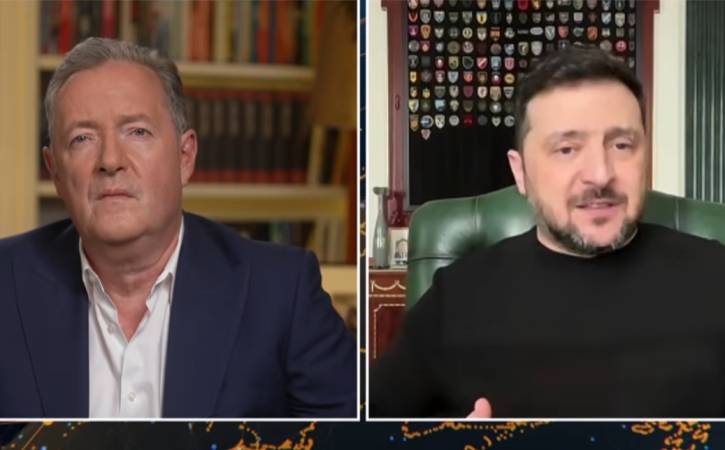
Editor’s Notes: In this exclusive and wide-ranging interview on Piers Morgan Uncensored, Ukrainian President Volodymyr Zelenskyy sits down for a frank discussion as the conflict with Russia nears its four-year mark. Zelenskyy addresses the difficult state of peace negotiations in Geneva, explicitly stating his refusal to cede Ukrainian sovereignty while detailing why he can never trust Vladimir Putin. The conversation also explores the president’s complex relationship with Donald Trump, the “double standards” of international sporting bodies, and the heavy personal toll the war has taken on his own family. Spoken entirely in English, this interview offers a raw and determined perspective from a leader fighting for his nation’s survival and dignity. (Feb 19, 2026)
TRANSCRIPT:
PIERS MORGAN: Four years ago, Vladimir Putin launched a war he believed he could win in four days. More than one million of his men have been killed or wounded since then, so have more than half a million Ukrainians.
And we’re more than one year into a presidential term that was supposed to stop the killing in 24 hours. A lot has changed in four years — and not just the lives of the millions of people living with grief. President Zelensky, revered as a Churchillian hero, became a bogeyman for US conservatives who want nothing to do with the war. The Ukrainian flag is no longer the prevailing symbol of struggle, flying above official buildings and emblazoned on social media. First, it was Gaza. Now it’s Iran.
The war itself has changed. Ukraine has moved from defense to attack with audacious drone strikes on Russian soil. But despite all of this, the big picture frustratingly looks exactly the same. Europe is not doing enough to solve a war on its doorstep. The US is giving Ukraine enough to survive, but not enough to win. Russia, we’re told, can’t possibly sustain those losses, but is also strong enough to raid the rest of Europe if Putin isn’t stopped. And most importantly, neither side wants to blink.
As we prepare to record this interview, Trump-brokered peace talks in Geneva have reportedly ended in acrimony. The US president is pushing for Ukraine to make concessions. The Ukrainian president, Volodymyr Zelensky, says that isn’t fair, and the pressure should be put on Russia. Well, President Zelensky joins me now on Uncensored.
—
The Interview Begins
PIERS MORGAN: President Zelensky, it’s great to talk to you again. Thank you very much.
PRESIDENT ZELENSKY: Hello, everybody. Maybe good evening — I don’t know, we live in different countries. Hello, thank you for the invitation for this dialogue.
PIERS MORGAN: President Zelensky, I came to Kyiv and interviewed you four months into this war. I was struck then by the extraordinary spirit of you, your First Lady, and your people. Ukraine was united, it was resolute, and it was prepared to do whatever it took to win this war. Many people feared that Ukraine would be taken quickly by Russia’s forces. That hasn’t happened. As we approach the fourth anniversary, what are your feelings about this war and where Ukraine now is?
—
Ukraine’s Resilience and the Cost of War
PRESIDENT ZELENSKY: Thank you very much. Of course, people are more tired than they were in the first year of the war. It’s understandable. It’s a long war, a big land war, and now with new technologies — with drones and so on. It’s another kind of war — a cyber war, a hybrid war.
This was, of course, a difficult and terrible winter. We still have winter, but mostly it’s in the past. It was terrible because the Russians understood they couldn’t achieve the goals they had before on the front line. They are not winning on the front. That’s why they decided to try to make chaos. Now we see the answers — they couldn’t manage it, but they wanted to make this a terrible winter by taking our energy.
As you know, we have about 18 gigawatts in Ukraine that people need each day, but Russia destroyed ten. So it’s understandable — people had four or five hours of electricity a day, and not everybody had heating. Of course, we innovated as quickly as possible, everywhere, but the unity of the people is still very strong.
For example, however we innovated everything in the capital — because the capital was in the most difficult situation, along with Kharkiv, Odessa, and Poltava — two hundred brigades came to renovate Kyiv, just from all their regions. It was not just my signal to them to come. Yes, it was, but not only because of that. It was because of the willingness of the people. They wanted to help, and it was like the first days of the war when everybody joined against the aggressor.
That’s why I say, yes, people are tired. Yes, people want to finish with this tragedy. And of course, we want to stop Putin and end this war as quickly as possible — but in the right way, without losing our dignity. That’s why I think our country has not lost its morality and dignity, as it was in the first year. But again, there have been a lot of losses compared to the beginning of the war — a lot of losses during these four years.
We are thankful to our partners, but you know that we pay for this Russian war against us with human losses. It’s a very high price. That’s why we do what we can.
If you’re asking what’s going on on the battlefield — as I said, they haven’t had successful stories. The Russians try to sell their audience successful steps, but they can’t, really. Even their own audience — even the very nationalistic, very radical part of Russia — doesn’t trust their government or Putin, because they see there are no successful steps on the battlefield.
Before the interview, you mentioned the meeting in Munich. During that meeting, I said that Russia is now losing 40,000 to 45,000 killed or wounded per month. They really lose 156 to 157 dead soldiers for every one kilometer of our land they occupy.
—
The Geneva Peace Talks
PIERS MORGAN: I mean, these are staggering statistics and an appalling toll on human life — both military on both sides, and civilian. As we were about to start this interview, the news broke that the trilateral meeting in Geneva between Russia, Ukraine, and the United States had broken up. There have been reports that it was acrimonious, that there was a big dispute. But there is going to be another meeting shortly, apparently. What can you tell me about the current state of these peace negotiations?
PRESIDENT ZELENSKY: I think the good point is that we really had a meeting in Switzerland. This is very important. I always raise this — with all respect to the Middle East and other countries — but I think that if the war is in Europe, then we need to find a place in Europe, and Europeans need to feel that this is aggression against us and against Europe. They recognize it — not everybody recognizes it — and that’s why I think peace negotiations have to be in Europe, to my mind.
This is not the priority. I just wanted to say that it’s in Switzerland. And you said about the next meeting — I just want to underline that the next meeting will also be in Switzerland. That’s the information I have for today. Of course, our group will come back and I will have a more open briefing than the one I had by phone.
In any case, we had two groups — a military group and a diplomatic, political group. On the military direction, we are closer than on the political. Why? Because the military guys spoke practically — they spoke about how to monitor, how to develop a monitoring mission for a ceasefire, when it will come, when the political side opens those possibilities. They discussed details, technical things, the capabilities of both sides — and first of all, of the Americans, because they will have leadership in the monitoring mission.
I also raised the topic of Europeans, because it’s always a difficult discussion about the role of Europeans. For us, the role of Europeans is significant. We again raised the topic that even during the monitoring mission — during the monitoring of a ceasefire, whenever it will come — it’s great that we have Americans, and it’s understandable that in this group will be Russians and Ukrainians, because we stand on both sides of the contact line. But again and again, I am underlining that I think we also need European representatives. It’s up to the military to decide who will be there, but I support this idea.
So on the military direction, as I said, they are closer to a result — we will have a paper where all the details will be written about how to monitor immediately after a ceasefire. On the political direction, it’s more difficult. We don’t have the same view. Even trilaterally, we have three different views on the land question.
—
The Question of Territory and Sovereignty
PRESIDENT ZELENSKY: I think this is not simple. We try to be very constructive. We supported the idea which was previously proposed — I think you remember Saudi Arabia, almost one year ago — when we supported a big compromise as the Americans proposed during the meeting in Saudi Arabia. They proposed a ceasefire and to speak about the other territories which are temporarily occupied only in a diplomatic way. First, make a ceasefire from the point where both sides of the war stand, and then address the other territories diplomatically.
That was a big compromise for us, because we always said that they have to go out from our territory. But the Americans said, “Look, let’s try to find a way to make a ceasefire, move this battlefield to the diplomatic way, and then during diplomatic conversation, you — Ukrainians — with Russians, and with our mediating role, will decide.” That was one year ago.
And now we are a little bit outside of that position, because the Americans said, “Look, we have to speak about a free economic zone.” We said, “Look, guys, we are at the same position — by the way, your American position — which was proposed in Saudi Arabia.” But okay, we are not delaying everything. That’s why it’s my position, Piers — I want to support any kind of format, any kind of dialogue. But that doesn’t mean that I will accept everything.
I can’t just accept withdrawing from our territory — even from the territory which we control right now. That is what Russia’s proposition sounds like. They said that their proposition for Ukrainians is to withdraw our forces from part of the Donetsk region — just to withdraw by ourselves — and the war will stop. But we can’t just withdraw. It’s unbelievable how that can even be proposed. It’s our territory, and of course the temporarily occupied territory is also our territory. That’s why it’s not just “occupied” — it’s temporarily occupied. We are not recognizing it judicially, and we are not recognizing it de facto in any papers. Yes, it’s temporarily occupied territories. It’s very painful for us, but let’s stop where we stand. And this is already a big compromise.
PIERS MORGAN: Can you imagine any circumstance in which Ukraine, while you are president, cedes any territory to the Russians in terms of sovereignty?
PRESIDENT ZELENSKY: Just giving it away by ourselves — I can’t really support such an idea. And I think that in any very difficult circumstances, I’m not sure that our people would be ready either, because thousands — dozens of thousands — of Ukrainians have been killed defending this part of Ukraine.
And I just want to tell everybody — it’s not only about morality. But morality, by the way, is very important for us. Very important. Like values, like freedom — these are not just empty words. For us, they are very important. That’s why the response was so strong from the first day of this war.
Defending these values, we have to understand that Donbas is a part of our independence. It’s a part of our values. It’s not just about the land. It’s not only about territories. It’s about people. It’s about membership, and also about strategy — how to defend our country.
—
Security Guarantees and the Future
PRESIDENT ZELENSKY: So for today, with all respect to the powerful American president and to America as a whole — America as a strong country — and with all respect, we need their security guarantees. But even having all of these, nobody can give us the word that Putin will not come again.
When we speak about security guarantees, we mean we need strong security guarantees — that the rest of the world, or some countries, will be ready to respond to Putin if he comes back with his aggression, or when he comes again. It can be the ending of the war, or it can be a freezing of the conflict, or it can be a pause. And it doesn’t matter — whether this pause is two years or ten years. It’s not about me. We have to think about the next generations. We have to think about the next people who will sit in our chairs, and they have to manage this. We can’t give them an empty paper. We need strong security guarantees.
One of these guarantees is, of course, security guarantees from the United States. Then EU membership is important, as are European representatives on our land. We support this idea — the coalition of the willing. Also, our army. That’s why I have always been against anyone decreasing our army. In any case, it’s up to us, up to our government, up to the will of Ukrainians. That’s why we need these 800,000 soldiers.
And one very important point — defending lines. That’s why when we speak about security, when we speak about the Donbas region, I also think as a president about the defending lines, which are very strong, especially there. What will happen if our forces withdraw — just go out without any kind of security? And if Russia begins aggression again, if they are already at that territory and ready — how can we defend?
For example, when we spoke with military officials from the United States — and Europeans have the same position, by the way — I showed them on paper. I drew it out for them and said, “Look, you know what this means? These are cities. This is one defending line. And you know what comes after the cities? Fields — kilometers of fields. And you know that even if you build defending lines there—”
Russia’s Red Lines and the Question of Trust
PIERS MORGAN: The Russians have stated that there are two absolute red lines for them. One is Ukraine cannot be allowed to join NATO, and there must be a guarantee of that. And secondly, NATO forces cannot be on the ground in Ukraine as part of any security guarantees that you’ve been referencing. What is your view of those two red lines from the Russian perspective?
PRESIDENT ZELENSKY: I think it’s more about ambitions of Russia. It’s not about the real logistic steps. When they speak about that, they also need security guarantees. They said that they don’t trust Ukrainians, that if we will have ceasefire, Russians are not ready for ceasefire because they’re afraid that Ukrainians will prepare and begin offensive operations.
So logically, it doesn’t work for me, because if Europeans or Americans state how we can begin any offensive operations — this is a guarantee that these representatives of NATO, by the way, can give — security guarantees that we will not begin offensive after this war will end, if representatives of these countries will stay. So it doesn’t work. And for me, if Russia doesn’t want representatives there on the front or deeper in the country, it’s the answer that they are thinking that maybe they will come again. Because if there are Europeans or Americans, it’s more difficult for them to begin an offensive.
It’s true. Yes, it’s true. The same about the sea. How we can use sea drones — they’re afraid that we will use sea drones, hundreds of them on the sea, in the Black Sea, maybe in the Baltic, and so on. But how we can do it if the ships of our foreign friends will stay there in the Black Sea and will control security, just security — that there is silence in the sea, that there is a food corridor, the grain corridor, that everything works. And the same about the sky. When they speak about satellites and so on, we need Europeans and Americans. They can control the sky. So that’s why I said it doesn’t work with NATO or representatives of NATO.
The second point — I know that Americans and some Europeans are discussing with Russia about something new, a new document between NATO and Russia. And I always said that we are not in NATO. It’s a pity, but we are not. And we have not been involved in NATO — I don’t remember, really, in practice, not just in words, in practice. The United States, the previous administration and this administration, doesn’t see us in NATO. Let’s be honest.
And they say this. But it doesn’t mean that in the future Ukraine will not be. But again, it’s not up to us. We already did what we had to do. We said that we want and we are ready to be a part of NATO, to be a strong part, and to strengthen all the allies. What more can we do? Nothing.
And now the ball is on the side of our partners, the NATO countries. That’s why I said to NATO countries that it’s up to them to have us or not, to accept us for the future in NATO or not. That’s why when they will have the document between NATO and Russia, they can discuss everything. Everything. But for me, it’s important that they will discuss our potential place in NATO with us — not just with Russians, but with us, because it’s about us.
But they can do it also without us. Maybe we don’t know something. So we will react to surprises in any way if there are any. This is about NATO. That’s why I said that Putin speaks a lot about Ukraine in NATO, but it’s a pity — it doesn’t depend on us.
—
Bill Clinton on Putin: “He Kept His Word”
PIERS MORGAN: You mentioned Vladimir Putin there. I interviewed the former US President Bill Clinton a few years ago, and he had a crossover period when Putin had first come to power and Clinton was president. And I asked him what it was like to deal with Putin. He’s gone viral recently again. I wanted to play you the clip and then get your reaction to what Bill Clinton says about dealing with Putin.
VIDEO CLIP BEGINS:
BILL CLINTON: I think the right strategy most of the time — and it’s frustrating to people in your line of work — is that you should be brutally honest with people in private. And then if you want them to help you, try to avoid embarrassing them in public. Now, sometimes they do things which make it impossible for you to keep quiet. But by and large, I’ve found all the people I dealt with appreciated it if I told them the truth, how I honestly felt, and what our interests were and what our objectives were. And they also appreciated it when I didn’t kick them around in public, for as long as I couldn’t kick them around. So that’s my experience.
PIERS MORGAN: Did Putin ever renege on a personal agreement he made to you?
BILL CLINTON: He did not.
PIERS MORGAN: So behind closed doors, he could be trusted?
BILL CLINTON: He kept his word in all the deals we made.
VIDEO CLIP ENDS:
PIERS MORGAN: I guess the obvious question, President Zelensky, is — would you trust Vladimir Putin? You have suggested that you would be prepared to meet with him leader to leader, and at some stage, I guess that has to happen for a peace deal to be done. Would you trust him if he gave you his word?
I found it very interesting at the time. But this is a long time ago — this is early Putin. I found it very interesting that Bill Clinton said, however rough things got in public, that if Putin gave him his word, he always kept it. Would you feel confident that Putin would keep his word to you?
—
“I Cannot Trust the Person Who Killed So Many People”
PRESIDENT ZELENSKY: Of course not. With all respect to President Clinton and to other partners — he never had a war against Russia. God bless him. He was never in such circumstances and relations as we have. We don’t have any diplomatic relations with Russia. We have a war dialogue, which has only just begun — dialogue during the war. And it’s not even me directly. It’s the technical level of our teams. And we are enemies.
I cannot trust the person who killed so many people in Ukraine and who began a full-scale invasion against my nation. And we answered — you know, we spoke about it today — he attacked all our civilians, infrastructure, people, schools, and so on. Of course we answered, but not targeting civilians. Everybody knows about it.
But in any way, he understands — I think he understands who I am, and I understand who he is. And that’s why I will not trust him. That’s why I have a more specific dialogue with him. It’s not about trust. It’s about deciding how to end the war.
I’m not sure that our teams can really decide the question of the land. Of course, it’s up to our people in any way. At the end, it’s our people who accept the peace deal or not — not up to anybody in the world. And it doesn’t depend on whether a country or leader is strong or not. No, it’s up to the Ukrainian people.
But before that, I see now the result of our negotiation meetings. As I said, there are some points which are constructive. Americans have put in a lot of effort, and everybody wants — I mean, it’s not everybody — we want, Ukrainians want very much to end this war. But I see now that only at the level of leaders can we really try to end this war. At the level of three leaders, we can really try to solve the territorial questions, which are very sensitive, painful, and difficult.
That’s why we speak about security guarantees — because we don’t trust Russians. Personally Putin, and personally Russians. It’s not just about Putin. It’s about the system. It’s about his people around him. Even when another person will be in his place, and other people will be in my place, of course — I don’t know what will happen with him, but in my place, of course.
It means that we have to speak about institutional trust, but not to each other — to the institution of security guarantees. Because we will not trust personally, and our nations will need — I don’t know how many years — for dialogue. I don’t know. I don’t know.
PIERS MORGAN: They need to apologize to you. You want to hear an apology.
PRESIDENT ZELENSKY: Not to me. Not to me. What I mean is that I don’t know how many years — dozens of years, or hundreds of years — before we will need dialogue between our countries. But in any way, it’s not only about years. It’s about the position of Russia.
Like the position of today’s Germany, which apologizes for all those Nazi years. And it’s understandable that it’s not about modern Germans, not about these young people, the new generation. But they know that at the end, it’s all about their roots, it’s all about their country. And it’s so difficult to clean all of this.
In any way, you have to change your strategy — from the point that you’ve been right, to the point that you started the war against people and you are the aggressor. And to recognize — sorry, I just found this word — to recognize that they started the war, to recognize that they really had real fascism in the twenty-first century. This is the regime which is now in Moscow. And that’s why I said that we don’t know how many years. It will depend on the position of Russia.
—
Face to Face With Putin: “No Emotions. Just End the War.”
PIERS MORGAN: If you were to sit with Vladimir Putin to try and finalize a deal, and you were face to face with this man who has committed such horror on your country and your people — what would you say to him if it was just you and him, face to face?
PRESIDENT ZELENSKY: I don’t have personal things against him. No emotions. No emotions. Just — I have an understanding of how to really try to finish this war. Not a permanent pause. I just want to finish this war.
I’m not sure that he will hear my arguments. And I don’t need it, because I’m not the aggressor — I don’t need to find arguments for why I’m aggressive. I don’t need arguments for the world about why I’m defending my life, like all Ukrainians. We don’t need it.
That’s why we don’t need to lose time on all these historical issues. With all respect to history, I don’t want to lose time on all these issues. We need, just now — and even by the way, we need just now — to finish this war.
That’s why it’s not even interesting to me why he began this war. He has his reasons, and it’s his personal matter. I don’t want to speak about it because I don’t have time. I have my point of view on why he began, or why this system began. And I can definitely speak about it. But I don’t need to waste time on historical issues, reasons why he began — all this, I think, is bullsh that he’s raising with Americans, about Peter I and so on. I don’t need it.
Because to end this war and to go a diplomatic way, I don’t need all this historical sh, really. Because it’s just to postpone. Because I have read no fewer historical books than Putin, I’m sure, and I’ve learned a lot — because we have to know everything about this country. And I know about his country more than he knows about Ukraine, simply because I was in Russia, in so many cities, and knew a lot of people, so many times. And he has never been so many times in Ukraine — he was only in the big cities. I was from small cities, from the northern part to the southern part, everywhere. I know their mentality.
That’s why I don’t want to lose time on all these things. It’s about them. They decided to have such a system. Russians decided to change themselves. Russians decided that they need a new Tsar. But that’s up to them.
But there is a security issue. There is a big war against us. There are our lives. The only thing I want to speak with him about is how to manage the most successful way — the quickest way, without too many more losses — to end this war. That is what I want to speak about only.
—
On Assassination and the Question of Putin’s Elimination
PIERS MORGAN: President Putin and his forces have made multiple attempts to kill you. If you had an opportunity to kill Putin, would you authorize your forces to take that opportunity?
PRESIDENT ZELENSKY: In their system, I’m not sure that another person would not be Putin — the same as Putin. It’s not about such things.
I don’t know how many times they tried to kill me. My security service told me about some of those times. I understand that in my country, in this difficult period of time, it was like pushing Ukraine into chaos.
But when you see our people under missiles and under attacks on our energy system — that is one of the elements which is very important during this war, not the only one. Of course, the priority is the army. The army is the strongest point, which is very important.
Zelensky on Ukraine’s Resilience, Trust in Trump, and the Path to Peace
PIERS MORGAN: But there are some other things, business which pays, defending production, energy system, water supplies, a lot of different things, banking system, anti-cyber system, and etcetera. So a lot of things which give Ukraine a possibility to defend. So in our system, the president is one of these elements. I’m not comparing, and I’m not sure, of course, that I’m the very important person. It’s more about institution.
The president in Ukraine is one of these institutions which strengthen the country. And they understand that to delay me, first of all, you always can find somebody in your country who will be maybe more diplomatic. Yes. And another thing is that the first period of time, the country can be in chaos.
But again, I think that it’s not smart to do because as I said, the attacks on our energy didn’t break our country. It was the opposite — the hatred towards Russians increased after that. That’s why I think it’s the same with killing people, even the president. It will not break. It will not break.
I think that the reaction can be another, which Russians — it’s a pity, but they don’t really estimate the reaction of Ukrainians because we are — I always said — we are emotionally different people. Emotionally different people. That’s why after emotions, after attitude to humanity, always go the values. And that’s why we can understand each other. We can speak with each other. We can fight, as you see, but for different values.
—
The Oval Office Confrontation with Trump and Vance
PIERS MORGAN: When you had the now infamous shouting match with President Trump and Vice President Vance in the Oval Office, the world watched on in horror, I think. But I made the point at the time, and you can correct me if I’m wrong here, that I suspect that you guys have had quite a few fiery conversations behind the scenes during this war. The only difference is that this time it was in public and the world was watching. Is that true? Have you behind the scenes had a lot of fiery, passionate arguments like that?
PRESIDENT ZELENSKY: First of all, we had different — absolutely different — conversations with Americans. I had a lot of different conversations with the Biden administration, and I had with Europeans a lot of conversations. And of course, I had during this year conversations with President Trump and his team. Different. Some of them have been very constructive. Some of them have been emotional, like one of them which you raised, and there are some which have not been in the media but have also been emotional.
Yes, it’s true. Emotional. But I think — I don’t know. We are who we are. So I can’t change myself, and it will not be fair to my people, first of all.
PIERS MORGAN: People said, President Zelensky, that you were humiliated in the Oval Office that day. Did you feel that?
PRESIDENT ZELENSKY: Not me. I had the feeling that Ukraine was in a position where our people — after all these days and years and after all this pain — thought that it was not, how to say, fair. It was not just to us. Even not the words of the president — I’m not about the words. I’m speaking about the situation.
I came to the partners and I wanted very much to hear more big support than the previous administration. Yes, I wanted that because I knew that President Trump is a strong person, and that’s why I wanted to have strong support. But even so — it’s not my decision, I mean, it’s the decision of a sovereign country — I didn’t want to hear, with all respect, some support of Russians. That’s why my reaction was my reaction. That’s it. What can I say?
—
On Trump Being Tougher on Ukraine Than on Russia
PIERS MORGAN: When it comes to President Trump, I’ve had private conversations with him multiple times in the last year since he became president again. And he cares genuinely and deeply about the appalling loss of life in this war. And he is, it seems to me, desperate to try and bring peace and to end this war. But many people feel he’s tougher on you and Ukraine than he is on Russia and Putin. Do you think that? And if that is the case, why do you think he’s tougher on you than he is on Russia and Putin?
PRESIDENT ZELENSKY: I don’t know. Maybe because America thinks that they helped us from the very beginning of this war. And even before the war, when President Trump sent Javelins — I have also been very thankful to him. It was not during my presidency, it was before, but in any way, we speak about our country. It doesn’t matter who is the president at that time. But he helped, and I think that he saw that he helped Ukraine and Ukraine has to be more thankful, and he underlined it. And I think you hear about it.
Maybe he’s right. Maybe we have different positions on it. I think that we are defending Ukraine and defending the world and defending the values which all these Americans spoke about and tried to push to the world. And I think that we are defending by paying with our lives. That’s why I thought that it’s not just help. No, it’s not just — I mean, for the nations of America — it’s about the help of allies, that we help each other. We are helping to defend Europe, and America is helping Europe to stay alive. And that’s why they support us. Maybe we had different views on it.
PIERS MORGAN: Do you trust President Trump?
PRESIDENT ZELENSKY: I trust him on the first, very important thing that you said — that he really wants to end this war. Yes, he really wants to end this war. And the second point — when he speaks about the children, when he speaks about losses in Ukraine, I trust that it’s very painful for him and he speaks about it. Yes.
I don’t know all his internal questions and steps. With all respect, I’m sorry — I’m focusing on the war, not on these things. Maybe some of his internal American things are even more important for him than this war. I’m sure of that. But in any case, I trust that he really can end this war.
But I don’t know — to speak about his relationship with Putin — I want to be very honest. It’s not about a question of trust or not. He has such a relationship which I can’t really estimate or understand. Something which is not known to me. I don’t know about it. But they have some relationship, I’m sure.
And that’s why for me, sometimes it’s very painful that his attitude to Putin is sometimes — yes, I think sometimes his attitude to Putin is more favorable than Putin deserves. And that’s it. I’m sharing with you what I think.
But really, Trump always speaks with me about the many, many losses in Ukraine. Yes. And that’s it.
—
On Elections, Ceasefire, and the Path Forward
PIERS MORGAN: President Trump has said that he would like to see presidential elections in Ukraine this summer. Obviously, because of the war, it’s not been possible to have a free and fair democratic election because you have hundreds of thousands of men fighting on the front line. You’ve had millions of people leave the country. Obviously, twenty percent of the country is under Russian occupation at the moment.
You have responded that if there was a two-month pause in fighting — a ceasefire — it might be possible to have elections. Do you think it would work to have a free and fair election even after a two-month ceasefire?
PRESIDENT ZELENSKY: I think that our partners have to answer one question — what do they want? Do they want real elections, or do they just want to change me? And I think that Russians just want to change me. And then they used something you said before — physical change or other steps. And there is a very, how to say, civilized way. Yes, a civilized way is elections.
Yes, but you can’t influence the people of other nations. They have to choose with whom they live. But I said that I will never stop any propositions from the Americans if they can bring us peace. So if we can have two months of ceasefire for elections, I will do my best to speak with parliament and to push parliament in a direction which they don’t support — and even the people don’t support — to make elections during the war. Because even if you have a ceasefire for two months, it’s not ending the war.
But even in such a case, if you have a ceasefire for only two months — yes — if it can bring, at the end of those two months, the signing of everything, or a referendum, or something like this, and people will accept peace, I will do my best. I will speak with parliament. They will change the law. I hope so. I hope so.
By the way, they are also independent people — we must not forget that. When Russians, for example, speak with Americans, I know they say elections can be done in one week or two weeks. It doesn’t matter. No — they always forget that we are not Russia. In parliament, yes, there are our parties, different parties. But even during the war, we have different positions on many laws, different positions on a lot of things. And that’s why you can’t just pressure or break the parliament. You have to speak with them and have real reasons why to have elections now. Because now it’s against today’s law. We can have elections only during peacetime. That’s it.
But I said — do the strong first step. Push Russia for two months of ceasefire for elections. If they want elections, we can think about it. They have to do their homework. I mean, homework doesn’t mean that we are pushing them to this. They raised this topic. That’s why I said, “Okay, guys, if you can stop Putin for some months for the elections, let’s do it.”
—
On American Public Opinion and the Fight Against Corruption
PIERS MORGAN: It’s an interesting situation with the American public in relation to you personally, because there are a lot of people on the MAGA conservative right who, as you know, don’t like you, don’t like the American support for you or Ukraine. They think that Ukraine is corrupt — and we’ll come to some recent stories about that. But that’s how they view you.
But at the same time, a YouGov poll only last week — I think it was two weeks ago — in the United States came out. It asked U.S. adults to give favorability ratings to world leaders. And you were number one by a distance. You were the leader around the world that most adult Americans view favorably. Putin was second to bottom, just above Kim Jong-un from North Korea. Donald Trump himself was sixteenth, which is not surprising because the country is obviously pretty split fifty-fifty.
But the fact that you won a favorability rating amongst American adults so comfortably, and Putin came right at the bottom — what does that tell you about how most Americans really feel about you and Ukraine?
PRESIDENT ZELENSKY: First of all, I want to react by saying that I’m trying to be as honest as possible with everything and with everybody. Of course I have mistakes, like every person who tries to do something in this life. And when any newspapers and media in Ukraine or somewhere speak about some cases of corruption — this is the answer. This is the answer that we fight against it. And that we have such cases, yes, but we are building a big anti-corruption infrastructure. This is the first point.
The second point is that we are a new country with historical roots. We had our independence thirty-five years ago. And of course, we’ve always been under somebody — some pressure on our roots, on our identity, on our language, a lot of things — but at the end, on our freedom. This is the most important thing. That’s why it was always difficult to fight for independence. And that’s why, of course, institutions are young. That’s why there are a lot of different people and there are some cases, and of course there are criminal cases, a lot of different things.
The difference between our country and other countries is that we are not silent. I think this is good — that we can speak about it and we can really support the fight against any kind of such cases as you mentioned.
The second point is that we really fight just for freedom and for independence. And I’m focusing on it. And I think that Americans feel it. They feel that we are honest in this fight. They feel that the big guy — the Russian enemy in this case — wants to consume us. Definitely. One hundred percent. They just want to destroy us totally. And I think that Americans feel it.
My personal steps each day are about speaking with the world, telling the world all these crimes that Russia has brought to us. And I think that Americans also feel it and hear it. Yes.
And I know that the questions of a lot of difficulties — crimes, anti-corruption steps, or corruption steps — will be raised a lot of the time, because they don’t know what more to raise, what is wrong with Ukraine, how to divide this society in Ukraine, how to pressure and at the end how to change me and how to break our soldiers. So it’s understandable what Russia is doing. And I think that Americans, mostly, they feel it. They feel where the truth is and where it is not, where there is disinformation and where there are real problems in Ukraine.
And I think the answer for such support is in this — that Americans truly understand and are truly on our side.
—
PIERS MORGAN: President Zelensky, I want to end just with two questions. One is about the Olympics. One is about you and your family.
The Winter Olympics Controversy
PIERS MORGAN: On the Olympics, there was an extraordinary moment last week in the Winter Olympics where the Ukrainian skeleton racer, Vladislav Horaiskyovich, was thrown out of the Olympics for wearing a helmet that had images of athletes and children killed during the war. You’ve now presented him with the order of freedom. But I posted, as you know, because you posted back at me on X, that I was enraged by this. It wasn’t a political statement. It was somebody using a helmet in the Olympics simply to honor people who’d been killed.
Did you feel that it was outrageous that he was thrown out of the Olympics?
PRESIDENT ZELENSKY: Yes. Yes. Of course. They withdrew this man — no, this man after his steps. He’s not a boy. He’s a man. And I had the privilege to meet with him and his father. He’s a trainer. And he came to the Munich conference, but I reacted after they withdrew Vladislav.
You know, the reaction of all the people has to be very, very strong for this, because it’s not just about him and Ukraine. I can tell. Because, as you know, in Ukrainian language, it translates like “two standards policy.” I don’t know if it’s understandable in English.
PIERS MORGAN: A double standard?
PRESIDENT ZELENSKY: Yeah. Double standard policy. Why? I will tell you. I like sport. I don’t have time, but I am a fan of different kinds of sport. I always respect all sport. I understand that it’s a big, difficult work to be a great sportsman. That’s why I deeply understand the details of some personalities who’ve been taking part during the Olympic Games, who participated in teams.
For example, if you look at figure skating — German, United States, Kazakhstan, even Poland, maybe I’m mistaken, but in any way. You can see different countries. Hungarians also. In the Hungarian team, by the way, in the pair of figure skating, both are Russians. Both Russians.
So what I wanted to say — if you look at figure skating, just one kind of sport during these Olympic Games, you will see that thirty percent, maybe half, thirty percent of the teams of all the countries have Russians there. Not Russians who were born somewhere else — I’m not about their identity, I’m not about roots. I’m about Russians who trained in Moscow, in St. Petersburg, who trained in Russia, who moved during the full-scale war to another country and changed their citizenship. No, it’s not my attitude to them. That was their decision. It’s my attitude to the management of the Olympic Games. That was their choice. They have to live with it, and they will live with it.
But at the same time, as I said, it’s two standards.
PIERS MORGAN: Well, also, President Zelensky, if I could —
PRESIDENT ZELENSKY: If I could tell you something else about this nonsense —
PIERS MORGAN: Sorry. Finish your point, please.
PRESIDENT ZELENSKY: I wanted to say — they withdrew one man with a helmet bearing images of sportsmen, not just soldiers, by the way, but sportsmen who became soldiers or were killed by the Russians during this war, during Russia’s aggressive steps, and he put them on his helmet. It was to show that people must not forget. And for me, it’s very symbolic that these boys and girls represented Ukraine even in such a way — they represented Ukraine in the Olympic Games. That’s a great idea. It’s all about respect to these people, not something else.
But the fact that they withdrew this man means they made this case political. They moved this case from sport to political policy.
The Paralympics Decision
PIERS MORGAN: Well, also on the same theme — I don’t know if you’re aware of this, but this morning, the Winter Paralympics announced that Russian and Belarusian competitors will be allowed to perform under the flag of their countries, which is obviously not the case in other sporting competitions since the war began. What is your reaction to that decision?
PRESIDENT ZELENSKY: I don’t want to say that it’s about money because I don’t know. But it’s a dirty decision, absolutely not respectable and not European. This is not Europe from the point of values. I think this is an awful decision. Absolutely. And not just the decision — we will react. I didn’t know about it. Thank you for telling me, but I didn’t know about it.
But it’s like the Russian way of life, how they began this aggression. You know, we say — gripping, gripping, gripping occupation. A little bit of Crimea, nobody answered, nobody gave a kick. Nobody is answering, nobody is putting sanctions — okay, full-scale invasion. Step by step, the Russian way of life. The same with the Olympic Games.
A Personal Tribute and Farewell
PIERS MORGAN: Finally, President Zelensky, and thank you so much for giving me so much time. When I interviewed you that first time, four months into the war, your wife, the First Lady, joined us. And I wanted to play you a clip from what she said.
VIDEO CLIP BEGINS:
OLENA ZELENSKA: When we have this interview, we experience joy because we have the chance to see each other throughout past days, past months. Because during this period, Volodymyr has been living at his workplace. And I’m with the children, but we are in another place.
VIDEO CLIP ENDS:
PIERS MORGAN: I was really struck by the way she said that and the fact that obviously you had so little time together. In the next three years, I’d imagine the war has put an unbearable strain on your life, your family life — with both your wife, your kids and so on. On a human level, how has it been for you as a family?
PRESIDENT ZELENSKY: Not enough time. The daughter — she’s not a child, she’s a young lady — and I lost this time. I lost this period from childhood to this moment, to today’s moment. I lost it — I will not even say because of the war. I lost it by myself. Of course it’s because of this war period, but in any way, this is my question.
And the boy — he’s a real boy and he has many questions for me, and I didn’t have enough time for answers. What can I say? Thanks to my wife that they are well educated. I think this is very important — when you are losing time and you know that this period of all these challenges, to have good education, not bad education. Yes, because it’s not normal education in any way — everything is online, it’s not the same as offline, and that’s why the level is what we have. But it’s the same for all Ukrainians. We are all in the same position.
But this is important — the one emotion is that they still miss me and I still miss them. And I think that if we miss each other, the only one constant thing we have is that we love each other. And I think that is great.
PIERS MORGAN: That’s wonderful to hear. And I think I said to you when I saw you in Kyiv that you reminded me of Winston Churchill — that sometimes leaders are kind of born for a role, to lead a country when it comes under attack, as Churchill was in World War II, as I think you were in Ukraine.
And for all those who criticize you, President Zelensky, I have remained absolutely steadfast in my enormous admiration for you. I think you’ve shown astounding leadership and courage — personal courage. And I just want you to know that a lot of people feel that way about you. We wish you all the very best in trying to secure peace for your country, and hopefully it comes sooner rather than later for the sake of everyone involved in this awful war.
And just on the point of education — I would like to point out to my viewers that I’ve interviewed you numerous times now, but always in Ukrainian with a translator. I asked you today if you would do the interview in English. You’ve spoken for nearly eighty minutes in English. Your English has improved enormously from when I first met you. So congratulations on that, and thank you for doing it in English.
PRESIDENT ZELENSKY: I appreciate it. Thank you so much. And I’m so sorry — to you and to all the viewers. Sorry for my English. Maybe I made a lot of mistakes. I’m so sorry, but I tried my best.
PIERS MORGAN: Your English is great, actually. And I think it’s more powerful to the wider global audience when you speak in English like this. Your English was excellent, and I really appreciate it. Best of luck to you, President Zelensky, and thank you so much for giving me so much time.
PRESIDENT ZELENSKY: Thank you so much. Thank you, Piers. Thank you for your support. All the best. Bye bye.
—
Panel Reaction: Analyzing the Interview
PIERS MORGAN: Interviews with President Zelensky always make headlines, and they always spark debate. He is, after all, a world leader fighting the deadliest European conflict since the Second World War. I’ve personally interviewed him numerous times since the war began, but this time it felt different. This is a man no longer holding back.
You may be frustrated by the stalemate in Ukraine, by the same talking points, by the same arguments, by neither side giving an inch. Well, so is he. Whatever your personal view of the conflict, Zelensky has personally had four years of arguing his country’s case with diplomacy, four years of questions about Russia’s red lines, and four years of talking points about why Americans — at least some of them — don’t support the war. Clearly, he’s had enough.
He told me Ukrainians want the war to end, but not without their dignity. He said he doesn’t trust Russians, and he’ll never trust Putin. He said he’s sick of wasting time on historical bullsh about Russia’s right to invade. He said that Oval Office bust-up was unfair on his country. He said he’s pained by Trump’s relationship with Putin, the man who invaded his country. And he slammed the Olympics and Paralympics for what he called an awful double standard.
This was a frank, feisty, and fed-up Zelensky who wants his country’s suffering to end. But for those who’ve held clear and firm views on this war ever since it began, did it change their minds at all?
Here to give their reaction to the interview: Scott Horton, author of Provoked; General Mark Kimmitt, former US Assistant Secretary of State; Jack Posobiec, senior editor of Human Events; and Anna Danylchuk, Ukrainian commentator. Welcome to all of you.
Territorial Compromise and War Aims
PIERS MORGAN: General Kimmitt, welcome back to Uncensored. I’ve interviewed Zelensky a few times now, and I really felt that he’s reaching a point where he’s prepared to speak very frankly — probably the way he does in private, but now prepared to do it in public. And it struck me that at the center of all this, in the end, is this debate between all the sides. He made a point of saying it’s a three-way debate — United States, Russia, and Ukraine — over territory.
Ultimately, any peace deal is going to come down to a settlement over territory, and he is not prepared to cede, on behalf of the Ukrainian people, an inch of land in terms of sovereignty. The compromise, as he was putting it to me, is that they may freeze this war on current territorial lines — but without any ceding of territory — and work out security guarantees, perhaps for ten or twenty years, in a way that ensures Putin can’t attack again. What do you make of what he was saying about that?
GENERAL MARK KIMMITT: Well, I think he’s starting to acknowledge that his war aims are finally getting worn down. And for that matter, so are President Putin’s. One of the reasons they can’t come to an agreement is because they still believe in their original war aims. President Putin wants him out. He wants to take Ukraine, and he doesn’t want Ukraine to be part of NATO. He doesn’t want those security guarantees.
President Zelensky wants security guarantees to include being part of NATO, wants to restore his entire landmass including Crimea, and wants Russia to pay reparations. What has changed in four years of war?
So I think at the end of the day, if President Trump wears him down and says, “We’ll offer you those long-term security guarantees for land,” I think he’s got a choice to make, and his people have a choice to make — which is either continue this slaughter for years and years, or finally come into some sort of cold war, some sort of frozen conflict inside the country.
The State of the Battlefield
PIERS MORGAN: I want to play you, General Kimmitt, just a clip of what he said about the current state of the battlefield — in the context that there’s been a report out today that Ukraine has made more gains in the last three or four days than it has made for a very long time in this war. Let’s hear what Zelensky had to say.
VIDEO CLIP BEGINS:
PRESIDENT ZELENSKY: If you’re asking what’s going on on the battlefield — as I said, they didn’t get successful stories for them. The Russians try to sell their audience successful steps, but they can’t really. Even their audience — even the very nationalistic, very radical part of Russia — even they don’t trust their government, don’t trust Putin, because they see that there are no successful steps on the battlefield.
VIDEO CLIP ENDS:
Russia’s Military Failures and the Path to Peace
PIERS MORGAN: The report I was alluding to said that Ukraine has recaptured territory at its fastest pace in three years, seventy-eight square miles between last Wednesday and Sunday, which is equal to Russia’s advances for the entire month of December. Should we read anything significant into that? And what do you make of his kind of overview that Russia has failed in its military objectives, which, you know, I remember at the start of the war, the belief was Russia was trying to get this over in a few days, depose Zelensky, take control and so on. Clearly, that has not been achieved. And they’ve lost over a million people in terms of death and wounded in this war so far, which is a catastrophic loss for any army. What do you think of the two points?
GENERAL MARK KIMMITT: Well, number one, Russia has not achieved its military aims in any sense of the word. Number two, seventy-eight square miles in a country of that size is meaningless. Unfortunately, one of the most pressing articles I ever wrote was in July of 2022 in the Wall Street Journal, when I said this is going to turn into a bloody stalemate. I wish I was wrong, but this looks like — and you know this well, Piers — the history of the First World War after about a year and a half.
Looks like Flanders Field.
PIERS MORGAN: Yeah. You know, the last person that used the comparison to Flanders to me privately was Donald Trump, President of the United States, who said that this is like Flanders. It is open fields, and there are thousands of young men being mowed down week after week, month after month, year after year. Let me bring Scott Horton in.
Scott Horton on the Origins of the War
Scott, I obviously know your perspective on this war. I thought it was interesting that President Zelensky several times just said to me he’s not interested in relitigating Russia’s excuses for doing the invasion, or as he put it, “all the historical bullshit.” And I’m sure that people will take issue with that. But I think what he was really getting at is that we are where we are, and it is kind of meaningless to any resolution now. Would you agree with that?
Notwithstanding, I know you wouldn’t view what happened before as historical bullshit, but do you agree that we are where we are, and if we need to get to peace, actually, it is kind of irrelevant?
SCOTT HORTON: Well, no. Because you have to take into account what started the war in order to figure out how to solve it. So for example, if Ukraine is going to insist on more guarantees from all the European countries and even the United States, including hosting European troops on their territory, well, then obviously that is completely contrary to incentivizing the Russians to compromise and come to peace on their side, since that was one of the major instigators of the war — the integration of Ukraine into the Western alliance instead of working on a permanent neutrality.
As I’ve said on the show before, even the NATO expanders said all along, “Well, we’re going to have to make a special case for Ukraine and guarantee their neutrality.” And then when the policymakers didn’t abide by that, starting with George W. Bush, they really put Ukraine on the path to war. That’s the point of my book — the book is called Provoked: How Washington Started This War — not so much Kyiv. It’s the United States that put them in this position.
There’s that famous Henry Kissinger quote that says, “To be America’s enemy is dangerous, but to be America’s friend is fatal.” And what he was talking about was the kind of things that he would do, which is support people in a fight that they can’t win and then eventually turn around and leave them high and dry — like the Bay of Pigs, or like the Shiite uprising and Kurdish uprising in 1991, or the Hmong tribesmen in Vietnam, or you name it. We’ll make big promises and then stab you in the back.
And so the Ukrainians have a right to be resentful. Joe Biden promised them total victory. “We will give you whatever it takes to completely defeat the Russians.” And based on those promises, they gave up on the peace talks in the early part of the war in 2022. Then the die was really cast, Piers, in September of 2022, because that is when Ukraine had their best day — their best weekend — when they got a real victory in Kharkiv and down in Kherson.
But then Putin just got angry, called up three hundred thousand more troops, and then officially annexed Zaporizhzhia and Kherson, doubling the size of his territorial claims in the war, which he’s still far from achieving. And so you mentioned that seventy-eight miles — the only meaningful thing about that really is it reinforces the Ukrainian government’s position that they don’t want to quit when they haven’t lost yet. But of course, the Russians don’t want to quit when they are winning, but slowly, and they are far from finished taking even the rest of Donetsk, much less the rest of Zaporizhzhia and Kherson.
So at the rate we’re going, this thing could go on for years, and it really is all Washington’s — and especially Joe Biden’s — fault for getting the Ukrainians into this position and then refusing to negotiate a peaceful settlement.
Anna Danylchuk on Ukrainian Trust in Zelensky
PIERS MORGAN: Yeah. Anna Danylchuk, I want to play you a clip. This is where he talks about Vladimir Putin and the prospect potentially of a face-to-face, leader-to-leader meeting, which obviously hasn’t happened since the war began.
VIDEO CLIP BEGINS:
PIERS MORGAN: If you were to sit with Vladimir Putin to try and finalize a deal, and you were face to face with this man that’s committed such horror on your country and your people, what would you say to him if it was just you and him face to face?
PRESIDENT ZELENSKY: I don’t have personal things to him. I have my point of view on why he began, or why this system began, and I can definitely speak about it. But I don’t need to waste time on historic issues, reasons why he began — all this, I think, bullshit that he’s raising with Americans and so on, about Peter the First and so on. I don’t need it, because to end this war and to go the diplomatic way, I don’t need all this historical sh, really.
VIDEO CLIP ENDS:
PIERS MORGAN: He went on to say that he doesn’t just distrust all Russians, but he specifically wouldn’t trust Putin at all. I just want to flip that question slightly and ask you, as a Ukrainian — do most Ukrainians still trust President Zelensky to do the right thing by them in this war?
ANNA DANYLCHUK: Yes. And, you know, I think this is one of the big things that many people who push Ukraine to have elections right now — to organize all the process in one week, change the landscape, and make it easier to get Ukrainians to agree on giving up our territories or the way we see our future. But it’s not the first time that Ukrainian civil society surprises the world.
We do have a very open, very sincere, and active — not always easy — dialogue inside Ukrainian society. And you might have noticed that with protests, with disagreements, we always react in a constructive way. And this is actually what ruins all of Putin’s plans. He has misread Ukraine from the very beginning in 2022, and now.
They think that the problem is Zelensky, because in Russia, they have just one leader for twenty-five years, and nobody’s talking about the need for elections. The fact that we have this dialogue, that we influence the decisions of our government, that we have a parliament that is working, that we do not rewrite our constitutions based on the czar’s decisions as they do in Russia — adding Ukrainian territories or changing the duration of Putin’s regime — all of this matters.
Of course, we can criticize our leaders. We can demonstrate that we don’t like something. But in general, what Putin did is he united Ukraine extremely well. Even during this cold genocide that he tried during what may be the worst winter in ten years, the country once again backed each other up. Regions sent energy to the most affected areas, and nobody during these cold, dark days thinks, “Oh my god, we want to join Russia.”
Concerning a meeting with Putin, I think our president is young and strong, and Putin could not survive that meeting. But speaking seriously, I think that not enough world leaders discuss whether Putin is actually adequate and fit for the job now, after a quarter of a century of his reign. And I’m sure that he knows very little about the things that are happening on the front lines or in the Russian economy.
Their decision, for example, to switch off messengers only proves that these pressures and problems in Russia keep accumulating. Look at me — I’m in Ukraine. I have problems with electricity, but I have access to messengers. I can speak to you. Russians cannot do it, and not because they are hiding their victories or successes.
Jack Posobiec on the MAGA Right and American Public Opinion
PIERS MORGAN: Jack Posobiec, it was an interesting moment when I told him about this YouGov poll that came out several weeks ago. Obviously, there are a lot of people on the conservative MAGA right that have expressed concern about America continuing to fund Ukraine and its war against Russia. It’s split the conservative right in many ways, in a surprising way, because if you went back thirty or forty years, it would be unthinkable that the American conservative right would not be united in wanting to help a European country against a Russian dictator. But times have changed.
And I was struck by this poll because, notwithstanding all the animosity that’s come Zelensky’s way from sections of the conservative right in America, this YouGov poll showed that he is by far the highest amongst American adults when it comes to favorability of any world leader. And it’s Putin who’s right down at the bottom with Kim Jong-un. So what was your reaction to that poll, and what do you feel it says really about what most Americans are thinking?
JACK POSOBIEC: Well, Piers, it’s the first time I’ve seen the poll, and it really goes to show me that Americans do, by and large, regardless of which side of the aisle you’re on, stand for freedom. They stand for the right to vote, the right to democracy. These are things that, by and large, Americans do share.
Now, of course, across the left and right, you’re going to find many big differences on how we define that democracy. The left likes to use this as a watchword — “our democracy is under assault” — when President Trump is simply using the actual laws on the books for deportations or something like this.
But what I wouldn’t read into that poll too much is an appetite for continued war, and that is where you see the split that you’re talking about among the MAGA right. It’s typically an age split. Those who are older tend to support war, whether it be Ukraine, whether it be Iran. We’re, of course, hearing the war drums beating yet again as we speak, and seeing a massive military buildup in the Middle East.
And when you look at the younger voters — I work with Turning Point USA — when we see folks really in college, in high school, even up to the forty-year-old level, that’s where you just see people who are remembering the history of Iraq, the history of Afghanistan, the losses there, the disastrous withdrawal from Kabul, saying, “What was it for? What did we go for?” And people who are veterans, like myself, who served in the War on Terror — a lot of people are saying, “Do we really need to do another one of these things?” And politically, that’s where the bottom falls out.
PIERS MORGAN: I mean, just on that point though, it’s interesting because when this debate started, of course, America was pursuing very much an America First agenda under President Trump in his second term. But now he’s flexing American military muscles in a number of places — from Venezuela to Iran and so on — showing that he does have an appetite for engaging in foreign affairs in a way that perhaps some people who are MAGA or America First in their thinking find a little bit perturbing.
But it makes interfering in the Ukraine war more consistent with what he’s doing in other parts of the world, because actually what Trump would argue — and has argued — is that you can’t let Russia just ride roughshod over a sovereign, democratic European country. And my whole argument from the start has been, if you let him take Ukraine or the Donbas, for example, as he took Crimea, as he marched into Georgia and all these things, the lesson surely we’ve learned from Putin is he won’t stop there. Why would he? He would just perceive weakness and carry on trying to take more.
JACK POSOBIEC: Well, I think you’re going to see this split continue regardless of what really happens, because it’s not so much that Americans are going to support Russia in their gains — which, of course, we’re always accused of whenever anyone brings up this America First line. It’s that Americans are sick of putting the interests of other people around the world ahead of their own.
When you’ve got people freezing to death on the streets of New York City, when you’ve got people who are trying to just put food on the table, where we do still face issues with inflation in the United States — and when you look at the affordability crisis, which unfortunately has seen some help on gasoline and some other issues, but price-wise, those are the issues that are going to be driving this election, not foreign policy.
And I predict that when you go outside of the America First wing and just really look at the broader picture, any of these actions — whether continued war in Ukraine or a new war in Iran — that is going to be very, very unpopular with the American people writ large.
The Oval Office Confrontation: Zelensky’s Reaction
PIERS MORGAN: General Kimmitt, I want to play you a clip. This is where we talked about the now infamous meeting in the Oval Office. It got very shouty and acrimonious between President Zelensky, President Trump, and Vice President J. D. Vance.
VIDEO CLIP BEGINS:
PIERS MORGAN: People said that you were humiliated in the Oval Office that day. Did you feel that?
PRESIDENT ZELENSKY: Not me. I had a feeling that Ukraine was in the position and our people, after all these days and years and after all this pain, I thought that it was not — how to say — it’s probably what’s fair, no.
It was not just to us. It was not simply — not just to us. Even not the words of our president. I’m not about the words. I’m speaking about the situation.
VIDEO CLIP ENDS:
PIERS MORGAN: But what did you feel generally, General Kimmitt, at watching that? Did you feel it was disrespectful to Ukraine? Did you feel it was a bit humiliating for Zelensky? Or is this the kind of, as I suggested to him, the kind of confrontation that goes on a lot behind the scenes when you’re trying to negotiate peace in a war — and that actually the difference this time was it happened in the Oval Office in the full glare of the world’s media?
General Kimmitt on Trump’s Evolution and America’s Role
GENERAL KIMMITT: I think that was early on in President Trump’s second term, and I think he was still sort of getting his feet on the ground. You take a look at Steve Witkoff, Jared Kushner, and the other negotiators that we have around the world — they’re not acting that way, and President Trump is not acting that way. So that was pretty much a maturation of the president. I think he’d take it back and at least do it behind closed doors the next time.
Listen, I’d like to go back to a comment that was made. I think people don’t understand to a great extent what’s happening in America. What is called the right-wing MAGA is really a conventional isolationist group, which you find in both the left and the right.
President Trump has turned out to be far more internationalist than those on the right who believed we were going to get an isolationist president — or at least a president who was going to focus on more immediate challenges and larger challenges like that of China.
But I think it’s also important to understand that in terms of quoting Iran and quoting Venezuela, Ukraine is unique. Ukraine is simply unique because Americans don’t feel it. There are no American troops at risk. There are no American troops that are getting killed.
This is, in many ways, for somebody who spent twenty-five years of his life on the East German border — this is ideal. We’re finally killing Russians and we’re not getting Americans killed.
But nonetheless, I think the important thing to understand is that the Ukrainians are taking the casualties. They are willing to fight, and whether you’re an isolationist or a globalist or an internationalist, we should be backing Ukraine until this is over. Doesn’t matter how we got here. It matters where we are and where we’re going from here.
The Iranians — let me jump in here, Piers.
PIERS MORGAN: Yeah.
GENERAL KIMMITT: Let me just finish.
PIERS MORGAN: Yeah, sure. Sorry. I thought you were finished.
GENERAL KIMMITT: Let me just finish. If the Ukrainians want to fight to defend their country, why shouldn’t America support? We’d support any other democratic country in the world.
Scott Horton on Isolationism and the Cost of War
PIERS MORGAN: Okay. Scott?
SCOTT HORTON: Well, yeah, a few things here. First of all, anyone in American political culture could tell you there are no group of people anywhere who call themselves isolationists. That’s just a smear term for anyone who’s anti-war. No one talks about isolationist Brazil or isolationist Spain just because they’re not picking fights all the time the way the United States —
GENERAL KIMMITT: I misunderstand. That’s a neutral term. Isolationism is a neutral term.
SCOTT HORTON: No. No, it’s not a neutral term.
GENERAL KIMMITT: It is a neutral term. We are thirty-seven trillion dollars in debt. Empires fall apart because they run out of money. The isolationists say we need to regroup. We need to rearm. We need to fix our deficit. China is the threat, and so let’s hunker down — as we used to say in the military — let’s regroup and recock and get ready for what’s important, and not fight these lesser essential wars like Iraq and Afghanistan that are not a threat to our nation.
So there is a logic to the isolationist argument. I don’t consider that a smear. I consider that a logical branch of our political theory that says we’ve gotten ahead of ourselves. We need to focus on rebuilding our infrastructure. We need to start saving America before we save the rest of the world.
SCOTT HORTON: Well, I appreciate that, but that term is always used as a smear — except this time, I guess. But the point being, to imply that people who are isolationists are just cowards or afraid of engaging with the rest of the world, don’t want to trade with anyone, don’t want to know about anything in the rest of the world, don’t want to travel, don’t want to engage — no matter what the emergency was — that kind of deal, that it’s just ideological over reality. And that’s not true.
As Jack explained, Americans have very good reason. There is a subset of the isolationists that we can call the ostriches. But I think in the main, most isolationists are logical, and they’re not ostriches putting their heads in the sand.
GENERAL KIMMITT: Well, we are agreed about that then.
The Human Cost: Are Ukrainian Soldiers Volunteers or Conscripts?
SCOTT HORTON: And then I have to say too, I do find it very distasteful — all of this talk, and you’re not alone, sir. There are many others, General, who have made these same sorts of comments about how we’re killing Russians on the cheap. We’re sending them home in body bags. We’re sending them home in coffins. We’re causing the Russians to bleed, and no American soldiers are dying.
But hundreds of thousands of Ukrainians are dying. Their country is being completely destroyed, and they’re being essentially used as a weapon in what the Biden government called a policy of strategic defeat. They didn’t want to end the war. They wanted to drag it out as long as possible, knowing that Ukraine would lose ultimately, but thinking that that was acceptable essentially — because it’ll cost the Russians a hell of a lot of rubles and a hell of a lot of dead young men to do it.
And that is about as satanic a policy as you could possibly come up with. It’s one where, even though American GIs are not directly engaged on the ground, the war risks spreading into a full-scale war with the Russian Federation and the NATO alliance. And I’m not saying that’s likely, but it’s a lot more likely than it has been since the end of the last Cold War — and completely unnecessarily.
PIERS MORGAN: Well, let me say one last thing —
GENERAL KIMMITT: Let me just say one last thing.
PIERS MORGAN: Yeah. Let me just have General Kimmitt respond to that, then I’ll come to you, Anna.
GENERAL KIMMITT: It is a collateral benefit. It was not the primary benefit that the body bags are voluntarily being piled up inside of Ukraine by volunteers who want to fight. And candidly —
SCOTT HORTON: What about conscripts? We have people on this panel who have sent their friends home in body bags. And I think that if we’re going to fight a war and another country voluntarily wants to do it and does not need the involvement of American soldiers and American body bags, that’s a collateral benefit.
GENERAL KIMMITT: A lot of those Ukrainian soldiers are kidnapped off the street by press gangs and forced into vans and taken to the front lines to be cannon fodder. We’ve all seen the videos, and there are more than a quarter million Ukrainian troops who have gone AWOL and tried to flee. Some of them drowned in the river on the way trying to escape to Romania. It’s in the Wall Street Journal, in the Associated Press — hundreds of thousands AWOL. They’re conscripts. They’re slaves. They’re not volunteers. Their government has volunteered them like Woodrow Wilson.
Anna Danylchuk: Ukraine’s Strength and Russia’s Weakness
PIERS MORGAN: Good time. Maybe this is a good time to talk to Anna.
ANNA DANYLCHUK: That’s a bit outdated. Repeating these messages — and I’m not sure if you even speak Russian to read Russian Telegram channels and the impressions of Russian soldiers as they get super exhausted.
We also observe a very serious evolution of the Ukrainian army. What you’re talking about are cases that might have been observed even during the Second World War in the bravest armies. But in general, right now, Ukraine has the strongest and most skilled army of the twenty-first century.
We did not choose the war. Russians invaded our country. Any Russian soldier can save his life by not crossing the border of an independent country, but they kept making these choices because of money.
You forget that Ukrainians are super motivated to defend their territories because they know what happens in the temporarily occupied Russian territories. Millions die instead of hundreds or thousands on the front lines. People know that. They have filtration camps. They steal children. Look at Donetsk and Luhansk.
This is, by the way, one of the best motivations for people who were pro-Russian or neutral — not to join this “Russky Mir” — because they bring destruction. And when we say occupied territories, we actually have to change the term. They are destroyed. And more and more Russian military experts now discuss whether they actually need these territories, because these are ashes — nothing else. They do not get access to factories or schools or people. They erase and destroy everything.
So people do want to keep this front line. And another important thing — this is the war of the twenty-first century, where infantry now matters very little in comparison to drone warfare. This is exactly the reason why the front line is not moving. And here I have to disagree that this is similar to the First World War. No.
Because right now, Ukraine — they target our infrastructure deep inside the rear. My city is eighty kilometers from the European Union, and it was struck a number of times. But at the same time, Ukrainian drones do a lot of work in very different Russian regions that right now do not have money left, because we destroyed the oil industry. Fifty percent of revenue to the Russian federal budget was lost in 2025.
And how do they get their soldiers into the army? By offering them money. And now there are dozens of Russian regions that do not have money to pay soldiers. Putin faces one of his biggest fears now — he needs general conscription.
But in the case of Ukraine, we protect our homes, kindergartens, hospitals. We witness what they do. Don’t you think that we have emotions, that we have brains, and that we react based on our experience of Russia — and not on some conspiracy theories about NATO or something?
Ukraine was denied entry to NATO many times. Georgia was denied, and that’s exactly the moment when Russia attacks. Plus, where is Putin’s reaction on Finland and Sweden? He actually, as a so-called master strategist, doubled Russia’s border with NATO.
So let’s not try to find simple solutions to very complex problems. And also, please have a look — this war has already lasted four years, longer than the Second World War for the Soviet army. And they do understand it.
Ukraine not only survived, but right now our military technology is better. A lot of American businesses and EU businesses are openly or secretly coming here to learn from Ukraine. What we have in Russia — their defense tech failed in Venezuela, and thank you, Donald Trump also demonstrated that in Syria, and they won’t help Iran. And this geopolitical influence for Russia is also important.
And trust me, even the fact that some negotiations are taking place between Ukraine and China is not a sign that we will cooperate, but a sign that China also senses the weakness of Russia.
Jack Posobiec on Peace Talks and Prediction Markets
PIERS MORGAN: Okay. Jack, let me bring you back in here. Often in terms of prediction markets, to see where the money is going in terms of predicting what may happen here — it’s been interesting. Polymarket has an eighteen million dollar market on whether a ceasefire can be achieved by the end of March this year. They say it’s just a four percent chance of that. That’s down thirty-nine percent from around the time of the Alaska summit. It’s been heading down ever since.
At this rate, it’ll be no chance by March, which I think is probably realistic. How do you see this impasse being broken? Because it seems to me Russia wants territory — they definitely want the territory they’ve taken, they would like a bit more of the Donbas, and then they’re prepared to do a deal. But the Ukrainians are only prepared to freeze things on current territorial lines, not to include anything that Russia doesn’t currently occupy, and not to see a single inch of land in terms of sovereignty being transferred.
Does this get settled? Or, as General Kimmitt has warned, could we be seeing just years more of this?
JACK POSOBIEC: Well, I certainly hope we don’t get more of that. Look, I traveled to Ukraine multiple times since the war started — both on the ground doing reporting in early 2022, and then also last year along with Secretary Bessent, meeting at the presidential palace for the mineral deals as part of the peace talks.
I went up to Anchorage as well with President Trump, with President Putin and Lavrov, and those talks — the Anchorage Accords — which of course we all wished had gone better. It seemed like everything was cordial in the room, and then nothing really shook out of it.
And of course, I’ll be at the Board of Peace meeting, which is happening here tomorrow in Washington DC as well.
The Role of American Support and the Geneva Talks
JACK POSOBIEC: But at the same time, I think the key thing — and I believe you mentioned it in the earlier interview with President Zelensky — is that there is a third party to all of this. It’s Ukraine, it’s Russia, but it’s also the United States. And whereas Russia is drawing on its limited group of allies, Ukraine is very much reliant on NATO and the United States to continue to prosecute this war. And so while the general is correct that they are using Ukrainian bodies to commit this war, when it comes to the money, when it comes to the armaments, when it comes to the technology, so much of the stuff that’s going on — they are so reliant on that American support, that American material, similar to Lend-Lease, which, of course, has an interesting history in the region as well.
And so that’s really what it comes down to. I would say the ball is in Washington’s court. This meeting that was held in Geneva earlier today — Kushner, Witkoff sitting down with Ukrainians — we’re told that actually didn’t go very well. So we’ll see what happens with President Trump. Perhaps he makes an announcement tomorrow.
Russia, Belarus, and the Paralympics Controversy
PIERS MORGAN: General Kimmitt, just to get into another story that’s developed today, which is the decision by the Paralympics — the Winter Paralympics — to allow Russian and Belarusian athletes to compete in the Paralympics under the flags of their country, which would be the first time in a major sporting event since the war began. President Zelensky didn’t know about this. I broke the news to him, actually. Let’s take a look at this moment from the interview.
VIDEO CLIP BEGINS:
PRESIDENT ZELENSKY: It’s dirty decisions. Absolutely not respectable and not European. I mean, this is not — I mean, this Europe from the point of values — I think this is an awful decision, absolutely not just decision. So we will react. I didn’t know about it. Thank you that you said to me, but I didn’t know about it.
But it’s like the Russian way of life, how they began this aggression. You know, we say — gripping, gripping, gripping, gripping occupation, you know — a little bit Crimea, nobody answered, nobody gave a kick. Okay, don’t buzz, nobody is answering, nobody is putting sanctions. Okay. Full scale invasion. Step by step, the Russian way of life. The same with the Olympic Games.
VIDEO CLIP ENDS:
Sport, Boycotts, and Political Pressure
PIERS MORGAN: Now this came against the backdrop, General Kimmitt, of the FIFA president, Gianni Infantino — obviously, the World Cup coming to the United States, Mexico, and Canada this summer — saying that football bans on the Russian national team and clubs have achieved nothing but create more hatred.
Zelensky’s argument is this is all just mission creep by the Russians. The more they can be accepted back into sporting events and so on, particularly under the flags of their country, the more Russia is seen to win, and that you’ve got to stay firm on this. What’s your view about sport and the part it can play in terms of boycotts or otherwise?
GENERAL KIMMITT: Very simple. The 1980 boycott of the Olympics because of the Russian invasion of Afghanistan — that was the precedent at that time. It should continue to be the precedent at this time.
PIERS MORGAN: You think it works?
GENERAL KIMMITT: This is where values and interests collide. It may not be in our interest to have this happen, but I think this is where our values need to step in and simply say there was a moral imperative to boycott the 1980 Olympics. And if the Russians and Belarusians are in that, then we should boycott the Paralympics as well.
Double Standards in Sport and Politics
PIERS MORGAN: Mr. Scott Horton, there’s a lot of double standards, as President Zelensky pointed out about all this. And obviously, you had the Ukrainian competitor in the Winter Olympics who was just kicked out because he wore a helmet which featured the faces of people who’d been killed on the Ukrainian side in the war. And at the same time, you’ve got the Paralympic Committee bosses saying, “Hey, Russia, Belarus, all is forgiven, come back in.”
I mean, that appears to me to be a pretty prima facie double standard. But are you of the view that sport can play a part in political pressure, or should it stay out of it?
SCOTT HORTON: The politicians should leave these athletes alone. These people are achieving athletic greatness. It has nothing to do — I mean, they’re representing their country, but they’re not representing their national government and its interests necessarily.
And, you know, I’m sorry — I forget the specifics — but it’s just in the last couple of years, I saw a thing about where a guy talked about how his entire athletic dreams were destroyed when he was not allowed to go to the Olympics in 1980. That was his path, that he had been working his entire life up until then, and it was destroyed as collateral damage in these people’s posturing.
And I think more important is to dispute Zelensky’s narrative there, which is understandable from his point of view — that Russia gets away with this, and then they get away with this, and they keep being appeased, and then they get hungry or whatever.
But I would point out that the Russians say the exact same thing. The way the Americans always invoke Munich and Neville Chamberlain, the Russians invoke Molotov and the deal with Ribbentrop — the pact to appease the Nazis in the east. And they say, “Here are the Americans — they keep expanding NATO, now they keep expanding their military equipment into NATO, now they’re making big promises to Ukraine and Georgia, they’re giving all these weapons and increasing what they call interoperability with their military, making them somewhat de facto members of NATO. And we’ve got to draw the line somewhere. We learned the lesson from Hitler that you can appease Hitler, and everybody’s Hitler.”
He sounds just like a Democrat. And that’s what they all say. But they’re essentially all being children. No one here is Churchill, and no one here is Hitler, and no one here is Stalin for that matter. This should be hammered out at Geneva, but people are going to have to climb down from their high positions.
PIERS MORGAN: Okay, we’re going to leave it there. Thank you all very much indeed. I appreciate it very much. Thank you.
Related Posts
- President Trump Remarks on US, Israel Attacking Iran (Transcript)
- President Trump on Economy, Energy in Corpus Christi, TX (Transcript)
- Bulwark Podcast: w/ Susan Glasser on Trump’s State of the Union address (Transcript)
- Douglas Macgregor: US-Iran Diplomacy Fail (Transcript)
- The Truth About Trump’s State of the Union w/ Sen. Bernie Sanders (Transcript)