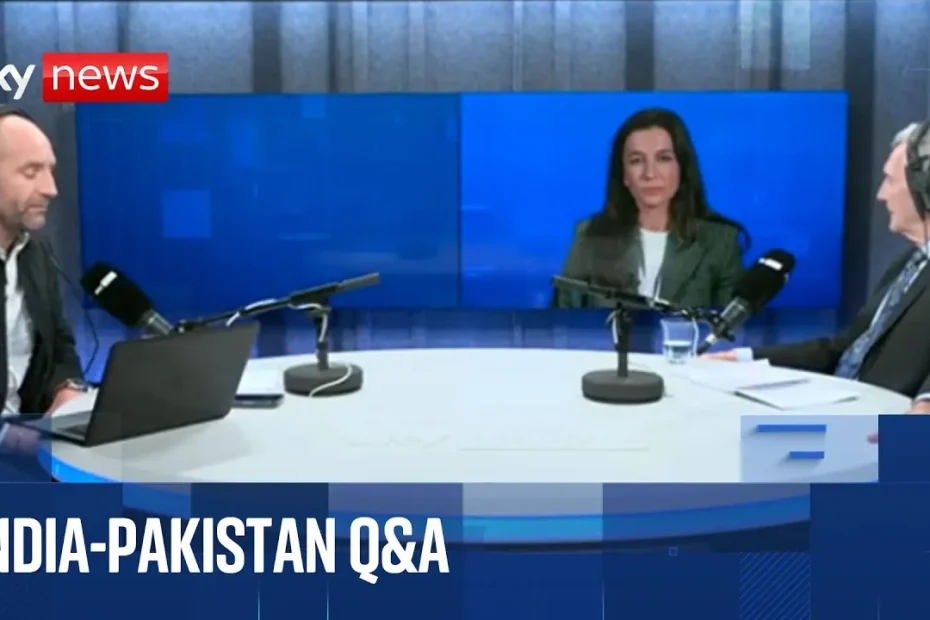
Read the full transcript of Sky’s host Tom Cheshire in Q&A with security and defence analyst Michael Clarke and presenter Yalda Hakim after India launched airstrikes on Pakistan and Pakistan-controlled Kashmir in revenge for a terror attack two weeks ago.
Listen to the audio version here:
TOM CHESHIRE: Hello and welcome to another Q&A. Today we are speaking to Yalda Hakim and Michael Clarke about the tensions between India and Pakistan. We have already had lots of questions, so thanks for sending those in, but you can keep sending those in. If you are watching this on YouTube, you should be able to see a QR code on the screen, so scan that and you can send it and we will try and answer as many as we can over the next half an hour really.
Fears of Full-Scale War Between Nuclear Powers
TOM CHESHIRE: So let us get straight into it. We have got a couple of questions. I think this is the main question from lots of people about the fears of escalation. So this is from Vin saying, what are the chances of this ending up in a full-scale war and who would support India or Pakistan? Yalda, can we start with you? What do you think the chances of a full-scale war are here?
YALDA HAKIM: Well, Tom, I think with anything like this, misunderstandings can lead to miscalculations, which can lead to escalations, which can ultimately lead to war and we are talking about two nuclear armed nations, two rivals here, where we have seen things escalate between them in the past. In 2019, after a series of airstrikes that India launched on Pakistan, we saw that one of their pilots, the Indian pilots, the plane was shot down, the pilot was taken captive and it actually took a situation to escalate for it to de-escalate because then the Pakistanis handed the pilot back to India and it brought down the temperature. But there is no doubt that this situation, while currently contained, could actually escalate.
In terms of who is on whose side, I mean, I think India is currently watching to see A, how Pakistan responds, but B, they are also looking at what China does as well. China is a close economic ally of Pakistan. It also supplies them with their military hardware and military equipment. So, India will be curious to see where China sits on this. And in the last few years, Washington and New Delhi have forged very close ties, especially to counter the rise of China in the region. So, I think that’s how it will play out in terms of how the different nations in the region respond to this, but also just where the United States and China might sit given their rivalry.
TOM CHESHIRE: Yeah, and we’ll talk about that diplomatic, you know, who’s going to mediate that if there is mediation. In terms of what you said, Michael, about escalation, what might that look like? What are the mistakes that might be made on either side? And this also ties into a question from AZ asking if Pakistan or India don’t back down, is it a military incursion into each other’s administrative Kashmir, the only goal for each country, or could it be something different?
The Potential for Escalation
MICHAEL CLARKE: Well, there have been four wars between India and Pakistan since independence in 1947, and three of them have been about Kashmir one way or another. The point is that neither side needs a war over this because neither side’s integrity is threatened as such, neither side’s sovereignty is threatened, neither side has a real national stake in this, other than credibility about what’s happening in Kashmir.
And so, as Yalda says, there’s always the possibility of miscalculation. Really, the issue is we’re waiting for the Pakistani response, there will be a response, and if that response is roundabout at the level of the Indian action, then probably it won’t go very much further. But if the Pakistanis feel, no, no, we have to go above that, because although this looks like playground politics, it looks like children in the playground, sort of action and reaction, the grown-up version of that is that both sides want to re-establish deterrence, they want to actually make the other side frightened of doing it again, whatever the it is.
So both sides are talking about re-establishing deterrence because it’s broken down since this terrorist attack of the 22nd of April. When we see the Pakistani response, we’ll know if it’s more or less at the level that the Indians have set, or if it goes above that. If it goes above that, then the Indians will say, oh well, we’ve got to establish deterrence, and so we’ve got to think of something else. But at the moment, I’m not sure it will go there, because there’s no reason for either side to want to attack the other, other than what’s happening in Kashmir itself.
TOM CHESHIRE: Is that reminiscent perhaps of what we saw earlier between Israel and Iran, where we had the similar sort of weighing of response, and actually that didn’t go any further. I mean, it was pretty terrifying watching it.
MICHAEL CLARKE: That’s exactly right, Tom. I mean, if both sides have an intrinsic idea of where the threshold is, the key thresholds, then you can stay within it. But if one side has a different interpretation of the threshold to another, that’s where, as Yalda says, that’s where the scope for miscalculation comes in, because one side thinks it’s reacting, as it were, reasonably within the threshold, and the other side thinks you’ve gone over it. That’s the problem, and we won’t know about that sort of mutual thinking, probably until the end of this week, when we see what Pakistan does.
Historical Context: Partition and Kashmir
TOM CHESHIRE: I mean, this is obviously a new situation, but this is, in terms of on the ground now, this is not a new situation in terms of the politics of this, the depth of feeling on both sides of this, and that’s one of the questions we’ve got from Nick M.
Again, thanks for the questions. Please do keep sending those in. Nick’s asked how much of this is down to how India was partitioned and the UK’s part in that. So, you know, going back a bit, but it is so relevant today, and I think important for people to understand. Yalda, perhaps you could take us through that, both in terms of the history, but how keenly that history is felt. I mean, you know, you realise in these moments how keenly that history is felt.
YALDA HAKIM: It goes back to, as the question posed, 1947, during partition. At the time, there were questions asked about whether Kashmir should become an independent state, whether it should, a Muslim majority territory should be on the Pakistani side, or whether it should become part of India. Now, the Maharaja at the time decided that it wanted, you know, it to be part of the Indian administered side of the line of control, and yet both sides administer a part of it, and yet it has been hotly contested a flashpoint, the most heavily militarised zone on the planet, frankly, and something, as Michael said there, that they have fought over, you know, disputed in terms of lines of control and loyalty for a long time.
And frankly, in the 2000s, we saw escalation in terms of the number of people who were killed, the raids that took place, the finger of blame being pointed at the Indian army of the treatment of the people of Kashmir, and then these militant groups that emerged to sort of free and liberate Kashmir at the time, that still exists to this day. And that is what Pakistan is being accused of. When we talk about the finger of blame being pointed on Pakistan, I don’t think that India believes that, you know, the civilian government in Pakistan has sat down and decided to mastermind this terrorist attack, but they’ve done enough or there’s enough evidence to point to the fact that they have trained and funded and backed these militant groups enough to give them sort of enough rope so that they’re able to go and launch these kinds of attacks. And I think that is where the sticking point is today over the issue.
TOM CHESHIRE: Michael, you want to pop in there?
MICHAEL CLARKE: Yeah, just a quick thing. In terms of Britain’s responsibility for this, we can’t avoid the fact that the last governor general of India before independence was Lord Louis Mountbatten. And he was very close to the Maharaja Hari Singh, who was the man who made the decision that Yalda talked about, of wanting his princely province, I think they’ll call the princely provinces or princely kingdoms, to be part of India rather than Pakistan and Mountbatten went along with that and he shouldn’t have done it.
I mean, Kashmir was a difficult issue, but if Mountbatten had not been so accommodating to his friend, then things might have been a bit different. And when people have talked about the origin of the Kashmir problem, the miscalculation, I think, or the sort of leadership weakness of Mountbatten does feature in Britain’s responsibility for this particular situation. But having said
TOM CHESHIRE: That, the independence of India was something Britain was determined it had to give. India independence in 1945. It did it very quickly because it couldn’t sustain its imperial presence. And to give a subcontinent as big as India, the whole subcontinent that is now covered by India, Pakistan and Bangladesh, to create independence inside two years was always going to be a chaotic process. And of course, more than 2 million people were killed in the intercommunal violence. So it was a messy process of almost instant independence, which might have been handled differently. And Kashmir might have been handled differently if Lord Louis Mountbatten had been a more decisive and better decision maker at the time. And I think Britain should acknowledge some responsibility for that. And the consequences of that being felt today.
On those points that you both raised, actually, we’ve got two questions from Sunny and Kajur. And Sunny asks, what proxies are in play in this conflict? Is it like Hezbollah in Lebanon? How powerful are they? And Kajur asks, why has India not provided evidence for these so-called terrorist-based attacks? And to what extent do you think Pakistan will respond? So this idea of which you touched on Yalda of these militant groups and India’s evidence for this, whether they’ve produced enough, you know, striking, they said that they were going to hit non-military targets. And they’ve said we are targeting terrorist sites. But just in terms of those groups, does India have cause here? Is it well documented? And how powerful are they?
Militant Groups and Proxy Forces
YALDA HAKIM: Yeah, I mean, as we’ve been hearing, you know, at different points, whether it was the 2008 Mumbai attacks, where a number of locations were targeted by a group known as Lashkar-e-Taiba. At the time, you remember the iconic Taj Hotel and the foreign civilians who were in those rooms, the Indians who were caught up and killed at the time during the 2008 Mumbai attacks, or whether we saw different sort of points where a military convoy was targeted in 2019. The finger of blame has always been pointed at these militant groups, Lashkar-e-Taiba, Jaish-e-Mohammed that operate in Pakistan. And as I said, they have been seen to be a proxy of the Pakistani government.
And let’s not forget that the ISI, the intelligence agency, spy agency of Pakistan was long accused of backing, funding, harbouring, giving shelter and sanctuary to the Afghan Taliban as well. During NATO’s 20 year war in Afghanistan, the Americans were often extremely frustrated with Pakistan. At one point in 2018, one of the things that Donald Trump during his first administration did was say that he was going to cut military aid to Pakistan because of accusations of playing a double game.
So these are groups that operate within Pakistan’s territory. They are powerful in their own right. They have proven to be a problem for Pakistan as well. Thousands of people over the years have been killed as a result of terrorist attacks in Pakistan. Benazir Bhutto, when she returned to the country, the former prime minister, when she touched down on Pakistani soil, so many people warned her and said, do not return because of the threat of terrorist attacks. And she was, of course, assassinated in the country.
I spoke to her son just a few days ago, and he’s a former foreign minister of the country. And he admitted to me that actually they have had a history, a long history of funding, backing terrorist organisations that goes back to the Soviet invasion of Afghanistan and that they, in support of the Americans and various other groups, they backed the Mujahideen at the time. And we know how that unfolded in terms of many of them, their children, orphans of the Mujahideen ended up becoming the Taliban and being trained in these seminaries or these madrasas where they were turned into extremists. And then they went on to become a fighting force in Afghanistan and Pakistan.
So there is this murky, long history that has existed in the country. It’s extremely murky, extremely complicated. And you’ve also got, you know, the Pakistan military flying F-16s, that relationship with America, which we’ll talk about in a bit.
Military Capabilities and Nuclear Arsenals
TOM CHESHIRE: Just to pick up on that, though, talking about the militaries rather than these sort of proxies. Hugh has asked Michael, I want to know, how do the nuclear arsenals and militaries of these two countries compare internationally? And also J.P. Roberts has said, what would a full-blown military conflict between these two nations look like in 2025, given how we’ve seen warfare develop since 2022 and the Ukraine war?
MICHAEL CLARKE: Okay, well, in nuclear terms, they’ve both got about the same. They’re believed both to have about 170-odd warheads, which are easily deliverable from their point of view, because they’ve got a very short distance to go. They’re right on each other’s borders. And that’s one of the issues for nuclear politics, that there’s no reaction time, which is one of the reasons why both sides get quite nervous, simply because if anybody decided to use a nuclear weapon, there’d be no sense of warning, it would just happen. We’re a long, long way from that, but that’s what informs a lot of the crises.
In conventional terms, if you look at something called the global firepower scores, I mean, I look at these things, you know, as part of my bedtime reading, such a sad man that I am. But if you look at global firepower scores, which is a very mechanistic way of looking at military hardware, sort of top jobs.
TOM CHESHIRE: Exactly. Yeah.
MICHAEL CLARKE: I mean, who can do what in the world who’s got the ability to deliver firepower, you know, with all the logistics and transport and weapons. And India is number four on that list of global firepower scores. Pakistan is number 12. In case you’re interested, Britain is number nine. But I mean, that tells you something about the difference between them.
And roughly in rough handfuls, the Indian forces are about double the size of Pakistan’s forces. So the Indian army is 1.2 million. And they’ve got another million in reserve. The Pakistani army is about 500,000, with about, they’ve got about a quarter of a million National Guard, they could push to about a quarter million 200,000. And they’ve got their own reserve. But they, they’re about half the size. And if you look at, you know, air, land and sea, ships, tanks and planes, they’ve always got about half of what the, what the Indians have got.
The bottom line is, if it came to a war, India will win. If it goes to above the threshold of war. India wins, it always does, because it’s got more to put in. If it’s below the level of a war, if it’s some sort of military confrontation, then Pakistan might think it could get something out of it. But you know, the higher it goes, the more Indian dominance will play.
TOM CHESHIRE: Okay, and Yalda, do you have any, I know you’ve got to run very shortly, do you want to pick up on that quickly before you go, or do we have to say goodbye?
YALDA HAKIM: No, I mean, I do have to run, but just to pick up on some of the points that Michael made there in terms of the fact that they, we are far away from, you know, the idea of a nuclear threat. But again, it could be worrisome for the world because they are two nuclear rivals. And, you know, just in the last few days, Pakistani officials have said to me that these missiles are not just sitting there on display, they are pointing towards India. India for its part says that, you know, we can’t continue to be threatened with this and we are going to act and do whatever we need to do.
We’re talking about nuclear weapons and then alongside that, proxy groups that are being supported, terrorist groups that are being supported. And unlike peanut butter and jelly, nuclear weapons, terrorism, they don’t really mix well together. So it is a worrisome time. But, you know, hopefully there is a flurry of diplomacy now that can de-escalate the situation.
We saw tensions de-escalated in 2019 when that Indian pilot was handed back. And this time round, what was interesting was although Pakistan does claim that a number of Indian aircraft was shot out of the sky, we’re still waiting to sort of see any evidence of that and for India to confirm. But that situation was de-escalated through that. It will be interesting to see at what point what de-escalates this particular situation and if it is able to be de-escalated. The last time that de-escalation happened was, of course, with a President Trump in his first term. So what he does in that will be crucial.
TOM CHESHIRE: Yalda, thanks so
TOM CHESHIRE: We’re going to keep going with Michael for another 10 minutes or so. So keep getting your questions in, scan that QR code and we’ll try and get through as many as we can. Just on that, Yalda mentioned this potential downing of Pakistan, claiming that five Indian jets have been shot down, which seems like a lot. There has been some clips on social media, which we’re working to verify at the moment. But I don’t think we can say with certainty whether they show fuselage of downed jets. We need to work out when those are taken. How plausible is that? I mean, five jets would be a lot to lose.
MICHAEL CLARKE: Well, I mean, I don’t know how they shot down any because there’s no reason for Indian Rafale aircraft, which is almost certainly what they were, to have left Indian airspace. If you look at the distances involved, Bahawalipur is 56 miles over the border. That’s well within the range of a Rafale inside India firing a scalp missile at Bahawalipur at the mosque there. And if you look at Muzaffarabad, that’s only 20 miles away from the line of control. So Indian jets could have stayed within their own airspace. Even a hammer air to surface missile with 20 mile range would do it. So I don’t see why Indian jets ever left Indian airspace.
If they did, they must have had a special reason to do so. And I’d be astonished. Why would they do that? Why would they put an expensive jet and an even more expensive pilot in harm’s way? Quite likely they flew drones over the real targets. That’s entirely plausible. Drones to confuse the electronics, drones to open a path in air defense systems, because, unless you’re going to bomb air defense systems, which is a different game altogether, then what you can do is open, like opening a curtain, you can open a path for your missiles to go through. And that path will stay open for a couple of hours, which is enough.
The whole operation seems to have been over in about 20 minutes from what I’ve read. So it’s entirely plausible that there was surveillance drones and electronic warfare drones above Pakistani airspace. But I’d be very surprised if any Indian aircraft were above Pakistani airspace last night.
TOM CHESHIRE: That does seem to tally with the videos released by the Indian government. They look like drone videos over targets rather than jets. And if there’s debris strewn around the area in Pakistani territory, I mean, it’s your job, not mine, Tom, to verify these things. But I’d be looking very hard to look at the debris with a view to it probably being a drone. But, who knows? This crisis could go in all sorts of ways. But if an aircraft has been downed, then India has got something badly wrong. And that’s very, if so, it’s very embarrassing for them.
TOM CHESHIRE: And the other issue is, where is the pilot?
MICHAEL CLARKE: Yes, which was, as Yalda was saying, a real issue back in the last episode with the MiG-21. But they got the pilot back, who was uninjured, and the Pakistanis looked after him and gave him back as a sort of peace offering. But a MiG-21 is a certain sort of aircraft. That was 2019. Here we are six years later, Rafale is no comparison in terms of the sophistication of the aircraft.
Military Capabilities and Modernization
TOM CHESHIRE: That’s one of the questions actually we should think about is lessons that can be learned from Ukraine. But this is very mountainous, it’s very high altitude, it’s a different sort of fighting. In previous conflicts, I think they had a huge tank battle over this in 1965. It’s evolved since then, there’s that dogfight in 2019. What are the key areas? And how have both sides upgraded their military to try and get an edge there?
MICHAEL CLARKE: Well, the Indians have upgraded the military a lot more than the Pakistanis have, mainly because the Indian military is focused on China. For India, China is the peer country, the threat that they worry about, the long term challenge. And so they look at what India has got, what China has got, and they work around that.
For Pakistan, their main threat is India. And the Pakistanis, their economy is not doing terribly well. They’re in the middle of a big IMF loan to keep them afloat, whereas India is on course to be the third biggest economy in the world by about 2050. So the qualitative edge of Indian equipment in general is greater all the time than Pakistani equipment.
Although Pakistan gets its equipment from China, it can’t afford or hasn’t afforded some of the best. And ultimately, it comes down to the two big land armies. Both the Indian army and the Pakistani army are 20th century style land armies. But the Indians are modernizing more quickly than the Pakistanis are doing.
Pakistan is not modernizing partly because it can’t afford to and also because the army is just much more traditionalist. In essence, the ISI, the Inter Service Intelligence Organization, has a disproportionate role in the army. And the army has a disproportionate role in the government. And that is a recipe for a lack of innovation.
International Dimensions and Diplomacy
TOM CHESHIRE: It’s a very different political system as well. That is worth bearing in mind. In terms of the politics of this, away from the conflict, a couple more questions here from Ashish and from Gail. First one being what role can the UN play in resolving the conflict? Are multilateral institutions effective these days, or is that very old fashioned? Is the UN actually going to be a forum for de-escalation and resolving this conflict?
And Gail has asked, who are the key international moderators in this conflict? Are there countries who India and Pakistan really listen to and don’t want to isolate? But I think for both of those, you’d think the US and China are the really big ones. But does the UN have a role as well?
MICHAEL CLARKE: It does in the sense that everyone says, why can’t the UN solve problems? The fact is, only great power politics solves the problem. But then everybody needs the UN. So when the forces who are antagonistic reach some sort of accommodation, they then turn to the UN to legitimize it, to monitor it, to record the fact. Nobody turns to the UN to solve the problem. But everybody turns to the UN to tidy up the loose ends. And that’s where the UN will come in, in this case as well, I suspect.
But we do live in an era now of great power conflict, far more than multilateral cooperation. And so it’ll come down to who’s prepared to put pressure on either side. But when we talk about China and America, the problem is, China is extremely antagonistic to India, of course, they’re the big competition, and China is behind Pakistan, they won’t want Pakistan to be in any way humiliated.
The United States is much closer to India now than it was, and the US is very antagonistic these days towards Pakistan. The US really lost patience with Pakistan during the Afghan crisis. From 2006 onwards, with the war in Afghanistan taking a new turn after 2006, right through to the withdrawal in 2022, Washington always thought that Islamabad was not being helpful, that Islamabad was behind the Taliban, with the ISI again, was helping the Taliban, which it was most of the time, and that Pakistan was playing two sides of the same conflict.
And so there isn’t much love lost in the Trump administration for Pakistani’s leadership. And so you’ve got the US on one side and China on the other, neither of them are in a good position to play a mediating role.
Do you know, funnily enough, the country that is listened to by both is Britain. And although Britain is a long way away from this conflict, and certainly doesn’t want to get involved, Britain is one of the very few powers that has a good relationship with Pakistan, for historical reasons, for reasons of recent history as well.
TOM CHESHIRE: There’s a lot of foreign aid sent from the UK as well.
MICHAEL CLARKE: There is indeed, yeah. So London and Islamabad actually get on pretty well. And London and Delhi are getting on…
TOM CHESHIRE: And we witnessed this week, the economic deal has only been announced a couple of days ago. I mean, that’s really important, right? Because when you mentioned China getting behind Pakistan and not wanting it, it might be a similar dynamic to what we saw in Ukraine, right? In terms of rival blocs, Russia enlisting North Korea, China, probably without sort of tacit backing, at least some materials going there and the world being divided into these two blocks, Iran as well. Pakistan isn’t part of that, as far as we understand now. But if this became a sort of a real prolonged conflict, could that be another?
MICHAEL CLARKE: I don’t think it’ll go that way, because it’s not in the interest of either United States or China to allow this conflict to become a sort of a focus of anything else between them. I mean, this is just going to be a nuisance from their point of view. And China is very anxious to complete its investments in its Belt and Road Initiative. The Chinese are involved in building an enormous port in Gwadar to the west of Pakistan as part of this great big sort of route from China into the Indian Ocean and ultimately into Europe. There’s six different routes in the BRI, the Belt and Road Initiative. The port of Gwadar is a really important part of that network. They won’t want things to interfere with that.
They certainly won’t want a war. But they won’t want China, China won’t want Pakistan to be humiliated or undermined by this. But equally, they certainly won’t want the Pakistanis to get too aggressive. So I think there’s a, unless India and Pakistan themselves elevate this conflict, the forces behind them are not going, nobody’s in a really good position to mediate, but nobody is in a position to manipulate it either. I think in a sense, this is going to be a rather self-contained crisis. And it’s up to Delhi and Islamabad to decide if they really are going to take it to another level after the end of this week. By the end of this week, we’ll know if Pakistan has matched India’s escalation and not gone any further. If that’s what they’ve done, then this crisis might be over quite quickly.
Nuclear Deterrence in the India-Pakistan Context
TOM CHESHIRE: In terms of that, I mean, I think the reason everyone gets worried about this is you have two nuclear-armed states, and you have a long-running intractable conflict. But that might also be an argument for why this doesn’t have to become a wider thing. You’ve had a lot of conflict. Keep on managing it. They’ve had nuclear weapons since 1947. Carry on doing it.
MICHAEL CLARKE: Yeah. And it doesn’t solve it, but you can stop it getting worse. That’s the theory.
TOM CHESHIRE: And is that, I mean, some people make the argument that because of nuclear weapons, you know, you haven’t seen war, full-scale war between nuclear-armed powers. There’s been the great fear during the Ukraine war as well. Obviously, only one side in that instance with nuclear weapons, but actually that perhaps it does limit full-scale war between countries that wouldn’t have it. Controversial.
MICHAEL CLARKE: It’s often, I’ve made this point a few times, that it’s often said that deterrence, nuclear deterrence, works better in practice than it does in theory. The theory of nuclear deterrence is terrible. But the practice is that people sort of understand what these weapons do. We know what these weapons will do. There’s no doubt what will happen if a nuclear device is used. And for that reason, everybody gets a bit careful whenever the nuclear issue comes up. They get very careful.
However, in the case of India-Pakistan, this is the nuclear relationship, which is the closest, the one that’s got the least distance involved. It would be instant. If a nuclear weapon were to be used by one side or the other, then the other side wouldn’t know about it until it went off. In effect, there’s no reaction time. And for that reason, both sides get very worried about nuclear diplomacy, even though a crisis is far, way, way below the level. I mean, nuclear weapons would only be used by any country, it is said, if its existence was at stake. And nothing that happens in Kashmir threatens the existence of Pakistan or India as presently constituted. So why would they go there? They won’t.
But the decision makers on both sides of the border tend to get nervous that the other side might have taken leave of its senses using nuclear weapon just to demonstrate it. And we won’t know anything about it until it goes off. And then it’ll be too late.
TOM CHESHIRE: And you have memories of the Cold War and Abel Archer misreading intentions.
MICHAEL CLARKE: 1983, Abel Archer. Yeah, that was famous, an American nuclear exercise, regular nuclear exercise. And it was picked up as a genuine nuclear attack by the Russians. And one Russian operator who should have sounded the alert said, I don’t believe it. I’m not going to sound the alert. And in the 20 minutes that he thought about it, it might have saved the world, because it was then discovered that it was it was, in fact, only an alert that had gone wrong. And thankfully, one nuclear operator on the Russian side said, I’m not going to do this. I’m not going to obey orders until I’ve thought about it and double checked. And I think we can all be grateful for that.
Economic Impact of a Potential Conflict
TOM CHESHIRE: I mean, a reminder, even if we think this might be a limited conflict, it does. You know, the stakes are really high. And this escalation ladder could continue. I’m just here. Lastly, if it is more prolonged, Denise, the question. Thanks again for the questions. And this will probably be our last one. She has asked, how does this conflict affect trade and the global economy? So let’s say it’s not over by the end of the week, but actually becomes something more protracted. What are the effects there? We know it’s not a great time for trade at the moment in the world, mainly thanks to the US president rather than anything else, but what are the considerations there?
MICHAEL CLARKE: It’s a very good question because global trade is in such a volatile state at the moment and the world may be hovering on the edge of a recession and a war in East Asia, if it became a war, even a small war as these things go, that would be bad for trade, it would disrupt supply chains and so it would be another factor which would likely push the world into global recession in the second half of this year. So if you said to me, you know, if this turns into a war, what would be the effect? I’d say it makes global recession almost, not inevitable, but very, very likely and then we all suffer lack of growth, lack of trade, more disruption to supply chains.
TOM CHESHIRE: Well we shall see what happens, as Michael’s saying there, we’ll have a much better idea by the end of the week whether this does stay contained or whether it does have those effects going on. Michael, thank you very much for joining us, thank you for joining us too and for sending in your questions. We’ll be back on Friday with another Q&A, back on the topic of Ukraine, see you then.