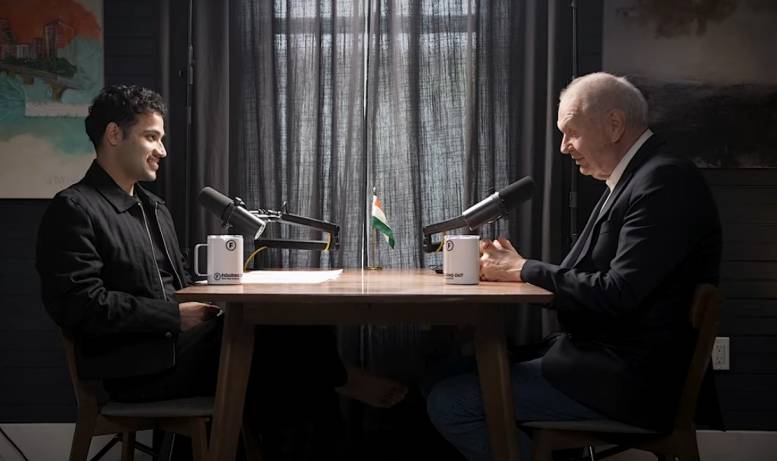
Editor’s Notes: Join host Raj Shamani for an extraordinary conversation with Jack Barsky, a former KGB spy who spent years living under a false identity in the United States during the Cold War. In this episode, Barsky pulls back the curtain on the brutal inner workings of the KGB and provides a unique comparison between political figures like Vladimir Putin and Donald Trump. From the dark history of Soviet atrocities to the modern influence of techno-oligarchs like Elon Musk, this deep dive explores the high-stakes world of espionage and global power. It is a compelling look at the secrets, crimes, and personal transformations that define the life of a man who once served as a silent observer for the Soviet Union. (February 12, 2026)
TRANSCRIPT:
The Real Identity of Jack Barsky
RAJ SHAMANI: So, Jack Barsky, is that your real name?
JACK BARSKY: Yes, it is. It’s on my driver’s license.
RAJ SHAMANI: But wasn’t it?
JACK BARSKY: It was not the name that was given to me at birth. No, that’s correct.
RAJ SHAMANI: What was it then?
JACK BARSKY: That name? I hate to pronounce it because it’s difficult to repeat. And then people say anyway, Albrecht Dietrich.
Understanding the KGB’s Power
RAJ SHAMANI: Explain to me for all my Indian audience, what was KGB? How big was it? What were they controlling? How would you explain it to me?
JACK BARSKY: Okay. The KGB in the Soviet Union was the CIA, the FBI, the National Security Agency, the Secret Service, the internal police as well. It was the most powerful agency that there ever existed in the entire world. The power that Stalin wielded was through the KGB. And Stalin was, up until he passed away, apparently from a long disease. But he had unlimited power, and he wielded it through the KGB.
RAJ SHAMANI: So when you say power, what do you mean by what power did KGB have?
JACK BARSKY: Life and death. They could go and arrest somebody and put him in a jail in a gulag. You know what a gulag is? A prison camp. There would be someplace out there in Siberia in very cold weather where people were forced to do hard labor and couldn’t get out for years. A lot of them died there, women as well.
So there was a phenomenal internal apparatus to oppress any kind of resistance to Stalin and the regime. And it was not the army, it was the KGB.
Examples of KGB’s Capabilities
RAJ SHAMANI: So give me four or five examples of what all were they capable of.
JACK BARSKY: In the early 1930s, Ukraine was part of the Soviet Union in those days. And Ukraine was always known as the breadbasket of Europe because the soil in Ukraine is very, very fertile. And there were pretty big farmers that owned a lot of land, and they produced a lot of the grain that then was consumed by a lot of the rest of the Soviet Union.
And Stalin wanted to collectivize them. Lenin, before Stalin, left them alone. And Stalin said, no, no, we need to become a collective like all the other farmers, so we can control you. Now, he didn’t say that directly. And they resisted then, no, we’re not going to do this.
And so Stalin tasked the KGB with forcing that collectivization with the help of the army, but it was run by the KGB. They confiscated all the grain. They stole it. All the grain, including the grain that the Ukrainians need to eat. That resulted in several million people dying from hunger. This was known as Holodomor.
This is one of the reasons that the Ukrainian people even today hate Russians. And there are well documented cases where parents ate their children after they passed away from hunger. It was a horror show. Well, collectivization succeeded.
Stalin was very paranoid. When he had a thought that there was danger to his rule, danger to his life, he proactively told the KGB, mix something up, bring him to jail and just execute them. There wasn’t even a lawsuit or anything like that.
Just prior to World War II, Stalin had another notion that things weren’t really good and that maybe the army, they were conspiring against him. Just anytime he had a thought and a suspicion, he was just paranoid the same way Napoleon was paranoid. And paranoia makes you believe in a lot of threats that are not real.
RAJ SHAMANI: Yeah.
JACK BARSKY: So you don’t miss the real ones. So what he then put in motion was called the Great Purge. The Great Purge involved arresting and killing hundreds of high level party members. He had almost all the senior officers arrested and executed, which actually weakened the military a great deal.
And it allowed Hitler to come in. It was just before Hitler came in. Hitler to come in and reach pretty much Moscow. Didn’t succeed in getting into Moscow. And eventually was defeated by winter, not necessarily by the strong Soviet army.
So there was a situation where Stalin really shot himself in the foot, but there was literally unlimited power. The only limitations that there were, were inflicted by Stalin upon himself.
RAJ SHAMANI: Like what?
JACK BARSKY: For instance, he had to have doctors. And occasionally when he was suspicious that one of those doctors was no good, goodbye. And that may have been a real good specialist to take care of himself.
RAJ SHAMANI: So he would kill them.
JACK BARSKY: Yeah, absolutely.
RAJ SHAMANI: And he would kill anyone and everyone who he just felt.
JACK BARSKY: That is correct. And he was denounced all over the place. Well, yeah, denounced for what? Not what he did. What he did was kill a lot of people when he was head of the KGB. And, oh, by the way, he killed his predecessor by the name of Yezhov. He also was a mass murderer.
So there were in the history of the KGB, I forgot the exact number, seven, eight, nine heads of the KGB.
I have a presentation where I show all the pictures and then I kill them all visibly, so to speak. It’s funny, right? But this is, I don’t think the world has seen bigger terror than what happened under Stalin and executed by the KGB.
The Origins of the KGB
RAJ SHAMANI: But I’m sure when it started, it was not for the purpose of just protecting Stalin and giving him unlimited power. Why was KGB started? Who started it?
JACK BARSKY: Okay, it was started by Lenin. You know, Lenin was the head of the Bolsheviks, the Communist Party that took power in 1918, I believe, in October. What they did, it wasn’t really a revolution. They all said it was going to be, it was a revolution. No, it was an insurrection.
It was a bunch of militarized people, extreme Communists gathering and storming the building where they had at that time, a parliament was called the Duma. And they arrested the parliament and then took over.
The Russian state was very, very weak because Russia got beat up in World War I. And so the army was beat up. The state was ready for the taking. So Lenin took over.
Now, once you take over by violent means, how do you remain in power? Because there were other forces that were against him. Well, you use violence. So he got in touch with a fellow that was a Polish man, a Polish nobleman who was also a radical Marxist Communist, said, you need to form an organization, we call it the Cheka. And then that organization will be in charge of what we call the Red Terror.
And that was officially, they called that the Red Terror. Yeah, the Red Terror. And the Red Terror was really officially meant to defeat the enemies of the revolution. And so what that meant, really, it wasn’t going arresting somebody, it’s going kill people.
You know, when somebody pointed at a neighbor and said, this guy is anti-Bolshevik, they would just go and kill him. And then the guy who denounced him would go to his apartment and steal everything that was in there. So it was individual terror. It was brutal, it was ruthless, it was lawless.
And also it started out, you know, hanging a bunch of peasants by the trees. And Lenin was the one who initiated all of this. He was, when you now listen to historians who studied both Lenin and Stalin, he was actually even more evil than Stalin inside. But he didn’t have a strong instrument.
The Cheka then became the NKVD. That was the German pronunciation, NKVD. And had a number of name changes until it became the KGB. So the history of the KGB.
Jack Barsky’s Recruitment
RAJ SHAMANI: And then you became part of KGB at 21.
JACK BARSKY: When people say part of the KGB, I was never really hired. I was a contractor. You could not become a member of the KGB unless you were a citizen of the Soviet Union. I didn’t know any of that, but I…
RAJ SHAMANI: How were you contacted? Why were you contacted?
JACK BARSKY: Okay, why? And when? So I was in my third year at university, so that means I was 21 when I was first contacted. And it was an informal contact by somebody who spoke German who came to visit me in my dorm. And he lied to me. No surprise. He wanted to talk with me about what my plans were after I graduated from college.
Now I was already known as a super smart student. I was the best of an elite group. I had also, just prior to that visit, I had received a national scholarship that was limited to 100 holders in the entire country.
RAJ SHAMANI: So you were one of them.
JACK BARSKY: Yes. And you had to be really smart, you know, nothing but A’s. And you had to be active in the communist youth movement. You had to be a party member. You had to be known to be a follower of Karl Marx and Lenin and Khrushchev in those days. So I was all of that.
And the KGB, most likely, they were fishing in the files of top universities, like the CIA recruits at universities too. And they looked at the person who looked at my records and whoa, we need to talk to that guy. I mean, it’s a no brainer, you know, I fit. I had the foundation.
They were looking for smart. They were looking for communist. And I also was in the starting lineup of the basketball team. That didn’t hurt either. So they were looking for an all around, really very talented individual.
And so this fellow just came into the dorm room and he pretended to be from a local optics firm. And that was the dumbest lie that I’ve ever heard spoken by somebody on behalf of the KGB. Because he wanted to know what my plans were after I got a master’s degree in chemistry.
After you were done with that study, if you were near the top of the student body, you could get your doctorate, you could stay and then maybe have a career in the university, maybe. And that would have been my plan, but everybody else was assigned. You go there and you go there. There was no companies recruited ever.
And this guy wanted to know what my plans are. Didn’t he know how his country functions? It was a German, right? You know, I played until he used a technique that interrogators actually worldwide use. So they make small talk. You know, they talk about anything and everything and get you relaxed.
And then radically they change the topic so you don’t have a chance to respond unless you have a really, really respond and come up with a lie. The only what comes back as an answer is what’s at the top of your stack.
And he actually made the switch to and saying the following. He said, you know, I’m not really from the, I have to be honest. I’m not from that company. I’m from the government. Can you imagine?
One day, I was fast enough to give him an answer that he liked, but it didn’t commit me at all. I said, yeah, but not as a chemist. He was working, he was a volunteer for the KGB. They worked with a bunch of Germans in Germany as well.
So he said, oh, that sounds interesting. Why don’t we have lunch together? And in Germany, lunch is big meal. So he invited me to the top restaurant. I still remember what I had. It was a very expensive meal. I picked the most expensive stuff on the menu.
But as I was walking in there, there was another man sitting at the table next to the fellow who never introduced himself by name, but the short fellow, the German got up and he led me to the table. Because in those days there could have been a stranger sitting next to, we had shared tables. That was typical. There were not enough seats in restaurants.
And he brought me and he said, I’d like to introduce to you Comrade Herman. We’re working with our Soviet comrades. And then he said, you know, I’m sorry, I have an appointment. I got to leave.
So the man who never gave me a name, not even a cover name, the only German who I ever met who worked with the KGB disappeared. And I’m now with Herman. So of course I knew that was KGB. And I was flattered, clearly, you know, and I was curious, what’s going to happen next? Well, next was a year and a half.
RAJ SHAMANI: But weren’t you given 24 hours to decide whether you…
That comes after the year and a half.
RAJ SHAMANI: Okay, so then, year and a half, what happened?
The Recruitment Process
JACK BARSKY: I need to explain why they actually recruited me. There was no recruitment. There’s a list of character traits that they were looking for. These candidates for what I consider, and many intelligence operatives consider the most difficult job in intelligence to be by yourself, make your own decisions, go to another country, say goodbye to your mother tongue, your mother country, pretend to be somebody else. You had to have some character traits, not just smart and not just being a good communist.
I have examples of people who actually failed that test. I’ll tell you some of the other traits. Courage. Obviously, you can’t be fearful in that situation. No problem with changing, moving, leaving your parents, leaving your family, leaving your country. No problem. Making up stories right on the spot. Lies. And there were about 10 of them.
How did I find out about those? Because when the Soviet Union fell apart and the KGB was dissolved, there were some leaders of the KGB that gave interviews and they disclosed to the press what they were looking for. And they found it in me. Because after 18 months, I think Herman just wrote reports to the headquarters of the KGB in Berlin.
RAJ SHAMANI: But what did they do in 18 months?
JACK BARSKY: I met an agent in Berlin. His name was Buddies. I remember that name. And he gave me a little training. I said, why am I here? This is nothing special. But what training? Like observing a building and figuring out what’s going on inside of that building. Some surveillance detection, like meetings, very basic stuff there. This was no tradecraft, no technology.
But he also gave me Western literature to read. And we talked a lot about what it would be like. But it was like, why am I here? Well, I found out the next to last day. He took me to the headquarters there. And I was led into an office. And when I walked in there, it’s like, wow.
It was about the size of this room here, but it was extremely well furnished, very richly decorated. And clearly I know I was in a room where an important person had his office. And when that fellow came in, he was about, he reached about up to here. It was a short guy. He sat down behind the desk and there wasn’t much of his body visible. And I’m thinking, okay, what now? What am I doing here?
And he opened his mouth, and there was a ton of energy coming out of him. He would speak like this. From the small body, it was. And then he spoke like this, doing propaganda, like, why we, why the KGB is doing what they’re doing. I’m thinking, I don’t need this. I know all of that.
And then we went back and forth, and again, he used the same technique. He put my mind to sleep. And then he pretty much radically changed his tune. And he said, so what? Are you in or not? Are you going to join us?
And I was not prepared for that question. I didn’t. So I played for time. I said, I can’t give you an answer because I don’t know if I qualify, and I don’t know if I have enough training yet. I need more training.
And he said in this steely voice, don’t you worry about that. We know you’re qualified, and we will train you. However. And then he paused for a while. However, we only work with people who can make important decisions very quickly. You got until noon tomorrow to give me an answer. So that was when I was recruited.
RAJ SHAMANI: What was going on in your mind then?
The Decision
JACK BARSKY: Well, that was the first time that I really took this seriously. I was like, all right, well, let’s see what happens. And so they brought this to me with this surprise element. And I had, on the one hand, I was well respected. I had this national scholarship. I had a career ahead of me. I was going to be a tenured professor. No doubt in my mind.
I loved basketball more than anything else. I was a basketball maniac. The only people that I would at that point betray, so to speak, was the remnants of my family, my mother and my brother, because I would leave them, obviously. So that was not something that held me back.
RAJ SHAMANI: But was it a yes from your side, like, without even thinking?
JACK BARSKY: No. The thinking took all night. It was not an instinctive yes. But I’ll tell you what. There’s two things that really made the difference.
First of all, my ego. I knew I was recruited by the most powerful intelligence agency on the planet. That’s like, whoa, look at me. I was very impressed with myself, number one.
Number two, Germans like to travel, and we were not allowed to travel to Western countries. So the travel and the good life. Because I knew on the other side of the wall, the standard of living was much higher. So I would go over there. I was meant to go initially to West Germany, go over there and help the revolution to take over in the entire world, and in the process, live like a king.
So you put this all together. It beat basketball and it beat professorship in East Germany.
RAJ SHAMANI: But did you really believe in KGB ideology or was it just…
JACK BARSKY: Oh, absolutely I did.
RAJ SHAMANI: Oh, you did believe in the ideology.
JACK BARSKY: What we didn’t know. What I told you about all the atrocities that they committed, you didn’t know. That did not even leak out.
RAJ SHAMANI: So you just believe that they were on a revolution and protecting their people?
JACK BARSKY: Absolutely. Absolutely, 100%.
RAJ SHAMANI: What made you a communist? What made you believe in this community?
JACK BARSKY: Oh, brainwashing.
RAJ SHAMANI: Who brainwashed you?
The Brainwashing System
JACK BARSKY: The institution is starting with kindergarten, actually. And it was age appropriate. They would teach us about the Nazis in West Germany. And we would have cartoons and stuff like that, and we would have cartoons of American presidents.
And it went on then to elementary school, middle school, when we then studied history. And as part of history, of course, the Soviet Union was the greatest power that ever existed because they defeated Adolf Hitler. Right? Never any mention made that Americans and British had something to do with this as well.
And the brainwashing also went on into college, where everybody had to take a course called Scientific Marxism Leninism. So we were, and there was no other opinion available. We were taught by really smart people who had an interest in telling lies or maybe believe the lies. It doesn’t matter that Marxist philosophy was a science just like physics, because Marx had discovered the laws that dictate how humanity, the human civilization, would evolve. And at the end, there was a communist paradise. So I was aligned with the natural law.
And never mind the Scientific Marxism Leninism. When you see visibly visible proof of how the Nazis killed masses of people, how it was done, like in an assembly line, you come in, you go there, you go in there, you turn on the gas. Boom. And there were pictures of piles of corpses and the most gruesome exhibits.
There were two of them. A shrunken head, the head of a person who was a real person about this size in a glass case. And then two lampshades that had interesting designs. And we were told they were tattoos, that the lampshades were made out of human skin. And the person who actually commissioned these lampshades was the wife of the commandant of this Buchenwald, this concentration camp.
You know, how much of an emotional impact that leaves on young people. The girls were crying and us guys, we were really, really quiet.
Now coming back home, the final argument was made. We were also told that Ernst Thälmann, he was the leader of the Communist party in the 30s before Hitler came over and he was put in jail. He was executed in this concentration camp. So we were the heirs of Ernst Thälmann and his communists.
And that’s historic truth that the communists were the only force in the Weimar Republic before Hitler took over, the only force that fought the Nazis in the streets. That doesn’t mean that they were better. They would have been just as bad if they had come to power. But we knew they were the Nazi fighters and we were the heir of Ernst Thälmann.
And there you, in West Germany, you have some people that were associated with that kind of killing that went on there. You know, there’s one thing to commit to a cause because of logic and you buy in and it’s good for you. And it’s another thing if it comes from, and the hatred for Nazism and by extension the hatred for NATO and the West German government and America was in here.
RAJ SHAMANI: But do you think that there was a chance that you could have said no? Were you allowed to say no?
JACK BARSKY: Yes. And I’ll tell you what.
RAJ SHAMANI: And it would have been okay?
JACK BARSKY: Yeah. I’ll tell you, you don’t force somebody into that kind of a job. I had to sign up voluntarily. All right? Number one.
Number two, at that point, I was still an asset to communism. So they would have, this was not defiance. However, I have evidence that once you signed up, once I said yes, and then you say change my mind, you get in trouble.
I met a classmate of mine from high school who was recruited to go to West Germany as an illegal by the Stasi, not by the KGB. And he failed the final acceptance test. He had to, and I had the same test, by the way. They gave, both the KGB and the Stasi did this. Gave us passports that allowed us, East German passports, allowed us to cross over to the other side of the wall to West Berlin.
And he spent like 15 minutes there. And he was so uncomfortable that he went back and told them, I can’t do that. He had an engineering degree, he was really good. He never worked as an engineer. So if the same thing happens to me, that’s when revenge takes place. You take care of you. You will not get any valuable position in this country for the rest of your life.
My friend actually wound up making model trains and selling them as toys because he was pretty good with his hands.
RAJ SHAMANI: So you. But isn’t it a saying that if you say no to KGB, there are consequences?
JACK BARSKY: Yeah, once you’re in, but before you’re not in, then no.
RAJ SHAMANI: Okay. And then what happened? You were, after that, you were trained for five years?
The Training Begins
JACK BARSKY: Yeah, training was five years. And it was initially…
RAJ SHAMANI: How did the training happen? What happened?
JACK BARSKY: Well, first thing that happened, I had to quit my, I was already an assistant professor at the university. I had to quit the job. And so I got documentation that the foreign ministries had recruited me. So I was going to be a diplomat.
RAJ SHAMANI: Okay.
JACK BARSKY: Showed that to the folks at the university. And okay. Packed my bags and went to Berlin. I had two bags. I had a small suitcase and an attaché case. And I had no belongings, really, just my clothes.
And I showed up in Berlin and I met my future boss, Nikolai. I wasn’t quite in yet. I had to pass, first of all, that wall on the other side of the wall test. That came later, but I had to pass another test. And if I failed that one, I’m on my own.
RAJ SHAMANI: What was the test?
JACK BARSKY: It was Nikolai, when we sat down. He got me, picked me up from the train station and took me to his vehicle and closed the door. And he said, I already have a task for you. And I’m like, oh, exciting. What is it? You’ve got to find a place to live.
And he spoke with a strong voice. You’ve got to find a place to live. Well, background information. There was very limited living space. All the big cities, Berlin included, were severely destroyed. And whatever living space was available was controlled by the government. You could not find a place to live. It was an impossible task.
Well, that was the final test. Can he…
RAJ SHAMANI: Can he figure it out on his…
JACK BARSKY:
own way and to manage himself out of a hole when to deal with an impossible task. Well, I did. You couldn’t, by the way, you couldn’t go to a hotel either. And that’s everything. That’s not an option. Severely controlled by the government. Strongly controlled.
So I had a brainstorm. I didn’t say a word. I didn’t make a facial expression. I think that Nikolai was impressed by that. And I went as far away from the downtown Berlin that you can take a train so you could go in and out of Berlin. And I knocked on a bunch of doors and asked people, do you have a room? And after about 10 knocks, one fellow said, oh, yeah, I know this lady. She has been renting one of the garages or whatever she has there.
So I went there and yeah, the garage was an outbuilding. It was a concrete bunker that was smaller than the section that we have here. Had one bed and a table as furniture. Not even a chair. This was going to be my living quarters for forever long. I didn’t know how long. It had a wood burning stove, so when it was cold, at least I wasn’t freezing. You know, it gets really cold in the wintertime in Germany and running cold water, but the toilet was on the yard and there was no running hot water.
And so next time I met Nikolai, he said, so what about, have you found something to live? I said, yeah. I didn’t say a word. I didn’t tell him what it was because I had learned not to answer questions that weren’t asked. You know, there was a lot of like, and I had also learned not to ask questions that could make my boss uncomfortable.
So interestingly enough, you know, I was a contrarian and I never wanted to be told what to do. Yeah, but when it came to the KGB, I was like this. I was instinctively a good boy and a good player. So I just told him, yeah. Well, and so what I did, you know, I slept in that bed. But as soon as I woke up in the morning, I went to Berlin and spent rest of the day in libraries and studied there and so forth.
And after about seven, eight months, I meet Nikolai again. And apparently he decided at that point that I passed the test because he handed me a set of keys.
RAJ SHAMANI:
What were the keys to?
JACK BARSKY:
An apartment. And that apartment was available when I first met him, I guarantee you.
RAJ SHAMANI:
So he just wanted to test you.
The Mental Torture Test
JACK BARSKY:
And I, you know, this is in hindsight, I realized that this was another test. It makes sense. They did not treat us nicely. It’s like boot camp for special forces. You know that it’s torture.
RAJ SHAMANI:
Yeah.
JACK BARSKY:
And this was mental torture. The physical torture wasn’t necessary for me. It was like, just like, see what you got up there? And once I passed that test, there’s the keys. And then he gave me a thousand marks to buy furniture. At that point, I know now I was in. I was finally in. And you know, he probably very proudly reported this back to Moscow. We got one. We got one for you.
RAJ SHAMANI:
But how did they test your loyalty?
JACK BARSKY:
I was brutally honest. I would admit to my parents, I would admit to teachers, and I would admit to Herman, who initially analyzed me when I made a mistake that nobody else knew about. So I was, you know, and I still have this reputation, and my friend over there may agree or not, does not agree with me. I have a reputation of being 100% authentic. That’s just the way I behave. I don’t know. I give the aura of just always being honest because I sometimes say some pretty critical things.
RAJ SHAMANI:
But wasn’t it bad for you and for your job because you were going to be a spy?
JACK BARSKY:
Yeah.
RAJ SHAMANI:
So then honesty would have been the worst trait that you would have, you know.
The Paradox of Trust in Intelligence
JACK BARSKY:
Not testing me and not just trusting me. Isn’t that pretty dumb? It’s not. I tell you what, the paradox in intelligence is that trust is an absolute foundation for any intelligence agency. And yet we don’t trust one another. But here’s the thing. If they don’t trust me, they won’t send me because they were sending me to be on my own and they wouldn’t supervise me whatsoever. So they had to trust me. So they took a risk. And if I don’t trust them, I don’t even say yes to the offer. So, number one.
And with regard to the dichotomy of being honest, of being a liar, agents, agents like me, but also agents who are in a diplomatic cover or goes to another country as business people and so forth, are in regular life, always honest. Well, we lie about being an agent, right? And I lied about my very existence. But inside of that Jack Barsky identity, I was always honest. So I could be trusted, you know.
And if you lie constantly, I think that’s counterproductive for an agent. You need to create trust. And you can, you know, the moment there’s a lot of lies that are not necessary. Do you lie when it really counts? And I lied every time when people ask me where I was born and all this kind of stuff. And I had to repeat my backstory. But everything else, I was supposed to live like an American and integrate in society. There was no reason to lie now. So that’s the short answer.
RAJ SHAMANI:
And then you were part of the program called the Illegals. What is illegals?
Three Types of Intelligence Agents
JACK BARSKY:
Well, there are fundamentally three types of agents. The vast majority of intelligence agents that go to another country operate under diplomatic cover. Doesn’t matter which intelligence service it is. And they are obviously suspected by counterintelligence. And so they’re followed, they’re under observation and they have a hard time really doing a lot of good work. They occasionally do, you know, particularly when in the country, in the United States, for instance, there’s somebody, let’s say in the KGB, I’m sorry, in the CIA or in the FBI who is ticked off at the United States or who needs money desperately.
And they volunteer and say, you know, how much are you going to pay me for XYZ? And when they volunteer, they would go to the embassy. Right. And then they will get to talk with one of those agents and the agent becomes a lead for that person, the handler. So that’s mostly the value that they have. So that’s the ones with a diplomatic cover.
The second group is called NOC. That’s an abbreviation. Non-official cover. So they go to the country where they are deployed with an official cover, as I said, could be exchange students, could be visiting professors, could be business people, could be artists, could be anyone. Ballerinas, anyone. They use their own name and their own skill set, but they do some spying on the side. Now when they’re caught, they go to jail.
And then there are the illegals. The illegals take on a different identity. They don’t use their own name. They pretend to have been born in some other country. A lot of illegals for the KGB and even today for Russia get smuggled into getting citizenship in a third country, such as Brazil or Canada. That’s where it’s easy to become a citizen and then they legally immigrate.
But people like me were very special because first of all, Russians, because I don’t know why, but Russians have a hard time getting rid of their accent. You can’t train a Russian to speak like I speak the American brand of English. So I was a rarity. And there were others like me. Even the ones that came through Brazil, now, they had a little red flag attached to them because they came from another country. I did not.
I operated with a birth certificate that said Jack Barsky. So you know what the Manchurian Candidate is? That is somebody who, there was a movie about this, I believe, and the Manchurian Candidate is a foreign intelligence agent that becomes president of a particular country. I could have run for Congress. I would have passed every background check, and I did. I passed a lot of background checks with companies that had high security requirements. I had all valid documentation. No forgery involved, nothing. The birth certificate that I used when I came to the US was authentic. It was acquired legally. How? I don’t know. They just gave it to me.
RAJ SHAMANI:
The illegals are on their own.
JACK BARSKY:
Yeah.
RAJ SHAMANI:
They don’t have any cover. They’re not diplomats. And they’re trained for five years, six years.
JACK BARSKY:
No, I was an exception.
RAJ SHAMANI:
Okay. How long are they trained?
JACK BARSKY:
My base training was two years. I was supposed to be sent to West Germany. And it turned out that I have this language talent, and that triggered two years of training in Moscow because in Berlin, they didn’t have a trusted individual that could teach me American English.
RAJ SHAMANI:
Okay, so you were sent to Moscow to learn American English.
JACK BARSKY:
That is correct. And it was altogether maybe two and a half years.
RAJ SHAMANI:
And then for two and a half years, you learned English.
Learning American English
JACK BARSKY:
Oh, no. I started learning English when, so, okay. A part of the base training in Berlin was for me to learn another language. They told me everybody has to learn another language. So they asked me to pick, and I picked English because I had, it was really easy for me in high school and in college. And I studied for the two years in Berlin, I studied English like a maniac. You know, I’m a perfectionist. And when I put something, when I take on something, I want to be the best.
I learned 200 new words every day. And I counted this. And that was in emulation of Vladimir Lenin when he was in exile. He learned German the same way. 200 words every day.
RAJ SHAMANI:
And what were you getting trained for? What was the main purpose for building you into something and spending so much money on you and training?
Tradecraft Training
JACK BARSKY:
The training on surveillance detection, dead drop operations, which is where you hand over objects to another person without being there. Like, you put something like money or a passport in a cup and cover it up and throw it someplace in a park. And Morse code was very intense.
RAJ SHAMANI:
So you would call this dead drop, right?
JACK BARSKY:
No, no, no.
RAJ SHAMANI:
Putting a passport and then sending it, putting it somewhere that somebody else pick it up.
JACK BARSKY:
They used like crushed oil cans. I actually made rocks out of plaster of Paris.
RAJ SHAMANI:
So what do you call this trick? I think CIA calls it dead drops, right?
JACK BARSKY:
Yeah, they call it dead drops. That’s correct.
RAJ SHAMANI:
So that was one trick. That was tradecraft.
JACK BARSKY:
Yeah, tradecraft.
RAJ SHAMANI:
Then you were also code and…
JACK BARSKY:
And also decryption and encryption. Secret writing.
RAJ SHAMANI:
What was secret writing?
JACK BARSKY:
Secret writing is when you take, let’s say you, let’s assume the paper that you have lying in front of you is a letter that you just wrote, open letter. And then you take special contact paper and you write, you put it on top and you write something on the contact paper and it leaves a trace of a chemical on the open text. And that can be developed.
So when you look at the letter, there’s nothing to see. And if you don’t know what you’re looking for, you won’t find it. You know, this is only just a trace of a chemical. I’ve seen the developed end product. It looked barely readable because the reason was just a little touch with this. I had to be really careful not to touch the paper with a hand.
There was a lot of training that I also got trained in photography and developed my own pictures and microdots. You know what a microdot is?
RAJ SHAMANI:
No.
The Art of Microdots and Secret Communication
JACK BARSKY: So let’s say you have a sheet of paper and you take, you want that information to go someplace. You take a picture of it and then you use a microscope in reverse. So you shrink. Instead of making it bigger, you shrink it really, really small. So it’s like the size of tip of a needle.
And it becomes a piece of paper that has all that information on it. And you can place it under a postage stamp and mail it someplace. And there they take a microscope and read it.
RAJ SHAMANI: So what do you call this trick?
JACK BARSKY: Well, just making microdots. There was a couple of times when I had too much information so I couldn’t put it all in a letter. So I wrote it down on paper and photographed the paper and then handed the undeveloped cartridge over in a dead drop.
So that was one way for me to communicate. And the other one was to only, only through letters in secret writing. There was no valuable information on the outside of that letter. That letter was supposed to be just as innocent as possible. Not even like I was told, be very careful, don’t put the postage stamp at an angle or something like that. No, nothing like that. Had to be clean. And that method that you’re talking about, I’m not aware of it.
RAJ SHAMANI: And what else were you taught? You were taught microdots, dead drops, communication.
JACK BARSKY: Cryptography.
RAJ SHAMANI: Cryptography.
JACK BARSKY: And…
RAJ SHAMANI: Were you taught to kill someone and put it off grid?
Weapons Training and the KGB’s Compartmentalization
JACK BARSKY: No, there was not even a thought. There was also some thought of teaching me some aggressive driving, but no weapon training. This hand, this is my right, this is my strong hand, has never touched a weapon in my entire life that could kill somebody. This was supposed to be my weapon.
Clearly they had in their ranks killers, but they kept them separate from the rest of the agents because that’s a different personality that’s required. And there’s people who just don’t have a problem shooting something that’s alive. I would have had a problem with it. I would not have signed up if they told me that I need to shoot to kill somebody. No. The only living beings that I have killed in my entire life are insects.
RAJ SHAMANI: Were you taught Morse code?
JACK BARSKY: Yeah.
RAJ SHAMANI: What was…
JACK BARSKY: Took a while. You know, first, I only learned the digits. No alphabet. No A, B, C, D, E. Because everything that I received was encrypted. And you don’t encrypt with letters. You know, this is mathematical stuff.
You write down a text and then you change the letters to numbers and then you do some mathematics on the numbers. And at the other end they do the mathematics in reverse. And then they get, and then they do the numbers to letters in reverse. That’s how it worked.
And that’s one method. When you develop your algorithm manually, and this is how I did it most of the time. But there’s also a method that is used internationally, everywhere. It’s called a one time pad. Where the numbers to decrypt are on a little pad notepad. You don’t see them, you need to develop it with some chemical. And then they come to, and then you see them and then you can copy these letters on a piece of paper and then do the math to decrypt or encrypt.
That one time pad, last I heard, if it’s used only once, that’s why they call it one time pad, it still cannot be decrypted, not even by artificial intelligence. If you use a particular pad multiple times or a particular code, manually developed code, then AI will eventually break it more faster than prior to AI.
Honey Trapping: Swallows and Ravens
RAJ SHAMANI: And were you taught the dark art of honey trapping somebody?
JACK BARSKY: I wish.
RAJ SHAMANI: I heard there was. I’m going to read it because I don’t want to get it wrong. And I don’t want to get words wrong, so I’m going to use a lot of references. Then I was reading that KGB used one of these tradecraft for honey trapping. They were called swallows and ravens. Were you aware of it?
JACK BARSKY: No. No, no, no.
RAJ SHAMANI: So they would use…
JACK BARSKY: The swallows were the ladies.
RAJ SHAMANI: Yeah. The swallows were the female agents and the ravens were the male agents.
JACK BARSKY: I don’t know if the KGB was as good as the Stasi was. The Stasi used a lot of good looking young men to seduce older women who had access to secrets. There was never a thought. Even though in those days I was a pretty good looking young man. You know, blue eyed, blond hair, tall, smart. No.
RAJ SHAMANI: Are you sad that you were not taught that?
JACK BARSKY: No. I’m glad because, you know, there could be a lot of children running around that are mine and I’m not even aware of. So no, I was very shy. I was a good looking, shy young man and it took me a long time to get rid of that shyness.
No, there was never a thought. You know, it was compartmentalized. They had specialties and special trainings. And these, by the way, these sex operatives, they were trained in groups. My training was all one on one. There was never a classroom, not once.
RAJ SHAMANI: So these sex operatives were, were they trained in a special school?
JACK BARSKY: Yes. I didn’t, obviously I didn’t know that, but that information came out. There was a particular building just outside of Moscow where they…
RAJ SHAMANI: State School 4 in Kazan.
JACK BARSKY: Yeah.
RAJ SHAMANI: Where they would train them.
JACK BARSKY: It may well be, you know, more than I know.
RAJ SHAMANI: I’m just quoting what I have read.
JACK BARSKY: I have enough contacts in the intelligence world, worked in intelligence, FBI, CIA and so forth. And when they tell me some things and something like this, did something like that existed, I say okay. I don’t really have an, I’m not a historian. I’m not doing research.
You know, I have done this one book that really helped me a lot to understand how I fit into the intelligence picture is called “The Sword and the Shield.” I’m digressing again, but you can put it in someplace else. That was written by an archivist in the KGB who had access to all the secret documentation for the First Directorate espionage.
And he had developed extreme hatred of the Soviet system. And he decided the only way that he can do some damage, he copied a lot of stuff. He’s responsible for me being discovered by the FBI, because amongst that stuff was my name.
And then when, after the KGB was dissolved, he reached out to MI6, British intelligence agency, and told him what he had and that some of that made it into a book, “The Sword and the Shield,” where it talks a little about the illegals and how many illegals they trained and so forth. And I, through that book, I got a better understanding of the things that the KGB never shared with me.
Deployment to the United States
RAJ SHAMANI: What happened after training? Like, when you got trained to do all of this intelligence, cryptography, stuff like that. What next?
JACK BARSKY: The plan was to now deploy me to the United States. And next, before I could go there, I needed a birth certificate. So they sent me to Canada. And as a practice, you know, to spend, like, I spent three months in Canada to practice my English and interact with Canadians and just like, get used to what it’s like to be in the United States.
RAJ SHAMANI: But why United States? What was the reason for you to go there?
JACK BARSKY: Well, it was the main enemy.
RAJ SHAMANI: What did they tell you?
JACK BARSKY: Like, just go there and that’s Russian, the main enemy? No, I mean, this was, anybody that they could send to the United States, like me as somebody who was born there, was a huge asset.
RAJ SHAMANI: So they would just develop you and send…
JACK BARSKY: Well, this was during the Cold War, because they…
RAJ SHAMANI: But they wouldn’t give you any instruction that this is what you’re supposed to do there.
The Real Mission: An Insurance Policy
JACK BARSKY: Well, initially the instruction was to just get my documentation. I needed a driver’s license and Social Security card. And then you live like an American, integrate in society and become part of society. And the instructions then were, but they are partially false.
They told me, as I said before, to get to know as many people as possible. They also told me to pay attention to people that are making foreign policy or influencing foreign policy. So they were saying, like, it would be great if you could, you know, befriend such and such. No, I forgot his name. National Security Advisor. And that, yeah, that was dreaming anyway.
But they had me practice to extract and summarize information that was in the media, in American media. The thinking is that since I lived in the United States, I have a better chance of giving a decent extract as opposed to the Soviets, who really didn’t have any good interaction with Americans. So they would just copy whatever was in the New York Times and say, well, that’s my report.
So my opinion was valued. And every two, three months I had to send a report as to what Americans think about events that happened internationally. So, and also predictions about the elections and stuff like that that I was told would be my task.
What I wasn’t told was what was the most important thing was for them, if I may. And I found that out again only afterwards. And that was in that book that I told you, “The Sword and the Shield,” as well as in the interviews that I already mentioned.
Think about this. This was the mid to late 80s. There were a couple of situations where we came very close to a nuclear exchange between the Soviet Union and the United States. Not because of misunderstandings or accidents. There was no intention by either the Soviet Union or the United States launching an attack. But it was extremely tense and there was a good chance that war might break out.
In that case, there’s no more diplomats in the United States, there’s no more KGB spies. The only ones that are left over would be us. So we were an insurance policy.
And also before, I mean, in the 80s, there was also this war that the CIA and the KGB were conducting. You know, if the United States found out some diplomats that did some things, the Russian diplomats that did some things that weren’t, had nothing to do with the diplomacy, kicked out of the country. And sometimes teams were kicked out of the country and then there was retaliation. And the Soviets, just like for the heck of it, sent American diplomats.
And that means the number of spies in both countries was reduced. And the head of the KGB at the time, no, he was the head of the KGB at one time, he was the President of the Soviet Union, Andropov, was convinced that diplomatic relations would be completely severed. So there are no more spies in the United States.
And except there were two very, very important. The most successful agents for the Soviet Union in the United States during the Cold War were American born Aldrich Ames, who was a mole in the CIA and Robert Hansen, who was a mole in the FBI. They did a lot of damage to the United States and they were more successful than the rest of us KGB spies.
But who did they interact with? The diplomats. If there are no more diplomats, the only ones left were us. And we were never told. I was never told. And a friend of mine who I met, who also was an illegal, a German illegal in the United States, we were never told that this would have been one of our tasks.
But the ideas about weapons, that I knew where to find weapons and explosives, none of that was ever mentioned. Who knows? I wasn’t trained. But you know, I was trained to interact with most. I was very good at that.
So yeah, and this is again, this is the bizarre situation that I did a job for many, many years not knowing what I was supposed to do anyway. And I got to brag about it. I did this job so well that I got in 1988, two years before I retired from the KGB, this is the second decoration of the Soviet Union.
RAJ SHAMANI: Can I see it?
The Order of the Red Banner
JACK BARSKY: That was the Order of the Red Banner that was given out by the government, not by the KGB. And to tell you how important, how much value that is, this was given to some members of the Rosenberg spy ring, the most successful espionage operation in the United States by the KGB. And that was the theft of the atomic secret. They gave it to me, so I must have done a pretty damn good job.
RAJ SHAMANI: When you entered USA and you were given these tasks to get close to foreign policymakers, national security advisors to the President, all of this, this was your major task just to go there, live there, understand, observe and give that information to Moscow.
JACK BARSKY: Okay, right.
RAJ SHAMANI: Now you were also given a six page legend which was your background story, which is a fake story, right?
JACK BARSKY: Yeah.
RAJ SHAMANI: So now what about that story was something that you feared that would expose you? What were you scared about out of all that?
Constructing the Perfect Legend
JACK BARSKY: It was really well constructed. First of all, my legalization in the US was based on that birth certificate, right? And any trace that could have been left behind of the real Jack Barsky was not available. And in those days the places where they keep records on United States citizens’ birth and deaths, they didn’t cross reference.
Jack Barsky passed away at the age of 11. The KGB was certain that nobody knew that, nobody in the government knew that. And I was told that it was safe. And then we came up with addresses that existed at one point, but the houses didn’t exist anymore. They used like, or even a company that I started working for when I didn’t graduate from high school.
So I needed to have an explanation. Why? Because I had a lot of headaches and I said the heck with it, I don’t want to. I finished school, I didn’t graduate and I started working for a company. And I still remember George Luderson company that made chemicals. Well, that company actually blew up. Okay. So there was no record. So they did a pretty good job researching and constructing a good story.
The story was then filled out by me. And particularly when I saw the birth certificate, I said okay, mother’s maiden name is Schwartz. That’s a German name, most likely Jewish, but German Jewish. So what we did in my backstory, we killed off my father. So I grew up bilingual. I spoke fluent German. And so I had a bit of an accent, right? I had a little accent left over. And when people ask me, so what is, do you talk a little funny? What are you, European? No, it’s bilingual.
Fish in an Aquarium
RAJ SHAMANI: But you said somewhere that you’re famous for the fish in the aquarium statement. Yeah, right. Like KGB, Russians, they don’t understand.
JACK BARSKY: Yeah.
RAJ SHAMANI: What it is like to be American.
JACK BARSKY: And what it’s like to be American, 100%. The worst thing in life is not to know what you don’t know. If you know what you don’t know, you won’t touch it, right? Or you learn it. And the diplomats that work for the KGB were the only Soviets that were in the United States. There were maybe occasionally there may have been an artist or two, but you know, they were in and out.
And so they interacted with Americans. They read American newspapers, they watched American television. So they thought they knew everything there is to know. Well, they never knew what it was like to get a job. They never knew what it was like to get an apartment. They lived together in compounds. Some of them had their family with them, but they were the experts. Nobody else knew anything about the United States.
So they were full of themselves. They said, well, you know, we’re going to teach you that with this, that and that. And the instructions that they gave me out of Moscow, how to acquire the documentation and what kind of a job to be looking for, they were all wrong. They were dead wrong.
I mean, for instance, for my first job, they said, how about taxi driver? No, that would have been pretty much, it didn’t pay a lot. It was a grind. And it would take pretty much all day, seven days a week to make a living or work in the harbor. They said, you know, what is, stevedore is somebody who loads and unloads ships. And they said, there’s good jobs. Yeah, but you had to be a member of the union. And you don’t get to be a member of the union unless you become friends with another member of the union.
So that wasn’t a good idea. So that’s how I wound up operating as a bike messenger. So all the instructions that they gave me did not work. And this is when I, what I tell people that I give the picture of an aquarium. Actually, there are some aquariums in this country that are really big, and you can just like, it’s amazing. You watch the fishies swimming. But if you think you know what it’s like to be a fish, no.
And so they didn’t know what it’s like to be an American. And again, they didn’t know what they didn’t know. That made them rather dangerous.
RAJ SHAMANI: What was the biggest mistake Russians made about knowing something about Americans? What did they didn’t get?
JACK BARSKY: I think the biggest mistake was not understanding the individual freedoms that Americans cherish so much, because they didn’t. If you live, even if you live in another country as a diplomat, you know, you’re subject to the collective always. So you know, there’s a limit as to how much in charge you can be in your life.
The Damage of Soviet Espionage
RAJ SHAMANI: And how much damage do you think Russian cost to America at that time with all the agents, with all the illegals, with the sort of officials and diplomats?
JACK BARSKY: Well, the biggest damage was the theft of the nuclear secret. That’s for sure. Ultimately, I don’t believe the, well, clearly the Soviets lost the Cold War. So no matter what damage they did. And I think the Soviets collected more secrets than the Americans collected from the United States.
And both agencies, the FBI and the KGB, got most out of defectors, out of moles and defectors, not so much from their trained agents. And the same, by the way, in parentheses happened between West Germany and East Germany. The East Germans won the war, an espionage war, big time. And they lost the Cold War. So, and then you ask yourself a question, why the heck even do the spying?
RAJ SHAMANI: So you feel even though Russian caused a lot of spy damage and installed like a lot of moles in American system, still it was of no use.
JACK BARSKY: They didn’t install a lot of moles, you know, but they had like an…
RAJ SHAMANI: FBI, senior officers in FBI, senior officers in CIA.
JACK BARSKY: They weren’t installed. They volunteered. They went to the embassy and said, you know, I want to work with you.
RAJ SHAMANI: Why?
The MICE Acronym
JACK BARSKY: Robert Hanssen was, because he felt he was underappreciated. He was pissed off. He was angry. Even though he had a pretty high position, but somehow, you know, that’s a typical narcissist who knows that they deserve better, also a little bit of money. But he was not motivated by money.
And Aldrich Ames was motivated by money. He had a beautiful Brazilian wife that had very, very good taste. And you know, he needed to get her a nice house and nice cars. So he did it for money. Okay?
And there’s an acronym that tells you what motivates people to spy for a foreign intelligence service. It’s called MICE, M I C E. You ever heard of it?
RAJ SHAMANI: No.
JACK BARSKY: Money, ideology, C is for coercion and E is for ego. There’s one thing missing in that acronym and believe it or not, it’s called love. And I tell you when you find, and I was looking for people like that. When you meet somebody who works, let’s say in the, I’m KGB and I meet an FBI agent and he tells me that his daughter is fatally ill and she can’t get treatment in the United States and he needs money to send her to another country where there may be a chance.
That is the strongest motivator I can think of. But it doesn’t fit into the MICE acronym. I just added that. I should copyright it.
RAJ SHAMANI: But then the other question. Why do you think Russians were not able to act on such information even though they had the strongest spy network in the world? They had good moles. They were at a strong position. They were still not able to make use of it and do anything about it.
JACK BARSKY: No, but they didn’t get to the super secret stuff. And then we’re talking about the plans of the American, particular the NATO military, the super secret plans. I don’t think they got in.
RAJ SHAMANI: Like what?
JACK BARSKY: Well, what to do when nuclear war breaks out.
RAJ SHAMANI: The strategies and plan. They had no clue.
Nuclear Stalemate
JACK BARSKY: They may have had some, but it changes all the time. And even Ames and Hanssen and there were a few other agents, they didn’t collect enough. And here’s the thing. The Soviet Union, the government of the Soviet Union did not plan to attack NATO. They planned to undermine NATO and eventually make, somehow generate, that didn’t work, by the way.
Let me rephrase it. They were trying to stir as much trouble on the inside and like the Russians have been doing as well by interfering in our elections. That kind of stuff. It’s called active measures. But they were not suicidal. Okay? None of the Soviet government leaders were suicidal and they knew that the nuclear exchange would kill them as well.
Vladimir Putin is not suicidal. But there was always a chance of a war breaking out because of misunderstandings and you had to be prepared. So I don’t believe that these plans never came into play. Even if the Soviets had access to them, they were not ready to attack. This was a nuclear stalemate.
I need to tell you why all of that was important. Because the plan A for me, for them and that was a very good plan that failed because I made a mistake. Plan A was get everything that I just told you. The documentation, the job, an apartment, become a legitimate American from all angles.
RAJ SHAMANI: What mistake did you make?
The Brilliant Plan That Failed
JACK BARSKY: Okay, the plan was to get a passport, an American passport, right? Well, I had everything it was needed. I needed to get, to apply for a passport. Even today, you need documentation. It was a driver’s license. You need the proof of birth and driver’s licenses or proof of residence, Social Security. No, you don’t need to know. I think these are the two documents. You need proof that you’re a citizen and you need proof of residence. And I, at one point, I had it.
So it was, and the plan was to get a passport, then move to Europe to a country where they speak German, Switzerland or Austria, not West Germany, and then open up a business. They didn’t say what kind of business, but there’s all kinds of businesses. You know, the KGB would have funded this. They know, you know, they were very good at money laundering.
So I would have opened a business and then run a business for a while, for two, three years. And then, and they would add some more money.
RAJ SHAMANI: Could be.
JACK BARSKY: All together, I could have saved like 10, 20 million dollars. Lots of money in those days. Legitimate, sort of, right? And then I come back to the United States and I declare that money. Say, I made this in Switzerland, right? And all of a sudden I’m wealthy.
Now with my education and my ability to interact with others, I would have become a very dangerous agent. For example, go join a golf club where officers that work in the Pentagon play golf and befriend people that way. And to join a club like that, you didn’t necessarily need social standing. You need money. And they only let people with money. And it’s even today.
So yeah, that was a brilliant plan. It failed because I made a mistake.
RAJ SHAMANI: What mistake?
The Passport Office Mistake
And I’m so glad that I made that mistake and didn’t become a dangerous agent. So I went with my documentation and one application that I had filled out at home. I went to the Rockefeller Center, which has a place where you can apply in person, the Passport Office. I went there because the KGB told me to do that. I could have done this by mail. And that was sort of their mistake, but it was exacerbated by my mistake and how I filled out the application.
So it asks in the application, what’s your profession? And honestly and stupidly, I told the truth. I was a messenger. I didn’t say bike messenger, and I should have actually said contractor. But I’ll tell you why. There were some other fields that said, where do you plan to travel to, what country do you plan to travel to, and when do you think you want to go? They were not necessary. They were voluntary. So I left them blank.
So now the guy behind the counter happened to be more of a senior guy because, you know, he was an in-person kind of guy instead of the people in the back office. And he scanned this thing. And I’m now thinking what he’s thinking. All right, so we got a messenger here who makes practically no money, minimum wage. He doesn’t know where he wants to go, and he doesn’t know when he wants to go there. And he said, “You know, I have some doubt about your identity.”
Oops. That was an interesting remark, but I was still optimistic. I’m an inveterate optimist. And he said, “Well, here’s a, fill out this additional questionnaire to clear things up.” And so I went to the back and looked at the questionnaire at a desk. First question that I read, I knew at that point I was in big trouble. It says, where did you go to high school? I have a high school in my backstory. But no Jack Barsky ever attended. They would have found out, right? So Plan E was not possible anymore.
But I also had to get out of that dilemma I was in. And this is where, again, the KGB validated my choice, because I made a really quick decision to get out of that mess. I walked over to the counter mumbling a bunch of curse words which I don’t want to repeat here. One of them starts with an S. And “Who needs that? You know, s* and blah, blah, blah. I don’t want to do this like, blah, blah, blah, blah, blah.” Really loud. People were looking at me.
And as I’m walking to the counter, the agent still had my application and my documents lying in front of him. I grabbed the stuff and walked out. I didn’t run. I walked. Now, I got lucky. Either he didn’t give a damn anymore because it was time for the end of the workday, and he said, “I want to go home,” or he didn’t remember my name, and he clearly didn’t notify security. They should have stopped me, but they didn’t. That’s the invisible hand of God. This was the worst mistake I made. And it was the best mistake I’ve ever made because that got me to being able to talk with somebody like you today and make fun of things that were rather serious.
RAJ SHAMANI: But what happened then, after you became a bike messenger for two and a half years after that? How did you go from there to your eventual plan of becoming friends with the President’s advisor?
JACK BARSKY: Yeah.
RAJ SHAMANI: How did that happen?
The Columbia University Plan
JACK BARSKY: For some reason, I forgot his name now. Zbigniew Brzezinski, he was, he had a dual function. He was in charge of the Institute for Foreign Policy at Columbia University, and he was also National Security Advisor. And the KGB thought Columbia was a way for me to get closer to him, but not as a bike messenger. I had to have a reason to show up at Columbia.
So when I couldn’t get the passport, Plan B was for me to get a college degree. I told the KGB, “I can’t hang, I can’t go and befriend people like that. I’m busy.” And they accepted that. And again, they accepted that because it was more important for me to exist there and integrate as much as possible in American society. So, yeah, so then I had a job and I started a career.
RAJ SHAMANI: And then what information were you sending necessarily to Moscow?
JACK BARSKY: Well, again, the information that I sent, it was twofold. The reports about what Americans thought about certain events in the world. I issued those reports periodically and I profiled a bunch of people that could have been recruited, but I was never told if anybody was recruited.
Particularly when I was in college, I profiled a lot of students who were likely to get a job in government and who had radical opinions of some kind. Not necessarily communist, radically, but pro-Israel, for instance, like ideologically motivated. And that’s all the reports that I sent.
I once offered a treasure trove of information, and they did not bite. And again, that tells me how inept some of these people were.
RAJ SHAMANI: What information?
The Group Insurance Intelligence
JACK BARSKY: Okay, I worked for a company in a department that was processing group insurance. Group insurance, that means if you work for a company, you get health insurance. That’s in the United States. Happens today as well. Most companies at least subsidize insurance. And we had as customers companies that were part of the military-industrial complex, like Boeing or weapons manufacturers. And I had access to all the health records of these people.
You know how important that information is? You can find out whether somebody has a drug addiction and is in treatment. And there’s a law in the United States that the medical information is to be kept secret. So you could use coercion to get to that person and get that person to cooperate with you. Or one of those cases where the daughter was denied treatment in the United States. I offered this, I told them I had access to that information. They didn’t react.
RAJ SHAMANI: Why?
JACK BARSKY: I don’t know. Because they were stupid. That did not occur to them. I mean, there were a lot of, I’m sorry to use that word, idiots in the KGB. There were also some really clever people. But overall, I sometimes call the KGB the Keystone Cops of intelligence because they screwed up so many times.
It has something to do with being in a large hierarchy where people that are incompetent can hide very well. And I’ve seen this in corporate America as well. And it also is the case in the various U.S. governments, state and federal. Large hierarchies allow very incompetent people to hide. And I met quite a few of those.
The Recruitment Pipeline
The rules were for recruitment where there’s three people participate in recruiting and then running an agent. The first one is a spotter. The person who, that was me. I was supposed to find candidates. The next one is the recruiter, the guy who makes the offer. And the third one is the handler, the guy who runs the agent. And the three don’t know one another. And neither one knows what happened in that pipeline.
I was never told what happened to those people. And they didn’t even congratulate me, saying, “Well, you’re doing a good job with these suggestions,” because God forbid I had taken notes and remembered the names. Right? So yeah.
RAJ SHAMANI: But when you would send all of these information in different forms, in either crypto or by dead drops or by Morse, when you were sent, no Morse? You never used it?
JACK BARSKY: No, no, no. I used the strings of digits that were encrypted. And only the names, for instance, like when I wrote letters in secret writing, the names and addresses were encrypted. But no more. No Morse code going that way. No, no, no, no, no. And I’ll tell you why. Morse code, you know where it originates. You don’t know who’s listening to it. So for me to listen to it was safe. For me to send it was not. Okay, so that’s why that was never a thought.
RAJ SHAMANI: But then how would you know that nobody’s watching you? Nobody’s spying on you?
JACK BARSKY: No, I had to figure this out myself.
RAJ SHAMANI: Like, what are the steps? Like, how would you send a message through a dead drop to Moscow and still get to know that nobody’s actually watching or looking?
Surveillance Detection Techniques
JACK BARSKY: Well, it’s called surveillance detection. There’s two things that I did to make sure that I am, actually, there’s more than two things, but on a regular basis, I did surveillance detection. And I had phenomenal training in Moscow.
Surveillance detection means you go outside into the city and go from here to there to there to there. Every place you go to is a public place. You know, you have a reason to be there, and you use public transportation. And you really need to know the city very well, because if you are under surveillance, there’s a team that follows you. Typically, the team is seven, eight people, and they can never lose sight of you. One of the team has to always see you, because if they lose sight of you, you can do something. They’re watching you to see if you’re doing something. Right?
And so there are places where the person, the lead person, needs to come so close that you can see the face. My favorite place, there were two of them, the Museum of Natural History. Because you can, without being suspicious, you can go this way and that way and turn around, and the Museum of Natural History has a lot of hallways, so you will see some faces there. And I had excellent memory for faces. That was my strength.
And also large stores, grocery stores, drugstores, where you can go this way and that way and the other way, and you could easily do something in that store. You put a little package and put it over there real quick. They need to see you. So I got this training in Moscow, and I was told I was really, really good. So that helped me to know.
And I also had one measure in my apartment where I was pretty sure that I would know whether somebody had gone through my apartment and searched it. And this is not, people always think about the hair over the door. No, no, no, no. That’s, I had a chest of drawers that had a drawer that came at an angle here, it had an overhang, so to speak. So when you, you didn’t know whether that drawer was completely closed, there was always this, or you had to actually purposely go and look underneath.
So I made, every time I left the apartment, I left about 8 millimeters not closed. I mean, even a counterintelligence team wouldn’t think of that. So every time I went home, the first thing is when I checked the 8 millimeters. And it was always there. So I was in charge of finding out whether I’m being studied and being surveilled. And there was never a case where I was even suspicious.
And there was one other measure. When I said two, there was a third one. Writing a letter to yourself. Just a regular letter to yourself. And leave, when you close this letter, when you glue it together, you leave maybe a half inch without glue. Okay? So there’s a gap. Now, at least in those days, people can’t open these letters without doing damage to them. They had to use a machine and the machine automatically glues everything. So when you get this letter that you mail from some other place, you open this and there’s a section that has no glue, you know that somebody opened the damn letter. So yeah, there’s some trickery here and there.
KGB Assassinations
RAJ SHAMANI: When you heard, like when you were in America doing all these tricks, collecting information, you would also hear that KGB was able to assassinate certain high-profile killings all around the world. Right? Would you get that kind of information? Would you get to know that they must have, maybe they killed some French ambassador, they killed somebody? Did you feel proud when you hear these things about them?
JACK BARSKY: I knew about a couple of them and I thought they were justified.
RAJ SHAMANI: Like what?
JACK BARSKY: Like, you know, defectors. KGB killed defectors. That actually was known to me. There was some fellow named Georgi Markov who was actually a Bulgarian who was assassinated by KGB with the famous, in London, the famous umbrella tip. Yeah. So I knew all this.
RAJ SHAMANI: But were you trained to use ricin, an umbrella technique like that?
JACK BARSKY: No, nothing. I told you, no killing, no injuring, no fighting with the FBI. I did get self-defense training, but not to fight.
RAJ SHAMANI: But were you aware of all the poisonous techniques and things they would use?
JACK BARSKY: No.
RAJ SHAMANI: You got to know about them later.
JACK BARSKY: Yes.
RAJ SHAMANI: And did you know about Laboratory 12?
JACK BARSKY: About what?
RAJ SHAMANI: Laboratory 12?
JACK BARSKY: No.
RAJ SHAMANI: A laboratory where they would make all of these different kinds of poisons which will imitate heart attacks. And there was a famous accusation that they tried it on about 200 prison mates just to test it, whether this is actually imitating heart attacks or not. And KGB used it all around the world.
JACK BARSKY: The more I get to know, it doesn’t make that organization more hateful. It just was raw evil.
RAJ SHAMANI: But you were never aware or told about what work they would do?
JACK BARSKY: No, not at all. Same way they didn’t tell me what my actual task was. I told you, absolute secrecy.
RAJ SHAMANI: Nothing at all?
JACK BARSKY: Nope.
RAJ SHAMANI: And then when you were telling me, when you would hear about these assassinations, you thought they were justified? You never felt proud or sad about it?
JACK BARSKY: No. Even the assassination attempt when they attempted to kill the Polish Pope. Well, I hated the guy. I was still a communist in those days. And he was instrumental, not the only key figure, but accelerating the fall of communism. And I was still a communist and I softened a little bit, but I was still at least a socialist and I still thought capitalism was evil and America was not the country I wanted to stay in until something happened. But if that didn’t happen, and we’re going to get to it eventually, I would not have defected or stayed here to live the good life in the United States. I was still at least a socialist.
The Danger Signal
RAJ SHAMANI: So what happened then? They called you? There was an incident that they wanted you back. What was that?
JACK BARSKY: Well, the incident was that it was a signal. We had a set of signals where those diplomats could signal something. They usually were chalk marks. They were very basic. Like for instance, when I re-entered the country after having been in Moscow for some time, I had to make a mark saying I’m back in the country. Or they asked me to confirm that I received the radio transmission that they sent and I had to make a chalk mark. And there could also be a mark that says, come to the dead drop operation, we have something for you. That was prearranged. So these were the signals.
And one of the signals was danger. That was the most radical that I never wanted to see. All the other signals were little chalk marks in white chalk. And this one was going to be a red fist-size red dot. And these signals, by the way, I could set signals for them on where they would be going on the way to work. And in New York they were all going from northern Manhattan with a vehicle to the United Nations. So I would make a signal on the path so they didn’t have to go out of their way to try to read it. In the same way, there was a signal where on my way to work, and this one was on a steel beam that supported the elevated portion of the subway that went from Queens to Manhattan.
So one day I routinely just looked at this and I never expected to be anything there, anything major there. And there was a red dot. It was screaming at me. It said danger, the emergency procedure is in effect. And that meant don’t go home, don’t go to work. Make a beeline to get the emergency document that I had, some emergency documents in a park, and then go to Canada, make a beeline to the Canadian border and go to Ottawa to the Soviet embassy and they’ll get you out of the country.
That required for me to constantly have a lot of cash on me because I wasn’t supposed to go to the bank. I was supposed to just literally not run, but purposely make my way to Canada. And well, I didn’t. I went to work.
RAJ SHAMANI: Why?
JACK BARSKY: Because I wasn’t ready. I had an 18-month-old daughter at the time in the United States. And you’re too young to have a daughter, are you not?
RAJ SHAMANI: I don’t have.
Choosing His Daughter
JACK BARSKY: One day you will have one. And I loved that child more than I ever loved another woman. It’s built into us men. And she was 18 months old, couldn’t even talk yet. She was just very pretty. And she looked at me with her big brown eyes and the brown eyes talked to me. “Daddy, I love you, I need you.”
And I was trying to figure out how to support this girl from a distance because my tour of duty was supposed to finish after about 12 years and I was in my 11th year. So I knew and I couldn’t take her with me. And her mother, she was from South America. She didn’t have, she had only four years of formal education. If I leave them to their own devices, they grow up in abject poverty. And so I hadn’t figured out how can I take care of this child when I leave. And I can’t tell the KGB, I can’t ask them for help. They would just probably not like it, to put it mildly. They could have possibly even put me in jail for insubordination. That was me having a child in another country. I don’t know what they would have done with me or to me.
And so I couldn’t have asked American friends. They would have said, what’s the matter with this? So there was no solution. And I was still hoping eventually something will pop up and who knows, maybe I win the lottery and give mom a lot of money, whatever. None of that happened. And when that dot appeared, I wasn’t ready. I had not decided how to react to something like that.
And I tell you what. And I showed you the Order of the Red Banner. Everything that was good for me was back behind the wall. The wall was still up. So I would have come home as a conquering hero. I would have lived a good life. They promised me a house. And I had dollar savings in East Germany. So everything that was good for me was over there if I went home. And everything that, the only thing that was good for me if I stay and defy the KGB, the only thing that was good for me, I could take care of Chelsea and her mother. But there was a danger that the KGB was right, that I would be arrested.
RAJ SHAMANI: But then, didn’t you think that you were going to die? KGB would kill you?
JACK BARSKY: Well, there was the other danger that if I defy them, if I say I’m not coming or I just don’t show up, period, if they had to interpret this as a defection, there was some danger, yes. Because I knew that the defectors, they dealt with very radically. So that had to be taken into consideration. But I avoided that by coming up with a great story.
RAJ SHAMANI: What was it?
The AIDS Story
JACK BARSKY: The story was that I had contracted HIV AIDS. You know what HIV AIDS was?
RAJ SHAMANI: Yeah.
JACK BARSKY: Well, okay. And it was very credible too. So first of all, the day I saw the dot, I went to work and I just stared at the screen and did nothing. And I was thinking, I have a little more time, you know, because there was one time I was sick and maybe I didn’t read the dot well. So I was still kicking the can down the road until I was approached by an agent while waiting for the subway.
And it was dark outside, it was already early winter. And I’m standing there, not too many people. It was early in the morning. And this short man, I will never forget him, I never forget what he said. And he whispered in a strong Russian accent, “Come home or else you’re dead.”
Was that a threat? You had to take it seriously, knowing what I knew. So now at that point, I had to make a decision. And the decision just came to me. The only way I can get out of this is if I claim to have a deathly disease. And AIDS was a really good candidate because it was a death sentence. And I knew that the Soviet Union, rightfully so, was very much concerned with regard to letting foreigners that have the AIDS virus into their country.
And they had no reason to think that I was lying to them because they knew how much good it was going to be for me to come back home. Right? And I made also my explanation very credible in that I told them even who I got the disease from, because I was also required to report on anybody who I was close friends with, not just for recruitment purposes. They needed to know. And I had a couple of girlfriends, and one of them had an ex-boyfriend who was a drug addict. And I reported that as well. So I said I got it from her.
Now I was a good liar. They believed it, and they told my German family that I had died from AIDS. And the interesting thing is today, even today, Albrecht Dittrich, remember, that’s my German name, his file, his record in the social register says that he passed away in 1988. An ex-classmate of mine who worked in the archives saw that. So I got away with it. They did not come after me.
And that is when my entire attitude changed, because now I had a family. I had a daughter and I had a wife to take care of. And that’s when I started something I never thought I would like, work on a career and build the American dream and buy a house and another house and another house and make really good money, a house with a pool. It was amazing. And at one point, I forgot that I ever was even a communist or KGB agent. I put this out of my mind. I did not want to say hello to the FBI because I was afraid that might cause damage to me and the family.
Fear of Retaliation
RAJ SHAMANI: But then, aren’t you scared today, now that you’re public? And KGB has a saying that we never forget traitors.
JACK BARSKY: That’s in the movies.
RAJ SHAMANI: Yeah. In reality, it’s not the thing.
JACK BARSKY: Okay, first of all, there’s no more KGB.
RAJ SHAMANI: But now it’s FSB. And then there’s SVR.
JACK BARSKY: Okay, but secondly, my case is very old.
RAJ SHAMANI: So they don’t care anymore.
JACK BARSKY: Even if they do care, to do damage to somebody on the territory of a foreign country requires special teams, and they don’t have so many. And there’s evidence of that. You remember the attempt to poison Sergey Skripal in London with Novichok? There was a defector who lived in London. There was a GRU team, put poison on him while he was sitting on a park bench with his daughter. He survived.
RAJ SHAMANI: 13-year-old daughter. Yeah.
JACK BARSKY: Oh, you know the story?
RAJ SHAMANI: Yeah. But go ahead, tell me.
The Elite GRU Team and Personal Safety
The GRU team was one of the elite teams that they have and they don’t have that many. And they didn’t get out of the country without having been known to be intelligence. They weren’t arrested, but somehow they left the trail. And so even the top team made a mistake.
So why would they squander team like that on an ancient case like mine? So the bottom line is, and I tell everybody when they ask that question, the bottom line is I am safe in Western countries. I’m safe in Europe. I think I would be safe in India. I clearly would not want to ever. If you offer me $10 million, I wouldn’t want and visit Moscow or St. Petersburg because they have too many windows there that you can fall out of.
And I tell you why this is, this is actually not just my fantasy. You see Vladimir Putin, one of his strongest weapons is that he likes to scare people. You know, when he’s always out to scare people. And in a situation like this, if I have an accident that doesn’t even have to be reported in the Russian press, it gets reported in the Western press and it sends a signal to whom, sends a signal to agents who think that they might want to defect because it says, we’re going to get you. We got this guy.
So that is why I wouldn’t show up there and wouldn’t show up in other countries that used to be former Soviet Union, where there is lawlessness and you can do things like you couldn’t do in life, for instance.
RAJ SHAMANI: But how easy do you think it would be for Russia to get somebody killed on an American soil? Very hard in today’s world.
JACK BARSKY: Oh, absolutely.
RAJ SHAMANI: Even with the best services, best agencies, best network and money, they can’t get it clear.
JACK BARSKY: You know, first of all, let’s assume, what weapon would you use? Maybe a drone. But then you need to know where that person is at a certain point in time. So you need to do some research. So you need to hang out there someplace. So it is, it’s very, very difficult.
And the other thing is, if you send a person to do the killing, that person needs to have an escape plan. So he would have to find a spot where he can then wait for the victim so he can get out okay. And all of this is a lot of activities that can be noticed. It’s very, very difficult. Not impossible, but it’s very difficult to do it without a trace.
And I never thought about the drone. This is a spontaneous answer now, but you need to know where they are. Right. Because killing means something physical.
RAJ SHAMANI: Yeah, but not even with poisoning one of their drinks or food.
JACK BARSKY: Well, they did it with Navalny. Okay. But, you know, he made a mistake and returned to Russia. And then I don’t know what happened. Forgot what happened to him.
RAJ SHAMANI: He was jailed there. Right. For a long time.
JACK BARSKY: Yeah.
RAJ SHAMANI: He was arrested.
JACK BARSKY: Yeah. Right. And then he died.
RAJ SHAMANI: Yeah.
JACK BARSKY: But the bottom line is, yeah, it can be done. Sure.
RAJ SHAMANI: Like with the poison can be done. Right. Because the antidotes is only.
JACK BARSKY: But if it is feasible and if it is useful, well, we would hear more about this kind of stuff. Right. Even Putin is not going into the rest of the world, you know, killing one person after another.
Modern Oligarchs and Power Structures
RAJ SHAMANI: Do you think America is at fault right now?
JACK BARSKY: Of course. And I’m talking about the oligarchs that we have. The, you know, the.
RAJ SHAMANI: Who are the oligarchs in America right now?
JACK BARSKY: Well, every big IT company. Every. The folks that are working on AI and on the cutting edge of AI in the Western world.
RAJ SHAMANI: Do you think those, who do you think would be more powerful today? The Rockefellers of the world or the IT guys of the world?
JACK BARSKY: That’s a good question, because I was actually thinking about this. There, you know, there has been some news about the, what’s it, the guy that committed the sex crimes.
RAJ SHAMANI: Epstein.
JACK BARSKY: Epstein, yeah, that Epstein was also involved in high finance. And this is sort of connected with the, not the Rockefellers, the big banking family that was big already, maybe a couple of thousand years ago. The Rothschilds. Yeah. And so forth. And so I’m thinking, so, yeah, no, who has more power?
RAJ SHAMANI: Rothstein or.
JACK BARSKY: I think the guys that eventually control the information. And I think it’s the techno oligarchs. And, you know, the biggest one of them is a guy who’s a Tesla guy.
RAJ SHAMANI: Elon.
JACK BARSKY: Elon, you think?
RAJ SHAMANI: Yeah, Elon’s controlling.
JACK BARSKY: Are you kidding me? That doesn’t mean he’s evil, but, you know.
RAJ SHAMANI: He necessarily doesn’t belong to the big information technology world. I mean, he just got.
JACK BARSKY: He’s stepping into it.
RAJ SHAMANI: He’s just stepping in like a Twitter and X right now. But the big ones would be your Google and Microsoft and Facebook.
JACK BARSKY: Oh yeah, but we’re also talking about things like connecting the.
RAJ SHAMANI: The neuralink and stuff.
JACK BARSKY: Yeah, I don’t follow this very much, but he is now stepping aggressively into AI also. And the power has always been where the information is.
RAJ SHAMANI: But do you think Bill Gates is more powerful or Elon Musk?
JACK BARSKY: No, it’s Elon Musk now. And Gates actually has stepped back a little bit.
RAJ SHAMANI: But then he still sort of controls. Right. Because he still has the controlling share of Microsoft. He doesn’t operate a day to day basis, but he owns it. Then the ChatGPT is owned by Microsoft. So the new AI world is led by Bill Gates. All the government, the Pentagon, everything is handled by Bill Gates software.
JACK BARSKY: But then you have the Google people have their own AI, which is Gemini. Yeah. And supposedly Gemini just caught up quite a bit. You know, I used to use nothing but ChatGPT but now I’m occasionally going to the other side.
RAJ SHAMANI: Yeah.
The AI Revolution and Its Challenges
JACK BARSKY: And I have found that ChatGPT occasionally defeats me some garbage. Okay, true, I agree and particularly since it does not. So I asked a question about this guy who was assassinated, probably Kirk, about his death and ChatGPT told me he’s not dead. And really when we argued back and forth and I said, do you read the Times? Well, yeah, blah blah, blah, he’s not dead.
Now what I understand that the ChatGPT is trained and fed certain information that cuts off at some point and it was looking at old stuff. Now the idiot programmers and the quality assurance people should have put in something like, oh, by the way, I’m looking at old stuff. So, you know, caveat here. No, just they argued back and forth like I said.
Eventually I said, you know, I’m going to go to Gemini, I’m going to divorce you. I gave my ChatGPT a nickname, my ex wife with whom I argued a lot. Her name is Shauna and so GPT is Shawnee. So I can argue with her. And then she’s still nice to me. Oh, I will miss you.
It’s a scary world that we’re entering and it’s a world of, I used to read a lot of science fiction and there’s two authors that describe this world that we’re having now rather closely. Whereas a lot of robots and you know, intelligent beings that are not human operate in this world that was visionary because that’s where we’re going.
All we need now is, oh, did you see that, the video where the Russians premiered in a new robot, a thinking machine, and he goes on stage and he keels over, he falls.
RAJ SHAMANI: No, I didn’t see.
JACK BARSKY: Yeah, I didn’t see that. So, you know, Russian engineering has never been top notch.
RAJ SHAMANI: Yeah, but they’ve been top notch in defense. Yeah, their weapons, missiles, anti missile systems, planes, all we’ve been top notch. That’s something they’ve been good at.
JACK BARSKY: I’m worried about the quality of the maintenance of the nuclear arsenal, because all I know in personal experience is that Russian engineering was sloppy.
RAJ SHAMANI: But how did they get so good at nuclear and defense mechanics like defense weapons and stuff?
JACK BARSKY: They had a lot of resources that they could throw at it, and they don’t have that many resources now. I mean, the Soviet Union was like, what, seven, eight times stronger than most of the strength of the Soviet Union didn’t come out of Russia. It came from the old republics.
Okay, so Putin is not anywhere near as far as his, the standing of Russia in the world is not anywhere as near as the Soviet Union. I understand that. You know, the United States has always been considered since the end of World War II as a big bully, even by the Germans, who, the ones, particularly the ones that grew up in West Germany that were saved from communism.
And when I went back to Germany after many years, I mean, it was like they favored Putin over the United States. Actually, a lot of people explain me.
Putin’s Rise to Power
RAJ SHAMANI: Rise of Putin, how powerful from just being an agent.
JACK BARSKY: Yeah, and he wasn’t even a good agent. You know that.
RAJ SHAMANI: Yeah, I’ve heard it from you and your sayings. You have, you’ve quoted somewhere that he was a mediocre agent and somebody also his senior also somewhere quoted that. Well, he was not really great.
JACK BARSKY: Well, he spoke German very well. And during the height of the Cold War, they sent him to East Germany. Why wouldn’t they send him to a country where, you know, where the action was? There was no action in East Germany. Not where he was. He wasn’t Dresden, not even in Berlin. So he was a mediocre liaison and bureaucrat.
RAJ SHAMANI: So he was in Dresden, right?
JACK BARSKY: Dresden. Yeah.
RAJ SHAMANI: But then what did he learn in Dresden that made him the man he is today?
JACK BARSKY: Nothing.
RAJ SHAMANI: How did he become this powerful?
JACK BARSKY: He became this powerful because he was a good organizer, he was a good networker. And when the Soviet Union fell apart, he managed to get hired by a fellow named Sobchak. He was the mayor of St. Petersburg. And he helped this guy, you know, with his organizational skills, help this guy to stabilize St. Petersburg and got a reputation of being a good team player.
And he had also, some of the people that KGB people that knew how capitalism functions, they became, you know, they became when they privatized the economy, they knew what to do with these stock certificates and they bought them up and they got rich. And Putin had friends amongst them. Okay.
And Sobchak then suggested to Yeltsin to bring him on in the central government. And Yeltsin and Putin had a reputation of being just a real quiet, nice guy. He played his cards really well. You know, he was not a threat to anybody because he knew he couldn’t be seen as a threat until he had the power.
I read quite a bit about him and this makes all sense. And actually Yeltsin thought it was safe to announce Putin as his successor because Yeltsin had dirt on his hands and if somebody else would have succeeded him, he might have actually gone to jail. And he knew Putin was safe. So that’s how Putin got, and every, all the colleagues, you know, what did he.
RAJ SHAMANI: Putin become successor of what, a presidency. But then before presidency he ended up becoming FSB director. Right?
JACK BARSKY: Yeah.
RAJ SHAMANI: So how did that happen? If somebody who’s an average person, I.
JACK BARSKY: Have a gap there. This is, you know, this is political. This is not necessarily like you’re a great agent. It’s, if you know, there’s power games are being played at the top. There is balances to consider. There is alliances and as you may know that the same thing in corporate America.
The best guy doesn’t necessarily get up to the top because there’s too many people who might be afraid of that guy. So they put a safer guy in there. It could even happen in intelligence.
RAJ SHAMANI: So it was just a safer option. That’s why he was made the possibly.
JACK BARSKY: It’s a good guess. I wish I had the luxury to investigate all of this, but the KGB doesn’t pay my pension and I have a 15 year old daughter who I need to take care of to the extent I can. So I have to work and I don’t mind working. This is work too. This is pleasant work.
And even, you know, having a lot of friends, contacts, networks and all of this is great for particularly somebody my age because I live alone. But I’m not lonely. You know, I have more friends than I could handle. If I could sell some of my friends, I would make a lot of money. They are really, really. I have a lot of outstanding good friends. And they’re like some. A couple of them are billionaires.
RAJ SHAMANI: You were called back by the KGB and you didn’t go. You choose to stay here?
JACK BARSKY: Yes sir.
RAJ SHAMANI: You chose to be here. Then what happened? Did Americans ever find out?
The FBI Discovery
JACK BARSKY: Yeah, eventually. And I told you about Metrokin fellow who smuggled a bunch of information out of KGB archives. And amongst that information was just very little. There was a person by the name of Barsky. I think they didn’t even have the first name. Is an illegal living in the northeast.
Now when that got to the FBI, it wasn’t that hard. There are not too many Barskis in the northeast particularly. So they ran the. Also they went to the Social Security archives and they found that one Barsky who got his Social Security number at you know, the age of 40 or whatever. And that’s him. So they had an illegal in, you know, to investigate and investigate they did.
It took them quite some time to actually introduce themselves. You know, why? Okay. At that time the Ames and Hanson had been discovered. Okay. And they were moles. And there was now some paranoia whether they’re illegals like me. I actually might be in the US Government everywhere.
RAJ SHAMANI: Yeah.
JACK BARSKY: Yeah, really. And I got this unofficially from the FBI. They couldn’t necessarily share all that with me. But in the conversation and Joe Riley, the lead agent on my case actually has given interviews and talked about that there was a concern that I was still active.
And so instead of, you know, coming to and arrest me or whatever, they watched me for a long time because if I’m still active, I could lead them to moles. Right. And it took. I forgot the number of years, but it was at least two years. But it was maybe a little more when they watched me from a distance.
But they watched me from a distance because if I am active, I would notice that they’re following me because I had survived that long. They knew one thing. I was a really well trained agent. That’s all they knew when they did the investigating, when they started the investigation.
So even they didn’t follow me that far when I drove someplace where normally wouldn’t go. Like where it could be that I’m doing surveillance detection. And they even at one point bought the house next door and had some agents sitting there and watching me.
And the lead agent, Joe Riley, he positioned himself across the street. There was a little hill and he was sitting on the hill with a book that was about birds. And he pretended to be a bird watcher and he just watched me from a distance. There was no listening devices, no nothing. It was. They were very, very careful so as to not alarm alert me that I’m being investigated.
And I didn’t give a hoot. I told you I had sort of forgotten that I was an agent at one point. I was like, so safe, like, whatever. I played with my children. I had, you know, I had the kids to worry about. I had fights with a wife to worry about. But overall, it was typical American family life that I led.
And that eventually let the lead agent, the Joe Riley character, suggest that I’m not active anymore and it might be a good idea to say hello to me. And that’s what they did. And clearly I wasn’t prepared for that. You want to hear about how that happened?
RAJ SHAMANI: Of course.
The Dramatic Confrontation
JACK BARSKY: That’s one of the more dramatic scenes in my life. So I had a commute from Newark, New Jersey. And I lived in a house in Pennsylvania. I had to cross the Delaware River. And there was a toll to be paid. You had to. In those days, it was with coins. You had to put in a couple of quarters to for the gate to open.
And so that means I had to slow down and stop so that nothing dangerous, no car chases or anything like that, I had to stop. And they had rented themselves a state trooper in uniform who was positioned right behind that toll gate. And as I was moving out, he waved me by. No big deal, you know, follow him. And I stop and I roll down the window. I don’t know if I said, I don’t think I said anything. He said to me, please step out of the car. Routine traffic check.
If I’m still an agent, I know I pay more attention. That was not a routine check. You know, they don’t. Routine checks. They ask you for license and registration, that’s it. And then you maybe step out of the car if you see something that’s suspicious. So I just didn’t even think about it.
But then somehow I get a sense there’s somebody else coming for me from the right hand side. And I still didn’t know exactly what was happening. But the moment this somebody comes closer and he flips open a wallet, I knew I was in trouble because I didn’t even have to look at the identification when he said, FBI, we would like to talk to you.
At that moment, it’s all that suppressed memory that I had in somewhere in my brain, you know, you can’t wipe it out. It’s still there. I just kept it on lock and key. I never wanted to go there. And every time my mind wanted to go there. No, no, it doesn’t exist.
So at that point, it all came rushing back into my consciousness. It was almost like you’re being hit with 50 gallons of ice water. I didn’t go, okay, but internally I did. And then he said, as he said, we’d like to talk to you. And then he said, please step in. Follow me.
They had a car parked a little further away. I walked there, and they were prepared to kind of scare me. So when I. His partner was sitting in the vehicle and Joe. I can call him Joe now because he’s a good friend of mine. I spoke with him actually yesterday.
RAJ SHAMANI: Yep.
JACK BARSKY: And he’s in his 80s and he still skis. And, you know, we played golf a lot. But not, you know, at that moment, he was the enemy. He was going to arrest me and do harm to my family and all that.
So he opened the door. It was on the right hand side of this vehicle, and his partner was sitting in the other seat. And he had a gun attached to his ankle visibly. Okay, so that’s a sign that says, we’re serious here. This is no child’s play. I was meant to see that.
And the first one to open their mouth was me. I had gained my composure to some degree, and I just felt like I was okay to ask, am I under arrest? And Joe, who was driving at the time, he turned around a little bit and he said, no. And then he said. And that was an overture. He said, this may not be the worst day of your life.
Okay. They were. He had convinced his management that most likely I would cooperate willingly because he watched me interact with my family. He knew that I was not active anymore. And so. And he sensed that I was very much Americanized.
So I took a few minutes. No, maybe not minutes, more like half a minute. And instinctively, I knew without thinking this out loud. And my instincts sometimes have rescued me in many instances. I have made a lot of important decisions from here instead of here.
So I knew instinctively that for this to work as well as I wanted to work, they need to like me. Makes sense, right? And instinctively. And so I made a joke. I’m known for making stupid jokes all the time. So I asked him, what took you so long? And I saw Joe was grinning a little bit.
And then we all went silent. They took me to a motel. And that motel was a cheap motel, but they had rented the entire motel, every room. And it was an L shaped. And they let me into one end of that L and got me to exactly the middle, the center room. I am sure that the other rooms, they had people there so nobody could listen to what was going on.
Also as I entered, there was a guard with a machine gun. And then they opened the door to the room and there was more stuff to scare me, but that didn’t scare me at all. That was sort of out of a cheap movie.
They had on the wall cardboard posters, so to speak, with large letters written, some information about me as a spy. My cover name, Dita, the name and address of one person I wrote letters in secret writing to and some other stuff. But at that point I was already sharp enough to realize this was all old stuff. They didn’t know much about me, you know, past that period. It was the beginning period.
RAJ SHAMANI: So.
JACK BARSKY: But I didn’t let on to that. But what I then did, and in hindsight I realized as I’m talking about this, I took the initiative away from them because I was the first one to open his mouth. I was the first one in the room, in the hotel room to open my mouth. And I said, “Gentlemen, I know one thing for certain that the only way for me and my family to get out of the situation with the least amount of damage is if I cooperate fully.”
And I spoke from my heart and I think that they sensed it. And I said, “I am determined to do so. I will share everything that is important to you and if that’s agreeable to you.” And so there were some questions back and forth, not a whole lot. They allowed me to call my wife to tell her that I’m delayed from work and there’s some work related items that needed to stay longer and then they allowed me to go home, not without another scare.
They introduced me to the head of the team that had secured the hotel and the environment. And this guy, he made it like, tough face. And he looked at me and he said, “If you think you can run, think twice. We got every escape route covered.” Where was I going to run? But they didn’t know that. They didn’t know that I had broken up with the KGB. They didn’t know anything other than I was at one point an illegal and I wasn’t active anymore.
So I didn’t know that I had no place to run. I think I could have probably escaped because I had a house that had a back door out of the basement into the woods. I don’t know if they had that covered, but I wasn’t running. They gave me keys to my car. I drove home. And we made an appointment, Joe Riley and I.
The Debriefing Process
And the, it’s not an interrogation. The debriefing started and Joe Riley spent, I would say I forget the exact number of weeks, but it was the equivalent of like, I would say three, three and a half months. We met once a week for about an hour. And he started asking me very, very, very many questions that went deeply into detail of my upbringing, my time with the KGB from day one, what I remember about childhood.
And it was all recorded and it was all apparently useful because they wanted to know what kind of a person they could expect to be an illegal and how the training, everything, how the training was and what kind of a person I was, how my childhood was, and on and on and on. Eventually, I think Riley knew more about me than I did myself, because he had it all recorded.
And then one day he invited me to play golf with him, but that came a little later. But I saw him play, hit golf balls while waiting for me. There was a driving range. So, but we got to know each other quite well. And I may have made a joke here and there too, and make him smile, but I shared everything freely, whatever information I had.
And then the last thing that was at this point, there was no promise made. I made a promise, but there was no promise in return. In return, they didn’t say, “Okay, if you help us, we will help you and you can stay.” None of that. And I was scared out of my mind that, what was going to happen to me. But also my kids.
See, my wife had come from Guyana, and she was illegal when I met her. And she became a citizen based on me marrying her and getting her a green card. And eventually she got the US passport. There was a chance that she would get kicked out of the country and my children would become wardens of the state. I was scared more for them than I was scared for me.
The Lie Detector Test
So I had to pass a lie detector test. That was protocol at the FBI. So they took me to headquarters now, headquarters in Pennsylvania. And I took the test. Now, it was anything but what people see in movies. There was no light in my face. There was no aggressive questioning. I understand there’s some lie detector tests are done that way where people yell at you and tell you, “Oh, I know that you’re lying.” Blah, blah, blah, blah. Not in my case.
And I was told that the examiner was the number one guy in the entire eastern region. So they brought him in. And it was a very friendly atmosphere. I was sitting like this next to you. I was wired up a little bit. But before I was wired up, he read me all the questions, and we practiced the test. And the question and answers were all whispered so there was no additional motion like, “Is your name Jack?” “Yes.”
So the questions were such that there were only yes and no answers allowed. No explanations. Yes, no. And apparently then when you start lying, the instruments are so sensitive that they notice it. So we went through all the questions, and then I was wired, and we started the test itself, and I felt good about it. There was no reason for me to lie.
And the man went back and looked at the printouts, came back with a sad face, and he said, “I’m sorry, you failed one of the questions.” I said, “Well, I told you the truth. I mean, I don’t even know.” So I asked him, “What’s the question?” And it was a very innocent question. I forgot he had some control questions in there where they had nothing to do with espionage.
And then it came to me. I said, “Sir, the only thing that I can see here is this has a double negative.” So in other words, asking “Were you born in Germany?” we would ask something like, “Were you not born in Germany?” Or something like that. Where it’s like you have to sort of think for a second how to answer the question. And he said, “Yeah, that’s interesting.” He was playing a game in a second. So I had to go back and answer that question again. That was then rephrased as not as a negative. And I passed.
RAJ SHAMANI: Do you think today KGB would be active? Not the KGB like any intelligence of Russia in US the way you were. Do you think there would be people?
Modern Russian Intelligence Structure
JACK BARSKY: I doubt it. I doubt it very much and I tell you why. And in the interviews that I told you that the senior KGB officials gave, they literally said we combed through several thousand candidates for this kind of a job to find somebody like me who qualified. And on top of it, these types of agents, once you find the candidate, the training I got, I became a state secret the moment I signed up.
So that’s why I wasn’t only one on one, no other agents. So we were very, very expensive to train all one on one, very expensive to maintain and high risk. So I doubt that there are agents today. Those agents exist today.
RAJ SHAMANI: So now KGB is divided into three parts.
JACK BARSKY: Yes. It’s the, well, not true. The KGB was split up into the SVR, which was supposed to do foreign intelligence, and the FSB, which was supposed to be the counterintelligence FBI. The GRU was never dismantled. It’s the military intelligence and they still GRU and they are the most effective ones. I mean the, I don’t know, because they never had to rebuild themselves. Right.
RAJ SHAMANI: Which one’s the more dangerous amongst three?
JACK BARSKY: GRU. And the FSB is second beat. The FSB is big. The SVR is practically incompetent.
RAJ SHAMANI: So foreign intelligence for them is incompetent right now.
JACK BARSKY: No, FSB does all of that too.
RAJ SHAMANI: So FSB, GRU and SVR. And FSB is more active. And FSB would have knocks.
JACK BARSKY: Yes, correct. And the SVR may have knocks too, but there’s an interesting clip that the BBC, so I don’t know how the BBC got a hold of a video where Vladimir Putin has a, it’s a video of Vladimir Putin in his cabinet. They’re sitting around and he is facing all of them and he is reading the riot act to the head of the SVR.
He’s treating him like a little child in front of the entire team. And this guy is sitting there like he’s probably peeing in his pants. That is so indicative how weak that part of the intelligence services is in Russia, it’s the FSB and the GRU.
RAJ SHAMANI: Interesting. Do you think now Russia has shifted their strategy and instead of using agents, they use a lot of these activists and students to create some kind of ruckus and online illegals of sort to create more ruckus in around the countries. Like what’s happening in, do you remember the Paris thing that happened? The activism that happened on the Arc de Triomphe.
JACK BARSKY: No.
RAJ SHAMANI: The Russian activists who paint in red. You don’t know about that? Recently in 2022 it happened.
JACK BARSKY: No, no I don’t.
RAJ SHAMANI: Okay.
JACK BARSKY: Sorry. So.
RAJ SHAMANI: But there are a lot of warehouses which are getting infrastructure damage all around the Europe. In 2016 there were allegations that even American elections were manipulated by Russians somehow. Do you think Russians are doing this right now?
JACK BARSKY: Yes.
RAJ SHAMANI: They’re manipulating Americans elections.
Active Measures and Modern Disinformation
JACK BARSKY: Yes. And actually one of my first interviews on TV I already pointed that out because during the Cold War and even prior to that there was within the KGB there was a directorate was responsible for what they call active measures which is spreading lies in the enemy territory. Right.
And some of the biggest lies that actually worked. Most of them didn’t work. But that the director of the FBI in those in the old days was a secret cross dresser. I forgot his name too. Now I’m not like name deprived. And that people still know this today. What they did in those days they worked with sort of left leaning but still mainstream news media, particularly news magazines and newspapers and fed them, fed journalists these stories and they ran with it and then it was, they were picked up by other media and before you know it everybody knew that J. Edgar Hoover, now this was a secret cross dresser.
It’s not true. It was manufactured by the KGB. The other one that also has stuck quite the, that the AIDS virus was developed in a CIA lab and escape there. So nowadays with the Internet available these lies are so much easier to produce and spread.
And there was, and this is when, when the rumor came about that the Russians were influencing American elections to favor one or the other. And I told them no, they want to, what they’re doing is to create discord. They do like what the KGB did when they didn’t have the means. Active measures they attach. There was an organization that was called the Internet Research Agency that was headed by one, was it Vladimir Prigozhin? Prigozhin is the guy who died in a plane crash.
RAJ SHAMANI: I wouldn’t know.
JACK BARSKY: You wouldn’t know. He was very much involved in the war in Ukraine and he wanted to actually stop the war and he had people marching onto Moscow. You don’t remember that. Prigozhin, he was a threat to Vladimir Putin. And once they were friends because it was, the Internet Research Agency was in a building outside of St. Petersburg where they had a whole bunch of IT experts inventing these lies and attaching them and inventing artificial personas that didn’t exist, that attached themselves to groups on Facebook and other social media and influence those.
There’s actually a situation that was documented by an author who looked at Russian espionage. An incident where one of those artificial personas, this is somebody that you think exists. There’s a picture and there’s somebody who puts posts and notices on the Internet and interacts with you. This Internet Research Agency produced them and produced quite a few of them, and they influenced groups in a certain way.
The Russians liked to attach themselves to ideologically motivated groups. Right, left, right, Republicans, Democrats, doesn’t matter. And actually radicalize them more. And there’s one instance where an artificial persona organized a demonstration. They said, and she had taken the leadership and said, “You know, I’m sorry, I’m not really well, but you need to like, do this, this and this. And this guy needs to put a poster. And this is what we should put.” And there’s evidence that this demonstration, it wasn’t like destructive, but it was a demonstration. It was organized by the Russians.
RAJ SHAMANI: Do you think they have influence today to do all of this?
JACK BARSKY: They still do, but we do it too.
The Power of Russia and America
RAJ SHAMANI: But do they have enough power? Do Russians have enough power to influence American elections as of now?
JACK BARSKY: Not influence in favor or against somebody else, but what we have now, we have in this country significant doubt that our democratic system still functions well. And so it doesn’t.
RAJ SHAMANI: There’s no democracy left.
JACK BARSKY: Well, I wouldn’t say that, but the democracy is weak. And I think there’s a lot of corruption at all levels of government in America, in the United States. Yes.
RAJ SHAMANI: And why would you say so?
JACK BARSKY: Well, follow the money. You know what? Particularly when we were talking about what happened during COVID and who benefited from COVID, it’s the pharmaceutical companies. And there were laws, and not just laws, but also rules that were issued by the government, issued by Congress, that benefited the companies that made the medications.
And even though there was science that indicated that these decisions were not based on science, so how did they come about that? Self interest by the lawmakers, by the decision makers.
Comparing Trump and Putin
RAJ SHAMANI: You know, here’s a good question which is coming in my head. Compare Donald Trump and Vladimir Putin.
JACK BARSKY: To me, they are both political narcissists.
RAJ SHAMANI: There are similarities, more than comparisons between them, differences between them.
JACK BARSKY: Putin is more of an outright dictator. Donald Trump is not a dictator. He still abides by, you know, every lawsuit that was against him, he still appeared in court. He still follows the fundamental laws. Maybe he would want to be a dictator, but I’m not in his head.
Putin is an outright dictator, even though there’s elections in Russia, but he is such a great manipulator that the election results are actually pretty accurate. The numbers are maybe a little bit off, but the Russian people are still behind him.
So when I, if I may explain what I mean by political narcissist. They’re both narcissists, for sure. They are both convinced that they deserve what they got and deserve even more. But they’re not the typical narcissist. A political narcissist is not a complainer because everything is always wrong with me. And like, you know, why don’t I get this and that and the other. I’m a victim.
Both Putin and Trump are very rational when it comes to behavior, so they don’t allow the emotional narcissism to run away with that. Occasionally, Donald Trump is arguing with a person who really is not anywhere near his level, and I wonder why he would spend presidential energy on those arguments. But you can claim that either one of them are not very deliberate in the action that they’re taking.
The part of narcissism that they have embraced is that they deserve everything they got and then some, but they are very deliberately working on it.
RAJ SHAMANI: Who do you think can be more dangerous just by identifying their behaviors, personality, and mindset?
JACK BARSKY: I think with regard to the past, Putin has been proven to be the more dangerous. But if you talk about the world stage, I mean, look at what motivates Donald Trump these days. He wants to win a Nobel Peace Prize. Well, whether he goes about it the right way or not, I’m not the one to judge. Putin hasn’t done something like that.
They both want to create a legacy. They both want to be remembered as the greatest politician who ever lived. But Donald Trump wants to do it via the Peace Prize.
RAJ SHAMANI: Tell me one thing which the world underestimates. So let’s say one thing about Putin that the world underestimates and one thing about Donald Trump that the world doesn’t get.
JACK BARSKY: It’s hard to underestimate both of them. I mean, they project strength, clearly, and they’re both clever. I think I would rather say that I would think overestimated to some degree.
RAJ SHAMANI: They’re not as powerful as the world thinks.
JACK BARSKY: No, they are not as powerful as they think themselves. Particularly our president treats politics as if it was a business and he was very successful negotiating in business. But politics has something that he doesn’t have. That’s why a lot of people voted for him. He’s not a politician, but when you’re talking about world politics, he has no experience in that and he has been trying to.
Like for instance, that summit that he had with Putin that went nowhere.
RAJ SHAMANI: Yeah.
JACK BARSKY: And I predicted that, you know, nobody listens to an ex-KGB agent, so. And you know, I think Putin has this illusions of grandeur. He wants, he already is convinced that he is in the footsteps of Alexander the Great, the greatest tsar.
RAJ SHAMANI: Okay, okay.
JACK BARSKY: So Putin is already convinced that he is in the footsteps of Alexander the Great.
RAJ SHAMANI: Really?
JACK BARSKY: He is on his way. And that is, I think he overestimates his ability to, he needs to have massive victories and build something great that Alexander was supposed to have done, which is actually legend. It’s not reality. He built, yes, he built St. Petersburg, and in the process, several thousand people died because they were building this in a swamp in the winter.
So there’s a lot of legend in both countries’ history, by the way. And I do, you know, I’m talking myself into a big pile of trouble here by criticizing both.
RAJ SHAMANI: You can criticize anyone in America. You have right here, can’t you?
JACK BARSKY: Yeah.
RAJ SHAMANI: So you’re not going to land in trouble.
JACK BARSKY: Well, no, no, hold it. Of course you, there’s freedom of speech and you can criticize, but you can’t malign. And I don’t, I don’t have, knowing what it means to be a Nazi, I don’t like it when any American politician is classified as a Nazi and police like the Nazi Stormtroopers.
That is as far from the truth as you can possibly get because I know, I wasn’t there, but I know the German history and you know, nobody has called Vladimir Putin another Stalin either. And they shouldn’t do that because he’s not.
Understanding Putin’s KGB Mindset
RAJ SHAMANI: You know, so what do you think America gets wrong about Putin and his KGB mindset?
JACK BARSKY: He is just incredibly clever, street smart, manipulating.
RAJ SHAMANI: And do whatever it takes to protect people of his country, whether it’s right or wrong.
JACK BARSKY: Well, and that is actually protect. He says he’s protecting his people from Ukraine. And in the process, he’s lost a lot of lives. So there’s, yes, you’re right.
RAJ SHAMANI: That’s what the philosophy of KGB was, right?
JACK BARSKY: No, the philosophy of, let me tell you something. The philosophy, this is something I call the national DNA of Russia. When Russia came into existence in the Middle Ages, it was immediately attacked. It also was quite aggressive and went out and collected more territory to make it Russian. And so Russia was constantly involved in wars.
And then it was invaded from the north, from the Vikings, from the east, the Mongols, from the south, the Turks. And from the west, we were talking about Napoleon and Hitler. And so there is this mentality amongst the Russian people, they always look for a strong man to save them from all the evil that’s coming in.
And Putin is playing that extremely well. He says, well, look at what’s going to happen. And we, as the United States has been quite unaware of that, because when American politicians, both parties, by the way, suggested that Ukraine should become a member of NATO, plays right into Putin’s, makes Putin’s argument. See, they’re coming, they’re coming together. So we need to prevent that from happening.
And unfortunately, that has never changed. This is, you know, the same way that when the Balkans, the nations fight each other, and in the Middle East, they fight each other. There’s something that gets handed over from generation to generation, and that’s what I call the national DNA.
Why do the Balkans fight? I mean, they’re like brothers and sisters, so to speak. And why do you know, the various factions of Islam fight one another when they have more in common than not? It’s all this history. And so Putin is using that history.
And we are, of course, America. America is not very historically minded. We barely teach history anymore in our high schools.
The New World Order
RAJ SHAMANI: Do you think the new change of world order is coming? Where China, Russia, India, they’re going to form together and then they’re going to challenge the west supremacy.
JACK BARSKY: I think this is a marriage of convenience. Ultimately, China is not going to treat Russia as an equal, not going to treat India as an equal either, because they want to be in charge.
RAJ SHAMANI: Yeah. Do you think China will overtake America’s supremacy?
JACK BARSKY: You know, China has their own problems. Of course. They have a, their population is shrinking, and as far as innovation is concerned, they copy a lot.
RAJ SHAMANI: Yeah.
JACK BARSKY: So it will be a challenge. And as I said before, he who has knowledge will have the power. And China is making some progress on artificial intelligence, but right now it’s still driven out of the United States.
So if I had to, if somebody gave me some money to bet, not my own money, I would still bet that the United States might survive. But we need to stop, you know, acting like we’re completely divided nation. See, this is where China has the advantage. So it’s a tie with, maybe that’s an emotional thing.
Because I have children in this country, and I want them to live as good a life as I have lived in this country here. So I would give the United States a slight advantage. But it’s, again, it’s based on my emotions.
The Rise of Putin
RAJ SHAMANI: Okay, I have last three, four questions for you. One of them, I want to understand the rise of Putin, and I’ll tell you some incidents which I’m sure you are aware of. Tell me if it’s, do you think it’s true or no?
JACK BARSKY: Okay.
RAJ SHAMANI: Okay. So when Putin, for the first time, he got into power, I think 1999, when the apartment bombings happened. Do you remember?
JACK BARSKY: No.
RAJ SHAMANI: So when first he claimed his position in power, only 2% people voted for him. And then within few months, there was apartment bombings which happened, which was through Chechen terrorists.
JACK BARSKY: Okay, right.
RAJ SHAMANI: And then he said, we need to fight the terrorism and we need to go hard at it and against them. And then after that, 51% people actually supported him to become.
JACK BARSKY: Well, don’t forget that he imprisoned some oligarchs. That helped, too.
RAJ SHAMANI: But do you think that there are, there are few people like who, I would say some critiques. They say that probably few people in FSB did that to their own people in Russia and they orchestrated those terrorist attacks. Do you feel so, do you think?
JACK BARSKY: I think it’s a possibility. But if anybody has proof, they wouldn’t dare to come out.
RAJ SHAMANI: Or they would have probably been gone.
JACK BARSKY: Yeah, right. So that’s now subject to speculation. It’s a possibility. I wouldn’t deny that Putin might have been able to do something like that.
RAJ SHAMANI: And did you hear about what the Western media calls sudden oligarch death syndrome?
JACK BARSKY: Sudden oligarch death syndrome in Russia I didn’t hear about, but I can understand what they’re talking about. You know, if you don’t play by Vladimir’s rules, he’s got the weapons that they don’t have. They have only, you know, their weapon is like producing or holding back production, that kind of stuff. But not killing and in jail.
I mean, oligarchs have to be. Well, as I said, he started his career as a president. He put some of them in jail and took all their riches away from them. I don’t know what happened to them in the long run, but he’s got the power, he’s got the military, he’s got the intelligence services, so yeah.
Have we had situations where oligarchs actually just disappeared? Well, the same as this guy Prigozhin. You know, the guy stepped into a plane without checking his people, having checked whether everything is okay, and then that plane failed and it fell out of the sky. That means somebody had an insider in Prigozhin’s team. So yeah, that’s another situation where Vladimir is, like, I believe, scaring people who want to even go away from his directions just a little bit. You know, he’s paranoid.
RAJ SHAMANI: You know, in middle of the conversation, you joked about there are a lot of windows in Russia. Why did you say so?
JACK BARSKY: Well, because there are a lot of instances where people had, there’s people actually falling out of windows. But then also people have traffic accidents. And you have to wonder, why is it people that we sort of know if we do research? And at one point they were like, they had influence, they were powerful, and now they’re dead. So that’s when you, what do you call this again?
RAJ SHAMANI: The sudden oligarch death syndrome.
JACK BARSKY: Sudden oligarch death syndrome, guaranteed. It’s not just oligarchs. You know, that if you’re getting into Putin’s way, watch out. And so when you ask me the question, you know, as to who is more dangerous and on that level is Vladimir Putin. There’s nobody even on the extreme left has ever accused our President Trump to have orchestrated an assassination. There’s no such accusation in flying around.
RAJ SHAMANI: So you feel these, so about more than 70 elite people, oligarchs got killed between 2022-2025 in Russia. Do you think that has to do something with orchestrated assassination by Putin?
JACK BARSKY: Yes.
RAJ SHAMANI: All of them.
JACK BARSKY: I don’t know all.
RAJ SHAMANI: I mean, and what gives you belief that it is orchestrated by Putin?
JACK BARSKY: Because you got to have the means to do that. You know, why would, and also why would, what’s the means? And you also have to have a motive. And so who had a motive? You know, do you think competition like the oligarch competition will kill one another?
RAJ SHAMANI: I don’t know. You tell me.
JACK BARSKY: I don’t see that. How capitalists, there’s nothing that I know in history where capitalism got to a point where the competitors were shooting with weapons at each other and kill the other side CEO.
RAJ SHAMANI: And he would just assassinate because they all went against him. That’s it.
JACK BARSKY: They may have said something that indicated that they could go against him. You know, again, I refer you to that, the tape that the BBC had on YouTube and probably still do where Vladimir scared the f* out of, I’m sorry, the SVR head sending a message to the entire cabinet.
And so when people in the US Media always speculate one day there may be sort of a putsch and somebody else will take over. There will be a conspiracy. Putin is aware that there could be a conspiracy. But the people that would have to be involved in the conspiracy know that if they have one bad apple, they will all be dead. It’s just one talks and the one who talks saves him. Saves his own behind because he’s afraid that another guy talks. So they don’t even go there.
Where Is Russia Headed?
RAJ SHAMANI: Okay, here’s my last question. I won’t ask for many but here’s the last question that. Where do you think Russia is headed today? Where do you think Vladimir Putin is headed today?
JACK BARSKY: That’s your guess is as good as mine. I do believe that the Ukraine war is still going to go on. He needs to get out of this war eventually to be so he can declare some sort of victory. He cannot be seen as a loser. And that requires, and right now what he’s still insisting on that he gets to keep the territories that he invaded, Crimea and the eastern part of Ukraine.
Somehow he needs to save face because there’s one thing that Vladimir Putin cannot afford to do is to show weakness. That invites opposition and it also his legacy. He wants to be the strong man. Okay. He wants to be the Alexander the Great, the savior of the nation.
So it all depends. And if I’m Vladimir Putin right now, I’m conflicted because this war is really eating up my resources right now. The Russian population is still pretty much supporting him because his manipulation skills are outstanding. And he also has arguments that, while not 100% valid, have some strength.
And then because there are ex Nazis in the Ukraine and they are allowed to operate freely. You know, when Hitler came east, you won’t march through Ukraine, and there were a bunch of Nazis already in existence that cooperated with Hitler, and a lot of them became wardens of concentration camps.
And this is where Ukraine really shot themselves in the foot. It’s not the current administration. It wasn’t Zelinsky. But some years ago, there was a fellow during when the Nazis marched into Ukraine. There was a fellow there who led the Ukrainian Nazis by the name of Stepan Bandero. He was bona fide Nazi. And the Ukrainian government issued commemorative stamps to celebrate this guy’s 100th birthday. Okay. Would you like to have another president, Mr. Putin? No.
And they have not really clamped down on fascism aggressively in Ukraine. Yeah. There, as far as I’m concerned, I don’t see any really good positive figure in all of this. What’s happening over there. And the only ones that are suffering are the good people of Russia and Ukraine. Yeah. Because I know individuals from both countries, and they have so much in common, and it breaks my heart that they’re shooting at each other. Yeah.
RAJ SHAMANI: Well, thank you so much.
JACK BARSKY: Famous last words, huh?
RAJ SHAMANI: Thank you so much for spending time with us. Thank you so much.
JACK BARSKY: Yeah, you’re very welcome. Hello, sir.
RAJ SHAMANI: Hello.
JACK BARSKY: Oh, all team.
RAJ SHAMANI: Hi, Raj.
JACK BARSKY: You’re the man.
RAJ SHAMANI: Yes.
JACK BARSKY: Okay. Hello.
RAJ SHAMANI: Nice to meet you.
JACK BARSKY: Hi.
RAJ SHAMANI: Pleasure meeting.
JACK BARSKY: Where did you come from? India Direct. No, you’re welcome.
RAJ SHAMANI: From New York.
JACK BARSKY: Okay. So you have a couple of stops, huh? Yeah, that makes sense. How did you know to eat healthy on a podcast?
RAJ SHAMANI: I was doing a podcast with a nutritionist and then just changed my perspective to study.
JACK BARSKY: We have that in common too. Not a podcast, but I belong to a network, and in that network I met a nutritionist, and he told me all this stuff that I shouldn’t eat anymore. You know, and at my age, I pay attention and I’m in really good shape.
RAJ SHAMANI: Thank you so much for watching this podcast till the end. Please let us know in the comments. What all did we do right so that we can improve and keep doing that better. And what all did we do wrong so that we never repeat it? And at the same time, please give us suggestions of who’s the next guest that you want to see on the podcast.
And don’t forget to share this episode with at least one person who will get some insights because one conversation is enough to give people enough ideas to change their lives. I’ll see you next time. Until then, keep figuring out. And also, don’t forget to subscribe the channel.
Related Posts
- Bondi, Baal, and the Dow @ The Tim Dillon Show #483 (Transcript)
- You’ve Been Lied To About Masculinity – Scott Galloway @ TRIGGERnometry (Transcript)
- Joe Rogan Podcast #2454: w/ Robert Malone (Transcript)
- Nicolai Petro: Europe at a Crossroads at Munich Security Conference (Transcript)
- Tucker Carlson: Epstein Files, NATO, Iran & China’s Rise (Transcript)