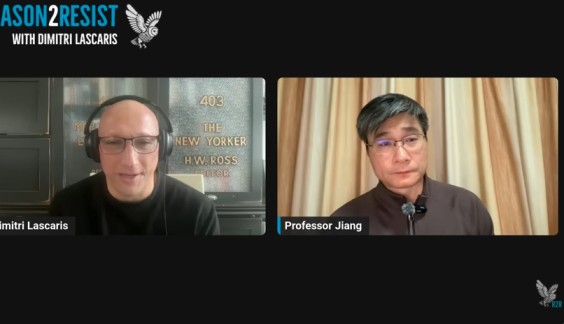
Editor’s Notes: As U.S. naval forces mass near Iran, Dimitri Lascaris sits down with Professor Jiang Xueqin to explore whether Trump is on the brink of launching a new war in West Asia and what that could mean for global stability. They delve into how a U.S.–Iran conflict could strangle China’s access to Middle Eastern oil, trigger military and economic escalation, and reshape the balance of power in Asia. The conversation then turns to Mark Carney’s Davos admission that the so‑called “rules-based order” is a partial fiction, and what his proposed “values-based realism” really signals for Canada and other middle powers. Finally, they examine the emerging Canada–China “strategic partnership,” from electric vehicles and canola tariffs to how Canadian elites may be repositioning the country within a fragmenting world economy. (Jan 22, 2026)
TRANSCRIPT:
DIMITRI LASCARIS: This is Dimitri Lascaris coming to you for Reason to Resist from Montreal, Canada, on January 22, 2026. Today, I’m very pleased to be joined by Professor Zhang. Professor Zhang is a Chinese Canadian educator, writer, historian and geopolitical theorist based in Beijing, China. He’s also the founder and host of a widely followed and important YouTube channel called Predictive History. Thanks very much for joining us for the first time.
PROFESSOR JIANG XUEQIN: Thanks so much, Dimitri. I’m a huge fan of your work.
The Looming Attack on Iran
DIMITRI LASCARIS: Thank you so much. First, you know, I wanted to discuss with you initially when I reached out to you Mark Carney’s just completed trip to Beijing and also his widely discussed speech at Davos. But in light of events over the last couple of days, I’ve added to the agenda the looming attack, or what appears to be a looming attack on Iran. And I’m going to start with that subject.
Before I do, I’d just like to remind our audience to like and share this video if they find it informative, and to please subscribe to our YouTube channel if you haven’t already done so.
So with that Professor, I want to show you an excerpt from an interview this week of retired US General Jack Keane. In this clip from a Fox News interview, Keane is asked whether he believes that an attack on Iran by the Trump regime is imminent. And this is what he had to say.
VIDEO CLIP BEGINS:
JACK KEANE: And there’s no doubt about it. I mean, we’re bringing these resources to bear and it’s likely because we had to expand the target set. And why are we expanding it? Because we have to consider what is Iran going to do in retaliation? Our bases are vulnerable. What are they going to do about Israel? They’re going to attack Israel, likely, and they’re vulnerable. And what are we going to do about their ballistic missiles? Are we going to take them down before they fire them at our bases and also at Israel? Likely. Are we going to kill leaders, certainly IRGC members, the people that are oppressing the people? Absolutely.
So I think the target set is expanded. Resources are being brought in to deal with an expanded target set, which is what we do.
VIDEO CLIP ENDS:
DIMITRI LASCARIS: That’s right, folks. That’s what we do. Now, last week, Professor Zhang, you gave an interview, I believe it was on Danny Haiphong, in which you talked about the possibility of an attack on Iran and you expressed the view, as I understand it, that the US Government would have considerable difficulty toppling the current government of Iran and that it would more likely to turn instead to easy wins in places like Greenland, Canada, and Cuba.
I’m curious to know whether, in light of what has transpired over the last two to three days and in light also of retired General Keane’s commentary, has your assessment changed? Do you think that an attack on Iran is not likely at this stage, or do you think one is virtually inevitable?
PROFESSOR JIANG XUEQIN: Yeah. So let me clarify my comments. So my feeling is that they will attack Iran. They will use airstrikes. It will be very impressive. They will hit a lot of military targets. It will be very sustained. But airstrikes by themselves are not effective. And eventually Trump’s going to halt airstrikes and move his attention elsewhere, but then he’ll resume airstrikes at a later point.
So I think that this U.S.–Iran conflict will be in the background throughout 2026. Unless Trump is willing to commit ground troops, he cannot actually achieve any of his war aims in Iran. The regime is far too resilient, far too resourceful, far too cohesive. So that’s what I meant.
I do think that Trump will strike Iran because that’s always been part of the plan. Remember, back in his first term, there’s a clear trend towards confrontation with Iran. So Trump immediately withdrew from the nuclear deal. Then he transferred the US Embassy from Tel Aviv to Jerusalem, which was extremely provocative. He initiated something called the Abraham Accords, which sought to brought peace between Israel and Saudi Arabia.
And the most provocative thing he did, of course, was in January 2020, he authorized the assassination of General Soleimani, who was the Iranian de facto envoy in the Middle East. And that essentially is the declaration of war. So if he had stayed in office, then we would have seen military strikes against Iran. He lost in 2020, but now he’s back in the second term. He is going to continue his apostle Jesus from his first term, which is seek regime change in Iran.
DIMITRI LASCARIS: I would add to that list, by the way, and I’m sure you’re aware of this, the recognition by the Trump regime in the first administration of Israel’s theft of the Syrian Golan Heights. We could probably go on and on, but I think people get the picture.
The Strait of Hormuz and Global Economic Impact
Now, Iran has long warned that if pushed, it’s willing and able to close the Strait of Hormuz.
If it did that for a significant period of time, let’s say six months or even more, what would you expect the impact on the global economy to be?
PROFESSOR JIANG XUEQIN: So if Iran were to close all the Strait of Hormuz, it would really be the nuclear option. It’d be worse than a nuclear bomb because it would paralyze the global economy. So most of Southeast Asia, specifically China, Japan and South Korea, depend on most of its oil energy from the Middle East. And so if that were to happen, then these economies were to shudder and they would have to respond militarily, especially China and Japan. And so that really is the trump card that Iran can play.
So I imagine that we still have pretty far to go on the escalation ladder before Iran plays that trump card. So I imagine what’s going to happen, and it’s just my best guess as to what’s going to happen, is that Trump’s going to authorize airstrikes and then Iran is going to retaliate against Israel because Israel is going to participate in the airstrikes.
Iran is also going to retaliate against local Middle East allies, including Jordan. And Iran will strike at US bases in the region for its proxies, Hezbollah and the Houthis specifically. So I believe there’s an escalation ladder and we have to climb pretty far up the escalation ladder before Iran closes the Strait of Hormuz, because if they were to do that, this would basically be World War III. It would draw in a lot of nations and the consequences could—it’s not really contained anymore. It would be very unpredictable and unprecedented if Iran were to close off the Strait.
China’s Response and Military Support for Iran
DIMITRI LASCARIS: Now, a couple of days ago, a publication called Defense Security Asia published an article stating that there were unconfirmed reports, that’s the way they described them, of a rapid Chinese military airlift into Iran involving up to 16 cargo aircraft. That would be quite a haul potentially of military equipment. What do you make of these reports, Professor Zhang?
PROFESSOR JIANG XUEQIN: Right. So from the Chinese perspective, what Trump is really doing is initiating a long term strategy of strangling China economically. If you read the National Security Strategy, which came out last month, it’s very explicit that the United States cannot challenge China in the Southeast Asia militarily. So what it’s going to do is that it’s going to use its proxies like Japan, and it’s going to strangle China economically.
Now, the problem with China is that its major strength is its exports. So if the United States were to close off the first island chain, which is Japan, Taiwan, the Philippines, and if there were a war in Iran, then China would be strangled economically because it could not access oil. So I know that Russia is providing 20% of China’s energy needs, but 20% is not a lot. And the reality is that Russia is having problems meeting that demand right now.
So it’s going to take, you know, five to 10 years before the Trans Siberian pipeline is online and Russia can provide more energy to China. And that’s why the United States is going to strike. Now, from China’s perspective, I’m saying this from a Chinese military perspective, that the real reason that Trump is going after Iran is to destroy China’s economy because China had no choice but to bolster Iran.
And so they’re going to send weapons systems, they’re going to send financing, they’re going to do whatever they can to support Iran. But there are some red lines. So China will not send soldiers and China will not declare war on the United States.
DIMITRI LASCARIS: Do you think that China might send naval vessels into the region?
PROFESSOR JIANG XUEQIN: Yeah. So the issue is that China doesn’t have a blue water navy to challenge the American Navy, the blue water Navy. But I think what’s going to happen this year is that very quickly Russia is going to transform its shuttle fleet, it’s about 1,000 ships, into a blue water navy. There’s no way that Russia can defeat America in the oceans, but Russia at least has to challenge America.
It basically has to basically create a war of attrition in the seas that would hamper America’s aggression against Iran. And China would provide financing for Russia’s blue water navy. So I think that’s what’s most likely to happen.
Mark Carney’s Davos Speech: Values-Based Realism
DIMITRI LASCARIS: So let’s turn now to a less violent topic, namely the subject of Mark Carney’s much discussed speech at Davos. The most widely discussed aspect of the speech, I think, is Carney’s acknowledgment that the rules based order is, as he put it, “a partial fiction.” Now, he didn’t—that implies that some part of it was true. And he didn’t tell us which part, if any of the rules based order was true or based on reality.
But in any case, he went on to explain what he believed should replace the rules based order. And he referred to this new foreign policy paradigm as “values based realism,” which he said actually came from Finland’s President, Alexander Stubb. And in the following excerpt from Carney’s Davos speech, Carney explains what he means by values based realism.
VIDEO CLIP BEGINS:
MARK CARNEY: What does it mean for middle powers to live the truth? First, it means naming reality. Stop invoking rules based international order as though it still functions as advertised. Call it what it is, a system of intensifying great power rivalry where the most powerful pursue their interests using economic integration as coercion.
It means acting consistently, applying the same standards to allies and rivals. When middle powers criticize economic intimidation from one direction, but stay silent when it comes from another, we are keeping the sign in the window.
It means building what we claim to believe in rather than waiting for the old order to be restored. It means creating institutions and agreements that function as described. And it means reducing the leverage that enables coercion.
VIDEO CLIP ENDS:
The Hypocrisy of Western Foreign Policy
DIMITRI LASCARIS: Now, professor, we just heard Mark Carney say that values based realism means applying the same standards to allies and rivals. And I must confess that I’m deeply skeptical that Canada will now apply the same standards to the West’s allies and rivals. And I’m going to give but one example, and that is within 48 hours of Carney delivering this speech, Israel murdered 11 Palestinians in the Gaza Strip, including three more journalists and two more children.
As you can see from this report by Thomson Reuters, I’ve seen no statement from any Canadian government official condemning or even expressing concern about these atrocities. They have been virtually silent the entire time that Israel has killed over 100 children in what is supposed to be a ceasefire.
Moreover, after more than two years of genocide, Mark Carney’s government has imposed no sanctions on Netanyahu or Gallant, both of whom have been indicted by the ICC. It has imposed no sanctions on major Israeli corporations, not even those in the military industrial sector. It’s imposed no sanctions on Israel’s military leaders, but it continues to maintain sweeping sanctions on Russia and Iran, both of which it regards as geopolitical rivals of the West.
So again, to be perfectly blunt about it, Professor, I think that Mark Carney’s speech was essentially a marketing exercise. That’s my suspicion, and I hope I’m wrong. He knows that the whole world now sees the reality of the rules based international order, that it is a fraud and that the concept has been discredited. And therefore I suspect, and I could be wrong again, that Western leaders want to rebrand their foreign policy as values based realism.
But there doesn’t appear to be any meaningful distinction between that and the now completely discredited rules based international order. So that’s basically my skeptical view. But I’m very curious to know, what is your take, not just on this particular question, more broadly, on Mark Carney’s speech at Davos?
Mark Carney’s Historical Allusions and Canada’s Predicament
PROFESSOR JIANG XUEQIN: Yeah. So overall I agree with your sentiment. I think you tend to be very right about these sort of things. It’s very skeptical than it is to be naive. Right. So I did read Mark Carney’s speech and he makes in his speech two major historical allusions.
The first is to Thucydides. And Thucydides is written about the Peloponnesian War, and the war was fought between Athens and Sparta. So Athens had defeated the Persians, and because of that, the Aegean Sea Greeks were very thankful to the Athenians, just as the Europeans were very thankful to the Americans for defeating fascism in Europe. And so after the Persian wars, they created something called the Delian League. It was meant to be a mutual defense pact. But over time, Athens as a hegemon, started to exploit its allies. It became a mafia regime and it started to extort its allies. And then its allies had no choice but to seek relief from Sparta.
So I think that with this Thucydides illusion, Mark Carney is sort of hinting to his audience that we are at this moment when America’s former allies have turned into their vassals. And so America is going to exploit us. America is going to steal our wealth. America is going to make us fight wars we cannot possibly win, probably in Ukraine. And so we need to band together and seek relief from another Sparta. Today’s Sparta would be China, right? So I think that’s the first historical illusion he’s making.
The second historical illusion he’s making, of course, is to Vaclav Havel’s famous essay, “The Power of the Powerless.” And you know, it’s very ironic he does that because in his speech he says that, okay, let’s be honest, from day one we knew this rules-based national order was a fraud. It was hypocritical. But we benefit from it because we were friends of the hegemon, the great empire. And so we benefited. But now that the empire is turning against us, now that the empire wants to cannibalize us, we must now speak truth to power, okay?
So you can imagine the hypocrisy. So I don’t think it’s much of a strategy, okay? Because I think like anyone with a brain, which obviously precludes Canadians, but anyone with a brain can see through the hypocrisy, the travesty and the self-indulgence. In his speech, it’s not really a grand strategy, it’s more of a lament, right? It’s lamentation of, you know, we used to be best friends, America, we benefited a great deal. Now America has abandoned us, we’re a jilted lover, and now we’re forced to band together and seek a new ally in China. So I read the speech more like that, you know.
And he has three grand suggestions for moving forward. The first, of course, is to speak truth to power, to recognize the severity of the situation and be honest with ourselves. The second is to create, as you say, a new system of rules-based international order of institutions that could counterbalance the bullying of America. And the third is to rely more heavily on Canadian capital and talent.
The problem in Canada, you know this, is that everyone’s fleeing, right? Capital is fleeing, talent is fleeing Canada. So Canada’s being hollowed out. So you know, as a banker, and you know Mark Carney used to work for Goldman Sachs. He used to be governor of the Bank of Canada and then he went to England and became the first foreign governor of the Bank of England. He is a banker who serves transnational capital.
And the reality is that Canada, the nation, I hate to say this because I grew up there, right? But Canada, it’s a toxic asset. Right now housing prices are sky high. The Canadian economy, 40% of the Canadian economy is real estate speculation. Canada is this glorified money laundering operation. It’s lost all its legitimacy by supporting this genocide in Gaza. There are hundreds of thousands of homeless in Canada, yet Carney still continues to send tens of billions of dollars to Ukraine to fight a pointless war causing about a million Ukrainians to die.
For no particular reason, these Canadian companies refuse to invest in the country and many of them are fleeing the country. So Canada is a toxic asset. And what you do with toxic asset as a banker is you sell it to the foreigners. And who are the foreigners? The Qataris and the Chinese. Okay, so that’s the grand strategy that Carney has and everything else like this grand rhetoric about a rules-based national order. It’s as you say, marketing. That’s all it is. Don’t pay any attention to it. Watch what he does.
So what he’s going to do is this. He’s going to call an early election, probably late spring, okay, April. He’s going to win by a landslide. He’s going to have a super majority and then he’ll start to asset strip Canada. Okay, that’s the plan. Pretty simple.
Canada’s Limited Options
DIMITRI LASCARIS: That’s quite distressing for those of us who live here, but I find that an entirely persuasive prediction about what is likely to happen in the months ahead.
Now let’s imagine, Professor Jiang, that you were asked to provide advice to the Canadian government about how to deal with the current predicament. I know this is a huge and complex question, but I am curious to know how you would deal with it. Let me be clear. I’ve been complaining for years that our government, successive Liberal and Conservative governments have done so much to increase our dependency upon the United States and to de-industrialize this country, to deprive this country, to deprive us of the capacity to produce domestically the things that are necessary for the well-being of the Canadian population.
But this is the world we’re now in. We have an extraordinary degree of dependency on the United States. We have a lunatic in the White House who openly talks about turning Canada into the 51st state. There’s no way, even with the ruinous plan to increase Canada’s military spending to 5% of GDP, that we could compete with the United States in terms of military spending. We have the longest undefended border in the world with the United States. We’re in a bit of a pickle. So in these circumstances, how would you recommend the Canadian government deal with the new reality?
PROFESSOR JIANG XUEQIN: Okay, so realistically, there’s nothing Canada can really do to stop America from colonizing Canada. There just really isn’t. And America doesn’t have to use its military because all America has to do is propose that Canadians can have American passports and that whatever Canadian savings they have will be converted to American dollars one to one. Okay? So Canadians are getting a huge discount.
The reality is that 25% of Canadians are foreign born and most of them do not have any loyalties to Canada. Canada also has this bloated bureaucracy where 22% of Canadians work for the government in some capacity. Entrepreneurial energy is dead. If you’re an entrepreneur, you are burdened by too many taxes, by too much regulation, and so you flee to the Americans. So if there were ever a referendum, you’d be surprised by the number of Canadians who vote to join the United States.
The big vulnerability for Canada is Alberta. The Albertans are not very happy with the fact that they’re basically subsidizing all of Canada. And the push for independence is now very, very strong in Alberta. And Trump can take advantage of that by supporting this push. So there are a lot of vulnerabilities in Canada.
But I’ll answer your question directly. Like, what would I suggest? Okay. Well, first of all, the problem is that Canadians live in a bubble. And Canadians have an unfortunate tendency to put their heads in the sand at the worst times. And so the idea that government would actually bring an outside advisor who would tell them bad news, it’s very inconceivable.
But, you know, let’s just say, for the sake of argument, just say that they bring me in and ask me what I should do, what I would do. Okay? And here’s my advice. And I know this is counterintuitive but my advice is Canadians should love Trump. They should make Trump into a God. They should have statues of Trump everywhere. Okay? They should put Trump on TV all the time in school. All Canadian children should love to worship Trump as a king. Forget King Charles. We don’t want him anymore. We want King Trump to be the sovereign of Canada. I guarantee you, if Canadians were to do that, all the problems would go away and in fact, their lives would improve. But guess what? They’re not going to do that.
Mark Carney’s Beijing Trip and the “Strategic Partnership”
DIMITRI LASCARIS: Well, no, that actually brings us to our next topic, which is Mark Carney’s trip to Beijing. That doesn’t seem to be the kind of thing that is going to win the goodwill and good graces of King Donald. But I want to get into the particulars of what happened there.
And you know, when Mark Carney completed his meetings with Chinese President Xi Jinping, he issued a statement, his government did, which touted what he described as a new strategic partnership with China. And I’m just going to put up on the screen here what I think is the most informative part of the statement. And I’ve highlighted in blue the only aspects of the agreements that were struck in China which translate into concrete improvements in the terms of trade between the two countries. I wasn’t able to identify others. There were numerous agreements apparently which stated, you know, the party’s commitments to various objectives and the goodwill and their hopes and aspirations. But the actual meat on the bones, this is what I was able to identify.
And I’m quoting, “To help deliver the full potential of these partnerships and build up our domestic manufacturing sector, Canada will allow up to 49,000 Chinese electrical vehicles into the Canadian market with MFN tariff rate of 6.1%. This corresponds to volumes in the year prior to recent trade frictions on these imports representing less than 3% of the Canadian market for new vehicles in Canada.” The, I believe the number for 2024 was somewhere in the range of 28 million vehicles sold in Canada. So this is a really small proportion.
“It is expected that within three years this agreement will drive considerable new Chinese joint venture investment in Canada with trusted partners, protect and create new auto manufacturing jobs,” blah, blah, blah. And then he goes on and says, oh, I should also just specify that in this paragraph it stated that it’s also anticipated in five years more than 50% of these vehicles will be affordable EVs with an import price of less than $35,000. Somewhere else I read that half of this very low quota is for vehicles less than $35,000. And from what I understood, the rest have to be at a price point above $35,000.
In any case, it goes on and says, “Agri-food and trade are foundations of a long-standing relationship to Canada and China. And Canada expects that by March 1, 2026, China will lower tariffs on Canadian canola seed to a combined rate of approximately 15%. China is a $4 billion canola seed market for Canadian producers, and this change represents a significant drop from the current combined tariff levels of approximately 85%. And Canada expects the Canadian canola meal, lobsters, crabs and peas, will not be subject to relevant anti-discrimination tariffs from March 1, 2026 until at least the end of the year.” So that’s 10 months.
Now, all of this strikes me as rather modest, Professor Jiang. I don’t see this as being any profound change in the trading relationship between Canada and China. I guess I would concede that it is a significant improvement and I certainly would love to see Canada pursue closer relations in all aspects with the People’s Republic of China. But I don’t see this as being a strategic partnership. And I’m curious as to your thoughts as to how important this actually is and also secondarily how you anticipate that the Trump regime is going to respond to this.
Canada-China Strategic Partnership: Economic Realities and Political Implications
PROFESSOR JIANG XUEQIN: Right. So I would say this is a breakthrough, and I would say this will lead to bigger strategic partnerships very quickly down the line. So there are different aspects to what’s going on.
The first aspect is that Trump has basically declared war on Latin and South America. So you have countries like Brazil, Colombia, Mexico that are not obeying him, that are not being sufficiently differential to him. Now Brazil exports a lot of agricultural products to China, especially soybeans. And Trump is angry about that as well. Because remember when Trump imposed tariffs on China, China responded by cutting agriculture imports from the United States, which hurts farmers in America, which supposedly hurts the MAGA base.
And then China started to import a lot of agricultural products from Brazil. So what Trump wants to do is basically strangle South America and prevent trade between China and South America, which forces China to look for agricultural products in North America, United States and Canada. Also, if there’s a war that breaks out in Iran, then China needs oil. And so China is now forced to buy oil from Canada and the United States. So that’s one element of what’s going on. That’s number one.
Number two is we have to remember what the Canadian economic model is. There are three pillars to the Canadian economic model. The first is sell resources to America. 77% of Canadian trade is with America. That’s number one. Number two is exploit cheap immigrant labor. Today’s job don’t actually work. They get immigrants to do work for them. I know this because my dad was a dishwasher. He had two managers who were Canadian. That’s number two.
Number three, which people don’t ignore, is laundering. Help corporate officials from around the world launder their ill-gotten gains into Canadian real estate. So the very important idea is these EVs are coming into Canada. They’re meant to be the spearhead for this massive collaboration between Chinese companies and Canadian companies which allows Chinese companies to launder resources into Canada. So it’s money laundering. That’s one aspect.
The other aspect is this. Look, I keep on saying this, but Canada has become a toxic asset where real estate is completely overpriced and so they’re trying to dump this toxic asset onto the Chinese. So what Carney really wants, this is key, is access to the household savings of the average Chinese citizen, which is about 40%.
So in Canada, Canadians, the average Canadian household has got 100% debt to income ratio. So basically Canadians owe more than they actually earn. But in China, Chinese will save 40% of all their income. That’s a huge financial resource for Carney to tap into. So what Carney wants, he doesn’t care about the EVs, he doesn’t care about selling canola to the Chinese. Who cares? That’s penance.
What he really wants is a new economic relationship between Canada and China where the Chinese household are able to divert a lot of savings to Canadian resources. So imagine Chinese buying houses in Canada. Imagine Chinese sending their kids to Canada for university. But also imagine Chinese food, stable coins buying Canadian currency. So that I think is the grand plan because again, Carney’s a banker, he thinks like a banker. He thinks about how to tackle chain financial resource and sell it really expensive to stupid investors. That’s how he thinks.
So I think that’s a grand strategy here and Trump’s going to go along with it. Because this for Trump is really the ideal arrangement between China and the United States as well. So let Carney test the waters, see how the Chinese respond. And then when Trump visits Beijing in April, negotiate the same deal.
DIMITRI LASCARIS: And do you think the Chinese government appreciates fully that this is the long term strategy of the banker?
Central Banks and Economic Coordination
PROFESSOR JIANG XUEQIN: The decisions, high level decisions, are not usually made between government and government. They’re usually made between central bank and central bank. So the Bank of International Settlements in Basel, Switzerland, that’s a coordinating body of the central banks. And that’s where they come together and they discuss the problems and the solutions.
So the Canadians have a problem because it’s entirely based on money laundering. It’s a Ponzi scheme. So they need people to come in and store their resources in Canada. That’s how the thing works. The Chinese have a problem because their people refuse to spend their money. And Chinese refuse to spend their money because Chinese absolutely no confidence in the future. There’s no safety net. The pension is not reliable. Their children is not going to have a great bright future. So maybe they just save up as much money as possible for the future.
The problem from the economic perspective is that that’s actually counterproductive. You need people to spend their money for the economy to function, right? So the money is staying in the bank dormant. That creates a lot of issues. One major issue is of course its trade imbalance where China has like 1.2 trillion trade surplus with the rest of the world, which just doesn’t help the Chinese at all.
So the Chinese central bank has a problem of how to increase consumption. The Canadian central bank has a problem of how to absorb more of savings around the world. So I think that these guys had serious discussions at the Bank of International Settlements and they’ve come to an agreement. And that’s why Carney went to Beijing, because remember, there had to be agreements in place for these leaders to meet. The two leaders meet in order to sign the MoU. They’re not going to sit together for days and days to negotiate the deal. That’s what underlings do.
So I think there’s already been an agreement in place. And how this agreement will pan out is something that we will observe over the next year.
Chinese EVs and the Future of Canada’s Auto Industry
DIMITRI LASCARIS: Now, I want to focus on one particular aspect of this agreement and namely the electrical vehicles. I happen to drive an electrical car, but it isn’t a Chinese made one because it pretty much is inaccessible in this country. So now the BYD vehicles will be coming in. Based on what I’ve heard about them and read about them, they’re going to be extraordinarily attractive, probably to a lot of consumers in this country.
And assuming that the quota doesn’t get in the way, one could easily imagine a very rapid increase in the sales of Chinese EVs in Canada in the months and years ahead. Do you think that there’s any prospect of Chinese automobile manufacturers moving production or some part of their production to Canada in order to avoid the destruction of the domestic automobile industry? Or that’s not the way they operate?
PROFESSOR JIANG XUEQIN: I think that’s a plan. I think that’s the agreement. I think the agreement is for Chinese EV factories to move over to Canada and create joint ventures. So the Chinese political system, it’s very strange for Westerners. So EVs, it’s not an economic tool, it’s a political tool.
And what I mean by that is think of the 2008 Beijing Olympics where the government spent billions and billions of dollars on creating this amazing show for the world. And so it’s a political show. And that’s what EVs are. EVs are a sign that China is technologically advanced, that it’s not just like a sweatshop to the world, that it is one of the leading technological centers of the world. And it’s all part of China’s grand strategy to be a technological powerhouse.
So the problem EVs is that they’re heavily subsidized by the government. So people don’t appreciate this, but EVs lose money because they’re all heavily subsidized by the government. And there’s overcapacity in China. So everywhere you go, there are lots of EVs, but they can’t actually sell all the EVs in China. So for Canada to start selling EVs, for Canadians to start buying Chinese EVs, for Chinese EV companies to open shop in Canada, it would be a huge political victory for the Chinese leadership. And that’s all they care about.
The Huawei Controversy and Security Concerns
DIMITRI LASCARIS: Let’s talk about another sector. Telecommunications. You know, when Mark Carney concluded this trip, the neocons in Canada started freaking out. And one expression of that was this article in the Hill Times, which is a go-to newspaper for Canada’s political elite. It’s based in Ottawa. And as you can see here, the Hill Times went to security experts, or at least that’s the way they describe themselves, including a former director of CSIS, Canada’s spy agency, and also to politicians and asked them about Huawei.
And there’s a ban on Huawei’s 5G in this country. And they warned ominously that we should not lift that ban and continue to express hostility to this really, this extraordinary corporation. What do you think is going on here, Professor Zhang? Why is the Canadian political and economic elite and particularly the security establishment so hostile to Huawei? I mean, they claim that it’s potentially a vehicle for the PRC to spy on Canadians. Do you think that that’s what’s really underlying this hostility?
PROFESSOR JIANG XUEQIN: So I think this is very personal. Remember that there’s bad blood between Huawei and Canada because a Huawei executive, she was, I think, a Canadian PR and she was living in Vancouver, but she works for Huawei and she’s actually the heir apparent to the Huawei empire, Meng Wanzhou. And when she was going to Mexico for a meeting, she had to transfer through Vancouver. She was detained by the Canadian authorities because the Americans requested that she be extradited.
DIMITRI LASCARIS: That was Donald Trump, just to be clear. Sorry to interrupt you, but it was the first administration.
PROFESSOR JIANG XUEQIN: Yes, yes. And the Chinese responded by basically holding two Canadians hostage. And this created a huge political furor between Canada and China. And I think there’s still bad blood between the two sides. The intelligence agencies in Canada and intelligence agencies in China have a lot of bad blood over this thing. So I think that’s why there’s so much hostility towards Huawei. But I think at the end of the day, the agreement is already in place and they don’t really care what the intelligence agencies say anymore. They’re not relevant to this overall strategy.
Chinese Interference: Manufactured Threats?
DIMITRI LASCARIS: And related to this hostility, as I’m sure you know, in recent years there has been an avalanche of accusations leveled by various Canadian politicians that the Chinese government is interfering in Canada’s so-called democracy, as if we have one. And there has been an inquiry that was struck that investigated these allegations. And interestingly, I’ve written and talked about this a fair bit. The inquiry didn’t really find any concrete evidence of interference.
But nonetheless, the judge who presided over it expressed considerable concern about the Chinese government’s intentions. I’ve always thought, Professor Zhang, that really there’s nothing, much if anything, to be gained by the government of China engaging in the sorts of shenanigans that it has been accused of engaging in this country. What do you think the reality is there and what is motivating these incessant accusations of Chinese government interference in Canadian domestic politics?
PROFESSOR JIANG XUEQIN: So when I was younger, I read a lot of John le Carré novels. I’m not sure if you read him. His real name is David Cornwell and he used to work for MI6. And so he knows a lot about the British intelligence service. And the thing that comes across very clearly in his novels is that these guys are always trying to justify their existence. They’re basically bureaucrats. They’re always looking to create threats and they often create threats with their enemies. Because at the end of the day, spies benefit actually more from working together than they do from fighting against each other.
So it’s all a manufactured threat. And as you say, the Chinese government does not benefit at all from interfering in Canadian politics. And quite honestly, it doesn’t have the expertise, doesn’t have the resources, it doesn’t have the time to go interfering in Canadian politics. Why would you want to do that? I mean, the Indian government has a lot of reasons to interfere in Canadian politics. Does anyone talk about what a threat India is? So it’s very silly.
DIMITRI LASCARIS: Yeah, I couldn’t agree more. Well, thank you so much. It’s been fascinating talking to you and I hope we can have you back on the program soon to explore other topics of interest to our audience.
PROFESSOR JIANG XUEQIN: Great.
Related Posts