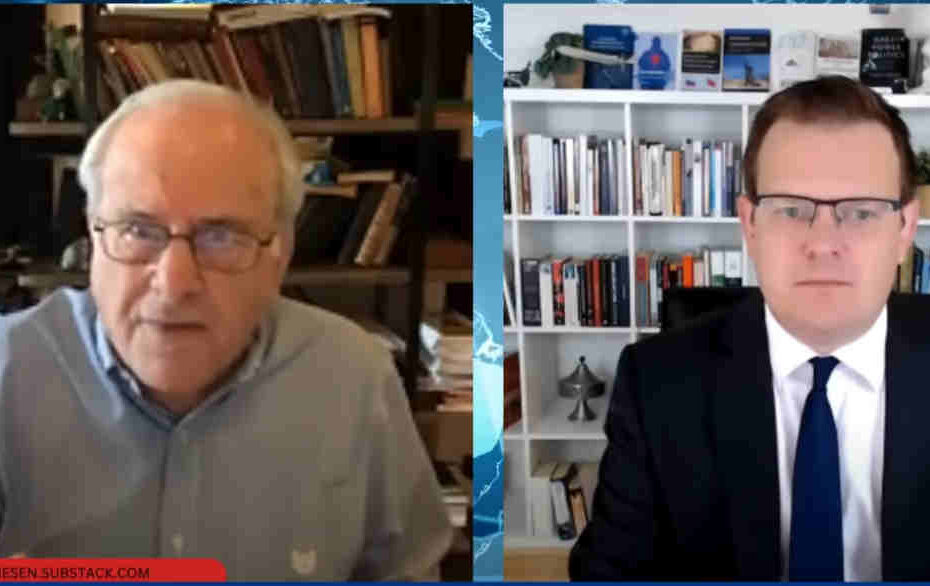
Read the full transcript of Professor and economist Richard Wolff in conversation with Norwegian political scientist Prof. Glenn Diesen on “US Empire in Collapse, China Builds Rival System”, September 6, 2025.
INTRODUCTION
GLENN DIESEN: Hi everyone and welcome back. We are joined today again by Professor Richard Wolff, a world renowned political economist, to discuss what is happening in China this week. So welcome back to the program.
RICHARD WOLFF: Thank you very much. I’m glad to be here.
GLENN DIESEN: So you have all these world leaders from the non western world meeting in China for the Shanghai Cooperation Organization summit. Now most of the world these days seems concerned about the Western centric economic system coming to an end. That is unsustainable debts, excessive financialization, you can add, the weaponization of economic dependence.
Anyways, we seem to be watching the not so slow collapse of the Western centric international economic system while something else is being constructed. It’s not quite clear yet what this is, but I did want to know what do you make of all of this and how significant is it?
The Western Perspective on Imperial Decline
RICHARD WOLFF: Well, I admit that I come to this from a Western perspective. I should make it clear I’m an American citizen, been born and did my work and live here in the United States. I’m speaking to you from New York City. So I come at the answer to your question from the standpoint, not just of the west, but literally of the center of the currently declining Western empire.
So to me it is very dramatic, it is very fast, it’s unraveling in what seems to me a short amount of time. I understand human history to have seen many empires – the Greek, the Roman, the Ottoman, you name it, in all parts of the world. And I’ve always understood that to be a long slow process. So I do somewhere understand that it is long and slow. And I have to remind myself of that because it seems right now to be unraveling very quickly.
So I don’t want to resolve that. I don’t think that’s a contradiction that should be resolved. I’m more of a Hegelian. That’s a contradiction that is constitutive of the reality in which we live. So having said about the long and the slow, let me tell you how it looks from someone who right now is struck by how fast it’s going.
The Ukraine War as a Symbol of Western Decline
And here’s how fast I mean by fast. The war in Ukraine is part of this. And that’s only three years now. A little over three years. And look what happened at the beginning. We were told by our leaders here that Russia would be on its knees, that the ruble would become rubble, in other words, that this was going to be a short, easy, one sided story.
And we were kept with that story into much of 2022, much of 2023. And so on, as the west added more and more layers, more sanctions and more weapons and higher grade weapons and more money. And what we have seen, very dramatic to us in the face of all of that, a steady defeat at the hands of Russia, whose ruble didn’t collapse, whose economy didn’t fold, whose economic growth record is faster these last three years than that of the United States, if you measure it by annual percentage growth of GDP and so on.
That is very dramatic and is leading this country to have a kind of schizophrenic splitting of the consciousness. There is a minority, I want to be clear, a minority, although significant, that sees Ukraine as a defeat. Part of Mr. Trump’s behavior is because he sees it that way, too. But the overwhelming majority of Americans will not admit this. They are denying what I just said, that the war is not over, that the war is not being won by the Russians, that more effort is coming and will be victorious when this is over.
Signs of Desperation: Military Rebranding and Aggressive Actions
Second example, and these are little things, but you should see them in this context. We once upon a time had a Cabinet office called the Department of War, in which the United States copied Great Britain, who also called that the Department of War. Then after World War II, when the United States position was global empire manager, it was changed to Department of Defense, and now it is being changed back to Department of War.
That’s part of a positioning of the United States in its own mind as big and powerful. And now taking the veneer, the wrapping off to reveal the underlying raw power, in the same day that they announced that the American military destroyed a boat that was 1,000 miles away from the United States in the Caribbean, the South Caribbean, near Venezuela and Trinidad.
A boat in which 11 people were moving, no one knows from where, no one knows to where, and no one knows what was in the boat other than the 11 people that were summarily killed. What’s going on here? There’s no state of war between the United States and Venezuela. There is no threat to the United States by a boat, a little boat, you know, a boat that has four outboard motors that is a thousand miles away.
You have to think, why would you do this? What in the world would possess you to be the judge, the jury and the executioner all at once of these 11 people, whoever they were with which we will probably never be told here, maybe somewhere else, but not here.
And then now finally punishing Mr. Modi and the Indians by an increase in the tariff which was already heavy on them because they would not stop buying oil from Russia. This is a secondary tariff. This is a tariff that is punitive. This is a tariff that, if it is allowed to stand, will damage Indian businesses and American businesses in significant degrees.
Acts of Desperation
What is going on?
In my judgment, these are desperate acts. I use the word intentionally. These are acts of desperation, of a government trying to hold back the decline because they, like me, see it as fast. Ironically, I have to say now it isn’t as fast as they fear it to be.
It’s partly the political stance of the United States to justify the extremity of the tariff war against the world, of the sanctions against much of the world. These are extraordinary, aggressive actions that have to be justified. And the justification here is the ironic and in the long run, very dangerous reinforcement of the notion of a declining empire by those people working hard to prevent it.
But they inadvertently, by having to justify what they’re doing, teaching the American people to fear a process that is in fact underway, but that most of them most of the time still want to deny. So they’re caught between the urge to deny and the irony that the people riding that wave into office have to reinforce it.
Something similar, I believe, is going on in Europe. In order to justify 5% of your budget for defense, you have to hype the threat of Russia invading all of Europe. You have to revive 75 years of cold War mentality as if the Cold War were still there. And so you inadvertently, you are frightening your people. And that will come back and hurt you since your leadership screams every day of its incapacity to manage any of this.
The Rise of the East: A Complex Transition
Having said all that, I do think that what’s happening in the east is an important milestone in the decline of the West. I don’t think these things will happen overnight, and I see them as full of contradictions.
Is it a sign of the economic maturity of the East? Yes. Is it a sign that the BRICS countries, the SCO countries, all of that part of the world, is beginning to seriously disconnect from the United States because the United States is behaving as a rogue player in the world economy? Yes, I think that’s going on.
I think India is trying to solve problems with Russia and China to isolate the United States relative to itself. I think these are extraordinary steps happening in a long, slow process. But more quickly and that the United States own desperate efforts to hold it back are having the contradictory effect of speeding it up, which only reinforces the American desperation.
This is a dangerous loop because of its military implications. But as I say, I think there are also all kinds of contradictions.
The Dollar’s Complex Role
For example, the US dollar as the world currency is definitely part of the US domination of the US Empire, the way the British pound was for the British Empire before. Yes, all that’s true. And so the rise of the BRICS, the rise of China challenges some of the privileges that the dollar gave to the Western empire.
But we have to remember the dollar was also the global currency within which China achieved its economic miracle of the last 30 to 40 years, and India also. So it’s not as though the dollar was some obstacle. You’d see much more anti dollar activity because they’re capable of it. But why would they? Having a universal currency is not a bad thing. For the country that wants to be the universal provider of manufacturing in the world, that’s a convenience.
It’s a little bit like the relationship between Chinese manufacturing and the major retail giants of the Western world. Amazon, Walmart, Target, those are mass distributors of the mass production of Chinese manufacturing. They need each other. Without China, Walmart wouldn’t be the number one retailer in the world, and vice versa.
So I think inside China you will see and there are already signs of people in no great rush to undo the dollar. The dollar is very convenient and they are aware, which I as an economist would tell you, that most capitalists would rather a situation that has costs than the uncertainty of what would happen if the dollar weren’t the global currency.
China has capital controls. The Chinese Yuan cannot, at least not yet, play that role. No one else can either. So beyond a certain point of looking into it, if you really begin to move in that direction, you would have an uncertainty about global payments, global exchange currency that many capitalists do not want to see, do not want to have to navigate, do not want to have to ensure against the consequences of.
The Cautious Nature of Transition
It’s a more complicated process than you might imagine. Yes, one empire is dying and something else is emerging. But that’s a slow process because the one dying is desperate to stop it. And the ones who are inheriting the new mantle are very understandably cautious and nervous about how this is working and need to manage it and feel that need very intensely.
And I haven’t even said a word about the military dimension of all of this. And you should be aware that that too is a danger lurking in the background. If you provoke the west, particularly the United States, if you deprive it of its economic hegemony and you deprive it therefore of its political hegemony, it may decide to rely on what’s left, which is the military hegemony. And that’s with a world of nuclear weapons, very scary.
The Militarization of American Society
And I would have to remind everyone that the budget just passed here in the United States contracts everything that the government is doing relative to the Defense now War Department, and to an altogether new entity, which is a new internal army called I.C.E. whose current orders give it something on the order of $170 billion over the next five years to multiply it by several in size.
Yes, they are currently ordered to deport undocumented immigrants. But I would urge everyone to remember a very deep historical lesson. The army that is organized and does horrible things abroad, sooner or later comes home and does those things at home. This new army can deport anybody. Doesn’t have to just be. They can’t yet legally. But who knows where this will go.
But it tells you a society that is taking its money and betting on the military, even at the price of dismantling or accepting the dismantling of its economic and political hegemony.
The Dollar’s Declining Dominance and China’s Strategic Patience
GLENN DIESEN: I think you’re definitely right, especially on the dollar. This is that the United States, well, as Trump suggested, it would be like losing a world war if they would lose this privilege. But you also see on the Chinese side, for example, that they see benefits of using it, so they’re not in that big rush to dismantle it.
But that being said, they are experimenting of course with alternatives so they’re not left in a very weak spot if something does go wrong. But it appears that a bit of a perfect storm is brewing up though, because, well, 500 years ago this is when European maritime powers began to connect the world by sea, setting up trade post empires.
Then later on you have the industrial revolution giving them technological industrial dominance, also leading to colonization of the world. And yes, what seems to be slipping now though is centuries of a Western led economic order.
The Three Pillars of American Economic Power
That is, well when the United States tried to break apart from Britain economically with the American system, it more or less organized around three pillars. One was the industrial technological independence with its manufacturing base. The second was some transportation corridors with roads, ports. And the third was the finance with the national bank.
And these kind of three pillars has also been the source of dominance it seems, especially after World War II now. But if we see what’s happening, all of these pillars seems to be falling at the same time. The industrial might is gone. The technological dominance also being swept away by China at a rapid speed.
You see the controlling the main transportation hubs around the world also falling apart with belt, the Belt and Road initiative and other connectivity, physical connectivity projects. And the last is of course the financial system in which we see now alternatives of swift new development banks, experiments with other currencies.
So all you kind of need is some institutional arrangement to bring all of this together and bring all the major players together. And even two weeks ago or three weeks ago, who would have thought these pictures of Xi, Putin and Modi having a laugh together.
And well, today Trump tweeted out, “Looks like we’ve lost India and Russia to deepest darkest China. May they have a long and prosperous future together.” I’m not sure what to make of this, but again, it does seem like the mindset is still either you follow the American model or, you know, come here and pay tribute. Otherwise, you know, you are, as he earlier said, conspiring against America. That’s the word he used for what they were doing in China. They were conspiring against America because they’re trying to break free.
So I just isn’t this. I know it will probably happen very slow and I agree, but all of these things happen at once. It is quite significant though.
The Merger of Government and Big Tech
RICHARD WOLFF: Yes. I mean, again, remembering that you and I are sitting in the declining end of the spectrum. Yeah, it is very fast. I think of European culture like you. You go back to when they started sailing their ships around the world and constructing their colonial empires.
But I also go back to around that time, although I think more in terms of the Renaissance and the Reformation and the whole development of Europe as it luxuriated in its image of itself as the center of the world, the cultural center, the political center, the military. It had several centuries of a tremendous self celebration which carried it across many of its contradictions, like they slaughtered each other on a scale that the rest of the world probably has never seen, culminating in the two world wars, etc.
But it is spectacular that all of this, which we took for granted over 500 years or whatever the numbers are, should be falling apart. But it is and it isn’t. Let me give you again the contradiction.
As we look at our president here in the United States, we noticed at his inauguration he had lined up on the platform behind him not the greatest thinkers, not the greatest athletes, not the greatest poets or actors and actresses. He lined up the billionaires, the Musks and the Zuckerbergs and all of those people.
And the other night, I think last night or the night before, they had a major dinner in the White House and we were all shown pictures of this major dinner where all the high tech leaders came in from California and sat around in the White House with the President. The only one excluded, Elon Musk, because he’s misbehaved and so Mr. Trump has to throw him aside. It’s also a message to the other people around the if you behave, you will be at this table and if you don’t behave, you won’t.
Government Ownership in Private Corporations
And now the even more important steps of the last two weeks. The United States government took a 10% position in the stock ownership of the Intel Corporation, one of the giant companies in California, with a written agreement that they can buy another 5%. Well, if you own 15% of the shares of a company like that, you are a de facto decision maker. You are among what we call the major shareholders. Who are the owners of these business who can have a disproportionate effect on who is on the board of directors and what they do?
Well, this is extraordinary. To save the company. It was said for national security, it was said the government and the top echelon of this corporation become the same thing. Well, let’s see, that means if workers strike that company, they’re striking the government. Will the government send in soldiers, which sometimes happens? Will it be then a strike against the government? Will the union be unable to function? Will the government throw the union out the way they are doing now with the government employees at the federal level where they are directly removing the union?
I mean, we’re talking about really big changes in the internal structure of American capitalism. There was an agreement made with Nvidia and AMD to get the government gets a 15% cut of the revenue from their being allowed to sell chip making machinery, I believe, and chips to China. Now the government is a partner in those two corporations.
Now, if you remember what German fascism was or Italian fascism, the merger of the top echelon of German companies with the Nazi party or Hitler Mussolini’s fascists. You should stop and take a deep breath here.
The New American Capitalist Structure
What is emerging in America is a capitalism that has two foundations. The big collections of capital, Vanguard, BlackRock, Blackstone, known over all the world because they’ve begun to be the capitalists of the world. And the high tech, which is the only remaining dynamic part of the American capitalist system, the big financiers and the high tech.
And Mr. Trump is positioning himself as their spokesperson, their leader. And would they sacrifice much of the rest of American capitalism? The answer is yes. And why would I say that? Because they’ve been doing it. They have made the money from the last 30, 40 years of globalized neoliberalism. They are the victors. They have the global market, they have the global capital coming into their hands and they have bought large portions of it.
The left wing in Berlin struggles for a rent control system and discovers that the largest landowner landlord in Berlin is the American. I forget whether it was Blackstone or BlackRock, but one of them is the major landlord they have to contest with. Wow.
This is an extraordinary reorganization of American capitalism to be the agency, if you like the old notion, the central committee of the capitalists. That central committee the US government recognizes the financiers and the high tech and the rest of it. They do not. They will profit from the total global picture and they want deals with the Chinese. They don’t want war.
And that’s a contradiction also because Mr. Trump wants them to think that his global dominance is their best way forward and they are not sure of that and at all. Many of them don’t want that, don’t like it and argue and push against it. That’s being fought out here and will be as powerful a shaper of what now happens as will be the contradiction between China and the BRICS on the one hand and US G7 on the other hand.
Historical Parallels to Fascist Political Economy
GLENN DIESEN: This new tech economy you’re describing something that has been experimented with in the past. Although if you have this relationship between the public, the government and the market forces or the oligarchy historically, you see that the liberals in the early 19th century would look to the free market as something to constrain the power of the state to make sure it doesn’t get too powerful.
The end of the 19th century, the capital interest gets too powerful. In rise of oligarchs, many liberals then look towards the state as a partner to limit the power of the capital owners. The problem is when you have capital and government going hand in hand, especially if they begin to then whip up ideology that the individuals who should subordinate themselves to the nation or with excessive militarism and or other ideologies, it yeah, the individuals in a very weak spot.
So when you see the president filling up the first row with this tech billionaires and making essentially aligning their interest with state interest going hand in hand. This used to be a good description of a fascist political economy.
How where does it go from here though? Because this is again, it’s not just in the international sphere. You see this economic decline of the west, but even within our societies, capitalism isn’t working as it was supposed to. And a lot of the values and ideals which, well, our governments used to lean on for legitimacy, they’re all falling apart, which means that there must be a different source of legitimacy. This is. It’s hard to see how this is going to play out well, though.
The Conditions for Fascism in America
RICHARD WOLFF: Don’t think it’s going to play out well. I think what you have here in the United States are you don’t have fascism yet, but you have the assembling of the conditions and the parts. Will they come together in a fascism? Could they? Absolutely. Will they? I don’t know. I think it’s a little too early to say.
But look, I mean, there’s no lack of suggestion of where it can go. The same president who is enormously increasing the defense budget and enormously increasing ICE as an internal army has already shown he’s willing to send that army into the cities, into Portland, Oregon in his first presidency, now into Los Angeles in his second, and with threats now for New York and Chicago.
Okay, what are you sending them in there for? To clean up crime? I mean, nobody, and I really mean this, nobody in a serious position had anything like this to say. Most of our crime statistics show a falling off of crime in recent years. Not that that’s all that important. But the reality is he had to make this up.
He had to go to the rural areas which think in rural areas in this country there’s a fear of the city. Many rural people do not go to this city. And when you ask them why do you never go to the nearby city, “oh, I will get shot or they will steal my wallet.” But these are fantasies. I live in New York City. Nobody stole my wallet. Nobody has ever shot it here.
Manufacturing Crises for Military Deployment
You’re seeing the president have to hype to kill the 11 people in the boat a thousand miles away. And to talk about the drug trade, you know what, the drugs are everywhere. The drugs I can get anywhere in New York City or any other American city, that’s a big problem. So he’ll talk about that, but he’ll talk about crime. He’ll make things up in order to provide an excuse to use the military.
Now that he’s becoming a share owner in a company, will he use it for that? The headlines in the United States today were ICE went to a factory in Georgia that makes automobile batteries overnight and arrested hundreds of workers because they are undocumented immigrants. Well, it turns out a little research shows that there have been some industrial accidents at that factory and the undocumented immigrants took the chance of reporting them.
And so the management didn’t like this. And you can now be sure no undocumented immigrant who works there will report anything because they’re all being deported. And who knows who they’ll will be replaced. We are seeing signs of all of this.
Political Struggles and the Rise of the Left
Will the American people support it? Not clear yet. We don’t have the AfD in Germany or Le Pen in France or Farage in Germany or Meloni in Italy. We don’t have that yet. But we have the same splits. We have an emerging left which is strong in the United States, not very well organized, but strong in the United States.
That’s why we’re about to elect a socialist Muslim to be mayor of New York City, the largest city in the country, and looks like he’s going to win and can only be defeated if the following event occurs. That the mayor of New York currently, who has been charged with all kinds of corruption, whose entire government is in jail now or pending trials for corruption, who’s been pardoned from some of his corruption earlier by the Department of Justice, choosing not to prosecute him despite the evidence being huge.
It was announced this morning that he may be made the new ambassador to Saudi Arabia from the United States in order to get him to stop looking for a reelection because he his votes might go to the other opponent of the Muslim socialist who otherwise is going to become the mayor. That’s an act of desperation. It’s politically grotesque, obviously.
The report, by the way, of this appears in this morning’s New York Times, which is the most prestigious newspaper for such a story to appear in the whole country. So you’re seeing the decision to do this and the decision of those represented by the New York Times to expose it right away as an effort to stop it. Now you see the struggles that are going on here that are very momentous.
Corporate America Reassesses Strategy
I would argue that all of this is a complicated internal network of contradictions and struggles to cope with the decline of the U.S. empire and the rise of what you’re seeing. Look, every company that I know of here in the United States that is engaged in some way or other in international trade, buys from abroad, sells from abroad, has storage facilities abroad or production facilities. Every one of them is urgently rethinking their strategy for the next five or 10 years because the world has changed.
They don’t want to be in a country that either will have heavy tariffs which affect their business, or it will raise them or lower them or delay their implementation or get rid of them. The uncertainty is. And that they don’t think will go away. They know that Mr. Trump is in there for three more years. They know that the support for Mr. Trump is big enough that even if he leaves the scene, whoever comes next.
I’m not saying they will all make decisions in the same way. They won’t. But nothing other than reassessing is going on. If you want evidence that the meeting in Beijing and Shanghai and so on was important, that’s it. Every country, every corporation is trying. What do we do? What is our strategy if these tariffs persist, if they leave, and above all, with the uncertainty that has now been loosed on the world, they may blame Mr. Trump, and no doubt they will.
Global Hostility Toward the United States
That’s a footnote, by the way. Every leader in the world, whatever the economic problems they have, Europe, Asia, Africa, Latin America, they’re all blaming it on Mr. Trump. And there’s enough of a grain of truth that their problems are worsened by the tariff, the sanction, the whatever you have. Mr. Trump has mobilized the most global hostility to the United States as a nation that could be imagined. And we are only at the very beginning of how that plays out.
And every company is wondering about that and trying to figure out, of course they’re suspending. They’ll tell Mr. Trump, “we’re going to invest 800 billion like the EU underlie it, we will invest.” That’s costless, means absolutely nothing. The truth. We have no idea what the role of the United States will be in our future investments because it’s impossible for us to make a rational decision.
So we’ll shut you up by giving you something you can tell your people. Then we’ll see what two, four, six years from now look like. And then we’ll tell you where we’re going to go. And we’re going to hold that over your head, because if you do things we don’t want, we will revisit the commitment and blame you for undoing it. Everybody here knows that.
And it’s the fading of the US Empire is the thrusting bitterly. They don’t like it. Into the hands of the capitalists, a context that is the last thing on earth they want to be confronted with.
The Search for Stability and Alternatives
GLENN DIESEN: Well, as you said, all this, in this, all this uncertainty, which is what? Well, the market, the businesses, states want to avoid, everyone’s searching for predictability. So that’s why I think this is this thing which is happening now in China, the attempt to build a new foundation, that this attracts a lot of attention for countries and companies who are looking for now alternatives that could provide stability.
Just for me, the main shock has been that not only are countries like South Korea, Japan, now questioning the alliance system with the United States, as they should look towards diversifying and reconsidering what kind of economic system they’re marrying into, but as all of this is happening when the most important thing the US can do is to promote more trust, we saw this tariffs against India, the attempt to humiliate India, just, it’s, it doesn’t make any sense to me.
This is. Even if you want to have more obedience and loyalty, this way of doing it is humiliating them in public, essentially asking them to sit down on the chair next to the Europeans, more or less in front of Trump’s desk. You know, this kind of. It’s very difficult for. It’s difficult for me to understand why it was done in this way. It just seems like an exercise of self harm. I’m not sure if you have any final thoughts on this before we wrap up.
Trump’s Impossible Contradiction
RICHARD WOLFF: Yeah, before we wrap up, let me try to explain out of the United States why that contradiction that you summarize well exists. Mr. Trump also, like every corporation and country, is trying to figure out how to play the decline of the American empire. And as I tried to say at the beginning, he’s caught in the contradiction.
On the one hand, he has to make accommodations to slow it down. That’s what he’s trying. And so he will. He’ll meet with Putin, he’ll do things that may surprise you. On the other, he must be the standard bearer for the denial because the mass of people voted for him.
The people who got him into office are the ones who have been hurt over the last 40 years. They’re mostly white male manufacturing workers. And their families and their communities, they really got hurt. They lost their jobs, they lost their income, they lost their security. And their families and their communities were badly damaged. Still are bad by that process, which still goes on.
All right. They want a reversal of the 40 years of history. They literally want America to go backward, “make America great again” says what they want. They want a powerful leader who is strong enough to compel the world to go backwards. 40 years. He cannot survive. Even in the office that he was elected to, he cannot survive if those people lose confidence. He has to be the big tough leader.
They want United states of the 1970s and 80s where they were the global hegemon, or if you like, the 1990s, the unipolar moment that Professor Mearsheimer tells us about. He has to play that role.
The Tough Guy Performance
So when it comes to India, he wants to accommodate something. Could he get Putin to bend a bit more if India stopped buying the oil? He doesn’t want to smash Putin. He wants to work a deal, but he knows he has to squeeze Putin to get it. So, Kenny. So he wants that, but he can’t be seen asking because that violates the denial. He doesn’t need it. He’s punishing Mr. Modi for not. So he reverts to the. And that works here at home. He’s a tough guy.
You know, Putin is the bad guy of the way he’s played in this country. Mr. Trump, despite everything he tried, could not get a revaluation of Putin. And that’s symbolic, too. He’s willing to work with him. He meets with him, brings him to the United States. Symbolically significant. But he then has to cope with his own contradiction by being the tough guy who punishes Mr. Modi.
Because Americans, thinking of Asians as the inferior people, which most of them more or less have in their minds, are very troubled by anything that looks like begging or asking or being in a penitent position. You have to punish them. Look, Mr. Biden was better the few years of difference. He referred to Xi Jinping in public as a “thug.” A thug, you know, a common criminal is what that in American English is what it means. What in the world are you doing?
He had to. He had to be that Persona. Otherwise his handlers would tell him, you know, you just lost 20% of the vote, that you need to stay in office. Everybody here, Trump included, is caught up in the contradictions of a declining empire.
The End Game
GLENN DIESEN: Yeah, I’m not sure how they’re going to get out of this one. It’s. It does feel like an end game here. There’s. Yeah, no good solutions anymore, but.
RICHARD WOLFF: Well, I want to thank people like you who have and who organize honest confrontations. It’s not a question of whether I’m right or wrong about this or that point, and that’s true for all your guests. But what’s really. I want to recognize in you is the value of having these kinds of conversations, trying to take a step back from this totality, to be able to say something important about it, rather than simply taking sides and repeating what’s in the media.
GLENN DIESEN: I agree. And I think that’s one of the consequences also of this decline, not just of the United States, but the political west is the growing obsession with holding on to the narratives. I see the freedom of speech really being choked by as facts and objective reality get in way of the narrative. Anyways, Richard Wolff, thank you so much. It’s always a great pleasure to speak with you.
RICHARD WOLFF: Same here. And thank you again for your work.
Related Posts