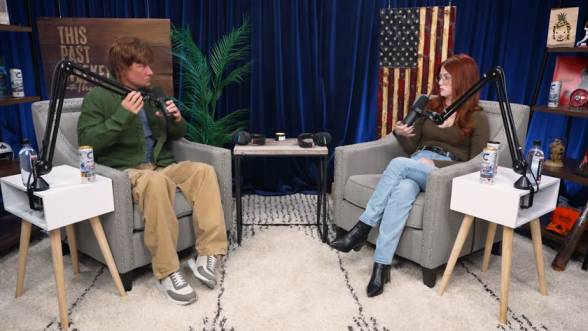
Here is the full transcript of comedian Fiona Cauley’s interview on This Past Weekend w/ Theo Von, January 16, 2026.
Brief Notes: Fiona Cauley joins Theo Von for a candid and funny conversation about life with a rare neurological disability and how it shapes her comedy. She talks about being one of only a few thousand people in the U.S. with Friedreich’s ataxia, going from athlete to wheelchair user, and how Kill Tony completely changed her career overnight. Fiona and Theo also dive into what Autistic Barbie says about representation, why late-night TV hits different than viral podcasts, and how humor helps people get more comfortable with disability.
Introduction
THEO VON: Today’s guest is a comedian and a podcaster. You may know her from her appearances on Kill Tony. She has her own podcast called Rampin Up, and I’m thankful that she’s here today. Today’s guest is Ms. Fiona Cauley.
FIONA CAULEY: Your house is beautiful, by the way.
THEO VON: Oh, thanks. Yeah, I feel lucky to have a place to live. I got to get, I think, a new couch or something. How many times after you sit on a couch, you have to get a new one? That’s the thing. They should put, like, a little counter on the side that kind of goes down.
FIONA CAULEY: I like that. It’s like the lollipop question.
THEO VON: Yeah, yeah, yeah. Like, how many sits does it take?
FIONA CAULEY: I thought you’re out and it catapults you out.
THEO VON: The springs just activate.
FIONA CAULEY: Yeah, I like that.
THEO VON: No, yeah, yeah, that’s what we need now. It’s like, yeah, how many sits does it take to get to the center of your sofa?
FIONA CAULEY: I would be screwed, really, because all I do is sit.
THEO VON: Oh, that’s true.
FIONA CAULEY: Huh?
THEO VON: You’re here. You’re what some people would consider a heavy sitter, huh?
FIONA CAULEY: Yeah, I’m professional. Yeah, y’all ain’t got to sh*t on me.
Living with Friedreich’s Ataxia
THEO VON: For some of our listeners that don’t know, so you have, you live with an ailment. What do people call it? A disease, an ailment? Just because you’re already talking about it.
FIONA CAULEY: Yeah, it’s a disease and disability. It’s called Friedreich’s ataxia.
THEO VON: Yeah. What is it? Is it okay to ask you about it?
FIONA CAULEY: Yeah, yeah. So it’s like a really rare neurological disease, and it’s progressive, and there are like 5,000 people in the U.S. that have it, and I’m one of them.
And the only difference between us, the reason you can walk and I can’t, is I don’t make enough of a protein called frataxin. And that’s kind of it. Like, both my parents were carriers. Didn’t know. And then they had kids, and we’re screwed.
THEO VON: And so are you the only child that has it?
FIONA CAULEY: No.
THEO VON: So if two parents have it and they have a child, any child they have can have it?
FIONA CAULEY: Can, yeah. But also, they might not. Some of them. But I’m one of three in the middle. We all have it. I got diagnosed first, so they can say it. Yeah.
THEO VON: It’s like that twin that’s born later. Did you feel like they were copying off you at any point?
FIONA CAULEY: I mean, I’m the middle child, so it’s like I can’t have anything to myself. My sister is even in the same wheelchair as me now. Rude.
THEO VON: No, same brand?
FIONA CAULEY: Yeah. Oh, I know.
THEO VON: But is she the younger sister?
FIONA CAULEY: Older.
THEO VON: Oh, that’s not good. Because I noticed my nephews at Thanksgiving were dressing the same as each other, but they’re like, two years apart. And I was like, oh, it kind of makes sense. The younger one is dressing like the older one.
FIONA CAULEY: Yeah, it’s even, well, imagine if your siblings got the same car as you. Yeah, it’s the same thing. Oh, yeah.
From Athlete to Wheelchair User
THEO VON: Do you have to have a cane? How do you, because, no, you have a wheelchair.
FIONA CAULEY: Well, good question. I mean, progressive. So I used to be an athlete before. And then I walked weird, like, kind of like I’m drunk. I spoke, still do speak that way because your tongue’s a muscle.
And then I went into a cane phase when I was 21 because they wouldn’t serve me at bars. And I was like, I got to find a way to, like, show them it’s like, I’m not drunk. I was drunk, but I was, you know.
THEO VON: Did a lot of brothers hit on you when you had that cane?
FIONA CAULEY: Honestly, I would go to bars, not bring the cane. And if a guy hit on me, I was like, that’s a bad person, because I look like the drunkest person in this. Right. It was a litmus test.
THEO VON: You’re just reporting people. At one point, did you and your sisters have canes? Because that’s almost like a black prom, I feel like.
FIONA CAULEY: I did have, like, 14 to match every outfit. Yeah.
THEO VON: Oh, that’s kind of hot.
FIONA CAULEY: Thank you. Yeah, I have one that was like a sword cane. You unscrew the top and the sword came out.
THEO VON: Really? Oh, that’s the one you definitely needed. Probably an Irish bar.
FIONA CAULEY: Yeah, I took it on every date just in case, you know, I don’t. With pepper spray. Just sword canes.
THEO VON: Oh, that’s, dude, that’s the British pepper spray. The sword cane. That’s exactly what, that’s exactly the wildest thing there is. That’s unbelievable.
Fiona Cauley, thanks for joining us. Yeah, thanks for stopping by. I appreciate it. We got to do a show together not long ago that was at the lab, and that was really awesome.
And I saw you’re going to be on the Kill Tony.
FIONA CAULEY: Once Upon a Time in Texas? Yeah, the one that just came on Netflix.
THEO VON: That’s you right there, right?
FIONA CAULEY: Yeah.
Netflix and Kill Tony Success
THEO VON: Oh, how crazy is that to see yourself on, like, kind of like, because stuff like this, I think is kind of, it’s not monumental, but it’s interesting in a comic’s career when they see themselves on, like, a Netflix poster.
Something that gives us some semblance of what we deem as, a lot of us deem as success. Was that interesting for you?
FIONA CAULEY: Yeah. I mean, I’m grateful it put me on the poster. You know what I mean? But, yeah, I mean, being on Netflix, this is actually the second time with Kill Tony I’ve been on.
THEO VON: Oh, nice. I didn’t know that.
FIONA CAULEY: Yeah. The other one was at Madison Square Garden.
THEO VON: Dude, that’s wild. And they kind of, and they hid your legs, too, which is, are they?
FIONA CAULEY: Which was nice of them. It grosses people out. They don’t want to see this.
THEO VON: Oh, I bet a lot of dudes. I know some dudes who would for sure. And also, you think they could have had you sitting on his shoulder or something?
FIONA CAULEY: Would have been pretty dope. Yeah. Way funnier. I like that.
THEO VON: So you’ve been doing comedy for about five years. Okay. And was Kill Tony, did Kill Tony feel like a big break for you? Like, what does that feel like? Because.
FIONA CAULEY: Yeah, I would say so. I was, you know, I live in Nashville, so I was really just working Zanies and I was certain in the future and whatever. And then I heard about Kill Tony and people, you should go on that, and I was like, okay. It changed my life overnight.
THEO VON: Wow.
FIONA CAULEY: Like, fully, you know, from like, 30,000 followers. And now I have, like, more than half a million.
THEO VON: Are you kidding me?
FIONA CAULEY: Yeah.
THEO VON: Wow. Dude, kudos to Tony and Redband just for making that thing stick and thrive. And the years they went through it at the Comedy Store, there were times when it was big and times where it was kind of like, in between buildings and, like, they were switching it around.
Even when they got to Austin, I think they went to three different places and they kept that thing alive. That’s unbelievable. Was your first time there? What’s it like when your first time there, did you know you were going to get up or was it?
FIONA CAULEY: Yeah, so he basically was, I didn’t know what Kill Tony was. I heard about it.
THEO VON: Yeah. Because you’re already, you know, you’re already having health problems. Kill Tony sounds like.
FIONA CAULEY: Right? I’m like, stay away from that word.
THEO VON: You know, I’m not seeing another surgeon.
FIONA CAULEY: I’m like, what’s next? Kill Fiona. No, I.
THEO VON: Sorry, am I joking too much or?
FIONA CAULEY: No, no, I like it.
THEO VON: Okay. I thought you did. That’s the only reason why I’m joking.
FIONA CAULEY: No, I’ll take it too far. You let me know.
THEO VON: Okay. Okay. So you go there and for people that don’t know, most of our listeners know, but Kill Tony, it’s a show that’s run by Tony Hinchcliffe and Brian Redband, and they basically bring in kind of newcomers. It’s kind of the new Tonight Show in a lot of ways.
And they have regular guests on there and a lot of people go in there and get their first minute. It’s kind of their first minute that’s in front of the Kill Tony crowd. And sometimes those minutes are amazing, and sometimes those minutes are very nerve wracking. I think they’re probably nerve wracking no matter what.
But, yeah, take me through that minute. Like, what’s that first minute on Kill Tony? What is it? What is that like, especially for somebody that’s had five years in comedy? Because, you know, it’s not some of these people that, it’s their first time ever getting on stage.
FIONA CAULEY: Yeah.
THEO VON: And some people just hiding from their wives or something. Some people are hiding from ICE for a minute. Yeah. They’re like, this is one minute away from ICE. Right. They won’t find me here. But yeah. Can you kind of take us through that?
The First Kill Tony Minute
FIONA CAULEY: Yeah. So it’s very, it’s stressful because it’s not, you realize it’s not just the room you’re in that’s going to see it. It’s not just the 300 people. The platform is so big. So you’re like, everything I do right now is going to be seen by millions of people. Like you’re stressed, you know?
And also the whole thing is like, the panel gets to be mean to you, and the crowd loves that.
THEO VON: Yeah. Yeah. It’s very Roman Coliseum, huh?
FIONA CAULEY: It feels, the arena shows for Kill Tony feels so Roman. I say that all the time.
THEO VON: Wow.
FIONA CAULEY: And every time I go out on an arena show with them, I swear the person right before me gets booed by the entire arena. And then I’m like, that’s kind of nice.
THEO VON: Because then if somebody else has taken that L, then you’re like, nah, could have been me. Yeah, but it was them.
FIONA CAULEY: I’ve been through enough.
THEO VON: Before you went on the first time, are you just, are you, like, waiting in the wings? What’s the setup?
FIONA CAULEY: So I, because I’m in a wheelchair, I have to, like, go around the building and get carried up these stairs by the dumpsters and stuff. Yeah, yeah, it smells real bad, but it reminds you of your life, you know, so, like, I’m grateful for sure.
And yeah, they have you waiting back there. You smell like trash. You’re looking at Heidi, the best looking woman I’ve ever seen in real life.
THEO VON: Oh, does she work on Kill Tony?
FIONA CAULEY: Yeah, you know the beautiful blonde Heidi? Member? She’s very nice. Look at her. Are you joking?
THEO VON: I know. I’m not joking. Oh, wow. She looks like Geena Davis. And she’s got strong cheekbones. She looks like Gene Davis too, who used to play catch up for us when I was growing up, actually. Great kid, Italian. Good guy.
FIONA CAULEY: I’m like, I don’t know.
THEO VON: No, she’s stunning. I’m just joking. I’m sure she’s on Kill Tony. She can take a couple of jokes. Do they joke about her a lot too?
FIONA CAULEY: Oh, yeah, she’s very funny. Takes jokes very well. Very.
THEO VON: I got to go back on.
FIONA CAULEY: Yeah. Because the Heidi.
THEO VON: No. Well, it is funny that, yeah, you show a cute girl.
FIONA CAULEY: God, I got to get there.
THEO VON: I got to get back out there. It’s like you could show a picture of the North Pole and guys are like, that looks cold. I ain’t doing that. And then you show a guy and you show just like a silhouette of some tits on the edge of a glacier. And some guy’s like, man, we got to get back.
FIONA CAULEY: I got to get back up there.
Late Night vs. Kill Tony
THEO VON: Yeah, I got to warm up the old ice pick, Bubba. And so as you’re going along, I cannot imagine how overwhelming that feels. It reminds me of, I did a late night set one time for Craig Ferguson. And it never aired because I think it was too edgy or something they said. And I was heartbroken, dude. I was like, oh, I worked so hard and put the set together.
But that was nerve wracking. That was like one of the most nerve wracking moments because you kind of know what you want to do, but you haven’t been in this instance where there’s a lot of heat would build up around my neck and you’re like, you want to make sure your words get out clearly. That was super frustrating for me.
I know you did a late night set. Did you do Fallon? Which one? Congratulations, by the way. Was there any different feeling between those two things or did one feel easier?
FIONA CAULEY: I think Fallon felt easier because he’s not there to be mean to me.
THEO VON: That’s a good point. Yeah, he’s not hiding in a wheelchair while you’re up there. Like, Red Band will sell it on Etsy.
FIONA CAULEY: Red Band just on my seat cushion on this.
THEO VON: That’s hilarious. And he would, too, that guy. Dude, shout out Red Band. People are like, well, what does he look like? You’re like, let’s say, sniff a seat cushion. That’ll tell you, but very successful sniffs.
FIONA CAULEY: Seat cushions for fun.
THEO VON: Yeah, that’s true. For fun. Yeah. I don’t think he would maybe do it for profit.
FIONA CAULEY: I didn’t need to.
THEO VON: That’s a good point. He’s making good money. Dude. There you are right there.
FIONA CAULEY: Yeah. And they let me plug the foundation to raise money for my disease, and that was cool.
THEO VON: Do you notice the differences between doing a set on Kill Tony and a set on Fallon? Because that’s not a lot of people have probably had that exact experience.
FIONA CAULEY: Like the way, like, for me, or the way it exists in the world?
THEO VON: Just kind of the way it exists in the world.
FIONA CAULEY: Yeah. I think Fallon impressed my grandparents, which finally, they’re like, “Oh, she is a comedian.” You know what I mean?
THEO VON: That’s true.
FIONA CAULEY: Yeah. So that was something my mom can send to people and be like, “Look at my daughter.” But with Kill Tony, they definitely have a bigger reach now. You know, late night is not the same, I think.
THEO VON: Yeah. Because I think people, just less people have cable, people are more tuned into their phones.
FIONA CAULEY: Right. Kill Tony is definitely more divisive. You know, and so people make a lot of assumptions about me through that. I don’t know.
THEO VON: Yeah, it’s more divisive. He almost sunk Puerto Rico. Remember that?
FIONA CAULEY: That was crazy.
THEO VON: That was crazy. And then they probably would have got sued. They would have lost the show. They would have changed the name to Kill Puerto Rico, probably, which would have been a lot, I feel like.
FIONA CAULEY: Yeah, a lot of people can’t spell Puerto Rico.
THEO VON: But there is this thing, though, where it’s like, yeah, you do a certain thing, and people can see that, and that appeases them. That’s kind of an interesting thing as a comedian. I think it’s kind of an interesting thing almost in anybody’s walk of life with work, because you’re like, oh, if I do this, then my dad, he’ll understand that that to him equals success. Or to my grandparents, that to them equals success.
FIONA CAULEY: Right. And it’s different for everyone. But it’s like this. I feel like part of being a comedian is being like, but there’s always going to be that one person that doesn’t believe I’m doing anything real, and I have to prove it. That’s just me.
THEO VON: Yeah. I wonder if there’s always somebody in the back of a comedian’s head that fuels them, right? Like, one day I’ll get that person. I bet there probably is. I bet there probably is for everybody.
I bet it would be pretty fascinating to learn what really fuels some of the ways that we operate and the choices that we make. Because it could be one or two people that said something when you were young or one person’s look that gave you a certain feeling, and you’re like, and it’s ignited this thing inside of you.
FIONA CAULEY: The words, when you hold on to those two words or that look, and they’re like, “I don’t remember that.” You’re like, “That dictated my future.”
THEO VON: Yeah. You’re like, I’d still be, I would have kept walking.
FIONA CAULEY: Yeah. I stopped walking because of that.
Autistic Barbie and Representation
THEO VON: Yeah. That’s crazy. Oh, dude, did you see that? What did I see the other day? Oh, they have an autistic Barbie now. Did you see that?
FIONA CAULEY: I did see that.
THEO VON: Do people send a lot of that stuff to you?
FIONA CAULEY: Like, hey, wheelchair Barbie?
THEO VON: Or just what do we think of this? If there’s some sort of…
FIONA CAULEY: Oh, like, I’m the voice of reason for any disability?
THEO VON: Yeah, you’re like the, what’s that? You’re like the show where the chairs turn around. What is that? Oh, you’re like, yeah, you’re like the voice for disabilities and stuff.
FIONA CAULEY: People are like, hey, not punching my button.
THEO VON: Oh, autistic Barbie. That b ain’t getting sh.
FIONA CAULEY: My guys. But headphones on her. Cool.
THEO VON: But those aren’t headphones. I think those are just noise canceling earmuffs.
FIONA CAULEY: Oh, yeah. Yeah.
THEO VON: I think those are just those things that help autistic people kind of operate. They used to do earmuffs and now they kind of made them fancy or something.
FIONA CAULEY: Yeah. Made them fashion.
THEO VON: Mattel is introducing an autistic Barbie as the newest member of its line, intended to celebrate diversity, developed in partnership with a nonprofit organization that advocates for the rights and better media representation of people with autism.
FIONA CAULEY: I think I find that kind of weird, though, because autism isn’t visible generally. It’s how you, it’s how you function. And it’s a Barbie. So couldn’t any Barbie be autistic?
THEO VON: First of all, I’ve met a lot of Barbies in the world, and these bes are missing something. Okay. A lot of these bes are picking up odd signals, a lot of times from an Hermes or something. They’re like, “Oh, I just got an update from an Hermes somewhere or something,” which is like a fancy shop.
FIONA CAULEY: I shop on Amazon. I’m sorry.
THEO VON: Yeah, sorry. Yeah, that was maybe a bad reference. Why is she Hispanic looking?
And is there Hispanic autism? Look it up. Who’s got the most autism?
FIONA CAULEY: Feels like a white people sport.
THEO VON: Yeah, well, white people create any new sport to try and keep away from having to compete against black folks.
FIONA CAULEY: Yeah. Anything we can do? Yeah, it’s like, oh, my disease is only white people.
THEO VON: Your disease is only white people. Let’s go.
FIONA CAULEY: Huh?
THEO VON: I like that sh. And we barely landed that fist bump, but let’s go.
FIONA CAULEY: Oh, it doesn’t matter.
THEO VON: Yeah. Oh, sorry. Barbie. Yeah, they should have. Dude, you should have a Barbie. That’d be so great. Fiona Barbie.
Based on the most recent data from the Centers for Disease Control and Prevention published in April 2025, Asian Pacific Islander children and American Indian, Alaska Native children had the highest reported prevalence of autism. So Asians. But they were going to have it.
Dude, a lot of Asians that I knew and that have been known over the years by people, it seems like a lot more is going on inside than outside. And I feel like if you put too much traffic on those inner streets, you’re going to end up bumper to bumper in there. And that’s, I feel like, where autism really shows up. And that’s not a scientific definition of autism.
But a lot of Asian people, you just want to go up to them and be like, “What are you doing in there?” Especially in my generation, because they were very quiet. You would rarely get a word out of an Asian guy.
FIONA CAULEY: How many Asian people did you know growing up?
THEO VON: We had one, we didn’t have, well, we almost had one we had. Yeah, dude, there was a rumor that there was an Asian guy in this town near us called Slidell, Louisiana. And it was 17 miles away. So me and my buddy Scotty and some other guys, we cut grass for three weeks and saved up money to go see this guy, right? Because, dude, we don’t know when we’re getting another one, dude.
And so we get over there and here’s what had happened. A Pizza Hut, remember they had those unique rooftops, had burned down to the ground. And people had started saying that an Asian person was living in there. It was just a myth or whatever. Bring up that Pizza roof. Bring up Pizza Hut red roof. That one. So imagine that completely down on the ground. Now imagine you don’t know a lot of information. Now imagine somebody tells you there’s an Asian living in there.
FIONA CAULEY: You got me? I’m with you.
THEO VON: And that’s what happened. That word traveled to us and we went over there and all it was was a burnt down Pizza Hut. But that’s something that happened. It’s like, you never know what can happen if there’s fire, if there’s foul play.
FIONA CAULEY: What did you think was going to happen if you found an Asian person in the hut?
THEO VON: We didn’t know there would be a hut. We thought it would be a place of living. We thought it would be a, I don’t know, a lean to whatever. We had no idea what an Asian lives in or whatever. An egg. You know what I’m saying? We had no idea of what it could be. We just knew if we get there, we’ll see him. And we didn’t. Fool’s gold or fool’s yellow. So that’s too much. That’s too much.
FIONA CAULEY: I love that.
THEO VON: But dude, I wonder what the Barbies, I wonder if the Barbies are low key like the Simpsons, where over the years they’ve slowly been predicting the future.
FIONA CAULEY: They definitely have wheelchair Barbie. They did, yeah. Everyone sends me that, but I want electronic.
THEO VON: Everyone sends you that?
FIONA CAULEY: Yeah.
THEO VON: And what do they say? Do you want this for Christmas? Or whatever. That’s crazy.
FIONA CAULEY: I mean, it’s been going on since before I was a comedian. Random people would send me.
THEO VON: Just thinking of you or something.
FIONA CAULEY: Yeah. I’m like, thank you, thank you. My hands don’t work. I can’t look at them. Oh, they have Down syndrome Barbie.
THEO VON: Oh, that’s cool.
FIONA CAULEY: Interesting.
THEO VON: I guess you could. I mean, look at the, I mean, look at the group up there. And the black girl does her hair like that to keep it out of the wheels or whatever. It’s like, what are we? This is great, right? It’s great stuff. But some of this stuff, I just wonder, are they, I guess it’s just all about inclusion.
There are a lot of people that are facing different disabilities or handicaps. Do you say handicaps? What’s kind of the practice?
Disability Language
FIONA CAULEY: I actually recently learned it’s person by person. All people feel different. But for me, I prefer disability, disabled. I think handicap is a thing, like a handicap parking spot or stall, you know?
THEO VON: Yeah. Handicapped placard, like that thing that people hang.
FIONA CAULEY: It’s like an item. But I’m a person with a disability.
THEO VON: Do you use handicapped parking?
FIONA CAULEY: Yeah.
THEO VON: F* yeah.
FIONA CAULEY: Yeah. It’s worth it.
Early Signs and Diagnosis
THEO VON: What were some of the first signs whenever Friedrich’s ataxia came along? What were some of the early signs? And did you misplace it for something else?
FIONA CAULEY: Oh, this is good. So when I was 15, it started. I started walking weird. I was a volleyball player, and I couldn’t do the practices. We would do suicides. You know what I mean?
THEO VON: Yeah.
FIONA CAULEY: And I would start falling a little bit. Just getting clumsy. My coach was like, you’re not taking this seriously. Thought I was high.
THEO VON: Did they bench you?
FIONA CAULEY: Yeah. And so I—
THEO VON: Which is where you were going to end up anyway.
FIONA CAULEY: They were just getting me prepared for my future. They were like, sit down. You should be real good at this.
THEO VON: Oh, man, that’s so good. And did your parents pick up on it pretty quick? I mean, how did that kind of go?
FIONA CAULEY: Does that make you so mad?
THEO VON: It is.
FIONA CAULEY: Yeah. Maybe.
THEO VON: Your parents drinking and stuff. Were they having a tough time?
FIONA CAULEY: Oh, well, yeah. Yeah. But no. So 15, I was like, something’s wrong. My principal was like, smell my breath, because she thought I was drunk. I would spill everything, drop everything.
THEO VON: And the red hair, too, probably.
FIONA CAULEY: Yeah. Yeah. That’s like, number one indicator.
THEO VON: Yeah. You’re St. Patrick’s daughter in here.
FIONA CAULEY: Something was wrong. Yeah. And then I went to my mom, and I was like, I think I need to go to the doctor. I don’t know what, but something. And my older sister had health issues that weren’t this. But different stuff.
THEO VON: Acne or whatever.
FIONA CAULEY: Well, yeah, but scoliosis.
THEO VON: Oh, God. I’m sorry.
FIONA CAULEY: Yeah. Wow.
THEO VON: And that’s so—dude. And I’m very sorry. God. And that shows what somebody who doesn’t have to deal with a common ailment thinks of as—
FIONA CAULEY: Yeah, that’s actually so real. No, I love it. But she was like, you’re copying your sister. Because my sister walked weird. But we blamed it on other stuff, and I had nothing wrong with me. And then I kind of got in trouble for faking it by my family a lot and yada yada.
Then once I turned 18, was my senior year of high school.
THEO VON: She had to go that long dealing with it. And would it always be there, or is it just kind of every now and then?
FIONA CAULEY: It was getting worse. Yeah, it was always all the time. I didn’t know why. I used to get in trouble. There was an elevator in the school for people that broke their legs or whatever, and I would use it. And I got detention all the time because I would fall down the stairs all the time. And I didn’t know why.
THEO VON: Sorry. I’m not laughing. There’s something wrong with my face and voice. Oh, that’s insane. And did you—was part of you still unsure, too? Because I’m sure if a lot of your surroundings were like, nah, you’re just not figuring this out correctly. Was part of you still kind of unsure, too?
FIONA CAULEY: Well, I was gaslit crazy. I fully thought I had a mental issue and I was making this all up. I really—I just wanted an answer. I fully believed it was something I could get fixed before I went to college. I did not think it would be this serious.
THEO VON: Yeah.
Getting the Diagnosis
FIONA CAULEY: So at 18, I went—I took myself to a neurologist. I eventually ended up being a neurologist, but I had to involve my mom in that. And she was like, fine. But this has to be the end of the road. They were so sick of me being like, something’s wrong, you know?
And then I was right. And then they were like, oh, my God, what’s wrong with your sister? They got her tested. Same sh*t. And my little brother, a year and a half ago, got tested, and he has it too. He can still walk, so—
THEO VON: So you cracked the code. Really?
FIONA CAULEY: Yeah. I ruined our family.
THEO VON: Yeah.
FIONA CAULEY: It’s another way of saying that. Yeah.
THEO VON: If you never figure it out, you’re just a bunch of—
FIONA CAULEY: People who are just a bunch of Weeble Wobbles.
THEO VON: You’re just a bunch of people who just break out into the Electric Slide every now and then. You’re just doing the Cupid Shuffle. Your mom’s like, stop Cupid shuffling.
Wow. And so was that a real breakthrough moment for your family? Oh, my God, this is what’s been going on. And for your sisters as well.
FIONA CAULEY: Yeah. My mom felt so bad, cried and, you know, because she had been telling me I was wrong and I was just excited to be right. So I didn’t even hear—I was 18. I didn’t get the seriousness of it. And I was like, f you, f you, f* you. You know, I’m celebrating that she was wrong and I was right.
THEO VON: Oh, yeah. You know, get f*ed.
FIONA CAULEY: I’m a vape. Yeah. Yeah, I’m a vape.
THEO VON: Yeah. Dude. Did they think—was that ever part of it? Are you just vaping too much or whatever?
FIONA CAULEY: Yeah, I smoked a lot of weed in high school too. I partied a lot. And then I got diagnosed and I partied more. So I was like, what’s the point of all this?
Depression and Finding Purpose
THEO VON: Oh, did you go through a point where you were depressed about life and stuff?
FIONA CAULEY: Six, seven years?
THEO VON: No way.
FIONA CAULEY: Yeah. It was hard to find a reason. I was like, why am I in college now? I don’t have a future.
THEO VON: Right. I’m not going to be a pharmacist. But I guess you could still—I mean, do you think looking back on that, that there was different ways you could have gone with that thought process or just kind of, that’s just where you were? Because it’s tough for somebody to just imagine what they would be like in that scenario, I think. I’m sorry you had to go through that. That’s hectic.
FIONA CAULEY: Hey, it builds character if you make it out, you know. And I’m grateful for that. I wouldn’t be who I am today. I have more perspective now than I think most 29-year-olds do probably. I don’t know.
I think it’s important when you’re given something that’s serious and kind of life altering to allow yourself to mourn. Because I’m mourning what I thought I had. Right. And I’m trying to get accustomed to what I know I’m going to have or not have in the future, you know.
And humans, we adapt. I’m fine. People feel bad for me and I’m like, you bought tickets to my show. I’m doing all right, you know?
THEO VON: Yeah, yeah, yeah.
FIONA CAULEY: I’m happy.
The Weight of a Diagnosis
THEO VON: Yeah. I’ve never felt bad for you. I mean, I guess some people probably could get in a space where they feel bad. I feel bad that you felt that way. I feel bad that such a… that’s hard. That’s heart wrenching for somebody to, I think, have something that occurs in their life and then feel like maybe when you look back on that feeling, are you able to think like, did you feel like you didn’t have a lot of hope? Or did you feel like, was it like woe is me and all those things are normal? I could imagine will be very normal to feel.
FIONA CAULEY: Yeah, I think hope because before that I was pretty religious for a while. I really, I believe in God. Not really just, but I was like spiritual. I believe in a higher power. And that happened. And it kind of took the air out of all that for me. And I was like, what I do, you know, I haven’t even had time to get the karma for this kind of information, you know. I’m sorry, what was the question? I really forgot where I was going.
THEO VON: I think just thinking about what it’s like to have a prognosis like that and then to think about what it’s like to have something come into your life that’s big and that affects you in such a way. And then to look back and think like, what was I thinking at that moment? Was I depressed? Was I hopeless? Or did I doubt hope?
I thought it was interesting that you said like, we mourn things. I know that’s something that I don’t do well these days in my life is take time to mourn things. Like, even if it’s just kind of like something heavy happens, you know, it’s like I’ll just get back on my phone or I’ll find something to distract me. And when I’m distracting myself, even just my eyes and my focus, I’m distracting my ability to process through some of those things, you know?
But yeah, to mourn something is like that. It’s almost like driving by an old house or something or driving by a place you used to live at. Or like even a snake. When he sheds his skin, I bet he probably looks back at least once.
FIONA CAULEY: And is like, damn, I used to be that.
THEO VON: There’s the old Buick.
FIONA CAULEY: That was cool. Just like that. So the gold wheelchairs that don’t work anymore.
THEO VON: It’s like, yeah, he looks back, he’s like, oh, I can’t believe I used to wear Skechers. He just keeps moving along. When you would have and are we talking too much about your ailment stuff?
FIONA CAULEY: I don’t care.
Finding Comedy in a Unique Perspective
THEO VON: Okay. Because I think it’s fascinating to me. I know that you had a series that was called or that had a series on YouTube and it’s called Capable. Right. How have you been able to grab comedy out of some of these different moments and things that you see? Because you probably have such a unique perspective on the world that that’s probably something that’s honestly kind of amazing is like your perspective on society and the way that we operate has got to be super interesting.
FIONA CAULEY: It is weird. That’s funny. I did Capable before comedy and so like writing that and like it wasn’t even writing it. I just feel like this happened the other day. I want to reenact it. Like all of it’s true. Like in my comedy it’s all true too. Like I don’t have to make stuff up, but like it’s hard because you don’t want all your jokes to be like wheelchair, wheelchair. But it’s like I experience everything from this vantage point. You know, you talk about like, I walked into the rooms. I’m talking about wagon.
THEO VON: Yeah, yeah, you’re right. No, you’re right. Well, I think it’s also, it is a fascinating vantage point though, because it’s a vantage point that a lot of people don’t get, that a lot of people don’t experience or probably till they get older or certain or… or some. Most people probably don’t.
FIONA CAULEY: Yeah.
THEO VON: Has there ever been like an Uber that like they see you and they kind of shake you off? Like a pitcher? Like a picture that gets like a pitch called in from the catcher or whatever and he just kind of like… like we’re not doing it yet.
The Uber Driver from Hell
FIONA CAULEY: I’ve had so many Uber drivers now I’ll like hide and have my able bodied friends go to the car and open the door and they’ll be like… because they’ll just drive off. That happens so much. One time I had to Uber. Oh wait, this is crazy. I forgot about that.
THEO VON: Okay.
FIONA CAULEY: Okay. There used to be a show or maybe tell you this called Stone Cold Sober and it’s like teams of three comics against each other. And one of you is drunk. One stone once over. Right? So I’m on that show and it’s like four years ago.
THEO VON: And which one are you on it?
FIONA CAULEY: I’m the drunk one.
THEO VON: Okay.
FIONA CAULEY: Okay. I’m pretty good at that. But because I knew I was drinking and they don’t give you for drinks. So I drank at my house before I Ubered there. I get the lady Uber driver, her trunk is full, so we have to put my chair in her back seat. My neighbor has to come do it because she won’t do it. She’s like, whacked out.
THEO VON: She’s an autistic Barbie.
FIONA CAULEY: That’s worse. So much worse. She… I don’t know. She was, like, on drugs. I could not recognize kind of thing.
THEO VON: Oh, that’s always kind of fun.
FIONA CAULEY: Yeah, I’m, like, trying to Google smell.
THEO VON: It’s real hard Googling bath salts.
FIONA CAULEY: I’m, like…
THEO VON: Holding JPEGs up.
FIONA CAULEY: So I just send the passengers frenzy. And she’s crazy. Car smells weird. She’s swerving. It’s not good. And I’m, like, stressed out. And she’s ranting. I’m kind of just, like, pushed up against the side of the car trying to ignore.
THEO VON: What? Something was wrong with her vagina.
FIONA CAULEY: You think she was talking about Jesus sent her to Nashville from California to save all of us from the liberals.
THEO VON: Oh, yeah.
FIONA CAULEY: So thankful for her.
THEO VON: No, I’m glad she’s here. Yeah, I’m glad. I’m glad. Christopher Columbus. Yeah. F*. I was going to try to make a joke, but my brain doesn’t work good anymore. Anyway.
FIONA CAULEY: I’m rubbing up on you. It’s not good.
THEO VON: If I catch this, I’ll be so bad. Oh, no. Take us through the story, though, because that is unbelievable. When you get in a thing, you’re like, oh, my God. Now I’m at the whims of it. If this lady sees one person dressed up in a Civil War outfit, she’s going to hit him with a vehicle, you know?
FIONA CAULEY: And, okay, so she’s ranting about this. She’s swerving. I mean, we’re still in my neighborhood, and she’s almost hitting parked cars. I’m like, hey, girl, please, look, the road. You know, she’s yelling at me.
THEO VON: You’re trying to use female associative terms.
FIONA CAULEY: Yeah. Angry.
THEO VON: What you doing?
FIONA CAULEY: Hey, Queen, there’s a car. Hey, Queen, red light. No. Is she talking about how the liberals are trying to take her guns?
THEO VON: Oh, yeah. Okay, well, that could be true. But, yeah, it’s not the time of discussion.
FIONA CAULEY: I don’t think everyone’s trying to take your gun, so I don’t think it’s…
THEO VON: Oh, that’s true. I agree. That’s a great point. Yeah, that’s a great point. Everybody’s trying to take it these days.
FIONA CAULEY: But then I’m not. I’m literally just like, you know. And we’re on the interstate and she is ranting about the gun thing. Opens the glove box in front of me, pulls the gun out.
THEO VON: Sorry. This is so…
FIONA CAULEY: And again, remember, I am drunk. I’m drunk. And this woman swerving.
THEO VON: She’s like a LiAngelo Ball fan or something.
FIONA CAULEY: But, like, she’s not, like, threatening to shoot me. It’s more like… see, they can’t take it, like, making a point.
THEO VON: Like, they’ll never find it here, right in this glove box, which is probably just an extension of her…
FIONA CAULEY: Right? She pulled out. No. And then I’m, like, not looking at her because I’m crying a little bit. You know, it’s just girl stuff.
THEO VON: And she’s like, oh, are you on your period? You’re like, no, I’m not on my period. There’s an insane…
FIONA CAULEY: She was like, oh, my God, we’re signs up.
THEO VON: She’s like, 11.
FIONA CAULEY: 11.
THEO VON: Make a wish. Did you wish for more ovulation? This is getting insane.
FIONA CAULEY: Oh, sh. Scorpio. Oh, man. But I’m not. I’m not looking at her because I don’t want her to see him panicking. And so she pokes me in the arm with the…
THEO VON: No. Oh, my God. That’s probably… did she know that you couldn’t feel it if she poked you in the leg?
FIONA CAULEY: She wanted to make sure I could.
THEO VON: She wanted to make sure you could feel it.
FIONA CAULEY: And then… so I’m like. I’m like, I haven’t told that story in so long.
THEO VON: Do you tell this on stage?
FIONA CAULEY: No, I told on stage once.
THEO VON: You’ve got to tell this on stage. This is one of the best stories ever to me. But go on. Sorry.
FIONA CAULEY: Oh, my God. Okay, so I’m panicking. She’s got the gun. I’m just…
THEO VON: And she’s still driving.
FIONA CAULEY: Yes. And she’s just kind of waving around. Hey, look at me. Hey. Yeah. Again, not threatening to shoot me. Just…
THEO VON: Right. Got it, got it. Yeah, that… mommy’s strapped that. She got that Draco on her. And are you… and what are y’all listening to?
FIONA CAULEY: It’s quiet.
THEO VON: Oh, yes.
FIONA CAULEY: Yeah, I’m just listening to her. I hadn’t even thought about that. It was totally quiet.
THEO VON: That’s the best when people play too much music or… and this is an all call. This is from me. And it’s just my thoughts. These are my thoughts. If you’re an Uber driver or somebody that works in, like, operating, like, transportation, that sort of thing. If you keep that thing on, that’s like, “right turn in seven seconds.” That I will never tip somebody. If they have that on, turn that thing off. Have just… at least just look at the drawing.
FIONA CAULEY: The worst is when they ask what music utilities do. Turn it on. And then that interrupts every 20 seconds.
THEO VON: And you’re like, the music does…
FIONA CAULEY: No, the…
THEO VON: Oh, they interrupted the talk.
FIONA CAULEY: The sound.
THEO VON: Oh, yeah, it’s all. Anyway, I ruined your story. Let’s go. So you guys are rolling together.
FIONA CAULEY: So I’m… I’m trying to be chill. Because I don’t want to freak her out.
THEO VON: Yeah. You know for sure she has a gun. Yeah, yeah, yeah, she has a gun. And she’s driving you somewhere. Yeah, you don’t want to freak out your captor.
FIONA CAULEY: I guess that’s exactly why she… so I’m… there’s like, a group text for the show I’m headed to, and so I’m like, “I’m scared at the venue. My Uber driver has a gun.” I’m like, live texting. All the guys are like, sorry, not there. I don’t think anyone believed me.
And then there was one girl in the group text that I didn’t know at that time. And she was like, “Oh, my God, I’m hurrying to the venue. I’ll try to meet you there.” And I was like, please, please, please. We’re three minutes away. Two minutes. You know, I get there and no one’s there. I am so panicked. And again, my wheelchair is in the backseat, and I’m wearing shoes like these with heels.
THEO VON: I… I didn’t mean to make that sound. I meant… yes, those are nice. Sorry. That was insane. Your husband’s in here. And I… I think I… my body just didn’t know what sounded. Did. Those are nice. Carry on.
FIONA CAULEY: Here.
THEO VON: Go. Well, I think you just picked the wrong sound. It’s been a tough… it’s been a tough year. Okay. I know.
FIONA CAULEY: I’m like, damn. Damn.
THEO VON: Okay, okay, tell us what happened.
FIONA CAULEY: So we pull up. No one’s there. I’m freaking out.
THEO VON: Nobody’s there. So now she thinks, oh, this b got me running around in circles around me.
FIONA CAULEY: I swear, I’m so full of adrenaline, I jump out of the car and pull my own wheelchair out.
THEO VON: Wow.
FIONA CAULEY: So, like, gun to my head, I can walk.
THEO VON: You can make it happen.
FIONA CAULEY: Yeah.
THEO VON: Gosh, that’s a lot. That’s crazy. Pulled that Draco out that glove box.
FIONA CAULEY: Yeah, like, really insane. That scared me. So then I got weirder, though.
THEO VON: You have weird stories in that same night?
FIONA CAULEY: Well, do you want to go there?
THEO VON: Carry on.
FIONA CAULEY: Okay. So I do. I show up at the venue. I’m like, hyperventilating, crying, you know, like, I’m inside, I’m safe, but I’m panicking.
THEO VON: Very scary.
FIONA CAULEY: Yeah. And everyone’s like, oh, my God. And I go to the bar. Because that sobered me up and I’m, I don’t know, I was like, I’m going to get drunk. I don’t know what’s happening.
THEO VON: I don’t know what else to do. I’m a human, right?
FIONA CAULEY: I’m freaking out. I’m alone. I was single at the time, so I didn’t, like, have anyone to be like, please come get me, you know? And so I go to the bar at Third Ghost, and this married couple who I had met at the airport in Las Vegas a couple months back were there because I’d posted online.
THEO VON: Oh. And they came to the show. Oh, that’s pretty cool.
FIONA CAULEY: And they were like, I told them because they were the only ones I knew, kind of. And they were like, oh, my God. And they’re buying me a bunch of drinks. So I do this show. I bomb.
The Nissan Altima Incident
THEO VON: Well, yeah, you had freaking Stockholm syndrome. What do you mean you bomb? You were basically the Elizabeth Smart of comedy that night. Like, you didn’t bomb. You did your best. I feel like after being held hostage and what kind of car was it?
FIONA CAULEY: Do you remember a sh*t like a Nissan Altima.
THEO VON: Oh, dude, Nissan Altimas. People have given birth in those more than any other vehicle in the past 10 years in this country.
FIONA CAULEY: Given dead. Then what? Yeah, white one. Yep.
THEO VON: That is the purgatory of existence, dude. If you’re in a Nissan Altima, things are headed up or down.
FIONA CAULEY: You’re not doing great.
THEO VON: You are at a confluence in your life. You’re at a fork in the road. You’re at a fork in the road, dude.
FIONA CAULEY: Oh, my God.
THEO VON: Okay, so a couple’s buying you shots are from Vegas.
The VIP Party
FIONA CAULEY: So I do this show afterwards. Because I had told them about the outfit, was scared to Uber, you know, and so they were like, we’ll drive you home. And I was like, okay, thank you. And they get me in their car, but you know, and they go, hey, before we take you home, we want you to come to this bar with us first. And I was like, okay.
And so we go to some bar. I’m pretty drunk, okay. And I get carried upstairs to a VIP area by some security guy.
THEO VON: It all sounds almost like Cinderella.
FIONA CAULEY: Oh, Rapunzel. Yeah, all of them.
THEO VON: Well, you might have to rappel down too.
FIONA CAULEY: Rappel is just falling for me. That was a nice way to. No. And then, and I don’t know, I’m just sitting in my wheelchair, not approaching anyone, just kind of drinking, like quietly. I’m freaked out. It’s a private party. I don’t know who anyone is. They all have face tattoos. Like, it looks like a biker gang. Maybe. Like, I didn’t care, though.
THEO VON: It might have been Jelly Roll doing one of those Booty Boot Camp classes or whatever. He does some of those halfway house Booty Boot Camp classes, I think. But go on. I’m ruining your story.
FIONA CAULEY: No. And, you know, someone’s just giving me a new drink every time mine’s gone. It’s the Kennedy treatment, you know?
THEO VON: Yeah, the Kennedy treatment.
FIONA CAULEY: And I realized there’s one guy everyone’s, like, trying to talk to. So I’m like, must be his party, you know? He comes up to me at, like, 2 a.m. and he’s like, hey, we’re having an after party at my, like, apartment or whatever, if you want to come. What’s your name? I was like, I’m Fiona. What’s yours? And he was like, you can call me Michael. And I was like, okay.
And so, Michael, Biblical name. Good sign.
THEO VON: Michael has his Michael Myers. Was he wearing a mask? Is that Michael Myers?
FIONA CAULEY: Yeah.
THEO VON: Yeah.
FIONA CAULEY: I get stuff. He cares. He has the security carrying me down. And we’re all, it’s like his posse and me and Michael. He goes on Instagram story. I’m in the video, and the married couple’s being weird to me, and the wife keeps trying to, like, get on my lap. And Michael didn’t like that. And so we had a security kick them out.
And so we get to his apartment. The elevator opens to his apartment. Oh, that’s like, money. I had never seen that kind of money.
THEO VON: That’s rich.
FIONA CAULEY: There was, like, motorcycles inside. It’s huge. And he has, like, a chef and a bartender.
THEO VON: Is it Michael Strahan? Carry on.
FIONA CAULEY: So I’m in.
THEO VON: Two more guesses.
FIONA CAULEY: I’m in there. I’m in there. And there is one guy that was at the Third Ghost show that was tagging along for some reason. He was like, a ballerina.
THEO VON: Let’s go on. Sorry. I know your husband’s in here. Hope everybody’s with God. He’s a ballerina. He’s a male ballerina. Oh, yeah. I used to live with a guy. He wasn’t a ballerina. What was he? Like one of those frozen ballerina? He was an ice skate. This dude was a mixed dude, too.
FIONA CAULEY: Wait, this guy was Mexican?
THEO VON: Your guy was Mexican? Yeah, my guy was mixed black and white. Or black and, or white and something.
FIONA CAULEY: Okay.
THEO VON: And, yeah, but he would, every now and then he would have a couple drinks and he would take us outside. He never wanted us to see his craft or whatever. That’s what he would say all the times. We wouldn’t invite us to any of his performances or whatever, but every now and then he’d get drunk and he’d take us outside and he would jump sideways over a car. And it was pretty amazing to watch him do it.
Anyway, carry on. It’s just some mixed guy that I shared an apartment with for a month. Let’s go. Sorry. Not let’s go. I’m enjoying the story. So you’re there. It’s nice. There’s, like, fancy stuff, outdoor stuff that should be inside. That’s when somebody’s rich, when they have, like, a car in the living room or they have motorcycles.
FIONA CAULEY: I might have this get up here. When they make you think about it. Yeah, yeah. And all the girls, they’re very good, though. Gang. I was like, why the f* am I here? Like, blonde, big fake boobs, like everyone. Beautiful covered tattoo.
THEO VON: And this is in Nashville.
FIONA CAULEY: Mm-hmm.
THEO VON: Wow.
FIONA CAULEY: And I’m like, I still don’t know where I am. And Michael feeding me drinks, too, but he was like, are you hungry? And he had someone make me pasta and pizza. And there’s, like, a video of him feeding it to me.
THEO VON: Really?
FIONA CAULEY: And then he put his number in my phone, and then I had the ballerina drive me home. And then the next morning, I wake up to, like, 60 missed phone calls from my friends being like, are you alive? Because apparently I was all over this guy’s Instagram story and stuff. Do you know Yelawolf? It was him.
THEO VON: Really?
FIONA CAULEY: Yeah. He, like, saved me that night.
THEO VON: He saved you from the swingers?
FIONA CAULEY: Yeah. Yeah.
THEO VON: That was sweet of him.
FIONA CAULEY: And he, like, made sure it was okay. He was very nice. I have not seen him since then.
THEO VON: Wow. I saw him. We hung out one night in Los Angeles. I got to check in with him. I haven’t talked to him in a while. We kind of, I think.
FIONA CAULEY: Yeah.
THEO VON: I think he lives in Nashville or he did.
FIONA CAULEY: Yeah. At that time.
THEO VON: He’s had some great songs over the years. Yeah, dude, we used to jam his sht. Heavy. We used to definitely. Oh, dude. Being white and being like, f them. And then just replace just who anybody could be them, you know? Dude, we would fing listen to his sht a lot, dude. Most of it was against, like, rich people or whatever.
FIONA CAULEY: Yeah, f* him.
Rich People and Dead Dogs
THEO VON: Yeah. I never was, I never really liked the rich, really. You know, because we had a ditch in our yard, right? And it wasn’t our yard or whatever. I think the government owned it. Somebody owned it. Whatever. We didn’t. But in our neighborhood, people would burn trash. That’s how they got rid of trash, you know. So people would just burn trash in the ditch. Because a lot of times people would forget to get it out to the curb or sometimes people didn’t have the cans or whatever. You know, people would always be burning trash in the ditch. And we’d be running and jumping through the soot all the time. Right.
So we, so from 50 feet away we look like young African American children, you know. Or blacks.
FIONA CAULEY: Yeah.
THEO VON: And anyway, that’s not even part of the story. That’s just something that happened a lot. But what happened was rich people. There was a rich guy who was a veterinarian or whatever and he would drive through our neighborhood and he would take like dead animals and stuff out of the trunk and he would throw their bodies out into our like, like ditch and like just like getting rid of them on the way to like some other rich area or whatever, you know, because our, our, our street was like a pass through between like a couple rich areas kind of.
And so they would just that like. So it always made me angry at rich people.
FIONA CAULEY: Because what type of dead animals?
THEO VON: Dogs. Things that had died, I think of just that had been put dogs. Sorry. And that’s the worst one to say.
FIONA CAULEY: Oh my God.
THEO VON: I could have said any other one. And hold on. He wasn’t, he wasn’t like some dogster or whatever, like, or like a Dexter? I mean, sorry, but he wasn’t. He was a youth and he was a veterinarian and I think he was having to put these animals to sleep. And some of them they would dispose of. You know, this wasn’t a time when people would keep their dog. This was a time when a lot of dogs weren’t in inside.
FIONA CAULEY: I feel like you’re lying to me. Like I’m a little kid because you’re like, no, you know what? They’re, they’re inside the farm.
THEO VON: Oh no. Yeah, they’re safe.
FIONA CAULEY: They’re all alive now actually.
THEO VON: They’re in a special area. Get rid of some of the carcasses and stuff in our neighborhood. And I think when I was a kid that was like a rich guy because it was a nice car. So I think I associated like, oh, rich people are like that. Like they just throw out the junk for poor people to deal with, you know, and we’re out here fing. And then we ended up throwing bones at each other and sht after. It would like decay or whatever.
FIONA CAULEY: That’s so gross.
THEO VON: Well, we didn’t know. We didn’t, we didn’t have it. Nobody in our neighborhood had a dog. We didn’t have a dog. We had like a couple of dangerous dogs that would travel around the neighborhood and attack people for no reason.
FIONA CAULEY: I feel like that.
THEO VON: Well, we didn’t have any, like, semblance of them. Yeah, yeah. None of my friends had dogs. They had a dangerous Doberman.
FIONA CAULEY: No, dude.
THEO VON: Nobody I knew had a cat growing up. There were some cats that lived outside.
FIONA CAULEY: Yeah.
The Golden Retriever Story
THEO VON: And were up to very bad things. And obviously worked for the Satan. There’s no denying that they work for the Satan. So, yeah, people were not. Nobody was anti-animal in our area, but that wasn’t something that people had on a regular basis.
I remember the first time I went to my friend’s house and they had an indoor dog and it was a golden retriever, which first of all, how nice that you have so much gold. You can have an animal just go get some of it for you. That blew my mind when they told me what it was. I was like, this is unbelievable. We can’t even go in our apartment two days a week because some of the gas issues and these people have an animal that will just run off and grab a mouthful of bouillon whenever you need it.
And I remember seeing its just long, beautiful hair and it looked like a beautiful woman to me. I remember, that thing is beautiful. It was better looking than most of the women in our area. It looked like Suzanne Somers. Bring up Suzanne Somers. Let’s get a gander at her. This is one of the funniest times I’ve had on a podcast in probably two years. Don’t you think, Trevin? This is great. Thank you so much.
FIONA CAULEY: Oh, my God, I’m having a blast.
THEO VON: That’s her when she came in. Right there.
FIONA CAULEY: When I saw that golden retriever for sure that was her.
THEO VON: She was the icon.
FIONA CAULEY: Throw some teal earrings on that dog.
THEO VON: Put some teal earrings. Is that what you said?
FIONA CAULEY: Yeah.
THEO VON: Oh, dude. Yeah, that’s perfect. That thing could have worked. Volunteer to work in the nurse’s office at our school.
FIONA CAULEY: Yeah.
THEO VON: I’d have been so happy.
FIONA CAULEY: How mean to you for being a little late to class. I was burgled and ordered.
THEO VON: Let’s go to a new section. I’m going to take a break for one second. Get to pee or anything?
FIONA CAULEY: No, I’m good.
The Renee Good Shooting
FIONA CAULEY: Sometimes, I mean, I know a lot of people that just. I do research and I let the morality stuff go and I’m like, okay, that can all be true. But imagine that was your sister, brother or whatever.
THEO VON: Yeah. And we’re talking about the Renee Good shooting. Let’s put the ICE shooting that happened. And this is one clip of it. We’ll show this clip. I know there’s different angles of clips. I’m not going to get into a lot of the angular stuff, that sort of thing. But I do want to cover this a little bit because we haven’t talked about it on here.
FIONA CAULEY: I’m not. Man, show your face. I’m not mad. That’s okay. We don’t change our plates every morning. Just so you know. It’ll be the same plate when you come talk to us later. That’s fine. U.S. citizens.
THEO VON: And this is a lady and her girlfriend who are out and they’re protesting these ICE agents. Renee was involved with an activist group called Minnesota ICE Watch, acting as a legal observer, documenting what’s going on. Okay, play it up.
FIONA CAULEY: I said go get yourself some lunch, big boy. Go ahead.
THEO VON: And then there’s three shots. And the woman. The woman’s deceased, right?
FIONA CAULEY: Yeah.
THEO VON: Okay. I mean, this is just baffling. What are some of your first thoughts? Do you even want to talk about this? I mean.
FIONA CAULEY: Yeah, no, I think it’s important. Well, okay. So I found out that the defense I keep hearing for this ICE agent is that he six months ago or so was dragged 200 feet or something by a vehicle. And I’m like, he shouldn’t have been working.
THEO VON: Yeah.
FIONA CAULEY: PTSD.
THEO VON: It says the Immigration and Customs Enforcement agent who shot and killed 37-year-old Renee Nicole Good in Minneapolis on Wednesday was dragged by a car in the line of duty last summer, according to court records. So there was documentation that that happened to him. Ross needed more than 50 stitches and had abrasions on his knee, elbow and face, according to court papers. So obviously he has PTSD in this situation. I don’t think there’s any way that you couldn’t. Right.
FIONA CAULEY: He’s going to be trigger happy. If you’re telling me he has trauma related to vehicles, for sure this is.
THEO VON: The last place that he should be.
FIONA CAULEY: Right.
THEO VON: My thoughts on. I think nobody deserves to lose their life in an instance like this. Right. The guy shouldn’t have shot the woman. He could have shot the vehicle. Yes. Or let the vehicle go and deal with it later and find a way to deal with it later on. Those are some of my first thoughts. I have a couple of others.
You know, I think as far as the agitators go, which I think is what it’s safe to call them, at a certain point you have to recognize that people are just people, right? So if someone’s a doctor, they’re wearing a doctor’s coat. If they’re wearing a police uniform, a fire uniform, a principal, they’re just people. So they’re still flawed, right? They’re still just a regular person like you and I, and we know what it’s like to be a person. It’s hectic and it’s hectic more than ever. I know you want to have an effect, but this just felt like there.
FIONA CAULEY: Are so many other ways to go.
THEO VON: About it for sure.
FIONA CAULEY: I doubt she had ever been face to face with someone that had a gun like that. Because I’d be scared, right?
THEO VON: Oh, I’d be super scared. I’d be super scared. A guy pulled. Because if an officer pulls his weapon out, they don’t usually pull it out unless they’re going to use it or unless they’re probably. They fear the threat of death. I think that’s supposed to be why they pull it out. When is an officer supposed to pull their weapon out? Can you look that up for me, Trevin? That’s kind of interesting because I feel.
FIONA CAULEY: Like I watch a ton of police body cams. They always pull out their Taser first. Yeah.
THEO VON: Oh, well, I don’t think anything should have been pulled out here. It’s like, I just don’t know if this had happened six other times down this street where this woman is moving their car and then blocking in front of them. You know what I’m saying? I’m not saying anything justified it. I’m just saying at a certain point, it’s a bad idea to mill around somebody that has a gun and be doing anything.
I’m the kind of guy if. When people show up with guns, I’m out. I’m out of the room. I’m out of the house. If somebody, I’m at a party, somebody wants to show somebody a gun, I’m out of here. If I’m at a hunting camp and somebody pulls out a gun, I’m out of here. I’m out of here, dude. I’m out of here.
A police officer, reasonable belief of threat. The primary justification is the officer’s reasonable belief that there is an imminent danger of death or serious physical injury to themselves or other persons. From my look of view and from the videos I’ve seen, it seemed to me like he wasn’t going to get run over.
FIONA CAULEY: Yeah.
THEO VON: But when you factor in the fact that that had happened to him, I’m not surprised that he would.
FIONA CAULEY: He believed it was reasonable that he would overreact.
THEO VON: Oh, it’s just a stupid situation that really felt like it didn’t have to happen.
FIONA CAULEY: Well, also, the scary part about that is this is someone that’s a government person. And so her being, you know, annoying or aggravating or whatever, I mean, they’re in the U.S. I think there’s a certain level, maybe not anymore, but there was of a belief that, oh, you know, I’m safe and I’m an American. I can talk or, you know.
THEO VON: I can express my beliefs, that sort of thing. Yeah.
FIONA CAULEY: And if this goes unchecked, it scares me for what that means. What is reasonable after this.
THEO VON: Yeah, I get that for sure. It’s hard to know if this had been going on for two hours before this or if this had just all happened in 30 seconds. That’s a tough thing to know. But what it’s. What to your point is we’re going to get into a place where there’s a lot more. I feel like this vigilante journalism type of thing, where even with the guy, Nick Shirley, who went and tracked down the Somalian health care fraud. You’re going to have more of that.
And are you going to have more people out here who want to go out and contest the police? Yeah. Overall, in the end, for me, it gets weirder and weirder that we’re just getting to these more comfortable places. You and I are able to sit here and watch a video where somebody got killed. We don’t see the bullets hit them and stuff like that, but we know what happened. And we’re in a place now where.
FIONA CAULEY: We’re just like, yeah, let’s talk about it. Yeah, that’s terrifying.
Immigration and ICE Enforcement
THEO VON: It’s pretty scary. One of the things that’s happened that’s caused a lot of this is they let so many people into the country without proper documentation and without proper checking in. We had some Border Patrol agents on where they would. When people were coming across the border, they would have to meet later with an agent at a certain point. Because they were so overwhelmed, they’d be like, okay, you have to meet with an agent at this point. And so many people were not making those appointments. And so people were just in America, undocumented. Right.
And I just believe that everybody should have documentation. I believe that there’s fair ways to be in the country. I believe that we need a proper immigration in and out. I’m a huge believer in that. Pew Research Center reported 14 million undocumented immigrants in 2023, a record high that likely peaked further before declining in 2025 under stricter enforcement.
But what I’m saying is this is one of the reasons why there’s so much of this ICE stuff, why there’s so much ICE going on, because there’s so many people that are up to no good, that don’t want to have any laws, that want to hide from documentation, that want to hide from being here legal. And then what’s wilder from there is the process of becoming an ICE agent. Have you seen some of this?
FIONA CAULEY: No.
THEO VON: So U.S. Citizenship is required. What’s required? Trevor, you on mic? So U.S. citizenship is required. No felony convictions or misdemeanor domestic violence offenses are allowed. You have to pass drug tests, medical exams, background checks. It says here for entry level positions, you typically need a bachelor’s degree. But some. There was reports of some recent ICE recruitments stating that undergraduate degrees are not always needed. So it’s kind of a gray area as far as that goes.
Go back up. What’s the age restrictions on it. Didn’t they change that recently? Let me see. Applicants must generally be referred for selection before age 40, though recent policy changes under Secretary Noem have removed strict age limits to attract more candidates, with waivers available for veterans and prior federal law enforcement. So you can be getting a lot of different types. What. What were some of the posters, though, in some of the campaigns? Can you show some of that? See if you have some of that.
FIONA CAULEY: Oh, my God. So it’s like, why is he trying to. That’s like a thirst trap, you know, old man thirst trap.
The ICE Hiring Campaign
THEO VON: Well, for sure, because I think they opened up the age restriction in an effort to hire more ICE agents. The federal government has lowered the age limit. This poster is part of the Department of Homeland Security’s push to hire 10,000 ICE agents. Previously, agents had to be under the age of 40. Now that has changed. This is like, yeah, you want this ice, baby girl?
FIONA CAULEY: He looks like he’s not wearing pants. Yeah, yeah. And he wants you to know.
THEO VON: You want this warm ice. You know who he looks a little bit like is Josh Duhamel. A little bit. Can you see that? A little.
FIONA CAULEY: A little bit, yeah.
THEO VON: Josh. And he might be upset that I said that, but no, he’s a good looking dude.
FIONA CAULEY: Oh, my God.
THEO VON: I honestly, I know him some.
FIONA CAULEY: Is he hot in real life?
THEO VON: Dude, he’s so handsome. And he doesn’t act like he’s the most handsomest guy around. No, not around me. I’m a man. But he might in other circumstances. But, dude, he’s so handsome.
FIONA CAULEY: I’m married. Take him off the screen.
THEO VON: Thank you. Please, God. The woman’s already dealing with a lot. He’s so handsome. Sometimes I don’t even want to go back home after. It’s like, I can’t keep living like this. What visual squalor are the rest of us living in if this man gets to operate like this?
FIONA CAULEY: Imagine how I feel. I’m in a f*ing wheelchair and he gets to look like that.
THEO VON: Yeah, but you’re still hot, though.
FIONA CAULEY: For now.
THEO VON: Yeah.
FIONA CAULEY: Well, look, I’m a pumpkin, brother.
THEO VON: But that’s just because of the hair right there. You can change that. You can change that with a box of VO5, honey. But no, that’s one of the posters. Yeah. Posted by DHS, it almost has like a baseball, like you get the baseball umpire. You could umpire whether somebody should be in the country or not.
FIONA CAULEY: The type of people this is for are not the people that should be doing this job. Yeah. Like they’re like, hey, does no one respect you at home? Come on out here. And like what?
THEO VON: I bet you do get some of that energy where people—that’s the thing. It’s like in the end, the people who are officers, police, anything, they’re just people. They’re taking those feelings of whatever’s happening to them at home, whatever’s in the rest of their life, whatever else has occurred, and they’re taking them out there.
And we also expect guys to also be—I mean, I think this poster is kind of crazy. I do think that they just kind of expanded to try and just get more people in. This feels like it’s like, oh, you’re the umpire and you’re calling safe. You’re calling safe and out. You can decide who’s safe and out of America. You know, I think that’s the kind of energy I get from this poster a little bit.
But yeah, everybody takes whatever it is into the world with them, and it’s like, even though we put on certain uniforms or certain costumes or certain name tags, whether you’re the principal or a teacher, it’s still just a person. And that’s why I feel like to be out there taunting a person, whether the person’s a police, anybody, it’s like the danger, especially these days, it feels dangerous to engage in stuff in public. It feels like—
But this poster does say ICE hiring 10,000 agents with a $50,000 hiring bonus. That’s wild. Now that makes me want to dust off the old vampire uniform. Look, look at this. Somebody caught this. An ICE agent was caught slipping on ice.
And you know what’s the craziest thing these days? Literally don’t know if it’s a real life agent. There’s so many people out there that are just cosplaying and getting involved. It’s like you just don’t even know what’s real anymore. And the government could create, or the government or different entities could create videos like this just to get us agitated. It’s a wild time.
FIONA CAULEY: Yeah. And the AI of it all.
THEO VON: That could totally been AI. We’d have no idea.
FIONA CAULEY: It’s getting really scary. Well, there have been a couple AI videos of me, but they can’t make even AI me walk, and I find that disheartening.
THEO VON: You think, huh? Just one more protein.
FIONA CAULEY: Come on.
THEO VON: Was it prolactin? Is that what you said it was called?
FIONA CAULEY: Frataxin. You have a good memory.
Alternative Medicine and Treatment
THEO VON: I do. Has there been times where you tried alternative methods of medicine? Did you ever go to Honolulu or something? Was there stuff like that?
FIONA CAULEY: I’ve never been to Honolulu.
THEO VON: They never took you to an exotic place to get a new medicine?
FIONA CAULEY: No, they took me to New Jersey during COVID and they locked me in a hospital for a month because we weren’t normally okay.
THEO VON: That’s unusual. Usually people get to go. You go to New Zealand or you’re going to somewhere in the Amazonia, and you got New Jersey. What part? Not Trenton.
FIONA CAULEY: It’s like 45 minutes from New York.
THEO VON: Newark.
FIONA CAULEY: Yes. Yes. During the winter. Nightmare. Yeah. And you think walking in snow is hard?
THEO VON: Try just having your husband drag you through.
FIONA CAULEY: Yeah. And every two seconds, I’m like, are you mad at me?
THEO VON: What therapy did you try? Or what was something that you tried that was kind of novel or new?
FIONA CAULEY: The reason I’m emotionally okay now, I do have a lot of faith that medicine will catch up. The one I did out there was a frataxin replacement therapy. So they’re trying to figure out how to get it back in your body. And then at that point, it would be me relearning how to walk.
They do believe they’ll cure me in my—but then the next 10, five or 10 years, you’re not going to like me as much when I can walk.
THEO VON: Whoa. That’s going to be crazy. So was there a time when you felt like there would be no cure?
FIONA CAULEY: Yeah, well, when I got diagnosed, I was like, all right, now we know. So what do I do? And they were like, there’s nothing. And they were like, well, your life expectancy is 40. Yeah. And I was like—and they’re like, you’re going to lose the ability to walk, talk, see, hear. All of it. So I’m Helen Keller. Right.
And yeah, it was pretty dark, but now I am on a med called Skyclarys, which is the only treatment out there for FA that I have. And, I mean, it hasn’t been around long enough to have long term research done.
THEO VON: There’s a little bit of being a guinea pig in it.
FIONA CAULEY: Yeah. My whole life has been a lab rat. Yeah. And I’m okay with it, you know, but it’s just three pills every day, and it’s supposed to pause the progression, which I am okay with. If I can stay this way and not turn into Stephen Hawking, you know? Yeah, that’s my—he did get to go to cool places.
THEO VON: Did he have this same thing?
FIONA CAULEY: No, he had ALS, which is way worse.
THEO VON: Oh, it is.
FIONA CAULEY: Yeah.
THEO VON: And are you guys ever at odds with that kind of stuff? Or is it—it’s probably very similar type of experience.
FIONA CAULEY: I think it’s worse because it’s quicker. And you’re definitely going to—he lived for a long time, but he was also kind of—
THEO VON: His posture wasn’t a dick.
FIONA CAULEY: No. Kind of a dick.
THEO VON: Was he?
FIONA CAULEY: Yeah, he was on Epstein’s flight log. Did you say that?
THEO VON: But some people deserve to go over there.
FIONA CAULEY: He was cheating on his f*ing wife.
THEO VON: Yeah.
FIONA CAULEY: You can’t toot without help. That’s crazy.
THEO VON: Oh, that’s a good point. Wow. So somebody else is—
FIONA CAULEY: Grabbed his hand. Those teeth are crazy. Looks like a mean little dog.
THEO VON: Oh, my God.
FIONA CAULEY: I’m so sorry.
THEO VON: We’re going to go to hell for—yeah, no, but it definitely. Yeah, it reminds me of my stepdad had a dog. I don’t know if he was my stepdad or not, but he had a dog named Muffy. And at the end, it was just blind or whatever, but it had these teeth, and he would always brush them in front of us, and I was like, what are we doing? You know, he’d brush them like 40 times a day. He would brush that dog’s teeth. I think he felt like, because it couldn’t see.
FIONA CAULEY: Was he mouth kissing it? What the hell?
THEO VON: He probably was, dude. And the dog had kind of those brown marks around his mouth, you know, that let him get this kind of—the tire burns, like those little white poodle dogs.
FIONA CAULEY: Yeah, it’s like a kid with the Gatorade.
THEO VON: Yeah, with the Gatorade. But yeah, it’s brown all around their mouth and stuff. They get that.
FIONA CAULEY: Yeah.
THEO VON: Oh, that actually looks cute.
FIONA CAULEY: It makes me sad.
THEO VON: Muffy. Muffy was all right, I think. I don’t know. My mom knew her a little bit better. I didn’t know. I don’t even know if she was a female.
FIONA CAULEY: Sounds like she had better breath than me 40 times a day.
THEO VON: Oh, he would brush that dog’s teeth. God, he would brush them bitches till they were just fing shining. I mean, just fing—just look like a belt buckle right out there hanging out the front of his mouth. I mean. Yeah.
Facing a Death Sentence
Anyway, what are we talking about? So that has to be totally wild. So there was a time in your life when you went—you were like, wow, so my life is only going to be so much longer. And then there’s a time now where you feel like it will be different.
FIONA CAULEY: Yeah. And it’s weird being given sort of a death sentence.
THEO VON: Did you do some things? You were like, I’m going to treat myself some crazy things.
FIONA CAULEY: There’s no reason for me to care about anything. And now I’m like, f*, I’m going to be here longer. I was a slut for a long time. Because I was like, once I’m in a wheelchair, it’s over. You know what I mean?
THEO VON: So I’m like, oh, yeah, that’s a good point, dude.
FIONA CAULEY: Right? So I’m like, I’m going to—everyone I can, but I can walk into it. Sorry, too much. I’ll pull back, edit that out.
THEO VON: No, no, that’s fine. I just—yeah. Yeah. Well, yeah. People get out there. You got—did you feel like you would ever find love? Was that a fearful thing?
FIONA CAULEY: I fully—well, it’s the scariest part is people meet you while you’re walking with the cane, and then you have to explain to them it’s going to get worse. So signing up for this is a bad idea. And so I would try to avoid that conversation and avoid telling them the name of what I had. And that wasn’t fair.
THEO VON: So you just try to play it off or whatever.
FIONA CAULEY: Not a big deal. Yeah, I’m just clumsy. I call myself “clinically clumsy.”
THEO VON: You came up with that?
FIONA CAULEY: Mm.
THEO VON: That’s interesting.
FIONA CAULEY: Yeah.
THEO VON: Well, at least it gives you your own ownership over it, too.
FIONA CAULEY: But, you know, I mean, Matt and I got together before this med is saying came around. So he signed up for me, thinking I’d look like Stephen.
Finding Love as a Comedian
THEO VON: But also he signed up thinking, if he gets 10 more years of—I mean, you are a beautiful lady. If he gets 10 years of this beautiful lady, that’s a good deal. I feel like. Was that what he was thinking or was it hard for you to get to believe that he was in? Like, what was that like? Was it hard for you to believe? Like, really? At some point. Did you ever realize for yourself? Because I think at some point, all of us, it’s hard for us to believe that somebody would love us. A lot of people, especially probably comedians.
FIONA CAULEY: Oh, my God.
THEO VON: But you being a comedian and having this ailment, do you feel like that was ever, like, an about face? You’re like, wow, I just have to believe this.
FIONA CAULEY: Yeah. I think in the beginning it was hard because my husband is a really good person, so Matt’s a comedian as well. Yeah.
THEO VON: Yeah. So that’s how you guys met?
FIONA CAULEY: Yeah, we met at an open mic here, but he’s a good guy. Oh, yeah, that’s a—yeah, he said that.
THEO VON: Look at Matt taking it easy. Lazy dude. Oh, that’s beautiful, huh?
FIONA CAULEY: Yeah. You always got a chair with me.
THEO VON: Who are you dancing with there, Matt?
FIONA CAULEY: His mom.
THEO VON: Oh, that’s nice. What did your mom do, Matt? Oh, wow, that’s cool.
The Proposal at Zanies
FIONA CAULEY: Yeah, it was very sweet. He proposed to me outside of Zanies. He had the marquee say, “Will you marry me?”
THEO VON: Really?
FIONA CAULEY: Yeah.
THEO VON: Oh, did you know?
FIONA CAULEY: This motherf*er. I guess, like, I had to have known because we actually booked the venue before we were engaged.
THEO VON: Okay. So you guys were hoping it could happen. Oh, really? Dude, that’s so cool. I didn’t even know that. And where did you propose? Right out there in the front?
FIONA CAULEY: Yeah. Well, they took me to dinner at a place I did not like, and the name of it is called Bad Idea. So I was like—
THEO VON: Good husband, bad dater, bad dinner guy.
FIONA CAULEY: And then I get a call from the booker at Zanies, and they’re like, “Someone’s here. They want to meet you. Like, hurry up. It’s a big deal.” And I’m like, “What?” And so we close out our tab, and we are driving over to Zanies. He’s being nervous, and I think he’s nervous because—
THEO VON: He pulls a gun out of the glove box. He’s poking you in the arm with it.
FIONA CAULEY: Oh, man. And then he was like, “Maybe it’s Nikki Glaser.” And I was like—because I had never met her at that point. And I was like, “Oh, my God.” So I’m rolling real quick, top speed around the corner, and then Matt goes, “Wait, come back.” And I was like, “Matt, we got to go.” And I look up, and he got on one knee, and I don’t think I even said yes. I think I just kept saying, “I’m going to throw up on you.”
THEO VON: But that’s an Irish yes. Oh, that’s a beautiful story, actually. It makes me think so much differently of this place now when I’m there. I didn’t know that people were falling in love right outside of there and planning their futures. That’s awesome.
FIONA CAULEY: They let us have our—we had like an after party after the wedding and reception.
THEO VON: Aw.
FIONA CAULEY: Yeah. It was very sweet.
Navigating Love and Comedy
THEO VON: Oh, that’s cool. Wow. So that must have been—yeah, because I guess, like, yeah, I guess you did. Yeah. Was there feelings like, do you feel like—yeah. Because I think comics in general have a tough time finding love and figuring that kind of stuff out, you know.
FIONA CAULEY: And the lifestyle of being a comedian, it’s really hard to negotiate with love. Right. So, I mean, I feel lucky that we’re both—we travel and now we’re starting to travel together. Matt features for me a lot on the road, which is like, you know, a dream come true. We’re starting to do where he’s headlining this Sunday and I’m doing Friday, Saturday.
THEO VON: Dude, that’s awesome, bro. Congratulations. Just the ability to be able to do that together. That’s pretty cool.
FIONA CAULEY: Yeah, it is cool. I’m lucky.
THEO VON: Is there points where you, like—has it felt weird having this ailment that you’re not even going to have that much longer, which is going to be really f*ing weird.
FIONA CAULEY: Everyone’s going to be like, “That dumb b*h was faking it,” and I don’t know what to do.
THEO VON: I know.
FIONA CAULEY: I want to do a special now called “Before.” No, do one called “After.”
THEO VON: I think that’s a great idea. Was there a part like—I guess, yeah. What’s that relationship like with comedy and with—obviously, people have to joke about what they know the most, right. And I think people are—people that a lot of times are—I think they look at people. I think sometimes people look at people that have an ailment or something either as like a good luck omen or like, as like something like that they’re almost fearful of, right. Because they don’t want to imagine it, you know, they don’t want to think like, “Oh, that could be me,” or “I could be in that situation.”
Dealing with Sympathy and Projection
FIONA CAULEY: That’s the weird part about, like, the sympathy. Some of it truly is that just simple sympathy. But a lot of the times I can tell when people feel bad for themselves because they’ve created a whole story of, like, how terrible their life would be if they were me. And I don’t like that, you know, because, like, we all have shitty things. I’m lucky for a lot of reasons, you know, I mean, I’m luckier than most people.
THEO VON: Yeah. That’s interesting. I think it’s interesting to think, like, yeah, like, how we relate to people sometimes and in the end, it’s a reflection of something about us or some way we view ourselves or some way that we’re afraid to imagine ourselves or there’s an ego in that or a selfishness in it. It’s hard to kind of figure out exactly what that is, but that’s really fascinating.
FIONA CAULEY: It’s like, you know, I’ve been now diagnosed disabled for 11 years, and you figure it out. The worst part is people doing shitty things. And everyone doesn’t want to call it shitty. They are like, “Hey, they had good intentions.” It is not my job to figure out what your intention was. You know what I mean?
THEO VON: Like, you mean people saying mean stuff?
FIONA CAULEY: Yeah.
THEO VON: Do people say mean stuff to you a lot?
FIONA CAULEY: Yeah.
THEO VON: Really? And is it just Kill Tony fans trying to show affection?
FIONA CAULEY: Probably. Oh, my God. The Kill Tony fans. They are—not all of them, but a lot of them.
THEO VON: What are they like?
FIONA CAULEY: The DMs I get would blow your mind. Like, I get this a lot. It’s people—men asking if I’ll roll over their dk.
THEO VON: Oh, with the wheelchair.
FIONA CAULEY: Yeah. Or like, “Show us your boobs before you die.” I get that a lot. Yeah. It’s fun. I’m having a good time.
THEO VON: I mean, I bet it’s added a lot of, like, color just to your life. I think things like that are just—I mean, yeah, some of that stuff’s insane. Is there ever stuff that does kind of pain you a little bit that’s like, are you able to just kind of—
FIONA CAULEY: There’s—yeah, you know, it’s whenever someone touches on your real insecurity and you’re like—for me, it’s my voice because I let go of the fact that my body is not functioning a long time ago. But my voice is all I have, so I recognize I speak slow. It’s because I’m trying to pronunciate, you know, or enunciate.
THEO VON: Did you used to be like, louder and have a different voice at all?
FIONA CAULEY: It was more annoying. It was more valley girl, bro.
THEO VON: Thank God you got rid of that.
FIONA CAULEY: Now it’s kind of deep.
THEO VON: Oh, damn. Really deep valley girl. Oh, now you’re saying now it’s kind of deep. Now it just seems like it just—I don’t know. I feel like you want everybody—I kind of always feel like you’re like a kindergarten teacher. You want everybody to sit on the rug and listen to a story.
FIONA CAULEY: Kind of like, “It’s okay. It’s almost nap time. Everyone sit down.”
Perspective and Purpose
THEO VON: Wow. Are you ever like, do you have moments where you’re also envious of the fact that you get to have such a perspective of life because you, like, not many of us have this thing where there’s a possible timeline on our lives and you know what that’s like. But also are able to have a voice like you have, like, able to be a comedian whose job it is to articulate things and to share thoughts and feelings. Is there ever moments you’re like, “Wow, this has been, you know, if I don’t get to do life again, or if we do get to do it 100 more times, this has been a pretty special experience.”
FIONA CAULEY: Yeah. I feel very fortunate because before the diagnosis, the things I cared about did not matter, and no one could tell me they didn’t matter. It just took them—once things are taken away, it kind of strips down to, like, the truth and the core of, like, what is important. Right. I was very vapid, very, like, whatever. Like, I didn’t care about my relationships that much, you know?
But all you have is connection. So, like, the more you can connect with people, the bigger the impact you leave. You know what I mean? And all I want to do now, which I never first saw any of this, is like, yeah, give a voice to the voiceless a little bit. And with them telling me my voice was going, it feels so ironic that I’m doing that, but it feels good.
THEO VON: That would be the scariest thing.
FIONA CAULEY: Yeah. Yeah.
THEO VON: It’s like all we have especially, like, is—I think it was—if you work in a comedian or someplace where you speak or someplace you have to, like, communicate with others regularly or probably just for anybody. It’s just like, man, my voice. I can’t tell you how I feel.
FIONA CAULEY: Right. Yeah.
THEO VON: You’ve done—you were doing public speaking. Do you still do that some?
FIONA CAULEY: So I did. I think you’re talking about the TED Talk. I did, like, a TEDx talk a while ago. I’m still waiting for it to come out. But, yeah, that was really crazy because that was the first time I publicly spoke and it wasn’t comedy and not, like, getting laughs because I wasn’t being funny was really stressful. Hell, yeah.
THEO VON: That’s cute, huh? I’m so happy that you guys have each other. It’s nice to have somebody. Is it?
FIONA CAULEY: Oh, yeah, it’s really nice. I went a long time without it. I also didn’t think I’d ever get married. It wasn’t really—I wasn’t someone that was seeking that. All my friends were kind of falling into that, and I was like, “Cool.” I get—I can’t imagine that. And when I met him, I was like, “Oh, yeah, he’s honky. He got me.”
THEO VON: Yeah.
FIONA CAULEY: Honking from Alabama.
THEO VON: Oh, he’s from Alabama.
FIONA CAULEY: Yeah, I know. It’s—
THEO VON: You were already—
FIONA CAULEY: I’ve been through a lot. I told you already.
THEO VON: Dealing with an ailment. Now you’re married. Wow. And shout out Alabama, dude. All right. That’s all people say. Yeah. Shout out. What part, though?
FIONA CAULEY: Tuscaloosa.
THEO VON: Oh, that’s a great part. You’re a Bama fan. Oh, it’s so cool.
FIONA CAULEY: Roll, Tide.
THEO VON: I know. Yeah.
FIONA CAULEY: Yeah.
THEO VON: We get the red hair. They’re ready for you.
FIONA CAULEY: Yeah. And the wheels are roll.
THEO VON: Yeah, that’s true. That’s hilarious. You seem to be on your period when you show up over there. They should have a Roll Tide section. It’s just women on their period during the game.
FIONA CAULEY: For the game in wheelchairs. I love that. That’s great. Red man would be sniffing.
THEO VON: Red Van will judge a seat sniffing.
FIONA CAULEY: No, I got the red part of his name.
Nikki Glaser and the Golden Globes
THEO VON: Wow. So all the people who throughout this episode were like, Theo’s be doing too many jokes. Just know that that’s where we’re at here. That’s the level that we’re at. I heard you talk about Nikki Glaser. How great is she?
FIONA CAULEY: She is a queen.
THEO VON: She’s the best. She just did the, ah. She hosted the Golden Globes. Let’s see some of that. Do you have any of that, Trevin? And congratulations to her. She’s fought so hard. You know, she was an opener for Amy Schumer for a long time, where Amy was like, you know, the biggest thing in the world. And here she is as just, like, the absolute queen.
FIONA CAULEY: Yeah. She is crushing. “The Golden Globe for best editing goes to the Justice Department.”
THEO VON: Back to that.
FIONA CAULEY: “And the award for most editing goes to CBS News. CBS News. America’s newest place to see BS News.” She’s awesome.
THEO VON: She’s so good.
FIONA CAULEY: She actually, I had never had anyone take me on the road. And I understood pretty quickly that probably was not going to be part of my comedic journey. Because taking me on the road, you got to account for a chair and blah, blah, blah.
I DM’d her out of nowhere. Because I saw she was coming to the rhyme, and I was like, I’m a local comedian. Would love to, you know, do a guest spot if you have room. And she replied within, like, a couple hours and was like, absolutely love. And had me on both her shows and then took me on the road.
THEO VON: No.
FIONA CAULEY: Yeah. And she was, she’s the only person that’s taken me on the road.
THEO VON: That’s incredible.
FIONA CAULEY: And she, like, paid for an extra ticket for Matt because she wanted me to have someone there.
THEO VON: Mm, that’s sweet. Yeah, she’s the best. She’s so funny. I’d love to have her back on again. Every time we sit and chat, we have a great time. Dude, imagine that. You’re sitting there, you get to joke with Leonardo DiCaprio. That’s got to be crazy.
FIONA CAULEY: Oh, my God. “Talking shit to Leah. You’ve worked with every great director. You’ve won three Golden Globes, an Oscar. And the most impressive thing is that you were able to accomplish all of that before your girlfriend turned 30.”
I mean, it’s just insane. “Leo, I’m sorry I made that joke. It’s cheap. You know what? I tried not to, but, like, we…”
THEO VON: Don’t know anything else about you, man.
FIONA CAULEY: Like, there’s nothing else. Like, open up.
THEO VON: That’s a good point.
FIONA CAULEY: I know.
THEO VON: He’s starting to look like Jack Nicholson a little bit.
FIONA CAULEY: Oh, my God.
THEO VON: Go back to him. Right there.
FIONA CAULEY: You’re totally correct.
THEO VON: Pull up Jack Nicholson at his age.
FIONA CAULEY: Oh, no.
THEO VON: You did it. We cracked the code a little bit.
FIONA CAULEY: The hairline.
THEO VON: The hairline’s better on…
FIONA CAULEY: You don’t think Leonardo has any hair implants or anything?
THEO VON: Well, here’s the thing. I think he has a great hairline, but I bet he also could have easily had that done. It wasn’t available in Jack’s time.
FIONA CAULEY: I mean, if you’re only dating young girls, you got to…
THEO VON: You got to keep it. And you got to keep it until you get a wife. I’ve had hair put in here.
FIONA CAULEY: Oh, hell, yeah.
THEO VON: I didn’t know if I needed. I was just dealing with a ton of stress.
FIONA CAULEY: Hey, he’s bald and you got a wife type shit.
THEO VON: I got to change my attitude.
FIONA CAULEY: I just can’t see the top of his head. That’s it.
The Reality of Living with Disability
THEO VON: Dude, that’s a great point. You’re like, yeah, what do you care? What are, like, some of the toughest things about being, having this disability that people do not realize. You think, are there some little things that are kind of interesting?
FIONA CAULEY: I think there’s a general assumption that, like, I am mentally disabled because of how I speak. I’ve, oh, my God. I do have a joke about this, but it’s like a real story. Do you remember that bar Kung Fu?
THEO VON: It was a natural.
FIONA CAULEY: It shut down.
THEO VON: It was on Broadway. Yeah, I’ve heard about it.
FIONA CAULEY: So I went there with some friends a couple years ago and we rented one out. It was a friend’s birthday, just like six girls, you know, drinking, whatever. And long story short, I watched my friend get roofied. Okay. But again, nothing bad has happened to any of my friends that they just take drinks from people and you know, whatever.
So my friend is getting real sick and starting to pass out. It’s been like 45 minutes. My able bodied friends all go to the bathroom together. Dude, I saw give her the drink, tries to come in, she’s passed out. And he’s like, “Hey, that’s my friend. She asked me to take her home.” And I was like, “No.”
And I just rolled over and put my foot on the door to close it and he shouldered it open. They kicked him in the wiener. And I started yelling for help because he’s fighting me and I can’t do much.
And finally security comes over and the guy goes, “Hey guys, I’m so sorry. That’s my girlfriend, my friend Bessa, and this is her mentally retarded friend that doesn’t remember me.” And I had to convince these security guards that I was not mentally disabled.
THEO VON: And how do you do it?
FIONA CAULEY: I couldn’t do. It’s so much harder than it sounds.
THEO VON: Yeah.
FIONA CAULEY: How do you even. It’s like trying to convince someone you’re from the future. You can’t do it.
THEO VON: Oh my God, that’s hilarious.
FIONA CAULEY: Yeah. Trying to get away from the accusations. I can’t beat those guys. No, we got kicked out. But that guy didn’t get my friends. So that’s a win.
THEO VON: I can’t believe he had such a plan too. That’s the crazy part that he must…
FIONA CAULEY: Say that first time. Yeah. I was like, oh my God. Kind of genius, kind of funny.
THEO VON: Just crazy. There’s sick people out there like that too.
FIONA CAULEY: Yeah.
Disability Rights and Representation
THEO VON: What would you say to people, other people that have. A lot of people don’t have the same ailment, right? You said it’s so few.
FIONA CAULEY: Yeah, but they have stuff similar and in school at my shows a lot of disabled people come which that success to me I would love one day just like for the club to have to take out every chair because everyone has their own. Yeah, I think that’d be sick.
THEO VON: I love that BYOC, huh? That’s great. And were there people that had ailments that you looked up to at certain points or did you find like that isn’t people just look up to.
FIONA CAULEY: There’s one that comes and I know there are more but like kind of the like godmother of disability. Her name, she’s dead now, but her name was Judy Heumann, and she helped pass the ADA Act or whatever. Yeah. Judy Heumann. She rocked, basically. Yeah. The Black Panthers helped get the ADA passed.
THEO VON: Wow. Judy Heumann, born in Philadelphia, was an American disability rights activist known as the mother of the disability rights movement. She was recognized internationally as a leader in the disability movement.
In 1970, Heumann was denied her New York teaching license because the board did not believe she could get herself or her students out of the building in case of a fire. She sued the Board of Education. Local newspaper ran in the headline, “You can be president, not teacher with polio.” The case settled with the trial.
Wow. Heumann received much mail from disabled people around the country due to press coverage of her lawsuit. Many wrote about the experiences of discrimination because of their disabilities. Based on the outpouring of support and letters, in 1970, Heumann and several friends founded the Disabled in Action, an organization focused on securing the protection of people with disabilities under civil rights law through political protest.
Wow. Do you think, do you think there is a common, like, energy where people feel like you can’t do something?
FIONA CAULEY: Yeah, I think people think Matt is my caregiver and not my husband.
THEO VON: Oh, yeah.
FIONA CAULEY: Which makes me very mad.
THEO VON: Yeah. You’re like, my caregiver keeps taking advantage of me.
FIONA CAULEY: My caregiver keeps grabbing my boobs, and that ain’t right.
THEO VON: Yeah. I guess there’s part of you I think, is that, like, as someone that doesn’t have an ailment like this right now, that, like, you feel like you want to be helpful and you don’t know how to do that, really.
FIONA CAULEY: That is a question. People always say, like, well, how do I know when you need help? And if it’s like, an innocent question, I understand that, but, like, I’m an adult. I know how to ask. You know what I mean? So, like, unless I’m like, “Hey, can you do this for me?” I’m fine.
THEO VON: Yeah.
FIONA CAULEY: You know, I, learning how to ask for help was one of the toughest parts about, like, I wasn’t disabled, and now I am.
THEO VON: Oh, wow.
FIONA CAULEY: You know, I was very independent.
THEO VON: God, that’d be so hard.
FIONA CAULEY: Yeah, it’s a nightmare. But, like, there is so much power and being able to. And I know disabled people that are bad at it, and they hurt themselves not asking for help, and they’d rather that. And I’m like, what good are you to yourself or others if you’re hurting yourself?
THEO VON: Yeah.
FIONA CAULEY: You know?
THEO VON: Yeah. I mean, you’ll sit there forever and be in pain because you just don’t want to speak up. I think it goes back to even, sometimes it’s like, how, how even like some, how like those law officers feel. I think there’s a code of human where it’s like, I want to be able to take care of myself. I should be able to. I don’t want somebody to know I’m having a tough time. I don’t want to feel like I can’t do this.
Yeah, I think a lot of that probably comes to surface. What is something that you see, like walkies or I don’t know, what you call, like, people that are day walk. Day walkers? Yeah. What is something you see day walkers do that just blows your mind? Is there anything that, like, comes up like that?
FIONA CAULEY: I think able bodied men are dumb as f*. Because I see them do the dumbest shit. Like, I’m like, your body can break. What are you doing?
THEO VON: Oh, there’s crazy shit.
FIONA CAULEY: Yeah, like the jackass stuff. I’m like, y’all are so lucky. But like, anything bad can happen to anyone. Like, the disabled minority is the most inclusive minority.
THEO VON: It’s a good point, huh? Anybody can show up here.
FIONA CAULEY: Yeah. Like, you feel bad for me today, but you could be sitting next to me tomorrow.
THEO VON: Yeah, we’ll save you a seat.
FIONA CAULEY: I like that a lot. It feels like a threat.
THEO VON: Is there, is there a, are there like, AA meetings for people that have different types of ailments or like, like, that have, like, mobility ailments?
FIONA CAULEY: I know there are disability support groups. I’ve never been to one. Which is probably not good. I’m sure there’s something in Nashville. But it’s hard also because I feel disability. It looks like so many different things.
THEO VON: That’s true. You don’t want to get in there with somebody that has a neck brace.
FIONA CAULEY: They’re like, “I have ADD. I’m just like you.” I hear that a lot. Yeah, deadass.
THEO VON: See, that’s another place we’ve gotten with these autistic Barbies. It’s like making everybody believe that there’s something that they have.
FIONA CAULEY: And it’s like, it might be true, but you’re fine.
The Blessings We Take for Granted
THEO VON: Yeah, well, we’re all so blessed. I mean, I think there’s like, you just don’t even realize the blessings that we have every day. I was just, this morning, I woke up with a good amount of gratitude for the first time. I haven’t had that in a while, and it felt pretty good.
What was I seeing in the news? Something else. We’ll finish up in a few minutes. Oh, do you see in Iran that they cut off all the Internet and the phones over there?
FIONA CAULEY: No.
THEO VON: Nationwide unrest in Iran right now is being driven mainly by a severe economic crisis that has quickly turned into a broader anti-movement. What caused it? Iran’s currency has plunged to record lows with the rial, that’s what they use, losing a large share of its value and pushing up prices for food, fuel, and other essential items.
The initial economic anger morphed into political slogans like “death to the dictator” and calls for the end of the current system. So inflation above 40% in years of sanctions, mismanagement, and corruption have left many Iranians unable to cover basic living costs, prompting shopkeepers, workers and students to launch strikes and street protests.
Is there any video from that? I mean, it’s unbelievable. Like the Internet. Imagine if they shut the Internet down here. Look at this. That’s wild. There’s just, and this is in the capital, Tehran. There’s this protest against the regime there.
I think at a certain point, you see when things get bad enough that people will take action, which I guess is still nice to see that people work together to make something different. Because it starts to feel like in America—
FIONA CAULEY: We’re all for ourselves. Yeah.
THEO VON: And as long as somebody’s mailing me some Tostitos or something and I can’t have government debt, that I’ll be, you know what I’m saying? I just think we’ve gotten very comfortable here, you know?
FIONA CAULEY: Yeah.
THEO VON: I mean, what would happen in America if the government was down? We’d have to write letters to each other.
FIONA CAULEY: I can’t even write anymore. How to get a typewriter or something.
THEO VON: Oh, that’d be unbelievable. Yeah.
FIONA CAULEY: My chair would stop working.
THEO VON: Your chair would stop working too, huh?
FIONA CAULEY: Probably.
THEO VON: You’d be stranded.
FIONA CAULEY: I’d be screwed.
Revolution in Iran
THEO VON: You’d be like one of those Waymos that just went in a circle or whatever when it got commandeered. Do we have anything from just somebody like boots on the ground over there? I know they’re having, oh, what’s this?
This is Masi Alinejad. This says “please help us. The situation here is horrific. It is a full scale war. The regime’s forces show no mercy. They shot protesters in the head and heart and even finish off those already wounded. On the streets, in hospitals, the wounded are being kidnapped and killed.” Wow.
This is Nikki Haley says at least 12,000 Iranians fighting for freedom have been murdered by the regime. Wow. Is that true? Possibly thousands more. Okay. The death toll and growing protest in Iran is believed to be in the thousands, with an Iranian official putting the figure at 2,000. But human rights groups estimating those numbers could be far higher. Wow. Have been killed in protest of Iran.
Now in their third week, Iranian officials have called the protesters terrorists and accused them of rioting. I mean, it’s interesting to see how quickly a republic will call someone a terrorist. Iran International, a London based Persian language news channel, wrote in an editorial on Tuesday that it believes 12,000 people have been killed. They called it the largest killing in Iran’s contemporary history, taking place over two nights between January 8th and January. Wow. I mean, this is a revolution. This is a revolution.
Demonstrations began in late December over economic hardships, but have grown into widespread anger against the regime of the Islamic Republic. Yeah. Prayers for the people in Iran that are dealing with that. That are dealing with, just like, I can’t even imagine what it’s like not to be able to have a voice, to feel like you don’t.
Anyway, it just goes to show, like in the old days when they didn’t have the Internet and they didn’t have cell phones, you still had a voice. Right. But I think this is almost, this feels like proof to me that those things create what a voice is nowadays. Right. Because some of those companies will be like, well, it doesn’t matter how we act or how we behave or what rules we allow or don’t allow on our platforms. Because if you don’t have this, you still have a voice, but you really kind of don’t.
FIONA CAULEY: Yeah.
THEO VON: You know, it’s like, it’s hard to know what’s going on somewhere.
FIONA CAULEY: Yeah. Well, it’s like we became so reliant on technology and stuff that we don’t know how to have a voice without it. And that was by design because it’s something that can be taken very easily. Right.
THEO VON: 100%. I didn’t know we can go down those roads. Well, if we go down those roads. No, it’s good. No, I think the same way. It’s like, oh, well, here’s a voice, but it’s for lease, really.
FIONA CAULEY: Right? Yeah, yeah. It’s like a voice you are no longer allowed to own.
THEO VON: Yeah. Interesting. And what’s the president saying about this? Trump said, “Iranian patriots, keep protesting. Take over your institutions. Save the names of the killers and abusers. They will pay a big price. I have canceled all meetings with the Iranian officials until the senseless killing of protesters stops. Help is on its way. Make Iran great again. President Donald J. Trump.”
That’s insane. “Effective immediately, any country doing business with the Islamic Republic of Iran will pay a tariff of 25% on any and all business being done with the United States of America.” Wow. So they’re not playing around. They’re trying to, or who knows if they are. I mean, half the stuff they say means nothing, but they’re definitely sticking their heads out, man.
It’s just so, it sucks so much that people, the regular people, have to suffer the whims of their politicians. But then also it’s brave that people are willing to get out and protest and speak up for things that need to happen in their community. You know, if your government is just ruining the value of your currency and you’re sitting there, you can’t afford to feed, like, I’ve read some of the price of eggs over there gone up like seven times and that they have oil and then they reframe the prices of gasoline over there to make it more expensive. At a certain point, you have to stand up for yourselves, you know.
FIONA CAULEY: Which can be hard for some people.
THEO VON: Yeah, it can. See if you have one video of Iran before the, in the 1970s, before the—
FIONA CAULEY: Oh, yeah, dude, they were getting it.
THEO VON: They were getting it. They were putting lotion on outside.
FIONA CAULEY: Oh, hell yeah.
THEO VON: Another motorized person, you know, I like that. Cone wheels, huh? Yeah. I mean, it’s just wild. It’s crazy to think to live in a, grow up in a place where you’re not free, you know what I’m saying? And it’s not, you just are a soul put on an earth. You’re supposed to be free here. Like, if anything, you’re supposed to be free. Free. Like whether you’re supposed to just live in the woods or whatever, we’re supposed to actually be—
Disability and Freedom
FIONA CAULEY: It’s weird that just by happenstance, you’re either free or you’re not. Just depending on where you were born, you know. And not to make it all about disability, but being disabled in a country that’s not free. I mean, even here, before Judy Heumann did her thing, there were signs in the 90s on windows of private businesses. And some of them wouldn’t let disabled people in because it made their other customers uncomfortable.
THEO VON: No way.
FIONA CAULEY: Disabled people have been left behind forever. Even now, I think as a minority, even though we are the largest minority, we have the least amount of progress. It’s because all we’re asking is for accessibility and no one wants to spend money. And when money is involved, you’re going to see change real slow. I can’t even afford to really make where I live completely accessible. You know what I mean?
THEO VON: Yeah, people don’t even think about that.
FIONA CAULEY: It’s really—
THEO VON: Yeah. I mean, I don’t ever, I don’t ever even think about that. A lot of times, like, is this place accessible? Could somebody live here? What would this be like?
FIONA CAULEY: Yeah, I didn’t think about it before I was disabled. You know, I never thought, this is all I would think about. Yeah, yeah, yeah.
THEO VON: And think about New York. You can’t even, half of the living, more than half of the living, you can’t even, probably doesn’t even apply to you because—
FIONA CAULEY: You can’t do it. I want to talk to a disabled person that lives in New York and be like, how? What are you doing? I’ve been a few times now, but not for more than two days because getting around is a nightmare. So many restaurants are just stairs. And so I’ll wait on the sidewalk and Matt will go in and send me a picture of the menu. Yeah, dude.
THEO VON: That’s why you don’t even think how many comedians who are disabled comedians probably haven’t even had a chance to shine because of how, just because of maybe what a place like New York is. Just the fact that it is stairs to get in a lot of places.
FIONA CAULEY: Name of the seller. Come on, come on.
THEO VON: Think about it, guys.
FIONA CAULEY: I haven’t been able, I’ve been able to get that side room. They have a little elevator, but not the main one. There are so many clubs. I remember when I started comedy, I had never seen, I’ve seen Josh Blue. He was a big inspiration.
THEO VON: Yeah, that’s when I was starting out with Josh Blue. He was so great. Dude, I’m so funny.
FIONA CAULEY: I met him once before, way before. It was a comic. I paid money to go to a show at St. E. I got s* faced and embarrassed myself in front of him. And then later that—
THEO VON: Are you sure that’s what happened to you? It sounds like you were just an alcoholic. Did you get in a drunk driving accident?
FIONA CAULEY: I can’t remember.
THEO VON: You went to see Josh?
FIONA CAULEY: Yeah, and he was doing a little meet and greet and I was like, ah. And he was like, okay, that’s so cool. Really embarrassing. I tried to jump a curb in my wheelchair that night. Not like fella. And give myself a black eye.
THEO VON: Oh, yeah, yeah. They just put some speed bumps in our neighborhood, and it’s a nightmare sometimes.
FIONA CAULEY: I mean, they keep the disabled out. It looks like a moat in my world. Oh.
THEO VON: Every now and then I’ll see a disabled person just stalled out of there at the speed bump.
FIONA CAULEY: And you’re like, well, they didn’t ask for help, so I’m not helping.
Drew Ski’s Megachurch Pastor Skit
THEO VON: Any other news? Was there anything else about the new Drew Ski skit where he rips on megachurch pastors? Let’s take a peek at it. I love Drew Ski. I haven’t seen him in a while. Let’s see. Let’s see what Drew Ski says here. Let’s watch it and we’ll get out of here.
“Do you want a revolution? I’m going to have Wanda stand up here. Wanda, please. Wanda told us earlier this month that—”
FIONA CAULEY: She could not have a baby anymore.
THEO VON: “So I impregnated her with the word of God. I’m going to impregnate everyone with the word of God. You going to get pregnant with the word of God? You going to get pregnant with the word of God? You going to get pregnant with the word of God?”
FIONA CAULEY: Impregnate.
THEO VON: Oh, my God. He can do that. Somebody in the congregation ask why I’m with, I know he can slip and slide.
FIONA CAULEY: That’s just me trying to do stand up.
THEO VON: That worm.
FIONA CAULEY: No, with the—
THEO VON: Oh, with those. Dude, why don’t you get those?
FIONA CAULEY: We got to talk to the club.
THEO VON: You’re like, look, if they’re not putting a ramp in, they’re certainly not putting in two cables that I can hang from the ceiling.
FIONA CAULEY: I just want to be puppeteered.
THEO VON: That’d be so crazy if you had a whole musical and it was people that are in wheelchairs and they’re all being puppeteered, though, and they have them as if they’re not.
FIONA CAULEY: I love it. I feel great. I can’t walk, but I can fly.
THEO VON: Fiona, thanks so much for joining us. I appreciate it.
FIONA CAULEY: Thank you for having me.
THEO VON: I know you and Matt have a podcast called Ramping Up.
FIONA CAULEY: Yeah.
THEO VON: And is it out every week?
FIONA CAULEY: Yeah, every Monday at 4:30 Central.
THEO VON: Okay, great. That’s beautiful. How long have you guys been doing it? Christina was on.
FIONA CAULEY: Yeah.
THEO VON: Oh, she’s the best.
FIONA CAULEY: Yeah, she rocks.
THEO VON: She’s my favorite.
FIONA CAULEY: Do you know Derrick Stroop?
THEO VON: I don’t know my person.
FIONA CAULEY: Oh, my God. Yeah. He’s unreal. He’s maybe the funniest working comic I’ve seen in a long time. He’s from Natural, from. He’s in New York. But he’s from Alabama.
THEO VON: I got to touch base. Maybe I do know him. I bet I met him here. I don’t know. I think I had an aneurysm last year. But we’ll see. I’ll probably see you.
FIONA CAULEY: I’m saving you a seat.
Upcoming Tour Dates
THEO VON: Don’t worry. That’s going to be a new merch. “Saving you a seat.” Fiona Cauley. You can see her live coming up in Chandler, Arizona. San Antonio, Texas. Nashville, January 21st. That’s this week.
FIONA CAULEY: Next week. Next week.
THEO VON: Next Monday. Right.
FIONA CAULEY: Or Sunday.
THEO VON: Sunday. Out in LA. January 27th. I might be out there. That’s going to be cool. San Diego. Comedy Works, Denver. Have you been there?
FIONA CAULEY: No, it’s my first time.
THEO VON: Dude, it’s so cool you’re getting to go to all these places.
FIONA CAULEY: It is very cool. I’m nervous because I assume it’s snowing in Denver right now.
THEO VON: Yeah. And I think there’s one downtown and there’s one that’s on the south or whatever.
FIONA CAULEY: Yeah, I’m doing that one.
THEO VON: The south one. South one’s good. It’s got a good. There’s a good place to eat right around there. Oh, and the room is super cool. I’ve actually never done the downtown one. I’ve only done the south one.
FIONA CAULEY: I think downtown is new and it’s more like events is what I heard. I’m not sure. Well, you’re going to be in LA.
THEO VON: Yeah.
FIONA CAULEY: At the same time. Well, I’ll have to come watch. I have a show at the Bell Room.
THEO VON: You do? If I’m there at the same time, I’ll do it. You didn’t invite me to do it.
FIONA CAULEY: No, I want you. Dude. That’s where I was going. I talk real slow.
THEO VON: Oh, sorry. I was like, God, this is getting really me.
FIONA CAULEY: It is nap time. Holy.
THEO VON: Do you get a nap time?
FIONA CAULEY: If Matt lets me.
THEO VON: That pervert. He doesn’t let anybody.
FIONA CAULEY: He just watches.
Wrapping Up
THEO VON: Well, Matt was in the background here, so Matt, thanks so much for being here. Taylor. That’s your last name? Yeah. Matt Taylor. Fiona Cauley. Thanks so much for coming in and hanging out today. I’m glad we got to chat and just laugh and think about some stuff together. And best of luck. And you guys go see her, check her out, wherever she is. It’s great. It’s really. This is one of the funniest episodes I’ve had in probably two years. Probably some of the most I laugh. So thank you.
FIONA CAULEY: Thank you for having me. Now I’m just floating on the breeze. And I feel I’m falling like these leaves I must be cornerstone. Oh, but when I reach that ground I’ll share this peace of mind I found I can feel it. It’s bones, but it’s going to take a little.
Related Posts
- Transcript of Elizabeth Lane Interview on Propaganda Network: Tucker Carlson Show
- Transcript of Justice Ketanji Brown Jackson Interview: IMO Podcast
- Transcript: Mary Talley Bowden Interview on Tony Fauci’s Diary @ Tucker Carlson Show
- Transcript of CIA Whistleblower Jim Erdman Interview: Tucker Carlson Show
- Transcript of Shawn Ryan Interview: Trump’s Betrayal – Tucker Carlson Show