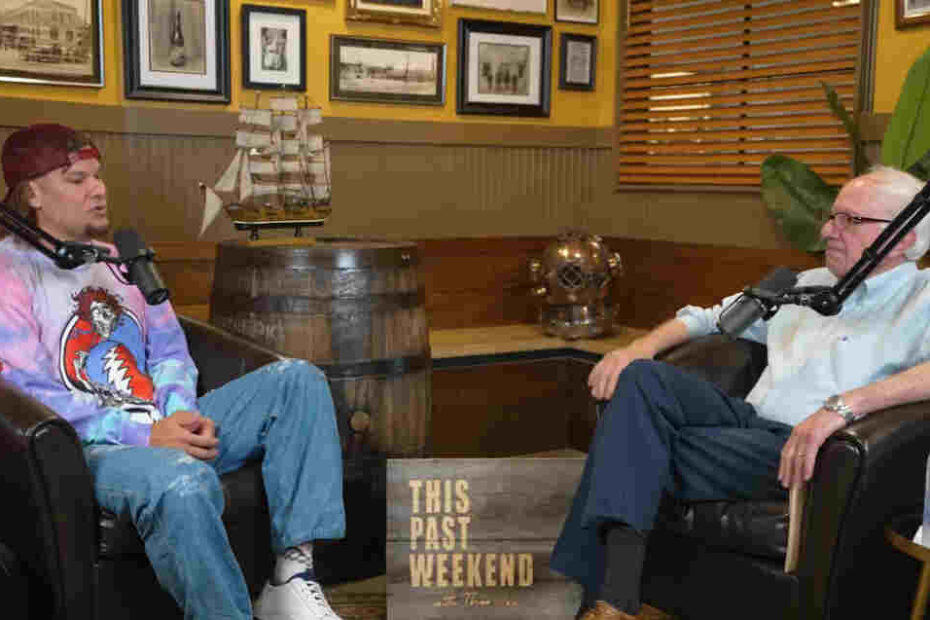
Read the full transcript of U.S. Senator (I) Bernie Sanders’ interview on This Past Weekend w/ Theo Von #524, August 14, 2024.
THEO VON: Today’s episode was filmed at the Venetian Soda and Cocktail Lounge in Burlington, Vermont. And we want to thank them for hosting us and allowing us in their beautiful space.
Our guest is a United States senator from Vermont. He’s an independent, though he’s been friendly with the Democratic Party over the years. He’s been a congressman, a senator, a presidential candidate, and he’s one of the biggest lightning rods in American politics.
At the very end of the interview, we did experience some difficulties with our microphones, so we apologize for the change in sound there. We’re grateful to welcome today’s guest, Senator Bernie Sanders.
Getting to Know Each Other
BERNIE SANDERS: So do you travel the country doing these things?
THEO VON: Yeah, mostly I travel doing standup comedy. But about six years ago I started doing podcasting just in my kitchen at home. Mostly was just talking about I’ve been in recovery for years, so mostly just talking about that kind of stuff and alcohol and drugs and intimacy disorders. So a lot of that kind of stuff.
And then we started having guests after about two years and went on Joe Rogan a few times and that helped boost the steam. And yeah, it’s been surprising since then.
BERNIE SANDERS: Congratulations.
THEO VON: Thanks. It’s made me grow up some, which is a blessing and a curse. But yeah. And I just went to the Grateful Dead the other day with my brother, so pretty cool. You ever see the Grateful Dead?
BERNIE SANDERS: No.
THEO VON: You remember what was the first concert you ever went to?
BERNIE SANDERS: A name you probably wouldn’t know. You ever hear Pete Seeger?
THEO VON: I’ve heard of Bob Seeger?
BERNIE SANDERS: Yeah, I think that there’s something. I was kind of into folk music more.
THEO VON: Billy Strings. Have you heard of him?
BERNIE SANDERS: Yep.
THEO VON: Yeah, he’s awesome. He’s one of my favorites. Pete Seeger. That’s him right there.
BERNIE SANDERS: That’s… God, that was fast. Yeah, he’s an interesting guy. And there’s another guy who died a long time ago. I don’t know if you know his name. Woody Guthrie.
THEO VON: Is that name Woody Guthrie? I’ve heard of him. Yeah.
BERNIE SANDERS: Yeah. And actually his granddaughter helped me out during my campaigns. He wrote a lot during the Great Depression, so he went around the hobo camps, talked to poor people.
THEO VON: Wow.
BERNIE SANDERS: And he wrote songs. You ever heard the song “This Land Is Your Land”? That’s his song.
THEO VON: Oh, wow. I didn’t… I didn’t even think somebody wrote that.
BERNIE SANDERS: No, he was a great songwriter and a great singer.
THEO VON: Woody Guthrie. I’m going to have to tap into some of his stuff. Yeah. My brother and I went… You have a brother?
BERNIE SANDERS: I have an older brother, yeah.
THEO VON: You guys ever go to a concert together?
BERNIE SANDERS: Nope, I don’t think we… He lives in Oxford, England.
THEO VON: Yeah. It’s fancy over there.
BERNIE SANDERS: It is. Have you ever been to England?
THEO VON: Yeah.
BERNIE SANDERS: And they have this old university called Oxford University, which is one of the great universities in the world. I stayed in a house… God, like, was 1400 or 1300. Who the hell knows? I mean, really, it goes way, way back.
THEO VON: Oh, yeah. The plumbing.
BERNIE SANDERS: Yeah.
THEO VON: You got to bring your own plumbing, I’m sure.
BERNIE SANDERS: Well, they’ve advanced a little bit.
THEO VON: Bernie Sanders, thank you so much for joining us today.
BERNIE SANDERS: Great to be with you.
Money in Politics and Corporate Influence
THEO VON: I really appreciate it. Whenever you started in politics, I’m sure that there was a real idea of one person can really affect change. Right. Do you think that that’s still possible today with a lot of the lobbies and stuff that goes on?
BERNIE SANDERS: Well, I think one of the points I think everybody knows is you have a government dominated by big money interests. Right. That’s no great secret.
So you have these billionaires now in their super PACs. If you’re a billionaire, you can contribute hundreds of millions of dollars to elect people or defeat people. If you’re a large corporation or you represent the pharmaceutical industry, do you know how many lobbyists there are in Washington, D.C. representing the big drug companies? Take a wild and crazy guess.
THEO VON: 2,000.
BERNIE SANDERS: You got it. That’s a pretty good guess. About 1,800.
THEO VON: Wow.
BERNIE SANDERS: So there are 100 members of the Senate and 435 members of the House. Got it. 535. And you got 1,800 lobbyists, well paid, former leaders of the Democratic Party, leaders of the Republican Party.
They’re there to say, “Hey, Congress, do everything you can to make sure we make as much money as possible. And who gives a damn whether people can afford the prescription drugs they need?” So that’s power.
THEO VON: So you have a whole other drug government almost going on.
BERNIE SANDERS: Absolutely.
THEO VON: That’s even bigger than our own government, numbers wise?
BERNIE SANDERS: Well, not big, that’s… Well, we could define what we mean by bigger.
THEO VON: That’s fair.
BERNIE SANDERS: But if you look at Wall Street, the power of Wall Street, the drug companies, the insurance companies, the fossil fuel industry, you have enormous wealth, enormous power.
And if your question is, is it government that tells them what to do, or they tell what the government to do? More the latter. They tell the government what to do. Very powerful.
THEO VON: Does it feel like that’s changed over your time in politics, or has it always been that way?
Citizens United and the Rise of Super PACs
BERNIE SANDERS: I think to some degree, money talks. Right? No great secret. That’s always been the case. It’s worse now, and I’ll tell you why.
As a result of this Citizens United Supreme Court decision, you familiar with that?
THEO VON: 100%.
BERNIE SANDERS: Okay? And Supreme Court said, “Well, guys, you’re right. You’re billionaires. You should be able to spend as much money as you want to buy elections.” And that’s what you have.
So right now, this is literally the truth. You have super PACs where billionaires can put unlimited amounts of money, hundreds and hundreds of millions of dollars, to defeat people they don’t like or to support people they do like. That’s power.
And that is the corruption of what democracy is supposed to be. Look, you and I can disagree on an issue. Ten people, we argue it out, we vote, I get the majority, you get the majority. So somebody wins, somebody loses. I don’t think billionaires should be able to buy elections.
THEO VON: And I think most people think that. Most people are like, why are corporations or companies allowed to give money to candidates and influence elections? Right. Almost every person I know says that that should be… No. Whose responsibility is it to make sure it doesn’t happen? Is it ours or is it the politicians?
BERNIE SANDERS: What happened is there were laws put in place. Not as strong as I would like, but they did limit the power of big money.
THEO VON: Yeah.
BERNIE SANDERS: Okay. And what that Supreme Court decision said is what Congress did was unconstitutional. Denied big money their freedom of speech. If you’re a billionaire, you have freedom of speech. That means you can run ads all over the day to beat Bernie Sanders, beat anybody. And that’s what happened.
So what we have got to do now is once again pass legislation that will do that.
Politicians and Lobbyist Influence
THEO VON: Are there politicians that aren’t viable, kind of… Or aren’t influenced by lobbyists?
BERNIE SANDERS: Of course there are.
THEO VON: There are.
BERNIE SANDERS: Yeah. There’s some very good people, but many people… Look, just to write an example, you’re running for election, okay? Your opponent is spending millions of dollars. These TV ads are up there. All right?
Do you think you’re going to stand up to powerful special interests who say, “You know, Theo, listen, I like you, but you’re going to take that position on that issue. I got to be running millions of dollars of ads against you.” What do you think you’re going to do if you want to get elected?
You could say, “Well, go to hell. I’m going to do it anyhow.” And many would do. Or you run the risk of seeing that kind of money come against you.
THEO VON: Or you then have to find a lobbyist that has an interest of yours and you have to try and fight back.
BERNIE SANDERS: Which is a pretty pathetic thing. Right?
THEO VON: Right.
BERNIE SANDERS: So to some degree, what you have right now, it’s a funny kind of thing. Let’s say you want it against me. It’s not you against me. It’s your moneyed interest versus my moneyed interest. That’s what super PACs are.
Now, corporations cannot directly contribute to your campaign, but big money interest, billionaires can contribute to a super PAC. So you have all these… I would say to you, people watch the show here. Look at the ads that are on television. They’ll be underneath it, you’ll see “Paid for by supporters of the American way of life” or whatever the hell it is.
Understand that in most cases, these are billionaires putting money into a candidate.
THEO VON: So the super PAC is kind of the loophole.
BERNIE SANDERS: Yep.
THEO VON: Is how they do it so it’s not directly from…
BERNIE SANDERS: Exactly. There are limits. All right? You wanted to contribute to my campaign. They’re pretty stringent limits. You can’t contribute… I think it’s… I don’t know. It’s $5,000. To a super PAC, you can contribute $100 million.
THEO VON: Wow.
BERNIE SANDERS: That’s a big issue. We don’t talk about it enough. And then you can understand that if you’re an ordinary person who’s going to listen to your interests, your needs. Right. When billionaires are putting in this kind of money. Right.
THEO VON: If the best I can help you out with is $5,000, you might show up and shake my hand. But when something really… When the rickshaw hits the road or whatever, you’re going to be working for the big dogs for the cash.
BERNIE SANDERS: And that’s the way the system works.
Campaign Finance Reform
THEO VON: And how do we change that?
BERNIE SANDERS: Well, first of all, this campaign finance reform is a big deal. Just this one issue, and I’m glad you raised it. We got to do away with the Citizens United. We have to have restrictions. Okay.
When I ran for president, the average contribution was $27. Okay? Roughly speaking. And we got millions of people to contribute, so I think there has to be a real stringent limit on the amount of money that any individual can put into the political process.
And I also believe that we should move to what we call public funding of elections. You’re a candidate. You want to run for governor. You want to run for senator. If you show that you have a certain amount of support, you got X number of thousands of people willing to put $5 into your campaign, you can be able to get public funding, and there’s a limit how much you can spend.
These are not radical ideas. They exist in many countries around the world, actually.
THEO VON: Yeah, it’s pretty normal. Do you think that our election process is still democratic? Do you think it’s still…
Healthcare as a Right vs. Privilege
BERNIE SANDERS: Yes and no. I mean, you want to run for office. Can you? Yeah, you can. You got a certain number of signatures. But if you’re going to win and I have 10 times more money than you do, I will beat you 95% of the time. I mean, that’s a fact, right?
You’ll beat me maybe if you’re really an exceptional candidate. I’m a real idiot. You will beat me once in a while. But by and large, the money people will win. So if you’re asking me, are we a democracy, in one sense, we are. All right, you can run for office. You can raise your issues.
On the other hand, in terms of who has the real power, many people do. And I use the term oligarchy. And oligarchy is a society where small numbers of very wealthy people control the economic and political life of the country. I think we are moving rapidly in that direction.
THEO VON: Yeah. I feel like it’s, to me, it feels like an almost privatized communism in a way.
BERNIE SANDERS: Right. That’s a very good point. It’s a very good, that’s an interesting way of looking at it.
THEO VON: Yeah. And I don’t know exactly sometimes everything of what communism isn’t, what socialism is, but sometimes that’s how it feels.
BERNIE SANDERS: Well, let me give you an example. Let me pick, can I pick up on you?
THEO VON: Sure.
BERNIE SANDERS: Okay. I believe we are the only nation on earth, major nation, wealthy nation, that does not guarantee health care to all people. Okay. Get in your car, go 50 miles where you are sitting right now in Burlington, Vermont. You have a terrible automobile accident. You’re in the hospital for a month in Canada. Do you know what the bill is when you come out? Zero. Nothing. Okay.
Do you know how much the Canadians spend per person on healthcare compared to us? Half as much. They spend half as much. You don’t take out your wallet if you get sick. You go to the doctor that you want. Okay. I believe in that type of system, they guarantee healthcare to all of their people. It’s publicly funded, the way we fund police departments, fire departments and libraries. Okay. You got to pay taxes for it, but at the end of the day, it is less expensive for your health care. You follow what I’m saying?
THEO VON: Yeah. Okay. Yeah. Because you’re a proponent for healthcare for all. Right. And yes, and you always have been. But how the system seem, that system seems so rigged because you have, you have like, one of the number one causes of bankruptcy in America is medical debt. Right?
BERNIE SANDERS: Yeah.
THEO VON: Like, people can’t, people, they go in, they don’t even know the cost. They sign an agreement that they’re going to be billed later. Right. It’s like, and then they get the bill and it’s astronomical. And they spend the rest of their life literally a slave to the health care system or to the medical billing system or the, dealing with their insurance. And not to mention they’re sick. So the added stress of that, it just feels like, yeah, like something so much better could be done.
The Cancer Crisis and Financial Devastation
BERNIE SANDERS: That is so pathetic and so sick and so cruel. I mean, we did a hearing on this and roughly speaking, and I know the viewers will think this is hard to believe, half of the people who are dealing with cancer. Now, cancer is a terrible disease, right? Your point?
THEO VON: 100%.
BERNIE SANDERS: You’re struggling for your life, right?
THEO VON: Yeah.
BERNIE SANDERS: Maybe you make it, maybe you don’t. Maybe you got radiation, chemotherapy, bad stuff, right? Half the people who get cancer treatment either end up in bankruptcy or utilizing all of the financial resources of the family. They’re depleted, they’re broke.
So imagine that you go into the hospital, doctors, sorry, you got cancer. Terrible. You’re worried to death, right? Your friends, your family are worried. And then on top of that, what are you worried about? Oh, my God.
THEO VON: What?
BERNIE SANDERS: I’m going to have to sell my house. I have to go bankrupt in order to pay medical bills.
THEO VON: That is insane. Yeah.
BERNIE SANDERS: And if you’re trying to deal with cancer, then you got to worry about financial stress. Think that’s going to make your condition any better?
THEO VON: No, the worst. You spend half your day. You can’t, even in the insurance companies, it’s all a rigmarole. It’s constant stress. But how is it set up like that? Like, what is the gimmick between insurers and the hospital? That’s the thing. I don’t know what’s going on.
BERNIE SANDERS: Take it a step. Let’s take a step.
THEO VON: Okay.
How the Canadian System Works
BERNIE SANDERS: Let me talk about the Canadian system, okay? Simple system. You pay taxes. And progressive. The more you make, the more you pay. But everyone pays taxes, all right? End result is you walk into the hospital, you sign your name, you got all the treatment you need, and it’s good quality health care.
You don’t have to argue with insurance companies. You get the care that the doctors think you need. End of discussion. And in my view, that’s the way it should be. We spend, it’s not just that the insurance companies make huge profits. They do. Not just, they pay their CEOs exorbitant salaries, which they do. Everybody’s got to fill out a thousand different forms, right? Goes crazy filling out forms to see what you’re entitled to, what you’re not entitled to. Deductibles, right?
THEO VON: Yeah. The bureaucracy. It’s ridiculous. Is that called bureaucracy? Yeah.
BERNIE SANDERS: Yeah, that’s exactly what it is. All right, so look, you may have health insurance, but I just talked to a person the other day. We had a meeting. You know what their deductible was? $13,000. What does that mean? It means that the first $13,000 of illness, they got to pay out of their own buck. How many people can make $13,000?
So if you get hit by a truck and you’re up a million dollar bill, yeah, the insurance companies will kick in. Yeah, presumably. All right, so the whole idea that health care in America, unlike every other major country, all right, go to Europe, go to Canada, go to many Latin American countries. It is a bloody right, not a privilege. And that’s what I think it should be.
So we have a system that works very well for the insurance companies and the drug companies. In some cases, you’re going to pay 10 times more for medication in America than they do in other countries. That’s a whole other story we’re trying to deal with right now. But it’s a corrupt system benefiting the people who own it, not the ordinary American.
You go out on the street. Go out on the street, say to people, do you think health care is a human right? All people in America shout out, yeah, we do. That’s what I’m fighting for.
The Lobbyists and Politicians
THEO VON: And who are the lobbyists that are against that then?
BERNIE SANDERS: You think guys from the insurance companies, from the drug companies.
THEO VON: Okay, and then what? Politicians work with those. Like, why don’t we know what politicians are cheating us so that we don’t have them in anymore?
BERNIE SANDERS: All right, you’re a smart guy. You tell me. How often have you heard a discussion in this country about how broken the health care system is and comparing it to other countries?
THEO VON: A lot.
BERNIE SANDERS: All right, you’ve heard a lot about this?
THEO VON: Well, I mean, I think I hear a lot about, I look into it a lot.
BERNIE SANDERS: You look into it. But how many people even know that we are the only major country on earth not to guarantee health care at all? People. So when people say, oh, Bernie Sanders is a radical idea. He thinks everybody should have health care. Really? That exists in Canada, it’s in France, in England, in Denmark and Sweden, in every bloody country on earth. Virtually rich country. So it’s not a radical, even Mars.
THEO VON: I heard they have health care there now.
BERNIE SANDERS: I wouldn’t be surprised.
THEO VON: Now, some people would say that the argument against that would be that then there’s less personal responsibility to take care of yourself. Right. But do you.
BERNIE SANDERS: Really.
THEO VON: But that’s, but that would be in other countries anyway, right? That would be in any way if.
BERNIE SANDERS: God forbid, you or I came down with a serious illness. Am I going to blame you becoming down with cancer? I mean, is that a personal responsibility?
THEO VON: It’s a good point. Yeah, probably not. That might just be kind of a ghost of an argument.
Prevention vs. Profit
BERNIE SANDERS: But to pick up on that point, what should one of the priorities of a good healthcare system be? It should be to try to keep people healthy. So we should encourage people to have good diet, to do exercise, to stay away from addictive stuff. Right. Do we do a particularly good job on that? Not so much. Because where do the insurance companies make their money? Hey, if you’re really sick, pretty good.
THEO VON: Yeah.
BERNIE SANDERS: We keep you healthy, not so much.
THEO VON: Are they one of the largest lobbyist groups?
BERNIE SANDERS: Yep.
THEO VON: Wow.
BERNIE SANDERS: Very, very. They’re huge. I mean, we started this discussion. You talk about privatized communism, whatever the expression you use is. I believe that Medicare is the health insurance program for the elderly, Medicaid is for lower income people. I think we should combine all these and guarantee healthcare to all people.
But your point is that in the private sector, we are moving to a monopoly. And it’s true, people like UnitedHealth. Unbelievable. UnitedHealth, to the best of my knowledge, has under contract or hires 10% of the doctors in America. Wow. Talk, that one insurance company, 10% of the doctors.
A Realistic Path to Reform
THEO VON: And so how would you even start to undo something like that? Like what’s a realistic path to reform? I guess here’s.
BERNIE SANDERS: Thanks. Great question. Because I wrote the bill. I know the answer. Okay?
THEO VON: Okay.
BERNIE SANDERS: All right. Right now you have Medicare, which is very popular program. It’s life saving to many elderly people. That was developed in the 1960s by President Lyndon Johnson. Okay, very popular program. You got Medicaid for the lower income people, also a popular program.
What I would do is over a four year period, take Medicare. First thing you do is expand Medicare because Medicare does not now cover dental, hearing or vision. A lot of people can’t afford to go to a dentist. Got me?
THEO VON: Yeah.
BERNIE SANDERS: Okay. You expand it and then you say right now to be eligible for Medicare, you got to be 65 years of age. First year, lower it to 55. So you have graduations. You don’t have to worry about whether you have insurance on your job.
You want to hear something else crazy about the private insurance system? You work for a big corporation, okay. They give you good health insurance. He works for McDonald’s, virtually nothing. All right, that’s pretty crazy. Where you work determines the kind of health care you got anyhow.
So we’ll go from 65 down to 55, 55 next year down to 45, 45 to 35, 40. You cover everybody. Gradual absorption. So you have a Medicare system that covers all people. You no longer have to pay any more deductibles or co-payments, no more premiums. You get your health care because you’re an American citizen.
Will your taxes go up? They may. Will it be less than what you pay right now in private insurance? Yes, it will be. It’s a good deal.
THEO VON: Can we afford that as a country, you think?
BERNIE SANDERS: Sure.
THEO VON: Yeah.
The Cost of Healthcare in America
BERNIE SANDERS: We are now spending over $4 trillion on health care. We spend double. Here’s another point to be made. We spend twice as much per person on health care as any other country because it’s designed to make money for the insurance companies and the drug companies.
THEO VON: Wait, so explain it to me. So we spend twice as much on.
BERNIE SANDERS: Health care we are spending right now.
THEO VON: As any other country?
BERNIE SANDERS: Yes.
THEO VON: Per person?
BERNIE SANDERS: Yes.
THEO VON: But we’re not, but the money isn’t going towards them getting. So we’d almost save the money just by. You got it?
BERNIE SANDERS: Here, example.
THEO VON: Is that true?
BERNIE SANDERS: Yes, it’s true. Check it out. It is true. Chairman of the bloody committee. Yes, it is true. All right.
THEO VON: Bloody. Literally, people are completely bloody.
BERNIE SANDERS: All right, if I buy a car tomorrow for $80,000, you buy a car for $40,000. What is the presumption? Should my car be a better car than yours?
THEO VON: Yes.
Healthcare Costs and Transparency
BERNIE SANDERS: Okay, I’m spending twice as much. All right? But I got a really much better car than you have. All right. We are spending per person, over $13,000. Spending $13,000 on you, $13,000 on me. $13,000 on a five year old. $13,000 on a 90 year old. All right, $13,000 per person. Over $4 trillion nationally. Canadians are spending about half of that per person.
THEO VON: And they’re taking care of everybody.
BERNIE SANDERS: Yes. And the British are spending less than that. Other countries a little bit less.
THEO VON: But does that affect us with the population number that we have?
BERNIE SANDERS: Doesn’t matter. I mean, per person.
THEO VON: Got it. Okay.
BERNIE SANDERS: I’m not talking about in gross.
THEO VON: Right?
BERNIE SANDERS: Per person.
THEO VON: How do you stop hospitals from overcharging? That’s part of the…
BERNIE SANDERS: It’s a corrupt system.
THEO VON: If they know that the government’s going to pick up the tab.
BERNIE SANDERS: Good. Very good question. The answer is what they do. I mean, it’s not like we’re inventing something. Other countries do it. What they say to hospitals is, look, you’re not going to be charging Keogh when he’s in the hospital. You’re not going to be charging him a nickel. But we know, roughly speaking, in a year what you are going to be. You need certain number of doctors and radiologists and nurses and all that stuff. Here is your budget. It’s like a police department. Here’s your budget. In a year you need more. Maybe we can come up with one, you get what we call a global budget.
THEO VON: It’s like the Dodgers or something.
BERNIE SANDERS: But you got a global budget, right? You got a budget and you take care of all the needs. It’s not per person. You get it. And what you do there, we spend as a nation, one of the other insanities of this healthcare system. We spend hundreds of billions of dollars on billing. You know what I mean by that?
THEO VON: Billing? Yeah.
BERNIE SANDERS: All right, so I’m the insurance companies. First of all, you got to fill out forms. I hire people who are not doctors or nurses. Right. They’re just book…
THEO VON: Oh, yeah.
BERNIE SANDERS: All right. You got bill collectors. You go to a hospital, go down to the basement. Well, depending on size of the hospital, dozens of dozens of people. They don’t see a patient, they’re just filling out forms.
THEO VON: Yeah. Half the Philippines is people just do medical billing over the phone, you know.
BERNIE SANDERS: Well, there are countries where you show your card and that’s the end of the discussion. But we waste hundreds of billions of dollars just on billing people. Now, there’s another issue I want to discuss. Life expectancy. What do we know about life expectancy?
Life Expectancy and Healthcare Quality
THEO VON: We’re getting pretty long in the tooth.
BERNIE SANDERS: Nope.
THEO VON: We’re not living long.
BERNIE SANDERS: Nope. Compared to home.
THEO VON: Compared to probably Vietnam.
BERNIE SANDERS: Yeah, I’m sure. Maybe. All right, but we have the richest country on earth. Do we live longer lives than other people?
THEO VON: No, we don’t.
BERNIE SANDERS: We do not. In fact, we’re pretty far down the list. Why is that?
THEO VON: Well, I mean, I think it could be that we’re not taking as good care of ourselves.
BERNIE SANDERS: Okay.
THEO VON: And I think it could be that, yeah, that we don’t have as good healthcare.
BERNIE SANDERS: That’s right. All right. I think that’s two pretty good answers. All right, now there are two facts. We, country, Japan, other countries will live four or five years, six years longer than we do. That’s a lot. You know what I mean?
THEO VON: Yeah.
BERNIE SANDERS: So they’ll live, I forgot what it is…
THEO VON: 8% or something.
BERNIE SANDERS: Yeah, right. It’s a lot. But here’s another fact that is really unbelievable. It’s not just that we live shorter lives despite spending so much on healthcare. The gap between the 1% and the working class is 10 years. If you’re rich, you’ll live as long as people in other countries. You have a long life, the 80s or whatever it is. If you’re working class, you’re going to live 10 years younger. How does that happen? Do you think?
THEO VON: Wow. Because just stress, burnout, man.
BERNIE SANDERS: All right, I’m going to sign you up there. You got it.
THEO VON: Look, I think I like a lot of the things that you think about.
BERNIE SANDERS: Let’s deal with the issue of stress.
THEO VON: Okay?
BERNIE SANDERS: Yes, you’re right. It is twofold. It seems to me, number one is if you’re rich, you go to any doctor you want, when you want it, get paid for all the drugs you need. Right?
THEO VON: Yeah. Right.
BERNIE SANDERS: That’s a real advantage. But above and beyond that, working class people live under enormous stress. Right. And that takes a toll on you. Takes a toll on you physically and mentally. And that is we have parts of this country where life expectancy is actually in decline. Got it? People are living shorter lives because of the stress. Because of the stress. And with that stress and the hopelessness, they turn to drugs, they turn to alcohol, they turn to suicide.
THEO VON: Yeah.
BERNIE SANDERS: All right. Bad stuff.
THEO VON: Oh, yeah. I think those are things that, yeah, they don’t even take those factors into consideration when they’re making all of these, you know, you call to get your medical bill, it’s a nightmare. It’s like, it’s a fight. You almost want to, this is crazy. There’s been times when I’ve been like, I would rather take my own life than sit here and make another f*ing call. And I’m not even sick. You know, I’m just somebody trying to get to the bottom of the…
BERNIE SANDERS: All right, and why does that happen? Because it’s…
THEO VON: Loopholes. They want you, they don’t want you to get paid.
BERNIE SANDERS: You got it. Not that hard. Look, you pay me money through insurance, right? So you’re sick. I’m supposed to, you know, pay your bills, right? If I drive you crazy, you’re going to say, screw it. Hell with it. I’ll pay the goddamn thing myself.
THEO VON: It’s not worth it.
BERNIE SANDERS: Yeah, Good. I’m the insurance company. Right on, man. That’s exactly what I wanted.
Political Obstacles to Healthcare Reform
THEO VON: So how then, how do we change that as a system? How? What do we do? Because it feels like we’re electing people that have this in our best interest. If that’s the number one cause of bankruptcy is medical billing, how do our politicians not see that this is extremely important, that things need to be different? I know it’s money, but it’s like, I just can’t imagine that people wouldn’t see the good, the value and what is right.
BERNIE SANDERS: Well, you know, all that I can tell you is money talks to a large degree. And it’s not to suggest that members of Congress are evil or terrible people that want people to suffer. They don’t. But you have a system which almost says, oh, you can’t even think about guaranteeing healthcare to all people. Oh, my God. What kind of, you’re a far leftist.
THEO VON: Yeah.
BERNIE SANDERS: You’re a communist man. What are you, you don’t want to take all the insurance companies, hard working people, you know, so it almost, you’re not even allowed to talk about those issues. And meanwhile, we’re the only country that doesn’t guarantee healthcare.
THEO VON: Yeah, I mean, my one caveat, and I don’t know exactly what caveat means, but I think my one, you know, left turn on it would be, yeah, how much responsibility then do people, are people going to just have totally less responsibility and just be taking pills? You know, I don’t, maybe that’s just a crazy thought, but if it’s not happening in other countries, then maybe that’s a good example that it wouldn’t happen here.
BERNIE SANDERS: It is an issue in other countries, for example. All right, you’re a lonely older person. Maybe you’re living by yourself. I’m feeling lonely. Maybe I’ll go to the doctor right when I’m not really sick.
THEO VON: Oh yeah, for sure.
BERNIE SANDERS: Will people abuse it? Yeah. So what? I mean, it happens. And you try to discourage that. No system is perfect.
THEO VON: Right.
BERNIE SANDERS: But the bottom line, as Americans, we have to answer a very simple question. Is healthcare a right of all people, whether you’re rich, poor, medium, whatever you are? I think the answer is yes.
THEO VON: Well, I think especially when you start to look at other places that we spend our money, it would be very hard not to say we should certainly spend it there first. It’s just f*ing unbelievable that we’re this powerful of a country and we don’t have an emote, like it’s like we lost our emotional…
BERNIE SANDERS: All right, that’s a good point. And I’ll tell you something else. Let me get off of healthcare for a second.
The Transparency Bill
THEO VON: Okay. Before we get off, I want to, so I know that you guys have a bill because I have a group that I’ve worked with, done volunteer stuff with, called Power to the Patients. Right. And it’s notating the prices of like, say you get an MRI. Like the hospital now has to let you know that the MRI is $700. So you can call the hospital down the street and see that there it’s $550. So you can make a choice. So you know up front, so you’re not getting a $10,000 bill later on.
BERNIE SANDERS: You got it. It’s called the transparency bill.
THEO VON: Transparency bill. And is it passed yet or no?
BERNIE SANDERS: No, it has not. I’m working with it with a guy named Senator Braun from Indiana who’s a Republican. Good guy. And look, it’s exactly the issue. People walk into an emergency room, they walk into a hospital. Do you have any idea, you know, here, Theo, this is what we’re going to do for you. Blah, blah, blah, blah. And you come out and you drop dead because you see a bill of, you know, tens of thousands, right? I mean, people go into surgery, they come out hundreds of thousands of dollars in debt. It’s insane. All right?
And the point is, look, I should have the right to know. You want to hear? You think it’s crazy? Let me tell you how crazy. It’s even crazier than you think it is. Okay?
THEO VON: Okay.
BERNIE SANDERS: You have Blue Cross insurance. I have another insurance company. Same hospital. You go and get an MRI, your insurance company will pay $500. My insurance company pays $700. So even in the same hospital for the same treatment, the prices differ, not to mention different hospitals.
THEO VON: Yeah. Well, it’s just wild that they can do that. It’s almost like I’m going to go to the grocery store, I’m going to get an apple, right? I’m going to eat it, and then after I eat it, you’re going to tell me how much it costs.
BERNIE SANDERS: You got it? That is like.
THEO VON: It’s $400. You’re like, is it from the Garden of Eden?
BERNIE SANDERS: But it’s even worse. You’re exactly right. But it’s even worse because you had.
THEO VON: To go to the hospital, right? Right. Yes. It wasn’t a choice that you made. I know you had. You guys had launched an investigation even. Because this is kind of current about Ozempic, right. And the cost of Ozempic in different countries because I was dating a girl, or not dating, but we met. We met up a couple times at night or whatever.
And it’s like she was leaving one morning to drive to Mexico to get Ozempic. And I’m like, what are you. You’re just driving in the middle of the at 5:00am to go to what’s going on? And she’s like, well, it’s just way cheaper there. And I’m like, but is it as regulated? I don’t know.
But I know that in some countries, the prices on it are so different. In Canada, it’s 150 something dollars.
BERNIE SANDERS: Got it.
THEO VON: And in America, it’s 700 and something.
BERNIE SANDERS: Close to a thousand.
THEO VON: It’s close to $1,000 for a diabetes medication. I know some people use it for weight loss or look the way they want spring break or whatever. But that’s crazy. Why is it that? Why isn’t it just the same? Is it because they know they can charge us more because we have more money?
The Cost of Prescription Drugs
BERNIE SANDERS: That’s half of it, but only half of it. That’s a great question. All right. That’s what my committee deals with every day. We’ve had, by the way, some success in the last few years and the Biden people have done a good job on this.
All right. Why is it that I want to make sure I’m right here? Well, certainly in Canada it’s about 150 bucks for Ozempic. Here it’s 900, close to 1000. Why is that what the Canadians do and what countries around the world do, what makes common sense? They purchase a lot of the drug. Right. All right.
So they sit down with the drug companies. They said, look, we have hundreds of thousands of people going to use your drug. We’re going to sit down and we’re going to negotiate a price. Right, right, of course.
THEO VON: Certainly after a few months, you should be able to see the averages and make a good business choice.
BERNIE SANDERS: Yeah, I mean, if you’re bulk, if you’re a businessman and you’re buying something from me, you’re buying thousands of items. I’m going to have to give you a discount if I want your business. Right, Certainly. That’s the way the business works.
So that’s what every country on earth does. They sit down with the drug companies. Some do it more stringently than others. Up until very, very recently, there have been no requirements, zero for the drug companies to negotiate anything.
So they come in and they say they have the board. What do you think we can get, Harry, sitting around the board of directors? Well, see, I think you can get a $10,000 a year. No, I think we can go high. We can get 20,000. Look, we get what the market will bear. The government has no power charge of anything you want. That’s what they do.
So you got. Now it’s not just Ozempic in which we pay in some cases 15 times more than European countries. It’s all kinds of drugs. So the answer is, the answer to your question is up until recently and the Biden administration has done a good job this, there have been no capabilities of the government, Medicare, anybody else to negotiate prices. They charge anything they want and as much as they possibly can.
What we did is part of a bill called the Inflation Reduction Act. Stupid title to the bill, but that’s what it was. Finally have that the drug companies are going to have to sit down with Medicare and negotiate prices. They’re going to be announcing some interesting results pretty soon.
So for the first time, there is the beginning of negotiating prices and it will lower prices. Second of all, what we’ve done on my committee, a lot of people have asthma and they use inhalers. I don’t know if anybody use an asthma inhaler.
THEO VON: Yeah.
BERNIE SANDERS: All right. Ten times more expensive than the United States. Well, we kind of shamed some of the big companies. They lowered it down to some of them to $35, so making some progress on lowering the cost of prescription drugs. But to answer your question, up until a couple of years ago, drug companies could charge any price they wanted for any reason.
THEO VON: And now. And that could be changing with the Inflation Act.
BERNIE SANDERS: Yeah. Inflation Reduction Act. What it basically says is the 10 top selling drugs. They’re going to have to come then and sit down and negotiate with Medicare price. That is, by the way, what the Veterans Administration does. The VA in America does a good job.
THEO VON: Yeah.
BERNIE SANDERS: They don’t pay outrageous prices. They negotiate. And that’s what Medicare is beginning.
THEO VON: Yeah. If you can’t breathe, I mean. Yeah. You’re almost a fish if you can’t breathe. Let’s talk about some policy. Oh, wait. And so. And the price and the price transparency that’s happening now, people have to show their prices or they don’t.
BERNIE SANDERS: No, they don’t. We still haven’t passed that bill.
THEO VON: Okay. Do you think it’s going to happen?
BERNIE SANDERS: It’s a popular bill. I think we have a good shot to get it done.
THEO VON: Yeah. That’s cool. Yeah, man. It makes me just sick because somebody’s already sick and you know they’re sick. If it were your family member, what you would you want them to just sit there and just be angry? They’re on the phone every day. Then they don’t have any energy for their own family. It’s just.
BERNIE SANDERS: You’re right. You’re absolutely. You’re absolutely right.
THEO VON: I just don’t. I just can’t imagine choosing, especially when you’re already making a ton of money, choosing to make a little more money. What do you need?
BERNIE SANDERS: Well, now you’re raising even another issue.
THEO VON: What do you need?
BERNIE SANDERS: Corporate greed here. But that’s another issue.
The 2020 Election and Trump
THEO VON: Yeah, I know you hate it and we all hate it. I think America’s at the point where they. The screw has been turned so f*ing tight that I think, yeah, it starts to. It starts to create radicalization, starts to create a lot of stuff.
Let’s Talk about the election coming up right now or just the current candidacy. I wanted in 2020. I believe that’s when you ran. I wanted you and Donald Trump to be on the same ticket.
BERNIE SANDERS: Right.
THEO VON: That was a thought that I had because in my mind, I’m just a regular guy. I don’t know a ton about politics. Right. I wanted, I felt both y’all were outliers. Right. That’s how it seemed to me. These guys are both outliers. They’re both different, but seem to be doing their own thing. You’ve been outspoken against Trump, right? Do you think he’s not? Is he doing his own thing or is he.
BERNIE SANDERS: Look, I will give Trump credit, okay? He does his own thing. Okay. He’s a very different type of politician, and that’s clear. But this is what I do think, Theo. While I respect somebody who has the guts to do their own thing and be very much a non traditional politician, which is what he is. Here’s the facts. He lies all the time.
I got four kids and I got seven grandchildren. And we really have to ask ourselves whether the guy who is the leader of the country, whether that’s the kind of example that we want. So I have a lot of friends in politics who differ with me. More conservative people. They’re not liars. We disagree. So you and I disagree on something. Fine. So what? It’s called American democracy.
THEO VON: Yeah. It used to be fine.
BERNIE SANDERS: That’s right. But Trump really is. I use the word pathological. He lies. When you see him on television. Every, not everything, but a lot of lies. Okay. And I think that’s. We can’t have that, and when he was in the private sector, before he became involved in politics, he was sued. His companies were sued 4,000 times.
And I just. Above and beyond his political views, which I disagree with. But then those you can discuss. I don’t think you want somebody leading this country who is shady.
THEO VON: So you’re saying the exact. He doesn’t set the best example of.
BERNIE SANDERS: Exactly. Look, you got kids? Do you have any kids?
THEO VON: I don’t have any yet.
BERNIE SANDERS: All right. All right. Well, hope you do. And aren’t you. You want kids to be honest, right?
THEO VON: Yeah.
BERNIE SANDERS: You don’t want them to be bullies and picking on the weak. And he said that from a character point of view. I don’t like him. But also, let me give another example. I happen to believe, I don’t know what your views are, that women have a right to control their own bodies. All Right. I don’t want, as a man, somebody saying, oh, Bernie, you can’t have a vasectomy. You can’t do this. My business, not the government’s.
And Trump does not hold that view. I happen to believe strongly that climate change is real. We got the just a week or two.
THEO VON: I saw your podcast with Bill McKibben.
BERNIE SANDERS: Bill McKibben, of course. I’ve known Bill.
THEO VON: Yeah, yeah.
BERNIE SANDERS: And Bill is.
THEO VON: Yeah. I wanted to. I want to get to speak to him. He seems really interesting.
BERNIE SANDERS: Smart guy.
THEO VON: Is he?
BERNIE SANDERS: I’ve known him for years.
THEO VON: Yeah. Because I want to learn more about, you just always hear about climate change, and so, yeah, I want to learn more about it.
BERNIE SANDERS: Good. And I hope you do. And I’m sure Bill would be happy to go on the show with you.
THEO VON: That’d be cool.
BERNIE SANDERS: If you wanted, I can give him a call.
THEO VON: Awesome.
Climate Change
BERNIE SANDERS: All of the scientists agree when you put carbon into the atmosphere, it creates a ceiling there. The Earth warms up, and then because of the Earth warming up, you have extreme weather disturbances, like the. You come from Louisiana, the Earth?
THEO VON: Oh, yeah, we’re seeing.
BERNIE SANDERS: You’ve seen the terrible floods there. We’ve had them here in Vermont.
THEO VON: Yeah. They have them in Savannah right now going on.
BERNIE SANDERS: Right? That’s right. Floods, the likes of which we’ve never seen. You’re seeing drought, Saudi Arabia, temperature reached 125 degrees, which people dying by the hundreds.
So Trump does not believe that climate change is real. And if he becomes president, that means not only will the United States, the whole world will give up. And I don’t know what this planet is going to look like in 10, 15 years.
THEO VON: And do you say that because America is really the leader of the forefront of looking out for climate change.
BERNIE SANDERS: We’re the largest economy in the world.
THEO VON: Right.
BERNIE SANDERS: China is a bigger polluter than we are right now.
THEO VON: Oh, yeah, dude, they all smoke, too. A lot of Chinese people. Yeah, that kid that smokes on that bicycle or whatever, he’s smoking like 11 cigarettes.
BERNIE SANDERS: But if we were. If we say, hey, the hell with it, then other countries are going to. Because it’s a global problem.
THEO VON: Right.
BERNIE SANDERS: Then everybody’s going to be like, oh, everybody backs off. And then I don’t know what this planet you talk about floods, it’s going to get worse and worse. Heat waves, worse drought, worse migrations. There are millions, hundreds of millions of people. Little farmers in poor countries, they can’t farm anymore.
THEO VON: Yeah.
BERNIE SANDERS: Okay, so I disagree With Trump on that. So those are some of the reasons why, strongly against him.
THEO VON: Those are important issues. And I don’t think. Yeah. It’s like everybody can have their own thoughts on different issues. And do you see why people like him?
BERNIE SANDERS: I do. Because he’s very disarming. He gets up there, he says whatever the hell he wants.
THEO VON: Yeah. He doesn’t seem like he’s by the book. That was a thing is that’s why the book.
BERNIE SANDERS: Right.
THEO VON: And so that’s something the same as you. It’s like he’s speaking for, or it feels like they’re speaking for themselves. Right. Whether you agree with maybe what they believe, they believe what they’re saying. And that, I think comes through. I think you’re right, clearly, to people.
BERNIE SANDERS: I think, you know, he’s certainly unusual. Gets up there and he rants and he does his thing and he’s not necessarily. I’m sure his advisors go crazy, but he’s not, you know, not reading off, you know, he doesn’t know.
THEO VON: Kid Rock is one of his advisors. You know, hey, look, I love Kid Rock, but, you know, I don’t know if every advice, you know, every advice of his is the best, but now some of it is, that’s for sure. But some of it may not be right.
BERNIE SANDERS: And, you know, a lot of these politics have 18 different consultants. You can’t use that word. You can’t say that. You know, and he’s not like that.
THEO VON: He’s not like that. Right.
BERNIE SANDERS: People find that appealing. I get it. But you know, again, I don’t think you could have a pathological liar. Somebody doesn’t believe in women’s, have the right. Women have right to control their bodies. You know, who doesn’t believe in climate change? I think that’s better. By the way, I’m not quite so sure, but she believes that democracy as well.
The Assassination Attempt
THEO VON: Yeah, well, and look. Yeah, those are, that’s exactly, that’s how you feel and it’s important. And you’ve always had your own feelings and I appreciate you always having them and sharing what they are. Do you feel like whenever the people tried to assassinate, did you think it was deeper than that? Do you think it was just some Reddit jockey?
BERNIE SANDERS: First of all, it was horrible. I mean, I disagree with Trump and everything, but the idea of people assassinated from, or anybody else.
THEO VON: Yeah, it’s crazy.
BERNIE SANDERS: It’s crazy. It is horrible. And it’s, I mean, I can’t give you the words, it’s just terrible. We cannot have that in American politics. My own guess, and I’m not an expert, I’m sure there are a lot of, you know, conspiratorial theories that are out there. You know, I think you have, you know, we’ve seen it before. You’ve seen seemingly normal people walking into schools with guns, doing horrible things, right?
THEO VON: Yeah.
BERNIE SANDERS: You know, and I think you had, for whatever reason, I don’t want to even speculate why this young man did what he did.
THEO VON: You just think it was a young man who just, that was it.
BERNIE SANDERS: That’s what the evidence seems to suggest so far.
THEO VON: But you didn’t hear anything else? You guys don’t hear anything else as Congress people? You don’t hear.
BERNIE SANDERS: I don’t know any great secrets that you don’t know.
Kamala Harris and the Democratic Nomination
THEO VON: Yeah. Do you think that Kamala Harris is the best person to run against Donald Trump right now?
BERNIE SANDERS: Well, she is the person. And.
THEO VON: And that won’t change probably, huh?
BERNIE SANDERS: She’ll be the Democratic candidate. And, you know, I’ve known Kamala for a number of years. Not best friends, but I’ve known her. She was in the Senate for a short period of time. She’s very smart, and she’s determined. I mean, above and beyond her views on the issues, which I, you know, support most of them, not all. You got to give credit to somebody, a black woman, to move up the ladder. That ain’t easy stuff. There’s a lot of resistance that, and she’s persistent, she’s strong, and I respect that.
And, you know, I think she’ll be a good candidate. I was interested that Trump apparently backed out of a debate with her on ABC. And I could, I wouldn’t, you know, I have debated her, as a matter of fact. She’s tough.
THEO VON: She’s tough. Was there a chance that you were going to get that nominee? Or as an independent, can you get then plotted with the Democratic Party and put in? Was there even a call about it or anything?
BERNIE SANDERS: No. You know, I ran in ’16. I ran against Hillary Clinton, and I ran at ’20.
THEO VON: Yeah, I remember. And I felt like you, I felt like you didn’t get treated fairly to be honest.
BERNIE SANDERS: And that’s what happens when you take on the establishments. What happened is we won the first three primaries, and then the establishment got very, very nervous, and they got a whole lot of candidates in the Democratic primary and they said, hey, be a good idea if you all dropped out. Let Joe Biden be the one campaign. People rallied around them and.
THEO VON: Is there a call that you get and it’s like you’re not going to move forward? Is it just news articles? How does the establishment work?
BERNIE SANDERS: What happens is I won the popular vote in Iowa. I won the New Hampshire primary, I won the Nevada primary. And those were the first three. And then front pages of New York Times, Democratic establishment very nervous. Bernie Sanders could win the whole. We were doing very well in the polls. And, you know, I think behind the scenes people thought, you know, there were like 15 different candidates and they were splitting up the vote. And that’s how I was. I was not necessarily getting over 50%. I was getting more than other people. So I was on the way to victory.
And they said, look, Bernie shouldn’t be the candidate for a variety reason, we don’t want him. The candidate drop out. And then on one day, a lot of people, Monday through, there’s a lot of people dropped out. It was Joe Biden and me. And Joe had a lot of support and all these people came behind him, and that’s what happened.
Let me also say, you know, having said that, Biden is a friend of mine. I think he has done a very good job over the last three and a half years. And I’m working very hard to see that Kamala is elected our next president.
Media Consolidation and Corporate Control
THEO VON: The fact that you and I are talking is wild. You know, it’s like I f*ing wouldn’t talk to me. You know, but, but, you know, but the fact.
BERNIE SANDERS: But look, the bad news is bad news and good news. The good news is you got a program. Invite millions of people to an idea. Yeah. And part of that is that people do not necessarily believe CBS, NBC, ABC, or even Fox or anybody else. And so let me tell you what I think about that. I think you’re touching on an important issue. We talked about healthcare. You talk about media. You have about eight large media conglomerates. You know, Comcast and all these guys.
THEO VON: Are you serious?
BERNIE SANDERS: Exactly. They own, you know, people turn on their channel. You got it. You got it. They’re huge. They own, they don’t own one station. They own radio stations. They own TV stations. They own movies, you know, producers. So these are owned by very large billionaires, you know, big companies owned by billionaires. And they, they will discuss issues from here to here.
I gave you an example about Medicare for. We should be having a tremendous discussion. We should. Why? We’re the only country on Earth not to guarantee healthcare. It doesn’t take place on television. We should be talking about massive income and wealth inequality. There are three people in America want more wealth than the bottom half of American society. Think that’s appropriate?
THEO VON: No, sir.
BERNIE SANDERS: Okay.
THEO VON: I think there should be a limit on how much a person can earn.
BERNIE SANDERS: Okay.
THEO VON: To be honest with you, it may be, you know, some millions, but I don’t think it should be billions. Someone should.
BERNIE SANDERS: I agree with you. I agree with you, actually. And I think most Americans would. When’s the last time you’ve seen that discussion on NBC? It ain’t going to take place. All right. We have.
THEO VON: But that’s what the people want, though.
BERNIE SANDERS: Yes, that is exactly. And that’s why you’re a success and why other people, you know, with very limited resources, if you like, because you don’t see that type of discussion. I just did a poll. My campaign did a poll just on these issues, you know, talking about issues that working class people want and need that are almost never discussed in politics or in the corporate media. And the answer is people are hurting. They want change. No one’s talking about it.
The Erosion of American Identity
THEO VON: Yeah, yeah. It’s heartbreaking. It’s like, I don’t know, the people don’t even get thought of anymore. It feels like a lot of times. And here’s the toughest part, I think Bernie is as a person who, you know, has felt like in their life, maybe their father died in a war, their grandfather died in a war, and they’ve been tried to pay their taxes and be a, you know, considerate person in their town or their country.
After a while, those good people start, it starts to erode a little because they don’t feel like, and they lose their sense of purpose, man. When you’re, you lose the fabric of your society. A lot of people, that’s how they didn’t even realize that. A lot of us only realize that’s we identify as an American. And when you realize, well, America, it’s nothing, but it’s a, it’s a shell LLC for f*ing big corporations, then what am I? I’m just a, I’m just an idiot. You know, you almost feel ashamed of yourself, you know, or you can, you know, anyway, just, I don’t know. A lot of that stuff just, I just don’t see how people think that that’s good or how you’re going to still be able to get people to buy in.
BERNIE SANDERS: Theo, I think you said it better than I did. I mean, I agree with you. I think a lot of people are ashamed. They’re giving up. They’re hurting.
THEO VON: Yeah.
BERNIE SANDERS: Many of these people have fought and died or their families have fought and died in wars, and they’re good people. And maybe they’re, you know, nurses and business people.
THEO VON: Yeah, anything. Crossing guard, mailman.
BERNIE SANDERS: Exactly. They believe in their community.
THEO VON: Yeah.
BERNIE SANDERS: And meanwhile, they’re getting ripped off by people on top, politically and economically.
THEO VON: Well, even the radio, like you’re saying, it’s like you used to have a newspaper and you ran. It meant something. Your community meant something. It used to be that your grandpa worked at the factory and they made the table that you have in your home. And so everything had a story to it. There’s some connection. And now it’s like we’re buying stuff from countries that they’re making it. They don’t care we’re using it, we don’t care. There’s no story. Nobody has any, there’s no thread. You know, the thread just gets thin.
BERNIE SANDERS: That’s a very profound point you just made.
THEO VON: And so how do we get it back? You know, it ain’t easy. Yeah.
The 32-Hour Work Week
BERNIE SANDERS: But I think you hit the nail on the head, people. You know, you’re in. Right now you’re in Vermont, which is one of the smallest states in the country. It’s very rural state, beautiful. Burlington is the largest city with 40,000. I used to be mayor here, you know, but you go into small towns, everybody knew everybody.
Often they were dairy farmers. We had a lot of dairy farmers. People worked really hard being a dairy farmer.
THEO VON: Oh, yeah. I used to work at Cold Stone Creamers for a while. So not the same, but I get it.
BERNIE SANDERS: But milking cows, you know, 5 o’clock in the morning on a cold winter day ain’t easy work, but it was. Everybody knew each other. Nobody cheated each other. It was a sense of. Then you have town meetings once a year and people argue about the school budget, all that stuff.
And we are losing that big time for a lot. Maybe next time we’ll talk about that. But we’re losing. We’re losing that, as you indicated, for a lot of reasons. And if we don’t get it back, I worry about the future of this country.
THEO VON: Yeah, we can. That is kind of a bigger topic. I’ve heard you talk about the 32 hour work week, man. It’s intriguing when anybody second I heard that, I’m like, I’m in.
BERNIE SANDERS: You know, I tell you, it got a lot of response.
THEO VON: Yeah.
BERNIE SANDERS: I think there was a poll.
THEO VON: I thought if it was a Newsweek, I don’t know where it was. That. Yeah, the 32 hour work week. And one of the reasons behind it is why.
BERNIE SANDERS: Okay, here’s why. All right, let me back it up a little bit. Okay, here’s. I’m going to ask you a question. Are you ready for a tough question?
THEO VON: Let’s do it.
Worker Productivity and Wages
BERNIE SANDERS: All right. Over the last 50 years, five, zero years, massive changes in technology. Right. 50 years ago, they didn’t have this stuff. Worker productivity has gone way up. Right.
So you’re a worker now playing with technology, machinery, whether it’s a computer, whether it’s, you know, factory technology, you’re producing a lot more. Correct. In terms of real.
THEO VON: You’re producing more because you have machines that can help you. Got it.
BERNIE SANDERS: Okay. Right. Much more, by the way.
THEO VON: Right. So a machine can do the work of 30 men in a day.
BERNIE SANDERS: You got it. Whatever it may be. Okay. In terms despite all of that worker increased worker productivity is the worker of today in real inflation accounted for dollars making more or less money than that worker was doing or a worker similar type worker 50 years ago? What’s the answer?
THEO VON: I would say less. So less. Based on inflation and everything. The workers making less amount than they were then in real dollars.
BERNIE SANDERS: Yeah, we’re called real dollars. Inflation accounts for dollars. Real dollars. Perfect. How insane is that? If that worker is now producing so much more than the issue did. Oh, I see. So now if a worker is operating.
THEO VON: A machine and that machine is doing the work of 20 workers, then why isn’t there some benefit to the worker?
BERNIE SANDERS: You would think that a guy’s making. Well, just making more money. Right. Hey, you’re producing a lot more or with it. Yeah, yeah, yeah. 100K. Got it. Okay. Make a must wait a whole lot of money coming. Who benefited from that?
Over that same period of time there was a study that there was a 50 trillion dollar redistribution of wealth from the bottom 90% to the top 1%. So getting back to the 32 hour work week. It’s a simple idea. If you are worker producing a hell of a lot more than was the case 50 years ago, you should benefit from increased technology and one of the things, people as you mentioned, at the moment we’re living under a lot of stress. Right.
If you can lower that work week without loss of pay. Right.
THEO VON: So you’re saying that there needs to be some feedback to them because if everybody’s earning more, if the company’s earning more. Yeah, some of the degree. It’s just scary, man. I don’t know. Yeah, it’s just scary. I want to get into. Oh wait, but what about would you have to raise the pay of people then? Oh, I guess you would because they’re.
BERNIE SANDERS: Yeah. You know what if you reduce. What we’re doing here is reducing the work week which is from 40 to 32 which by the way has not been changed since before you were born.
THEO VON: Yeah. And that’s when people had to do crops and everything, you know.
BERNIE SANDERS: Yeah.
THEO VON: People were just.
BERNIE SANDERS: Yeah, people were working by lightning bug. So we are a much wealthier nation now. But I want that wealth to be distributed a little bit more fairly.
THEO VON: Cool.
Advice for Young Activists
THEO VON: We’re almost done. Yep. Forgot. Just one more issue I want to ask and we’ll be quick last question. If you were to look at if there’s somebody out there today who’s like a guy who you were, who wanted to see change, who, you know, started protesting on campuses and got involved and became a mayor and wants to get into politics and really think that they can make a difference, what path do they need to try for themselves now with so much lobbying and stuff going on?
Like, what would you tell them?
BERNIE SANDERS: All right, first of all, what you’re involved in, politics and change and being elected official is one way, but it’s not the only way. Dr. Martin Luther King Jr. was never elected to anything. Right. He had a profound impact on this country. Never ran for anything. All right?
And you’re seeing young people who are concerned about climate change on campuses and more. So go with your passions. Your passion may be different than mine. What’s your issue? So work on that issue. Meet people, educate, organize, meet people.
And if you then decide, hey, maybe I want to run for the state legislature, maybe I want to run for office. I want to get my hands dirty in politics.
THEO VON: Do it.
BERNIE SANDERS: But first of all, don’t do it just because I want to get elected. That’s bad.
THEO VON: Right.
BERNIE SANDERS: Do it because you believe in something and getting elected will help you do it, fine. If not, you can do it in other ways.
THEO VON: Yeah. Bernie Sanders, thank you so much for your time, man.
BERNIE SANDERS: Oh, Theo, thank you very much. Let me just say this. Congratulations on your programs and what programs like this do. I’m on TV a lot. We know I get seven seconds to make a point. Can’t make it in seven seconds.
So the opportunity you can have a serious discussion about serious issues is really great. I thank you for the opportunity, and thank you for what you’ve done.
THEO VON: Thank you. I’ve always been a proponent, and thank you for being an outspoken person who believes in things and moves forward with those beliefs.
Related Posts
- Bondi, Baal, and the Dow @ The Tim Dillon Show #483 (Transcript)
- You’ve Been Lied To About Masculinity – Scott Galloway @ TRIGGERnometry (Transcript)
- Joe Rogan Podcast #2454: w/ Robert Malone (Transcript)
- Nicolai Petro: Europe at a Crossroads at Munich Security Conference (Transcript)
- Tucker Carlson: Epstein Files, NATO, Iran & China’s Rise (Transcript)