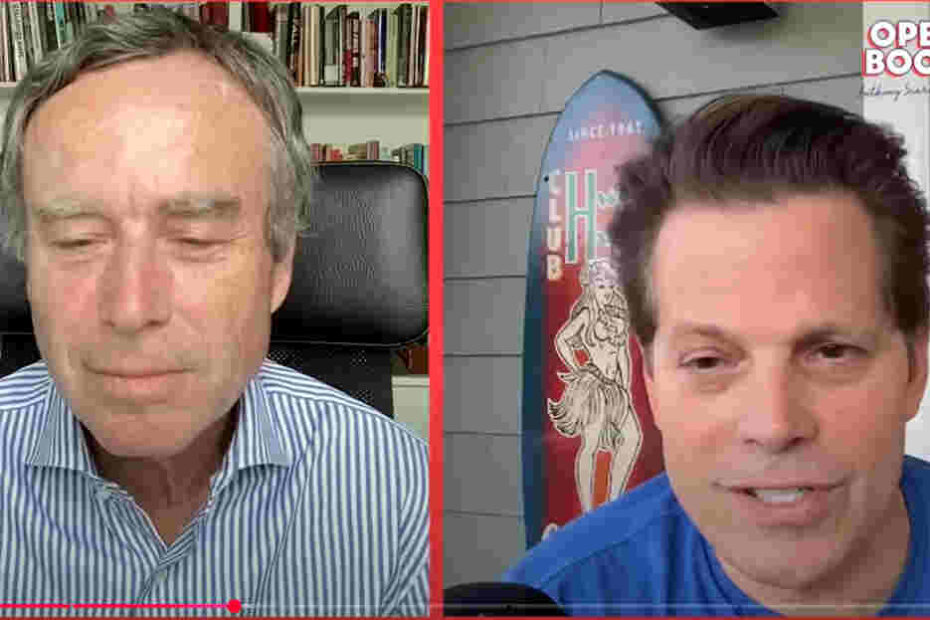
Read the full transcript of former editor of the Financial Times Lionel Barber in conversation with American lawyer, financier and broadcaster Anthony Scaramucci on “Putin, Trump & The Secrets of the World’s Most Powerful Editor”, August 13, 2025.
From Scotland to the Financial Times
ANTHONY SCARAMUCCI: Welcome to Open Book. I am your host, Anthony Scaramucci. Joining us now is Lionel Barber. Lionel was the former editor in chief of the Financial Times. He’s written two extraordinary books. I’m going to hold this one up. It’s in that pink salmon color. “The Powerful and the Damned: Private Diaries and Turbulent Times,” an awesome book. And a newer book, “Gambling Man: The Wild Ride of Japan’s Masayoshi Son.”
And so we’re going to do a two for one special here. Mr. Barber, very grateful for you joining us. We’re sort of having a home and away. I did your podcast in London a few weeks ago, which I greatly enjoyed. And one of the promises I make to our authors, I read these books so that I can ask the questions from a reader’s perspective, not just from somebody that gets like a briefing.
So I want to go to your career, by the way, which I found to be remarkable as I traced it back. Let’s go back to 1978. And of course, there was an article in the Financial Times this weekend when you were working for the Scotsman. So let’s go to 1978. How do we go from the Scotsman to becoming editor in chief of a century and a half old news organization, the Financial Times?
LIONEL BARBER: Oh, Anthony, a confession straight up. It was the only job I was offered in journalism. All the other people turned me down. So I thought, well, I’m going to take the Scotsman. I’ve never been to Scotland. And it wasn’t that easy to be an Englishman in Scotland because they had a referendum just to have their own Parliament back in ’79.
And so I arrived and I had a lot to learn. Well then I got lucky because a series of articles I wrote… Actually I went to Poland and the uprising and the fall of the government was one of the first cracks in communism. And I got the young journalist of the year in Britain in 1981. So the Sunday Times, Rupert Murdoch’s paper, he just bought those papers. They gave me a job as a business correspondent and I think that was probably the beginnings of a career. But I did have to get knocked into shape.
The Calling of Journalism
ANTHONY SCARAMUCCI: Let’s talk about journalism for a second. You know, I find journalism for me it’s sort of a calling. If you haven’t figured me out yet, Lionel, I’m a closet journalist. You know, I read everything. I’ve got subscriptions to every newspaper and every news magazine and I follow journalism with great detail. I got in trouble with Donald Trump for writing an op-ed that the free press is not the enemy of the people.
So I’m a closet journalist but my passion is more for money management. But you, based on this book, “The Powerful and the Damned,” are a real journalist. So talk about the passion and the calling to becoming a journalist.
LIONEL BARBER: Well, I got it from my father who left school at 15. I’m not going to say I came from a poor background, but I came from a modest background and my father came from the north of England. He didn’t go to college and so he taught us, Anthony, to read books and newspapers. And you’re a great reader. I had to learn how to be a big reader from my father and I thought I’m pretty good at storytelling and I admire him. I don’t think I’m ever going to be as good as my father who went on to work at the BBC.
But he always made the point that journalism is not a profession, it’s a vocation. And he always said to me, “If you want to earn money, you’re in the wrong job. It’s a vocation. You’ve really got to be passionate about it.”
The Enigma of Masayoshi Son
ANTHONY SCARAMUCCI: And so very true. So this book, this is a 35 year book. I guess this is…
LIONEL BARBER: No, actually Anthony, it’s just the time I was editor.
ANTHONY SCARAMUCCI: No, no, no, no. I see that. I know it’s 2005-2020, but to me there’s 35 years of experience in this book. I know it’s a diary for those 15 years, but I find that the Masayoshi Son book is a different book. I feel like this is somebody by your own words in the book is not well known. I think you described him in the book as probably the most consequential investor that people know the least about.
And I’ll just tell my own personal story. I was with him at a New York Mets Chicago Cubs game 25 years ago in the Tokyo Dome. And I had gotten invited by Mark Schwartz, who was running Goldman Sachs’s Tokyo division. He was the CEO of Goldman Tokyo. And I was a guest because I was friends with Bobby Valentine.
Sitting next to me was a guy named Masayoshi Son. I had no idea who he was. It’s probably embarrassing to admit that to you because at that time he was Internet famous, as you point out in the book. And he was just a very humble, very soft spoken. Felt like he was just like a diligent guy. And so why don’t people know who he is? Here is this consequential investor with hundreds of billions of dollars of scale.
LIONEL BARBER: Well, he’s from Japan. And although he speaks fluent English, because he did go to college at Berkeley and spent six years, he left Japan age 15, very unusually, to learn English and to get that American experience.
But he’s also somebody who’s under the radar. I mean, we can talk about why he’s suddenly been big in the limelight with Donald Trump recently with his AI investments.
But back then he was soft spoken. He was under the radar. And he was probably even more soft spoken when he spoke to you in the stadium, because in 2000 he just lost 97% of his paper fortune with the dot-com bust.
ANTHONY SCARAMUCCI: He was on the way down. So it was just to set the scene for you, sir. It was March of 2000, and it was right before the implosion of the NASDAQ bubble, which, as you point out in the book, would have destroyed most people. But he stayed on message. So where does he get this grit from?
The Outsider’s Advantage
LIONEL BARBER: I think it’s because he’s an outsider in Japan. He’s Korean Japanese. And if you’re Korean Japanese in Japan, you’re not going to go to become a schoolteacher or a banker or a politician. You’re basically a nobody. You’re discriminated against. And remember, Anthony, he had to live under an alias, like most Korean Japanese. His name was Yasumoto because the family didn’t want to show that they were actually Korean.
So I think being an outsider, watching his father, who was into pachinko slot machines, he had before been a loan shark and he was selling moonshine as a kid. But his father got rich on slot machine gambling called pachinko. And in pachinko you can make a lot of money and you can lose a lot of money. And I think he learned the hustle from his dad.
ANTHONY SCARAMUCCI: I’ve had my share of pachinko losses while I’ve been in Tokyo, so I have great sympathy for that. But for me, there’s one exchange in this… I don’t want to give the whole book away. But I just think it’s a phenomenal book about understanding entrepreneurship, Asian based entrepreneurship. I think you delved into this, frankly, because you were an Englishman as an outsider in Scotland. Here is a Korean in Japan as an outsider taking risks.
I want all that 35, 40 years of journalism into the following question. Ready? What was the most powerful exchange between the two? You had access to him and you had several interviews with him. What was the one interview where the apple hit you on the side of the head and said, “Whoa, this guy’s a different beast than the other guys?”
LIONEL BARBER: Well, it was the first interview. I’d gone to Tokyo the first time, and he said he was too busy. I think he was actually not that well, it was just after Covid and he’s very elusive, man. And I finally had gone out to see his home and I went into this meeting and I’d done my homework and I asked him what it was like growing up as a kid.
And he said, he described how he’d grown up on the edge of this shanty town and been with his grandmother and there were just pigs around the grandmother’s house. And he told me with tears in his eyes that as a kid he had constant nightmares. And even as a young man, the stench of the pig feces, the excrement in his nostrils, that was a recurring memory nightmare of where he came from and which he can never forget. And I have to say that was a very powerful moment. You couldn’t make that up.
The Power of Resilience
ANTHONY SCARAMUCCI: Well, I love that story. I think there was something about it when I closed that book before I started… I read that one first, by the way. When I closed that book, I always try to take one or two things away from a book that I’m reading. When I closed that book, you know, to me it was his resilience. And I think what marked his resilience is that he really doesn’t care. Meaning that I’m going to lose 90% of my money, 97% of my money. No problem. I’m getting up tomorrow. Let’s go at it again.
And I think he has built a reputation institutionally. I think you interviewed one of my friends, Marcelo Claure, for the book. And I had dinner once with Marcelo, who said to me, “The one thing about Masayoshi, he does not stop.” And I’ve got a lot of young people that listen to this podcast. And it’s a big lesson for people. You can get knocked down, as he did in March of 2000 into June of 2000, and look at where he is today. And I think that’s a big lesson for people, that there are second, third, possibly fourth acts in your life. Just keep moving.
Editorial Challenges at the Financial Times
All right, so I’m going to switch abruptly now to this one. And this one really touched me, sir, because I thought… And I’ve recommended this now to several of my journalist friends. You should read Lionel’s book because you went through Brexit, the tech boom, the global financial crisis, and the rise of fake news. That was your tenure basically at the FT from those years.
So looking back, I have a guess for myself. But what is the toughest editorial call that you had to make in the 15 years?
LIONEL BARBER: Oh, God. You know, there were quite a few. One strategic call was to say even though we’ve had the shock of the global financial crisis, we should not write off capitalism. It may need some changes, but what we must not do is lose all faith in capitalism. And I have to say my predecessor made that mistake after the dot-com boom because I wouldn’t have got the job if… I was in New York and they decided to make a change in the editorship. And that’s how I got that job. And I think I had that in mind.
I think on Brexit, hands up, Anthony. We got that wrong. I made the call that based on rational economic argument, the Brits would vote against Brexit. I didn’t let that color the news reporting. But I kept in the back of my mind thinking, “I’m worried that the whole paper is so pro-remain that Britain should remain in the European Union. We may be missing something.” So I would say that was a tough call and I don’t think I got it completely right. What do you think?
Digital Transformation and Leadership Insights
ANTHONY SCARAMUCCI: It’s interesting because I really thought the digital advancement, I felt you got that right. Meaning you pushed the FT in your tenure to switch it up. I mean, you were frankly, in my mind, ahead of the New York Times in terms of you went full hog into digital advancement. I can remember late 2005 subscribing to FT Digital and it was incredibly robust. And I think that’s something that you’re not giving yourself enough credit for because it sustained the FT in a way that it may not have been sustained just from the broadsheet paper. So I give you a lot of credit for that. That was bold.
I guess the one thing I would tease you about is there’s one section in the book where you’re not upgrading the hard top computers in your New York office. I caught that. I was like, “Whoa, that’s impressive” because I’m always so anxious about that. You know, I’m talking to you from a brand new laptop, Lionel Barber. I just want to make sure you know that because I’m always nervous that I’m going to miss something or something will glitch on me.
But also your insight, I thought, I really feel you’ve got very good insight. You have a wide aperture into human beings. So what writings, what experiences have you… Do you draw from your insight into Blair, your discussion of Putin when you met him in the embassy and of course various assortment other people. You know, you’ve gone from Riyadh and the Royal palace to Trump Tower to the Kremlin and back. So what are you drawing on when you make these judgments? I feel like I got a very good scouting report on a lot of people in this book.
The Putin Interview: Five Years in the Making
LIONEL BARBER: Yeah, I would single out the Putin interview with Vladimir Putin in 2019 in June, because, you know, it took five years. I wasn’t begging for it. They offered several times to have an interview with somebody else or they wanted to do it one way. And I said no, it should be just the FT me leading. I’ll take the correspondent, obviously. But I waited more than five years for that.
And you know, the most important thing is to do your preparation. This podcast is not where you take shots at other people. But I would just say that I don’t think Tucker Carlson in his interview did enough preparation. He was very focused on a very small audience in America and Putin slapped him around, if you remember, and said, “I thought you were going to do a serious interview, but you’re just some kind of talk show host.” And he didn’t do that with me because I took advice, I did my preparation and treated it seriously.
ANTHONY SCARAMUCCI: Not to interrupt you, sir, but I think the difference between you and him is you weren’t intimidated. I think Tucker, I mean, again, I know Tucker a long time. Work with him at Fox News. Yeah, I think he was intimidated. You could see that he was back here. You’re working for the FT, and you’re carrying the august institution of the FT on your back into the interview. So you have a responsibility to be more discerning with somebody like President Putin.
LIONEL BARBER: But very important to do that, have that combination when you’re talking. And this book is, you know, I do drop a lot of names. I interviewed a lot of world leaders and people, top people on Wall Street, Jamie Dimon a number of times and Lloyd Blankfein, your old colleagues at Goldman. I mean, you can’t. You shouldn’t be arrogant. You got to be respectful. But you cannot afford to be intimidated because Trump, Putin, they smell weakness and they take advantage of it.
What Didn’t Make the Book
ANTHONY SCARAMUCCI: No, no, no question. I mean, that’s something I’ve always had these conversations with my friend Mark Carney, who’s now the Prime Minister of Canada, about this, particularly with President Trump. I love this book. It was raw, it was immediate. There were fresh accounts. But it made me question something that I was dying to ask you, which is what entries did not make the book. Is there something you could share with us? Say, whoa, a little bit too much, maybe I got to leave it out of this beautiful book.
LIONEL BARBER: Well, an awful lot went in. I think there were one or two exchanges, and I do need to tread here a little bit because I wasn’t spending all my time with the intelligence community. But, you know, occasionally, once a year or so, you go for lunch at MI6 and talk to the spy master. And those conversations I did not report in the book because I think they were so, you know, they were off, totally off the record. And I don’t think they were that revealing compared to others. But that didn’t make it.
I think what would be other things, maybe one or two conversations with the proprietor, and certainly, Anthony, I did not dump on my colleagues. You know, there were some interchanges, obviously, where there were difficult conversations where you have to make a big decision about somebody. That didn’t go in the book.
A Hopeful Perspective on Leadership
ANTHONY SCARAMUCCI: No, no, that wasn’t this book. This book was here are my observations as a global traveler and as a journalist, someone that has great, insatiable intellectual curiosity. Here are my observations of what went on during my tenure. And also decisions. And I think you were very fair in the book of decisions that you made. Right. And some things you could have done better or differently, which is every business executive.
There’s no executive, whether it’s Warren Buffett, Jamie Dimon, Lloyd Blankfein, who’s a close friend of mine. Nobody can be perfect with their decisions. And by the way, you wouldn’t have time. Lionel Barber. For all the bad mistakes I’ve made. Okay. I’ve got phone books of mistakes about my life.
But I, one last question that I want to turn to my favorite part of our podcast where I list out five words. I get my author to respond to the five words. But this is more of an existential question. I found the book to be hopeful. I found the book to be, I think we’re in a media morass right now. We’ve got tribalism, we have ethnic distinctions and stereotyping that’s going on. Tribalism and polarity in the United Kingdom that would be true here in the US and probably most of the Western world has some elements of this.
But I found the book to be hopeful because I found that most of the people that you’re writing about, whatever their flaws, are, at least Western leaders and Western business executives are generally well intentioned. Do I have that wrong or is that something I shouldn’t be taking away from this book?
LIONEL BARBER: Now I’m going to butter your biscuits here, Anthony. You’re dead right. I’m so glad you noticed that. I think with experience and some maturity, you become a little bit more understanding that maybe people aren’t always totally cynical. They are trying to do the right thing, but they’re human beings and they make mistakes.
I’m hopeful because I genuinely believe there is room for serious journalism and for reliable, trustworthy information. And I think, and I say this in the book, there are such things as facts. They’re very important. I should have said the toughest call I made was on the Wirecard investigation, that huge German fraud as big as Enron. I mean, I lived that story for a year and we got them in the end. They were fraudsters and we showed them importance of that story, Anthony, for all people in finance and business was there was a fraud. A newspaper exposed it. Facts are facts, no question.
Five Words: A Rapid-Fire Exchange
ANTHONY SCARAMUCCI: I appreciate that. But I found the book to be remarkably uplifting and I admire you a great deal for writing it. So we’re down to the five words. How this goes down with my other authors is I’m going to say the word. You give me a sentence or two. Okay? And so I’m going to start with the word power. I say power, you say what?
LIONEL BARBER: I say palace. I look at the room where the person of power is and I study everything in that room to try because power reflects character. Then the second point would be, it’s changed, hasn’t it? There are people, there are new, always new sources of power, people that you’ve never thought of. Like Elon Musk, who’s suddenly the most powerful person in the world in terms of money. So defining power and the relationship that an editor has with power, I’m giving you far too long an answer.
ANTHONY SCARAMUCCI: No, no, it’s good, it’s good. But also it’s also unpredictable, though, by the way.
LIONEL BARBER: Very true.
ANTHONY SCARAMUCCI: Predictable. I don’t think any of us, myself included, you know who didn’t predict Donald Trump’s first electoral victory? That would be Donald Trump. I was with him the evening of the. He was like, “What are you doing tomorrow?” He was heading to Scotland to go play golf. That’s that was his plans on November 9, and it got detoured by his electoral success. So power sometimes can also be unpredictable. If I say the word journalism, sir, what do you say?
LIONEL BARBER: The truth. The search for the truth based on facts.
ANTHONY SCARAMUCCI: Well said. Which is why I’m intrigued by journalists. Masayoshi Son.
LIONEL BARBER: Man of mystery, outsider, massive gambler who’s just more resilient than a gummy ball.
ANTHONY SCARAMUCCI: Yeah, interesting. Yeah, I got that from him. And that was a big part of that book. I’m going to stay in things no matter what’s happening around you. If I say the FT, the Financial Times, the Pink palace.
LIONEL BARBER: The world’s leading business newspaper.
ANTHONY SCARAMUCCI: Yeah.
LIONEL BARBER: With great reference deference to the Journal, but, you know, based in the City of London, a vital part of public discourse and a source of trustworthy journalism. It’s now been going more than 130 years under new ownership with the Japanese. Hasn’t changed.
ANTHONY SCARAMUCCI: Well, you mentioned the intelligence services. When I got my first presidential daily Brief, I asked the analyst where he felt. Where he was reading. I said, to the CIA. So a lot of the information is coming in very tribal and very slanted. And he said, and I’ll just share this with you. He said he reads the English version of Le Monde, which is the Parisian paper, because he says, “Anthony, they don’t care about us. So they report politics pretty objectively.” And he read the FT for an overall survey of the business landscape in the world, because he felt that that was the most impartial of the papers out there that were covering that. So I share that with you.
LIONEL BARBER: Bob Rubin said the same thing.
ANTHONY SCARAMUCCI: Last. Last word. And I’ll give you. I’ll give you the last word. Lionel Barber. I say the word Lionel Barber, the two words, and you say what?
LIONEL BARBER: This life after the FT, it’s been.
ANTHONY SCARAMUCCI: Good for you, right? You’ve been enjoying it?
LIONEL BARBER: I’ve been enjoying it. I have, you know, family and my two kids are in the States. I think of my first name, Franklin. My father named me after Franklin Roosevelt. I wish I could have kept that name but people kept calling me Frankie, so that’s why it’s Lionel Barber.
Closing Thoughts
ANTHONY SCARAMUCCI: All right, well, there you go. I love it. Thank you so much for joining us on Open Book. There are two books here. The first one is “Gambling Man,” about the life of Masayoshi Son. And the second book is “The Powerful and the Damned,” which is a diary. It’s a Private Diaries and Turbulent Times of The Financial Times, 2005-2020. Mr. Lionel Barber, thank you so much for joining us on Open Books.
LIONEL BARBER: It’s been a huge pleasure, Anthony. I’ve really enjoyed the conversation. Thank you.
Related Posts