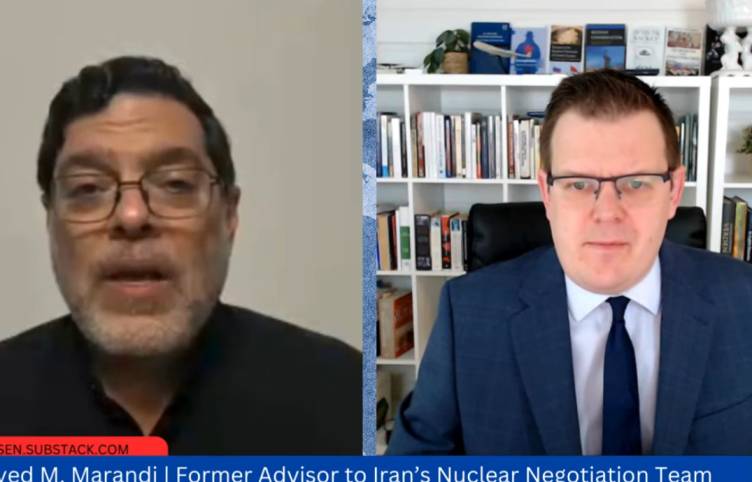
Editor’s Notes: In this episode, Professor Seyed Mohammad Marandi joins Glenn Diesen to discuss the dramatic escalation of conflict following attacks on Iran’s critical infrastructure, including the world’s largest natural gas field. Marandi analyzes Iran’s strategic leverage through its control of the Strait of Hormuz and outlines why he believes U.S. and Israeli efforts at intimidation and assassination will ultimately fail to achieve their objectives. The conversation explores the potential for a global economic crisis if hostilities continue and examines the shifting political dynamics and military capabilities across the Middle East. (Mar 19, 2026)
TRANSCRIPT:
Introduction
GLENN DIESEN: Welcome back. We are joined today by Seyed Mohammad Marandi, a professor at Tehran University and a former advisor to Iran’s nuclear negotiation team, to discuss this new round of very dramatic escalations occurring in the war against Iran. So thank you very much for coming back on.
SEYED M. MARANDI: Thank you, Glenn. It’s always a great pleasure being on your show.
Attack on Iran’s Infrastructure and the Escalation Ladder
GLENN DIESEN: Well, as I said, there seems to be some very powerful round of escalation. First we heard about this attack on the Bushehr nuclear power plant. That is, it didn’t hit the nuclear reactor, but well, close enough to create some concern about what could happen in such an attack in terms of nuclear contamination. We’ve seen further assassinations of Iranian leaders and also, of course, the most recent — yeah, coming breaking news now over the past two hours, it seems — was this attack on this south parts in Tehran, which is the largest natural gas field in the world.
I mean, I guess Iran has many ways of retaliating. How are you assessing this situation and where do you see this heading?
SEYED M. MARANDI: Well, there are a number of things. One is that Iran has a very strong chokehold on Trump and the Trump regime. And that is, of course, the Strait of Hormuz and the vulnerability of Saudi Arabia. Even as it exports a portion of its oil through the Red Sea, Iran can block that with missiles and drones. And it is doing that with regards to the Emirates and that portion of oil that it exports from outside the Persian Gulf.
So this is a very difficult situation for Trump. And as he admitted, he didn’t think — or his administration didn’t think, I’m not clear to me where the fault exactly lies — they didn’t think that Iran was going to attack US assets in the Persian Gulf region or shut the Strait of Hormuz, which I find extraordinary because you and I and many others, I think, knew quite well that such a thing would happen. We’ve been discussing this together for maybe a couple of years.
So when this happened, Trump, of course, made many bold threats. He saw that they weren’t working and he, despite saying that Iran was obliterated, again he called for the entire world to help him open the Strait of Hormuz. And everyone said no. Obviously, Iran hasn’t been obliterated. Iran’s navy — almost the entire navy that is used for wartime — is in tunnels. And they will enter the Persian Gulf, the Gulf of Oman and the Indian Ocean when the time comes. They are speedboats with missiles. And Iran’s missile capabilities and drone capabilities are endless. They haven’t struck any of the underground bases. They’ve failed to do anything about Iran’s production capabilities. So Trump is in a very difficult place.
Israeli Regime’s Role and Operational Control
SEYED M. MARANDI: On the other hand, the Israeli regime wants escalation. And from what I’m hearing in Tehran, the operational control has shifted from the United States to the Israeli regime. And so it is their war, and they are the ones who chose the targets. And the United States agreed to cooperate with it to strike these targets. So it may not make a huge difference, but it is significant.
And I think the Israeli regime probably, and the United States maybe, want to escalate to see how far Iran will go. That’s one possibility. I think they’ll soon find out that Iran is willing to go to the very end and it will fight to the finish. So this experiment is a foolish one.
Some believe that the Israeli regime wants the total destruction of oil and gas assets in the Persian Gulf region. And it’s possible that Trump will go along with it. In any case, Iran is going to go up the escalation ladder if that is what the US-Israeli coalition does. So I think ultimately the big issue is that the United States is stuck with the Strait of Hormuz, and Iran really holds all the cards.
Assassinations and the Martyrdom of Dr. Larijani
SEYED M. MARANDI: Now, the Israelis are assassinating people. They may continue to do so or have successes, but it’s not going to change anything. The Iranians have a very sophisticated constitution. They have a very sophisticated state structure. They have many experts and people who are well acquainted with matters of state. So if one person is martyred, someone else will replace him.
It’s a loss, without a doubt. Dr. Larijani — I’ve never worked in government, but I encouraged him to go to China. And ultimately, when he went, he asked me to go with him. And when he came back, he asked me to take care of the China dossier for him. So for a couple of years, until he left Parliament — he was the speaker of Parliament — I was in charge of the dossier on his behalf as a volunteer. I didn’t receive any salary for this. But he was an excellent man, very smart, very dedicated, a very moral person. And it’s a major loss. I was very fond of him. He was a very polite, highly educated man. But everyone can be replaced with someone else.
And martyrdom itself boosts the morale of society.
So I don’t see any success of major substance. Obviously you can’t say an assassination is not a success, but it’s not going to achieve the results that they’re seeking. And in a way, it’s actually going to have the reverse effect.
Public Mobilization and Failed Terror Plans
SEYED M. MARANDI: As we saw with the martyrdom of Ayatollah Khamenei, it really mobilized the nation in a way which I have never seen, even during the 1980s. I have witnessed things in Tehran personally, and I’ve seen images and videos that I have never seen before anywhere. People on the streets, huge crowds. I was there on Friday.
And then the US-Israeli coalition bombed the people demonstrating on the streets and murdered a person. And you don’t even hear about it in the Western media. But no one ran away. I’m sure you’ve seen images of it and many of your viewers may have, but it’s on my Twitter account. So people are steadfast and people have been mobilized.
The United States had a plan to carry out terror attacks last night and riots, as they did a couple of months ago. It failed completely. People were on the streets throughout Tehran and throughout the country and they couldn’t do anything.
So on the whole, I think the war is going very well for Iran. It’s painful. They murdered many people, school children. They bombed hospitals. Today, they bombed key infrastructure. None of this makes us happy. It’s painful. When they murdered Dr. Larijani, they murdered all the neighbors in that apartment block. But the United States and the Israeli regime have failed so far.
Likely Retaliation and the Role of Yemen
GLENN DIESEN: Yeah, well, what is seen as likely retaliation? Because I watched a spokesperson recently — well, 20 minutes ago or so — give a talk about how the energy infrastructure of those who participate in this will now, I think he said, “burn to ashes.” But we also see now some incoming strikes on the capital of Saudi Arabia.
But I was also curious — what is the likelihood that Yemen could actually be activated in terms of closing down the Red Sea as a response to this escalation? Because there’s an important strait, of course, that is the Bab-el-Mandeb, if I’m not slaughtering that name. And essentially also a narrow strait which can be used to sever access to the Red Sea. This is quite a critical maritime corridor as well, because with the Strait of Hormuz disconnected, this is essentially the only access to Saudi Arabia then along its western coast.
So how do you see this — do you see this as a possibility? What kind of retaliations, again, I know the government doesn’t tell you what they’re going to do, but what kind of retaliations do you think are realistic here?
SEYED M. MARANDI: Well, the government has said that they will strike oil and gas facilities in the Emirates and Qatar and Saudi Arabia. I think by the time your viewers see this video, probably that retaliation will have taken place. We already hear that there was a strike on Qatar and on Saudi Arabia. Apparently the strikes on Saudi Arabia targeted jet fuel depots for the US Air Force, because the Saudis are deeply involved in this. And it is increasingly becoming clear that the Saudis are encouraging the Americans to carry out these strikes against Iran.
In the case of Yemen, they have said that they will enter the war and we’ll have to see when that happens. Obviously, things depend on the escalation ladder. In Iraq, the resistance is striking at US assets, but it could do much more. And the same is true with Iran. Iran can strike much harder, but Iran is moving up the escalation ladder based on US-Israeli — or what I would call the Epstein Coalition’s — actions.
Global Economic Consequences
SEYED M. MARANDI: So, for example, today, when they struck Iran’s infrastructure, the gas installations, that was something that Iran had to respond to. Iran doesn’t want to create a global economic meltdown. This war was imposed on Iran. And as we saw Joe Kent resign and basically say what we’ve been saying all along — that Iran was no threat and that it was the Israeli regime and the Zionist lobby that pushed the United States to war, a war that’s not in US interest at all.
So Iran is responding to aggression and it has shut the Strait of Hormuz to put pressure on the United States and its proxies and its allies. But if the United States moves to destroy Iranian key installations, then Iran will do the same, and then we will definitely move to crisis mode with regards to the global economy.
Because later on, if there is an end in hostilities and Iran’s demands are met — if there’s no oil or gas because of the damage or the destruction of the installations, and if there are no tankers — then what’s the use? So the global economic crisis will be permanent, or at least it will last for many years. There’ll be a global economic depression.
So the United States began this aggression. The Trump regime, the Israeli regime and its proxies in the region are all complicit. The Iranians shut the Strait of Hormuz to put pressure. But if the United States starts attacking Iranian key infrastructure — or the Israeli regime, it doesn’t make a difference to us — Iran will respond in kind. And since these Arab regimes host US bases and allow them to use their airspace and their air bases and allow them to use their territory to fire missiles towards Iran like HIMARS missiles, they have no reason to complain whatsoever.
Boots on the Ground — A Realistic Possibility?
GLENN DIESEN: Well, we see these US troops which have been sent to the region and some speak of putting boots on the ground. I’m not sure if that is on Iranian soil or if it’s intended to open up the Strait of Hormuz. It’s also not unrealistic that it could be used to invade Yemen, perhaps to make sure that this strait — while keeping the Red Sea accessible — is kept open. How are you assessing this? Do you think that the US could go to this extent, going with troops on the ground?
Yemen’s Capabilities and the Cost of U.S. Escalation
SEYED M. MARANDI: Well, Iraq and Yemen are not small countries with small populations. And Yemen today is much more powerful than it was a year ago when the United States waged a war against it and lost after seven weeks.
And by the way, let’s remember that during the seven-year-long genocidal war carried out by the Saudis and the Emiratis against Yemen with the support of the entire region, except for Iran — and Turkey and Qatar also supported the genocide in Yemen until the Saudis and the Emiratis turned against Qatar, and then Erdogan and Qatar tilted away from them. But the entire west and the region were all supporting the genocide in Yemen. And after seven years it failed.
What brought the Saudis to accept the ceasefire when Yemen targeted Saudi oil installations and oil exports? If Yemen could do that four years ago, I think it was, it could definitely do it again. It can end the Saudi oil exports that go to the Red Sea and it can also shut the Red Sea. So Yemen has these capabilities and I’m sure its missile and drone capabilities are more of a threat today than they were back then to the US Navy.
I don’t see a scenario where the United States can — its troops, a few, I don’t know, 2,000, 3,000, 4,000 troops — can make any real difference. And it’s even more implausible with regards to Iran.
But let’s say hypothetically that the Americans somehow with this small group takes the Strait of Hormuz. They’ve already underestimated Iran’s missile and drone capabilities, obviously. And they keep saying they’ve destroyed them all and Iran keeps firing missiles and drones.
But let’s say that they take the Strait of Hormuz and that the Iranian armed forces, which have been preparing for such a scenario for 25 years, they fail to dislodge them — what difference is it going to make? Ships have to come into the Persian Gulf. Iran, if anyone looks at the map, Iran owns one half of the Persian Gulf. They could strike missiles at ships from anywhere. And then missiles that Iran fires are not fired from the coast. They’re fired hundreds of kilometers in, inside Iran.
So they can take the Strait of Hormuz and Iran can still destroy whatever it wants, whether it’s ships or whether it’s installations, as we’re seeing right now. Or if they want to go all the way to the north of the Persian Gulf and take Kharg Island, it’s a flat island, then the Iranians can hammer them on that flat piece of land and they’ll take large casualties. But still, they’re not going to open the Strait of Hormuz for trade. There won’t be any oil.
The only thing that will happen is that through escalation, you’re going to have more tankers destroyed and more oil and gas installations destroyed. And so ultimately, when this ends — and it will end at some point — but with failure by the U.S. and Israeli failure, then there won’t be the oil that they’re seeking to bring back to the market. And every day that goes by, Glenn, you have what, 15, 20 million barrels a day that are not being sent to the market. So the shortage is growing by the hour.
And they can manipulate the market for a few days or a couple of weeks, but then it’s going to hit them very hard. And of course, it’s not just oil, it’s gas. And of course it’s not just gas. It’s fertilizer and petrochemicals and its imports and exports, because these Arab family dictatorships are huge consumer markets. And the United States and the Europeans have huge assets in this region, trillions of dollars. They’ve invested all sorts of money in these consumer societies.
Losses to the United States through the rise in the price of energy, the shortage of energy or fertilizer, the destruction of their assets — a lot of the weapons that the U.S. sells, they sell it to these countries. And these countries don’t even know how to use them because they don’t even have competent military forces. I thought it’s only like 350,000, 400,000 people. How are they going to use all those jets that they bought? Those jets are basically bribes. And also the kickbacks and the commissions by Western senators and their business partners and the royal family and all that, and the same issue with other countries.
So the losses to the United States are multi-dimensional and of course the petrodollar takes a hit. So as things stand, I don’t see the United States finding a way out. They’re only digging themselves further in the hole and the world is going to blame them. I mean, what Joe Kent says is recognized across the world. So people are going to blame Zionism and Trump for the misery that they are beginning to impose on the international community.
The Resignation of Joe Kent and the Search for Proxies
GLENN DIESEN: Yeah, the resignation letter of Joe Kent, it’s been read tens of millions of times apparently online now. So it’s quite extraordinary that essentially the second in command would be the one who resigns and put this out there. So it does show that the narrative of this war is also not going well.
But I think what you referred to as panic is probably correct, because this began — it looked like Trump genuinely thought this would be another Venezuela, a quick in-and-out attack. And by the end of the weekend, before the stock markets open, then have your victory speech prepared. But the government didn’t fall and the army didn’t collapse.
So there seems to be uncertainty in terms of what other cards can be played, and we’ll see reports that Trump was quite upset that there are no military ways to open up the Strait of Hormuz. But it does seem that, as one often does in this kind of situation, the effort has been to prepare a proxy to fight on your behalf. But the Gulf states appear to have resisted so far — at least they don’t want to get into a direct fight with Iran. Azerbaijan looked for a moment like it could take the more direct role, but then they turned. The Kurds, which were armed by the CIA, then also apparently got very concerned. I’m not sure if they were ever ready to go or if they just didn’t want to bet on the losing horse.
But even the allies of the U.S. — NATO and in East Asia — they didn’t want to join in on this mission to, I’m not sure how they would do it, but a convoy to try to open up the Strait of Hormuz.
But the last effort we see now is we read in the American media some pressure on Syria to enter Lebanon — that is, to take in this chaos to assist the Israelis, that is Jolani’s government, to help Israel to essentially get rid of Hezbollah in Lebanon. How do you see this scenario, or the likelihood of this being initiated and even succeeding?
Western Narratives and Complicity in War
SEYED M. MARANDI: Well, first, Glenn, I want to say something, and then there are a number of things we have to unpack here.
One is that the people in the west, in the mainstream, there are two types. One says, “Let’s go and take them out.” And the other says, “They’re bad, but this is not a good idea.” In my opinion, they’re all the same. And the reason why I say this is that I won’t name names, but one of your guests who came on a few days ago, he was that sort of person. He said something dishonest about Mahsa Amini. He said that she was murdered. There’s no evidence of that.
GLENN DIESEN: She —
SEYED M. MARANDI: The footage is out. The medical report clearly indicates that she had a condition. She was not beaten. There’s no evidence of that. And just like the tens of thousands of people — they keep saying that Iran killed tens of thousands of people. These are all lies. And those people who repeat those lies are making the case for war. And so they’re complicit in war, and they have blood on their hands, every single one of them. And it’s unforgivable.
I’m glad that you invite all sorts of people. I’m just saying that I’m trying to make this point because I want people to know that those in the United States, in the mainstream — it’s like Maduro. Those who say, “Maduro is a bad guy, but we…” No, they have blood on their hands. Because instead of saying, “No, we’re the bad guys for bombing boats in the Caribbean, we are the bad guys for murdering a hundred people and then kidnapping the president,” they say, “Yes, he’s a bad guy.” No, you’re the bad guys.
And so these people who repeat these lies, I think usually they just want to be relevant in the mainstream. Or some of these leftists — European leftists in the global south, they’re not like that at all. But in Europe, they’re very hostile towards Iran. They have this old irrational hatred because the only revolutionary movement for some of these people can be them. And so obviously, the Islamic revolution of Iran is medieval and backward and evil. And the mullahs, they’re crazy, and they suppress women and, you know, all that nonsense that we’ve been hearing for 47 years.
GLENN DIESEN: But —
The Iranian People’s Unity and Resolve
SEYED M. MARANDI: For the last 18, 19 days, ever since the beginning of the war, we’ve seen millions of people on the streets every night. As we speak, Glenn, there are huge crowds in Tehran, huge crowds across the city. And you know, we all saw the footage of men and women standing their ground under missiles. That’s not a people that hate the regime. That’s not a people who, you know, people willing to die under airstrikes but stand their ground. That’s not a people who believe that Mahsa Amini was battered to death and that the mullah regime is killing women all the time and that they’re slaughtering tens of thousands of people.
Iranians know better what goes on in their country than these people who live in Europe and the United States and basically lie about Iran because it serves their interests. But in any case, the point I’m making is that for me, those who say Maduro is evil, the Cuban regime is evil, but let’s not do this — no, they are evil and so are their governments. And if they have intellectual honesty, they’ll point the finger at their own governments and leave Cuba alone, leave Venezuela alone, leave Hezbollah alone, leave Iran alone. It’s none of their business.
A New Situation: The Empire’s Failure
But to get back to the question, I think that what we are witnessing is a completely new situation. And that is that for the first time the empire has failed not only at regime change, it’s failed to even take a country. Because we’ve always been told that the United States lost the war in Iraq, it lost the war in Afghanistan, it lost the war in Vietnam. But in the case of Iran, it hasn’t even been able to occupy parts of the country after weeks of battle and with a huge coalition. The collective west is behind it. All these regional regimes are with them. Azerbaijan, the Persian Gulf, Turkey under Erdoğan, that transports oil, AWACS jets fly over Turkish airspace to gather intelligence against Iran. And US bases work as well. They’re all working against Iran, but they failed.
Why? Because the Iranian people support the Islamic Republic of Iran today, yesterday, two weeks ago and two months ago. Today they’re more mobilized, they’re more united. And a lot of that minority that was rioting, that small minority that was on the streets rioting that the west glorifies and exaggerates and lies about — a lot of them have changed their positions because they now see that the west, which said “we are democratic and we support” basically their kids. They were kids like first year university students, second year university students, 11th grade, 12th grade high school kids. But they see that they’re bombing schools, they’re bombing hospitals, and their whole worldview has been shattered.
So now they are — I’m not saying all of them, but many of them — are on the streets like everyone else. And I have my own anecdotal examples of that. So that’s why the Republic of Azerbaijan would never dare attack Iran. I mean, look at the images of people on the streets in Tabriz, in Ardebil, in Urumiyeh, in Marand, another Azeri city. They would take over the Republic of Azerbaijan in a week. They’d overthrow the regime, the Iranians.
Iran’s Warnings to Regional Actors
And the same is true with these Kurdish terrorist groups, because the Iranians have warned the semi-autonomous government in Erbil, the Kurdish government in northern Iraq, that if you allow these people, these terrorists, to attack us on behalf of their masters, the CIA and Mossad — because that’s what these groups are, they’re owned by Western and Israeli intelligence agencies — then we will destroy you and we will, and so will the Iraqi resistance. And then there will no longer be an autonomous Kurdish government in northern Iraq. So they stood down.
If he tries to do anything against Lebanon, first of all, he’s shown his true colors. Everyone now — unless they’re utterly sectarian, ignorant sectarian people who just, you know, Wahhabi, Salafi types that close their eyes to truth and just support these terrorists, even though they know that the Americans were controlling them and the Israelis were allied to them — everyone knows who Joni is now. He’s a US asset. If he attacks Lebanon, the Iraqi resistance will move into Syria and Iran will destroy him and his commanders with drones and missiles. We don’t need our long-range drones to do it. Drones and missiles that we strike Israel with — we can do it with shorter range missiles and drones, different classes of missiles and drones, just like what we’re doing in the Persian Gulf. So I don’t think he’s going to do that either.
The United States Is Stuck
So ultimately, the United States has failed to use terrorists inside Iran. Maybe they’ll try something in the days and weeks ahead, but it will fail. Even if one person is killed, they’ll make a big deal about it and the Western media will say all sorts of nonsense, Fox News and all that, but they’ll fail. And the same is true in all these other arenas that we’ve been talking about. So the United States is stuck.
So all they can do is assassinate. That creates more determination. That makes the Iranian leaders more angry and adamant that we must defeat the enemy. Because these are friends, these are national figures. People will seek revenge when they kill more people. I just posted a clip of a woman — a missile struck nearby and she was in panic, and then another missile hit her. People see these clips in Iran and the rage grows, the anger grows.
The day I was at the funeral, the huge crowd for Dr. Larijani and the naval officers — and I’m not a government official, I’m not in government, I’m just at the University of Tehran — but people see me online and rarely I’m on Iranian television, and they come up to me and say, “The leaders should protect themselves more.” They say they’re too courageous. You saw on Friday, on the National Quds Day, the Rally for supporting Palestine — Dr. Darijani was on the streets, and the President was on the streets. The head of the judiciary was doing an interview when the missile hit. He didn’t even blink. The foreign minister was there and so on. And of course, the US Secretary of War called them all “rats hiding in their holes.” But people saw the reality. They know who the real cowards are.
People were telling me — they thought I have access — “Tell them not to come out on the streets, tell them not to come to the funeral.” They were demanding that the leaders not attend the funeral. Literally hundreds of people said this in one way or another. I was just walking through the crowds and people were stopping me the whole time.
Assassination Will Not Help
So this is a nation that’s united. They can assassinate — it’s not going to help. It’s going to make things worse for them. They can bomb Iranian infrastructure, critical infrastructure. Iran is going to hit back. And that’s only going to complicate matters further, because as I said, if the United States meets Iran’s demands, then the Strait of Hormuz can be opened. And after a period of time, the flow of oil and gas and everything else, petrochemicals, can go back to normal.
But if the key infrastructure in Iran is destroyed, then it’s going to be destroyed in those regimes where they have their bases. So the problem is going to become very long term. So that’s not a solution either. So Trump is stuck in a hole and Netanyahu put him there. The Zionists and Netanyahu and the Epstein class has created a global crisis.
The Perversion of Peace: The Political Left and Liberal Hegemony
GLENN DIESEN: Well, it’s interesting what you said about the political left and all this. After the Cold War especially, you saw these new conservatives on the right who aspire for security through hegemony or empire. They more or less engaged in this unholy alliance with the political left as well, under the idea that this is a liberal hegemony — that by dominating, we will elevate the role of democracy and human rights around the world. So all conflicts are now just framed as humanitarian.
And then suddenly you see the former people advocating for peace on the left — they now essentially say, well, peace is… well, we can’t support those authoritarians. So this is why Maduro, the Russians, Iran — they’re all “regimes,” and they can never be supported. But as you suggested, once they are denounced, then they’ve already made essentially indirectly the case for war.
And even when you sell to people on the left that, well, it’s about liberating women, then suddenly they’re on board with war. You also see this with the Ukraine war — on the political left, the people who traditionally are the first ones to take up the cause for peace, they’re not talking about diplomacy, they’re not talking about dialogue, mutual understanding or peace. They’re talking about how do we send more weapons, how do we close down the media of the opponent. The whole concept of peace has been perverted to a large extent.
I like Jeffrey Sachs for this reason. He went to speak at the UN Security Council and he opened up — this was before the attack on Venezuela — and he opened up just saying, “I’m not here to discuss the character of the Venezuelan government. That’s beside the point. We’re talking about what the US is planning to do.” And just to put that whole thing aside, because once you get into either you support this and we condemn you, or you also condemn them, then you make the point for war. He just swept that whole thing aside.
What Are Iran’s Demands? Peace Settlement vs. Ceasefire
But yeah, I wanted to ask about something you said. You mentioned that if the US meets the demands of Iran — and I did see the Iranian foreign minister, he said that Iran does not want a ceasefire, it wants a political settlement, a peace settlement. So peace is not the same as a ceasefire. And again, we heard similar arguments coming from Russia as well — that a ceasefire is a temporary pause that allows the enemy to regroup, replenish and get back to the fighting, while a peace settlement would address the underlying causes and actually find a solution.
So what is the solution? What are the demands that America must meet? What is the opening position of Iran, and where do you see possible compromises coming in?
Iran’s Conditions for Peace and the Future of the Persian Gulf
SEYED M. MARANDI: Well, first I just wanted to. Because I was thinking, I was really laughing inside. Whenever these people talk about Iran or Venezuela, they say, “Oh, do you support the war?” And first they have to, for five minutes, they have to badmouth Iran and say, “Well, Iran is really evil, they’re really bad people, they’re horrible. I don’t condone anything. It’s a dystopia. But I don’t support war.” And Maduro. And, you know, when I look in Iran’s neighborhood and when I look at the West, I mean, it’s Iran that’s opposing genocide. The West supports, you know, and the regional countries, they’re all US proxies.
But anyway, I think that, first of all, this is not just going to be about Iran. Iran has said that its allies in the region, they have to be included in any cessation of hostilities. Why do we oppose this? He’s fired. Just as you said, we’ve done this before. We had a ceasefire and they regrouped and attacked us again. We were negotiating, they attacked us. We negotiated again, they attacked us again. And doing a deal with Americans, especially under Trump, is just meaningless. Nothing that he says means anything. A piece of paper that he signs is just a worthless piece of paper. So the facts on the ground have to change.
So first of all, it has to include Iran’s allies across the region. Second of all, the facts on the ground have to change. What do I mean by that? It means that the Persian Gulf must be structured. The security of the Persian Gulf must be structured in a way in which Iran no longer feels threatened by the United States. These countries cannot be used as platforms to attack Iran. And if the Israeli regime attacks Iran, there has to be consequences. So there has to be change on the ground. Pieces of paper are worthless, and there’s the issue of reparations. Iran will demand reparations.
And the security of the Persian Gulf in future will be different from the past. These Arab family dictatorships, if they last, they will have to deal with a new reality. And they will be severely weakened. They are already severely weakened. It will never again be the Emirates that it was three weeks ago. That’s gone. All those billionaires, they’re not coming back, which is a good thing. I mean, in a sane world, there should be no billionaires, but, you know, anyway. But they won’t be coming back. And the same is true with the rest of these tiny regimes in the region.
So, you know, Iran is here to stay. And after almost three weeks, we’ve seen that the Americans are incapable of defeating Iran. And ultimately, Iran is prepared for a very, very long war. As we speak, Iran is producing more missiles. I don’t know if it’s producing more drones because it doesn’t even have space for drones. All of its underground bases are full. They are more than prepared to go on for years. This is not a war that the United States can win.
We fought Saddam Hussein for eight years, and people in Iran are not prepared to back down. Before the war, everyone was concerned, “What will happen now that there’s war?” Now people say, “Let’s do it, let’s finish it, let’s defeat them.” Everyone understands that a ceasefire is of no use. People on the streets know this because this wasn’t 20 years ago, this was nine months ago. And both were unprovoked. In other words, people in Iran, just like people across the world, recognize that the United States. I mean, unless someone watches Western mainstream media, especially Fox News, and what are the other crazy ones? Newsmax or whatever. I don’t know what it’s called. I just did an interview with one. I don’t remember. They were crazy. But anyway, unless someone watches that sort of nonsense, everyone knows that negotiating with Trump is useless.
So the facts on the ground will have to change so that Iran and its allies feel secure in the years ahead. The Israeli regime can’t just bomb Lebanon whenever it wants, despite having a ceasefire. Can’t just kill Gazans, Palestinians in Gaza every day just because it feels like it. So the facts on the ground, it has to be inclusive and there have to be reparations. There may be other issues. And of course, they can negotiate these issues in different ways, but ultimately, Iran is not going to accept a situation where it can be attacked again in a few months.
The “Obligatory Condemnation” Tactic in Western Media
GLENN DIESEN: I had a thought about what you said about this obligatory condemnation of the opponent. Because I’ve been in many interviews and debates, and it almost always starts with the same question, that is, “Do you condemn Putin? Do you condemn Iran? Do you condemn Hamas? Do you condemn Maduro?” You know, this is the opening question. It’s very clever, though, because if one hesitates, then it’s already implied, well, there’s a false dichotomy. Either you align yourself with the moral posturing of the person doing the interview, or then you’re with the other side.
And then if you fail to say yes to this opening question, which allows you through the gate as being legitimate, and now we can listen to you. If you fail to do this, then you’re morally suspect. You’re already compromised. You’re now a Putinist or a Tola apologist or, you know, whatever words one would use. It’s clever because it forces a choice. Either they are weeded out, so now we can’t listen to you, or you have to buy into the premise. And if you buy into the premise, you essentially decide which side is the goody and which is the baddie, which is legitimate, which is illegitimate. And also at times it indicates when the conflict starts.
So, you know, no one would start an interview asking me, “Do you condemn the past decades of Israeli treatment? Do you condemn U.S. bombing?” This is not how it’s intended. It always goes one way and it’s manipulative, but it’s very effective. People have a hard time getting through that starting line.
Just a final question, though. There was a spokesperson, I think from the Iranian government, who said. Perhaps it was the Foreign Minister. I get things mixed up now. He said that there’s no going back to the way things were in terms of the Strait of Hormuz. How do you interpret this? Will the waterways, the accessibility, be conditioned in the future? What do you think was meant by this? Sorry, a lot of speculation.
The Strait of Hormuz and Iran’s Grievances Against Gulf Regimes
SEYED M. MARANDI: No, no, no, I think you’re right. I think the Foreign Minister said that. I think others said it as well. I don’t think it was just him, but I do vaguely recall him saying it in an interview recently. He’s been doing a lot of interviews and he’s been doing a pretty good job, actually. Some people say to me that he does a smirk, and apparently I’m known by some for my smirk, and they say he does it better than I do, so I should be jealous. I haven’t watched many of his interviews. I’ve seen bits and pieces because so many things are happening and the Internet connection isn’t great. But from what I’m hearing and some of the bits and pieces that I’ve seen, he’s been doing a really, really good job.
I think what they mean is that there will be some sort of control by Iran and there will probably be a financial element to it. Whether that will be a part of the compensation mechanism or whether it will be something else, I don’t know. But again, we’re not going to go back to where we were before.
These regimes in the Persian Gulf, they’ve harmed us for a very long time. When Saddam Hussein invaded Iran, with Western pressure, I mean, they encouraged him. The Soviets also helped him, but the West pushed him for war. When he invaded, these same regimes in the Persian Gulf funded the war. They gave him hundreds of billions of dollars. I think maybe $200, $250, $300 billion, which in today’s dollars would be much more. And he was able to purchase chemical weapons from the Germans. The Germans helped him build a huge chemical weapons capability, slaughtering so many Iranians.
I mean, one of those really hypocritical regimes is the German regime. It’s never apologized, never paid compensation. Once, a number of German MPs came to Iran and they visited our university and someone asked me to be in the session. There was this woman from the Green Party and she was badmouthing Iran and I said, “Excuse me, I’m a chemical weapons victim. Will you apologize for what you’ve done to me?” And she couldn’t say anything. And actually afterwards, two or three of the other MPs came to me and said she’s, you know, these people are crazy. The Green Party. I thought the Green Party would. Because I didn’t know European politics that well. This was 2009 when they came as a delegation.
So in any case, those chemical weapons, part of a lot of the funding came from these countries. So they supported Saddam Hussein. We forgave them after the war and normalized. And then they began building bases. Those bases were used in the previous war against us to help the Israelis defend themselves and the Americans defend the Israeli regime, the radar systems, and to help with their offensive actions against Iran. And of course, the U.S. attack on Iran. So we have many grievances.
But after this war, Iran is not going to allow these regimes, these family dictatorships, if they remain in power, to behave like they did before. That’s just not acceptable. It won’t happen. And of course, Iran holds the cards, and ultimately the United States will have to leave. This cannot go on forever. And when they do leave, these regimes will have to recognize that they have to behave like ordinary countries, not with the arrogance that they did before. Just because they had gas and oil wealth and they were dictatorships and they had American bases there, they could behave in any way that they wanted. That’s no longer going to be acceptable.
Closing Remarks
GLENN DIESEN: I know things aren’t easy over there in Tehran now, so I do appreciate that you took all this time to speak with me. Yeah, thank you. And take care and stay safe.
SEYED M. MARANDI: Thank you very much, Glenn. I do what I have to do, and I’m grateful for all the great work that you do.
Related Posts
- Transcript: Tucker and Saagar Enjeti on America’s Fastest-Growing Addictions – Tucker Carlson Show
- Transcript: NVIDIA’s .2B Quarter, China’s 200,000 Fake Accounts, & OpenAI’s New Chip – Moonshots EP #284
- Transcript: The Historians Who’ve Had Enough of Woke History – Nigel Biggar and Robert Tombs
- Tucker Carlson Interviews Missouri Farmer Joe Maxwell (Transcript)
- Transcript: David Friedberg Interview on Diary Of A CEO Podcast