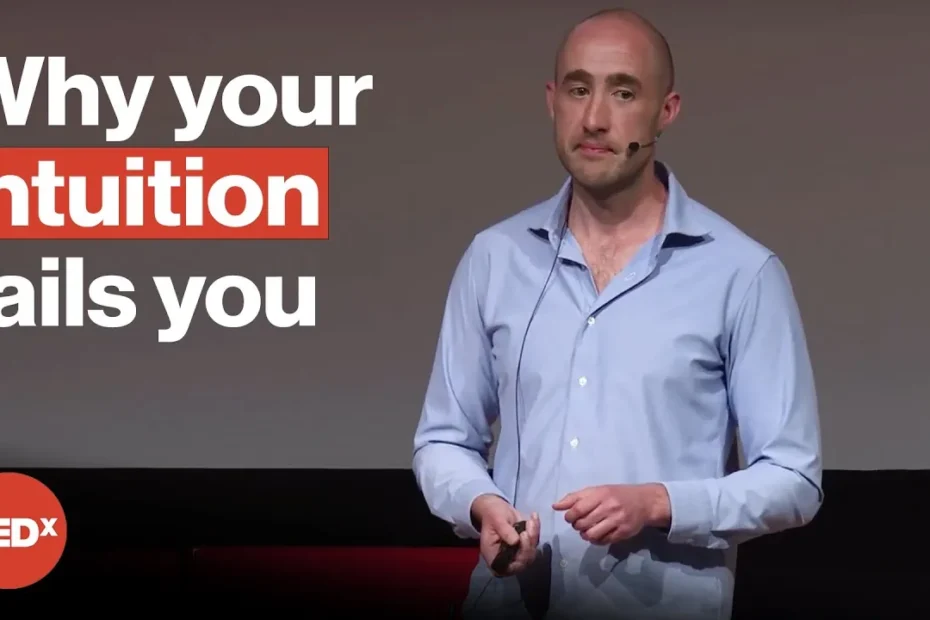
Read the full transcript of consultant psychiatrist Dr. Alex Curmi’s talk titled “Should You Trust Your Gut?”, at TEDxLondonBusinessSchool, July 17, 2025.
Listen to the audio version here:
The Power and Peril of Gut Instincts
Dr. Alex Curmi: Today I’m going to talk to you about instinct, intuition and how we make decisions. And it really matters because of course the decisions we make have such a huge impact on our lives and we know indecision is such a huge cause of suffering for people.
A few years ago one of my psychotherapy clients, for the sake of this talk we’ll call him Steve, told me about his new relationship. He was in love. He felt so good about this new person he was seeing. He told me over and over again how he thought she would make such a good partner, he could see them building a life together. And so it’s no surprise that when the opportunity came for them to potentially move in together after only a couple of months of seeing each other, he didn’t hesitate. It was a no-brainer. He could feel it in his gut. All of his intuitions were pointing in the same direction.
Eight short months later, Steve told me about the breakdown of that relationship. He told me that his partner had gradually become more emotionally abusive, often flying into unpredictable bouts of rage, yelling at him until the early hours of the morning, criticising him for spending time with his family and friends. He tried as much as he could, but the relationship couldn’t be saved. Steve told me this in total shock and disbelief. How could he have been so mistaken? Sometimes our intuitions are just plain wrong.
The Overwhelming Nature of Modern Decision-Making
As a psychiatrist, people often come and see me when this is the case. As we all know, in the modern world, life throws us endless decisions, and it’s totally overwhelming. Career, finance, romance, how many children to have, where to live, whether or not to have that second glass of wine or that second piece of cake. It’s totally overwhelming, and as life gets more complex, so do the more decisions we have to make, and increasingly, we’re burdened by a sense that there’s a correct answer to every decision.
Obviously, when it comes to some decisions, having rapid, highly motivating unconscious instincts is a good thing. If you’re walking down a dark alley and you feel some fear and urge to leave that situation, I’m not going to question your instincts in a situation like that. What I’m concerned with are the long, slow, complicated decisions that unfold over weeks, months, and years, the ones that really impact us.
The False Dichotomy of Trust Your Gut Culture
In the face of very human problems like this, society and culture often step in to try and ameliorate our existential angst, and I find culture often does this by setting up false dichotomies that simplify our lives, like, are you right-wing or left-wing? Are you pro-business or pro-environment? Do you believe in individual responsibility or systemic change? I would argue in this situation, the false dichotomy that’s set up is something like, should you trust your gut, impulse, intuition, emotion, or should you trust your cold, hard logic or your rationality?
Clearly, we’re fascinated by this topic. Looking back over the past 10 years, you see an 85% increase in searches related to keywords like gut feeling, trust your gut, trust yourself, and this topic has been explored at extremely prestigious conferences around the world, and I would argue in the modern West, we seem to be leaning more and more towards what I would call “trust your gut culture.”
We see many different manifestations of this. We have totally unqualified relationship coaches telling you to trust your impulse when it comes to big relationship decisions. We have cryptocurrency gurus who tell you all you need is a healthy appetite for risk and a bit of decisiveness to get into the 1%. We have internet conspiracy theorists who will debate everything from microchips and vaccines to whether or not the earth is flat.
Underlying all of these examples is a basic sense that taking your time, expertise, deliberation, introspection, reflection, they’re not necessary. You should trust your instincts, generally in the service of individual empowerment, self-compassion, and authenticity. You should look for the facts that fit your instincts, and if they don’t, then just get new facts, and in a world full of algorithmic interest-driven information platforms, this is now more possible than ever before.
The Problem with Intuitions
Obviously, there are a few problems with this. Firstly, which aspects of your experience are your intuitions exactly? Are they your thoughts, emotions, memories? Is it the feeling in your gut, or perhaps the quiet voice in the back of your mind, something you could call your conscience? Or are they your ambitions, or perhaps your insecurities? And the second problem is each of these facets of our experience, which I’ve just listed, can each be incredibly misleading and prone to bias.
Four Arguments Against Trusting Your Intuitions
I’m going to outline four arguments why you really shouldn’t trust your intuitions at all.
One, evolutionary. Our psychology evolved in an environment that’s very different from our own. Take public speaking. If I was speaking to all of you here thousands of years ago, chances are it’s a very different situation, probably a lot more high stakes, I’d have a lot more to gain or lose by the end of this conversation. If I said the wrong thing, maybe I’d get kicked out of the tribe, which could mean certain death. It’s no wonder then that people continue to have a fear of public speaking in the modern day.
Similarly, we know from studies of behavioural genetics that some people are simply higher in a personality trait called neuroticism, which tends to make people sadder, more fearful, more anxious.
Having a trait like this makes a lot of sense, again, in an ancestral world where you have to worry about neighbouring tribes, predators, adverse weather events. Does it still make as much sense now in a comparatively much safer world, especially a world where you have to compete with all those really annoying people who are low in neuroticism? You can take advantage of that by speaking in public to get ahead.
Two, psychoanalytic. Anna Freud, Sigmund Freud’s daughter, came up with the once radical but now commonly accepted notion of the defence mechanism. This is the idea that our first psychological reaction to something can be heavily influenced by our childhoods and potentially by traumatic experiences. For example, if someone grew up in an abusive home, they may have developed the tendency to lash out in anger, and that may have been the right thing for them as a child. That may have protected them, that may have saved their life. But does it still make as much sense now in their current relationships where they need is probably love, connection, closeness with their current partner, but they still feel that instinct to lash out.
Three, perceptual. Increasingly, we understand that brain structures like the reticular activation system are continually filtering out most of the information that we could be perceiving from the environment and unconsciously focusing on a tiny amount of data we do deem to be relevant. And that relevance is normally determined by things like our goals, our expectations, our beliefs about what is possible. This idea of selective attention was popularised by the now famous gorilla video.
But of course, it doesn’t just come up on YouTube, it comes up all the time in day to day life. For example, if you’re in the market for a new car, you’re thinking about buying a Toyota perhaps, you walk down the street, all you’re going to see are the Toyotas, the other brands of car fade into obscurity. Sometimes our perceptions are actually totally distorted. Like if you’re a socially anxious person, and you have a fear of judgment, you walk into a party, you see a group of people laughing, you’re much more likely to perceive them to be laughing at you, as opposed just laughing, because that’s the perception that matches your expectation.
Four, philosophical. Wisdom traditions like Buddhism teach us that the mind, especially the untrained mind, is prone to all sorts of what it calls dysfunctional roots to our instincts, like cravings, aversions, delusions. And Buddhism advises us we should gradually get to know our minds through practices like mindfulness, such that we can cease to be slaves to every thought or impulse that spontaneously pops up in our consciousness.
Revisiting Steve’s Story
Back to my client Steve, whose intuitions had let him down. His first instincts in relationships were to people please. We all know people pleases. His instincts told him to mold himself to be the best partner possible for someone else, rather than seeing people on his own terms. So we have to re-evaluate his approach to dating and relationships.
Now I’ve just given you four arguments why you shouldn’t trust your intuitions at all, but maybe we shouldn’t throw them out wholesale. We have intuitions for a reason. What if we could challenge, improve our instincts and intuitions? That would be good. And you definitely can, but the very unsexy, unglamorous answer to how you do this is with time and hard work, unfortunately.
And here we can learn a simple lesson from exposure therapy. In exposure therapy, people with things like anxiety, phobias, OCD, are taught that if you can just confront the thing that makes you anxious, your anxiety will decrease. And this is one of the most reliable findings we have in psychology. But I would argue the anxiety decreasing is only half the story. Besides the anxiety decreasing, we’re also making room for new possibilities.
Again, taking public speaking, if you can get over the fear and anxiety of public speaking, what that can make room for is the very real excitement and joy of getting to share your ideas with a lot of people. And I think this doesn’t just apply to anxiety, but it also applies to our insecurities, our self-doubt, but also our righteous certainty, our fervent enthusiasm, and all the strange, generally unconscious predictions we make about situations before and as we enter them.
The Science of Unconscious Predictions
This is supported by cutting-edge neuroscience pioneered by scientists like Lisa Feldman Barrett, among others, which again posits that our minds are always making these unconscious predictions, generally based on our past, the information we take in, the sensations in our body, the situational context. So we’re making these unconscious predictions. I would argue in the modern world, where we have access to more information than ever, the biggest mistake we make when informing our unconscious predictions is we mistake information for experimentation. We overvalue the opinions of other people and we undervalue what our own experience can teach us.
By going out in the world, immersing ourselves in new challenges, having the courage to fail, reflect on those failures, our instincts can become sharper and sharper. Conversely, by staying away from new challenges, recusing ourselves from the world, maintaining the status quo, the more likely it is that our intuitions will remain mismatched to reality. I’ve seen clients meaningfully change their lives by having the courage to question their impulses and crucially to question their perceptions when they don’t map onto reality rather than questioning reality when that doesn’t map onto your perceptions.
Steve’s Transformation
Back to Steve. We continued to work together after his relationship broke down. Gradually, he learned to follow his instincts to people-pleased less and that made room for something new. It made room for evaluating people on his terms, how attractive he found them, how much they could add to his life. Crucially, whether or not he thought they could form a healthy give and take relationship. And so, after a lot more experience and a few bad dates, the time came where he could walk into my office and tell me that he was in a new relationship. Unfortunately, this was a relationship that stood the test of time because it was one based on the mutual attraction of two strong individuals rather than a relationship based on mere codependence.
Calibrating Your Intuition
Just like a simple weighing scale, our intuitions require calibration in order to be accurate. Unreliable as they are by default, if we never test them, the more likely it is they’re going to be divorced from the reality around us. And I bet while most of you can probably recall times where following your intuitions worked out, I’m sure equally you can probably recall many times where the opposite is true.
Intuition can be a reliable way to help us make decisions quickly and effectively, but only once you earn it. And we must keep in mind that it’s not infallible. That’s why it’s so important to continually ground oneself in what I would call reality-orienting activities. Something like socializing in person, going to psychotherapy, starting a new business, doing a TEDx talk. Something where you give of yourself to the world and get feedback in return.
Conclusion
By questioning, refining, challenging, occasionally directly opposing our thoughts, impulses, emotions, intuitions, our intuitions can eventually become one of our most useful tools to navigate life’s most complex problems. So should you trust your gut? The answer is yes, but only once you’ve taught yourself what’s worth trusting. Thank you very much.