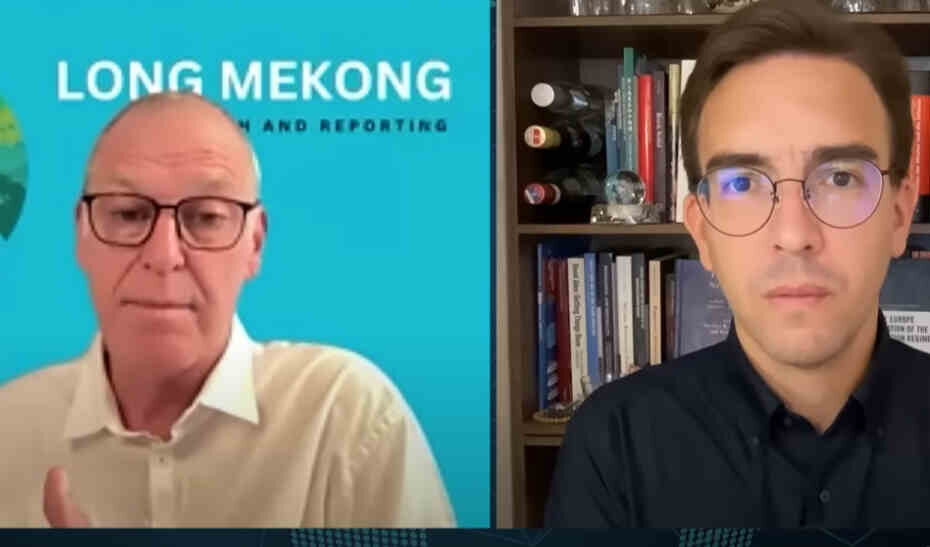
Read the full transcript of geopolitical and geoeconomic risk expert Dr. Digby J. Wren in conversation with Pascal Lottaz of Neutrality Studies on “Thailand vs Cambodia: Proxy War Or Internal Power Struggle?”, July 26, 2025.
Introduction
PASCAL LOTTAZ: Hello, everybody. This is Pascal from Neutrality Studies coming to you with a special episode on the ongoing and unfortunately still escalating conflict between Cambodia and Thailand. Here with me to clarify what’s going on is Dr. Digby Wren. Based in Phnom Penh, Cambodia, Dr. Wren has been connected to the region for decades.
He runs a geopolitical risk advisory firm and is the former external relations advisor to the President of the Royal Academy of Cambodia. He’s also the publisher of the very successful Substack analysis “The Long Mekong,” as you can see right behind him. Dr. Wren, welcome back.
DR. DIGBY WREN: Welcome. Yeah, it’s really nice to be back on the show, Pascal. I really enjoy your show.
PASCAL LOTTAZ: Yeah, thank you very much, Digby. And we talked about half a year ago or a year ago last time, and I’m really glad that you agreed to give us your take at what’s happening. I also reached out to you because you are an Australian citizen, although you’re living in Cambodia. So I do think you have somewhat of a third party perspective on this entire region.
Because like some neutral analysis is important right now on Twitter. What we see is like, “oh, pro Cambodia. Oh, pro Thailand.” Which is absolutely dumb. But can you give us a rundown of what’s actually occurring right now as we speak on this Saturday, July 26?
Historical Context and Border Disputes
DR. DIGBY WREN: Yeah, so the key thing, I suppose back to your point just now about events, right? So everybody’s pro Cambodia or pro Thailand or pro something. But yeah, it’s a series of events. It’s not as if this is just new. This has been going on for quite a long time – these sort of border skirmishes. Well, at least since the 1990s, and even before really.
But this sort of current series originally is about seven sites on their shared border. But that shared border is up in what they call the Emerald Triangle. So northwest Cambodia, northeast Thailand, up where there’s the juncture of Laos as well. So that’s kind of the area. We’re talking about mountainous forests – not easy to navigate.
So it’s been going on up there. Now these places are these temples, right, that mark these sites. And so these temples are Hindu temples. They’re really old. They’re ancient Khmer temples. Because what people don’t realize was that the Khmer Empire used to be a lot larger and stretching all the way down to what is now South Vietnam was originally Khmer Empire, and parts of what is Thailand now, up in the northeast and northwest, that was also part of the Khmer Empire. So that’s why you have these temple constructions on the mountains and things like that. So that’s sort of a historical context.
But the real problem came, of course, with colonialism, and it was the French and the British that sort of split, set all the borders. This is not a new problem – this happening everywhere in Africa and the Himalayas and everywhere, all these sort of British and French borders, Sykes-Picot and all that stuff. So they’ve done the same thing here.
Thailand wasn’t really colonized, but it was sort of cut down from its sort of largest empire stretch, which was in the 19th century. And so it’s never been happy about losing what it had taken from the Khmer from the Cambodians during its expansion in the 17th and 18th century. And so they lost all of that. The French and the British cut that back, created carved Cambodia out in the middle.
So now, like in the present, if you’re a Cambodian, you think of yourself as being squeezed between the crocodile of Vietnam, which is that long, thin crocodile all the way down the coastline and on the South China Sea, and the Tiger of Thailand. So those are the two big ones.
And so this was supposed to be all very good and constructive within the ASEAN format, within the RCP format and internal trade with ASEAN. And so Cambodia was going to benefit enormously because it’s directly between the tiger of Thailand, but also an industrial tiger, and Vietnam, also an industrial crocodile. So that was going to be great for Cambodia. It’s going to be a node, a hub for light manufacturing components and all that sort of thing.
PASCAL LOTTAZ: Yeah, it’s a little bit like Switzerland benefiting from being right between Germany and France and Italy and being the connecting hub.
DR. DIGBY WREN: Right.
PASCAL LOTTAZ: And that can be great for a landlocked country.
Cambodia’s Strategic Position
DR. DIGBY WREN: Exactly. And geographically, Cambodia is really in the center of Asia. And so the port of Sihanoukville, for example, is really the closest distance for transport across the Gulf of Thailand for Bangkok, Thailand, for Malaysia and for Vietnam. So Cambodia actually – I think last time I was on your show, we talked about how Cambodia really is geographically super well placed, just like Switzerland. And that’s neutrality is important. Right.
So that seems to have flown out the window. I suppose the first question we should ask is how did this recording between Shinawatra – the Shinawatra prime minister. I have a lot of trouble pronouncing these Thai names.
PASCAL LOTTAZ: Yeah, it’s Shinawatra. Right. And we need to give the background for this one. So there was a phone call, right, about three weeks ago between the female prime minister, Ms. Shinawatra of Thailand and the prime Minister of Cambodia.
And funnily enough, they’re both the children of the patriarchs of their countries, Mr. Shinawatra on the Thai side and Mr. Hun Sen on the Cambodian side.
The Political Dynasties
DR. DIGBY WREN: Right, that’s right. So, and they’ve known each other since they were basically teenagers.
PASCAL LOTTAZ: Yeah. But on and off, actually, because they were even kicked out of the country sometimes because they’re quite hotly hated by one part of the Thai political establishment.
Political Structures in Thailand and Cambodia
DR. DIGBY WREN: Yeah. So that we need to think about the structure of Thailand’s politics and the structure of Cambodia’s politics. There’s basically a triangulation in both countries. And the triangulation in Thailand is the king, the army and the civil government. Civilian government is the weakest of the three.
And of course, no government can exist anywhere without the military. So the royalist and conservative factions in Thailand side with the military always. And so whenever there’s a civilian government they’re not happy with or that’s too friendly to the Americans or too friendly to the Chinese or, I don’t know, not friendly enough to somebody, they tend to get pushed out and the military takes over again.
And of course, the military is also going to not like civilian governments that try to adjust legislation to create greater control over the military. And so that’s what the Shinawatras have just done because of the three prime ministers that the Shinawatras have had. So that’s the father, Thaksin, who’s very friend – he’s a billionaire, very friendly with Hun Sen and his sister Yingluck. And then she was also kicked out by the military, so that’s two. And then now the daughter, and now she’s been pushed aside through the Supreme Court. What they have the Supreme Court that’s filled with conservative royalists.
The Leaked Phone Call
PASCAL LOTTAZ: Yeah. And the reason she was pushed out or she was suspended for the moment is because she had this talk with… And in that phone call she actually said she criticized the army, her army for their actions. And it seems that Hun Manet now leaked that phone call to the press and that created huge upheaval in Thailand. Who’s like, “oh, how dare she criticize our army?”
DR. DIGBY WREN: Right. So in Cambodia, the structure is slightly different. So you’ve got the party, CPP, that’s the party of Hun Sen political party. They’re by far dominant. And then you have the army. Right. So they’re together, but the king is virtually powerless in Cambodia. Virtually powerless. So the triangulation is slightly different.
But yeah, so they had this conversation because of a small skirmish that was held up, as I said to you before, up very close to the Lao-Thai-Cambodian border. And there was a series of little events, like some general hosting of a group of families. Then they went across the border into Cambodia, all these Thai families. And they promote this idea that this used to be Thailand. Well, which I suppose it was part of the Thai empire for a little while.
PASCAL LOTTAZ: And let me just add one thing because I think it’s important to know that the ICJ awarded the temple that is kind of in the center of attention to Cambodia, but the surrounding area not. Right. The surrounding area is supposed to be demilitarized. So there’s still on both sides. There’s a question, where’s the actual border?
The ICJ Ruling and Disputed Territory
DR. DIGBY WREN: That’s right. Yeah. That was done in 1962. And so they got a ruling on the actual temples. Not just one, but a few of them. And, but yeah, you’re right. The area around that, I’m not quite sure how big it is now. I’ve forgotten. I think it’s about 42 square kilometers. I’m not really sure. Anyway, so that is still – there was no ruling on that. So that’s still in dispute. That’s been just going on forever. Right.
But the thing was that up until, let’s just say the last year, relations between the three – so the three Gulf of Thailand countries, so Cambodia, Thailand and Malaysia, they were working really closely together. Hun Sen, Thaksin Shinawatra and Anwar Ibrahim, they had sort of formed a small group, small triangulation and they were working towards solving a lot of the problems relation to the Gulf of Thailand gas and oil rights. And they were making progress on that.
They were also making progress on Myanmar and the implementation of the ASEAN five point consensus. And that was kind of seeming to work. And then there was another thing that happened which was the announcement of Cambodia going to build a canal from the Mekong straight down into the Gulf of Thailand, which the Vietnamese were very unhappy about.
Now one has to remember that the Vietnamese have a big say in the Cambodian economy and that canal was not seen very well in Vietnam. You’ll just follow me here because it’ll get to the point and the point here is that so Vietnam’s not been happy about this relationship, that Cambodia is going to be sort of cut loose, if you like, from Vietnam. And so this will come back to us at the end when we talk about who benefits from the conflict between Cambodia and Thailand anyway?
The Phone Call and Military Criticism
So this phone call happened between Hun Sen and the Prime Minister, the current daughter, right? 36 year old Shinawatra. And in that, yes, she criticized the military commander of the second military area, which is the area involved here. And this guy’s name is Bussin. He is a creature of the former military dictatorships or juntas that were in power that kicked out the other Shinawatras. So in I think it’s 2008, 2014, right.
And now, so she’s criticized them. But you have to remember that the head of the army is also appointed by the former military government back in 2016, I think like that. So that conservative royalist military faction is strong. And because the coalition government in Thailand has got two parties that are royalist military parties in their coalition now one of them’s left, but they still have a majority with that military backed party.
So what we have to imagine here is that there’s internal problems in Thailand. A power struggle in Thailand related to the military. Exactly. What that is, I suppose is going to be determined. We can talk about that today.
And then external pressures, now the external pressures relate, there’s so many of them. The tariffs from the USA, ASEAN Myanmar, destabilization there. Vietnam’s not happy about losing some control over the Cambodian market. I think also related to infrastructure, the opening up of all ASEAN to railways and highways and so forth. That’s also I think a little bit feeding into this.
So there’s three external factors. And what is the internal factor in Thailand is the military wanting to not be controlled by the civilian government. That seems to be the thing that set it off and so where are we going now? Are we going to get another military coup or are we going to get the government’s going to be slightly destabilized and there’s going to be a power shuffle inside the existing government. But the military will have more control. I think that’s probably where it’s going.
PASCAL LOTTAZ: Yeah. And I need to add, the last Yingluck was so the aunt of the prime minister, I mean the one who was just ousted. She got ousted and then we had, I think it was seven years, wasn’t it? Seven years of military.
DR. DIGBY WREN: That’s right.
The Power Dynamics in Thailand and Cambodia
PASCAL LOTTAZ: Control where the military actually appoints all of the parliament. Right. And then basically you have that transition back into a semi, you know, 50-50 kind of control of parliament only about two years ago. Three years ago.
DR. DIGBY WREN: Yeah, three years ago.
PASCAL LOTTAZ: Three years ago. Right.
DR. DIGBY WREN: So you’ve got a coalition government and in that coalition you’ve got royalist and military partners. So they’re not necessarily going to help the Shinawatra.
PASCAL LOTTAZ: And plus, the Shinawatra is the leader of the second largest party. I mean the largest one that won the most share actually got kind of sidelined and parked because they had an anti-royalist leader.
And so she was always a weak prime minister but the strongest thing she had going is of course being the daughter of Mr. Shinawatra who came back. He was exiled for a long time. Came back and was regarded as kind of just like Hun Sen in Cambodia. The unofficial patriarch of the party.
DR. DIGBY WREN: Yeah, that’s right. I think both prime ministers, the Shinawatra and Hun Manet, they’re both very inexperienced and they’re both young and they’re both the prodigy of their prime minister fathers.
So I think both of them are a little bit inexperienced and they may have not guided this on their own too well. But we should go back to the phone call and how that was released.
Hun Sen’s Continued Influence in Cambodia
PASCAL LOTTAZ: Right, please. And also can you talk about the Cambodian side and Hun Manet and the power structure inside. Maybe there is – is it Hun Sen still in charge or has he faded out?
DR. DIGBY WREN: Hun Sen is the chairman of the party, the CPP, Cambodian People’s Party, which is by far the most powerful party in the country. And he holds that role and he is also president of the Senate. So he still has an enormous amount of real power.
And he’s guiding his son’s sort of assumption or ascension to the prime ministership. And he needs to go through another election cycle. So once Hun Manet’s got at least five to 10 years experience, then I think probably it could go on longer.
I mean, let’s be real and say Cambodian economy is pretty stable. Still got more than 5% growth, even with all the external problems, tariffs and so forth. So the area is still growing. It’s not about that. And one can say the same about Thailand.
I looked yesterday at the import, export, stock market and currency. Now the currency has taken a bit of a hit, but in terms of the stock market, nothing’s happened at all. There’s no causal effect coming from capital flows. So we can get rid of that. And strangely enough, import-export too, hasn’t really changed very much. So that doesn’t seem to be a dominant effect either.
So we really need to concentrate on the internals. Now in Cambodia, there is no internal struggle, but it’s true that Hun Manet is not super strong yet. I mean, he’s a young man and his father’s still in power.
And there are some institutional struggles inside Cambodia between ministries that’s traditionally and historically true. So certain families vying for positions in the government, that sort of thing. And that’s pretty well settled down, but it’s still ongoing.
The Controversial Phone Call Release
Now, the strange part is where this phone call was released to the public. Hun Sen said that 80 people were on the list, were able to listen to this phone call. And somebody who didn’t like the Thai government released the phone call. That’s what he said, the original nine minutes.
And in that nine minutes, yes, the Shinawatra said that Boonsin, this second army fellow in Thailand who’s in charge of the border area, was the problem and was acting against the interests of the civilian government. Well, this is not really news. I think everybody already knows that, but it was released publicly.
Now the strange part about that is can anybody trust Hun Sen? If you’re going to have a private conversation with him and then the conversation is going to be released, I think there’s going to be an element of distrust related to Hun Sen now.
PASCAL LOTTAZ: The question though is was it intentionally done in order to destabilize the Thaksin government or is it a saboteur? So I mean, the difference is actually quite important. But either way, you cannot trust the communication channels anymore. And obviously if she said that, it meant she had that trust that this would not be, that this would remain private.
DR. DIGBY WREN: Yes, for sure. So that’s still unknown. I don’t know that for sure. Who released it? Was it by design or was it betrayal of some sort, somebody letting it go?
But I suppose there’s nothing really revealing in this phone call. Not really. I mean, the worst thing that she says is this thing about the army, right? Well, pretty well anybody that’s looking at Thai politics knows that this is what’s going on in the army.
General Busan: The Provocateur at the Border
But this guy, I had a look at him and I wrote an article in Substack about two weeks ago and had a good close look at his career. He was promoted through the military junta period and he’s just been promoted again. So he’s the head of 2nd Army Group and he is the one at the border.
PASCAL LOTTAZ: The Thai guy at the border, right.
DR. DIGBY WREN: Yeah, very nationalist. And he’s from there. He was born there, he grew up there. He came through the ranks. He served in the army in that area. So he knows it really well. It’s not like he’s just been brought in and put in charge. He really knows his stuff up there.
And he has been, yes, a provocateur. In fact, almost all his actions have been provocative, but he’s been promoted for that. So that tells you that inside the royalist conservative military factions in the Thai government, they are supporting this.
And they were supporting it before it turned into what it is now. So that means that they wanted it to happen. So it’s been by design of some description to this furor. So that’s the question then is, well, who benefits? Is it really an internal thing or is it a larger external? Is there something larger external going on?
Escalation to Heavy Artillery
PASCAL LOTTAZ: Yeah. And also then on the Cambodian side, at the moment both parties say the other one shot first. And one of the things we know is that on both sides we had landmines exploding and we had shots fired at each other. That has happened also in the past and repeatedly.
But what we are seeing for the first time, or I haven’t heard about it before, is heavy artillery. And we’ve seen these videos from the Cambodian side shooting these multiple rocket launchers. Right. And hitting even a gas station and a hospital complex in Thailand.
And this is – now the Thais are boiling over with anger at being not just military targets but civilian targets being hit. Can you speak to that a bit?
DR. DIGBY WREN: Yeah, well, none of that’s good. And actually Hun Sen, they’ve reintroduced conscription into Cambodia, which is a sort of interesting thing to do right now.
PASCAL LOTTAZ: I mean, recently or in reaction to this?
DR. DIGBY WREN: Yeah. Two weeks ago he made an announcement saying conscription has been reintroduced. So I think women can be excused, but all young men must do it. So they’re obviously trying to prop up their numbers a little bit.
I had a look at the command structure of the Cambodian army. They’ve sent their second top general to this area and they’ve given him some artillery and rockets and they’ve been firing them.
Now, we’re still not in kind of organized, divisional level or even regiment level war or anything like that. It’s nothing like that yet. We’re talking about fairly random – I mean, I’m not going to say what they chose as targets was random, but what I’m saying is the use of one piece of artillery, one rocket launcher, one death. Originally there was only one death.
PASCAL LOTTAZ: One soldier killed on the Cambodian side. Yes.
DR. DIGBY WREN: Yeah. And by troops under the command of this General Busan. Right.
PASCAL LOTTAZ: And also the rocket launchers we have seen so far to me seem not connected to this larger kind of radar system. It’s more like the thing that you just aim in a direction and then you just fire and it hits whatever it hits, which is bad enough, but it doesn’t seem like a coordinated approach by Phnom Penh in order to blow up a gas station.
DR. DIGBY WREN: No, it’s not that. No, it’s still fairly, let’s just call it ad hoc.
PASCAL LOTTAZ: But that’s what makes it so dangerous because now it’s the individual idiot commanders on the ground that might kick off much worse things. Right. Because these people are not under – I mean they are under command structures, but then they just act on the ground.
Military Capabilities and External Factors
DR. DIGBY WREN: Yeah. So now we’re looking at kind of battalion level, so like a hundred soldiers to a thousand soldiers maximum, kind of operating, building trenches and setting up sort of security areas and so forth.
Look, my understanding is that there’s very little in terms of real armaments being taken up to the border area besides the fact that it’s difficult to get there and Cambodia doesn’t have a huge air force or even helicopter or even drones. They don’t really have a very sophisticated border patrol functionality in terms of military. I mean, I think it’d be better if they did really. Maybe they’re using this as an excuse to partly do that because they actually need to do that. And I think Thailand also.
So look, what do we know? We know that there’s some weapons up there. Yes, the commander on the ground might make mistakes, but it seems that Busan, the Thai guy, he knows what he’s doing because every step has been fairly well calculated and it’s just incited and built it up a little bit. But it seems to be some kind of plan in this. On the Thai side, definitely there’s some kind of control going on.
But can I talk a little bit about the externals?
PASCAL LOTTAZ: Yes, exactly. Because there’s always this suspicion that the others, the Americans and maybe the Chinese might have some skin in the game. Although what I know from my own visits to Thailand is that the Americans have much larger complexes and CIA bases actually on the other side of Thailand around, you know, a huge consulate in Chiang Mai.
DR. DIGBY WREN: Oh, in Chiang Mai.
PASCAL LOTTAZ: On the border with Myanmar. So we are talking about the other side of the border where I’m not aware about U.S. involvement. But do you know anything?
The Role of External Powers
DR. DIGBY WREN: Well, look, I mean, there’s always US involvement that can’t be discounted or discredited. You know, the US is very active and this, all of. You know, look, the first event, the first sort of trouble was in February, and that was very low key. And I think that was very much related to the internal, you know, struggle, political struggle inside Thailand at that point.
And then the, when the Shangri La thing happened, that was in May, this whole thing just started to take off after Shangri La, after the Americans had called for, you know, rearmaments and spending more money on guns, et cetera, et cetera. Then suddenly there’s this thing’s turning into an actual conflict zone. Right.
So you know, is there a causal connection there? I think there is a connection. There’s some kind of correlation, but whether it’s causal, I can’t say, but it’s definitely, it’s, you know, you can definitely say that there’s. You’ve got Pete Hegseth in Shangri La, in Singapore, saying, “everybody has to spend more. China’s really dangerous, Southeast Asia is under threat.”
And then literally. And he met with Hun Manet, right? In Shangri La, he met with Hun Manet, and Hun Manet also met with the French, and now the French are also involved in this. Macron is kind of pretending to be a mediator as well. And there was a. When Manet went off to France and visited with the French, and they were also talking about threats in Southeast Asia.
And so apparently Hun Manet had invited Macron to help mediate. But then what we found out is that the Anwar Ibrahim in Malaysia, of course, had been included in this sort of. You know, he’d been closely involved previously with Thaksin Shinawatra and with Hun Sen. They had a very good relationship, the three of them.
So they’ve obviously been talking again quietly, and he’s mediated. Ibrahim mediated a ceasefire, but the Foreign Ministry spokesman from Thailand this morning said, “no, the Thais are not going to accept a ceasefire.” So I suppose we’re going to see some more ad hoc firing across the border and more troops being moved there.
But look, a ceasefire, I mean, it’s not as if there’s occupied territory at this point in time. They’re still kind of obeying or looking at the, you know, sort of respecting the border area. Generally speaking, there’s some movement, but there’s no real fighting yet.
So the question is, why don’t the Thais want a ceasefire? What do they really want out of this? Do you think they’re going to get a temple or going to get a result out of this? Is that what they really want?
But in the meantime, what we see is that lots of Thai products have disappeared from shelves in Cambodia and lots of Vietnamese products have replaced them. So the Vietnamese, I think, have gained some commercial benefits from this. And I wonder if that’s not related in a larger way. It’s hard to say, but it is clear that Vietnam has a lot a big say in the government here in Cambodia. They do have a big say.
And, you know, I haven’t seen Vietnam saying very much about this other than they should just get to peace. I mean, that’s really. They’ve kept out of it at all. But they are definitely benefiting commercially and it’s giving them more influence politically as well, I think, probably.
ASEAN’s Dilemma
PASCAL LOTTAZ: But you know, when we look at this from an ASEAN perspective, this is kind of a worse case scenario because the last thing you want is your members openly fighting with each other. It’s already bad enough that in Myanmar you have a civil war, but the rest, you know, Anwar Ibrahim, Malaysia, but also Indonesia, they pride themselves of trying to keep ASEAN out of these geopolitical shenanigans. Right. And maintaining a neutral position. Actually, Anwar Ibrahim even says so.
And now your two of your major. I mean, at least Thailand is a huge factor in ASEAN, right? Going into open conflict. So if we suppose that there are also outside interests involved, then, you know, ASEAN, it cannot be an ASEAN interest. Right. ASEAN should have every interest right now at making sure that this dies down as quickly as possible and we get back to negotiations between the two.
DR. DIGBY WREN: There can be no doubt about that. ASEAN centrality is the most important thing. Everybody in ASEAN knows that. Every government, every minister, they all know that. So that’s topmost in their minds for sure. Nobody wants to split up ASEAN. On the other hand, the Americans are not particularly happy that ASEAN maintains its neutrality. Trade bloc. Yeah. And it effectively provides the largest trading partner for China and it protects China’s southern flank.
PASCAL LOTTAZ: So without any proof of any kind of involvement, we would say that if there is a conflict, an open conflict, and both sides are going to buy more weapons, that would probably potentially benefit the understanding of the United States, which then has a stronger, a strong argument to say, like, “look, Thailand, you should have us as your protector. Right. We should have a few bases more and a few US personnel more.” I mean, without having any proof that that’s what’s going on.
DR. DIGBY WREN: Yeah, yeah, well, that’s right, that you can’t actually prove that. But what we can say, what we do know for sure, is that there is a, you know, a high level of American involvement both in Myanmar and in the Philippines. Yeah. So that one is maritime, one is continental. In real terms, Myanmar is basically continental, does have a coastline, of course, but it’s a very large country and that’s been, you know, destabilized for, well, what, at least 10 years.
And so now destabilizing Thailand, you know, that’s going to fracture ASEAN for sure. Look, do we want ASEAN to end up looking like Europe?
PASCAL LOTTAZ: Of course not. Nothing should look like Europe. I mean, it’s bad enough to have one Europe.
DR. DIGBY WREN: Well, I think that’s what the Americans have effectively achieved if they’ve subordinated Europe to their global plans. And I think they’re trying to do the same in ASEAN. I think that’s true. Whether or not they’re actually. There’s a finger in the pie in Bangkok, you know, twisting things here. That’s very hard to say. There is no physical evidence of that. I don’t have any statements to that effect.
But look, there’s definitely some kind of link and correlation to that finding the cause, the causal link. Direct causal link. Well, that’s. I think there’d be a lot of people looking for that right now. Yeah. But for China’s point of view, I can’t see that it’s particularly beneficial in any way. It doesn’t help them at all. It’s not good for business and that’s their primary concern. It’s not good for stability. That’s another primary concern. So, yeah, it doesn’t look good.
Internal Power Dynamics
PASCAL LOTTAZ: And you know, just since we are in the realm of speculation, and again, I have no indication for this, but Mr. Thaksin Shinawatra has given speeches when he came back indicating that he’s online also with Ibrahim and so on. You know, the neutralist part saying like, “we are not pro Chinese, but we maintain strategic independence.” And if internally the military, which always has had closer relationship with the Americans, if there’s a power struggle between them, then, well, there would be a logic to strengthening the military versus the Shinawatra government.
DR. DIGBY WREN: Right. So that would be, as you just said before, that would be quite possibly the idea that you’re suddenly going to see an increase in budget, right, in defense budget, because all of the Asian countries only pay about 1.5% of GDP. And what are the Americans asking them to do? Spend 3.5.
PASCAL LOTTAZ: It’s a stupid metric. You don’t decide on a budget and then what kind of threats can we invent? You look at the problems you have. And the best thing is if you don’t have threats, then you don’t need a big budget. But that’s not the logic. But.
DR. DIGBY WREN: Sorry, but now we have a threat. Right? And so is that the causal part is that the thing is that, you know, Hegseth going to Singapore, Shangri La, saying “you have to spend more on money” where it. And so, well, let’s just have this little tie up that’s really emanating from the Thai side. I, you know, I, you can’t say that this was started by the Cambodians. I think that would be very hard to justify.
I think you’ll find that it’s particularly sits in the camp of this Thai General Boonsin. Now he retires in September. In September. So the outcome in my mind is probably post September. So he’ll be, he’ll no longer be a serving general in the army. And as we all know in Thailand, what happens to generals that do sort of, you know, things that the conservatives and nationalists want is they get promoted in the next government.
So I think we can see that he’s being positioned for a position in the government either as the next head of the government or perhaps head of the army or Defense Minister, something like that. That’s what it’s looking like. So the timeline I think is probably September. I think Boonsin has got a lot to do with this, this general, this Lieutenant General. I think he’s really part of the whole thing.
So he, I’d be, I’ve been looking closely at his promotions and his actions and where he’s going to go in September and it looks like he’s being set up for a position, a very high position in the government. And as you said, the military is going to be more pro American. Yeah. Maybe they’re going to buy more weapons, maybe even Cambodia is going to spend more on weapons. I don’t know.
But theoretically they’re not supposed to be Chinese weapons. Right. Or Russian weapons. The landmines in Cambodia are apparently Russian. I don’t know if that’s true. And the landmines in Thailand are American. I don’t know if that’s true.
Cambodia’s Position
PASCAL LOTTAZ: Do you have any indication of, you know, how the Cambodian side is now looking at this? And if there’s, I mean, Cambodia must have an interest in de-escalating this. This cannot be in the interest of Phnom Penh to have an open dispute, a dispute, I mean, actually escalating into a war with a neighbor which at least on paper has much more firepower than you. Right. There must be an interest in de-escalating this. So what is Phnom Penh looking at?
DR. DIGBY WREN: You could have said that about the Ukraine and Russia. You know, why would you pick on your big neighbor? Yeah, so that’s true. I don’t think there’s any benefit for Cambodia in, you know, which just makes me think that, you know, Hun Sen probably didn’t deliberately release that recording. Although, I mean, it’s possible, but I just don’t think, I just don’t think so. It seems strange to me.
But anyway, yeah, there’s, I don’t see any real benefit for Cambodia. It doesn’t look good for them with anybody. And they’ve still got this tariff thing hanging over their head. They have to do that. So, you know, the timing is very strange. You know, I don’t believe there are coincidences anytime, Pascal. So, you know, but I can’t make those causal connections yet here in Cambodia.
But look, it does. It’s not good for the economy, it’s not good for the populace. But yes, it fills the papers and the media and everything else and everybody’s angry about it on the street, but they can’t afford to fight a war. And even if there was a war, they wouldn’t be able to win it. And they’re fighting in areas where it’s jungle. I mean, you know, these things are just.
PASCAL LOTTAZ: Yeah, but I mean, when we take a step back from the rationalist approach, looking at what is good for the nation and go toward what is good for the factions, because we can see how in Ukraine, the war was, of course, horrible for Ukraine and Ukrainians and Russians too, but we can see how it was. It was very good for the power elite in Kiev. I mean, they amassed money and power and they managed to grab it and to have this connection to the outside.
So sacrificing your country in order then to entrench yourself. And if we start from the idea that the Thai army military wanted to get rid or diminish the Thaksin government, then this was also kind of a win. And on the Cambodian side, it still there a. Is there something to gain from increased nationalism on the street, you know, for the party and so on?
Regional Winners and Losers
DR. DIGBY WREN: Only in the sense that it might strengthen Hun Manet’s position a little bit, because he was seen to be, let’s just say inexperienced. So I think this may harden him a little bit and also help put the army more strongly behind him, under his control. I think that’s possible, yes.
In terms of economics, it also kind of lines up their economics a little bit. They have to have some discipline in relation to the tariffs. Discipline in relation to them. Their military industrial complex, very small that it is, but they still have one. And yeah, firmer control over the actual army. Yes, I suppose those ticks for the government in Cambodia, but overall, having difficulties with Thailand, inside ASEAN, et cetera, I think that net negative is larger than any positive they might get internally. I don’t think it works very well for them.
In terms of inside ASEAN, it seems to me that Vietnam is the big winner out of all of this. They’re getting more commercial exposure. They did their deal in tariffs really, really fast. There’s a 40% tariff on intermediate goods from China. Cambodia has become a kind of an intermediate transport hub for Chinese goods for all of ASEAN. So that could have something to do with it as well.
But then Thailand also, you know, it’s got a booming kind of industry. They got new EV factories going up basically. But their economy has been a bit of a mess. I mean, let’s be honest, their economy is a bit of a mess. These tariffs are not going to help.
So yeah, look, all in all, I still think that most of this problem is an internal factional power struggle as you’ve just mentioned, inside Thailand. I think that is the number one driver of this and that there’s some external benefits being derived from this by Vietnam just as a local export market and political influence inside Cambodia. And then as you said, maybe the American military is getting beneficial benefits from this inside Thailand. That’s possible too.
PASCAL LOTTAZ: And your take at the most likely course of this would in that case probably be that we have institutional interests in maintaining some form of skirmishes for time being, but that both sides would probably want to keep it below the level of, you know, outright “let’s go to war.”
DR. DIGBY WREN: Yeah, that’s what it looks like. So people are trying to leverage to gain advantage in what we’ve just discussed. So either economically or politically or militarily, geopolitically, I think. Yeah, that’s what’s happening. As you said, they’re going to keep it simmering just as long as it’s useful.
And I suppose you can tie it to, as I said, Boonsin quitting the army in September and then ready for a civilian political job. The end of the discussion on tariffs and the decision on what it’s going to, the effect will be on intermediate goods from China and then yeah, the destabilization, partial destabilization of ASEAN. I worry about that a lot. Myanmar, Thailand, Philippines, not good.
BRICS as a Potential Mediator
I suppose one could. There is one sort of positive side that I can see in here and that is the BRICS and that is because Vietnam, Malaysia and Indonesia are now part of BRICS.
PASCAL LOTTAZ: Yes.
DR. DIGBY WREN: So that makes a southern arc around Asia.
PASCAL LOTTAZ: And, but Thailand is a partner country. Right.
DR. DIGBY WREN: So I can see that there’s, I don’t know, there’s no institutional framework within BRICS to kind of organize these sorts of things. So I’m not sure how that could be done. But you can see that both China and Russia and India have a say inside BRICS. And so, and the Philippines is inside that circle, that Vietnam, Malaysia, Indonesia circle. Philippines is kind of inside that.
So I think there might be something going on in that as well that’s worthwhile having a look at. And then the last thing that I would mention, I suppose is UNESCO. The Americans have just withdrawn from UNESCO and these temple sites that are being fought over by Thailand and Cambodia, they all have UNESCO World Heritage status.
So if the Americans are not in UNESCO, then they can’t be told that. Or nobody, you know, nobody’s going to say, “Oh yes, well, it’s a heritage site. You can’t do these sorts of things.” The Americans can say, “Well, we’re not part of UNESCO, we have nothing to do with it.” So I don’t see that’s good either.
PASCAL LOTTAZ: Did you hear any talk about, you know, China, India, Russia is the big close three BRICS states calling on Cambodia and Thailand to negotiate. I mean, if it was for BRICS to step in and say like “we are now going to push for peace,” that would, and create an institutional, you know, setup a mechanism that could be used again, that would be a great step forward for BRICS.
DR. DIGBY WREN: Yeah, well, BRICS doesn’t have an institutional framework for that, you know, to this sort of thing. So where does it go? You know, and we know that the US doesn’t like anything multilateral. They just hate it.
PASCAL LOTTAZ: Yeah, they don’t like anything that pushes toward peace if the opposite increases their standing. So, you know, peace breaking out is always a nightmare in Washington.
DR. DIGBY WREN: Yes, yes. Well, the irony of that. Right, so yeah, so they don’t like any of the multilateral. So it’s definitely in the interests of ASEAN to act multilaterally. I think it can be done informally inside the BRICS. That would be probably worthwhile and not RCEP. I don’t think it can be done there, although I think that the Australians could have a positive effect on this if they wanted to.
I think the current ambassador here in Cambodia seems to be doing quite a good job. And their soft power has increased quite a lot in the last year. I think they’ve been very active and I think the Australians could be, could, you know, maybe, just maybe Gareth Evans, who knows a lot about Cambodia and Thailand and all that sort of stuff. He was just in China and Anthony Albanese. Look, it might be something that the Australians could get involved in. Why not?
PASCAL LOTTAZ: I mean Australia, Indonesia, Malaysia, pushing for a joint kind of course of action, plan of action. That would be something positive from the region.
DR. DIGBY WREN: Yeah, something like that. Yeah. Even you know, Japan and South Korea as well. I think they should all be talking about this and you know, not the Europeans and not the Americans. Right. So try and keep it ASEAN centrality and then you know, the largest sort of Asia, East Asia, Southeast Asia, RCEP countries. Why not?
The Challenge of Military Influence
PASCAL LOTTAZ: The question is of course how to get to the right people who actually make the decisions if even the Prime Minister is not properly in charge over the military forces. So you need a military to military approach in one way or another.
DR. DIGBY WREN: That’s a good point, Pascal. I think, you know, in terms of the Cambodian military, that’s not a problem. But definitely in terms of the Thai military, that is always kind of, it’s so opaque. Right. You can’t really see it’s, it’s, you know, it’s all smoke and mirrors really.
I mean they are so, they are so deep in the government and in the economy. You can’t, you know, the military in Thailand, I don’t, it can’t be separated. And the king like the military and the conservatives and the royalists, that can’t be separated. Yeah.
PASCAL LOTTAZ: And unfortunately the current king is, let me put it this way, he’s not famous for being a prudent or far sighted personality.
DR. DIGBY WREN: Right.
PASCAL LOTTAZ: So there’s probably nothing going to come from his side.
DR. DIGBY WREN: But his followers, his supporters, you know, the conservative royalists, ultra nationalists, look they, but they’re not strong enough to ever get a majority in the government.
PASCAL LOTTAZ: No.
DR. DIGBY WREN: Right.
PASCAL LOTTAZ: No, they just lost it, they lost a huge majority to the party that actually wanted to constrain the royal influence. Right. Even the lese majeste, the famous one. But the question to me now is like who in the neighborhood has a good enough relationship with the Thai order to talk to the people there who would need to be convinced that it’s not in their interest to actually keep that simmering and it should be negotiated away. So if anyone listening has an idea and knows how to create something, do post.
DR. DIGBY WREN: Yeah, no, that’s a hard one. Yeah, but there’s definitely going to have to be somebody talking to the Thai military. Who that’s going to be, I don’t know. But look, this is going to simmer. I think this is going to simmer for a while longer.
And the word ceasefire has been put out there at least two or three times now from different sides. China and Vietnam have both called for, you know, stop any kind of fighting whatsoever. Anwar Ibrahim ceasefire. And he’s willing to be the mediator. I suppose that’s okay. Yeah.
PASCAL LOTTAZ: Because he’s also the head of ASEAN this year, right?
DR. DIGBY WREN: Yeah, he’s got the chair of ASEAN, so it makes sense right now. The Philippines gets it next year. Now that would be a disaster. Yeah.
PASCAL LOTTAZ: Can you imagine, Marcos? Oh, God.
DR. DIGBY WREN: So, well, so there you go. So if you think about that timeframe as well, if ASEAN was just sufficiently disrupted and they could hold it until the Philippines chair next year, it doesn’t look good for ASEAN. I don’t think the Philippines are going to be pro ASEAN. I don’t think they’re going to be really helpful at all. No.
PASCAL LOTTAZ: Because they’re mad at ASEAN for not helping them enough in the South China Sea, with the islands and so on against China. They are mad at that, which is why they are siding with the Americans.
DR. DIGBY WREN: They need any help. What help do they need? I mean, you know, they’re choosing this, right? They, this, they’re acting like a colony, you know.
PASCAL LOTTAZ: Yeah. But we must, you know, we must say like. And we are digressing a little bit. But you know, the guy now in the Hague who was extradited to the Hague, the former Prime Minister Duterte, he for six years tried very, very hard to be as cozy and cuddly to China as possible. And the Chinese didn’t seize on that. They just went harder with military power.
So it’s kind of, it makes sense from the Filipino perspective to say like, “Hey, this didn’t work, so we got to do something more confrontative,” which is not a good thing. It’s the Ukrainian route.
DR. DIGBY WREN: It was good for their economy. The Philippine economy is not, you know, the only reason the Philippine economy is doing any good at all is because it’s getting so much subsidization from the U.S. yeah. I mean, yeah.
Summary and Casualties
PASCAL LOTTAZ: Okay, well, we are digressing. This is a whole different topic. But Digby, is there anything we need to add about Cambodia and Thailand that hasn’t been said yet?
DR. DIGBY WREN: Let’s summarize it. So it looks like in the first instance it’s an internal power struggle from Thailand. That’s the first kind of take. The second take is that it strengthens internally in Cambodia. It strengthens the control of the Prime Minister, Hun Manet the younger. Right. It helps strengthen his control over the military and possibly the government.
Generally speaking, I don’t see that as a really big thing, but it definitely, I think it does give him a few percentage points of extra influence over those institutionally in the country. Vietnam is benefiting commercially by getting more access into the market in Cambodia, which they were worried about losing because of the canal. And they’ve also got more political influence in Cambodia because of this.
The Americans are going to be happy because they see more fracturing fragmentation. Their ally, the Philippines is going to get the chair next year of ASEAN, so they might be able to continue this kind of fragmentation like they did in Europe, which is my biggest fear.
And that the on the ground actions, look, there could be some more deaths. So so far how many people have actually died? One soldier in Cambodia, that was the first thing. Then two civilians in Thailand and now the numbers are not clear.
PASCAL LOTTAZ: Around 12 or so. It was quite a few civilians on the Thai side, which is why Thailand is now bubbling with hate toward Cambodia, which is really bad.
DR. DIGBY WREN: I have no confirmation on total death tolls yet. I think that’s still unclear. We can definitely confirm that there were two deaths, but I can’t confirm 12 deaths or 26 deaths. I’ve read quite a few numbers. None of that can be confirmed yet.
PASCAL LOTTAZ: Okay, let’s say at the moment it’s unclear, but there were casualties.
DR. DIGBY WREN: Yeah, there is no mass mobilization yet. These are all very limited, small scale. It’s mostly trenches and infantry soldiers and things like that. There are some artillery pieces, some rocket things. There were no, as far as I understand there’s no tanks or anything like that yet.
One F-16 was sent into the air by the Thais. So at this point it’s lots of signaling but not really fighting.
PASCAL LOTTAZ: Good.
DR. DIGBY WREN: Okay, yeah. So jostling for influence here but who exactly is, you know, what the outcome is supposed to be, that is still unknown, I think. Yeah.
The Key Question: Who Benefits?
PASCAL LOTTAZ: And maybe, maybe nobody knows. But we need to keep a close eye on it also and constantly ask the question, cui bono?
DR. DIGBY WREN: Yeah, you know, cui bono. Exactly. That’s the really important thing. Who is benefiting from this? Right.
PASCAL LOTTAZ: All right, we will talk about this again. Digby, I thank you very much for your very detailed assessment. Everybody who wants to follow you should go to your Substack, the Long Mekong, and I will put the links into the description. Dr. Wren, thank you very much for your time today.
DR. DIGBY WREN: My pleasure, Pascal. It’s great to be with you again.
Related Posts
- President Trump on Operation Epic Fury Update (Transcript)
- President Trump Remarks on US, Israel Attacking Iran (Transcript)
- President Trump on Economy, Energy in Corpus Christi, TX (Transcript)
- Bulwark Podcast: w/ Susan Glasser on Trump’s State of the Union address (Transcript)
- Douglas Macgregor: US-Iran Diplomacy Fail (Transcript)