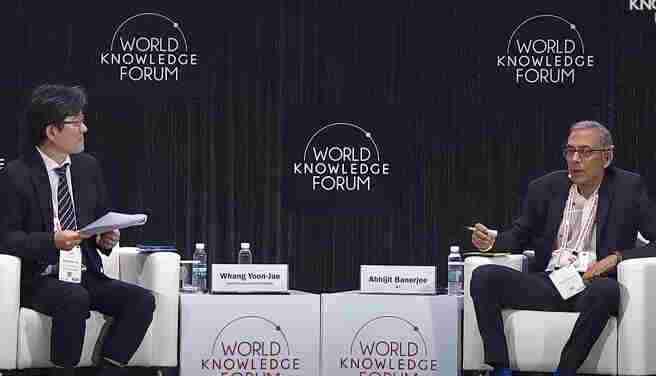
Read the full transcript of economist Abhijit Banerjee’s talk titled “The Future of Inequality” at World Knowledge Forum 2024. In the Q&A session, Yoonjae Whang, Professor of Economics at Seoul National University, interviews him.
Listen to the audio version here:
TRANSCRIPT:
YOONJAE WHANG: Good morning, ladies and gentlemen. My name is Yoonjae Whang, and I’m a professor at Seoul National University. And I’m very pleased and honored to have an opportunity to moderate this invite session by Professor Abhijit Banerjee. Professor Banerjee is one of the most famous and respected economists in the world, as far as I know, and so would not need a long introduction to be introduced.
Professor Banerjee is currently the Ford Foundation International Professor of Economics at MIT, and he received his bachelor’s degree at University of Calcutta in India and obtained a Ph.D. from Harvard University. He also worked at Harvard and Princeton before joining MIT.
His work is vast and covers a wide range of topics in development economics. He received numerous honors from prestigious academic societies. Among them, the most notable honor should be the Nobel Memorial Prize in Economic Science, awarded jointly to Esther Duflo and Michael Cramer in 2019 for their experimental approach to alleviating global poverty. They pioneered the use of randomized controlled trials, so-called RCTs, in economics to measure the effectiveness of policy actions, such as government interventions or government programs, in improving individuals’ lives, particularly in areas like education and health care, etc.
Their research had a profound impact on economics and opened a new paradigm for empirical research in economics. Today, Professor Banerjee will talk about the future of inequality and share his intuition on this important topic. He will first give us a keynote speech for about 20 minutes, and then we’ll have some discussion for about 30 minutes, followed by a Q&A session for the audience in the floor. And this section will be finished with short closing remarks by Professor Banerjee.
Professor Banerjee, please go ahead.
Keynote Speech by Abhijit Banerjee
ABHIJIT BANERJEE: Thank you. Thank you very much for having me. It’s an honor to be addressing this very important event, and I’m very grateful to be invited.
My topic is the future of inequality, but I don’t have a crystal ball, so mostly what I’ll talk about is the past of inequality. That’s all we can really talk about because the only guidance we have, in a sense, is past plus some contemporary evidence and some theory. Let me start with the past. In particular, I don’t want to start with the long past.
I just want to observe that we are currently, in many countries, not all actually, I’ll come to that, in a really somewhat exceptional point in the history of inequality. For a range of countries, that includes China, India, Japan, the United States, Korea, and of course many other countries, the inequality that we measure now, let’s say measured by the ratio of the incomes of the top 10% to the incomes of the bottom 50%, are at historical highs. They have never been this high since we have measured data. It doesn’t mean that 600 years ago it wasn’t higher, but since we have had data, so in many countries that data goes back to 1900.
Since 1900, we are now at global heights of inequality in these countries. In many countries, we are more unequal now than we have been in modern memory. There are others where it’s not as striking. There’s a set of European countries like the UK and Italy, which used to have a very large aristocratic class.
So, till about 19 — till the Second World War, there was a lot of inequality. But even in these countries, the current levels are higher than it’s ever been since the Second World War. So, we’re in a place which is unprecedented in some ways. We don’t have a moment in history where we measured the data and it looked like this.
Is this inevitable? Is this something about the nature of economics which makes this necessary? It makes this unavoidable? I think if you look at the recent history, some things seem clear.
One is that while there’s a lot of countries where it happens, and if you look at the global income distribution, because these are big countries, these are countries like India, China, US. The global picture looks more like these countries. But the countries which are not following this trend, and those are not necessarily European social democracies. They are actually countries like Mexico, Brazil, Indonesia, Morocco, Nigeria. These are countries where you don’t follow this trend. Inequality is actually going down in these countries. These countries are flat. And it’s striking that these are countries which historically have had very high levels of inequality.
And inequality has been a big social problem in these countries for a long time. These are the countries where inequality has not gone up in the last 30 years or so. That’s in a sense interesting that it’s precisely the countries that are famous for the inequality. Countries like Brazil, Nigeria, Indonesia. These are the countries where inequality is actually either stable or falling.
I want to make something of that, so I’ll come back to that. Other fact that is very striking is that the timing is quite specific. The inequality falls in all the countries I mentioned at the beginning till 1980 and then goes up. And some of these countries, countries like China, of course, there is a clear policy shift there. China becomes a market economy in 1979 or begins to become one. And so you see why it’s happening. But in others, it’s a turnaround that actually deserves an explanation.
So the bottom of this curve of inequality is around 1980. Now what happens in 1980? One thing that happens, I live in the US, so it’s maybe an overly US-centric perspective, is that Ronald Reagan becomes President of the US and Margaret Thatcher becomes Prime Minister of the UK in 1979.
And the first thing that immediately happens is that the marginal tax rate, the tax rate on the rich in the US goes from 70% to less than 40% immediately.
That was part of the Reagan program, so it’s not saying that this is a secret. This is what was meant to happen. The second thing that happens is that there is a very clear discourse in my field in economics, and I was actually a student in the early 1980s, which is basically saying inequality is necessary for growth. This claim was being made.
So there was a very much political and pseudo-scientific perhaps argument saying inequality is, don’t worry about inequality, inequality is the nature of things. By not allowing inequality, we have actually slowed down growth. To have growth, we’ll have lots of inequality. I think I want to make a distinction within that statement between countries like China and North Korea now, which have an economic system which very, very strongly discourages inequality by controlling every economic activity, and so when you open up the economic activity, some inequality will be created, and countries like US, which were always free market economic.
Is it actually true? So the claim was very much that inequality is needed. I’ll actually say one more thing. The other thing that happens, taxes go down, is that inequality, because it becomes legitimate, within firms, the CEOs start paying themselves very high salaries.
The ratio of the CEO’s salary to the salary of the lowest paid employee in large firms goes from a factor of 60 to a factor of 6,000. A hundred times increase in the ratio of the CEO’s pay to the pay of the workers, the lowest paid workers. So that’s a number that is rather, and this is a consequence of an ideological move, which says that it’s legitimate. The CEOs deserve, because they are producing so much, they deserve this pay, and that workers are not very useful, so they can be paid less.
So it was a clear ideological move that made it happen. Is it actually true that inequality generates growth? So of course the obvious example is what happened in the US and the UK after they cut taxes and let inequality explode. The reason they did it was that growth was slowing in this country.
The fast growth period from about 1945 to 1972-73 stops, and the countries are worried that growth is stalling, so they decide that they have to increase inequality. To do that, inequality goes up massively. As I said, growth does not. Growth remains exactly, well, it goes down and stays down.
Across the world, you can look at the correlation between changes in inequality and changes in growth, and I have some research on this, and there is no correlation. There is no relationship. If you look at the level of inequality and the level of growth, meaning, do more unequal countries grow faster? The answer is no, they grow slower.
Maybe that is spurious, but certainly there is no evidence that increasing inequality promotes growth. Is there a very strong theoretical argument for the relationship between inequality and growth? Well, there is an argument, which is the typical one that Ronald Reagan, for example, used, which is the argument that you need incentives. I am not about to say that you do not need any incentives, but the elasticity of effort, how hard you work as a function of the tax rate among rich people is very, very low.
And that is not surprising. If you look at the recent biography of Elon Musk, it says that he is obsessive, he cannot stop working. It is not an accident. These people got there because they are obsessed with working, and that is what you see very much, the elasticity of…
Now, what happens when you raise tax rates, they stop paying taxes. They move the country money to tax havens, so they do not pay taxes. But it is not that the tax collection goes down, but I will come back to that point at the end. But it is not because people are not working, it is because they are just cheating the government.
At the bottom of the distribution, the other side of this is at the bottom of the distribution, redistribution, which also gets lowered by this. Of course, once you stop collecting taxes, then you cannot redistribute, so redistribution goes down. The evidence suggests that if anything, these have very positive effects. And you can see that US as a country, when it used to be much less unequal, it used to be a country which was much more socially mobile than most European countries.
Some, you can measure social mobility in many ways, but there are measures by which US was twice as socially mobile as continental Europe. Now it is half as socially mobile. Social mobility, so because poor people are unable to make investments, they do not move out. For example, in the education of their children.
You also start to see that the concentration of wealth now is really so dramatic that it is having effects on competition. I talked about the income shares of the top 10%, but a lot of this story is about the top 0.0001%. About the top 1000 people in the world, their income growth between 1995 and 2021 was 2.5 to 3 times that of the top 1%. So the top 1% are very rich, but the top 1000 people, their income grew 3 times as much as those very rich people.
So the very richest people, their incomes are growing very very fast. That reflects wealth concentration and these enormous companies, global companies that you all know about, and these companies are extraordinarily profitable, but the correlation between profitability and investment has gone down massively. So it used to be that when you are profitable, you invest. But if you are profitable because you have a monopoly, then you don’t need to invest and they don’t.
And that’s what we are seeing. So productivity growth, this as a force for productivity growth, this is a negative force. Finally, I think of course there is the political consequences of this growth in inequality. If you look at where did Trump get most of the votes, much of his votes, he got those votes from places where real wages growth was the lowest.
And that’s not surprising. It’s exactly what you would expect since he came on an anti-globalist platform. But this means that a set of policies are being framed by this conversation where the victims of increasing inequality are voting for people who are then not necessarily taking, who are taking populist policies. So all of this makes me think that there is no very good argument which says that inequality is essential for sustaining growth.
Why is inequality going up? Well, I think there are several things happening. One is, I told you a little while ago that the rich are getting enormously richer. The very rich are getting enormously richer to the point where they can’t spend the money.
I did a small calculation of how long it would take to spend the money if you were buying let’s say a car every month or something and you couldn’t spend the money by buying an expensive car everywhere. You could buy a Ferrari every month and Elon Musk wouldn’t even notice the difference. They cannot spend the money. That’s why they are spending money on going to Mars because there is no other way for them to spend the money.
There is no consumption. So that’s reflected in the fact that if you look at the wealth share of income, how much of your income is coming from wealth, then even for the top 1%, increasing share of their income is coming from wealth. It’s not coming from their labour, it’s not coming from their job, it’s not coming from their skills, it’s coming from their wealth.
Structure of global trade is another thing. So in a sense, these are vicious cycles. As people get richer, they can’t spend the money so they get even richer. As people get richer, they demand higher quality goods, they demand branded goods. And as they demand branded goods, the companies that control those brands, and I don’t necessarily just mean Samsung, I mean all the companies that are in that supply chain of Samsung, but still a small set of companies are getting huge economies of scale.
They are growing extremely fast. A set of global brands are growing faster than the global economy by many times. And that reflects, and those companies are becoming incredibly profitable. And again, because they are becoming profitable, inequality is going up.
Inequality is going up means the demand for the goods they produce is going up. So there is a certain vicious cycle there. What’s going to change? Right now, I don’t see a, I think that both the tendencies I mentioned, one is the fact that the rich are making so much money that they can’t spend it.
And the second, that the structure of trade is one that favors global brands. Neither of them is about to change unless we change inequality. The second thing that’s happening is AI. And I think the evidence from AI is very tenuous because we don’t really have a lot of AI.
But to the extent that there is evidence, the sectors that were more ready for AI have had less wage growth. So the workers are losing. That’s not surprising, but I think that what’s interesting about AI and maybe different is that the set of jobs that AI is going to take away are going to be jobs that are middle skilled workers, not the lowest skilled workers, not the people who are flipping burgers in McDonald’s, but the middle skilled workers across the world. So these are people who are among the best paid people in countries like India, and they are the ones who are going to be clearly, directly in the line of losing their jobs.
So that’s a separate problem. It’s not the problem of the very poor getting poorer. In a sense, AI might actually help the very poor by making health access better. It’s the middle classes, and the middle classes in the US, for example, who are going to get hurt. And the accountants are going to get hurt because AI will do accounting better than them. And that has major political consequences.
The last piece of the story is that if you look at what’s happening to elite education, it’s getting incredibly expensive. All over, there’s a global demand, and that’s a consequence of the fear of AI.
The fact that if you don’t have elite skills, you won’t have a job. And so, education everywhere, the price is growing much faster than global GDP, and as a result, only the rich can afford it. There’s an article in New York Times yesterday saying that if you look at the people with the same SAT scores, the children of the top 1% are 2.7 times as likely to be admitted to an elite institution than the average, and for the bottom 20%, that’s 20% less than the average. And so, from AI to a demand for elite skills, and from elite skills to elite schools, and a mechanism for exclusion.
What do we do? I’m going to spend very little time on that. Maybe we can talk about that as we go. I think the first thing is we need to change the tax treatment of AI, of investment. Investment is subsidized. New investments, many countries subsidize investments. Investments right now are taking form of AI. So, the substitution of AI for workers is actually tax subsidized.
Secondly, the tax subsidy is actually very largely underestimated, because when a worker loses his job, the state supports him. That’s not in any capitalist calculus. And therefore, the 25% of the worker’s income or 30% of the worker’s income that the capitalist, now, he doesn’t pay the worker, the worker has been fired, the state is taking care of him, that 30% is also a tax subsidy, effectively. So, we’re really creating, we have a very distorted pricing of AI.
Second, I think we have to directly take on capital accumulation, wealth accumulation. Wealth taxes and estate taxes are needed. And to do that, we need to think of tax havens. I think there should be a global agreement to ban tax havens, personally.
I’ve been saying this for 15 years. There’s not a lot of take up, but there’s a little bit more interest now in that idea. It’s really essential. One place where AI can be very useful is in identifying where, in the near future, we’re going to see major shocks.
Where will the jobs disappear? If we know that, we can anticipate that, we can actually help people move out of those sectors. Anticipate it, build it in, create, retrain, subsidize. So, I think that’s actually going to be very critical.
And while there are programs like that, and the US has what is called the Trade Adjustment Allowance, they are really not used. So far, people just, when they lose their jobs, they lose their jobs. And that’s part of the reason for Trump’s support, for example. And let me just, the last thing I want to say is that I think, and we need to redistribute in ways that are less humiliating.
I think the idea that unemployment is your fault is something that has to go, especially if AI is the source of it and global trade is the source of it, then we really can’t let people blame themselves. In the US, the death rates among the white population in the last four years have been so high that the white population, for the first time since 1919, the life expectancy of the white population is falling. And it’s a consequent combination of drugs, alcoholism, suicide. If we want, if we think that the middle classes are going to be hurt a lot, and these are people with a lot of self-worth, then I feel that we need to do something about it.
So I realize that I didn’t cheer you up a lot, but maybe we can talk about policy solutions as we go from here. Thank you.
Q&A with Yoonjae Whang
YOONJAE WHANG: Thank you. Thank you much for your insight.
And Professor Banerjee told us that the global inequality is worsening significantly and it causes a lot of problems worldwide. So I think this is no exception for Korea. So let’s talk about the inequality situation in Korea. Before doing that, I must confess that I’m not an expert in development economics, so I’m not familiar with literature.
ABHIJIT BANERJEE: You seem to know a lot, actually. I saw what you wrote.
YOONJAE WHANG: Well, I looked at the dictionary of the definition of inequality, and it says that inequality refers to unequal or unjust distribution of resources and opportunity among members of a society. So I think this concept has different meaning in different contexts, and it’s not easy to measure, but I think all the concepts are kind of related.
So I think in any case, it is bad for society, because it weakens the strong bonds among people. Also, it leads to political polarization and restricts social mobility. Also, it may lower economic growth. You said they are not correlated, but I agree that inequality does not boost economic growth, but excessive inequality may hamper or disturb this economic growth, because you have conflict, social conflict.
And as you know, Korea is well-known for its rapid economic growth and social cohesion. And one of the sources, I think, of the social cohesion is that this society is very homogeneous, very homogeneous with most people of single race. And this homogeneity also makes this inequality matter a lot in our society. So there is a famous Korean proverb saying that if my stomach hurts, if my cousin buys lent, that means that I’m super jealous of the prosperity of other people.
So in that sense, inequality matters a lot in Korea, and people care too much about others’ behavior. So thank you very much for raising this issue today in Korea. So before we start, let me give you some statistics on welfare statistics. So in Korea, income inequality and relative poverty rose substantially, especially after 1997 Asian financial crisis, and have remained persistently high in recent years.
So if you look at the Gini coefficient, which is a measure of income inequality, it is like 0.333. It’s a bit increasing. And income quanta share ratio, which is the ratio of the top to the bottom 20% income, is like almost six times. The bottom top 20% owns about six times more than the bottom top 20% people.
And the relative poverty rate, which is the proportion of people with less than 50% of the median income, is 15%. So these numbers are relatively very high in OECD countries. Also, we are experiencing rapid demographic changes because of population aging and low birth. So proportion of the population over 65 now is 17.5%, which is already very high, and they expect it to increase to 46% in 2070.
So almost half of the people in 50 years from now will be over 65. And total fertility rate is extremely low, lowest in the world. It’s like 0.78. So given this situation, we are facing a substantial pressure on public spending for this welfare.
Also, we have another restriction because we have a geopolitical risk because we are facing North Korea. So we have to be very cautious in increasing the public spending too much on welfare. So given this restriction, it would be very important to find out cost-effective solutions to reduce inequality and strengthen social safety net. So I would like to discuss some policies to reduce these inequalities and promote social mobility, especially in Korea because you are in Korea.
But before I start, maybe I have a personal question. So you are an expert in development economics. How did you become interested in development economics, especially in elevating poverty issues? Do you have any motivation?
ABHIJIT BANERJEE: Well, you know, I grew up in India. In fact, maybe just by accident, even though my family was perfectly, comfortably middle class, I grew up right next to one of the biggest slums, literally right next to the last house. My grandfather very cleverly bought a plot which turned out to be one of the worst investments you could have made. It was right next to a slum.
So it was very hard to sell the land. And as a result, I had lots of exposure to poverty from day one. I can’t remember the time when I didn’t know about deep poverty. So this is in the 1960s when people in India were much poorer than now. I mean, we lived next to the same place until very recently. So I saw the change. And even though, you know, there are many, many things that I’m not satisfied with, it’s clear that the very poor, all over the world have become less poor in the last 40 years. You see that very much.
Everybody has clothes. Everybody doesn’t look like they’re starving. Some changes have happened. But it was very much that. So I don’t think I had a choice. If you’re an economist and you grew up with that, it’s hard to imagine sort of saying, well, no, I’m going to… And in fact, I’m trained as an economic theorist. And I was even…
I taught economic theory for many, many years at places like MIT. So it’s not particularly because this was my training. In fact, I had no training in development economics. I trained myself. But in the end, it was very hard to resist that compulsion.
YOONJAE WHANG: I see, I see. I heard that both of your parents are professors of economics.
ABHIJIT BANERJEE: Correct.
YOONJAE WHANG: And it’s very depressing that professors in India don’t make so much money.
ABHIJIT BANERJEE: So it was… We were… In a sense, we had a very… Everything was very, very, very close to being the margin. Always.
YOONJAE WHANG: Okay. So the next question will be on old age poverty.
ABHIJIT BANERJEE: Okay.
YOONJAE WHANG: So poverty in Korea is concentrated mostly among elderly. And relative poverty rate among the elderly, which has aged more than 65, is OECD average like 13 percent, which is very high, highest in OECD countries. So the Gini coefficient for the elderly group is also very high, which means that there is a lot of income inequality among the elderly population as well.
So I don’t have any data on absolute poverty, but it’s likely to be significant, especially for the elderly living alone without family support. So Korea has some — like basic livelihood security program or basic pension system. But so far it has been insufficient to prevent high poverty rate.
ABHIJIT BANERJEE: Most of it is still contributory from pension?
YOONJAE WHANG: Pension. So we have basic pension also, national basic pension.
ABHIJIT BANERJEE: But then there is contributory pension. You base it on your income from what you accumulated during your working life?
YOONJAE WHANG: No, this is different. That is called just a national pension. This basic pension only applies to elderly. It gives to about 70 percent of elderly people and it gives about 300,000, like 230 US dollars. So it’s given almost all elderly. We also have national pension, so it depends on how much you accumulate throughout your life. But it was introduced relatively late recently.
It started in 1999, so many of the elderly cannot receive the pension. So that’s why the cause of the poverty. So government is now trying to reform the pension system, but has not made a big progress yet and the result is coming from intergenerational conflicts, as you can imagine, because younger generations may have to pay more and receive less to sustain this pension system. It is difficult for the young people because after the pandemic, the housing price increased a lot and young people cannot buy houses, so they cannot marry.
They cannot get regular jobs. So that caused a lot of frustration among young people, and they tend to have extreme self-perfection. In Korean, it’s called isaengmang. That means that this life is hopeless, this life is doomed, something like that. So we have some intergenerational conflicts and the problem with the pension system, so what caused you to currently deal with this old age poverty problem and solve intergenerational conflicts.
ABHIJIT BANERJEE: I mean, I think part of the, just to say the obvious, the reason why Korea has this and China will have it too, is because these are countries that grew very fast at some point. So the people who retired 20 years ago had a lifetime earning stream — whether they saved that money or they saved in the national pension, the lifetime earning stream was very low relative to the people who are earning now. So fast-growing countries kind of inevitably have this problem.
So the good news there is that as growth slows, the problem sort of somewhat solves itself. So it’s relatively, you know, because then the inequality goes down because the young are not much richer than the people who are reaching, reaching pension age now had high wages for a long time. Whereas people who reached pension age 20 years ago had high wages, never, almost never had high wages. So therefore, I think the problem will be solved.
Part of it will be solved. That’s the good news, I think. That’s the demographic demographer’s point of view. But I think there is some truth to it.
On the other side, I would say that the, I think again, rather than taxing, I think taxing profits, profits are growing as a share of GDP in Korea as well. And wealth is growing as a share of GDP. And that, both of those are direct targets of taxation. So I would say that, you know, my views are that you should take on wealth and profits.
I think that’s where the leverage is.
YOONJAE WHANG: OK. Thank you very much. So we have other questions.
But we only have three minutes. So, well, so about racial inequality, so given the rapid demographic change, many people believe that Korea should pursue an active immigration policy.
ABHIJIT BANERJEE: Yeah.
YOONJAE WHANG: So we should get high-skilled immigrants, for example.
But there are also concerns that immigrants coming from Korea may take away jobs from Koreans. So also, also Korea is moving toward multicultural society. It has been very homogeneous society with a single race for a long time. So there is some hostility against immigrants.
So some people even suggest that differentiated minimum wages should be provided to foreign workers to protect welfare level of the existing Korean workers. So what would be appropriate policy for immigration?
ABHIJIT BANERJEE: You know, I think most countries that have actually, you know, the history of immigration is always this. The U.S. , you know, in Boston where I live, the Italians and the Irish, white people, were seen as being, you know, they were described as being black people, as being, you know, immigrants from Africa. The Italians were described as being, they’re coming from Africa. There was prejudice which then, of course, the Italians soon became integrated into society and then the prejudice moved to the next group, the Mexicans or something.
So the history of integration is always that there will be more fear than, and then you forget that that was your fear and then you start fearing something else. So that’s the, I think, one thing to say. There’s a long history of this. The other part of it is that I think that given how much Korea is going to age, whatever you do in a sense, and if you then want to introduce child care and have an aging society, there’s going to be huge demand for old age care and child care.
These are two jobs where you need enough people to do them. So I do feel that there is a real space and opportunity precisely because of that, that we need people. I mean, if you look at where the Syrians are working in Germany, they’re working, a lot of them, the women especially, are working in old age care. Germany is also an aging economy. And that’s not crazy.
YOONJAE WHANG: Thank you very much. I have other questions, but maybe I should start with questions from the floor. So any questions?
AUDIENCE MEMBER 1: Hello, Professor Banerjee and Professor Whang. I’m a grad from Cornell University and I’m working at LG Corporation right now. My questions are twofold. So first, usually in development economics, we see high inequality and very high fertility rates.
But in countries like China and Korea right now, we see persistent inequality and extremely low fertility rate. And I am wondering how low fertility rate would be impacting inequality in the future. And my second question is, you’ve mentioned low fertility rates and simultaneously rapid population aging. And do you see these two forces being inflationary or deflationary? Thank you.
ABHIJIT BANERJEE: Inflationary, it’s mostly monetary policy. I don’t think these are per se. I think the real issue, I think the one you’re pointing to, is the the connection to inequality. And I think there are two directions.
One is that I think it’s what’s going to do is it’s going to eventually you’ll have wages catching up because there’s no way to the workers will be scared. The second thing is the intergenerational question will be critical because there will be an aging population who will need not just money but services and how you will redistribute money towards the elderly will be a critical part of the inequality story.
YOONJAE WHANG: Another question? Okay.
AUDIENCE MEMBER 2: Hello. Thank you so much for your presentation. I work for the UN on violence against children. I wonder what your position is regarding how the climate crisis is also affecting inequality and the future of inequality. Thank you.
ABHIJIT BANERJEE: I could in fact, two days ago, give a one hour lecture on this. I can go on and on. It’s certainly going to be, I think, both in terms of the employment opportunities, it’s the world’s poorest people who are going to suffer. It’s very clear. The geography of the climate crisis is very, very clear. The poorest people will suffer, poorest people will die. And there is really right now almost no mechanisms for redistributing at a scale that will be needed to even mitigate this to a significant extent.
YOONJAE WHANG: Given the time constraint I think we should stop here. Do you have any final words?
ABHIJIT BANERJEE: Only thing I want to say is that while we — I didn’t paint a very cheering picture, I do want us to not lose hope. We need to keep trying. We as humanity have been creative. We need to solve this problem. Many of you look very young to me. You have the responsibility of taking care of the climate crisis and finding solutions for the world. Thank you.