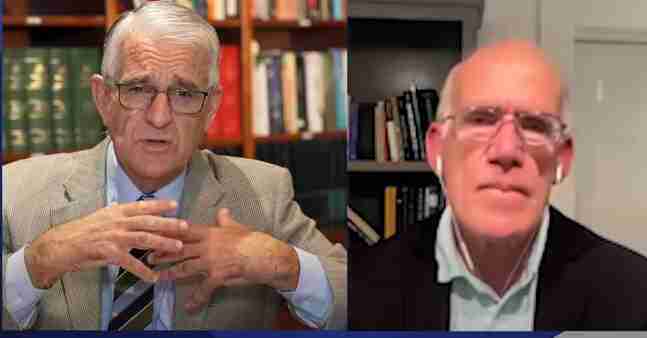
Read here the full transcript of a conversation between former Deputy Prime Minister of Australia John Anderson and military historian Victor Davis Hanson. This conversation was recorded on Wednesday the 18th of October, 2023.
Listen to the audio version here:
TRANSCRIPT:
JOHN ANDERSON: It’s an enormous privilege to talk to Victor Davis Hanson from Stanford University, the Hoover Center at Stanford University in America, California. He, of course, is an internationally respected historian, writer and occasional guest in these conversations. What he has to say in this is of profound importance. Victor, thank you so very much for joining us. Can we just begin very broadly why this attack on Israel and why now? And then we’ll unpack that further.
Reasons for the Attack on Israel
VICTOR DAVIS HANSON: Well, the general reason why attack, I think that there was a perception, a general perception and we can go to why now in October, but there was a general perception in Israel that they had they had never been wealthier. They have never been more successful. I’ve been there the last two summers. I talked to a lot of people in the government. There was a general perception on the Israeli part that they had 20,000 gas workers coming in every day nearly and that that argument they had accepted that these people were very well paid and they were supporting another 100,000 in Gaza. They were ready with the renewal or the rebooting, I should say, of the Abraham Accords.
There had been kind of a you talk to Israelis. They were kind of relieved that the Iran deal effort to 2.0 had failed. So I think there was a general sense on the Israeli part at complacency because of their sheer success. It was almost talking to a lot of Israelis that they thought we’ve been so magnanimous now with bringing in gas workers and we’re reaching out to the Arab world that they’re going to look at our success and they’ve never been wealthier or more successful. It’s a stunning country to see just versus 20 years ago.
It’s got a higher standard of living in many ways than we do here in the United States. And I think they thought that magnanimity would be reciprocated in kind rather than a source of envy and anger that would create a nihilism about people who were not able to do that. And that’s just the general atmosphere.
Hamas’s Perspective
More specifically from the Hamas side, I think they looked at the huge left wing demonstrations against the Netanyahu government. There were reservists who were not reporting for annual call-ups. There was a sense that Israeli society was bifurcated. They wanted to stop this Abraham renewal that was clear and they felt that Iran had been given a blank check and they had more rockets and Hezbollah would help them. And that all gave them a sense that the Israelis are not going to be, they have no idea what we’re up to. We’ve been planning this a year. We’re going to stop the Abraham Accords. We’re going to really shock the world.
The Role of the United States
And then the final third player in this triangle is of course the United States, John. And we in this administration had put Robert Malley in charge of the Iran deal. He has now lost his job. He’s lost his security clearance. He was obviously loose and that’s a euphemism with classified documents. He brought pro-Iranian nationals and Iranian Americans into the state department and that sent a message to Iran that this administration really did want to appease them. They were begging to go back in the Iran deal.
The Afghanistan disaster, the 50 billion in weapons, the Ukraine invasion of Putin, our open border, the Chinese balloon, it all cemented a picture that Hamas, Hezbollah and Iran had formed that the United States either could not or would not do what they did, say, the prior four years under Trump. They knew they would not do something like bomb the blank out of ISIS or kill Soleimani. And they thought it was an opportune time and they didn’t think they’d ever have a time like this again.
Impact on Israel
JOHN ANDERSON: So if we can examine those three major players for a moment, just drill into it. As you say, a very, very prosperous Israel, asleep at the wheel to external dangers, deeply divided it seems over reforms to their legal system. What impact in your judgment will this horrific event have had? Will it be galvanizing? To what extent will it be galvanizing? What sort of willpower and capacity will emerge in your view?
VICTOR DAVIS HANSON: I think that their original plan was to go in and take 100 or 200 captives, which in itself would be a coup and kill some soldiers. But in their bloodlust, they not only killed over a thousand civilians, but they desecrated, mutilated their bodies. They attacked women and children. They burned them. It was pre-modern. It was pre-civilizational. Reminded me something of what I learned all these and as a count of the Aztec human sacrifices and mutilation.
And so they really inflamed Israel justifiably in a way that we had never seen it before. And they’ve woken up. And the reaction is going to be exactly like the Yom Kippur, except to the nth degree. And I don’t think Hamas understands that this is the first time in our lives, John, that there’s no restraint to speak of. I know Joe Biden will go over there and he’ll say, do this and do that and do that. But he’s not going to stop this righteous retribution of Hamas.
International Response
And then Hezbollah is talking, talking, talking, and Iran is talking, talking, talking, and beating their chest. And tomorrow is supposed to be a day of reckoning, but they don’t understand that they’re widely despised in the Western.
The second thing is that Joe Biden is not leading events. He’s being driven by events. And if they have 10,000, 100,000 rockets, I should say, in Lebanon, does Hezbollah, if they get full of themselves and they send, I don’t know, 5,000, 4,000 at the U.S. fleet, perhaps one might hit it, a lot might hit it. And they don’t understand that there is a, there’s no patience with them anymore. There’s no restraint on the United States.
Global Dynamics
Russia is bogged down in Ukraine. China has one, two, China has two concerns, one, anything that hurts the United States, they’re up for. But number two, that what overrides that initial, initial agenda is they don’t want 40% of their oil disrupt. And they don’t want a big war in the Middle East, not right now with economic difficulties. And what that means is the clients of Iran are not going to be eager to get into a war with the United States or the West in general. And so Iran has no client, it has no backup. And I don’t know if they know that they keep thinking because of the weakness in this administration that it’s systemic, and it will continue forever. But I don’t think that Joe Biden will be able to stop the righteous anger if they do something stupid. And they may well do something stupid, because we’ve lost the terms.
America’s Resolve
JOHN ANDERSON: The question of willpower is one thing. And this is very interesting that you’re seeing, as you say, perhaps we’re being dragged to it rather than leading events, but nonetheless, as the Russians discovered, and now the Middle East is observing the rest of the world is observing, you know, when it comes to foreign affairs, when it really comes down to it, America is still resolute enough to stand up, it has the willpower. That seems to be one of the great messages out of this.
VICTOR DAVIS HANSON: I think so. There’s a weird calculus going on, because there are people in the Democratic Party, not their crazy lunatic squad base, but are very strong supporters of Israel. And they are shocked by this nihilist, blood-curdling support for Hamas’s barbarian savagery. And they want Israel to retaliate. That’s not coming from the conservative or the right. That’s coming from mainstream Democratic Party. They are telling Joe Biden, you’ve got to let Israel go and do what they need to do.
And that’s, that’s very, that’s very new. And when you have a Democratic president, I don’t think people abroad fully comprehend, you have no, you have no restraint. Typically a Republican or conservative administration wants to have deterrence, and then the left, almost in Pavlovian fashion, says this is imperialistic, neo-colonialist, provocative.
Trump killed Soleimani, he got blasted for it. Trump bombed ISIS, he got blasted for it. But when the Democratic people are in, there’s no restraint, because no Republican would say please don’t hit Iran, or please don’t hit Hamas, and we have the members of their own party who are outraged about what happened to Israel, and what Hamas and Hezbollah and Iran are saying, not only about that, but what they’re going to do in addition, in addition to that.
I don’t see, when I look at the landscape here or abroad, I don’t see any restraining voice that’s going to say you better not do that or else, or you can’t do that because that would be amoral, or it’s against UN rules of war. There’s nothing, I don’t hear any of that. So we’re just seeing, really if you think about it, the ball is in Hezbollah and Iran’s court. They have the braggadocio and the bravado, and we’re just going to see if they really want to go to war.
Regional Implications
I don’t know if you saw the economics minister of Lebanon not too long ago, I think four days ago, said if there’s a 2006 war again, we’re going to be back in the dark ages, because we’ve spent almost 17 years and we haven’t recovered yet from the damage the Israelis did. And that was a scenario in which most people thought Israel didn’t do well in the 2006 war. If Hezbollah showers Israel with missiles, they will make Beirut look like a moonscape, and they know it. And I think Iran, if Iran thinks that Hezbollah and Iran will destroy the Jewish state, I think at that point they’re sorely mistaken, because Israel will go, as I said, medieval on them.
Israel’s Military Capacity
JOHN ANDERSON: Can I ask, then, that raises the question about the military capacity of the Israelis. I don’t think anyone would dispute massively powerful in terms of technology, their air force. They have six very heavily armed submarines, and I understand a couple of them have their missiles, missile firing capacity, aimed right at Iran, as we speak. But the idea of a house-to-house, almost room-by-room guerrilla warfare with a bunch like Hamas, how well-equipped are those massive numbers of reservists and so forth? It goes, we’ve covered the issue of willpower. What about capacity to actually do it? I take it that Hamas will have set every imaginable and horrific booby trap you could ever imagine.
VICTOR DAVIS HANSON: Well, I think it’s going to be a little bit like what the Americans did in Fallujah or Mosul. I was embedded twice in Iraq as a journalist, and they didn’t do what everybody thought they were going to do, just charge in there. They cut off certain sections of the city, fragmented them, and then they had civilians go out, and then they had a combined air and ground assault. But they didn’t go into individual houses. They blew out the stairways in most of the houses I could see.
So I think what they’re doing is they’re saying that Biden, they don’t want to do it with Biden. They don’t want to do it because of the weather. I think they’re getting ready, and they want the Hamas people to stool. I know that’s counterintuitive, because people say, well, you need to do it when this horrible massacre is fresh so the world doesn’t forget it. Yes, but I think they are going to fragment. They’re going to go into a section of Gaza City, and they’re going to kill the people that need to be killed, and then they’re going to destroy all the tunnels and infrastructure. And then they’re going to go into another one and another one, and they’re never going to know which one they’re going to go into, rather than just a whole swarm.
I could be wrong, but I don’t think they’re going to do what everybody thinks they’re going to do. And I think it’s going to be pretty sophisticated. And we talk about Fallujah, but when you walked in Fallujah after the Americans took the city, you can see how they took it. Almost every house had a hole about the size you could drive a car through, where they didn’t say, we’re not going to go up the stairway and fight it out with these guys upstairs. They just blew apart the stairway and tapped the wall, and they went to the next one. And then they came, after about a day or two, they got rid of the people that were trapped up there. So I think the idea is that rather than saying, you’re going to go into these houses, you’re going to find ways to make sure they’re trapped in those houses, and they’re vulnerable.
Israel’s Military Strategy
VICTOR DAVIS HANSON: And sort of what, you know, when you say door-to-door, they went against individual civilians, but Hamas went into these towns and they trapped people in their home. And then they closed the doors and fired them and did stuff like that. Some of the people, a few of them were armed, but it was very effective, unfortunately. And I think we’ll see something like that.
But the biggest problem they’re going to have, it’s a subterranean war they’re going to have. These tunnels go down to 200 feet before they go in the horizon, and they’re going to have to find them, and they’re probably going to be stocked with hostages and who knows what, booby-trapped, as you say. But I think they can handle it because there’s not, I just don’t think Joe Biden politically will be able to say to them, you’re not going to be able to do this. I think he’s going to try to say, we’re not worried about humanitarian things, we’re going to give supplies, but secretly they’re going to be able to do what they need.
And I can’t think of a time, maybe you can, in our lifetimes when somebody said, we’re not going to restrain the Israelis. They’ve always been restrained. But I don’t see the restraint on the horizon anywhere now. Not in terms of superpower nuclear deterrence, not in terms of public opinion in the United States, not in terms of the left in the United States, not in terms of Europe. I don’t see where somebody, some strong voice is saying, you better not do this. It’s just not going to happen.
Global Reactions and Anti-Semitism
JOHN ANDERSON: We are seeing this sort of wobbliness, I suppose, this lack of moral clarity, nonetheless, amongst a lot of people who I think leave themselves open to the charge, if I may be so bold, as being seen, painting themselves really as anti-Semitic, it seems to be at the base of a lot of this, when our own foreign minister, I don’t accuse her of being anti-Semitic, but she did call for restraint. You’ve seen those sorts of calls.
And we’ve also seen horrific demonstrations here with people mounting protests where they’ve been celebrating the horrors of all of this. I suppose the question that arises out of that is just how much tolerance, just to push back gently, there will be if this is protracted and ugly and there’s heavy loss of life. And a lot of it comes out of a very deep misunderstanding about what the real situation in Gaza is and the West Bank, who the Palestinian people are, and the fact that they’re not the same as Hamas. Hamas is another even uglier iteration of extremist Islamic behavior.
One of the great problems we’ve got is that, of course, the left-wing media across the world essentially doesn’t like Israel. I’m wondering whether that is encoded for a streak of anti-Semitism in them, and they haven’t actually revealed to us the true nature of this evil and the real natures of the battle.
Shift in Media Coverage and Public Opinion
VICTOR DAVIS HANSON: That’s all true. But when you see CNN and Anderson Cooper doing a documentary about the horrors that took place, the mutilations, the torture, the burning of people in the kibbutzes, I’ve never seen CNN do something like that. It was just damning that appeared yesterday. When you see wealthy left-wing donors to Harvard or to University of Pennsylvania say, we’re not going to give any more money, none. You see silk-stocking law firms say, we want the names of all the people who supported Hamas. We don’t want to hire them.
Where I work at a very, very liberal university, and I think it’s the most left-wing of any major university, Stanford University, but when you have a lecturer tell Jewish students to stand in the corner and see how it feels to be on, and he’s summarily put on, what academics do is they put them on leave and they never hire them back. Once you’re reprimanded by that, that’s equivalent to a firing, and we did that immediately. I think higher education in the West in general, but particularly in the United States has embarrassed itself. People were shocked.
Immigration and Assimilation Concerns
They said, we had no idea the level. This kind of ties into the demonstrations we’re seeing in Los Angeles and New York by first and second generation immigrants from the Middle East. A lot of people now are saying, well, what did you expect? We have an open border with 8 million people came through. We’ve had two years of just a lax immigration. We have no assimilation or integration confidence. I think it’s really shaken up Americans, and there’s not a lot of tolerance.
Yesterday, Governor DeSantis said that he wanted nobody coming in from Gaza or the Middle East as refugees. I think that that will be almost politically, because he said in a blanket fashion, and he didn’t retract it, that they were an anti-Semitic group of people. He didn’t want them in the United States. Well, that would be politically toxic just to say that a month ago.
Changing Political Climate
And so I don’t think that it’s kind of like 9-11. It builds very slowly, but this time I don’t think people are going to say, we need to go over to the Middle East, and we need to do what we did in Afghanistan, Iraq, and try to win hearts and minds, and recreate a Western. Nobody’s saying that. If we have to go over there, it’s not going to be on their terms. It’s not going to be house-to-house Americans. It’s going to be an air campaign that they will not welcome.
So what I guess I’m saying, John, is I don’t see any major political figure on there. I don’t see a Nikki Haley, or Ron DeSantis, or Donald Trump, or even Joe Biden, or as Edward Kennedy, anybody on any saying, we’ve got to restrain Israel, and it’s just a cycle of violence. And the people who did do that, there was something in the State Department, Palestinian Affairs Bureau, it was taken down immediately.
Antony Blinken met with the Turkey’s foreign minister and said, we need to talk about a ceasefire. He met with so much criticism that now he thinks he’s George Patton, the way he’s talking. So I guess what I’m saying is public opinion is driving this. And I think the Biden administration, maybe unwillingly, but it’s floating along with it. It can’t stop it.
Iran’s Isolation and Potential Consequences
And that’s what I don’t think Iran or Hezbollah, and we’ll see if they’re smart as they think they are. But it would be very unwise for them to shower Israel or our ships with a pen of raucous, because I think they have the wherewithal to do a lot of damage to both Tehran and Beirut. And there’d be a huge demand in Western publics if that happened.
The other thing I think very quickly, I don’t think Iran realizes how isolated it is. It’s widely despised by everybody. It’s despised by the Arab world. It’s despised by Europe. It’s despised by North America. It’s despised by the English speaking nations of the British Commonwealth. I don’t see, it’s kind of a robes galley. Even Russia and China, convenient allies, they don’t like Iran. They don’t really want them to be nuclear unless it’s going to be an irritant completely without any exception to the United States. So Iran has no friends. Nobody will rue if they do something stupid and there’s a retaliation against them. The same goes for Hezbollah or Hamas.
America’s Reset and Refocus
JOHN ANDERSON: So this is very profound coming from a scholar of your standing who’s frequently despaired, I think, as we all have of American willpower and capacity and leadership in the world. You’re really painting the picture of a very nasty, a very evil jolt having reset and refocused the leader of the free world. That’s what, that’s, that’s, am I hearing you correctly?
VICTOR DAVIS HANSON: I’m not advocating any type of action. I’m just trying to reflect as I see it. I think that being a left from the left and given the record of appeasement with Putin and the disaster in Afghanistan and the lack of reaction to the Chinese espionage escapade, it was a natural inclination of this administration to try to restrain Israel. And we saw that in the first 48 hours with a statement, as I mentioned, of Blinken and on our own state department website and a few other people, Sullivan, the national security advisor, but that there’s something going on that’s carrying them now and they realize that that’s not viable.
So now they’re trying to, at the edges, peck around and say, well, bring back the water or let’s have some type of effort to go into Gaza, but they’re hitting reality. And the reality is that Egypt does not want to open their country to Hamas and they will damn Israel to the, to the skies, but they will call Israel up privately and say, we’re not going to let them in. We want you to deal with Hamas and in a counter intuitive fashion, John, I think the big danger for Israel is if it would go in house to house and get bogged down and then take casualties and then bend to an opportunistic American demand to do some, that will bring Hezbollah in and that will bring Iran in.
If they go in and they’re completely unrestrained and they, as I say, not trying to be dramatic, but they go medieval on Hamas, that will keep Iran and Hezbollah out because they will see the damage that they’re seeing right now. And they will say, do we want that in Tehran? And do we want that in Beirut? And I don’t think they do. And yet they can’t predict the reaction of Israel or even for that matter, public opinion in the United States.
Changing Attitudes Towards Iran
That’s pretty, I’ve been kind of amazed at the statements that are coming out, signing former Attorney General Bill Barr, very worked for the Trump administration, very anti-Trump calling to deal now with Iran. Walter Russell Meade, a very distinguished, sober and judicious Wall Street journalist column saying, whether you like it or not, we’re going to have to deal with Tehran. And you have Lindsey Graham, all these people are, it’s almost, I think they need to take a step back because if we deal with Iran, it’s not going to be tick for tat, stop, go. If you deal with Iran, you’ve got to go all the way. And I don’t know if they’re ready or prepared for that.
The Impact of Hamas’s Actions
But I don’t think that Iran or Hamas or Hezbollah quite understand that when you go into a village, a villages, a country, and you invade that country at a time of a holiday and you deliberately massacre women and children. And then almost as if they’re Aztec captives taken up to Templo Major and Tenochtitlan to sacrifice in the 15th century or 16th century, taking these kids back. It was so horrific and horrifying that I think everybody just said, you can’t deal with these people.
And I don’t think that Hamas represents all of the Gazan people. I don’t believe in collective punishment. But that said, the images that we got here in the United States of captives that were almost like they were in a Roman triumph in a jeep or they were ridiculed and almost a spontaneous crowd spitting on them and yelling and we want more of them. And you never got the impression that Hamas was facing public outrage from Gaza. There was celebration at what they were doing.
And I don’t think they understood that. But Yasser Arafat did right after 9-11 when they were celebrating our loss of 3,000. He stopped it very quickly and started to give blood so people would not bomb, he thought, Jericho or something. But when you see that unrestrained celebration and you see some of it in the United States and around the world among expatriate communities, that only furthers this anger.
It doesn’t make people say, oh, we better pull back. These people are very angry at us. It has the opposite effect. And no one wants to see a four-year-old Israeli boy taken captive and then have a video made of young Gazan children kicking him and calling him a filthy Jew and trying to ridicule, torture him.
The attitude is, whether it’s fair or not, is you can’t work with these people as long as Hamas is there and there’s going to be collateral damage. But they asked for war, they wanted war, and now they’re going to get war. I think that’s the attitude. And I hope that they pull back.
I’m not sure that they’re so accustomed to us being appeasing that they don’t realize that Westerners have this traditional trait that they take it and take it and take it. And then when you get a particular point, they kind of go berserk. And I hope that doesn’t happen. But if they continue to do this, it’s going to happen. One hopes they read the tea leaves because we do need a major reset. The world’s become very unstable.
America’s Global Commitments and Military Readiness
JOHN ANDERSON: Can I ask you? Yes. This does raise again the question, America heavily committed to Ukraine, Europe not stepping up properly. And I’d have to say, I think even my country, although we’ve done a bit long distances, we are away, we haven’t done enough. America’s done all the heavy lifting. Again, America will be doing all the heavy lifting here over and above what the Israelis do.
It raises, well, obviously many questions. One of them is America has reduced its GDP expense on, you know, spending on defense as a proportion of GDP very, very significantly. We hear reports about a lot of American equipment being obsolete or in maintenance or what have you, submarine, very relevant for Australia, submarine yards, not able to keep up with your own replacement program and so forth. What does this mean in terms of America being involved on potentially several fronts?
America’s Global Role and Military Readiness
JOHN ANDERSON: And again, you have touched on it, but how China might seek to take advantage of this or whether they will be wise enough to say, no, hang on, this is a resolved America again. It doesn’t do any good for the president to say, well, we’re the United States, we’re the strongest power. I’m quoting him verbatim in the history of civilization. That doesn’t mean anything unless you are.
VICTOR DAVIS HANSON: And when you look at the $50 billion, a lot of it was small arms, but nevertheless, 50 billion in equipment we threw away in Afghanistan, or I should say handed over the Taliban. And then you see the $120 billion of munitions we’re giving Ukraine. And a lot of this stuff is off the books as far as economic support or other types of aid that’s not really spoken about. And then you see what we’re going to have to give Israel.
Although they’re not, I mean, we’re giving Israel air power munitions and we’re giving Ukraine more ground power munitions. Maybe they overlap, maybe they don’t. And then you see what China’s saying about Taiwan. And then you look at the fact that we’re $33 trillion in debt.
And all I can say is that after COVID and after the George Floyd and the woke movement, we decided we were going to defund the police and defund the Pentagon. So we actually cut real dollars, Pentagon. And we borrowed enormous amounts of money to redistribute lavish. Most of it was ill spent.
And we’re in a terrible financial situation. And we’re under arm given our commitments. In other words, our strategic commitments way outweigh our wherewithal. That being said, the history of this country, if you look at 1917 or 1941, we were more ill prepared to meet those strategic debt demands than we are now.
America’s Potential for Recovery
And it all hinges on at what point does this traditional American light click on. It says, this is an existential period and you’ve got to now rearm to the teeth and you’ve got to change and you’ve got and I can see that coming. And I think this country is very lax. It’s a very strange country, as you know.
But when it finally gets in its head, it has enormous powers of productivity. Its labor participation rate is way under what it could be. There’s a lot of labor that’s not being used. There’s a lot of capital that’s not being invested in where it could be invested very quickly.
And we could really ramp up very quickly if we wanted to. And I think we’re going to do that. And I think there’s a sense now that woke is over with the George Floyd is over with the COVID lockdown is over with it. None of it worked.
And it’s time to get back to looking at taking a hard look at our universities, our educational system, going back to assimilation, integration of different types of ethnic groups and closing the border and, you know, stepping back into reality rather than this two or three year fantasy. And I think someone who’s 70 years old now and watch the United States, it still has that ability to recover and react very quickly. And it always amazes me when it really wants to do something and the amount of talent we have here and wealth if we really want to do it.
And something usually sets it off if Hamas or Hezbollah or Iran do something like they did on October 7th involving either hostages or Americans or Israelis again, I think it will set this country off.
I really do. And I think we’re already on that pathway anyway. I don’t see anybody in the political realm who’s saying we can’t spend this money. Everybody’s talking about, I’m going to spend more money in defense than you.
Everybody’s trying to say, we’re going to have to address the immigration problem. We’re going to have to address the university problem. And I mean that from both sides of the aisle. I can’t believe what the New York Times and CNN have been writing.
I mean, it sounds like for a brief moment in their existence, they believe in America again, and they believe in deterrence, and they believe that the Arab world suffers from endemic anti-Semitism. That’s contrary to the whole DEI doctrine and gospel.
Rise of Anti-Semitism
JOHN ANDERSON: Anti-Semitism has been on the rise in Europe. Clearly, it has been in Britain. It was a massive problem for the Labor Party prior to the last election. And it has here too in Australia. And we had horrendous scenes, horrendous really. The Sydney Opera House, which is no greater symbol of Australia than the Opera House, lit up at the request of the New South Wales Premier, appropriately with the Israeli flag, in my view.
And then you had Palestinian supporters basically rallying and reflecting what are nothing short of Nazi views, really. Gas the Jews. How incredibly inappropriate. We’ve since had some of our green or left-wing politicians being highly ambivalent in their support for Israel.
And we’ve seen Islamic leaders, extremist leaders, celebrating, openly saying, I’m crying with joy for all of this. To what extent do you think hatred of Israel or the belief that Israel is a colonizing power is used as cover for something that’s as ancient as time, simple loathing of one race? Yes. And it seems to me that the very people who scream most about racism and the horrors of it and march in the streets with BLM and so forth are the most ambivalent about this particular form of hatred.
VICTOR DAVIS HANSON: It is. It’s anti-Semitic. And you can even see it in Warren Sidious. I support helping Ukraine, but you didn’t see any major politician on the left say, we have to stop the cycle of violence in Ukraine.
And violence never solved anything. And the Ukrainians better listen to us and stop this cycle of violence. They don’t have a right to retaliate. It’s only Israel that we give both lectures to.
And if anybody said to Ukraine, what’s the cycle of violence solved? Why are you tit for tat? The same type of dialogue they’re using with Israel, everybody would think they were insane. And yet they get a pass by that attitude toward Israel.
Evolution of Anti-Semitism
I think part of the problem is that, and I’m speaking that we’re probably in roughly the same age group. When we grew up in the West, anti-Semitism was more of a kind of a right-wing carryover from the 20s or 30s where people said, you know, the Rothschilds are running the world and it was easily identified. And it was discredited because of World War II, etc. But this is new, the last 30 years.
This is coming, A, from the left, but it’s also coming from the diversity, equity, and inclusion. And that tells me that they feel they are exempt because they feel they’re marginalized people. And according to the doctrine of anti-racism, nobody who is not white can be guilty of being a racist. So they embolden themselves.
And so when we look at what the Black Caucus is saying, or what Black Lives Matter with their poster, verifying a hang glider coming down to kill Jewish children, that’s a poster that they had out. An African-American professor at Cornell today, one at Stanford where I work, there’s this idea that you can say these things on the left and there will be no consequences because you are a post-George Floyd woke victim yourself. And of course, anti-Semitism is anti-Semitism.
Reaction to Anti-Semitism
So I think there’s a very radical change and it’s going to affect because they’re sounding so heartless, and as you say, so semi-fascist or indeed Nazi-like, that people are repulsed by that.
And they were repulsed by the things in New York. They were repulsed by the thing in Sydney. I think the West in general, and you see it in France, especially, the government is outlawed. I think people are saying multiculturalism doesn’t work.
It’s different than multiracial. We are tolerant of races, but we have to have one common culture. Our universities, these demonstrations, they show that immigration that is non-bureaucratic, illegal, but not diverse, as in one region, does not work, especially given the lack of assimilation and integration. And they’re saying something is toxic in higher education.
Maybe we should not give them tax-exempt status for their endowments. Maybe we should get the government out of student loans. We’ve got to do something because this country is not sustainable with that level of anti-Semitism and hatred. So I see the reaction to it is very, I’m very optimistic because I think people are now saying, yes, they’re anti-Semitic, but the problem is even deeper than that.
Shifting Public Opinion
And they showed their true colors when they were on the side of death. They were nihilist, and they were basically celebrating the slaughter of children. And when you get to that point of hatred, something is terribly, fundamentally, systemically wrong with these institutions that allows that. And I think people are going to make some changes, and I think they’re very careful.
I think the squad, we have these radical Islamist Congresswomen, I think they’re very careful now what they’re saying. They’ve got a furious pushback, and they know they have no support for it. When you have a left-wing African-American mayor in New York, Eric Adler, and he sounds like he’s an Israeli now, and he’s damning the hatred and the anti-Semitism in his city. Granted, he has a large Jewish population, but there are people now on the left saying, this is embarrassing.
And these people really do hate Jews. They say they hate Israelis, and anti-Semitism is no longer some crazy guy on the right that’s in the Stone Age. These are left-wing, sophisticated elites, professionals. And they’re ungracious.
Criticism of Anti-Western Sentiment
We have so many first and second generation people from the Middle East, and they come over here. And we’ve been a very generous host to them. We give them prosperity, and security, and freedom. And yet, when you look at what they’re doing, and I say they, because there’s thousands of them protesting on behalf of these Hamas killers, you want to say to them, stop.
Do you think that you could go to Gaza, and you could protest and say, I disagree with Hamas? They’d kill you. You think you could be gay in Gaza? They’d kill you.
You think you could be a lesbian in Iran? They’d kill you. You think you could be trans on the West Bank? They’d probably kill you.
And to come over here, and flee that tyranny, and beg us to allow you to be part of our body politic, and then to voice support for the very things that you fled is incoherent. And so, a lot of people, you hear that all the time. If you hate this country, or you hate everything, why don’t you go back where you want to be, and join in with the Jihad, and you’ll have no freedom, and you’ll have no security, and no prosperity. But to take advantage of all that we offer you, and then to damn your host, and to damn your host’s allies, it’s Western.
Comparison with Israel
It’s so incoherent that it’s really counterproductive for the left. I mean, they say apartheid. When you go to Israel, 21% of the population is Arab. And out of that Arab, I think 11% to 12% are Muslim. They have political parties. They vote. They have freedom of speech. They’re prosperous.
I’ve been to many of their villages, cities in Northern Israel, and compared to anywhere else in Jordan, or Egypt, Syria, Iraq, there’s nothing like it. No Arab citizen anywhere in the Middle East has the freedom to express himself, and to vote, and to worship as he feels as they do in Israel. And yet we’re told by American leftists that these people suffer under apartheid. Everybody knows it’s a lie.
So lies don’t have any currency, finally, because they’re divorced from reality. And I think everybody understands that. They’re getting angry about people who enjoy our hospitality, and our comfort, and our security, and then champion and praise these totalitarian systems that are cruel to people. And yet they lecture us on morality. And yet they’re defending a system, not just that it’s hypocritical, but they would never go back to. They fled those systems. And that’s what’s really aggravating to me.
Potential for Civic Renewal
JOHN ANDERSON: You’ve written extensively. You wrote a book, The Dying Citizen. To some extent, I’m hearing you say there’s an opportunity here. There’s an incentive. There’s a moment when middle America feels this is enough, and we’re going to step up and take back some citizenship. Is that a potential benefit of this?
VICTOR DAVIS HANSON: All the polls show that, John. If you take the controversial figure of Donald Trump out of the equation, and you look at what we’ve talked about, both in the past and currently, what’s your attitude on the border? What’s your attitude about defense spending?
What’s your attitude about the Middle East? What’s your attitude about what happened in Afghanistan? What’s your attitude about crime and defunding the police? What’s your attitude about energy versus cutting back on fossil fuel?
Political Landscape in the US
VICTOR DAVIS HANSON: It’s not even close. It’s 55%, 60% are traditionals. Now, when you put Donald Trump into the equation, and even though his four years were vastly superior because of what the media has done to him in his own controversial nature, then it gets problematic. And that’s something that the Republicans will have to deal with, just as the Democrats are going to have to deal with Joe Biden and come out with Harris.
So, if we take the personalities out of it, and you see what the issues are, the country is center right. It always has been, and it’s never more so now. But to reify that or to translate that into a political figure or a political party gaining power to enact that center right agenda is another thing altogether, given the media and the personalities.
Australia’s Recent Referendum
JOHN ANDERSON: We just had a fascinating thing in Australia happen. We had a very heated, very difficult national conversation at the behest of, I have to say, a very small group of Australian Indigenous people. A suggestion that we insert a group right for extra capacity to advise governments, departments, bureaucrats, et cetera, on policy for Indigenous Australians. On the surface of it, it looked very popular. But as people realized it meant abandoning the central principle of the equality of all Australians in the constitution, thin edge of the wedge.
It was overwhelmingly rejected by the people. Despite having the support of a government and the prime minister of the day, all of what are now called, Lucy, the elites, the big corporates were all lined up, put a heap of money into it, heckled ordinary people, academia, the universities disgraced themselves, the sporting clubs, and the Australian people said, no. And actually, the biggest reason they gave is we don’t want to be divided. It was an act of anti-racism.
Similar Trends in California
VICTOR DAVIS HANSON: Yes, the same thing happened here in California, the most liberal state. We had something called Prop 16 four years ago, and it was to resurrect racial preferences. There is no majority in California. It’s 43% Hispanics and about 42% white, about 17% Asian, about 5% African-American, and it was overwhelmingly defeated.
And then we had this reparations movement that the governor was for, yes, the legislature was for, the elites were for, and it just imploded because Hispanics, Asians, and white, all minorities said, this doesn’t, it just opens a can of worms. Everybody has a grievance against somebody rather than go back six generations and see who’s the victim and who’s the victimizer. Throughout six generations, it was incoherent. And so I think when you see those issues crystallized, it’s not even a contest.
It’s a center-right reply to the madness of the left the last 20 years. But the key ingredient is, I don’t know how the center-right translates that into charismatic, effective leadership, because it’s so dispersed itself.
Political Dynamics in the US
And it’s trying to rediscover whether it’s national populist or traditional. I don’t think it’s traditional in our country, republicanism, but yet they don’t really know what it is. And they’re looking for a leader that can unite the party. And we’ll see what happens. It’s a very volatile time. And I think Joe Biden’s advisors, I’m not sure Joe Biden is cognizant of it.
They understand it very well. And they are pushing the democratic leftist elite, especially vis-a-vis Israel, in a direction where it does not want to go. But they sense that the rank-and-file democratic voter and the rank-and-file American, they don’t want to go against them. And they’re afraid of.
And so now, for the first time, they’re acting like a JFK. Or they’re forced to play even a Bill Clinton rather than a Barack Obama.
Criticism of Obama’s Middle East Policy
And I think Barack Obama, just incidentally, John, has taken a great deal of criticism in the media, not just the conservative media, from the left-wing media, because his idea of balancing out Israel and the Gulf monarchies and perhaps Egypt and Jordan by pushing the Muslim Brotherhood in Egypt, pushing radicalism, but especially this Iran, Hezbollah, Assad, Hamas crescent. And this was going to bring on creative tension in which the United States then would step back and adjudicate the Yang and the Yang, the Wolf and the Warp, and play these without any consideration of humanity, and that we were dealing with a democratic, humane Israel put at the mercy of this crescent, I think.
And we had Robert Malley, as I said, in the Iran deal and supporting Morsi. And I think his spokesman was Erdogan. Obama bragged that my conduit to the Middle East, Mr. Erdogan, was an Ottoman revivalist.
That is completely blown. And everybody now is, he didn’t want to say anything about this. And he was damned by the Wall Street Journal, all the liberal papers in addition to the Wall Street Journal. And finally, Obama came out and said, 72 hours, I deplore what Hamas did.
It took him 72 hours. But my point is that that is a discredited idea now. And so out of this terrible tragedy, I think it’s a wake-up call not to be vindictive or rash, but to say, wow, we were going in a direction. Had we headed in that direction, we were going to be in big trouble.
Need for Recalibration
We were not going to have a border. We were going to have millions of unassimilated immigrants that didn’t like the West. We were flat broke. And we didn’t treat our allies very well.
And we treated our enemies as if they were neutrals at best, and maybe friends. And this is not sustainable. And we’re going to go back and, I think, recalibrate. I hope that’s true. I think there’s a great public demand for it. I’m tempted to say, God bless middle America.
Challenges in Political Leadership
JOHN ANDERSON: But the issue then becomes, as you’ve said, because it’s much the same in Australia, in my view, there’s a sort of a triple set of questions in there. Firstly, is there anybody on the scene now who can really capture that and take advantage of it and drive it forward, given that you’ve got presidential elections tomorrow?
Secondly, will there be sufficient acquiescence from the lunatics that we’ve been talking about who have lost their moral compass to let it happen? And thirdly, and this is a really important one, will people sense again that such a thing as public duty, and if you’ve got leadership capacity and so forth, and you ought to be exercising it, will they step up? One thing to say that the citizenship is, if you like, marginalised and pushed to one side and disincentived. It’s another to say, well, they need to step up and take it back.
So I guess the issue now is, as you’ve alluded to it, how do we crystallise this? How do we try and ensure that we’ve got the emerging leaders, they’re getting the support they need, they can be heroes in their time, and relish that over trying to get on with a quiet life and just keep their heads down and survive? Because that’s no good to anyone.
The Need for Engagement
VICTOR DAVIS HANSON: Yeah, that question came up, I did an interview not long ago with Tucker Carlson, he asked that, and I suggested to him, and I think he agreed, that this, on the right, this monastery of the mind, I use that term, made it up.
This idea that the system is going to hell, and you’re going to move to Tennessee, or you’re going to move to rural Idaho, or you’re not going to get out of California while you can, you’re not going to watch the Emmys, you could care less about the latest Hollywood movie, you haven’t turned on the NBA in many years, that type of stuff. You don’t even know who won the Oscar, you just drop out of culture. You say, you know what, the left controls all the institutions, K-12 education corporation, I don’t go to Disneyland, that kind of stuff. I don’t think it works.
And when you get engaged, and you hold Disney to account, or Anheuser-Busch, or Target, or you start calling out these professors, then things start happening. And whether it’s on the women’s movement to stop biological males destroying years of achievement and records and stuff. And they wake up and they find out, wow, we’re powerful. We’re the majority.
They have the institutions, but we have the people. And that’s just a very slowly, it’s kind of like a proverbial dragon that’s waking up and finds out he’s powerful, and all the people that were ridiculed.
Republican Presidential Candidates
And I think somebody, the question is, what we’re seeing on the Republican side, because that’s where the conservative movement is, you’ve got three figures, I think, that are viable. You’ve got Donald Trump, and you’ve got Rhonda Santos and Nikki Haley.
And what’s interesting, nobody is running on a McCain, Romney, Bush return to doctrinary Republicanism. It’s more of a middle America populist, inclusive. We are going to be a unity party. And the one who will win is the one who can say, and they all know this, I can get the old MAGA base.
I can bring along the MAGA, but I can also appeal to people who may have had reservations about Donald Trump. Donald Trump gets the MAGA base, but the question is, can he get out of jail? Or if they put him in, is he going to be viable? And can he moderate his personality so he can pick up people who agree wholeheartedly with his agenda, but they get turned off for a tweet?
And then can Ron DeSantis say, you know what, I can be Donald Trump without being Donald Trump. I can bring in his MAGA, but I can appeal to the suburban mom. And then Nikki Haley, her challenge is, I can appeal to the suburban mom, but does the MAGA base trust me as a genuine conservative? So they all know what has to be done.
Democratic Party Challenges
And I think one of those three or a combination of those three will get the nomination. Looks like everybody says Donald Trump will be the nominee. He may well be, but they haven’t figured out how to, everybody knows it’s a political vendetta against him. Everybody knows it’s designed to destroy him financially, psychologically, politically, but none of his supporters know how to stop it.
On the left, I mean, there is an 80-year-old president that’s suffering cognitive decline, and there’s no other alternative to him. Robert Kennedy is now an independent. Bernie Sanders is a socialist that’s out of vogue, and he’s older than Biden. And Kamala Harris scares the left if she were to be president.
The Current Political Landscape
So they are in disarray, and I don’t think that Joe Biden will be viable for the next five and a half years if that should happen. So we’re in a big, well, I guess what I’m trying to say very inelegantly that we’re in a period of chaos on personalities and the inaction of these agendas, but we’re not chaotic about what needs to be done. Everybody knows what needs to be done. We’re just waiting for the person who can best articulate that and appeal to people on a personal level to do it.
Foreign Policy Outlook
And I think that’s good news for the world, because on the one hand, people say we do not want to go into an optional war in the Middle East on the ground. And I think everybody in the world thinks that’s smart. But on the other hand, we’re not going to sit behind and let the forces of totalitarianism hurt our friends and our own interests. And I think we can do that in a way, given our technology and our strategy, that we don’t have to go in to fight Hamas on Hamas’s turf.
And I think Donald Trump, to his credit, showed us with Soleimani and with ISIS, he destroyed them. And Iran did not do anything. And there would be no way Hamas was doing this between 2017 and January of 21. They had a small war, but they never did anything like this.
And I don’t think Vladimir Putin would have gone into Ukraine. And I don’t think that China would have sent a balloon. And just because he was unpredictable and they thought the United States would be a dangerous thing to tempt it. And I think we want to get back to that.
The Need for Strong Leadership
It doesn’t mean we have to have the Trumpian rhetoric. But he set a model. I think everybody says, wow, 2014, a Biden administration, back to the Trump administration, back to George W. Bush bogged down. They moved in Ukraine, the Russians did. 2017 to 20, they did not. Why? Iran talking like they’re going to just do this and do this and do this to us.
Suddenly, for four years, they’re quiet. And everybody said, if you move the embassy to Jerusalem, if you say that the golden knife shall be Israeli, if you cut off the 700 million to the Palestinian, if you say that you’re not going to give one dime to Hamas, you can’t do that. And he did it. And nothing happened.
And everybody. And that was because we were strong and reliable. And I think we’ll be that way again. And I think once we if we were to do that, then allies like Australia can be assured that they don’t have to go out on a limb.
Global Implications
JOHN ANDERSON: That’s the real that’s the real issue, isn’t it? Because when we step back, then Japan and Australia and Taiwan and they’re confronted with a China that will say, look, the United States is in decline. You better cut a deal with us or at least understand that we’re here. And if we can’t ask countries that don’t have the wherewithal to stand up to these global bullies, and when we step back, we put them in an impossible situation.
The Importance of Shared Interests and Alliances
VICTOR DAVIS HANSON: But when we step up and we say, we’re not asking you to be at the point of the steer, but we’re asking all of us to have shared interests and to sacrifice together in deterring these people, then we’re always surprised how many allies we have. And I don’t know why we don’t understand that lesson. Some presidents understand it, some don’t. But you can’t put allies in a position where they have to profess 110 percent solidarity with the United States when the United States doesn’t believe in itself and is going to put them in jeopardy for that for that fealty.
And that’s just a law of diplomacy. And I think to our blame, we didn’t understand that. We used to understand it. We’ve lost that. I think it’ll come back again. We won’t do that again, I’m hoping.
Alliance of Responsible Citizens (ARC) Conference
JOHN ANDERSON: Well, Victor, you’ve given us some incredible insights. I know you’re busy and can’t be with us for the ARC Conference in London. ARC stands for Alliance of Responsible Citizens. Yes. The name does actually reflect some of your thinking, and that is quite deliberate because we’re talking about, on the one hand, trying to remove some of the powerful disincentives for decent people who want to be involved but feel they’re going to be cancelled. At the same time, we want to encourage heroes to step up, the very things we’ve been talking about.
And personally, I’ve been enmeshed in it from day one, seriously hoping that it helps build a movement that’s not just about America. It’s about us believing in democracy, which, of course, in the context of our conversation today, we need to remember, has deep Jewish roots. It does. The whole idea of the sort of exodus, let my people go, we will enter into covenantal arrangements, so much better than contractual.
We’ll be citizens, we’ll make responsibilities to one another and to higher ideals or higher authority, if you want to put it that way. And we’re faced with people who despise that line of cooperative thinking and empowerment of citizens. So there’s a lot of work to do. I can’t thank you enough for your time today, but more generally, for your incredible contribution to our thinking.
Moral Clarity at the Hoover Institution
VICTOR DAVIS HANSON: I’m very confident. I’ll just end on a note. I’m at the Hoover Institution. We’re center-right, but we also have a lot of left-wing people. We have paleocons, neocons, isolate. They have everybody, libertarian. And right after this happened in Hamas, our director, Condoleezza Rice, we had a big retreat scheduled that evening for 400 overseers of all different. And she just said, before we meet, we’re all going to walk over to the Hoover Tower.
And I’m going to address you. And it was a very powerful re-stand with the Israeli people. And there is no excuse for this. And Hamas is going to pay. It was part Old Testament, part New Testament. But it was a moral clarity. And she said it in front of the entire donor class. And it was met with overwhelming approval.
There were people crying. And these are hardcore business people, very well-off. And they wanted to hear that. And they thought, you know, a university head or a think tank doesn’t talk like that. Because it’s on one, you know better than I have, the mush that we get on the one hand, on the other. Yes, but it was very clear, she did. And it met with an overwhelming response. And that really, I think, reminds us that when people do that, people react to that positively.
The Need for Positive Moral Clarity
That’s what they’re yearning for, is what you called moral clarity. Or, you know, we’ve had a moral clarity. We know what is bad now, because they’ve shown us true colors in Hamas and on our campuses. But we haven’t had moral clarity in a positive sense. This is what we stand for. And now we kind of, we’re in that transition. We’re not those people. We don’t believe what they do.
But what do we believe in? And I think now we’re starting to go back. And it’s not a brain science. That’s what we are, the Judeo-Christian tradition. We’ve got a whole 2,500 years to guide us. And I think it’s going to be, I think we have a chance for a real Western Renaissance if everybody steps up according to their station and says, you know, I can’t drop out anymore. I can’t just move away. I can’t just divorce myself from the popular cult.
I’ve got to get into the arena. And I think a lot of people are going to get into the arena.
JOHN ANDERSON: That’s a beautiful phrase, if everyone steps up according to their station. Yeah. Leadership is required at every level. And one thing we do have to end is this obsession with the idea that the greatest virtue is autonomy. It’s about self. We live in community. None of us have a life if we try and take the doctrine of the individual to absurd limits. It’s absolutely right. There’s a rethink there required by every one of us, not just by our leaders. Yeah.
The Importance of Courage
VICTOR DAVIS HANSON: 2,300 years ago, when Aristotle listed all the virtues that were necessary for the citizen, he said that, of course, there’s only one that matters, and that’s courage. Without courage, you have no virtue. You have to have courage. So we all have to step up and address, and we can do it this next coming weeks because there’s going to, it’s going to be very, I keep using that word medieval, and it’s going to require a lot of people to articulate what’s going on and what Israel has to do for its survival.
Related Posts
- Bondi, Baal, and the Dow @ The Tim Dillon Show #483 (Transcript)
- You’ve Been Lied To About Masculinity – Scott Galloway @ TRIGGERnometry (Transcript)
- Joe Rogan Podcast #2454: w/ Robert Malone (Transcript)
- Nicolai Petro: Europe at a Crossroads at Munich Security Conference (Transcript)
- Tucker Carlson: Epstein Files, NATO, Iran & China’s Rise (Transcript)