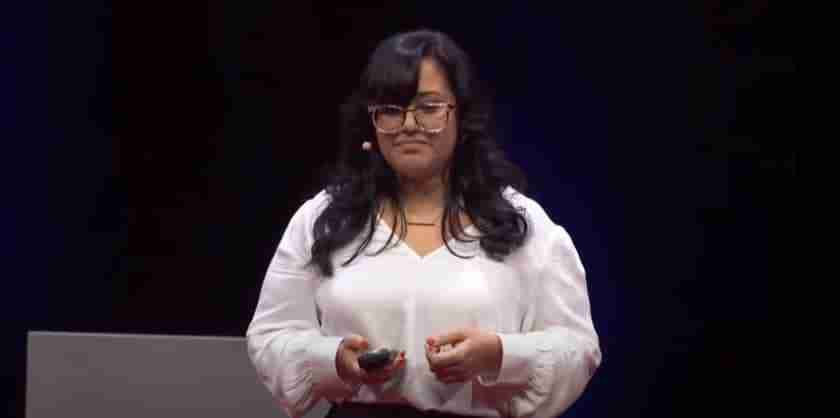
Full text of justice reform advocate Nisha Anand’s talk titled “The Radical Act of Choosing Common Ground” at TEDxBerkeley conference.
Listen to the MP3 Audio here:
TRANSCRIPT:
Nisha Anand – CEO of Dream Corps
In 1994, the Violent Crime Control and Law Enforcement Act passed. You probably know it as the crime bill. It was a terrible law.
It ushered in an era of mass incarceration that allowed mandatory minimums, three-strikes laws, the expansion of the death penalty — it was terrible. But it passed with bipartisan support.
GOP House Speaker Newt Gingrich, architect of the Republican Revolution, led the way, signed into law by Democratic President, Bill Clinton.
Also in 1994, I was a senior in high school when this bill got passed, and you were likely to find me on the streets protesting any number of causes, including the crime bill. So that’s what makes this picture all the more surprising.
Newt was not on the top of my “Favorite Person in this Country” list. But this picture was taken in 2015. This was the start of a movement that would pass a bill called the First Step Act. The “New York Times” called it the most significant reform in criminal justice in a generation.
You know, 1994 Nisha… on-the-streets activist… might be disappointed in this photo; some of you might be too. But standing here today I’m not. This is what I’m here to talk to you about today. This is radical common ground. And I’m not talking about the kind of common ground where, you know, we can talk about how much we love springtime or “puppies are super cute.”
And it’s not, you know, compromised common ground. This is common ground that’s hard. It hurts. It’s the type of common ground where you will be ridiculed and judged. But it’s the type of common ground that can secure human freedom. It can save lives. And it’s the type of common ground I was born to find. It’s in my DNA.
My dad was born during the partition in India. After the Indian independence movement, the country was really divided between people who wanted to keep the country together and those who wanted different independent nations. And when the British left, they just decided to draw a line, the partition and make a new country.
This started the largest forced mass migration in human history. Fifteen million people trapped on the wrong side of these new borders. Two million people dead during the partition.
And my dad was the youngest baby in a Hindu family on the wrong side of the border. and like families all around the border on both sides, they went into hiding.
And I was told when I was little about the story of my family in hiding, and one day when armed men came into the house that they were hiding in, searching for families, my dad started crying. And my grandma started shaking him. And my grandfather, in that moment, he made the choice that he’d sacrifice his son in order to save the family.
But luckily, in that moment he stopped crying. My grandma, she shook him and he stopped crying and I’m here today because he stopped crying.
But I’m also here today because of that Muslim family that took us in. They also were held at gunpoint and an armed man asked if they were hiding anyone, and they swore on the Quran that nobody was in that house. They chose in that moment when the entire country — everybody in the region, you could hate people who had different politics than you, different religion, you could kill people. That was what was happening.
But they swore on their Holy book, they chose the shared humanity over politics of that day, and we lived. And we survived.
And I start with this story because often people tell me that my mission for common ground is the weak position. But I ask how was that Muslims family’s actions weak? Because of that, my dad did grow up healthy in India and he emigrated to this country, and I was born here in the late ’70s, and like most first-generation kids I was born to build bridges.
I was a bridge between the old country and the new. And just growing up, that’s what I did. I was a brown girl in the Black and white South in Atlanta, Georgia. I was like, on one hand, the perfect Indian daughter… straight As, captain of the debate team.
But on the other hand, I was also this radical feminist, punk-rock activist sneaking out of the house for concerts and, you know, getting arrested like, all the time for causes. I was a mix of a lot things. But they all live harmoniously in me.
Building bridges was just natural, and I think all of us represent a mix of a bunch of things. I think we have that ability to find the common ground. But that’s not how I was living my life… at all.
I moved to the Bay Area in 2001, and this was kind of a turning point for me; it was the start of the second Iraq War. And I was organizing with a bunch of activists, of course. And we were thinking that probably we needed to expand our circle a little bit, that we weren’t going to successfully stop the war if, you know just amongst us. So we decided we’d build bridges, expand our circle, and so the great, anarchist versus communist soccer tournament of 2001 was born.
That’s it. That’s how large my circle was allowed to expand. Building bridges with liberal Democrats? Oh, no way, that was a bridge too far. Local electeds? That was a bridge too far. And that was in 2001.
And I think you’ll agree with me now… in 2020 it’s gotten even worse; that division, that tribalism. We won’t sit down at dinner with people who voted differently than us. We, like, see a mean tweet from our best friend, a tweet that, like, doesn’t fit with our worldview, and all of a sudden they’re canceled.
The purity politics of the moment gone.
I sometimes wake up — I don’t know what we’re going to do. And people ask me “how do we do that?” But I know about common ground. I feel like we can build those bridges. But it’s not easy.
I have a concept that I go back to, and it’s a concept that should be familiar to everybody since the beginning of human history. It’s the idea of the commons. This shared place in the center of town — town square, the quad — but it’s the place where you come together, your community, and you can listen to people on soapboxes with different ideas, and you can be very different. But you come together because you know together we’re stronger than being apart.
And today when I think of the commons, I think I extend it to kind of the resources we all share… collectively owned, like the air we breathe. I think of schools, parks. I think of the intelligence we share. We can share in libraries or the internet. And I think the internet’s important. In this digital age, that shared humanity, that access to be together in the commons, is at our fingertips. But we’re not using it that way. We’re not coming together.
To choose that path towards the commons and to be with each other, you also have to choose love. That’s a hard thing. But I know you can’t go to the town square filled with hate for the town. You can’t lead a people you don’t love. You can’t lead a country you don’t love.
And I don’t think you can change the world and say, “I’m only going to change it for the people just like me, my own circle of friends, not for the people I hate, not for them.” It doesn’t work. It’s a terrible strategy, it doesn’t work, but that’s what we keep doing. I see it every single day. These silos are just getting stronger.
And you know, your corner of the internet, like Instagram or Twitter, we’re just in an echo chamber talking to each other. So I can be really comfortable in my Berkeley Democratic Socialist commons and talk to all of you. And my dad can be in his bootstrappy immigrant Republican commons, and I can watch MSNBC and he can watch Fox News and we will not know the same things. We won’t have the same — I mean, we won’t live in the same world.
We may never know each other or be with each other again. And I don’t want to keep going down that path. And I know we can get back to a better path. I know we can find our way to the commons, and I know that because I had a first, like, front-row, firsthand look at the ability to do it and do it on a large scale.
And so I want to get you back to the First Step Act and the criminal justice reform. I interviewed for a job with Van Jones about seven years ago. And he’s been a mentor and my boss, and he’s actually an inspiration behind a lot of this in the speech. And he told me that we were going to pass bipartisan criminal justice reform, and I laughed because I thought that was an oxymoron.
I was in the streets — go figure — at the Republican National Convention in 2000 in Philadelphia, and we were protesting the criminal justice system. And there were no Republicans on the streets with me at that protest. I remembered the crime bill; I lived through the tough-on-crime era; I didn’t see it.
But he saw it and he walked me through it. He saw me and people like him on the Left, who… it’s always been an issue of dignity and justice, that this system has been racist since the start and discriminating against poor people and people of color and it’s an issue of justice and dignity.
So there we were. But he also saw something different from our colleagues on the Right. The fiscal Conservatives, they had an economic incentive to do it: they saw a system that cost the taxpayers a whole lot of money and was getting terrible results and it wasn’t making the communities any safer.
The Libertarian Right, who believe in less government, saw an expansion of government control, an expansion of the police state, mass incarceration is like, antithetical to who they are. And the Religious Right: second chances — redemption. These are values that they hold dear, and the criminal justice system can’t see those anywhere.
And so there was common ground to be had. And that’s what we set out to do. And under the leadership of the formerly incarcerated folks who have been leading this forever, we built this bipartisan coalition to pass criminal justice reform. Eighty-seven senators voted in favor of the First Step Act, and yeah, President Trump signed it.
And because we were able to do that, because we were able to look at that shared humanity, get over our distaste for working across the aisle, 20,000 people have been impacted in just the last year, 7,000 home who would not have been home, 17,000 years of human freedom restored just in the last year.
And Republicans and Democrats in this election cycle, almost all of them running, are running on platforms of criminal justice reform. They are trying to bring this bigger, stronger, bolder and more reforms everywhere they are. That was impossible during the tough-on-crime era.
But I also look at this. These are the people coming home. In my office, we get a video like this almost every day. Thousands of people coming home.
And when people tell me that common ground is the weak position or that my love for the people or my belief in our shared humanity is naive, or that if I work with folks across the aisle that I’m somehow getting taken advantage of, I just look at this: I look at the people. I say, “Say that to this — to the folks coming home.” Say that to those 2.2 million people that are still behind bars.
So now our challenge is to make this possible across a whole bunch of other issues too: human rights, immigration, I mean all sorts of things — health care, mental health. I think there’s common ground to be had. But it’s not easy.
If you want change in a large scale, you need large movements, and that means our circles have to be bigger. And it’s not easy being a Lefty working across the aisle; I certainly get my fair share of hate mail, but I think that that’s exactly the radical approach we need right now.
And so this is Jenny Kim. She is someone who is dead serious about second-chance hiring. She wants to make sure that formerly incarcerated folks have a pathway to jobs and that businesses make it an amazing place for folks to work. She’s also the deputy general counsel at Koch Industries. K-O-C-H, Koch. She is an amazing organizer, and I’m proud to work with her on this issue.
And an issue I care deeply about, and probably a lot of you do too — climate, which seems divisive, seems like there’s no common ground to be had there. I think there is. Trump’s own Department of Defense this year released a report saying that all future wars were going to be wars about resources, wars about climate.
And so yeah, I want to find partnership with the military. And I used to be the national director — the national organizer for the War Resisters League, the oldest pacifist organization in the country. But if there’s common ground to be had there, yeah, I’ll partner with them.
It’s not easy. The approach means we need to find love. We need to get back to that shared humanity and that commons. But I know this love, it doesn’t just get us through Thanksgiving dinner. It’s the kind of love that secures freedom, changes the world.
But to do that, I have to step into my courage, and I want all of you to step into your courage. Just like that Muslim family stepped into their courage for my Hindu family all those years ago. I think we can do it. But it’s a little bit uncomfortable.
If you are who I know you to be — you know, someone who cares about change and progress and wants to see something change in the world, you probably want to know how but you’re also a little bit uncomfortable about me standing up here and celebrating these pictures with Newt and Koch, talking about partnerships with the military.
I want you to feel those feelings. I feel them too. I don’t enter into these partnerships lightly at all. My entire trajectory of who I am has made me think that it’s not even possible, but I know it is. That feeling, that discomfort, that’s preceded every major breakthrough in human history ever. That’s that feeling that comes before a moonshot.
And so I want to make you even a little more uncomfortable. I want you think about an issue that you care deeply about — something that you want to see changed on a national or global scale. Think big. What would resolution look like? On a large scale, what would it look like to solve that problem? Can you get there with just your circle of friends? I know you can’t. The anarchist-communist soccer tournament isn’t going to help bring about that change.
So I want to think about how we can expand our circle a little more. Where is there common ground to be found? Can you think of any unlikely allies? Strange partners?
Further than that, who’s in your way? Who’s stopping you from finding that common ground, and is there room for them in that circle? I think there is. I think we have to be able to find it at this scale. And it means that we’re going to have to step into that courage and include people, hold our vision so strong, know that justice and freedom is so important that we’re able to include more people, love the people who might not love us back.
And so I want to ask you: who’s your Newt? Who’s your Koch? Who’s the military in your story? And I want you to find, choose that common ground.