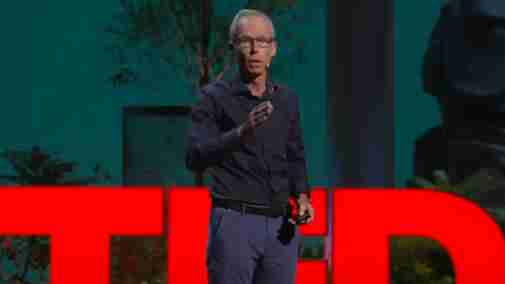
Here is the full transcript of climate impact scholar Johan Rockström’s talk titled “The Tipping Points of Climate Change — and Where We Stand” at TED Talks 2024 conference.
Listen to the audio version here:
TRANSCRIPT:
The Earth System in Crisis
The Earth system scientists and climate scientists are getting seriously nervous. The planet is changing faster than we have expected. We are, despite years of raising the alarm, now seeing that the planet is actually in a situation where we have underestimated risks. Climate changes are occurring in a way that is way beyond the realistic expectations in science.
Fifteen years back, I introduced the Planetary Boundary Framework, the scientific framework with the nine Earth system processes that determines the stability, the resilience, and the life support on planet Earth. Ten years back, the world signed the Paris Climate Agreement. Almost five years back, we entered the decisive decade where our choices will determine the future for all generations on planet Earth. Where are we on this journey halfway into this decade?
I will give you a scientific state-of-the-planet report, the most objective assessment that science can give today. And it starts here. We’ve reached 1.2 degrees Celsius of global mean surface temperature rise, the warmest temperature on Earth over the past 100,000 years. We have just scratched on 1.5 degrees Celsius as an annual mean in 2023.
Accelerating Warming and Its Consequences
But what worries us most is this. We are starting to see an acceleration of warming over the past 50 years. 0.18 degrees Celsius per decade from 1970 to 2010. But then from 2014 onwards, it abruptly jumps up to 0.26 per decade.
And if we follow this path, we will crash through 2 degrees Celsius within 20 years and hit 3 degrees Celsius by the year 2100, a disastrous outcome caused by us humans. But it’s not only carbon dioxide. Any parameter that matters for human well-being and our economies look the same. Here you have it.
Linear change up until the 1950s, we go into the Great Acceleration, and this is what we’re seeing across over-consumption of fresh water, the sixth mass extinction of species, over-eutrophying our fresh water systems with nitrogen and phosphorus, all of it undermining the stability of the planet. As if this was not enough, we are seeing that this is now causing impacts across the entire economy. We’re seeing bigger and bigger invoices being sent by the Earth system onto societies across the entire world in droughts, floods, heat waves, disease patterns, human-reinforced storms scientifically attributed to human-caused climate change.
Extreme Weather Events and Economic Costs
40 degrees Celsius of life-threatening heat across all continents occurring in 2023. 62 degrees Celsius hitting the over 1,000 who lost their lives at the Hajj pilgrimage in June in Mecca, three times higher climate change risks now attributed to our cause of climate change. 2023, up to 12,000 deaths, $200 billion of costs just in the US, up to $100 billion. This is seriously causing economic costs. We have scientifically in the past shown that this could cost a few percent of global GDP of the climate impacts caused by us.
I can tell you that the latest scientific assessment is what you see on the screen here. An 18% loss of GDP by 2050 if we now follow the current path. This is equivalent to $38 trillion of loss per year in 2050. It’s starting to hurt. Both in human social costs and in economic costs. And this is happening at 1.2 degrees Celsius of global mean surface temperature rise, and we’re following a pathway that takes us to 2.7 degrees Celsius in only 70 years.
And we’ve had a 10,000-year period where our civilizations have developed where we’ve had an enormous privilege of a planet at 14 degrees Celsius plus minus 0.5 degrees Celsius. That’s the Holocene since we left the last ice age.
The Corridor of Life
And if you look 3 million years back, we never exceeded 2 degrees Celsius. That’s the warmest temperature on Earth during the entire quaternary. The coldest point, minus 5 degrees Celsius, ice age. I call this the corridor of life.
Is it surprising that we scientists are getting really, really nervous? But it’s more. It’s so much more than this. The first issue is buffering capacity. The second is the risk of crossing tipping points. And both are moving in the wrong direction.
Buffering capacity is the Earth system’s ability to dampen shocks and stress, like, for example, soaking up greenhouse gases in intact nature on land and in the ocean. And so far, Mother Earth has been so forgiving.
Here we have the evidence. What you see here is the hockey stick of fossil fuel burning in red and deforestation in yellow. Is it this tremendous climate forcing that has caused the 1.2 degrees Celsius climate crisis so far? The answer is no. 53% of the carbon dioxide from fossil fuel burning and land system change have been soaked up by intact nature on land and in the ocean.
It’s only the blue sliver you see here, which remains in the atmosphere, causing the climate crisis so far. The problem is we have more and more scientific evidence of cracks in this system. Let’s start on land. Land absorbs 31% of the carbon dioxide from our greenhouse gas emissions.
Losing Carbon Sinks
We have more and more scientific evidence, that caused so much research, that the boreal forests in Canada or the temperate mixed forests in Germany and Russia are starting to lose their carbon uptake capacity. Did you know that the latest science shows that the part of the Amazon rainforest, planet Earth’s richest biome on terrestrial land, has already tipped over and is no longer a carbon sink? It is today a carbon source. It’s no longer helping us.
But as if that was not enough, what really worries us today is the ocean.
The ocean absorbs 90% of the heat caused by human-induced climate change. This is well understood, but what really worries us is what you see here. This is the latest data on sea surface temperature across the ocean.
Ocean Temperature Anomalies
What you see here is from 1980 until today, how gradually the ocean surface just gets warmer and warmer. It’s actually warming all the way down to 2,000 meters depth. This is well understood in science. It’s a deep concern. It’s well represented in the climate models. We understand it. Then suddenly in 2023, something happens. Temperatures just go completely off the charts.
0.4 degrees Celsius outside of the warmest temperature in previous years. What’s happening? We admittedly must be honest here. We do not know. El Niño is certainly partly to blame, but cannot explain it all. 2024, it just continues. What is happening? We do not know, but the candidate number one is the energy imbalance caused by us humans.
In one year alone, the heat equivalent to 300 times global electricity use is absorbed in the Earth’s system. Is it what we see on the screen here, an ocean that is starting to lose resilience? An ocean that is at risk of releasing heat to the atmosphere and self-amplifying warming? We do not know, but one thing is for certain. The ocean is sounding the alarm.
Tipping Points and Planetary Stability
Reasons for concern? Yes. We are now at a point where we are forced to ask the following question. Are we at risk of pushing the planet out of the basin of attraction, the stability of the planet where we’ve been since we left the last ice age, the extraordinarily stable Holocene state? And if we push ourselves outside, drifting away unstoppably towards a hothouse Earth where we get self-amplified warming and losing life support on Earth, what could take us there? Well, we know it. It is if we cross tipping points.
Big systems like the Greenland ice sheet, the overturning of heat in the North Atlantic, the coral reef systems, the Amazon rainforest are tipping element systems. Push them too far and they will flip over from a desired state that helps us to a state that will self-amplify in the wrong direction, going from cooling and dampening to self-amplifying and warming. A rainforest tips over to a savanna state.
Mapping Tipping Elements
Now, we have now mapped the 16 tipping element systems with a now scientifically catalog that regulate the climate system. These 16, and you see the five in the ground zero on planet Earth in the Arctic, are connected via cascades through the ocean, particularly via the AMOC, the Atlantic Overturning of Heat in the Ocean, all the way down to Antarctica. These are big biophysical systems that we all depend on, global commons for the stability of the planet.
The question is, at what temperatures are they at risk of tipping from helping us to becoming self-amplifying foes? Well, for the first time, we have an attempt to answer that question. What you see here are the 16 tipping element systems on the y-axis, and in red, you see the uncertainty range, the best estimates and science. Darker the red, the higher the risk of tipping is the temperature levels at which they’re likely to cross the thresholds. The average temperature at which they are likely to tip is the yellow circle lines you see here.
What this tells us is the following. Five of these 16 are likely to cross their tipping points already at 1.5 degrees Celsius. The Greenland Ice Sheet, the West Antarctic Ice Sheet, abrupt thawing of permafrost, losing all tropical coral reef systems and collapse of the barren sea ice. Just the two ice sheets hold 10 meters sea level rise, which would be unstoppable on the long term.
Scientific Uncertainty and Increasing Risk
Now, sure, there’s scientific uncertainty here, as you see from this graph, but there’s one red thread in science for humanity, in the scientific message, and it’s this. The more we understand of the Earth system, the higher is the risk. And here is the proof. This is five IPCC assessments, Intergovernmental Panel on Climate Change, 30 years of scientific advancement. Here again, you see risk assessment, darker the red, higher the likelihood of causing irreversible change in the climate system.
30 years back, the risk was put at 5 degrees Celsius of tipping, and coming down to current state of science, the risk is set at 1.5 to 2 degrees Celsius. We are in the midst of a danger zone today. But it can be even worse than that. Let’s go to the Amazon basin.
The Amazon Rainforest at Risk
Again, the richest terrestrial ecosystem on land. Climate science estimates the risk of the Amazon rainforest tipping over irreversibly to a savanna at 3 to 5 degrees of global mean surface temperature rise, a really high temperature, unlikely even to be met over the next 70 years. But if we lose forest cover, the risk is that the system can tip already at 1.5 to 2 degrees Celsius if we lose more than 20 to 25% of forest cover. So that’s a very dangerous combination.
Where are we today? We are at 1.2 degrees Celsius of global mean surface temperature rise and 17% of deforestation. We are very close to a tipping point in the Amazon rainforest. Very close.
The Path Forward
What shall we do to avoid these unmanageable outcomes? Well, the IPCC is clear on the pathway. To stay under 1.5 degrees Celsius, to avoid crossing tipping points, we need to operate, to navigate within the global carbon budget that gives us a chance of holding 1.5. What remains for us is only 200 billion tons of carbon dioxide that we can continue emitting to have a 50% chance of holding 1.5.
We emit today 40 billion tons of carbon dioxide per year, giving us five years at current rate of emission before we consume the budget. We are seriously running out of time. And the pathway for a safe landing is also well studied and understood. You have it here.
Bend the curve of emissions immediately and follow a path where we reduce emissions by at least 7% per year for a safe landing and a net zero world economy by 2050. But it’s more than that. We also know that even if we succeed with this, we have already loaded the atmosphere with so much greenhouse gases, with so much climate forcing, that we inevitably face a period of overshoot.
Overshoot and Planetary Boundaries
We must now be prepared for a very likely breaching of the 1.5 degree Celsius planetary boundary on climate somewhere between 2030 and 2035 in five to 10 years’ time, and then have at best a 30, 40-year period of overshoot before we can come back to 1.5 by the end of this century.
We would exceed with 0.1 to 0.3 degree Celsius the 1.5 limit, meaning up to 1.8 degree Celsius. What does this tell us? Well, I can tell you there are two main messages. Message one, buckle up.
We know for certain, 100% certainty, that this means more droughts, more floods, more heat waves, more human-reinforced storms, more disease during one generation’s time. 2023, the warmest year on record, will be looked back upon as a mild year. Message two, why would the planet come back to 1.5 after overshoot? Well, the answer is very simple.
The health of the planet must be kept intact. We must continue having a planet that can absorb 50% of the carbon dioxide. We must have a planet that crosses no tipping points. We must have a planet that remains healthy and keeping heat intact in the ocean.
That is why we need planetary boundaries, the planetary boundary framework that defines the nine Earth system processes that regulate the stability and resilience of the entire planet. Climate, biodiversity, nitrogen, phosphorus, land, freshwater, air pollutants, and chemicals. That is the challenge. To summarize that, there is no 1.5 degree Celsius delivery on the Paris Agreement by only phasing out fossil fuels.
We also need to come back into the safe operating space of the nature-based biodiversity, all the planetary boundaries of nature. This means that science is clear. The window is rapidly closing. But there is still some light in the window.
A Pivotal Point for Transformation
We actually have evidence that we’ve reached a pivotal point, not only in terms of risk, but also in terms of opportunity to transform the world towards a safe and just future for humanity. Linear change is no longer an option. The only option is exponential change. We know that the only currency that matters is speed and scale.
We also need to become stewards of the entire planet. We need to now recognize from local to global level that we’re all so intertwined that we must govern the entire planet. I know that is very daunting. But what choice do we have when on the line is the future of our children on planet Earth?
Solutions for a Stable Future
And we have the solutions. We know that solving the planet crisis is not utopia. It’s not fantasy. We have the solutions for a secure, stable future for humanity.
What are those transformations? Well, we know them. It’s a rapid transition away from fossil fuels. It is a transition towards circular business models. It is transitioning towards healthy diets and sustainable food systems. And it’s not only halting loss of nature, it’s also scaling the regeneration and restoration of marine systems, soils, forests, and wetlands. We have solutions for all of these. Just take green energy, which today is cheaper than fossil fuel-based energy.
It’s our choice that we’re facing today. Now, I was nervous already in 2020 when we entered this decisive decade and had to cut global emissions by half by 2030. Halfway into this decade, the road is steeper than ever. It’s steeper than ever.
A Window of Hope
This is what really, really concerns us, that we have a situation where we now need to move so fast. And I’ve been standing on stages like this so many times, sharing the dire scientific diagnostic. But still, I just told you that I do conclude that there is still some window open. There is a light in the tunnel.
And you may ask, what is it that makes me able to continue to be a realistic optimist in this situation, the most dire situation, I must admit, in my whole professional life? Well, actually, I promise this is an honest statement. There are so many positive items as well. The most important one in my mind is that we have ample evidence that citizens across the world, a majority of them, care about nature and climate.
They trust climate science. They’re concerned about climate change and they want solutions. And the second key factor is that we have so much evidence today that the solutions are not only available, but if we implement them, we get a more healthy, stable, secure future with the jobs and the economies that can compete and provide livelihoods into the future. This means, dear friends, that solving the planetary crisis is not only necessary, it is possible, and we all win if we succeed.