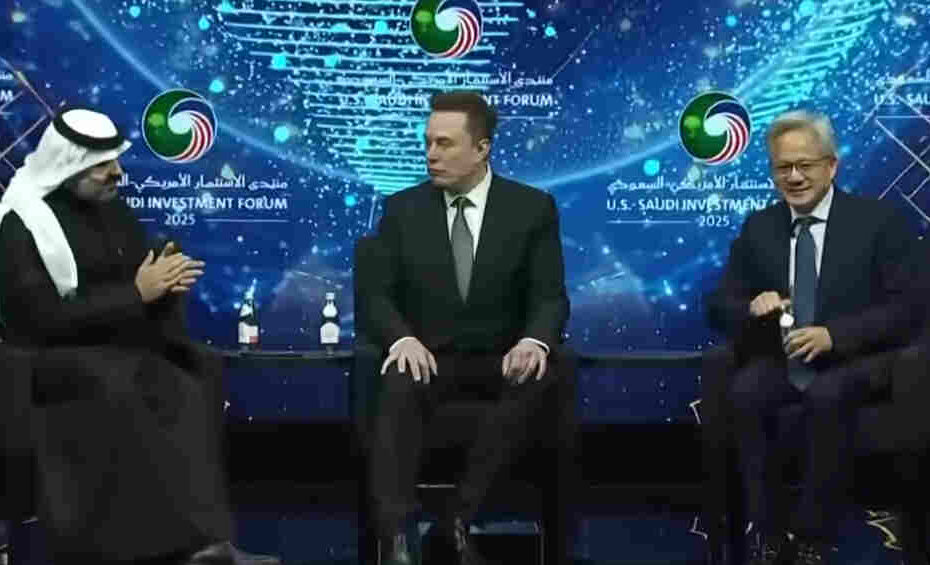
Here is the full transcript of Tesla, SpaceX and xAI CEO Elon Musk along with Nvidia Founder and CEO Jensen Huang – giving remarks on AI at the U.S.-Saudi Investment Forum in Washington, D.C. on Wednesday, November 19, 2025.
The Greatest Alliance: US-Saudi Partnership in the Intelligence Age
ABDULLAH ALSWAHA: Please have a seat. Now I’m sure we can do a bigger round of applause for one of the greatest two leaders of our history. Let’s go ahead. So we’re talking about, I lost count, you know, seven to $8 trillion worth of market cap combined. I lost count.
But right now we’re here to celebrate a historic moment. A moment that yesterday during the dinner, and thank you for joining us under the patronage of the honorable President and his Royal Highness the Crown Prince, where we had the pleasure to hear firsthand, this is the greatest alliance between the Kingdom of Saudi Arabia and the United States, where we have joined hands and you have helped us build our energy-based economy, fueling and energizing the industrial age.
And now fast forward going to the intelligence age where we can fuel AI factories, robotics, EVs and all of the rest. Speaking of that, let’s start with you Elon, if you don’t mind. Jensen, feel free to chime in. You have a big fascination of something all of us have admired: first order thinking, which Jensen sometimes calls first order scaling, which is an opportunity for how you have dropped the cost of batteries from $1,000 per kilowatt hour to sub-hundred bucks.
And right now you’re doing the same thing with robotics, for actuators with servo rotors and motors. So I want to hear from you, how do you manage to always disrupt every single industry with that thinking?
First Principles: Creation Over Disruption
ELON MUSK: Well, it’s mostly not disruption, it’s creation. So with say SpaceX, with reusable rockets, there really weren’t any reusable rockets. But the essence of revolutionizing space travel is reusability. If you throw the rocket away every time, the cost of access to space is extremely high.
With respect to electric cars, there weren’t any electric cars when we started making them. Really, you couldn’t buy any to the best of my knowledge. So with Tesla, we wanted to make electric cars compelling and affordable. That was the goal.
With respect to humanoid robotics, there are no useful humanoid robots at this point. There are sort of gimmicks, but there are no actually useful humanoid robots. And I think Tesla is going to make the first actually useful humanoid robots. And this will be quite a revolution and I think something that everyone will want because I always think of, who wouldn’t want their own personal C-3PO or R2-D2?
Oh yeah, of course everyone would want one, right? And then there would be many in industry providing products and services. This is why I say that humanoid robots will be the biggest industry or the biggest product ever. Bigger than cell phones or anything else. Because everyone’s going to want one or maybe more than one. And there’ll be many in industry.
JENSEN HUANG: I want R2-D2 in C-3PO’s body.
ELON MUSK: Yeah, there you go. Well, I mean a humanoid robot would be better than R2-D2 and C-3PO combined times ten.
And you know, people often talk about sort of eliminating poverty and that kind of thing, but really, how long have they been talking about that? There’s lots of talk, you know, there’s lots of NGOs sort of trying to do these things but really not succeeding. And the evidence speaks for itself.
But AI and humanoid robots will actually eliminate poverty. And Tesla won’t be the only one that makes them. I think Tesla will pioneer this, but there will be many other companies that make humanoid robots. But there is only basically one way to make everyone wealthy and that is AI and robotics.
From Oil Refineries to AI Factories
ABDULLAH ALSWAHA: And we can’t talk about robotics without AI factories. And yesterday was such a historic day for the two nations, but also for all of us where we celebrate the AI strategic partnership with the US, signed and witnessed by the honorable President and his Royal Highness, about how we are committing our capital, energy, and land to energize the AI US ecosystem to be able to build inference nodes, training nodes, and to be the most AI-enabled nation.
With that announcement, tell me what’s next in AI factories?
JENSEN HUANG: There’s a beautiful story about how Saudi Arabia is building AI refineries now, building AI factories from oil refineries to AI factories.
ABDULLAH ALSWAHA: I love that.
JENSEN HUANG: You know, I’ve said that AI is an infrastructure and the reason for that, of course we understand AI from the perspective of the technology and how it’s revolutionizing every industry. Digital intelligence of course has applications into every field and so it’s going to be used by every company, every industry, every country. In that way it’s foundational and therefore it’s part of infrastructure.
What is new about AI from a computer science perspective is that the way computing was done in the past was largely retrieval-based computing. Somebody typed in a story or somebody created a piece of art or came up with four versions of a digital ad. It’s all pre-built by somebody which is then using a system to retrieve the appropriate version for you. It’s a retrieval-based computing model. Hadoop and many of the frameworks and operating systems of the past, all designed to retrieve the appropriate information for you.
But today software is going to be generated in real time. It’s generative based on the context, based on the circumstance, based on who you are, based on the problem you asked, based on your prompt. It will generate unique content for you every single time, for everybody. It’s unique.
When you use Grok, every time you use it is different, right? Based on the prompt that you give it and based on the circumstance.
And so therefore it used to be retrieval-based, today it’s generative. And if it’s generative, and every time is different, then you need AI factories all over the world to generate the content in real time, which is the reason why you need AI factories. And this is a unique way of doing computation. But the benefit of course is that everything isn’t preconceived and pre-documented and it’s contextually sensible and therefore intelligent.
The Future of Work: Optional Employment
ABDULLAH ALSWAHA: So AI factories and robotics, and we heard it yesterday from his Royal Highness, his vision, how to augment our workforce with roughly tens of millions of robotics to be able to infuse the next wave of productivity and progress. But this scares a lot of folks here when it comes to the future of jobs. So let’s hear about your thoughts, Elon and Jensen, on that.
ELON MUSK: Well, say in the long term, where will things end up long term? I don’t know what long term is. Maybe it’s ten, twenty years, something like that. For me that’s long term. My prediction is that work will be optional.
ABDULLAH ALSWAHA: Optional. So we’ll take that.
ELON MUSK: Yeah, I mean it’ll be like playing sports or a video game or something like that. If you want to work in the same way, you can go to the store and just buy some vegetables. Or you could grow vegetables in your backyard. It’s much harder to grow vegetables in your backyard. But some people still do it because they like growing vegetables. That will be what work is like: optional.
And between now and then there’s actually a lot of work to get to that point. And I always recommend people read Iain Banks’ Culture books to get a sense for what a probable positive AI future is like. And interestingly, in those books money no longer exists. It’s kind of interesting.
And my guess is if you go out long enough, assuming there’s a continued improvement in AI and robotics, which seems likely, money will stop being relevant at some point in the future. There will still be constraints on power, like electricity and mass. The fundamental physics elements will still be constraints, but I think at some point currency becomes irrelevant.
ABDULLAH ALSWAHA: Jensen, any thoughts?
ELON MUSK: By the way, the Nvidia earnings call is later today.
JENSEN HUANG: And by the way, Bernstein’s rolling.
ELON MUSK: Cheers.
Productivity and the Radiology Paradox
JENSEN HUANG: Elon just wants to share with you some breaking news. The two of us would like to share some breaking news. I would say there’s different horizons you can look at. Everybody’s jobs will be different, I think that’s for sure. How the students learn will be different, how people do their work will be different, obviously, because a lot of the things that we do mundanely or arduously or very difficultly are going to be done very simply. And so we’re going to be more productive from that sense.
One of the things that I will say is that for most people or companies, if your life becomes more productive and if the things that you’re doing with great difficulty become simpler, it is very likely because you have so many ideas, you’ll have more time to go pursue things. It is my guess that Elon will be busier as a result of AI. I’m going to be busier as a result of AI.
And the reason for that is because we have so many ideas we want to pursue, so many things that we still have in our backlog inside our company that we can go pursue. If we’re more productive, we can get to those things faster. And so in the near term, I would say that there is every evidence that we will be more productive and yet still be busier because we have so many ideas.
One thing that I will say, give you some evidence, is that, and I was just telling Elon about this earlier, radiology, for example, has largely been converted to AI-driven radiology. And there’s some really great companies doing that. And the surprising thing is the prediction that all radiologists would be the first jobs to go was exactly the opposite. The trend shows that there are more radiologists being hired now as a result of AI.
And the reason for that, if you take a step back, it’s because the goal of a radiologist is not to study the images. The goal of a radiologist is to diagnose a disease. Now the studying of the images became so productive they could study more images, study more modalities, spend more time with the patients, and as a result, they were actually accepting more patients. We’re doing more radiology all around the world, we’re doing a better job with diagnosing disease.
And so that’s kind of the near term outcome of AI and productivity. And we’ll see what happens long term when currency doesn’t matter anymore. Just let me know right before.
ELON MUSK: You’ll see it coming. You’ll see it coming.
JENSEN HUANG: We text often, so just text it off, let me know.
AI-Accelerated Innovation: Saudi Success Stories
ABDULLAH ALSWAHA: I kind of agree with both of you because if you look at every technological trend, every general purpose technology has been net new positive for the globe, for humanity and so forth. And let me share with you two—
JENSEN HUANG: Your Excellency, I think it’s precisely the reason, the reason for that is because all the great ideas from innovators like Elon, you have so many good ideas that—
ABDULLAH ALSWAHA: And Jensen as well.
JENSEN HUANG: Yeah, well, thank you.
ABDULLAH ALSWAHA: So let me share with you two stories from two Saudi innovators in collaboration with a lot of the great work that Nvidia does, that Grok does. One is Omar Yaghi. Let’s hear that again. What does Professor Omar Yaghi—
ELON MUSK: Might need to move the mic here.
JENSEN HUANG: Come on, we’ll share this one.
ABDULLAH ALSWAHA: Let’s try this one more time. So one of them is Professor Omar Yaghi, who’s the first American-Saudi Arabian to win a Nobel Prize in creating new chemistry. And the way he has done that, he has leveraged your AI accelerators and models like Grok to be able to create new chemistry when it comes to metal-organic frameworks. Those are metal ions that are positively charged with organic linkers, to be able to effectively create a sponge with 0.33 nanometer pores, to capture water from air and also to capture carbon dioxide.
The second story has also to do with AI accelerated by Nvidia and with models like Grok, which is Nanopalm, which is effectively creating a nanorobot, 500 nanometers by 1,000 nanometers, to be able to do gene editing, leveraging the CRISPR technology to take out sickle cell disease.
Now in both these instances, they originated twenty years ago in research, but AI was able to really accelerate the outcomes and the outputs such that we can move into new value pools. So I think with every technological trend, humanity is going to always manage to shift to new value pools when it comes to workforce and productivity.
But we have some great announcements to talk about here today. Let’s begin with you, Elon. The things that we’re doing with xAI.
Breaking News: Major AI Infrastructure Investment
ELON MUSK: Yeah, we’re excited to announce that we’re doing a 500 megawatt—I mean, yeah, 500, sorry, 500 megawatt. 500 megawatt? Yeah.
ABDULLAH ALSWAHA: We’re doing 500.
ELON MUSK: Sorry, yeah, yeah, it’s 500 gigawatt. I’ll have to wait. So that’ll be eight bazillion trillion dollars.
ABDULLAH ALSWAHA: Not that.
ELON MUSK: So, yeah, we’re doing—xAI and the Kingdom of Saudi Arabia are doing—
ABDULLAH ALSWAHA: 500 megawatts, starting with 50 megawatts phase one. And we’re doing it with Nvidia. Congratulations to the team, to Target team. Such a fantastic job. Jensen, I think we’re also doing some great announcements this week.
Partnership Announcements and Humane Collaboration
JENSEN HUANG: We are. We’re announcing all kinds of things. Our partnership with Humane is going incredibly well. First of all, we worked together to get this company started and off the ground and just got an incredible customer with Elon. Could you imagine a startup company, approximately $0 billion in revenues, now going to build a data center for Elon? 500 megawatts is gigantic. This company is off the charts right away. In addition to that, we’re working AWS, as you know, is also.
ABDULLAH ALSWAHA: Congratulations to the Humane team with AWS, starting with 100 megawatts with a gigawatt ambition and counting.
JENSEN HUANG: So AWS is also coming to Humane. We’re working with Humane on Omniverse Digital Twins. As you know, that AI is not just agentic AI and chatbots and cognitive AI is incredibly important to the world. But AI applies to everything. Chemicals and proteins and genes and physics and fluid dynamics and particles and of course, robotics and activation.
And we created this world called Omniverse, where robots can learn how to be good robots. And it’s physically based, it obeys the laws of physics so robots can learn in these environments. And we’re working with Humane to apply Omniverse to all kinds of digital factories and robotics and warehouses and things like that.
And so that’s another. We’re also working in Saudi Arabia to build supercomputers to simulate quantum computers and using our computers to be the controller and the error correction. Quantum error correction requires an enormous amount of computation. And so we’re doing a lot of great work there too. So a big partnership with Humane. They’re off the charts, off the ground and off the charts at the same time.
ABDULLAH ALSWAHA: This is how we walk the talk in the Kingdom of Saudi Arabia in partnership with the US. Yesterday, the President and His Royal Highness announced the AI Strategic Force Framework and partnership. Today, we’re going big with Elon and Jensen. So thank you for those opportunities.
Now they told me I have time for two last questions. So last night at the dinner I got a number of questions because it seems that the schedule leaked and everybody was giving me hints about the last two questions I’m going to do. So the first one was for you, Elon, and there’s a big one for you, Jensen, so prepare for that one. AI in space, is that possible?
AI in Space: The Future of Computing
ELON MUSK: Yes. If civilization continues, which it probably will, then AI in space is inevitable. You know, I always have to preface that, you know, we shouldn’t take civilization for granted. We need to make sure to take care to ensure that civilization has an upward arc.
I mean, any student of history knows that civilization does not always have an upward arc. And in fact civilizations have life cycles. So hopefully we are in a strong upward arc. I think we are for now, but we don’t want to take that for granted or be complacent.
But in order to, the way to think of AI in space is that in order to achieve any meaningful percentage of a Kardashev 2 scale civilization, where you’re using even a millionth, a millionth of the sun’s energy, you must have solar powered AI satellites in deep space.
So once you realize, once you think in terms of a Kardashev 2 scale civilization, which is what percentage of the sun’s energy are you turning into use for work? Then it becomes obvious that space is overwhelmingly what matters. Overwhelmingly.
The sun only receives, roughly, Earth only receives roughly 1/2 billionth of the Sun’s energy. So if you want to have something that is say a million times more energy than Earth could possibly produce, you must go into space. And so this is where it’s kind of handy to have a space company, I guess.
JENSEN HUANG: Easier to cool chips in space too.
ELON MUSK: Yes.
JENSEN HUANG: Easier to cool chips in space.
ABDULLAH ALSWAHA: Yes.
ELON MUSK: There’s definitely no water in space. So you’re going to have to do something that doesn’t involve water. Just hang out. Well, it’s just got to radiate.
JENSEN HUANG: That’s right.
The Economics of Space-Based AI
ELON MUSK: So my estimate is that actually the cost of electricity, the cost effectiveness of AI in space will be overwhelmingly better than AI on the ground so far. Long before you exhaust potential energy sources on Earth. Long, long before.
Meaning, I think even perhaps in the four or five year time frame, the lowest cost way to do AI compute will be with solar powered AI satellites. So I’d say not more than five years from now.
ABDULLAH ALSWAHA: Wow.
JENSEN HUANG: And just look at the supercomputers we’re building together. Let’s say each one of the racks is 2 tons. Out of that 2 tons, 1.95 of it is probably for cooling, right?
ELON MUSK: Oh, yeah.
JENSEN HUANG: Just imagine how tiny that little supercomputer is, right? Each one of these GB300 racks just be a little tiny thing.
ELON MUSK: And just electricity generation is already becoming a challenge. So if you start doing any kind of scaling for both electricity generation and cooling, you realize, okay, space is incredibly compelling.
So let’s say you wanted to do, I don’t know, 2 or 300 gigawatts per year of AI compute. It’s very difficult to do that on earth. So the US average electricity usage, last time I checked was around 460 gigawatts per year average usage. So something like, say, you know, if you’re doing 300 gigawatts a year, that would be like 2/3 of US electricity production per year.
There’s no way you’re building power plants at that level. And then if you take it up to say, a terawatt per year, impossible. You have to do that in space. There just is no way to do a terawatt per year on Earth.
And in space, you’ve got continuous solar. You actually don’t need batteries because it’s always sunny in space. And the solar panels actually become cheaper because you don’t need glass or framing. And the cooling is just radiative. So that’s why I think that’s the dream.
JENSEN HUANG: Yes, that’s the dream.
The AI Bubble Question
ABDULLAH ALSWAHA: So Jensen, everybody last night was asking me and I’m mindful it’s earnings call for you today. So I’m going to say this delicately. Everybody has been asking me to ask you, are we going to have an AI bubble?
JENSEN HUANG: That’s the last question.
ABDULLAH ALSWAHA: All right.
JENSEN HUANG: Let me, well, let me just tell you what we see. Okay? So I think it’s really important when you look at what’s happening around the world and go back to first principles of what’s happening in computer science and computing.
There are three things that’s happening. The first thing is that we all know that Moore’s Law has run its course and the ability, the amount of demand for computing versus the amount of computation we can get out of general purpose computing is really challenging. And so the world’s been moving to accelerated computing for some time. We’ve been pushing this now for some over 20 years.
Let me give you one statistic. I was just at supercomputing six years ago.
ABDULLAH ALSWAHA: I.
The Shift to Accelerated Computing
JENSEN HUANG: CPUs were 90% of the world’s supercomputers. Top 500 supercomputers six years ago this year, less than 15% went from 90% to 10%. And meanwhile accelerated computing went from the other way, 10% to now 90%. Okay, so you’re seeing that inflection point, the transition in high performance computing from general purpose of computing to accelerated computing.
Well, one of the most data intensive, one of the most intensive computation things that the world does in cloud is data processing. Several hundred billion dollars of computation is done on just raw data processing has nothing to do with AI, just SQL processing data frames, you know, everybody’s names, address, their sex, their age, where they live, you know how much money they make. All of that sits into a data frame.
And that data frame drives the world today, whether it’s banking or you know, whether it’s in credit cards or of course e-commerce. And everything from ad recommendations, everything is driven off of that data frame. That data frame costs hundreds, hundreds of dollars to go compute. And so that’s the number one thing, end of Moore’s law.
The second thing is generative, what the last 15 years is called Rexis Recommender Systems. How do we know what information to recommend to us in a social feed? How do you know what ad to recommend to somebody, what book to recommend, what movie to recommend the world? The Internet is so gigantic without a recommender system that a little tiny phone of us will have no chance of ever seeing the right information.
That Rexis is the engine of the Internet today that’s going generative AI. It used to be running on CPUs, now it runs on GPUs, which then says the third thing, when if you just look at those two applications, many of the Internet companies can build enormous number of GPU supercomputers just doing that.
Of course then it creates this, the third opportunity on top of it, which is agentic AI. This is Grok and this is OpenAI. This is Anthropic, you know, this is Gemini. Agentic AI sits on top of that. But don’t, you know, don’t forget to think about what is happening above. Underneath what everybody sees as AI today.
There’s a whole movement of computing from general purpose computing to accelerated computing. And that if you just, if you take that into consideration, you’ll come to the conclusion that in fact what is left over to fuel that revolutionary agentic AI is not only substantially less than you thought, but and all of it justified.
Closing Remarks
ABDULLAH ALSWAHA: Well, I was just informed by the team that my boss and your bosses is going to talk next. The honorable President and his Royal Highness the Crown Prince and hence we ran out of time.
But in essence, this is such so much love for you, Elon and Jensen. But this in essence is a 92 alliance that shifted from energy to digital to the intelligence age. Powered by pioneers such as Elon and Jensen to serve humanity and create on a net new basis, new economies, new jobs and a better future for humanity. Powered by the Kingdom of Saudi Arabia and the United States.
Thank you for a lifetime partnership and friendship. Thank you, Elon. Thank you, Jensen.
ELON MUSK: Thank you.
ABDULLAH ALSWAHA: Ladies and gentlemen, what we just heard was a conversation about the future of technology spoken by the people building it. To His Excellency Abdullah, Elon Musk and Jensen Huang, thank you for a conversation that did more than describe the future of technology. It actually showed us who’s building it and how.
And now, ladies and gentlemen, we ask you to remain in the plenary. We will soon proceed with the special address by the leaders. As His Excellency Alswaha mentioned, our leaders are about to arrive, so the sponsorship recognition segment will take place after their departure.
And I just want to mention that His Royal Highness the Crown Prince Mohammed bin Salman bin Abdulaziz Al Saud will deliver his speech in Arabic for English speaking guests. We have live translation devices available for you. Our ground team will be more than happy to assist you. Thank you.
Related Posts