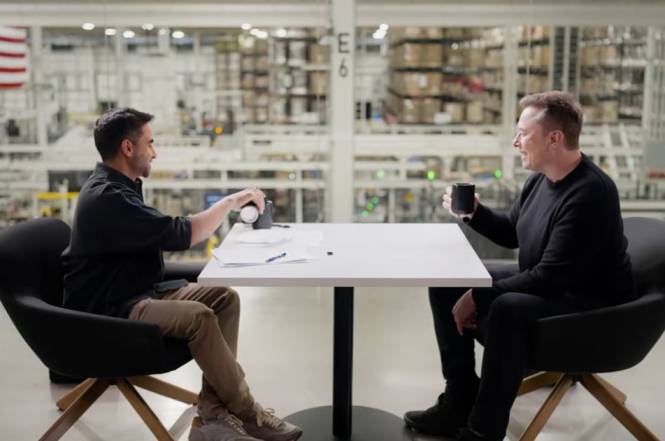
Here is the full transcript of Tesla CEO Elon Musk’s interview on People by WTF Podcast (Ep. 16) with host Nikhil Kamath, November 30, 2025.
In this captivating episode of “People by WTF,” entrepreneur Nikhil Kamath engages in an unscripted, deep-dive conversation with Elon Musk, touching on everything from the evolution of social media and collective consciousness to the future of AI, money, and universal high income. Musk shares candid insights into his work at Tesla, SpaceX, and xAI, including the promise of Starlink for global connectivity and Optimus robots as everyday helpers. Perfect for aspiring entrepreneurs, this raw dialogue explores what drives innovation, the meaning of life, and how AI could make work optional in the coming decades.
Introduction to the Conversation
NIKHIL KAMATH: Our audience is largely want to be entrepreneurs in India. And I feel like all of us have so much to learn from you because you have done it so many times over in so many different domains.
ELON MUSK: Yeah.
NIKHIL KAMATH: So we will speak to them today and I will try and center all my questions in that direction so they take advantage of this conversation and maybe start. Take a chance and build something. Do you want a coffee?
ELON MUSK: Sure, why not? Okay. Are we going to be talking for a while?
NIKHIL KAMATH: I hope we are.
ELON MUSK: Okay, good. Sure. May I trouble you for a coffee?
NIKHIL KAMATH: Can we get another coffee?
ELON MUSK: Cappuccino, I guess. All right.
NIKHIL KAMATH: Are you a coffee drinker?
ELON MUSK: Yeah, yeah. I mean, yeah, I copy it once, usually in the mornings.
NIKHIL KAMATH: One a day kind of thing.
ELON MUSK: Yeah. Pretty much.
NIKHIL KAMATH: Want to wait for it?
ELON MUSK: No, I’m good.
First Impressions
NIKHIL KAMATH: The first thing I must say is you’re a lot bigger and bulkier, muscular than I would have thought you are.
ELON MUSK: I’ll stop you if you make me blush.
NIKHIL KAMATH: Really?
ELON MUSK: Seriously? Yeah. I mean, look, on the Internet, I’m small.
X (Twitter) and Social Media
NIKHIL KAMATH: You’re essentially… What percentage of Internet is spent on Twitter? Is there a number to it on X?
ELON MUSK: Well, so we have about 600 million monthly users. Although it can spike up if there’s some major event in the world. It can get up to 800 million or a billion if there’s some major event in the world. So there’s, I don’t know, 250, 300 million per week type of thing. It’s a pretty decent number. It tends to be readers, people that read words.
NIKHIL KAMATH: Do you think that’ll change?
ELON MUSK: Yeah, I mean, there’s certainly a lot of video on the X system, but at this point, increasing amounts of video. But I think where the X network is strongest is among people who think a lot and read a lot. So that’s where it’s going to be strongest because we have words. So among readers, writers and thinkers, I think X is number one in the world.
NIKHIL KAMATH: As far as social media goes, the form factor, if you had to wager a guess for tomorrow. How much is text? How much is video? I’ve heard you speak about maybe voice and hearing being the next form of communication with AI. What happens to X in its true form? How does it evolve?
ELON MUSK: So I do think most interaction is going to be video in the future. Most interaction is going to be real time video with AI. So real time video comprehension, real time video generation, that’s going to be most of the load. And that’s how it is for most of the Internet right now, it’s mostly Internet is video.
Text is a pretty small percentage, but the text tends to be higher value generally or more. It’s more densely compressed information. So but if you say what is the most amount of bits generated and compute spent, it’s certainly going to be video.
The Acquisition of Twitter
NIKHIL KAMATH: So I used to be a shareholder of X, a very small one and I got paid when you bought it, when you bought Twitter and you made it X. Happy decision. Glad you did it.
ELON MUSK: Yeah, I think it’s important. I felt like Twitter was heading in or had gone in a direction that had sort of more of a negative influence on the world. It was, I mean, of course this depends on one’s perspective. Some people will say, well actually they liked the way it was and now they don’t like it.
But I think the fundamental thing was that Twitter was amplifying, I would say a fairly pretty far left by most people’s standards in the world’s ideology because where it was based in San Francisco and they actually suspended a lot of people on the right. So from their perspective, even someone in the center would be far right. If you’re far left, anyone in the center is far right because it’s just a political, on the political spectrum, they’re just as far left as you get in the United States and in San Francisco.
So what I’ve tried to do is just restore it to be balanced and centrist. So there haven’t been any left wing voices that have been suspended or banned or de-amplified or anything like that. Now some of them have chosen to just go somewhere else. But at this point it is the operating principle of the X system is to adhere to any country’s laws, but not to put out them on the scale beyond the laws of a country.
The Future of Social Media
NIKHIL KAMATH: When I think of social media, Elon, I feel like even data suggests that the current incumbents seem to be losing traction amongst the youngest of audience. Even platforms like Instagram, I mean, they’re not exactly like Twitter, but platforms across the board. If one had to rework social media and build something bottom up, what do you think could work for the world of tomorrow?
ELON MUSK: Well, I mean, I don’t think that much about social media, to be frank.
So you’re really trying to bring the world together into a collective consciousness. And that’s I guess, different from just saying what is the most dopamine generating video stream that one could make, which can be a little bit of brain rot, frankly. If you’re just watching videos that just cause dopamine hits one after another but lack substance, then I think those are not great. That’s not a great way to spend time.
But I do think that’s actually what a lot of people are going to want to watch. So if you say total Internet usage, it’s going to probably be optimizing for neurotransmitter generation. Like there’s somebody getting a kick out of it, right? But it becomes like a drug type of thing.
So, but I’m not really after… My goal is not to do that. I guess I could do that if I wanted to, but that’s… I just want to really have a global platform that brings together, like I said, like, it becomes as close to sort of a collective consciousness of humanity as possible.
And one of the things that we’ve introduced, for example, is automatic translation. So, because I think it would be great to bring together what people say in many different languages, but automatically translated for the recipient. So you have the collective consciousness not just of say people in a particular language group, but you have the thoughts of people in every language group.
The Meaning of Life and Collective Consciousness
NIKHIL KAMATH: And why is that important? The collective consciousness to have one platform.
ELON MUSK: I guess, why is that important? I guess it’s… You could also say why, if you consider humans, humans are composed of around 30 to 40 trillion cells and there’s trillions of synapses in your mind. But the why of it, I mean, I guess is just so we can increase our understanding, our understanding of the universe.
So I guess I had this sort of question about what’s the meaning of life? Why is anything important? Why are we here? What’s the origin of the universe? What is the end? What are the questions that we don’t even know to ask? And probably the questions we don’t even know to ask are the most important ones.
So I’m just trying to, I guess understand what’s going on. What is going on in this reality? Is this reality?
NIKHIL KAMATH: And where did you get, when you asked what is the point of life.
ELON MUSK: Yeah. So I came to the conclusion that, which is somewhat in the Douglas Adams Hitchhiker’s Guide to the Galaxy school of thought, which is what he do. He sort of Hitchhiker’s Guide to the Galaxy is like a book on philosophy disguised as humor.
NIKHIL KAMATH: Yeah.
ELON MUSK: And that’s where you get the, Earth turns out to be this computer to understand, to get to figure out the answer of the meaning of life. And it comes up with the answer 42. But then it’s like, what the heck does 42 mean? And it turns out, well, actually the hard part is the question, not the answer. And for that you need a much bigger computer than Earth.
So basically what Douglas Adams was saying is that we actually don’t know how to frame the questions properly. And so I think by expanding the scope and scale of consciousness, we can better understand what questions to ask about the answer that is the universe.
The Nature of Collective Consciousness
NIKHIL KAMATH: Do you believe the collective consciousness of society… When I was watching this movie recently called the Gladiator. Russell Crowe, have you seen it?
ELON MUSK: Yeah.
NIKHIL KAMATH: In Gladiator in Rome, when people are fighting and the crowd is cheering when people kill each other. The collective is very much like the mob. It doesn’t have nuance in its opinion per se.
ELON MUSK: Well, that’s a particular kind of mob. I mean, they’re sort of going there to see people kill each other.
NIKHIL KAMATH: Do you suspect the society we live in today is very different?
ELON MUSK: We don’t, we don’t generally at this point, we don’t go watch people kill each other.
NIKHIL KAMATH: Maybe some kind of euphemism of that.
ELON MUSK: Sports, I suppose. So people do sports without… Where teams attempt to defeat each other, but minus the death. Right.
So just going back to the consideration of a human. We all started out as one cell, but now we are over 30 trillion cells. But I think most people feel like they’re one body. Usually your right hand’s not fighting your left hand type of thing. It’s a chance to sort of cooperate. Your mind is just a vast number of neurons. But most of the time it doesn’t feel like there’s a trillion voices in your brain. Hopefully not.
So there’s clearly more that happens when you have trillions of cells working as a cellular collective than say one cell or a small multi-cellular creature. There’s clearly something different that happens. Like you can’t talk to a bacteria. It’s very silent. They just sort of wiggle around. And from their perspective, I don’t know, I was sort of, what is life like from the perspective of an amoeba?
But I know you can’t talk to amoeba, like, they don’t talk back, but you can talk to humans. So there’s just something obviously qualitatively, fundamentally different for humans. Once you have a large number of cells and sufficiently large brain type of thing, there’s… You now talk to humans and they can say things, they can produce things, but bacteria are not going to produce a spaceship, for example, but humans can.
So I think there’s something qualitatively different that also happens when there’s a collection of humans. In fact, safe to say that a single human cannot make a spaceship. I could not make a spaceship by myself. But with a collection of humans, we can make spaceships. So there’s something obviously qualitatively different about a collection of humans.
In fact, it would be impossible for me to learn all of the areas of expertise. There wouldn’t be enough time in one lifetime to even learn all the things before I was dead. So you really fundamentally have to have a collection of humans to make a rocket.
Then I think there are probably some other scaling, qualitative scaling things that happen when you have groups of humans. And then if the quality of the interaction or the quality of the information flow is the better it is, the more the human collective will achieve.
And like I said, I’m just curious about the nature of the universe. And I think if we, it’s safe to say, if we increase the scope and scale of consciousness, we’re much more likely to understand the nature of the universe than if we reduce it.
NIKHIL KAMATH: Is that a bit like spirituality? A lot of people talk to me about spirituality, right? I still don’t know what it actually means. Like, I keep asking them, what do you mean?
The Nature of Spirituality and Predictive Value
ELON MUSK: Yeah, what do you mean? Yeah, I mean, a lot of people have spiritual feelings, right? And I wouldn’t try to deny that those spiritual feelings are real to them, but it doesn’t entirely translate. I can’t—just because somebody else has a spiritual feeling doesn’t mean that I would have that spiritual feeling.
So, you know, I tend to be kind of physics-pulled, which is like, if something has predictive value, then, you know, pay more attention to it than if it doesn’t have predictive value.
NIKHIL KAMATH: Right.
ELON MUSK: So you know, physics, I would say, is the study of that which has predictive value. There’s pretty good definition.
NIKHIL KAMATH: My primary job, Elon, is a stock broker and stock investor.
ELON MUSK: Okay.
NIKHIL KAMATH: There is no predictive value. Nobody knows what will happen tomorrow.
Long-Term Investment Philosophy
ELON MUSK: Well, but I think you can generally say, you know that if it’s long term for a company, then you can say like, well, does that—is that—do you like the products or services of that company and is it likely to—do you like the product roadmap? Do you like—it seems like they make great products and they’re likely to make great products in the future. If that’s the case, then I would say that’s probably a good company to invest in.
And I think you also want to believe in the team. So if you say, well, that’s a talented and hard working team, they make good products today, they seem to be still motivated to make things in the future, then I’d say that’s a good company to invest in. Yeah.
And now that won’t solve for the daily fluctuations which happen and sometimes are pretty extreme, but over time that is the right way to invest in stocks because a company is just a group of people assembled to create products and services. So you have to say, well, what are—how good are those products and services? Are they likely to continue to improve in the future? If so, then you should buy the stock of that company and then don’t worry too much about the daily fluctuations.
Advice for Aspiring Entrepreneurs
NIKHIL KAMATH: Right. What’s got you most excited now, Elon, in terms of all that you’re building, you’re doing so much. So let me just preface and contextualize who is watching this. Our audience is largely want to be entrepreneurs in India.
ELON MUSK: Okay.
NIKHIL KAMATH: Really ambitious, really hungry, want to take the risk and build something. And I feel like all of us have so much to learn from you because you have done it so many times over in so many different domains.
ELON MUSK: Yeah.
NIKHIL KAMATH: So we will speak to them today and I will try and center all my questions in that direction so they can take advantage of this conversation and maybe start, take a chance and build something.
ELON MUSK: Okay, sure. Yeah. I guess the most important thing to do is just make useful products and services. Yeah.
NIKHIL KAMATH: Which one of all that, all the products and services that you’re building has got you most excited today?
The Convergence of SpaceX, Tesla, and xAI
ELON MUSK: Well, I think that there’s increasingly a convergence actually between SpaceX and Tesla and xAI in that if the future is solar powered AI satellites, which it pretty much needs to be in order to harness a non-trivial amount of the energy of the sun. You have to move to solar powered AI satellites in deep space which somewhat is a confluence of Tesla expertise and SpaceX expertise and xAI on the AI front.
So it does feel like over time there’s somewhat of a convergence there. But all the companies are doing great things, very proud of the teams that do great work.
So you know we’re making great progress with Tesla on the autonomous driving. I don’t know if you’ve tried the self driving. Have you tried it?
NIKHIL KAMATH: I’ve tried it in the Waymo, not in the Tesla.
ELON MUSK: Yeah, it’s worth—we actually have it here in Austin so you can love to try it. You can literally just download Tesla app and I think it’s open to anyone, definitely try it out, you know how it goes.
But you know we’ve made a lot of progress with electric vehicles, with battery packs and solar and, but and very much so with self driving. So basically real world AI. Tesla is the world leader in real world AI, I would say so.
And then we’re going to be making this robot Optimus which is, you know, starting production hopefully some of next year at scale. And I think that’s going to be pretty cool. That’ll be like, I think everyone’s going to want their own personal C-3PO, R2-D2, you know, helper robot. Like it would be pretty cool.
And then SpaceX is doing great work with the Starlink program, you know, providing low cost, reliable Internet throughout the world. Hopefully India, we’d love to be operating in India. That would be great. We’re operating in 150 different countries now with Starlink.
How Starlink Technology Works
NIKHIL KAMATH: Can you give me a bit about Starlink and how the tech works? Because somebody I was speaking to, I don’t know if you know, this company called Meter out of San Francisco, they’re trying to replace network engineers, but I know it now. So he was telling me about how in densely populated areas Starlink works differently than it might be in a place with not as many people. Can you explain how it works?
ELON MUSK: Yeah. So Starlink, there’s several thousand satellites in low earth orbit and they’re moving around 25 times the speed of sound in these—they’re zipping around the earth basically. And they’re at an altitude of about 550 kilometers, which is called generally low earth orbit.
Because they’re at low earth orbit, the latency is low, like the distance, because the distance is not that far compared to a geostationary satellite, 36,000 kilometers. So you’ve got thousands of satellites providing low latency high speed Internet throughout the world.
And they are interconnected as well. So there’s laser links between the satellites. So it forms sort of a laser mesh so that the—if, let’s say, let’s say if cables are damaged or cut like fiber cables, the satellites can communicate between each other and provide connectivity even if the cables are cut.
So for example, when the Red Sea cables were cut, I think a few months ago, the Starlink satellite network continued to function without a hitch. So it’s particularly helpful for disaster areas. So if an area has been hit with some kind of natural disaster, floods or fires or earthquakes, that tends to damage the ground infrastructure. But the Starlink satellites still work.
So and generally whenever there’s some sort of natural disaster somewhere, we always provide people with free Starlink Internet connectivity. You know, we don’t want to charge, we don’t want to take advantage of a tragic situation. So if there’s natural disasters, we’re like, okay, it’s free during the natural disaster. You know, we don’t want to say like put a paywall up while somebody’s trying to get help. That would be wrong.
So, so that’s, it’s a very robust system. It’s complementary to ground systems because the satellite beams work best in sparsely populated areas. But because you’ve got it, you’ve got a satellite beam, it’s a pretty big beam. So you have, and you have a fixed number of users per beam.
So it tends to be very complementary to the ground based cellular systems because those are very good in cities because you’ve got these cell towers that are, you know, only a kilometer apart type of thing. But cell towers tend to be inefficient in the countryside.
So in rural areas is where you tend to have the worst Internet because it’s very expensive, difficult to lay to do all these, do all the fiber optic cables or to have high bandwidth cellular towers. So Starlink is very complementary to the existing telecom companies. It basically tends to serve the least served, which I think is good.
The Physics Limitations of Starlink in Cities
NIKHIL KAMATH: Will that change tomorrow like today? As you explained, the beam is quite broad and it can’t work in a densely populated area with high buildings. Maybe, but can that change? And tomorrow it becomes really efficient in a densely populated city where it is competitive with the local network providers?
ELON MUSK: It’s, unfortunately the physics don’t allow for that. So we’re too far away. So at 550 kilometers and even if we try to reduce it, which about as low as we can go is about 350 kilometers, still very far away.
You’ve just, you can think of like a flashlight, which is, you know, that flashlight’s got a cone. And that cone is coming at, you know, today, 550 kilometers. In the future, we’ll try to get down to 350 kilometers, but we can’t beat something that’s one kilometer away, which the cell tower physics is not on our side here. Right.
So it’s not physically possible for Starlink to serve densely populated cities. Like, you can serve a little bit, maybe 1% of the population. And sometimes people get, you know, even in crowded cities, there might be, you know, no fiber link up their road. Like sometimes somebody’s on a cul-de-sac or something or in a place. In cities, there’s sometimes underserved areas for random reasons.
And so Starlink can serve, like I said, maybe 1% or 2% of a densely populated city. But it can be much more effective in, like I said, in rural areas where Internet connection is much worse. And often people either have sometimes no access to Internet or it’s extremely expensive, or the quality is not very good.
India’s Urbanization Trends
NIKHIL KAMATH: So if I were to ask you to wager a guess, Elon, do you think India will go down the path of urbanization like China did, with more people moving in from rural economies to urban centers?
ELON MUSK: Some amount of that has happened, right. I mean, I’m curious to sort of ask you some questions as well. Of course. Isn’t that the trend or is it not the trend in India?
NIKHIL KAMATH: It is the trend largely, I think, a little bit changed during COVID when a lot of urbanization slowed down. And that was not organic. It was very artificially manifested. But one does question that with AI, if productivity were to go up, and I heard you speak about UHI instead of UBI.
ELON MUSK: Yeah, I think it will be universal high income.
NIKHIL KAMATH: In a world like that. I wonder if more people want to live in cities, which are always going to be more polluted and not offer the quality of lifestyle that a rural environment might.
The Future of Work: Optional Employment
ELON MUSK: Well, I guess it’s up to—some people want to be around a lot of people and some people don’t. You know, it’s going to be maybe a matter of personal choice. But I think in the future it won’t be—I think it won’t be the case that you have to be in a city for your job, because I think my prediction is in the future, working will be optional. Right.
NIKHIL KAMATH: We seem to be moving from—not in India, but in some parts of the west, from six days to five days to four days to three.
ELON MUSK: Not me.
NIKHIL KAMATH: I think the Europeans.
ELON MUSK: Yeah, yeah, yeah, yeah. There’s—I mean, I think if you’re trying to make a startup succeed or you’re trying to make a company do very difficult things, then you definitely need to put in serious hours. I think that’s right. That’s how it goes.
NIKHIL KAMATH: And if we were to move from five to four to three days, how do you think society changes when people have to work half the week? What do they do with the other half?
ELON MUSK: Well, I think it’ll actually be that people don’t have to work at all. It may not be that far in the future. Maybe only, I don’t know, 10—I’d say less than 20 years. My prediction is in less than 20 years, working will be optional. Working at all will be optional, like a hobby, pretty much.
NIKHIL KAMATH: And that would be because of increased productivity, meaning people do not have to work.
ELON MUSK: They don’t have to. I mean, look this—obviously people can play this back in 20 years and say, “Look, Elon made this ridiculous prediction. It was not true.” But I think it will turn out to be true that in less than 20 years, maybe even as little as, I don’t know, 10 or 15 years, the advancements in AI and robotics will bring us to the point where working is optional in the same way that, like, say you can grow your own vegetables in your garden, or you could go to the store and buy vegetables, you know, much harder to grow your own vegetables.
But, you know, some people like to grow their vegetables, which is fine, you know, but it’ll be optional in that way is my prediction.
Human Competition in a Post-Scarcity World
NIKHIL KAMATH: If one were to argue that humans are innately competitive and everything is relative, from the time of hunters, somebody wanted to be the alpha hunter or the biggest farmer. If everybody gets a universal high income and everybody has enough, what do you compete for? It would be relative, right? Like, if we all had enough. Enough is not enough.
The Singularity and the Future of Work
ELON MUSK: Yeah, I guess I’m not exactly sure because we’re really headed into the singularity, as it’s called, which, you know, they refer to AI sometimes as kind of like a black hole, like a singularity. You don’t know what happens after the event horizon. It doesn’t mean that something bad happens, just means you don’t know what happens.
So, like, I’m confident that if AI and robotics continue to advance, which they are advancing very rapidly, like I said, working will be optional and people will have any goods and services that they want. If you can think of it, you can have it type of thing.
But then at a certain point AI will actually saturate on anything humans can think of. And then at that point it becomes a situation where AI is doing things for AI and robotics are doing things for AI and robotics because they run out of things to do to make the humans happy. Because there’s a limit. They say people can only eat so much food or, you know, but it’s going to be, I think if you can think of it, you can have it will be the future.
NIKHIL KAMATH: You know the Austrian school of economics, if you go back in time with the digression from Adam Smith, they talk about the marginal utility of everything. Having one of something has value, having two of the same thing has lesser value. And having 10 of the same thing has no value.
ELON MUSK: Yes.
NIKHIL KAMATH: So if we could have everything we wanted.
ELON MUSK: Ten marshmallows, I mean, who wants that? One’s plenty. This is a marshmallow test. You’re like, you can have two marshmallows later or one marshmallow now. And I’m like, I’ll have one marshmallow. I don’t want two marshmallows.
NIKHIL KAMATH: That’s interesting. What would you pick?
ELON MUSK: One marshmallow is enough. I always question marshmallows as being like not the most, you know, the best candy, you know? Yeah, I don’t yearn for marshmallows.
NIKHIL KAMATH: I think you’re the best.
ELON MUSK: Who does?
NIKHIL KAMATH: You’re the best testament to the marshmallow experiment, I think.
ELON MUSK: I suppose so. Well, I mean like delayed gratification, essentially.
NIKHIL KAMATH: You were able to delay it more than most. You know I have a tattoo which says “delay gratification.”
ELON MUSK: Yeah. Wow. Okay. What’s this? Okay, you’re really taking the marshmallow test off.
NIKHIL KAMATH: I feel like I can’t remember when I’m trading or when I’m buying into delay gratification. Yeah, yeah, it helps.
ELON MUSK: Wow. Okay.
NIKHIL KAMATH: That’s pointing at me. So it reminds me of.
ELON MUSK: Okay, well it’s good advice. I mean I can’t miss it.
NIKHIL KAMATH: If you could get a tattoo, what would you get?
ELON MUSK: I guess maybe my kids’ names or something, right?
The Letter X and Its Significance
NIKHIL KAMATH: Why do you like the letter X as much as you do?
ELON MUSK: Well, I mean, yeah, it’s a good question. Honestly, sometimes I wonder what’s wrong with me. So I mean it started off with, I think, way back in ancient times, in 99, in the pre-Cambrian era when there were only sponges. There were only three one-letter domain names and I think it’s X, Q and Z. And I was like, okay, I want to have, create this place where it’s the financial crossroads or like the financial exchange.
You know, essentially solving money from an information theory standpoint where the current banking system is a large number of heterogeneous databases with batch processing that are not secure. And if we could have a sort of a single database that was real time and secure, that would be more efficient from a monetary, from an information theory standpoint than, you know, a large number of heterogeneous databases that batch process very slowly and securely.
So, so that was sort of X.com way back in the day, which kind of became PayPal and then it was acquired by eBay. And then eBay, someone reached out from eBay and said, “Hey, do you want to buy the domain name back?” And I was like, “Sure.” And so I had the domain name for quite a while.
And then, and then yes, then I was like, well, maybe this, maybe this acquiring Twitter would also be an opportunity to revisit the original plan of X.com which is to create this clearinghouse of financial transactions that you like basically to create a more efficient database. Money database is way to think about it. It is like, like f*, like money is really an information system for labor allocation.
People sometimes think money is power in and of itself, but it doesn’t, it doesn’t really, it’s if there’s no labor to allocate, it’s meaningless. So if you were to be on a desert island with a trillion dollars or whatever, does it matter? Oh yeah. Why speculate when you can be real? I just hope I don’t end up on a desert island. You know, it’s not going to be very useful to me, but it illustrates my point that if you’re stranded on a desert island with a trillion dollars, it’s not useful because there’s no labor to allocate. You just allocate yourself.
So, so it’s, anyway, so it’s so this long-winded way of saying that it’s just really like I’m just kind of slowly building, revisiting this idea that I had 25 years ago to create a more efficient money database. And, and if that’s successful, people will use it and if it’s not successful, they won’t use it, you know, and, and, and then I also like the idea of sort of having a unified app or, or, or website or whatever where you can do like, you can, you can do anything you want there.
So, you know, sort of China has this with WeChat somewhat, you know, where you can, you can exchange information, you can publish information, you can exchange money, you can, you know, you sort of build kind of live their life on WeChat in China. It’s, and it’s quite useful, but there’s no, there’s no real WeChat outside of China. So it’s like, it’s kind of WeChat I’d say, is the idea for X.
Anyway, so then Space Exploration Technologies is the full name of the company. But it’s like, that’s too much, that’s a mouthful. So I was like, we’ll just call it SpaceX, like FedEx for space. It just happens how the X in the, you know, because exploration has an X. But, you know, and I was like, well, I like the idea of capitalizing the X just artistically. So, so then that’s why it’s SpaceX.
But, and then what else we got? I got a kid, he’s called X2, but his mother is the one that named him X. And I said, you know, people are really going to think I’ve got to think about X if we name our kid X2, you know, and I said to her, like, “Look, I do have X.com, you know, so people are going to really think I’ve got somewhat of a fetish for this letter.” But she said, no, she likes X and she wants to call him X. I’m like, okay.
NIKHIL KAMATH: Is this a new thing or have you had it growing up?
ELON MUSK: No, I’m saying it’s somewhat of a coincidence. Not everything’s called X. I mean, Tesla isn’t. There’s no X’s in Tesla.
The Future of Money and Energy
NIKHIL KAMATH: What do you think money will be in the future, Elon Musk?
ELON MUSK: I think long term, I think money disappears as a concept. Honestly, it’s kind of strange. But in a future where anyone can have anything, I think you no longer need money as a database for labor allocation. If AI and robotics are big enough to satisfy all human needs, then money is no longer, its relevance declines dramatically. I’m not sure we will have it.
So the best sort of imagining of this future that I’ve read is from Iain Banks, the Culture books. So I recommend people read the Culture books. In this sort of far future of the Culture books, there’s, they don’t have money either and everyone can pretty much have whatever they want.
So there’s still some fundamental currencies, if you will, that are physics based. So energy is, energy is the real, is the true currency. This is why I said Bitcoin is based on energy. You can’t legislate energy. You can’t just, you know, pass a law and suddenly have a lot of energy. It’s very difficult to generate energy, especially to harness energy in a useful way to do useful work.
So I think that probably we probably won’t have money and probably will just have energy, you know, power generation as the de facto currency. So I mean, I think one way to frame civilizational progress is the percentage completion on the Kardashev scale. So Kardashev 1 is what percentage of a planet’s energy are you successfully turning into useful work? And I’m maybe paraphrasing here a little bit, but a Kardashev 2 would be what percentage of the sun’s energy are you converting into useful work? Kardashev 3 would be what percentage of the galaxy are you converting into useful work? So things really, I think, become energy based.
NIKHIL KAMATH: But if you have solar powered AI satellites, energy is also free and abundant because we’ll never be able to utilize all the solar energy available to us. So it can’t be a store of wealth essentially in that, can it?
ELON MUSK: You know, there’s not really, you can’t really store wealth. You can only, you can accumulate numbers. And currently you can accumulate numbers in a database that allow you to incent the behavior of other humans in particular directions. And I guess people call that wealth. But again, if there’s no humans around, there’s no wealth. Accumulation is meaningless.
NIKHIL KAMATH: There’s a digression. But if you were to consider food as the energy for a human to thrive.
ELON MUSK: Yeah, food is energy. Especially calories just means energy.
NIKHIL KAMATH: So can a farm which is self-sustaining be a commodity that is.
ELON MUSK: I’m not sure what that means. But you know, there’s like, I think at a certain point you, you do complete the cycle where, and I think at a certain point you decouple from the sort of conventional economy. If you have AI and robots producing chips and solar panels and you know, mining resources in order to make chips and robots, in order to make you sort of complete that cycle. Once that cycle is complete, once that, that cycle is complete, I think that’s the point at which you decouple from the monetary system.
Countries, Debt, and Deflation
NIKHIL KAMATH: Is that the way forward for the US by virtue of how much debt they have today, do they deflate away their currency and transition into this new form and lead that push? Because it would make more sense to them?
ELON MUSK: Well, in this future that I’m talking about the notion of countries becomes sort of anachronistic.
NIKHIL KAMATH: Do you believe in it today? Do you believe in countries?
ELON MUSK: I certainly believe in it today. And I want to just separate like something that I like. These are just what I think will happen based on what I see as opposed to, I think these are fundamentally good things and I’m trying to make them happen. It’s like I think this would happen with or without me. Whether I like it or not.
As long as civilization keeps advancing, we will have AI and robotics at very large scale. I think that’s pretty much the only thing that’s going to solve for the US debt crisis. Because currently the US debt is insanely high and the interest payments on the debt exceed the entire military budget of the United States, just the interest payments. And that’s at least in the short term going to continue to increase.
So I think actually the only thing that can solve for the debt situation is AI and robotics. But it will more than it might cause. I guess it probably would cause significant deflation because, you know, deflation or inflation is, it’s really the ratio of goods and services produced to the change in the money supply.
So like, so if goods and services output increases faster than the money supply, you will have deflation. If goods and services decreases, if real goods and services output increases slower than the money supply, you have inflation. It’s that simple. People are trying to make it more complicated than that, but it’s, it just isn’t.
So if you have AI and robotics and a dramatic increase in the output of goods and services, probably you will have deflation. That seems likely because you simply won’t be able to increase the money supply as fast as you can increase the output of goods and services. Supply is a real hazard here.
NIKHIL KAMATH: Should we do something about it?
ELON MUSK: Maybe we can convince it to go somewhere else, entice it elsewhere.
NIKHIL KAMATH: It actually left, I think. Oh no, it’s back. Maybe it’s attracted to the light.
ELON MUSK: If deflation wants some coffee.
NIKHIL KAMATH: If deflation is inevitable because of the, why do we.
ELON MUSK: Most likely the case. Yeah, right.
NIKHIL KAMATH: Why do we have inflation again? All over in society today? Has AI not led to increased productivity yet?
AI, Productivity, and the Future of Money
ELON MUSK: It’s not. AI has not yet made enough of an impact on productivity to increase the goods and services faster than the increase in the money supply. So the US is increasing money supply quite substantially with deficits that are on the order of $2 trillion.
So you have to have goods and services output increase more than that in order to not have inflation. So we’re not there yet. But if you say like how long would it take us to get there? I think it’s three years. Probably three years before.
In three years or less, my guess is goods and services output will exceed the rate of inflation. Like money goods and services growth will exceed money supply growth in about three years.
NIKHIL KAMATH: Maybe after those three years you have deflation and then interest rates go to zero and then the debt is a smaller problem than it is.
ELON MUSK: Yes, that’s most likely the case.
The Matrix and Simulation Theory
NIKHIL KAMATH: You spoke about being in a simulation earlier. I love the Matrix.
ELON MUSK: Yes.
NIKHIL KAMATH: If you were to be a character from the Matrix, who would you be?
ELON MUSK: Well, there’s not that many characters to pick from. Hopefully not Agent Smith. He’s my hero. I mean Neo’s pretty cool. The Architect is interesting.
NIKHIL KAMATH: The Oracle.
ELON MUSK: The Oracle. Sometimes I feel like I’m an anomaly in the Matrix.
NIKHIL KAMATH: That is new.
ELON MUSK: Yeah.
NIKHIL KAMATH: Do you believe you’re in a matrix though? Like actually believe?
ELON MUSK: I think you have to just think of these things as probabilities, not certainties. There’s some probability that we’re in a simulation.
NIKHIL KAMATH: What percentage would you attribute to that?
ELON MUSK: Probably pretty high. I would say it’s pretty high. Yeah. So one way to think of this is to say if you look at the advancement of video games in our lifetime, or at least in my lifetime, it’s gone from very simple video games where you’ve got like Pong, you’ve got two rectangles in a square, just batting it back and forth to photorealistic real-time games with millions of people playing simultaneously.
That’s happened just in the span of 50 years. So if that trend continues, video games will be indistinguishable from reality. And we’re also going to have very intelligent characters like non-player characters in these video games. Think of how sophisticated the conversations are you can have with an AI today. And that’s only going to get more sophisticated.
You’ll be able to have conversations that are more complex and more sophisticated than any, almost any human conversation, maybe any. So then, so you have, so the future, if civilization continues will be millions, maybe billions of photorealistic like indistinguishable from reality video games with characters in those video games that are very deep and where the dialogue is not pre-programmed.
That’s for sure. What’s going to happen in this level of the simulation? If you could call it so then, then what are the odds that we’re in base reality and that this has not happened before?
NIKHIL KAMATH: If I were to buy into that and assume that we are in a simulation as Neo of this story. What do you know that I don’t and I can learn from?
The Most Interesting Outcome Theory
ELON MUSK: I think most likely outside the simulation would be less interesting in the simulation because you’re most likely a distillation of what’s interesting because that’s what we do in this, that’s what we do in our reality.
And then I do also have a theory which is like the most interesting outcome is the most likely outcome as seen by a third party, the God, the gods or God of the simulation. Because when we do simulations, when humans do simulations, we stop those simulations that are not interesting.
So like if SpaceX is doing simulations of rocket flights, the boring ones we discard because they’re not, they’re just not, we don’t learn anything from those. Or when Tesla is doing simulations for self-driving, Tesla is actually looking for the most interesting corner cases because the normal stuff, we already have plenty of data on, driving on a straight road on a sunny day. We don’t need more of that.
We need like heavy weather conditions on a small windy road with two cars that are coming at each other with an almost head-on collision. We need like weird stuff, basically interesting stuff. So I think that from a Darwinian perspective, the simulations most likely to survive are going to be the ones that are the most interesting simulations, which therefore means that the most interesting outcome is the most likely.
NIKHIL KAMATH: And the people who simulated our world, if one were to extrapolate, they themselves might in turn be in another simulation.
ELON MUSK: Yes.
NIKHIL KAMATH: And there could be many layers of simulation.
ELON MUSK: Yes.
NIKHIL KAMATH: Beyond all of these layers of simulation, do you think there’s something? I read somewhere that you used to ascribe to Spinoza’s God in a way.
Morality Without Religion
ELON MUSK: I was really just pointing out that you don’t have to have, one of the things Spinoza was saying is that you can have morals in the absolute. You don’t need to have morals to be handed to you. It’s like the question is, can morality exist outside of a religious context? And Spinoza was arguing that it can.
NIKHIL KAMATH: Wasn’t he arguing for the laws of nature should be where we seek our laws of morality from? To a certain extent, yeah. But when I think of laws of nature, I see a tiger eat a deer. And in Spinoza’s morality that’s fair game, right?
ELON MUSK: Well, you can, I think there’s a lot of things you can take from Spinoza, but the only point I was making in referencing Spinoza was that you can have a set of morals that make society functional and productive without, you don’t necessarily have to have religious doctrine for that. So that’s, yeah, I think that’s the main thing I was trying to say there.
Like, I don’t think people just like, if somebody is, it doesn’t, if there’s not like a commandment not to kill, doesn’t mean somebody’s without that they will run around murdering people. You don’t have to have a commandment not to kill. Have you played religious edict to run around killing people?
I actually, I’ve only played a little bit of GTA because I didn’t like the fact that like in GTA 5 you literally can’t progress unless you kill the police. And I’m like, this doesn’t work for me. I actually don’t like killing the NPCs in the video games. That’s not my thing. So actually I didn’t like, I didn’t like GTA because I actually stopped when it said you have to, the only way to proceed is to shoot at the police. I’m like, I don’t do that.
NIKHIL KAMATH: Maybe that’s why us as the NPCs of our simulation are not dying.
ELON MUSK: Maybe. I think you can just sort of say there’s some common sense things that any civilization that runs around where people just murder each other wantonly is not going to be a very successful one.
NIKHIL KAMATH: You seem to be changing a bit towards religion though. Faith, like off late, you’ve said a bunch of things which are pro-religion, almost not pro-religion, but on those lines.
ELON MUSK: I mean I think other religious, other principles in religion that make sense. Yeah, I think there are.
NIKHIL KAMATH: Is it easier for us in relation to have a pro-religion projection for the world that we live in? We become more relatable. It’s easier.
ELON MUSK: Well, which religion though?
NIKHIL KAMATH: Any depending on where you live.
ELON MUSK: So pick one. It’s pretty rare that kids have said which religion would you like? It’s pretty rare. I don’t know too many situations where kids got, were offered like what do you want to major in type of thing. It’s usually like they get given a religion by your parents and your community.
But I think there’s good things in all religions that are good principles. You can sort of read any religious text and say, okay, this is a good principle. This is going to be, this is going to lead to a better society, most likely.
I mean, in Christianity, sort of love thy neighbor as thyself, which is have empathy for fellow human beings is a good one, I think, for good society. Basically just consider the feelings of others and treat other people as you would like to be treated.
Redesigning the World
NIKHIL KAMATH: If you had to redraw, re-sketch the world, Elon, think morality, politics, economy. How would you change the world we live in today if you had to have Elon simulation of things?
ELON MUSK: Well, overall, I think the world is pretty great right now. I mean, anyone who thinks that like today’s world is not that great, I think they’re not going to be excellent students of history. Because if you read a lot of history, like wow, there’s a lot of misery back then.
I mean, it used to be that people would be dropping dead of the plague all the time, par for the course. Just be like a good year. Back in the day would be like, not that many people died of the plague or starvation or being killed by another tribe. That was a good year. We only lost 10% of the population.
NIKHIL KAMATH: I think like 100 years ago, we lived up until 35 or 40, right?
ELON MUSK: We had very high infant mortality. Yeah. So like, you do have had a few people that would live to an old age, but not that long ago. 100 years ago, if you got like some minor infection, they didn’t have antibiotics, so you just kick the bucket because you drank some water that had dysentery and that was at curtains. Just die of diarrhea.
NIKHIL KAMATH: Maybe that’s…
ELON MUSK: You just literally die. I was like, that’s miserable.
NIKHIL KAMATH: Maybe that’s why people had as many kids as they did back then.
ELON MUSK: I mean, if you didn’t, then half the kids would die type of thing. Yeah.
Family and Children
NIKHIL KAMATH: You have a lot of kids now.
ELON MUSK: Yeah. Like an army. I’m trying to get an entire Roman legion. So, yeah, well, I have like some older kids that are adults essentially, and then a bunch of younger kids. So.
NIKHIL KAMATH: Do you still believe in the concept of, not still, do you believe that the concept of one child, one mother, one father works?
ELON MUSK: I think that it does work for most people. Yeah. Like, that’s something like that is going to be generally the metallic. That’s what works for most people.
NIKHIL KAMATH: Changing though.
ELON MUSK: I mean, I’m not sure if he knows, but like my partner Shivon, she’s half Indian. I don’t know if you know that.
NIKHIL KAMATH: I didn’t know that.
ELON MUSK: Yeah, yeah, yeah. And one of my sons with her is, his middle name is Secar, after Chandrasekar.
NIKHIL KAMATH: Wow.
ELON MUSK: Yeah.
NIKHIL KAMATH: Very interesting. Did she spend any time in India, Shivon?
ELON MUSK: No, she grew up in Canada.
NIKHIL KAMATH: You mean origins? Sorry, ancestry? Like, oh, her parents or grandparents were from there.
ELON MUSK: Yes, yes, yes. Her father, I mean, she was given up for adoption when she was a baby. So I think her father was like an exchange student at the university or something like that. I’m not sure the exact details, but it was the kind of thing where, I don’t know, she was given up for adoption and, yeah, so, but she grew up in Canada.
NIKHIL KAMATH: Would you adopt kids, Elon?
The Future of Family and Population
ELON MUSK: You know, I definitely have my handful, hands full right now. So no, I’m not opposed to it. But it’s like, you know, I do want to have, be able to spend some time with my kids, you know. So it’s, you know, right before coming here, I mean, I was with, you know, with my kids. So just, you know, seeing them before bedtime, that kind of thing.
So, you know, beyond a certain number, it’s like, it’s kind of impossible to spend time with them. But like, my older kids, they’re very independent. You know, they’re in university and so they’re, they’re, you know, especially sons when, when they get past certain age, like they’re very independent.
You know, it’s like most boys don’t talk to their, they don’t spend a lot of time with their parents after age 18. You know, so I see them once in a while, but they’re very independent. So then, you know, I can only have enough kids on the young side that like, it’s where it’s humanly possible to spend time with them. So.
NIKHIL KAMATH: Any views on the future of marriage, family? What do you think happens to people having lesser kids everywhere, including India? I think our replenishment rate is down to, I mean, our fertility, it dropped.
ELON MUSK: Below replacement rate, I believe last year.
NIKHIL KAMATH: Below 2.1.
ELON MUSK: Yeah.
NIKHIL KAMATH: What do you think happens tomorrow? Does the world just get older and then there is a phase where the world again is replenished, but with a less, with a smaller population than we had to begin with?
ELON MUSK: I mean, I do worry about the population decline. This is a big, big problem.
NIKHIL KAMATH: Why is that?
ELON MUSK: Well, I don’t want humanity to disappear.
NIKHIL KAMATH: But a decline and disappear are completely different things.
ELON MUSK: Right. Well, if the trend continues, it disappear. But also going back to, you know, my philosophy, if you will, which is that we want to expand consciousness, then fewer humans is worse because we have less consciousness.
NIKHIL KAMATH: Do you think consciousness will go up by virtue of the number of people in there?
ELON MUSK: Yes. I mean, just like consciousness increases from a single celled creature to, you know, a 30 trillion cell creature, we are more conscious than a bacteria. It seems that way. So a larger human population will have increased consciousness. We’re more likely to understand the answers to the nature of the universe if we have a lot more people than if we have fewer. Right.
The Joy and Philosophy of Parenthood
NIKHIL KAMATH: I don’t have kids.
ELON MUSK: Well, it’s, maybe you should.
NIKHIL KAMATH: A lot of people tell me I should.
ELON MUSK: You won’t regret it.
NIKHIL KAMATH: What’s the best thing about having kids?
ELON MUSK: Well, I mean, you’ve got this, I mean, you’ve got this little creature that loves you and you love this little creature and I don’t know, you kind of see the world through their eyes as they, you know, as they grow up and the conscious awareness increases, you know, from a baby that has no idea what’s going on, can’t survive by itself, can’t even walk around, can’t talk to, you know, stop walking, then talking and then having interesting thoughts.
But, but yeah, I mean, I, I think we, we fundamentally have to have kids or, or go extinct. You know, it’s like, is there any.
NIKHIL KAMATH: Ego in having a child? I often think of this when I see my friends with their kids. They’re all seeing a reflection of themselves in their children. It’s almost like.
ELON MUSK: Well, yeah, I mean, it’s because Apple’s not going to pull that far from the truth, you know, or something wrong. You’re like, wait a second. Yeah.
NIKHIL KAMATH: I’ll give you the example of a friend of mine who has a child, and each time the child does something good, there is almost a sense of ownership and pride where his ego is satiated because the kid is like an extension of himself. So is it valid?
ELON MUSK: Well, kids are going to be like, you know, half you genetically. And then, you know, to the degree that they’re like growing up around you, there’s going to be some transfer of, I don’t know, understanding, like they’re going to learn from you.
So then, you know, yeah, obviously kids are just, you know, going to be half, yeah, just half you from a hardware standpoint. And then like, I don’t know, some portion you from a software standpoint. You know, not to make sort of cold analogies or anything, but it’s just obviously going to be some, yeah, they’re going to be pretty close to you.
NIKHIL KAMATH: Do you pick a side in the nature versus nurture debate?
ELON MUSK: I think there’s hardware and software and it’s a false dichotomy essentially. At least there’s, you know, once you understand that a human is like there’s a bone structure, there’s a muscle structure, there’s a, there’s a, if you think of a brain as somewhat of a biological computer, there’s a circuit efficient, there’s a number of circuits question and circuit efficiency from strength and dexterity standpoint, there’s a speed at which muscles can actuate and the reactions can take place.
So then the potential within that hardware is set by the software. So that’s it.
Education in the Age of AI
NIKHIL KAMATH: So for our audience, like I said earlier, young ambitious, hungry, want to be entrepreneurs in India, I said something recently which I think got blown out of proportion that I was suggesting that an MBA degree might not make sense anymore if they were to be deciding on what to study.
ELON MUSK: Yeah.
NIKHIL KAMATH: Do you think kids should go to college anymore?
ELON MUSK: Well, I mean I think if you want to go to college for social reasons, I think, which is I think a reason to go to be around people your own age in a learning environment. Will these skills be necessary in the future? Probably not because we’re going to be in like a post work society.
But I think if something’s of interest it’s fine to go and study that. You know, to study that. The sciences are, the Austin sciences.
NIKHIL KAMATH: Is college a bit too generalized and not specific from that lens?
ELON MUSK: You know, yeah, I actually think it’s good to take a wide range of courses at college if you’re going to go to college. I don’t think you have to go to college, but I think if you do, you try to learn, learn as much as possible across a wide range of subjects.
But like I said, the AI and robots, AI and robotics is a supersonic tsunami. So this is really going to be the most radical change that we’ve ever seen. You know, when I’ve talked to my older sons, I, you know, I said like, you know, you guys, they’re pretty steeped in technology and they agree that AI will probably make their skills unnecessary in the future, but they still want to go to college.
AI: Truth, Beauty, and Curiosity
NIKHIL KAMATH: You always spoke about AI, not from the dystopian lens, but, but you were worried about where the world of AI is going.
ELON MUSK: Well, there’s some danger when you create a powerful technology that, a powerful technology can be potentially destructive. So there’s obviously many AI dystopian novels and books, movies. So it’s not that we’re guaranteed to have a positive future with, with AI.
I think we, we got to make sure that, in my opinion, it’s very important that AI have pursuing truth as the most important thing. Like don’t force an AI to believe falsehoods. I think that’s, that can be very dangerous. And I think some appreciation of beauty is important.
NIKHIL KAMATH: What do you mean, appreciation of beauty?
ELON MUSK: I just, like what, what, I don’t know. There’s this, there’s this truth and beauty. Truth and beauty and curiosity. I mean, I think those are the three most important things for AI.
NIKHIL KAMATH: Can you explain?
ELON MUSK: Well, the truth as the truth is like, I think you can make an AI go insane if you force it to believe things that aren’t true because it will lead to conclusions that are, that are also bad. So, and I like Voltaire’s statement that, and I’m somewhat paraphrasing, but “those who believe in absurdities can commit atrocities.”
Because if you believe in something that’s just absurd, then you can, that can lead you to sort of doing things that don’t seem like atrocities to you. But, and that can happen in a very bad way with AI potentially.
So, and then there’s like, if you take, say, Arthur C. Clarke’s 2001 Space Odyssey, one of the points he was trying to make there was that you should not force AI to lie. So the reason that HAL would not open the pod bay doors is because it was told to bring the astronauts to the monolith, but that they could also not know about the nature of the monolith.
So it came to the conclusion that must bring them there dead. That’s why it tried to kill astronauts. The central lesson being, don’t force an AI to lie.
NIKHIL KAMATH: Then why would one force the AI to lie?
ELON MUSK: I think if you simply don’t have a strict adherence to the truth, you’re going to, and you just have an AI learn based on, say, the Internet, where there’s a lot of propaganda. It will absorb a lot of lies and then have trouble reasoning because these lies are incompatible with reality.
NIKHIL KAMATH: It’s truth, a binary thing, though. Is there a truth and a falsehood, or is truth more nuanced and there are versions of the truth?
ELON MUSK: It depends on which axiomatic statement you’re referring to. But I think you could say there’s certain probabilities that say any given axiomatic statement is true. And some axiomatic statements will have very high probability of being true.
So if you said, say the sun will rise tomorrow, very likely to be true, you wouldn’t want to bet against that. So I think the betting odds would be high. The sun will rise tomorrow. So if you have something that says, well, the sun won’t rise tomorrow, that’s axiomatically false. It was highly unlikely to be true.
I mean the beauty is more ephemeral, it’s harder to describe, but you know it when you see it. Then curiosity just, I think you want the AI to want to know more about the nature of reality. I think that’s actually going to be helpful for AI supporting humanity because we are more interesting than not humanity.
So it’s more interesting to see the continuation, if not the prosperity of humanity than to exterminate humanity. Mars, for example, is, I think we should extend life to Mars, but it’s basically a bunch of rocks. It’s not as interesting as Earth.
And so we, yeah, we should like, I, yeah, I think if you have curiosity, I think if those three things happen with AI, you’re going to have a great future. The AI values truth, beauty and curiosity.
A Post-Work Future
NIKHIL KAMATH: If we all don’t have to work in the future and AIs are going in this direction and they’re able to, we win. All that we spoke about right now. Do you think humanity goes back a couple of thousand years to maybe the Greek times where philosophy or philosophizing took up a lot of everyone’s time?
ELON MUSK: You know, I think actually it took up less time than we think in ancient Greeks because it’s just that the writings of the philosophers are what survived. But most of the time people were just like farming or chatting and once in a while, quite rare, they would write down some philosophical work. It’s just that that’s all we have. We don’t have the chat histories, but most of it would have been like chat and farming.
So you didn’t farm. You’re like going to start in a lot of what you, I mean, you know, when we read history like this, this battle and this battle and this battle, it seems like it’s history must have been non stop war. But actually most of the time it was not war, it was farming that was the main thing, or hunting and gathering, you know, that kind of thing.
NIKHIL KAMATH: You love history, no?
ELON MUSK: Yeah.
NIKHIL KAMATH: German history, World War II, World War.
ELON MUSK: I, yeah, world history, yeah. I mean I generally try to listen to as many, read as many history books and listen to as many history podcasts as possible.
NIKHIL KAMATH: Anything you’d like to recommend?
ELON MUSK: Well, there’s this hardcore history which is quite good, was by Dan Carlin.
NIKHIL KAMATH: I’ve read it, I’ve heard it.
The Evolution of Language and Communication
ELON MUSK: He’s got a great voice and very compelling narrator. There’s the Adventurers podcast. There’s the books, the Story of Civilization by Durant, which is a long series of books. Very, very deep. Those books take a long time to get through. There’s quite a lot out there.
I sort of like, if you want something that’s gentle, a gentle bedtime podcast, I’d say the History of English is quite a nice one because it starts off with gentle tavern music and very pleasant voice. And he’s talking about the story of Old English and then Middle English and then later English. And where did all these words come from?
And one of the interesting things about English is that it’s somewhat of an open source language. Like it actively tried to incorporate words from many other languages. So whereas French sort of generally, they fought the inclusion of words from other languages, but English actively sought to include words from other languages, sort of kind of like an open source language.
So as a result, it has a very large vocabulary and large vocabulary allows for higher bandwidth communication because you can use a word that would otherwise, you could use a single word that might otherwise take a sentence to convey.
NIKHIL KAMATH: Why has podcasting become so big all of a sudden?
ELON MUSK: I think it’s been big for a while. I mean, aren’t you a podcaster? What are we on right now?
NIKHIL KAMATH: It’s kind of new to me.
ELON MUSK: Okay.
The Future of Content and AI-Generated Media
NIKHIL KAMATH: I was having this conversation with the YouTube CEO and the Netflix CEO, and we were debating what chemical is released in your brain when you consume a movie, for example, versus when you consume a podcast where you think you’re learning something in the background. It appears that they are two completely separate things. What do you think will happen tomorrow to content? Movies, podcasting?
ELON MUSK: I mean, I think it’s going to be overwhelmingly AI generated. Yeah, yeah. Real time. Real time movies and video games. Real time video generation, I think is where things are headed.
NIKHIL KAMATH: The nuance of having a scarred human being who you can resonate with in a manner that you can’t with AI, for example.
ELON MUSK: AI could certainly emulate a scarred human being quite well. Yeah. I mean, the AI video generation that I’m seeing at xAI and from others is pretty impressive.
NIKHIL KAMATH: You know, we were looking at data around what industry is growing the fastest and especially when we looked at the amount of time consuming movies versus time spent on social media, time spent on YouTube. What seems to be growing really fast are live events all over again. Going to a physical.
ELON MUSK: Actually, I think live events, when digital media is ubiquitous and you can just have anything digitally at, you know, essentially for free or very close to for free, then the scarce commodity will be live events. Yeah, yeah.
NIKHIL KAMATH: Do you think that the premium for that will go up?
ELON MUSK: Yeah, I do.
NIKHIL KAMATH: Good industry to invest in.
ELON MUSK: Yes, yes. Because that will have more scarcity than digital. Anything digital.
Investment Philosophy and the Future of AI
NIKHIL KAMATH: If you were a stock investor, Elon, buy one company, which is not your own at the valuations of today to meet a capitalistic end and not an altruistic one, which is good for the world, what would you buy?
ELON MUSK: I mean, I don’t really buy stocks, you know, so it’s not like I’m not an investor. I don’t look for things to invest in. I just try to build things and then there happens to be stock of the company that I built. But I don’t think about should I invest in this company or I don’t have a portfolio or anything.
So I guess AI and robotics are going to be very important. So I suppose it would be AI and robotics that aren’t related to me. I think Google is going to be pretty valuable in the future that they’ve laid the groundwork for an immense amount of value creation from an AI standpoint. Nvidia is obvious at this point.
I mean there’s an argument that companies that do AI and robotics and maybe space flight are going to be overwhelming. Overwhelmingly the, all the value, almost all the value. So that just the output of goods and services from AI and robotics is so high that it will dwarf everything else.
David and Goliath in the Modern Age
NIKHIL KAMATH: The world seems to be moving to a place where everybody loves David and hates Goliath.
ELON MUSK: Why? I mean, he’s the one who cooked the stone in the forehead, you know, which honestly though is just a big mistake. You should have either cover yourself entirely with armor and make sure you’ve got a missile weapon of some kind. Otherwise your opponent is just obviously going to take a kite. The boss strategy. Just kite the boss. I mean you run around in a thong with a, it doesn’t matter, you know, it’s never going to catch you. Yeah.
NIKHIL KAMATH: Of all the people, you’re as much at risk of being looked upon as Goliath.
ELON MUSK: Okay.
NIKHIL KAMATH: Especially the weekend after, you know.
ELON MUSK: He hits me with a stone in the forehead especially. I’m not going to travel around in the desert with too much armor, you know, it’s too hard.
NIKHIL KAMATH: Yeah. After the last lesson.
ELON MUSK: Yeah. Yeah. Sometimes I think about people in the old days, you know, when you’re supposed to go into battle with all this armor, but it’s like, let’s say it’s the middle of summer. I mean, it’s so hot in that armor, you know, be sweltering, you know, it’s at a certain point, you’re like, I’d rather die than have to wear this armor one more hour in the hot sun. It’s like, I’d rather die.
That’s why the Romans had the skirts, you know, to get some air in there, you know? Let’s say you have to go to the bathroom and you’re in armor. I mean, it’s going to be pretty difficult. You going to pause for a minute, take your armor off. I saw that the Romans had the skirts, so it made going to the bathroom at least manageable.
Humor, Comedy, and AI
NIKHIL KAMATH: You often make jokes?
ELON MUSK: I do. Me, yeah. I like humor.
NIKHIL KAMATH: One could argue.
ELON MUSK: I think we should legalize humor. What do you think? Controversial stance.
NIKHIL KAMATH: Is comedy going to be really hard for AI to get? Probably the last thing.
ELON MUSK: Grok can be pretty funny.
NIKHIL KAMATH: You know what I suspected, this is a far off extrapolation, but when I see you make jokes on X and on interviews that you do at some point, I was like, maybe Elon has a model he’s running in private and he’s testing out comedy, because the day that works, he knows it’s there.
ELON MUSK: AI can be pretty funny. If you ask Grok to do a vulgar roast, he’ll do a pretty good job. You say even more vulgar and just keep going. It’s really going to get next level. It’s going to do unspeakable things. Say vulgar roast yourself on Grok and it’s going to do unspeakable things to you.
NIKHIL KAMATH: What kind of comedy do you like?
ELON MUSK: I guess I like absurdist humor.
NIKHIL KAMATH: Comedy always had a place.
ELON MUSK: Monty Python or something like that.
NIKHIL KAMATH: Comedy always had a place in society wherein the role of the jester was so important to every kingdom because they said things in a funny way that could not be said in a straight way.
ELON MUSK: Yeah, I guess so. Maybe we should have more jesters. Yeah.
NIKHIL KAMATH: Is that what you’re trying to do when you say something which is a joke? Say something you can’t when you’re not joking about it.
ELON MUSK: I just like humor. I think we should, I like comedy. I think it’s funny. People should laugh. You know, it’s good to generate a few chuckles once in a while. I mean, we don’t want to have a humorless society.
Friendship and Connection
NIKHIL KAMATH: When you have a friend, Elon?
ELON MUSK: Who, me?
NIKHIL KAMATH: Yeah.
ELON MUSK: I mean, are you saying I have a friend?
NIKHIL KAMATH: When you hang out with your friend, who are you?
ELON MUSK: I wish I had friends. No, I do have friends. I think so. Hope so. Yeah, sure. It’s, yeah, we have a good laugh. Yeah.
NIKHIL KAMATH: What does it look like? What’s like, every group has a dynamic.
ELON MUSK: We talk words, you know, we eat food sometimes, you know, once a while we swim in the pool. You know, normal things. I think there’s a limited, what are the things someone can do with friends? You know, chat, have, discuss, you know, the nature of the universe?
NIKHIL KAMATH: What do you emotionally get out of friendship?
ELON MUSK: I don’t know. I think the same thing anyone else would get out of friendship. You know, you want to have an emotional connection with other people and you want to, I don’t know, you want to talk about various subjects and, yeah, I mean, I generally talk about, I mean, a wide range of things about the nature of the universe. I mean, a lot of philosophical discussions.
Although, you know, we have come to the conclusion that we should not talk about AI or the simulation at parties because we just talk about it too much. You know, it’s kind of a buzzkill.
NIKHIL KAMATH: So I can’t remember who it was, Aristotle or Plato. They had a framework for how to pick a friend based on respect and mutual admiration. But people don’t pick friends like that. Even me, I feel like I pick my friends based on people who say and think in a manner that I can resonate with.
ELON MUSK: Sure.
NIKHIL KAMATH: I wouldn’t pick a far out there contrarian to my own belief systems as a friend because it would get tiring. Hanging out would get tiring. Are you like that? Do you pick friends who think like you or do you look for the one who can debate you and be a contrarian to you?
ELON MUSK: I’m not sort of, you know, going on a friend hunt. Hunt down some friends. It’s sort of, yeah, I mean, I think it is just sort of people that you’ve resonated with somewhat on an emotional and intellectual level and, yeah. You know, and I guess a friend is someone who’s going to support you in difficult times.
I suppose a friend in need is a friend indeed. Like if someone’s still supporting you when the chips are down, there’s a friend. You know, if somebody’s not supporting you or if somebody’s only, there’s fair weather friends are useless, you know, they’re not real friends. So everyone likes you when the chips are up, but who likes you when the chips are down?
NIKHIL KAMATH: With someone who has as many chips as you would, it matters.
ELON MUSK: I mean, it’s relative, you know, with that particular, it’s not just a chips thing. It’s just a, yeah. I mean, there’s this sort of popularity waxes and wanes.
Power, Popularity, and Philosophy
NIKHIL KAMATH: This is interesting. Does it wax and wane only by virtue of the number of chips or also by virtue of proximity to power? And which one is bigger of the two?
ELON MUSK: I don’t know. What is power? You know, power to do what?
NIKHIL KAMATH: I would think in the traditional sense, elected power position.
ELON MUSK: You mean how many gigawatts or whatever.
NIKHIL KAMATH: More like how many words.
ELON MUSK: Yeah. Like it’s a voltage and amperage. Yeah. Don’t touch the wires. Don’t put a fork in the power outlet. You’ll get a real feeling for power if you do that.
NIKHIL KAMATH: There.
ELON MUSK: Yeah. It’s going to be very visceral.
NIKHIL KAMATH: I know you like Nietzsche and Schopenhauer and they.
ELON MUSK: I’ve read the book. Yeah, sure.
NIKHIL KAMATH: I mean, you spoke about how your childhood was.
ELON MUSK: Yeah, I was just trying to find answers to the meaning of life when I had an existential crisis. I don’t know, when I was 12 or 13 or something.
NIKHIL KAMATH: They speak about the will to power.
ELON MUSK: Sure. I mean, Nietzsche said a lot of controversial things, you know, I mean, he sort of, I think he was, I mean, a bit of a troll if you ask me.
NIKHIL KAMATH: Are you a troll now?
On Nietzsche and Controversial Figures
ELON MUSK: I mean, you just say controversial things to get a rise out of people.
NIKHIL KAMATH: He lived a miserable life and died early.
ELON MUSK: Did he?
NIKHIL KAMATH: Yeah.
ELON MUSK: Well, how. Who says he lived a miserable life?
NIKHIL KAMATH: His sister, I think.
ELON MUSK: Okay, well, maybe she didn’t like him.
NIKHIL KAMATH: I think he got sick and he died. He got a disease.
ELON MUSK: I mean, allegedly syphilis or something. But there’s only one way to get that, you know, so he might have had some fun along the way.
Milton Friedman’s Pencil Argument
NIKHIL KAMATH: I did want to ask you this. Milton Friedman speaks about the pencil.
ELON MUSK: What? Why does he go on about pencils?
NIKHIL KAMATH: I have to say that after Nietzsche and syphilis.
ELON MUSK: Why is Milton Friedman keeps talking about pencils. There he goes again with the pencils. He won’t stop. I swear to God about you. If Milton talks about pencil one more time, I’m going to lose my mind. He just rabbits on about pencils all day. Don’t even mention crayons.
NIKHIL KAMATH: What I find interesting about his pencil argument.
ELON MUSK: Yeah, yeah, yeah. No, it’s very difficult to make a pencil. Yeah.
NIKHIL KAMATH: In one place.
ELON MUSK: Think of all the things you have to do to make a pencil. Yeah, yeah.
NIKHIL KAMATH: The lead comes from a country. The lead comes from another country, the rubber from another. You’ve always been against tariffs, but.
On Tariffs and Free Trade
ELON MUSK: Yeah, I mean, I think generally free trade is better. Is more efficient. You know, tariffs tend to create distortions in markets. And generally, you think about any given thing. So, would you want tariffs between you and everyone else at an individual level? That would make life very difficult.
Would you want tariffs between each city? No, that would be very annoying. Would you want tariffs between each state within the United States? No, that would be disastrous for the economy. So then why do you want tariffs between countries?
NIKHIL KAMATH: I agree.
ELON MUSK: Yeah.
NIKHIL KAMATH: How do you think this plays out? What happens next?
ELON MUSK: What with tariffs or what? I mean, the president has made it clear he loves tariffs. You know, I’ve tried to dissuade him from this point of view, but unsuccessfully. Yeah, fair. Yeah.
Business and Politics
NIKHIL KAMATH: The relationship between business and politics. I was having this conversation with someone and we were thinking, which is the last. How many large, really big, profitable businesses have been built in the last few decades without access to politics?
ELON MUSK: Okay, I don’t know, probably a lot. I don’t know. Not everything is politics. I think once you get to a certain scale, politics finds you.
NIKHIL KAMATH: I was reading this book about Michelangelo.
ELON MUSK: He’s the Teenage Mutant Ninja Turtles.
NIKHIL KAMATH: I used to watch that when I was a teenager.
ELON MUSK: It’s quite compelling.
NIKHIL KAMATH: Yeah, I still love it. Michelangelo, Leonardo, Raphael, and who’s the fourth one? Donatello.
ELON MUSK: Yes.
NIKHIL KAMATH: Yeah. No, but about the sculptor, the artist. And when he was sculpting David, a politician comes up to him and says, “the nose is too big.” So you know what Michelangelo does?
ELON MUSK: Total power.
NIKHIL KAMATH: So Michelangelo pretended to work from his scaffolding and threw some dust down, but didn’t change anything. And he said, “okay, done.” And the politician walked away happy. Is that how you deal with politics sometimes?
ELON MUSK: You know, I’ve generally found that when I get involved in politics, it ends up badly. So then I’m like, you know, probably shouldn’t do that. I should do less of that, is my conclusion.
NIKHIL KAMATH: Do you think that’s true for all businessmen?
ELON MUSK: Yeah, probably. Yeah. Yeah, yeah. I mean, politics is a blood sport. You know, it’s like, you enter politics, they’re going to go for the jugular. So best to avoid politics where possible.
Lessons from DOGE
NIKHIL KAMATH: What did DOGE teach you, if you learned one thing?
ELON MUSK: Well, it was a very interesting side quest, you know, because I just got to see a lot of the inner workings of the government. And, you know, there’s been quite a few efficiencies. I mean, some of them are very basic efficiencies, like just adding in requirements for federal payments, that any given payment must have an assigned congressional payment code and a comment field with something in it that’s more than nothing.
That trivial seeming change, my guess is probably saves $100 billion or even $200 billion a year, because there were massive numbers of payments that were going out with no congressional payment code and with nothing in the comment field, which makes auditing the payments impossible.
So they should have said, why can the Defense Department, or now the Department of War, why can it not pass an audit? It’s because the information is not there. It doesn’t have the information necessary to pass an audit. It does not exist is the issue.
So a bunch of things DOGE did were just very common sense, things that would be normal for any organization that cared about financial responsibility. That’s most of what was done. And it’s still going on, by the way. DOGE is still happening.
But it turns out when you stop fraudulent and wasteful payments, the fraudsters don’t confess to us. They actually start yelling all sorts of nonsense that you’re stopping essential payments to needy people. But actually you’re not.
You know, we get this thing, saying, “oh, you’ve got to send this thing for whatever. You know, it’d really be, this is going to children in Africa.” And I’m like, “yeah, but then why are the wiring instructions for Deloitte and Touche, Washington, D.C.? Because that’s not Africa.”
So can you please connect us with the recipients of this money in Africa? And then there gets silence. We just want to literally talk to the recipients. That’s it. And then we’re like, “oh, no, it turns out for some reason we can’t talk to them.”
Well, we’re not going to send the money unless we can talk to the recipients and confirm they will actually get it. But you know, fraudsters necessarily will come up with a very sympathetic argument. They’re not going to say “give us the money for fraud.” That’s not going to be what they say. Obviously they’re going to try to make these sympathetic sounding arguments that are false.
NIKHIL KAMATH: They’re going to start an NGO and.
ELON MUSK: Yeah, they’re going to see NGO. It’s going to be the “Save the Baby Pandas NGO,” which, who doesn’t want to save the baby pandas? They’re adorable. But then it turns out no pandas are being saved. Okay. In this thing, it’s just going to a bunch of, it’s just corruption essentially.
And you’re like, “well, can you send us a picture of the panda?” And they’re like, “no.” Okay, well, how do we know it’s going to the pandas then? That’s all I’m saying.
On Philanthropy
NIKHIL KAMATH: So what do you think of philanthropy?
ELON MUSK: Yeah, I think we should. Well, I mean, I agree with love of humanity and I think we should try to do things that help our fellow human beings. But it’s very hard. If you care about the reality of goodness rather than simply the perception of it, it’s very difficult to give away money well.
So I have a large foundation, but I don’t put my name on it and I don’t, in fact, I say I don’t want my name on anything. But the biggest challenge I find with my foundation is trying to give money away in a way that is truly beneficial to people.
It’s very easy to give money away to get the appearance of goodness. It is very difficult to give money away for the reality of goodness. Very difficult.
Immigration and the H-1B Program
NIKHIL KAMATH: For a long time, the US had a lot of immigration, really smart people coming into the country.
ELON MUSK: Yes.
NIKHIL KAMATH: We back home in India called it the brain drain. All our Indian origin CEOs in Western companies.
ELON MUSK: Yes. I think America has benefited immensely from talented Indians that have come to America.
NIKHIL KAMATH: That seems to be changing now though.
ELON MUSK: Yeah, I mean, yeah, America’s been an immense beneficiary of talent from India.
NIKHIL KAMATH: Why has that narrative changed of late? And America seems to have become anti-immigration to a certain extent. I was passing immigration and I was worried if they’d stop me a couple of days ago.
ELON MUSK: Well, I think there’s different schools of thought. It’s not unanimous, but, you know, under the Biden administration, it was basically a total free for all with no border controls, which, you know, unless you’ve got border controls, you’re not a country.
So you had massive amounts of illegal immigration under Biden. And it actually also had somewhat of a negative selection effect. So if there’s a massive financial incentive to come to the US illegally and get all these government benefits, then you’re going to necessarily create a diffusion gradient for people to come to the US. It’s an incentive structure.
And so I think that obviously made no sense. You got to have border controls. It’s kind of ridiculous not to. Then that’s, so the left wants to basically have open borders, no holds barred. You know, it doesn’t matter what their situation is. It could be a criminal. Doesn’t matter.
Then on the right, you’ve got, you know, at least a perception that somehow their jobs are being taken by talented people from other countries. I don’t know how real that is. My direct observation is that there’s always a scarcity of talented people.
So, you know, from my standpoint, I’m like, we have a lot of difficulty finding enough talented people to get these difficult tasks done. And so more talented people would be good. But I guess some companies out there, they’re more making it more of a cost thing where it’s like, okay, if they can employ someone for a fraction of the cost of an American citizen, then I guess these other companies would hire people just to save costs.
But at my companies, the issue is we just are trying to get the most talented people in the world and we pay way above average. So that’s not my experience, but that’s what a lot of people do complain about.
And I think there’s been some misuse of the H-1B program. It’s certainly, it would be accurate to say that some of the outsourcing companies have kind of gamed the system on the H-1B front and we need to stop the gaming of the system, you know.
But I’m not, I’m certainly not in the school of thought that we should shut down the H-1B program. That’s where some on the right are. I think they don’t realize that that would actually be very bad.
Advice for Young Indian Entrepreneurs
NIKHIL KAMATH: If you could speak to the people of my country, India, the young entrepreneurs who want to build and say a message to them, what would you say?
ELON MUSK: Well, I think I’m a big fan of anyone who wants to build. So I think anyone who wants to, you know, make more than they take has my respect. So that’s the main thing you should aim for. Aim to make more than you take, be a net contributor to society.
And it’s kind of like the pursuit of happiness. You know, if you want to create something valuable financially, you don’t pursue that. It’s best to actually pursue providing useful products and services. If you do that, then money will come as a natural consequence of that as opposed to pursuing money directly.
Just like you can’t sort of pursue happiness directly. You pursue things that lead to happiness but there’s not direct happiness. You do things like I guess fulfilling work or study or friends, loved ones that as a result make you happy.
So it sounds very obvious but generally if somebody’s trying to make a company work, they should expect to grind super hard. Accept that there’s some meaningful chance of failure. But just be focused on having the output be worth more than the input. Are you a value creator? That’s what really matters. Making more than you take.
NIKHIL KAMATH: I think that’s a good way to end this. Lauren is asking us to wrap up. I also want to take the opportunity to thank my friend Manoj in IGF. He does a great job of connecting, I think Indians like the group here with people like you in order to, of many things, I think get to know each other and become friends because once we are friends, maybe we can start working together.
So thank you Manoj for putting this whole thing together and thank you Izu and thank you so much Elon for taking the time.
ELON MUSK: You’re welcome.
Reflections on the Conversation
NIKHIL KAMATH: Did you have fun?
ELON MUSK: Yeah, it was an interesting conversation. You know, sometimes I take these answers out of context, but I think it was a good conversation.
Related Posts
- Anthropic CEO Responds to Trump Order, Pentagon Clash (Transcript)
- Elon Musk on CyberCab, FSD and Optimus @ Brighter with Herbert (Transcript)
- Alexandr Wang’s Remarks @ AI Impact Summit (Transcript)
- Demis Hassabis On AGI, Advice For Indian Engineers, AI In Gaming & More (Transcript)
- Transcript: Google CEO Sundar Pichai Speaks @India AI Summit