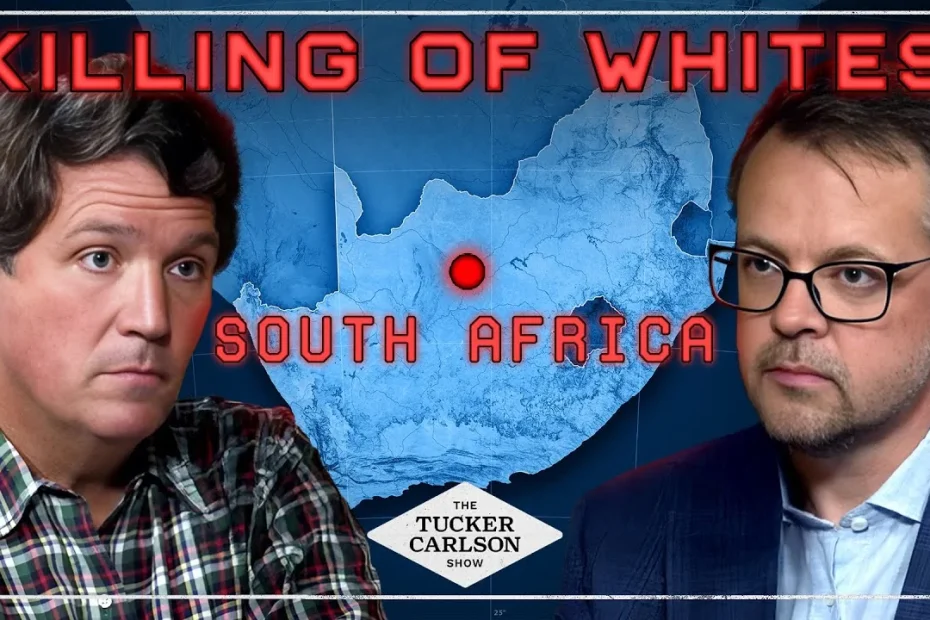
Read the full transcript of writer and filmmaker Ernst Roets’ interview on The Tucker Carlson Show episode titled “Man Charged With Treason for Speaking to Tucker About the Killing of Whites in South Africa”, premiered on March 3, 2025.
Listen to the audio version here:
TRANSCRIPT:
The End of Apartheid and Western Perceptions
TUCKER CARLSON: So I think for most Americans, news about South Africa ended in 1994, both literally. We stopped getting a lot of news from the country, but also people’s views about it stopped evolving then. That was the year that apartheid ended, I guess, officially. You had elections. Nelson Mandela is still a hero in the United States, often referred to by politicians, and it’s only been, I think, in American media in the past couple of months that stories have come out of South Africa that a lot of Americans have read suggesting that actually the country seems to be falling apart and that the government is kind of genocidally racist.
ERNST ROETS: Yeah.
TUCKER CARLSON: And then President Trump in the past month has basically said the same thing. And it’s shocking to a lot of people, I think, how bad it is and how just how racist it is, you know, far more than apartheid ever was. And so I’m wondering since you’ve just landed from South Africa, you live there, what describe the state of the country right now, if you would.
The Democratic Paradox
ERNST ROETS: Well, perhaps I can start with your reference about the nineties because it’s absolutely true. South Africa and America was very involved with the setting up of the political system that we have in South Africa during the nineties, and it was, of course, the end of history era. Everyone is excited about the fall of the Berlin Wall, and the whole world’s going to be liberal and democratic, including African countries.
Samuel Huntington actually cautioned against this in 1996, saying, when he wrote “The Clash of Civilizations,” that we shouldn’t expect African leaders and African liberation movements to suddenly become Western when you give them Western constitutions because they are still African. So they will use the democratic paradox. They will use democratic institutions to promote nondemocratic ends. And that’s what we see in South Africa.
We have a parliament, we have a very liberal constitution, but if you read the constitution and you compare that to reality in South Africa, it’s two completely different worlds. The de facto and the de jure reality in South Africa is irreconcilable.
What has been happening in South Africa is, firstly, there was this major excitement about the new South Africa, Nelson Mandela, the miracle story. Oprah spoke about this, and Charlie’s Koran, everyone. But the reality on ground level was in many ways the opposite.
The National Democratic Revolution
ERNST ROETS: They started, for example, with BEE, as they call it, it’s black economic empowerment, which of course has nothing to do with economic empowerment. They started with that in 1996.
And they actually said, initially in the 90s, that that’s the ruling party’s strategy. They still call it the National Democratic Revolution, which is about using democracy to promote socialist ends. And so the revolution, they say, goes in two phases. The first phase is present yourself as being liberal and democratic and get support, especially international support and local, and then use multi-party democracy as a way of promoting the goals of taking the country down the road to socialism.
Recently, they even went as far as publishing a document saying, “We are now ready for the second phase of the revolution. We now have power. We have control of the state. We now need to use this to become much more aggressive in our socialist policies,” and we’re seeing this in a plethora of new laws all of a sudden in South Africa, which I think has gotten to the point where it’s just not possible to maintain the view that people have had of South Africa for the last few decades and look at what’s currently happening in South Africa. It’s two completely different worlds, and hopefully, or happily at least, a lot of people are starting to wake up to this.
The Truth About Nelson Mandela
TUCKER CARLSON: So you said Samuel Huntington wrote that in 1996, two years after the… I kind of thought that from day one simply because I knew people there, and I was more familiar with the details of the Mandelas. But I think most Americans don’t think I had any idea. Like, what was Nelson Mandela on Robben Island for? What was he imprisoned for? For being black, or was there another reason?
ERNST ROETS: Well, literally so I have children, and they are taught in schools, and the government prescribes what children should learn in history. And so the official version is he went to prison because he was a good leader, and the government didn’t like that.
I should say that he certainly was the best that the ANC has ever had to offer, but the reason why he went to prison is because they started Umkhonto we Sizwe, which was the military wing of the ANC, which became involved with military actions in South Africa with an attempt to overthrow the government. I’m quoting from the ANC’s own policy documents that’s on their own website, so they had this operation when they started, which was used in the Rivonia trial against Nelson Mandela. It was a strategy called Operation Mayebuye, and the slogan of this operation was “Shamelessly we shall attack the weak, and shamelessly, we shall flee from the strong.”
So those were the circumstances in the 1960s.
TUCKER CARLSON: Pretty noble policy statement that “will attack the weak and flee from the strong.”
ERNST ROETS: Yeah. And it’s still on their website. You can find it there.
So it was an attempt at an armed uprising. Now we can talk about everything that was wrong with the previous political system in South Africa, there was a lot wrong, but it’s simply not the case that he went to prison for being a good leader.
The ANC’s Violent History
TUCKER CARLSON: Well, I think that most people would acknowledge a distinction between military action, which is, you know, a fight, a war, a battle between militaries and attacks on civilians, which is something we call terrorism.
ERNST ROETS: Yes.
So it was officially a policy that says, “We can kill innocent people,” and a lot of innocent people died in the political violence in the run up to 1994, and ninety percent of the people who died were black South Africans.
TUCKER CARLSON: But noncommens, women and children.
ERNST ROETS: Yes, yes. Women and children.
TUCKER CARLSON: Passersby. People had nothing to do with anything.
ERNST ROETS: Yes, especially.
Winnie Mandela’s Dark Legacy
TUCKER CARLSON: And so during that time that Mandela was imprisoned, I’m 55, so I remember this very, very well, his wife was effectively his spokesman, Winnie Mandela. And she was lionized in the United States. She was the hero. She was the mother of an emerging nation, you know, a woman of peace and decency, really a transcendent figure, a holy figure. Then it turned out that actually she was a murderer who had, you know, burned to death or supervised the murder of a bunch of different people. Tell us about that.
ERNST ROETS: So let me firstly say that I have a lot of respect for Nelson Mandela, I think, in terms of his efforts, as I say, I think he’s the best the ANC has ever had to offer. Winnie Mandela, his wife, not so much.
She famously has been involved with a lot of things, including what was called Mandela Football Club, which was a gang that was involved with violence and killings of innocent people. And she famously said, at a political rally, “With our necklaces and our matches, we will liberate this country,” which, of course, is a reference to the necklace murders, which was very popular in South Africa and still happens in South Africa.
That’s when you take a rubber tire, you fill it with petrol or gasoline, and you put it around someone’s neck so that it’s bound around their arms, and you set it on fire, and then you stone that person while he’s burning to death. And that happened. I think five hundred or seven hundred people were killed like that during political violence in South Africa, and she encouraged this. Initially, she denied it, and then it came out that it was recorded of her saying this. So yes, it’s very bizarre that someone like Mandela is a hero today.
TUCKER CARLSON: And was a hero then, and so that to me was a sign that these are not, you know, liberators, that they’re oppressors.
ERNST ROETS: Yeah.
Communist Influences
TUCKER CARLSON: And so but no one in the West wanted to think that. It was like a really simple tale of white oppression of noble black people, and by definition, black… I mean, there were oppressed black people, of course, and there were noble black people, but the leadership always struck me as evil.
ERNST ROETS: So there were some better and some worse people in the leadership. I think an important component here that is very well documented—it’s not a secret, but a lot of people don’t seem to want to know this or recognize this—is the very strong alliance that the ANC has always had and still has with the South African Communist Party, and the extent to which they were supported not just by the Soviet Union, also by the Vietnamese and by Mao Tse-Tung as well, implementing what they call the people’s war strategy that they got from Mao Tse-Tung.
So yes, it was very much the ANC saw themselves as being the African or South African frontier of promoting a socialist or a communist revolution.
South Africa’s Decline
TUCKER CARLSON: So how did it turn out?
ERNST ROETS: Well, if you mean in terms of where we are today? Let’s just follow different threads. So let’s just start with, I don’t know, technology and infrastructure.
TUCKER CARLSON: In 1993, South Africa was famously the most prosperous society in Africa by far. Among the most prosperous in the world. Correct? They had nuclear weapons in South Africa.
ERNST ROETS: Yeah.
TUCKER CARLSON: What is it like now thirty years later?
ERNST ROETS: Well, the reality is that virtually every sphere of society is collapsing with the exception of taxation, of course, and tax collection that’s still very, very efficient.
Maybe I can explain it this way. So America has a somewhat skewed tax system, if my information is correct, about 85 percent of income tax in America is paid by about 10 percent of the people. I think that’s correct. So one in ten. In South Africa, 85 percent of income tax is paid by one in thirty people.
So it’s a very small number of people, a very small portion of society that pays tax, that is heavily taxed, and then about almost half of the population in South Africa get money from the government in the form of social grants. If you add government employees, conservative estimates say that 50 percent of people in South Africa get money from the government. Some estimates say it’s up to 60 percent of adults, voting age adults, get money from the government each year.
Government Failure and Discrimination
ERNST ROETS: This money, of course, is then used. It’s given out as social grants, but what’s left is used to set up these programs that are actively discriminating against taxpayers. There are so many examples. One of the most recent ones is this blacks-only fund that the government has set up, whereby they give money to black entrepreneurs exclusively.
So this is happening, and then on top of that, after you spend your tax money to fund these government programs that are discriminating against you, you have to spend what is left to do the things that the government was supposed to be doing.
So the classical definition of a government is that it should protect life, liberty, and property. The classical liberal view, we’re a bit Ciceronian, so we think a government has to do more than that, but if we use those three things, the government’s not protecting our lives. There’s about—if this interview that we’re about to have is two hours, there will be about seven murders in South Africa in this time.
Government does not protect liberty. It’s actively targeting schools of minority communities, actively denying the identity and the rights of minority communities, and it’s certainly not protecting property. It’s actively involved with the program to empower the government to expropriate private property without compensation.
And then we have to use the money that is left to pay for our own private security, to become involved with organizations, to fulfill the things that the government was supposed to be doing with the tax money that we paid in the first place.
American Influence on South African Racism
TUCKER CARLSON: One of the reasons that I find this story so fascinating is not simply because, you know, it’s like the classical irony of history. This group comes in with one aim and then achieves exactly the opposite. We’re going to end racism and then make racism much worse, but also because they have gone about it in a way that’s almost like American, with the same language, the same “diversity is our strength” kind of sloganeering, and it’s had the same result, which is to basically kill whites. I mean, that’s just true. And I wonder if you see that. It’s almost like you imported our kind of intellectual class framework for this project.
ERNST ROETS: That’s absolutely the case. So there’s a theory. There was this video that just went viral on social media of this guy talking about how white people are subhuman and all of that. Well, this is taught at universities in South Africa. There’s a theory called Azania Critical Theory. Azania is a pan-African word for South Africa. And they actually get this from Americans like Robin DiAngelo, Ibram X. Kendi, Ta-Nehisi Coates, these people.
They get it from them, and then they put an African flavor on it, which essentially boils down to a theory that justifies the targeting and extermination of the white minority. And so the theory, to summarize, goes more or less like this. There’s an African term called ubuntu, which means brotherliness, or it’s about your internal humanity, it’s a Zulu term. And the theory goes that white people are incapable of having ubuntu. But ubuntu is the essence of humanity, so if you don’t have it, you’re not truly human.
# The Ideological Foundations of Violence in South Africa
TUCKER CARLSON: So it boils down to the logical conclusion that if you kill a white person, then you did not actually commit murder. So this is not widely believed in South Africa, but this is taught at universities by university professors, and it’s certainly believed by radical elements.
ERNST ROETS: It’s a predicate for genocide. I mean, it’s always the same in every part of the world now. They’re not fully human, right? So we can kill them. Because if they’re fully human, then it’s, of course, a grave sin to kill them.
We’ve always been saying that there’s not a genocide in South Africa. Looking at what happened in Rwanda and so forth, it’s not the same thing, but it is very alarming to look at some of these claims that are being made and to compare that to what was made in Rwanda.
Political Rhetoric and Farm Attacks
TUCKER CARLSON: Every country and, you know, genocide broadly defined is an attempt to eliminate a group of people on the basis of their race or ethnicity.
ERNST ROETS: And we have these political parties chanting—I mean, you’ve seen this. We’ve reported on this—chanting, “Kill the boer, kill the farmer,” to a stadium filled with people. And it’s not just rhetoric, so they would say, “No, it’s just a metaphor.”
But it’s preceded by a speech about how white people are criminals and should be treated like criminals, how everything they have is illegitimate and stolen, in which people are encouraged to go and invade their farms and so forth, and then they chant, “Kill the boer, kill the farmer,” and they make these hand gestures. Of course, the “boer” is a reference to the Afrikaner people.
But the reality is also that the farmers are being attacked and killed on their farms, so it’s not just a metaphor, and our attempt at researching this has found that there’s an increase in farm attacks. Obviously, when the political climate becomes heated or warmer, and these type of statements are made in a way that’s highly publicized, you do get an increase in farm attacks, and it’s very brutal and very horrific farm attacks that we see.
TUCKER CARLSON: Farm attacks are attacks against white farmers, not against—
ERNST ROETS: Not exclusively white farmers, but it’s attacks against farmers in South Africa, of which the majority is white.
TUCKER CARLSON: Right. Okay. So this has been going on a long time. I think it’s been well documented. I believe you wrote a book about it, which has become—sold a lot of copies on Amazon, I noticed.
ERNST ROETS: Yes.
TUCKER CARLSON: And so none of this is like a secret, and all of it’s verifiable because, you know, dead people are pretty easy to track because they’re dead.
ERNST ROETS: Yeah. We have the names of the people who’ve been murdered. Exactly.
Media Response and Denial
TUCKER CARLSON: But in the United States, the country that inspired the revolution that you’re living through, our media have ignored that and then gone beyond ignoring it to attack anyone who brings it up as a, quote, “white supremacist.”
ERNST ROETS: Well, I can tell you so many stories about that.
TUCKER CARLSON: Please do.
ERNST ROETS: For example, I was on your show a few years ago to talk about the farm murders, and the extent to which we were attacked by American media as a result of that. I had someone from CNN come see me in my office in Pretoria to interview me about farm attacks, and the entire interview was about you.
So he would put things to me and say, “Did you know Tucker Carlson said the following? Do you agree with this statement? Did you know that Donald Trump said this? Are you comfortable with this?” And so I paused him at one stage, I said, “What are we doing? I thought we’re here to talk about farm murders and what’s happening in South Africa.”
But the argument was that because Trump made that comment about farm murders in 2018, it has to be a non-existing issue because Trump is a liar and everything he says is false, and the same with you. Because you spoke about it, that means that the problem doesn’t exist, and we have to prove that it doesn’t exist in order to get to you.
TUCKER CARLSON: Well, not only doesn’t it exist, you’re not allowed to complain about it existing.
ERNST ROETS: Yes.
TUCKER CARLSON: Somehow a moral crime to notice and to not like it when people are murdered for the color of their skin. It’s bizarre.
ERNST ROETS: It’s not bizarre. It’s they’re telegraphing genocidal intent when they’re telling you, no, you’re not getting killed, and yes, it’s a good thing that you are.
TUCKER CARLSON: Now you’re not getting killed? What are they saying?
ERNST ROETS: It’s “No, you’re not getting killed, and if you are, you deserve it.”
TUCKER CARLSON: Right. Because of a variety of things, because the attackers are poor, or because remember all the horrible things that white people have done in South Africa and outside of South Africa. So there’s always a justification.
Official Denial and Media Complicity
ERNST ROETS: So another example, just in 2018, again, after you spoke about this and after Trump spoke about this, the president of South Africa, Cyril Ramaphosa, came to America, and he spoke at an event in New York, and he said, “There are no killings of farmers in South Africa.” And he just flat out denied the existence of the problem.
And he said this on an international platform. He said it’s not happening. It’s not true. And the worst of it all was how the media knew this was wrong, especially mainstream media in South Africa. They knew that it’s not true, and so they immediately rushed to his defense, writing articles like, “This is what he actually meant to say,” and then they sort of justify what’s happening.
We really do sometimes feel that our biggest battle is not primarily against what the government is doing, but against how the media is reporting.
TUCKER CARLSON: But just to consider this, I mean, if, you know, Tutsis in Kigali in 1994 said, “Boy, you know, lot of us seem to be getting hacked to death by machetes,” and reporters or political figures said, “shut up. You know, you’re a Tutsi supremacist for saying so.” I think we could fairly say the people shouting them down are pro-genocide of Tutsis.
ERNST ROETS: Yeah.
TUCKER CARLSON: I mean, what’s the other explanation? I don’t really get it. I mean, what honestly, what’s the other explanation?
Justifications for Hate Speech
ERNST ROETS: Well, the explanation that is used in court cases—so, by the way, the chant was found in court not to be hate speech according to South African law. It’s not hate speech.
TUCKER CARLSON: Killing people is not hate speech.
ERNST ROETS: Chanting about killing people.
TUCKER CARLSON: You know why it’s not hate speech? Because it’s not speech they hate. That’s why. Maybe that is that they approve of.
ERNST ROETS: So the arguments that are used to defend this type of rhetoric would always be something like “you need to see it in context, you need to remember the apartheid system, you need to remember what these people went through.”
TUCKER CARLSON: That they deserve to be killed. You need to remember that.
ERNST ROETS: Yeah. That’s—well, so the argument is that they’re actually commemorating the historic struggle, and that’s why they are still chanting this thing.
TUCKER CARLSON: I would disagree with you. I think what they’re saying is the people getting murdered deserve to be murdered, so stop complaining about it.
ERNST ROETS: Well, few people are saying that out loud, but that does seem to be the thing.
Actions Speak Louder Than Words
TUCKER CARLSON: Look. At some point, you know, I don’t need you to explain your motive if I have a clear glimpse of your actions. If I know what you’re doing, I don’t have to hear you explain why you’re doing it. I already know because the motive is displayed in the action. Do you know what I mean?
ERNST ROETS: Yep. So in other words, if I pull out a gun and shoot you and somebody said, “Did you not like Tucker?” I can say whatever I want, but I just shot you. So I think it’s kind of fair to infer that I didn’t like you. Right?
TUCKER CARLSON: Yeah.
ERNST ROETS: But the motive is also explained in the words, so they’re trying to defend the words. It’s the famous story of Chamberlain and Churchill. You know, when Chamberlain came back from meeting Hitler, he said, “No. Well, I met him, and, you know, I think we’re going to find peace,” and then Churchill said, “No, well, I read what he said and I believed him.”
And so you can just read what they’re saying. If you read the policy document of the ruling party, they say they want to convert South Africa into a communist society. They want to have a revolution in South Africa.
If you listen to the more radical parties to the left of them, they openly chant about killing white people. So they say these things out loud. Now there are obviously more to the fringe. You find the more extreme rhetoric in South Africa, but it’s very alarming and how people just rush to their defense all the time.
Western Responsibility and Complicity
TUCKER CARLSON: So that’s the part that bothers me. Like, I’m not—I’ll just say it. I’m not surprised at all. I watched what happened in Rhodesia, and it became Zimbabwe in 1980, and something identical happened. There was a lot of killing, and they drove it, you know, to the bottom rank of nations, the poorest country in the world.
ERNST ROETS: Mhmm.
TUCKER CARLSON: And following exactly the same script, I always thought that would happen in South Africa. I wanted to be wrong. Turns out I wasn’t. What really bothers me is that the West has allowed this and cheered it on because I live in the West. I live in the United States.
So, like, I don’t want to think that my leaders are for killing people on the basis of race, but watching how they’ve stood by and, you know, applauded—Barack Obama’s applauded all this stuff.
ERNST ROETS: Yep.
TUCKER CARLSON: It tells you everything about Barack Obama and other American leaders, doesn’t it?
ERNST ROETS: Yes. And this brings us back to the nineties. So during the nineties, it was, again, after the Cold War, and the world and especially the West was high on ideology and this idea that, you know, the world will become liberal, and everyone’s going to become like us, and everyone in the world is just an American waiting to be liberated, and we just need to go and liberate them from their own traditional beliefs and so forth.
And so it really is the case that America and many Western countries played a very significant role in creating the South Africa that we have today.
TUCKER CARLSON: I’m aware. I’m aware.
ERNST ROETS: And so we don’t want other people to fix our problems on our behalf. We want to solve our own problems, but you can certainly make the case that the West has a moral responsibility towards the people in South Africa.
TUCKER CARLSON: Of course. The West forced through sanctions and boycotts the change of government that put the ANC in power. So absolutely. In the same way the West has armed Ukraine, so they have an obligation to make sure, you know, to at least know what’s happening and to be honest about it, not to hide their own responsibility for the crime.
False Dichotomies in South African Politics
ERNST ROETS: So there’s this false dichotomy in South Africa with regard to South Africa that if you are against what’s happening in South Africa now, that means you want the apartheid system. So you have a choice. And this one former judge recently said this, who’s retired, he said that we have a choice in South Africa between a moral system that is dysfunctional, which is the current system, or an immoral system that is a functional one, which is the former system.
And so the problem is if you criticize what’s happening in South Africa now, you get accused of wanting to return to the apartheid system. But the truth is you can reject both. You can say, “We don’t want the apartheid system, and we don’t want what’s happening in South Africa at the moment. We want to govern ourselves. We want freedom.”
But it seems that a lot of people are incapable of making that conclusion or leaving any room for saying that both these systems are wrong and we need a better system, a system that is much more decentralized, a system in which the various nations who live in South Africa, because South Africa is very big, it’s almost as big as Europe, the various nations living in South Africa should just govern themselves, and that’s not what’s happening in South Africa, and I think it’s a worthy cause to pursue.
TUCKER CARLSON: So can I—I think I’m hardly an expert in South Africa at all, but I am American, so can I just give my overview of what of the different groups in South Africa, and you correct me, but just so people following on because I think it matters for reasons I’ll explain? So South Africa, there are basically two big white populations in South Africa historically.
ERNST ROETS: Mhmm.
TUCKER CARLSON: They’re what we call the Boers, the Afrikaners, who were religious basically religious refugees.
ERNST ROETS: Yeah.
# The Complex History of South Africa
Origins of the Afrikaners
TUCKER CARLSON: A mixture of Dutch and French Huguenots, Protestant Dutch, Protestant French, who moved to Southern Africa for reasons of religious liberty.
ERNST ROETS: Mhmm.
TUCKER CARLSON: Okay? Then you had the English, who I think were after the Boer War in power.
ERNST ROETS: Yes.
TUCKER CARLSON: Who mostly were there for economic reasons and had, in many cases, passports back to Great Britain. And then you had a couple of different African black groups.
ERNST ROETS: Mhmm.
TUCKER CARLSON: The largest of which, I think, to this day are the Zulus.
ERNST ROETS: Yes.
TUCKER CARLSON: Who, like the Afrikaners, the Boers, and the English, were not native to the area at all. They were newcomers who arrived, I think, just right before the Boers did.
ERNST ROETS: Yeah, not long before.
TUCKER CARLSON: Okay. That’s all true. Yes.
ERNST ROETS: Yes. Yes.
TUCKER CARLSON: And they, you know, as invading groups often usually do, kind of exterminated the native population, who were what we would call the Bushmen or…
ERNST ROETS: Yeah. The Khoi and the San, as they are also called.
TUCKER CARLSON: Thank you. Yes. Okay. So that’s my dumb foreigner overview. Is that roughly true?
The Origin Story of the Afrikaner People
ERNST ROETS: Can I tell you a story from our history?
TUCKER CARLSON: I hope you will. Yes.
ERNST ROETS: Some people call it the origin story of the Afrikaner people, and it explains a lot about who we are today. So we were settled in the Cape, the proto Afrikaners, who were still the Dutch, the French, and the Germans. We were then colonized in the Cape in, I think, 1810 by the British. It was during the Napoleonic—
TUCKER CARLSON: When did the Afrikaners or the Boers first get there?
ERNST ROETS: 1652.
TUCKER CARLSON: 1652? What? Hundred and fifty years before the declaration of independence or something.
ERNST ROETS: Wow. Something like that. Yeah. That was a long time ago.
TUCKER CARLSON: Yeah.
ERNST ROETS: So my great, great, great grandfather, Nicolas Roets, who was the first Roets who came to South Africa, came more or less the time when George Washington was a teenager. So he was eight years older than George Washington. So my family has been in Africa since, you could say, since the time of George Washington.
TUCKER CARLSON: So before the United States was a country.
ERNST ROETS: Yeah. Yeah. Absolutely.
TUCKER CARLSON: Do you have another passport?
ERNST ROETS: No. No. I don’t really want one.
TUCKER CARLSON: Right. And do most Afrikaners have other passports?
ERNST ROETS: No. Most don’t. But this goes to the story I want to tell you.
The Great Trek and Battle of Blood River
ERNST ROETS: So we were colonized by the British, and the proto Afrikaners then said, “We don’t want to be governed by anyone else. We want to govern ourselves.” And so they opted to move into the interior of South Africa, which was called the Great Trek, and they didn’t know what they would expect. They said they reject slavery. They want to foster good relations with local tribes, which they did. There were many treaties signed and agreements and so forth.
They did not hold slaves. There was slavery in the Cape Colony before that, but when the Great Trek—that was around the time of the abolition of slavery, and they also rejected slavery. Explicitly said so.
So they then went into the interior, and the leader of the Great Trek was a guy called Piet Retief, who went to negotiate with the Zulu king, Dingaan. And so he said, “What can we do to buy land from you for our people to live?”
The agreement was they had to return cattle that was stolen by another tribe with a king called Sikonyela, so they went, they retrieved the cattle, they brought it to the Zulu king Dingaan. King Dingaan said to them that we have to celebrate, so leave your weapons outside the lager, come inside, and we’ll have a celebration. During the celebration, at one stage, he chanted, “Bulalani Abatakati,” which means “kill the wizards.”
So they took Retief and his commando, his group, to a nearby hill, and they slaughtered him. They slaughtered him last because they wanted to make sure that he sees his people and his son murdered. A few months later, they went on an extermination mission. They killed women and children in the lagers and so forth.
TUCKER CARLSON: A lager is a group of wagons pulled into a—
ERNST ROETS: Yes, correct. Yes. And so a few months later, his body was found with the treaty on which the Zulu king signed, giving them some land. So they then initiated a punishment commando, a group of 300 to 400 men, to counterattack the Zulus, which eventually led to the Battle of Blood River, one of the most significant battles in our history, where they found themselves completely surrounded.
TUCKER CARLSON: Before Nabors?
ERNST ROETS: Yes, surrounded by 12,000 Zulus. So they had this wagon, and my great, great, great, great grandfather was in that lager, and he was the religious leader. His name is Sarel Cilliers.
TUCKER CARLSON: And what was their religion?
ERNST ROETS: Christian.
TUCKER CARLSON: Dutch Reformed?
ERNST ROETS: Dutch Reformed, yes. So he said to them, “Listen, we need to make a vow to God.” And so he wrote a vow, which they all made, and the vow said that we’re standing here in front of the God in heaven and earth to make a vow to Him that if He protects us in the battle that lies ahead, we will commemorate this day in the years to come as a day of thanksgiving and a Sabbath, and we will also tell our children the story, and we will build a church, and we will make sure that the honor of the victory goes to God and not to us.
They made this vow, and the battle took place, and the result was that not one of the Afrikaners were killed. Three thousand Zulus died in that battle.
TUCKER CARLSON: Not one was killed?
ERNST ROETS: Yes.
The Afrikaner Identity and Connection to Africa
ERNST ROETS: And so the reason why I’m telling this story is not to point to the Zulu people—we have good relations with the Zulu and we’ve worked with them. This was, of course, the one major battle, but we’ve had good relations with them over the years. But it says something about, firstly, why the Afrikaner people are so patriotic. It says something about why we are so attached to African soil and why we are still religious, a very religious community.
We have some problems in terms of belief and so forth, but broadly speaking, the Afrikaners are, compared to Europe and compared to some parts of America, still a very religious people. And it also says something about why we are so attached to the country and why we don’t want to leave. We want to stay there because our ancestors have been there for hundreds of years, and we fought and died for our space there, and we’ve gotten used to it to a certain extent.
TUCKER CARLSON: Well, it’s the only country that you have, isn’t it?
ERNST ROETS: Exactly. We don’t have any other country. We can’t go back to England. We’re not Dutch anymore. There’s a slogan in South Africa that says, “Go back to Holland.” But I mean, I’ve been to Holland. I’ve been to Amsterdam. It’s a beautiful city, but I don’t feel like I’m at home when I go there. A beautiful foreign city that I’m visiting.
We became a people in Africa, which is why we are called the Afrikaners. We named ourselves after the continent, and our language, Afrikaans, is named after the continent.
TUCKER CARLSON: But you’re being called invaders by people whose ancestors were also invaders.
ERNST ROETS: Yeah. Well, who came from the north of Africa, yes, from where Cameroon is and so forth. It came down firstly towards the east of Africa and then along the Great Lakes, eventually ending in South Africa. Yes.
Historical Misconceptions and the Anglo-Boer War
TUCKER CARLSON: So I think what you said is really important because I think from the American or the Western perspective, there’s this idea that the Afrikaners, the Boers are worse. They’re the worst whites there, worse than the English.
ERNST ROETS: Yes.
TUCKER CARLSON: English, by the way, created the concentration camp during the Boer Wars.
ERNST ROETS: Yep. Yep. That’s true.
TUCKER CARLSON: Winston Churchill was there and kind of behaved pretty dishonorably, I would say, on many, many levels for hundreds of years in South Africa, that’s just my opinion.
ERNST ROETS: Yep. But the Boers are somehow the worst and that they have no right to be there, and I think history suggests something different.
ERNST ROETS: Well, absolutely. So on my mother’s side, I descend from the British. My great grandfather fought in the First World War for the British. And so in many ways, culturally, we’ve become very close to the British because of the influence over the years, and I don’t think there’s friction today between the Afrikaners and the British, but it certainly is the case.
I mean, the concentration camps were horrible. I recently read Gulag Archipelago, and Solzhenitsyn writes in there that the first concentration camps were invented by the Soviets, but that’s actually wrong. The first concentration camps that we know of, at least this type of concentration camps, were during the Anglo-Boer War, where about 30,000 women and children died.
But the great thing about the Anglo-Boer War was that it was in many ways the first for the world. Some people call it the first international propaganda war because it was in a time when newspapers became popular. So there was this propaganda war in Europe with regard to the Boers, or the Boer War, with a lot of people saying the Boers are boorish. That’s where the word comes from. Evidently, if someone told me that’s where the word boorish comes from, it’s to be sort of, you know, very old style and not very sophisticated.
TUCKER CARLSON: Rough.
ERNST ROETS: Yeah, rough around the edges. And so there was a lot of propaganda, like the Boers being compared to wild hogs and things like that. But that’s okay. The word Boer was actually used for a long time as an insult, almost like Jew, like calling someone a Jew. It’s like, “Oh, you’re a Boer, typical Boer.”
But I mean, we’re very proud of that word. It’s something that we take pride in. In many ways, there’s some debate about the difference between Boer and Afrikaner, but it’s broadly speaking synonymous. But I mean, we’re very proud of our history in South Africa, we’ve become a very sophisticated community with an immense treasure chest of literature, of poetry, of philosophy, all of it in our own language that we developed over the last—especially the last hundred years, which, of course, is under threat now.
The Afrikaans Language and Demographics
TUCKER CARLSON: Your language not spoken by anyone else in the world?
ERNST ROETS: No. It descends from Dutch. Yes. And so if you spend some time as an Afrikaans person with some Dutch friends, eventually, you start to follow, but it’s not Dutch anymore. There’s been influences by other languages and so forth.
So there are people who speak it all over the world, but that’s only because so many people have left from South Africa. Some estimates say it’s about a million people, white people, who have left South Africa over the last few decades.
TUCKER CARLSON: How many are left? How many whites overall in South Africa, and how many of them are Afrikaans?
ERNST ROETS: So it’s more or less about five million who are left. The Afrikaner community is about 2.7 million. And the total population is about just over 60 million.
The Future of South Africa
TUCKER CARLSON: And now it looks like you’re, as you said, entering some kind of final stage where they’ll be—I mean, they’ve been expelled from a bunch of different African countries, as you know. But it sounds like the plan is to force them to leave or kill them, or what is the plan exactly?
ERNST ROETS: So Jan Smuts, the famous Boer general who worked with Churchill, famously said that South Africa is a country where the best never happens and the worst never happens. And so we sort of believe that, and we hope that the worst outcome is an unrealistic outcome.
We do know that the most important thing that we need to do now is to be very well organized in terms of our own communities, to be very well connected to each other. There’s this whole debate about the individual and the community in philosophy, and we’ve realized that if you’re just an individual, you are completely helpless. If you’re not part of a community, if you’re not given meaning by the community of which you are a member, you’re completely helpless against the leviathan, the state.
We need to be well organized, we need to be armed, we need to have well functioning communities who look after each other, look after the poor, do all the things that the government’s supposed to be doing, but also look after our safety. So we drive patrols at night, we’re involved with tens of thousands of volunteers involved with patrols, looking after our own safety, and so forth.
But I think the bigger question here is the future of South Africa, and this is a controversial thing to say, but it’s so obvious that it’s not sustainable. It’s not going to work, and it’s just getting worse. So the only possible solution is not simply to say we need a different party in power because the underlying foundation is still problematic.
The only possible solution is to move toward a system with subsidiary authorities, which could imply something like a republic for the Afrikaner people. It could imply a kingdom for the Zulu people. It could imply different types of authority depending on the community.
But South Africa is a country made up of a long list of minorities. If you look at it from a racial perspective, you can say there’s a majority, but the black majority also consists of a variety, as you mentioned, a variety of nations and tribes and so forth.
TUCKER CARLSON: Plus massive immigration into your country.
ERNST ROETS: Yeah, yeah. That’s a very serious problem. We virtually don’t have borders in South Africa.
TUCKER CARLSON: Right. And a problem, of course, for the country, but also a demographic fact that it’s not as if there’s this, like, monolithic black majority. There are all kinds of different components of the black majority, right?
ERNST ROETS: Yes.
TUCKER CARLSON: You don’t necessarily get along.
ERNST ROETS: Yeah. And then a lot of Zimbabweans murdered in South Africa by South Africans.
Xenophobic Violence in South Africa
ERNST ROETS: It’s xenophobic violence. Every now and then, there’s this upsurge in violence against foreigners. What typically happens is people coming from the north of South Africa, like Malawi, Zimbabwe, Zambia and so forth, and then they work and they accept jobs for lower wages, and a lot of them work really hard. This leads to friction because there’s very high unemployment in South Africa already, creating tension within the local communities. And then every now and then, we have this upsurge in very, very brutal xenophobic violence. And so, yes, the border to the north of South Africa is virtually nonexistent.
Self-Determination and Autonomous Communities
TUCKER CARLSON: So what would it look like to have autonomous republics, and is that allowed under your ’94 constitution? I thought there was some provision for that.
ERNST ROETS: It’s interesting that you know this. Yes. There’s a section in the South African constitution, section 235, that provides for self-determination for communities.
Now there’s some ambiguity in terms of how to interpret that section, but there’s some constitutional provision for that. During the 90s, during the negotiations for New South Africa, the more conservative groups who were white and black, who were arguing for self-determination were made fun of by the ruling party at the time, the National Party, and the ANC, of course, and also some Westerners. “This is just backwards, this idea of governing yourself is somehow an old ancient thing that we should move away from.”
Part of the problem, part of the reason why they were made fun of is the question is, how do you do that practically? The only way to practically do that is to have areas where people live concentrated, where people form a de facto majority.
There are such areas, like, for example, when you talk about the Zulus and so forth. The Afrikaner people are pretty much dispersed, although there are some areas where we live more concentrated. There are some initiatives to get Afrikaners to move closer together, and I think that’s a solution that we need to really focus on, is getting the Afrikaners to move closer together.
TUCKER CARLSON: They’re clustered in Pretoria was my understanding.
ERNST ROETS: The majority, yes. Pretoria and in the Western Cape, at the south of the country, and then there’s this Orania initiative in the Northern Cape.
The Orania Initiative
TUCKER CARLSON: So tell us about that. What is Orania?
ERNST ROETS: Orania is a cultural community. It’s an Afrikaner cultural community. It’s fairly small, it’s about three thousand people, but it’s growing rapidly. It’s growing by about twelve percent to fifteen percent per year.
And the idea is that it’s culturally privately owned. It’s a community where the Afrikaner culture can survive and flourish, and it has been growing at quite a pace, even though it’s from a small base. But the idea is to say this is an area where we are the majority, and we make our own decisions. We make our own laws. We govern ourselves. We make our own decisions in terms of what happens with our tax money, what happens with our streets, what type of monuments—
TUCKER CARLSON: Do murder other people or oppress other people?
ERNST ROETS: No.
TUCKER CARLSON: Then maybe you have an answer to this. A neighborhood, a community of three thousand people, which is tiny, even by South African standards, has received unrelenting negative media attention. Why is that such a moral crime, such an outrage to have a community like that?
ERNST ROETS: It’s bizarre the extent to which Orania has been attacked, especially in the international media. I spoke with a friend in Europe recently who said to me, “I’ve only read negative things about Orania, but that’s why I like it, because I know who’s attacking it.”
In South Africa, there are many traditional cultural communities, like Zulu communities. When they are reported on by the media, they would say, “this Zulu cultural community” or “This Pedi cultural community is doing this.” But when it’s Orania, they say it’s a “whites only enclave.” That’s the term they use, even though it’s a cultural community.
Media Bias and Double Standards
TUCKER CARLSON: Black communities can have their own communities. Why the hostility? And that’s true globally, by the way. Any white majority country—there are very few left—but there’s just suspicion because they exist. What is that?
ERNST ROETS: I think it’s underpinned by oikophobia, this idea of just hating your own people and wanting your own people to disappear.
TUCKER CARLSON: It is strange. I’m not mad at China for being ninety-nine percent Chinese or I’m not mad at Burundi for being all black. It just never even enters my mind. What is that? Why is that? I mean, honestly, I guess now we can ask questions like this. Do you have any idea?
ERNST ROETS: I honestly think it’s underpinned by an enormous sense of guilt within Western society or the Western world, not knowing how to make sense of the Second World War, and being influenced over decades and centuries by enlightenment philosophy that talks about how you are the problem and how you should have a sense of guilt for who you are, and the idea that community and identity is a bad thing. But it’s not a bad thing if it’s someone else.
TUCKER CARLSON: Not only is it not a bad thing, it’s required by law. Community and identity, I mean, those are, like, the buzzwords of the moment. But those are—I mean, basically, it’s just like everyone hates whites, including a lot of whites, and I just don’t understand that. I am white, but I’m kind of agnostic on the question. I kind of like all people. I think they’re all created by God, but we’re required to pretend this isn’t happening, but it is happening. Everybody hates the whites and wants them to die. Where does that come from?
ERNST ROETS: I think it’s primarily a Western thing.
TUCKER CARLSON: But what’s the root of it? I think it’s the weirdest thing I’ve ever seen. By the way, if everyone wanted Malaysians to die or something, I would say, “Whoa. Whoa. Whoa. Whoa.” Whatever Malaysia has done through the years, like, you can’t attack people on the basis of their Malaysianness. That’s just wrong. I would say that, and I mean it.
ERNST ROETS: Of course. Yes.
TUCKER CARLSON: But it’s considered a crime to say that about whites? Where does that come from? I’m honestly baffled. Do you have any idea?
Understanding the Origins of Anti-White Sentiment
ERNST ROETS: No, I can only speculate. I think some part of this oikophobia—I honestly think enlightenment philosophy has played a big role in this. I think the influence of ideas about power structures and all this stuff that’s coming from America…
TUCKER CARLSON: The Chinese have an awful lot of power in Asia, and I never heard anybody say it’s outrageous that China’s ninety-five percent Han or something. It’s not even a thing. It’s something about what—well, as they say in our universities, “whiteness” is uniquely offensive. It’s unique and I don’t think that’s a product of enlightenment philosophy because, I mean, this is a new thing. This is postwar. The Second World War did this in some way that I don’t fully understand. I don’t understand at all.
ERNST ROETS: I think so. Alexander McIntyre has an explanation of how we’re derailed in trying to make sense of the Second World War. I mean, obviously, Hitler was evil and all of that. I mean, no one disagrees with that. Obviously. But the wrong lesson from the Second World War is that nationalism is evil, or a sense of pride in your identity is evil.
TUCKER CARLSON: Only when they’re white.
ERNST ROETS: Yes, yes. Yeah, of course.
TUCKER CARLSON: I don’t think anyone thought the lesson of the war was that nationalism is evil, only that nationalism when whites do it.
ERNST ROETS: When whites do it. Yeah. So McIntyre’s line is that a sense of communal identity and pursuing what is good for your people is a good. And what went wrong with the Second World War was that Hitler was trying to pursue this good at the expense of all other goods. He was detaching this one thing from everything else, and you cannot do that without committing evil and inflicting evil.
The Contradictions in Modern Discourse
TUCKER CARLSON: I thought the lesson in the Second World War was that targeting people for violence and discrimination, but especially violence on the basis of their immutable genetic characteristics was wrong. Like, that’s what I was taught. I believe that now as much as I’ve ever believed it, but it’s just crazy to see people say that on the one hand, and then for a lot of people, a lot of our leaders, the lesson of Second World War was, “No, that’s good. Actually, you need to target more people on the basis of their immutable ethnic characteristics, their whiteness, and kill them.” That’s the lesson? That’s the opposite lesson.
ERNST ROETS: Yeah. Right? Yeah. Of course. Well, so in South Africa, and this is part of the bizarre part of it, the ruling party in South Africa, they would write in their policy documents. They say, “Our ideology is a blend of race, nationalism, and socialism.” That’s literally what Nazi means. Now I’m not saying they’re Nazis, but in some sense, they’re calling themselves Nazis if they say we promote a combination of race, nationalism, and socialism.
TUCKER CARLSON: I don’t think people can hear themselves. I mean, I think even this conversation will be like, “Oh, that’s a Nazi conversation.” It’s like, no. No. No. We’re arguing—or I’ll speak for myself. I’m arguing against what I thought the core idea was, or the core bad idea in the Second World War, which is that you should attack people, hurt people because of how they were born.
ERNST ROETS: Based on who they are.
TUCKER CARLSON: Always been opposed to that. Will always be opposed to that. But now it’s like complaining about it makes—I don’t know. It’s all so—you’re not even allowed to say this has to—it’s also fake. It’s also fake. Like, it’s actually—this is all a cover for something much more sinister that is not really related to the Second World War. I just don’t think—because it doesn’t make any sense.
ERNST ROETS: It’s difficult to make sense of it because it’s completely irrational.
TUCKER CARLSON: Irrational. Therefore, I think it’s a lie because it doesn’t even—like, you don’t even—I don’t have an especially high IQ, and it’s super obvious to me that it doesn’t make any sense. So, like, what really—I guess there’s no answer. I don’t know the answer, but there’s something very deep going on here where the leaders of every country in the world all of a sudden decide this one ethnic group needs to be killed. Like, what’s—
Affluence and Self-Hatred
ERNST ROETS: I think one part of it is something that you’ve said before, which is affluence. The people in the Western world have become very affluent, and unfortunately, as a result of that, very self-centered. And in many ways, they’ve become disconnected from their communities, disconnected from their tradition and so forth.
TUCKER CARLSON: There’s no doubt about that. But, I mean, I would—I just spent a lot of time in the gulf, in the Persian Gulf, the most affluent countries in the world per capita, I think. I mean, they are. And, you know, whatever you think of them, you don’t see a lot of Arab leaders being like, “We really were too Arab. That’s the problem, I hate myself for my Arabness.” Like, that doesn’t even occur to them, to their great credit, by the way. I don’t think self-hatred’s ever good. I don’t think hating anybody on the basis of race is ever good. It’s only this one group that does—
ERNST ROETS: I’d like to believe, and I hope that I’m right, that it’s a minority within the Western world that really believes this stuff, but they have significant power and influence.
TUCKER CARLSON: Why do they?
ERNST ROETS: They are the editors of newspapers, they are the prime ministers, they are professors at universities, and so forth. Those are the people who are promoting this type of idea. When I think most hardworking, ordinary people don’t fall for this, I think.
TUCKER CARLSON: Well, certainly most authentic Christians reject it out of hand immediately as—
ERNST ROETS: It’s essentially anti-Christian in many ways.
TUCKER CARLSON: Well, it is the definition of anti-Christian, I think. I mean, that’s my—oh, look.
# The Moral Imperative and South Africa’s Future
TUCKER CARLSON: What do I know? Don’t take theology advice from me, but that’s certainly my truest, deepest belief that this is immoral, you know, no matter who it’s done to.
ERNST ROETS: Yep.
TUCKER CARLSON: So one—I should have said this at the outset—but one of the reasons there’s been this real change in people’s willingness in the West to talk about what’s happening in South Africa in an honest way, not with the false pieties of “Desmond Tutu was so great”—whatever you think of Desmond Tutu…
ERNST ROETS: Not much.
TUCKER CARLSON: But we were required to talk about South Africa in a very specific way.
ERNST ROETS: Mhmm.
TUCKER CARLSON: And to repeat certain cliches, really at gunpoint. And that’s changed in the past couple of months, and it’s really changed due to a South African emigre called Elon Musk. This is my perspective. You tell me yours. But he has made it possible through X, but also through statements he’s made on X, to say the obvious, which is this is a crime against a beleaguered minority and that, you know, this is racism against human beings, and it’s wrong. Do you feel that?
Elon Musk’s Impact on South Africa’s Narrative
ERNST ROETS: Yes. I don’t know how much of what is in his biography by Isaacson is true, but it does seem from his biography that he’s had some bad experiences growing up in South Africa, which is unfortunate. We’re still not sure quite how attached he still is to South Africa as a country, but looking at his X and his comments, it’s very clear that he’s interested.
The strange thing is even though some people are very angry with him for speaking about South Africa, the only thing that he’s really doing is he’s picking up a mirror, and he’s saying, look at what’s happening in South Africa. And he’s just retweeting videos from rallies in South Africa.
TUCKER CARLSON: Exactly. He’s literally just saying to people, “Look at this stuff that’s happening in South Africa. What do you think of this? Are you okay with this?”
ERNST ROETS: No. I think I can speak for a lot of people in saying that we’re really, really grateful for what Elon Musk is doing to shed light on what is happening in South Africa.
TUCKER CARLSON: It must be so weird to live in a country that has received so much attention from Western media, so much attention. I mean, there’s no other country in Africa where your average American knows the name of three famous people. You know what I mean? There’s not even close. Name three famous people from, you know, Congo. No. But every American knows about Nelson Mandela, probably Winnie Mandela, Desmond Tutu. Jan Smuts was also very big, who became this boy general with a adviser to Churchill. Had joined the English in the First World War, like, right?
ERNST ROETS: Yes. First and Second World War. Right. But the First World War was, you know, not even fifteen years after the Boer War, so that was a pretty remarkable decision that he made.
TUCKER CARLSON: I don’t think most people are that in tune, but they know the big outlines of what happened post-1994, and they know all about apartheid and all that, but it must be so weird to be living in this country where all this stuff is happening and nobody is saying anything about it.
ERNST ROETS: Yeah. It’s crazy. It really is. And I have to say, the last two months has been quite alright in terms of the executive order signed by President Trump and statements coming from the US.
The Executive Order and American Response
TUCKER CARLSON: Tell us about that executive order, if you don’t mind.
ERNST ROETS: So the executive order is a very strong reprimanding of what the South African government is doing. It says that the South African government is, or as Trump said, is treating certain sections of society very badly—that’s the Trumpiest thing ever said. And the US will not stand for this, and so it boils down to sanctions in an important way, which is one part of it says that they will grant refugee status to Afrikaners if they want to go to the US.
Which I don’t think, in all fairness, we’re really grateful for the public stance taken by the US, and in a certain sense, they haven’t gone far enough, but in a certain sense, I don’t think the granting of refugee status is much of a solution. Some people will take that up, but that’s why I told you the story of the Battle of Blood River and the Vow. We are culturally very, very attached to South Africa, and so most of us—
TUCKER CARLSON: Most of your family got to South Africa around the time my family got to the United States? Hundreds of years.
ERNST ROETS: This is my country. I think I’m ninth generation.
TUCKER CARLSON: And so I also have a mother of English descent, and I’m also unlike you, I’m ashamed of it. Sorry. Just kidding. Sort of. Not really. But, yeah, no, of course. I mean, it’s your country. I mean, at that point, what you know?
ERNST ROETS: So I think what a better response from the US could be is to take a firm stance against what is happening in terms of what the South African government is doing, but then to say, “How can the US support minority groups in South Africa who are really working for some form of self determination?” I think America should recognize that it does have part in the problem in terms of what happened historically.
TUCKER CARLSON: Are you kidding? Yes, it does, big time.
ERNST ROETS: Yes, and therefore it’s reasonable, and I think it’s fair, and I’m hesitant to say this because I’m not an American, but I think it’s reasonable to say that America has some form of a moral responsibility. Not to fix South Africa, but at least to try to rework this mess that has been created, because it was involved in creating this mess.
TUCKER CARLSON: We’ve mobilized our State Department to defend, quote, “trans rights” in the Donbas. Okay? We’ve weighed into every sectarian conflict in this world for the past eighty years. I think we can certainly say that a minority group targeted for genocide in the country we’ve been involved in really intimately for my entire life, that that group has a right not to be killed and to have some measure of self determination. I think we can do that. That’s not too big a deal.
ERNST ROETS: Absolutely.
Self-Determination and Rights
TUCKER CARLSON: Right?
ERNST ROETS: Yeah. And the solution, I would say, the most sustainable solution is to help such communities to govern themselves, to have self determination. It’s not only in obviously, would be in our interest, but I think it’s also in the interest of the West and of America today.
TUCKER CARLSON: Well, just on principle, every other group in the world has the right to its own homeland except white people? Like, what? Tell me, just explain to me how that makes sense. Either no group has a right or every group has a right. It’s really that simple. And if you want to say no group has a right, okay. You might even convince me. I don’t know. I’m not a race guy, actually, by my temperament at all. I’d kind of like to ignore it, but as long as some groups have a right to self determination, then every group has a right. It’s that simple. And if there’s a special carve out where one group doesn’t have a right, you have to explain to me why that group doesn’t have that right. Is that fair?
ERNST ROETS: It’s absolutely fair. Well, I think South Africa is a—
TUCKER CARLSON: What? I mean, what the hell is—why are we playing along with this nonsense?
ERNST ROETS: Yeah. This narrative has become this massive stream that has turned into rapids on a river that just pulls everyone along, and this narrative just says if you’re white, then there’s inherently something wrong with you. It doesn’t make any sense, and it’s leading toward a really bad conclusion, obviously, as it has for every other group targeted in this way.
TUCKER CARLSON: Has really suffered in a bit and there are a lot of them. Okay? It’s not—you know, there are a lot of them. And it never ends up well, and I just don’t know why we’re playing along where you’re not even allowed to say—Oh, you haven’t been. I don’t care anymore, obviously. But again, either every group has a right to self determination or no group does. You can’t have this system where, you know, some groups do or all groups do but one. No. No. It’s all or nothing on this.
ERNST ROETS: Well, I can guarantee—
TUCKER CARLSON: Tell me how I’m wrong.
ERNST ROETS: No. Well, I can guarantee you that when I get back home, I’m going to be in a lot of trouble for this interview.
TUCKER CARLSON: Well, I don’t know why, though. I mean, like, what’s the counterargument? I don’t really get it. Like, what is the counterargument? There’s only one group on the entire face of the planet that doesn’t have the right that every other group has? Like, tell me how. It’s all—Maybe there’s a good answer. I’m waiting for it.
ERNST ROETS: No. Well, we don’t know what the answer is. So there is no answer. And so because there is no answer, the way that uniformity is maintained is just through threats. Like, shut up.
TUCKER CARLSON: Yep. “You’re a bad person for saying that. You’re a Nazi.” It’s like, no. No. I hate the Nazis. I’m going to speak for myself. I hate the Nazis. Of course. I hate the idea that people are attacked for something they can’t control, like how they’re born.
ERNST ROETS: Yep.
TUCKER CARLSON: Their genetics. I just don’t believe in that. I never will. I’m a Christian. I don’t believe in it. So you can call me whatever you want. I’m actually making the opposite case, and I haven’t done anything to be ashamed of, and if defending the right of people not to be murdered because of how they were born is a crime, then I’ll plead to it.
ERNST ROETS: Yep.
TUCKER CARLSON: But I actually think that the only thing the people currently in charge of most of the world, certainly of the West, are good at is seizing the moral high ground.
ERNST ROETS: Mhmm.
TUCKER CARLSON: And they don’t deserve it. They haven’t earned it. They’re rotten. Their ideas are rotten, and they don’t deserve to lecture the rest of us about our moral inferiority while they’re endorsing the murder of people for how they were born.
ERNST ROETS: Yep.
TUCKER CARLSON: Sorry. It’s a house of cards.
ERNST ROETS: Yeah. What is a house of cards? That’s exactly right. It’s built, it’s a very shining house of cards, and it’s very proud of its accomplishments, but it’s not sustainable. South Africa has been a victim of Western imperialism in ways, ideologically currently, ideological imperialism, but also—and this is interesting.
The ANC that’s governing South Africa today was founded just after the unionization of South Africa in 1910, and they said that this was one of the major triggers that sparked us to start this movement. And the unionization was after the Boer War, before the union. South Africa was a variety of different republics and colonies governing themselves, and unionization effectively meant that all of these different subsidiary authorities were combined into one big South Africa, as we know it today. The borders of South Africa were actually drawn pretty much by the British in 1910, and the ANC were vehemently opposed—
TUCKER CARLSON: Have a long history of border drawing, I—
ERNST ROETS: Yes. You see this when you have these completely straight borders, and you know that’s artificial. And so the borders we have for South Africa today was a product of Western imperialism, and now those in power would very much like to maintain these borders because they have control. So if we are truly anti-colonialism and anti-imperialist, we should return to a position where people govern themselves. We should rethink the borders.
The Path Forward
TUCKER CARLSON: Don’t—you’ll never be allowed to do that. I mean, let’s just cut right to the no BS part of this. That will not be allowed. It’s never been allowed. You will need either to get to force, which I pray you don’t because I hate that. I hate killing, or you will need the assistance of a powerful outside force that makes it happen. That’s just a fact. Is that fair to say?
ERNST ROETS: Yeah. No. I think it’s fair to say.
TUCKER CARLSON: Right? So anyone who says, “want to kill you, you know, kill the boer, you’re subhuman,” those are not people who are going to say, “Yeah. Go ahead and create your own independent state and not bother anybody” because you’re going to be way more successful and prosperous than they are, and they’re going to hate you on the basis of envy, of course. That’s already happening. And we have to ask them nicely to make certain concessions towards—
ERNST ROETS: No. I get it’s not going to happen.
TUCKER CARLSON: So what is your plan?
ERNST ROETS: Well, I think the plan is to, firstly, to be well organized communities, to have a very strong sense of community, a sense of pride in who we are, to remain Christian and have a strong faith, strong family ties and so forth, that’s where it starts. And then other than that, the second step, you might say, the plan is to just create certain realities on ground level.
So it’s one thing to say, “We want more authority or more self determination,” but you have to, in a sense, create that, so that what you have created can be recognized. There’s no point in saying, “Well, you guys can have your own place,” but that place doesn’t exist. So I think what the Afrikaner people need to do is, to a large extent, build their own self determination, and I think that that’s what we intend to do, but it would help a lot if we can get recognition for this pursuit as a legitimate pursuit.
TUCKER CARLSON: So you don’t think—I sort of just didn’t ask you to pause. I should’ve. You began this segment of the conversation by saying the current scheme, the current arrangement is not going to work.
ERNST ROETS: Yep.
TUCKER CARLSON: I think most people—certainly I as an outsider—instinctively kind of want it to work.
ERNST ROETS: Well, it’s a good story. It sounds like a good story.
TUCKER CARLSON: It’s good story.
# The Conversation Continues: Tucker Carlson Interviews Ernst Roets
On Racial Harmony and Political Hypocrisy
TUCKER CARLSON: Yeah, it is. I mean, I’ll admit to being kind of a dopey liberal in some ways, I really prefer the idea of you people living together in harmony. It’s just I feel that way. I can’t help it. Maybe it’s my enlightenment legacy or something.
I also think you should do it with reality, and I definitely don’t think you should be allowed to kill people because of the way they look, period. So by the way, how did these people why did they go on TV like they’re on the right side? They’re, like, endorsing genocide. I don’t understand how they’ve been allowed to get away with being on Winnie Mandela’s side and feeling self-righteous. I just don’t get that.
ERNST ROETS: I think it’s disgusting. I can’t say it enough. But how do you know it won’t work? Like, ANC obviously isn’t a gang, totally incompetent. You don’t have electricity a lot of the time.
TUCKER CARLSON: Like, it’s not working. They’re just stealing everything.
ERNST ROETS: Got it. Stealing the copper out of the wires.
TUCKER CARLSON: But there’s not another political coalition that could run it effectively?
The Collapse of Basic Services
ERNST ROETS: No. So you mentioned electricity. In Johannesburg, the mayor, just a few days ago, announced that people should just wait seven days and then they will have water. So it’s not just an electricity problem, there’s a water problem as well.
TUCKER CARLSON: So it’s a water problem. You’d have a food problem at some point.
ERNST ROETS: Well, if the farmers are targeted, yes. So there are many reasons why it’s not working and why it won’t work. Everything you can think of points to that direction. One is just the data. As I said, you can look at the levels of how crime is increasing, how unemployment is increasing, how government service delivery is increasingly failing, everything.
Honestly, everything is deteriorating – health, everything – except tax collection. That’s one aspect of it. Another aspect of it is just the extent to which people in South Africa are turning their back on politics. There’s this political vacuum in South Africa, and you can see it, for example, with the extent to which people have stopped voting, how voters turnout has dropped significantly in elections.
People just aren’t interested. They vote reluctantly, those who do.
TUCKER CARLSON: Interesting. Even so, why? Why do you think they… because they feel hopeless?
Political Disconnect and the Vacuum of Power
ERNST ROETS: Because they feel the political establishment is completely disconnected. It doesn’t resonate with them. People vote for parties even though they don’t really like them, but they think this is of all the parties, I don’t like any of them, but this one is the least bad, so I’ll vote for that one. So there’s a complete disconnect between the politicians or the political elite in South Africa, even the opposition parties and the people.
And so there’s this political vacuum that has developed, and this vacuum is filled, as my friend Adam Stonstael in South Africa says, either by the good guys or the bad guys. It’s filled by the bad guys in terms of organized crime, so we have these mafias and gangs coming to the fore with significant power, to such an extent that the government is afraid of them.
TUCKER CARLSON: Boy, that is the story globally, isn’t it?
ERNST ROETS: Yeah. I think it is.
TUCKER CARLSON: The drug cartels are one of the most powerful governments in the world, or they’re not even in government. It’s incredible.
ERNST ROETS: Yeah. So we have a construction mafia, for example. If you build a shopping center, the construction mafia turns up and they tell you, “You need to employ our people, or else we’re going to sabotage your building,” and stuff like that, and it’s a regular thing.
TUCKER CARLSON: And you can’t fight them.
ERNST ROETS: No, you can’t fight them. But the vacuum can be filled by the good guys, and that’s well-organized communities who take control of what is important to them. And so the future is very… and that’s what analysts and scenario analysts and so forth have been saying, that the future is one of deterioration, where you will have communities who will be much worse off than they are today because of the bad guys filling the void, and you might have flourishing communities because of good guys filling the void.
South Africa’s Complex Reality
So that’s another reason, but I think the most important fundamental underlying reason why it’s not sustainable is it’s a political system that is detached from the reality in South Africa. The reality is the distance from Cape Town, the south to the north of South Africa, is the distance from Rome to London.
So it’s a big country, number one, but it’s not homogenous by any means. It’s very diverse. There’s eleven official languages.
TUCKER CARLSON: To restate this, not just black and white at all?
ERNST ROETS: No, no, no, no, no. Certainly not. There’s this Indian community, there’s what we call colored communities in South Africa, and there are various different tribes, you could say, or cultural communities among black South Africans and among white South Africans. So it’s very diverse, different languages, different cultures.
Now we have this political system that just says you have individual rights. In some ways, the constitution, even though it was very much celebrated when it was adopted, it was called the best constitution in the world, and the most liberal, most democratic, and so forth. The constitution guarantees everything…
TUCKER CARLSON: But you get none of it.
ERNST ROETS: Yeah, exactly. That’s exactly it. So we have what they call third generation rights, first, second, and third. It’s a very vast network of rights that you have in theory, but then the question is, so there’s this idea that the highest authority is the constitution, but it’s not possible for a written document to have the highest authority. The highest authority is with the person who gets to interpret it.
TUCKER CARLSON: Boy, is that true, isn’t it?
Constitutional Interpretation and Property Rights
ERNST ROETS: So for example, section twenty-five of the constitution in South Africa, which the government is trying to change, it’s a private property rights clause, they want to change it, but currently it says the government can expropriate your property if it’s in the public interest. Now, if you ask me as a westerner, when is it in public interest to expropriate property? It would be something like they have to build a big highway, or maybe there’s a military emergency, or something like that.
If you ask a judge who is founded in this ideology we’ve just spoken of, they would say it’s in the public interest for white people not to own land. So it’s a question of interpretation. You can have a wonderful document, but it boils down to how do you interpret it. And that’s why I’m saying it’s not compatible with realities on ground level.
There have been many lawsuits in South Africa, many, many, many. South Africa is a very good example of political court cases, and we’ve won many and we’ve lost many, but it’s a ship that is sinking. That’s the fact.
TUCKER CARLSON: Well, it all seems fake. I mean, it seems like and I again, one of the reasons I’m so fascinated by your country is I think it’s on a trajectory that I recognize as an American. So you have these legacy institutions that sort of go through the kabuki of dispensing justice, but it’s not justice, actually. It’s totally disconnected from justice. It doesn’t mean anything.
ERNST ROETS: Yes.
TUCKER CARLSON: And you have this constitution, which is beautiful, which is, you know, ignored. The only power resides in the people who interpret it, as you said.
ERNST ROETS: Yep.
Land Expropriation Without Compensation
TUCKER CARLSON: So then you reach kind of the endpoint or the most recent endpoint, which is the idea that whites can’t own land. Can you explain this?
ERNST ROETS: Yes. So they have been trying to change the South African constitution, the property rights clause, to empower the government to expropriate private property without compensation. That’s the buzzword.
TUCKER CARLSON: Just steal the land.
ERNST ROETS: Yeah. Call it EWC. It’s expropriation without compensation. But it’s confiscation of property. That’s what it is.
TUCKER CARLSON: Well, how is expropriation without compensation different from stealing?
ERNST ROETS: No, exactly. But-
TUCKER CARLSON: It’s just shoplifting. I mean, what?
ERNST ROETS: It’s flabbergasting to see the extent to which, again, academics and analysts and journalists are rushing to the defense of the South African government.
TUCKER CARLSON: In South Africa?
ERNST ROETS: Yes. So here’s one of the many bizarre things that they would say. They would say, “This is all a lie. You guys are lying. It’s not expropriation without compensation. It’s expropriation with compensation, but compensation can be nil. So it can be zero compensation.”
TUCKER CARLSON: So it’s not happening, but it’s a good thing that it is?
ERNST ROETS: Yeah. That’s it. That’s always it.
TUCKER CARLSON: Right.
ERNST ROETS: And so the president has just signed the expropriation bill in South Africa.
TUCKER CARLSON: He signed it?
ERNST ROETS: Yeah. Yeah. And there’s still an attempt to change the constitution, and there’s now a new bill in process. It was just announced, I think, a week ago that they want to pass through parliament that says that eighty percent of—that’s what it boils down to—that eighty percent of land or property in South Africa must be owned by black people, because it says it must be racially representative.
The Racial Ideology Behind Land Reform
And so I want to tell you a quick story about this, because it sort of highlights the ideology. I was at a land summit in South Africa, and a spokesperson for the Department of Land Reform spoke, and it was very clear from his speech that the problem is white people owning land. It was a racial thing. It was very clear. But it’s colored with words like restitution and correcting historic injustices and so forth.
And so I asked him at this summit, I said, “So here’s an example, and what would the government’s position be on this? The example is a white guy owns a farm, the government takes it from him to correct historic injustices, and they give it to a black guy, and it’s a black farmer. And maybe a year or two down the line, this black farmer decides he doesn’t want to be a farmer anymore, he wants to sell his land, and the buyer is white, and now there’s a white farmer again. What’s the government’s position on this?”
And the spokesperson for the department says, “In that case, the correction of the injustice has been reversed.” It’s completely bizarre.
TUCKER CARLSON: What’s interesting is we’ve seen this exact movie frame by frame right next door in Zimbabwe, formerly Rhodesia, which was one of the most prosperous countries in Africa, one of the big tobacco producers in Africa. It’s a very sad what happened to that country.
ERNST ROETS: Well, it’s shocking.
TUCKER CARLSON: But it’s again, it’s, you know, like, organized government sponsored racism doesn’t work, and I don’t care how often the New York Times defends it. It’s always the same. And that is, like, right next door to you, and you have a refugee crisis in your country because of it.
ERNST ROETS: Well, our government, our ruling party—
TUCKER CARLSON: So what do they say to that?
ERNST ROETS: No. They say that Robert Mugabe is a hero and that ZANU-PF, the party—
TUCKER CARLSON: His party.
ERNST ROETS: Yeah—is a good party, and it’s a liberation force, we respect them.
Confronting the Reality of Targeted Persecution
TUCKER CARLSON: Okay. So, again, no one wants to use the term, but this is genocide. I mean, that’s what that is. It’s like targeting a group of people for extinction or elimination on the basis of immutable characteristics. Like, I don’t know what is there another genocide definition I’m not aware of?
ERNST ROETS: Well, I think you can say there are threats of that happening.
TUCKER CARLSON: There’s not a genocide happening in South Africa.
ERNST ROETS: No.
TUCKER CARLSON: I’m not saying there is. I’m saying that’s where it’s going. Like, what’s the other end point here?
ERNST ROETS: Yes.
TUCKER CARLSON: You’re not human. You can’t own land. You should be killed. What am I missing?
ERNST ROETS: Yes. And, yeah, if you own land, by definition, that’s illegitimate, regardless of whether you bought the land. It doesn’t matter how you got the land.
TUCKER CARLSON: Because of your race.
ERNST ROETS: Because of your race. Yes.
TUCKER CARLSON: Okay. If we can’t say that’s wrong, then you know, anyone who can’t say that’s wrong, anyone who makes excuses for that is a dangerous person. Don’t know what else to say. Put another group in there. I don’t care what group it is.
Political Absurdities and International Reactions
ERNST ROETS: So the ANC in South Africa wanted to—they have this process of name changes. And by the way, this targeting of statues came from South Africa.
TUCKER CARLSON: Happened in America.
ERNST ROETS: Started in South Africa, burning down statues and so forth. And they’ve had this long process of name changes, and one thing they wanted to change the street in which the US embassy is in South Africa, to Fidel Castro Avenue. That’s one story.
The other one is they wanted to change one of the main streets in Pretoria to name it after Mao Tse-Tung. And then some of the opposition parties said, “Are you crazy? Do you know what Mao Tse-Tung did?” And the response was, “Remember, Mao was never convicted of any crime.”
TUCKER CARLSON: I say, it does seem not only like one of the worst governments in world, but one of the dumbest also.
ERNST ROETS: Well, I think there’s some explanation as to why the South African government has gone so off the rails, and it’s that they’ve gotten a free pass for decades.
TUCKER CARLSON: Yeah, that’s right.
ERNST ROETS: Because of this narrative. Could do and say whatever they want. They’ve got no criticism or very little criticism, or very careful criticism. And that’s why I think they’ve gone so ballistic after the recent comments by Trump and people like Elon Musk and so forth.
TUCKER CARLSON: Oh, have they? I’m sorry. I don’t follow that closely. Have those comments been noticed since then?
ERNST ROETS: Oh, yeah. Absolutely. Yeah. It’s the biggest story in South Africa at the moment.
TUCKER CARLSON: Really?
ERNST ROETS: And what are they saying?
ERNST ROETS: Well, they’re saying that the organizations that I was involved with at the time have committed treason.
TUCKER CARLSON: They’ve charged with treason.
ERNST ROETS: You’ve been charged with treason?
ERNST ROETS: Yeah.
TUCKER CARLSON: For what?
ERNST ROETS: For speaking well, among others, for me speaking with you about what’s happening in—
TUCKER CARLSON: That’s treason?
ERNST ROETS: Yeah. Because it’s bad-mouthing your country. That’s the argument.
TUCKER CARLSON: Damn. So I don’t know if it’s one of the opposition parties who called—I wanted to go to Cape Town for Christmas just on vacation. I didn’t have time in the end, but—
ERNST ROETS: You’ll probably—I think, probably shouldn’t go. Is that what you’re saying?
ERNST ROETS: No.
# Confronting Challenges in South Africa
Government Threats vs. Mob Violence
TUCKER CARLSON: You should come to South Africa. You should definitely come to South Africa. I don’t know if they’re going to come from the trees and charge you, but that’s certainly the issue.
ERNST ROETS: They were official complaints filed at the police. Yes.
TUCKER CARLSON: You’ve been charged with treason?
ERNST ROETS: Yes.
TUCKER CARLSON: What’s the penalty for treason in South Africa?
ERNST ROETS: Imprisonment. We don’t have the death penalty. No. They just necklace you.
TUCKER CARLSON: It’s informal.
ERNST ROETS: I’m honestly, seriously, I’m more concerned if the question is about safety, about mob justice in South Africa than the actual government coming after you.
TUCKER CARLSON: So what does that look like?
ERNST ROETS: Well, I think you reported on this in 2021, when there was this massive riot in South Africa. In Durban, and then it spilled out to Gauteng, to Johannesburg to a lesser extent.
It’s just people almost like smelling blood and becoming extremely violent, and then people join in by the thousands. I’ve seen that with my own eyes a couple of times. It’s really scary.
A friend from Europe once asked me, “Are you not afraid that the government’s going to come to your house and take your stuff?” And my honest answer is not that much. I’m more concerned about a mob showing up.
TUCKER CARLSON: So then what do you do?
ERNST ROETS: Well, if you are alone, you can’t do anything. If you’re a well-functioning, well-organized community, then you can call people on the radio. You can get the community to take a stance.
TUCKER CARLSON: So you don’t get lynched?
ERNST ROETS: Yes.
TUCKER CARLSON: You got a lot of lynchings and stuff. I mean, that’s, again, added to the irony file. I mean, South Africa is like the world capital of lynching.
ERNST ROETS: Yes. It’s not so much white people who are targeted.
TUCKER CARLSON: I’m aware. Blacks.
ERNST ROETS: Yes, that’s certainly true. It has happened in the previous dispensation. It’s still happening to an extent, not as much as in the past, but people don’t know that it’s still happening. To people accused of crimes. And it’s partly due to the fact that the police is absent. Especially in townships, someone is a rapist, and the police doesn’t show up, doesn’t do anything, and then the local community just deals with him. That type of thing happens.
TUCKER CARLSON: In a very brutal way.
ERNST ROETS: Yes. It does happen in a brutal way.
TUCKER CARLSON: I’ve noticed. Like, pretty shocking. Like, almost like I wouldn’t want to describe it.
ERNST ROETS: I mentioned the necklace murders before. We have that. And it’s the same with the xenophobic violence. It’s very unfortunate. And if we had a well-functioning police service, maybe that would have helped, but we don’t.
Private Security and Self-Defense
ERNST ROETS: In South Africa, I’m pretty sure the private security sphere is almost as big as private security in America, but America is much larger. Private security in South Africa is more than double the police and the army combined. If you add the police and the army up together and you multiply it by two, that’s the amount of private security officers in South Africa.
TUCKER CARLSON: Do you have the right of self-defense, the right to defend yourself and your family in South Africa?
ERNST ROETS: We do have the right to self-defense. We can own firearms, although it’s not as easy as in America. But you can do that. You can get arms, especially through a private security company. There’s some room to make sure that you can protect yourself.
TUCKER CARLSON: And does it work?
ERNST ROETS: Yes. In terms of the farm murders, we’ve seen that statistically, in areas or communities where people are well organized, where they have radios, where they drive patrols, where they are trained, there’s a decrease in farm murders. You can clearly see that.
Actually, the last few years, the farm murder numbers have come down a bit, and it’s not because the incitement has gotten better. It’s not because the police is more efficient. It’s because local communities have become much more involved with their own safety, and so that’s certainly one of the most important building blocks of this situation.
Land Expropriation and Resistance
TUCKER CARLSON: What happens when the government tries to put this law into effect, to try to act on it? The government shows up at your house and says you can’t have it because you’re white, we’re taking it. Like, do people comply?
ERNST ROETS: No. People won’t comply. I mean, that’s partly why I told this story at the beginning – the Afrikaner people and the farmers are very stubborn. In Afrikaans, we say “hard headed.”
TUCKER CARLSON: Well, farmers, you have to be stubborn to be a farmer in the first place.
ERNST ROETS: Yes, and especially a farmer in South Africa. It’s a common trope among farmers to say that “I would rather die on my farm than to hand it over to the government.”
So I think if they really try to act on it, which they haven’t tried – there are land invasions in South Africa, but it’s not so much the government, it’s mobs and gangs invading people’s land. But if they really try to act on these attempts at expropriation, there’s going to be a massive backlash, there’s no doubt.
What the government says is that we need to do what happened in Zimbabwe, but without violence. That’s how they would argue it.
TUCKER CARLSON: That’s what we need to happen in Zimbabwe?
ERNST ROETS: Yes. But this time without violence.
TUCKER CARLSON: That’s one of worst crimes of my lifetime.
ERNST ROETS: Well, they say it publicly. You can find it online. So the argument is, “We’re going to do it a bit better. We’re going to do it without violence.” But what that means is we’re going to do what happened in Zimbabwe, and you are not going to resist. That’s what it means. But obviously, people will resist when they try to do that. There’s no doubt about it.
But I do think the government is very incompetent. They have these very radical ideas, but I don’t know if they have the competency to actually go through with these plans.
Civil Disobedience
TUCKER CARLSON: That’s the opposite of Washington, D.C. I lived there almost my whole life, and that was absolutely true there. The local government would make all these threatening noises – “Do this. Do that. It’s against the law to do this” – whatever, and people just ignored it.
ERNST ROETS: There are some business organizations in South Africa who now use the term “maximum appropriate noncompliance.” That’s what they encourage private companies to do. So it’s a form of civil disobedience with all these BEE, that’s these black empowerment laws.
TUCKER CARLSON: I know someone who had a thriving business he built himself in South Africa, and the government showed up and said, “You’re handing half your business to your new partner.” They didn’t do anything. They just show up and collect the money. They stole half his business.
ERNST ROETS: Black South Africans haven’t gotten richer in the last thirty years. And the government owns most of the land that they expropriate. They don’t give it to people. It goes to the government.
TUCKER CARLSON: So what if you just say, “How about no? You have no legitimacy, and you haven’t been here any longer than I’ve been here. And I have guns too, so I’m not participating. How’s that?”
ERNST ROETS: Well, disobedience can be a wonderful thing, and we’ve had some examples of successful civil disobedience campaigns in South Africa. The government had this e-toll system, a big tax system on the highways, but people by the hundreds of thousands just refused to comply. Eventually, they had to stop it because even though it was law, people just didn’t do it.
The same with COVID. We had these strange laws like you can’t buy flip-flops during COVID.
TUCKER CARLSON: Those are deadly.
ERNST ROETS: And you cannot buy shorts. You cannot buy cooked chicken. We had these really bizarre COVID laws. And so people just said, “Well, we don’t care. We’re just going to do what we want.”
There was a massive civil disobedience phenomenon in South Africa during the COVID lockdown, and the government couldn’t do anything about it. I think people have learned that you can actually do a lot if you just don’t comply with these completely ridiculous irrational laws.
The Threat of Mob Violence
TUCKER CARLSON: I wonder about what you said when we first started talking about this, about the mob justice. That does sound scary to me. I think that’s a bigger threat. What do you do about that? How do you live in a country where your neighbors could rise up against you?
ERNST ROETS: We’ve had some examples of this. It started with the “Rhodes Must Fall” movement.
TUCKER CARLSON: Oh, Cecil Rhodes.
ERNST ROETS: Yes. So this one guy defecated on Cecil Rhodes’ statue at a university in Cape Town. And then they started this movement.
TUCKER CARLSON: He defecated on it?
ERNST ROETS: Yes. So they started this movement of tearing down statues, which eventually boiled over to America, and that’s how it got to America, and it boiled over to Europe and so forth.
But it started with that, this targeting of statues. I think it was 2012 or something, maybe before that even. And it became a mob, they wore T-shirts with slogans like “kill the whites,” and it became very violent and very overtly racist. And it was students, running around setting things on fire, burning down buildings, and stuff like that. So that is a real threat.
And then later, we had the “Fees Must Fall” movement – university students demanding that education must be free. And now more recently, we’ve had political parties taking up that approach.
I honestly think in South Africa, the threat of mob violence is a bigger threat than the government.
TUCKER CARLSON: Of course it is. And, you know, that’s where you get killed in situations like that, I think. So you have to be pretty well organized, pretty well armed.
ERNST ROETS: The thing is there’s no silver bullet. There’s no one thing that we can do to make sure that we’re equipped to withstand that. But if there is a silver bullet, or the closest to it, it would be what I mentioned earlier – well-organized communities.
Communities that have a sense of community, that recognize that you have a sense of responsibility, not just towards yourself and your own family, but towards your community, and that you have some form of a communal identity that is under threat, that is being targeted, and you have to protect yourself.
You have to fulfill a bunch of functions that the government is not fulfilling. Even though you’re paying them to do it, they’re not doing it. So you have to look after your own safety. You need to have a gun. You need to have a bulletproof vest. Or if you don’t, then at least a significant amount of people in your community must, especially those who are more interested in this type of thing.
You need to be well organized. You need to be prepared if something bad happens in your community, if the mob comes, if they set the shopping mall on fire, or if they come for people’s houses, that in a very short timeframe, you can get a whole bunch of people mobilized to protect their community.
With these riots in 2021, that was a good case study because some communities were completely unprepared and they were virtually destroyed, and some communities were very well prepared. And when the mobs arrived, there was a bunch of people with guns waiting for them.
TUCKER CARLSON: Well, I saw video of the South Asian communities in Durban. They’re a big South Asian, big Indian community there. And I don’t know if this is representative, but the videos I saw, man, they were not putting up with it at all.
ERNST ROETS: Yes. They were very well armed.
TUCKER CARLSON: It was like some heroic Indians out there.
ERNST ROETS: There was one, I think, some guy with something that looked like a minigun on the back of a pickup truck. I don’t know where they got that.
TUCKER CARLSON: Is that true? You know, these videos are all out of context. I’m not into them, but I just saw some brave Indians in South Africa.
ERNST ROETS: Yes. We do have some brave Indians.
# South African Resistance and Community Defense
ERNST ROETS: We do. There were other examples. One was the mob was approaching a town, and the people were waiting for them on a bridge. And then they got there, they just couldn’t enter because the people had just cordoned off their own town, their own village, or community, and they weren’t able to enter. So we’ve had some case studies of this.
TUCKER CARLSON: South Africa is a fascinating case study for a lot of things.
ERNST ROETS: It certainly is. It certainly is.
TUCKER CARLSON: Can I just ask you a dumb question, a childish question? Why if I’m the governor of South Africa, it’s like, why are you going after productive people for one thing? The most productive, and that would include the Indians, the Afrikaners. By the way, some of the black African immigrants, the Zimbabweans, like, these are some of the most productive people. I’m like, why not just live in harmony, actually? Wouldn’t it be better for everybody?
ERNST ROETS: Of course. Of course it would be better. I think it’s because when they took power in 1994, they explicitly said, “We are not a political party. We are not a government in terms of what people think a government should be. We are a liberation movement committed to the promotion of socialism and committed to the promotion of black nationalism,” that’s their ideology. They said that in ’94.
TUCKER CARLSON: Yeah.
ERNST ROETS: They even said that before ’94. They published it.
TUCKER CARLSON: I know. I’m going back to the same themes. I’m getting older. Sorry. But, I mean, I actually did know that because, as I said, I’ve always been interested, and I knew people there, but nobody in the American press mentioned that. Not one person.
Media Blindness to South Africa’s Reality
ERNST ROETS: There’s a well-known book that was an international bestseller, “My Traitor’s Heart,” by a guy called Rian Malan. It’s sort of his autobiography.
TUCKER CARLSON: Oh, yeah. Yeah.
ERNST ROETS: I know Rian, I know the author. He’s a great guy. But in the book, he writes about—
TUCKER CARLSON: In English, I don’t know if he wrote in Afrikaans originally, but it’s a beautifully written book. It’s very well written. He’s a very nice writer. He speaks like he writes as well.
ERNST ROETS: Oh, does he? Yeah, yeah, yeah. So there’s one part in the book where he talks about picking up the New York Times, and I’m sort of saying this from memory, from reading the book, but broadly speaking, what he says is he picks up the New York Times in, I don’t know, 1992 or something in New York or wherever, and there’s two stories on the same page. The one is about the ANC and Nelson Mandela coming to save South Africa, and then the other story is a somewhat smaller story about a guy being necklaced in a local community, a guy being viciously attacked and killed. And so he writes in that book that what concerned him was that The New York Times was not able to connect these two stories to each other.
TUCKER CARLSON: Yes.
ERNST ROETS: They didn’t recognize that it’s part of the same story. It’s presented as two completely different—
TUCKER CARLSON: I knew exactly. I think it was very obvious. So I was twenty-five in 1994, and it was very obvious to me, and I don’t think I have any special powers of insight. I think you would have to be lying to yourself or lying to your audience not to acknowledge it. And by the way, 1994, that’s less than twenty years after the Khmer Rouge took power in Phnom Penh in Cambodia. That was while the Rwandan genocide was happening. It was the same year as the Rwandan.
ERNST ROETS: It was later that year.
TUCKER CARLSON: The same month even.
ERNST ROETS: The election at least.
TUCKER CARLSON: Was in July?
ERNST ROETS: April. May.
TUCKER CARLSON: May. May. Okay. Right. Right. Yeah. Yeah. I remember them both very well, and I knew people in both places at the time. But I remember thinking, you know, obviously, what happened in Kigali in Rwanda is way worse than anything that’s happened in South Africa. But bottom line, when bad people with bad motives stated publicly take power, it’s not good. It’s like, I don’t know. That’s not hard.
Ignoring Warning Signs in Rwanda and South Africa
ERNST ROETS: Well, there’s a story from Rwanda, one that I keep mentioning. I think Linda Melvern wrote a book called “Conspiracy to Murder,” which is about—I think she lived in Rwanda, she’s a journalist, and she wrote about what happened. And she writes about a meeting—it must have been a party in Washington between American diplomats and government officials from Rwanda, in the run up, I think, to the genocide. And it was just a big celebration, and everyone was happy because Rwanda was in the process of becoming a democracy.
And then afterwards, someone asked one of the Americans, “But did you not know what was happening in Rwanda, that they were on the verge of committing genocide?” And the American diplomat said, “Yes, we knew, but we were so excited about democracy and Rwanda becoming a democracy, we didn’t want to spoil the mood by confronting them.”
TUCKER CARLSON: Sounds like an American diplomat.
ERNST ROETS: That’s very, very alarming, this idea of being so excited about a potential idea that you are not willing to confront the realities that are happening or that could potentially unfold. Or being unwilling to clearly define your terms. Like, what is democracy, actually?
TUCKER CARLSON: Well, that’s an underlying problem.
ERNST ROETS: Right.
TUCKER CARLSON: And it’s a problem that’s only surfaced in this country in the last couple years.
Symbolic Politics vs. Real Problems
ERNST ROETS: Example of that from the South African perspective? So I mentioned the name changes. It’s a big thing in South Africa.
TUCKER CARLSON: I’m sure that’ll fix your problems. Will that bring electricity and water back?
ERNST ROETS: No, obviously. So there’s a town called Amanzimtoti, which is on the East Coast of South Africa. The main street was named Kingsway. They changed it to Andrew Zondo Street. Now Andrew Zondo is really only known for one thing. He was a member of the ANC Youth League, and I believe it was 1985, he planted a bomb in a shopping center. And he killed, I think, five people and injured forty. All of the people who were killed were women and children. That’s the only thing he did, and he was a member of the ANC Youth League.
The ANC regards that event as something that they claim as an act of heroism, so they named the main street after him. And so there are people in that town who drive to work in a street named after the person who killed their children. And now they would say that they need to do these name changes to make sure that they get rid of offensive names. Offensive names are Afrikaans names, names linked to South Africa’s past.
And so I was at, again, a summit where this was discussed, and I mentioned this. I said, “So you say that in Pretoria, Church Street is an offensive name and has to be changed. In Amanzimtoti, you change Kingsway to Andrew Zondo,” and I tell the story. And I said, “So who decides if it’s offensive or not?” And the guy said, “Oh, that’s easy. The majority decides.”
But it’s not even the majority, it’s just the government. The government decides because they believe they are the majority. So we have these extremely offensive things happening under the banner of people—
TUCKER CARLSON: Well, they’re murderous. I mean, again, I just—I think the picture is really, really clear. It couldn’t be clearer.
Staying in South Africa Despite Challenges
TUCKER CARLSON: You’re staying?
ERNST ROETS: Yeah. No. Definitely. Yeah. We’ll stay.
TUCKER CARLSON: You guys must love your country.
ERNST ROETS: Yeah. We really do. I mean, in South Africa, everyone who’s been to South Africa would say it’s an incredibly beautiful country, and it truly is. And it’s a country that unfortunately has suffered so much under this current government, and had suffered so much in the past.
One of our Afrikaans philosophers, a man named N.P. Van Wyk Louw, wrote, I think in the 1930s or something, that you love a people not so much for their accomplishments as for the hardships that they’ve had to endure. And I think that’s true for South Africa. South Africa has endured many hardships, and also for our people, the Afrikaner people, as with many other peoples all over the world, have endured many hardships, and it’s through these hardships and maintaining our sense of identity that we really love our history and our tradition and our culture.
TUCKER CARLSON: Well, you came in the first place because you were an oppressed minority, correct?
ERNST ROETS: Yep.
TUCKER CARLSON: I know the French did.
ERNST ROETS: Yes. The French Huguenots.
TUCKER CARLSON: Yes. It was fleeing the religious wars in—
ERNST ROETS: They were getting killed.
TUCKER CARLSON: Yes. In big numbers.
ERNST ROETS: Yeah. Yeah. That’s part of our origin story, how we—
TUCKER CARLSON: Well, it’s also factually true.
ERNST ROETS: Yes. Absolutely. History. I mean, it’s not a myth. It’s real.
TUCKER CARLSON: Yes. Yes. Absolutely.
Speaking Truth Despite Consequences
TUCKER CARLSON: So do you think—I don’t know what the resolution will be, and I’m certainly rooting for all South Africans of every culture, but fervently. But I gotta think that being able to say certain obvious truths out loud helps. Do you think?
ERNST ROETS: Well, the problem is if you do that, you get bashed quite aggressively.
TUCKER CARLSON: Yeah, but like compared to what? The alternative is worse. It’s just living the lie. It’s much worse than getting bashed for telling the truth.
ERNST ROETS: Can I tell you a quick story or a quick reference about courage?
TUCKER CARLSON: Of course.
On Courage and Finding Balance
ERNST ROETS: So it’s somewhat philosophical, but I’ll make it practical. So Odysseus is on his way back from the Trojan War, and he has all these hardships, and he’s trying to get home. And he gets told that the only way for him to get home is to face Scylla and Charybdis. Scylla is this six-headed sea monster, and Charybdis is a monstrous whirlpool that swallows ships whole. And the only way for him to get home is he has to navigate through these two monsters, which he eventually does. He decides it’s better for him to sail his ship closer to Scylla, the sea monster, than the whirlpool. And a whole lot of his people die, but he reaches his destination.
And so Aristotle writes about this in the Nicomachean Ethics, when he talks about the golden mean. And he says any virtue is about finding the balance between having excess of it and having a deficiency of it. And so this goes to courage, and courage is a good example. If you have excess courage, you become reckless. And if you have a deficiency, then you’re a coward.
And so the point of having courage is finding the balance between cowardice and recklessness. And what’s great about the story of Odysseus is Odysseus discovers that he cannot simply go exactly in the middle between the two. He has to be closer to the one threat than to the other, because if he goes too close to the whirlpool, his whole ship gets swallowed up.
And so the point here, and Aristotle says this as well, it’s not to find the exact middle point, it’s to find the appropriate balance between the two extremes. And so the one extreme is recklessness, and the other extreme is cowardice.
And I honestly think in the situation we are in, it’s better to err on the side of being too bold than to err on the side of having not enough courage or trying to find some form of solution through appeasement. So we make mistakes in the process, and sometimes you say something wrong or you do something wrong, but I’m very much convinced that if we’re on this course and we try to pursue what we are trying to pursue, rather err on the side of having too much boldness and too much courage and facing the consequences than having to face the consequences of having a lack of courage.
TUCKER CARLSON: I love that. I gotta say, in a lifetime of travel, the two—if I could just generalize, the two most impressive groups I meet everywhere my whole life around the world, both groups living in exile in large numbers, are the South Africans and the Lebanese.
ERNST ROETS: Oh, really?
TUCKER CARLSON: Yes. Yes. I’ve never met one of either group I didn’t like and didn’t admire. I don’t think I’ve met one in either group, and the thing that they have in common is they live in beautiful, volatile countries that they really love, but they’re very hard to live in. And so they’re caught between that tension, you know, cowardice and recklessness, and they’re making that calculation every single day, and they’re living so thoughtfully and so purposefully and in such a, I don’t know, just an admirable, noble way. I’ve just noticed that.
ERNST ROETS: I appreciate the comment.
TUCKER CARLSON: It looks like just an observation, but I’ve thought about it many times. Last question. Where can people who have made it this far into the interview and are interested in what’s happening in your country and happening to your group, how can they follow it? How can they be helpful? How can they learn more and be supportive?
ERNST ROETS: Well, I think there are many ways. The one way is just to follow what’s happening in South Africa and speak about it because we’ve had this incredible barrage of communications coming, just telling us again how wrong we are. This narrative is this zeitgeist in a certain sense. It’s really like a monster that you have to fight, that you’re not allowed to speak certain truths, even though the truths are self-evident.
So I think one thing is if people just can help spread the message, help take some interest in South Africa, because what’s happening in South Africa is also of interest to the rest of the world.
TUCKER CARLSON: I think it is.
South Africa: Problem and Solution
ERNST ROETS: In many ways, South Africa is the future of the Western world, in terms of the problem and the solution, I think. So that’s one. And then the other is there really are some institutions in South Africa who are really focused on building community-based solutions. And I think if people can identify these institutions and support these institutions, it really would help.
I think in terms of the US government, if the US government is willing to do something as it seems that they are, the most important thing that they could do is a combination of pressuring the South African government away from these destructive policies, but also supporting communities, local communities or minority communities or nations, you should say, who are committed to finding some form of self-determination.
TUCKER CARLSON: Amen. Well, Godspeed. Thank you very much. I hope to see you again. I hope you’ll come back.
ERNST ROETS: Oh, thank you. I hope so too. And then I have to thank you, not just for this interview, but also for the focus you’ve been putting on South Africa. It was really just so interesting, and it reveals so much about us. I’m American, and it reveals a lot about our leadership class, and I think it’s important to say it.
TUCKER CARLSON: Yeah. Thank you.
A Note to Our Viewers
TUCKER CARLSON: Well, thank you very much. So it turns out that YouTube is suppressing this show. On one level, that’s not surprising. That’s what they do. But on another level, it’s shocking.
With everything that’s going on in the world right now, all the change taking place in our economy and our politics with the wars we’re on the cusp of fighting right now, Google has decided you should have less information rather than more, and that is totally wrong. It’s immoral. What can you do about it? Well, we could whine about it. That’s a waste of time.
We’re not in charge of Google, or we could find a way around it, a way that you could actually get information that is true, not intentionally deceptive. The way to do that on YouTube, we think, is to subscribe to our channel. Subscribe. Hit the little bell icon to be notified when we upload and share this video. That way, you’ll have a much higher chance of hearing actual news and information.
So we hope that you’ll do that.
Related Posts
- Neil deGrasse Tyson on UFO Files, Trump & Alien Existence (Transcript)
- Professor John Lennox: AI Is Humanity’s Attempt to Make God (Transcript)
- What’s Changing, What Kids Must Learn w/ Sinead Bovell @ SXSW (Transcript)
- How Emotions Are Made: The Secret Life of the Brain – Dr Lisa Feldman Barrett (Transcript)
- The AI-Generated Intimacy Crisis – Bryony Cole (Transcript)