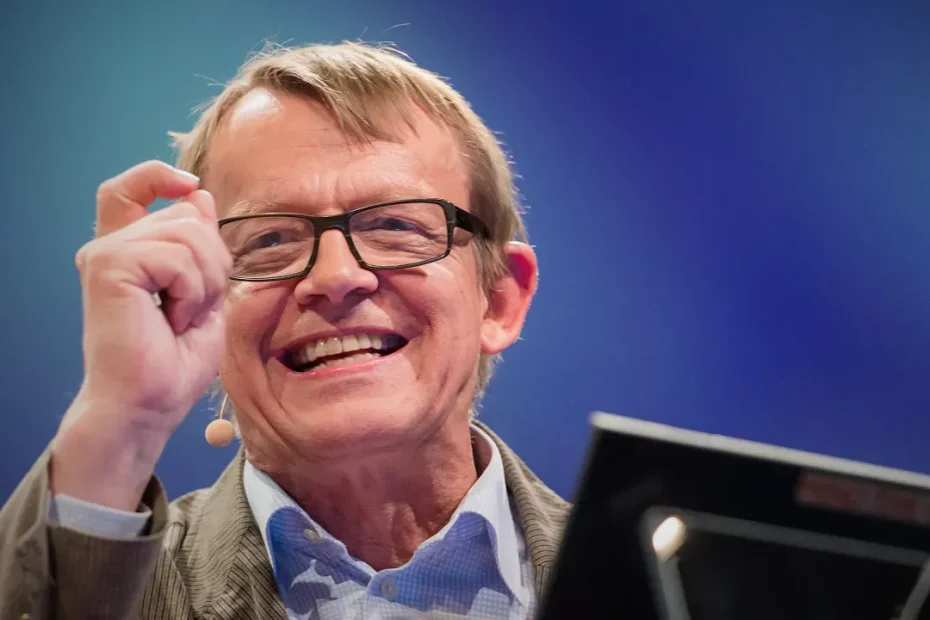
Read the full transcript of Hans and Ola Rosling’s talk titled “How Not To Be Ignorant About The World” at TED Talk conference on Sep 12, 2014. This is compelling TED talk by Hans and Ola Rosling that challenges our understanding of global facts and reveals how surprisingly uninformed most people are about the state of the world.
Listen to the audio version here:
TRANSCRIPT:
Testing Global Knowledge: The Quiz
[HANS ROSLING:] I’m going to ask you three multiple-choice questions. Use this device to answer. The first question is, how did the number of deaths per year from natural disaster change during the last century? Did it more than double? Did it remain about the same in the world as a whole? Or did it decrease to less than half? Please answer, A, B or C.
I see lots of answers. This is much faster than I do it at universities. They are so slow. They keep thinking, thinking, thinking. Oh, very, very good.
And we go to the next question. So how long did women 30 years old in the world go to school? Seven years, five years or three years? A, B or C, please answer.
And we go to the next question. In the last 20 years, how did the percentage of people in the world who live in extreme poverty change? Extreme poverty, not having enough food for the day. Did it almost double? Did it remain more or less the same? Or did it half? A, B or C.
Revealing the Answers: How Did You Do?
Now, answers. You see, death from natural disasters in the world, you can see from this graph here, from 1900 to 2000. In 1900, there was about half a million people who died every year from natural disaster, floods, earthquake, volcanic eruption, droughts. And then how did that change?
We asked, Gapminder asked the public in Sweden. This is how they answered. The Swedish public answered like this. 50% thought it had doubled, 38% said it’s more or less the same, 12% said it had halved.
This is the best data from the disaster researchers. And it goes up and down and it goes to the Second World War and after that it starts to fall and it keeps falling and it’s down to much less than half. The world has been much, much more capable as the decades go by to protect people from disasters. So, only 12% of the Swedes know this.
So, I went to the zoo and I asked the chimps. The chimps don’t watch the evening news. So, the chimps, they choose by random. So, the Swedes answer worse than random. Now, how did you do? That’s you. You were beaten by the chimps. But it was close. You were three times better than the Swedes. But that’s not enough. You shouldn’t compare yourself to Swedes. You must have higher ambitions in the world.
Let’s look at the next answer here. Women in school. Here, you can see men went eight years. How long did women go to school? Well, we asked the Swedes like this. And that gives you a hint, doesn’t it? The right answer is probably the one where fewest Swedes picked, isn’t it? Let’s see, let’s see. Here we come. Yes, yes, yes. Women have almost caught up.
This is the US public. And this is you. Here you come. Oooh. Well, congratulations. You’re twice as good as the Swedes. But you’re not as good as me.
So, how come? I think it’s like this. Everyone is aware that there are countries and areas where girls have great difficulties. They are stopped when they go to school. And it’s disgusting. But in the majority of the world, where most people in the world live, most countries, girls today go to school as long as boys, more or less. That doesn’t mean that gender equity is achieved. Not at all. They still are confronted with terrible, terrible limitations. But schooling is there in the world today.
Now, we miss the majority. When you answer, you answer according to the worst places. And there you are right. But you miss the majority.
What about poverty? Well, it’s very clear that poverty here almost halved. And in the US, when we asked the public, only 5% got it right. And you? Ah, you almost made it to the chimpanzee. That’s a few of you.
There must be preconceived ideas. And many in the rich countries, we think we can never end extreme poverty. Of course they think so. Because they don’t even know what has happened. The first thing to think about the future is to know about the present.
The Ignorance Project: Understanding Our Misconceptions
These questions were a few of the first ones in the pilot phase of the Ignorance Project in Gapminder Foundation that we run. And this project was started last year by my boss and also my son, Ola Rosling. And Ola told me, we have to be more systematic when we fight devastating ignorance.
Already the pilots revealed this, that so many in the public score worse than random. So we have to think about preconceived ideas. And one of the main preconceived ideas is about world income distribution.
Look here. This is how it was 1975. It’s the number of people on each income. From $1 to $100. See, there was one hump here around $1 a day. And then there was one hump here somewhere between $10 and $100. The world was two groups. It was a camel world. Like a camel with two humps. The poor one and the rich one. And there were fewer in between.
But look how this has changed. As I go forward, what has changed, the world population has grown, and the humps start to merge. The lower hump merges with the upper hump. And the camel dies and we have a dromedary world.
With one hump only.
The percent in poverty has decreased. Still it’s appalling that so many remain in extreme poverty. We still have this group, almost a billion over there. But that can be ended.
Now, the challenge we have is to get away from that, understand where the majority is. And that is very clearly shown in this question. What is the percentage of the world’s one-year-old children who have got those basic vaccines against measles and other things that we have had for many years? 20, 50 or 80%.
Now, this is what the US public and the Swedish answered. Look at the Swedish result, you know what the right answer is. Who the heck is professor of global health in that country? Well, it’s me. You see, it’s very difficult. It’s very difficult.
However, Ola’s approach to really measure what we know made headlines and CNN published these results on their web and they had the questions, their millions answered and I think there was about 2000 comments and this was one of the comments: “I bet no member of the media passed the test, is that it?”
So, Ola told me, take these devices, invite them to media conferences, give it to them and measure what the media know and, ladies and gentlemen, for the first time, the informal result from a conference with US media and then, lately, from the European Union media. You see, the problem is not that people don’t read and listen to the media, the problem is that the media doesn’t know themselves.
What shall we do about this, Ola? Do you have an idea?
[OLA ROSLING:] Yes, I have an idea but first, I’m so sorry that you were beaten by the chimps. Fortunately, I will be able to comfort you by showing why it was not your fault, actually. Then I will equip you with some tricks for beating the chimps in the future. That’s basically what I will do.
Why Are We So Ignorant?
But first, let’s look at why are we so ignorant and it all starts in this place. It’s Hudiksvall. It’s a city in northern Sweden. It’s a neighborhood where I grew up. And it’s a neighborhood with a large problem. Actually, it has exactly the same problem which existed in all the neighborhoods where you grew up as well. It was not representative. It gave me a very biased view of how life is on this planet.
So, this is the first piece of the ignorance puzzle. We have a personal bias. We have all different experiences from communities and people we meet and on top of this, we start school and we have the next problem.
Well, I like schools but teachers tend to teach outdated worldview because they learned something when they went to school and this were passed to the students without any bad intentions and those books, of course, that are printed are outdated in a world that changes and there is really no practice to keep the teaching material up to date so that’s what we’re focusing on.
So, we have these outdated facts added on top of our personal bias. What happens next is news. An excellent journalist knows how to pick the story that…
Understanding Our Biases
Will make headlines because it’s sensational. Unusual events are more interesting. And they are exaggerated, especially things we’re afraid of. A shark attack on a Swedish person would get headlines for weeks in Sweden.
These three skewed sources of information are really hard to get away from. They bombard us and equip our mind, and on top of it we put the very thing that makes us humans: our human intuition.
It was good in evolution. It helped us generalize and jump to conclusions very fast. It helped us exaggerate what we’re afraid of, and we see causality where there is none. Then we get an illusion of confidence where we believe that we are the best car drivers above the average. Everybody answered that question: “Yeah, I drive cars better.”
This was good evolutionarily, but now when it comes to the world view, it is the exact reason why it’s upside down. The trends that are increasing are instead falling and the other way around. In this case, the chimps use our intuition against us, and it becomes our weakness instead of our strength. It was supposed to be our strength, wasn’t it?
Measuring and Curing Ignorance
So how do we solve such problems? First, we need to measure it and then we need to cure it. By measuring it, we can understand what is the pattern of ignorance.
We started the pilot last year, and now we’re pretty sure that we will encounter a lot of ignorance across the whole world. The idea is really to scale it up to all domains or dimensions of global development such as climate, endangered species, human rights, gender equality, energy, finance. All different sectors have facts, and there are organizations trying to spread awareness about these facts.
I started actually contacting organizations like WWF, Amnesty International, and UNICEF, asking them: “What are your favorite facts which you think the public don’t know?” I gather those facts—imagine a long list with say 250 facts—and then we poll the public and see where they score worst. So we get a shorter list with the terrible results.
What are we going to do with this short list? Well, we turn it into a knowledge certificate, a global knowledge certificate which you can use if you’re a large organization, a school, a university, or maybe a news agency to certify yourself as globally knowledgeable. Basically meaning: we don’t hire people who score like chimpanzees. So maybe 10 years from now, if this project succeeds, you will be sitting at an interview having to fill out this global knowledge certificate.
Practical Tricks to Improve Your Global Knowledge
Now we come to the practical tricks. How are you going to succeed? There is of course one way, which is to sit down late nights and read all the facts by heart by reading all these reports. That will never happen actually. Not even Hans thinks that’s going to happen. People don’t have that time. People like shortcuts.
Here are the shortcuts. We need to turn our intuition into strength again. We need to be able to generalize. So now I’m going to show you some tricks where the misconceptions are turned around into rules of thumb.
Let’s start with the first misconception: “This thing is getting worse.” You heard it. You thought it yourself. The alternative way to think is most things improve. So when you’re sitting with a question in front of you and you’re unsure, you should guess “improve.” Don’t go for “worse.” That will help you score better on our test.
The second misconception: “There are rich and poor and the gap is increasing.” It’s an unequal world, but when you look at the data, it’s one hump. If you feel unsure, go for “most people are in the middle.” That’s going to help you get the answer right.
The next preconceived idea: “Countries and people need to be very rich to get social development like girls in school and be ready for natural disasters.” No, that’s wrong. That huge hump in the middle already has girls in school. So if you are unsure, go for “the majority already have this” – like electricity and girls in school, these kinds of things.
These are only rules of thumb, so of course they don’t apply to everything, but this is how you can generalize.
Let’s look at the last one. Sharks are dangerous. Well, yes, but they are not so important in the global statistics. I’m very afraid of sharks. So as soon as I see a question about things I’m afraid of—which might be earthquakes, other religions, maybe terrorists or sharks—anything that makes me feel afraid, assume you’re going to exaggerate the problem. That’s a rule of thumb. Of course, there are dangerous things, but sharks kill very, very few people.
With these four rules of thumb, you could probably answer better than the chimps because the chimps cannot do this. They cannot generalize these kinds of rules. Hopefully, we can turn your world around, and we’re going to beat the chimps. That’s the systematic approach.
Why This Matters
Now the question: is this important? Yes, it’s important to understand extreme poverty and how to fight it and how to bring girls into school. When we realize it’s actually succeeding, we can understand it.
But is it important for everyone else who cares about the rich end of this scale? I would say yes, extremely important for the same reason. If you have a fact-based worldview of today, you might have a chance to understand what’s coming next in the future.
In 1975, that’s when I was born, I selected the West—that’s the current EU countries and North America. Let’s now see how the “rest” and the “West” compare in terms of how rich you are. These are the people who can afford to fly abroad with an airplane for a vacation. In 1975, only 30% of them lived outside EU and North America. But this has changed.
Let’s look at the change up till today, 2014. Today it’s 50-50. The Western domination is over as of today.
So what’s going to happen next? Do you see the big hump? Did you see how it moved? I did a little experiment. I went to the IMF, International Monetary Fund website. They have a forecast for the next 5 years of GDP per capita. I can use that to go 5 years into the future, assuming the income inequality of each country is the same. I did that, but I went even further. I used those 5 years for the next 20 years with the same speed, just as an experiment of what might actually happen.
Let’s move into the future. In 2020, it’s 57% in the rest. In 2025, 63%. In 2030, 68%. And in 2035, the West is outnumbered in the rich consumer market. These are just the projections of GDP per capita into the future. 73% of the rich consumers are going to live outside North America and Europe.
So yes, I think it’s a good idea for a company to use this certificate to make sure they make fact-based decisions in the future.