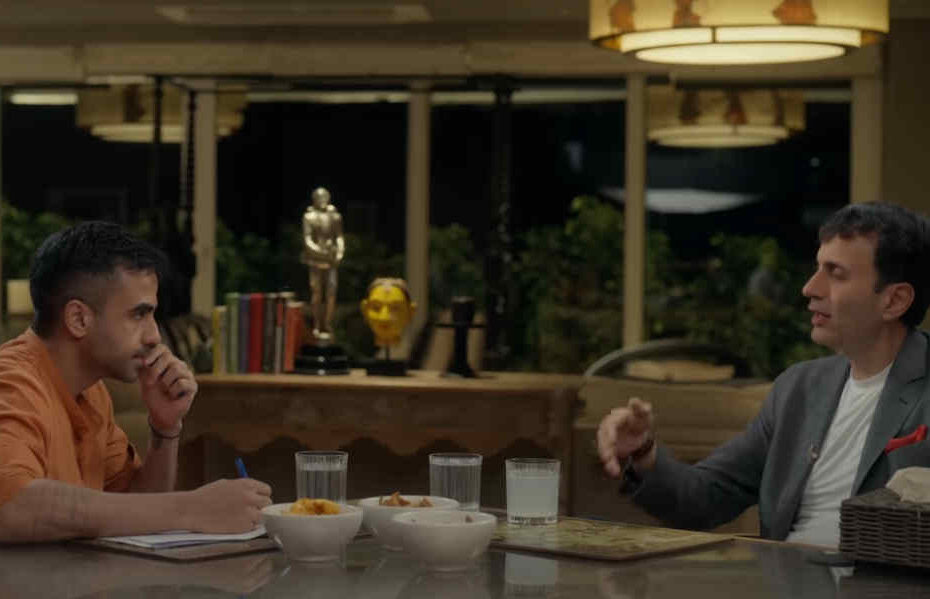
Read the full transcript of author and fund manager Ruchir Sharma’s interview on WTF is Finance Podcast with Nikhil Kamath on “India vs. China vs. US: Who Wins the Next Decade?”, September 3, 2025.
Introduction and Background
NIKHIL KAMATH: Hi, Ruchir. Thank you for coming. You’ve been on this table before, you’ve had lunch here before. So I hope you feel slightly more comfortable than you might in a new place altogether.
RUCHIR SHARMA: Yeah, I think that’s fair. Although the approach to the apartment is a bit of a project, but otherwise.
NIKHIL KAMATH: Has something changed?
RUCHIR SHARMA: In what way? Approach to the apartment? No, no. I just think that even last time, because of the fact that this is a big complex here. So in terms of getting this specific B2 location, in terms of the coordination.
NIKHIL KAMATH: No, I thought because of traffic maybe no traffic.
RUCHIR SHARMA: No, I mean, it’s pretty good. I don’t know that in Bombay everyone’s raving about it, but I see the effects as coastal roads made the biggest difference to our life.
NIKHIL KAMATH: When you stay in Bombay, where is home?
RUCHIR SHARMA: At the Oberoi. I still stay there in South Bombay because I grew up here. My father was in the Navy, so we were in Navy Nagar. And then when I started my first job at Morgan Stanley, I used to stay at Cuff Parade.
And so even though the center has moved much more towards Bandra, BKC Bandra, somehow I still feel more rooted when I’m in that part of town.
Early Life and Nomadic Childhood
NIKHIL KAMATH: Maybe we can start there. Actually, I’ve never asked you the origin story. How did you begin? Where were you born? I know you just said your dad was in the Navy, but what else?
RUCHIR SHARMA: So because of that, what happened was that we had a very nomadic existence which is that every two years my father would be transferred. And because he’d be transferred, we would go along wherever he went.
So I was born in Wellington. I was speaking with our friend Nilekani who was telling me about how they spend a lot of time there now and I need to go back and revisit Coonoor.
NIKHIL KAMATH: Nandan, Kiran, Gitanjali, Premji I think they’ve all bought houses in Coonoor.
RUCHIR SHARMA: Yeah.
NIKHIL KAMATH: And Nandan’s house actually is the place where – who is the guy who came up with the Turing test?
RUCHIR SHARMA: Was it Alan Turing or something like that? Yeah, yeah, that’s right.
NIKHIL KAMATH: His parents lived in Nandan’s house in Coonoor. And they actually go there a lot, Nandan and Kiran and all. They keep sharing stories about the Coonoor club. So me and Kiran live in the same apartment complex in Bangalore. And me, Nandan and Kiran, we all tend to catch up once every month or once every two months. It’s like a Bangalore group.
RUCHIR SHARMA: Yeah, I know. So it’s become a complete outpost for the Bangalore club. But so I was born there. There’s a military town there called Wellington which is right next to Coonoor. It’s part of Coonoor for practical purposes. And so my father was posted there and I was born there.
I don’t have much memory of obviously when I was born, but then he got transferred again to the defense college when I was 4 and 5 years old. So I’ve got some memories of that growing up there, going to the Wellington Club, seeing him play golf and those were the days.
So then as I said, every two years we shifted so a nomadic existence and so very difficult to make friends. Because you were always the outsider in the school. My father was also transferred to Singapore where he was the defense advisor in the Indian High Commission. So I spent my critical years there.
Singapore Years and Global Exposure
NIKHIL KAMATH: How does that happen? Army to…
RUCHIR SHARMA: Yeah, he was in the Navy. So what happens is that many high commissions and embassies around the world have something called a defense attache which is part of the Indian High Commission. You are a so-called diplomat, but you’ve actually come from the navy or the army or the air force, depending on which service has that. So that’s how he was posted there.
And I was there for – we were there for three years, seventh, eighth, ninth grade I did there. And I was at UWC United World College back then. And that was a very important time for me, I thought because apart from formative years, it was also a very global place.
I grew up there. This was the mid to late 1980s and Singapore was really booming there. It was emerging as this very successful financial center around the world.
NIKHIL KAMATH: What era was this, this was Lee…
RUCHIR SHARMA: Kuan Yew was the Prime Minister.
NIKHIL KAMATH: But he was the prime minister for…
RUCHIR SHARMA: 27 years or something. Yeah. So one of the longest serving prime ministers in the world. But this was Singapore just at the point of really booming and more than that, the schools I went to were very global in nature.
So in the eighth and ninth standard you were very aware of what was happening in the rest of the world because the students who would come, they would come from different parts of the world so very aware about what’s going on. I remember even things like the 1987 stock market crash.
NIKHIL KAMATH: How old are you, Ruchir?
RUCHIR SHARMA: I’m currently 51, but when that crash happened it was 87, so I was 13 years old. But I have memories of that crash just because in school it was discussed by some of the senior people in school, you could hear the discussion. So it was a very global sort of environment.
Contrasting Economic Models
NIKHIL KAMATH: Socialism in a way, growing up.
RUCHIR SHARMA: Yeah, so I saw India socialism and the contrast with Singapore was really remarkable because Singapore was going the opposite way which is that it was giving its people as much economic freedom as possible.
NIKHIL KAMATH: Communist manner though, right?
RUCHIR SHARMA: No, I won’t say communist, but some people would say authoritarian which is the fact that it didn’t have that. Some people would say was it a true democracy? It was a one party system where they had elections.
NIKHIL KAMATH: But isn’t it still largely like that?
RUCHIR SHARMA: Yeah, but it’s changed a bit. I mean there’s been more political freedom compared to what it was in the 1980s. But that model is very much the Singaporean model in terms of the fact that even as they’ve become a rich nation, they are still largely governed the same way.
So anyway, Singapore was there but it was a shining example of economic success already by the 80s and as you said it was a big contrast. So you know this word communist I think is wrongly used sometimes because we, even China we think of communist. Which it is from a political standpoint but from an economic standpoint, China and Singapore especially then were far more free than India.
NIKHIL KAMATH: That because foreign investment and privatization was not allowed here like it was there or what was it?
RUCHIR SHARMA: Yeah, so much more freedom for foreign capital to do what you want and also for people to do what you want. I think that this is one of the things that for me, what does capitalism mean and what is the difference between capitalism and other forms? For me, capitalism is about giving people as much economic freedom as possible.
So Singapore was doing that. China in fact had already started doing that. India was still very much a socialist country. The first sign of opening up in India happened in fact in the early 1980s. You know, people would usually associate India’s opening up in 1991, when the big reforms took place with Narasimha Rao and Manmohan Singh.
But there was also a phase in the 80s when the first phase of opening up in India happened. The peak of Indian socialism was 1970s, when everything was virtually controlled by the government. And then India ran into a financial crisis in the early 1980s. And under partly the pressure from the IMF, India began to gradually open up.
But yeah, the 1990s was when the real opening happened. But Singapore, China were well on their way of becoming more economically free countries. And Singapore was already a big success story.
Lessons from China and Singapore
NIKHIL KAMATH: When you look at China or Singapore today and you compare them to India of today, what do you think is working for them that we could incorporate?
RUCHIR SHARMA: I’m not sure our democracy can incorporate this. About China, I say that once again, we think of China so much as a command and control economy. As you said, possibly communist, but a very command and control economy as far as China is concerned. We forget some basic stuff about China.
For example, in the 1990s, this is one thing which I find very fascinating. China fired 90 million people from its state owned enterprises. You know, fired. And they told their people, “There’s no welfare state, you do what you want, go find a job wherever you have.” And a lot of people lost their jobs.
But they all migrated much more towards the coastal cities because that’s where the big growth was happening naturally, because that’s where the exports happen, the manufacturing exports all happen there. So they all move towards the coastal cities. But can you imagine that China firing 90 million people from its state owned enterprises?
NIKHIL KAMATH: What era was this?
RUCHIR SHARMA: This was the 1990s. There’s no way that we could do something like that. And also opening up Singapore, so much open to trade, no tariffs, no protectionism, just make the country and the people ruthlessly competitive.
So a lot of what we can learn is that how do you promote this kind of almost ruthless competition, which may appear to be heartless at some level, but also is something which is at the core of capitalism and it promotes very high economic growth and development. So I think that that’s what Singapore and China did. Much of East Asia did that.
So that’s the contrast with India. India gave its people lots of political freedom, that you can vote the way you want and you have democracy. These countries did not give their people much political freedom, but they gave their people much more economic freedom compared to India. So I think this was the big contrast between these countries. And even arguably today, that is still the case.
The Welfare State Debate
NIKHIL KAMATH: I was watching this interview between Tucker Carlson and a Chinese lady. Very interesting. She was speaking for Deng Xiaoping and she said the manner in which he brought 500 million people out of poverty, in a way, given the same – this is a bit controversial, but she was saying if one were to give Mother Teresa the same amount of money, most of those 500 million people would still be in deep abject poverty in a way. Do you think that kind of a model of welfarism is bad for a country like India?
RUCHIR SHARMA: I think that if you look around the world, and this is something which I’ve seen, that creating a welfare state prematurely can be one of the biggest mistakes any developing country can make. And you can see this Latin America did that.
Latin America, you know, all these countries, for example, in the 1960s, Korea, India, Brazil, they all had similar per capita income, which means that they were similarly rich or poor, whichever way you want to look at it. But then Korea really took off, Brazil kept on stagnating, and India took a very long time to get going.
But the biggest mistakes that I think that Brazil made, and this is my point, that creating a welfare state prematurely, where the state just spends on people by giving them freebies and giving them a lot of subsidies, I think is a mistake.
Whereas the way that growth is created is by creating the infrastructure. You create the infrastructure and then let people thrive and do what they want with that infrastructure, which means build the roads, build the ports, build the highways. So that’s what the East Asian model was.
No welfare state to start with. Spend whatever the government spent on building infrastructure, and then you create the welfare state later, which is that once you have enough money and people have enough income, then to cushion them in the hard times, you create a welfare state.
And that was also something which happened in the west as well, that if you look at America or UK, they followed what we call the Dickensian form of capitalism, after Charles Dickens, all the books we read as kids of Oliver Twist and all these things. It showed what the abject poverty used to be at one level and how the rich used to really rule.
India’s Growth Trajectory and Economic Model
NIKHIL KAMATH: Have you reached that point India as a country?
RUCHIR SHARMA: I think that India has always sort of the risk that why India will never achieve a growth rate like China of 9 or 10%. In terms of we have I think all now reconcile to the fact that we are a 6% type economy. The ambition of doing it 9, 10% I think doesn’t even exist anymore.
And partly it’s because of the recognition that in a country like India, our society or whether it’s that politics or what is never going to ever allow that sort of runaway growth to take place which requires very little welfare and on and any government spending on infrastructure and also very little protection from, you know, what’s happening internationally. Like you allow foreign capital to come, you allow, you don’t have much of tariffs and stuff like that. I think it’s very difficult in this country to have that sort of model. So that’s the reason why India was unlikely to ever grow at 9, 10% on a sustained basis, which East Asia did and why we are now reconciled to growing at 6%. That type of growth rate is what we are sort of seems to be what we are comfortable with.
Trade Policy and Industrial Development
NIKHIL KAMATH: When you look back at things like customs duty or tariffs back in the day when say the British had the Industrial Revolution originating from Birmingham, the reason why things like that could happen is for a short period of time they blocked out external economies so domestic industry could thrive. Now if we were to remove that and make it a fully free market and a Chinese product in an American car can compete here, will that allow for domestic industry to thrive or should we go by the Birmingham model and kind of lock things away for a while, allow for domestic innovation to come about and then open things again.
RUCHIR SHARMA: But we tried that, we tried that in the 1960s. We tried that in the 1970s. It was called something called import substitution, which is exactly what you’re referring to. And it didn’t work. It left us very uncompetitive.
NIKHIL KAMATH: Why did it work there? Where like in the UK for example.
RUCHIR SHARMA: Well, I would that familiar with the example that you’re citing. But my best guess is that, I mean if you look at the long history of development like I’ve studied that those economies also never were able to grow at 8,9%. This model of growing at 8,9% a year is very much an East Asian economic model. Before that there were very little examples of countries growing at that pace.
So we can, as I said that those countries, you know, like in terms of I’m not that familiar with, but I’ve studied East Asia deeply, right. And I’ve studied in terms of what these countries did. And I think that these countries were much more about allowing for competition and allowing for, you know, very little duties and stuff. And of course, the state played some role, which is that they sort of, you know, favored some industries and, and didn’t favor others and, and all that, but was largely giving people lots of economic freedom. So I think that. But the more important point as I make here is that which is less discussed is that they had no welfare state.
NIKHIL KAMATH: Right.
RUCHIR SHARMA: That, I think is a very important point because it appears very ruthless and heartless to say this, that, oh, there’s no welfare state. I would like, people obviously like to get welfare, but only that much money the government can spend. And are you better off spending that money on creating infrastructure, which as that Chinese example, you said that, you know, that, you know, that’s what helps create growth in the future, or if you give people a lot of freebies and other stuff in terms of that sort of doesn’t enable them to go out and earn income so much on their own or create wealth over a period of time. That’s the difference.
Social Mobility and Economic Opportunity
NIKHIL KAMATH: I’ve heard you say earlier that there is no real social mobility in society, not just in India, but across the world. And whatever research I could have done on that or whatever I have read about it historically, people say that the surnames, for example, of rich British folk a thousand years ago, if you were to see how well they’re doing today, they’re still in the affluent section of society. So barring social mobility in a pragmatic sense in society, if not for welfare and subsidies, what happens to society at large?
RUCHIR SHARMA: No, but the, the point that you’re referring to, which is what I wrote in my latest book, “What Went Wrong with Capitalism,” is that social and economic mobility in Western societies has declined in the last 30 to 40 years. So it’s not as if it was never there. You had. But that’s declined. And that is one of the main reasons why so many people in the west today are very unhappy in general with their life because they find that it’s very difficult for them to move up the ladder the way that they could.
Like in America, for example, like as I’ve cited some of the, like this work, that only about 30 to 40% of Americans today feel that they can have a better life than their parents. But back in the 50s and 60s, when the American dream was really shining, every American thought worthy. 70 to 80% of Americans thought that they, you know they could have a better life than their parents.
NIKHIL KAMATH: You also made a case for no home ownership is one of the reasons why they are so unhappy, especially the youth in America. Yeah, but do you think that’s true also for India? Do you think there is. If you were to ask an average Indian if they will do better off than their parents, would they say not today? And I think social mobility is lesser here or more here.
RUCHIR SHARMA: I think more here now. You know, in terms of. I think that in India the aspiration levels have increased. I think that any of us who have a memory of what the 1970s, 80s or even, you know, like even 20, 30 years ago, I think most of us will feel the India of today, at least from an economic perspective is better than the India of 20, 30, 40 years ago. In the west it’s gone the other way that there’s a much greater longing for what society and what the economies used to be. So I think there’s a big difference between emerging markets and in and in some of the developed countries here.
And this is also shows up in the politics because what’s happened is that the politics has inverted as well. That if you look at the western countries today, most governments lose election there, whereas in emerging markets in developing countries of late, most incumbents are winning their elections, which is a big difference. That’s happened used to be the other way around which is that in the western countries most incumbents. Because if you’re already in the company of the advantage, if you already people know you, you have the, you have the media and other access and stuff, then you’re a natural advantage like to win. Now it’s gone the other way and, and in many emerging markets, including India, it’s become now much more like in terms of the incumbent is not going to be thrown out like the way they used to be. That’s a big change that’s happened in society which shows up in politics too.
Anti-Incumbency and Regional Politics
NIKHIL KAMATH: Do you think India is an outlier there? Because when I think of our neighbors all around us, be it a Pakistan, Sri Lanka, Maldives, Bangladesh, Nepal, they seem to have anti incumbency. They have cyclically changing very quickly, changing leaders.
RUCHIR SHARMA: Yeah, but I’m saying I’m, I’m looking at, you know, a much greater canvas of emerging markets here because these countries, to be honest, you know, like aren’t that economically significant. But if you look at around the world, from Indonesia to a Brazil to other countries, you find even Mexico and stuff, you find that the incumbent in general, the chance of the incumbent winning has now gone up by more than 50%. In India, it’s possibly still 50-50 or, you know, depending how you look at the data.
But in India’s case, if you look at it, the word anti incumbency was in fact coined in India from what I know, you know, like my sophologist friends Pranoy Roy and Dorap Sopariwala, with whom I travel on election trips. I think that they are the people who coined this term.
NIKHIL KAMATH: I read that book of yours. Brilliant, by the way.
RUCHIR SHARMA: Yeah. “Democracy on the Road.” So they’re the people, I think, who coined this term anti incumbency. Because this term, I remember when I first started writing about this term anti incumbency, my editors in the western media, such as the New York Times and stuff, they would like actually ask me, what is this term? They were not familiar with it 10, 20 years ago. And now, of course, like, everyone talks about anti incumbency, but this term, I think was coined back in India.
Investment vs. Writing
NIKHIL KAMATH: You know, I come from the world of investing in stock markets, like fully, I think. Yeah, I think you’re from that world. But I don’t know if you’re a writer first or investor first. I’ve heard you say somewhere that one pays for it and the other is the creative outlet for it.
RUCHIR SHARMA: Yeah, I think, as I said in the past, that I invest for the dough. I write for the show because writing, as you know, is great. But 99% of writers would agree that doesn’t really make too much money.
NIKHIL KAMATH: Maybe not in this cycle, but maybe it will in the next.
RUCHIR SHARMA: Yeah.
Cultural Differences in Political Expectations
NIKHIL KAMATH: Traditional psychology says that Southeast Asians or Asians in general, when it rains for five days, expect it not to rain on the 6th because it has rained for five days. The Western economies on the other side, if it rains for five, will presume that it will rain on the sixth. I think culturally we are very different like that. Do you think that plays a role in anti incumbency and why the emerging economies of Asia are. Are eventually going to bet that the leader at the helm will change?
RUCHIR SHARMA: I think there’s some cultural aspect, but I think that’s more true of East Asia because in Latin America, Africa and all that, the culture is very different. So I think at a culture level, it’s hard to make a distinction between emerging and developed countries. I think it’s very region specific. I think that you’re right that in East Asia, people in general tend to be much more reverential towards their leaders. And I see it at the workplace and stuff like that. It’s much More of a reverential culture, whereas in India, I think it’s less so. But we’re somewhere in the middle. And in the west, it’s very different in terms of that. There’s much more questioning of what the leader does. So that’s true.
But as I said, in the west, ironically, the incumbent used to mostly win elections. In fact, even in America, they introduced term limits like after FDR had won, I think four elections in a row or something like that. And generally right up, if you look at the House, the Senate in America, right up until the last 10, 20 years, from the data that I remember, 70 to 80% of person who stood for re election would end up winning. But that has changed dramatically in the last 10, 20 years.
In fact, when Trump won, one of the things that people ask me that, you know, like this would be, I said, yeah, but you have to understand two things. One, that this is the first time in America’s history that the, at least the last 200 years that I know of that the incumbent party in the White House lost three times in a row. Right. In terms of that, that’s not, that’s not happened before in America, in fact, for 200 years or so.
So, and then, so people ask me that, you know, what will happen in the next election, the midterm elections are coming and stuff. I have no predictive power, but I can simply say that if I just follow the pattern, I think the Democrats have a good chance of winning just because, not because of any other reason. But look at what happened in New York. Made an election that Mamdani, you know, is like one end is all set to win. Mamdani’s rise is also interesting because it’s too. It’s sort of two people are rising here, which is Trump here, Mamdani. The politics appears very different, but I think the main root of the rise of both is an anti incumbency feeling that we just want to sort of, you know, go with someone who’s anti establishment. And Mamdani was able to, I think, capture that vote very well, that anti establishment, because in the primaries that he was standing where all these establishment figures, Andrew Cuomo and people are like fed up with establishment figures.
NIKHIL KAMATH: And in a strange way, Trump could be perceived as establishment in New York.
RUCHIR SHARMA: He could be perceived establishment four years, whatever, three years from now, he could be the establishment. Yeah, so I think that’s the three years prior.
NIKHIL KAMATH: If you’re in New York, you’re seeing Trump, Trump everywhere.
Social Mobility and Economic Opportunity
RUCHIR SHARMA: Right? Yeah, but I’m saying the New York Politics is very different because in America, you know, the coastal cities just tend to be very Democrat leaning. So that’s different. But I’m just trying to say that he lost the election in 2020 and it’s possible that the next time that the Republicans, if this anti incumbency follows, I think that they could lose the midterm elections and maybe they will be at a disadvantage even when the presidential election takes place just based on the pattern.
And this is true across the west as well. Look at UK, look at France, look at Germany now, you know, approval ratings everywhere are very low. People are just “throw the bums out.” People are dissatisfied in terms of what’s going on. And I don’t see that same level of anger and resentment in emerging markets.
NIKHIL KAMATH: To put a pin on the social mobility thing, because I think it’s very important. So social mobility when we are speaking about it is somebody who is not privileged climbing up the economic ladder. There’s a very interesting concept around this. It’s called the Great Gatsby Curve where the author explains it in a manner that the more the income inequality in a society, the more the people in that society believe in meritocracy. Do you see that at play?
RUCHIR SHARMA: Yeah, I think so. I think that’s true.
NIKHIL KAMATH: Why is that? That seems very counterintuitive.
RUCHIR SHARMA: Right. See, capitalism is not about equal outcomes. You will not get equal outcomes in capitalism. But you have to have a feeling of equal opportunity. There’s a very key distinction between this, that you should feel you have an opportunity. Outcomes will be unequal because capitalism by definition is going to favor those who are supposed to be more meritocratic and stuff. So it’ll naturally tend towards inequality.
But the issue is that can you feel that I have a chance despite coming from not a great background of making it in this country or not. And the great thing about America was, and that’s what attracted even people like me there, that you felt that you could get there and regardless of your background, you had a shot.
NIKHIL KAMATH: But that’s ironic because education is not really democratic in America. So it’s not equal opportunity. If education is as expensive as it is there.
RUCHIR SHARMA: It’s become like that over time. That’s one of the reasons the grievance of people is because over time these gaps have increased a lot more. You know, where you feel that you can’t, that social mobility has gone down because you can’t move from one city to another that easily as you used to be able to move. So I think that these are trends which have progressed over time. Now you’re getting to the point about what’s the root of the anger in America? Why are so many people unhappy with what the system at place is? Because of these trends that have played out over time.
Immigration and America’s Growth Advantage
NIKHIL KAMATH: Will our visas get cancelled if we say why Americans are unhappy?
RUCHIR SHARMA: I hope not. Because I mean you live there. Yeah, exactly. So. But I’m not sure we have gone that bad as yet in America.
NIKHIL KAMATH: Is there a line for crossing the line to have your visa revoked?
RUCHIR SHARMA: I don’t, I’m so far told that the line is, you know, only if it’s perceived as being anti Semitic or in terms of very. I’ve not heard that. All because you criticize the American system.
NIKHIL KAMATH: As such, not anti establishment.
RUCHIR SHARMA: No, I don’t think so. At least so far. And we have to keep using the caveat here so far that there’s no evidence of that.
NIKHIL KAMATH: Yeah, I’ve been there most of the last three months. And so many of the young people I’ve been meeting at college and Stanford and all these colleges are also worried about what happens to their visa in one year from now.
RUCHIR SHARMA: Right.
NIKHIL KAMATH: It’s a big thing. It’s a talking point.
RUCHIR SHARMA: No, it’s. And you see a collapse in that because if you look at the net immigration into America, the net numbers for much of the last decade used to be about a million people. Million people coming into America. Then what happened was that after the pandemic and because the Biden administration was supposed to be very loose towards immigration, that number jumped to 2 or 3 million people a year of people coming in. That’s what really set the tone for this big backlash this year.
I’m told that number is likely to drop to less than half a million. So there’s a dramatic drop off in net immigration happening in America. And I think that in the long term that’s very damaging also for the country. Because when you look at the past 30 years or so, I mean everyone’s spoken about America’s growth rate being much superior to Europe, to Japan. Everyone talks about, you know, because America’s got technology, Silicon Valley, the whole tech ecosystem, how great it is, the economic dynamism and stuff.
But the really underappreciated part of the demographic advantage, America had that because partly because of immigration, America’s population growth rate was much faster than Europe and Japan. So if you adjusted for per capita income, yes, the gap is there, but it’s not as pronounced. But the moment you sort of in terms of take out immigration, then the gap between America’s growth rate and Europe and Japan really begins to shrink.
Government Intervention and Market Dynamics
NIKHIL KAMATH: So to close the social mobility topic, no welfare, no subsidies, equal opportunity in education, would you say, would you put it that way? Do you think education is getting democratized by virtue of things like what we are doing now? This will be available freely online somewhere. Your books don’t cost a lot. I’m sure free PDFs of them are available wherever one might want to seek them. What else needs to change to have increased social mobility in our communities?
RUCHIR SHARMA: No, as I said that in terms of the fact that also I feel the single most important thing is less government bailouts and intervention. Yeah. And this has been a big sort of point of mine.
NIKHIL KAMATH: Not so much in India.
RUCHIR SHARMA: Yeah, not so much in India. But even in India in terms of that the government should not be bailing out private sector companies and should sort of, you know, keep. Because I think that that creates an impression that the government is favoring the incumbent. Because after all if companies are failing, it’s, you know, in terms of the fact that they tend to be incumbents. And the moment you do that, then you’re preventing new companies from entering.
So I think that it’s very critical that any government, including in India, does not bail out private sector companies. And also the fact that government, you know, favoring a few companies for whatever reason, I think leads to less economic and social mobility. Because then you sort of, you know, the average person feels even in India there is a feeling that some of the big conglomerates are capturing too much of the economic share.
In India, businesses don’t talk about this openly, but you speak to a lot of people. There is a feeling and it’s partly because of the regulatory environment which is the fact that mid to small size companies often say “we are better off selling to these big companies who can manage all this tough regulatory environment. It’s tough for me to negotiate this directly.”
So what will help is deregulation. That if you have a lot of deregulation then you are allowing more companies to come up on their own. But the more regulation you have, the worse it is because then the big companies are able to game the system, they can write the regulation in the way they favor it and also because then it costs so much to negotiate this regulatory environment that a small and mid sized company or a small and mid sized business person they find very difficult to do that.
The Problem with Over-Regulation
NIKHIL KAMATH: I’ve heard you make a case in America that there are 3,000 new regulations that come about. What do you think? Yeah. And only 20 have been removed in the last 20 years.
RUCHIR SHARMA: In 20 years, yes.
NIKHIL KAMATH: What do you think the case is in India for regulation and deregulation?
RUCHIR SHARMA: I think that the case is the fact that everyone wants to regulate because you believe that, you know, you want to keep out the bad actors and you want to favor this. But every time a policymaker introduces a new regulation, remember that regulation by definition tends to be pro incumbent. Whoever the person in power or the company which is already established regulation 90% of the time favors those people.
So I think that is the very fundamental principle that has to be behind policymaking. That if you do regulation, you are favoring the incumbent. And by doing that you’re disadvantaging the new people who want to come into the system.
NIKHIL KAMATH: Either directly or indirectly by taking the margins of that business down.
RUCHIR SHARMA: No, in terms of the fact that as I said that because the new companies, or let’s say the small mid sized companies, they find it much more difficult to deal with the regulatory environment compared to the big companies at two levels. One, the cost of complying with regulations. That’s a big burden. And two is the fact that the big companies, they’re able to lobby and get bills written and other rules written in a way that favors them, which the small mid sized business people cannot do.
NIKHIL KAMATH: Okay, fair point. You saw the recent regulation on real money gaming in India. What are your thoughts on that?
RUCHIR SHARMA: I’m not sure because you know, I have mixed views because I know that there’s in terms of, I’m for deregulation as much as possible, but there is a bit of an issue coming about, you know, what it’s doing for, in terms of what it’s doing for the mind space or the young generation and stuff. But generally I’m not in favor of regulation because I just feel that 90% of the time it kills entrepreneurship, it undermines the rise of new things.
I don’t have specific views on one thing, I’m a bit distant from that. But I would say that my gut on these things is that every time I’ve seen regulation come in, I think it’s been bad for the country.
NIKHIL KAMATH: Fosters the black economy in a way.
RUCHIR SHARMA: Yeah, that’s one aspect as what I said, it also undermines the spirit of the mid to small size business person.
Cryptocurrency and Alternative Assets
NIKHIL KAMATH: Right. When I was in the US I met the founders of Kalshi and Polymarket, they’re both prediction markets. One on the blockchain and one fiat currency. One is peer to peer, the other charges a rake per transaction. I think even in the US the same holds good where they’re regulating Kalshi, but not Polymarket when we speak about regulation.
If I were to come into something like crypto blockchain stablecoins in India, I’ve been doing a bit of research on it. The big hindrance today, let’s say for very obvious reasons in the world of today, we don’t want a stablecoin which is backed by the US dollar. If somebody from India were to start one, we would need something which is the collateral is maybe a combination of gold and Indian rupee.
But we have fiscal controls in the country, capital controls where there’s a certain amount of money that can go out, come in, it’s fairly regulated. The big hindrance seems to be the 1% tax deduction at source for any kind of crypto or stablecoin in India. Do you have a view on the crypto stablecoin blockchain world per se? And do you think we as a country are regulating ourselves out of a market which can be really big tomorrow?
RUCHIR SHARMA: Yeah, I think that this market now has taken off now, of course, you know, as I said that my definition of a bubble is a good idea gone too far. Been quite optimistic on bitcoin and the whole crypto universe, but bitcoin in particular. Just thinking the fact that this over dependence on the US dollar has to end and you need alternatives to emerge in terms of that. That’s been my thinking for a while.
NIKHIL KAMATH: I agree with you. But why not gold or something like that?
RUCHIR SHARMA: Yes, of course there, yeah. So both assets have done well, but gold at the end of the day is still a bulky asset in terms of that, right?
NIKHIL KAMATH: Not a digital contract of gold.
RUCHIR SHARMA: Yeah, but. No, but somewhere it has to be backed by actual gold production, right?
NIKHIL KAMATH: Yeah, but if you were to say the cost of insuring vaulting gold is maybe in India, I know the price is maybe the actual cost is about 30 basis points at scale, it would be even lower. That is lower than managing cryptocurrencies in a way.
RUCHIR SHARMA: Yeah, but to do transactions in gold etc. is still very difficult in terms of that.
NIKHIL KAMATH: I wonder why though.
RUCHIR SHARMA: But we haven’t seen it as yet. I mean this is. Remember gold’s been around for thousands of years.
NIKHIL KAMATH: Years and people did transact.
RUCHIR SHARMA: People did transact. But I think that crypto is a more advanced way of doing it.
NIKHIL KAMATH: And in a way, the world did transact in gold until Nixon removed the gold standard.
RUCHIR SHARMA: Well, it was there in terms of backing, but not on a daily transaction basis. People didn’t exactly go to shops and use gold bars and stuff.
Now, as far as crypto is concerned, its usage so far is still very limited for transaction use. It’s increased much more now as an asset class for people to store value. And I think that it is here to stay. I think that debate is over now that crypto is here to stay.
NIKHIL KAMATH: You think so?
RUCHIR SHARMA: Yeah, I think bitcoin is here to stay. Crypto is here to stay. This has lasted long enough. It’s getting mainstreamed, whether it’s banks or asset management firms who told you five years ago, “We’ll never touch this thing.”
NIKHIL KAMATH: Have you got an allocation?
RUCHIR SHARMA: No, unfortunately, I’ve always chased the price. I kept thinking it’s getting too high.
NIKHIL KAMATH: It’s getting too high down last few days, barely.
RUCHIR SHARMA: But I started writing about this in 2020, I remember, when the price was $20,000 or something like that, or barely that much.
NIKHIL KAMATH: I think now it’s $110,000.
RUCHIR SHARMA: Exactly. So it’s gone up and this is one of those issues. And I think as an investor, you know that one of the biggest mistakes we often make is we don’t put our money where our mouth is. We speak about something and say “I must do it,” but we try to get too cute on value or maybe we think “I’m going to wait. I’m going to wait.”
NIKHIL KAMATH: Yeah.
RUCHIR SHARMA: And then the damn thing runs away from you. So I think that’s been one of the mistakes. I can count endless investing mistakes. But at least for my writing, I’ve been on record to talk about my general feeling that this is here to stay.
The last piece I wrote about this, I said “Two cheers for the bitcoin bulls,” which is the fact that they’ve been broadly correct in that this trend has been here to stay and that now it’s getting more accepted as an asset class. Where they’ve been wrong is that in terms of transactions, it’s not being used yet. But the hope there is that someone had done the numbers on this – about 15 to 20% of the global economy is the so-called underground informal economy. And in that part, which we can’t measure properly, the usage has increased.
The Challenge of Sovereign Control Over Currency
NIKHIL KAMATH: I know that Trump is really pro, but I can’t find an argument how a sovereign country with a government which controls the fiat currency of saving and transaction benefits from something which is free and outside their control.
RUCHIR SHARMA: Absolutely correct. So they’re trying now the best to promote stablecoins as well.
NIKHIL KAMATH: Right.
RUCHIR SHARMA: Because they realize that this is one of those points which people find hard to grasp – what is the advantage America has today? The fact that it has what’s called the world’s reserve currency, which means that the US Dollar is there and it has that power over the US Dollar. What advantage does that give to America?
Because the dollar has to be used in so many transactions, a lot of countries end up holding US Dollars. And because they’re holding US Dollars, what are US Dollars? They’re holding US Debt in a way. And that lowers America’s borrowing cost. Some estimates suggest somewhere between 50 to 100 basis points – half a percent to 1% of annual borrowing costs are possibly lower because of the fact that America has the world’s reserve currency.
NIKHIL KAMATH: I would argue it’s much higher.
RUCHIR SHARMA: This is some of the academic work.
NIKHIL KAMATH: Let’s see if the treasury bills are at four and a half percent, let’s say ballpark today. I would say if they were not the reserve currency, I’m just thinking as a Japanese guy, a Chinese guy or Indian guy, why would I be buying their debt at four and a half, five percent or six and a half percent if it was not the reserve currency and I didn’t have to?
RUCHIR SHARMA: Yeah. But I’m saying that because there are other advantages America has. I mean, today, why is it fungibility? They have no capital controls. You can take money in and out when you feel like it. And also the attraction of the underlying economy, which is still there. It’s still 26% of the global economy.
And even today, despite all that Trump is doing, which appears to be damaging – the tariffs and undermining the independence of the Fed – why is so much capital still flowing to America? It’s not just because of the interest rates and debt, because of the entire mania, which is that people think that the only country which can build this AI infrastructure, which is now the hottest new thing, is America.
So it’s because of the dynamism of the economy and other advantages that America has that you’re still seeing so much capital flow into America. So I would say that you’re right that there’s no reason for you to hold debt if it weren’t for the world’s reserve currency, especially with their ability to…
NIKHIL KAMATH: Sanction that they exercised recently.
RUCHIR SHARMA: Yeah, that’s right. So that started the process where people are looking for alternatives. That was a big fillip for gold and for bitcoin and stuff. The moment America sanctioned Russia back in the spring of 2022, it seems serendipitous.
The Tariff Debate
NIKHIL KAMATH: That they would coincide with the tariff time because they both seem like net move away from America at the same time. Do you think tariffs are good? Net net. Are they only reciprocating what other countries have done to them for a long time, or is there a case to be made for why it could be good for them?
RUCHIR SHARMA: Well, I think that there are two points here. One is the fact that if they had done strictly reciprocal tariffs. Firstly, we don’t know what science is behind this. Generally from a pure economic perspective, tariffs aren’t great. There’s so much economic theory to back that up.
Now, you can argue that all economic theory is wrong, but all the economic theory says that free trade benefits countries the most. And that’s the system we’ve had in place for the last 50 years or so. It has helped many countries develop very rapidly.
NIKHIL KAMATH: But does it also benefit the incumbents more than it does the emerging players, free trade?
RUCHIR SHARMA: No, because if you look at the world, if the manufacturing…
NIKHIL KAMATH: Base, say, got set up in China and they’re producing 500 million TVs, as long as free trade continues, nobody can match the cost efficiencies that producing 500 million TVs brings to them. And they continue to scale and the other countries can’t catch up.
RUCHIR SHARMA: No, but this has changed over time, right? Because historically…
NIKHIL KAMATH: Yes.
RUCHIR SHARMA: First it was Japan, then it was Korea, Taiwan, and these other economies, and then it became China. So this thing has changed over time. It’s not been as if this has all been China’s advantage for very long. China’s export share has gradually increased over time. So this is not as if China was always the dominant player here.
NIKHIL KAMATH: Right.
RUCHIR SHARMA: So if…
NIKHIL KAMATH: Do you think they did the reverse of a tariff and they artificially subsidized many things in the country to arrive at this position and displace Japan from where they sat?
China’s Development Strategy
RUCHIR SHARMA: There’s a bit of element of that they did. But I said that so many other countries in East Asia did this – Korea, Taiwan, other countries. Just to say that was the big factor, then we look at what they did in Latin America and Africa also. They tried similar strategies which is trying to have protectionism, trying to give the government telling you what’s called industrial policy. And that did not work in these countries.
So China may have done that, but they did lots of other things also. In terms of building a great manufacturing sector. How do you do that? And even people in the 1990s, we go to China would be dazzled by the level, by the kind of infrastructure that they’d created. The highways, the ports and everything. All this is something which has happened.
So this is one element of it. But I’m saying that it’s not a one factor model because if this was the only factor that every country would follow it. And they tried – Latin America, Africa, they all tried this about how do you close yourself to trade. And Brazil is still trying it and it doesn’t work.
NIKHIL KAMATH: Right?
RUCHIR SHARMA: So if that’s the only way to grow is that you promote domestic growth by shutting yourself from the rest of the world. Show me one country which has benefited from that in the world historically. I don’t know of any such country.
NIKHIL KAMATH: So what did China do different?
RUCHIR SHARMA: As I said, what China did was that it built this massive infrastructure so that it became very easy to ship goods out of the country. And also in terms of its people, it just told people that you go and find a job wherever you want. We are not – the state is not going to give you support to remain on the farm. So you go find whatever you want.
Now in India’s case, the politics is very different here. In fact, it’s become a routine thing like MGNREGA and stuff, which is the Rural Employment Guarantee Scheme. Now the way that it functions is – and you can argue that it’s very, you know, that it’s maybe the right thing for India to do given its democratic setup and the polity here. But in China’s case, they didn’t have any MGNREGA and things. They just told their people that if you can’t make enough money on the farm, go to the city, find a job, join whatever manufacturing sector you have to, and produce whatever you have to.
So it was a very ruthless form of capitalism. In fact, you can argue that they followed… which worked. Which worked. Exactly. And we don’t have the capacity to do that. And therefore we never grow at a rate of more than 6% on a sustained basis, as has been my view, for a very long period of time.
NIKHIL KAMATH: Which is not probably enough because of our base.
RUCHIR SHARMA: Yeah. Our per capita income is barely $3,000.
NIKHIL KAMATH: And they say if you remove the richest thousand people, that number drops significantly.
RUCHIR SHARMA: Which is true for any country, by the way. It’s not just our thing. But generally what I’m trying to say is that if you want – why can we not grow further than that is because of this reason. This is the number one reason I would say.
Social Mobility and Housing Affordability
NIKHIL KAMATH: Right. To increase social mobility, focus on equal opportunities, not equal outcomes. No bailouts, democratize education, no welfare state, no subsidies. I’ve written down. Home prices need to somehow become affordable. How does that happen?
RUCHIR SHARMA: By just allowing supply. Because what’s happened in the west and other places is that the supply of homes is very limited because of regulation and other things. Very difficult to construct new homes. And you face massive amount of…
NIKHIL KAMATH: Do you think that’s why homes are not affordable because of regulation curtailing supply in the West?
RUCHIR SHARMA: For sure.
NIKHIL KAMATH: In India.
Tax Policy and Economic Growth
RUCHIR SHARMA: In India, I think it’s a bit more complex. But I think that in terms of home affordability in India, I know that anyone hearing this will say that the homes are expensive, but if you look at many metrics in India, it’s not as expensive relative to income as you find in some of the other countries in the world that I go to.
But regulation in the west for sure has been the single biggest reason why homes have become so unaffordable. There’s no supply. In fact, there’s one stat that someone told me about when the large private equity firms – the number of new homes that America builds today per year is the same as it was in the 1950s and 60s, even though the population is 50% higher. It’s impossible to get proper permits and once you build a home, then you have to face so much legal challenges if something goes wrong. So the supply of homes being limited is, I’d say, the leading reason for why homes have become unaffordable.
NIKHIL KAMATH: Okay, I’ll add deregulation to it. Home prices need to be affordable, maybe via deregulation or other means. For India, what else to increase social mobility? Would you make a case for something like property taxes?
RUCHIR SHARMA: I don’t see how property taxes would increase social mobility. I know some people would also talk about inheritance tax. As I said, these have been tried in other countries and hasn’t really worked. And property tax – I mean, I’ve seen work on inheritance tax, but I’m not sure how property tax would increase social mobility. I’ve not seen any work to back that for large property holders.
NIKHIL KAMATH: I’m making an extrapolation, thinking, okay, we used to have a big black money economy. A lot has been done to curtail it. A lot of the black money is sitting in property. Government has finite revenues today. How do you increase revenue to work on the other stuff? Maybe property tax?
RUCHIR SHARMA: Yeah, I mean, I doubt if in a country like India, as I said, in India, the success of having more taxes is really counterproductive. Even today in India, most people would sort of agree that just complying with tax is still a big challenge.
NIKHIL KAMATH: Here, don’t you think we’re at about average now? Tax to GDP ratio is say 11, 12% at federal level. If you add states, it maybe goes up to 17, 18%.
RUCHIR SHARMA: Yeah, that’s good.
NIKHIL KAMATH: That’s comparable to most of the world today.
RUCHIR SHARMA: In fact, I’d say for a country of our per capita income, it’s in fact high.
NIKHIL KAMATH: It’s gone up a lot.
RUCHIR SHARMA: Yeah. For a country of our per capita income, it’s higher than average. So I said, we should be less focused on extracting more taxes from people. Because for our per capita income level at $3,000 or so, our tax to GDP ratio is pretty high. So I’m not for increasing taxes.
NIKHIL KAMATH: And the highest component, the fastest growing component of that is actually income taxes.
RUCHIR SHARMA: Yeah.
NIKHIL KAMATH: Which are going up by something like 14, 15% a year.
RUCHIR SHARMA: Yeah. So if anything, there’s a case for cutting taxes in India, which I think they’re thinking of doing more.
The Reagan Tax Experiment
NIKHIL KAMATH: One of the presidents had this experiment where he moved – was it Nixon? I can’t remember. Or was it Reagan?
RUCHIR SHARMA: Reagan. Reagan. Yeah.
NIKHIL KAMATH: He moved tax rates around and he realized that at 40% or 50% tax, there is such a big incentive to evade taxes that the net collection is lower.
RUCHIR SHARMA: Yes.
NIKHIL KAMATH: He arrived at a number that 20% is ideal, where people don’t feel like the incentive to evade tax is high enough and they might as well just pay it.
RUCHIR SHARMA: Yeah.
NIKHIL KAMATH: So that should be the appropriate tax level. Do you agree? 20%?
RUCHIR SHARMA: Well, I don’t know what the studies which have done have generally shown that in fact a flat tax tends to be the best way to raise more taxes.
NIKHIL KAMATH: You mean a flat tax where the affluent pay the same as the non-affluent?
RUCHIR SHARMA: As everyone pays. And if you – in many countries around the world this has been tried. But you’re right that if you want to compete with East Asia, typically tax rates there, in Singapore and other places, don’t tend to be that high even for the rich out there. And the compliance is pretty good.
So yeah, I think you’re onto something here which is the fact that very high – the U.S. for example, they used to in fact have marginal tax rates of 80, 90% back in the 1960s.
NIKHIL KAMATH: So did India, right?
RUCHIR SHARMA: Yeah. But you know how many people paid those taxes even in the US? 400 people or something. So there’s no way people are going to pay those level of tax.
In fact I have a very simple philosophy here which is that in the US in particular, I feel where it’s gone – in the US in places like New York, you end up paying a tax rate, effective tax rate, if you’re in a reasonably affluent bracket, even not ultra rich or whatever. You end up paying more than 50% of income in taxes. Now when you’re doing that, you’re effectively working for the government.
Over-regulation and Its Consequences
NIKHIL KAMATH: Yeah, I feel the same. In the world of speculation and trading in India, we as a broker end up making lesser revenue as a typical user might pay in security transaction tax plus the transaction charge that an exchange charges, plus SEBI fees, education cess – all of that put together.
For every one of these things I think there is a number, there is a line. Beyond that line you incentivize people to go to – in my case maybe Dabba Market. It’s a big problem. I feel like the country has to come together to somehow curtail that industry where people are settling amongst each other or they’re betting against a local broker who is not going to the formal exchanges. It’s the biggest hindrance to our business.
But I don’t know what that tax number is where there is no incentive for somebody to do that or what that regulation line is where we are not under regulating nor are we over regulating. Yeah, so it’s a hard job for a government who’s not doing this one thing full time. But how do they determine where that line is? Where are they over regulating? Where are they underregulating? Where are they over taxing? Where are they undertaxing?
RUCHIR SHARMA: Yeah, I’d say, but on regulation front, I still feel there’s massive scope for deregulation still because doing business in this country is still a very difficult thing. I mean, if you want to set an office up here, the amount of things that you still have to do compared to setting up an office in some of the countries, I can tell you from personal experience, the regulatory burden is still much greater in India than any other country that I know of.
So this is still a very tough country to do business and I feel, therefore foreign investors are much happier piggybacking on some local person who knows how to navigate the system rather than come Greenfield and set something up. It’s much more difficult to do it. So I think that is an issue. And this is from personal experience too, I can say that.
NIKHIL KAMATH: I’m going to highlight deregulation twice. Big thing to increase social mobility in the country.
The Case for DOGE in India
RUCHIR SHARMA: Yeah. In fact, you know, one of those things – I know that, and I know this for a fact, that when Elon Musk was set up to do DOGE in America, there was a lot of outcry about it. Right. That what’s he doing and stuff. But a number of my friends in India, including so called liberals who were really saying that, yeah, India needs DOGE, that why can’t we get DOGE? And I think that even when I speak to some of the other people who are true free marketeers in this country, I think DOGE is what really caught the imagination of a lot of people.
NIKHIL KAMATH: So why do you think DOGE was against free market capitalist?
RUCHIR SHARMA: No, I’d say that DOGE is very much something which I’m for.
NIKHIL KAMATH: You’re for.
RUCHIR SHARMA: I’m for. I’d say that DOGE captured the imagination of a lot of people around the world. In fact…
NIKHIL KAMATH: Would you make a case for India to do something like that?
RUCHIR SHARMA: Absolutely. So I’d say that DOGE, in terms of it – now in America, it was wrongly executed. We can argue in terms of the fact that the way it was done, what the priority was, and it was too indiscriminate. Priority was to reduce the deficit, but you ended up firing people without putting in place a proper system to replace it. And also it led to a lot of chaos.
NIKHIL KAMATH: But the same problem holds true for India. Don’t hold me on this number, but because I might not remember it accurately, but we spend something like 12 lakh crores a year servicing the interest on the debt we have.
RUCHIR SHARMA: Yeah.
NIKHIL KAMATH: So if not today, tomorrow, reducing the deficit will be a very pertinent issue even here.
RUCHIR SHARMA: Yeah. So far, it’s stabilized, I’d say. If there’s one thing that the government has done reasonably well in the last few years is that it’s kept the deficit reasonably under control. Right. So the debt to GDP, the deficit have been reasonably contained.
NIKHIL KAMATH: Four and a half, 5%.
RUCHIR SHARMA: Yeah, exactly. At the central level, it’s been generally contained. I don’t think – yeah, I’m all for even lower deficit, but I don’t think that is such a big thing.
But on deregulation, I still feel from doing business in India that that’s a real hindrance to growth. And the other point which I’ve also made is the fact that you speak about greater certainty at policy level, it’s okay. But the uncertainty, I think also comes because of the fact that if you look at the way that the investigative agencies, for example, I’ve spoken about this extensively in the past, the way that they have been let loose, I think that leads to a lot of uncertainty for many people as well, that we don’t know as to what we do when that could come knocking on a door.
Now, it’s very easy to say from a puritan standpoint that if you do everything correct, nothing will happen. But I also find that this is an important point, that the many reasons why, or at least one big reason why so many people in this country are forced to do stuff which is strictly not per the law or the regulatory framework is because those laws and regulations are so onerous that to do business in India you almost have to beat them to be able to do anything.
I think that I wish the government would look at that, that okay, fine, these people may have violated this law or this regulation, but why are they doing it? Are they born cheats? Right. I think, as some people believe, which I don’t, or the fact that it is so onerous that if you want to execute something, you’ve left with no choice but to violate some regulation or some law.
Learning from China’s Approach
NIKHIL KAMATH: I think China did this in the 90s, where people violated the law, they had heavy penalties, but then amnesty, and the people were allowed to move on and continue on their capitalistic pursuit. You think that’s the way forward for India?
RUCHIR SHARMA: Yes. But I also feel that the foreign person, when they come to India, they should not feel harassed. That if you end up doing something…
NIKHIL KAMATH: Do you feel harassed?
RUCHIR SHARMA: In terms of – I think there’s a level of fear which is that if you end up saying something or if you end up doing something, you know that there will be consequences for you. I think that has become much more in India today than it used to be 20, 30 years ago. I think there’s been a change in that front.
NIKHIL KAMATH: So people are more scared today than they were 20 years ago?
RUCHIR SHARMA: Yeah. In terms of expressing their opinion, for sure. Right. That change has taken place. And so at times, I wonder even that how much is the leadership hearing the frank feedback. Yeah. Whether it’s from businesses or other people, people are scared to even speak their mind and tell, okay, this is what an issue is. Even if it’s constructive feedback.
Federal Competition and State-Level Governance
NIKHIL KAMATH: I think from the little experience I’ve had, at least with the people on top or the honorable Prime Minister, I feel like they’re very receptive and they want to know maybe the bridge. I feel like people there have so many different moving parts to maneuver.
Like, we might not get the full sense of the picture because it’s not one person they need to please, but a billion and a half people. Yeah, maybe that.
RUCHIR SHARMA: But it’s a good platform to put it out there as really constructive, positive things that India can change to have more social mobility, which is what we do all want at the end of the day.
NIKHIL KAMATH: Yeah. Yeah. So to summarize this, I think that DOGE for India is a good idea.
RUCHIR SHARMA: DOGE for deregulation and changing laws.
NIKHIL KAMATH: Yeah.
RUCHIR SHARMA: Simplifying laws.
NIKHIL KAMATH: Yeah. No, actually, that this can be done. The other stuff of not having a welfare state, etc. That’s all theoretical.
RUCHIR SHARMA: Yeah.
NIKHIL KAMATH: There’s no way that’s happening.
RUCHIR SHARMA: Right. And the other thing which I feel is the fact that now I keep saying this, that the one thing I feel very positive about India, we tend to focus, I feel, a bit more in Delhi, Bombay, on the center, which is that what is the center doing in terms of that, you know, what is the Modi government doing and stuff?
One very big positive I feel in India is that we are a truly federal country at some level, and the real execution happens at a state level. State chief ministers in India have a lot more power than other countries that I know of, where the provinces and stuff.
And I feel that there’s a very good competitive environment between states and what the center, if at all. And again, Prime Minister Modi used to speak about this a lot when he was the Gujarat chief minister. Was the fact that, how do you create a much more competitive federal system where states compete with each other? And you see that like it happens.
NIKHIL KAMATH: In China with mayors of different townships.
RUCHIR SHARMA: Yeah, but in India’s case, there’s even greater scope for that. And I think that we see that. Like, I was speaking to a leading businessman today, in fact, and what he was telling me was, you know, like, he had a large conglomerate that if I set up a factory in a particular state, I instantly get phone calls from five chief ministers saying, “Why didn’t you do it in my state?”
NIKHIL KAMATH: Which is a good thing.
RUCHIR SHARMA: Which is great. Right. So in terms of the fact that I feel that’s great. Yeah. And you can feel the difference in the states, like, so I see that.
NIKHIL KAMATH: In Maharashtra, actually, with Fadnavis constantly talking about, “We are extra economy, we will be so much. Yeah, we are equal to this country and that country.” It seems to be happening, but maybe it can happen at a faster pace.
Karnataka’s Success Story
RUCHIR SHARMA: Yeah, but I think that it is happening. And there’s a big state discrepancy in India. If you look at the per capita incomes, you look at performance and stuff. And from what I hear, purely from a business perspective, is that the biggest success story in India at a state level in the last 10, 20 years has been Karnataka. Karnataka is the state, you know, like.
NIKHIL KAMATH: Which has moved up where I come from.
RUCHIR SHARMA: Yeah. So in terms of the, you know, like. And it’s not just Bangalore, because most people think it’s Bangalore.
NIKHIL KAMATH: Yeah.
RUCHIR SHARMA: I’ve traveled in Karnataka. I’ve covered elections in Karnataka. And I just see the prosperity in Karnataka in terms of when I travel out there. Right. In terms of compared to any of the state that I’ve traveled in.
So why is that? It’s a good question. Because I think that the growth has been more even with even the agricultural sector doing very well. And you can see that it’s not just, you know, like, I know one third of the growth or something is just Bangalore and the surrounding areas there. But you see that it’s played very well.
NIKHIL KAMATH: Do you think the IT services boom had a big part to play?
RUCHIR SHARMA: It has a positive impulse. But I think simultaneously the agricultural sector also doing so well in Karnataka has been great. What I do is I maintain a rank of all the states and where they stand on their per capita income and what the movements have been over time.
NIKHIL KAMATH: Yeah.
RUCHIR SHARMA: So Karnataka has seen the sharpest movement in the last 10, 20 years in fact. Right. And obviously the IT services has played a big role, but I’d say it’s been broader than that. It’s not just that.
On the other hand you have states like Bihar and staff which have always been at the bottom for a long period of time. There was a 10 year phase when Bihar seemed to really grow very rapidly, which was from 2005 to 2015. But it’s gone back into stagnating.
The other state which is moving, you know where the growth rates have been really surprising a lot of late has been Tamil Nadu once again that for a while it seemed to lose its way. It’s again come back and it’s doing very well. So I asked some business people why and they tell me that for most part the bureaucrats there are given a free hand to deal with it. And the quality of the bureaucracy tends to be pretty good that you can deal with. The politicians may come in for some big deals or whatever, but generally the quality of decision making is very good.
Now there are some people, now this is more controversial also tell me that the other place which seems very hungry for investment is UP, that they’re seeing a more hunger among the UP government, like “Okay, what can we do to get more growth in here?” And even people like Mamta Banerjee who are otherwise seen to be not great at development and stuff like that, even she has been sort of trying to outreach to many business people and “Why don’t you put a factory in here?”
And then in terms of, and of course you need much more than the chief minister calling you to do that. You need the talent pool, you need the infrastructure and you need to create that. But I think that in India, what really I like is that, and you see this like you go to places like Davos and stuff.
NIKHIL KAMATH: Yeah, yeah.
RUCHIR SHARMA: And you see the difference that how many state chief ministers show up compared to what used to happen 5, 10, 15 years ago.
NIKHIL KAMATH: Yeah, I see more of that happening. I think it is happening. I don’t know how relevant Davos is now versus it was five years ago. I think Davos is becoming less relevant as an organization in itself. But you do see chief ministers competing.
The Case for Decentralization
RUCHIR SHARMA: There as an example. I’m just trying to say that you’re like, because that’s got a history to it, that how that’s changed over time. And as I travel in India, I find this competitive federalism is India’s greatest strength.
And the more the center can allow that, if Modi really wants to leave behind a legacy, I think that in terms of this is where I would say should be the real priority. This is going back to his roots because a lot of state chief ministers today think that there’s been more centralization. There’s too much happening at the center.
And I think that we also pay too much attention to the center. But what’s happening at the state level, what the state chief ministers are doing, how that dynamic is changing over time, I think is a very significant, could be a very significant driver of growth in India.
NIKHIL KAMATH: So you’re making a case for decentralization.
RUCHIR SHARMA: Almost. Yeah.
NIKHIL KAMATH: More power to the state. Decentralization makes states actually compete.
RUCHIR SHARMA: Yeah. And state chief ministers also need to do that, which is the fact, for example, one thing there is that there’s still that many states in India as big and as populous as some of the most populous countries in the world. So even they need to realize about how you give more power down the chain. Right.
Which is the fact that nobody really knows of mayors here as well as they know of mayors in, let’s say, in places like America and stuff like that. Yeah. Which means that the mayors are not that powerful in this country. They don’t have that much power.
NIKHIL KAMATH: I actually don’t know the name of Bangalore’s mayor.
RUCHIR SHARMA: Yeah. And even Bombay’s mayor at one point in time. But you won’t know it today. So I think that that’s what’s happening, which is that how do you give more power down the chain? So it’s not just the responsibility of the center to decentralize. It’s a responsibility also of the state chief ministers.
NIKHIL KAMATH: What is the argument from the other side is when power gets decentralized, say to mayors and people like that, if they were to argue that that leads to crony capitalism, nepotism, more graft in society, what would you say to that?
RUCHIR SHARMA: That’s always the risk. But the whole issue here is the fact that why should that not happen in a centralized way as well? Right. Because the more centralized the decision making, the more scope for that as well. Because the person at the center then has much more power to make and possibly makes even bigger money or bigger stuff because they get to make bigger decisions.
Even here, if that happens, at least the wealth gets democratized. If the decision making is spread much more.
Perspectives on Corruption
NIKHIL KAMATH: Do you believe corruption is a bad thing?
RUCHIR SHARMA: It’s a cliche.
NIKHIL KAMATH: Yeah.
RUCHIR SHARMA: Every country faces corruption. There’s no country I go to. I was in Indonesia last week, as I mentioned, corruption, corruption that people talk about.
NIKHIL KAMATH: America lobbying is legal.
RUCHIR SHARMA: Yeah. But I think we have to put corruption in its proper perspective, which is that generally the thing is that the less poor a country gets and the richer it gets, generally corruption levels tend to fall. So corruption is a problem globally, but you have to take it in context of what a country’s per capita income is.
The poorer country, the poorer tend to be the quality of institutions and the more the corruption tends to be. So if you go to Indonesia, Nigeria, all countries with roughly similar per capita income to us, some less, some more, but roughly in the same neighborhood, corruption will be a very big issue.
Whereas you go to some of the most richest countries in the world, Switzerland or in the Nordic countries, you won’t hear much of corruption. It’s not non-existent, but you’ll hardly hear of it. So I think that it’s generally about where you stand as far as India is concerned given a per capita income. I think that it’s not as if we are much more corrupt.
NIKHIL KAMATH: It’s not so bad in my opinion.
RUCHIR SHARMA: Yeah, yeah. I feel like per capita income.
NIKHIL KAMATH: Yeah, I feel like corruption is not bad. I mean, man at the end of the day will be selfish. We are not born altruistic. Everybody will want to hoard the commodity of the time that we live in. And in capitalism it’s money or property or gold or whatever.
I feel like corruption is a bigger detriment to society when the money is taken out of circulation or it delays processes. As long as the process is getting expedited by virtue of corruption and money is not getting hoarded. I mean like if a politician takes money which in turn he’s using as a helicopter spray on to people when an election were to happen and redividing it in society, I feel like that’s there everywhere in the world in one form or another, it’s not so bad.
RUCHIR SHARMA: Right.
NIKHIL KAMATH: I feel like the bigger problem is when corruption leads to delays. I feel like we need a mechanism to go after that kind of corruption first which delays processes. If I were to be setting up an office and some local authority is coming in the way. If I were to start a small company selling T-shirt and a tax authority is asking for a bribe which delays the process of me starting that company by six months, that’s the really bad corruption in my view.
RUCHIR SHARMA: Absolutely true. So in fact, I remember one foreign business person making a distinction to me between China and India’s corruption, saying in China the thing is that once you pay someone off or do something, the job gets done. In India’s case, even if you do that, you don’t know if the job will still get done. So it’s efficient versus inefficient corruption. One way of distinguishing it as well.
NIKHIL KAMATH: I don’t think it’ll be too utopian to presume that corruption can go away.
RUCHIR SHARMA: Yeah, there’s no country in the world, maybe Switzerland or something. But there’s no country, at least no emerging market where corruption is not an issue.
NIKHIL KAMATH: I feel like corruption has to be moved to the more efficient side.
RUCHIR SHARMA: Yeah, very good. Efficient corruption rather than inefficient corruption where you don’t know who to pay or what to do. And even if you pay, you don’t know what the outcome will be.
Social Mobility and Trust Funds
NIKHIL KAMATH: On social mobility, again, I was talking to this very interesting old man. I don’t know how old Michael Milken is now. I think near 80. There was a place where we both were staying in the same place and I was walking to my room and this old man is walking. So I started talking to him and we sat down and we spoke for a few hours. Very interesting guy. One of the most interesting guys in the world. Junk bond trader. Built that industry, went to jail, came out of jail, runs a large philanthropy practice now.
So he was talking about social mobility from the lens of what Australia has gotten. Income inequality in Australia relative to most peer economies seems to be lesser. There seems to be some form of social mobility which is still there. He makes a case for having an equity linked trust corpus. For every child that is born, the child is made aware that he has this corpus. It is growing and he gets that trust fund in a way when he’s 18 years old. I don’t know what the amount is – in India it could be $500 put at birth or something like that. He says that he has tested this theory a lot and he has seen that this has significant second degree impacts in society. What do you think of something like that for social mobility?
RUCHIR SHARMA: Well, I haven’t – as I said, these are interesting ideas, but I always find, Nikhil, I need to think about these things more before I comment. Because I don’t – all these ideas have somewhere been tried or somewhere, I mean, in terms of that. But you have to sort of see what the empirical evidence is. But intuitively it sounds okay, but until I can test this thing, I find it very hard to comment on the fly.
NIKHIL KAMATH: Somebody in a tier 3 town in Uttar Pradesh, for example, knowing that there is 50,000 rupees of cash, which is earning 11, 12, 13, whatever the stock markets in India have returned in the last decade, yielding that much for him every year in that pie is accumulating that rate of return and becoming bigger. I feel like the question is, does his outlook of life change drastically enough versus somebody who has nothing to fall back on?
RUCHIR SHARMA: Yeah, it could be, as I said. But as I said that, again, I’ve not seen this tried in East Asia or some other place, which have done pretty well. So I think you have to go back and look at what the impact will be. Or does this end up sort of disincentivizing people from working harder. I just have to sort of test this out.
NIKHIL KAMATH: And when I’m thinking of this, I’m thinking of it as a subsidy replacement. You remove one kind of subsidy and replace it with this.
RUCHIR SHARMA: Yeah, that’s right.
Universal Basic Income and Government Deficits
NIKHIL KAMATH: Do you think the world is moving in the universal basic income direction? And it is, but unavoidable?
RUCHIR SHARMA: Again, I don’t see the evidence that it’s moving in a very big direction just because the deficits are already so large for these countries. So I think that there’s been a – the problem the world faces today is that the government debt load, in particular in many countries, and especially to do with deficits, has become so large. And when money was free, when you had zero interest rates, then you thought that you could keep running these deficits. That’s no longer the case today. Interest rates have gone up everywhere, and so it’s very difficult. So I don’t see people have the money and the means to do it. So which is the fact that unless you’re willing to redirect capital from somewhere to do this, but today, governments don’t have the money.
NIKHIL KAMATH: Some people are making the case that AI increased productivity, eventually excess productivity will lead to a deflationary environment where interest rates will be negative and countries which have a deficit will deflate their currencies out of deficit in a way.
The AI Bubble and Technology Hype
RUCHIR SHARMA: You know we are currently in the middle, in the midst of an AI mania where every problem in the world is being solved because of AI.
NIKHIL KAMATH: What’s your view of it?
RUCHIR SHARMA: I think that it’s undoubtedly a hugely transformative technology. But I’m very concerned that this has echoes of what we went through in 99-2000. Every episode is different but the whole idea, we began your show by sort of saying this, that the definition of a bubble is a good idea gone too far. So I’m all for the benefits of AI and stuff.
But whether AI is going to come and solve every problem and the governments can be as profligate as they want and they can spend as much as they want, I just don’t buy that. Which is the fact that yes it should boost productivity. But technology is always boosting productivity. Right now the issue is, how big an impact it’s going to have on productivity. But technology is always boosting productivity from the steam engine to electricity and stuff.
And you know in Singapore I remember growing up and Lee Kuan Yew saying the best thing that ever happened for their growth model was air conditioning. Without air conditioning the country wouldn’t have been able to grow, whatever. So we are always seeing technology improve. Now whether AI is going to swamp all of this and lead to such a massive increase in productivity that we can all not have to work and the governments can give universal basic income and stuff. I just find that idea to be too far fetched and not something that you can plan on from today.
NIKHIL KAMATH: So I spent the last three months in the US and I met all the AI guys. Everyone you can think of. The valuations are crazy. There are companies which are earning $50-100 million of revenue, losing a lot of money but they’re worth 10 billion, 20 billion, 30 billion. Pick the company, right. In a way they seem to be making an argument that the world output is about $100 trillion. About 50 trillion of the hundred is coming from services. And they say if 10% of the services output is disrupted by AI, which is 5 trillion, it justifies all the infra spend that is happening around AI right now. I don’t know if I buy the argument or not, but that’s their argument.
RUCHIR SHARMA: As I said that even back in 2000 all these companies were trading at 50 times sales, 100 times sales and we are seeing something similar happen this time as well. But we know what happened to those companies eventually. How many survived? How many ended up actually becoming profitable? And also the technology stayed. But how many of those companies actually benefited and survived is the question.
NIKHIL KAMATH: I’m with you on that. That if you were to buy – if you were to put $1 in 100 of the leading AI companies of today 10 years down the line, I don’t think you would have made money at today’s valuation.
RUCHIR SHARMA: Exactly. So I think that’s the point, which is that – and something similar happened back then. But of course, Apple came out of it later and Amazon fell by 90% and then rose all the way back and Microsoft staged a comeback and stuff. But so that’s my point, that there’s a lot of AI hype today and this bubble can get bigger. We know that because there’s no end to this. Particularly when the Fed is cutting interest rates and stuff. This can happen.
But the whole idea that you can base policy already on AI, where governments think they can spend what they want and stuff. I don’t think we’re there yet. So therefore, I find – just back to original question – that universal basic income, nobody has the money today to roll it out in any big way. No government in the world, including the United States.
DOGE and Deregulation in India
NIKHIL KAMATH: DOGE for deregulation and simplifying laws. Who would you recommend in India? I have one name in mind. Nandan.
RUCHIR SHARMA: Yes, of course. Any issue in India. Nandan’s our favorite person.
NIKHIL KAMATH: No, I think Nandan is really good at this. He’s constantly obsessing. If you give him one issue, he will think about nothing but that for the next six months. I think he’s capable of having that focus that very few people do. Who else can be on it?
RUCHIR SHARMA: I don’t know. In terms of the fact that I think that we have such great business people, it’s to get someone from business to do it. So we can actually make this as a recommendation. Who do you think?
NIKHIL KAMATH: I think that people who understand this country very well. I think Chandra understands this country very well. I think people like Sunil Mittal understand this country very well. So the whole idea is to get someone from business to do this.
NIKHIL KAMATH: Do you think someone from politics should also be a part of it? Like Ashwini Vaishnav, Jaishankar?
RUCHIR SHARMA: I don’t know them that well, to be honest. So I can’t make a personal assessment here. I know some of the business people.
NIKHIL KAMATH: A lot of them are actually not career politicians, but people in some cases from academia, business, who have kind of been put in that place.
RUCHIR SHARMA: Yeah, yeah. But I’d say that some of these people, my own cousin, for example, he was in government and I think that he was a – he was a bureaucrat, but he was one of the best minds I know and he did a great job when he was there. Raghuram Rajan, he was the finance secretary, the home secretary and then staff. I mean, he was all for this. In fact, he said that when he was in power for the last few years, his biggest grievance was that he thought that in India the tax rates were too high, the state was too expansive and too involved. And this is someone who grew up in the IAS.
So I think it’s someone who’s seen it. It’s amazing that if you speak to some of these people who actually come up the IAS and who know the country really well, they will agree with a lot of what we are saying, even though they may – their forces may think that they have a lot to lose from it. But these are the people, in fact, who will support these ideas the most.
So I agree with you that the people I’m talking about are, I don’t know, the politicians from the policy making and how ideological they are from this. In terms of that. So therefore, I can’t comment the business people, I know that who have seen the country, who know how to deal with it and what they can do and how do you enlist them to come and do something like this? Other are some of these career bureaucrats who have actually seen the system and have seen about how all the problems are and what can be done to fix it.
So a lot of these people in fact are – I remember speaking to some of Manmohan Singh’s people back then, in the 1990s, and even they were disappointed that why did Manmohan Singh stop reforming after the first two or three years in 91, 92, 93, we saw lots of reforms and then once the pressure was off, that momentum began to flag there. And so the bureaucrats were saying that why aren’t we doing more in terms of that behind the scenes?
Policy Recommendations and Implementation Challenges
RUCHIR SHARMA: So I think that some people have seen the system, they’ll agree with this stuff that we are saying here.
NIKHIL KAMATH: Right. So I’m going to put it up again. Social mobility. Ruchir’s suggestions: equal opportunities, not outcomes. No bailout. Democratized education, no welfare, no subsidies. Home prices need to be made affordable. Problem in America for home prices is regulation. We have to figure out what the problem is in India.
Deregulation, simplifying laws. Maybe start a DOGE here. People like Nandan Nilekani, some bureaucrats might be great for this. Reduce power of investigative agencies. Less fear, more pragmatic action. Maybe like amnesty in China in the 90s, where you charge a fee and let people continue on their capitalistic pursuit.
Make states compete more. More power. Decentralization. A bit like mayors in China. Make chief ministers competitive in the capitalistic way. Maybe a case for lower taxes, maybe 20%. Attract more foreign capital into the country. One more thing I wanted to ask you. Is there anything else you want to add to this?
RUCHIR SHARMA: No. I think this is a pretty big mix. Because I think that you’ve drawn more out of me because usually I’m pretty wary of giving advice to policymakers. If you go to different countries and you do that, we find that it generally falls on deaf ears. That’s why am I wasting my time doing this? I’m better off hearing what people have to say.
NIKHIL KAMATH: I feel like the perception is that the politicians or the government at the top does not listen. But I found in many cases that is not necessarily true.
RUCHIR SHARMA: Yeah. But I’m saying that not just for India. I’ve been to other countries, and I find that generally, giving advice doesn’t pay off. Because that’s been my experience, as I said. And it’s not something specific to India. I was in Indonesia last week. I met the Indonesian president when I was there and he was very keen to tell me about all that he’s already done.
NIKHIL KAMATH: Yeah.
RUCHIR SHARMA: And not anything about what I had to say. Similarly, I’ve written about my experiences with people like Putin and Erdogan.
The Putin Experience: A Cautionary Tale
NIKHIL KAMATH: Tell us something about Putin. I’m very intrigued. I’ve watched him on TV, the translated version of whatever he’s saying, and it’s very hard to read him. What do you think of him as a guy?
RUCHIR SHARMA: So I’d say that this is a very interesting case study for me because I first met Putin in 2003. He’d come to the US and he came to New York, and he was very much about meeting foreign investors, courting foreign capital. And he had just come to power and he was like, “I have to make Russia like a European country again.” He actually said these words, right, that “I have to make Russia like a European country again.” He was very much about economic reform.
And we spoke about taxes. One of the very few governments in the world which actually introduced a flat tax was Russia. They said flat tax, I think 13% or something, flat tax. And he told the oligarchs, “You do what you want, just stay out of politics and you do what you want.” And he was that way when he came to power. In fact, he was a reformer in the classical way. I mean, it seems like such a long time ago, which most people forget.
And then as the Russian economy started booming in the 2000s, the Russian economy boomed, and also the oil price surged. When he came to power, the oil price was $20 a barrel. And then by the end of the decade, oil price was $100 a barrel. Now success starts to really go to his head.
I mean, you can see this. Then I go to Russia in 2010. I was going there to attend a conference in Moscow organized by one of the biggest banks they called VTB. And then what happens is that the owner of the big bank calls me up and says, “Listen, since you’re coming for this conference, why don’t you make a presentation about what Russia needs to do to sort of move up to the next level of its development? And Putin is going to be there at the conference.”
So his office is saying that since you’re coming, why don’t you make a presentation? So I’m like, okay, since I’m going there and I’ve been told to do this by the host, and Putin’s going to be there and I’ll get a chance to interact with Putin, I’ll do this. And then he gives me the advice that “make a frank presentation, say frankly what you feel about Russia.” I took those words seriously.
I made a presentation and I land up at the Moscow Convention Center. The conference is going on. Putin arrives. He’s on the stage and Christine Lagarde was the guest of honor. She was the French finance minister those days. So she came from France and there’s a stage.
So I go up on stage and then I begin my presentation. I’m told to make a frank presentation, right? So I start by telling Putin the fact that, “Listen, you came to power in 99, 2000, your country was in chaos and you came and you did these steps which were great for the country, like a flat tax, about stabilizing the business environment. That was great, well done.”
But now here are your problems: if you look at the top brands in the world, including stuff which is associated with Russia, like vodka, there’s not one brand which is Russian. If you look at small to mid-sized businesses in your country, there’s no small to mid-sized business of any note in your country. It’s all concentrated by a few oligarchs at the top. And then I run through the list about what all Russia has got wrong.
What I did not know was that this is going to be telecast live because the Russian cameras were there, people were there. So this is getting telecast live on Russian television as well. Putin’s there, he’s poker face, he doesn’t express anything, he doesn’t say anything, he’s taking notes down. I think it’s going fine. But then I could also sense that some unease is spreading in the audience.
So then I go back and sit in my seat and then I shake hands with Putin after the end of my thing. And then Putin talks after me and then in his speech he talks about being at a conference. He’s talking about how great the country is and all. But he does acknowledge one or two points of mine there, and I could hear that from the translation. He knows English very well, but he’ll never speak in English ever. He’ll only speak in Russian in public.
Then the conference gets over. I could make out something has gone wrong. The conference organizers don’t want to talk to me anymore. They are acting very cold. And all this has happened and it’s all looking very uneasy. I go back to my hotel room.
Early next morning, I’m woken up by a phone call. I was working with Morgan Stanley those days. I was running that emerging markets investing group. I’m woken up by the person who was a top executive at Morgan Stanley who was my direct boss, saying, “What have you done?”
So I said, “What have I done?” He says, “Haven’t you read the Russian press?” So I said, “No, I don’t read Russian press. What’s happened?” He said, “The entire Russian press has gone after you saying that you’ve come here for the conference and you’re just nothing but a party spoiler. Because Russia today has so much FX reserves, its oil is at $100 a barrel. Nobody needs your money and your capital. You should not come to Russia.” So it’s a very hostile tone in the press and it’s all controlled by the Kremlin.
So I’m like, okay, that’s problematic. And then I’m told that, and then he advises me the fact that “you should leave the country. This is not fun, this is not going to be fun.” I have no idea where he was coming from, but he should leave the country. So I left the country that day and then I’ve not gone back since.
And then I learned that this advice giving business is just counterproductive and giving frank exchange just doesn’t work. And it also taught me about how leaders transform over time, that when he first came to power, he seemed receptive. He needed the money, the country was in crisis, the country wanted foreign capital. But now he was in power for more than 10 years. Oil is $100 a barrel. He’s firmly ensconced and he has zero tolerance for hearing any criticism about the country or what anything has to do.
And so here we are. And after that day, I mean, I’ve always been suspicious about anything to do with Russia.
NIKHIL KAMATH: Fair point. But I think every country is different.
RUCHIR SHARMA: Yeah, but Russia, you’ll get scarred by some experience.
NIKHIL KAMATH: But you shouldn’t give up.
RUCHIR SHARMA: Well, I’m not giving up. I’m still investing, I’m still doing what I can. And I think the other way is I still write. So you write, you express your views, someone’s interested in it, you engage with them.
The Power of Written vs. Spoken Word
NIKHIL KAMATH: But the spoken word is a lot more dramatized than the written one.
RUCHIR SHARMA: I guess. Maybe, but I still believe in the power of the written word. So that’s my, maybe my wrong obsession, but that’s what it is.
NIKHIL KAMATH: Do you feel like you get into trouble more for what you write or what you say?
RUCHIR SHARMA: Good question. In today’s day and age, that difference has blurred so much. Because what you say can often be written as tweets and can go viral as well.
NIKHIL KAMATH: Yeah, yeah.
RUCHIR SHARMA: I think in the olden days, the written word was possibly more powerful because it had greater staying power. Today because of the Internet, social media, any spoken word also becomes a written word.
NIKHIL KAMATH: Yeah.
RUCHIR SHARMA: So that distinction, I think, has blurred. But yeah, I think platforms still matter. I think that, and there are very few platforms, because it’s become so democratized, very few platforms which still get you the kind of reach that you once got. No platform does.
You can be published wherever. The kind of reach that you had 20 years ago, if you got published in a particular newspaper, you knew that you were reaching a very large portion of the audience. Today, it’s much more fragmented anyway.
NIKHIL KAMATH: Today you’re reaching a large audience.
RUCHIR SHARMA: Yes. I mean, that’s the great thing about doing this show. Because a few people have broken out of that. They’ve hit a critical mass. Similarly, I feel I write for the Financial Times. I still feel that you get a lot of reach for that, but even then, I’m very clear with the editors. I negotiate that, “Listen, the day that I’m published, please make sure that this is at the top of the page.” Because you want to reach. You’ve done all the effort, you’ve done this stuff. So I think the platform still matters, but otherwise it’s become so much more fragmented.
Media Independence and Editorial Freedom
NIKHIL KAMATH: I think it’s the problem with the structure.
RUCHIR SHARMA: Yeah.
NIKHIL KAMATH: I feel like we are a lot more honest because we have no ads, we have no sponsors. We are not a, there’s no product placement. We’re not making money out of this.
RUCHIR SHARMA: Yeah.
NIKHIL KAMATH: For a FT or another media house per se, which is dependent on advertising from FMCG companies and political parties and all of that, it’s hard for them to publish your critique that might affect somebody who’s also giving them the revenue.
RUCHIR SHARMA: It’s less true of places. I mean, in India I can see that point in terms of many media organizations. With the FT at least, maybe I should touch wood, I’ve not faced that so much.
NIKHIL KAMATH: Lionel Barber is…
Media Integrity and Ideological Challenges
RUCHIR SHARMA: He used to be. I read the book. Yes. Yeah. I mean like he wrote one on Masayoshi Son, I think recently. But Rula Khalaf, the editor, she’s the one who got me. And I don’t face that issue there. I’ve never had an instance where they’ve been scared to publish something which would be hurtful of someone. So that way they maintain that integrity.
But you’re right that I mean, like it’s a risk. But the other risk that we have in media organizations today is ideological. Like I used to write for the New York Times before this. And there it’s much more ideological, more left leaning, Democratic. If you don’t have that world vision, then to pass your content through that filter is a lot more difficult. That is a bigger problem, I feel. Then this issue of product placement advertising and stuff, which is maybe true of many places, particularly India, but there, like in places, the New York Times, they feel the issue is much more ideological, that if you don’t fit their ideological filter, it’s much harder to get through it.
NIKHIL KAMATH: Do you think a true media organization of tomorrow by structure will have to be a cooperative and not owned by a person or a corporation?
RUCHIR SHARMA: I think we’ve already moved towards that. Right. Which is a subscription model. But unfortunately what’s happened is again, if I go back to the New York Times example, it’s gotten worse because what’s happened there is that they’ve become very profitable and their subscription revenue drives their revenue model. It’s not advertising so much anymore. It’s there, but subscription is the overwhelming driver. Now you would imagine that in a subscription driven model it should be much more free press. Right. And much more democratic in that way.
NIKHIL KAMATH: Yeah.
RUCHIR SHARMA: And yet because this subscription driven model, a lot of it is driven by very left leaning people. Yeah. If they see content which is too much to anything to the right, they almost want to threaten canceling the subscription. And they at times run movements saying that we need to cancel the subscription because of this. And I’ve seen people, I’ve actually seen that play out in front of me, which is that they had this in 2020. I remember that.
In fact, the editor I used to work with back then, they all suffered because they published a very controversial piece from a right wing Republican senator at the height of the Black Lives movement.
NIKHIL KAMATH: Yeah.
RUCHIR SHARMA: You know, when that was the right guys back then. And because they published that piece, there was such massive outrage that he had to go.
The Inevitability of Bias in Journalism
NIKHIL KAMATH: I feel like there will be some kind of a vacuum in media news journalism at some point in the future. And what comes into that vacuum, when you think about it 100% unemotionally, if news reporting is what a media organization is meant to do, it’s like 30 lines of text which tell everybody about what happened in the world today.
When we subscribe to a media house or I read from a certain journalist, I’m actually subscribing to the bias of that journalist. If you withdraw that bias from that journal, then I might as well read those 20 lines of text. So bias will never go away. I feel like.
RUCHIR SHARMA: Yeah, that’s right. And I’m a data person, I write a lot with data and I know very well how data can be also manipulated.
NIKHIL KAMATH: Yeah. Like you have a bias. I have a bias.
RUCHIR SHARMA: Yeah.
NIKHIL KAMATH: So if I’m reading Ruchir.
RUCHIR SHARMA: Yeah.
NIKHIL KAMATH: I’m subscribing either consciously or subconsciously to your school of bias.
RUCHIR SHARMA: Yeah. But I think that I still believe in maybe this is slightly old school of journalism, that your writing needs to be unpredictable. Yeah. Which is the fact that people that. And that’s what I’ve tried to make at least my. Or, you know, as I said, there is no single formula for success anywhere, as you know. Right. I mean, people have their own models in terms of that. The most ideological people have a huge following and huge readership as well.
My own personal belief as to where I come from is that you need to be unpredictable, which is the fact that if someone is picking up your piece or you’re hearing it, they don’t know from, you know, that always know. And the times when you will know me to be very predictable as well. Yeah. But you may not know as to what the take is going to be. And it’s very hard to pigeonhole that person in a particular place and say this person is left or this person is going to be sort of, you know, the typical Wall street guy who’s going to talk all about only lower taxes and all that. So idea is to be unpredictable.
AI and the Future of Contrarian Thinking
NIKHIL KAMATH: I agree with that 100%. We were interviewing Sam Altman recently. If AI is able to digest everything Ruchir has said and predict what Ruchir might say next, the novelty with Ruchir the human being is almost to become a contrarian of Ruchir himself.
RUCHIR SHARMA: Yeah.
NIKHIL KAMATH: Constantly.
RUCHIR SHARMA: Yeah. Yes, absolutely. Yes, that’s right.
NIKHIL KAMATH: So in a way, in a very perverse way. People who change their mind constantly in the future will have more of a use case in a world where predictability becomes very low hanging fruit. Because of AI.
RUCHIR SHARMA: Yeah. And also because. And I think that this is the good thing about the investing business, if I can say so. It forces you to be non ideological because like for example today also a very large segment of my friends keep wanting the American economy and the entire thing to tank. Because of Trump. Yeah, because of the tariffs that he’s doing.
NIKHIL KAMATH: Even though they will lose money.
RUCHIR SHARMA: Even though they will lose money. But they want it to happen almost in terms of that. Now I also don’t agree with tariffs generally, but I also realize that you can’t be ideological that for example, today why is the American economy, why is the American market doing better than was predicted? Because at the end of the day the tariffs are very significant at these tariff levels. Every economist had told us that we have a recession by now. Right. Because you have an effective tariff rate of 18% in America.
Why has that not happened? So I as an investor am very much seized by that fact that why does this not happen? Rather than sort of just saying that no, no, it’s a matter of time, it’s bound to happen, it’s bound to happen. As an investor, I find it very difficult to short like investing thing that you want to short this market thinking this is crazy, why is this not happening and stuff. And yet you realize when you dig deeper why this is not going on. Partly it’s because of the AI mania, as I keep telling people, that you’re obsessed with Trump, but there’s a force larger than Trump. It’s AI Today.
The Challenges of Short Selling
NIKHIL KAMATH: Have you made money shorting in life?
RUCHIR SHARMA: Generally not. It’s very difficult to make money shorting.
NIKHIL KAMATH: In life because whatever growth might be. 6%, 5%, 4%, 4%.
RUCHIR SHARMA: Yeah, there is growth in the world. Yeah, that’s right. So I mean you’re completely correct. In fact, I find that the best investing is the more, the more longer term your horizon, the better the chance of success.
NIKHIL KAMATH: I agree 100%. And strangely tax laws across the world seem to be on that side.
RUCHIR SHARMA: Yeah, that’s right. But I think that you know, we kind of have a simplistic view that you just keep buying every dip and then every dip is going to. Right, but you’re right. So that shorting is much more difficult and just the longer the time horizon you take, the better the chance of your success as well, of any stock or anything that you end up buying.
NIKHIL KAMATH: So India doesn’t have a very robust lending and borrowing mechanism. So you can’t really borrow companies to short.
RUCHIR SHARMA: Yeah.
NIKHIL KAMATH: Largely people choose to short through derivative contracts, which have. The liquid contracts have a shelf life of not longer than three months.
RUCHIR SHARMA: Yes. Yeah, yeah. That’s tough. Yeah, it’s really tough. But also the fact that we’ve had such a bull market. So, you know, that’s there. I mean, there are periods when short sellers have also done okay. But in general, you’re right, it’s a.
NIKHIL KAMATH: But if you’re short in your right, you pay 40% tax if you’re long.
RUCHIR SHARMA: In India, because of the way it’s structured.
NIKHIL KAMATH: If you’re long and you’re right, you pay 10% tax.
RUCHIR SHARMA: I know. Yeah. Yeah.
NIKHIL KAMATH: So it makes. I feel like shorting is such an essential part of the ecosystem. It makes our market so much more robust. It’s an artificial floor. When a correction is happening, shorts will cover. But also price discovery becomes a lot more efficient. I feel like we really need to make it a level playing field for somebody going short and somebody going long.
RUCHIR SHARMA: Yes.
NIKHIL KAMATH: We have, as a society, demonized short sellers because of headlines and news that people have not understood.
RUCHIR SHARMA: Yeah.
NIKHIL KAMATH: So I think there’s a case to be made for India to change that.
RUCHIR SHARMA: Yeah. I agree in principle. Yes.
Early Life and Finding Passion
NIKHIL KAMATH: Okay, I’m going to get your first thing. We didn’t complete your story. You spoke about school and then you traveled and then you heard. You saw a bit of socialistic India, I’m guessing, under Indira Gandhi.
RUCHIR SHARMA: Yeah, that’s right. I mean. And you know, as a kid. And then it just carried on. Right. I mean, until the 80s and stuff. And even when we started opening up in the 1990s, we were still very behind. Yeah. What other countries had done by then.
NIKHIL KAMATH: And then you went under Lee Kuan Yew, who’s like this magnetic. I’ve seen some of his speeches.
RUCHIR SHARMA: Yes.
NIKHIL KAMATH: I’ve just been interested in the history of Singapore fishing village to what they are today.
RUCHIR SHARMA: Yeah.
NIKHIL KAMATH: I think his son was in power now. No longer. But it’s still not a very partisan. Like there’s only one party even today. Right.
RUCHIR SHARMA: You have the opposition, but. Yeah. You have one dominant party there. Yeah.
NIKHIL KAMATH: Yeah. So what happened when you left India? Went there. Why did you go there and then what happened?
RUCHIR SHARMA: So, as I said, I went to Singapore because my father was transferred there. He was the Defense attache in the Indian High Commission. And then I had to come back to India when he came back to India and then I found my passion there, you know, which is that a lot of people ask me even today, you know, the typical question which I’m sure you get asked that what’s the secret of your success? And stuff. I hate such questions because it makes you feel very self important, which we should not be.
But if I can say one thing which I was lucky about, I can say was that I found my passion very, very early in life which was I was usually passionate about macroeconomics and how to make money out of it. I was very passionate about that. So at a relatively young age, about 11th, 12th standard when I was, when I came back to India, I started to doggedly pursue just economics and reading a lot of the financial press and stuff those days, you know what we’d listen to the BBC World Report to know what exactly is happening in the world.
And then I try and get hold of the newspapers like the Wall Street Journal, the Financial Times to read those, to see what the market commentary is. So I got obsessed with all that at a young age and then I started writing about it. I got an opportunity that after I finished my 12th standard India, this is 91 India was just about opening up to the rest of the world. And so India’s pink newspapers those days were very keen to have someone write about what’s happening in the rest of the world in terms of, you know, the world’s markets and stuff.
And I just summarize it, not even give an opinion, just write summary like someone puts a summary together. So started doing a column called “Forex Watch.” I first wrote that for a newspaper called Business and Political Observer. For a few months back then it was a newspaper which shut down.
NIKHIL KAMATH: And then there’s no free press in Singapore.
RUCHIR SHARMA: Right.
NIKHIL KAMATH: Like whenever I pull up a newspaper.
Early Media Career and Writing Journey
RUCHIR SHARMA: And I think I’m back in India though, right? In Singapore, yeah, in like Singapore in terms of it was all restricted. It was mainly the Straits Times and the Business Times. So the Singapore media is very different. But then I, in terms of the fact that when I moved to India the media was very vibrant those days, particularly like the print media.
NIKHIL KAMATH: What era was this?
RUCHIR SHARMA: 91 in terms when I started writing for the Business and Political observer. This is just after my high school. So I started writing that and then the Economic Times wanted something like that. And those days writing for the Economic Times was a big deal because it was the dominant newspaper back then. So then I started writing a few.
NIKHIL KAMATH: I still actually think Economic Times is quite good.
RUCHIR SHARMA: Yeah, yeah, yeah. So then I started writing for the Economic Times and when I said, like, the media world is much more fragmented those days, Economic times back in 19, in the early 90s, had huge prestige value for writing. So then I moved my column to the Economic Times and I started writing the same column called “Forex Watch” then.
So I always sort of had a keen interest in writing, but it was always at that age, as I would say, I can’t get people, I can’t relieve people of their wealth to give me to manage. So the next best thing is to write. So I wrote for all those, for the Economic Times. And in fact I had to pretend that because at the Economic Times they didn’t know who I was. And every Sunday they’d publish my column, but they do not know what my background was. And I had to hide from everyone that I was actually still in undergrad college.
I was studying at SRCC back then and I was like in undergrad college and I’d go every Saturday and submit my column called “Forex Watch.” And I’d write that column by talking to lots of like what I did. I think those days was like a bit sort of pioneering, was I’d actually get the phone numbers of all the top economists in the world working at various banks. Goldman, Morgan Stanley, Solomon, etc. Call them up, get their views about what’s happening and stuff like that, and summarize it and write a column in terms of what’s happening in the world of markets.
Till the mid-90s, I was doing that. I finished my college and then I was very keen to go and do my Ph.D. in the U.S. I thought that because I wanted to be an economics PhD thinking that’s things.
Academic Focus and Economics Passion
NIKHIL KAMATH: So basically academically, very gifted.
RUCHIR SHARMA: I don’t gifted, but I was very keen. Economics only.
NIKHIL KAMATH: Economics second or third rank in school, never.
RUCHIR SHARMA: Okay, okay. So this is a very important thing.
NIKHIL KAMATH: Okay.
RUCHIR SHARMA: My only interest was in economics, so I would top economics or be top of the class or economics, but in.
NIKHIL KAMATH: Other subjects, no mathematics, no, I was.
RUCHIR SHARMA: Okay, but I was okay at other subjects. The only subject I was really good at was economics, right? Because I put all my attention even in mathematics. Very important that you do that. The only mathematics stuff that I would like was where economics was involved. So, for example, I would love doing probability.
NIKHIL KAMATH: Right.
RUCHIR SHARMA: I would love doing stuff like even some calculus where I thought economics was involved. Involved where economics was not involved. Vector algebra or something I had no interest in but probability. I was fascinated by probability as a subsection of economics or of statistics. So it was just a natural inclination that I want to do economics and a huge interest in world affairs. Also that because I came from Singapore and stuff, a lot of interest in that, a lot of reading of that.
The Morgan Stanley Opportunity
So then I did all that and then I was going to do my PhD in the US and then some people in Morgan Stanley that I happen to meet and remember. Morgan Stanley those days was the first real big foreign organization, foreign investor to set shop in India. Some of the top people there, they read my work and then like I started to engage with them. In fact I interviewed them even for the Economic Times and stuff but they started to engage with them and then one of them sort of told me that “do you want to make money or do you want to study?” Sound like strange? I said no, I’m going to make money.
And then I got a job offer where I gave up my PhD plan. I was all set to go to my PhD, but then Morgan Stanley hires me then and there. I remember those days. They made an offer to me of $100,000 which ERA 96.
NIKHIL KAMATH: That’s a lot of money.
RUCHIR SHARMA: It was huge money back then. Right. And I was just 22 years old and they said that listen, we’ll give you this much, why don’t you sort of just come and be part of the team and you can do your global macro analysis etc sitting in India and we eventually we’ll move you to New York. But let’s get started.
NIKHIL KAMATH: My salary five years after 96 was $1,000 a year. Where were you working in Bangalore at, at a company called 247 Call Center.
RUCHIR SHARMA: Call Center. While you started the call center. Fascinating. So anyway, so I started that. You can imagine it was big money back then. Yeah.
The Asian Financial Crisis
And then I started at Morgan Stanley and then I had a 25 year career there. I was first in India and was baptism by fire because I joined them in late 96 and in 97, 98 the East Asian financial crisis broke out and they wanted me to spend more time in East Asia covering that East Asian financial crisis.
NIKHIL KAMATH: Japan?
RUCHIR SHARMA: No, this is like the Thailand, the Thai baht going bust and then like all the countries. Indonesia. Riots on the streets of Indonesia. No, that came later. In 2003, okay, this is even before. So this is in 97. All the pegs broke and it was like a complete chaos. There was Suharto and Maathir Mohammed. It’s that era. So all these guys get completely wiped out and stuff like that. And the economies suffer and it’s like complete chaos out there.
And I’m covering that whole crisis in terms of that. And even some of the people that I worked with, they lost so much money there that some of them also got wiped out by the crisis.
NIKHIL KAMATH: Right.
RUCHIR SHARMA: So it was a very harrowing time. And even I did not know whether I’d survive in my job.
NIKHIL KAMATH: Right.
RUCHIR SHARMA: Because it was just the winds of change were huge and the crisis that was happening, but I managed to survive. And that’s a longer story. But anyway, so then I worked at Morgan Stanley and then I moved. I ran the India funds for them there, which did reasonably well. And then that allowed me the platform to move to New York.
And then I moved to New York in 2020. In 2003, I moved to New York to run their global emerging markets group. And so I then was there and also helped do their global asset allocation. But one thing which I always did, and this has been my mantra in life about living life in parallel, is I always carried on writing. So there’s never been a month in the last 30 plus years when I haven’t written.
NIKHIL KAMATH: Right.
RUCHIR SHARMA: So writing for me was always a very important discipline. So it was writing and investing. Those were the two big things that kept me going.
Sources of Validation and Success
NIKHIL KAMATH: Can I ask you a question? Does validation for Ruchi Sharma today come from intellectual, academic superiority, the money you have made, or social influence?
RUCHIR SHARMA: You know, I say I truly believe in the life of living life in parallel because in each field I know people who have done much better than I’ve done. Right.
NIKHIL KAMATH: Let me ask, ask you in another way. Let me rephrase. If you could ditch either the intellectual superiority perception in society, the money you have, or the social influence that as many people read your book as they do and watch you when you speak, which one would you ditch?
RUCHIR SHARMA: It’s like asking you which of your three children do you like the most? No, it really is because for me, as I said, it’s been about.
NIKHIL KAMATH: I’ll give you an answer if you ask me that question.
RUCHIR SHARMA: That in terms of if I had.
NIKHIL KAMATH: Two, three traits that define me in society, which one I would ditch, I would pick right away.
RUCHIR SHARMA: I’d love to know which one I would pick.
NIKHIL KAMATH: The social influence. People listening. Yeah.
RUCHIR SHARMA: Yeah. Since of the pecking order, I think it’s very clear.
NIKHIL KAMATH: Yeah.
RUCHIR SHARMA: That the most empowering thing is to. Is to. Is to have money. Yeah. So I agree with that.
NIKHIL KAMATH: Yeah.
The Evolution of Money’s Importance
RUCHIR SHARMA: So most empowering is money. Yeah. Right. But beyond a point, I think that that also begins, like, it’s not there, like today. If you told me, like. Yeah. So if you told me 10, 15 years ago which one to ditch, I’d be very clear that money is the most important because I didn’t have enough money than to live a life on my own terms. But today it’s a bit different because today I feel I’m getting to a point where, like, in terms of. That the money is there for my personal lifestyle to sustain the way I want to. But.
NIKHIL KAMATH: But if you ditch money, money goes away.
RUCHIR SHARMA: That’s right.
NIKHIL KAMATH: Yeah.
RUCHIR SHARMA: So you can never ditch money. Yeah, I think that is at the core of it. But I also don’t believe in the other extreme. In fact, Ray Dalio, he goes on about how money is the measure of a man. And I find that a very sort of.
NIKHIL KAMATH: Finally, he sold everything. Do you hear.
RUCHIR SHARMA: I didn’t know. No, I didn’t know this.
NIKHIL KAMATH: Finally, Bridgewater has exited most capital.
RUCHIR SHARMA: Well, he’s no longer at Bridgewater, as you know, but I think he’s still.
NIKHIL KAMATH: Governing it from afar or something.
RUCHIR SHARMA: No, it’s run very separately now in terms of fit. So Bridgewater is still very actively running money. What Radial is doing with his personal money, given how bearish he’s on the world, I don’t know.
NIKHIL KAMATH: But Bridgewater, he’s got an excessively bearish of late.
RUCHIR SHARMA: Yeah, he’s like extremely bearish.
NIKHIL KAMATH: He’s saying the US supremacy time is over and there’s a shift in the world. China is the next.
RUCHIR SHARMA: Yeah, that I think is still mild, but he’s talking about World War three and crisis and stuff. That’s very extreme view. That’s fine. That’s his view. I respect that. But I think that for me, the issue is the fact that money, for. I guess the short answer to questions, I find money the most empowering. But I don’t believe in the extreme that money is the measure of a man. I agree. Because of the fact of the matter is that, like, in terms of that beyond a point, it’s a scoreboard.
NIKHIL KAMATH: So you would say money first, followed by intellectual academic superiority.
RUCHIR SHARMA: Possibly. I mean, if you. If you really want to rank it, as I said, for me, it’s like choosing between three children.
NIKHIL KAMATH: See, I know you socially, you don’t drink, you have no bad habits. You run your perception very much. Is the really smart guy in the room.
RUCHIR SHARMA: That’s good to hear that. Yeah.
NIKHIL KAMATH: So I was just wondering what you hold close because I have seen it from the outside.
Money as a Means to Autonomy
RUCHIR SHARMA: Right? Yeah. But for me, as I said that, that the money has always been a very empowering thing. Right. Which is that. Because. But for me it’s a, it’s a means towards the end. It’s not an end. There are many people for whom money is the end. The scoreboard is money in terms of what it is, not lifestyle. For me, it’s a means towards an end. That, it’s a means towards me having the thing that I value the most in life. Like the, like. For me, when someone asks me, what’s your definition of happiness? I think for me the definition of happiness is having complete autonomy.
NIKHIL KAMATH: And money is one of the conduits.
RUCHIR SHARMA: And money is like a very important conduit to it. You know, where you don’t feel indentured, you don’t feel like obligated, you feel like, okay, this is it.
FDI Challenges and Solutions
NIKHIL KAMATH: Okay. So we’re going to run through some trends and see what can we do to improve the India number. It’s going to be a little bit more India focused and less world focused, starting with FDI money coming into the country. FDI in the last few years seems to have slowed down significantly. How much of this is geopolitics? How much of it is the economic situation coupled with the tariff issues? Is the world becoming more fragmented where each country looks inward more than it does outward, like a more globalized world was looking outwards five or 10 years ago. What do you think will happen with FDI?
RUCHIR SHARMA: No, I think that as far as FDI is concerned, undoubtedly India’s rate has been a bit disappointing. Right. Because if you look at the East Asian countries, when they were doing well, since we’ve spoken so much about East Asia today, as an example, they were attracting FDI 3 to 4% of GDP. We have never really broken much above 1% of GDP, the net FDI number at least.
And that’s because, as I said earlier, that it’s just a difficult country for a foreign investor to come and do business from the start, that you’re almost happier doing portfolio or other investment where you’re piggybacking already on the existing local person who knows how to navigate this environment. But to directly set shop here is still very difficult. Therefore, our FDI number has barely broken above 1% of GDP ever.
Capital Account Convertibility Debate
NIKHIL KAMATH: So I was part of GIFT when it started. I’m still on their board and I work with those guys a lot. I love those guys. By the way, whenever I talk to funds outside, they seem to think that it’s easy to invest in India, it’s harder to take out money from India. And that narrative has not gone away.
And the many debates we have had over the years have been things like, for a while, they said, “Why do we require a PAN in India if you’re a foreign investor?” I think GIFT changed that ruling around and they said, “No PAN is required.” They’ve been acting on all the feedback they’ve received. Why do foreign funds, FDIs and FPIs still believe that it is hard to take out money from the country? And if we were to become capital account convertible, would that mean net inflow or net outflow from India as it stands today in the world?
RUCHIR SHARMA: Yeah. So two things. I think that for foreign investors to take money out of the country is not such a big deal. But the reason why you’re not the GIFT City stuff and all is that because unless you have greater capital account convertibility, it’s very hard for any GIFT City thing to really prosper. Right. For example, what’s going on? I mean, I know it today directly, which is that for a family office, if they want to take money out of this country, it’s extremely difficult today.
NIKHIL KAMATH: I’ll tell you what’s happening. The government came up with a structure called FIF.
RUCHIR SHARMA: Yeah.
NIKHIL KAMATH: Family Investment Fund. So what? ODI restricts you. ODI allows for a company to take out four times their net worth and invest outside. ODI does not allow you to invest in public market equity, nor does it allow you to invest in real estate. The government came up with a structure called FIF, which was meant to allow both of these, not in the structure of a joint venture, because nobody can buy 5% of Apple or 10% of Apple, but do minority investments.
I think the problem today is GIFT is regulated by IFSC and there is RBI. For somebody to transfer money, say from Bangalore or Bombay into GIFT, they have to go via the RBI, because it’s like a different geography. And I don’t think somewhere those two bodies are meeting eye to eye.
RUCHIR SHARMA: Yeah. But I think the fundamental issue is the fact that the fear is that if you open this gate, there’ll be a flood of money which will rush out. Right. That is the fear.
NIKHIL KAMATH: I don’t think that’s true. I personally believe that if India were to become capital account convertible, more money would come in than go out.
RUCHIR SHARMA: So you’re right about that. I’m saying what the fear of the policymaker is that what their reaction function is, because they sort of keep thinking about people wanting to set up family offices in Dubai and take money out into Singapore or wherever.
So you’re correct, theoretically, that whenever countries have – I remember writing this piece, in fact, back in the mid-90s, based on research, which is the fact that capital convertibility has always led in general, on balance, at least initially, to more capital flowing in than flowing out, because it’s a statement of confidence in your economy in terms of what you’re doing. So you’re totally correct about that. But the fear I know expressed is that in the current environment, given already the amount of money which is going out, that it would be a flood. That’s the fear.
The Case for Capital Account Convertibility
NIKHIL KAMATH: But it’s not like – I think the LRS money, which is going out every year, I don’t know this year’s number, but maybe 25 billion, pushing it 30 billion. The amount of money coming in through remittances, maybe 140 billion, 150 billion. The one thing we do have going for ourselves as a country is Indians outside of India tend to be very affluent people who would, in my opinion, bring in a lot more money here, especially when they’re coming from places where money in a bank yields significantly lower than India.
And at a time when the American government themselves seem to be making a case for depreciating their own currency. Yeah, I think that rupee depreciating 4% a year versus the dollar or 5% on average, that era is over for so many reasons. I can make a case for why capital account convertibility will be net plus, plus then minus. You think that’s the one solution to get more FDI into the country?
RUCHIR SHARMA: Yeah, I think that’s a very important part of it. But I still feel it’s about doing business on the ground that how that – what’s your interface with the tax authorities? What’s your interface with the other regulatory authorities? I still feel that’s very – that’s very difficult, you know. Yeah. And even setting up an office here, as I mentioned to you, compared to…
NIKHIL KAMATH: Find that with IFSC in GIFT City.
RUCHIR SHARMA: You know, I’m seeing as a general thing in terms of what will help more foreign capital come in here, because at the end of the day, like a foreign business person, if the costs are much – why does Vietnam in all attract so much more capital than we do? Right. Their FDI numbers are much larger, especially the share of GDP than what we get.
NIKHIL KAMATH: What else can change that outside of capital account convertibility?
RUCHIR SHARMA: As I said, it’s about your direct experience on the ground that has to sort of become much better with the experience.
NIKHIL KAMATH: Of dealing with regulators while opening a company.
RUCHIR SHARMA: Yes. Or even in terms of that, you know, like on a daily basis, you don’t know what notice you will be served. Whether it’s, you know, like, I think it’s a constant battle that you have to go through. And you know that as an Indian business person as well, that as an Indian business person, you know how to negotiate that. But the fear of some notices being served, this check, that check, that’s very onerous. And for a foreign investor in an alien environment, it’s much more difficult to deal with that.
Recommendations for Improving FDI
NIKHIL KAMATH: Fair point. So we are recommending that to get more FDI money in – capital account convertibility, experience with regulators becomes a lot more seamless and interactive and silly things like notices being served which help neither this party or that should go away.
RUCHIR SHARMA: Yeah, that’s right. Yeah.
NIKHIL KAMATH: Maybe there should be a separate body which is in charge of attracting FDI, which this sits under.
RUCHIR SHARMA: Right? Yeah. As I said, like, it’s about, you know, like the DNA has to really flow through. Right. Which is the fact you can create a body or something. But how do you make that DNA flow through, which is that – how do you make that, you know, much easier, I think, you know, that’s what needs to happen.
But any other thing that we spoke about earlier, the greater competition among states. Right. Because of this, a lot of the decisions have to also be made at the state. We tend to think much more that this is at the center. It’s the government, you know, like, what’s the Modi government doing and stuff. But a lot of the decisions are not just theirs. A lot of this is at the state level as well, that the state chief ministers need to make these decisions.
NIKHIL KAMATH: But we’re talking about a very competitive world where Europe is doing far worse than us. From a same regulation standpoint, I’m saying who are we competing against? Who’s doing better in attracting FDI and who’s doing worse?
RUCHIR SHARMA: Yeah, Europe, I love the term that someone gave me is like the “Silicon Valley of regulation.”
NIKHIL KAMATH: Right.
RUCHIR SHARMA: So that’s not a model we want to know. But there are enough countries in East Asia. I quoted just Vietnam for you in terms of that, even Thailand and all these countries where FDI is a share of their economy is much larger than what India is doing. Like even in our neighborhood – even, like, in terms of what some of the Bangladesh did historically and stuff as a share of their economy, these countries have done more. As far as the FDI is concerned.
NIKHIL KAMATH: The US is again, an anomaly because all the money is going there on the AI.
RUCHIR SHARMA: On the AI front, absolutely.
Investment Outlook: US vs Rest of World
NIKHIL KAMATH: Would you bet us now if you were to be given a choice, if you had one binary dollar, to either buy the S&P or the Nasdaq or not buy, buy or short.
RUCHIR SHARMA: My view is very clear just now that over the next 10, five, 10 years, I think the rest of the world outperforms the US. The US has had this incredible outperformance. We’ve gone through these phases. We’ve got history here going back right up till the beginning of the 20th century, covering more than 10 decades. And what you find is that it tends to often alternate. One decade, the US will do very well. The other decade, the rest of the world will do very well.
Until right up until the global financial crisis in 2009, the returns in the US and the rest of the world were roughly even in dollar terms. I’m talking about everything in dollar terms. Last 10 to 15 years, the US returns have just been three times faster than the rest of the world. It’s just left the rest of the world like, in the dust.
But a lot of that also had to do with the fact that the dollar was very strong. The US economy did very well already because of technology. And the rest of the world seemed to lose its plot after the heydays of the 2000s. The BRICs and everything sort of, you know, got complacent, took up too much debt, and then places like Europe, Japan, facing demographic issues, regulatory issues and stuff.
I feel that’s changing now that the rest of the world is getting its act back together a bit. Partly what Trump’s tariffs are doing is it’s galvanizing the rest of the world to do more domestic reform to, you know, like, get more capital to compensate for any damage from tariff. And the US has now become very overvalued compared to the rest of the world, including the dollar.
So now we are beginning to – so I think that in the next five to 10 years, I think the rest of the world outperforms the US. In fact, today, I’d say that the only reason for being in the US today is AI from an investment perspective. So someone asked me, like I was there talking to a large sovereign wealth fund that “How should we asset allocate? I got $100. How do I asset?”
So I said, “It’s probably simpler than it’s been in the past that if you want that if you want to be in the US, do it only for AI. Everything else in the US today doesn’t is either expensive or fundamentally flawed. So you don’t have to be there. And for anything outside of AI, you be in the rest of the world.”
The how much to allocate between US and the rest of the world depends on what’s your view on AI. If you’re a super bullish AI and you believe the projection these companies are giving, then you please put 70 to 80% of a capital in the US. I’m skeptical of some of those claims. Otherwise it’s the rest of the world where the returns are likely to be better. And a very key part of this is going to be that the dollar I think is going to be relatively weak for the next five, seven years, for the foreseeable future.
Dollar’s Future as Global Currency
NIKHIL KAMATH: You said this a few months ago, that dollar as the currency of global trade will go away, but not in the near future. In the long term.
RUCHIR SHARMA: Yeah.
NIKHIL KAMATH: Has your perspective changed? Does it look like it’ll happen sooner rather than later because of the last few months?
The Dollar’s Decline and Currency Dynamics
RUCHIR SHARMA: It could happen sooner, I just don’t know the timeline because everyone says what’s the alternative? The Chinese also don’t have capital account convertibility. So it makes it so difficult.
I think that’s been one of the big anomalies of this era. In the past when another superpower rose, they typically attracted a lot more foreign capital and all that. But because China doesn’t, it’s still at the end of the day controlled by a communist party and they don’t have capital account convertibility. Therefore the trust in the Chinese currency is still very low. So therefore it’s taking longer.
But I think the dollar generally, even if the dollar doesn’t go away as the main trading currency and still remains the world’s dominant currency. If you look at the last 50 odd years, since we’ve had freely floating exchange rates, it’s not that even when the dollar has been the dominant currency, the dollar always goes up. There have been very significant periods of time when the dollar has fallen by 30, 40%, especially when it’s become very expensive. It happened in the 2000s, it happened in the late 1980s, it happened in the 1970s.
So my basic view is that in the next four, five years the dollar now has declined this year about 10%, not against, apart from the rupee on average. I’m talking about the dollar’s down nearly 10% from its peak.
NIKHIL KAMATH: Do you think we are artificially devaluing our rupee to stay competitive on export?
RUCHIR SHARMA: No, I think that the fact is that we are partly paying back for the time we kept it a bit too strong in the past and now there’s this payback time. And second is that foreign investment has really dried up. If you look at foreign portfolio flows and all into our country, they’ve really dried up.
The China-US Financial Relationship
NIKHIL KAMATH: Do you think the Chinese and the Americans have this unsaid relationship where we will allow you to have a trade surplus as long as you in turn buy our treasury and then money net net is not going back to China. In a way it’s staying in America. Do you think that’s been a relationship of sorts?
RUCHIR SHARMA: It may have been in the past, but it’s declined. Because if you look at the Chinese hold of Treasuries.
NIKHIL KAMATH: Yeah, that’s gone down almost coinciding with this tariff narratives.
RUCHIR SHARMA: No, even before that, slightly one, two years. I’d say the big turning point was Ukraine.
NIKHIL KAMATH: Right.
RUCHIR SHARMA: The moment that happened, I think that was a very big turning point. Even before that, maybe it started because US China relations have been deteriorating for a while. But Ukraine was a very big turning point there.
And what I referred to is that the way the sanctions were imposed on Russia at the time of the Ukrainian war, where the assets were seized and Russia was thrown off the dollar grid completely, I think that was a big wake up call for governments around the world that, “Listen, if this can happen to Russia, it can happen to us.” Even though Russia may have acted outlandishly in the way what it did in Ukraine, but the fear felt, when you feel that if someone you know gets targeted, even if for the right reason, but you felt that this is being done very harshly, you fear for your life.
NIKHIL KAMATH: I think that’s the one most significant self goal the dollar has ever hit in its tenure.
RUCHIR SHARMA: That’s how we’ll view it today. No one in the US quite sees it that way because they still feel they’re funding their deficits, money is still coming in. But I think when we look back in history, we will look back at that as a very important turning point.
Shifting Geopolitical Alliances
NIKHIL KAMATH: Another thing that I’m no expert at geopolitics, but the US seems to negotiate better with people who negotiate with them. You’ve seen in the example of China. So when PM Modi, our honorable prime minister, is playing hardball with him and this new alliance of India, China, Russia.
RUCHIR SHARMA: It’s so hard to make these projections because remember how things have changed. When Trump won the election the second time, that was first term, there was a lot of euphoria in India and Russia. And Russia, you can argue, but especially in India, I’m talking about India. That Trump is going to be much more friendly and stuff for that. And there was still a lot of hostility towards China.
In fact, even as recently as after Operation Sindur, there was massive hostility towards China, saying that these guys have supplied weapons to Pakistan. Pakistan, in turn has used those weapons. And this is a proxy war being fought by China and everything. It was complete hostility towards China.
And look at how dramatically things have changed. Where here we are today, and all of a sudden it’s back to India and China, and we are now in terms of feeling so sort of let down by the US and now we are in terms of the same people who were so critical of China now are spending all their energy being critical of Trump.
NIKHIL KAMATH: Do you think that’s the human condition? Nobody remembers anything.
RUCHIR SHARMA: No, but I mean, you say that, but it also tells you in the world we’re living in that how quickly relationships can change and how quickly this theater changed. Could anyone have three months ago, imagine, US China relations have been on a downward trajectory for a while. All of a sudden, US and China today, Trump appears much less hostile to China and is appearing more hostile to India today.
So what I’m going to say is that let’s not extrapolate too much from what happens, because how dramatically the situation can change. We are in a world, at least Trump’s world is a very transactional world. And this is what I’ve said, even when he got elected. So let’s not think that there’s something major strategic going on here. This is a transactional world. If tomorrow something happens where he sees it advantages to get back with India, he will. He can turn on a dime.
NIKHIL KAMATH: What could that be?
RUCHIR SHARMA: I don’t know whether there’s a fallout with China on something or the fact that he feels his ego is getting placated again by India. It could be something as simple as that.
The American Tech Dominance
NIKHIL KAMATH: There’s one thing I’m watching around me, I’m observing around me, which I hate is every Indian brand, every Indian teenager, young adult. We’re all spending five hours a day on chatting on WhatsApp, consuming content on YouTube, watching Netflix, spending time on Instagram and Twitter which is the majority of our free time in a day.
If I’m a young brand, I start selling T shirts. My go to market strategy is again ads on Instagram, performance marketing on social on Google. So so much of our world today is dominated by that ecosystem of American tech.
Now I’ve tried to calculate the numbers and extrapolate. I was trying to figure out, let’s say we export software services of 250, 300 billion, whatever the number is. There is no accurate depiction of how much money, not just in terms of revenue but in terms of data from the youth of the entire country spending. That’s a big population. If you look at how many users any of these Instagram, Twitter etc have, the highest user base is India. So we are a significant part of the value accretion back in the US. Nobody’s accounting for that.
RUCHIR SHARMA: Yes.
NIKHIL KAMATH: I don’t know if that becomes our bargaining chip if it comes to that.
RUCHIR SHARMA: No, that’s a very interesting point. The issue is that how as you said, it’s so hard to tax that or to tariff that. Because goods is easy to do. How do you do that?
NIKHIL KAMATH: Maybe like China did with their own Google Instagram.
RUCHIR SHARMA: Yeah, exactly. But that took a long time to do. Absolutely correct. I was thinking about that. I remember this piece I wrote back about seven, eight years ago was exactly this, which is I went to China and I was fascinated that how none of these brands existed there and they created their own stuff. But that’s why we, I don’t think we have that capability as yet. I don’t see the evidence. We tried, in terms of some domestic version of Twitter or something.
NIKHIL KAMATH: I was invested in that.
RUCHIR SHARMA: Yeah, yeah. So that’s the point. We’ve tried it. We have not been able to create it as yet.
Building Indian Alternatives
NIKHIL KAMATH: The one thing America does a stellar job at is selling patriotism. I don’t know how they do it, but to see a flag outside every other house to talk about this American dream and all of that, you see it, it’s like it’s permeated all parts of society.
I think India is on that path where everybody’s getting more patriotic. I’m a big champion of buy Indian brands only. I’ll buy shirts from 11:11, I’ll buy my chapels from some brand here. I feel like we’re on that journey. I don’t know when that line is crossed, but I feel like that’s the time when they have something to lose and bargaining becomes more fair.
RUCHIR SHARMA: Well, that’s what’s happening with China today. In terms of the fact that because China sort of has the rare earths and stuff, but having said that, the only slight pushback I’ll give on this American point is that at the end of the day, the consumer there is also quite transactional because after all they were not able to get rid of TikTok. Because I mean, they kept threatening or whatever, but it’s so popular among the young in America that one of the reasons they were not able to fully get rid of it was partly that as well.
NIKHIL KAMATH: But they said they will Americanize it and get somebody to buy the equity.
RUCHIR SHARMA: I mean they’re doing that, but otherwise, the way we could shut it down, they couldn’t do it there.
NIKHIL KAMATH: But I would also argue that if TikTok were to be shut down, people would just switch to Instagram instantly.
RUCHIR SHARMA: Could be. But I’ll be surprised because as I said, something prevented the American government from doing it, maybe not to instigate part two Russia’s actions because it would become harder for foreign companies to then invest and build in America.
RUCHIR SHARMA: I don’t think that was a consideration from what I gather because on TikTok, I just feel that they’re quite transactional. And the thing about America also find today, you talk about nationalism and stuff, maybe on brands, but otherwise if you look at in America today, the amount of criticism against Trump government and their own government in the media at least is quite staggering.
NIKHIL KAMATH: In a part of the media.
RUCHIR SHARMA: Yeah, of course. But I’m saying in that ecosystem, it’s very polarized. Very polarized.
NIKHIL KAMATH: Pro and anti.
RUCHIR SHARMA: Very polarized. But the anti stuff there is anti on steroids always.
The Future of Indian Tech Independence
NIKHIL KAMATH: But I think this is a great call. I feel like AI and the ability to code with things like cursor and a bunch of other changes have democratized the ability to build a lot of these American products which might have costed X at a fraction of X.
So I feel like I heard the prime minister give the speech on Independence Day where he said the same. I feel like the China example is not a bad one for social media, for things like chatting. I don’t know why I use WhatsApp to chat with people. Why am I putting my data on an American company and using that to communicate with people? Because there’s no beta there. It’s just a service where you type a message and you send it.
RUCHIR SHARMA: Yeah. It’ll take a while though, for these things to change. And for India to come up with its stuff. China was able to do that, which was really remarkable.
NIKHIL KAMATH: But I think we should all try. The youth. I don’t know if I’m youth anymore. I’m nearing 40. But whoever is the youth of our country should try.
RUCHIR SHARMA: Yeah.
NIKHIL KAMATH: So for the FDI, winter capital controls become capital account convertibility comes through experience with regulator improves, notices being served go away. You have somebody to interact with where everything gets faster.
China’s Economic Transformation and Current Challenges
RUCHIR SHARMA: Yeah.
NIKHIL KAMATH: You will get more money from your ex company and your current company, Rockefeller and Morgan style.
RUCHIR SHARMA: Yeah, I’d say that. And I mean me in terms of raising my own money, my own fund and stuff for that. I’d say that. Absolutely. That will become like, I want India to get more capital. Right. Because my heart still lies here. This is where I want the thing to prosper, but I just want to sort of see this stuff happen in an easier way.
But and also, as I said, the responsibility also has to be down with the chief ministers as well. Yeah. Especially for FDI. Yeah. Yeah. Maybe not for FI, but FDI.
NIKHIL KAMATH: Why not for FI?
RUCHIR SHARMA: Well, for FI, I think the regulatory environment is much more at the center.
NIKHIL KAMATH: The categorization you would make is one is capital market and one is private market.
RUCHIR SHARMA: Yeah.
NIKHIL KAMATH: Public. Public. And one is private.
RUCHIR SHARMA: No, I’d say that the one is in terms of. Is more. Is more funding. Other FDI is more direct greenfield, where you’re on the ground. Whereas the other one’s more capital flow. Right. Which is that it’s going to somebody else, but it’s being routed through us. Right.
Small Cap vs Large Cap Performance Trends
NIKHIL KAMATH: Okay. So in the last decade, small cap companies in India have outperformed large cap companies and they are more expensive. Today in the US the case is the opposite. This to me seems worrying that so much retail money has gone into small cap companies in India.
RUCHIR SHARMA: Yes.
NIKHIL KAMATH: What do you think about it?
RUCHIR SHARMA: I totally agree. So which is that in fact, one of my top 10 trends of the year. Like I do this top 10 trends every year at the beginning of the year, one of my big top trends was this, that I expect much more that the large caps to outperform small to mid caps for the small caps for at least the foreseeable future.
NIKHIL KAMATH: I watched your top 10 trends for many, many years. A, I like you. B, I also like Pranay Royal a lot. A good friend of mine.
RUCHIR SHARMA: Yes.
NIKHIL KAMATH: And I love the show you both did together for as many years as I’ve watched.
RUCHIR SHARMA: And we still do it. Yeah. Yeah. So I think that that’s it. So one of the top. And he holds me accountable every year about whether what he said was right or wrong. So I think that that’s one trend which I sort of believe in. But the US when the trend will turn, I just don’t know because those big companies just eat everyone’s lunch.
Corporate Concentration and Regulatory Challenges
NIKHIL KAMATH: Aren’t the regulators trying to break them up? At least in some cases like Alphabet?
RUCHIR SHARMA: If anything, I find very counterproductive of the Trump administration steps, including the latest bill which they introduced, the budget bill, the big beautiful. Yeah, the big beautiful bill. They all seem to favor the big still, the tax rates, the concessions they get and stuff like that. I just don’t see a movement towards that and I find that very disappointing.
NIKHIL KAMATH: I know the previous government was anti M and A, which allowed the big to get better, bigger. Trump is more pro M and A and a lot of the deals are happening. I know Figma was stalled and then the IPO, but while he’s allowing for M and A to happen, isn’t it like now that we’re hearing about Alphabet needs to break down and stuff like that. It forced him coming to power.
RUCHIR SHARMA: It’s talk, but it’s not really anything like I’m in fact, I’d say the noise has gone less. So there’s no movement in America to break these companies down. And as you know, these companies, these are seven companies. But I think if someone gave the stat to me, these are really 850 companies which have been put together.
So if I was a regulator in America, I would like, even though I’m a free market person, I think it’s become so extreme where you need. This is one area where I would say that almost that acquisitions need to be banned.
The Inequality Debate and Market Dynamics
NIKHIL KAMATH: You made a case for no subsidies, welfare, state, all of that. If you are running a race, it’s a 1km race. If somebody is starting at 100 meters, somebody at 200, somebody at 500, somebody at 900, and the winner gets 100 bucks, won’t the one at 900 continue to win in perpetuity and get bigger and bigger, if not for welfare and subsidies?
RUCHIR SHARMA: No, but in the past, for example, like in America and other places, you had much greater churn. Something has gone wrong in the last few years, in last couple of decades, where the churn has reduced.
NIKHIL KAMATH: I mean all classic economic guys like Ayn Rand says that free market capitalism doesn’t facilitate crony capitalism. In a way, it’s when government is permeated.
RUCHIR SHARMA: Yeah, but I’m saying something has gone wrong last 10, 20 years. And I agree with that. Where this, where you’ve had increased subsidies, you’ve had increased government intervention and the big have gotten bigger. Right. So that’s what’s happened.
And why has it happened, as I’ve argued in my books as well, which is the fact that because you have so much in terms of amount of government intervention, which that regulation, by definition I keep saying is pro incumbent. And the cost of regulation has gone up so much like, in America. I know, forgive speaking from personal experience, if you set up a hedge fund today in America, the cost of doing that has gone up 10x over the last 20 years. The legal cost, the compliance cost, administrative costs.
So then the threshold for you to break even has become much higher. So for the average person, fund manager, who starting out, they’re like, I’d rather join a large firm, they’ll take care of all these costs. And I’d rather be there because if you were able to break even, let’s say $50 million of assets 10 years ago or 20 years ago, today’s probably, the break even is at $500 million because the regulatory cost has gone up so much.
NIKHIL KAMATH: Hence as many people are moving to Dubai and places like that.
RUCHIR SHARMA: Oh no. Or just working for the large hedge fund, they’d rather go work with Citadel or Millennial or whatever and have them because they can absorb the cost much more easily given the scale. Whereas the average person, the average hedge fund for them has become so much more difficult.
I remember, I know that no one has sympathy for hedge funds, big or small, but in general I’m just using a personal because we come from that field to see what that example is. And I’m sure that’s happening across the board. So if you look at America today also the confidence of the large cap companies is very high. Small to mid sized companies is very low.
Now this has happened despite all sorts of government regulation, subsidies, bailouts, everything. Why? Because the people who benefit from this are the largest companies.
Wealth Taxes and Inheritance Policies
NIKHIL KAMATH: But you’re against the premise of a wealth tax, inheritance tax, all of that. Wouldn’t that help recalibrate?
RUCHIR SHARMA: No, but I’m going to say that because how do you implement it? Countries have tried.
NIKHIL KAMATH: South Korea has it.
RUCHIR SHARMA: Right.
NIKHIL KAMATH: I think the Samsung.
RUCHIR SHARMA: I think five or six countries in the entire world where an inheritance tax still exists.
NIKHIL KAMATH: U.S. no.
RUCHIR SHARMA: Yeah, it’s there, but I’m saying that. But it’s much more sort of. Not for. Not for companies and stuff. It’s there. At an individual level, it’s there. But the inheritance tax in terms of. And even US, they found ways of trusts and other places where you can get over it.
Yes, but the. In the US too, that inheritance tax has not prevented these companies from getting bigger and bigger. Right. Over time. What’s the fundamental problem today in America? It’s that you’re dominated by seven companies. That I think has become a fundamental issue at many levels in America today.
NIKHIL KAMATH: How does that change? If you had to suggest stop acquisitions, which is what the previous government was doing?
RUCHIR SHARMA: In a very haphazard way. Yeah, Lina Khan. But I almost had some sympathy for her or what she was trying to do. Acquisitions. Because these big companies have so much money today that they can just keep spending and shut out competition or make.
NIKHIL KAMATH: Cost of capital go up.
RUCHIR SHARMA: Cost. Yeah. And also make it much more prohibitive for someone to fight illegally. I mean, if they steal patents, do other things, it’s so, they can fight those cases so much more easily because they just flush with so much cash. So they’ve almost achieved escape velocity where it’s become impossible to try and curb them unless you actively do it, where otherwise the natural market forces are not being able to curb them.
Capitalism is about competition. It’s about churn. But that fundamental concept is being violated by these companies.
NIKHIL KAMATH: I think traditionally, if I go back to Ayn Rand books, the smaller guy changed faster and disrupted the bigger guy. Why is that not happening anymore? Because when the smaller guy changes and builds something, the bigger guy just buys him.
RUCHIR SHARMA: Yeah, absolutely. That’s one thing. Right. Because so much easier to just sell out to do that. As I said, the cost of doing business has gone up so much that you might as well just do that.
China’s Economic Evolution and Current State
NIKHIL KAMATH: Interesting. Okay. Coming to China, interesting place. I’m planning to go in September and spend some time there just to learn about what’s happening on the ground. I feel like China is like a black hole. You hear one story outside, you hear another story inside. What do you think about what’s happening in China from the economic lens? From the lens of manufacturing, real estate, social economic classes. Are people happy, unhappy, Whatever your thoughts are?
RUCHIR SHARMA: So as far as China is concerned, we all grew up really fascinated with China. Have you been many, many times to China? I mean, it was a very critical emerging market. So when I was in Morgan Stanley, I’d at least go there once a year, like to China, sometimes more. But once a year I went there. So I must have done close to 20 odd trips to China. And so I’ve seen it.
And before I even went to China, I was fascinated by just seeing the way China rules. And I remained a big bull on China until about 10 years ago or so. Then I got really concerned that everything that China believed in, it was violating, including the fact that the government see like one thing people forget about China, that the key success to China’s economic story was the fact that the government got out of the way.
NIKHIL KAMATH: Right.
RUCHIR SHARMA: When Deng Xiaoping began economic reforms In China in 1978, the government was practically more like the entire economy. The government’s share in the economy, if you look at employment and other things over the next 30, 40 years fell to about 30%. So it was about the government.
We all think of China as a state directed model. It was quite the opposite. The government kept on getting out of the way, kept on giving more rights to the people. First it was like agricultural land, then property rights. You just kept giving those back to the people. Privatizing a lot as we discussed, selling off unprofitable state owned enterprises, firing people from those enterprises. So the government kept on downsizing and getting out of the way. And so that was a great success story in China.
But then to sustain its economic model, after a point it started taking on too much debt to try and keep growing because it was very ambitious. We want to still grow at 6%, 7%, 8%.
NIKHIL KAMATH: And they built up over capacity and.
China’s Technological Edge vs Economic Challenges
RUCHIR SHARMA: They built up a lot of capacity. And also they took on too much debt in terms of that. So then I started to turn much more bearish on China. And the other big reason was demographics, that there is no country in the world which has grown rapidly without rapid population growth. No country.
China’s population growth today is shrinking. With a shrinking population growth and too much debt, it is very difficult for a country to grow rapidly. Now what is still sustaining China today is the fact that it is its technological prowess. That is incredible. And when you go there, you will see it.
Even when I was going there like 10 years ago, it had already moved to a point where cash had become irrelevant. You could not use cash. Everything was done through digital payments and stuff like that. Alipay, whatever it was. And then I remember that in 2019, even in places like Hangzhou, room service was actually being done by robots. This is huge advances in China.
So technology is its edge. And even on the AI front, the only other country in the world today which can do AI of any meaningful scale is China. No European country or any emerging market can. So I’d say that China, in terms of the two big negatives in China, too much debt and demographics are all negative now in China.
NIKHIL KAMATH: Is India going the same way, demographic wise?
RUCHIR SHARMA: Yeah, but we are far, far sort of. You know, our population is not shrinking in our lifetime. Not up until 2100, as I said, like in our lifetimes. And you know, beyond a point that’s just too far off.
So for the next few years, yes, our demographic, our population growth also has slowed down, but it’s no way close to sort of, you know, being a drag on growth or something. In China’s case it is. And they have too much debt. In fact, today China’s debt today is like consumer debt, or that debt is a share of its economy is same level as America, even though America is a much richer economy and stuff.
So those are two big negatives. But the positive on China is the technology that they have. And the dynamism of that sector is still very, very impressive and very meaningful. So that’s how I see China today.
The Super App Phenomenon
NIKHIL KAMATH: You spoke about being on Alipay 10 years ago. Why do super apps work in China and they don’t work anywhere else.
RUCHIR SHARMA: Super apps in terms of, you know.
NIKHIL KAMATH: What an app to do shopping, pay, book cars. Book flights, plan travel.
RUCHIR SHARMA: Yeah, that’s a good question. I wish I had an answer to that. I mean, that’s a good question. Maybe I. Maybe you’ll come back with an answer to that. No, I’ve thought about it a lot. Yeah. Yeah. But you know, like, I mean, it’s interesting, but, you know, as I said, China is a very different market.
The other thing about China, you know, which fascinates me is that it’s the most competitive market in the world, partly because of overcapacity, but partly because, again, you know, we always think of that the capitalist model they have there is ruthless. Yeah. So one of the reasons you Very hard. It’s harder as an investor to make money in China than America is not because of anything else that the government’s taking your capital? No, no. It’s because competition is so intense that they’ve launched a campaign now on how to consolidate.
So America has the opposite problem. We have too much concentration of power. And like a few companies making abnormal profits, in China, you have the opposite problem of too much competition.
NIKHIL KAMATH: Do you think that valuation bridge will go away? I think China is at, what, 13 times forward. The US is at 25, 26 times.
RUCHIR SHARMA: I don’t think it’s very difficult because the profit margins also so different between the two countries. So it’s very difficult because. But in China’s case, that’s the ironical thing. The competition is so intense and that as an investor, you can lose money so quickly because you think you’re doing okay, Boom, some other one will come and, and take your margins away.
American Exceptionalism Under Pressure
NIKHIL KAMATH: You’ve spoken about American exceptionalism going away a whole bunch of times. It was part of your 10 themes to watch out for this year. Yeah, it’s not played out that much, though. Because of the bubble.
RUCHIR SHARMA: No, I’d say there are two ways. I mean, like, it has played out. One, it has played out in a way that after a long time, today, the international stock markets are outperforming America. Right. So the American stock market, even after this big comeback, is up about 8,9% for the year. The international stock markets in dollar terms are up 20%.
So American exceptionalism, in a way, from that perspective, I’d said my grudge against American exceptionalism was that by last year, it seemed as though the only country in the world that people were willing to invest in was America. And they all thought Europe, emerging markets, Japan was all junk. No need. Instead, this year, the international stock markets have significantly outperformed America. So in that way, American exceptionalism has been dented. The US Dollar has fallen.
But the only thing which has surprised even me is that how well the American markets have remained resilient even in the face of all the tariffs and everything else. So they’re two different statements. American exceptionalism was that America is the only place to invest in and will keep outperforming the rest of the world. That was the American exceptionalism thesis. And that was, I’d say, had reached, like, already extreme, and that was unlikely to continue.
So in that regard, at least till now, the fact that the international stock markets in general have done much better this year than America shows that’s been dented. But the true test will come is the. Is when the bubble fades, then we’ll see what really happens because if it weren’t for the bubble today, the mania, I think the American stock market will be down. So if you look at the American stock market today, the average stock in America is barely up. Yeah. But whatever returns you’re getting, 8, 9, 10% at the overall index level is all happening because of the AI dominated companies at the top.
Wage Growth vs Asset Price Inflation
NIKHIL KAMATH: In a free market capitalistic society like America, will that society thrive only as long as wage growth inflation is higher than asset price inflation, which has not been the case in America for the last couple of decades.
RUCHIR SHARMA: It’s not the case for a long period of time. But yes, I think inequality, that’s the problem. That, and this has been my issue with the Fed. Other things that the policies have been very favor in favor of asset owners and capital by keeping capital cheap, by keeping capital cheap and also by the tax rates. There’s a big gap in America between how much you tax wages and salary compared to how much you tax capital.
NIKHIL KAMATH: And you’re not making a case for taxes on assets to go up but for salaries to come down.
RUCHIR SHARMA: Yeah. It’s just too onerous in terms of that. And that can only happen if you cut spending. And that again, as I said, we can talk about advice. The chances that this is happening is zero. Yeah. And until you get an economic crisis, no one cuts government spending anywhere in the world.
NIKHIL KAMATH: What can India do to make sure wage growth is higher than asset growth in the next 10 years?
RUCHIR SHARMA: No, I think it’s about productivity. That if you end up getting productivity, labor productivity does decently, wage growth will go up and asset prices in terms of the factors that, you know, like, like how much free money is being given out by the government and all that. And to make sure the tax rates between the two aren’t that different, you know, so that you’re not incentivizing too much money which only goes to capital and not enough to wages.
The Future of Work and Human Desires
NIKHIL KAMATH: In a dystopian world where not everybody has to work because of productivity through AI, if less people choose to work, wage growth increases for the ones that do choose to work.
RUCHIR SHARMA: Yeah, that’s. In terms of. That’s true. But in terms of why would these people choose not to work? It’s because you’re going to give them subsidies and other stuff, I guess. Yeah.
NIKHIL KAMATH: Do you think everybody wants more in perpetuity?
RUCHIR SHARMA: Yeah. You know, like someone gave me a very interesting line in this. In fact, I can, you know, probably name him like Ajit Jain from Berkshire Hathaway that “no matter what your net worth is, you always want to be 2x.” Everyone thinks everyone across the income curve. Unless you’re Bill Gates who apparently said that “for me everything is free.” So that’s different. Right.
But for most people across the spectrum I’ve noticed especially amongst the, you know, like amongst the middle class or middle class, even if you end up making even people who you know like are worth 50 million or say just keep wondering, “only if I was 100 million, I would be so much happier.” But you know, and, and if you were like if you’re making like a million dollars or whatever or you have even a net worth, “if I had two, I’d be happier.” I think it was a very basic observation, But I’d say 99% of the people, it’s somewhere fundamentally true.
NIKHIL KAMATH: But maybe the commodity of transaction changes depending on the ecosystem that you’re in. In a socialistic world, does the commodity change from money to proximity to power?
RUCHIR SHARMA: Yeah, yeah. That was the case in India.
NIKHIL KAMATH: Like Mamdani’s New York.
RUCHIR SHARMA: Yeah, but it’s the case in India too. We live through that era where sort of, you know, the most high minded thing in India was to be part of government to join the IAS and stuff. I mean when I grew up, my grandfather, his aspiration was join the IAS and you know, it was that. But I don’t think today the aspiration is necessarily that. It’s still there a lot. But the degree has changed.
NIKHIL KAMATH: Actually it’s changed abruptly. I think 10 years ago back then I would still hear about people wanting government jobs. I don’t hear that at all anymore. Do you?
RUCHIR SHARMA: Again, it depends about what your demographic.
NIKHIL KAMATH: Demographic is skewed.
RUCHIR SHARMA: Yeah. Because if you look at the numbers that when you have an opening for a government post, the applicants are still like way above what the, you know, like the applicant to acceptability ratio is still very, very skewed. But yeah, among our demographics. In terms of, if I can say so very bluntly, in this demographic, government is not anywhere close to the top for 99% of the people.
Gold vs Bitcoin: The Anti-Dollar Play
NIKHIL KAMATH: I’ve been wondering a lot about gold versus Bitcoin. I hold a lot of gold. I try and make it a habit to keep between 8 to 10% of whatever I have in gold. And I’ve been doing that for a long time. It’s done very well off late now I’m trying to.
Okay, one is a very stupid theory. Like what happened to lab grown diamonds. There are some crazy people who are talking about how gold might be produced in a lab. I don’t buy into it. It’s a part of the fusion process where it’s a byproduct and stuff like that. Forget all of that. Let’s assume the amount of gold in the world is in some way finite and the cost of mining and lifting that gold out of the ground is X. There is a premium about that because of desirability.
The amount of gold that a bitcoin could buy X years ago, I think like five years ago or 10 years ago. Today a bitcoin is able to buy a lot more gold. It has beaten gold significantly in the last few years. Crypto ruchir is a new world for me which I don’t have any expertise in. I have some kind of academic curiosity about. I’ve never bought a bitcoin in my life, but off late I’ve been trying to figure out.
I’ll give you a very pragmatic example. I spent some time thinking, should there be a stablecoin to solve for the remittances coming into India? A stablecoin which is not denominated by the dollar but denominated by another asset where India as a country has more control over it. If you had one binary dollar again gold, bitcoin, what do you think happens and can you make a case for or against either?
RUCHIR SHARMA: I mean I think we just spoke about it that I am like equal. I mean like I you know, like do the two equally because I’ve been bullish too. Equally because my negative view is on the dollar. Right. So therefore I see both those as sort of anti dollar plays. That’s how I view the two of them.
NIKHIL KAMATH: So would equity sit on top of both?
RUCHIR SHARMA: No, because equity, I mean it depends on. No, no. Depend on which equity. Not US equity.
NIKHIL KAMATH: No, just equity overall as an asset class.
RUCHIR SHARMA: Oh, of course. As an asset class, yes. As an. Yeah, yeah, totally.
Investment Strategies and Market Outlook
NIKHIL KAMATH: People are telling me if you have a bitcoin in a DeFi world, there will be a yield attached to it because you can lend it. It’s the equivalent of lending money.
RUCHIR SHARMA: Also like you get a lease rate and stuff like that. So I’m not sure how much that’s going to change. But wealth creation, I don’t think the base, the basics, the one on one of wealth creation will change that.
Of course equity valuations will always matter because even the US market, remember has gone through many periods when the real return on equities has been zero for 10 to 15 years.
NIKHIL KAMATH: Yeah.
RUCHIR SHARMA: So the equity returns will be chunky too. Like I also used to be bullish on Gold. And then for a while I gave up on it because it never seemed to work and stuff. Even gold went through the entire 2010 decade doing nothing. So you’ll keep getting these chunky returns.
I think that the issue is this, which I feel, Nikhil, is that so much of the function of a time horizon. And I feel that the biggest frustration for most people happens is that what they say, the time horizon and how they experience the time horizon is very different. People will tell you, “Yeah, we’re looking at a retirement, we’re looking at the next 20, 30 years,” what happens and stuff. And yet they’re looking at the portfolio on a daily basis. And they’re like looking at the P&L every day. Even professional portfolio manager.
It’s a term that I use. We all suffer from something called portfolio disease, which is that we all are habitually looking at screens and looking at what performance is, and yet we think that we want to invest in the long term and stuff. There’s a big disconnect between these two things and we have to be self aware of it.
So I try and think of myself as an investor where the outlook. Every year I sort of rethink what my outlook is. And every three to… I typically have a holding period of three to five years. I think that’s not long term.
NIKHIL KAMATH: Which is also not long term.
RUCHIR SHARMA: Yeah. But it’s longer term than most people can think. And you have to try. And despite doing that on a daily basis, the noise is there about what’s happening to your stock value and it affects you. I don’t know of anybody who’s not affected by their portfolio going up and down on a daily basis or the stock or their… I mean the biggest business people who, from the corner of their eye, they’re not watching what their stock price is doing.
NIKHIL KAMATH: It’s the same extrapolation as saying people don’t want a higher net worth.
RUCHIR SHARMA: Right. Yeah.
NIKHIL KAMATH: If people are watching and wanting their net worth to double, they’re also watching the stock price.
RUCHIR SHARMA: Yeah, that’s right. But they’re all the time. Because you don’t know there’s no end of that ambition. And yeah, there’s a big debate on.
Private vs Public Markets
NIKHIL KAMATH: Private market versus public market. Off late, I’ve heard a lot more people say the opportunity lies in private versus public because public is so expensive. I am also at some level a proponent of that because I have more negotiating power. If I’m bargaining with the company which is not listed, what do you think?
RUCHIR SHARMA: In India that may be true, but not in the US. The entire bubble is now in the private markets and it’s not been tested. People think they’re earning 10 to 12%, but people, the credit cycle hasn’t been tested. We don’t know what’s going to happen, like on a downturn.
So in India I think it’s very different because we are still at the infancy stages of the private market here, especially on private credit and stuff. But not in the U.S. other places they’re the private markets. I’d say I would not put any money in private markets in the US today in like public markets. And if I have to be in the US, I’d be in the public markets.
NIKHIL KAMATH: Right. So you don’t like the idea of American valuations today. So you won’t put money there?
RUCHIR SHARMA: No, I’ll put money in America only to the extent that I believe in AI.
NIKHIL KAMATH: So you will put money in AI companies in America?
RUCHIR SHARMA: I’m saying that as a small portion to what I think, but otherwise most of my capital is international today, my own portfolio.
NIKHIL KAMATH: And where is that going?
RUCHIR SHARMA: It’s mainly emerging markets and even Europe.
NIKHIL KAMATH: Which one?
RUCHIR SHARMA: So, emerging markets. But again, for example, I think Eastern Europe looks very good. The Greece, the Polands.
NIKHIL KAMATH: Why is that?
RUCHIR SHARMA: Because of the fact that these countries are… it’s very interesting that all these, like in Europe. Typically we speak about Europe in generic terms and we cast it in a very bad way. But there’s only three Europes. There is continental Europe, which is the Germany, France kind of countries. Then the Southern Europe and there’s Eastern Europe and the Southern and Eastern Europe.
Growth prospects have been very different than the big continental Europe, Southern Europe. All these countries were called the pigs because they were totally bust or close to bust 10 years ago. And yet they have now they are booming. Spain, Greece, Portugal. They’re doing very well.
NIKHIL KAMATH: Everything which had bankruptcy news five years ago.
RUCHIR SHARMA: Yeah, 10 years ago. Because you know why? Because whenever countries bankrupt or close to it, that’s when they carry out change and reform. Whereas countries which are cruising like Germany was cruising 10 years ago, they get complacent and stop taking any action which could be the risk with the US today as well.
And Eastern Europe has always been a very vibrant manufacturing hub. And so the next country to become a developed country likely is going to be Poland, which… And it’s very rare for a country to become a developed country after being an emerging market, most emerging markets keep emerging forever. So I think that that’s the thing. So I think that those places are doing well. I think that then you have countries like Vietnam doing decently. And then I’m also turning much more optimistic on Latin America.
Investment Approach and Country Selection
NIKHIL KAMATH: And are you being sector specific or are you buying the index in emerging markets?
RUCHIR SHARMA: I’ve always believed that getting the country right is very important.
NIKHIL KAMATH: More than the top down.
RUCHIR SHARMA: Yeah. In emerging markets, country. And then at the end of the day, like you have to buy the best quality companies in that country. But if you get the country wrong, then if you’re investing in Argentina and Argentina the basket case, good luck spotting the one company out of thousand which is going.
NIKHIL KAMATH: You don’t like Argentina under the new leader with Milei.
RUCHIR SHARMA: Absolutely. I like it.
NIKHIL KAMATH: Now I heard him give a speech even though in… Not in English obviously, but there was a translator and I thought he was incredible.
RUCHIR SHARMA: Yeah, yeah. So a lot of people are very simplistic viewer about him because he comes across as a maverick and he’s close to Trump.
NIKHIL KAMATH: Yeah.
RUCHIR SHARMA: But he’s a very… He’s a true capitalist, actually. He’s not. He’s not a state interventionist capitalist.
NIKHIL KAMATH: Yeah. I think he got into a bit of trouble recently. Right. Like his family launched some coin which failed and.
RUCHIR SHARMA: Yeah, that’s right. Even now some scandal he keeps facing. So that’s again, but I think that’s.
NIKHIL KAMATH: Part of being the leader of any country.
RUCHIR SHARMA: Yeah.
NIKHIL KAMATH: Like if I were the lead, I mean, I don’t think I will ever be the leader of anything. But if there was a person who was a leader of a country, he will have scandals along the way.
RUCHIR SHARMA: Yeah.
Key Investment Trends for the Future
NIKHIL KAMATH: So I’m going to put you on the spot. Last question for tonight. Don’t give me 10 trends of tomorrow, give me one or two that you didn’t give last time around.
RUCHIR SHARMA: As I said, for me, the big thing now is that the only reason for investing the US today is AI. Otherwise the rest of the world will do better than America.
NIKHIL KAMATH: And even if you’re doing AI and you put a buck into 100 AI companies, you lose money.
RUCHIR SHARMA: That is my thing that in the next five to 10 years that we as a consumer will benefit. But I’m not sure that the producers of AI, so to speak are going to be the beneficiaries. I don’t think that’s going to be the case.
Second is the fact that I think that the continent that could surprise on the upside some way or the other could be Europe because I feel that people have completely written off Europe. Eastern Europe? No, in general. Europe doing well. Southern Europe’s doing well. I think even continental Europe could surprise on the upside because I feel that people have really, really given up on that continent and expectations are very low.
And is this any place where leadership can emerge to challenge the US? That’s the only place which can come out of it.
NIKHIL KAMATH: What are you thinking when you say Europe? I was in London recently.
RUCHIR SHARMA: Yes.
NIKHIL KAMATH: Look quite bleak there.
RUCHIR SHARMA: London, not Europe. But I think something has to happen. I say Germany has to surprise us on the upside somehow because it’s a… it has the potential but it’s in a terrible funk today.
NIKHIL KAMATH: What sector would it be? The high end manufacturing could be.
RUCHIR SHARMA: I mean defense is already doing reasonably there and all that sort of stuff. I’m always looking for places where expectations are very low and I’ve tried to stay away from places where expectations are very, very high. I think that’s a fundamental concept that I try and keep in mind.
India’s Manufacturing Opportunity
NIKHIL KAMATH: If there’s a sector in India that could lead growth over the next decade. Do you have any?
RUCHIR SHARMA: There’s only one and I think is manufacturing.
NIKHIL KAMATH: You think?
RUCHIR SHARMA: Yeah, I’m saying if growth has to happen, I don’t see anything else. And in India it’s very interesting. One of the trends that I noticed was, and this is very counterintuitive, even the manufacturing of the share of GDP has not gone anywhere for a long period of time today. The maximum number of billionaires in India today are manufacturing.
NIKHIL KAMATH: Are they?
RUCHIR SHARMA: Yeah. So about 200 billionaires in India today, about I think 40 odd are in manufacturing. So all these companies like Havells, Pidilite, whatever, this is where the manufacturing like really has shot up.
NIKHIL KAMATH: Right. Services is about 59% of the Indian GDP now, which is the only thing which is really growing.
RUCHIR SHARMA: Yes. And yet the billionaire wealth creation, the maximum in the last 10 years again tells you about how the Indian model works.
NIKHIL KAMATH: And the previous 10 years were all the IT guys services.
RUCHIR SHARMA: Yeah. So the number one today is manufacturing. I think number two today in terms of… because I do these lists all the time, the billionaire list and see what trends emerge from them. I think the second is possibly pharmaceutical, I think in the country today. But number one is manufacturing.
So it tells you again, manufacturing, the share of GDP hasn’t done that much. But those who succeed in manufacturing make a disproportionate amount of wealth and the market values them for it.
NIKHIL KAMATH: They get crazy multiples.
RUCHIR SHARMA: Exactly.
NIKHIL KAMATH: And that to contract manufacturing, not brands.
RUCHIR SHARMA: Yeah. Can you beat it? Just tells you about what happens that those who can crack manufacturing is where the real wealth creation has happened. At a big scale.
NIKHIL KAMATH: Yeah. Interesting. Any other trends?
Currency Challenges and Global Trade Dynamics
RUCHIR SHARMA: Well, since you asked me, not what I’ve already knew, I’m still thinking about. I usually it’s at the end of the year that I think of what my new trends are going to be for the preview. It’s like a preview. But as I said that I think that these are top of the mind just now.
And I said that the politics is really shifting in favor of like in Latin America where because of mile and other places continents moving more right. And I was just in the region that is really disappointing me the most is the Southeast Asia ASEAN region. This used to be the region with lots of growth and lots of stuff which is going on.
And yet look at the fact that they’re getting flooded with Chinese imports and you can see that their industrial sector and all are getting hollowed out by that and it’s having an effect on their employment and stuff. So that’s one big trend we’ll have to watch for is this flood of Chinese imports, what impact it has on economies around the world.
NIKHIL KAMATH: But I worry about the same with manufacturing in India. Like sans anti dumping and heavy duties. They just dump at whatever price as long as they’re in the market. How does anything domestically grow even in manufacturing?
RUCHIR SHARMA: Yeah, that’s a challenge for us. But as I said that people who are able to crack it in India have done really, really well. So as far as you know. So as I said that I just feel the fact that. And I still feel the dollars on a big declining path even versus the rupee. As I said, this is one of the very strange years where the worst performing currency in the world is the…
NIKHIL KAMATH: Rupee, which doesn’t make sense. I realized this when I was traveling somewhere and I saw that the pound is suddenly 118 or something like that. I’m like when did this happen? I remember it at 100 bucks. And that’s happened very quickly, right? Four or five months.
The Rupee’s Unexpected Performance
RUCHIR SHARMA: Yeah, yeah. So hopefully the rupee stabilizes here. But you know in terms of that, that’s already surprised me because I expected that the rupee would benefit a bit from this dollar depreciation, even if…
NIKHIL KAMATH: Not in the short term. In the long term, I guess the US will want to have the rupee.
RUCHIR SHARMA: Appreciate what the US want. Beyond a point, markets do their own thing. But as I said that if we start getting more foreign investment flow back in here, that’s, I think, will help the rupee. Unfortunately, foreign investment flows into India are still very, very low. It’s just that our current account deficit is also not very high. So I think that’s what’s there. But otherwise, we need much more foreign investment to come in.
NIKHIL KAMATH: Maybe our suggestions will happen and something will change and more money will come.
RUCHIR SHARMA: I’d love that because there’s nothing which would make me happier to spend more time here.
NIKHIL KAMATH: No, thank you, Ruchir. This was so much fun. Thank you for doing this. We’ll do another session sometime later in the year. Maybe go down to basics of finance.
RUCHIR SHARMA: Done. I would love that.
NIKHIL KAMATH: Thank you. Thanks, guys.
Related Posts
- Michael Saylor Responds to Bitcoin Critics @ Coin Stories (Transcript)
- Why Multilingual Human Support Still Matters in Digital Banking
- To Buy Or Not To Buy Cryptocurrency? That’s The Question On Everyone’s Mind
- Ajay Banga on India, Migration and a Youth Jobs Time Bomb (Transcript)
- A Global Monetary Crisis Is Coming & AI Could Make It Worse – James Rickards (Transcript)