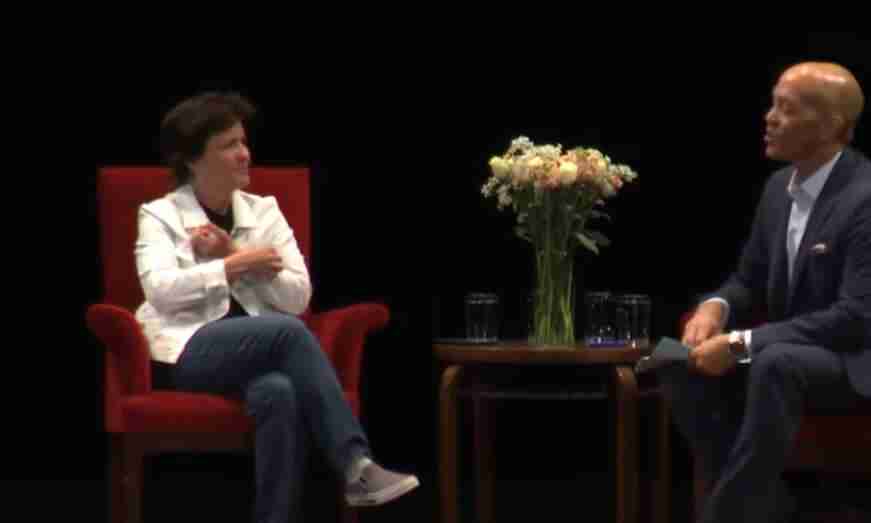
Read the full transcript of Journalist Kara Swisher’s interview at 2025 Reframe Festival on What’s Next in AI, May 6, 2025.
Listen to the audio version here:
INTERVIEWER: So it is a real joy to be with you here this evening. We had Robert Reich kick things off and we’re going to keep things going with Kara Swisher. She is among the most influential, most important tech journalists and commentators of our time. She’s known for her fearless interviews, her decades of covering Silicon Valley. I’m sure you listened to her Pivot podcast with Kara Swisher. I’m sure you’ve read her memoir, Burn Book. Ladies and gentlemen, Kara Swisher.
KARA SWISHER: Hi.
INTERVIEWER: Thanks for being here.
KARA SWISHER: Thank you. Robert was great. I love Robert Reich. My son loves him. The Youngs like him a lot.
INTERVIEWER: The Youngs.
KARA SWISHER: The Youngs like him a lot. My son was like, “Oh, you saw Robert Reich.” I was like, “Well, I’m doing a thing too.” And he’s like, “Yeah, but how was Robert?”
On Being Silicon Valley’s Most Feared Journalist
INTERVIEWER: Well, let’s start here because you have earned the reputation of being one of Silicon Valley’s most feared and most well liked journalists.
KARA SWISHER: I wish that would stop.
INTERVIEWER: You wish that would stop? Why don’t you embrace that journey?
KARA SWISHER: I don’t think I’m well liked.
INTERVIEWER: I don’t think, oh.
KARA SWISHER: Anymore.
INTERVIEWER: Well, how did you earn that?
KARA SWISHER: I didn’t understand that it was New York Magazine, it was a cover, it was a headline. It’s not true.
INTERVIEWER: They were doing their job as headline writers.
KARA SWISHER: I suppose, but I’m sure there.
INTERVIEWER: Was a kernel of truth beneath it. How did you earn that reputation?
KARA SWISHER: I think it was because I don’t. I’m not necessarily. I’m not. I am snarky, but I guess it’s. I suppose I’m sometimes funny when I do interviews and I sometimes I don’t come off as. I guess I can be somewhat charming to some of the people I cover, some of them.
At one point when I wrote a pretty scathing article about something they did that was deservedly so, they said, “I thought we were friends.” And I went, “We’re not friends,” because I’m friendly. Friendly to them, because I think that’s what a reporter does as a thing.
But I spent a lot of time developing long relationships with people because I think a lot of reporters are too transactional. And I don’t mean to say you shouldn’t do your job and break stories, but you have to really understand people. And I think it gives you greater insight to them as what is happening when you know what they’re like, you know about their families, you know about lots and more things than most people do. And I think if you rush in and out, you do a sort of very mile wide and a foot deep kind of coverage.
INTERVIEWER: So how did you learn that lesson? Because it takes time for journalists to understand that.
Building Relationships with Tech Leaders
KARA SWISHER: Yeah, I think. Well, one of the things was I was covering tech, especially the Internet. I didn’t cover early, early chips and stuff, although I just did a really fantastic interview with Lisa Su, who’s the head of AMD Monday in DC.
I covered the Internet early and I was the only one covering it. And so a lot of these people that you’re thinking of, Jeff Bezos, I went with him when he looked for an office. I went with Steve Case. I go to people when they look for offices. I also went with Steve Case when he looked for an office. I met them early on in their tenure and so I went to Google when they were in a garage when they first started and so I was there when other people weren’t.
And so I got to know them and therefore, you know, you understood what they were like at the start and it gave you a great insight. No matter what hand waving they’re doing now, I know who they were and I know who they are a lot better than most people. And so if you spend a lot of time with startups, when they were startups, you have a certain relationship. Twitter, when it was back here on—I forget the street it was on, but I went and visited them very early in their tenure when they were struggling, and they just shifted from being a company called Odeo, which was an audio podcasting service, to Twitter. So it’s just being. I’m just old.
How Tech Leaders Have Changed Over Time
INTERVIEWER: This notion that, you know, people don’t change, they just get older. Sergey Brin, Steve Case, Elon. Are they still fundamentally, at their core the same people just.
KARA SWISHER: No, no. I think. No, unfortunately for some. I think Elon.
INTERVIEWER: We’ll talk about him in a second.
KARA SWISHER: I think there’s echoes of them in everything they do. You know, I think they’re. I was just talking with Robert backstage and he was like, “Was Jeff Bezos always a jerk?” And I’m like, “Yes.” Like, you know, like, he was always a jerk.
So Mark Andreessen, many of them actually, but they’re often. They change. Some people evolve very much. So a good person would be Mark Cuban. He’s terrific now, but trust me when I tell you he was such a—I shouldn’t use the word douche, but I shall. He really was a jerk. He was like this arrogant person. When he had Broadcast.com and when Yahoo bought it for $5 billion. I broke that story, $5 billion. I was like, this is just such a ridiculous company for five. And he called and yelled at me. He was kind of like a young, jerky, arrogant person.
Over time he’s evolved. He’s had kids, he got married. He’s doing things that are really interesting. He’s gotten thoughtful. So there’s a plus person who’s gotten older and become an adult.
You know, Elon was a really interesting character because there was some, you know. You know, right now you don’t want to say this, but there was. He was really interesting. It was. He was very different and even thoughtful about a lot of the issues we faced and has changed drastically, like in terms of that and all to the negative, unfortunately, for lots of different reasons.
Those were all there. Those were. Obviously, I obviously missed 100% missed some of the behaviors towards his daughter, which I wasn’t aware of. But I’m not sure quite how he could have been. But I should have been. I feel I should have been. It’s a regret I have, but I think they. They just shift. It depends. With Elon, it was Covid really seemed to mess him up in a way that, you know, really got. A lot of people went down that rabbit hole during COVID especially conspiracy theories, obviously. He talks about his use of ketamine and everything else I think had an effect. I think becoming very wealthy had an effect. All kinds of things affected him.
The Role of Powerful Tech Leaders in Society
INTERVIEWER: The fact that he has such a unique role now in American life. Everything from space exploration to social media to electric vehicles. His role with Doge, obviously. What does that say about the role of powerful individuals these days in shaping American culture and society?
KARA SWISHER: Well, it’s not a new thing. I mean, we’ve had someone like that. We’ve had industrialists running things for a long time. It’s not a new fresh thing. And you know, you think of Henry Ford, a very deleterious effect, especially given he was a stone cold anti-Semite and worse. But he had a very. He was very important.
You can go back through history and at every juncture there is someone like Elon Musk. And it’s just we don’t study our history a lot. During the 50s. There’s one, I forget his name, this guy in Texas, an oil guy who had enormous, very Elon Musk-like. And I’m blanking on his name, but there’s always been someone like him. Thomas Edison is a really good example, another good example.
And so I don’t think it’s the influence, it’s what has happened. It’s become explicit, the explicit corruption. It’s so clear and so easy to see, which in some ways you sort of, it’s kind of a good thing. Before it was very backroom.
In Elon’s case, you know, he’s been involved in a lot of really interesting stuff. A lot of it. Some of it is PR, some of it is PT Barnum, some of it is credit taking where it’s not deserved. He did not create Tesla, for example, but he did a good job now running it into the ground this week. Although he grew it, he also grew it. So, you know, but there’s always been characters like him around for a long, long time. I don’t think it’s. And he’s the richest person in the world and we have an idolatry of innovators and an idolatry of wealthy people.
Tesla’s Troubles and Musk’s Leadership
INTERVIEWER: The Wall Street Journal reported exclusively that the Tesla board is looking for Musk’s successor. He has said that’s not true. Is his story a cautionary tale? I mean, I think it was an NPR poll that downed him with his unfavorability rating in like the 50s. Yeah, he’s taken a blow course to his reputation.
KARA SWISHER: Yeah, no, he has certainly done that. I think people just got to know him and then decided they didn’t like him. You know, it’s interesting because right now, here you’ve missed. Jesse Waters is interviewing some of the Doge staff, including introducing the world to big balls. So I’m so sorry you got to miss that pleasurable moment. Someone was like, “We live in hell.” And I agree with them completely. Like shitty little 19 year old, they’re all going, big balls. I have a 19 year old who is not shitty. I’m sorry, what was your question?
INTERVIEWER: I actually don’t recall what the question was. I was following your lead there.
KARA SWISHER: Oh, what he did to Tesla. What he did to Tesla.
INTERVIEWER: Oh, it’s a cautionary tale.
KARA SWISHER: Yeah, well, you know, they’re saying that they didn’t look for a CEO. Look, the board of Tesla has been literally the most rubber-stamped board I’ve seen in history. Like this group of you, this guy has constantly, you know, the thing is he’s rewarded them on the way up by giving them tens of millions of dollars. This board has been rewarded like it’s crazy, the corruption on this board. And they’re not doing their job, which is to manage a public company CEO, but they don’t care because he controls them. He controls them utterly. And that happens on boards. But I’ve never seen anything like this particular board.
And so, you know, as the stock declined and as the profits were off, I think 71% for lots of reasons, by the way, he’s blaming the protest and quite well done San Francisco, by the way. But the real heart of the problem at Tesla, no matter how much he screams at moments about the protesters and George Soros and whatever nonsense he spews out of his mouth at any given time, it was because he hasn’t created an innovative car in a little while.
And the problem is that there’s a lot of competitors now, including from Europe, from Japan, from China, and they’re creating really delightful cars. I just saw the Ford, I’m sorry, the GM Escalade EV is fantastic. It’s a great car. And instead we got the Cybertruck, which has sold 40,000 cars. I want to meet every one of those people. But it was supposed to sell 250,000 cars a year, and it didn’t, so.
So his real problem, as in everything, is he failed to innovate. It’s as if Steve Jobs didn’t invent the—I mean, didn’t introduce the iPhone. And so they have to. He’s going back there, I think he’s. I have made the prediction that he’s going to merge it into XAI and try to get. Make it into an AI company and then go on about optimist time, how we’re all going to own a robot in like millions of robots, and it’s a trillion, and his robo taxi business is going to be a trillion dollar operation. I mean, this is the kind of nonsense you get out of them.
And of course, leaving aside the fact that Waymo’s been operating three years, four years in this city and across the country now, you may or may not like Waymo, but Google has been working at it and they haven’t fielded one single autonomous car on the road. And by the way, please don’t get in a Tesla if you’re going to do that. They have much less safety around, they don’t use certain things. And so I would be very wary until, for a while before I get in one of those, if ever.
INTERVIEWER: If you accept the argument that tech leaders are playing a major role in eroding the public trust right now, yes, I’d say so. Media, elections, democracy itself, how are they reckoning with that, if at all, in your conversations with them, how are they reckoning with it?
Tech Industry’s Lack of Accountability
KARA SWISHER: They don’t care. I think one of the messages in my book was that they don’t care. Like everyone doesn’t believe me when I say that, but they don’t care. They think what they’re doing, they think they hung the moon. They think they’re amazing. They think they’re giving us the greatest gift of all time by their creations.
You know, thank you so much for the mapping service, except it was based on mapping data that was paid for by the US taxpayer. Thank you for the search engine which was riding on rails paid for by the US taxpayer and by universities and other research. They ride on everyone’s back and then ask us to say thank you almost continually.
Now, I’m not putting off that this is not innovative. It’s very exciting. But I don’t recall Thomas Edison forcing us to say thank you for the light bulb for years. And maybe he did. He was actually an irritating character from what I understand.
But one of the things that’s really, really problematic is that they truly have no regulation whatsoever. And I’m not a huge proponent of a lot of regulation, but any. I was on one of those screamy CNN panels with this guy, Pat Channing. Jesus, that guy, let me just tell you, he’s as loathsome as he seems. So he’s running for the senator. Good luck, Scott. So he’s—I call him the bad Scott, the good Scott is Scott Galloway, who’s my Scott.
But they don’t feel they have responsibility. So I was on this panel and this guy who worked for Trump was going on and on about all the rules and regulations constraining tech. And I said, how many rules and regulations are there on the tech industry? And he said hundreds. And I said zero, but you were close, which was really fun. I hate to say it, but I am quite good at that wrestling kind of thing and I hate myself for it.
INTERVIEWER: But you secretly enjoy it.
KARA SWISHER: No, I don’t actually. I actually won’t go on that much anymore because it’s really like, it’s reductive and you don’t get—I like longer like this.
INTERVIEWER: The news hour, right?
KARA SWISHER: The news hour is fantastic.
INTERVIEWER: So it’s all of Shameless plug.
KARA SWISHER: Most of the news done on public stations are fantastic, just amazing. So anyway, so there’s no rules, there’s no privacy rules, no antitrust rules. There’s no—it’s moving that way. There’s a few cases right now in Washington, as you must know, but there’s no legislation that has been passed for lots of reasons, including the interest in help. And this is through Democratic and Republican. I would blame Obama just as much in terms of embracing them without doing any kind of regulation.
But there’s no regulation. And even though whatever you may think of pharmaceutical companies or airlines or cars, they do have enormous amounts of regulations they have to contend with. They just want to have the wild west continue. And this is what’s happening inside in Bitcoin and the cryptocurrency stuff. I mean, Donald Trump right now is running the most corrupt scheme around crypto right now. He just got $2 billion from Dubai or Abu Dhabi. It’s insane how much his pocket is being filled and he’s able to do so. And he’s of course removing regulation after regulation on the crypto industry, of which there weren’t any, but now there will be none for at least two years.
A lot of people in tech, as innovative as they are and as amazing as some of the products are, it’s gotten to the point where they’re on third base and they think they hit a home run, that kind of expression. But they do not want to take responsibility for anything they do, whether it’s hurting children, which they do. And I would urge you to listen to an interview I did with the mother of the young man who killed himself after developing a relationship with a bot. And of course, the Wall Street Journal just had another story about Mark Zuckerberg pushing through bots that will be sexualized in some way and the children getting access to them. I mean, they don’t care. They just put it out there. And then when there’s an accident, they act like victims themselves.
The Future of Tech Regulation
INTERVIEWER: What’s the way forward? Or are we too far gone?
KARA SWISHER: Well, they’re very rich, aren’t they? So I think it’s very difficult right now because both parties do not have a taste for any kind of regulation. And I do understand the need for innovation. I do understand the need for competition, especially with China. It is really important. But it’s an excuse for every single thing they do.
Right now, Facebook’s current quarter was astonishing. I have to say, Mark Zuckerberg is fantastic. He’s sort of an A-class manager. But they are dominating. Advertising in the meantime, has eviscerated regular media. They are dominating social media. They are dominating in lots of areas. And so these companies are going to probably be just fine through a trade war. There’s no issues for them, maybe for Amazon, a little bit for Apple, but they are global companies that have interests around the globe and so they will continue to make all the rules.
And now we’re moving into the AI period. And this presidency will matter of who gets to be in the front row of the AI revolution which is going to change everything. I think people do not understand the implications of what’s about to happen.
INTERVIEWER: If you were to design new tech regulations, what areas would you focus on most?
KARA SWISHER: Well, I would have a robust privacy bill, where your information is yours. You know, it just seems basic. I think certain AI regulations. I thought the Biden administration had a pretty good one. The Trump administration acted like they were trying to really hamper them. They weren’t. They were the softest little regulation. You should tell us when it’s unsafe. Why? Why do they need to tell us it’s unsafe? It was very light, actually, what Biden was proposing. I thought it was too light in some ways.
Safety, what’s in the algorithm, algorithmic transparency laws, I would certainly put in. Obviously, changing our antitrust laws rather significantly would be a good idea. I think the last time, and I’m not an economics professor, Professor Reich, but I think it’s 100 years now or 150 years since we did that. Things have changed.
I suspect we probably have to do more on kids, in terms of regulating what kids are available to. It’s a shame because kids are at risk. You know, I’m a proponent of taking phones out of schools. I don’t know if other people are. I get why parents don’t want to, but I don’t agree with them. I think they’re a distraction and they create a different brain for kids. There’s a lot to do, but I just think they run the show and the citizens should be running the show of this kind of stuff.
The Unique Challenges of AI
INTERVIEWER: On this question of AI, is this moment in artificial intelligence fundamentally different from past tech waves, or is it sort of the same pattern of disruption?
KARA SWISHER: It’s bigger. Well, so far it’s going so well, the disruption. But yeah, I mean, if you think the Internet was problematic around polarization, I mean, to me, I attribute polarization to three things. If I had to boil them down, one is gerrymandering, the other is Fox News. The other is social media. I would say together they have created the most polarized, have created a lot of the problems and a lot of the disinformation.
But that did enough damage without being as big as AI is going to be. And AI has the capacity to do all that and more. Here’s one thing I do agree with Elon Musk on: AI will be 99% of thought, in terms of information and knowledge. Intelligence will be 99% AI. It really will. The strides these models are making are vast.
I think most people tend to focus on whether it’s sentient or not, whether it will kill us or not. A lot of that is from science fiction, Terminator specifically. But it’s really the amount—if you were going into law, parts of medicine, in terms of diagnostics, in terms of accounting, oh, my goodness, much of journalism, not all of it, certainly, because there’s a lot of creativity involved in some of it. You are really in trouble, like, really in trouble, because AI really can do this very quickly in a way that is a lot different.
I don’t know how many of you use it. You should be using it, you should understand it. But what’s happening now is really the strides are rather significant. And even though there’s issues around environmental issues and energy issues, they will figure those out. That will be solved. And this stuff will be running our world. They really will.
And it’ll depend on what goes in and who runs it and where the human interaction is in terms of the rules and laws. And that’s why to me, citizens and their elected officials should be the ones making these decisions rather than very small coterie of people here in San Francisco or elsewhere making these decisions for everybody.
The money is enormous, of course. I was just recently with someone who was giving me all the different possibilities. And he said, what do you think if AI would solve hunger? Or whatever, what it would do without rules? Well, it would kill half the human race, of course. Like, of course. I know it sounds crazy, but it has to have a bunch of rules.
It’s not to say people aren’t flawed because there’s a whole issue around the justice system and whether it should be decided by AI models. If a judge is exhausted in the morning and gets in a trackback accident or yells at his spouse or something like that, they might do a judgment differently. There’s all kinds of very clear evidence that human decision making is flawed in a rather significant way, but this abrogates our responsibilities as humans onto a machine which is mostly smarter but possibly deadly, if that makes sense. Possibly deadly.
Finding Leadership on Tech Issues
INTERVIEWER: Well, who are the folks, the lawmakers, the thought leaders who are asking the right questions about all this stuff right now?
KARA SWISHER: Well, there’s plenty of them. Mark Warner is really smart. Amy Klobuchar is smart. Among the Republicans, some of them. There’s a bunch, a couple who’ve left, actually. All the ones I know that I think are smart have left because they can’t take Trump.
But, you know, I think it’s hard to say. There’s a lot on the state level and everything else, but this is a global initiative. This has to be global. It’s like nuclear energy and nuclear proliferation. It’s like cloning. This is something that should be a global decision making and in conjunction with China, by the way, in a way that I think we don’t quite grok yet.
I was at a dinner party and Tony Blinken happened to be there when Biden was in office, and I just chewed his ear off about, what are you doing? Let’s go, let’s go. But I think it’s critically important. There’s a global initiative around AI to decide certain standards.
And there’s three groups of AI people which are pretty easy to organize with. One is the doomers. It’s going to kill us. They’re not quite right. It’s not the case, you know, but they’re there. Trust me. Someone at another dinner party was like, “Kara, if you don’t stop Sam Altman, society is doomed.” And I was like, that’s the plot of Terminator. That’s literally the plot. I was like, “Okay, I’ll go and hurt him somehow. I don’t know.”
So that was one. And then there’s the boomers, which is, oh, it’s going to be nothing but great. Every cancer is going to be solved. And this is correct. Some of the stuff around drug discovery and all kinds of healthcare stuff, education is really exciting, but everything is great. There’s sort of the Mark Andreessen “nothing but great” approach. Like when Mark Andreessen says nothing but great, I like, run for cover.
And then there’s, I think Reid Hoffman calls them the zoomers, who are interested in it, who see the problems and realize we have to put some safety issues in place. At the same time, they want to be optimistic about some of the possibilities, which are huge, which are massive.
INTERVIEWER: So realize the door is wide open.
KARA SWISHER: That was the Zoomer. That was the Zoomer.
The Media Business and Its Challenges
INTERVIEWER: Well, let’s talk about a topic near and dear to my heart. The media business. Yes, you have said that tech doesn’t necessarily destroy industries. It rewires them.
KARA SWISHER: No, no, I said it. No, no, I said doesn’t destroy. It gets rid of them. It obliterates them. But go ahead.
INTERVIEWER: Okay. I interviewed you once and I wrote.
KARA SWISHER: That down in my notes. You meant to say obliterate.
INTERVIEWER: I think I misquoted you and I wrote it down in my notes. But in any case, post 2025, what does the media industry look like?
KARA SWISHER: Well, it’s tough. I mean, well, now with the tariffs, who knows? Because that’s going to be one of the first places media business was actually returning a little bit. But now with the tariffs, all bets are off because who knows what he’s going to do when he wakes up any one day. And we’ll see when the Republicans decide to do something about it. They probably won’t. It’ll probably take the 2026 election to change things.
It’s very difficult to be a big media company. First of all, a lot of them are doing shameful capitulation to the Trump administration. CBS right now. Who? 60 Minutes think, well, it’s terrible. Cherry Redstone should be embarrassed, but she’s not. Apparently, someone I know, I’m not surprised necessarily. But they want to do this deal for the Ellison, David Ellison Byatt and his company, Sky Dance, I think it is. And so 60 Minutes did something. Trump sued them for trillions of dollars and they were going to settle with him. They did nothing wrong. 60 minutes. This is just obliterating one of the most important news programs in history. Really. The guy who runs it just quit because of that.
So they’re going to settle ridiculous nuisance lawsuit, which is baseless, and they’re going to do that. Disney did that with its issues around George Stephanopoulos. That was definitely a mistake. No question. Question of whether Donald Trump would have won. George made a mistake. That’s it. Full stop. Facebook paid because they took him off of Facebook on January 6th. So everywhere you go, there is capitulation. Not just law firms and universities and things like that, but these corporate media companies.
So I put great faith in smaller media companies like the ones. I mean, we were sort of the og Walt Mossberg and I were the OG doing that. But there’s all these really exciting small media companies, one or two people that are really good. And across the country, there’s something called Mississippi Today. There’s the Baltimore Banner in San Francisco, the Standard. I know it’s backed by Mike Morris. But great work. They do really good work.
So you’re seeing them come up with all kinds of different media revenue plans, people that really take business seriously, journalists who do understand business. One of my, I would say, mentor is Casey Newton, started something called Platformer. Now he employs two people. He does amazing coverage. So you’re seeing that around the edges. And everyone’s sort of experimenting, whether it’s podcasting or stuff like that. So I find that really. I mean, I’m constantly changing and doing different things. But it definitely. The idea of corporate media and big newspapers is very much challenged from a financial point of view.
The Washington Post and Media Ownership
INTERVIEWER: Are you still in the market to buy the Washington Post?
KARA SWISHER: Is he in the market to sell it? I think that’s more the point. He’s not selling it. He’s using it as a cudgel against Trump. And I mean, talk about incredible. He’s unfit to own it at this point. What he just did yesterday was really astonishing. You know, I thought he would be a good owner. I would like to look at it for sure. It’s an amazing thing. And I have. It’s not that hard to raise the money to do. It’s not very expensive now that they’re running it right into the wall again.
But he doesn’t seem willing to engage, so he has to want to sell it before. I think he has been a terrible owner. And it’s in big trouble. It’s in big trouble. They’ll bump along. It doesn’t really matter because he has so much money, but it shouldn’t be where it is right now.
INTERVIEWER: Where does the future of independent journalism live? Is it substacks and podcasts? Because I always have the question who can afford to do that and how do you scale it?
KARA SWISHER: Well, that’s difficult because there should be public. This thing next week that’s happening. Yet another attempt to defund public media, which seems it’s not a new thing by the way. It’s gone on for a long time. There has to be availability of news for everybody because what’s happening is very similar to nutrition, is the rich people get all the good food, right or the good supermarkets and everybody else gets the non stop supermarkets.
Although all of us will be getting non stop supermarkets very soon because of the tariffs. No, seriously, it’s going to be something because the shipping has stopped to the United States. There’s been some hoarding by different retailers, but it’s going to be something for Americans to see for the first time probably in a long time.
But you know, I think a lot of people don’t have a news diet. What happened was for many years there was a sort of news desert across the country in different places and different populations. And now there’s a news flood of misinformation and bad information and unchecked information. And so, so it’s the same damage that happens.
And so if there’s not good information and factual information going to most of the populace, they’re going to be subject to whatever lunacy comes across the social media site because people are glued to their phones, they are glued to these devices. And so if they’re getting sort of a problem of toxic waste and hate and disinformation, that’s a real problem for a populace. And let me tell you, the United States has not been the most well read population for a long time. So that’s not a new thing. But it really gets worse when they get fed a constant diet of propaganda. And it’s propaganda is really what it is.
Tech and Geopolitics
INTERVIEWER: And the intersection between tech and geopolitics has never been more apparent. Whether it’s Russia’s use of disinformation in political campaigns or China’s tech rise. I mean, what is the role of the west of the US to be more specific in this new landscape?
KARA SWISHER: Well, we have to decide if we believe in a democratic Internet, right? Or do we believe in a surveillance economy. Like I think that’s really one of the choices. The other is an economy. You know, it’s so ironic that all these tech bros by the way my favorite thing recently is that the Tech Bros. Stands for technically Broken. That made me laugh. At least I had thought of it. Anyway. I’m going to use it a lot anyway.
It’s really amazing that we do not, given how innovative our country is. And we really have been at the forefront of all the technological revolutions, going back to the electric light bulb and beyond that. Our country has been a font for innovation, and yet we continue to write education and real news and facts and things like that. And we’re so subject and so easily fooled by these. You know, our history is littered with con men and confabulators and charlatans. It’s really quite something to see sort of the two parts of the American experience.
But it’s critically important, whatever you think of the history of the United States. And it’s a mixed bag, of course, like everything else. You have to understand that what we stand for, this idea of free speech and people get to say what they want and people get to do what they want is critically important in a world where digital can control people in a way that’s terrifying.
And so, you know, a dictator authoritarian loves the Internet. Trust me when I tell you they don’t dislike it because they can use it for their own purposes. And I think that’s a really dangerous situation to be in, especially when you have. It’s not working great for Donald Trump, honestly. He, he’s very, I mean, he’s trying his best, but he’s really somewhat incompetent at destroying democracy on some level, but still, don’t count him out. But the use of propaganda has been so widespread now that it’s quite dangerous and it opens opportunities to authoritarians easily because people are exhausted, they’re overwhelmed. And then like, oh, can you, can you make me safer?
Future Tech Trends
INTERVIEWER: You were one of the first to see trends in tech that others don’t. Looking ahead the next five to 10 years, what trends do you have your eye on?
KARA SWISHER: Well, I pay a lot of attention to electric vehicles and autonomous vehicles. I know lots of people in San Francisco don’t like them, but they’re really. That’s something you’re going to see a lot more of across the board, definitely electric vehicles, but others, it’s had a push and pull, but I pay a lot of attention to it.
I’m spending a lot of time on healthcare in the next few years talking about what’s happening around AI, around the things, the science that’s going on, around things like Ozempic and those things. Really interesting stuff. A lot about even psychedelics, you know, there’s all kinds of really interesting stuff around human healthcare and how to eliminate cancer or restrict it in some ways that I think is very promising and really interesting.
One of the things I’m trying to do is focus on the good things like that are interesting and could really help the human race. Because after a while you’re like, these assholes. I can’t talk to them anymore. I want to talk to people that are doing things. There’s a lot of really interesting stuff being done, especially by younger people around energy, climate change.
There’s all kinds. The stuff around climate change could be really groundbreaking for this planet in terms of. And tech isn’t going to solve every problem, but some of the energy stuff is really, really astonishing. My son is at Michigan. One of my kids is at Michigan, and he’s studying. He’s going to be an engineer, but he’s studying energy. Like, he’s working for a hydrogen energy company this summer for an internship. And he doesn’t like it, but I say, I’m building the good Elon he hates. Funny. Mom, don’t say that.
But the energy stuff to me is really interesting because we do have to figure out how to remove fossil fuels from the equation. Our planet is really heading towards disaster in terms of. There was just a story I sitting backstage just looked at. Bird species are dying at an astonishing rate. Things like that. Think about a world without birds. It’s just weird to think about.
So I’m very interested in the nature of how nature intersects with tech and how we solve problems. And I am interested in space travel. I’m not going to go myself. And it’s definitely not on Jeff Bezos rocket. I loved how they tried to pretend it wasn’t embarrassing. If I was any of them, I’d be like, ugh, you fucked up.
INTERVIEWER: You’ve interviewed moguls, tech CEOs, but I.
KARA SWISHER: Have to tell you, the memes about Katy Perry, they’re mean, but they’re funny. I’m sorry, didn’t.
INTERVIEWER: KFC or one of the fast food restaurants, Wendy’s. Wendy’s.
KARA SWISHER: Wendy’s went after. I was like, wendy’s?
INTERVIEWER: That was surprising.
KARA SWISHER: They were having a little too much fun.
INTERVIEWER: I was gonna ask you in all of the interviews that you’ve done with moguls and tech CEOs and presidents and political leaders.
KARA SWISHER: Yeah.
INTERVIEWER: Who said something that really surprised you?
Memorable Interviews and Impactful Moments
KARA SWISHER: Yeah. It’s interesting. They’re all different in their own way. I actually just did a really interesting one with Judith Butler, who does a lot on gender ideology. And she was funny. Like, you don’t think of Judith Butler as funny, but actually she was really very wry and interesting.
But if I had to go back, I think what I like to do is you see them like, I think the interviews I did with Mark Zuckerberg, you see him like, or when he talked about that Holocaust deniers don’t mean to lie. I thought I got him to tell the truth. Or as Travis Kalanick when he said, you know, “as soon as we get rid of the guy in the front seat, everything will be golden.” You saw him, I mean, loathsome, but you saw it.
And so I think what I’m trying to do is make people see people. And in that regard, probably the Steve Jobs interviews, if I had to pick just a few, would be the most important ones. Just a really interesting and impactful person. We did a series, we did about eight interviews, including the one right before he died, that I thought was really a great interview, just really important. And I think historically that’ll last for history. And of course, the Gates and Jobs interview was one of the best ones I thought was really that I did with Walt Mossberg.
But oddly enough, one that I think of a lot is I did one with Monica Lewinsky many years ago. And I keep thinking of that interview a lot because here’s someone who obviously made a huge mistake at a very young age. And I have young, I have lots of different kids, but I have ones of that age and made a stupid mistake and bad decision and lived with the rest of her life. And couldn’t be a lovelier person. Let me just tell you, never dropped a dime on anybody. Think about in today’s culture, everyone’s writing a book telling all that. She’s never done that. She stayed, she made a mistake and she’s lived with it and accepted it. And she’s never written the tell all. She never did this. She never told you what happened. Everything else, which is astonishing in today’s vomit culture.
And I mean, really, it is. And also has turned out to be a very lovely person. And when I ask really good questions, I’m very happy when they are. And I asked her, she was like, “well, this is a life I have.” And I said, “can you explain your life if it hadn’t happened, if you didn’t make that decision?” And believe me, I give 100, like 99.9% blame to Bill Clinton, not her, you know, because she was a kid.
But I said, “can you imagine your life if this never happened?” And she did. And it was. It broke my heart. It just was one of these things. I know it sounds silly because it was kind of the many people I’ve interviewed, so many famous people, so many. I just felt like it was a real human moment, and she imagined having kids and stuff like that, and it was heartbreaking. I thought that was really good.
INTERVIEWER: It’s the real moments.
KARA SWISHER: It really was. It was really. I felt like the connection we made was really strong. And I still talked to her quite a bit, so. But I like them all. I like all my little interview babies, so.
INTERVIEWER: All right, my final question for you.
KARA SWISHER: Sure.
INTERVIEWER: What’s the biggest tech story or company right now that’s not getting the attention it deserves?
The Future of Healthcare and Technology
KARA SWISHER: Oh, that’s interesting. We pay a lot of attention to a lot of companies. I think some of these health care companies, and I think I’m not going to name a single company because again, I’m just starting the research on it. But I think there are health care companies that are going to be groundbreaking in terms of cancer. And right here in the Bay Area, there’s a lot of activity going on. Jennifer Doudna, for example, I did a great interview with her, who did the CRISPR stuff.
I just think there are, I think, not just life extension, but the way we live ourselves and conduct ourselves as humans is going to change, really. We’re going to know so much about ourselves. And I think I’m excited by that because there’s so much unneeded suffering.
I still, I mean, I just still am astonished at how many great strides we can make as humans, you know, being exceptional. And yet we have right now, you know, HHS is like delaying the COVID vaccine for ridiculous reasons. That guy is going to kill millions of people. Like, he is going to kill people. I’m sorry. And you can have your opinion about vaccines. I’m not going to get in the debate with people about. But now they’re keeping people who want vaccines from having vaccines, which is exactly the opposite of everything they said.
And so I just can’t sometimes I can’t believe how forward we are and how backwards we are at the same time. And so when we’re on the cusp of so many really interesting creations that we do, this is a really, you know, it’s a tragic. It’s often a tragic story.
And we have so many great minds in this country, I just think a lot about finding talent everywhere it is in order to better the human race going forward. Because anyone. You don’t have to have kids to believe in the future, but I happen to have four. And so I really believe in the future. And so I think a lot about their lives going forward without me and beyond me and their children.
And so we should really be as citizens, not just caught up in the daily lunacy of Trump. Because I think he just creates. He’s a person like Robert said, he’s the perfect example of distraction. He’s just a product of that. And there are other ways of thinking of ourselves as Americans, as citizens, and also as citizens of human race. They’re very different.
And I think we’re either living a Star Wars life, which is a dark, dark vision of the future, or a Star Trek life. And this is something Steve Jobs talked to me about. I would really like to live a Star Trek life. Not the outfits, but is that.
INTERVIEWER: Is that what keeps you doing this work? You have built a brand, a business and a following.
KARA SWISHER: Yeah.
INTERVIEWER: What keeps you. What keeps you going?
What Keeps Kara Going
KARA SWISHER: Being irritating to some of these billionaires is enjoyable, I will admit. Although a lot of them like me. It’s odd. A lot of them like me. It’s weird.
No, I just. I’m an entrepreneur. You know, one of the great things about San Francisco, and by the way, San Francisco looks great. Everybody I love. I still have my house here. What a great city. What a great city. It really is. It just is. I just had lunch with London Breed, who did a great job. I mean, I know she didn’t win, but she did an amazing job. And I think Daniel. Let’s give Daniel an attempt to try to make it. But San Francisco overall has great people involved in it.
What keeps me going? I think I really do like being an irritant. I know it sounds dumb, but I think my brother’s here in the audience. I think I was irritating from the beginning. He can attest truth, fact check through.
I think it’s really. I’m an entrepreneur at heart. I think San Francisco really, of all places, infected me with the entrepreneurial gene. And I always think about what’s the next thing I could do, how can I do it differently? How can I do it? And I think it’s really exciting to always think that you don’t have to do what you’re always doing.
And I say that to a lot. I mentor a lot of people, and we are privileged to be in this country, we’re privileged to have free speech today. We’re privileged for a lot of things, and so we should use that time we have on the planet. My dad died when I was really little, and you don’t have a lot of time. So I think that’s what I think about a lot. I just don’t have that kind of time for this nonsense. And so that’s what keeps me going.
INTERVIEWER: Kara Swisher, thank you.
KARA SWISHER: Thank you. Good luck.
INTERVIEWER: Thank you for your work.
KARA SWISHER: Thank you.
INTERVIEWER: And thank you for your time.
KARA SWISHER: And support public. Let me just say support public media. It’s critically important. They do amazing work. And not just Ken Burns, who’s a lovely guy, by the way, but still support it. They do astonishing work, give money to it. Our Congress is acting like assholes right now. They will get over that eventually, but not today. So really, they need your support more than ever. They’ve given to you more than you have given to them. So just remember that.
INTERVIEWER: Well, thank you all for being here. Thank you for making night one of the KQED Reframe Festival a success. I deeply appreciate your energy, your curiosity, your commitment. And this all continues tomorrow. We’ll hear from AI pioneer Fei-Fei Li. We’ll hear from your attorney general, Rob Bonta. Judy Woodruff will bring one of her brilliant crossroads conversations to the stage. And we’ll also hear from speaker emerita Nancy Pelosi. So the fun continues tomorrow. Thanks again. Get home safely. Be well.
Related Posts
- Anthropic CEO Responds to Trump Order, Pentagon Clash (Transcript)
- Elon Musk on CyberCab, FSD and Optimus @ Brighter with Herbert (Transcript)
- Alexandr Wang’s Remarks @ AI Impact Summit (Transcript)
- Demis Hassabis On AGI, Advice For Indian Engineers, AI In Gaming & More (Transcript)
- Transcript: Google CEO Sundar Pichai Speaks @India AI Summit