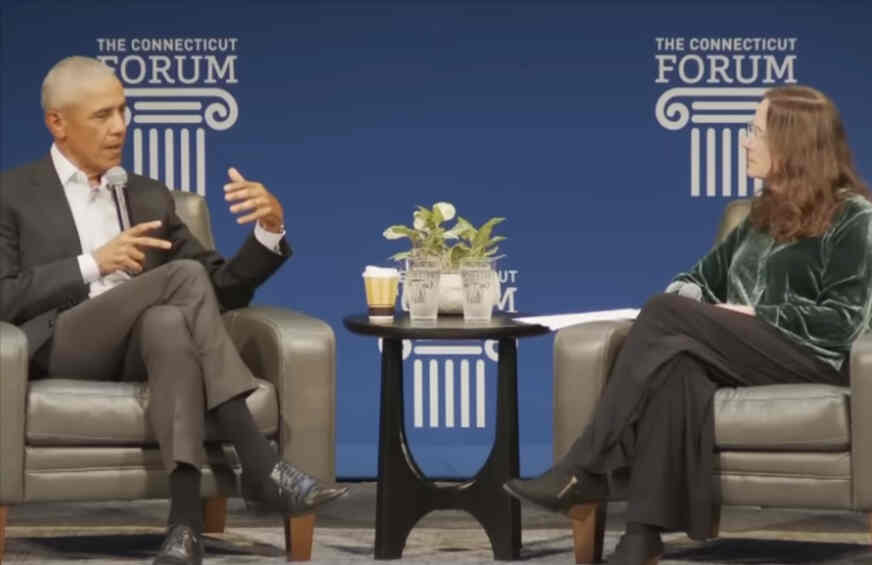
Read the full transcript of former President Barack Obama in conversation with historian Heather Cox Richardson on Tuesday, June 17, 2025 at The Connecticut Forum in Hartford, CT.
Opening Remarks and UConn Basketball
BARACK OBAMA: Thank you so much. Hey, thank you, Hartford. Thank you very much. Thank you. Thank you, guys. Thank you. Thank you so much. Thank you, Connecticut. I appreciate you. Thank you for the lumbar support.
And, Heather, I do have to just be clear about this whole UConn thing. Coach Auriemma, like, we had a room for him in the White House. I will point out that while I was in office, they just kept on winning, and I picked them about four or five times. So, you know, one year I get it wrong, and suddenly everybody is all on me about it. Just letting you know, much respect to the Huskies, please.
HEATHER COX RICHARDSON: But it is nonetheless an honor to have you here at the Connecticut Forum, and thank you all for coming tonight. Shall we dive into it?
BARACK OBAMA: Let’s go. Let’s talk. Chop it up, as they say.
Working Within and Against the System
HEATHER COX RICHARDSON: So let’s start off the top. You are both a historic figure and a historical actor in one of the most fraught times in American history. And in your book A Promised Land, you wrote about the conflict between working for change within the system and pushing against it. Wanting to lead, but wanting to empower people to make change for themselves. Wanting to be in politics but not of it.
What did that mean for you in your early career, and how has it changed? How did it change when you were president, and how do you think about that now that you’re out of office?
BARACK OBAMA: Well, I’ve talked about this publicly before. I was not someone who as a young person said, I want to be president. I wanted to be a basketball player, architect. There were a bunch of different things. Politician was not on the list.
The way I came into it, I was inspired by social movements. I was inspired by, in particular the civil rights movement that I had been too young to participate in. My role models were people like Bob Moses and Diane Nash and the Freedom Riders.
And then after I’d started community organizing and then went back to law school, this is a moment when Solidarity is rising in Poland, right? And the Berlin Wall is coming down and Tiananmen Square is happening and the people’s people power in the Philippines. And so you’re seeing a sense of ordinary people rising up and taking control of their lives and overthrowing oppressive structures and systems. And so that’s what excited me.
But what I also recognized, studying with smart professors like you and doing a little reading, by the way, for young people here, reading. It’s outstanding. Cat videos and TikTok is great. But every once in a while, picking up a book, what you came to recognize is that the success of the voting rights act or the Civil Rights act, was first and foremost the courage and tenacity of generations of freedom fighters and the civil rights movement and Dr. King.
But it was in the end also Lyndon Johnson, as flawed and tragic a figure as he was in a lot of ways. His capacity to overcome the constraints of his background and his politics as a Dixiecrat and then say, you know what? At this moment in history, I’m going to help make this happen, that was important, too. And figures who aren’t famous in the Justice Department who made sure that the federal government weighed in on the side of equality and freedom.
And that, I think, continues to be the recipe for change when our democracy is working. I do believe the most important office in a democracy is the office of citizen. That change happens because ordinary people get together and reimagine what their lives could be and push on the system.
But I also think that you have to have people inside that system that can translate those impulses into laws and institutional practices. And I’ve been on both sides of that equation. And there have been times, once I was in office, where I got pushed. And sometimes it was annoying to me, but it was necessary. And it was sometimes necessary for me when I was on the outside.
And I pushed to hear that those who were working within government or in politics, it was important for them to be able to explain that you’re not the only interest group, you’re not the only constituency. There are other equities. And so we have to balance those equities. That’s part of our job.
And that, I think, is how a healthy democracy works. And unfortunately, I think both outside government and inside government, sometimes we get so cynical or we want maximalist outcomes. We want all of what we want all the time right now. And that’s not how, in a big, complicated, messy, noisy country like this, our democracy is going to work. Everybody has to figure out that push and pull that over time incrementally leads to extraordinary progress.
The Current State of Democracy
HEATHER COX RICHARDSON: Can I push back on that?
BARACK OBAMA: Of course. See, it’s happening already.
HEATHER COX RICHARDSON: I’m curious. In this moment in which we are currently living, for a lot of people, it feels as though the people who are speaking up and trying to change our society are not, in fact being heard. And that change is coming not from outside the system, as you suggest suggests, but rather from within the system. Oh, and I. Well, I wonder.
BARACK OBAMA: You were asking me about what it felt like for me coming up.
HEATHER COX RICHARDSON: Oh, well, I did.
BARACK OBAMA: You didn’t ask me about what the heck is going on right now that that’s a whole another.
HEATHER COX RICHARDSON: No, no, no, no.
BARACK OBAMA: During my, during my presidency, I didn’t, I didn’t hear the out office thing. It’s changed a lot in the last few years.
HEATHER COX RICHARDSON: Yeah, well, but the, but the, the, I agree with you actually. But the, the premise that the way you create change in a democracy comes from below and not from above, I continue to think is solid. Do you, are you rethinking that?
Democracy Under Threat
BARACK OBAMA: No, no, I’m not rethinking at all. But what we were also witnessing is that when the system is captured by those who, let’s say, have a weak attachment to democracy are not. I don’t even think that’s a controversial statement at this point. No, I’m actually being serious now. It was a controversial statement. Now it is self acknowledged if you follow regularly what is said by those who are in charge of the federal government right now.
There is a weak commitment to what we understood, and not just my generation, at least Since World War II, our understanding of how a liberal democracy is supposed to work. And when I say liberal, I don’t mean left. I mean liberal in the sense of believing in rule of law and independent judiciary and freedom of the press and freedom of assembly and protest and compromise and pluralism.
All those institutional norms and laws that were embodied in the Constitution imperfectly and then over time were expanded so that we had a basic understanding like, I can’t just be picked up on the street and hauled off to another country. That’s not something. That wasn’t a partisan view. That wasn’t a Republican or Democratic notion that that shouldn’t happen. That was an American value and norm.
And so, so what I believe it continues to be that there has to be responses and pushback from civil society, from various institutions and individuals outside of government. But there also has to be people in government, in both parties who say, well, no, you can’t do that. You can’t do that.
And what we’re seeing right now is when you do not have those constraints and guardrails, right? When you don’t have people inside of government who say, no, this is how the law works and we should follow it. Democracy is not self executing. It requires people, judges and people in the Justice Department and people throughout the government who take an oath to uphold the Constitution. It requires them to take those that oath seriously.
And when that isn’t happening, we start drifting into something that is not consistent with American democracy. It is consistent with autocracies. It’s consistent with Hungary under Orban. It’s consistent with places that hold elections but do not otherwise observe what we think of as a fair system in which everybody’s voice matters and people have a seat at the table and there are checks and balances and nobody’s above the law, and we’re not there yet completely.
But I think that we are dangerously close to normalizing behavior like that. And we need people both outside government and inside of government saying, let’s not go over that cliff, because it’s hard to recover.
What Makes America Exceptional
And part of the reason, I think it’s interesting, when I was first elected, we were in the middle of a huge global financial crisis. It had started on Wall street, so. So understandably, other countries were annoyed about it. And the Iraq war obviously, was not popular around the world. And so our reputation and our leadership globally was. Had dipped pretty significantly.
And so I come in first year, and I’m doing a lot of travel and making a lot of speeches and holding town halls and like this in foreign countries. And one of the raps that I got from the opposition, the Republican side, was he’s on an apology tour. And basically what they were arguing was that I wasn’t just going around bullying other countries and telling them that we’re better than you, which I thought was a bad strategy to get them to cooperate to. That’s human nature, I think.
But what they always missed, and what I would always say everywhere I went around the world, was what makes America exceptional is not that it has the biggest military, it’s not that it has the largest economy. What really makes America exceptional is that it’s the only big country on earth and maybe the only real superpower in history that is made up of people from every corner of the globe.
And they show up, they come here. And the glue that holds us together is this crazy experiment called democracy. And this idea that we can somehow, despite all our differences, we don’t look alike. We don’t worship God in the same way. We don’t like the same foods. And yet, when this experiment works, it gives the world a little bit of hope, because it says it is possible for human beings who are not bound by tribe or race or blood, but are instead bound by an idea that they can somehow work together and arrive at a common good.
That’s what made America acceptable. And so I think we have to recover pride in that. That’s what makes us special. That and our capacity through this constitutional process and representative government and an adherence to certain ideas has allowed us to get better. Not perfect, but get better over time. With just one big civil war, large exception. But otherwise we’ve managed to make real progress.
Challenges Facing America Today
HEATHER COX RICHARDSON: You’ve talked about how the system has frayed Since World War II, and the post war World War II years have seen a lot of things falling apart. And there’s a lot of different areas we could talk about. But what do you see as the biggest areas in which we’re facing challenges in the US or that has perhaps taken us to where we are now.
The Impact of Globalization and Technology
BARACK OBAMA: So some of these trends you could start seeing during the start of my presidency or before the start of my presidency, a couple of huge factors. I’m not being particularly original in saying this. The Berlin Wall comes down, Cold War is over. There’s this period in the 90s in which the US really doesn’t have a competitor.
And the combination of technology, transportation improvements, suddenly you have a global marketplace with fewer barriers. And that process of globalization and technology creates this explosion of growth and huge, huge amounts of wealth spinning around the globe, taking advantage of opportunities.
In many ways, it was this extraordinary period of progress because you have a billion Chinese lifted out of poverty. That’s a big deal. You have former Eastern bloc countries who places like Poland or that suddenly are growing rapidly and people’s standards of living are rising. India, less so in Africa. But even there you’re seeing progress.
The Winner-Take-All Economy
But there was a catch, because this was all driven by global capital. And that was that created what some economists refer to as a winner take all economy in the sense that if you had high skills, you already had capital, you had advantages, you had education, you could leverage that and do even better. And if you didn’t have those things, you could become redundant and marginalized.
And that was happening not just between countries, but within countries. And so in advanced countries like the United States, economically wealthier countries, in absolute terms, people didn’t get poor. But the gap, the rise in inequality, made people feel like I’m losing ground.
And this globalization was hugely disruptive. So at first it happened in manufacturing, and that happens pretty early in the 70s and 80s, but then it starts happening in other industries and retail and you get Walmart, then Walmart now suddenly has to deal with Amazon and those economic dislocations and the capacity of some people to make $100 billion or more and others not and have trouble making the rent or feeding their families, that’s created tensions.
The Information Revolution’s Impact
And if you combine that with a change in the information ecosystem brought on by the Internet and then social media and everybody carrying around this little thing in their pocket. What that also did was to let everybody know how unequal everything was.
Many people know my father was from Kenya when I went there for the first time in 1987. I mean, this is rural, there’s no indoor plumbing in a lot of areas, there’s no electricity. By the time I went back in, let’s say the last time I was there, 2011, 12, I was probably 13. Everybody has got a cell phone.
So you have people who are subsistence farmers looking at the Kardashians. And it’s funny, it’s a weird image, but what that does is it created both a collision of cultures. People started seeing how different others were living. And that’s an assault on their identity and their status.
And it also triggered all kinds of movement among peoples. The degree to which mass migration has been triggered in part by the communications revolution, I think is something that is not talked about enough because people started saying, oh, I can be here and here’s how I can organize moving to a better life.
The Erosion of Social Trust
So you get this combination of things. Essentially what happens is people are feeling stressed from all sides. They feel stressed in terms of their identity, they feel stressed economically, they feel stressed in terms of social arrangements and gender norms and marriage and all the institutions and religion, all the things they, they could count on as giving solid ground under their feet. Suddenly all that stuff feels up for grabs.
And in that situation, it’s harder to maintain the social trust that keeps democracy going. Long answer to what should have been a shorter or to a good question that I should have responded to quicker.
Growing inequality, a changed information and media environment, demographic change, those who used to be marginalized now wanting a seat at the table. All those things were disruptive and got people nervous. And there was a backlash. And that backlash increasingly took forms in which we don’t care what we said about democracy. We want to make sure that we maintain the status quo. And that I think is part of what we’re going through right now.
The Coming AI Revolution
And it’s probably the changes I just described are accelerating. If you ask me right now, the thing that is not talked about enough, but is coming to your neighborhood faster than you think. This AI revolution is not made up, it’s not overhyped. You are already there, probably. I know. I was talking to some people backstage who are associated with businesses here in the Hartford community. I guarantee you you’re going to start seeing shifts in white collar work as a consequence of what these new AI models can do.
And so that’s going to be more disruption and it’s going to speed up. Which is why one of the things I discovered as president is most of the problems we face are not simply technical problems.
If we want to solve climate change, we probably do need some new battery technologies and we need to make progress in terms of getting to zero emission carbons. But if we were organized right now, we could reduce our emissions by 30% with existing technologies. It would be a big deal. But getting people organized to do that is hard.
Most of the problems we have have to do with how do we cooperate and work together. Not, you know, do we have a 10 point plan or the absence of it. Public schools, we know how to teach kids effectively, but organizing school boards and making sure adequate funding is there and making sure that teachers can teach, and that’s what’s hard.
The Need for Democracy and Social Cohesion
So if you ask me right now what, what is our biggest challenge? I go back to what I talked about earlier. Our biggest challenge right now is we need democracy and social cohesion and trust more than ever. And it’s probably as weak as it’s been since I been alive. And that’s a bad combination.
And so if we’re going to fix all these other problems, if we’re going to deal with climate change effectively, if we’re going to deal with this AI revolution in a smart way, if we’re going to address economic inequality, it is going to start with a reaffirmation of our ability to work collectively, together. If we don’t do that, then the other stuff is not going to get solved.
HEATHER COX RICHARDSON: So one of the. Yeah, go ahead. So one of the things you didn’t mention about the accumulation of money into certain hands after the fall of Berlin Wall and in the former Soviet republics and so on, was the degree to which people who made that money took over the political systems to weight everything in their own favor.
And one of the things that I think is interesting about cell phones, for example, I think you’re absolutely right that people can now look at their cell phones and say, why don’t I live like that? And it seems to me that in many ways they are a tool to push back against that loaded world, if you will, that has been so skewed toward a very small group of people. And we’re really seeing that push come to shove right now under this particular administration.
The Challenge of Technology and Truth in Democracy
BARACK OBAMA: It could be, look, technologies are tools, but they’re also not, I don’t want to stretch the analogy too far, but they’re also operating systems. They kind of move you in certain directions. You know, I was jokingly talking about books previously, but books are an interesting technology because they force you to focus and concentrate your attention over a certain period of time. And that encourages you to consider a bunch of factors and to think about complexity and to reason things out. It creates certain habits of the mind. Tweets, do something different.
And look, look, I was the first digital president. So I saw the dawn of this and saw it unfold in the book Audacity of Hope that I wrote right after I’d been elected to the Senate. So this is pre-presidency. I have a chapter that starts with me visiting the Google campus in Mountain View in 2005 and it is fascinating. I’m talking to Sergey and Larry and you could already see the revolutionary potential of this.
And then smartphones come out around 2010 and are associated with the Arab Spring and Tahrir Square and there’s this enormous optimism. And I myself was elected in part because of this digital revolution, because I was not the establishment candidate. I’m an upstart. And so I’ve got a bunch. And I can’t even take credit for any of this.
The reason I was an early adapter of digital technology and campaigning was because I could only afford to hire 20-something year olds. They were the only ones stupid enough to think that we could get me elected to anything. And so I’d come into the office and we’d have our little, you know, Mac and they’d say, oh, we set up a webpage. I said, that’s great, what is that? And then they’d kind of show it to me and they say, look, you can click this button and people can volunteer. Really? And what does that button do? People can send you money. I said, no, really, it was great. I had nothing to do with it, but I was smart enough to get out of these kids’ way. And so. But yeah, I give credit, I take credit for that.
The Dark Side of Digital Connectivity
The reason I’m saying all that is what you said, Heather is absolutely right. There is the problem promise of this connectivity being harnessed for good. What we have learned subsequently is that it can also be harnessed for bad. And it can be captured by authoritarian states, it can be captured by wealthy economic interests.
And there is something that has happened in social media in particular, which is their business model shifted early on. The idea was we just want to put a bunch of good information out there and we’re going to privilege accuracy as well as speed as sort of the most important thing that you’re getting on this platform.
And at some point their business practices. They realized if we’re going to make money, maybe the fastest way for us to make money on these platforms is to sell ads. And once you needed to sell ads, then the most important thing was getting attention and keeping people engaged on these platforms.
And it turned out that there’s part of our reptilian brain that gets really attracted to, in addition to cat videos, it’s attracted to anger, and it’s attracted to resentment, and it’s attracted to conspiracy theories, and it’s attracted to those aspects of ourselves that react rather than try to think. And it also splinters and divides into these slots, and you go down different rabbit holes.
The Loss of Shared Cultural Experience
And so what it’s done is we’ve lost a monoculture. We’ve lost everybody watching Walter Cronkite. We’ve lost everybody watching MASH or Mary Tyler Moore or All in the Family or Roots. We’ve lost everybody getting a Time magazine. And on the COVID is this new novel or new novelist. And so everybody’s got to read that book.
And so it makes it more difficult now for us to find common ground. It makes it easier for demagogues to divide us and start arguing that those people who do those things in those spots who don’t look like us, they’re after you and they’re trying to get you.
The Crisis of Truth and Facts
And so one of the most important challenges I think our democracy faces is how do we regain some common sense of truth. Not absolute truth, but rough, basic truth. In 2020, one person won the election, and it wasn’t the guy complaining about it. And that’s just a fact. That wasn’t just like, my inauguration had more people, and that’s demonstrable. I say that, by the way, not because, like, I don’t care, but facts are important. Because if you can’t.
And I think one of the most pernicious things that has happened is we have a situation now where we’re not just arguing policy or values or opinions, but basic facts are being contested. And that is a problem, because then the marketplace of ideas of the democracy.
I’ve said this before, but I always repeat it. You and I can have an opinion about this little side table. You might not like the design. He might not like the color or how it’s finished, but we can have that discussion. If I say to you, this is a lawnmower, you’ll think I’m crazy. And if I really believe it, I’ll think you’re crazy. And we’re now in a situation in which we are having these just basic factual arguments. And that further undermines trust.
The Strategy of Flooding the Zone
And those in power, those with money, exploit that space in which nobody knows what’s true. Vladimir Putin and the KGB had a saying that was then adopted proudly by Steve Bannon, which was, if you want propaganda to be effective, you don’t have to convince people that what you are saying is true. You just have to flood the zone with so much poop. They used a different word. But you have to flood the zone with so much untruth constantly that at some point, people don’t believe anything.
So it doesn’t matter if a candidate running for office just is constantly just hypothetically saying untrue things, or if an elected president claims that he won when he lost and that the system was rigged, but then when he wins, then it isn’t rigged because he won. It doesn’t matter if everybody believes it. It just matters if everybody starts kind of throwing up their hands and saying, well, I guess it doesn’t matter.
And that’s what’s happened. That’s what’s happened in one of our major political parties. You have a whole bunch of people who know that’s not true, but we will pretend like it is. And that is dangerous.
Solutions and the Path Forward
So one of the things I think Heather, you’re doing, for those of you who don’t know her newsletter, it’s an example of. I’ll give you a little plug here. But part of what we’re going to have to do is to start experimenting with new forms of journalism and how do we use social media in ways that reaffirm facts, separate facts from opinion? We want diversity of opinion. We don’t want diversity of facts. And how do we train and teach our kids to distinguish between those things? That I think is one of the big tasks of social media, by the way.
It will require some government, I believe, some government regulatory constraints around some of these business models in a way that’s consistent with the First Amendment, but that also says, look, there is a difference between these platforms letting all voices be heard versus a business model that elevates the most hateful voices, or the most polarizing voices, or the most dangerous in the sense of inciting violence voices. And that, I think, is going to be a big challenge for all of us that we’re going to have to undertake.
HEATHER COX RICHARDSON: A couple questions about that. How do you think we can rebuild a sense of shared national identity? And let me give you the other one, because maybe they overlap. We have a number of different sectors in this country who are now sort of banding together in the face of hostility and what are their different roles in that project? And I’m thinking of universities and law firms and businesses. And you talked about media, but also about culture. So.
The Great American Story
BARACK OBAMA: There is this great American story, and it’s like the Great American Songbook. There is a running thread through America, from Thomas Paine and George Washington to Thoreau and Emerson and Lincoln and Douglas and all the way through King and Kennedy’s inaugural, Whitman. There is a story about America that includes everybody. It’s a good story.
It’s a story about people who aren’t pretentious and don’t believe that anybody is worse than them or better than them, that we’re all endowed with a core dignity and are deserving of rights and respect and have to assume responsibility for ourselves individually and our collective lives. And we all play a part.
And that historically has not been a. I’m repeating myself here. It hasn’t been a Republican or a Democratic idea. That is an American idea that everybody could tap into. And if that ends up being our starting point for common identity, if our starting point is these homespun values of we don’t have aristocracies here, we don’t have rank, we don’t have monarchies, we have rule of law, all people are equal in the eyes of the law. That we all have a part to play in democracy, that we all have to take individual responsibility for our lives. But we also have to, as Lincoln said, do some things together because we can do it better together than we can do it apart. If that’s our starting point, then I think we’ll be okay.
The Bad Story of America
But that’s not where we are right now. I think right now what we’re seeing is a politics that is reasserting a bad story of America, which is that even if there aren’t technically ranks, we like the idea of caste and we like the idea of hierarchy. And some people, this is our country, the real Americans, and these other folks are the phony and the fake Americans or not even American.
And that story also has a deep history in this country, right, that says, okay, the first Americans aren’t Americans, and slaves are not Americans, and women are sort of Americans as long as they’re doing what their husbands say. And people of different sexual orientations, they’re not. We don’t even want to hear about them. That story has been part of America as well.
The Battle on Edmund Pettus Bridge
And people sometimes ask me, what is my favorite. What is the favorite of the speeches I’ve given? And probably my favorite. And it will be a portion of. It’s on the face of the Presidential center that we will be opening next year in Chicago is the speech I gave in Selma for the 50th anniversary.
And the reason I love that speech is because to me, that contest on the Edmund Pettus Bridge is as important a battle as Concord and Lexington and Appomattox. Because you have, you have on one side, you have on one side John Lewis in a backpack and an apple and a toothbrush, and maids and college students have flown down and rabbis and young priests. And they are carrying with them across that bridge this story, this better story, that we’re all equal, we all have a place, nobody is worse, nobody is better, and we can all join together.
And on the other side, you’ve got folks on horseback with billy clubs and guns and dogs, and they’re carrying a different story, which is no, ignore what we say in the Declaration of Independence. We have caste and some people are better and more deserving than others and have more power and more wealth.
Institutional Courage and Commitment
And so I think we are. That question right now is being called and you asked about universities, law firms, businesses. One of my bigger concerns is when I see institutions cower before this bad story because they’re worried that it will affect their bottom lines in some fashion.
And the question I’ve asked, because there have been partners in law firms who have called me and asked me about this, there have been university presidents who I’ve had conversations with about this businesses who’ve asked me how they think they should handle this. And what I’ve said to them is, well, what do you believe? Like, that’s your starting point. What do you care about? What’s your mission?
If you believe, if you are a university, what is your core mission? And if, as I think your core mission should be, it’s to teach, to transmit knowledge and broaden horizons for young minds and transmit information that allows them not just to get a job, but also to live meaningful lives and be good citizens. If that’s your mission, then it really doesn’t matter what the threats are coming from the outside. You push back against somebody who says you can’t carry out that mission.
If you are a law firm, then now obviously you’re running a business, it’s a partnership, you’re billing, you want clients, but you’re also all supposed to be officers of the court. You went into the law, presumably not just because you couldn’t think of anything else to do, or your dad or your mom thought it was a good idea. Presumably you went into the law because you believe in the law. So if you are getting pressure from government saying ignore or fudge or compromise that commitment, you have to push back.
The Anomalous Period of Progress
Now, one thing that I’ve noticed, and I’ve said this before in a few other venues, Heather, you and I, we both grew up after this World War II, and America’s the colossus around the world, and we’re exporting all these ideas and our economy is growing and terrible things have happened during our lifetimes. Vietnam and assassinations and killing fields and Rwanda. So I don’t want to in any way minimize those things.
But what’s been fascinating about this period in our history, and it’s anomalous, is that things got sort of steadily better. I mean, the world became hugely wealthier and healthier and better educated, and infant mortality dropped, and women and girls suddenly had access to education and human rights became an idea that people violated but were guilty about.
If you listen to sometimes, like just Nixon, the Nixon tapes, just talking about bombing Cambodia. Crazy how indifferent they were in ways that were taken for granted then and now. Whatever differences I have with the Bush administration, they wouldn’t have conversations like that. And that happened just in 20 years. So I think a lot of us started to take it for granted.
Testing Our Commitments
And part of what happened was if you were relatively privileged to have been grown up in the United States of America during this period, you could be as progressive and socially conscious as you wanted, and you did not have to pay a price. You could still make a lot of money. You could still hang out in Aspen and Milan and travel and have a house in the Hamptons and still be. And so think of yourself as a progressive.
And now things are a little different. Your commitments are being tested not the way Nelson Mandela’s commitments were tested, where you go to jail for 27 years, you might lose some of your donors. If you’re a university and if you’re a law firm, your billings might drop a little bit, which means you cannot remodel that kitchen in your house in the Hamptons this summer.
And if you’re a business, and this has happened because I’ve been getting calls about it, yes, you may be threatened by an administration that says, we won’t approve a merger or we will launch an investigation of you and we will make you uncomfortable.
Part of what all this tariff stuff is about, by the way, because it’s such a poorly thought out economics. So you kind of wonder, well, why would you do something that’s just not well thought out? I mean, you can apply tariffs. There’s a place for tariffs to help open up markets and leverage. The United States sometimes gets taken advantage of because we’ve been the biggest market, China, China in particular, as it came up, started taking advantage of the rules. And my administration applied tariffs as well, occasionally to counteract these bad practices.
But that’s not what’s going on now. What’s going on now is that tariffs means everybody has to come to you for favor. You apply blanket tariffs around the world. Now suddenly Vietnam has got to negotiate tariffs. And, oh, would it be helpful in terms of lowering tariffs if maybe we approved a golf course for a certain business? All discuss that.
So what’s happening is that we now have a situation in which all of us are going to be tested in some way and we are going to have to then decide what our commitments are. And there will be it will be uncomfortable for a time, but that’s how you know it’s a commitment, because you do it when it’s hard, not just when it’s easy, not just when it’s trendy, not just when it’s cool.
You know, and sometimes I feel as if during my presidency, I think a lot of people felt comfortable in their righteousness because they didn’t have to test it. And now you have to test it a little bit more.
A Note of Hope
HEATHER COX RICHARDSON: President Obama, it has been a real pleasure. And I would like to end, if we can, on a note of hope.
BARACK OBAMA: Yes.
HEATHER COX RICHARDSON: And that is, you know, I don’t know if you all know that the president, Mrs. Obama, have the Obama foundation, which fosters the next generation of leaders. And I would love if you could tell us what advice you are giving those young scholars to enable them to be optimistic about their future and about the future and maybe about our future.
The Foundation of Hope and Leadership Development
BARACK OBAMA: Yes, I’m still optimist. I’m still the hope guy. I am. But the thing is, look, part of the reason I’m hopeful is, as Heather mentioned, our foundation, the premise of it is that leaders are not just they don’t just pop up. There is extraordinary talent in every community, in rural communities, in inner city neighborhoods. They’re remarkable leaders in fancy Ivy League schools. But they’re also amazing leaders who don’t go to college and are organizing unions or organizing neighborhoods. And that’s true not just in the United States, but around the world.
And so we, our mission is to train this next generation of leaders, give them resources, ideas, most importantly, to convene them so they know they’re not alone. And when I say young people, we’ve got programs that reach very young people, like My Brother’s Keeper, targeting young men of color who historically have been left out. Girls Opportunity alliance that focuses on women and girls making sure they have access to opportunity education around the world as well as here.
But a lot of the leaders we’re talking about are doctors who’ve set up clinics in Appalachia to fight the opioid crisis or clinics in subcenter in Africa for to give women access to health care. It’s human rights lawyers in Eastern Europe, and it’s civil rights lawyers here in the United States. And we’ve got members of parliament and state legislators, but we also have activists and journalists and people who put on community theater.
The Better Story of America Lives On
You watch these young people and it will make you optimistic. Because the thing that I have seen is that that better story of America is alive and well, and it’s in the hearts and minds of people everywhere. But we’re not giving it enough of an institutional base and support, and we’re not fighting for that better story enough. And these kids are willing to be on the front lines fighting for it every day.
So where my optimism comes from, it’s not blind optimism. I’ve said before, I don’t think progress goes in a straight line. I think that there are times where you take two steps forward and you take one step back. There are times where you take one step forward and take two steps back. That’s been true in the United States. It’s been true around the world.
But if we are willing to attach ourselves to that better story in our own individual lives, in our communities, in our businesses, in our law firms, universities, in our places of worship, then I think the good will win out.
The Politics of Addition, Not Subtraction
And I guess the thing that when I’m talking to these young people, though they need to hear the most, is is important to be impatient with injustice and cruelty. And there’s a healthy outrage that we should be exhibiting in terms of what’s currently happening both here and around the world. But if you want to deliver on change, then it’s a game of addition, not subtraction, which means you have to find ways to make common ground with people who don’t agree with you on everything, but agree with you on some things.
And, you know, we were talking about social media earlier. It’s part of the reason why my favorite app, or I guess it wasn’t an app program, whatever it was, I don’t know, always the terminology when we were running our campaign was meetup. You remember Meetup? So young people, you do not remember Meetup Some older people remember it.
So it’s a. You could send out information on it, but then attached to it would be let’s meet up. And you didn’t stay in your cocoon on your phone. The phone prompted you to then actually meet people in the real world.
Building Real Community Through Face-to-Face Connection
And the reason I loved it was you’d get like the Idahoans for Obama. We didn’t send a staff to Idaho because generally it was not going to vote for a Democrat, but we wanted to encourage volunteers. So they’d self organize, they’d send out, let’s meet in a church basement and they’d all show up.
And online, it sounds like they’re all the same and they agree on everything. And there’s a certain type of person who’s supporting Obama. Then they show up and it’s like you’ve got what looks like a former army colonel with a buzz cut and a flannel shirt and then you got a young black woman with a nose ring. And then you’ve got a mom pushing a stroller coming in because she couldn’t get a babysitter.
And now they’ve got to have a conversation that doesn’t just focus on we hate the other side or we don’t like this or we don’t actually. They now actually have to recognize, oh, part of being a community, part of learning from each other is even the people we agree with, we don’t agree with 100% of the time. We have to. People are complicated and unique and they have their own stories.
Fighting Against Pigeonholing and Absolute Positions
That I think is a lot of what we work with, our young folks is fighting against this tendency to try to just pigeonhole everybody. And I think the left sometimes does it as much as the right. And it’s part of what contributes sometimes to backlash when the left starts being scolds and absent wanting absolute positions on things. And you have to agree with me on everything as opposed to, you know what, I’m not crazy about your position on X, but man, don’t you agree on Y. Let’s work on that for a while.
That, I think, is where you start seeing hope. Because what ends up happening is when people actually meet and they get to know each other and then they work on a common endeavor, then what Lincoln called those better angels come out, people start recognizing themselves in each other and they start trusting each other. And that’s not just the basis for democracy, but that’s the basis for our, our long term salvation.
So. All right, that was fun. Thank you. Thank you. Appreciate you. Thank you.
Related Posts
- President Trump Remarks on US, Israel Attacking Iran (Transcript)
- President Trump on Economy, Energy in Corpus Christi, TX (Transcript)
- Bulwark Podcast: w/ Susan Glasser on Trump’s State of the Union address (Transcript)
- Douglas Macgregor: US-Iran Diplomacy Fail (Transcript)
- The Truth About Trump’s State of the Union w/ Sen. Bernie Sanders (Transcript)