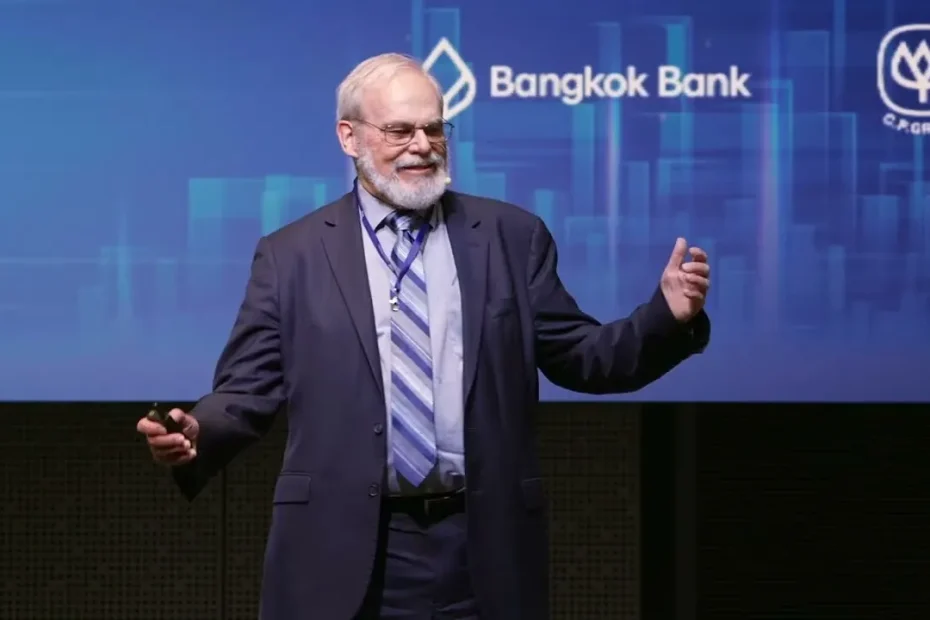
Read the full transcript of Prof. W. Eric L. Grimson’s lecture titled “Artificial Intelligence – Past, Present, Future” at 2025 MIT Bangkok Symposium on Feb 25, 2025.
Listen to the audio version here:
TRANSCRIPT:
INTRODUCER: And now, to present our keynote talk, I’m privileged to introduce MIT’s Chancellor for Academic Advancement, Eric Grimson, the Bernard M. Gordon Professor of Medical Engineering.
Introduction
PROF. W. ERIC L. GRIMSON: Good morning. Nice to have you here. Thank you for joining us today for what I hope is an informative, engaging, and interesting conversation about AI and its impact on almost every aspect of your life.
I’m going to start by saying what I’d like to do in this talk is give you a little bit of the history of AI, especially MIT’s role in it, a little bit of a review of what AI systems do. I know many of you know this well, but it’s worth reminding you of what are the pieces involved in it. And then talk about what MIT is doing to embed AI throughout the research at the Institute and to push it forward into the future. So that’s my goal.
AI Is Everywhere
AI is everywhere. In the United States, if you watch television and you look at ads, it looks like any company that can spell AI says they’re doing it. And most of them are. But it doesn’t matter what you pick, whether it’s finance, it’s health, it’s transportation, it’s commerce, it’s security, AI is here and it’s having an impact.
It’s worth reminding ourselves of what is an AI system. The standard definition from computer science is that it’s intelligence executed by a machine. AI is a rational agent that perceives its environment, gathers information, and takes actions in order to try and maximize success at a particular goal. It’s the fundamental of what AI does.
Often people will say AI is exhibited by a machine when it does something that we would associate with a human, hopefully good things that a human does and not mistakes that the machine makes. And so that involves problem solving, which are those three steps, and it involves machine learning.
As a consequence, modern AI systems really incorporate information from four different areas: obviously computer science, but also from neuroscience (what goes on in our brains), from cognitive science (how we think), and from mathematics, especially reasoning about uncertainty.
A Brief History of AI
One can debate how far back you want to go, but most people would point to the Dartmouth workshop in 1956 as the founding of modern AI. I was three years old at the time, so I’m as old as AI, or a little younger than AI. Three of the four founders or organizers of that workshop were MIT faculty members: John McCarthy, Marvin Minsky, and Claude Shannon. Rochester was from IBM, McCarthy eventually left to go found AI at Stanford, but we had an early role in it.
You can see the definition that they gave:
Every aspect of learning, or any other feature of intelligence, in their view can be so precisely described that you can get a machine to do it.
That was the motivation behind the founding of AI.
First Wave: Search-Based AI
For 20 years, early AI was basically search. If you wanted to prove a theorem, if you wanted to win a game, you started at some initial position, and you executed a series of steps trying to get to the goal. And if you got to the goal, great, if you didn’t and you hit a dead end, you backtracked and tried the next thing, and you did that until you explored all the space or you found a solution.
I’m sure you can quickly figure out this does not scale well. It runs into a combinatorial explosion. The number of things you have to explore becomes huge. As a consequence, for that first period, people looked at very small examples, and they made a lot of ad hoc assumptions in order to remove things they didn’t want to think about, without any real basis on how well it was going to work.
And as a consequence, after about 20 years of funding in the US and elsewhere, we hit the first AI winter, that is funding dried up, because these things were seen as just not usable.
I will point out to you, I started my own work in AI in 1975. In those days, it was something you scraped off the bottom of your shoe. It was not highly respected because it had these problems. It didn’t handle problems well.
Second Wave: Expert Systems
Second wave of AI, rise of expert systems in the 1980s. This was a focus on a particular domain and creating logical rules for deductions so that you would basically say, given what I want to accomplish, here is the natural way in which I would get to it.
There were some early commercial successes, but again, one of the struggles here was that they didn’t scale well. Even if I built a system to do Campbell’s Soup maintenance, which was the first successful AI application of which I’m aware, you couldn’t apply it to some other problem. You had to start over again. It didn’t learn. It didn’t generalize. That led to the second AI winter.
Third Wave: Modern AI
Now we’re in the third phase. The third phase is really driven by bringing in solid scientific bases from mathematics and from neuroscience. Mathematics being able to reason about problems under uncertainty and come up with a principled solution to it. Neuroscience using what we know about how our brains work to give us a guide to how we might build a real system.
And of course, we began to see early on in this phase some successes. You’ll decide for yourself, but IBM’s Deep Blue system beating the world’s chess champion was certainly an indication of the power of these systems and early commercial successes.
And today, as you all know, this is really driven by three trends:
1.
2. The incredible growth of data. And this is an issue I think all of us need to think about as we build modern AI systems. How do we get access to enough data to train these systems and how do we have confidence in the quality of the data and lack of bias in the data? As I’m sure many of you know, a current modern AI system might have millions or hundreds of millions of parameters and you need hundreds of millions or billions of examples in order to train all of those parameters. So massive data sets are important.
3. And the third one, of course, is an incredible growth in computing. Whether that’s standard computing or that’s GPU chips from NVIDIA or AMD or pick your favorite company that makes these things, the ability to do the computing allows you to get to it.
Notice two correlations, though, that come out of this. Not everybody is going to have access to the same data sets. So there’s going to be an imbalance about who can succeed in this space. And the climate implications, if you like, of the power demands of these systems to do the training causes other challenges for companies and governments to think about. How do we want to balance the advantages with the cost of it?
Machine Learning: The Heart of Modern AI
Those are the pieces that let us build a useful application. Now today, AI is mostly machine learning. Not all of it, but most of it is. Unfortunately, I think this is still true for lots of application cases. You just throw a bunch of math and a bunch of data, stir it around. If you get a good answer, great. If you don’t, just stir it around until you get an answer you like. Not a satisfying way of dealing with things. And so we want to talk a little bit about how one does better on it, but essentially it’s machine learning.
And the definition of machine learning actually comes from the early days of AI. The first machine learning algorithm was done by an IBM researcher named Art Samuel. He wrote a program to learn to play checkers, that simple little game. Not very sophisticated, but it learned. And as he said:
It’s the field of study that gives computers the ability to learn without being explicitly programmed.
Let me now dive into machine learning and why we want to think carefully about how we use it. Traditional programming works like this: you’re a client, you give a program a specification. I want my program to do this particular task. With this input, I want this output. They write the program and then you give new inputs, you get good answers out.
Machine learning works differently. The programmer writes a machine learning program and takes a collection of input-answer pairs. For this input, this is the answer. For this input, that’s the answer. And the machine then builds a new program so that given new inputs, it will give you an answer and you can use it to make a decision about whether this is the right thing you want to do. You are still involved in that process. But notice there’s an implicit program there. You never create the program, the machine does. The question is how well does it do it and does it do it in a manner that actually meets my goal.
Notice a problem that many people acknowledge: the quality of the input data is going to dramatically affect the ability of the algorithm that gets created. If you get really good input data that covers the space, it will do well. If you give input data that’s missing elements of the space or has a lot of incorrect information, you’re going to have a problem.
A Simple Machine Learning Example
Let me give you a quick example. You have a set of training data. I might say, here are a set of images that I know are cats. Here are a set of images that I know are dogs. I want to build a system that will recognize cats and dogs.
I convert each example into a set of features, a set of numbers. In this case, it might be a set of numbers that talk about the shape of the nose, a set of numbers that describe the color and the texture of the fur, a set of numbers that represent the shape of the eye, a collection of pieces like that.
And then I want to infer something about the process that created that. Typically here, I’ll just use a neural net. I will train a system on those examples to say, how do I weight the different features to have something that I think actually captures the difference between cats and dogs?
Then I want to use it on new data to make sure it works. So I give it a new image that says that’s a cat. I give it a new image that says that’s a dog. And there’s still the challenge. Are these cats or dogs or very confused animals? I’ll let you decide for yourself. I think the one on the left is a dog. I think the one next in is a cat. I’m not certain about the one after that. And I think the one on the far right is a cat. But you get the point. There are going to be edge cases that you still need to think about as you use this system.
Machine Learning Algorithms
That’s the paradigm for machine learning. And I want to come back to how we use it today, but also some of those challenges in terms of the performance of it.
There’s a range of things we want to do. Most common machine learning algorithms today are supervised. We give them those feature label pairs and we use them. It’s a whole range of algorithms, many of them dating back to the 50s that can be used. But today, at least in my experience, almost everything is some version of a neural net. And, of course, the hot topic are large language models, which everybody seems to want to use, and we’ll talk about that as well.
Logistic Regression
Just a tiny bit more on what those systems do. Basically, we’re going to use something called logistic regression, which is going to learn a probability of assigning a label to a new example based on that training data.
I’m going to skip this tiny bit of math. This is an MIT talk. There will be a quiz at the end, so you might want to take a few notes, but everybody will pass the quiz, so don’t worry about it. And yes, by the way, my jokes are all bad, but I’m a tenured professor, so you can’t do a damn thing about it.
With that in mind, it’s worth reminding you what that system does. In logistic regression, I’ve got a set of feature values. In a modern system, that might be tens of thousands of feature values. And the system is going to learn weights to assign to those features.
So, given an instance, it multiplies the weight by the feature value, adds them all up, and it applies what’s called a logistic function to it. That function is designed to assign the probability that this is, in fact, an example of what I’m looking for. It’s designed to very quickly push the probability either towards zero or towards one.
The whole goal is to find the best weights, which is what the learning algorithms do, and then set a threshold so that when I have a new instance, if I’m above that threshold, I’m going to say this is an instance. And if it’s not above that threshold, I’m going to say it’s not an instance of it.
The Importance of Thresholds
I raise the threshold because it’s actually important to think about. And unfortunately, many AI systems don’t. For example, if I’m building a system for autonomous driving that is going to try and detect pedestrians, I want to set the threshold so I have very few false negatives. I don’t want to not recognize a pedestrian and have a disaster. I want very few false negatives. That tells me how to set the threshold.
On the other hand, if I’m a faculty member and I’m running an exam, and I’m looking for cheating, I probably want very few false positives. I’d much rather accept a few kids getting away with cheating than accuse somebody of cheating in that exam.
So you get the idea. The context really matters here in terms of how I set the threshold.
Neural Networks
What about neural nets? They’re based on our knowledge in neurophysiology, how our brain works, but they’re essentially a way of learning those weights in order to set up a logistic classifier.
An artificial neural net, again, a simplified model of what goes on in the brain, has a set of inputs, a set of feature values, a bunch of numbers. I then connect each of those features to what’s called a hidden node. It takes the product of the weights and the feature values, adds them up, and applies a function to it that gives you an output of that internal node. The choice of that function is really important. We’ll talk briefly about that.
Those are all connected up to an output node with an additional set of weights. And that weighted sum is applied to the input to the logistic function to say, yes, this is a cat, or yes, this is a dog, or I’m not certain. It’s one of those confused examples in between.
In the early days, artificial neural nets had maybe one hidden layer, mostly because of computational cost and lack of data. Today they can be huge. One of my favorite examples from an MIT spinoff, the Hong Kong-based face recognition and AI company SenseTime, their system has a thousand layers in their artificial neural net. And I’m sure there are bigger examples around.
Deep Learning and Its Origins
Deep learning just refers to a complex neural net trying to accomplish this. There are lots of variations, but most of them, and early ones, at least in computer vision, go back to the work of two Harvard neuroscientists that won the Nobel Prize, David Hubel and Thorsten Wiesel, who discovered cells in primate cortex that did what we would see today as an artificial neural net.
I’m going to skip by the examples, other than just to say that a modern neural net can do things like face recognition, character recognition, extremely well.
Large Language Models
And then large language models. I’m sure you’re all aware of them. They’re the current rage. I think they have a lot to add to the system. Basically, I think of these as a deep neural net that has some interesting properties. In language, it’s a way of predicting what’s the next word in an answer I’m constructing based on the words before it. Notice the size, though, here. A
In this system, each word is represented by over 12,000 feature values. A word with a similar meaning is very close to other ones. A word that has multiple meanings has multiple representations so that you can deal with the confusions in language. And a sentence is just a sequence of those feature vectors, one for each word. The magic inside of here is something called a transformer, which is a system that basically takes one of those words as a representation and uses other words to decide how to disambiguate meaning, how to use context to associate pronouns with nouns, how to use other information to refine the words so that you can then run the full system in order to come up with a solution.
To train this, DeepMind, who did one of the first versions of this, or OpenAI, which is probably the better example of it, they trained their system on 30 billion sentences. 30 billion. By the way, all of you are entitled to a little bit of revenue from OpenAI because they probably used your Facebook page or your LinkedIn page or something else to gather that data without your permission. You can worry about the legal ramifications of that. But they’ve mined massive amounts of data in order to train this.
And now, given an input query, the system basically samples words from that query to start the system and then predicts probabilistically, what’s the likely answer I want to generate, with an input as long as 3,000 words long, which is actually impressive. And, of course, you can generalize this. If you want to create a chatbot, you take as input a sequence of queries and responses, either generated by ChatGPT or something that humans did, you scale them or weight them in terms of what the quality is, and then you retrain the system in order to create something that gives you conversations.
Limitations of AI Systems
So, those are the elements of modern AI. And I want to give you a sense of some of the strengths and some of the challenges. I want to remind you that a modern large language model, based on all of this technology, gives you a probability, gives you the probability of a good answer. If you run the same query multiple times, you may get slightly different answers. You may get very different answers, because it’s a probability.
If there is bias in your training data, and bias can be incorrect data, but it can also just be things you’re missing, it’s going to affect the output. In healthcare, this can be a huge problem. A system trained on data from people that look like me may be very different than a system applied to data from people that look like you or somebody else because of missing data. So bias in the data is huge.
And these systems don’t have the ability to apply common sense to their answer. If it comes up with a ridiculous answer, you or I would look at it and say, no way, but the system doesn’t have that ability. So it’s a tool, it’s not a replacement.
Real-World AI Performance Study
I want to show you an example of this. I’m stealing a little bit of thunder from a couple of my colleagues, but I want to show you very quickly a little bit of an example of using an AI system and why you need to be careful about knowing when to trust the response.
It’s a study out of the Sloan School of Management at MIT, I think in collaboration with some other people. They took, if I remember right, 500 middle managers, HR experts, management experts, and they divided them up into three groups. A control group, a group that had access to GPT-4, and a group that had access to GPT-4 and a guide on how to use it. And they gave them two tasks.
The first task was designed to fit very squarely into the expertise of GPT-4. It was coming up with a description of a new product. And notice the results. The group that had access to GPT-4, as judged by experts, their performance, both in efficiency and quality, improved 38%. And if you were in the lower half, you had less experience, less capability, your improvement was 43%. If you’re more experienced, not surprisingly, you’re still an improvement of 17%. You got better. If you had access to GPT-4 and a guide on how to use it, you did even better in terms of performance. This is great.
You notice I have blocked out part of the slide, because now you go to a problem that was designed very explicitly not to fit well with the capabilities of GPT-4. And there, the group using GPT-4, their performance decreased by 13%. All right, not great. And the group that had GPT-4 and a guide to use it, their performance decreased even more. Why? Because they trusted it. It’s an AI system, it’s gotta be good, it must be right. Not a good answer.
My point is, it’s a tool. And as a user, you need to know how to judge when it is doing something that’s acceptable and when it is not. And I think that’s one of the challenges here.
Impact of AI in Academia
Nonetheless, it’s been fascinating to see the impact of AI. And I will simply point out to you, this year’s Nobel Prize in Physics, two of the awardees are pioneers in deep learning, Jeff Hinton and John Hopfield. Nobel Prize in Chemistry, Demis Hassabis, another pioneer in neural nets. Hopfield spent a year at MIT on sabbatical. And Hassabis completed his postdoc at MIT. So we had a little bit of effort in influencing these people.
Success Stories in AI
With that in mind, where are we today? And what’s MIT doing? There are a ton of areas of great success. I’ve just listed a bunch of my favorites here. I’m going to show you four examples of them, but there’s hardly an area that hasn’t seen an interesting application of AI into the system. Systems mostly built around software, but obviously there are hardware boosts, certainly GPUs, but also specialized chip sets being built to make these things go.
And so success stories, you all use them. Speech recognition, speech translation, remarkably good systems, and a range of them available. My own field is, or was, computer vision. I find some of these systems really impressive. Face recognition systems today actually perform better than humans, certainly on face verification and even on face recognition.
Autonomous driving, should be careful as I say this, I’m not a fan of some of the shortcuts that Tesla has taken here, but there are some impressive systems for doing autonomous driving. Primarily one for me is Mobileye. It does an incredible job with it, but computer vision has been dramatically changed.
Robotics. I’m being biased, this is an MIT event. These are four MIT spinoff companies. Mobileye with autonomous driving. iRobot and the Roomba with household robots. Kiva, now part of Amazon, with logistics. And perhaps an interesting one, FarmWise, which does an AI-based vision system to actually pick weeds from crops without damaging the crop in practical use today.
And of course, question answering. Early version would be IBM’s Watson system, but ChatGPT is a great example of the kinds of things you can do in terms of answering questions.
MIT’s AI Initiatives
So, what’s MIT doing? We’re essentially embedding AI and machine learning across the entire institute. And we’re doing it both at the curricular level, in terms of what we teach students, but also in terms of research. In interest of time, I’m going to skip over the curricular level. I’d be happy to answer questions, but we’re changing how we train and teach students today to embed computation throughout the curriculum. Every student is learning about AI, no matter what their major is.
What I want to show you is the level of activity and interest at MIT today, in terms of research using these systems. When we founded the MIT Stephen A. Schwarzman College of Computing five years ago, one of the things we said was, we were not only going to embed computation throughout the institute, but we were going to add 50 new faculty lines to the institute. It’s the largest growth at MIT in 80 years. 25 of them are in computer science. 25 of them are bridge faculty. They’re in between computer science or the college, if you like, and another discipline. And that both changes the kind of faculty member we hire, but it changes the way we think about using AI.
So I know this is a busy slide, but here are examples of the people that we have hired in the last five years in these bridge areas. In management, somebody who does…
Behavioral economics, mechanical engineering, agriculture management, chemical engineering, new synthesis design. But then some places that may surprise you. Music, music technology. We have an offer out in philosophy for somebody who does computational ethics. How do you think about the ethical use of these systems? And then I have the pleasure this term of actually co-chairing a search committee to find somebody who sits between computation and history. It’s going to be an interesting challenge to find somebody, but there are some interesting people there. But the idea is that we want to have faculty that are bridges here.
Two weeks ago, MIT did its review of faculty members for promotions. And of the, I don’t know, 60 cases that we saw, I would say 55 of them involved somebody using AI in a department, whether that was urban planning, or economics, or philosophy, or political science. So there’s actually a real strong interest. And let me show you some examples of this.
Revolutionary AI Applications in Healthcare
One of my colleagues built a deep learning system. This is before ChatGPT, that is able to identify new drugs to kill antibiotic-resistant bacterial infections. Has a lot of structural knowledge about chemistry built in, but it also has a deep learning system underneath it. In their first trial, the molecule they selected based on what the system gave them as recommendations, they tested on 25 known antibiotic-resistant infections. And that new molecule was shown to have an effect on 24 out of 25. It was one lung infection it didn’t deal with. Since then, they’ve used it to design drugs very specifically for particular antibiotic-resistant bacterial infections.
Can’t resist telling you, because my colleagues had discovered a new drug, they got to give it a name. And they chose to call this new drug HALICIN, H-A-L-I-C-I-N. ICIN sounds like penicillin, like the name of a drug. And where did HAL come from? The AI computer in 2001 in Space Odyssey. So they’re nerds, they’re geeks, they have a terrible sense of humor, but they have the ability to actually build it. But notice the impact. New drug discovery.
A colleague, second colleague, actually a colleague in both of these, is a breast cancer survivor. And she became fascinated with how can you do a better job of detection? She has built a deep learning system which tested on retrospective data, old data. She has shown with 85% accuracy and spot the early signs of something that is going to turn into a tumor five years before the radiologist will detect it. It’s now in common use at the Harvard hospitals as a screening mechanism. Incredible impact on human health.
Third example from health, colleague Dina Khatabi is a wireless communication expert. There’s a Wi-Fi signal here. As I’m pacing back and forth, I am slightly disrupting that Wi-Fi signal. And her system, which could be in the corner of the room, will not only detect that disruption, it will infer what caused it. So things she can do:
She can detect vital signs of a patient remotely with nothing attached to the patient. During COVID, we used her system in most of the Boston Bay’s hospitals so that staff didn’t have to go into the ICU. She can actually tell how well I’m walking. So if I happen to be a patient with Parkinson’s, her system can tell the clinician how the disease is progressing automatically. She can detect activities. The one that I find fascinating, she can detect disruptions in sleep, which are often a signal of onset of diseases like Parkinson’s, all completely automatically.
Transportation and Logistics
Transportation, obviously we’re working on autonomous vehicles extensively. We’re interested in the traditional components of it, but we’re especially interested in things like behavior prediction. How do you predict what a vehicle in front of you is going to do? How do you predict what a pedestrian is going to do? If I were in Bangkok, my apologies, how do you predict what all those scooters are going to do as they go flying by you in the wrong lane? But it’s really being able to do reaction, if you like, to the system. And then things like last mile vehicle routing, a great logistics application.
AI for Scientific Discovery
An area I think is really primed for major impact is discovery of new things. A young colleague in chemical engineering has built an AI system that comes up with new models for catalysis, for building catalysts, aimed at coming up with solutions that are more efficient, less expensive, and will produce good quality outputs.
Design of new materials. Again, colleagues have built a system that will design or suggest designs for new materials. An area of particular interest for us is things like concrete production, where the system will predict ways to come up with new mixtures with lower costs, lower emissions. But these are things creating new materials.
Economics and Finance
Finance. My colleagues will talk about this, but studies on the economic impact of generative AI on jobs of the future. There are a number of programs going on. The one I will simply highlight is work of our most two recent Nobel Prize winners, Daron Acemoglu and Simon Johnson, looking at the economic impact of what’s going to happen to jobs as we think about AI there.
There’s a whole range of examples here of things that are going on. Again, it is hard to find an area where there isn’t some research going on at MIT. And the way we think about it is that machine learning now is the third leg in the stool of scientific discovery. A good researcher, at least in science and engineering, will use mathematics to do a formal model of something that will make predictions, which they will then gather information on experiments that they do physically. But they then use AI and machine learning to add the computational component. Not just to do the analysis, but also to do the simulations to look at other things that should be tested here.
And so we refer to our students and our faculty now as being computational bilinguals. They speak the language of chemical engineering and the language of computation. But these are the range of things that MIT is looking at. And our goal going into the future is to embed that notion of machine learning throughout every department at the Institute. It means we’re going to hire new faculty members, new kinds of faculty members. We need to break down disciplinary boundaries. And of course we have to face one of the challenges, which is our data needs, our data storage needs, and our computing power needs are growing. And we need to think about how we’re going to address those things which we’re actively working on.
Conclusion
I wanted to give you a sense of what MIT thinks about AI. I wanted to give you that sense of not only the history of how we’ve dealt with it, but especially how we see it moving into the future. New discovery mechanisms, new management methods, new economic models. But even in places that you wouldn’t expect. New planning for design, a new planning of design for cities. Use of this in political science, use of this in economics. Every part of MIT is now using AI in a different way.
Before we go to questions, I will simply say, as somebody who started in this field 50 years ago, it’s been fascinating to see where it ended up. I hope the next 50 years aren’t quite as tumultuous, but that they lead to something different. But even though there were two AI winters, this one feels like it’s here to stay. And we need to adapt to it, adjust to it, and use it.
And with that, Quan, I’m going to let you pick the questions. I see people have put things in here, but wherever Quan is, do you want to pull one of them up for me? Ah, there we go, all right.
Q&A Session
AUDIENCE QUESTION: People talk about artificial general intelligence a lot. Can you explain it in plain English? And how can this concept be applied in business?
PROF. W. ERIC L. GRIMSON: I’m sorry, I shouldn’t smile. I answer to the first question, no. I’m joking. The goal of people who are pushing AGI is to say, can we build an AI system that really does behave the way we do? It’s not just built for a task, but it is built to apply intelligence to anything. As I said earlier, it’s an area where, to do that, you need to capture common sense reasoning, the kinds…
of things that a two-year-old knows and an AI system doesn’t. It’s a wonderful goal to have. I will show you my bias. I think it’s a long ways away. We’ll get closer to it, but I think we’re likely to see successes in particular areas more quickly than building a general AI system. If you had it, it’d be great, because you could use one system to do marketing planning, to do customer service, to do management of your finances, all of those sorts of things. But again, I think it’s much more likely that in the shorter term, you’re going to build a generative AI system for a particular application. But that’s what it’s about. There are people who think it’s going to happen. I’m a little skeptical, but I may be wrong.
The Prospect of Another AI Winter
All right, go on, second question. You’re an optimistic group, I like this. Since history is often a predictor of the future, I should be careful. But I think, as I said, this wave feels much more real than the two previous waves in those AI winters. And why do I say that? This wave is built on much more solid scientific foundation. It really is built on deep understanding of the mathematics. It’s built on deep understanding of at least what we know about how people think. And you can just see it in terms of the commercial impact. I’m sure you’re all affected in your own companies with this, so will there be another AI winter? Possible. Could be affected by government agencies deciding not to provide funding for it. We’ve just had an interesting event in Washington yesterday, and we’ll see what happens in terms of funding there. But I don’t see this having an AI winter anytime really soon.
Having said all of that, as a quick comment, I want to remind you that even though these current systems are built on a model of what we think goes on in the human brain, it’s not a perfect model. And there may be alternatives. And I’ll give you a very quick example. It comes from my colleague, Josh Tenenbaum, who raises a really good point. These systems are impressive, but they need to be trained on hundreds of millions of examples in order to be effective. For those of you who have young children or had young children, think about a two-year-old. You can show a two-year-old a stack of blocks on a table and ask them, what will happen if you hit the table? And with good, reasonable accuracy, they’ll be able to tell you what happens. They don’t have hundreds of millions of training examples, but somehow they learn very quickly how to predict what happens in a setting. And so there may be alternatives that we see that change the path of AI. But to the winter case, I don’t think it’s coming soon, or at least I hope it is not.
AI Regulation and Ethics
What’s my next question? I’d like to be able to catch a flight in a couple of days and still get back to the United States. So I’m not certain how much I want to answer this question, but it is a great question. Let me answer it this way. I’m not going to answer the particular one. Is it a wise decision? I’m sorry. That just gets me in trouble. But I do think, and I think many companies certainly in the U.S. have taken a role in this, that we need to think about the regulatory issues of how you use this. Where are the places where you want guardrails? Where are the places where you’re happy to use this? What are the standards that a product should meet before you allow it to be deployed in terms of use?
I will point to the European Union, which I think has done a really interesting job of this. You can quibble with pieces of it, but they’ve laid out an interesting structure for how you think about the regulatory issues here. And so I don’t know whether, let’s say this, I don’t know if politics should have an influence on this, but government agencies absolutely should have it. But working with the companies, and I will point to in the U.S., at least my recollection, my colleagues may be able to correct me, Microsoft took the lead in creating a consortium of other major U.S. companies to begin building a framework for what was an ethical use of AI in different areas. Not to maximize their profit, it would help, but to actually make sure that it was doing what it should, which is to protect people while building them. And so absolutely, there should be government role in regulatory components. Politics is a little different. I’ll stay away from that one.
Will AI Surpass Human Intelligence?
All right, Quan, pick me one that doesn’t get me in trouble when I try and get back into the U.S. Yes, I’ve heard Masa talk about this. It’s an interesting question, you know, how realistic is it? I’ll do it the following way. A completely general AI, I think, as I said, unlikely in 10 years’ time. But in particular domains, an AI system that outperforms humans, yeah, I do think it’s possible. You can already see it in some places.
I’ll give you two examples, just ones I happen to like. Again, I’ll go back to that face recognition system. There are ethical issues about how you use it. That’s a separate issue, but the ability of modern face recognition systems, it is better than humans, and it’s something that really is going to have an impact on safety and security in places. When I flew over here in order to board the flight, basically it was using a face recognition system.
The second example I personally find impressive is some of the autonomous vehicle systems. And again, I’ll point to Mobileye, which I think builds a great system. I’m biased. It’s an MIT spinoff. But I had the pleasure of actually riding in a car using that system. There was a person behind the wheel. He never touched the wheel. In the streets of Jerusalem, lots of narrow places, lots of people walking across, and it was impressive how well that system navigated, merged into traffic, you know, didn’t use the horn anywhere to honk at anybody, which in Boston you would use regularly. It’s an example of something that is better than a human. And I use that example because think about the impact if that could actually be brought to bear. You reduce traffic fatalities tremendously. I forget the number, but it’s like millions a year around the world. You would reduce the cost of that tremendously. So those are places where I think it is realistic to see. I don’t know if it’s 10,000 times smarter. But in specific areas, you will see things that certainly outperform humans to our benefit, I think.
Fostering AI Innovation in Thailand
All right, Quan, I got time, I think, for one more question. Ah, great question. I guess the short answer is, I think that’s a topic of a session this afternoon, but a slightly longer answer I would say is there’s no one solution to this. But our experience at MIT is that if you find ways to encourage students, faculty to explore new ideas, find ways to connect them up with sources of funding and find ways to connect them up with users in the real world, you lead to interesting things that can happen.
So for Thailand, that is your choice. But I hope that you will work both with your local universities but with institutions internationally to identify places where you can have an impact and to use it to actually then collaborate in that way.
I’ll give you one small piece of advice. Like any piece of advice, it’s not worth very much, but I’ll give you one small piece of advice. I know for my MIT colleagues, we get many requests to collaborate. We’re always interested in listening. But often the really interesting collaborations are when there is something about a local setting that doesn’t exist in Cambridge, Massachusetts, and it will draw the faculty member here because they’re really curious to explore it. You will know what those are. That could be a particular disease. That could be an opportunity to think about transportation in a different way. It could be something else. But to the extent that you can find those opportunities, you will draw talent from around the world to come and work on it.
With that, I have 22 seconds left. Thank you.
Related Posts
- How to Stand Out in an AI World by Thinking Better, Not Faster: Sol Rashidi (Transcript)
- Modern Wisdom: w/ Alex Petkas on True Story Of The Odyssey (Transcript)
- Reconstruction: Malcolm Gladwell Interviews Barack Obama (Transcript)
- Transcript: “How to Win Without Crushing Your Soul” – Graham Weaver
- Why Early Legal Action Matters After a Cryptocurrency Investment Scam