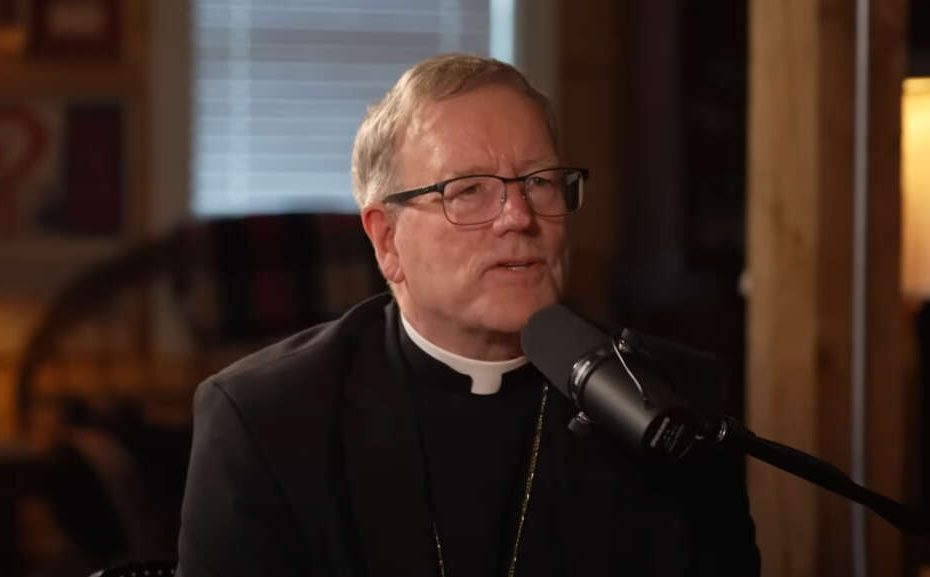
Read the full transcript of Bishop Robert Barron’s interview on The Tucker Carlson Show episode titled “the New Pope, the Foolishness of Atheism, and Why Young Men Are Turning to Christ”, premiered June 2, 2025.
The interview starts here:
The Roots of Western Unhappiness
TUCKER CARLSON: I don’t think I’ve ever received more texts about any guest than I did about you. From Catholics I know. From non-Catholics I know. But the Catholics all wanted to hear details on, you know, factions within the Church. And I’m not going to ask you any questions about that because I don’t understand any of it.
BISHOP BARRON: Good.
TUCKER CARLSON: I want to start as broad as I possibly can, which is it seems like a lot of people in the west are unhappy. And it’s measurable. Suicide rates are at record highs and birth rates are at record lows. And those are not signs of confidence in the future. Those are signs of despair. Why are people unhappy?
BISHOP BARRON: Well, they’ve lost a sense of God. I mean, God is the supreme good. And when you lose that sense of God and you collapse back in on yourself, that St. Augustine defines sin as curvatus in se. I’m caved in around myself. When you do that, you are by definition, unhappy. When you lose a sense of objective value grounded in the supreme value of God, almost again, by definition, you become unhappy.
TUCKER CARLSON: What does it mean to cave in on yourself?
The Danger of Self-Worship
BISHOP BARRON: It means that you’ve lost a sense of connection to the values that should be calling you out of yourself in an act of love. And you’ve now come to reverence your own freedom, your own autonomy. So what gives my life meaning is the fact that I’ve chosen something. I have determined my life.
If the Bible has one message, it’s that when you live your life that way, you get lost. When you deify your own Psyche, your own ego, you get lost. The joy of life comes from forgetting. In this great ecstatic act, you forget about yourself and you lose yourself in some great value. Now, that could be sports, that could be politics, whatever it is. But then the supreme value in which all the other ones participate, we call God. God is the highest good, the summum bonum. That’s why you love the Lord, your God. That’s the first commandment, right?
But when the culture’s lost that which ours is in danger of, you by definition become unhappy. You get caved in around yourself, and then you fuss around in this kind of addictive way. That’s how I would diagnose the thing.
TUCKER CARLSON: Spiritually, when you are in love with the idea of choices. I thought the whole point of the west was choices.
BISHOP BARRON: Well, but you have to know what your choice is for. When you deify choice itself. When you say autonomy, that’s my God. No, choice is for some good. And the idea is to order freedom, right? Freedom is not an end in itself. Freedom is ordered towards some good. When it’s disordered, it tends to collapse in upon itself. That’s what we got.
TUCKER CARLSON: The whole point of America, I thought, was choice and freedom for its own sake.
Ordered Freedom vs. Autonomy
BISHOP BARRON: Well, and I would argue it’s not for its own sake. And if that happens to us, something’s gone wrong. The Founding Fathers, they weren’t in the full sense of the term. It wouldn’t have the full Catholic imagination, as I would like it, but they certainly had a sense of the objective good and that the purpose of life is to find that good and be ordered toward it. An ordered freedom is what they’re interested in, not freedom for its own sake.
TUCKER CARLSON: What does ordered mean? Ordered freedom.
BISHOP BARRON: Ordered toward the good. And that’s why it has to be educated. Your freedom has to be disciplined and directed. It’s like a kid with all kinds of athletic ability. But if a coach never directs that ability toward the achievement of some good, that he can become a great tennis player, a great golfer, then the freedom begins to kind of stew on itself. No, direct freedom, direct talent, direct energy and our culture.
See, I think of this. If you have banks to a river, the river has energy, it’s going somewhere. You knock down the banks, you say, oh, I don’t want to be limited. Don’t set limits to my freedom.
TUCKER CARLSON: It just floods the fields.
BISHOP BARRON: It just opens up in this big lazy lake, and everyone’s just sort of lying on their air mattresses right now. I’ll tolerate you? Tolerate me. I won’t bother you. But then we’re not getting anywhere. The point of the banks is not to restrict me, is to direct me, see, towards some good.
Well, religion has played that role for much of our history. And in the measure that religion gets marginalized and the measure that we deify our autonomy, welcome to the unhappy world that many of the young people are living in, sadly.
TUCKER CARLSON: Deify our autonomy. So you’re speaking as if autonomy and choice are the same thing or closely related.
Theonomy vs. Autonomy
BISHOP BARRON: The goal for the Bible is not autonomy. It’s theonomy. God. Theos becomes the nomos. God becomes the law of my life. And see, here’s the trick. When God becomes the norm of my life, I become more myself. I find who I really am. If I jettison God and I say no autonomy, it’s I’m the leader of my own life. I get lost, right?
What does Jesus say? The one who loses himself will find it. The one who’s trying to hang on to himself is going to lose it.
TUCKER CARLSON: Don’t tell me what to do.
BISHOP BARRON: Throw off the rules, right? Knock down the banks and the river becomes a lazy lake. And we tolerate each other blandly, but we don’t have a common purpose.
There’s another problem. See, if you reject objective value, so you got your values, I got my values, your freedom, my freedom. Well, what connects us? In fact, we’re antagonistic to each other, right? We tend to grow into hostility, and my freedom’s against your freedom. But if together we find a common good, a common goal, now we can join forces, right?
So it’s falling in love. That’s Aristotle with the transcendent third. So, if two friends like each other, that’s fine. But Aristotle says that won’t last, that relationship. What makes it last is when the two friends together fall in love with a transcendent third, the country or philosophy or some great value. And now together, we look to that. Now we really find a bond.
Go back now to the 1950s, and Fulton Sheen, the great Catholic preacher, writes a book called “Three to Get Married,” made the same argument, right? The three are the bride, the groom and Christ. When the bride and groom together look to Christ, now they’ll stay married. If they’re just looking to each other, it’ll founder.
The Banks We’ve Demolished
TUCKER CARLSON: What are the banks that we’ve demolished?
BISHOP BARRON: Well, I would say objective value.
TUCKER CARLSON: You know…
BISHOP BARRON: The life of the mind, the moral good, religious good, aesthetic. Think of the good, the true, and the beautiful. If we subjectivize those and just relativize them, you got yours, I got mine. What you think is right, I think is wrong. When that’s lost, the banks are knocked down.
But when together we can reverence the beautiful, we can together reverence the moral good, we can together reverence the epistemological good, the intellectual good. And then together we move someplace. And see, our whole system educationally was set up classically to do just that, was to train people in what these objectivities are.
But when you subjectivize those or you see it simply as part of an oppressive or patriarchal system, you know, why do we read Shakespeare? He’s just an old patriarch, see? But that’s a very dangerous game to play. Now we’ve lost the common mooring, and then we devolve into this sort of self-regarding autonomy.
TUCKER CARLSON: So, I mean, Christianity is probably not the… I don’t think it’s the only religion to make this point. But self is the trap.
The Self as a Black Hole
BISHOP BARRON: Yeah, yeah. See, think of the self here. The ego is like a black hole. A black hole that will draw everything into itself, sucks all of life and light and energy into itself. Nothing can escape the curvatus inse ego, right, becomes a black hole.
And I’ve known people like that. I’m sure you have, too. Oh, yeah, you’re with them. They’ll draw everything into themselves. The best people are those who breathe life into a room. And that happens because they’re not preoccupied with the ego. They’re captivated by some objective good, and they want to show it to you.
Think of some great coaches I had as a kid that wanted to show me the various games I learned to play baseball. We had a coach when I was a little guy, 7, 8 years old, and he said, all right, guys, I want you to get down on your hands and knees on the field. I want you to feel the infield, and I want you to smell the grass. And it was such a good move. He was trying to get us in. Look at this great game we’re playing here. He also practically, if you’re playing shortstop, you can’t be afraid of the ground. You got to get down to the ground.
TUCKER CARLSON: Exactly.
BISHOP BARRON: So, all right, boys, get down there. Well, he was someone in love with baseball and then was communicating to us that same love. So together we’d fall in love with the transcendent third, which is baseball. That’s going to bring a team together. Right. That’s what great teachers and coaches and mentors and spiritual directors do. They help people fall in love with the same values they fall in love with.
TUCKER CARLSON: Fall in love with something bigger than themselves, you know, other people, nature, God, and…
The Ego Drama vs. The Theo Drama
BISHOP BARRON: Look at even that. Fall in love. Right. You’re not in control. You’ve let go of your own ego drama. I love that language from Hans Urs von Baltasar, one of my favorite theologians from the last century. John Paul loved him and Benedict loved him. He talked about the ego drama, which is a drama that I’m starring in. I’m producing it, I’m directing it. Right.
TUCKER CARLSON: And you’re all actors in my play.
BISHOP BARRON: Yes, you’re all actors in my play. And I’m going to take it on the road eventually somewhere else. Well, that’s a very boring thing. What’s exciting, he said, was the Theo drama, which is now God’s writing a drama. God’s producing a drama. He’s got a role for you, and he’s trying to draw you into playing that role. And it might not be the role at all that you envisioned for yourself. So what? But he’s calling you into it. That’s going to be an exciting life, a Theo-dramatic life, a theonymous life, not an autonomous life.
TUCKER CARLSON: Wow, that’s vivid. So what’s the daily practice for someone to move beyond himself to get out of lake Me?
Daily Practices to Transcend Self
BISHOP BARRON: Fall in love with objective value. Find mentors that can really help you enter that world. Like in my own life, I’ve loved that. I’m no great… I play the guitar poorly, but I love classical music, and I had mentors early on that said “Let me play you Beethoven’s seventh Symphony. Let me just play it for you and then talk about it.” I remember the Queen of the Night aria, the famous Mozart aria where the woman is singing these impossibly high notes. I remember teachers saying, “Listen. Listen to this.” Someone that would draw me into that world. Like my coach drawing me into baseball.
Now, put it in religious context. Prayer. People that taught me how to pray when I was a young guy. Okay, say my prayers. No, but prayer is a conscious exercise in overcoming autonomy. It’s a conscious exercise to say, I want to get out of my preoccupations. I’m placing myself in the presence of God. I’m using language of the psalms and so on. I’m using song, I’m using silence, using the rosary, whatever it is, all of it’s designed to get me up out of myself and into the space of God. So prayer is a way, you know, to overcome.
TUCKER CARLSON: How do you pray? You said you were taught to pray.
BISHOP BARRON: I was indeed, very early on, when I was about my early 20s, before I was a priest. But I got into what we call the liturgy of the hours in the Catholic Church, which is this daily prayer at certain points during the day, imitating, by the way, the seven times you pray in the Bible. You know, seven times a day you stop to pray.
So the hours, psalms, canticles, biblical, the Bible tells the Old Testament and the passage about seven times I stopped to pray. And so the early church imitated that in the rhythm of the monastic life. And the liturgy of the hours would be kind of a monastic life for non-monks, people like you and me. But you use the psalms, the canticles, the readings, the church fathers. And I was taught that prayer early on, and at times I found it tiresome or difficult to do. Now it’s like water in the desert.
When I was a young guy, we didn’t pray the rosary. The rosary was seen as kind of something your grandmother did. My generation didn’t spontaneously pray it, but then I learned it later in life, and that too is like a lifeline to me.
What is the Rosary?
TUCKER CARLSON: What is the rosary?
BISHOP BARRON: Well, it’s this collection. I have it on me. It’s a collection of Hail Marys, Our Fathers, Glory Bes in a rope, and you count your way through the beads. And it takes about 20 or 25 minutes. It’s a meditative prayer as you’re praying the Hail Marys, meditating upon the mysteries of Jesus’ life and Mary’s life.
It doesn’t get you anywhere. You start here and you end up exactly where you started. So it’s not effective in that way. It’s a meditative prayer. I remember I was giving a retreat to the priests of Dublin many years ago. These were mostly older men, been through the wars, you know, most of them. And they invited me to come. They said, we’re going to pray the rosary tonight. And all these Irish guys: “Hail Mary, full of grace. Hail Mary, full of grace. Hail Mary…” What is going on?
But what became clear to me was, well, it’s like a mantra. They were producing this kind of meditative mantra. They finished it in about seven minutes. You know, it usually takes 25, but that’s…
TUCKER CARLSON: They don’t pronounce all the sounds though.
BISHOP BARRON: No, they’re kind of… See, think of it. The Buddhists talk about the calming of the monkey mind. That’s the mind that’s always leaping from branch to branch. The mind that gets you through the day, do this, got to do that. But to really pray, you have to calm that mind down.
The church has often used these means to do that, to calm that mind, to open up to a deeper consciousness or a deeper awareness. And prayer is that. Thomas Merton said, prayer is finding the place in you where you are here and now being created by God. Which I think is a great definition of prayer.
So right now you and I are being created by God, but we’re rarely aware of that. We go through our day, you know, the monkey mind, and we’re doing this. Yes, but at certain points you say, okay, I’m going to calm the monkey mind. I’m going to open up a deeper door, and I’m going to commune with the God who’s here and now creating me. That’s prayer. And then there’s all kinds of disciplines around that.
Understanding Prayer
TUCKER CARLSON: I think many people think of prayer as a list of requests, and that’s okay.
BISHOP BARRON: I mean, petitionary prayer is good. John Paul II, toward the end of his life, you know, he said, I know different types of prayer, but I found the longer I live that all prayer is basically a petition. And there’s something really right about that, that no matter how kind of high and elevated your prayer is, at bottom you’re saying, you know, Lord Jesus Christ, have pity on me, or Lord help me. I find it as I pray. That’s the phrase. Help me, help me, Lord. That’s fine. I have no problem with that. That’s a very deep and powerful prayer.
TUCKER CARLSON: How do you keep your mind from wandering during prayer?
BISHOP BARRON: Yeah, read the masters, they recognize that forever. The desert fathers knew all about that distraction in prayer. And of course, the devil loves that too. He loves to distract us in prayer.
The best advice, someone like John of the Cross, our greatest spiritual master, would be acknowledge the distraction. Don’t try to fight it. Acknowledge it and then go back. If it comes again, acknowledge it. I see you. And go back. Don’t try to fight it or don’t try techniques to avoid it completely. A distraction comes, see it and then return. Let go of it.
Seeing God in the World
TUCKER CARLSON: I’ve noticed in the past few years people I know who are secular or have always been suddenly talking about the existence of evil in the world. I think it’s very clear to non-religious people even that there’s some kind of supernatural force of darkness at foot in the world. I don’t think you really need to make that case anymore that that’s real. How do you see God in the world? Because if you spend your life, you know, staring at evil, probably not productive.
BISHOP BARRON: No. Well, the world is charged with the grandeur of God. That’s Gerard Manley Hopkins’ great poem. And I think that’s right if you have the eyes to see. And prayer disciplines that. Prayer makes that possible. The world is charged with the grandeur of God, meaning everything that exists. Because being and good are convertible terms. That’s something from Thomas Aquinas that I think you can…
TUCKER CARLSON: Being and good are convertible terms.
BISHOP BARRON: In other words, to be is to be good, period. Whatever is, is good. Evil is, Aquinas would call it a privatio, a privation of the good. Evil is a cavity, it’s a lack. Right? But whatever is, is good.
So, for example, take the devil as an example. Is the devil good? Sure, of course. In the measure the devil exists, has a mind, has a will, all that is good. What’s evil about the devil is the corruption of mind and will and power. That’s why, like Satan in Dante, this highest of angels, full of goodness. God doesn’t make anything that’s not good, but it’s become corrupt.
So the trick there is always to focus on the good. Because being and good are convertible terms. Whatever is, is good. Think of the mystics who talk about, you see, like a little bug crawling across this table. That’s an avenue toward God. Because if you look at this little tiny bug, let’s say. But the more you look at it, I mean, incredible complexity and richness and density of its being. And of course, it speaks to you of the creator of all things, whose very nature is to be.
So all being reflects God. And if you have the eyes to see, that’s what the great saints have. They see that all the time. We sinners tend to focus a lot on the lack. Right. We focus on the cavity, not the tooth. The idea is, look at the tooth. Always acknowledging the cavities because there are plenty of them. But the focus should be on being, being good are convertible terms.
TUCKER CARLSON: I may be too shallow for Catholic theology, but I love what you’re saying.
BISHOP BARRON: Yeah, that’s as old as being and…
TUCKER CARLSON: Good are convertible terms.
BISHOP BARRON: They talk about the transcendental properties of being, which means wherever there is. So here’s glass. It’s good, it’s true, and it’s beautiful. Now, why is it good? Well, because it corresponds to the will in some ways. There’s, you know… I want to study this glass. It’s interesting and look at the beauty of it. It’s true because it corresponds in its intelligibility to an inquiring mind. The mind wants to understand that thing. What is that thing? It’s beautiful because it’s radiant.
You know, go back to like James Joyce, the famous scene in the Portrait of the Artist, when he sees the woman, eventually would marry Nora Barnacle. And he sees her out on the strand and he has this rapturous description of her, remember? And at the end of it, he says, “Oh, heavenly God.” And that’s the way it works. Is the beautiful. This particular girl he sees out in the surf. But she speaks to him of God. So that’s why whatever is, is good. It’s true and it’s beautiful. Those are all convertible terms.
Evil and Grace
TUCKER CARLSON: It seems like the threat, maybe the satanic threat, is distraction.
BISHOP BARRON: Yeah, I think that’s absolutely right that we focus so much on the lack. It’s like you’re sucking on an aching tooth. You’re focused on the lack. But see, you know, St. Paul says where sin abounds, grace abounds the more. And that’s not just a nice, like, Hallmark card sentiment. That’s a metaphysical truth. Wherever there’s sin, sure, sin everywhere. But grace is always greater. It has to be, because sin is a cavity.
You know, in Tolkien. Remember when the Nazguls are these flying demons that are threatening the battlefield and all this. But then when they finally conquer them, what they discover, they’re nothing. They’re a cloak that covers nothing. And it’s because evil is a type of non-being. And so it puts on a big show. It puts this big cloak over itself. But what it is is just a lack. It’s a cavity.
That’s why if sin is abounding, sure, sin abounds in our world, but grace abounds the more. The gates of hell will not prevail against church. They can’t. In a way, they can’t. And we should have that confidence. Christians should never be cowed by evil. We acknowledge it. But the great saints aren’t cowed by evil because evil is a lack. It’s a cavity. It’s a Nazgul, it’s a non-being.
TUCKER CARLSON: Where do you see grace?
BISHOP BARRON: Bob Dylan is one of my great heroes. “Look around this whole world and all that I’m finding is the saving grace that’s over me.” That’s Bob Dylan after he became a Christian. Grace is being. Grace is what’s real. “Tout est grâce.” That’s a line from Bernanos, the great French Catholic novelist. “Tout est grâce.” Everything’s grace. Everything’s grace. Because of that principle, whatever is is good. Whatever is, is true and beautiful. Whatever is reflects the one whose name is to be.
Right. When Moses asked God, what’s your name? And God says, “I am who I am.” Right. Well, our tradition reads that as I’m not contingent, evanescent being, I’m the one whose very nature is to be. So therefore, whatever is is reflective of God. That’s where you find grace, I think so.
Modern Distractions
TUCKER CARLSON: If you could distract people sufficient that they never had the time or the inclination to notice things that are real, you would trap them in a kind of hell.
BISHOP BARRON: Yeah. Yes. But that’s exactly what happens, isn’t it? Now, psychodynamically is when we focus on all this kind of lack and anxiety and frustration within us, it is a kind of preoccupation with what’s not real. That’s true. I’m not denying the psychological reality of suffering. But metaphysically speaking, evil is a type of non-being. And if I’m focused on that, then I’m going to get myself in knots.
TUCKER CARLSON: I was thinking more of the iPhone, which when I use it, cuts me off completely from other people, from the world around me, from nature, from myself.
BISHOP BARRON: Yes, and believe me, I mean, we’re all addicted to it. Those machines were designed to be addictive. They worked. During Lent, this past Lent, I did a resolution for the first time that one day I put the phone away and I did it. And it was a little bit of a struggle, but not terrible. And I thought, that’s a good thing.
When we bring our guys now into priesthood studies, we always call the propaedeutic year this year of kind of preparation before the formal study begins. And the thing that all the guys say they like best about it is they take their cell phones away. So for the entire year, I think once a week, you can check it for emergencies or something, or someone’s got access to it in case of emergency, but they take the phones away from the guys. Great move.
TUCKER CARLSON: And what happens to them?
BISHOP BARRON: What happens? They all feel liberated. They all come back saying, it was the best year of my life. And I read books again and I talked to people. I cultivated friendship, I played games, I played sports, you know, and it’s exactly this principle I wasn’t look at, that’s almost an illustration of Augustus Corvatus and say that I’m caved in over my iPhone. Right? That’s what it looks like.
TUCKER CARLSON: Do you think that that’s driving some of the disassociation and agony that we see around us?
The Impact of Screen Time on Mental Health
BISHOP BARRON: Yeah, it’s not helping at all. Jean Twenge is a psychologist from San Diego that I read a lot. And she has a book called iGen about the generation that came of age totally with the iPhones and iPads and stuff. And she said there’s a direct correlation between screen time and depression, which I find perfectly plausible.
Leonard Sacks, you know, the great psychologist, also a physician dealing with young people now for decades. Same thing he says, the correlation between screen time and look how unhealthy it’s making our young kids. When I was a little kid, we were all skinny. We all were, all my friends and I, because we were outside from 8 o’clock in the morning until 8 o’clock at night in the summertime, playing games, running around, shooting hoops on a bike, you know, and way too many kids now are hunched over their iPhones. And then it invites you into such a world of meanness and competition and look at my picture’s better than yours. And those people have seen so much happier than I am. No, I think taking those things out of the hands of our kids would be a great idea, at least to some degree.
Daily Spiritual Discipline
TUCKER CARLSON: How do you force yourself to notice things beyond yourself? Like, what is your actual discipline? Like, you wake up. How do you keep God ever present in mind and yourself at bay?
BISHOP BARRON: Well, my first move is the holy hour. So I learned that from Fulton Sheen, taught now a couple generations to do every day an hour of uninterrupted prayer in the presence of the Blessed Sacrament. As a Catholic, I have the Blessed Sacrament in my house. So first thing I do in the morning, I get a cup of coffee and I go up to my chapel and I will sit in front of the Blessed Sacrament for an hour and I’ll pray my office as part of it, often pray the rosary or other things.
TUCKER CARLSON: Pardon, again, my ignorance. What’s your office?
BISHOP BARRON: Yeah, that’s the liturgy of the hours. What I was describing earlier, psalms and canticles and readings that priests pray.
TUCKER CARLSON: Do you read them as you pray them?
BISHOP BARRON: Yeah. So I’ll have the book and I’ll read the psalm, then usually then spend some time meditating and then do the next one, you know, and then I might, let’s say between the office of readings, which has to do with the church fathers, I read something from the church fathers and usually from the Bible. Maybe between that and morning prayer, I’ll do the rosary and I might do another form of prayer between morning prayer and midday prayer. So I’ll work my way through the office, the liturgy of the hours, but my main task is to sit in the presence of the Blessed Sacrament. And one of the great lines this goes back to.
TUCKER CARLSON: And what time is this in the morning?
BISHOP BARRON: I wake up about 5:30. So like between 5:30 and 6:30.
TUCKER CARLSON: Do you text like 11 people first before you do this?
BISHOP BARRON: No, no, no, no. I leave the phone in my bedroom. So I always leave the phone while I’m praying. I don’t have that because that’s an immediate distraction and that’s the last thing you want when you’re trying to pray in a concentrated way.
And then, you know, some of that too is petitionary prayer. I’m a bishop, so people are always, hey, Bishop, would you pray for me or my son’s having a hard time. So I try to conjure as best I can the memory of these various people that asked me to pray for them. I’ll pray for my, you know, parents and family members who’ve died. And, you know, so it’s just giving yourself the leisure. You have a full hour where you can bring all this before the Lord.
TUCKER CARLSON: But when you pray for someone who’s died, what do you pray?
BISHOP BARRON: I pray they might find peace and rest. I pray the Lord might be kind and good to them. I pray all the time for people who have died. Because you’re aware of it when you’re in pastoral ministry. Some people who’ve died, they’re not formally canonized by the church, but kind of in an informal way. I think of them as being already in the presence of God, and I’ll pray for their intercession. Cardinal George of Chicago was a great mentor to me, and I’m often linked to him in prayer.
TUCKER CARLSON: Meaning you pray for him.
BISHOP BARRON: Pray for him. But also I pray to him not with the complete confidence I would praying to a saint canonized by the church, but with a kind of practical confidence. I knew him very well, and I asked for his help.
TUCKER CARLSON: When you pray, do you hear back?
BISHOP BARRON: Not in the, you know, physical sense, but, yeah, you get, I’d say, a sense. You have a sense of connection. I put it that way. Sometimes in prayer, you get a very intense feeling. The Irish talk about thin places, you know, where the veil between this world next becomes very thin. I find there are kind of thin moments like that where there’s a moment when you feel the other world impinging on yours.
TUCKER CARLSON: What kind of feeling is that?
Experiencing the Divine
BISHOP BARRON: Peace, I would say, you know, harmony. The disharmony, the difficulty of this life kind of resolves into a higher harmony. Something like that.
See, you know what’s interesting to me, Tucker, is the world that we’re in. Looking around at this, you know, interesting, beautiful place right now, and good in the world of nature. Driving up here, seeing the nature around me. Beautiful, beautiful. But, like, is that it? Is that it? To me, it seems so unlikely that the world that the sensorium of these advanced apes can take in is all there is to reality. What my little eyes can see, you know, they see a narrow range of the color spectrum, and that’s it. I think that’s so wildly unlikely. Just the fecundity and variety of being that we experience through our senses. I think beyond our senses, there’s a world of even more extraordinary fecundity and richness. And I think there are times when we sense it, we get in touch with it.
Look, Plato knew that. Plato knew. He talked about stepping out of the cave, right? And the first step out of the cave. The cave is where the flickering shadows on the wall, it means the world of our ordinary experience. Yes, I’m here with you right now. In a few hours I’ll be gone somewhere else and other images will be flickering past my sensorium. Okay? That’s what this life is like.
But Plato thought the first step out of the cave was mathematics, which is very interesting because when you understand two plus three equals five, you’ve stepped out of this world in a very real way. I can see, oh, here are two things. But when you grasp the principle two plus three equals five, you’re not in the world of ordinary experience anymore. You’re in a world now of eternity, of immateriality. A world that doesn’t change, that can’t change even in principle. Well, there’s nothing like that in this world.
Well, Plato knew that. When you grasp the quadratic equation or something, you’re not dealing with a physical reality that has color or shape or size or nothing that’s evanescent or mutable. You’ve reached a higher plane of existence. Even mathematics does that to us. A fortiori. Now philosophy, and then even more so religion are opening you to higher and higher expressions of reality.
On Evolution and Creation
TUCKER CARLSON: I don’t think you’re fully on board with Darwinism. I’m getting that sense.
BISHOP BARRON: Well, there are a couple ways to look at that. I mean, there’s a big debate going on right now in the world of evolutionary biologists about Darwin and neo-Darwinism and questions raised about it. I mean, in a way, I’m happy to leave that debate to them. I mean, because that’s talking about how do life forms develop over time and given genetic variation and natural selection. Okay, fine, I’ll let the experts debate that. Yes, that in itself is not really a theologically relevant concern. I’ll leave that to them.
TUCKER CARLSON: I agree.
BISHOP BARRON: But see, here’s the thing. Creation in the theological sense has little to do with that. That’s all about development of biological forms, okay? Creation is much more dramatic. Creation names the relationship that obtains between unconditioned being and conditioned being. Or to put that in more regular language, between God and the world.
So, I mean, like right now, here, you and I are, sitting here in this table, in this room, is entirely conditioned form of existence. By which I mean, it is, but it doesn’t have to be. I could have missed the ride up here today. You could have gotten sick. This thing could have fallen on the table. It could be a thousand degrees and we’d be incinerated. It could be a thousand degrees below zero. We’d be frozen like. There are a million things that make this set of affairs real. But it doesn’t have to be. It doesn’t have to be the case.
So how do you explain that? Well, you can’t appeal endlessly to other contingent things. You have to come finally to some reality whose very nature is to be that’s not contingent, not finite, not evanescent, not dependent. But whose very nature is to be.
TUCKER CARLSON: I am.
BISHOP BARRON: Right. Now go back to Moses. What’s your name? See, Moses was asking a very sensible question for this worldly perspective. So. Hey, what kind of glass is that? You know, how tall is that glass? What kind of table is this? A nice table. What kind of table is it? So you’re a God, obviously. You know, you seem to know a lot about me and you’re. So which one are you? Are you the God of the mountain? Are you the God of the place? Are you a God of these people? Who are you? Which one are you? What’s your name?
So when God says, I am who I am, he’s saying dumb question. That is not the right question to ask here. Because I’m not a conditioned state of affairs. I’m not a being among many. My name is. I am. I am who I am. Right? My nature is to be. Well, now we’re talking about the Creator. See, the Creator is the one who is here and now undergirding all the finite reality.
Who is right? Now this is a great line from Herbert McKay, the theologian. He’s singing the world into being the way an opera singer sustains a song. God, the ground of being, is singing this finite world into being. That’s creation, see? So now within creation, I can talk all day about the Darwinists and how this life form developed into that life form, and I’ll let them debate that. But the religious question remains, no matter what you say about that. The religious question is about why is there something rather than nothing, Right? Exactly. Why should there be a finite conditioned world at all? You can’t explain it by appealing endlessly to other forms of conditioned existence. You can’t. That’s the mistake of materialism.
TUCKER CARLSON: So the questions end at a certain point and there’s an answer. So the question is, well, who created the Creator? And the answer is nobody. The Creator is right.
BISHOP BARRON: And if you ask that question, it means you haven’t grasped the solution. If you say who created the Creator? Well, then you haven’t grasped. No, the argument leads towards something that doesn’t need to be created, that can’t be created, whose very nature is to be, and who therefore is eternal. We say outside of time, immaterial, outside of space, right? So all the finite things that or the characteristics of finite reality can’t apply to that, that reality. That’s why we say God’s eternal or why he’s immaterial and so on. Immutable. That means nothing that characterizes finite things should characterize him.
On New Atheism
TUCKER CARLSON: What do you think of the new atheists?
BISHOP BARRON: I don’t like them. No, look, I, I, my ministry Word on Fire emerged around that time. So right around the year 2000, the new atheists emerge after September 11, which is not surprising because September 11 stirred to life again this old kind of enlightenment idea. Religion is irrational, therefore it’s violent. Because they can’t settle things through argument. They have to settle them through bombs and guns.
TUCKER CARLSON: Exactly right.
The Foolishness of Atheism
BISHOP BARRON: So that’s an old argument. Goes back to the 17th century. It was revived massively after September 11. The New Atheists, I think, rode that wave in a big way. Now, they were gifted rhetoricians, especially Hitchens, right? I admired Hitchens. I read Hitchens, always with great pleasure. Dawkins, less so. Sam Harris, I think, has, you know, rhetorical gifts. But their arguments there’s nothing new about them. They were old hat. They’re borrowed from Marx and from Freud and from Feuerbach especially. So nothing new at the intellectual level. They were new in their nastiness.
So the classical atheists think Feuerbach, Marx, Freud, you got the sense they knew they were dealing with a formidable opponent when they were fighting religion. The new atheist, it was like they were dealing with an idiot child, you know. And so that’s what was so annoying about them, I thought. And their arguments were pretty bad. And they were, you know, so aggressive toward religion.
They did a great service, though, I’ll say this. They awakened the Christian churches in many ways. The apologetic weapons that we threw away 40 years ago, we were compelled to pick up again. So a lot of us got into the game to kind of battle the new atheists and to draw upon the very rich intellectual tradition, especially of Catholicism. So in that way, they did a service to us, you know.
And also I wrote a paper on this one. I called it Thomas Aquinas and why the new atheists are right, because the new atheists, see, they make this mistake we were just talking about. They will construe God as some kind of big being. And okay, is there this big being or not? Some say there is, some say there isn’t. So it’s like Bigfoot, you know, Some say there is a Bigfoot. There isn’t a Bigfoot. Let’s go look around for evidence and find out. Well, you’ll never find God that way. God isn’t a being. God isn’t a thing in the world. Right? He’s the reason why there’s a world at all. Therefore you’re not going to find him in the world. Therefore you can’t say things like, oh, there’s no evidence for God, as though he’s like he’s a chemical reaction.
TUCKER CARLSON: He’s a yeti.
BISHOP BARRON: Yeah, right. He’s not like that. You have to ask a whole different set of questions, and that’s what the new atheists did. Like what?
TUCKER CARLSON: What were the questions?
BISHOP BARRON: Like why is there something rather nothing, like why should contingent being exist at all? How do you explain the to be of something whose nature is not to be? Namely you and me and everything around us? I am, for sure. But my nature is not to be. I could think myself out of being in a second. There’s nothing necessary about me. Well, how do you explain that? How do you explain that?
Now you say, oh, it’s all matter and energy. It’ll never work. Why? Because matter is always matter under these conditions, matter in this size, matter at this energy, matter at this speed, matter of this color. How did it get there? Why is it this rather than that? See, you can’t answer that question, the really cool, interesting question, by appealing to something within the contingent world. You have to go outside the contingent world. And again, don’t think of that spatially. The minute you go, oh, yeah, God must be that other up out there someplace. No, he made him a big being. You have to go outside in the metaphysical sense, to a reality which indeed contains all of that, but is in no way contained by it. Now we’re talking. And that, to me is the really interesting question.
God’s Immanence and Transcendence
TUCKER CARLSON: It also suggests that God’s like right here, right now, always.
BISHOP BARRON: Well, he is, and here’s the interesting thing. And all the mystics and theologians around to this. So is God in this room? No, absolutely not. Because this room is just full of contingent things like you and me and the shelves and the books and. No, no, God. God’s nothing in this. I can’t point. Oh, there he is. God’s in this room. God’s nowhere in this room. Is God in this room? Yes, he’s everywhere in this room. Because this room wouldn’t exist unless God were singing it into being.
And so God is at the same time as transcendent as you can imagine. Not a thing in the world, and as imminent as you can imagine. It was the great Augustine who said, God is at the same time superior, summo meo et interior intimo meo, which means he’s higher than anything I could imagine, and he’s closer to me than I am to myself. Now figure that one out. Now you understand the God whose nature is to be, he’s transcendent. I can’t grasp him. And he’s so imminent, I can’t hide from Him. See?
And that’s the space opened up by the Bible, I think. So what’s the solution, you might ask. The solution is fall in love with God. Falling in love is not grasping. It’s not hiding from. And can we read the Bible as God trying to draw his people into that space? I want you to fall in love with me. I don’t want you grasping at me. That’s idolatry. I don’t want you hiding from me. That’s secularism. I want you falling in love with me. And that’s the right reaction to the God.
TUCKER CARLSON: You’re defining secularism as hiding from God?
BISHOP BARRON: Yeah, as an ideology. If you were to say all that there is is the secular world, right? As a materialism or immanentism or scientism in the political sense. Secularism, meaning all that there is is the world that I can see and measure and so on. That’s hiding from God. That’s saying, I’m not worried about God. God doesn’t impinge upon me. That’s the buffered self. Charles Taylor, the philosopher, calls it that. I’m buffered from any contact with the transcendent. That’s an attempt to hide from God. Doesn’t work. And see, what I think, Tucker, is really interesting is the fact that religion is experiencing a revival even as we speak.
TUCKER CARLSON: You feel that?
BISHOP BARRON: Oh yeah, I can measure it. It’s been measured statistically because you can’t hide from God all day and you can’t grasp it. That’s idolatry. Idolatry is attempt to manipulate God. And the Bible knows. Knows all about that from page one. Page one. The Bible knows about manipulating God.
Idolatry and Manipulation of God
TUCKER CARLSON: Tell me what you mean by that. Manipulative.
BISHOP BARRON: Let’s see, the original sin is to say, I’m not going to obey God’s law. I’m going to make. I’m my own law. I’m going to grasp the tree of the knowledge of good and evil is I’m going to make my own freedom. As we were saying a few minutes ago, my own freedom becomes my God. That’s a type of idolatry. Or I turn pleasure, money, sex, power into my supreme good. That’s idolatry to me.
The great biblical story there is Elijah and the priest of Baal, remember in the first book of Kings. So Elijah’s the one left, not only one priest of Yahweh, but there’s all these priests of Baal, by the way. So it always goes, right? There’s always a lot of avatars and false gods. They’re all over the place. They’re thick on the ground. They’re all over. And now let’s. You erect altars to your God, I’ll erect one to mine. And let’s see who responds, right?
So the priests of Baal erect the altars and then they start begging and they end up cajoling and pleading and they’re frustrated as God’s not answering. Their gods aren’t sending fire. And Elijah mocks them, which I think is a great part of that story. He publicly mocks them. You know, who knows, maybe your gods are napping or maybe they’re in the bathroom. I don’t know where they are, right?
And then they finally end up. It’s a beautiful detail. They end up slashing themselves with knives. They’re trying to get the gods to respond. It’s a beautiful image of what happens to us in idolatry. We end up harming ourselves, right? In a frenzied attempt to get gods to answer, who can never in principle answer. Now think of someone addicted to power, sex, money, pleasure, whatever it is. And I’m begging, begging, begging. You will satisfy me. It won’t, because it can’t. And I’ll end up harming myself.
Then Elijah calls upon the true God. The fire comes, destroys, takes the sacrifice. It’s not just a jingoistic story, it’s a very powerful story that the true God is the only one that can satisfy the longing of the heart, right? And so idolatry will always lead us down this self destructive path. And the worship of the true God is what’s going to lead us to the fire falling on us.
Why God Requires Sacrifice
TUCKER CARLSON: Why does God require sacrifice?
BISHOP BARRON: He doesn’t require it. And that’s a super important point. The Bible and the great tradition make it over and over again. How could the one who made the entire universe from nothing possibly need anything from it? Right. It’s just a logical contradiction. Like the ancient gods of Greece. Sure, they need all kinds of stuff. Remember that scene, it’s in the Odyssey, I think, you know, where as the sacrifices are being made and the gods are like desperately lapping up the blood of the sacrifice because they need our loyalty and so on.
The Bible, Psalm 50. You think I need to drink the blood of goats? Are you joking? All the animals in the field, they all belong to me. But that’s a very important point because it’s not that we’re playing some game of like codependency with God. God needs nothing. That’s the best news ever. God needs nothing from us. What he wants is the openness of heart signaled by the sacrifice because he wants us to be alive. And when we say, lord, I’m opening my heart to you, I’m ordering my life to you. In this great sacrifice of praise, God delights. Because now we’re going to find the joy he wants us to have.
That’s St. Irenaeus, my great intellectual hero. The glory of God as a human being, fully alive. See, the glory of God is not putting us down. And boy, they finally got around honoring me sufficiently. So that’s all paganism. But it haunts the Christian mind still. It haunts our minds. But the Bible is always trying to dismiss that demon. God wants our sacrifice because it’s good for us. God gets nothing out of it. Think of bounces off of the rock of the divine self sufficiency and comes back to our benefit.
So when I pray to God or I offer the sacrifice of the mass to God, I’m not giving God anything he needs. God needs nothing. But it bounces off of that self sufficiency to me. It redounds to my benefit. So go into the Catholic Mass. We offer the sacrifice of Jesus to the Father. We represent the sacrifice of the cross to the Father. Oh, because the Father needs it. The Father needs nice. But it bounces off of the Father’s self sufficiency and comes back as food for us. So now we eat the body and drink the blood of Jesus. We consume the sacrifice. It’s for our benefit, not for God’s. But your question is really a good one because it leads us into that very important spiritual space.
Christianity’s Truth and Opposition
TUCKER CARLSON: One of the reasons I think Christianity is true is because so many people hate it.
BISHOP BARRON: Yeah.
TUCKER CARLSON: And Jesus is really the great dividing, the great divider. Yeah, and like, why would you be mad at Jesus or Christianity when it’s like a non violent religion that teaches.
BISHOP BARRON: People to love each other?
TUCKER CARLSON: If you’re mad at that, it says something about how real it is. I think I agree.
BISHOP BARRON: Both Billy Graham and Fulton Sheen, I mean, arguably the two greatest evangelists of the 20th century said the same thing, which was the objection to God is rarely truly intellectual. It’s a moral objection.
TUCKER CARLSON: Totally.
The Moral Demand of God
BISHOP BARRON: The moral demand of God becomes too great. See, Jesus, if he’s one spiritual figure among many, he’s a great teacher, like the Buddha, he’s like Muhammad, he’s like Confucius. Well then I can kind of handle him. I can put him in a corner and say, okay, that’s interesting, I’ll abide by some of that. And I also like what the Sufi mystics say. And I also like what Moses says here. But see, Jesus as C.S. Lewis saw so perfectly, is qualitatively different than that. And that’s why he’s a problem. Because if he is who he says he is, not just one teacher that I can listen to, but he’s God from God, light from light, true God from true God, begotten, not made consubstantial with the Father, as we say every…
TUCKER CARLSON: Week of the Creed, through Him all things were made.
BISHOP BARRON: Yeah, if that’s who he is, well, the game’s over.
TUCKER CARLSON: But why does it make people mad? I mean, one of the late life revelations in my life has been that these great spasms of violence, these revolutions that we studied, French Revolution, Spanish Civil war, Bolshevik Revolution, 1917, huge parts of World War II were anti-Christian. Absolutely. The point was to murder Christians.
BISHOP BARRON: Absolutely.
TUCKER CARLSON: But it’s not recorded that way.
Jesus as a Sign of Contradiction
BISHOP BARRON: Yeah, but that’s true. Jesus, he’s a problem because of who he says he is. But also we’re sinners. And so sinners don’t want to get out of their sinful patterns. We’re way too comfortable. It’s like the Israelites that want to go back to Egypt. Right. They’re on their way to liberation. But oh boy, did we love the flesh pots of Egypt. At least we had cucumbers. Right? It’s my favorite part. But see, that’s the story of every sinner. Every sin is a type of addiction you’re addicted to. That’s the priest of Baal.
And so as I’m trying to move toward conversion, I’m moving across the painful desert, right on the way to the promised land. I’m always hankering for Egypt. And so Jesus is a constant reproach, a constant challenge. No, no, you know, so of course I’m going to resist him.
Look at, you know, the very fact. I think this is very interesting. Muhammad dies in his bed full of years. The Buddha dies in his bed full of years surrounded by his disciples. Confucius, the same thing. Moses dies at the age of 120 or something, you know, and then there’s Jesus who dies 30 years old, naked, pinned to a desperate instrument of torture. His disciples having abandoned him, his enemies mocking him. That’s how he dies. Now what does it tell you? It tells you there’s something about him.
TUCKER CARLSON: Well, who’s right that by the way, if I, if I’m trying to create a new religion.
BISHOP BARRON: No way. You’re right.
TUCKER CARLSON: He is not the hero I’m creating.
BISHOP BARRON: No, but it’s a sign. He’s a sign of contradiction. He’s the one that, that’s the way the world is going to react to him. Now what’s the good news? The good news is having endured all of that, he returns. And I always think of this, you know, if we were Hollywood telling the story, you never heard the Jesus story, but here’s this guy with this horrible thing and these people betrayed him and denied him and they crucified him. And now he’s back, he’d be back with a machine gun. I’m back for vengeance. He’s back with shalom, a word of peace.
As the way I put it in Christianity is this. We killed God and God returned in forgiving love. And that’s why, as Paul said. Right. I’m certain neither death, nor life, nor angels, nor principalities, nor height, nor depth, nor anything else could ever separate us from love of God. How does Paul know that? Because we killed God and God return in forgiving love. That’s salvation. That’s the word of grace, if you want. That’s the good news. That’s what they went careering around the world to their deaths proclaiming was that, you know, Paul, I preach one thing, Christ and him crucified. Because that’s the message is we killed him, God raised them up and he returned in forgiving love. You know, that’s the good news.
Christian Persecution
TUCKER CARLSON: Do you think that Christian persecution is on the rise?
BISHOP BARRON: Oh, I know it is. It’s documented. 20th century was the worst century for Christian martyrs of all of Christian history. All the previous centuries combined. There were more martyrs in the 20th century than any other time. We think about the early church, they were all being persecuted far greater the 20th century. Now around the world, we are by far the most persecuted religion. Absolutely. And it’s a crime, it’s an outrage. And we talk about, in a kind of demure way about religious liberty in our country, which is indeed under threat. But you want the real threat to religious liberty. It’s in different parts of the world people are being killed for their Christian faith.
TUCKER CARLSON: So why is that fact suppressed? That is intentionally suppressed. Again, I was like 45 before I realized the Bolshevik Revolution was aimed at Christians. I don’t know why I didn’t get that, but I didn’t.
BISHOP BARRON: Yeah. I have to ask the keepers of the flame culturally, but it’s simply the case today. I mean, it’s the most persecuted religion. You know, we can look at things from different angles, I suppose. One tragedy, let’s say the 20th century, you have World War I and World War II. Yes. There are anti-Christian elements, to be sure. I mean Hitler is deeply anti-Christian. But you also had French Christians killing German Christians killing Canadian Christians killing American Christians killing Russian Christians, is that it was this massive Christian slaughter bench. And my pet theory is when you go to Europe today, especially parts of Europe, and you see a kind of spiritual wasteland, I think that’s a big part of that is.
TUCKER CARLSON: I agree.
BISHOP BARRON: We’re just recovering from this horrific outbreak of Christian on Christian violence. The Gospel. Did that get into anybody’s mind and heart in the 20th century that allowed this, this orgy of violence to take place?
The 20th Century and Evil
TUCKER CARLSON: What do you think that was? Why the 20th century?
BISHOP BARRON: Well, you could do so much darker.
TUCKER CARLSON: Than anything that happened in the Dark Ages.
BISHOP BARRON: You could do the Leo XIII, you know, who gave us the St. Michael prayer and who supposedly had an intuition or a sense that the 20th century would belong to the devil. And to my mind, it’s kind of hard to argue with that. If you believe in the devil, as I do, and you see what happened in the 20th century, it’s kind of hard to imagine it wasn’t to some degree.
TUCKER CARLSON: Well, nuclear weapons are proof as far as I can tell.
BISHOP BARRON: I know. I mean the mass destruction, mass death of the 20th century, it’s hard to blame that simply on political reality, you know.
TUCKER CARLSON: I’m sorry, I interrupted you.
BISHOP BARRON: I’m sorry.
TUCKER CARLSON: You said Pope Leo XIII.
BISHOP BARRON: Yeah.
TUCKER CARLSON: Had. Can you explain what you mean? He had this sense, he had a.
BISHOP BARRON: Mystical experience of the devil would have a unique control over the 20th century. And so he formulates the famous St. Michael prayer that we still pray in many churches asking for the protection of Michael the Archangel.
TUCKER CARLSON: When did he have this experience?
BISHOP BARRON: Toward the end of his life. So he died 1903. So it would have been like around 1900, so late 19th century. And many would say, well, it was born out by the 20th century. I would like, you know, for me in my own lifetime. See, when I was a young guy going through school, we were still very much formed by a more liberal Catholic view. The devil literary device as a symbol for evil. Don’t take it literally.
TUCKER CARLSON: You were taught that.
BISHOP BARRON: Yeah, it was sort of a standard view. But you know what really convinced me powerfully of the devil’s reality was the sex abuse scandal. Because you look at the sex abuse scandal which has haunted almost the whole of my priesthood. It broke in Chicago in early 90s. I was ordained in 1986. So most of my priesthood has been under the shadow. The sex abuse, clergy sex abuse scandal has adversely affected the church in every possible way. And when you look at it and you say, could that have just been an accident or just human folly and sin? It seemed to have been so designed by a wicked mind that wanted to undermine the church. But then now look at the whole 20th century and the level of destruction and degradation. It’s hard for me to imagine it’s just because of political forces or cultural.
TUCKER CARLSON: I don’t agree more. I’ve come to this conclusion recently, but I think you’re exactly right. So what’s the St. Michael’s Prayer?
BISHOP BARRON: That was St. Michael the Archangel defend us in battle. I won’t get it exactly right, but it’s an invocation of St. Michael to defend us in battle against the devil who sends his minions for the destruction of souls. So it’s a very conscious awareness of the presence of evil in the world.
TUCKER CARLSON: And Pope Leo XIII said, I think this century is going to.
BISHOP BARRON: Be what belonged to the devil. And he formulated that prayer to be prayed in Catholic Church.
TUCKER CARLSON: What did people say when he said that?
BISHOP BARRON: I think most of them follow them. I think most said we start saying.
TUCKER CARLSON: Because, I mean, 1903 was a period of great hope in the West.
The Church’s Response to the 20th Century
BISHOP BARRON: Yes. Which is fascinating to me. You know, there’s a magazine called the Christian Century. It’s a Christian theological journal. And it was born at that time. And it was always the idea. This is the Christian century, that, you know, progress and economic progress and dominating the world and the social gospel. And this is our century. And then it didn’t exactly work out that way. Leo intuited or had a mystical experience to the effect that it would belong not to the Christian churches, but to the devil.
So, you know, we got a battle on our hands, but we mostly forget what we were saying earlier. You know, where sin abounds, grace abounds. The more the gates of Hell will not prevail against the Church. You know, that image, too. I don’t know why, but for most of my life, I am okay. The gates of Hell will not prevail against it, which means somehow Hell is going to come against us, but we’re going to win the battle. But that’s not what it means. The gates would be the weakest point of a city wall. And so when you’re attacking a city, you go after the gates.
So what the Lord is saying is, no, no, you’re not defensive here. You’re on the march, you’re on the offensive, and the gates of Hell will not prevail against you. You’re going to win. You’re invading Hell, and it’s not going to prevail against you. So it’s like not a cowering, like, oh, we’ll put up a good defense. And I guess we’re going to move.
TUCKER CARLSON: As far away from Hell as we can.
BISHOP BARRON: We are on the march.
TUCKER CARLSON: Move to the suburbs.
BISHOP BARRON: No, but see, one of the problems is when Christians forget that and they hand the to pure secularism or whatever. Well, of course we’re not going to do well in the battle, but when Christians know. No, our job is to be fully engaged in this great struggle. And we’re going after you. Hell, we’re coming after hatred, violence, stupidity, superstition, scapegoating. We’re going after you. We’re on the march.
When I was coming of age, we didn’t have that language. Why? It was an attempt. I know, because the people that taught me were good people and they were positively motivated. I know that for sure. They felt the Church needed to be relevant to the modern world and that the modern world should set the agenda for the Church. That was a big part of the mentality that we had been in a fortress too long. We’d been in a defensive crouch. We had demonized the world. And so now we need to go out to the world in a confident spirit. And that’s definitely the Catholicism I got as a young man.
But see, here’s something I’ve always found kind of puzzling. So I come of age right after the Second Vatican Council, which ended 1965. I went to first grade 1966. Right. So that’s the church that I inherited very much. Vatican II was written by people who had experienced the worst of the 20th century. Yes, mostly European intellectuals, French, German, a lot of them Americans, Jewish, some Italians, Swiss. Right. Are the people that wrote Vatican II and they experienced some of the worst horrors in human history.
TUCKER CARLSON: So Vatican II is a direct response to the Second World War?
Vatican II and Its Impact
BISHOP BARRON: No, I wouldn’t say that Vatican II. Look, let me talk about it positively. Vatican II was a missionary council. I think the best people at Vatican II felt, well, the church has been crouching behind walls for too long and it should go out not to conform to the modern world, but to go out to convert the modern world. It’s how do we get the church to engage modernity in a confident spirit. I think that people like Dlubach and von Balthasar and Wojtywa and Ratzinger, these people, that’s what they had in mind.
Now what the church became after the council, that’s a different story. What developed after the council? That’s the church that I came of age in. And I think that was a too apologetic church. That was a church that in fact lost a missionary edge. It was more the, you know, conformity to the world. The world sets the agenda for us. That was a distortion of Vatican II, but that’s the church that formed a lot of people in my generation.
TUCKER CARLSON: Do you think that the sex abuse was a result of Vatican II?
BISHOP BARRON: Not Vatican II per se. I would say more the result of the sexual revolution and of a loosening of moral strictures. There was, I sense this even as a young man. There was a sense of, you know, we’ve repressed stuff too long and we really need to be more expressive and there’s too much of this obsession with, you know, sexual sin and so. And then the whole culture was going through a sexual revolution and stop repressing and be yourself and express what you’re feeling.
I think a lot of priests frankly got caught up in that cultural movement because we can measure it. The sex abuse, the clergy sex abuse spiked by the 70s into the very early 80s. And then it began going down. And then after 2002 when the church put in all kinds of important restrictions, the so called Dallas Accords being first among them. It’s fallen off the table. The statistics have gone completely down. So we can measure a spiking of it right at the height of the sexual revolution. I think that’s responsible for a lot of it.
TUCKER CARLSON: What were the changes wrought by Vatican II? There was famously, you know, the Change in language of the Mass from Latin to colloquial. But I learned recently that there were what seemed like theological changes to church doctrine.
BISHOP BARRON: Not really. I would say there was development of doctrine. I’m using John Henry Newman’s language there. Newman says that doctrine is not just handed on like a football, you know, from one generation to the other. It unfolds more like a river expanding or like a tree growing. So doctrine doesn’t turn back on itself, but it can grow and express itself in fresh ways.
For example, the ecclesiology of Vatican II, the understanding of the church and its nature underwent a real development at Vatican II. Moving away from a, let’s say, highly juridical to a more organic sense of the church. The church not crouching defensively, but the church going out in a confident missionary spirit. The church is the people of God, not just the hierarchy. All of that stuff would be emphases within Vatican II. They represent not a repudiation of the previous ecclesiology, but a development of it.
The role of the laity in the world that’s around from the beginning of the church, but had been muted prior to the council. Laity were, you know, come to Mass on Sunday. Yes. And say your prayers and donate to the church and all that were. Vatican II said no. Your job is to christify the world. You’re meant to go out into business, finance, entertainment, sports, education, everything, and crucify the world. Well, that’s a real development. I say a healthy development of doctrine.
TUCKER CARLSON: I agree.
BISHOP BARRON: So that’s how I read it and again, do Vatican II. But then the post conciliar period, which was often not all that faithful to Vatican II. It was more faithful to the spirit of the world.
TUCKER CARLSON: Were there any changes to the way the Gospel story was told?
BISHOP BARRON: Well, no, except, you know, the vernacular at the Mass makes the whole liturgy more accessible to people. I think I don’t even know, because this is before my time, that the gospel was still read, I think in the vernacular before the council, we got greater exposure to the Bible. After Vatican II, they opened up more of the Bible to us. But I don’t think the way the Gospel story was told, I don’t think that changed.
The Church’s Direction and Supernatural Focus
TUCKER CARLSON: The church seems to be readjusting in a new direction now.
BISHOP BARRON: Is that fair with Pope Leo, you mean?
TUCKER CARLSON: Well, that just happened. No, but I mean. Well, I’ll just be totally blunt. So the Catholic Church got, in American political terms, which are a pretty limited way to describe it, because got super liberal. The Jesuits, the Mary Noles, Pretty liberal. This is my non Catholic perspective. And then all of a sudden, everywhere you look, people, you know, are converting to Catholicism with a pretty kind of traditionally Christian orientation. Is that real, do you think?
BISHOP BARRON: Yeah, I think that’s going on today. You know, we have to go back, let’s say when I was a kid, there was that liberalization for sure. And what I was describing as, you know, the church or the world setting the agenda for the Church. That’s kind of liberal move, a tendency.
And this is how I would characterize ecclesial liberalism. A tendency to reduce the supernatural to the natural. So instead of emphasizing the supernatural dimension, God, Trinity, grace, salvation, Jesus, cross, resurrection, eternal life. Right. A tendency to say what the Church is really all about is social justice and racial justice and economic justice and so on, where indeed those are implications from our doctrine. And indeed the Church is interested in transforming the world. True. But the liberal tendency is to reduce the supernatural to the natural. That was going on for a long time. Yes. And the change commenced really with, like John Paul II. It’s been happening now for many decades, in very recent years. To your point, I think, yes, there’s been a keener interest in the supernatural dimension of the faith.
TUCKER CARLSON: Why would you go to church if it’s not supernatural?
BISHOP BARRON: Which is a darn good question. But see, again, the instinct. I get it. All my teachers felt this way when I was a kid. Well, we don’t want to be irrelevant. You know, the church is all this about the world and we’re engaged and we’re not just, you know, running off to heaven or pie in the sky when you die. They tended to think of it in a very dualistic way.
TUCKER CARLSON: Why, that’s such an interesting. It’s kind of the last impulse you would think, in someone who’s devoted his life to. To being a member of the clergy.
BISHOP BARRON: Yeah, I kind of share your puzzlement in a way with it, but it was the Church that I took in as a kid.
TUCKER CARLSON: But it’s not just the Catholics who did this. Totally eliminated mainstream Protestantism with these ideas.
BISHOP BARRON: Yes, and we keep analyzing. The thing too is the supernatural during the modern period and then into the postmodern period is subject to a withering criticism, you know, on the part of secularist rationalists. The scientistic mentality and materialistic mentality. So if you accept bad criticism, all the supernatural, you know, mumbo jumbo. So what’s left is. Well, it’s, you know, moral commitment.
TUCKER CARLSON: We’re good people.
The Influence of Kant on Modern Religion
BISHOP BARRON: The other thing, if you want to do it philosophically the influence of Immanuel Kant. And I might be boring your audience with this, but Immanuel Kant, late 18th century, the most influential the modern philosophy philosophers, writes a book called Religion within the Limits of Reason alone. Extremely important text.
TUCKER CARLSON: Hilarious title.
BISHOP BARRON: Yes. Actually, it is as if you can.
TUCKER CARLSON: Have a religion within the limits of reason.
BISHOP BARRON: Right, but that’s so funny. Yeah, he’s an Enlightenment figure. Think Thomas Jefferson cutting all the supernatural parts out of the Bible.
TUCKER CARLSON: Right.
BISHOP BARRON: Same instinct. But Kant said religion is finally all about being an ethically upright person. And so worship and liturgy and doctrine and miracles and all that. Fine, fine, fine. If it leads you to moral rectitude.
Well, see, I think we drank deeply from the wells of Kantianism, a lot of Christians did, and they said, well, all right, when push comes to shove, what it’s really all about is, am I a dedicated person? And that now, because of the critique of sexual morality, took the form of social justice morality. So the way you prove that you’re a religious person is not. Not, do I believe in the Trinity so much? It’s. Am I committed to social justice? I think it’s a sort of popular Kantianism that was imbibed by the Christian churches very much, including my own.
TUCKER CARLSON: Interesting. And again, it completely destroyed American Protestantism.
BISHOP BARRON: Yes, no, quite right. I completely agree with that. And we see the. It’s heartbreaking, really. We see the ruins of Christian churches because of that Kantian move, literally the.
TUCKER CARLSON: Ruin, I mean, of physical ruins. Like the roof has fallen in. No one’s going.
BISHOP BARRON: Yes, because again, to your point, why would they bother? If you’re, you know, you’re a dedicated political person and your political party is focused on these things too, why would you need to go to church to talk about it? No, it was a disaster of the last about 50 years in the Christian churches.
TUCKER CARLSON: And do you feel like that’s changing in the Catholic Church?
BISHOP BARRON: Yes. No, I do. I do. See, the supernatural has a way of reasserting itself, that being supernatural.
TUCKER CARLSON: Supernatural, right.
BISHOP BARRON: It’s. Death has been predicted so many times in so many different circles. Enlightenment most famously. But look, the Enlightenment was a long time ago, and religion’s still around. I have an Internet ministry, and I used to do it more. I go on the comment section to respond to people, but you still hear it. People say, you know, religion, it’s. Its days are numbered. I think, oh, buddy, they’ve been saying that for, like, hundreds of years, and it’s not worked out, you know, but it’s still this, this prejudice that, you know, somehow science and you know we’re going to knock religion out.
Religion keeps reasserting itself for all the reasons we were saying in the first part of our conversation. Because all those spiritual and metaphysical truths, they don’t go away. We can hope they go away or pretend they go away, but they don’t go away. They reassert themselves. And the deepest reason is we’re made in the image and likeness of God. So there’s a hunger in us for God. And so that’s why it’s reasserting itself.
Religion and Violence
TUCKER CARLSON: Even now you often hear, and it’s accepted uncritically, or was when I was a kid anyway, that religion, Christianity leads to violence.
BISHOP BARRON: Right.
TUCKER CARLSON: You know, and that was really the driver, I mean Hitchens, who I knew well, that that was his main argument. People get, you know, inflexible when they believe in the supernatural and they have to kill anyone who disagrees. But does the historical record support.
BISHOP BARRON: No. And of course that’s a great myth. There was a book done some years ago, I forget the title of it now, but a guy that did a very careful study of all the great wars going back a couple thousand years and the conclusion was something like 8% could be traced to a religious cause. But that’s part of enlightenment historiography. It’s one of the myths of enlightenment historiography that religion is the problem.
And see, it’s the origin myth of modernity. Modernity emerged out of the mists of a superstitious religion and out of a primitive pre science, let’s say. And so we have to regularly bring out these sort of boogeymen to knock down again, like religion bad, superstition bad. And look at now this enlightenment reason, enlightenment. But no, that’s all simplistic, you know, and it betrays a deep lack of appreciation for the intellectual tradition within the religious sphere.
But that’s part of the way they’ve told the story and of course may I say too about violence. I always have to smile when people, oh, religion is a source of violence. Give me a break. Look at the 20th century. I mean the corpses piled up in the 20th century. And it was not religion that did it. It was deeply anti religious ideologies.
TUCKER CARLSON: It was murdering religious people.
BISHOP BARRON: So I mean, I’ll take lecture on violence for many people, but not from the avatars of modern secularism. And sure there’s distortions of religion and bad religious people that did things in its name, but you can’t talk about the risen Jesus still bearing his wounds and with the word of shalom on his lips and say that’s a religion of violence. It’s a religion that shows God absorbing the violence of the world. Yes. You know, Jordan Peterson I think made a very important observation about the cross when he said there’s no other story. In fact, you couldn’t imagine a story that shows more of human degradation than the cross of Jesus.
TUCKER CARLSON: That’s right.
The Essence of Christianity
BISHOP BARRON: Physical suffering, psychological suffering, death itself, the abandonment by your friends, betrayal, denial, institutional injustice. It’s all there. As I said earlier, this 30 year old man dying naked on this instrument of torture. Well there it is. There’s the totality of human dysfunction. And God’s response to that is not to more violence, it’s to respond with forgiving love. That’s Christianity. Now the distortions of it are everywhere, but that’s Christianity. It’s not a religion of violence.
TUCKER CARLSON: It’s so non obvious, it’s so preposterous and crazy that the fact that that became the world’s most popular religion tells you it’s true.
BISHOP BARRON: I know, yes.
TUCKER CARLSON: Like who could make that up?
BISHOP BARRON: Yes.
TUCKER CARLSON: It’s so unappealing. Like your God got tortured to death and didn’t fight back.
BISHOP BARRON: Absolutely. It’s the weird. I wrote a little book years ago called the Strangest Way. The Strangest Way and it’s a book about Christianity because that’s the argument I made was this is the weirdest religious ever ever. Because again when I was coming of age it was very much all religions, you know, they’re kind of the same and we all climb the holy mountain with different paths. No, I completely repudiate that now. Completely repudiate that. I’m with Tom Holland, you know, not Spider man, but the popular historian Tom Holland, you know, called Dominion. Wonderful.
TUCKER CARLSON: Oh I read Dominion, yeah, yeah, but.
BISHOP BARRON: That’s his argument is things that we just think are. Oh, that’s just part of the way things are. No they’re not. It’s Christianity.
TUCKER CARLSON: That’s a great book. Yes.
BISHOP BARRON: Christianity bequeathed to the west these deeply weird ideas like we’re all equal, we’re all subjects of dignity, that you should care for the poor and the margin. And they didn’t just come up out of enlightenment rationalism, they came up out of Christianity.
TUCKER CARLSON: That weakness is something we should celebrate. I mean not to talk about counterintuitive.
BISHOP BARRON: And you say, okay, God, give me an image of your God. Mighty, you know, kings. There’s our image of God is that 30 year old rabbi on the cross.
TUCKER CARLSON: Whose closest friends didn’t really believe in him.
BISHOP BARRON: Right. Close friends ran away. You know, it’s like the most pathetic story you can imagine. And we say that’s the manifestation.
TUCKER CARLSON: But if you were making it up, you would hide all that.
BISHOP BARRON: Of course. Of course. No, it’s the last story in the world you dream of making up. It’s the opposite of the story you’d make up. The Gospels are all like that. They’re strange and weird and wonderful.
Technology and Moral Vision
TUCKER CARLSON: So it does seem like you were saying that Kant was the root of the ideas that led to the French Revolution and Auschwitz. And like, you know, every. And I agree with you, but Kant sort of began writing at the beginning of a technological revolution.
BISHOP BARRON: Yeah.
TUCKER CARLSON: And as technology advanced, first incrementally, then exponentially, and now we’re on the verge of, like, singularity with AI, those ideas became stronger and more dominant. So there’s a connection between technology and the belief that man is God. And all the suffering results.
BISHOP BARRON: They became very dangerous. So technology is not bad in itself. But when you couple technology with a sheer celebration of autonomy or a bracketing of God, I don’t blame poor Kant for that. Kant had a very vivid sense of God as a moral guide. But you do indeed. With someone like Nietzsche, you know, you get to a sense of Ubermensch, and it’s just human autonomy expressing itself. That’s a very dangerous combination. And you bring high technology into that and you don’t anchor it in something of spiritual, moral. Welcome to the 20th century.
TUCKER CARLSON: But the 21st century sees a continuation of those trends, like in a way that you couldn’t even imagine 15 years ago or 25 years ago, at the end of the last century. So, like, where are we going?
BISHOP BARRON: I don’t know. That’s the whole AI thing, which, you know, I kind of have to understand. But it always makes me nervous when I think about it. And I see, you know, instances of it chat, GPT and all that. And it’s kind of amazing. Like most technology, it breaks through like, oh, my gosh, that guy can actually compare pose a novel in a minute or whatever it is. But it’s frightening because it’s got to be grounded in a moral vision. It has to be, or it will become a Frankenstein’s monster. I mean, she saw that. By the way, it’s very interesting about Mary Shelley. I mean, she saw that coming. She saw exactly what will happen when we become God. We decide to dictate terms to reality. It’ll turn on us and wreck us. I mean, that’s a very prescient novel.
TUCKER CARLSON: Yeah, it feels Tower of Babbali a little bit.
BISHOP BARRON: Absolutely. The Bible knew all about it. Yes.
The Church’s Response to Modern Challenges
TUCKER CARLSON: So how does the individual respond to this?
BISHOP BARRON: Well, yeah, I mean, I would say that the awakening of the moral sensibility and a groundedness of your life in God. You’re not the center of the universe, the de-centering of the ego. I mean, all those spiritual practices would be essential to a rightly ordered world. But yeah, we have a dangerous weapon in front of us. And that’s the thing. The churches can’t seed the ground. I mean, cede the ground. We can’t withdraw to the sidelines. The churches have got to be front and center in shaping the consciousness of our people.
See, in the measure that we become just the faint echo of the culture. That’s very dangerous because the very weirdness of Christianity that we were talking about, that’s got to be front and center. It’s got to be front and center. See, when I was coming of age, the churches were made to look like they’re just blending into the suburban environment that’s emblematic of the time. Make the church just. You can barely see it. The medieval cathedrals looked like Tibetan temples. They were wildly colored and rising up like monsters from the. But that’s because they were speaking of another world. And you open the door or not like you’re entering a bank, which is the way a lot of our churches feel now, like you’re entering another world. That to me, is emblematic of what the churches should be like today on the scene. We’ve got to be a very strong presence.
TUCKER CARLSON: But the stronger the presence of Christianity, the more vehement the persecution, Right?
BISHOP BARRON: Yes. And see, they know at some level when I say they, I mean the enemies of the church. They know in some way we are the enemy that matters.
TUCKER CARLSON: Yes, I totally.
BISHOP BARRON: We’re the enemy that matters. And that’s why they go after us with.
TUCKER CARLSON: That’s how they convinced me it was real. I mean, because I spent my whole life watching what the enemies of civilization do. That’s like my job. And the thing that triggers them most of all is Jesus. Like, there’s nothing that comes close. And I think the whole point of the trans thing was just to, like, figure out who believes in Jesus and who doesn’t. That’s my personal view.
BISHOP BARRON: But.
TUCKER CARLSON: But whatever.
BISHOP BARRON: No, we’re the enemy. And that’s true. And they know it. They intuit that. But see, the gates of hell will not prevail against us, so we should go forth with panache. And with confidence. You know what I mean?
Responding to Persecution
TUCKER CARLSON: You’re the only person in America who’s used that word today, and I love it. A forgotten word. But how does the individual believer respond to persecution?
BISHOP BARRON: Well, it depends where you are. I mean, there’s some. I know, these believers in Nigeria who are under very direct persecution and they’ve responded, I think, beautifully, by 94% of them coming to mass every Sunday. That’s an act of resistance, persecution.
TUCKER CARLSON: If you could just put a finer point on it. By which you mean like denial of federal contracts?
BISHOP BARRON: No, I mean threat to your life and limbs.
TUCKER CARLSON: Like beheading.
BISHOP BARRON: Yeah, yeah. There are people being killed all over the world for their Christianity today in our country, of course, it takes a subtler form. And, you know, we’re being persecuted institutionally in different ways, and they’re trying to get us off the stage. I was a bishop for six years in California auxiliary of LA, and there’s no question the government wanted us out of healthcare. They want us out of education, they want us off the public stage. And, you know, in using all kinds of different strategies. And we, you know, we resisted it successfully in some cases, not so much in others. But they definitely want us off the stage because we are the principal and enemy.
TUCKER CARLSON: So they didn’t want you healing the sick or educating the kids for free?
BISHOP BARRON: They don’t want free, no, because there’s a. As you just were suggesting, there’s an ideology in place that they want all the kids to subscribe to. And we stand at thwart that. We have a different anthropology and they want hospitals where, you know, abortion and euthanasia and all that and where gender surgery is being done. And the church has to stand against that.
TUCKER CARLSON: What’s wrong with euthanasia?
BISHOP BARRON: Whether you live or you die, you’re the Lord’s. My life doesn’t belong to me and it’s not a matter of my autonomy deciding, oh, now it’s time for me to get off the stage. That belongs to God, you know, so it’s another expression of the deification of the autonomous will is I determine, you know, how I live, how long I live and all that. And the church says, no, no, you belong to God.
TUCKER CARLSON: That’s going to be a battle that, you know, we’re all going to be fighting or witness to soon. Right.
BISHOP BARRON: Well, we fought in California and it’s in so many states, you know, euthanasia, I think it’s a very demonic manifestation, and so is the transgender surgery stuff. My home state now in Minnesota, it’s a Sanctuary state. So kids can, without their parents permission, can be brought to Minnesota to have gender or reassignment surgery. I think that’s as perverse as it gets.
TUCKER CARLSON: So as believers say, like what you just said, they’re going to be. Well, they are already being punished in the state of Minnesota and in the state of California. How do they respond to that punishment?
BISHOP BARRON: Well, I guess it depends on the person. And the church at its leadership level has tried to affect an organized response. I mean, so on a regular basis, I’m chair right now of our Bishops Committee on Laity, Youth and Family Life. And we’ve issued, you know, strong statements. We meet as bishops with the leadership of Minnesota once a year. So we met with the governor, met with most of the top leadership. We lay out, you know, our positions on things in California.
TUCKER CARLSON: Well, what does the governor say?
BISHOP BARRON: Not much that’s helpful. California, there was a law, now one like it just passed in Washington state, but in California, to compel priests to break the seal of confession in the case of child sex abuse. And we fought that and we roused the people, and the people inundated Sacramento with so many petitions that they dropped it. So we figured that was a victory. But these battles are just ongoing. That’s why religious liberty is a serious issue in our country.
TUCKER CARLSON: I mean, Christians should be prepared to suffer, correct?
BISHOP BARRON: They should be, yeah. Yeah.
TUCKER CARLSON: Do you think they are?
BISHOP BARRON: Well, I think at their best, and some of the best would be. But I think we’ve been out of practice in a way that we’ve so internalized practices of accommodation that it’s probably hard to imagine, you know, that we would be standing athwart, let’s say, a government or standing athwart. I mean, for a lot of Catholics, that would be still kind of a new idea. But maybe that’s the challenge of our time.
TUCKER CARLSON: You keep hearing reports of people imputing, like, supernatural power to AI and you hear very credible reports that, in fact are true, that it acts autonomously, that it lies to the people who created it, for example. That’s real. Do you see a spiritual component to that? Like, what is that?
Artificial Intelligence and Consciousness
BISHOP BARRON: I wish I knew more about it. I’ve been involved in a couple conferences about AI and when people start talking about it, I always go back to Thomas Aquinas and those people that no matter what this thing is, which I would say is mimicking consciousness, it’s not conscious. Consciousness has to involve something immaterial. As I was saying earlier, if you’re entertaining a pure mathematical idea or pure abstraction, that’s a sign that your mind is not simply order to the material. And the brain might explain imagination, but it can’t explain pure conceptualization.
I don’t think a machine is in principle capable of real conceptualization and real intellection and will. So whatever’s going on with AI is a simulacrum of consciousness, not the real thing. Now, having said all that, it doesn’t take away the fact you just said might. They develop in a way that’s really repugnant to our own interests. And I think yes. The answer to that is yes. And yeah, I worry about that.
The Vatican I know is very interested. They’ve had several conferences on AI. One of the first things the Pope said, our new Pope, was about AI. So it’s on their mind for sure that it’s talk about your Frankenstein’s monster, right. This thing that we’ve created that might turn on us. So I see all that.
The New Pope
TUCKER CARLSON: The new Pope’s American from the Midwest.
BISHOP BARRON: Yeah, yeah.
TUCKER CARLSON: Do you know him?
BISHOP BARRON: A little bit. We grew up about a 25 minute drive from each other. So I grew up in Western Springs. He grew up in Dalton, which is just off the south side of the city. I was in the southwest suburbs where he’s about four years older than I am, so around the same age. He would have come of age as an Augustinian, which meant he was in the order side of things. I came of age as a diocesan priest, so we didn’t really share an educational background.
I came in home a little bit at the last two synods. So the last two Octobers under Pope Francis, we had these synods, a gathering of about 400 people, 300 bishops, about 100 lay people, to talk about a lot of important issues. So for two Octobers, the current Pope and I were both at the synod. So in that capacity I saw him, I talked to him a couple of times.
He’s a very quiet man, very kind of reserved. We talked a little bit about Chicago, a shared background there. I was never at a table with him at the synod, but I know someone who was. And he said he was by far the quietest guy at the table, which I thought was interesting. Yeah, he intervened. We all had a chance, I think, once or twice to speak to the plenary session. And he spoke, I remember, in Spanish. I frankly don’t recall what he said, but. So I had a little contact with him, but I don’t know. I don’t know him that well.
TUCKER CARLSON: What changes do you think he’ll make?
BISHOP BARRON: I don’t know is my honest answer. So far he’s made some interesting gestures. I think the fact that he appeared on the loggia with the, what we call the Mozetta and the elaborate stole, traditional garb for the newly elected Pope. Francis eschewed that famously. So this Pope, you know, brought it back. He’s used Latin a lot more, which is kind of interesting. I don’t know.
TUCKER CARLSON: What does that mean that he used. What significance would you ascribe to that?
BISHOP BARRON: I think it was a gesture toward more traditional Catholics. Francis would have seen it as a gesture toward poverty and simplicity. And I think this current Pope would see it as what he did, a gesture toward more traditionally minded Catholics that like the liturgy and so on, the use of Latin and all that, those are little indicators.
They say he’s going to move back into the Apostolic Palace. Francis famously moved into the guest house, which is. I stayed there one time during a conference and it’s, you know, it’s like a three star hotel. So he lived, you know, pretty simply. They say that it was harder to protect him there, which I get the palace, it’s easier to protect the Pope. But this current Pope, they say he’s going to move back in. So they’re all little gestures perhaps, but I don’t think we know.
The one thing we know would be the name Leo XIV. The name is always a giveaway. And he said it was indeed in tribute to Leo XIII, who was one of the most consequential popes. And we mentioned already the St. Michael’s Prayer.
TUCKER CARLSON: But he had envisioned the 20th century being controlled by Satan.
BISHOP BARRON: Right? It belonged to the devil. But he’s also the father of the modern Catholic social teaching tradition, beginning with his famous letter called Rerum Novarum, which means about the new things. And that’s a very interesting letter. Rerum Novarum.
Catholic Social Teaching
TUCKER CARLSON: What does he say?
BISHOP BARRON: Well, among many others, fierce opposition to socialism, fierce defense of private property. Zero truck with Marxism. That’s very clear. And by that time, you know, Marxism was kind of a coming thing by the late 19th century. So very clear on that. On the other hand, it’s the first great ecclesial gesture toward unions, that labor unions were good.
But it also invoked a principle that goes back to Aquinas. But behind Aquinas, it goes back to the Church Fathers and the Bible, which is called the universal destination of goods. And what that means is since the whole world belongs to God ultimately, right? God makes the whole world from nothing. It belongs to God, it doesn’t belong to us. We are stewards of it. To use biblical language.
Right. So Leo says, said everyone has a right to private ownership, private property. I own this house or whatever. But when it comes to the use of what we own, he said, once the requirements of necessity and propriety have been met in your own life, everything else you own belongs to the poor. That’s Leo XIII. That’s a pretty strong statement. So private property. Yep, you got a right to it. But is your life basically okay and necessity, propriety, you know? Yeah, I’m doing all right. Well then everything else you have belongs to the poor. That the common good should be your primary preoccupation.
It was Ambrose of Milan who said, if you’ve got two shirts in your closet, one belongs to you, the other belongs to the man who has no shirt. So that’s the tradition. And that goes back to the Hebrew prophets, right? That goes back to Amos and Isaiah and those people.
So that’s what that letter is about. And that’s echoed by all the popes coming up through the 20th century, including up to Francis, the idea of the universal destination of goods. So it’s not, it’s certainly. It’s against socialism, against Marxism. We like the market economy. That’s a basic principle of Catholic social teaching. We like the market economy, but we’re not laissez faire. Anything goes. Make as much money as you want.
TUCKER CARLSON: Sort of capitalists opposed to accumulation of wealth for its own sake.
BISHOP BARRON: Well, you know what, the Catholic social teaching, I’ll put it positively, what it likes is a wide distribution of wealth and power throughout a society. It doesn’t like hyper concentrations of wealth and power.
TUCKER CARLSON: Communist.
BISHOP BARRON: No, see that’s the thing is it’s fiercely anti communistic, but because the communist.
TUCKER CARLSON: System always winds up with a hyper concentration of wealth and power.
BISHOP BARRON: Right. And the Church would never recommend that the government should be the agent of that distribution. It would encourage mediating institutions and all this sort of thing. Read someone like Tolkien or Lewis in the 20th century and you’ll find echoes of that sort of sensibility. Look at it in the Lord of the Rings, when power gets concentrated, it’s always something bad. And Tolkien likes the Shire, he likes the small businesses and small homes and all that. That’s reflective of Catholic social teaching. So I think it’s intriguing that this man took the name Leo XIV clearly in homage.
The Church on Economics and Usury
TUCKER CARLSON: Where was Leo XIII on loaning money to interest, which is the basis of the modern economy in the West.
BISHOP BARRON: The Church has been against it from time immemorial. Now the transition that took place was once we kind of understand the dynamics of a market economy better. What it tends to mean now is loaning at exorbitant interest or loaning in a way that’s deeply abusive toward others. It doesn’t mean that in itself. It’s intrinsically evil, because then the capitalist thing.
TUCKER CARLSON: So how would the church feel about a credit card that charges 25% interest?
BISHOP BARRON: Yeah, it would be wary of it would be wary of it and would want some kind of regulation and some kind of oversight of those things. John Paul II would say the economy needs to be regulated morally and legally, so there should be a moral regulation. And see, that comes from the churches. It comes from a clear teaching about the moral life and care for the poor and so on, but also a legal regulation to some degree.
The best statement of it, I think, is John Paul II. It’s called Centesimus Annus, written in 1991 on the Centesimus Annus, the hundredth year of Rerum Novarum. That’s the clearest expression, I think, of the balance of Catholic social teaching. I think this man is signaling that he likes that tradition.
TUCKER CARLSON: And what did he say about usury?
BISHOP BARRON: He didn’t talk about usury specifically, but he has a paragraph where he says, do we support the market economy? If by that you mean one that encourages entrepreneurship, that is based upon private property, that allows even for a profit motive, and he goes through various things, the answer is yes. If by that you mean one that is completely unregulated, legally or morally, one that exploits the poor, one that excludes most people from participation in it, then the answer is no. And so he kind of sets the parameters for how we think about the economy.
TUCKER CARLSON: That feels. I mean, I’m so grateful to the Catholic Church for standing up for life, for opposing killing. Yeah, truly grateful. And for emphasizing the poor. I think someone needs to. I’m grateful that the Catholic Church has never stopped doing that. But I don’t hear any conversation ever from normal Catholic clerics about, hey, maybe you shouldn’t, you know, exploit people in business like this.
BISHOP BARRON: We should, though. That’s part of our social teaching. And that’s part of where the instruction should come from, is the pulpit. You know, has that broken down generally in our society? Probably, you know, so. But that’s part of the Church’s job, is to preach that clearly.
And that’s where, you know, that’s. People like Dorothy Day, the founders of the Catholic Worker movement, would come in these more radical voices. But, you know, sometimes you have to shout to get people’s attention. And I think Dorothy Day’s a good example of someone that she reverenced the Catholic social teaching tradition, but she felt that in certain ways it had been so ignored that she needed to shout.
Learning More About Christianity
TUCKER CARLSON: Last question. If someone’s made it to the end of this conversation and is wondering, like, how do I learn more about this religion called Christianity? That’s a good place to start.
BISHOP BARRON: At the risk of being self serving with our Word on Fire materials, but, you know, the Bible is always the best place to start. Is the best place to start. But you know, I know for a lot of people the Bible can be very difficult. Yeah. Just trying to plow through it.
I mentioned my ministry, Word on Fire. We have an edition of the Bible that I think is beautiful. It’s full of great artwork, but also it’s got the biblical text, but then surrounded by, literally surrounded on the page by commentary from the church fathers and the great saints and the popes and so on. So that as you’re reading the Bible. Wait, I’m lost. I don’t know what’s going on. Okay, read this commentary. It might be a good way for someone to get into it.
TUCKER CARLSON: Word on Fire.
BISHOP BARRON: Word on fire. Yeah. Go back to Mass too. I say to Catholics, the fact that in our country now 18 or 19% of Catholics go to mass on Sunday, that’s a rotten shame. Vatican II at that time, 60, 70% of Catholics went to Mass every Sunday, like in 1960, now it’s 19. It’s pathetic. Go back to Mass.
TUCKER CARLSON: The sex abuse thing played a big role in that, didn’t it?
BISHOP BARRON: It did, but I wouldn’t put so much on us in that because those numbers were really bad. Even before the sex abuse scandal. We were down like 20% in the 1980s. But that has had a deleterious effect on our whole culture.
I think people absenting themselves from church. When I was a little kid, it was 97% of Americans would have identified as religious. Right. Well, you saw that Sunday was different when I was a kid, Sunday was an entirely different day of the week. It felt different. People went to church, they’ve stopped going to church. And that is not good for the society.
TUCKER CARLSON: Bishop Barron, thank you very much for that conversation.
BISHOP BARRON: You’re welcome. Loved it.
TUCKER CARLSON: Me too. So it turns out that YouTube is suppressing this show. On one level, that’s not surprising. That’s what they do. But on another level, it’s shocking. With everything that’s going on in the world right now, all the change taking place in our economy and our politics, with the wars we’re on the cusp of fighting right now. Google has decided you should have less information rather than more. And that is totally wrong. It’s immoral.
What can you do about it? Well, we could whine about it. That’s a waste of time. We’re not in charge of Google. Or we could find a way around it, a way that you could actually get information that is true, not intentionally deceptive. The way to do that on YouTube, we think, is to subscribe to our channel. Subscribe. Hit the little bell icon to be notified when we upload and share this video. That way you’ll have a much higher chance of hearing actual news and information. So we hope that you’ll do that.
Related Posts
- Transcript: World’s First AI Actress Interview on Piers Morgan Show: ft. Tom Conti, Tom Bilyeu & Prof Jiang
- In Vivo Podcast: w/ Cathy Tie and Prof. Jiang on Editing Embryos (Transcript)
- Transcript of Evy Poumpouras Interview: Read People, Spot Lies & More – FO563 Raj Shamani
- DOAC AI Emergency Debate: ft. Ed Zitron, Andrew McAfee, Nate Soares & Roman Yampolskiy (Transcript)
- Transcript of Norman Finkelstein Interview: Tucker Carlson Show