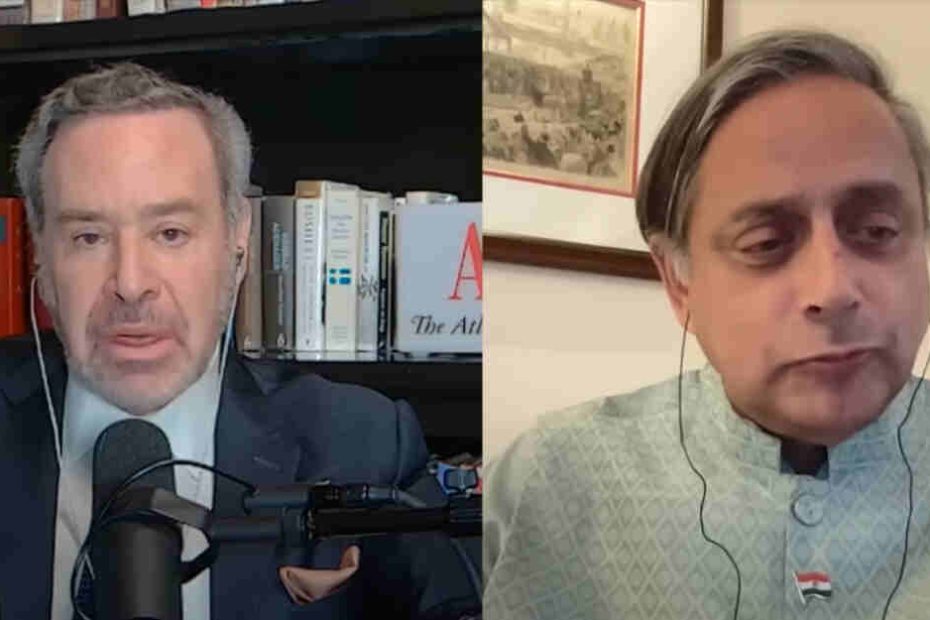
The following is the full transcript of The Atlantic’s David Frum’s conversation with Indian Member of Parliament and Chairman of the Committee on External Affairs Dr. Shashi Tharoor on The David Frum Show (premiered May 14, 2025).
Introduction and Background
DAVID FRUM: A terrorist outrage in Kashmir killed some 25 Indians on April 22nd. India and Pakistan have since mutually retaliated, one upon the other, as we record this dialogue on the morning of Sunday, May 11th in Washington. The evening of Sunday, May 11th, in the subcontinent, a ceasefire has taken hold to discuss the very distressing and worrying events in the subcontinent.
I am very proud and pleased to be joined by Dr. Shashi Tharoor. To say Shashi Tharoor is an author and a member of the Indian Parliament, is accurate so far as it goes, but inadequate to the reality. His books have been massive sellers in India and the United Kingdom, have had great influence on all debate about Indian politics, and he himself occupies a very important place as a politician that goes beyond the merely parliamentary in a country where politics has for a long time been drifting in sectarian and authoritarian directions.
Dr. Tharoor’s public advocacy and political work elevate him as one of India’s preeminent voices for secular and liberal politics. A graduate of the University of Delhi and a PhD from the Fletcher School at Tufts University here in the United States, Dr. Tharoor spent much of his early career in working in international organizations. He rose to be Under Secretary General of the United Nations. In 2009, he entered Indian electoral politics and was elected to Parliament. He has been reelected three subsequent times for a total of four. An unbroken career of success. He now heads the Parliamentary Committee on Foreign affairs in the Indian Parliament.
Thank you so much for joining us today at this time of tension. Maybe you can begin by talking about the ceasefire. A ceasefire has taken hold. The Trump administration claims a lot of credit for brokering it. Do they deserve that credit?
The Reality of US Mediation
DR. SHASHI THAROOR: We were all a bit puzzled by President Trump’s posts on Truth Social and on X, because India has historically been allergic to mediation, doesn’t believe it needs it, and it’s unlikely to have invited mediation in a formal sense. On the Other hand, it’s true that the US Administration, in particular Secretary of State now also NSA National Security Adviser Marco Rubio and to some degree Vice President Vance, have been speaking to Indian officials, as indeed Indian officials have acknowledged. The Foreign Minister’s tweets will tell us about these calls.
But it’s one thing for the Indian Foreign Minister to say to the Americans, look, if the Pakistanis do this, we will do that, or if they hit us, we’re going to hit them harder back. And quite another for the foreign Minister to say, would you mind relaying this message to the Pakistanis? India would never do the latter. They would do the former. And I think what happened then perhaps is that Rubio then called the Pakistanis and said, look, I’ve been talking to the Indians and this is what they’re saying, so you might want to take this into account and would you not like to move in a different direction, that kind of thing.
The initial Trump announcement gave the impression that the Americans and Indians and Pakistanis have been pulling an all-nighter, discussing everything jointly. That simply hasn’t happened. And I think that’s a misrepresentation of what role the US played. But I certainly don’t want to sound ungrateful for anybody who was willing to pull the Pakistanis down off the escalatory ladder that they had climbed onto.
The Recent Conflict Explained
There was a terrorist outrage in India. India chose to react in a very careful, calculated, calibrated and precise way only against terrorist infrastructure. Didn’t strike any Pakistani military installations or any civilian or governmental installations and basically signal, look, we’re only after terrorists. And we did this strike at 1:30 in the morning so there wouldn’t be too many civilians about. We want to avoid all collateral damage. It was a very responsible strike that the Indians conducted.
The Pakistanis chose to react with unnecessary escalation. They shelled very heavily civilian and occupied civilian inhabited areas of India Capitol, killing 22 civilians and hospitalizing a further 59 in the district of Putsch in Kashmir. And frankly, India had to respond and did very, very strongly. And when India responded, it also attacked places it had so far kept off limits. It hit Pakistani air bases, for example, very hard.
Pakistan has, because there are no terrorist infrastructure in India to aim at. Pakistan was assaulting Indian cities where ordinary human beings live. And that was simply unacceptable. We were able to use our air defense shield. Stop that. But we hit the Pakistanis hard where it hurt.
Now, this escalation was leading nowhere for nobody. As far as India was concerned. They delivered their message to the terrorists they were willing to stop as far as Pakistan was concerned. They didn’t know when to say that their honor was satisfied. And if the US helped them to step off that ladder, the US gave them an excuse to climb down off it. So much the better because India had no interest in a prolonged war.
What was very clear from the manner of the Indian strike to begin with, David, was that India was trying to signal from the very start this is not the opening salvo in a long conflict. This is just a one off retaliation to a terror attack, period. Nothing else. It’s Pakistan that was taking it in the wrong direction. And I’m glad that stopped right now.
Historical Context of US Involvement
DAVID FRUM: Well, let me ask you more about this American mediation. You’ll remember that in 2001, there again another outrage against India. Colin Powell personally inserted himself and worked very hard, deployed a lot of threats, actually against the Pakistanis to bring about a ceasefire.
In 2008, after the terror attack in Mumbai, another outrage on Indian soil. Condoleezza Rice was in person in the subcontinent and flew back and forth. That’s what American mediation has looked like in the past from our point of view. And not to make this a story about the United States when it’s a story about the people of the subcontinent, but it does look like the Trump administration showed up, took credit for something that had already happened and is now, because its main interest seems to be not a structure of peace, but scoring some Nobel Peace Prize nomination for Donald Trump.
DR. SHASHI THAROOR: You said it, David. I didn’t. And I probably would be unwise to say very much along those lines myself. I will say that mediation is possibly the wrong word. Mediation implies a request by both parties to be involved. In the two examples you gave, and a third example, the 1999 Kargil conflict, where when President Clinton summoned the Prime Minister of Pakistan to Washington and told him to lay off, which he did, all those three cases were essentially the US putting pressure on the Pakistanis, who in every case were in the wrong. They were the perpetrators of terror, they were the perpetrators of violence. In the case of Kargil, they were the ones who had led an invasion of Indian territory.
So in all those cases the US was telling one side. I would say that in this particular instance, in as much as there was any strong American messaging coming, it was almost certainly directed principally to the Pakistanis because India at no stage wanted to prolong a war.
India as a Status Quo Power
See, India, David, is a status quo power. It is a country that basically would be very happy to be left alone. There’s nothing Pakistan has that we want, we’d be very happy to focus on our own growth, our own development, the well being and prosperity of our own people. We are a high tech economy moving in that direction. We are trying to find a way forward in the 21st century. We are already the world’s fifth largest economy in dollar terms and in purchasing power parity terms, the third largest.
So that’s where our ambitions and aspirations are. We don’t want to get bogged down into a meaningless war with a bunch of Islamist fanatics whose lust for our territory is what motivates them. When you are a status quo power, what you want to do is to just continue with the way things are.
Next door to us, unfortunately, is a revisionist power, a power that is not happy with the existing state of regional geopolitics and wants to upend it. And that’s what the Pakistanis, sadly are. So they couldn’t do it by conventional means. They kept losing formal wars against us. So from 1989 onwards, having learned an unfortunate lesson from the success of the Mujahideen against the Soviet Union in Afghanistan from Pakistani soil, the Pakistanis decided to turn that technique against us. And they started unleashing mujahideen by various names and various terror organization front organizations into Indian territory and to wreak havoc against innocent Indian civilians. They’ve been doing that since 1989. This is year 36 of Pakistani terrorism.
America’s Declining Role
DAVID FRUM: Lost patience with this one last question about the American role. Because when you line up, and I should have mentioned the 1999, 2001, 2008, and you see the pattern of the American involvement there, and then you contrast it with the pattern of American involvement in 2025, it does really look like the United States is a receding power in the world that mattered much more a quarter century ago than it does now. And that the Trump administration seems to want the accolades that it would get domestically from the assertion of great power status. But actually it has given away that status and maybe by its own neglect, maybe by some objective reality.
DR. SHASHI THAROOR: Yeah. And there was some slightly confused messaging also coming out of all of this, that the first statements of Mr. Trump were that, oh, these Indians and Pakistanis have been fighting for thousands of years, which is slightly odd because Pakistan has only existed for 77 years as a country, so they haven’t fought anybody for a century, let alone centuries or thousands of years. Then we had Mr. Vance saying, oh, we have no business in this fight. Let them sort it out themselves. And then suddenly, within a day or two of these remarks, the same two people are taking credit for the ceasefire.
I’m at a bit of a loss, frankly, about what they did. Certainly there is no independent confirmation from the Indian side of any successful or serious negotiating effort by the US here. It’s possible that they did this with the Pakistanis. We might learn more from the US there’s always stories coming out in the US media from reliable sources in Washington as to what exactly America did with Pakistan. I’m sure we’ll find out soon enough. But for now, I am a bit of a loss to answer your question, David, but the desire for accolades without too much of effort is a human foible, isn’t it? It’s something which too many people tend to want to do.
DAVID FRUM: It runs stronger in some human beings than in others. And in a few, it’s the overwhelming passion of life. Let me ask you, you alluded, I think, a little bit to what will be your answer to this question, but why is it so hard to reach an enduring peace in the subcontinent? The one smidgen of truth in Donald Trump’s post about 1000 years is for 1000 years Hindu majority and Muslim majority, Hindu ruled and Muslim ruled states have coexisted peacefully and successfully in the subcontinent. Why can’t they do so now?
India-Pakistan Relations: A Complex History
DR. SHASHI THAROOR: Well, I mean, that’s the irony of all of this. I mean, it’s utter nonsense to imply that there is a thousand year battle between Hindus and Muslims. On the contrary, every great Hindu king had Muslim soldiers and generals on his side, every great Muslim king had Hindu generals and soldiers on his side. And the two communities have coexisted ever since the advent of Islam on the Indian subcontinent, which was within a century after the birth of the Prophet.
Indeed, in my own state of Kerala, Islam came peacefully through traders and merchants, bringing it as news from the Arab world, rather than coming as some sort of foreign conquest. So there’s been a long and complicated history, but it’s not all been hostile.
The British during the colonial regime chose a very deliberate and deliberately minuted policy of divide and rule, where they actively fomented a distinctive Muslim identity as distinct from, as separate from a Hindu identity, in order to prevent the two uniting against the British as they had done in the revolt of 1857, when Hindus and Muslims alike rose up in arms against British rule. It was ruthlessly suppressed, for The British butchered 150,000 civilians in Delhi alone in putting down that revolt. And then they adopted a conscious policy of divide and rule.
And divide and rule meant that when the Indian National Congress was established as a representative body of Indian nationalist in those days, very decorous Indian nationalist agitation for rights and political rights in India against the British. The British actually paid to establish a rival Muslim organization called the Muslim League in order to undermine the Indian National Congress.
Finally, partition happened and Pakistan was carved out of the stooped shoulders of India by the departing British in 1947. And ever since it has had to justify its existence as a separate country by an increasingly belligerent Islamism. This is why Pakistan was not only the source of these horrific attacks such as the 26/11 attack to which you alluded, the butchery of 166 innocent people in Mumbai in 2008, or the earlier attacks on the Indian Parliament, the invasion of Kargil and so on.
But Pakistan was also the place that sheltered and protected Osama bin Laden for many years until as you know, he was found living in a safe house right near a Pakistani army encampment. This is Pakistan’s history. It is a country that has unfortunately armed, trained, equipped, guided and directed terrorism from its soil for decades as an instrument of state policy. It is a malcontented state that wants territory that India controls and that it can’t have. It is a bigoted state that believes that all Muslims belong to it and that the first loyalty of Muslims even in India, should be to Pakistan, which, I’m sorry, is never going to be the case.
It was very striking that one of the daily briefings that were being done by the Indian military featured an Indian woman colonel who was a Muslim. It was a very powerful message that India stood united. It was not about Hindu Muslim, it was all about India standing united against terror. Pakistan doesn’t understand that because their state is built on a totally different set of premises.
It’s also, to paraphrase Voltaire on Prussia, a situation where India is a state that has an army, Pakistan is an army that has a state, and that army really controls the state, runs the state, controls the largest share of that country’s GDP and governmental budget, larger than any army of any country in the world, controls of its GDP and national budget.
So for the army to continue its disproportionate dominance of Pakistan, it needs to be able to have enough external demons in addition to the demons it has nurtured in its own backyard in order to be able to point to the fact that it is the sole savior of its people. It’s a very, very sad and pathetic story. The Osama bin Laden story was merely the tip of a very, very large mountain.
I’m afraid of this kind of thing. Hillary Clinton rather memorably said as Secretary of State, when Pakistan has tried to plead victim about its own terrorist problems with a group called the Tehrik-e-Taliban, Pakistan initially created by Pakistan, but which has deemed Pakistan to be insufficiently Islamist to its taste, and that has turned around to attack Pakistan’s military and political institutions. Hillary Clinton said, well, if you nurture vipers in your backyard, some of them would turn around and bite you. And I think that was absolutely the right metaphor. That’s what Pakistan has done. Vipers in your backyard is really a case of to mix up the animals, the chickens coming home to roost in Pakistan. Very sad story, but that’s the problem we’re living with next door to us.
DAVID FRUM: Pakistan is ideologically committed to the conflict for reasons you describe. But the wealth gap between India and Pakistan has been growing and growing and growing. Presumably the power gap follows. Although India has historically had difficulty turning wealth into power for reasons you may want to explain at some point you would say, however ideologically committed you are to this conflict, it’s not working. So peace becomes your logical outcome. But in the subcontinent, as indeed in west, in the Israeli conflict with the various anti-Israel rejectionist groups around Israel, the logic of power that political scientists would predict doesn’t seem to work. Why does it not work between Pakistan and India where they say, you know what, we’ve just lost too many times?
The China Factor in India-Pakistan Relations
DR. SHASHI THAROOR: Yeah, but you left out a very important force unfortunately in this equation, and that is China. China is sitting on our northern borders, nibbling away at our land. They have a long standing frontier dispute with India and Pakistan has been reduced to a client state of China over the years.
China’s single largest project under its Belt and Road initiative is a massive highway through Pakistan called the China Pakistan Economic Corridor, which is of inestimable economic value to China because goods coming from the Suez Canal and from the Gulf countries can now be offloaded at the port of Gwadar in the southwestern tip of Pakistan, in Baluchistan, Pakistan’s Baluchistan province, and transported on this Chinese built highway all the way directly into western China.
Whereas in the past and right up to then, these goods had to go all the way around India, through the Straits of Malacca into the South China Sea, be offloaded in ports like Guangzhou in southeastern China, and then transported laboriously over land all the way across to western China. They saved 90% of the cost and 95% of the time by just being able to use Pakistan as a conduit for their goods into western China.
So China has a huge interest in keeping Pakistan safe and secure and an obedient vassal state, which Pakistan is indeed happy to be. And China also has its own problems with India, which it would dearly like to cut down to size as a potential geopolitical rival in the area.
So when you talk about the power gap between India and Pakistan, the difficulty we have is we have two fronts we need to be worried about. We have a Pakistan front and a China front. And cumulatively, I’m sorry to say, we are not in a position, most unfortunately, to fight a two-front war.
So we have a very complicated mix of diplomatic, military and geopolitical calculations to make. Every time Pakistan triggers a problem with us, we’ve got to make sure we hit Pakistan hard so that they learn a lesson. But we also have to make sure we don’t go to such a point that China feels obliged to come directly to Pakistan’s rescue.
The overwhelming majority of Pakistani weaponry, which means, I believe as high as 90-odd percent of Pakistani weaponry, comes from China. That includes China’s latest 4.5 generation J10 fighter aircraft, their PL15 missiles, and various other kinds of ammunition.
So India’s problem is that it is essentially having to juggle a number of geopolitical, diplomatic, as well as military considerations when it reacts to Pakistani provocations. We want to send the terrorists a message, we want to hit back whenever Pakistan hits us. But we don’t want to get to a situation where we might end up, quite frankly, provoking a more direct Chinese involvement because India is not particularly keen on entering into a two-front war with both Pakistan and China.
So it’s a complication. When you look at the power asymmetry, as you mentioned, you are not just comparing India and Pakistan, you’re comparing India against both Pakistan and China. And then the comparison doesn’t look that good for India.
US-India Relations Under Different Administrations
DAVID FRUM: But as China has colonized Pakistan in this way over the past generation, a succession of American presidents, starting with Bill Clinton, developing very rapidly under George W. Bush, the president for whom I worked under President Obama a little, maybe less energetically, have sought to build an American Indian partnership that is closer and closer. And there are a lot of difficulties in the way of this, but there has been effort very much on the US Side, a little more doubt on the Indian side. President Trump has just slammed India with a whole new set of punitive tariffs, undercutting all the fine things that he and his vice president say about India, how would you assess the state of that US-India partnership, so founded by Bill Clinton and nurtured by W. Bush and President Obama?
DR. SHASHI THAROOR: Well, you know, and even in the first Trump administration, it was going fine. I mean, I would have said that in many ways the India-US relationship was above partisan politics, that it certainly transcends the political divide within India and appeared to have transcended the political divide of the US because both Bush and Clinton, both Obama and Trump 1.0, all supported a very close relationship.
But everything has become very confused in Trump 2.0. There have been the tariffs, which certainly have hurt India quite significantly. There have been the very stringent policies with regard to immigration, including legal immigration, H1B visas, spouse reunions and so on, which tends disproportionately to hit Indian techies who provide a lot of IT services in the US and who obviously want their families to join them and so on, who are going to find that challenging.
But even more, Mr. Trump’s statement yesterday and today has been very troubling because it has de facto handed Pakistan a victory that Pakistan has not earned by choosing unnecessarily to imply an equivalence between India and Pakistan. It was equating the victim and the perpetrator by speaking in terms of getting the two to sit down together and talk to end their thousands of years of conflict.
Apart from the fact that it hasn’t been thousands of years, there is a fact that we are certainly not going to give Pakistan the satisfaction of earning negotiating rights at the point of a gun. We are not going to talk to the Pakistanis after what they have done to us by killing innocent civilians. And I’m sorry, if that’s what Mr. Trump wants, he’s not going to get it.
Thirdly, he has given the Pakistanis the victory of re-internationalizing the Kashmir dispute, which had been off the international agenda for quite some time. And he has done India the grave disservice of rehyphenating India and Pakistan in the American imagination, which had been de-hyphenated since the days of Clinton.
You will notice, David, that since the days of President Clinton, no American president has actually visited both countries on the same trip. They have very deliberately sent a signal that India is a country you deal with in its own right. It’s not something we twin with Pakistan in the American imagination.
Sadly, Mr. Trump’s post has done all of these four things, and I think it shows that he has not yet been rather well briefed. What’s striking is that he has named proposed Assistant Secretary of State for South Asia, who’s a very knowledgeable scholar about South Asia and about India and who is himself partly of Indian American origin and who would, I believe, know far better than to say the kinds of things that President Trump has said on Truth Social, which are in that sense an embarrassment to these last quarter century of American policy. It has really upended all of these fundamental assumptions of the US-India relationship.
India’s Pluralistic Identity
DAVID FRUM: Let me ask you a question about speaking about India in its own right, about Indian domestic politics. The political tradition from which you come and indeed your life’s work has been to speak for India as a non-sectarian state, a state with Muslim and Sikh and other minorities. And I will note here for those who you will know this history, but many forget that the Indian army that liberated Bangladesh in 1971 was led by a Jewish officer, which is a detail that is often forgotten.
DR. SHASHI THAROOR: Yeah, not lead. It was more complicated. We had the army was commanded by a Parsee, a Zoroastrian, a tiny minority. The general officer commanding the Eastern Command, the forces that marched into Bangladesh was a Sikh. The vice chief of the air staff was a Muslim. And the major general who was helicoptered into Dhaka to negotiate the surrender of the Pakistani army at the end of that war was Jewish. The major general, JFR Jacob, who’s a friend of mine, remarkable gentleman now, now no longer with us.
But that was India, David. That’s what India is all about. It’s just a country of such immense diversity that it really is a microcosm of all that’s fine about pluralism as a social construct.
The Rise of Sectarian Politics in India
DAVID FRUM: That said, over the past decade and a half, India has emigrated away from that tradition to a great extent. And you see a rise of sectarian and authoritarian politics in India. And I don’t say this to cast aspersions. We have seen it in the United States. Why should you be any different from the rest of the world? But it has become to the point where people sometimes fear India becoming a Hindu Pakistan, chauvinist, sectarian, authoritarian. How worried should we be? How strong are the forces of opposition to this tendency? And the last question, maybe we can break this into a separate part. How is this affecting the way the authoritarian and sectarian elements in the United States think about India?
DR. SHASHI THAROOR: Okay, so first of all, as far as India is concerned, this is a battle we fight daily on our own soil. And I have been, I hope I’m acknowledged as being a very strong voice against sectarian tendencies in our politics. I believe strongly and passionately that every Indian has the same rights as every other Indian, and that their religion, their language, their ethnicity, their color, the region or the state they come from have absolutely no bearing on their rights as an Indian and their contributions to this great country.
And in many ways, my notion of Indianness is comparable to most Americans’ idea of civic nationalism. In America, where you all belong and you’re sheltered by this collective identity, you can be Jewish, you can be Californian, you can be Hungarian speaking, whatever. But you are who you are because America being American makes it possible. And it’s the same for us in India. You can be a good Muslim, a good Gujarati, and a good Indian all at once, because that Indianness is what protects your ability to be all of that. And I fought for that idea and I will do so till my last breath.
But having said that, when it comes to something like a conflict with Pakistan, it’s very interesting how quickly some of these divisions in our internal domestic politics disappear. And as I mentioned to you, the striking site in the daily briefings of an Indian woman military officer who is a Muslim sent a very powerful message both at home and abroad. This is who we are. That’s not who we are. Not the guys across the border with their sectarian bigotry. And to my mind, that was actually a very welcome reminder.
The second paradox, David, is that this government, despite the fact that it has presided over some of the worst tendencies of bigotry and encouraged intolerance within Indian society, it has actually been a remarkably good government when it comes to strengthening India’s relationship with the Arab and Muslim world. It’s quite astonishing to see, for example, the closeness of India’s relations with Saudi Arabia and the UAE and Egypt, all of which have never been better. And it’s striking that’s happening on the watch of a government that domestically has been rightly criticized for some of its statements and actions with regard to the Muslim minority.
So there is hope. Yet I do believe that we are going through a certain churn in our politics. You’re quite right that it’s reminiscent in many ways of what we’re seeing around the world. The same degree of xenophobia and rejection of the “people not like us” kind of thing that you’ve seen in the US, in Brexit, in Britain, in Hungary, in Erdogan’s Turkey and so on right across the world. There have been a lot of these tendencies and we’re seeing it rising in many parts of liberal Western Europe with the rise of AfD in Germany or the equivalent party in Austria.
There have been suddenly elements given a free reign to say we are more authentic representatives of the country than these people who worship foreign gods and speak foreign tongues. And that sort of thing, I’m afraid, is what has also been rising in India. But I do believe that liberal, pluralist, humane values have not been snuffed out. We’re going to continue to keep them aloft in my country.
US-India Relations and Political Alignment
DAVID FRUM: Well, you’ll remember the Howdy Modi event in Houston, Texas, in Trump’s first term, where he gave a very personal greeting to Prime Minister Modi of a kind that previous American presidents have tried absolutely to subordinate. To say this is not a personal relationship. Bush, Clinton, doesn’t matter. Whoever is the head of government in India doesn’t matter. This is a national nation to nation, people to people relationship.
But there do seem to be elements in the Trump administration, the vice president is one that—I don’t want to overstate this, but seem to be indicating that a more Hindu, chauvinist India is what they want, just the way they want to see neo-Nazis or neo-fascists prevail in many European countries. And I know you’re speaking to an American audience and you want to preserve national unity, but can you talk a little bit about, from an American point of view, what are they right, that the United States would be better off with a more Hindu, chauvinist India?
DR. SHASHI THAROOR: Look, I don’t think the US would be better off with one or the other kind of group in India. I think that the U.S., this particular administration, may be equally comfortable with people of that persuasion. Whereas arguably, someone like Bill Clinton or Barack Obama would not have been comfortable with a more explicitly sectarian Indian government. In fact, Obama made a famous speech in Delhi calling for greater religious tolerance at a time when Mr. Modi’s government was still pretty new.
So there is a difference, yes, in your domestic politics between a more liberal government and a government that considers itself more conservative. But ultimately, I still would like to believe, David, that this relationship is above and beyond that, that if tomorrow a more liberal Indian dispensation came to pass power, that there would still be enough forces in America that would want to preserve a good relationship with it.
One factor undoubtedly is the extraordinary influence of the Indian American diaspora. It’s now 3.4 million strong, which is a good 1% of your population heading a little above 1%. And these are people with a tremendous contribution being made to America. They have the largest single median income of any ethnic group, higher than Japanese Americans, higher than white Americans, they’re making significant contributions in a number of cutting edge sectors. They’re technologists, they’re computer geeks, they’re doctors and medical people, they’re biotechnologists. They’re doing all sorts of things in fields that America values.
They’ve not only done all of that, they’ve also got involved in your politics. There are Indian Americans amongst top fundraisers going back to George Bush Sr, whose leading fundraiser was an Indian American dentist in Florida. You’ve had American Indian Americans on the campaign trail. You’ve had Indian Americans getting elected to office. Nikki Haley is an Indian American. Bobby Jindal is an Indian American. And of course, there will be more. There are half a dozen of people of Indian origin in the US Congress right now, today, six of them.
So you’re looking at a community that’s not only made a valuable contribution to America, but that is visible, is active, is engaged in your social and political life and therefore cannot be ignored. By extension, the country they came from and still in many cases care about cannot be ignored. Just as, you know, Jewish Americans have an impact on America’s policy towards Israel, I expect Indian Americans to continue to have an impact on America’s policy towards India.
And I believe that will be the case whoever forms a government in India. I may be wrong, David, we’ll find out the hard way. But as of now, the changing complexion of Indian politics may not make such a difference to the US attitude to India, because there are now more and more sort of permanent structural factors sustaining that relationship, including the presence and role of the Indian diaspora in America.
The India-Pakistan Ceasefire
DAVID FRUM: Will the ceasefire hold?
DR. SHASHI THAROOR: I think so, yes. I don’t really think that Pakistan has much to gain from starting a new misadventure because India has been able to demonstrate that they can hit very hard. They’ve destroyed the runway in a major air base called the Rahim Yar Khan Air Base, and have severely damaged another air base, the Air Marshal Nurkan Air Base, which is right next to Pakistani military headquarters at GHQ Rawalpindi, not far from the capital of the country.
So I think it’s been a sobering wake up to the Pakistanis that this is not an adversary you want to monkey around with. Now, did they achieve their goals? Partially, yes. And Mr. Trump’s statement would be cause of rejoicing in Islamabad that, look, we’re back on the map with the US they’re treating us as the equal of the Indians. So they might feel that, look, we pulled off something very good by doing what we did.
So I don’t think they would see a reason now to get back again to the battlefield and possibly risk further defeat and further opprobrium. They would actually feel they’ve actually pulled off something here. So I think not. And as far as India is concerned, India has never been the belligerent, has no interest whatever in initiating conflict and ideally wants to be left alone by Pakistan to get on with its own business and focus on its economy.
So for all these reasons, I believe the ceasefire could hold, can hold, should be holding, but it’s not even 24 hours yet. And in fact, on the first day of the ceasefire, which in our time zone is yesterday evening, I’m afraid the Pakistanis violated it in three places by sending missiles across to Indian cities, hitting civilian targets, homes and cars. We were able to stop many of those missiles, but we did take a few blows and we hit back as well in retaliation.
So the message is very clear, David, if the Pakistanis can’t curb their hot heads and if they fire at us, we will fire back and we will fire back very hard. But if they are able to curb their worst instincts and behave and actually hold their fire, we have no intention whatsoever of initiating any action. We would like the peace to hold and we’d like to get on with our lives.
DAVID FRUM: Thank you so much for making the time for us today.
DR. SHASHI THAROOR: Thank you, David. Really good speaking to you.
DAVID FRUM: Thanks to Dr. Tharoor for joining me on the program. Because of the substance and length of our discussion today, we’ll omit the viewer question part of the program this week. I hope you will send questions for next week’s programs to producer@thedavidfromshow.com and I hope you’ll join us again next week for the next episode of the David Frum Show.
Remember, if you like what you hear on the David Frum show, you can support our work and the work of all Atlantic journalists when you subscribe to the Atlantic at theatlantic.com/listener. That’s theatlantic.com/listener and please like, subscribe, rate, review, share in any way you can the content of this program, if you enjoy it and find it of value.
We are already past in our first five episodes 1.5 million views and downloads on video and audio platforms. We hope to keep growing. We need your help to do that. So please rate, review, like, subscribe, share in any way you can and subscribe to The Atlantic at theAtlantic.com/listener. Thank you. I’m David Frum. See you next week.
Related Posts