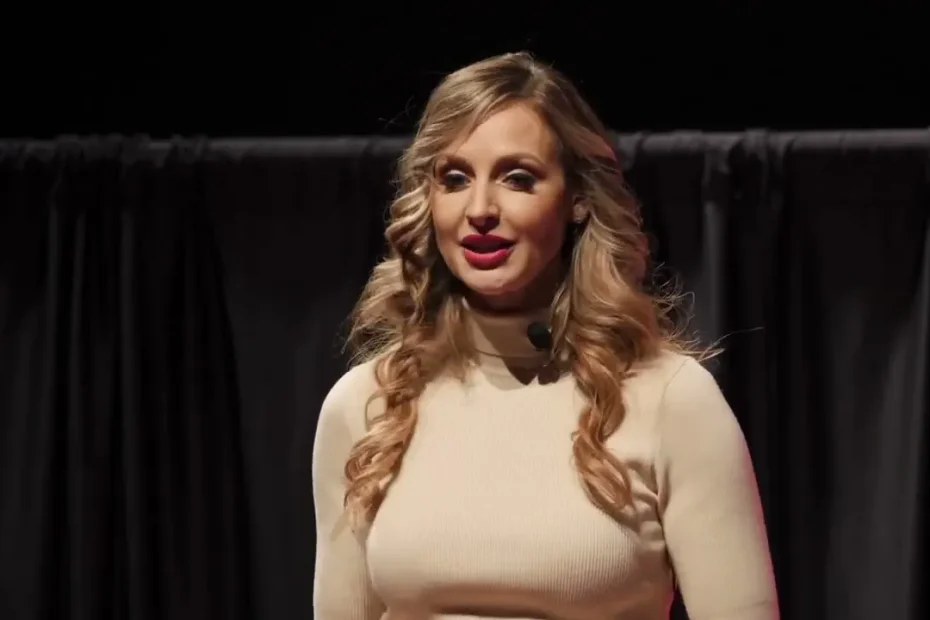
Here is the full transcript of author Dr. Taryn Marie Stejskal’s talk titled “How Resilience Breaks Us Out of Our Vulnerability Cage” at TEDxValparaisoUniversity 2022 conference.
Listen to the audio version here:
Introduction: The Power of Resilience Stories
DR. TARYN MARIE STEJSKAL: We all have an imaginary slip of paper that we carry around in our pockets, and this slip of paper reads, people would think I was crazy if they knew. How we answer this question is our resilience story. Each of us have at least one resilience story. It’s a story about an experience, something that happened to us. It’s a story that most needs to be told, but the story we most don’t want to tell.
You see, when we share our resilience story with others, two important things are launched. First, we expand our own resilience by demonstrating how others can learn from our experiences when we share generously and allow others to learn vicariously. The second is that we role model resilience and vulnerability. We pave the way for others to face their fear of vulnerability first by role modeling our own.
Now, so many of us think that we have to go looking for resilience, but actually resilience comes and finds us. It’s the moment when we face challenge, change, and complexity that teaches us the most about resilience and who we truly are.
My Personal Resilience Story
Resilience first found me on a cold October morning in Ann Arbor, Michigan. I was 14 years old, getting ready for school in my ground floor bedroom, and when I went over to turn off the stereo, see me later if you don’t know what a stereo is, I saw a face at the bottom of my window, and as I looked at that face that was peering in through a couple-inch crack of the window opening, my 14-year-old mind was already buzzing trying to figure out what in my array of experience would account for what was happening at this moment.
Then I remembered a time when my dad was outside playing a trick on my brother and I, and I said, dad? And he said, take off your clothes, you’re beautiful. Not dad. I ran from my bedroom, I was terrified, calling for my parents. We made a police report, and after taking down all the information, the police officer concluded that this really wasn’t anything to worry about, just someone passing through the neighborhood. A fluke.
Well, 10 months later in June of the following year, my parents were out of town. I always kept that window where I’d seen his face shut tight, but there was another window in my bedroom that faced the back of the house, and I had that window open for ventilation, and as I changed and got ready for bed, I stopped. I heard his voice again. This time, he said, I’ve been waiting a long time for this.
And at that moment, three important things in my life changed forever. The first was that I was naked in front of a man for the first time. The second was that my childhood bedroom, which should have been, for me and for all of us, one of the safest places, became profoundly unsafe. And the third was that this was not just someone passing through the neighborhood. This was not a fluke.
Well, when we think about our resilience stories, this became one of mine. Resilience found me a couple years later when my mom called me at university. A neighbor who lived a couple houses away had brutally raped and attacked another woman, and we thought that this might be the same man who had come to our home, whose behavior escalated over time.
The judge sentenced this person to 20 years in prison, and I, too, spent time in captivity. The bars that I lived behind were a diagnosis of post-traumatic stress disorder. I looked out from behind those bars for two decades with insomnia and hypervigilance and anxiety, and when I received that diagnosis of post-traumatic stress disorder, I thought to myself, self, this is a story that you can tell no one. You must keep this a secret, fold it up, put it in your pocket, and don’t let it out.
Studying Resilience
Well, a number of years later, I went on fellowship for neuropsychology, and something interesting happened. As I sat there in our outpatient clinic, watching our patients come in who had sustained brain injuries and spinal cord injuries, sometimes many years before, what I found was that people often were doing better than their prognosis or not as well as we had thought, but rarely were we ever right.
As I looked at each one of these people, I thought, what is happening to allowing people to do better than we expected or detracting from their rehabilitation after a brain injury or a spinal cord injury? What that led us to do was to engage in the first study on resilience.
We looked at the factors that enhanced rehabilitation or detracted from it, and what we found was stunningly simple and surprisingly basic. We found that people that had access to reliable transportation, these were the people who beat their prognosis. These were the people who were living independently as opposed to living in an assisted care facility, and we all know how important our independence is to us.
As I departed from my fellowship in neuropsychology, I was still thinking about that study, and I thought, you know, we’re not all going to experience brain injuries or spinal cord injuries, but we all will face our own moments of challenge, change, and complexity. And in those moments when resilience finds us, what will be the things that we do? How will we respond? What will be the behaviors that we’ll harness in those moments? What are the things we can do to create a more positive and productive outcome? In short, what would be our version of reliable transportation?
The Five Practices of Particularly Resilient People
As I moved into the corporate world and became a management consultant, I decided I would study this a decade and a half ago.