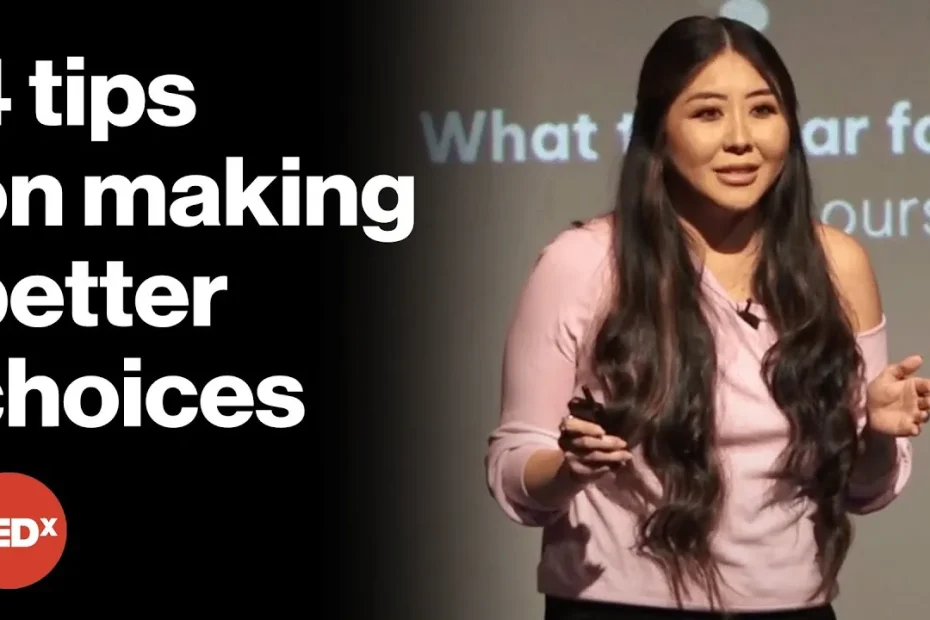
Read the full transcript of world-renowned poker professional Maria Ho’s talk titled “How To Make Decisions Like A Poker Pro” at TEDxUCSanDiego conference (May 27, 2025). World-renowned poker professional Maria Ho shares her insights on decision-making in this compelling TEDx talk from UC San Diego. Drawing from her experience as one of the top poker players in the world, Ho reveals how the strategies that work at high-stakes poker tables can transform how we make decisions in everyday life.
Listen to the audio version here:
The Scale of Daily Decision-Making
MARIA HO: Have you ever stopped to think about how many decisions we as humans make? How many do you think we make in a day? Is it 500? No. What about 5,000? Nope. Try 35,000 decisions a day according to an article in Psychology Today. Think about it. What to wear? What time to go to sleep? Which bathroom stall to go in? Which bathroom stall to definitely not go in? Where should I sit for this TEDx conference? And did I leave enough of a buffer so a complete stranger doesn’t come and sit right next to me?
We don’t often even realize it, but our brain is constantly in overdrive. It’s never-ending. The decision fatigue is real.
As one of the top poker players in the world, I often find myself in situations where the difference between making the right or wrong decision could cost me or earn me a million dollars. This is why one of the most important skills I’ve had to hone is the ability to think clearly under immense pressure with incomplete information in a game where time is not a luxury I could afford.
Whether it’s as mundane as what to eat for dinner or as significant as what career path to embark on, our lives are defined by our ability to make decisions. We can’t do so effectively. We risk finding ourselves in a state of decision paralysis out of fear of making the wrong decision.
But what if I told you I could help you optimize your decision-making process so that even in the most consequential moments, you can not only decide with less difficulty, but it’ll be a decision that you could feel good about after the fact. It all starts with addressing some simple truths about decision-making.
Truth #1: Taking More Time Doesn’t Equal Better Decisions
Taking more time to decide doesn’t necessarily help you make the best decision. In poker, we often defer to the saying, “think long, think wrong.” That’s not to say we don’t consider the multitude of variables and factors in play at any given point in the hand. It’s just that most often, it’s the conclusion we come to initially that ends up being the correct play. Only when we start to second-guess ourselves do we begin to diminish our confidence in the carefully constructed logic that got us there in the first place.
In fact, some poker tournaments have us play with a shot clock that only allows for a set amount of time on each decision, so we couldn’t take our sweet time even if we wanted to. Poker tournament rules also state that if a player has taken a reasonable amount of time on their decision, any other player at the table can call for a clock, at which point the tournament director comes over, gives that player a 30-second countdown to make their decision, otherwise their hand is declared dead.
This concept should apply in life as well. Don’t be afraid to call the clock on yourself. If high-stakes poker players don’t get 20 minutes to decide on a pot worth tens of thousands of dollars, it shouldn’t take 20 minutes every night to decide what to watch on Netflix.
In one Stanford study, faster decision-making was linked to better performance, while slow decision-making was linked to poor performance. We as humans have been equipped with this ability to think quickly on our feet. We were able to reign supreme in the evolutionary process because we adapted swiftly to ensure our survival.
Although nowadays we don’t have to hunt our own food or make our own tools, we still do some of our best work when our back is against the wall and time is of the essence, like slamming on our brakes when a car stops short in front of us. Imagine if we were to carefully weigh our options as we’re hurtling towards somebody’s rear bumper.
So, to all my fellow procrastinators out there, you know who you are. There’s hope for us yet.
Truth #2: Perfect Conditions Don’t Exist
There is no such thing as perfect condition. In poker, we aim to make the most optimal play that yields the highest expected value based off of incomplete and imperfect information. The same is true in life. There’s always so many unknowns, so many variables we can’t predict, and aspects that can’t escape being viewed through a subjective lens.
Ten years ago, I was offered the opportunity to become the first woman strategy commentator on a televised poker show. Having had no prior broadcasting experience, I was reluctant to say yes because, frankly, I didn’t think I was qualified. I thought maybe I could get some training or find an opportunity on a smaller stage to get my start and then come back to this once I had more experience under my belt.
But the more that I thought about it, the more I realized that fear of the unknown was not a good enough reason to say no. After all, what’s the worst that could happen? I’m a woman with an Instagram account. I’ve pretty much heard it all. Plus, the production company knew I had no experience, yet they were willing to take a chance on me. So, in spite of my what ifs, I said yes.
Next time, when you are faced with a decision with this uncertainty, don’t be afraid to take that risk and trust that you can make a good scenario out of a bad situation.
You might be wondering how it worked out for me. Well, this is me winning the Global Poker Award for Best Broadcaster of the Year in 2018.
Making decisions with imperfect information is also about having a healthy tolerance for risk. Now, some people view risk as a four-letter word, which it is, but that’s not a bad thing. It just means there’s more to consider.
Psychology also plays a role in our ability to engage in risky behavior. When faced with uncertainty, most people would rather have the safety and familiarity than venture into the unknown. Unfortunately, what ends up happening is that the more meaningful a decision is, the more risk-averse we tend to become.
In its simplest form, a standard risk-reward calculation always favors taking on more risk when there’s more potential for a greater upside. In poker, I’m much more likely to go for that big bluff when there’s a thousand chips that we’re playing for than just a hundred in the middle. Foster the mindset and self-belief that allows you to trust your judgment even when uncertainty looms.
Truth #3: Good Decisions Can Still Produce Bad Outcomes
Sometimes even a good decision can produce a bad outcome. You might have watched poker on TV late at night, flipping through the channels. It’s not exactly prime time when it’s on. It’s usually after bowling and before darts. The game that they’re playing is the most popular form of poker out there today, Texas Hold’em.
In Texas Hold’em, each player is dealt two cards face down. The best possible starting hand is two aces. When you have two aces and you’re up against any other pair, the chances that aces will win is 80% of the time. Even though you’ll lose 20% of the time, you’re supposed to go all-in with aces 100% of the time. The times that you lose doesn’t mean that going all-in with aces was a bad decision.
Life is also similarly probabilistic in nature as there are no guarantees and no such thing as a sure bet. Start viewing your decisions as weighing them as the probability of something happening or the likelihood of your desired outcome against the probability of it not happening or the likelihood of the undesired outcome and stop thinking in absolutes. That way, you won’t be afraid to make the same decision over and over again even if it’s produced a bad outcome before.
What you should focus on is the reasoning behind your decision and making sure that the basis of it is fundamentally sound, whether rooted in math, science, or just plain common sense.
Consider traffic. These days there are a million apps that are designed to help us avoid traffic at all costs. Do I want to take 18 different side streets and cross a super sketchy bridge just to avoid a four-minute backup on the freeway? Yes, you bet I do. But even with all of that planning and consideration, we can still find ourselves in bumper-to-bumper traffic because of a fluke incident up ahead. Does it mean that we made the wrong decision to leave at the time that we did? No. It was statistically the best time to leave. It just didn’t work out for us that day.
Remember, a bad result doesn’t necessarily mean you made a poor decision.
Truth #4: Recovery is Always Possible
You can make a bad decision and still recover from it. Let me set the scene for you. I was 23 years old and it was my first time playing in the World Series
Now, the World Series of Poker main event is the most prestigious and largest poker tournament in the world. With a buy-in of $10,000, it was by far and away the most expensive buy-in that I had ever played up until that point. Not to mention, I wasn’t exactly bankrolled for it, but we’re all young and dumb once.
Walking in, I was immediately intimidated by the sheer scope of it all. Multiple convention-sized rooms filled to the brim with almost 9,000 players seated at rows upon rows of poker tables as far as the eye could see. They were all vying for their share of the over $80 million prize pool.
As I sat down, the nerves hit me. As the tournament went on, I slowly began to settle in. I won a few pots, regained my confidence, and just when I was thinking, oh, I finally got my bearings, I found myself involved in a massive pot against the player at the table who had accumulated the largest chip stack.
A Critical Decision Point
We were on the river, or for those that don’t know poker jargon, the last card, and he had put me all in. It would be all of the chips I had in front of me to call. If I called and I was wrong, I’d be out of the tournament. So I sat there motionless, trying to play back the hands in my mind and hoping to make sense of it all.
Now, what I’m about to say next, you might need a poker rosetta stone for, but try and bear with me. Okay. I raised from the cutoff and I had 40 big blinds affected. He 3-bet me from the button. Okay, he’s been really active and he has a very high V-pick, but that means my hand should play pretty well against his range. Now on the flop, he see-bets 30% pot on an ace-high flop, but on the turn, he decides to size up to 70%, but wait, a backdoor flush draw appears. Now on the river, the backdoor draw is missing. I don’t block any of those draws, but even though he’s been really aggressive, he should be pretty balanced in the spot, which means he should have a decent number of value combos as well as bluff combos.
Wait, is that his neck pulsating faster? What does that mean? Is he nervous because he’s bluffing or is he excited because he has a big hand? These are the thoughts that consumed me for over 10 minutes as I sat there trying to decide flip-flopping back and forth numerous times between calling or folding.
The Wrong Decision and an Important Lesson
After a few more minutes of deliberating, I decided to fold. I was really dreading how poorly I would sleep that night, not knowing if I had made the right or wrong decision, when in that moment, he stood up, fist-pumped the air, and proudly turned over a bluff for me and the whole table to see.
I sat there trying to put on my absolute best poker face to hide how I was really feeling in that moment, but deep down inside, I was mad and angry at myself for being wrong. As I sat there trying to regroup mentally, I looked down and I saw that I still had chips in front of me, which represented an opportunity to recover from my mistake.
I knew that the best thing I could do for my mindset was not to dwell on the fact that I had made the wrong decision in a critical moment, but to focus that energy on making good decisions from that point forward.
So, even though, I mean, let’s be honest, it was kind of a dick move for him to show me the bluff, I learned a valuable lesson that day. When we suffer a setback, we often allow that to cascade and roll over to our other decisions, and we end up compounding our original mistake. Of the infinite number of decisions we’ll make in our lifetime, chances are they’re not always going to be good. The silver lining is that you can recover and rebound from many of those.
Turning Information Into Advantage
The real mistake that day was when he couldn’t help it, but to show me the bluff. Information in poker is valuable. It should never be given freely. Now, not only did I know that he was capable of bluffing, but I also knew what kinds of hands he thought were good ones to bluff with. Armed with that information, I was able to adjust and fine-tune my strategy in real time to exploit him more effectively.
My ego and chip stack might have suffered, but those negatives were only temporary as I was able to regroup and refocus. I found myself ending play that day with more chips than I had lost in that hand. All this to say, trust that you’ll be able to pivot and adapt if and when more information reveals itself.
Conclusion: Trust Yourself
Our lives are defined by our ability to make decisions. The best decisions will be guided by the most confident version of yourself, the you that doesn’t shy away from taking risks when appropriate, the you that doesn’t allow fear to take over and immobilize you, and the tenacious side of you that learns and recovers from bad decisions.
Although it takes bravery, making good decisions is a numbers game. Learning how to optimize your decision-making process will help you make small but good decisions repeatedly, and it’s a warm-up for that rare occasion when you might have to make a life-altering decision.
When that time comes, trust me. But more importantly, trust yourself. You’ll be ready.