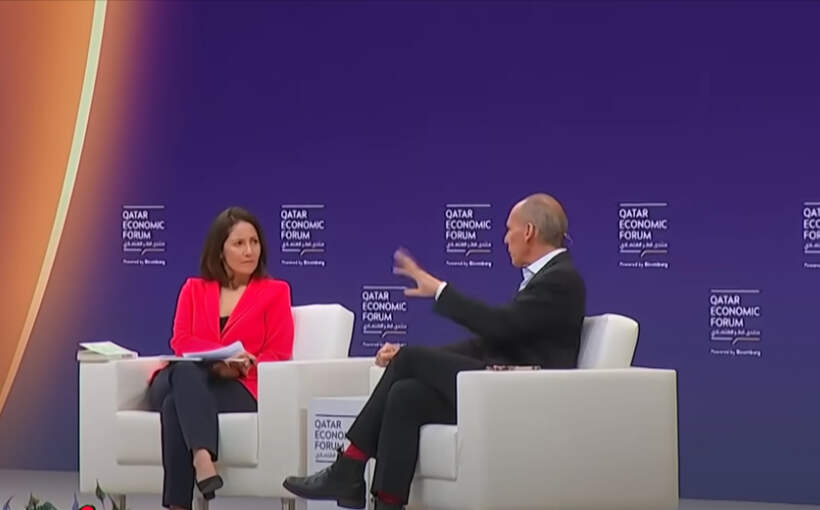
Transcript of former Finance Minister of Greece Yanis Varoufakis in conversation with Bloomberg’s Mishal Husain at the 2025 Qatar Economic Forum, May 22, 2025.
The Greek Crisis as a Symptom of Larger Economic Transformation
MISHAL HUSAIN: Here at QEF, we have talked about growth areas, about good investments, about risks and barriers. But this is going to be a conversation with someone who believes the following that capitalism is now dead in the sense that its dynamics no longer govern our economies and that it has been replaced with techno feudalism. So it is the thesis of economist and former Greek Finance Minister Yanis Varoufakis. He has put it in this book, Techno-Feudalism: What Killed Capitalism, which is out now. And Yanis, you are very welcome to QEF, and I think you’re going to challenge us a lot with what you’re going to say. So before we get into the heart of the argument that you’ve put forward in the book and elsewhere, I want to take you back 10 years to the moment where you were in the global headlines. You were the Greek Finance minister, exactly at this point 10 years ago. A few weeks later, in early July 2015, you ended up resigning. It was an intense time because as many of you will remember, it was the moment, well, the ongoing saga of the Greek financial crisis. And you were trying to have Greece’s debts restructured. I wondered what the link is between what you lived through at that time and what you are so exercised by today.
YANIS VAROUFAKIS: Well, Mishal, thank you so much for asking all these questions. Thank you for the invitation to the Qatar Economic Forum. Look, let’s go 10 years back, the only reason why I found myself in government was because the Greek state went bankrupt. It had gone back up 10 years before. The people of Greece invited somebody like me to try their hand out. But let us not focus on Greece, because it wasn’t a Greek financial crisis. It was a European banking crisis which begat the euro crisis.
MISHAL HUSAIN: It was the long tail, if you like, of 2008 and the financial crisis.
The Birth of Techno-Feudalism
YANIS VAROUFAKIS: Exactly. It all starts in Wall Street, as it always does. Like 1929 began in Wall Street. 2008 was our generation’s 1929. The banks of Germany and France discovered to their great horror, these huge black holes after the subprime crisis. And then you will remember, Dubai had a sovereign debt crisis. Then it went to Greece, then it went to Ireland, then went to Portugal.
What was the real issue at the time? What was the real issue at the time was that after the collapse of Wall Street in 2008, in 2009, in London in April, under the auspices of Gordon Brown, the UK Prime Minister, then the great and good leaders, including prime ministers, presidents and central bankers, got together and they decided to refloat finance. So we had a massive quantitative easing program, essentially printing money to refloat finance, while at the same time there was no coordination on fiscal policy. Indeed, whatever coordination there was, it was often Austerian version, fiscal contraction.
So when you contract aggregate demand and pump all these trillions into the Western economy, what you create is an incongruity because there’s a lot of money sloshing around in the financial sector. But industrialists, entrepreneurs do not want to invest because they can see the low levels of demand. So what they do is they take the money and they plow it back into the financial sector, share buybacks and so on. The only entrepreneurs, capitalists, who invested a good chunk of the $35 trillion that was pumped through quantitative easing between 2009 and 2022. The only entrepreneurs who seriously invested in new machinery where the big tech, Silicon Valley tech leaders.
And that gave rise, and this is the connection with what I’m saying in this book, to a remarkable transformation that humanity has never seen before. I truly mean that. I know that every generation wants to feel that we are on the cusp of a fantastic transformation. You know, we all have this delusion. But I believe that between 2010 and 2025, we had such a transformation.
The Rise of Cloud Capital
And allow me just to say what that transformation is. We have a new form of capital. Capital has always been, since time immemorial, since Paleolithic times, when humans fashioned a hammer or a plough. What is a plow? It’s something you create. You produce this machine to plow the land, to produce something else. A produced means of production. That’s what the steam engine was, which brought about the first industrial revolution. That’s what electromagnetism, you know, generators and electricity grids and telephone grids were towards the end of the 19th century. That brought about the second industrial revolution.
Between 2010 and 2025, we have a new form of capital, because what lives in here, ladies and gentlemen, is a machine. It’s not just what’s in here, but all the network machines that are connected to this satellites, the carbon fiber cables, the algorithms, the server farms, all that. I call this cloud capital because it lives supposedly on the cloud. It’s not on the cloud, it’s on Earth and it’s inside our oceans.
What does this do? What does Amazon, the Amazon or the Google or the Meta algorithm do? It doesn’t produce anything. What you buy on Amazon has been produced elsewhere, has not been produced by Amazon. What it produces is a remarkable power to input and infuse desires and thoughts into your mind. So it’s the first time we have machines that do that, which once upon a time, advertisers, human advertisers, human marketeers, orators, preachers, politicians, poets did, which is to change our mind, to modify our behavior. This is now automated. So anyone who owns concentrated quantities of cloud capital has an immense power.
And just very briefly, in order to end this long winded answer, think about Alexa.
Alexa is this little contraption that Jeff Bezos sells you to connect to Amazon and to the Internet and you feel that it is your slave. You say, Alexa, order this book for me or switch off the lights or whatever, right? But essentially it’s an interface with this cloud capital belonging to Jeff Bezos. And you’re training it to train you, to train it better, to know what you want, to give you good advice to win over your trust. I don’t know about you, but when Amazon recommends a book to me, I also want to read it. And I never regret it. Similarly with Spotify, when it recommends music to me, I actually like it, usually and sometimes I love it because.
MISHAL HUSAIN: Because it knows you very well.
YANIS VAROUFAKIS: I have trained it to train me, to train it, to know me.
The Problem with Progress
MISHAL HUSAIN: Isn’t that progress, Yanis? That is. That is, of course, the advance of technology.
YANIS VAROUFAKIS: But at the same time, it is a source of major crisis. Why? Because the moment it wins my trust, it can say to me, oh, buy this electric bicycle. And I say, okay, click, I buy it. And then this electric bicycle comes to me, bypassing every market. Once upon a time, a brilliant advertiser could convince me that I need to eat a Big Mac, that I really shouldn’t be eating. I didn’t need it, I didn’t want it, but it convinced me. But I had to go to McDonald’s to get it. Now it comes directly to me, bypassing every market. And Amazon keeps up to 40% of the price. That’s rent. And any economic system which is founded on rent, not profit, is a clear and present danger for the marketplace.
MISHAL HUSAIN: Okay, but people are making money because.
YANIS VAROUFAKIS: This money is coming out of the cyclical flow of income.
MISHAL HUSAIN: Okay, but so you’re casting the tech giants essentially as not being producers and not adding value. Well, but they are enabling other businesses, aren’t they? Someone has made that bicycle. Someone has earned money from it being shipped to you. And let’s. If we look at another example, Google, their algorithms, okay? They change the whole time. And that is a terrible thing for businesses who one moment benefit and the other moment find themselves low on the search engines. But they also enable people to find things that are useful, whether they are products or services or merely information.
YANIS VAROUFAKIS: That’s why we all use it. If you take away my phone from me, I’m dead.
MISHAL HUSAIN: So they are. But that’s fine, they are adding value.
Extraction vs. Creation of Value
YANIS VAROUFAKIS: No, they’re not adding any value, they’re extracting value. They’re very clever at being useful to us, making us feel absolutely dependent on them in order to extract. You mentioned, we mentioned, we both mentioned Mishal. The electric bicycle. I love it when I press a button of the electric bicycle, one that I actually enjoy riding to comes to my home. But think of the producer of this electric bicycle and I don’t mean just the worker that has worked on the assembly line, but I’m talking about the capitalist as well. He or she has to pay 40% to Amazon. This is the equivalent. That’s the connection with feudalism.
Under feudalism, what gave you power was property rights over the land. You own the land and you could charge rent. And the great invention, the great transformation of capitalists was that you moved away from wealth being concentrated into the hands of people who were lucky enough to inherit land, to entrepreneurs, to people who actually put everything together in the production process with old fashioned capital as a produce means of production.
But now one of the reasons why our central bankers are having such a difficult time rebalancing our economies, we have inflationary pressures and at the same time if they don’t keep adding to aggregate demand, there is a danger of falling into stagflation. One of the reasons is when you’ve got about this is my estimation, about 30% of GDP in advanced economies and increasingly in developing countries is siphoned off in terms of rent.
Remember David Ricardo, the great banker and economist and politician at the turn of the 18th to the 19th century wrote a whole book of the principles of economics of political economy in which he lambasted the landlords because their rent was impeding the development of market and entrepreneurship. And he was asking that, he was simply worried and I think he was correct that when a large chunk of GDP goes into rent, then the marketplace and our capacity to accumulate productive capital shrinks. This is David Ricardo, you know, 1800s, early 1800s. I think that he today would be absolutely appalled by the manner in which this amount of wealth.
Think about, you know, Meta Zuckerberg’s Facebook and so on, you know that only about 1 to 2% of their revenues goes to salaries. Because all of us, every time you post something on Instagram or Facebook, every time you post something you’re adding to the cloud capital of Zuckerberg. And this is free labor. Now, you may enjoy it. Of course you enjoy it. That’s why you’re doing it.
MISHAL HUSAIN: Well, you don’t think about it.
YANIS VAROUFAKIS: Most of the time you are distributing free labor, which does not come back to the circular flow of income.
The Question of Consent
MISHAL HUSAIN: But Yanis, most of us have agreed to that contract and we’ve ticked the terms and conditions off. And whether. Because we want the service for free.
YANIS VAROUFAKIS: Indeed. But if you go back to the feudal era, the vast majority of the peasants believed that it was a good and fair system. They even enjoyed life. We have a very negative view of feudalism. If you go back to the actual literature of the 16th century, 17th century, you know, people work, they didn’t work very long hours. They had their rituals, they had their, you know, they had lots of holidays. They, you know, it’s not clear. I mean, sometimes when the landlord overdid it in the rent extraction game, they rebelled and chopped off their heads.
But, you know, the fact that we consent to something does not take away from the economics of it and from the reality that we are essentially undermining the capacity of our macro economies to reproduce themselves in a manner which is not degenerative.
MISHAL HUSAIN: Okay, so the rent idea is the. If going back to your Amazon example, if the rent is 10% rather than 40%, does that fundamentally change your objection? That is, do you object? Could you accept Amazon getting something like that for the service it is providing, for what it is enabling? Is it the amount that bothers you?
The Power of Cloud Capital
YANIS VAROUFAKIS: It’s not just the amount. Because, you see, once you have control of this cloud capital, whether you are a nice person or not a nice person, whether you are Jeff Bezos or, you know, some saint, the incentives are ever so powerful to extract more and more. Because as we know from politics, from society, from families, you know, power corrupts and absolute power corrupts absolutely. This is a remarkable power that you have if you own that machine.
And so let me give you an example of the things that happen. So Amazon, or Google for that matter, or Uber, they entice you to get in as a seller, as a producer, if you are a driver of a car, they entice you. Uber gives you good rates to drive. Amazon invites producers to sell through Amazon, giving them, you know, extracting a very low percentage for them.
But once you’re doing really well by selling your services or your product through Amazon, through Uber, through Airbnb and so on, the incentive is there for them to downgrade you. You know what Google does with publishers? Initially they’re very high up on the search list, then they are pushed down and then they’re asked to pay more money.
And there’s a process that a friend of mine and a very astute observer of what I call techno feudalism, Cory Doctorow, has referred to as “enshittification.” This is the natural incentives within these big tech companies once they lure you in there both as a consumer, a user and as a producer to extract more and more from you. And therefore you have a systemic process of extraction which is macroeconomically highly dangerous.
And this is not just for the United States and for Europe. Did you know that in countries like Indonesia, for instance, millions of small scale kiosks and retailers have been taken over by the Amazon conglomerates and the various other cloud capitalists of that region. So you see this extraction process depleting the resources of actual producers globally. So my job is to alert people to this.
MISHAL HUSAIN: Okay, do you use these services all the time?
YANIS VAROUFAKIS: All the time. But you see, I don’t.
MISHAL HUSAIN: I mean, what with gritted teeth or what is.
YANIS VAROUFAKIS: No, I don’t believe in individualistic acts of, you know, vanity, rebellion. That is what is going to change if I stop using my phone. The world is not going to become a better place. I think that these machines are a great tribute to the human spirit.
So take AI. You know, you have AI programs as we speak that design antibiotics which can kill bacteria that kill people. Now that needs to be celebrated. So I don’t have a problem with the machinery, I don’t have a problem with the code. I have a problem with who owns these.
MISHAL HUSAIN: Okay, but maybe that was made possible by the 40%, what you would call rent.
Technology and Power
YANIS VAROUFAKIS: It has been made possible, but at the same time a lot of other activities have been made possible. For instance, Amazon in the United States uses exactly the same algorithms that design successful antibiotics in order to surveil workers in the Amazon warehouses and use a mathematical statistical program for predicting the probability that Joe or Kathy is going to talk to somebody and that this discussion may lead to unionization in the particular warehouse. And if the probability exceeds a certain threshold, either they’re fired or they shut down the multiple of that particular warehouse in order to prevent unionization.
So there are many different uses. So for me, it’s not what these machines do that I have no problem with. My problem is who owns them. And there is exorbitant power in owning Twitter, for instance, or owning Instagram or owning TikTok. It is utterly inconsistent with any concept of liberal democracy.
MISHAL HUSAIN: And you know that Elon Musk joined us here at the forum two days ago and one of the things he would like to do is to have a payment system within X to give it another dimension. And I’m interested in what you think of that because I know that you look to China and you see positives in the WeChat app, for example, which is a very all consuming app. But isn’t that another example of a tremendous monopoly power? So what if that is the answer? Then why would a payment system within X and extra dimensions to services like that not be welcome as well?
Digital Payment Systems
YANIS VAROUFAKIS: Well, interestingly, when Elon Musk purchased Twitter, remember for like $44 billion. The whole of the press was dumping on him. What a stupid purchase that was. I thought it was a brilliant purchase because exactly back then, actually in the book, I explained why he bought Twitter. He wanted an everything app. He wanted to create his own WeChat.
And for those of you who don’t know, WeChat is a Chinese application that does everything that our western applications do, from Netflix to Twitter to this. But also it offers you an opportunity to make free payments independently of where you have your bank account, as long as it is in one. And Elon Musk was trying, or is trying to do with X that which Zuckerberg failed to do with Facebook. Remember he was going to introduce his own currency, the Libra, and Wall Street killed that. Wall Street is trying, as we speak, to kill Elon Musk’s version of WeChat.
Now I think that there are two important points to make about this aspiration of Elon Musk. The first one is that the public out there really want it because who wants to pay commission to their bank of America, to JP Morgan, to Barclays bank and so on. And why should these banks, when they have a zero marginal cost for our transactions, charge us for it? And they charge us for essentially allowing us to use our own money. And this is preposterous.
So this is a rent that has to go. And Elon Musk would be sitting here saying, yeah, you see, I’m against rent. I want to create a free payment system through X. Yeah, but he wants to control it himself. And we know this, that any private system of monetary transactions is the first step towards a major crash, a major crisis. Because we can never trust a private entity with our money.
MISHAL HUSAIN: Are you on the side of Wall Street rather than Musk?
YANIS VAROUFAKIS: No, I’m. What I think is, I mean, I believe in a third way. I for instance, would very much welcome the Fed issuing its own digital wallet. Imagine if you could download, if you were in the United States, your Fed app or in the European Union your ECB app and you could put your money in there, ask your employer to pay your salary there if you want to, totally voluntarily.
And imagine if you were to collect the overnight interest rate of the central bank which is always much higher than what commercial banks offer. This would be a tremendous step in the direction of cultivating more competition in the financial sector.
MISHAL HUSAIN: It would be like your PayPal or equivalent as well or your Apple Wallet. But it would be way you wouldn’t.
YANIS VAROUFAKIS: Need the Apple Wallet anymore because you would have free payments anywhere in the world using your central bank app. By the way, the bankers already have that because private banks, commercial banks have accounts with the Fed.
Now the Chinese are doing that. The only reason why the United States cannot do this is because Wall Street is going to kick and scream. I know that Christine Lagarde and the ECB wants to do this for the euro and it would be a great financial innovation. But the banks in Frankfurt and Paris are going to be all over her if she dares to do this. So they are trying to contain it so that you can’t have more than one or two thousand euros in it. Essentially the bankers want their monopoly. They shouldn’t have it. They should not be allowed to have it.
So I’m against an Elon Musk owned cryptocurrency or payment system. I’m against WeChat because I don’t believe that we have the right to create yet more exorbitant power in the hands of an individual. But at the same time I do believe that we should democratize and socialize these digital payment systems.
I don’t believe in going back to cash. I believe in digital payments. We should own them collectively because Mishal, we create money collectively. It’s a mistake to think that the central bank creates money. You know, in every advanced economy only about 3 to 4% of money has been created by the central bank. The rest is created privately. Every time a bank extends a loan or an overdraft facility, it creates money. This is immense power. And I do believe that in democracies this power should be democratized and the technology gives us an opportunity to do that. So Elon Musk opens a way for us to do that which he doesn’t want us to do.
Looking Forward
MISHAL HUSAIN: Okay, it’s very useful to have got both your diagnosis of the problem and at least one or some of your solutions for the future. We only have a minute left, so leave the audience here with one action point. You’re still going to use these apps. We’re all still going to use these services. But what would you like people here to take action on?
YANIS VAROUFAKIS: Well, if you are the mayor of a city or if you play an active role as an active citizen in your municipality, in your region, why not suggest that you create a socially owned competitor to Uber, Airbnb, to Google and to Amazon? Why should these rents end up at the Cayman Islands through Ireland, usually being owned by big Tech, the big Tech oligarchy, who on the one hand, they are very smart people and they deserve to be rich, but they don’t deserve to collect 30% of global GDP simply because they have monopoly over us.
We can differ politically between rightist leftist centers and so on and so forth, but I don’t think we can disagree that having a monopoly over the most powerful form of capital, which is so concentrated in two loci in Silicon Valley and around Shenzhen, that does not make for a stable world. That poisons our democracies and even intensifies the clash between the United States and China, making this world a much more existentially challenged place.
Related Posts