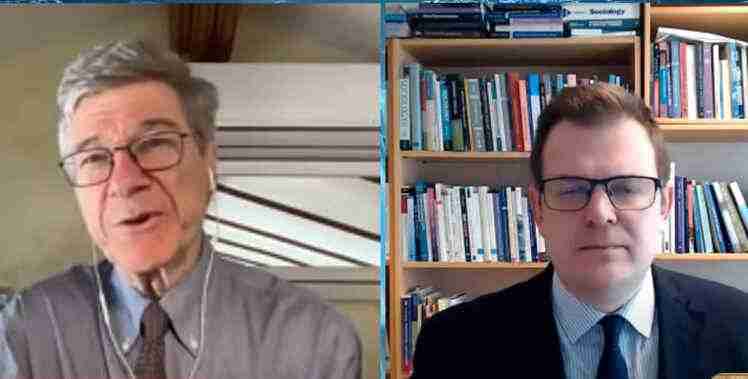
Read the full transcript of a conversation between Professor Glenn Diesen and Jeffrey Sachs on “Chaos & Restructuring of the Global Economy”, April 6, 2025.
The interview starts here:
Trump’s Tariffs and Global Economic Impact
GLENN DIESEN: Hi, everyone, and welcome. I am joined today by Professor Jeffrey Sachs to address some of the economic upheaval as we now see. Trump has really gone all in on these tariffs. And I’m not sure to what extent they are intended to shock the rest of the world as part of a negotiation tactic to renegotiate America’s trade agreements, or if they’re intended to protect domestic industries in the long term. How do you make sense of these tariffs? And what do you think the wider consequences will be for world trade? And as I say this, I’m aware that it’s not a very fair question, given that this is quite unprecedented. So it’s very hard to make predictions.
PROFESSOR JEFFREY SACHS: I think this is truly protectionism, not only a negotiating tactic, it’s protectionism on a totally flawed basis. It is a decision essentially of one person. This is not a decision of the Republican Party. It’s not coming from Congress. It’s not a reflection of the business community. It’s not a reflection of interest groups around the president. This seems, as best we can judge, to be a decision of President Trump.
President Trump believes, incorrectly, that the trade deficits of the United States are a reflection of unfairness in the rest of the world and that the trade deficits need to be closed. The trade deficits are not a measure of unfairness, either directly or indirectly. They’re a measure of America’s heavy spending compared to its income, and that reflects economically the large budget deficits in the United States more than anything else.
We’re running a budget deficit of about 7% of GDP. That means that the US government is borrowing heavily to transfer money to the private sector or to the domestic economy, and that leads to overspending. It’s as if the federal government is the credit card of the country and we’re running up our credit card debt. So Trump interprets this as unfairness. He looks and says, well, if China’s running a trade surplus, they’re cheating us. This is extremely primitive thinking.
And the question comes, how can the United States be in such a primitive political state of affairs that one person’s ideas, especially mistaken ideas, apply? And that’s a related question. My answer is that our political system has become deeply corrupted. Congress is mostly interested in campaign financing, and the system has become overtaken over decades by the security state. So legislation is littered with the emergency powers of the president, and Trump is invoking emergency powers to do his one person bidding on this.
Now, if I add everything up, I would conclude by saying the policies make no sense. I don’t think that they are primarily a bargaining chip. I think they’re primarily the economic fantasies of one particular person. The fact that one person can do it is a massive political failure of the United States. It does not reflect the interests of American business. So American business may revolt. We’re already hearing top business people objecting to what Trump is doing. This is something new because they view Trump as their agent for further tax cuts. But they’re wrecking the American economy.
And Trump has destroyed $5 trillion of market capitalization in just two days. This does not make the hedge fund managers who bought Trump’s election happier. This is something against their interests. Even some people in Congress are beginning to stir that, hey, we have a Constitution. Tariffs are our responsibility, not the President’s responsibility.
We also have a court system in the United States which may very soon rule when a case is brought that these tariffs are illegal because they’re based on an emergency declaration where there’s no emergency. So Trump has made up an emergency in order to invoke emergency powers, and courts may strike that down as well. So all in all, very unpleasant, irrational actions that have been deeply destabilizing in just a few days for the world. They do not make sense. They are not for America first, this is a lose-lose policy.
Global Trade Implications
GLENN DIESEN: Well, certainly stock markets around the world are reacting quite negatively to this. But how do you see wider global trade being impacted by this? For example, there’s some discussions now about a lot of Chinese exports possibly being directed to a large extent towards Europe. The Europeans then might react with some kind of tariffs of their own to protect their industries. Do you see this possibly spiraling out of control, triggering some wider global trade wars, or are you more optimistic?
PROFESSOR JEFFREY SACHS: That’s a very good and very important question. Of course, very uncertain prospect for all the reasons I just mentioned that these policies may prove short lived for one reason or another. But the right answer for the rest of the world is to say we’re going to move forward on open trade without the United States.
So if rational minds prevail, they will say, the United States has made an own goal, quite disastrous one, but it doesn’t ruin the trade for the rest of us. But what you’re proposing is a kind of domino effect where the US actions trigger shifts in trade that then lead to further unilateral protectionism. And if Europe were to raise barriers on China, we would have a cascade downward in the world economy that is familiar in economic history.
By the way, in the 1930s, it was a tariff measure in the United States, the Hawley-Smoot Tariff or the Smoot-Hawley Tariff, depending on which congressman you put first. That was voted in 1930. That initiated a round of protectionist tariff increases all through the world in the early 1930s that led to a cataclysmic decline of trade that greatly exacerbated an underlying banking crisis that culminated in what was a prolonged Great Depression and the prelude to World War II.
So if one looks to history, the United States started the last such trade collapse with a tariff increase that was voted by Congress.
And the question is whether the same will happen now. I hope that Europeans are smarter than simply slapping on new tariffs. I hope that the Chinese and Europeans negotiate to understand Europe should export what it would have exported to the US now to China, and China can export what it would have exported to the US partly to Europe, partly to ASEAN, partly to India, partly to other countries.
Some good news in recent weeks is that China, Japan and Korea at the high diplomatic level have intensified their diplomacy and called for more normalization of relations and reduction of tensions. Similarly, China and India have in recent months at least addressed the border issues that have plagued the relationship. And leaders of both China and India have said that we need to move to strong relations among ourselves. Those are both good signs. But what you point to, the China-Europe trade relations is especially important.
Impact on the US Dollar
GLENN DIESEN: Well, if this can result in, well, it is resulting in a lot of economic upheaval, not just the United States, but the world. What does this mean for currencies or the US Dollar? Would it be. Do you see greater struggles in the weeks and months to come, or would it? Well, it doesn’t necessarily have to be affected to that great extent. Again, I know that the idea of cutting the deficit and re-industrializing would suggest that it would only strengthen the dollar. But assuming that these tariffs do not go as Trump has planned, what do you see happening to the US Dollar?
PROFESSOR JEFFREY SACHS: We already see in the first few days that the usual safe haven effect of the dollar, that in times of insecurity people rush to the dollar, is not occurring now. The opposite is occurring. People are leaving the dollar. The dollar is weakening. I think the confidence in the U.S. economy, the confidence in U.S. political leadership and the confidence in the dollar have all been weakened by the events of the past week.
And in general, I’ve been arguing that the preeminence of the dollar in the international system will in any event decline significantly in the next 10 years. Just as we’ve moved to a multipolar world, we’re going to move to a multi-currency world. There are many reasons for that. One is the underlying gradual decline of the US in the world economy. So the rise of China, the rise of India, the rise of other nations means that the weight of the US in the world system is diminishing. And that means that the weight of the dollar also would tend to diminish.
A second reason is technological. The US dollar based payment system is specifically an interbank system that’s pretty much outmoded. Actually it is the SWIFT system. It’s not cutting edge technology in any way. And the idea of moving to a digital central bank based currency system is likely to come simply because of the change of technology.
The third reason is geopolitics. The US weaponized the dollar, especially seizing, or actually Belgium through Euroclear, seizing $300 billion of Russian foreign exchange reserves. But the US has been behind several seizures of foreign exchange reserves in recent years: Venezuela, Russia, Afghanistan, Iran, North Korea. And this weaponization of the dollar is certainly a good reason not to keep your currency forex foreign exchange in dollars.
Now there’s another point which is that the US has used the dollar based settlement system to enforce other kinds of sanctions as well. So it’s not just seizing dollars, but these secondary sanctions where the US tells third countries don’t trade with Russia for example, are enforced by the SWIFT system. In other words, if a bank in a third country does business with a Russian entity, that bank is then punished when it comes to, or potentially switch sanctioned when it comes to its access to the interbank dollar settlement system.
This also is inducing the BRICS countries to move to non-dollar settlements. It’s a little tricky. They have to establish new institutions, specialized banks for example, that don’t have dollar exposure, that don’t use the SWIFT so that they’re not subject to sanction. But all in all, using non-dollar settlements is not some highly esoteric phenomenon. It’s not something beyond the ken of some straightforward monetary engineering.
And all of this means that the dollar in my view will play a significantly smaller role in 10 years from now. Now saying that that also has geopolitical ramifications of course, because the US has benefited in a number of ways from the preeminence of the dollar. The ability to borrow at low interest rates and seemingly inexhaustibly from the rest of the world is one example. The ability to apply sanctions and to use foreign policy pressures is another. And both of those are likely to diminish, if not disappear.
China’s Response to Economic Coercion
GLENN DIESEN: Well, you mentioned the sanctions because of course these tariffs are not happening out of nowhere. This comes in addition to the growing economic coercion. Now you can say this is against China’s tech sector, but also the legalizing the theft of the Russian as well as the sovereign funds of other countries. What we see that this is happening now? Well, Trump initially seemed to be aware that it was important to rebuild trust again into the US centered financial system. But now that the negotiations aren’t going as well as they had hoped in Ukraine, we see the Trump administration threatening with sanctions now against Russia, also secondary sanctions. So effectively going after anyone in the world who would trade with Russia, which is quite severe given that Russia holds a very important part in the international energy trade. But as economic connectivity continues to be weaponized, how do you see China responding to all of this? Because the situation doesn’t seem stable. It is unraveling, at least it seems to me unraveling kind of fast. So how are the Chinese responding to this, given that, well, they would be the main rival to the U.S. economy?
PROFESSOR JEFFREY SACHS: I think China is trying to hold together the international system. China was not directly threatening the U.S. role in the system. For example, China has not rushed forward to say, use the renminbi rather than the dollar. Quite the opposite. China has been hesitant and slow to internationalize the renminbi and open up Chinese capital markets.
Having said that, China also sees that simply relying on the current system doesn’t work. China itself is the object of countless sanctions, countless pressures, countless crude US containment policies to somehow put a stick in the works of the Chinese system to stop China’s rise. None of it working, I would underscore. But China knows that the current system is a hostile US system, not a neutral system.
So China is taking steps carefully in China’s usual mode through its own national policies, developing a digital renminbi step by step opening capital markets to the rest of the world. And in a very gradual, methodical way. It’s also taking steps through the BRICS to develop non-dollar payments because it knows that many of the BRICS absolutely need it and that China itself is vulnerable to US pressures.
China has been gradually, not dramatically, but gradually diversifying away from the dollar and its foreign exchange reserves and building up non-dollar holdings of many kinds. So this is another matter. All of this is now dramatically accelerated by Trump. Trump is in overdrive in the American interference in the international system. And I think we’re going to see a lot of diplomacy in the coming weeks. Maybe not see it. It will occur behind the scenes. By China and others to try to keep a stable environment. The fact that Asian equity markets are plummeting again now shows that there are very high stakes in this. And I don’t think that China will just sit by. I think it will try to develop stabilizing alternatives.
The Overreach of American Power
GLENN DIESEN: Now, you mentioned the military. Well, the economic pressure, but of course there’s also military pressure. We learned that from New York Times with how deeply involved the US has been actually in fighting Russia militarily, especially since 2022, but also now threatening to bomb Iran, as well as intensifying pressure against China. Given what you described happening in Northeast Asia between the Koreans, Japanese and Chinese, do you see a wider restructuring of the international system because of the military and economic pressure, or have you seen any, I guess, tangible developments?
PROFESSOR JEFFREY SACHS: My own view is that the United States is wildly overplaying its hand that both Biden and Trump had grossly exaggerated visions of American power. Both, in their different ways, think America still rules the world, can threaten the world, can determine global policies, can set the agenda. I had thought that Trump had a bit more realism, at least when it came to Ukraine. It remains to be seen whether they are smart enough to be able to find their way out of that situation.
It’s a little disappointing in recent weeks that what seemed to start in the right direction is showing all the typical signs of US naivete, ignorance, lack of basic understanding of what to do. But in other areas, Trump thinks the American dollar is king. He thinks the American market is king. He thinks the sanctions regime is king. He thinks he can have Greenland and Canada or Panama for the asking. So right now there’s a grandiosity of Trump’s thinking about American power, which is extremely dangerous because it’s delusional and delusions lead to disasters. So this is a very fraught period, actually.
GLENN DIESEN: Well, Professor Sachs, I know you’re very busy, so I won’t hold you anymore. And thank you so much for your time. I appreciate it.
PROFESSOR JEFFREY SACHS: It’s always a pleasure and we’ll do it again soon, I hope.
GLENN DIESEN: Thanks. Thanks.
Related Posts