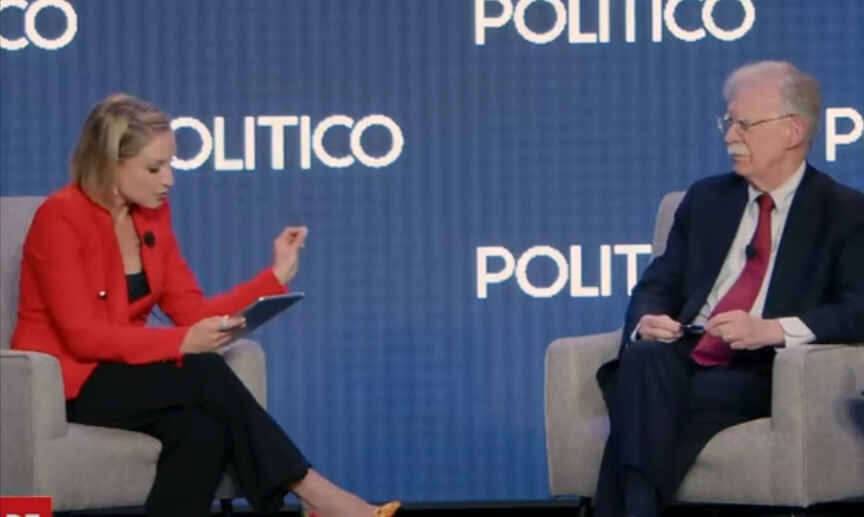
Here is the full transcript of a conversation between journalist Rachael Bade and former US National Security Advisor John Bolton at POLITICO Security Summit (May 15, 2025).
Listen to the audio version here:
Qatar’s Gift to Air Force One
RACHAEL BADE: I’m back. I’m Rachael Bade, the Capitol bureau chief here at Politico, and I am very excited for this next conversation. Obviously doesn’t really need an introduction. John Bolton served as President Trump’s former national security adviser in his first term before their rather infamous falling out. And I’m sure you all know he’s a household name on all things national security, so serving a number of GOP administrations, including as ambassador to the UN Under George W. Bush. So let’s just start with this ambassador. There are not a lot of areas where you agree or might agree with someone like Laura Loomer or Rand Paul, but this week, I think we found one. What is your take on this new $400 million jet that the president wants to accept from Qatar to be Air Force One?
JOHN BOLTON: Well, I think it’s a bad idea for the Qataris as much as it is for us. I came up with the idea yesterday. They should just give us $400 million in cash so that we can rebuild El Udeid Air Base in Qatar or Central Command and headquarters in Tampa. I think they’re going to get their reputation tarnished. And I think the impression that we’re going to leave the people is that the White House is open for the highest bidder. I don’t think Trump really expects to get this plane before the end of his term. I think he wants it to fly after he leaves the presidency, and that’s what triggers the emoluments clause argument.
I think the whole thing is unnecessary.
RACHAEL BADE: Ethical concerns aside, my gut reaction to this was like, would I want to fly on a plane that had been gifted from Qatar? I mean, security and technical reasons. Can you get into that? Like, is it safe for the President of the United States to fly on a plane coming from a country that had or has had ties to terrorists?
JOHN BOLTON: It’s not safe to fly on any other country’s plane. That’s why we buy planes from Boeing. They’re taking longer than it should, but that’s the only secure thing. I don’t think it would have mattered what country gave us the plane. They’d still have to strip it down basically to the airframe to make sure there wasn’t anything in there that we didn’t want to have it and to redo it, which is going to take an awful lot of work.
I mean, I don’t know whether this plane has aerial refueling capability, but Air Force One needs it. And I just kind of put a hose on the end of the Boeing 747 and expect it’s going to do it. It’s going to a lot of work, and it’s all totally unnecessary.
Iran Policy and Nuclear Negotiations
RACHAEL BADE: Let’s talk a bit about Iran, because there have been a lot of questions about President Trump’s posture toward Iran and what he actually wants. You have people like J.D. Vance, vice president, and much of sort of the MAGA wing, saying that they don’t want war and they don’t want to, you know, get sucked into war. And then we also know that Michael Waltz, who had been reportedly coordinating with the Israelis about a potential military action of some sort against Iran, he was pushed out, although we don’t know if it’s because of ideological reasons or more internal drama. But I guess I’m wondering, you know, people sort of take that, you know, they take different meanings from these things. And I’m curious, do you think, as somebody who worked with President Trump, do you think he actually wants a deal with Iran, or is this sort of like a check the box and then we’re going to go to war?
JOHN BOLTON: Well, I think he wants to deal with everybody. That’s what he does. He does deals. He doesn’t have a philosophy. He doesn’t have a national security grand strategy. He doesn’t do policy. As we understand that when people describe him as transactional, that’s what it is. He was persuaded in April and early May of 2018, when I was getting him ready to get out of the 2015 Obama deal, he was persuaded by French President Macron and Chancellor Merkel of Germany to try for a big deal with Iran that would include their terrorist activity, their ballistic missile program, as well as the nuclear program. But he at least understood he had to get out of the 2015 deal.
Now Iran’s never going to deal on terrorism or the ballistic missile program, and they’re not really going to deal on the nuclear side either. They’ve shown no evidence whatever that they’ve changed their strategic decision to get nuclear weapons. I think this is a waste of oxygen. And if he does agree to a deal, it’ll be a deal that Barack Obama will heartily endorse.
RACHAEL BADE: Well, that was actually my next question, if you thought Iran would ever agree to some sort of proposal where enrichment was only allowed outside the country. Like, are they going to. Would they ever sign off on something like that? They’re not.
JOHN BOLTON: There’s not only no evidence of that. The EU3, as we called them then, because Britain was still in the EU. But Germany, France, and Britain tried exactly that line of negotiation in the early 2000s, that Iran could have civil nuclear reactors but have no enrichment or reprocessing capability, no capability to reprocess plutonium out of the spent fuel, which is the other road to nuclear weapons. And the Iranians just said flatly no.
I mean, the central flaw of the 2015 deal was to allow Iran any uranium enrichment capability. Whatever. We don’t even allow. When we license our nuclear technology for the construction of civil reactors, we typically insist that the country receiving the license commit not to do uranium enrichment and plutonium reprocessing. And our Arab friends in the region said, you won’t even allow us to do uranium enrichment, yet you’re going to allow the Iranians to.
RACHAEL BADE: I was going to say, what is the, you know, to somebody who might make the argument, maybe someone in more the JD Vance wing of the party, that it’s okay as long as they’re making promises that it’s not going to, you know, end up with a nuclear weapon. Is it just, you know, they’re lying through their teeth on that? Or, like, why is it. Why would it be so bad?
JOHN BOLTON: Because they are lying through their teeth on it. And it’s not a question of trust, but verify. There’s no basis for trust there. And by the way, there was no verification. There has never been a single inspector of the International Atomic Energy Agency that’s ever been on one of Iran’s military bases where the weaponization work is done. You just don’t enrich uranium and then, you know, light a match and hope it goes off. You have to build a nuclear weapon, which they’ve been hard at work on. And that work has gone on essentially unscrutinized by the international community.
RACHAEL BADE: So basically, you think we’re going to wind up with Obama’s Iran nuclear deal with just a MAGA label slapped on it?
JOHN BOLTON: Well, that’s what Trump may do. He’s making a big mistake. I think this actually will cause dissension within the Republican Party. I mean, there’s some dissension now, but not much. But I think this will set a lot of people off. And I think, remember in 2001, the Israelis did not ask permission to bomb Saddam Hussein’s reactor at Osirak in 2007, the Israelis did not ask us permission to bomb the Iranian reactor at Deir Al Zor in the Syrian desert. And I think this time I don’t think the Israelis will ask permission to go after the Iranian program.
Syria Policy and Sanctions Relief
RACHAEL BADE: I was going to. Actually, one of my questions was how are they going to react to all these talks? But before I get to that, I want to ask a related question. We’ve seen a lot of bipartisan support and a lot of praise for President Trump from Democrats for lifting sanctions on Syria. I am curious your take on this. Do you feel like, you know, Mr. Art of the deal, you know, gave something big away without getting enough in return?
JOHN BOLTON: Well, I think he acted far too precipitously. This group that’s now in charge in Syria used to be the Al Nusra Front, which is an Al Qaeda affiliate. Al Jelani, as he used to be known. Al Sharra, as he is now, having abandoned his nom de guerre and trimmed his beard and put a coat and tie on instead of his combat fatigues, had a bounty on of about $10 million for his terrorist activities. Of course, he’s saying that he’s given up terrorist activities because he wants Western money. He wants access to all kinds of things from the West.
I think his words are not nearly enough given his own personal record. As Trump said, he’s got a strong background. Yes, the man was a terrorist and could well still be. So Trump asking to exchange diplomatic relations with Israel and kick terrorists out, that’s fine. He should have gotten that promise before he lifted the sanctions.
He also should have asked for a complete transparency in all of the Assad regime’s hostage taking of Americans and other foreigners, everything that’s in their archives. He should have asked for international inspection or US Inspection of all potential chemical and biological weapons sites. He should have asked for complete opening of the Assad regime’s archives on its dealings with Iran, on the nuclear program like the Deir Ez-Zor reactor. He should have asked for guarantees that the new regime in Damascus will resist Turkish efforts in northern Syria, that he’ll bring into a real broad based government the Kurds in eastern Syria, the Druze, the Alawites and other minorities, and that he’ll make a serious effort at peace with Israel. One more thing, that he kicks the Russians out of the Tardis naval station and their air base a few miles away. Now, you might not get all of them. I just got started, actually. I could name a few other things we wanted.
RACHAEL BADE: I think you just listed like show.
JOHN BOLTON: You’re not a terrorist. Don’t tell me you’re not a terrorist. Show me you’re not a terrorist.
Ukraine-Russia Conflict
RACHAEL BADE: You just mentioned Russia. Let’s talk about Ukraine and Russia. So today in Istanbul, I believe it was Putin’s idea for him to meet with Zelensky. He didn’t show up. Naturally. You have said the other day that you think Putin is overplaying his hand. You’ve also said that you think Trump is being suckered by Putin, who’s just sort of dragging these talks out. Do you think there actually comes a point where President Trump gets basically fed up with Putin sort of slowing this process down? Like, could he. And would he actually slap sanctions on Putin and Russia?
JOHN BOLTON: Look, he’s given Putin enormous concessions already. He’s conceded before negotiations start that he’s not going to demand that Ukraine be restored to its full sovereignty and territorial integrity, which has been the position of the entire west since the day of the second invasion in February. He said that there’s going to be no NATO membership for Ukraine, no NATO security guarantees for Ukraine. That’s pretty much the most Putin could hope to get. That has simply encouraged Putin to go further, to demand that all four of the Donbass provinces of Ukraine be ceded to Russia, which he doesn’t control militarily.
These are the kinds of things that could push Trump over the edge because he doesn’t want to be humiliated. But on the other hand, Trump’s gone a long way to appease Putin and not put things in place. Let me just say one thing about the sanctions. The Europeans are preparing a package of sanctions. It will be, according to The Press, their 17th package of sanctions since the invasion. And we’re in the same position. We’ve put on sanctions time and time again.
This is not the way to do sanctions. There’s no reason after the invasion why all 17 packages that they eventually imagined shouldn’t come on immediately. Sanctions only work when they’re massive, when they’re swiftly applied, and when they’re strictly enforced. And we just haven’t done that with Russia. That’s why Russia continues the war. So if you ask me if US sanctions package 7 is possible with Trump, the answer is yes. Will it have any more effect than the first six? I kind of doubt it, given the poor way we enforce sanctions.
RACHAEL BADE: I want to zoom in a little more on, like, President Trump’s psychology here. And, I mean, as somebody who worked with him, can you speak to why, you know, he always uses the stick with Vladimir Zelensky and the carrot with Putin, I mean, what is it about not being able to take out the stick and just say, look, you need to come to the table, you know, fly to Istanbul and say, I’m here. Zelensky’s here. Where are you? Why doesn’t he do that?
Trump’s View of International Relations
JOHN BOLTON: Trump sees international relations as equivalent to the personal relationships of their leaders. So if he’s good friends with Vladimir Putin, he thinks that the US has good relations with Russia. And conversely, if he doesn’t have good relations with Volodymyr Zelensky, dating back to the famous perfect phone call that led to the first impeachment, then we’ve got bad relations with Ukraine. He sees it the same way with Xi Jinping. They’re friends. When he met with Kim Jong Un, he said in response to a question a few days later, we fell in love.
Now, that’s not the way Kim Jong Un, Xi Jinping and Vladimir Putin see Donald Trump. But, you know, would you slap your friends around gratuitously in public? No. You’d try and work with. Would you slap people you don’t like around in public? Yeah, you do it all the time, including in the Oval Office.
RACHAEL BADE: That’s interesting. Just to stay on this topic a little longer, can you sort of take us into or give us a look at how President Trump sort of approaches these foreign policy decisions? Like, does he go around the room and, you know, there’s been this sort of narrative about President Trump that he likes people who disagree and he likes to hear all different things, and then he disagrees sides. Like, how was it when you worked for him?
Trump’s Decision-Making Process
JOHN BOLTON: Well, it varies considerably. There’s no pattern. And I think that’s part of the problem with decision making with Trump. It’s not disciplined. It’s not driven by data and by options. It’s very ad hoc. And often it’s the last person who sees him who influences the decision. I thought this is the mistake I made before I took the job. I thought, like every one of his predecessors, that the gravity of the responsibilities in the national security area, the enormous impact of the decisions that he would have to make, would discipline his thinking so that the National Security Council process would present him with all the data he would need to be fully informed. It would present him with a range of options. It would give him the pros and cons of the options, and then he could make a decision that’s the farthest thing from the way decision making was done, certainly during the time I was there, and I think through most of the first term. I don’t think, as far as I can see from the outside, it’s gotten any better in the second term.
RACHAEL BADE: And it sounds like you wrote in your book a little bit about this and how he didn’t at one point said something along the lines of, I should have chose Keith Kellogg or someone else because that person only speaks when spoken to, when you were trying to push back on something. I mean, is that right?
JOHN BOLTON: Well, this is. This is you’ve been reading, I’m sure, about the changes that apparently are about to be made in the National Security Council staff, which will radically transform what it does and what the National Security Advisor does. It could be that Jake Sullivan, who is your next guest, will turn out to be the last real National Security Advisor. The event you were talking about was Mike Pompeo and I were in Brussels with him in 2018 before the NATO summit, trying to persuade him not to withdraw from NATO. And at one point he turned to Pompeo and said, you know, I knew I should have made Keith Kellogg National Security Advisor. He only gives me his opinion when I ask for it. Well, the name of the job is National Security Advisor. So presumably you advise to be National.
RACHAEL BADE: Security sidekick, National security bag carrier.
JOHN BOLTON: You know, he wants people who will say, yes, sir, and he wants the National Security Staff according to the reorganization reports, but based on my own experience, not to say. But, Mr. President, have you considered A, B and C? Have you thought of options X, Y and Z? He just wants people to say, okay, it sounds good to me.
On Marco Rubio’s Dual Role
RACHAEL BADE: So you just brought up the new Marco Rubio’s latest job of what, a half a dozen or something like this I can’t keep track of. You’ve been critical of this new role, saying, you know, it’s going to be tough for him to be Secretary of State and National Security Advisor. Just walk us through. What was your, you know, typical 9 to 5 when you were in that job? I guess there was. It’s not 9 to 5. It’s probably like, what, 7 to, like, 10pm or something like this. But point being, was there any room in your day to, you know, oversee the State Department at the same time?
JOHN BOLTON: It’s simply impossible to do. The circumstances when Henry Kissinger filled both positions were the depths of Watergate, when people thought Nixon was cracking up. And he may have been. And he stayed on in that position for some time after Gerald Ford became President, until Ford himself recognized this wasn’t working. And we’re just. We should be happy that we had Henry Kissinger. It’s no knock at all on Marco Rubio, but there’s only one Henry the K and the positions really have very different functions.
Running the State Department, being in charge of American foreign policy is a more than full time job. And doing the coordination work of the NSC to make sure the president has everything he needs to make decisions and then following up with the bureaucracies, including the State Department, including Defense, the intelligence community, Homeland Security, treasury, all the rest of them is what the NSC does. And you can’t do both simultaneously and fulfill what Brent Scowcroft set up as the honest broker role for the national Security advisor.
RACHAEL BADE: What do you make of the new Marco Rubio? I’m sure you’ve been watching some of the things he’s been doing on the world stage. I mean, once a big supporter of certain types of US Foreign aid, that’s gonzo co sponsor of a resolution to bar the US from ever recognizing Russia’s sort of, you know, ownership of certain parts of what was formerly Ukraine, Crimea. Now, you know, Russia saying they want all of these things, Donbass, etc. Like, what do you make of this makeover?
JOHN BOLTON: Well, it’s a fact that the president is the decision maker on big foreign policy issues. And in any position you take at any level of government, you have to appreciate that you’re your superiors can overrule you. And if that gets you upset, then you’re really not suitable for government employment because much of your life is getting your positions overruled. The question though at that level is what positions that you lose. The internal debate on so fundamentally contradict your basic philosophy that your integrity prevents you from going any further.
And I think Marco Rubio has integrity and I think there’s going to come a point where he won’t be able to serve any longer. And I don’t obviously we haven’t reached that point yet. I mean, after all, we’ve spent four months in the administration yet and we only have 44 months to go. Is there anything new that’s coming? But it’s I reached my point. Others reach their points. We’ll see what happens.
On Trump’s Special Envoy
RACHAEL BADE: I have wondered because, you know, there was always this theory around Senator Lindsey Graham who big, you know, defense hawk, DOD hawk, but also Trump ally. And you know, he sort of employed the strategy of like you pick your battles. You know, you suck up to the president where you can, you know, you buy some, win some chits and then cash them in at some point when you need to. And I’ve sort of wondered if Rubio is doing the same. You’ve been critical of President Trump’s special envoy seat, Wyschkoff. You called him a, quote, disaster in the making. What’s your issue with him?
JOHN BOLTON: Well, given his responsibilities in the Russia, Ukraine, war, and Iran, just to take those two, you know, he knows he came to the job. He knows nothing about Russia. He knows nothing about Ukraine. He knows nothing about Iran. He knows nothing about nuclear weapons. He knows nothing about international arms control and nuclear proliferation, knows nothing about verification and compliance of international agreements. What could go wrong?
RACHAEL BADE: Well, I mean, I think some Trump allies would argue maybe that’s a good thing.
JOHN BOLTON: Yeah. So that’s the argument. Would you hire the country’s best divorce lawyer to handle your next antitrust case?
RACHAEL BADE: Probably not.
JOHN BOLTON: Probably not. Look, I think he’s already shown himself vulnerable to Vladimir Putin’s manipulation. He conveyed Russian propaganda that he heard from Putin on the situation of the Ukrainian troops inside Russia, conveyed that back to Trump, who promptly said it publicly, said, the Ukrainians are surrounded, they’re about to be slaughtered. That was not true. But that’s what the Russians wanted the world to believe. We can only imagine what other Russian propaganda went from Putin through Wyckoff to Trump. We’ve seen him take the word of the ayatollahs, and there are various commitments, quote, unquote, on the nuclear program. You know, I think it’s a real danger for Trump politically if he allows these negotiations to end in humiliation for the United States and for him personally.
Trump 1.0 vs Trump 2.0
RACHAEL BADE: You’re a big fan. A couple last questions for you. One is one that I believe a question you get all the time. What’s different between Trump 1 and Trump 2, we were just talking about this a little backstage, and you said you actually recently came to some new thoughts on this.
JOHN BOLTON: Yeah, I had thought really there wasn’t much difference because a lot of the behavior people remark on now we saw in private before, he’s just less inhibited. He was during the campaign, too. It’s just whatever he wants to say, he says. But the confusion of personal business and the office of the presidency, I think is a lot more visible. The family business and the presidency, a lot more visible now, I have to say, in the first term, I did not see, at least that I understood at the time, evidence of that mixture of the two things. I think you can see it in public now, and I think that’s damaging for the United States, damaging for the presidency, and ultimately it’s damaging for Trump, although he doesn’t see it that way. Obviously.
What Trump Is Doing Right
RACHAEL BADE: I just lost my train of thought on my last question for you, Mr. Bolton. Oh, yes. I remember I asked you when we did a podcast a couple of weeks ago if you thought President Trump was doing anything right. I want to revisit that because even since we talked, like a month ago, I feel like a million things have happened. What do you think he’s actually doing well in foreign policy, national security?
JOHN BOLTON: Well, it’s a stretch to get into it as national security, but there is a connection. I think he has closed the border with Mexico. He has done fairly quickly what he accomplished in the first term, and that’s important not simply for illegal immigration, but for drug trafficking concerns, human trafficking concerns, espionage agents coming across the southern border. And he did it by relying on the theory of deterrence. If you’re in Central America or South America or China, for that matter, and you think walking toward the Rio Grande across Mexico is going to lead to you being turned away at the border, then you’re not going to walk across Mexico. You’re going to stay where you were and hope for a change in administration. So I think that’s a very important political issue for Americans for good and sufficient reason. And I think he has fulfilled his commitment to close the border for all intents and purposes.
RACHAEL BADE: Yeah. Well, if he does land this Ukraine, Russia deal, which the previous person I interviewed up here, Senator Schmidt, says he thinks is going to happen, that would be huge. Would you agree? Would be.
JOHN BOLTON: Would be maybe in a paradise world. Yeah.
RACHAEL BADE: That’s all the time we have for. Thank you, Ambassador Bolton.
JOHN BOLTON: Thanks a lot.
RACHAEL BADE: And everybody, stay tuned for part two of our conversation about national security. Up next, we have Playbook managing editor and author Jack Blanchard, my colleague and former National Security advisor, Jake Sullivan. Thank.
Related Posts
- Transcript: Vice President JD Vance Remarks At TPUSA’s AmericaFest 2025
- AmericaFest 2025: Tucker Carlson on America First Movement (Transcript)
- Prof. John Mearsheimer: Unintended Consequences of a Meaningless War (Transcript)
- “It’s Really Not About Drugs” – Max Blumenthal on Mario Nawfal Podcast (Transcript)
- Erika Kirk’s Interview on Honestly with Bari Weiss (Transcript)