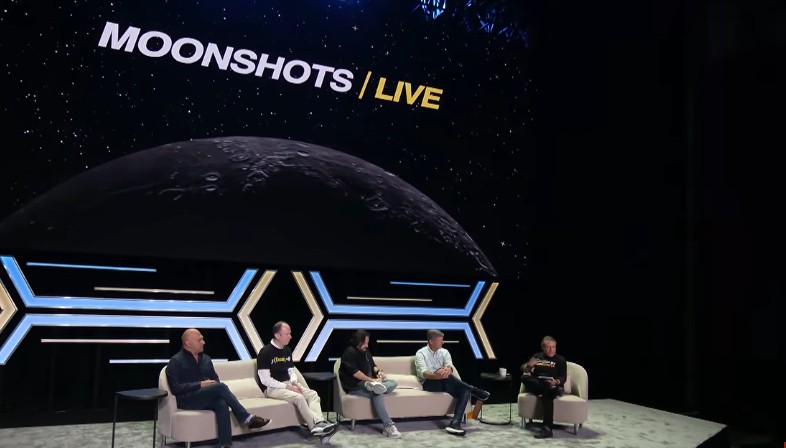
Editor’s Note: Colossal Biosciences CEO Ben Lamm joins Peter H. Diamandis, Dave Blundin, Dr. Alexander Wissner-Gross, and Salim Ismail on Moonshots #297 to discuss de-extinction, the woolly mammoth project, artificial wombs, and large-scale gene editing. He explains why AI foundation models still need wet-lab validation, how global biovaults could back up life on Earth, and why mammalian ex utero birth could arrive within 24 months. Read the full transcript of this conversation below:
Teacup Mammoths and the Woolly Mammoth Project
BEN LAMM: (00:00:05 – 00:00:14) I was a little terrified backstage when Palmer’s like, there’s something on the screen that says I’m not supposed to say this. It’s like, for the love of God, whatever it is, please don’t make it about Colossal.
PETER H. DIAMANDIS: (00:00:14 – 00:00:32) Please don’t say it. So I remember at Abundance 360 last March, just before you came on, Elon was there. And you said, yeah, I want a pet woolly mammoth. How are you doing on that project?
BEN LAMM: (00:00:33 – 00:00:43) We get that request. Yeah, but there was actually an amazing— I think it was either American Dad or Family Guy episode where they explained— did you see this? I don’t know if you guys saw this.
DAVE BLUNDIN: (00:00:43 – 00:00:44) It’s all over the internet.
BEN LAMM: (00:00:44 – 00:01:04) They explained CRISPR and it was amazing. And it was amazing because then at the end they’re like, yeah, and the woolly mammoths came out and they’re about the size of a dog. That’s actually how big they were. The fossils were just wrong, right? So it was amazing because it explains CRISPR. But we get the requests, the number 2 request we get is teacup mammoths.
PETER H. DIAMANDIS: (00:01:04 – 00:01:04) Teacup?
BEN LAMM: (00:01:04 – 00:01:22) Teacup mammoth. Everybody wants a teacup. They want to take a mammoth and put it in your purse, right? And so when, I mean, we can engineer a new melanin, make it pink, and then Paris may want one. So we are not working on that currently. But we’re making good progress on the mammoth project.
Entering Synthetic Biology as an Outsider
PETER H. DIAMANDIS: (00:01:22 – 00:01:38) So amazing. So let me kick this off. You’ve started 4 successful companies before Colossal in gaming, in defense, in AI, in mobile. And so you knew nothing about synthetic biology.
BEN LAMM: (00:01:38 – 00:01:38) Yeah.
PETER H. DIAMANDIS: (00:01:39 – 00:01:53) Before you started, now a company worth over 10 billion dollars. So what made you make de-extinction your moonshot? And having no background in synthetic biology, was that a hindrance or an advantage?
BEN LAMM: (00:01:53 – 00:02:57) Oh, I think it’s a massive advantage. I think that it affords me the opportunity to go into rooms of, Palmer talked a little bit about this too, of hiring people to replace you and hiring people that are much smarter than you, right?
And so what’s great about this from my vantage point is I get to deal with a lot of the same bullshit, but at the same time I can go in and sit down with Beth Shapiro and learn about ancient DNA extraction and how not to do things. But then the next meeting I can go learn about where we’re pushing the boundaries of multiplex editing and how many edits that we can make at once, right?
And so I would say that I guess in all of my career I’ve known how to ask the right questions because I’m really curious. But I really do subscribe to that old adage of putting the top smartest women and men around you, just ask them the questions, right? And so I get to go to meetings to just ask questions. And 90% of the time I think people are like, okay, if you knew more about biology, this meeting would go faster. But then 10% of the time they’re like, we never thought of it that way, right?
PETER H. DIAMANDIS: (00:02:57 – 00:03:12) Because by the way, this is such an important lesson for all of us as entrepreneurs, right? Just because you’re not an expert in an area doesn’t make it an area that you shouldn’t go into if you’re passionate, attract the best talent around you.
George Church, the Father of Synthetic Biology
BEN LAMM: (00:03:12 – 00:03:34) Yeah. George Church. And this is the only brag that I will say, which I’m very proud of. George Church says that I am the best student he’s never had, because I will literally just pepper him and be like, hey, my favorite times of the year are during holiday seasons when no one’s working, because I will just get on calls for hours and hours and hours with George Church and just talk about the possibilities with synthetic biology.
PETER H. DIAMANDIS: (00:03:34 – 00:03:35) Who’s George Church for everybody?
BEN LAMM: (00:03:35 – 00:04:29) Oh, so if you don’t know George, George is arguably the father of synthetic biology. He’s the head of genetics at Harvard. And a lot of the next-gen read-write technologies that were invented came out of the Church lab, and his lab’s prolific. There’s been numerous multi-billion dollar companies that have spun out of the lab. It’s probably the most active startup biology lab in the world.
And he’s also 6’7″ with narcolepsy and hilarious and such a sweetheart guy. And he is the most collaborative person ever, right? And so he’s also hardcore, even though he doesn’t come from software, he’s hardcore into open source. And just trying the democratization of technologies like genome sequencing. He wanted that to go from billions to 100 dollars, which he was very active in that category. And so he is literally just the most collaborative co-founder I’ve ever had the pleasure of working with.
AI Foundation Models and the Business of Biology
DAVE BLUNDIN: (00:04:29 – 00:04:44) Dave?
DR. ALEXANDER WISSNER-GROSS: (00:04:44 – 00:04:44) Yeah.
DAVE BLUNDIN: (00:04:44 – 00:04:58) So, I mean, it’s great to get your perspective as a serial entrepreneur who came into biology from the outside. So my first question on the business model is the foundation models. We just saw that out of the box, Astra can drive a car.
BEN LAMM: (00:04:59 – 00:04:59) Yeah.
DAVE BLUNDIN: (00:04:59 – 00:05:03) Is it going to do biology out of the box or do you say, no, no, no, no, we need to build our own?
BEN LAMM: (00:05:03 – 00:05:42) You still have to. So the foundation models now, and we’ve been very fortunate to work with both OpenAI and Anthropic and getting early access to some of that stuff, which has been great. For a long time, we were leveraging it for thoughtful middleware, right? Coming from a software perspective where we were connecting lab notebooks and Jira. I mean, one of the hardest things that we did at the company was retrain scientists to work in Jira. So that’s harder than some reprogramming at times. And so for a long time, the LLMs before the frontier models were really good at writing term papers, right?
DR. ALEXANDER WISSNER-GROSS: (00:05:42 – 00:05:42) Yeah.
BEN LAMM: (00:05:42 – 00:07:48) They weren’t really great at doing ancestral state reconstruction or comparative genomics, right? That’s where they just didn’t work, which would have been amazing. So for a long time we were leveraging them for middleware layers of infrastructure so you don’t have to go hire the Deloittes or Accentures of the world to build all these systems and reporting, right? So I think we were very successful at deploying that for a long, long time.
Now they’re getting pretty far where you can run simulation experiments. There’s a bunch of companies out there that are standing up, Lila and others that are trying to do lab automation around it, right? We’ve been pretty thoughtful about how and when we invest in that category. But I think that what you’re going to find is interesting insights between connections that are really still language problems, right?
So for example, if you search the literature on everything on mice, if you just want to go build a new therapy company or whatever for humans, and you go look at all of the published papers on mice, many of them, they’ll call a gene a different thing, they’ll classify it differently, they’ll run that experiment slightly differently. And so if you go try to run the exact same experiment, you’re going to get somewhere between 40% and 60% failure rate on published work, which is terrible, right?
So where I think AI is going to be really helpful in the next wave outside of small molecule drug discovery is eliminating that gap and bridging that nomenclature between work. There’ll be times where we’ll do work and we’ll find out later that there was a peer-reviewed published paper on one of the things that we were trying to solve, but the way we were looking for it wasn’t findable on PubMed or whatnot.
So in the short term it’s going to bridge the communication layer, but I do think you’re going to see— and I think Anthropic announced this a couple days ago, right, and you have Ginkgo and others that are now going to test it. You’re still going to need to have a wet lab experiment to test and validate those. But running simulation, design across a myriad of different experiments and helping creatively come up with the next experiment, I think that’s where we’re going to see AI in biology for the next 3 to 5 years.
DAVE BLUNDIN: (00:07:48 – 00:08:07) But what about this, if I think about text data and research results and going through thousands and thousands of prior tests, that’s all LLM city. But what if my input vector is just a gene sequence? If I dump that right now into Anthropic, pretty sure nothing good is going to come out the other side.
Global BioVaults and the Value of the Dataset
BEN LAMM: (00:08:07 – 00:09:37) Yeah, but at scale. So thank you for the tee-up. That is what I fundamentally believe is the importance of our global BioVault system that we’re rolling out, right? So we’re trying to roll out this Noah’s Ark 2.0 model. Not that Noah didn’t get it really right in the first stage, but at least ours is slightly different. We’re doing ATAC sequencing and other things that he didn’t do. And so we’re going out and trying to work with governments around the world to stand up localized biovaults to get all of that so that we can do T2T sequencing.
And so to your point, I do not think that a single genome is going to— you’re not going to feed it into Mythos and it’s going to be like, oh, well if you make these 6 changes, it’s immortal, right? But I think that if you go look at thousands of genomes across all these evolutionary lanes in avian species and see that they are not susceptible to many of these diseases, you’ll look at that, right?
We’re doing that on a small scale with things like P53, immortal jellyfishes, other things, looking at known outcomes of the species and then trying to backtrack it down the tree of life. So we’re doing some of that right now at one of our companies, which we’re pretty excited about, and early indications are positive. But to your point, you’re not just going to be able to throw a genome in and it’s going to be like, oh, here’s how you fix it and makes it perfect. But I do think that amount of data from a comparative genomics perspective at scale will get you there.
SALIM ISMAIL: (00:09:38 – 00:09:38) Mm-hmm.
BEN LAMM: (00:09:38 – 00:09:45) But I also think, so I would make the argument that the dataset is more valuable than the model.
DAVE BLUNDIN: (00:09:45 – 00:09:45) Yeah, yeah, yeah.
BEN LAMM: (00:09:45 – 00:09:46) Because I have the dataset.
PETER H. DIAMANDIS: (00:09:46 – 00:09:48) We’ve made that point so many times.
DAVE BLUNDIN: (00:09:48 – 00:09:48) Yeah.
PETER H. DIAMANDIS: (00:09:48 – 00:09:49) Alex.
De-Extinction and Russian Cosmism
DR. ALEXANDER WISSNER-GROSS: (00:09:49 – 00:10:00) Yeah, I’d love to talk a bit about de-extinction. I’m cognizant that you now have 4+ spinoffs, but nonetheless, de-extinction, I think, is still what you and Colossal are perhaps best known for.
BEN LAMM: (00:10:00 – 00:10:01) And certain things we’re not supposed to talk about.
DR. ALEXANDER WISSNER-GROSS: (00:10:02 – 00:10:31) We won’t talk about those, though. So de-extinction. There was a Russian philosopher, Nikolai Fyodorov, late 19th century, parent of a strain of philosophy called Russian cosmism, that argued that the ultimate trajectory of humanity in developing science and technology would be essentially to develop the technology to revive every human who’s ever lived. Russian cosmism, you can look it up. So de-extinction, in some sense you are—
BEN LAMM: (00:10:31 – 00:10:35) We are not doing that currently. Just to clarify.
DR. ALEXANDER WISSNER-GROSS: (00:10:36 – 00:11:03) Good to know. But in some sense, by de-extincting various model species, including the woolly mammoth, you’re the first company, to my knowledge, on Earth that at least has a plausible business model, or at least technical trajectory, to try to go after the entire historical biosphere. So maybe not even just every human who’s ever lived, but every non-human organism that’s ever lived.
BEN LAMM: (00:11:03 – 00:11:03) Right.
DR. ALEXANDER WISSNER-GROSS: (00:11:04 – 00:11:24) In an era of superintelligence where grand challenges are falling left and right, do you think that humanity’s common task, as the 19th century Russian cosmists thought, that we’ll ultimately have the technology to revive every organism that’s ever lived, or at least every human? Do you foresee that becoming possible?
BEN LAMM: (00:11:25 – 00:11:49) I do not. I think through DNA synthesis, prediction models, and some components of synthetic biology, we will be able to get pretty close approximates. I don’t think though, with 2 big caveats. Number one, just a second, I have to throw this out there. Colossal does not use any of our technologies at Colossal for humans, so we won’t do that, even though I think our technology—
DR. ALEXANDER WISSNER-GROSS: (00:11:49 – 00:11:51) You’ll need a spinoff for that, is that what you’re saying?
BEN LAMM: (00:11:51 – 00:12:01) I think that when you start working with humans, you need sometimes different investors, and definitely different governance, right? And you go through different processes.
PETER H. DIAMANDIS: (00:12:01 – 00:12:02) And more patience.
BEN LAMM: (00:12:02 – 00:13:39) And more patience, right? That was actually really good advice I got from Bob Nelsen. Bob Nelsen in the early days was like, hey, don’t apply any of this to humans for a while because you effectively go into code freeze with the FDA and you’re just going to be in this monotony forever. Go get the technologies until they plateau before you then take them out.
But back to your question, I think that fundamentally most organisms, remember these are the organisms that we know, but very few people realize this, there’s less than 100 T-Rexes that have ever been— I just won’t go down the path, it’ll scare you. There’s less than 100 T-Rexes that have ever been found, right? But with that, there’s billions that allegedly were on Earth at different points in time, right? And so very few things leave a fossil record.
So I think it’s more likely that we will be able to engineer life from a programmable life perspective in the way that we want it than just bring back everything that ever existed, because I don’t even think we know, right? I think it’s probably highly likely based on AI superintelligence at some point where we get to the point where we’re saying, oh, we’re going to engineer this thing. And to your question, maybe it did exist, but we just never know because it left no fossil records, right?
So I think it’s more likely that we will be engineering life to our advantage than trying to bring back things. And even if Colossal or a subset of our technologies, both cloning and genome engineering, can bring back things, as you know, environmental factors, epigenetics, all these other things, if we could clone Mozart, that doesn’t mean that he’s going to come out and be like, oh, I’m going to solve where the terrible trajectory of music has gone.
DR. ALEXANDER WISSNER-GROSS: (00:13:39 – 00:13:52) Well, just maybe a follow-up question. So for Mozart specifically, we do know quite a bit about Mozart’s life. So arguendo, if we did want to resurrect Mozart, we’d have no problem at all with reconstructing his childhood environment.
BEN LAMM: (00:13:53 – 00:14:41) To a point, right? To a point, right? And so I’m not— and by the way, just to be very clear, I am not encouraging in any way this line of questioning where we are taking humans and growing them. I feel like you’re going to go down this Michael Jordan, LeBron, super basketball thing in a second and scare me.
So I do think it’s highly likely that if we were able, or it’s not highly likely, it’s 100% accurate to say that we understand their genetic disposition and aptitude towards these certain traits, and under the right environments, if you want to go all simulation design on them, and put them in the right environments, then they could probably, your Mozart 2.0 could probably be better than the Mozart 1.0.
PETER H. DIAMANDIS: (00:14:41 – 00:14:55) But Ben, let’s bring it back to the animal kingdom, because right now the whole thesis is that the AI systems can design the genome sequence that reflect a phenotype. So if you want an animal that’s bigger—
BEN LAMM: (00:14:55 – 00:14:57) It’s getting better. It’s not 100% there yet, but—
PETER H. DIAMANDIS: (00:14:57 – 00:15:07) But that’s the objective, right? If you want an animal that’s got a longer snout or an animal that has wings, so I asked you on stage at FII, could you make a Pikachu?
BEN LAMM: (00:15:08 – 00:15:18) Yeah, that seems to be a weird fan favorite. People are more accepting, I think, of Pikachu than these large genetic human camps that you’re thinking.
DR. ALEXANDER WISSNER-GROSS: (00:15:18 – 00:15:19) Branded species.
BEN LAMM: (00:15:19 – 00:15:25) Yeah, yes. I think people are more open to that model of genome engineering than—
DR. ALEXANDER WISSNER-GROSS: (00:15:25 – 00:15:34) But it’s not just— maybe to tie a bow on this, it sounds like it isn’t a technical objection per se, it’s more worries of social, political, regulatory concerns.
BEN LAMM: (00:15:34 – 00:15:35) Correct, correct, yes, and ethical.
The Ethics of Bringing Species Back
SALIM ISMAIL: (00:15:35 – 00:16:02) So this is where I’d like to jump in. Stewart Brand made this famous comment, Peter, you named the title of your book, he said, “We are as gods, we might as well start acting like it,” right? And he said that in 1968. We are at a point where you can de-extinct or bring back any species. How do you think through the ethics of what we should bring back? Which ones? Which ones shouldn’t we bring back?
BEN LAMM: (00:16:02 – 00:16:40) So how do you think through that? I’m a huge Stewart fan. I love him. That quote has been out there for a while. But from my perspective, I would say that we spend a lot of time— it is not plausible yet to bring back everything or engineer everything from a synthetic biology perspective. So we try to be very thoughtful, and people ask us, is there a checklist? How exactly do you go about selecting your species? Because there’s a species that we’ve been very public about, and then there’s species that we have not yet.
SALIM ISMAIL: (00:16:41 – 00:16:44) Hold on, I’m not talking about what you’re doing specifically.
BEN LAMM: (00:16:44 – 00:16:45) Oh, you’re saying philosophically?
SALIM ISMAIL: (00:16:46 – 00:16:56) Generally philosophically. Right? If we could bring back any species, who gets to decide? What evidence do you use to say, oh, bring this back or that? Just from a societal ethics perspective, how should we be thinking about it?
DR. ALEXANDER WISSNER-GROSS: (00:16:56 – 00:16:57) Speciesism, right?
SALIM ISMAIL: (00:16:57 – 00:16:58) Yeah, yeah.
BEN LAMM: (00:16:58 – 00:18:27) And so it’s a great question, and because we’re the guinea pig in this world, the way that we think about it is what was their contribution to the environment? What was their contribution to the food web? Why did they go extinct, how do indigenous people feel about it, right? Some of the species that we work on, they have a deep spiritual connection to the indigenous people side of it, right? So I don’t think you’re going to walk in and quote Stewart Brand to them, right?
And so I think that it’s very important to factor all those and weight those, and we’re probably going to get it wrong, and I think society’s going to get it wrong, but we’re going to continue to try. But then we also look at is there an educational benefit to it, right? One of the things that we did when we did the dire wolves, after working with the indigenous people groups and the Red Wolf Coalition teams and all these different components is we did weigh in the pop culture nature to it. We thought, is there a way that we can bring all these people that focus on sci-fi and Game of Thrones and Magic: The Gathering, can we bring them to wolf conservation? And can we teach them about genome engineering because we brought something back that they thought was only a mythological creature in their fantasy universe, right?
So we try to weight all of these things differently. There’s not a perfect internal algorithm for how we look at it, but I do think that as the technologies proliferate and more governments start deploying our technologies, they will have to weight that on an individual basis. Yes, they will. So Ben, and I’m sure that all of us are going to get it wrong at some point.
SALIM ISMAIL: (00:18:27 – 00:18:47) Well, because there’s so many different factors involved, right? I’m some indigenous tribe and I worship the Tasmanian devil, right? That doesn’t mean you should or shouldn’t bring it back. There’s all sorts of other factors. We’re going to have to think through that at a very— because the power that you’re bringing to the table here is something that we’ve never seen in the history of humanity.
PETER H. DIAMANDIS: (00:18:48 – 00:18:48) Yeah.
SALIM ISMAIL: (00:18:48 – 00:18:48) Yeah.
BEN LAMM: (00:18:48 – 00:18:49) I mean, it is.
SALIM ISMAIL: (00:18:49 – 00:18:51) You’re like a walking singularity.
BEN LAMM: (00:18:52 – 00:19:21) Yeah, we are. I think that society doesn’t fully understand. I mean, they also dress the part. And I think that they’ve all heard Ian Malcolm talk about it. But I do think he was really right. I do think that the technologies that are being developed with the intersection of synthetic biology, compute, AI, and then eventually quantum will be more powerful than any weapon system that’s ever been created by far.
Designing Organisms and Gene-Editing Scale
PETER H. DIAMANDIS: (00:19:21 – 00:19:28) Ben, we talk about solving everything. We talk about math is cooked, physics is next, chemistry and biology.
DR. ALEXANDER WISSNER-GROSS: (00:19:28 – 00:19:28) Yeah.
PETER H. DIAMANDIS: (00:19:29 – 00:19:48) Is there an inflection point, a singularity in biology where all of a sudden there is a complete knowledge base of all the ingested DNA, all the ingested phenotypes, and you can literally design an organism like the CAD software for biology? You could prompt, give me an animal that does this.
BEN LAMM: (00:19:48 – 00:19:51) Yeah, I think that DNA synthesis isn’t quite there yet.
PETER H. DIAMANDIS: (00:19:52 – 00:19:53) But project for me here.
BEN LAMM: (00:19:53 – 00:19:56) Yeah, yeah, yeah. So I think that world is less than 10 years out.
PETER H. DIAMANDIS: (00:19:57 – 00:20:02) Okay. All right. So you can prompt your favorite Pikachu or animal in 10 years.
BEN LAMM: (00:20:02 – 00:20:19) Whoever owns those technologies should do it for you. But I do think that the technologies of being able to engineer key phenotypes on base level organisms in different clades and be able to synthesize them or multiplex engineer them and then grow them ex utero is within a decade.
PETER H. DIAMANDIS: (00:20:19 – 00:20:20) Okay. Ex utero.
SALIM ISMAIL: (00:20:21 – 00:20:21) Within the decade.
PETER H. DIAMANDIS: (00:20:22 – 00:20:23) Talk about your— what’s that?
SALIM ISMAIL: (00:20:23 – 00:20:24) Within a decade.
PETER H. DIAMANDIS: (00:20:24 – 00:20:25) Within a decade.
SALIM ISMAIL: (00:20:25 – 00:20:26) Holy shit.
PETER H. DIAMANDIS: (00:20:26 – 00:20:27) Can you make it worse?
BEN LAMM: (00:20:28 – 00:20:55) Well, let me give you a current curve. And this doesn’t obviously mean that it’s going to continue on this curve. But we were taking victory laps at 20 edits delivered. And I’d say 99% of biopharma and academia would do that today. We are delivering 300 plus at 90-plus percent efficiency consistently. Right. That was a year ago.
DAVE BLUNDIN: (00:20:56 – 00:20:56) Wow.
PETER H. DIAMANDIS: (00:20:56 – 00:20:56) Right.
BEN LAMM: (00:20:56 – 00:20:58) We’re now testing 1,000.
SALIM ISMAIL: (00:20:58 – 00:21:00) So that’s an exponential growing curve.
BEN LAMM: (00:21:00 – 00:21:01) That doesn’t mean it’s going to continue.
DAVE BLUNDIN: (00:21:01 – 00:21:01) Right.
BEN LAMM: (00:21:01 – 00:21:08) We’re testing 1,000. We’re working on 1,000 deliveries right now. Doesn’t mean it’s going to work.
DR. ALEXANDER WISSNER-GROSS: (00:21:08 – 00:21:10) We’re working on tripling year-over-year base.
BEN LAMM: (00:21:10 – 00:21:12) We don’t know if it’s going to work, but we are.
DR. ALEXANDER WISSNER-GROSS: (00:21:12 – 00:21:13) But you think it might?
BEN LAMM: (00:21:13 – 00:21:33) It could. Early indicators have low efficiency, but it’s working. But there is a point where large cargo swaps with DNA synthesis is just better. Unfortunately, the people in that category don’t really have a business driver to synthesize DNA after a certain scale. So we just started doing that internally.
DR. ALEXANDER WISSNER-GROSS: (00:21:33 – 00:21:39) So doing the math, tripling year over year, you’re at 1,000 base edits right now. That gives you what, 12 years?
BEN LAMM: (00:21:39 – 00:21:46) We are consistently north of 300. We’re testing 1,000. I think it’s highly likely we will get that working.
SALIM ISMAIL: (00:21:46 – 00:21:50) What’s the point at which it really goes crazy and you can do whatever you want?
BEN LAMM: (00:21:50 – 00:21:55) Well, I think synthesis will replace multiplex editing faster.
PETER H. DIAMANDIS: (00:21:55 – 00:22:00) Right. So basically a machine that generates all the new gigabase code you want.
BEN LAMM: (00:22:01 – 00:22:04) I think that has a higher likelihood of success faster.
SALIM ISMAIL: (00:22:04 – 00:22:05) Okay.
Artificial Wombs and Ex Utero Birth
PETER H. DIAMANDIS: (00:22:05 – 00:22:21) So Ben, you’ve come up with the artificial egg, not the kind you eat, but the kind that gives birth to an avian species. How far are we from a lady here in the audience, a young lady or older lady in the audience, having a baby in an artificial womb? A human?
BEN LAMM: (00:22:21 – 00:22:30) Well, from a technology perspective, I think it’s a very different answer than a societal and acceptance and ethics and regulation.
PETER H. DIAMANDIS: (00:22:30 – 00:22:33) Okay, okay. So let’s talk about an artificial womb for mammal.
BEN LAMM: (00:22:33 – 00:22:45) Yeah, I think within 24 months, Colossal will birth animal mammals fully ex utero from gestation through delivery that never went into a surrogate.
PETER H. DIAMANDIS: (00:22:45 – 00:22:46) Wow.
DAVE BLUNDIN: (00:22:46 – 00:22:46) Wow.
PETER H. DIAMANDIS: (00:22:47 – 00:22:48) That’s pretty amazing.
BEN LAMM: (00:22:48 – 00:22:55) Yeah, that’s wild. Hopefully sooner. But I think that 24 months is highly likely.
DR. ALEXANDER WISSNER-GROSS: (00:22:56 – 00:22:56) Wow.
SALIM ISMAIL: (00:22:57 – 00:22:58) I need to ask a quick question.
PETER H. DIAMANDIS: (00:22:58 – 00:22:59) Yeah.
SALIM ISMAIL: (00:22:59 – 00:23:04) Just a show of hands in the audience. Is your mind blown? Okay, just checking. Okay, got it.
PETER H. DIAMANDIS: (00:23:05 – 00:23:05) Yeah.
SALIM ISMAIL: (00:23:05 – 00:23:07) Make sure I’m not alone here.
The Next Inflection Points at Colossal
PETER H. DIAMANDIS: (00:23:07 – 00:23:16) So what’s the iPhone moment in Colossal here? Is it the woolly mammoth stepping onto the stage or is there something else?
BEN LAMM: (00:23:17 – 00:23:18) I think that— I think it’s—
PETER H. DIAMANDIS: (00:23:18 – 00:23:19) I think a WTF moment.
BEN LAMM: (00:23:20 – 00:23:34) Well, I think we’ve had a little bit of those already, but I think the next major inflection points are when we show the world the next extinct species, right? I think always in that 0 to 1 mindset.
PETER H. DIAMANDIS: (00:23:34 – 00:23:36) That’s next week. When is that? I’m just kidding.
BEN LAMM: (00:23:37 – 00:24:09) Coming soon. So I think that showing another extinct species back through precision gene editing, number one. Number 2, I think that mammalian artificial development and gestation is number 2. And then we are working on some things that we haven’t shared yet that I think are equally as interesting to Dire Wolves. So we have some more surprise and delights, if that surprised you and delighted you. If that surprised and scared, well, then we have that for you too.
Genotype-to-Phenotype Mapping
DAVE BLUNDIN: (00:24:12 – 00:24:16) Can I ask you about the dataset, actually? So protein folding just really snuck up on everybody.
BEN LAMM: (00:24:16 – 00:24:17) Yeah, yeah.
DAVE BLUNDIN: (00:24:17 – 00:24:18) It’s solved overnight.
BEN LAMM: (00:24:18 – 00:24:18) Yeah.
DAVE BLUNDIN: (00:24:18 – 00:24:24) It’s been just a total gold mine of change for all of biotech. And my daughter uses it every single day.
BEN LAMM: (00:24:24 – 00:24:25) Yeah, we use it.
DAVE BLUNDIN: (00:24:25 – 00:24:37) Massive. So the equivalent, the genotype to phenotype mapping problem where you say, okay, this sequence produced it. Oh, that’s Alex Wissner-Gross. Okay, this sequence, oh, that produced Salim. Great. Oh, that’s a dodo bird. Okay.
BEN LAMM: (00:24:38 – 00:24:39) I love this final jump there.
DAVE BLUNDIN: (00:24:40 – 00:24:41) Just a couple of months.
BEN LAMM: (00:24:41 – 00:24:43) We’d love that jump, by the way.
DAVE BLUNDIN: (00:24:44 – 00:24:51) So is there a point where given the dataset you’re accumulating, you can interpolate and you can say, okay, now I don’t have to create it. I know exactly what would come out.
BEN LAMM: (00:24:51 – 00:26:28) So from a product perspective, we’re doing it on a species basis currently. We’re trying to extrapolate to large clades of animals. So sizing’s a big one, right? Our model species that we’re working with for the Tasmanian tiger, or thylacine, is a fat-tailed dunnart, and it’s a 1,500x fold from a marsupial mouse to a marsupial wolf, right? So understanding that and extrapolating that and whether— what regulates that, not just the genes, but how and when it regulates in development, how does that transfer to, can you make a killer whale the size of your pet goldfish? Probably not, but you could probably scale within certain levels of function.
If you look at certain species like dogs and also certain species groups of birds, they have tremendous scale functions, right, which are larger than 1,500x. So we’re looking at it from a non-trait engineering perspective, but from a purist perspective in de-extinction to look specifically at the genes that drove X, Y, and Z. But separately, we are then trying to extrapolate that on a clade basis so that we can say, okay, how can we affect sizing? Even within some marginal 20-50% offshoot within other species. So I think it’s likely that coat color, sizing, things that form skin, scales, feathers, all of that will be highly measurable.
DAVE BLUNDIN: (00:26:28 – 00:26:28) Yeah.
BEN LAMM: (00:26:29 – 00:26:32) And be able to be inducible very quickly.
DAVE BLUNDIN: (00:26:32 – 00:26:33) Interesting. So yeah. All right.
BEN LAMM: (00:26:33 – 00:26:42) So I don’t know about everything, but we have a whole AI team that’s just working on patterning and stripes. It’s actually a really hard problem.
PETER H. DIAMANDIS: (00:26:42 – 00:26:45) Tusks, stripes, length of snout.
DR. ALEXANDER WISSNER-GROSS: (00:26:45 – 00:26:46) Yeah. Hair.
PETER H. DIAMANDIS: (00:26:47 – 00:26:47) Hair. Yes.
DR. ALEXANDER WISSNER-GROSS: (00:26:47 – 00:26:47) Hair.
BEN LAMM: (00:26:48 – 00:26:51) Yeah. By the way, they’ll go quite a bit.
The Woolly Mice
PETER H. DIAMANDIS: (00:26:51 – 00:26:59) When Chris and I took our boys down to Dallas to visit, it was a real surprise and delight to see the woolly mice there.
DAVE BLUNDIN: (00:27:00 – 00:27:00) Yeah.
PETER H. DIAMANDIS: (00:27:00 – 00:27:01) How many gene edits did that take?
BEN LAMM: (00:27:02 – 00:27:06) The first generation, which is what we’ve shown the public, was 8.
PETER H. DIAMANDIS: (00:27:06 – 00:27:07) Yeah. Amazing.
BEN LAMM: (00:27:07 – 00:27:08) In one delivery.
DAVE BLUNDIN: (00:27:08 – 00:27:09) 8 base pairs.
PETER H. DIAMANDIS: (00:27:09 – 00:27:10) 8 edits.
BEN LAMM: (00:27:10 – 00:27:14) 8 edits total. In one. 8 base edits in one delivery.
PETER H. DIAMANDIS: (00:27:14 – 00:27:14) Got it.
DAVE BLUNDIN: (00:27:14 – 00:27:15) Amazing.
Audience Questions
PETER H. DIAMANDIS: (00:27:15 – 00:27:18) Let’s go to some of the audience questions here. This is from Bruno.
BEN LAMM: (00:27:18 – 00:27:21) We may have another version at some point that—
PETER H. DIAMANDIS: (00:27:21 – 00:27:23) Okay. I can’t wait.
BEN LAMM: (00:27:23 – 00:27:24) Yeah, that’s interesting.
PETER H. DIAMANDIS: (00:27:24 – 00:27:26) We’ll have you back on Moonshots to talk about it.
BEN LAMM: (00:27:26 – 00:27:26) Great.
PETER H. DIAMANDIS: (00:27:26 – 00:27:30) All right. So Bruno asks, must a moonshot tackle one enormous problem?
BEN LAMM: (00:27:30 – 00:27:32) We had Shatner there the other day, and I was like, fuck.
DAVE BLUNDIN: (00:27:33 – 00:27:34) A tribble.
BEN LAMM: (00:27:34 – 00:27:41) Oh yeah. We made hairier and tailless. We could have gotten Shatner very excited about tribbles.
PETER H. DIAMANDIS: (00:27:41 – 00:27:46) Yeah, the tribbles. That’s right. We need tribbles. You can bring tribbles back. Just—
BEN LAMM: (00:27:46 – 00:27:48) I think back is the wrong word, but I think we could forward here.
DR. ALEXANDER WISSNER-GROSS: (00:27:48 – 00:27:49) Bring them forward.
BEN LAMM: (00:27:49 – 00:27:49) Yeah.
Vertical or Horizontal Moonshots
PETER H. DIAMANDIS: (00:27:49 – 00:28:08) All right. So Bruno asked the following of you. Must a moonshot tackle one enormous problem within a single vertical, or can it be horizontal, addressing a seemingly mundane everyday need that cuts across many verticals? And we’ll ask that of Astro as well, Captain Moonshot, shortly.
BEN LAMM: (00:28:09 – 00:28:45) I think you can go across verticals, right? But remember, I have ADD, and so I think that the lack of focus gives us a larger amount of wisdom across multiple categories, right? And so we look at de-extinction as a systems problem, but that same system modeling that can be used to preserve species, bring back species, can also be used to do all kinds of work specifically in human healthcare. So I think that if you ground your fundamentals in what you’re trying to build, I think you can apply it to many use cases and it doesn’t have to be so narrow that if you miss that window, it doesn’t have other broader applicability.
Ethics of Creating Mammals Ex Utero
PETER H. DIAMANDIS: (00:28:46 – 00:29:00) Here’s a great question from Teresa. “How are you planning the ethical issues in creating mammals ex utero? A mammal has emotional needs. And just creating an animal doesn’t relieve you of the emotional burden of a living creature.”
DAVE BLUNDIN: (00:29:00 – 00:29:05) That’s the same thing. If it’s born ex utero, do you give it a family to live with? Yeah.
BEN LAMM: (00:29:06 – 00:29:36) So we do a lot. I think most people don’t know this because the media doesn’t always cover all of the stuff that we do. We have a foundation. We open source all of our technologies for conservation. So anybody can use any of our technologies for conservation for free. We have 75 global partners. We’re very grateful for them. But we’ve also funded projects specifically around this, right? So mammoths and elephants are highly social animals, right? So we’re not going to bring back a mammoth, we’re bringing back herds of them. We have 16 different lines being worked on at the same time.
DR. ALEXANDER WISSNER-GROSS: (00:29:36 – 00:29:36) How many?
BEN LAMM: (00:29:36 – 00:29:37) We have 16 different lines working.
PETER H. DIAMANDIS: (00:29:37 – 00:29:39) How many total mammoths do you want to bring back?
BEN LAMM: (00:29:39 – 00:29:41) Do I want to bring back? Tens of thousands.
PETER H. DIAMANDIS: (00:29:41 – 00:29:44) Tens of thousands of mammoths? Yeah. Wow.
BEN LAMM: (00:29:44 – 00:29:50) In LA? It’d have to be Columbian mammoths for here, or pygmy. I’m going to steal your line.
PETER H. DIAMANDIS: (00:29:50 – 00:29:52) The mammoth in the room is where do the mammoths go?
BEN LAMM: (00:29:52 – 00:31:29) But going back to that, wait, wait, wait. I want to answer it because I think it’s a really important and thoughtful question. You’ve had California condors, you’ve had all these different close-to-extinct species that people work on and the rearing of it. We find, while there’s a halo effect of the positivity of this for today for elephants, it also has a broader implication for what Colossal is trying to do.
We fund in Botswana an incredible group called Elephant Havens, which is working with orphaned elephants, right, that have already been born and been abandoned for whatever reason. And they use AI, they use a lot of different tools to figure out how they create synthetic herds from a very matriarchal society of elephants where they don’t currently get that. How do they rear those elephants and train them to be elephants and also work together in a herd, right? Because that’s how elephants behave.
Separately, we’re funding and doing research in everything from satellite imaging to drones to AI, building programs in different elephant migratory patterns and corridors so that we can understand the social dynamics and hierarchy of moving, right? And so all of that technology and that data impacts elephant conservation work today. So you can rewild entire herds. But all of that data also informs us how we are going to rear these animals in a way where if they are born ex utero, how do they grow up in a social dynamic with the right hierarchy?
Mammoths and Climate Change
PETER H. DIAMANDIS: (00:31:29 – 00:31:30) Dave, you were going to say.
DAVE BLUNDIN: (00:31:31 – 00:31:41) So true story. Your guy, George Church, was at a presentation that we had at MIT and the topic was global warming, and he said, well, I have the— you know this, don’t you? I have the cure for global warming.
BEN LAMM: (00:31:42 – 00:31:43) We have several, but yes.
DAVE BLUNDIN: (00:31:44 – 00:31:49) We’re going to bring back the woolly mammoth. The woolly mammoth’s native habitat is Siberia and northern Canada.
PETER H. DIAMANDIS: (00:31:49 – 00:31:50) The tundras.
DAVE BLUNDIN: (00:31:50 – 00:31:58) The tundras. And back when they were around, there were no trees because the woolly mammoths walk around and knock down all the trees.
BEN LAMM: (00:31:58 – 00:32:03) And elephants actually do this in Africa too. Yeah, forest elephants. They’re incredible at this.
DAVE BLUNDIN: (00:32:04 – 00:32:12) So we’re like, well, what the hell is the connection to global warming? He goes, “Well, without the trees, the grass grows. The grass actually sequesters more carbon than the trees do.”
BEN LAMM: (00:32:12 – 00:32:17) Yeah, it’s about 6 times more efficient and a 2 to 3x albedo effect for light reflection to space.
DAVE BLUNDIN: (00:32:18 – 00:32:24) Yeah, so I don’t think you guys checked in with the Canadians to see if it’s okay, but you turn them loose in Canada.
SALIM ISMAIL: (00:32:24 – 00:32:28) I don’t live in the tundra. I’m from India, actually.
DR. ALEXANDER WISSNER-GROSS: (00:32:29 – 00:32:31) Seriously though, where do we build the rest of the park?
BEN LAMM: (00:32:32 – 00:34:45) No, but this is a really good point. So in the early days, and I’m a big data guy, so most of my background’s in software and a little space hardware, but for the most part, I just want to go where the data takes us, right? So you have high conviction, really smart scientists like George that will say, if you have this mammoth density at these places in the tundra, they’ll have this impact on the permafrost. A lowering of 6 to 8 degrees in the summer months, it only melts so far. So you can extrapolate that out. We have actually done that exercise, and it’s quite interesting.
But it goes back down to a top-down versus a bottom-up approach of how they affect the environment. There’s other people in the scientific community, including at Colossal, that think that they will not have that level of impact. But the good news is that generally speaking, how do you solve climate change with mammoths at 10,000-plus mammoths in the Arctic doesn’t really matter because they have a net positive benefit on the environment in terms of helping restore that ecosystem.
So what I try to do, and Palmer mentioned this in the last thing, is how do you get 2 assholes in a room and get them to agree? Well, it gets extrapolated to the 10th degree when they’re both PhDs. People think that I have a war on academia at times, but the pretty hard to deal with people out there, in my experience, are PhDs. What I have found though is when you sit them down and tell them that they’re both right, and you help them walk through that, it actually works.
And so what I’ve said is maybe George is right, that this level of density of mammoths at this latitude and longitude will have this level of impact. But maybe others are right saying that it will have a positive benefit on the flora and fauna, but it won’t cure climate change. Either way, it doesn’t really matter if it’s having a net positive benefit on elephants today, as well as the ecosystem of the tundra, which is highly degraded. So everyone can agree that the ecosystem sucks and we need to make it better. And so I’ve done that. And I don’t want to say that George is right, but I’ll just say I’ve looked at the math and I think George is pretty smart.
Astromech and Inflection Models
PETER H. DIAMANDIS: (00:34:45 – 00:34:52) Okay, Ben, you just spun out Astromech, a multibillion-dollar company from the start. What is Astromech doing?
BEN LAMM: (00:34:53 – 00:36:11) So this was a tee-up from your question. The foundation models and AI models aren’t quite looking at the entire tree of life, and they’re not going to magically overnight give us a genome and give us an answer. So we are trying to build what we call internally inflection models. What are inflection models that can plug into those foundational models that can say, okay, we’ve studied and we understand everything about this genome sequence across how it’s evolved and more importantly when it evolved and why it didn’t evolve in related clades. And then we’re looking at everything from climate, what spurred that, because we want to build essentially a prediction model to say, okay, where did that go and why did it go?
Because I don’t think that Astromech is going to have the magic, Anthropic Mythos, 4 trillion dollars or whatever the latest round is that solves all things always. But what I do think is it’ll have enough of the unique datasets and how to classify and understand that dataset that it can plug into those so that when you do have global biovaults and you have millions of samples that you can feed into a Mythos, this can be acting as your traffic control cop of where to go and where to focus.
Backing Up Life on Earth
PETER H. DIAMANDIS: (00:36:11 – 00:36:18) Let me synthesize a couple of questions here. What’s the biggest problem you wish people were working on, the biggest moonshot that people are not right now?
BEN LAMM: (00:36:19 – 00:37:31) I think that we are going to lose half of biodiversity in the next 25 years. And everyone who loves us and hates us agrees with that. So we need to do something about it. This is not going to be solved by a zoo or a nonprofit. We have to have billions of dollars of federal funding across multiple governments working together to at least back up life. We back up everything else. We back up our photos, we back up our texts, our emails, we back up everything, but ultimately, I think most people back up their texts and emails. Some people use Signal, but for the most part, I really think that right now we have got to invest in infrastructure to back those species up.
Because if you don’t, when we lose a species, we’re going to have negative impacts on ecosystems. When we lose a species, we’re going to have negative impacts in the food web for the animals. So if you like ecosystems, you should back it up. If you don’t like ecosystems and you hate the environment, but you like animals, you should back it up. If you hate the environment and animals, but you like fucking humans, you should back it up. There’s data in there that will help humanity.
PETER H. DIAMANDIS: (00:37:31 – 00:38:12) As a quick aside, one of my companies, with an amazing CEO, Bob Hariri, called Cellularity, we have something called LifeBank USA that when your baby is born, you store all the placental cells. And you’ve got basically the original boot disk. You’ve got your kid’s stem cells, T cells, natural killer cells, everything. And it’s like if your baby came with an extra set of organs, would you throw them away? Probably not. But why throw away— the placenta is the 3D printer that creates the baby. So this kind of envisioning of safety, of backups, is amazing. So this is what you’re doing right now in Dubai.
BEN LAMM: (00:38:13 – 00:38:51) We’re doing it in Dubai. We just announced a partnership with US Fish and Wildlife here as part of the Secretary of the Interior’s directive on backing up the natural resources that make America great. So we’re doing that now here domestically. We have 2 other governments we haven’t announced yet that we will announce when they want to announce that are part of our framework. And then it’s also what George and I talked about with open source, it’s completely open. So any nonprofit, any academic institution, any big foundation, any private individuals, anybody in Palmer’s secret billionaire boys club that wants to throw money at this.
DR. ALEXANDER WISSNER-GROSS: (00:38:51 – 00:38:52) Everybody wants to be boys.
BEN LAMM: (00:38:52 – 00:39:01) Yeah. Are you in the B-boys group? So anybody that wants to say, I’m not in these secret chat groups. I have a quick question.
Advice: How to Think Like Ben Lamm
PETER H. DIAMANDIS: (00:39:02 – 00:39:03) All right, let’s close it out with your quick question.
SALIM ISMAIL: (00:39:04 – 00:39:12) I want to be Ben Lamm with a mind as creative and crazy as yours to envision these things. How do I go about doing that?
BEN LAMM: (00:39:13 – 00:39:14) Oh, how you do what?
SALIM ISMAIL: (00:39:14 – 00:39:15) How do I go about—
PETER H. DIAMANDIS: (00:39:15 – 00:39:16) How did you become—
SALIM ISMAIL: (00:39:16 – 00:39:24) How do I take on the mindsets that you have to apply technology as incredibly creatively as you have done?
BEN LAMM: (00:39:24 – 00:40:25) So it’s very kind. I think that I’m very curious, right? So I like to just learn new things. And I think in a world, especially with AI, where everyone’s got every answer to their tool at their fingertips, I’m pretty good at telling people what I don’t know. So I think I take a childlike wonder to things and just say, hey, I don’t know this, but I’m sure I could go find the answer.
And what I’ve also found, which most people— this is big advice that I’d also give everyone— people will help you. I am an optimist. I believe in technology, but I believe in humanity first. And people will help you. I don’t think people ask for help enough. I think everyone’s walking on subways and shit, looking at their phones, but if you just look out for a second and ask for help, people will help you. And so when I don’t understand something, some of our top advisors at Colossal are advisors because I just cold emailed them, “Hey, I don’t understand this. My teams are telling me this. You’re the world’s expert in this. Can you have a meeting with me?” This woman or man has no reason to talk to me.
SALIM ISMAIL: (00:40:25 – 00:40:25) Right.
BEN LAMM: (00:40:26 – 00:40:32) But they’ll take the call. And so I feel like I just have this general curiosity wrapped with people like you.
PETER H. DIAMANDIS: (00:40:32 – 00:40:32) They want to help.
BEN LAMM: (00:40:32 – 00:40:40) No, I think that everybody— I really do. I think if people ask for help, 9 out of 10 times, I believe in humanity. They will help you.
Anthropic’s Wet Lab Announcement and P(doom)
PETER H. DIAMANDIS: (00:40:40 – 00:41:05) A big— 9 people, give it up for that. Right. A curiosity mindset, a purpose-driven mindset. And a quick question from Cathie Wood backstage. She said yesterday Anthropic announced their wet labs that were able to create something CRISPR-like. Does this light a fire in your work or does it kill forward momentum?
BEN LAMM: (00:41:06 – 00:41:52) So I think it’s massively validating, right? It’s a great question. Cathie’s great. I think it’s really important, right? There are so many problems to solve in biology. We haven’t even opened the door. The door’s barely cracked open. I think that what they announced yesterday, people see that and say, oh my gosh, biotech is going to be dead because it should be Anthropic in their lives. That’s not true, right? That’s just not true.
And so I think that was a huge watershed moment for the industry to show that you have the AI companies that understand. And yes, Dario has a background in biology, but you have the AI companies that understand that that will be one of the most accepted use cases and deployments of their technology, and that people want to have healthier families, healthier, longer lives, right? So it was a great thing for this society.
SALIM ISMAIL: (00:41:53 – 00:41:57) Really short, do you have a P(doom), or do you not even think about the question?
BEN LAMM: (00:41:58 – 00:42:34) You know, I’m an optimist. Thank you. I’m an optimist. I think we’re going to have some scary moments, of course, and I think that’s okay, right? Because I do believe in human ingenuity to work through those problems, right? But I think that you’ve got to have a conversation. I do think that the media is overselling that a little bit right now, to be kind. But I do think that we really will get there. And we’re going to have a couple scary moments, but you have turbulence on planes and everyone still lands, right? That’s okay.
PETER H. DIAMANDIS: (00:42:34 – 00:42:38) All right, welcome to the Oscars of Optimism. Give it up for Ben Lamm.
Related Posts
- Transcript: AMD Acquires Fei-Fei Li’s World Labs for $8.2 Billion
- Transcript of FO568 Raj Shamani: w/ Sumant Sinha
- Transcript of Bill Ackman Interview: All-In Liquidity 2026
- Transcript of Bill Ackman Interview: Holy Grail of Investing Podcast
- Transcript of Vivian Tu Interview on The Money Reset – The Mel Robbins Podcast