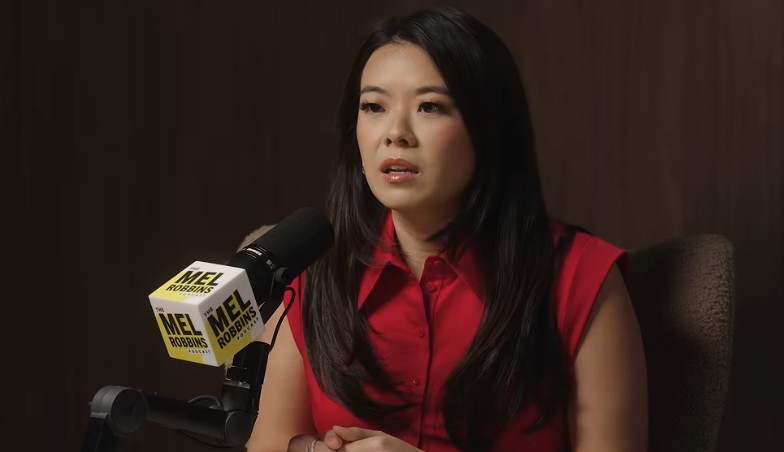
EDITOR’S NOTE: In this episode of The Money Reset on The Mel Robbins Podcast, finance educator Vivian Tu shares the money mistakes she made early in her career and explains how anyone can take control of their finances from any starting point. She and Mel Robbins cover paying yourself first, negotiating raises, fighting medical bills, investing basics, homeownership, and how to talk about money in relationships. This interview was premiered on September 28, 2026.
TRANSCRIPT:
Welcome and Why Money Means Power
MEL ROBBINS: (00:00:50 – 00:00:54) Please help me welcome Vivian Tu to the Mel Robbins Podcast.
VIVIAN TU: (00:00:54 – 00:00:55) Thank you so much for having me.
MEL ROBBINS: (00:00:55 – 00:01:43) When I told everybody that you were coming on, the team went crazy. And I wanted you on this show because my daughters follow you. And so many people around the world love you because you have this very rare ability to be able to empower us to feel like we can take control of our money. And at the same time, you also are a realist about what’s actually going on in the world right now. And so I’m grateful that you’re here.
And I’d like to start by having you paint the picture. So if the person who is listening right now is living paycheck to paycheck, what is going to happen? What will change in their life if they take everything to heart that their new rich BFF is going to teach them today?
VIVIAN TU: (00:01:44 – 00:02:40) This episode is going to give them power. We talk a lot about wanting money, wanting richness. And I think everybody pictures the lime green Lamborghini and the new designer bag. But that’s not what this is all for, right? We should want money because when you have money, you have the power, you have the freedom, you get to be the captain of your own ship. Something that so many people are feeling these days is this lack of agency, that so many things are changing around them, but they don’t actually get a say in their life.
And to me, that’s the most frustrating thing ever because if you can’t fix it, then what’s the point? So I hope everybody listening will realize by the end of this, you will have actionable things that you can do and that no matter where you are in your financial journey, there are very few mistakes you can’t come back from. It’s never too early to start, but it’s also never too late.
MEL ROBBINS: (00:02:41 – 00:02:51) I love that. When you have money, you have power and freedom. If somebody is listening right now and they’re saying, “I am struggling so profoundly right now.”
VIVIAN TU: (00:02:51 – 00:02:51) Yeah.
MEL ROBBINS: (00:02:51 – 00:02:54) It feels impossible to get ahead. What do you want to say to that person?
Vivian’s Own Money Mistakes
VIVIAN TU: (00:02:56 – 00:04:09) I do think that there are very few mistakes, especially in the financial sphere, that you can’t come back from because I’m someone who made a lot of them. I’m the person who would overspend. I’m the person who had to wait at a bar until 12:01 when my direct deposit hit to be able to afford my bar tab. The scariest words to me at 21 were, “Your card declined.”
And I am not someone who grew up with money. I am the only daughter to 2 Chinese immigrant parents. We grew up incredibly frugally. They really valued education. I did everything the way I was supposed to. I went to the right type of college. I got the right type of job. I got the Wall Street job. I mean, trust me, my Asian parents were very, very proud. And I made a lot of money mistakes.
So for me to be able to sit here now and talk to you about all of these things, I’m so proud. It’s an honor. It’s being able to show that I have battle scars and I came out bigger and better and braver. And I feel the same way. I mean, I have millions of followers who DM me and tell me the things that they were able to fix because they put this work into action.
MEL ROBBINS: (00:04:09 – 00:04:12) I would love to have you, Vivian, just speak to this moment.
VIVIAN TU: (00:04:13 – 00:04:13) Yeah.
MEL ROBBINS: (00:04:13 – 00:04:23) And what is the person who really does feel like they’re never going to get their head above water, what is available to them in the things that you’re about to teach to us today?
You Are Not Crazy: Internal vs. External Locus of Control
VIVIAN TU: (00:04:23 – 00:06:11) First and foremost, let’s address what you’ve just said. These people aren’t crazy. If I can address the audience, you are not crazy. If we actually look at the stats, right, we’ve seen that over the past century, the housing market, exponential increase. The cost to get higher education, exponential increase. The cost of living, exponential increase. You know what hasn’t exponentially increased? Wages. So you’re being asked to do more with less.
If I can wrap this all in a nice big bow, please. There are macroeconomic forces, whether that be politics, geopolitical conflict, things like legislation. The way our economy is currently designed really benefits people who have money and penalizes and treats not having money like it’s a crime. Those are not things that you can tomorrow wake up and change. These are things that are going to impact your money, but you are not necessarily going to be able to flip a light switch and be better at. Tomorrow, and hopefully depending on when you listen to this, today, if you actually can make changes in your own life, you can always end better than you started.
And I think that’s what we’re missing is that internal locus of control.
MEL ROBBINS: (00:06:12 – 00:06:23) I love that. And here’s what I love about it. When I was really struggling financially, it was very easy to be angry at the world and to not look in the mirror and go, “Well, there are some pretty dumb things I’ve been doing.”
VIVIAN TU: (00:06:23 – 00:06:23) Yeah.
MEL ROBBINS: (00:06:23 – 00:06:45) And on the converse, to go, “Wait, there are actually things in my control that will empower me.” There are things in my control, if I change some small habits day to day, will give me power back around money and around how I feel in my life and around the freedom I can create over time. What are 3 things you wish you knew when you were broke?
3 Things Vivian Wishes She Knew When She Was Broke
VIVIAN TU: (00:06:46 – 00:09:06) One, it’s very expensive to be broke. Think about it, right? Who gets charged overdraft fees from their bank? Oh, it’s the people who are overdrafting on their accounts. They don’t have the money. The second thing is that there’s a little bit of a frustration that comes when you’re playing this comparison game of you’re broke, but you’re trying to prove to people that you’re not broke. And I very much had this because I had the brand name job, I had the fancy title, but I didn’t have the money. And I did not come from a family that was going to be able to bail me out.
And so I would see some of my peers from college, they would be moving into an apartment that they bought, and I’d be like, “Man, what am I doing wrong?” FYI, their parents bought the apartment for them. I wasn’t 100% sure about that at the time. I am now. I’m very sure about that. And I think I got myself on this consumption hamster wheel trying so hard to fit in because I wanted to prove so badly that I wasn’t broke.
Because right now, money for us is very much a moral measuring stick. People feel like if you have money, you are a good person, you are a smart person, you do good things. And if you don’t, it’s a moral failure. You are not smart, you’ve made bad choices, you are irresponsible. And that’s just not always true. And I think keeping up with the Joneses, in my case, keeping up with all of the hot, flashy, cool things that were happening around me was a big problem.
And last but not least, I would say the third thing I really wish I knew when I was broke was that you don’t have to be broke forever. It felt like I was going to be stuck in a bad spot for eternity. So I found this apartment and it’s teeny tiny. My bed touches 3 walls, but it was going to be this beautiful SoHo apartment and my Sex and the City dreams were about to start finally. That apartment ended up having a severe German cockroach infestation.
MEL ROBBINS: (00:09:06 – 00:09:06) Oh my God.
The Cockroach Apartment
VIVIAN TU: (00:09:07 – 00:10:14) And I was so horrified because we had to pay to break our lease, and that was every dollar that I had saved from the first full calendar year of working. And I was devastated because it felt like I had run on a treadmill in place for 365 days of my life. What a waste. And ultimately, that was the moment, the belt-tightening, come-to-Jesus moment for me where I was like, “I actually need to be better.”
And I think I felt like I was going to be stuck there forever, but smart decision after smart decision compounds the same way bad decision after bad decision does. And eventually things changed slowly, not quickly, not overnight, but one day I woke up and I didn’t feel like I had this fear every single day of, “Was I ever going to make it? Was I ever going to have enough in savings to feel comfortable?” It’s my promise to people listening that you don’t have to be stuck forever.
MEL ROBBINS: (00:10:16 – 00:10:31) There is a different interpretation of that story, and I want to give it to you. You just proved what you promised you were going to teach us, which is that money is power and money is the ability to leave a sick job.
VIVIAN TU: (00:10:31 – 00:10:31) Yeah.
MEL ROBBINS: (00:10:31 – 00:10:39) Or a relationship or a German cockroach infested apartment. And so you did have a tiny enough mountain.
VIVIAN TU: (00:10:39 – 00:10:40) Tiny.
MEL ROBBINS: (00:10:40 – 00:10:43) To have the power and control to leave.
VIVIAN TU: (00:10:45 – 00:10:49) And wasn’t that an amazing way to end that story instead of saying I had to live there?
MEL ROBBINS: (00:10:50 – 00:10:54) Yes, because the you from a year ago would have had to live there.
VIVIAN TU: (00:10:55 – 00:10:55) Yeah.
MEL ROBBINS: (00:10:55 – 00:10:57) But what was the thing you changed most?
VIVIAN TU: (00:10:58 – 00:11:44) I think it was the keeping up with the Joneses. It was such a public thing because I was on the trading desk, which, by the way, you’re sitting shoulder to shoulder with other people, on the phone with the exterminator, yelling at the property manager. I’m red in the face. All the while I’m trying to juggle all of the trades happening, trying not to lose my job, trying to be good so I can possibly get a good raise at the end of the year.
I’m on the phone talking about my cockroach infestation, and everybody knew. Everybody knew I was weird cockroach girl. And so I was so embarrassed, and I was like, “Okay, we have to lock it up. We aren’t getting our nails done every week. We aren’t going out to eat as often.”
MEL ROBBINS: (00:11:45 – 00:12:37) Maybe you’ve had an experience where, like me, I remember standing on the sidelines watching our daughter playing town soccer, knowing that the $125 check that we had sent in the week before had just bounced. The fee for her to be on that field. And not wanting any of the parents to know. And then after the game, watching the coach walk over and knowing that I was about to be asked about this and hoping they didn’t say it too loud.
But I think we all have those moments you talked about, that frustration that you just can’t seem to get ahead. And I love that it was this, “I’m just not going to stay here.”
VIVIAN TU: (00:12:38 – 00:12:38) Yeah.
MEL ROBBINS: (00:12:38 – 00:13:02) I’m going to accept that I’m here right now, but, and this is why I wanted to talk to you and this is why I wanted you to learn from Vivian too, your new rich BFF, is because if you can have that mindset shift to say, “I hate being broke, I hate being paycheck to paycheck, I do not have to stay this way the rest of my life. There are simple things I can learn and there are behavior changes that I can make.” And you can do it from any starting point.
VIVIAN TU: (00:13:02 – 00:13:03) Yeah.
MEL ROBBINS: (00:13:03 – 00:13:07) So does it start with that? “Damn it, I’m sick of this.”
VIVIAN TU: (00:13:08 – 00:13:11) Are you sick and tired of being sick and tired of being broke?
Audit Your Spending: The Reality Check
MEL ROBBINS: (00:13:11 – 00:13:25) Is there a reality check that you also have for the person who’s saying, “I’m paycheck to paycheck,” saying that I’m struggling, saying it, but there are hidden buffers, so to speak, of s*** you don’t need?
VIVIAN TU: (00:13:25 – 00:14:47) Ask yourself honestly, when you say you are paycheck to paycheck, are you spending all of your money after taxes on necessities, or can you think of multiple instances where you have spent money that you have had regret about? Let us do an audit of your spending of the past month. First and foremost, if there’s a bunch of stuff that you bought and regret, can you return it? 2, if you are seeing that there is a trend of feeling like you are hand-to-mouth, oh, but by the way, there was that lash appointment, that nail appointment, maybe you were sports betting, maybe you bought those concert tickets that you didn’t necessarily need to get front row seats to, you could have just gotten a GA ticket.
I’m not asking you to cut out every little thing in your life that brings you joy forever. I’m asking you to cut it out for the next couple months to see what type of buffer you can build yourself. Because once you can get your head above water, once you are able to actually put some of that money into a little nest egg, into investments that can work for you, you’ll be able to do all of the things you enjoy and you won’t have to feel guilty about it.
MEL ROBBINS: (00:14:48 – 00:15:28) You write on page 49 of your bestselling book, this is in a chapter called Investing in Yourself, “Would I still buy this if I couldn’t tell anyone about it? One of the best pieces of spending-related advice I’ve ever gotten was to ask myself this question. Sometimes when we invest in luxury items or upgrades, a big part of the appeal is being able to tell others we have them. This question cuts to the core of that. Would I want the BMW as much if everyone else thought I had a Kia?” So talk to me about this. Would I still buy this if I couldn’t tell anyone about it?
VIVIAN TU: (00:15:29 – 00:16:09) That’s such a powerful spending exercise because I’ve actually bought a lot of stuff that I don’t like. And it’s crazy to say that part out loud. But I have bought shoes that were incredibly uncomfortable because they were from a specific designer and I wanted people to know that I could afford that specific designer. The stuff where I’ve actually spent money to improve my life in a meaningful way has always paid off and had a bigger ROI in terms of my joy and my satisfaction than stuff that I bought just so that I could tell people that I had the thing.
MEL ROBBINS: (00:16:10 – 00:16:20) I love a little 3-month challenge because I also think we don’t have a clue what we’re spending money on because you just swipe and then you tap and then you do this and it feels good in the moment. And then you’re like, “Wait, where did all my money go?”
VIVIAN TU: (00:16:20 – 00:16:21) Can I tell you a secret?
MEL ROBBINS: (00:16:21 – 00:16:21) Please.
VIVIAN TU: (00:16:22 – 00:17:12) Even as someone who feels very financially literate, I had a med spa subscription for laser hair removal that I forgot that I had had. Because I had finished my cycle of laser hair removal and I just kept paying for it. I just forgot to cancel it. And I was so embarrassed, but I knew that I wasn’t going to be able to get that money back. Spilt milk, we’re not going to cry about it. So what did I do? I canceled the subscription. I made sure the next month it didn’t show up on my statement. And going forward, I made a more concerted effort essentially to check my statement every month to make sure that that wasn’t something that I was seeing slip through the cracks in other parts of my life.
Build a System: Pay Yourself First
MEL ROBBINS: (00:17:13 – 00:17:32) And the exercise of just saying no to stupid things or things you don’t actually need in order to build a little bit of a mound versus continuing to dig deeper, I think would give you power just right there. So you always hear this advice from people who are out of touch that if you want to save money, just spend less.
VIVIAN TU: (00:17:34 – 00:17:50) “Sick, cool, good advice. I’m cured.” That is the dumbest thing I’ve ever heard because it is not actually a willpower thing. And frankly, you cannot willpower your way to good decisions. So what I actually encourage people to do is build a system.
MEL ROBBINS: (00:17:51 – 00:17:51) Okay?
VIVIAN TU: (00:17:51 – 00:19:15) So most of us these days, you’re not getting a physical check from your boss. Most of us get an electronic deposit of some sort, whether you are a W-2 employee and you get a biweekly paycheck, or if you are a freelancer and you send in an invoice and they direct deposit the cash into your account. Here’s what you’re going to do. If you work for a company with a workplace portal, you can actually set aside part of that paycheck to not your checking account. So most of us just have 100% of that paycheck go into your checking account. You see it, you spend it. “Hell yeah.” Wrong.
What we’re going to do is we’re actually going to set aside 95 or 90% of your paycheck and it’s going to go to that checking account. You’re going to pay your rent. You are going to take care of the needs for your family. You are going to pay for the things that you need to pay for. And that 10%, that 5%, if you want to start small, we’re going to have that immediately go to a savings account.
No matter how much money I had in that checking account, by the end of the month, by the end of that pay period, somehow I’d found a way to spend it. And I’m just like, “How did that happen?” And the more I made, I found the more I was spending. But if you are automatically paying yourself first and setting money aside into that savings account, today you is literally taking care of future you.
MEL ROBBINS: (00:19:16 – 00:19:22) Let’s say you don’t have a portal. Let’s say that you’re working a retail job. That’s fine. Or you’re working at a restaurant, or you got a bunch of side hustles or—
VIVIAN TU: (00:19:22 – 00:19:24) Retail job. You’re a freelancer.
MEL ROBBINS: (00:19:24 – 00:19:24) Yeah.
High-Yield Savings Accounts
VIVIAN TU: (00:19:24 – 00:19:49) All of that stuff. Most banks these days can allow you to do an auto transfer. So maybe it’s, “Oh, I work a retail job, so I know for the most part I can expect this much money to be hitting my bank account every month.” If there is a convenient date, or maybe 2 convenient dates, you can say, “Hey, let’s transfer $100 once this check clears, or by the end of the week.”
MEL ROBBINS: (00:19:50 – 00:19:50) Okay.
VIVIAN TU: (00:19:50 – 00:21:08) If you are someone who is a freelancer who’s like, “Okay, I’ve just sent in my invoice. I know I have net 30.” When that money comes in, you can say, “Hey, let’s go ahead and transfer 10% of that into savings.” Also, by the way, maybe also good to split off 30 to 40% of it for taxes. And put that into a high-yield savings account. So before your quarterly taxes are due, you’re making money on the taxman’s money. You’re able to earn more interest, and that’s great. That is extra money in your pocket that comes out of thin air.
Most banks that are traditional brick and mortar are offering you, the FDIC national average right now is 0.37%. So you put $100 in, at the end of the year you got $100.37. What are you buying with 37 cents? Nothing. Okay? But high-yield savings accounts are offering somewhere between 3% to 4% right now. And so, $100 in at the beginning of the year, at the end of the year, you have $103, $104. And that scales. So, you put in more money, you get the bigger percentage. And so, you will be earning more and more money. And so, I think that is a way that you can essentially start to bridge that gap.
MEL ROBBINS: (00:21:09 – 00:21:36) I want to really highlight something because I want to make sure as you’re listening or watching, you got the power of one small thing that you said, and I want to be sure you did not miss this. So you said your money’s coming in, right? And I love when you were like, “Great paycheck, let’s spend it.” Wrong. No. When the money comes in, the first thing you should do is have a savings account, high yield if you can get it, to pay yourself.
VIVIAN TU: (00:21:36 – 00:21:36) Yeah.
MEL ROBBINS: (00:21:36 – 00:21:48) And I had this download in my mind as you were talking. Sometimes this happens magically in the studio where, Vivian, I saw broke-a** you without a manicure.
VIVIAN TU: (00:21:49 – 00:21:49) Yep.
MEL ROBBINS: (00:21:49 – 00:21:57) Getting your paycheck. And then I imagined broke you paying the rich you.
VIVIAN TU: (00:21:57 – 00:21:57) Yeah.
MEL ROBBINS: (00:21:58 – 00:22:08) That you become your own rich BFF, that you take on this mindset that broke me is going to start paying rich me.
VIVIAN TU: (00:22:08 – 00:22:09) Yep.
MEL ROBBINS: (00:22:09 – 00:22:41) And I am going to do that every time money comes in. I am going to start paying the rich me in this savings account because the rich me in the future knows that’s the thing to do. And I will tell you, the way people often ask me, “How did you get out of $800,000 in debt?” I was like, “I got 3 jobs and I cut all my expenses that I could. And I then literally every dollar that I could, I would put $0.25 on every dollar into a savings account.”
VIVIAN TU: (00:22:42 – 00:22:42) Yeah.
MEL ROBBINS: (00:22:42 – 00:23:04) And then when I could start to get above water, it was $0.50 and I started getting payment plans. You just do it over time. It took me 7 or 8 years to get my head above water. But broke me was paying the future rich me. And if you can think about that moment paying yourself, that is so powerful.
The Emergency Fund and the Bread Knife
VIVIAN TU: (00:23:04 – 00:23:25) And you know what, Mel? It’s not sexy to be like, “Ah yes, I’ve saved 3 months of living expenses.” But you know what is sexy? Being able to sleep better at night, knowing that if something were to happen, you got it. A couple years after the cockroach apartment, I actually, I don’t know if you can see it, I cut off the tip of my finger with a bread knife.
MEL ROBBINS: (00:23:26 – 00:23:26) Oh, whoa.
VIVIAN TU: (00:23:26 – 00:23:48) It was the night of my 25th birthday. It was a very crusty baguette. I end up spending my 25th birthday, shout out to the Mount Sinai emergency department, I was in there, tears. And to add insult to injury, the total bill for that trip to the emergency department was $13,000.
MEL ROBBINS: (00:23:49 – 00:23:50) Oh my God.
VIVIAN TU: (00:23:50 – 00:24:24) I had really decent insurance, so my portion was $1,600. And man, that birthday party sucked. But you know what sucked less? Being able to pay the bill and move on with my life. And imagine, at the time, this was years and years ago, but I don’t want to have that bill hanging over my head for the worst birthday party ever. I want to be done. And I was lucky because I had the emergency fund to pay it.
MEL ROBBINS: (00:24:25 – 00:24:27) It comes back to power. Power. Power.
You Can’t Budget Your Way Out: Earn More
VIVIAN TU: (00:24:27 – 00:26:35) You cannot budget your way out of paycheck to paycheck. You need to increase how much money is coming in the door. This is not a spending problem. Well, hopefully it’s not, but this is a “how do I get more money in the door?” If you’re truly living paycheck to paycheck, you’re not doing the $600 Sephora haul every month and that’s why you’re paycheck to paycheck. If you actually are spending only on necessities, you feel like you’re being worked to the bone. I don’t think it’s fair that you cannot make ends meet with a 40-hour-a-week job. I think it’s not fair.
This is what we’re going to do. You got 2 options. One, you need to make more money at what you are currently doing. So what does that look like? That looks like negotiating a raise. That looks like getting a promotion. That looks like potentially job hopping somewhere else to get a more competitive salary or bonus. And then the second option is you have to pick up a side hustle.
And I know what everybody listening is probably thinking, “I’m working 40 hours already, I’m exhausted. I come home, I have to cook for my kids, I have to take care of everybody.” I know. I’m not saying it’s okay, and I’m not saying it’s fair. So either through negotiation of a raise, promotion, through getting a better job, or through making money on the side, walking dogs, tutoring, mowing grass, whatever it might need to be, you need to get more money in the door. You’re not the problem, but you do get to be the solution.
Because once you have more money coming in the door, you finally get a second to breathe. When you’re going hand, mouth, hand, mouth, hand, mouth, it’s very hard to think about the right decision because you’re thinking about the right now decision. How are you going to put food on the table? That is a bigger concern than putting money into your 401(k). That’s a bigger concern than, “What do I really want my career trajectory to be in 10 years?” You’re not thinking about that. You are thinking, “I gotta clock in, clock out, get my money, and do the things that I need to do,” which is pay my rent, buy my food, and hopefully have everything else in my life maintained because not one single unexpected expense can come up. When you have more money, you buy the buffer.
MEL ROBBINS: (00:26:36 – 00:26:40) What would you say if you’re in your 20s, crazy challenging job market?
VIVIAN TU: (00:26:40 – 00:26:40) Yeah.
MEL ROBBINS: (00:26:40 – 00:26:47) And you are not getting paid well because you’ve had to take whatever job you’ve had to take. What is your advice?
VIVIAN TU: (00:26:48 – 00:28:05) Some jobs are for learning and some jobs are for earning. If you are able to take a job that will give you some job experience, that’ll get your foot in the door, that’ll give you that inertia, and you have a familial structure that allows you to move home, that’ll help subsidize some of those costs because they are expensive, you’ll be able to get some of that on-the-job experience that’ll then hopefully translate to your next option. And so sometimes the thing you need to do to get paid more is to leave, even in a tough job market.
But I also think that can happen with department changes. I think that can happen if you want to maybe change different industries. So you’re in marketing for one type of company and then you go to a different type of company, but all companies need marketing teams. It is about understanding, are you here to make as much money as possible, or are you here to actually learn something? And I think at the beginning of your career, it should be about learning something. That’s not to say you shouldn’t be asking for more, but expecting a monstrous number out the gate may mean you have to give up other parts of your lifestyle that very few people actually are fully aware of what those sacrifices will be.
How to Ask for a Raise
MEL ROBBINS: (00:28:06 – 00:28:08) What do you think the best way is to ask for a raise?
VIVIAN TU: (00:28:09 – 00:29:24) Come with receipts, Mel. We are coming prepared. You better come in with everything that you’ve already done. Winter raises, winter promotions are made in the summer. At the beginning of the year, I’m talking January, February, you make sure that you know what your goal is for the year. You sit down with your boss, you set some goals, you’re going to revisit them in June, July. So it’s about 6 months in the summer. You’re like, “Hey Mel, I know at the beginning of the year we discussed that we were setting goals for me for this year. I’m happy to report that I’ve already accomplished X, Y, and Z. I would love to know what other things would you need to see from me for me to be in a good position to be promoted at the end of the year, for me to reach the next level of XYZ, for me to be given a new territory?”
I’m going to let you as my boss tell me. I’m going to say, “Great, I love that suggestion. I’m also going to focus on a couple of these other things that I know have just been a thorn in your side. So I can help make your job easier.”
MEL ROBBINS: (00:29:24 – 00:29:24) Great.
VIVIAN TU: (00:29:25 – 00:31:07) We leave. I crush it. June, July through October, we’ll call it, I am just grinding. I get it all done. And then in November, I come back with all of my receipts. I’ve built something called a brag book in my inbox. So I’ve titled it. It’s a little folder. It says “brag book 2026,” whatever. Anytime someone congratulates me, anytime someone’s like, “Wow, Vivian is amazing,” right?
Then in October, I sit down with you and I’m like, “Hey Mel, I’m so happy. We have done such a great job this year as a team. Everything has been going super well. I’d love to show you a couple of examples of how I was able to achieve all of these goals.” And then after I’ve shown you all of my bells and whistles, all the things I’ve already crushed, I go, “Given the amount of assistance, given the amount of success I’ve been able to bring to the team, a raise of XYZ would be commensurate with my performance,” or “A promotion makes sense given that I’m already operating at this level.” Then I shut up.
In one of my first negotiations, I gave this incredible pitch of how hard I was working. Everything was amazing. I asked for my raise and then I said, “But if not, that’s okay.” Vivian, stop talking. What is wrong with you? Stop talking. Let you tell me no. I don’t tell myself no.
MEL ROBBINS: (00:31:08 – 00:31:11) Now you’re actually showing that you earned it.
VIVIAN TU: (00:31:11 – 00:31:11) Yeah.
MEL ROBBINS: (00:31:12 – 00:31:14) And that you’re worth investing in.
VIVIAN TU: (00:31:14 – 00:31:18) Yeah. It’s the you show. It’s not about what other people are making.
MEL ROBBINS: (00:31:18 – 00:31:18) Yes.
VIVIAN TU: (00:31:18 – 00:31:28) It’s not about what the person sitting next to you is, because you can’t just be like, “Well, Johnny told me they made that.” Now you’ve snitched on Johnny. You are going to show why you deserve the number.
Fighting a Medical Bill
MEL ROBBINS: (00:31:28 – 00:31:32) I think the advice is absolutely fantastic, and I love the idea of the brag book.
VIVIAN TU: (00:31:32 – 00:31:33) Mm-hmm.
MEL ROBBINS: (00:31:33 – 00:32:55) Because you forget. You forget all the things that you’re doing and you should assume that the person that you’re working for isn’t aware of absolutely all the different things that you’re doing. If the person listening right now just got hit with a bill, because this happens to people, especially medical bills, what is your advice about how to fight it?
VIVIAN TU: (00:32:55 – 00:34:08) Okay, so before we even fight the medical bill, let’s see if it’s even right. Bad stat, 80% of medical bills have errors in them. 80%? 8-0. So first, I would say, first thing you do is make sure that you are asking for an itemized bill. You want to see every single thing they’re charging, not just the number at the end. Tell me everything that you did to me. Then I would say, check to see if that’s fair. There are tools online now, like FAIR Health Consumer, that you can go and check to be like, “What is a normal cost for an X-ray?”
So then after that, you’re going to call, not email. They will ghost you, by the way. You want to call the hospital that you went and you went to the emergency department and you’re like, “Hey, I would like to have a discussion about this. What waivers, relief programs, charity care, what is available to me?” From there, I want you to say, “I’d actually really be interested in paying this bill in full. But I’m not going to be able to do the whole thing. Would there be any sort of discount available if I can get that paid today?” Then they know they’re actually getting some money. And this all works if you don’t have insurance. If you have insurance, those rates are typically pre-negotiated.
Retirement and Your FU Number
MEL ROBBINS: (00:34:09 – 00:34:24) Vivian, what do you say to the person who is listening who has very little money saved for retirement? Maybe they’re more my age. And they’re starting to get really worried, or maybe they’ve come out of a divorce and they’re starting over and they’re starting to get worried about their future.
VIVIAN TU: (00:34:25 – 00:34:46) You can catch up. I think tactically we have to talk about catch-up. After you turn 50, you have actual access to something that the rest of us don’t called catch-up contributions. You can actually put more away because they want you to, and I quote, “Catch up.” That is literally what it’s called. Catch-up contributions.
MEL ROBBINS: (00:34:46 – 00:34:48) How much money do I need to retire?
VIVIAN TU: (00:34:50 – 00:35:00) People have no idea what they actually need and have no idea what they actually want. So what I like to advise everyone to think about is your FU number.
MEL ROBBINS: (00:35:01 – 00:35:02) FU number. Okay.
VIVIAN TU: (00:35:02 – 00:35:03) Your f*** you number, man.
MEL ROBBINS: (00:35:03 – 00:35:04) Yes, of course. Come on.
VIVIAN TU: (00:35:04 – 00:35:04) Okay.
MEL ROBBINS: (00:35:04 – 00:35:05) Yes.
VIVIAN TU: (00:35:05 – 00:35:11) The reason we call it the FU number is because it really is going to give you true financial freedom.
MEL ROBBINS: (00:35:11 – 00:35:12) Okay.
VIVIAN TU: (00:35:12 – 00:35:20) And we want your money from investments to replace your money from labor. So you’ll never have to work again. So how do we do this?
MEL ROBBINS: (00:35:20 – 00:35:20) I don’t know.
VIVIAN TU: (00:35:21 – 00:36:31) Close your eyes. We are having a zen moment. I want everyone to visualize a perfect year. Where do you live? What does your house look like? Are you supporting anybody? Maybe it’s a partner, maybe it’s kids, maybe it’s an adorable furry little pet? Are you traveling? Are there things you are spending on? What does your dining out situation look like? What kind of car do you drive? Envision your perfect little universe. Now open your eyes.
And this is a hard question. What do you think one perfect year in that perfect little universe would cost you? That is your perfect year number, okay? We are going to take this number and we are going to divide it by 0.04. You’re going to get a bigger number, okay? People think you’re going to get a smaller number. You’re going to get a bigger number, okay? That is the amount of dollars you would need to have invested for you to have this life.
MEL ROBBINS: (00:36:31 – 00:36:36) So if you had $1 million in savings, what is 4% interest? Is that $40,000?
VIVIAN TU: (00:36:38 – 00:36:39) That is correct.
MEL ROBBINS: (00:36:40 – 00:36:41) Well, that kind of puts it in perspective.
VIVIAN TU: (00:36:42 – 00:37:03) And I don’t want people to freak out. Because we have to remember that in retirement, oftentimes we are getting more assistance, right? There is Social Security, there is Medicare. And so you may not necessarily need as much to be able to live that happily ever after. But this is a good jump-off point for us to start calculating where we’re trying to get to.
The Sandwich Generation
MEL ROBBINS: (00:37:04 – 00:37:05) Talk to me about the sandwich generation.
VIVIAN TU: (00:37:06 – 00:37:59) So a lot of us these days are feeling sandwiched. We are starting to build our own families, our partners, our kids. All the while, our parents are actually coming to us and saying we are underfunded for retirement. And so not only are you supporting your family unit, you are also then supporting the family unit you grew up with, and you’re feeling a lot of that pressure.
And I think the number one thing I encourage everybody listening to do is have the conversation with your parents about their retirement funding. If your parents are behind on retirement, it is better to know now so that you can help them set up contributions that are going to then support them so that you can help them potentially think about downsizing their home. So you can think about all the other options and pull those levers now when you still have that runway.
MEL ROBBINS: (00:38:00 – 00:38:02) So give me the opening line of this conversation.
VIVIAN TU: (00:38:02 – 00:38:31) I would say something along the lines of, “You know that I’m always here to support and help you. I want to get ahead of this because so many people are underfunded for retirement. And I have no intention of letting you suffer. But for me to help you get to where you need to be, we got to do it together. So let’s sit down and talk about it. This is the first step that we need to take to make sure that you get the retirement you deserve.”
Investing 101: Making Your Money Work for You
MEL ROBBINS: (00:38:32 – 00:38:49) I love that. So if you’re intimidated by the word investing, how would you explain it to somebody who doesn’t think they’re smart enough to understand it? And where do you start if you can only have a few extra dollars every month to do it?
VIVIAN TU: (00:38:50 – 00:39:34) You work hard for your money through labor, whether that be mental labor, physical labor, whatever. Your money can also work for you. We as human beings are really bad actually at making money, because you can work maximum 14, 15, 16 hours a day. At a certain point, you still need to get sleep. You need to eat food. You are a human. You are not a good money-making machine, no matter how much money you make. You know what’s a better money-making machine? Your money. Your money works 24/7. It doesn’t take a lunch break. It doesn’t need holidays or vacations off. It is working day in, day out, 24/7. And it can.
MEL ROBBINS: (00:39:35 – 00:39:38) Okay, great. Because I want to see if I can give this back to you.
VIVIAN TU: (00:39:38 – 00:39:38) Yeah.
MEL ROBBINS: (00:39:38 – 00:40:07) In a way that somebody who has always been intimidated by this idea of investing can really grasp. So we’ve talked about, which I find personally helpful, broke you is going to start paying from the money that comes in the future rich you in the savings. This is your little fund. This creates the buffer. This is the money you’re going to start to use to climb out of where you are. Investing is where the rich you takes that savings account and takes the money that’s in there and puts it to work.
VIVIAN TU: (00:40:08 – 00:40:09) Yep, exactly.
MEL ROBBINS: (00:40:09 – 00:40:10) Got it.
VIVIAN TU: (00:40:10 – 00:40:10) Yep.
MEL ROBBINS: (00:40:10 – 00:40:11) Okay, so how do we start?
VIVIAN TU: (00:40:12 – 00:40:14) So first off, I want to make a distinction.
MEL ROBBINS: (00:40:14 – 00:40:15) Okay.
VIVIAN TU: (00:40:15 – 00:40:22) Saving and investing are not the same thing. They are not the same action and should not be treated the same. Today you is paying rich you for savings.
MEL ROBBINS: (00:40:22 – 00:40:26) So that’s what you save to have the buffer so you have power and freedom to leave.
VIVIAN TU: (00:40:26 – 00:40:26) Yep.
MEL ROBBINS: (00:40:27 – 00:40:30) Or to deal with an emergency. And so that you can sleep at night.
VIVIAN TU: (00:40:30 – 00:40:35) Correct. What you need to do to actually start investing is first you need to find a brokerage.
MEL ROBBINS: (00:40:35 – 00:40:35) Okay.
VIVIAN TU: (00:40:36 – 00:41:32) So you then are able to choose an account type. So maybe this is a Roth IRA, an IRA. This could just be a traditional individual brokerage account. These different types of accounts, some have different benefits. Others are more classic, general, not as many tax benefits, but still definitely worth using. You will make the decision based on what you are investing for. If it’s for retirement, a retirement account might make sense. If it’s for, “Hey, I just want to invest for the next 20, 25 years, this is not for retirement,” great, an individual brokerage account might make sense.
Then once you choose the account type, you open the account and you contribute dollars from a checking account or maybe even a savings account. You’re funding the account with the cash. This is where people get messed up. They put the cash in the account and they’re like, “I’m done.” No, you’re not. You have not even bought anything. It’s just cash in an account right now.
MEL ROBBINS: (00:41:33 – 00:41:37) So you’ve opened the account. You actually have to put the money into a fund.
VIVIAN TU: (00:41:38 – 00:41:46) Correct. You have to choose investments. You can’t just put cash into an account. You have to then use that cash to buy stuff.
MEL ROBBINS: (00:41:46 – 00:41:46) Okay.
VIVIAN TU: (00:41:46 – 00:41:58) In the same way that you go to the grocery store and you have cash in your wallet, you’re not going to do a hot lap around the grocery store, go home, open the fridge and be like, “Where’s my food?” You didn’t buy anything. You have to actually buy meats and cheeses and breads.
MEL ROBBINS: (00:41:59 – 00:41:59) Gotcha.
VIVIAN TU: (00:41:59 – 00:42:18) So what you can do there is then say, “Hey, I’m interested in investing. I really want to focus on the overall stock market because I don’t want to have to cherry pick.” Get into something that allows you to have exposure to a lot of things. This is called diversification.
MEL ROBBINS: (00:42:18 – 00:42:20) Basically mitigating the risk.
VIVIAN TU: (00:42:20 – 00:42:21) Correct.
MEL ROBBINS: (00:42:21 – 00:42:22) Of picking the wrong stock.
VIVIAN TU: (00:42:22 – 00:42:22) Correct.
MEL ROBBINS: (00:42:23 – 00:42:25) By buying a fund that invests in the whole thing.
VIVIAN TU: (00:42:25 – 00:42:26) Yep. Invests in everything.
MEL ROBBINS: (00:42:26 – 00:42:27) Okay.
The Robo-Advisor Cheat Code
VIVIAN TU: (00:42:27 – 00:43:13) There is a constituency of folks who are probably listening to this, and their eyes are starting to glaze and they’re like, “What the hell is she saying? I still don’t know how to invest. They’ve been yapping for 10 minutes and I still don’t get it.” Okay, fine. I will give you the cheat code. The cheat code is now because we have such incredible technology, you don’t actually have to go and pick your own investments. You can sign up for something called a robo advisor, and this can be done in 45 minutes.
You sign up for this robo advisor, you pick the account type. It’s going to ask you a bunch of questions, things like, “Hey Mel, how much do you make every year? How much do you have? How much debt do you have? How would you feel if your portfolio lost this much money? When do you plan on retiring?” All this stuff about you.
MEL ROBBINS: (00:43:15 – 00:43:15) Okay.
VIVIAN TU: (00:43:15 – 00:43:36) And then it is going to provide you a portfolio that makes sense for you. You’re going to pay likely a small fee for this to happen, but I would rather someone use a robo-advisor and pay that small fee and be invested now than say, “I’ll figure it out this weekend and do it myself.”
MEL ROBBINS: (00:43:36 – 00:43:49) What if you’re worried about losing the money? I mean, the market seems crazy. The world seems crazy. Do I jump in now? Do I wait for things to crash? Trying to get a sense of timing? Or you’re just planting seeds?
VIVIAN TU: (00:43:50 – 00:43:57) I am very much a buy and hold investor. The day you plant the seed is not the day you eat the fruit.
Should You Buy a Home?
MEL ROBBINS: (00:43:57 – 00:44:18) If you’re currently renting and you’ve always dreamt of owning a home. And now you’re thinking based on the insane costs and the rise in the housing market, particularly here in the United States and around the world, “I may never be able to buy a home.” What do you need to know?
VIVIAN TU: (00:44:18 – 00:45:25) Buying a home for so many of us is still so core to that American dream. It is still so core to success. And if you want a home, I think you should have every right to get one. But I ask you first, why do you want a home? Do you want a home because you know you’re in the right place and you plan on living there for at least 5 to 7 years? At least. You don’t want to go to a different city for any other job opportunities. Is it because you want to make that house your home and do a bunch of renovations to personalize it to yourself? These are all good reasons.
But if you are someone who’s like, “Well, I hate having to fix my own toilet at 2 AM. And I also hate the idea of paying a homeowners association fee. And I also hate the idea of paying property taxes. And I also hate the idea of being stuck somewhere. And oh, by the way, I might be in the market to expand my family in the next year or 2.” Maybe it’s not the right time to buy.
MEL ROBBINS: (00:45:25 – 00:46:52) That is the perfect question when you’re looking at homeownership as a lifestyle decision. When you ask yourself, “Why do I want a home?” You’re basically making yourself go, “Wait, why do I want a home right now? And does this make sense? Am I going to stay somewhere for a long time? Can I actually afford what it’s going to take to keep a home up?” Because if you’re going to be moving around a lot or it’s way too expensive for you to both buy it and then maintain it, maybe now is not the right time. That’s a lifestyle decision that then becomes personal to you instead of chasing it because you think you should buy it by now because your parents did or your friends are.
But let’s not ignore the truth that at least in the United States, buying a home and homeownership is one of the most important ways that people build generational wealth because it forces you to save. And then the other thing that people forget is at some point you want to be able to not have to pay rent. So if you’re never going to buy a home, in retirement, you’re going to have to pay rent, and that’s going to be part of the retirement savings that you need to do now.
And so I think the question is important, but I just want to make sure that you’re answering it based on lifestyle, but you’re also keeping the facts in front of you, which this is one of the most important assets that you could have in the long term. And it also forces you to save.
VIVIAN TU: (00:46:52 – 00:48:31) Correct. As for folks who are sure they want to buy, you need to get creative, okay? Because right now, it is true, in almost all major metros, it is cheaper to rent than buy. Buying a house is hard right now. Let’s not pretend like it’s not. People need to start thinking, “Do I need to buy my primary home?” I know someone who actually cannot afford to own their primary residence in Los Angeles, but he grew up in Oklahoma and has family there and ended up buying an investment property in Oklahoma. He can afford the mortgage in a lower cost of living area, and he rents because in LA he’s going to get a lot more with rental dollars than buying dollars.
Another option, let’s think about those unique mortgages. Everybody thinks you got to put 20% down. I think that is the norm because then it helps to make the monthly payment very, very manageable. But if you’re someone who just doesn’t have a lot saved, you’re trying to get into a neighborhood before you’re priced out of the neighborhood, and you have a good job that you can count on and you think you can make decent monthly payments, what about an FHA loan? What about a conventional 97? These are all different types of mortgages that either help you if you have a low credit score or basically give you a little prize, a little treat for having a high credit score.
What about if you’re buying in a rural area, a USDA loan? For our veterans listening, there is nothing better than a VA loan. You put nothing down. You don’t need to pay PMI to essentially insure that mortgage. That is the best possible option. But I think people don’t talk about those things enough.
Doing Everything Right but Still Not Getting Ahead
MEL ROBBINS: (00:48:31 – 00:48:41) I would love to have you speak directly to the person who is listening and they’re in their 20s. They’re doing everything that they were told to do, but they still can’t get ahead.
VIVIAN TU: (00:48:41 – 00:49:19) Sucks, doesn’t it? I think a lot of us were sold a promise and a dream that if we put our heads down, if we worked hard, that we went to the right school and we got the right job, we’d eventually get to have happily ever after. It’s looking like that’s not necessarily true. The new American dream doesn’t look like anything. It’s whatever you close your eyes and want it to be. It’s not about what has already happened. It’s about what can you do today to make tomorrow different?
MEL ROBBINS: (00:49:20 – 00:49:24) That’s the same answer you need to hear right now if you’re in your 50s or 60s.
VIVIAN TU: (00:49:24 – 00:49:24) Yeah.
MEL ROBBINS: (00:49:25 – 00:49:25) And you’re starting over.
VIVIAN TU: (00:49:26 – 00:49:26) Mm-hmm.
MEL ROBBINS: (00:49:26 – 00:49:32) Or you are dealing with a setback after divorce or a health diagnosis.
VIVIAN TU: (00:49:32 – 00:49:33) 1,000%.
Moving Back Home: The New Generational Wealth
MEL ROBBINS: (00:49:33 – 00:50:06) You have to take it. It is true that life is not fair and it sucks, and you can do something next that changes where you end up in the future. What do you want to say to the person who is back home living with their parents? Nearly half of all Americans under 30 live with a parent, according to the Federal Reserve data, which as a parent, I think is cool. But as a person who had a vision that you would be somewhere else, maybe it doesn’t feel that cool.
VIVIAN TU: (00:50:07 – 00:50:26) I would say you’re a genius. And one, you should go kiss and hug your guardians or parents or wherever and say thank you. Because if you are able to move back home, you already have a level of generational wealth that people don’t talk about. People think generational wealth is, “Ah, I am bequeathing Mel $1 million when I pass.”
MEL ROBBINS: (00:50:26 – 00:50:27) No, no, no.
VIVIAN TU: (00:50:27 – 00:51:33) Generational wealth is you can move home, is auntie daycare. “I’m going to take care of your kid.” Or, “Don’t worry, Nana and Papa don’t use the car as much. Don’t worry, Mel, you can drive it.” That’s generational wealth. And so I think if you are currently living at home, you have a sweet setup. What I ask is for you to do a couple things.
One, the money that you would have spent on rent, put it aside for yourself. Pay future rich you. 2, set a move-out number, not a move-out date. Do not put yourself on a timeline that you cannot hit and actually be comfortable. You don’t move out until you have the number you need. And 3, use this as an opportunity to maximize all of the financial advantages you have. So that means if you are paying no rent or less rent to live at home with your parents, you should be putting more money into your 401(k), more money into that Roth IRA.
MEL ROBBINS: (00:51:34 – 00:51:41) I absolutely love that you called moving home with your parents the new generational wealth because one of our kids just moved home.
VIVIAN TU: (00:51:41 – 00:51:42) Yeah.
MEL ROBBINS: (00:51:42 – 00:51:49) And I see it as an enormous opportunity and launching pad to set yourself up for the next chapter. Huge.
VIVIAN TU: (00:51:49 – 00:51:55) Because you don’t want to move out and then build your financial foundation on sand. You want to build that financial foundation on brick.
MEL ROBBINS: (00:51:56 – 00:52:01) I just absolutely love that this is the new generational wealth and looking at it as a power move.
VIVIAN TU: (00:52:01 – 00:52:01) Yeah.
MEL ROBBINS: (00:52:01 – 00:52:04) Versus something that means your life isn’t working.
VIVIAN TU: (00:52:04 – 00:52:04) Yeah.
MEL ROBBINS: (00:52:04 – 00:52:05) No, you’re being smart.
VIVIAN TU: (00:52:05 – 00:52:06) Yeah.
Your Spouse Is Your Biggest Financial Decision
MEL ROBBINS: (00:52:08 – 00:53:18) What is the single biggest financial decision you make in your life?
VIVIAN TU: (00:53:20 – 00:54:11) Kind of a hot take here, but I think it’s who your spouse is. We talk a lot about saving and budgeting and spending and investing, but your spouse is the person that you are going to spend the vast majority of your life, hopefully, with. Why would you not make sure that the two of you are on the same financial page? It is crazy to me because the top 2 reasons why couples fight, sex and money.
What if I told you if you had the conversation early, if you opened up a blank slate, if you opened the doorway, if you didn’t argue but instead sat down and laid it all bare and figured out a plan forward together, you could avoid 50% of those really hot-button topics? Wouldn’t you naturally assume it would make your relationship stronger? You would fight less and just be happier.
Talking About Money While Dating
MEL ROBBINS: (00:54:11 – 00:54:13) So what are the questions I’m asking if I’m dating somebody?
VIVIAN TU: (00:54:14 – 00:54:18) Well, Mel, how long have we been dating? Okay. Are we first date? Are we—
MEL ROBBINS: (00:54:18 – 00:54:20) Oh, I’m not going to ask you financial stuff on the first date.
VIVIAN TU: (00:54:20 – 00:54:21) I am.
MEL ROBBINS: (00:54:21 – 00:54:22) You are?
VIVIAN TU: (00:54:22 – 00:54:22) Yeah.
MEL ROBBINS: (00:54:22 – 00:54:23) Okay. What are you going to say?
VIVIAN TU: (00:54:24 – 00:54:31) “If tomorrow more money than you knew what to do with fell out of the sky, what would you do for work?”
MEL ROBBINS: (00:54:32 – 00:54:33) The same thing I’m doing right now.
VIVIAN TU: (00:54:34 – 00:54:35) At the time, would you have said that?
MEL ROBBINS: (00:54:36 – 00:54:39) Yes. I loved what I did. I just hated how little money I had.
VIVIAN TU: (00:54:40 – 00:54:51) Then that would tell me something about you. If someone is making a really high-earning job right now and they’re like, “Oh man, if enough money fell out of the sky, I’d become a social worker,” that tells you something about them.
MEL ROBBINS: (00:54:51 – 00:54:52) Yeah.
VIVIAN TU: (00:54:52 – 00:55:06) If someone who’s super broke right now says, “I would still do the same thing,” that also tells you something about them. I would also say, “Okay, Mel, if I gave you a budget of $100,000 to take the best vacation of your lifetime, what would you do?”
MEL ROBBINS: (00:55:07 – 00:55:15) Oh, well, it would be an adventure trip. I would either go to Africa.
VIVIAN TU: (00:55:15 – 00:55:15) Mm-hmm.
MEL ROBBINS: (00:55:15 – 00:55:27) Or I’d go to India, or I would do the trip that I just did with my family, which was rafting the Grand Canyon. I would 1,000% spend it on some sort of experience.
VIVIAN TU: (00:55:27 – 00:55:54) Yeah. If you were on a date with someone that said, “My dream vacation is to spend a month on the beach and every single day my step count is zero on my Apple Watch,” that person and you should not be together because you’re out here being like, “I’m going to climb this, I’m going to do this, I’m going to hike this, I’m going to trek this.” You now know something about that person, about how they value their money and how they value their time.
MEL ROBBINS: (00:55:54 – 00:56:18) So here’s what I’m hearing. I’m hearing that one of you wants to spend $100,000 to go to an 8-star resort and lay on the beach and do nothing, which means in my mind, you like status and luxury, whereas I want to go on a really extraordinary experience. And that tells you that we have very different values and we want to spend our money doing very different things.
VIVIAN TU: (00:56:18 – 00:56:26) You can talk about money on the first date. Don’t be like, “Hey, bring your pay stub.” Don’t be a weirdo. But you can talk about money as soon as the first date.
MEL ROBBINS: (00:56:26 – 00:56:30) So when you’re starting to get more committed.
VIVIAN TU: (00:56:30 – 00:56:30) Yeah.
MEL ROBBINS: (00:56:31 – 00:56:33) And you’re in that, “Is this the end of the aisle person?”
VIVIAN TU: (00:56:33 – 00:56:34) Yeah.
MEL ROBBINS: (00:56:34 – 00:56:36) What are the conversations you need to have that most people don’t?
VIVIAN TU: (00:56:36 – 00:57:31) Well, the first legal document that bonds you and someone usually is not a marriage license. It’s a lease. You move in together. And so that is a really good time to actually have this conversation because at some point you will have to provide a pay stub and the credit check and all of that, and you can’t lie about it at that point. And so it’s, “Hey, we’ve been dating now for however much time, and I know we’re talking about potentially moving in together, just so that we’re able to look at apartments that make sense for both of us. Roughly, what are you willing to spend on rent? And let’s have a conversation about how we’re going to split this.”
That then can lead into, “I make this much money, this is what I’m comfortable spending on rent. What about you?” You share first, then they give you the number.
When Your Partner Isn’t as Ambitious as You
MEL ROBBINS: (00:57:32 – 00:57:44) So what is your advice if your boyfriend or girlfriend is not as ambitious as you wish they were, and you’re trying to decide your future?
VIVIAN TU: (00:57:44 – 00:58:27) If you are in a relationship where you are already trying to change somebody, it’s probably not the right relationship, unfortunately. And I know people don’t like to hear that, but you can’t make somebody do something. They have to want it themselves. And unfortunately, if you are the one forcing the issue, oftentimes that’ll lead to resentment. And so you can’t force your spouse to want more. You just need to meet somebody and be with someone who values a dollar the same way you do, who values work-life balance the same way you do, and who has the same goals as you do.
MEL ROBBINS: (00:58:28 – 00:58:56) Or you need to get very clear about what you actually want in a partner. And whether or not the ambition that you want in them is ambition that you need to unleash in yourself. And that you recognize that you want to and see the value of other attributes in somebody. I’ve been married for 30 years, but I would say that I was in that classic situation where I just assumed my husband would make all the money.
VIVIAN TU: (00:58:56 – 00:58:56) Yeah.
MEL ROBBINS: (00:58:56 – 00:59:07) And he’s not a guy that’s driven by money. He’s driven by something else. I mean, the man is a death doula and he leads men’s retreats and he would live in a one-bedroom apartment.
VIVIAN TU: (00:59:07 – 00:59:07) Yeah.
MEL ROBBINS: (00:59:07 – 00:59:08) The ambition was mine.
VIVIAN TU: (00:59:09 – 00:59:09) Yeah.
MEL ROBBINS: (00:59:10 – 00:59:20) And I think when you are an ambitious person, it is a mistake to apply your ambition and aim it at somebody else and make it their responsibility.
VIVIAN TU: (00:59:21 – 00:59:33) Something that I have seen in both genders, but often from women, is that they are looking for traits in a partner that they do not personally possess. And that really bothers me.
MEL ROBBINS: (00:59:33 – 00:59:34) What do you mean?
VIVIAN TU: (00:59:35 – 01:00:24) “I need to date a man who makes over half a million dollars.” Do you make over half a million dollars? “I need a man who’s very generous and willing to buy me gifts.” Are you a generous person? Do you buy the people in your life gifts? We oftentimes expect the world but aren’t willing to give it ourselves. And so I just encourage anybody, especially with a partner, they don’t necessarily need to match your income, but you need to match each other’s effort. And if you don’t, it’s not going to work.
In terms of effort, it can look very different though. It could be one person being the breadwinner and the other person taking care of the home. It could be both people going out and working and splitting the household unpaid labor. But you have to be very clear about what the defined roles in your relationship are.
MEL ROBBINS: (01:00:25 – 01:00:34) I love that you come down to roles and values because roles and values come down to conversations, knowing yourself, and skills you can build, not gender assignment.
VIVIAN TU: (01:00:35 – 01:00:36) No, never. Be your own sugar daddy.
MEL ROBBINS: (01:00:37 – 01:00:40) Yeah, of course. Be your own rich BFF.
VIVIAN TU: (01:00:40 – 01:00:41) Exactly.
MEL ROBBINS: (01:00:41 – 01:00:56) And that gives you control and really defines what you want and what you value in life. And does this person give you that? And if they don’t, we’re out of here. But if they do, maybe it isn’t the financial thing. Maybe it’s something money can’t buy.
Women and Money: “Fire Our Publicist”
VIVIAN TU: (01:00:57 – 01:01:03) Yes. And can I just say, yes, I fear that we as women, we need to fire our publicist.
MEL ROBBINS: (01:01:03 – 01:01:04) What does that mean?
VIVIAN TU: (01:01:04 – 01:02:03) So we have been basically brainwashed into thinking we are actually bad with money. Women are told, “Dad will take care of money,” until “My husband takes care of money,” and “One day my son will take care of it for me.” You need to be an active participant in your own life. I hate to say this, but the media has brainwashed us, and our publicist is not doing a very good job as women. They have let us be described by shows and movies like Confessions of a Shopaholic. We have been shown TV shows like 2 Broke Girls. Where’s 2 Broke Guys? There are just as many young men who don’t have money as young women.
Confessions of a Shopaholic, yeah, okay, I got a lip gloss. What about that PS5 and the sports betting and the Super Bowl tickets and all the other stuff and the golf clubs that you bought? Those were just as expensive, if not more expensive. I don’t see anybody giving you crap about it. Instead we are seeing, “Oh, men, claim your power, step into your wealth.” Okay, but that’s not what the numbers show us, actually.
MEL ROBBINS: (01:02:04 – 01:02:04) What do the numbers show us?
VIVIAN TU: (01:02:04 – 01:02:38) More single women than single men own homes in all 50 states. We have less debt across every single category except student loans because we’re getting more and more educated. And Fidelity actually went through the portfolios of a test set of men and women, and the women’s portfolios actually outperformed the men’s. So if we’ve got less debt, if we own more homes and our money is growing more intelligently and doing a better job, don’t you think that’s the headline that should be in the news?
Parting Words
MEL ROBBINS: (01:02:41 – 01:02:44) Oh my gosh. Vivian Tu, what are your parting words?
VIVIAN TU: (01:02:45 – 01:03:05) You are the person who gets to change your life. Money is a tool. It does not get to shame you. It does not get to define you. Not having a lot does not make you bad, and having a lot does not make you good. But having it does mean you get to do whatever you want with your life. And man, doesn’t that freedom feel nice?
MEL ROBBINS: (01:03:06 – 01:03:08) It sure does. I just want to thank you.
VIVIAN TU: (01:03:09 – 01:03:09) Thank you.
MEL ROBBINS: (01:03:09 – 01:03:39) Thank you for showing up and slapping us across the face and then giving us a hug and then slapping us again with the truth. And I feel fired up. And I cannot wait to give this to the world as a free resource, because I agree with you that when you take control of your money, it gives you the power and freedom to live your life and to make decisions that you want to make. And isn’t that an extraordinary thing? So thank you.
VIVIAN TU: (01:03:40 – 01:03:41) Thank you so much for having me.
MEL ROBBINS: (01:03:41 – 01:05:04) You’re welcome. And thank you. Thank you for making the time to listen to an episode that will empower you through the simple things you can start doing right now. And if you’re sick of living paycheck to paycheck, if you’re sick of feeling broke, if you’re sick of shaming yourself about the past, then be really sick of it and make a decision that you’re going to get good with money. And so I want you to leave this conversation saying, “You know what, I’m done with that part of my life and I’m going to lean in and I’m going to start acting like my own rich BFF. I’m going to apply what I learned. I’m going to share this with the people in my life that need it.”
And I promise you, you and I are going to bump into each other a couple years from now and you’re going to be like, “Mel, oh my gosh, power, freedom. I’m now in control of my money.” And in case no one else tells you today, I wanted to be sure to tell you as your friend that I love you and believe in you and believe in your power to create a better life, and having control over your finances and the freedom to make decisions that you want to make and live your life how you want to live it is the definition of power. And I really want that for you.
Thank you for watching all the way to the end here on YouTube. Thanks for being a subscriber. It’s the best way to say, “Hey, thanks for all the support you’re giving me and thanks for these amazing experts.” I know you want to watch another episode. And so since you love this one, this is the next episode of the Mel Robbins Podcast you’re going to want to check out. I’ll welcome you in the moment you hit play.
Related Posts
- Transcript: AMD Acquires Fei-Fei Li’s World Labs for $8.2 Billion
- Transcript of FO568 Raj Shamani: w/ Sumant Sinha
- Transcript of Moonshots #297: ft. Ben Lamm on Wet Lab, Artificial Wombs and Gene Editing
- Transcript of Bill Ackman Interview: All-In Liquidity 2026
- Transcript of Bill Ackman Interview: Holy Grail of Investing Podcast