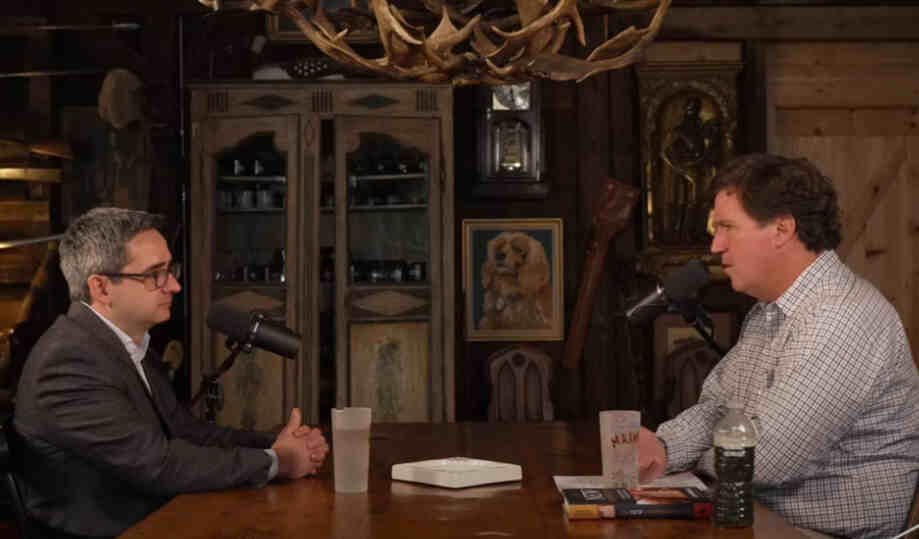
The following is the full transcript economist Oren Cass’s interview on The Tucker Carlson Show episode titled “How Trump’s Tariffs Are Reversing the Foreign Policy That Doomed America’s Economy”, premiered May 16, 2025.
Listen to the audio version here:
Defining Modern Conservatism
TUCKER CARLSON: Oren Cass, thank you very much for coming. So you’ve got a book called the New Conservatives, which tries to answer, I think, and we’ll speak for you. The question what is conservatism? What is the Trump movement? Who’s on what side? And probably not a better. It’s not really an abstract debate anymore. It’s like all of a sudden you find yourself. I find myself on the same side as people with whom I don’t think I have anything in common. So what’s your definition of conservative?
OREN CASS: That is the hardest question in conservatism, I think, and for me it comes down to a focus on what actually matters. And sort of all of our policy debates are about the means. What should we do? I think at the end of the day, what defines conservatism and what separates it from progressivism is the definition of the ends. What do we actually think is the good life? What are we trying to achieve?
And I think for conservatives, there’s a very deep recognition and belief that the good life is about more than just the individual liberty and autonomy and consumption of stuff. Obviously we care about those things too, but that it is much more balanced against a recognition that the well being of families and the conditions in which we’re raising the next generation and the strength of our communities, ultimately the strength of our nation, the ability to carry forward traditions that, that all of those things are equally, probably more important to people’s actual well being. And that as we think about what government is for, what public policy is for, those are the things we actually have to have in focus.
TUCKER CARLSON: So paint the picture of what the end result of a well organized society is.
The Family as the Foundation of Society
OREN CASS: Well, I think first and foremost it is the family that at the end of the day, everything is oriented toward this question of how do we raise a next generation that is able to do what we have done, hopefully more than we have done, to enjoy what we have enjoyed, hopefully more than we have enjoyed. And that that is a sort of fundamental obligation that we all have. It’s not a choice, a consumption choice. Right. Some people go to Greece, some people raise the next generation. I mean, as, as a descriptive matter, it is, it is true. But as a normative matter, as a question of should, that is what should happen and that is what needs to happen.
And so the question is, well, okay, what are the conditions in which that can and will happen? We need to have the conditions where young people can see a future for themselves. Forming families, being self sufficient, supporting kids, being able to provide them a good environment. They need to be in communities that have not just, you know, strong institutions and good schools, but also just a basic sense of a common culture and a culture that is going to be a healthy one for kids to grow up.
We obviously therefore need an economy that provides those kinds of jobs. There need to be good jobs available to anybody who wants to work and is willing to work hard, regardless of what their particular aptitudes and interests are, regardless of where they live. Right. The idea that, well, we’ll get more growth if everybody moves to a big city is highly corrosive to the idea that, that we will actually have a world of people raising strong families.
And then as you sort of keep zooming out, ultimately you get out to the level of the nation and you recognize that, you know, at the end of the day, you, you do have to have a country. A country is not just a market or an Olympics team. It is actually something with an identity within which people owe obligations to each other. And not everybody is raising kids. But if you’re not, you have some obligation to the folks who are. You have some obligation to those kids. And as those kids grow up, they will in turn have obligations back to you. And if you can’t maintain that structure, I think a lot of what you see in the modern west is struggles to maintain that structure. Things start to fall apart.
Living the Conservative Ideal
TUCKER CARLSON: It sounds like socialism or. No, I’m just kidding. It sounds beautiful, actually. And I should say for people who don’t know, I’m not going to give your home address or anything, but you kind of live that personally. You live in a smallish town, very far from a city. You have family, you’re involved in the town on like an official level. You are living the life that you describe.
OREN CASS: I try to. I think it’s. And I think it’s important at that level because I think that, you know, what I’m describing isn’t sort of the ideal that I hope somebody goes and does. I think it is, as I said, sort of that obligation that everybody should feel that they have and also that I would underscore that, that people can fulfill in lots of ways.
You don’t have to live in the middle of nowhere. You can do these things in a city too. You can do these things with all sorts of jobs. You can do these things in a family where both parents are working, in a family where only one parent is working. But I think a lot of what we need to aspire to, and the fancy term for it is pluralism, is the idea that having all of those different options is a good unto itself.
The fact that that people can see that option set and find one that works for them is part of what leads to human flourishing, part of what makes it all work.
The Lost Concept of Obligation
TUCKER CARLSON: It’s interesting, you use the word obligation, our obligation to others, to our children, to our neighbors, really sort of old fashioned Protestant talk that I haven’t heard in a long time from Protestants or anyone else. It’s not a worldview that like Ken Griffin talks about or probably believes in. Why don’t we talk about that anymore? Where does that obligation come from and how do you restore people’s sense of it?
OREN CASS: Well, I think it’s common to a lot of religions. Right?
TUCKER CARLSON: You’re right.
OREN CASS: There’s the Protestant. You certainly find it in Catholic social teaching. I think you certainly find it in Judaism, which my reading of it is especially oriented around raising that next generation. And so, you know, not by coincidence do the world’s great moral Traditions have this embedded.
TUCKER CARLSON: Well, that kind of is the moral tradition, right?
OREN CASS: Well, yes, that’s right. There’s a common, a common thread there. You know, I think you don’t see it as much today for two reasons. One is that it is constraining, right? The entire premise of obligations and duties as opposed to merely rights and privileges is, is that there are things that you should be doing even if they are not the thing that is the most fun at that moment in time. Even if they are not the thing that you personally want to be doing at that moment in time. Sometimes just because it is the right thing to do and it is something that is important to the well being of those around you.
A lot of times I think what you find in these moral traditions is that also in the long run it is good for you too that there’s a recognition that humans are frail, flawed people. And simply pursuing what the economist would say is optimizing your well being at every moment in time leads people to choose all sorts of things that are not actually good for them at all.
And that’s what I find fascinating about speaking about these kinds of concepts of obligation and duty in the good life. And is some people get very skeptical of this, say like, oh yeah, but you know, no one’s going to choose that when they could just have all this other stuff instead. But you step back and you look at all of the available data and you say no, no, they will actually be happier if they choose all this stuff. The, you know, people who are married are happier, people who have kids are happier. People later in life who have done these things live fuller lives overall. They also tend to earn more money. They have whatever it is you’re, you actually want to achieve in your life. It is almost certainly the case that making these kinds of decisions will be good for you too. The problem is just that in the moment when you’re 23, that it’s not necessarily a thing that you’re going to choose.
TUCKER CARLSON: That’s right.
The Need for Structure and Institutions
OREN CASS: And in a sense, and this goes back to where you started with what is conservatism. It’s a recognition that for people to lead good lives and make good decisions and they need to be operating within this structure, they rely on institutions, their own families, ideally an education system, ideally the broader culture to shape and form them and help them make these kinds of decisions that will benefit them, they themselves in the long run.
We’re not just asking for fixed bayonet charges, you know, into machine guns. We’re talking about things that will be Good for them, will be good for those around them, will be good for their own kids. But that, we know are not things that they’re just automatically going to choose by themselves.
And so just, you know, this is the other thing that you would just like, just like, well, why, why aren’t we doing this? Part of it is people just don’t like being constrained. Part of it is we have adopted this sort of what I call market fundamentalism where economists and their way of thinking have somehow persuaded a lot of people that, no, no, no, just everybody choosing what they think is, is good for them at every moment with, with no constraints is actually the way to optimize welfare for themselves, for the nation, for the economy. And that’s just not true.
The Boomer Generation and Economic Assumptions
TUCKER CARLSON: Everything you said. Well, you’ve described the basis of any civilization that. And no civilization can continue ignoring what you said. So it’s obvious. I mean, nothing’s radical that you described. It’s like fundamental. But it does feel like the generation that began in 1946 kind of like didn’t know that or something, spent the country into bankruptcy, sort of dying in their condos in South Carolina, leaving nothing to their children or grandchildren. It does seem like things change, those assumptions change with the baby boom.
OREN CASS: I think that’s right. And I think part of the answer is the sort of more skeptical or cynical one that, you know, this generation has not been especially thoughtful and obligation oriented.
TUCKER CARLSON: Man, you ought to join the State Department. That level of diplomacy is awe inspiring.
OREN CASS: That’s. Many of my friends are boomers, let me say. But I also think part of what we saw happen is that we went through the boomers, lived a life where everything did just seem to work. Yes, that, you know, if you look and sorry, I kind of, I always come back to the economic side of these arguments because I see them sort of infecting our culture.
You know, you had these folks like Milton Friedman as a classic example of someone who was sort of making this very public case that literally his, his best work is called Free to Choose, Right. That that was the mantra. And, and what Americans were experiencing in American society was that this just worked. That, that because we weren’t paying attention to, and were instead taking for granted all of that institutional capital we had built up in the American culture because we were taking for granted that we were the dominant industrial power, you know, far and away ahead of anybody else, it felt like, oh, you don’t have to worry about these things.
You can just leave people free to choose. They will just make these kinds of decisions. You know, investors will just invest in the best things. We will get the best innovation, we will create the good jobs. This is just how things work.
TUCKER CARLSON: Magic hands just.
OREN CASS: Well, this is. Right. And this is something I write about loud, right? Adam Smith, the father of capitalism, had this idea of the invisible hand, which, if you go back and look at what he was actually talking about, what he was describing it, like literally in the paragraph where he writes about the invisible hand, he has all these requirements, like if people prefer investing domestically to investing in foreign countries, if people focus on doing the things that will lead to the greatest outcome, you know, the greatest output and most jobs, then the economy will work.
And in this generation, just all that got erased. It’s actually interesting. In the leading economics textbook, it literally got erased. They just ellipsed it out and just left with the part that the invisible hand leads to this stuff. And so it sounds like a magical force.
TUCKER CARLSON: Well, yeah, I call it magical. It’s like the Holy Spirit.
How Trump’s Tariffs Are Reversing the Foreign Policy That Doomed America’s Economy
OREN CASS: Exactly. And this is why I call it market fundamentalism, because it sounds like a derogatory term. Obviously, I’m using it somewhat derisively, but it’s a descriptive term. It is a fundamentalism, just like a religious fundamentalism that misinterprets the original texts and ideas to create this very absolutist, easy to live by framework, even though it’s probably not actually true and probably isn’t actually very good for people.
And that is the course that the US set itself on and American culture set itself on in a period where things were working well. Right. You can get away with it for a while. And then, especially as the Cold War ended, as we sort of moved into this new world, it, I would say, just went off the rails and we started making choices in our foreign policy and our economic policy that assumed a whole bunch of things that certainly weren’t true anymore, even if they ever had been true. And I think in both our culture and our economy, we’re now sort of grappling with the consequences of it.
TUCKER CARLSON: Yeah, I guess the good news is the consequences are now so obvious and so dire that I don’t think anybody really is in favor of continuing to do what we’ve been doing for the last 50 years.
OREN CASS: Unfortunately, there are many people who still are.
TUCKER CARLSON: Yes.
OREN CASS: Among those for whom this has all worked. Right. Because there is still a class of people, certainly in the United States, if you are highly educated, you know, living in certain regions.
TUCKER CARLSON: Older.
OREN CASS: Older. If, you know, certainly if you are the beneficiary and have all the savings from the golden era. But, you know, there are plenty of people in their 20s and 30s, if they got, were in the right place, have the right education, get the right kind of job, they’re doing very well. And they have immersed themselves in a culture that says, well, we are here because we deserve to be here. Right. In our wonderful meritocracy. It is we who are supposed to be the winners and the ones who sort of make the decisions for everybody else. And let’s look at just some economic statistics, like, our TVs are bigger than ever. We have more stuff than ever. And so let’s keep the good times rolling.
TUCKER CARLSON: There’s a lot of small percentage of the country, though.
OREN CASS: Yes.
The Moral Failure of America’s Elite
TUCKER CARLSON: In that position. So that’s what I find baffling. It’s like, I mean, of course, famously, life is unfair. It’s not exactly clear how real free will is. I mean, like, lots of deep questions that arise when you think about how wealth is allocated. Luck plays a role or providence or whatever. But it’s still hard if you’re in that percentage that’s been benefiting and continues to benefit from the current arrangement. It’s hard to understand how you don’t look around and think to yourself, this isn’t working for the overwhelming majority of people. And that’s bad. If that doesn’t occur to you, what does it say about you?
OREN CASS: It’s a fair question. I guess one reason I have, maybe sympathy is strong, but a sense of it is I even look at my own trajectory, going through a lot of these same institutions and kinds of jobs. I ended up working for Mitt Romney’s presidential campaign after graduating Harvard. Yes. Well, actually while I was still in law school at Harvard, was in charge of domestic policy for the Romney campaign.
And we started, questions would come in, what are we going to do about the opioid epidemic? And I’m embarrassed to say this, I’m hopping on Google, like, what is an opioid? Like opium. I mean, I literally had no idea. And at that point, it had already been the deadliest drug epidemic in American probably for going on a decade. And it was extremely easy to not even know it existed, to have absolutely no contact with or familiarity with those kinds of challenges happening in other parts of the country.
It was extremely easy. If you had taken your economics class where they tell you that free trade benefits everybody and maybe you lose a job, but it’s okay, you get a better job to then be working in a big city, surrounded by other people, have good jobs and just kind of assume that that happened.
And I think one of the really important things about Donald Trump’s success is that I do think that represents a point at which you can no longer say, well, you could reasonably be sitting around just not understanding. At that point, you face a choice. You either have to recognize, wow, there are some things I did not understand that are serious problems that we need to focus more on or—and plain people did this—you conclude, wow, I just don’t like my country. These people must be too racist or xenophobic or just not understand how good they have it. And good riddance.
And let’s be honest, again, you’re right, just a small share of the population, but among those with power and money and influence, it’s a large share of the population that, even with Donald Trump’s success, even now went in that direction. And they call it, you know, a term, they call it grievance economics. If you think there are problems out there, that things are not going well, you’re just feeding the grievances of those who should take office.
TUCKER CARLSON: I think that’s a moral crime, that attitude, and I hope the people who have it are held responsible at some point. Sorry, I can’t. I have to. I’ve asked this before. You’ve never given me a real answer. So I’m just going to ask you one last time. Given your profile, your life history, the merit badges you collected, the fact you went to Harvard Law School and worked for Mitt Romney, how did you wind up with these views? You’re like the only person who. J.D. Vance. Okay, but he had a childhood that was different from yours. You, more than anybody I’ve ever met, like, took a path that was not obvious at all given. Why did you do that?
Breaking from the Meritocratic Path
OREN CASS: It’s a good question. I don’t try to avoid answering. I don’t necessarily have a great answer. I think if I were to pick two things, one is I ended up sort of hitting all those important checkpoints, but I kind of had a much quirkier upbringing. I mean, I give my parents a lot of credit. They were Americans, but they grew up overseas, met overseas in Israel and so, you know, met at the American school. My dad lived on a kibbutz. They got married there and so they moved back to the US. I was raised in the US but with a just sort of different outlook.
They hadn’t come through that model that we were just talking about in the 60s and 70s, they weren’t here and so they were growing things, literally. That’s right. My dad was head of irrigation on a desert kibbutz. And so like pipe, you know, like literally nozzles on pipes. And so, you know, I look back and I realize that I was incredibly fortunate to have been given at once both a lot of the sort of superficial accompaniments of the standard meritocracy, but also an outlook and set of values that from them really did focus much more on, you know, question one is family and what you’re doing there and how you structure a job and a career comes around that.
TUCKER CARLSON: Are they religious?
OREN CASS: No, not especially. You know, I think the Israeli connection is interesting there. On one hand, it’s very religious. There’s also just a very strong sort of secular culture that I think exists there. And so I had that and then the other thing I had—my grandfather was an extraordinary trial lawyer. And from the age of about four, he—my age of four, he just—whatever I wanted to say, he would just immediately take the other side of it and start arguing with me about it. My first book is—he was willing.
TUCKER CARLSON: To argue with a four year old.
OREN CASS: Yes. If that was who was available to argue with, that was who he was going to argue with. My first book tribute is in memory of Irv, who always liked a good argument. And I just grew up loving that. And the idea that everything was always up for argument and testing both sides of, I think just left me at every stage reflexively unwilling to accept the, you know, sometimes in a very unhealthy, contrarian way, but also in a healthy contrarian way, insisting on arguing about it and pushing on it from all directions.
And so I think those two things then left me kind of moving up through standard Republican conservative politics. But a little bit as an outsider and looking at saying like, well, why is that? I’m not sure that makes sense. That’s not what I thought we were here to do. I thought conservatism meant the things we’ve been talking about here, not tax cuts. And that led me down a lot of interesting paths.
TUCKER CARLSON: Well, it led you away from like everybody in your world because, I mean, I’ve lived here the whole time. The path for conservatives at Harvard Law School is well trod. Not a huge number, but there have been a lot over the years and they’re all, you know, I’m a socially liberal but economically conservative. And you literally took the inverse position. I mean, it’s like the single most unpopular combination that you could have.
OREN CASS: Yeah, I don’t. I guess that’s true.
TUCKER CARLSON: You guess that’s true?
OREN CASS: That’s definitely true, now that you mention it. I do think, though, and this is by my experience with all the work that we’ve been doing at American Compass over the last five years, which is my organization that sort of works on, okay, what is conservatism? What should it mean going forward? I find that as long as you’re willing to sort of engage people in good faith and try to understand what they think and tell them what you think and argue about it. Again, this is back to our mantra is intellectual combat with personal civility.
There are people who will be like, oh, well, I don’t like that person anymore. The vast majority of people are actually really interested in it. And so, you know, I guess it would be interesting to be sitting here telling you about the huge personal cost I’ve paid for doing these things. Frankly, there hasn’t been the personal cost at all.
TUCKER CARLSON: You did give up a lot of money, just in point of fact, but whatever.
OREN CASS: Oh, well, certainly to do public policy instead of going and being business, whatever. But that’s always been. Ever since I was a high school debate nerd. I always wanted, like I said, always wanted to be arguing about stuff.
TUCKER CARLSON: So, okay, you managed, I think, to, in the five years you’ve been running it, to remain pretty civil and people are civil back and like, it’s all interesting until the tariffs happen, at which point it becomes pretty emotionally charged, I would say. So what’s your position on Trump’s tariffs? Are they working and what kind of response have you received as, like, one of the best known tariff proponents?
Trump’s Tariffs and Economic Leadership
OREN CASS: Yeah, it has been a fascinating time since certain administration started, especially after Liberation Day. You know, my view is that the direction that Trump and the administration are going is exactly the right one. That the willingness to focus on how globalization failed, that free trade isn’t real, it has not worked out the way it was promised, we need to move on to something else. Is exactly right. The fact that they’re willing to acknowledge it has costs and that we should bear those costs is extraordinary. I mean, how long has it been since we had politicians who were actually willing to stand up and say, yes, this isn’t just a free lunch, There are actual costs here, and we think they’re worth it. And I think that’s right, too.
TUCKER CARLSON: That’s such a good point.
OREN CASS: And the irony, of course, is it’s exactly the very important people, very serious people in the newspaper, comms, so forth, who’ve been complaining like, oh, we politicians won’t do this. They won’t be serious. You finally get, you know, President Trump and Secretary Bessant, people who are willing to say these things, and immediately everybody attacks them. How dare you suggest we should accept any costs? You know, like, look at these fools saying, you know, and it’s like, no, this is exactly what actual leadership looks like. This is what we need if we are going to get back out of the hole that we’ve dug.
I think that being said, especially when you are doing this kind of thing that does have upfront costs, you’re kind of making an investment for a Payout down the road. You have to be really careful to keep those costs as low as you can and make sure you’re setting yourself for as much of the return as you can. And I think in some of the, frankly, chaos that we’ve seen in changes in the policy in a lot of people, not necessarily being clear on, okay, where are we going and why? I think in some cases the costs have been higher than they have to be.
And I think it’s been really encouraging to see, you know, really after Liberation Day, a bunch of shifts that have improved things. So I’m somebody who thinks tariffs are good, we should have them, but you should phase them in. You should give people time to adjust. And so now we’ve started doing that, right? Tariff were paused. So we have negotiations with China. They’ve now come back down a bunch so we can have negotiations.
I think what we should have is a very clear commitment that down the road, two or three years out for the long run. Countries that are not playing by the rules, obviously China, countries that are not willing to take a balanced approach to trade, yes, there are going to be tariffs, there are going to be obstructions. And if you are somebody who wants to business in America, you need to start planning for that and you need to invest more in America. And going back to Adam Smith and what the paragraph about the invisible hand actually says, if we want our economy to work well, it has to be one where the way to make a lot of money in America is by making things in America.
TUCKER CARLSON: Can we?
OREN CASS: Oh, yeah.
TUCKER CARLSON: It’s one of the saddest things about this country. The country’s getting sicker. Despite all of our wealth and technology.
OREN CASS: Americans aren’t doing well overall.
China’s Manufacturing Dominance and America’s Response
TUCKER CARLSON: So, for example, China, I heard the estimate from someone in manufacturing yesterday, makes the world’s magnets. They’re used in everything. We have about two weeks left supply in the United States. China’s cut off all shipments of magnets to the United States. How long should we build a magnet plant? Like, what? How is that resolved?
OREN CASS: Yeah, these things take time, I think. It’s funny, you know, you said earlier, like, well, the good news is people are starting to realize how big a mess we’ve made. The other thing I always say is the good news is that we’ve done it to ourselves, which is, I guess, mixed news. But it’s good news in that it is policy choices that we made that have led to this situation, which means we can make other policy choices.
You know, there are some things, if you think back in the 1970s with the oil crisis, oil embargo and so forth, there was a situation where in the foreseeable period, we just didn’t have oil. Now it turns out we actually did have massive reserves of oil. It took technological innovation to access it. But at least in the short to medium term, you can say, like, look, we just don’t have the oil and our economy runs on oil. Like, that’s just a sort of geographic reality.
The problems that we have created with trade are not about actual geography. Right. It’s not like, oh, shoot, we can’t grow avocados. Where will we get the avocados from? The problems are all a result of our country decision that we didn’t care what we made or whether we made anything at all. And other countries, China being obvious, but, you know, it’s also Korea and Japan and Taiwan and Germany saying, no, it’s actually really important to what we make. And so we are going to be the ones that invest in making it. And as a result, all of that investment, all of that technology went to those places.
But if we make the other decision, if we say no, actually we care at least as much as those places. We are going to make things here too. We certainly, we have the natural resources, we have the innate skill in the workforce, we have the capital. We can do it too.
Historical Precedents for Successful Trade Policy
And just a sort of two really good examples of this. One is Reagan actually did this, right? People think, oh, Ronald Reagan, free trader. Like, not true. The libertarian Cato Institute, when Reagan left office, Cato called him the worst protectionist since Herbert Hoover. You know, especially vis a vis Japan. Reagan had no patience for the trading relationship as it was working and under threat of tariffs, just as Trump is doing now, Reagan went to the Japanese and said, the way that you are flooding our market with Japanese made automobiles cannot continue.
And the Japanese, not wanting the tariffs, said, okay, we will voluntarily cap how much we import into the United States and we will instead send Honda and Toyota to go invest in the United States. And the entire American auto industry in the American south is a function of that of Reagan saying, free trade does not work here. You need to come invest here. And lo and behold, American workers can build great cars, including Hondas and Toyotas. Toyota actually has the Toyota Camry, has more American made content in it than anything coming out of Detroit. And that was an extraordinary success.
TUCKER CARLSON: Really?
OREN CASS: Yes, because it wasn’t just. So the first thing that happens is the assembly plant comes over once. This is a place where you’re assembling. Well, now it makes sense to move the supply chains over now it makes sense. Now they have research and development facilities here. If this is how these countries got everything from us, they took the American, American manufacturers, it said come over here instead. And it all moved in a case where we’ve actually said, no, you have to bring it here. That works too.
And the other great example we’re seeing now is with semiconductors, right? We have what’s called the CHIPS act where we basically said, wow, it’s a huge mistake that America, inventor of the semiconductor pioneer of pretty much everything chips related. We just said we didn’t care. We let all go overseas, right? The reason Taiwan, it’s not because Taiwan’s beaches are made out of silicon. There’s, there’s nothing special about Taiwan. The Taiwanese government said we’re going to lead in chips.
And now that the US has said no, we’re going to lead in chips. And Taiwan Semiconductor is, is making, you know, 60 billion, now another hundred billion of investment in Arizona. Their first plant is coming online and they actually said the yield’s coming out of it. So basically the quality of the chip manufacturing in Arizona is already better than in Taiwan. So, so we can do it, but it’s a policy choice of whether we care and whether we’re going to do it.
Strategic Manufacturing Priorities
TUCKER CARLSON: So, you know, we can’t make everything. What should we make? So if you were in charge of reshoring manufacturing to the United States, what would be the industries would get priority?
OREN CASS: So I think there are a few that you really give priority to because they have some of unique strategic value, either for defense purposes or because of the way supply chains grow up around them. And so chips is a great example of this. Critical minerals. You mentioned the magnets. It’s a great example of this. I think batteries, whether it’s for electric vehicles, for electric grid, generally for all sorts of uses is probably one of these things. And so there are a few particular things you want to identify and say, we have to have this. And that’s where I would use what’s called industrial policy. Right. You just literally say, we’ve decided this industry is important. And government people call this picking winners and losers. It’s not picking. This company wins, this company loses, but it’s picking. We actually have a point of view as a country that we want this thing.
Beyond that. One of the things that’s so great about tariffs, it’s funny, I’m having a lot of fights about people with this right now because in my view, tariffs are actually the free market approach. A tariff, it can be a very broad based policy. You’re not picking a particular industry, you’re just saying, look, we are going to give an advantage to things made domestically. So whichever things make, relatively speaking, the most sense to make domestically will come back. The things that relatively speaking, make the least sense to make domestically will stay elsewhere.
We don’t have to tell people what to invest in. We can just tell people, all things equal, we’re giving a 10% advantage to making things here now go. And I think that creates a much healthier economic system. It’s much closer to Adam Smith’s invisible hand and means we have to have less regulation. Right? We don’t have to go around figuring out, oh, what’s every other country doing? What do we have to correct this way or that way? We don’t then have to say, oh, and let’s not forget all the losers. We have to now have a whole other set of programs to help everybody who isn’t succeeding. Because we don’t have this stuff. We just say we actually want to have a free market in the United States, but it has to be one that makes things. And so we hereby give an advantage to whoever wants to make something here. And then as, as the Chinese would say, let, let the flowers bloom.
TUCKER CARLSON: Why is that so hard to do? That seems pretty straightforward. I would imagine it would have overwhelming popular support. Like what’s the process by which that gets done and why hasn’t it been.
The Economic Theory Behind America’s Trade Policies
OREN CASS: Well the reason it hasn’t been is because our point of view was that nothing that I just said was true. Right, our point of view in terms of the underlying assumptions, our point of view is that making things doesn’t matter. There’s a very famous quote attributed to Michael Boskin who was George H.W. Bush’s chief economic advisor. He literally said “potato chips, computer chips, what’s the difference?” If that is your economic theory, then yeah, who cares? If the idea is, well, anything that China can make more cheaply, we want China to make it, then why on earth would you put a thumb on the scale to make something here?
And so that model persisted for a very long time and it persisted partly on the very foolish assumption that we just don’t care if we can make anything. It also persisted on the foolish assumption that don’t worry, these things will sort of self-correct and work themselves out.
The best way I think to see how badly things have gone is our trade imbalance. Right? We bring in more than a trillion dollars more stuff from overseas every year than we sell to the rest of the world. That suggests that trade isn’t working very well. Paul Krugman famously said trade deficits are self-correcting. There was an economic theory that said such imbalances won’t persist, they will take care of themselves.
Krugman—I was actually there in a discussion I was part of with him—and I said why do you say that? And he said “yeah, that was naive,” like just sorry, we built an awful lot on that idea and that was just wrong. You see the same thing with Janet Yellen who was Biden’s treasury secretary. She has recently said, “look, the standard economic model was if someone will send you something for cheaper, you just send a thank you note.” And she said “I would never say that again, that just wasn’t true.” And so one reason we have not done it is because we actively believe things that were wrong. And we are fortunately now starting to realize that and try to fix it.
TUCKER CARLSON: I would argue that’s all clearly true. Slightly more complicated though because it wasn’t just that people believed something that was wrong. Now, demonstrably, it was that the people who argued it was wrong weren’t just debated in good faith. They were destroyed as people. So the two biggest advocates of the position you’re describing now were Ross Perot and Pat Buchanan. And both of them were kind of driven from public life on the basis of claims that they were not just wrong on economics, but dangerous, bad people. What was that?
The Ridicule of Trade Policy Critics
OREN CASS: It’s a great point. And using Krugman again as an example, he actually has a fascinating essay where he says, look, some people won’t understand this stuff that we now know is not true, and you’re not going to convince them. So the best tool you have is ridicule.
TUCKER CARLSON: That if you wrote that.
OREN CASS: Yeah, yeah, that’s right. Still up there on the web, that it’s not going to work to persuade them. But with sufficient ridicule, you can either essentially force them to stop saying it or make sure that nobody else listens to them.
TUCKER CARLSON: And it worked in both cases.
OREN CASS: There’s another—I guess this is the Krugman segment of the show. There’s a very famous anecdote. Dani Rodrik, who’s an economist at Harvard and one of the very few people who has always been skeptical of globalization, tells the story of sending out his manuscript for a book about this to Krugman to ask his feedback. And Krugman writes back, “you know, the substance of this is all fine, but you shouldn’t do it. You will give ammunition to the barbarians.”
TUCKER CARLSON: [Advertisement removed]
So that’s what I don’t understand. Typically, even in a debate between the Keynesians and the Milton Friedman people, it didn’t get to that level of like, let’s just wreck the person. Let’s make his wife divorce him. But it did. I mean, it kind of wrecked Ross Perot’s life, wrecked Pat Buchanan’s life. Like, why were the stakes so high on this one question?
The Foreign Policy Origins of Free Trade Ideology
OREN CASS: Yeah, well, I’ll give you my theory for it, because I’ve tried to go back and find, like, where did these economic arguments come from when they’re clearly just not true? And as best I can tell, what happened, particularly after World War II, and this was in this era where people kind of were rightfully saying, “never again,” obviously, about the Holocaust, more broadly about World War II. We can never go back to that kind of conflict. You have United Nations, you have, of course, all of these sorts of—that is everybody’s focus. And that is when the arguments about free trade actually start to emerge. And they emerge not actually primarily as economic arguments. They emerge as a sort of new model of a global world order.
TUCKER CARLSON: Now you’re getting to the heart of it.
OREN CASS: Well, one thing people look at is what happened after World War I, the way Germany had been treated, the idea that sort of holding them down rather than supporting them helps lead to World War II. So how are we going to rebuild the world after World War II? How are we going to build a sort of inclusive market that builds these countries up? How are we going to rebuild Japan as a democracy? How are we going to rebuild Germany as a democracy? How are we going to combat the Soviet Union, which, remember, is out there now putting out this ideology that says markets just can’t work at all?
We are going to put forward this vision. And the best illustration of this is Paul Samuelson, Nobel Prize winner, who sort of writes the standard economics textbook that comes out in 1948, right after World War II. Remember I mentioned the invisible hand gets ellipsed. That’s in this textbook, which was the textbook of generations.
TUCKER CARLSON: It was the textbook. Exactly.
OREN CASS: And I have a copy now. I went and got it. You go through it and you say, okay, well, how does he make the argument about free trade? And what you find is that he really doesn’t. He actually acknowledges all the ways that free trade might not work, that it might be bad for the United States, especially if other countries behave a certain way. And he says quite bluntly, basically, “so what,” that if we actually want to build this kind of global economy that we all agree we need, the United States basically just needs to take the lead and push this forward. And look, again, I mean, maybe I’m being too charitable again, but I can see why someone would say that in 1948.
TUCKER CARLSON: I totally agree. And I got to college 40 years after that book was written and it was assigned. It was the first book you read in economics class.
OREN CASS: Yeah. And by the way, you could even say it was right in 1948, that, and this goes to the point about the boomers, that the policy, as we pursued it into the 50s and 60s, did accomplish a lot of what we wanted it to. There’s a very famous article in Foreign Affairs in 1971 where one of the kind of leaders of international economic thinking says quite explicitly, he says, “you know, the case for free trade has always been primarily a foreign policy case, not an economic policy case.”
And then of course, when we get to China, the entire argument for welcoming China into WTO—I mean, economists said like, “oh, this will create good jobs for Americans” and whatever, but the actual argument was this is going to fix China. This is the way we democratize China, we liberalize China. And if that happens, if China does become a liberal democracy and we do bring them forward in this way, then won’t it be wonderful that we have trade with them and won’t it be great that everybody prospers? And again, if that had happened, that might have been a good idea too. The problem is that in the post-Cold War era, this model fell apart very quickly.
TUCKER CARLSON: Can I say why have I never heard this before? I think it’s the most interesting thing I’ve heard in a long time. So you’re saying that our economic model was not primarily an economic model, was an instrument of foreign policy. It was like the centerpiece of the global order, post-war global order. And it wasn’t designed really to help the United States as much as it was to preserve stability around the world, is that what you’re saying?
OREN CASS: Yes. There are other people who say that. I’ve written an essay about it. It’s called “The Free Trade Origin Myth” that kind of goes through the chapter and verse on all these various things.
TUCKER CARLSON: The way it was presented to me as someone who was always conservative and for markets and repeated all the slogans and all that. And was living in the world where I didn’t know a single person who disagreed. Talk about a bubble. Was that free market economics in the way that the United States was doing it was not really an instrument, wasn’t even a theory. It was like a physics principle.
OREN CASS: Right.
TUCKER CARLSON: It’s just true. Okay, so. And to the extent you deviate from it, you get punished. The extent that you hew to it, you’re rewarded because like gravity, it’s just real.
OREN CASS: Right. And this is the fundamentalism.
TUCKER CARLSON: But I just had no idea that this was like the U.N., something that people who are understandably horrified by what they’d just gone through—the World War.
OREN CASS: Yeah.
TUCKER CARLSON: It was part of their reaction to that. And they’re like, this will prevent that from happening again.
The Evolution of Economic Thought
OREN CASS: Yeah. And another good example is. So if you go back. So Samuelson is the key post World War textbook. There’s a prior textbook by a guy named Alfred Marshall, who’s kind of seen as the father of modern economics. Adam Smith is the original guy. Alfred Marshall is a British economist, probably the first one to actually be called an economist. No one would have called Adam Smith an economist back in the day.
So Marshall writes probably the first economics textbook comes out in 1890. And he says essentially nothing positive about free trade. He actually has a whole section, the comparative advantage is this idea that, oh, free trade works out great for both sides. And it’s attributed to a guy named David Ricardo, who’s a great early 1800s economist.
Marshall has a whole section called the Narrowness of the Ricardians, where he specifically says, look, Ricardo has this nice theory, has some good math associated with it, but it only works in very limited circumstances. It makes a lot of sense that Britain as a global empire is promoting it, but there are lots of people it doesn’t work for. The Americans don’t believe it, the Germans don’t believe it. And he even has this hilarious footnote where he says a lot of these ideas basically seem to be used as a way for people to put one over on the working class.
And then if you even go back to Ricardo, like, and Adam Smith, these guys, as I was saying, Adam Smith knew the invisible hand didn’t work automatically. Ricardo, when he’s talking about free trade, he gives the example of how it could work. The famous example is England specializes in cloth, Portugal specializes in wine, and here’s all the great ways it works them to trade right there on the same page. He says, by the way, this only works if capital is immobile, meaning if the British cloth makers can’t pick up and go make the cloth in Portugal, it’s right there. And he hopes that never changes that, that the idea that basically people were going to be stuck investing and doing business in their own countries was one of the core premises of any of this working.
So it’s all there. And it’s only post World War II that you get, partly for the foreign policy reason. And then building on that, people looking around like Milton Friedman and like Friedrich Hayek and just saying, like, wow, like, this is all just working, right? Friedrich Hayek used this term, the self regulating market. And he actually, it’s funny that Hayek is one of these libertarians who’s now associated with the right of center and people say, like, oh, like conservative economics.
Hayek has a very famous essay called why I am Not a Conservative, in which he specifically mocks conservatives for not being comfortable enough with the idea that markets are just self regulating and would automatically deliver good answers. And so there’s sort of this weird way where the ideas morph into, well, it’s working well, it must work automatically all the way to this fundamentalism where, like you said, it’s just like a law of physics. And if you don’t understand that, you must be an idiot and more importantly, you must be a heretic. And heretics are the one thing we cannot have.
TUCKER CARLSON: Boy. I mean, well, that’s just. We watched that happen. We watched that happen. And I participated in the slander, by the way.
OREN CASS: I did. I have my original college economics paper. I’ve got like, here’s my two pages on why free trade is good. And I have this great sentence that’s like, while some workers will lose their jobs, they will find better ones. Like a correct, correct answer. That’s what you were supposed to say.
The Trump Administration’s Approach to Tariffs
TUCKER CARLSON: So what’s the reaction to the administration’s tariffs in Washington? My sense is not positive. But you’re closer to this.
OREN CASS: Well, it’s interesting. Washington is changing. I mean, you now write the Trump administration. I think one of the very cool things about, and most encouraging things about the second Trump administration compared to the first one is that there is now an entire team of people who understand this stuff, are aligned on it, are carrying it out right in Trump’s first term.
Bob Lighthizer, who was, I think you had him on recently. He’s a wonderful guy. He’s been an incredible mentor to me. He wrote a wonderful book called No Trade is Free that talks about his whole history working on this. But especially then in the Trump administration, how even just within the senior Trump team, these ideas that we’re talking about were incredibly controversial. There were a lot of people who were still like, nope, free trade. Let’s just make sure Trump doesn’t disrupt things too much.
And now you have a team from Scott Bessent, the Treasury Secretary, Stephen Mirren, the head of the Council Economic Advisors, Jamieson Greer, the U.S. Trade Representative, obviously J.D. Vance, Howard Lutnick at Commerce. All of these people are on the same page that this needs to change and they’re going to push forward this new approach. And so, you know, and they have teams that understand that and are working on that. And so there you actually have a whole administration and then an ecosystem of organizations around them working on this stuff that are supportive.
In Congress now, you know, they’ve been trying to bring these resolutions of disapproval, and Democrats vote to disapprove just because they disapprove of Trump, even though, like, isn’t that funny that all of a sudden Democrats are now the free traders? Like, literally, Democrats are now fighting with labor unions over this because the labor unions to a degree are like, oh, yeah, like, hey, this is actually the kind of stuff that we wanted that we were talking about back in the 90s when we were shamed for it, and now the Democrats are shaming them for it.
But the Republican Party, generally speaking, is quite supportive of it. Some are mostly supportive because it’s the party line. But you have a really great set of especially younger Republican leaders, folks like Josh Hawley, like Bernie Moreno, like Jim Banks, who are being very outspoken and effective advocates for it. And so there’s, unlike in the past, there is a Washington that is actually supportive of it. And then there’s what you would call the Blob. And the blob obviously hates all of it.
TUCKER CARLSON: Is the blob, Is it your sense? Is the blob getting less powerful or more effective and organized?
OREN CASS: Oh, I think the blob’s getting much less powerful.
TUCKER CARLSON: Good sense, too.
OREN CASS: Yeah, I think it’s partly. There is more division within it. I was describing some of the things that someone like a Janet Yellen or a Paul Krugman has said recently. It is starting to dawn on folks that the status quo just is not defensible. And it’s funny to see the kind of ridicule argument flipped the other way at some point. Standing up and just being like, free trade with China is great. Is now the position that’s subject to ridicule. And, and if there’s anyone who cares about ridicule, it’s the Blob. And so that’s actually very powerful.
And then I also think there’s just a way in which, you know, one thing that Trump is demonstrating, that folks like Vance and Rubio have demonstrated, is that the Blob just doesn’t have power over you. That the Blob has been so discredited by everything it has gotten wrong, that when the Blob tries to apply its ridicule to a J.D. Vance, right, to be like, forget about them talking to each other to the extent that it’s just performative to the rest of America, America’s not going like, oh, well, this former State Department official says J.D. Vance is wrong. I guess J.D. Vance is wrong. They’re going like, is this the former State Department official who got us into Iraq?
TUCKER CARLSON: Yeah.
OREN CASS: The one who screwed up the Afghanistan withdrawal? Or that, like, embrace China, right? Like. And so look, there are some ways in which it’s a huge problem for the country that our experts have been so discredited. It would be nice to have credible experts, but to the extent that it’s happened, I think it just does not have the same political power that it used to.
Global Impact of Trade Policies
TUCKER CARLSON: So what? Just to go back to your amazing point. Sorry, you’ve got a dog there.
OREN CASS: Oh, welcome.
TUCKER CARLSON: Hey. Alone.
OREN CASS: A tariff supporter, I think.
TUCKER CARLSON: Sorry, you were nice to the dog on the way in and you’re marked for life. Your amazing point, that these were post war institutions, self consciously designed to keep order. How has that worked? Like leaving us. And there’s really no debate in this room anyway about the effects on the United States. Look at it. It didn’t work for us. Did it work for the world? And do we risk conflict by abandoning it?
OREN CASS: It’s a really good question. I mean, there’s one. So one way in which it obviously did work for the world is that it obviously worked for hundreds of millions of Chinese subsistence farmers who have now benefited from China’s growth.
TUCKER CARLSON: Yes.
OREN CASS: And China is the top example. But lots of countries have benefited from this system. And to the extent that the US was happy to kind of be the consumer for other countries as they developed, in some ways, we obviously benefited from getting to consume a lot of stuff too. So I think it’s important certainly to acknowledge that and I think it’s even important to say good US Policy, right? America first policy isn’t America only policy. I think we should want a policy that lifts other people up when we can.
But I think it’s important to be honest about the trade offs and say, you know, look, if we do X, this could have this great effect. It’s also going to have this cost and who’s bearing the cost. So there have been those benefits. I think during the Cold War era there was obviously enormous benefit in defeating the Soviet Union. I mean, in that sort of an existential conflict, holding together the American alliance, making sure that it was seeing broadly shared prosperity within it, proving that markets could work better than communism. Those were all extremely important things. And by the way, it did work. We did win the Cold War.
I mean, that’s always the one piece of credit I will give the market fundamentalists as I’m decrying them. The reason this became the standard economic thinking on the right of center is because Reagan brought it in. Reagan said, my coalition is this kind of free market economic thinking, even as he himself was not a fundamentalist on it. The more traditional social conservatism and the Cold War hawks. And what actually did all those folks have in common? They hated communism and gosh darn it, they succeeded. And so like, it’s very important to give that its due.
I think where things go so up the rails is once you don’t have that existential threat anymore. And you see it in the foreign policy context too, right, where all those hawks are now, like, well, let’s go like, find other wars to start in ways that are neither conservative nor good for the nation. And the economic folks say like, well, like great. How can we like continue to carry this further? Well, like now we need the WTO, now we need free trade with China and on and on.
And so I think it’s the classic pendulum swing from something that, you know, a world of no trade isn’t a good world either. Some good ideas were introduced, they did accomplish some things, and then it just sort of kept on swinging all the way to the other side. And you know, that’s where I think we got stuck and where it’s now very helpful to see we’ve kind of dislodged it and we’re swinging it back.
TUCKER CARLSON: Specifically on China. And they were open about it in the early 70s when Nixon famously went to China, that this is, this will be good for the world because it will de-radicalize China, which is the height of the Cultural Revolution, when he said that. So pulling back from that and starting a trade war with China, does that increase the chance of a conflict, a military conflict with China?
OREN CASS: I don’t think so. I think other things have increased the chances of conflict. Right. The chance, the fact that since the year 2000, China, rather than liberalizing, has become more authoritarian, with more expansionist ambitions, with a massive military buildup, that makes it more likely that we’re going to have a conflict.
But I think one of the key failures of the Blob is that it always tends to live in the world as they wish it were, rather than the world as it is. I wish we were in a world where China had liberalized. That sounds great, but we don’t. I wish we lived in a world where the US was still the superpower that could essentially dictate terms. I mean, when we did a bad job, that was bad. But all things considered, it would be great for the United States.
TUCKER CARLSON: You want your country to be on top.
The Transition to a Multipolar World
OREN CASS: Absolutely. But that’s just not the world anymore. It’s not a question of should, it’s a question of is. And so in the world that we have, the idea that like, well, higher levels of trade with China is what’s going to diffuse conflict. That’s just like a cliche that people say. Who had really close relationships in trade? France and Germany and the UK before World War I and World War II. Like, this idea that countries that trade don’t go to war with each other isn’t actually a thing.
Conversely, when we entirely decoupled from the Soviet Union, we had a war that stayed cold. I think the United States needs to make its decisions about the economic relationship with China pretty much independently. Not believe that one choice versus the other is the way that we’re going to manage the foreign relations.
All things considered, I think our best chance of maintaining stable, peaceful foreign relations is to make clear that we are capable of deterring China by re-industrializing, but then also to make very clear that we are not going to buy into this gobbledygook. We are going to be realists and we are going to look at the world as it is. And one element of that is not to pretend that you can have free trade with an authoritarian communist regime.
TUCKER CARLSON: So how does the tariff story end? Or, I don’t know, end, but like in the next five years, we’re clearly going to have some kind of economic reset. People will get poorer. That’s kind of guaranteed, I think. I expect it anyway. Do we then evolve past that and become more prosperous and more cohesive? Like, how does the story end?
The Future of Tariffs and Global Realignment
OREN CASS: I think we do. I think the best way to understand what’s going on is to think about this kind of world order that we’ve been talking about and recognize that what we are going through is a transition out of us as sole superpower. To what you would call a multipolar world where China is a kind of peer competitor and adversary.
Secretary of State Rubio has actually been talking about this a lot and all of the assumptions we made. We’ve been talking about the fourth policy case for free trade. In a world where the US was the power, you could make a case that it was worth accepting these various costs for maintaining that status. In a world where it is no longer – where we’re seeing in real time how it breaks down, how you can’t just be the benevolent open market when China is now bigger than you and more technologically advanced in some ways – it can’t go on that way.
I think the tariffs are the sort of tip of the spear of saying that system is over. What do we want to have replace it? And I think what the United States should want and what I see the administration pointing toward and pushing toward is basically, look, we still want to have strong allies. We still want to have free trade among our allies.
When I was talking about that idea, if you have a tariff on the outside, you can have a freer market on the inside. Ideally, that’s not just the US alone. Ideally, that goes for a set of countries that actually are market democracies and do want to play by the rules.
What the US is doing with the tariffs is saying, look, the open season where everyone does whatever they want and unconditionally gets benefits of American defense and American market, that’s over. New system. We would like to have strong alliances and relationships and low tariffs, but there are now conditions:
1. Condition one is balanced trade. Free trade is great if you’re actually trading stuff for stuff and you’re doing it in a way that fits with the economic model where it’s supposed to work. Countries that have been basically taking the most valuable industries for themselves and just selling to us, that’s over.
2. Piece number two on the defense side: Everybody needs to pull their own weight and actually lead in their own areas. You want to deter Russia? Germany, go figure out what you need to do to deter Russia. You want to deter China? Japan, go figure out what you need to do. Don’t be looking over your shoulder asking if you’ve done enough homework to go outside and play – actually get it done.
It’s actually interesting. You see the Trump administration, Stephen Mirren, who’s the chair of the Council of Economic Advisors, gave a very good speech talking about what we’re actually looking for in these negotiations. And he said, this is economic and security. These are not separate conversations. This is a question of whether you are in for both. And by the way, one way you could balance your trade with us would be to buy a whole bunch of American weapons and pay us for the security services we provide, because it ain’t going to be free anymore.
3. And then piece three is China is out. More like in the Cold War system, you can’t have these sort of entangled systems where the US doesn’t want Chinese supply chains, so they just go set up in Mexico and it comes in through Mexico.
TUCKER CARLSON: Exactly.
Building a New Alliance Structure
OREN CASS: Mexico and Canada with the U.S. should be the core of this alliance we’re talking about. But you need to understand that it can’t work the way it’s been working. It’s going to have to work on these terms. And so you see someone like Treasury Secretary Scott Bessent specifically saying, Mexico, we need to see the same tariffs toward China that we’re putting toward China. Canada, we need to see that same policy, because it can’t be a sort of screen door.
TUCKER CARLSON: I mean, I think it’s dawning on a lot of people that China has enormous influence over the political structures of Canada and China, particularly Canada, in some real way, kind of controls Canada. So is it too late to bring those two countries into…
OREN CASS: I don’t think it’s too late. And the funny thing about this sort of set of demands is that the Blob gets very uncomfortable with this, like, “Oh, you can’t. You’ll drive these people into China’s arms.” And you actually step back and you look at it objectively and you say, this isn’t some exploitative client tribute regime. This is a set of demands which, by the way, we hold ourselves to.
We are not asking them to switch to a trade relationship where we get all the advantages. We’re just asking for a balanced one. We’re not asking them to pay for our defense, we’re just asking them to do their fair share. We’re not asking them to keep China out so we get all the fun with China. We’re saying we all need to keep China out.
While there are obviously a lot of people who are very sore at the moment with how they’re being treated by the Trump administration, anybody who actually steps back and looks at this – if you are a market democracy that wants to remain a market democracy, this is your chance. By the way, not only are these not unreasonable demands, these things are good for you. You should want to be moving to balanced trade. You should want to have the will to get China out.
The US is frankly helping you by giving you a way in your own domestic politics to say, look, we can’t keep pursuing this compromise relationship partly with China. If we don’t get real about this, we are going to end up outside of the US perimeter and then stuck with China.
I think whether it’s Canada and Mexico, Japan, India, Australia, Korea, we’ve already seen with the UK now the start of a deal, I think that’s sort of a no-brainer. I think the one where it’s hard is Europe. I think Europe is probably more compromised. They’ve shown more willingness already to just take the short term gain. Where you see the crazy thing is the group most opposed to keeping cheap Chinese cars out is the German automakers.
TUCKER CARLSON: Oh, I know.
OREN CASS: Because they want to make five more years of money in China before they get thrown out of there. And so I don’t know if Europe has the civilizational will. I don’t know if they have the understanding of their interests. And because of the way the EU is structured, I don’t even know if they have the… This is something that could also pretty much break apart the EU. You could have some countries that say, wait a minute, we do want that deal with the U.S. and if we can’t get that through the EU, then the EU doesn’t work anymore.
That’s where I think you’re going to see the most tension. And then you’ll see countries that are going to be in China’s sphere. Pakistan, I think a country like Vietnam is a very interesting question, which direction they might go.
At the end of the day, the idea isn’t that we sort of are going to be able to get the whole world to gang up on and oppress China. The idea is that we’re going to be in a world with two powers that have two very different economic and political systems and different spheres of influence.
TUCKER CARLSON: Boy, that is best case if we wind up there.
OREN CASS: And that goes back to your question about like, well, but isn’t this going to start a war or whatever? It’s like, no, this is the best case. This is the formula for actually having, I think, a much more sustainable equilibrium.
TUCKER CARLSON: Yeah, like a peaceful, multipolar world.
OREN CASS: Yes.
TUCKER CARLSON: Which by the way, we’ve had for all of history, you know, up until it ended in 1991.
Returning to Historical Norms
OREN CASS: Well, and that’s such an important point that people keep raising this as like, what is this strange unprecedented thing that crazy Donald Trump is doing? No, no, no. First of all, this literally was US policy for the Cold War. And not to mention this was the way foreign affairs always worked for however many hundred years before the Cold War. It is only people who think the world started in 1991 that don’t understand what is happening.
TUCKER CARLSON: The problem though is a deeper problem. And I hope it’s, I mean, I pray it’s resolvable. But it’s like, how do you pull back from hegemony? How do you scale back an empire without becoming Great Britain?
OREN CASS: Yes, well, and that goes to your question about sort of the costs because there obviously are costs here. Some of them are the sort of direct, just consumer cost. If you were relying on cheap stuff from China, you don’t want to do that anymore. At least in the short run, there’s going to be higher cost.
I think in the medium term – not even just like the wealth someday, but within the five to ten year window – you actually see the benefits overwhelm that. You see that if you actually return to an economic model that does encourage domestic investment, that does focus on prosperity in places that aren’t just a few big cities, that is oriented toward creating good jobs for everybody, you actually get more growth that way.
The dirty secret of this post-Cold War period we’re supposed to celebrate for globalization and efficiency and growth is that growth just keeps getting slower. Investment keeps going down. In manufacturing, productivity has actually turned negative, which should not be possible in a capitalist economy. We are literally getting worse at making things. You need more labor in an American factory today than a decade ago for the same amount of output.
And so this just isn’t working. And going back to the kind of economic model that did drive our prosperity for so long I think will be much better.
The point about what happens after empire, that’s bigger than the economic question. If this were just about the numbers and the production, I think you can see a very clear way out. The social and political and cultural question of what does the United States become? Can it return to the idea of a republic as in fact far superior to and more desirable than an empire?
On paper, that sounds great. It shouldn’t be a problem at all. In practice, for anyone who studied history knows no one has ever really stuck that landing. And that is the challenge we have.
TUCKER CARLSON: Why do you think?
The Essence of Populism
OREN CASS: I think probably for a lot of the reasons we’re seeing now in our politics, which is that for the political class, for people who run things going from empire back to republic is not desirable, that the entire push toward empire, then the push towards sort of globalism, is a better end state if you are the emperor, if you are that set of people. And for me, ultimately, this is kind of the best way of understanding populism, because I think everyone agrees populism is happening, right? And it is used often in a very sort of derogatory way, like, oh, populism means just telling the masses what they want to hear or ignoring experts or something like this.
Certainly there are plenty of bad forms of populism, but I think at its core, what, particularly in a democracy, what populism means is that you have a situation where the elected representatives and the other elites, people with power in the society, are no longer fulfilling their own obligation, which is to use that power on behalf of everybody, that they in fact, have a privilege to be in those positions. And with that comes the obligation to rule not just in their own interest, but in the interest of the entire nation.
And when they lose sight of that, when they think, well, now that we have attained these positions, it is for us to do what is best for us. The response to that is a populism that’s entirely healthy. It’s to say, well, if the people who are in charge are not going to act on behalf of everybody, we are no longer interested in having those people in charge. And frankly, we will take anybody at all, if they at least will start with that commitment that we are here to act on behalf of the broader interest. And so I think what’s so encouraging about the US.
TUCKER CARLSON: Situation, what you just said is like, that’s the heart of it right there.
OREN CASS: I think it is. And it really dawned on me, speaking to the faculty of a university recently who are like extremely like they don’t understand what’s going on at all. And you know, not talking about elect officials, just talking about the university as a university, saying look like you guys are a sort of quasi public institution. You sort of have a, you know, operate in the public trust.
And at some point in the last 20 years you just decided you don’t actually have to run this place in the interest of the nation anymore, you’re going to run it in the interest of yourself and your friends and your policies are going to be the ones that you like best, not the ones that are best for everybody. And so like yeah, like either you self correct somehow and when I don’t see that happening or this gets done to you. And, and that is a natural and necessary step.
And if there’s a reason to be optimistic for the US I think it’s to contrast what is going on in the US with what is going on, let’s say in Europe, where for all of our political problems, our political system is actually proving itself to be extremely flexible and extremely robust. I mean it is actually responding to what people want.
TUCKER CARLSON: Yes.
America’s Political Resilience
OREN CASS: And it is bringing new leaders with different ideas and those and it has been painful and messy but the ship is in fact turning. You contrast that to what’s going on in Europe where you have frankly among the population a very similar set of frustrations and disasters and you have that political class at the top banning political parties.
And this is why I think J.D. Vance’s speech at the Munich Security Conference was so important and gets exactly to the heart of what is going on, of what the Trump administration represents in this respect, where he was saying look, the biggest problem that we all have here isn’t some external adversary. It is our own capacity to actually navigate these challenges and probably better than any country in history for reasons that is driving the blob, the elite absolutely nuts. The US is actually showing some ability to respond and if we can pull that off, that would be pretty exciting.
TUCKER CARLSON: It would be amazing. And I agree with every word you’ve said and said so well. My last question refers back to what you first said, which is about the point of the system, which is to encourage and support and sustain healthy families and bright eyed impressive children who continue on the civilization. I don’t think any person could disagree with that and thank you for reminding us of it. What are specific policy changes in the next five years that could help that?
Family Policy Beyond Tax Credits
OREN CASS: It’s a great question and I think it’s important to think about it expansively because it’s great that we now have a, quote, family policy discussion in the US. But a lot of the times it is basically a, well, how big should the child tax credit be? Exactly? Discussion. And to be clear, that is an important piece of it. And this goes back to the Boomer discussion as well. We have a system of taxation and distribution in this country that overwhelmingly brings resources to retired people.
TUCKER CARLSON: I’ve noticed.
OREN CASS: And I don’t think we should stop giving resources to retired people. I think, you know, the fact that we have Medicare, the fact that we have Social Security, are great things. But if there is any group to whom we should be focusing resources on, it is families raising kids who are the ones who have been, I think, most squeezed by these economic changes.
And I don’t think we should believe, you know, oh, well, if we manage to get them more resources through some sort of child benefit or child tax credit, like, that’s going to, like, make people have more kids in the short run, right? I don’t think that works very well. I don’t think we want to be in the business of saying, like, well, if we pay you, you know, if we pay you a little more, will you have another kid?
But what it will do is make the experience of being a family raising kids better. And in the culture, it will begin to shift what it feels like to be doing that and what people see about people who are doing that. Not this constant struggle and getting squeezed, but a little more something that is actually viable and desirable and that we all have committed to supporting.
And so, both for the sake of the families and for the sake of the culture, I think that does make a big difference. I also think it’s important to note that we will have to pay for that. And the people who will pay for it are the people who are earning a lot of money and don’t have kids, which is the direction of distribution we should be leaning toward more broadly. I think then, and this is great, that we’re sort of landing back here.
TUCKER CARLSON: I love that you said that out loud.
OREN CASS: What?
The Obligation of Citizenship
TUCKER CARLSON: Well, I mean, the people who will pay for that are the people who are earning a lot and don’t have kids, but they’re the ones who are constantly saying, why I don’t have kids, so why should I have to pay for other people’s kids, right? To which you’d say, what?
OREN CASS: Because that is your obligation as a citizen of the nation. And it is all our obligation to raise the next generation of kids. And whether someone is not called to do that. Whether someone is not able to do that, not everybody is going to be doing that. But the idea that you can disavow it and say not my problem is just not true. I mean, there are very specific, like math and demographic related reasons. It is your problem.
TUCKER CARLSON: But, but you’re making a moral case. You’re making a case about the obligations of citizenship.
OREN CASS: Yes. And it’s very interesting. Whenever you talk about an obligation, the question is like, well, where does that come from? Like, well, just because like somebody said it. And so I do think you have to attach it to something. And I think it attaches to two things.
One is this obligation of citizenship and the idea that if, you know, insofar as you think you are better off living in America than like having been dropped naked in a jungle somewhere. Like, you didn’t, you know, you didn’t cause America to come into being yourself. You are part of this larger system that if you want to benefit from, you probably need to contribute to.
But then also broadly, I have this crazy idea. The more specifically, you know, you as an individual came from somewhere like you’re only here because some other people actually chose to take the time and dedicate their life to having and raising you. And so, you know, either you could say, like, well, I’m just going to like stick that in my pocket and go on vacation to Greece, or you can’t pay it back, you can never repay your parents for what they gave you. The only thing you can do is pay it forward and do the next thing, the same thing for the next generation.
TUCKER CARLSON: So whether they’re yours or not, whether.
OREN CASS: They’re, that’s absolutely right. And if they can be yours, ideally they will be. And, and if everybody says, well, I’ll just support somebody else’s, obviously it doesn’t work. But I think that’s the sort of dual individual and communal commitment that’s, that supports all of this. And so that just, you know, we talked about the kind of narrow family policy, of tax policy, and I can.
TUCKER CARLSON: See why you’re successful because you say these radically countercultural things with the kind of like, of course, you know, just.
OREN CASS: Just putting, just putting ideas out there for whoever wants to pick them up there.
The Generational Shift in Conservatism
TUCKER CARLSON: So when you go back to Harvard and you say stuff like that, how do people respond?
OREN CASS: It’s an interesting question. I actually just did a talk at Yale Law School about this and one of the really things that’s interesting that’s going on with younger Conservatives is that they are very attuned to this.
TUCKER CARLSON: Yes, that is true.
OREN CASS: There’s an extraordinary divide, sort of really, once you’re under 40, certainly once you’re under 30, you’ve just grown up in such a different context that the Cold War Reagan style conservatism makes no sense. And the things we’ve been talking about here are just much more responsive to the problems you see out in the world.
TUCKER CARLSON: Yes.
OREN CASS: The funny flip side of it then is that you always get the few progressives who want to sort of come show up and to your point about like. Well, like nobody could disagree with this. In fact, you will have the few progressives who either somehow like think this must be a conversation about gay marriage somehow, even if, like they can’t, they’re not sure how, but they would like, they would like it to be, or they will just more broadly sort of try to interpret the principles as by implication oppressing some out group, which is. Right. I mean, look, that’s sort of the core of progressivism.
TUCKER CARLSON: But there’s only one template. I mean, there’s other things going on that don’t affect the trans community. Come on, stop. Well.
OREN CASS: This goes to the question of rights and privileges versus duties and obligations. Like, part of the reason progressives get very uncomfortable with that side of the discussion is because, well, like, wait a minute. That you just like infringed on something. And so there is a lot of, especially a place like Yale Law School. There’s a lot of sensitivity to like, well, what? Like who? Like who are you infringing on with this view?
And the answer is like, everybody. Like, to be clear, I am an equal opportunity infringer on. I value liberty and would like to protect it, but I am an equal opportunity infringer on all liberty to the extent that it is being claimed to the exclusion of all of these other things that matter too, if we are going to have a society and a civilization at all. And that is in my mind what conservatism meant for most of modern Western history. And it’s very exciting that a lot of people are now focused on it.
TUCKER CARLSON: Again, I can’t improve on that. Oren Cass, thank you.
OREN CASS: This was so much fun.
TUCKER CARLSON: Amazing.
OREN CASS: Thank you.
Related Posts
- Bondi, Baal, and the Dow @ The Tim Dillon Show #483 (Transcript)
- You’ve Been Lied To About Masculinity – Scott Galloway @ TRIGGERnometry (Transcript)
- Joe Rogan Podcast #2454: w/ Robert Malone (Transcript)
- Nicolai Petro: Europe at a Crossroads at Munich Security Conference (Transcript)
- Tucker Carlson: Epstein Files, NATO, Iran & China’s Rise (Transcript)