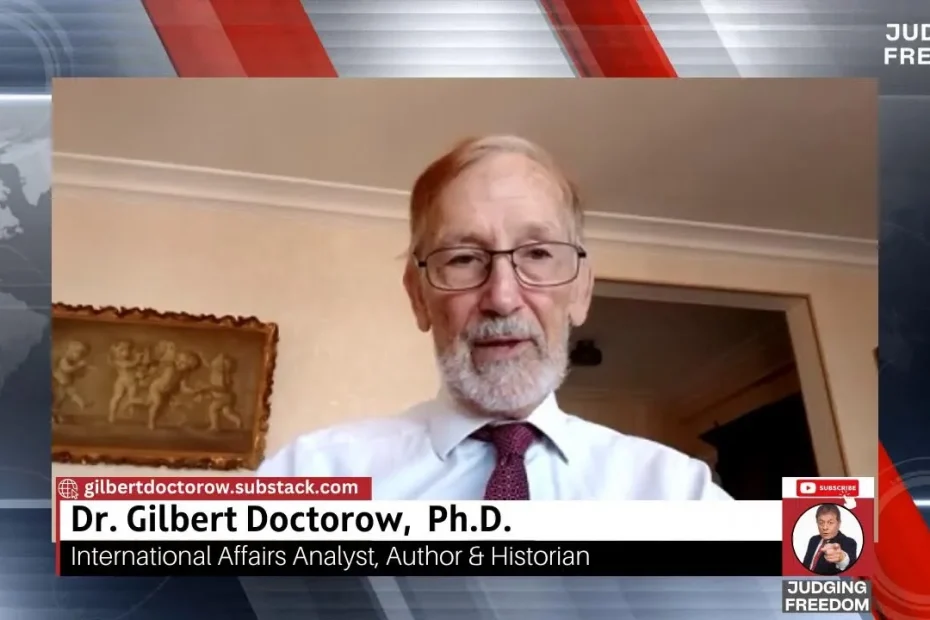
Read the full transcript of a conversation between Judge Andrew Napolitano and Prof. Gilbert Doctorow on Judging Freedom Podcast titled “Putin and Ceasefire” premiered March 19, 2025.
TRANSCRIPT:
Putin and Ceasefire: A Diplomatic Breakthrough?
JUDGE ANDREW NAPOLITANO: Hi, everyone. Judge Andrew Napolitano here for Judging Freedom. Today is Wednesday, March 19, 2025. Professor Gilbert Doctorow joins us now. Professor Doctorow, it’s a pleasure. Thank you.
Let’s get right to the news of the morning, which is that the White House is claiming a significant breakthrough in the negotiations that took place between President Trump and President Putin, which appear to have resulted in an agreement by the Russians not to attack energy infrastructure for the Ukrainians. We don’t have any response from the Ukrainians yet. But before we talk about Zelensky and before we talk about the Europeans, is this a ceasefire the way the White House wants us to believe?
PROF. GILBERT DOCTOROW: No. We know very little about what was discussed from what Donald Trump has released, and that’s not surprising and nobody can blame him. These discussions are still very sensitive. The opponents to Trump domestically and internationally are extremely powerful and are looking for a fight. So he will not tip his hand at this point. It would be quite inappropriate. It’s also clear that the two gentlemen didn’t spend 2 hours and 28 minutes discussing the halt of Russian attacks on the energy infrastructure in Ukraine. What I’d like to point out is a remark that I haven’t seen highlighted in mainstream, namely the remark made by Peskov after the call was over that the world is a lot safer now than it was before the call was made.
JUDGE ANDREW NAPOLITANO: Well, that’s profound. Do you know what he was talking about? Did they discuss nuclear weapons? I guess we don’t know what they discussed other than Ukrainian infrastructure.
PROF. GILBERT DOCTOROW: I don’t think that the energy infrastructure took much time in their chat. I’m sure that it was Trump trying to give a vision of what a reset with Russia would look like. And it obviously was very appealing to the Russians. The halt on attack on energy infrastructure was a gesture of goodwill, nothing more. But it was necessary to support Trump’s statements that progress is being made. Of greater interest, of course, is the announcement that working groups have been assigned again that there will be further talks this Sunday in Saudi Arabia. That’s with regard to progress on the well submerged issue of a ceasefire and the outcome of possible peace negotiations.
JUDGE ANDREW NAPOLITANO: When is the last time an American president spoke directly with a Russian president?
Historic Communication Between World Leaders
PROF. GILBERT DOCTOROW: Well, Joe Biden did this back in December 2021. And of course he had his little summit with Putin in the spring of that year. But the point is no one has spoken for two hours and 28 minutes on the phone, I don’t think anytime. This is a record and they had something to talk about. I think it really was at the level of presidents talking about a new cooperative relationship.
JUDGE ANDREW NAPOLITANO: Do we know if whatever they agreed to resembles at all whatever Secretary of State Rubio and Ukrainian President Zelensky agreed to?
PROF. GILBERT DOCTOROW: Oh, I think that’s off the table. That’s a separate issue. I would imagine, what we’re talking about, if I could just go straight to the point: We’re talking about a new configuration of the United States and Russia waging war on Europe.
JUDGE ANDREW NAPOLITANO: Well, that new configuration is what people like you and Doug McGregor and Larry Wilkerson and Jeff Sachs and John Mearsheimer and Scott Ritter and those of us who are decidedly not neocons have been pushing on the president since he was elected. That grand reset, which I think you will agree with me, should involve China in Brazil and India as well as Russia. That grand reset of realism recognizing the sovereignty of other countries and their legitimate security needs and interacting with them culturally, socially, and above all, economically. Agreed.
PROF. GILBERT DOCTOROW: Oh, I agree completely. But let’s go step by step. The immediate task is to neutralize Europe. The immediate task is to neutralize the Ukrainians, Zelensky and the others vying for power in Ukraine. And on that, I think they could have had a good subject for discussion because this is not an abstract issue. It’s a concrete issue which is intended by the Europeans and by Zelensky to sabotage the peace negotiations. So I think the Russians and the Americans are going to make common cause on this.
Putin’s Strategic Moves
JUDGE ANDREW NAPOLITANO: What do you think motivated President Putin to show up in Kursk in military garb and very publicly and ostentatiously? I’ve never seen him do this. Reminds me of Lyndon Johnson in Vietnam in the mid-60s, very ostentatiously saying, let’s get this over with. And it’s just about over with. What motivated that?
PROF. GILBERT DOCTOROW: Well, it’s critical for the Russian public to understand that the Kursk adventure is coming to an immediate end. That was held out as something to be done before any talks with the Ukrainians could take place. And so Putin was finalizing that, letting his own public know that this is being done. And for that reason, we are prepared to enter the talks.
JUDGE ANDREW NAPOLITANO: What is the Kremlin view of President Trump’s decision, if there is one? I know you monitor Russian media very effectively, professor, of Donald Trump’s decision to bomb the Houthis, which resulted in the deaths of Yemen civilians?
PROF. GILBERT DOCTOROW: Well, it’s easier to bomb the Houthis than it is to bomb Tehran. So this was a messaging look. There are a lot of cynical things going on here. And bombing the Houthis was one such cynical measure.
Lives were lost. Civilian lives were lost. This blood is on Trump’s hands. But I think he exculpates himself by saying that by his actions, he is avoiding much bigger bloodshed.
And I think that you have to look at everything that Trump is doing today from the perspective of his prioritizing, his managing his political strengths to achieve one overriding goal, and that is a reset with Russia, which is a precondition for a new world order of the kind that you described a few minutes ago.
Trump’s Middle East Strategy
JUDGE ANDREW NAPOLITANO: What does this say for the request that we know is coming to Donald Trump from Benjamin Netanyahu to back up the IDF when it attacks Iran? Has Trump already said, forget about it, Bibi, or I’m thinking about it?
PROF. GILBERT DOCTOROW: Well, he might say I’m thinking about it because it’s too early for him to fully alienate Netanyahu and Netanyahu’s backers in the States. This is a war of great proportions going on between Trump, his domestic opponents and his foreign opponents in Europe. And he has to find points of leverage. He cannot fight on all fronts. It’s quite enough that he’s got these tariff wars going. He cannot fight on all fronts, and he has to find leverage. And of course, the Israeli supporters are a very effective point of leverage and demonstration that, you know, boys, I’m not all bad. I’m doing some things that you want very much. So that is to have them at his back makes it much easier for him to go into what is going to be a really struggle of enormous proportions with Starmer and Macron and Merz and von der Leyen. That is a hell of a task he has.
JUDGE ANDREW NAPOLITANO: Well, what do you think those European leaders are thinking this morning after they read the Kremlin’s version of the two and a half hour conversation and the White House version of the two and a half conversation. They don’t see any mention of them.
PROF. GILBERT DOCTOROW: No, they’re not there. And practically speaking, Europe has made itself totally irrelevant. There are some people who may appreciate that, but the ones you mentioned don’t. They will get it. They think they have enormous leverage over Trump because of his domestic opposition, with whom they’re all well connected, and because they overvalue themselves in the world order. I think they’re in for a rude awakening in several weeks to come.
The Ceasefire Details
JUDGE ANDREW NAPOLITANO: What is the obligation of the Ukrainians in compliance with whatever Trump and Putin agree to do? They have to agree to stop attacking anything inside Russia. I mean, a ceasefire, however limited it is, has got to be bilateral, as my understanding.
PROF. GILBERT DOCTOROW: It is bilateral. And although some of the mainstream are speaking about this as something that Trump, that Putin will do, as I understand it, he gave orders to the military immediately after the phone conversation to stop all drone and aerial attacks on the infrastructure, the energy infrastructure of Ukraine. I believe that Kyiv has made the same promise. But let’s step back a bit, because everybody’s talking about a 30 day unconditional ceasefire. And that’s not where this all started.
This started from Zelensky speaking about a 30 day partial ceasefire, which was precisely about things like this against civilian infrastructure and against the free naval transit in the Black Sea. That is what Zelensky proposed. The Americans overrode that and made it much broader so it would be more impressive. And now it’s been rolled back to where it started when Zelensky first proposed it. So I think there’s no question but that Zelensky agrees to this notion of no attacks on the Russian energy infrastructure. It’s not to say no attacks on Russia, but not on the energy infrastructure which they have been doing. They were attacking refineries, oil depots and so forth.
Trump’s Israel Policy and Strategic Calculations
JUDGE ANDREW NAPOLITANO: Why do you suppose and do you see any connection. Why do you suppose Donald Trump authorized Benjamin Netanyahu to resume the genocide in Gaza? And do you see any connection between his communication with an agreement with President Putin and this dreadful unleashing of Netanyahu?
PROF. GILBERT DOCTOROW: I think they’re directly related. And this is a point that I’ve had in correspondence with some of the readers of my essays. Some people have been extremely outraged that I could speak rather calmly about the green light that Trump gave to Netanyahu.
JUDGE ANDREW NAPOLITANO: Oh, Professor Doctorow, you always speak calmly, no matter what we’re talking about, which is one of your great assets.
PROF. GILBERT DOCTOROW: Well, they’re linked because, as I said, Trump is in a struggle of enormous consequence and great danger to himself. And he has to have points of leverage. There’s no better point of leverage in the United States Congress than the Israeli lobby and that end of American foreign policy. So with that at his back, he can look like one of the boys, a continuator of American foreign policy at the same time that his overreaching aim is to destroy the fundamentals of American foreign policy of the last 80 years.
JUDGE ANDREW NAPOLITANO: Not with respect to Israel.
PROF. GILBERT DOCTOROW: No, not yet. But I would be very cautious in believing that his support for Netanyahu on this miserable, cowardly and deadly attack in Gaza is anything more than a temporary deal with the devil for the reasons I gave.
JUDGE ANDREW NAPOLITANO: All right, well, here is his press secretary, Chris. I’m going to guess this was yesterday or last night or very early this morning. This defending, well, revealing the consultation with the Israelis and defending the Trump administration decision to unleash them.
[Karoline Leavitt: The Trump administration and the White House were consulted by the Israelis on their attacks in Gaza tonight. And as President Trump has made it clear, Hamas, the Houthis, Iran, all those who seek to terrorize not just Israel but also the United States of America will see a price to pay. All hell will break loose. And all of the terrorists in the Middle east again, the Houthis, Hezbollah, Hamas, Iranian backed terror proxies in Iran themselves, should take President Trump very seriously when he says he is not afraid to stand for law abiding people. He is not afraid to stand up for the United States of America and our friend and our ally, Israel.]
JUDGE ANDREW NAPOLITANO: Now she’s known for her hyperbole, but it doesn’t sound like she’s representing or speaking on behalf of somebody who’s about to say to Netanyahu, enough is enough.
PROF. GILBERT DOCTOROW: He’s not prepared to do that today. He needs Netanyahu’s supporters on Capitol Hill.
JUDGE ANDREW NAPOLITANO: He needs Netanyahu supporters on Capitol Hill in order to do the reset with Russia, China, India and Brazil.
PROF. GILBERT DOCTOROW: Exactly.
JUDGE ANDREW NAPOLITANO: This is a fascinating, fascinating observation. It pains me that human beings lives can be sacrificed like this. Yemen lives sacrificed for Iran and now 400 civilians killed by the IDF yesterday. There is no moral, legal or even military justification for that whatsoever. And everybody acts like it’s a normal thing for the Israelis to do. Why aren’t people furious about it?
Trump’s Political Strategy
PROF. GILBERT DOCTOROW: I agree with you on all moral legal issues. At the same time, there is every political reason to do it. And I think that people misjudge Trump because he’s a businessman, he’s a transactional operator. He has no experience in international affairs. I think they’re dead wrong. I think that Trump is a very political animal, probably the most effective political animal we’ve had in the Oval Office since Lyndon Johnson. He trades IOUs, he uses threats freely and with some effect.
I made the remark that it was that his political strength was demonstrated by his getting every single one of his nominees for cabinet level posts through the nominating process. One of my readers who was better briefed in history than I am, American history, commented that in 285 years of American nominations, only nine nominees were ever rejected by the Senate. However, that’s a very good point and I have to admit it. Nonetheless, they weren’t candidates like the ones that Trump put up. I don’t think we’ve had a history of candidates being put up for the Senate process who were openly saying that they would use a wrecking ball against the institutions and policies of this country over the last 80 years, have we.
Discussing Trump’s Foreign Policy Approach
JUDGE ANDREW NAPOLITANO: Ever had a Secretary of Health and Human Services who believes the best way to fight a disease is to let it spread? Is what he said yesterday.
PROF. GILBERT DOCTOROW: Well, look, the Brits and the Scandinavians were saying that about COVID. So it’s not as though he’s promoting a novel approach. It was unproven. It didn’t work. But nonetheless, that idea did float for maybe a year or two during the COVID epidemic.
JUDGE ANDREW NAPOLITANO: All right, I want to balance off your calmness with Scott Ritter’s anger over Trump bombing the Houthis and threats to Iran. It’s a minute and a half long, but he’s over the top. And in my view, wonderful. But I’d love you to comment on it. Chris, get ready. Chris, cut number one.
[Scott Ritter: Because Donald Trump ordered a bomb that blows up with greater explosive force than the bomb there was drop under Biden. Trump is an idiot. I hate to say that, and my wife is going to be very mad at me for saying this, but this is the kind of stupidity that a chairman of the Joint Chiefs of staff has said, Mr. President, stop, cease and desist. The Secretary of Defense has to do an intervention, say, please don’t do this. You are making us look stupid. You’re putting us in a bad situation. And it’s unbecoming of the Commander in Chief to speak in this fashion about conflict when American lives are on the line. Mr. President. Shut up. And that’s what he needs to do. Shut up.
If you’re going to drop bombs, drop bombs, but quit pretending that because you’re Donald Trump, the earth shakes greater because you dropped the damn bomb than somebody else. The bomb blows up, and you know who doesn’t care? The Houthi. All you can do is drop bombs, and your bombs won’t stop them from firing missiles. And then you want to now threaten the Iranian people the same way. It isn’t going to work, Mr. President.
And what’s going to happen are one of two things. One, you’re going to look foolish because you’re going to have to back down when your Secretary of defense says, we can’t escalate any further without putting 700,000 boots on the ground. That’s a major invasion that will cause the entire region to blow up, oil prices will spin out of control and your economy will crash and you’re finished, Mr. President. You’re done, everything you’re trying to do. The American people will not tolerate $120 oil because they can’t economically. All the changes you’re making are predicated upon a foundation of economic stability which will not be here if you throw oil security, energy security, out the window by going to war with Iran. Stop it.]
The Risk of Escalation
JUDGE ANDREW NAPOLITANO: What do you think, Professor?
PROF. GILBERT DOCTOROW: I think he’s very excitable. My question in response, cynical as this is, ugly as it is on a moral and legal basis, as you properly remarked, the question is, what do you want? Do you want to be vaporized in World War 3 or do you want to let this sort of nonsense go on that Trump is doing to show that he’s one of the big boys, continuator of certain elements of American foreign policy? I think this is unfortunately, a price that has to be paid for you and me and Scott Ritter not to be vaporized. Understood.
JUDGE ANDREW NAPOLITANO: And deeply appreciated. And it brings us back to where we started. They talked for 2 hours and 28 minutes yesterday, probably 5 minutes on the let’s stop bombing energy infrastructure. And the rest was on these huge issues, the last of which you just alluded to. Nobody wants the world to be vaporized. Agreed?
PROF. GILBERT DOCTOROW: Agreed.
JUDGE ANDREW NAPOLITANO: Professor Doctorow, pleasure, my dear friend, and thank you for listening to my froggy voice. I’m at the tail end of a late winter cold. It’ll go away soon. And your time and your thoughts are much appreciated. I look forward already to chatting with you next week.
PROF. GILBERT DOCTOROW: Well, thanks for having me.
JUDGE ANDREW NAPOLITANO: Of course. And coming up later today at 11:00 this morning on all of this, Colonel Douglas MacGregor at 1 this afternoon on all of this. Pepe Escobar at 3:00 this afternoon on all of this, Phil Giraldi, Judge Napolitano for judging freedom.
Related Posts