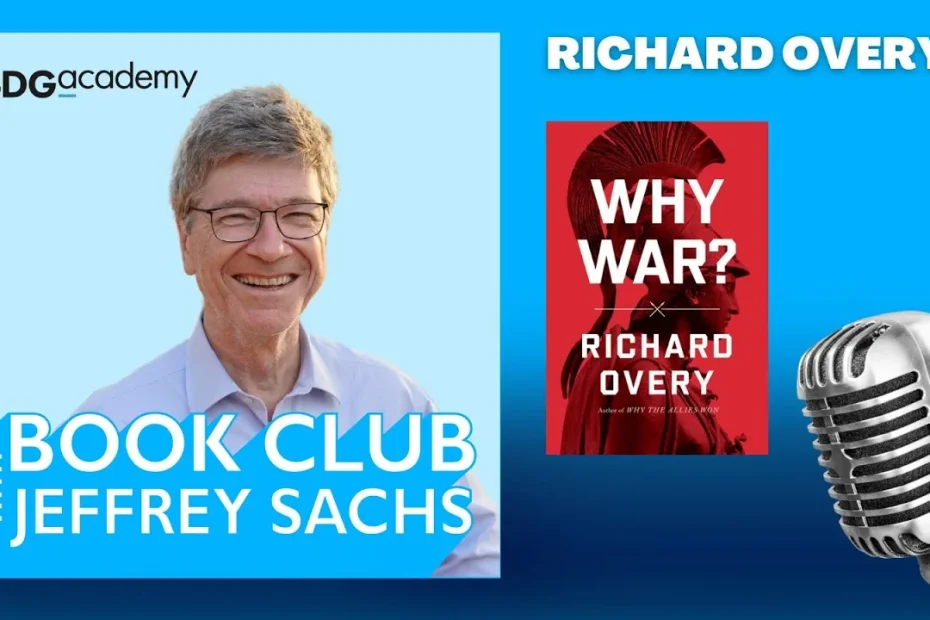
Read the full transcript of a conversation between Professor Jeffrey Sachs and historian Professor Richard Overy on one of humanity’s most unsettling questions: Why do we wage war? On Book Club with Jeffrey Sachs, premiered on Mar 4, 2025.
Listen to the audio version here:
TRANSCRIPT:
Introduction
PROFESSOR JEFFREY SACHS: Welcome to Book Club with Jeffrey Sachs. I’m really excited today to be speaking with one of the world’s great historians, a great historian, especially of World War II, but a historian of war in general. We’re speaking with Professor Richard Overy, the Honorary Professor at University of Exeter. He’s also was longtime professor of history at King’s College London. He is a graduate of University of Cambridge and a great scholar.
Professor Overy, thank you so much for the chance to speak with you about your new book. I’m going to hold it up as a paper because I read it as a Kindle. But this is the cover, “Why War?” And it’s a wonderful overview and discussion of the many perspectives of why war, ranging from the biology and anthropology of our species, to the motivations of war of those who take their nations into war, whether it’s the pursuit of power or the pursuit, they think, of national security or the search for resources and so forth. So it’s a great overview of this enormously complex, challenging, and central issue for humanity.
And it seems we’ve been surrounded by war non-stop. I feel as an American, my whole life has been lived with America at war of one kind or another, proxy wars, direct wars, covert wars, overt wars. So I immediately grabbed your book as soon as it appeared to better understand this. So thank you for being with me, Professor Overy.
PROFESSOR RICHARD OVERY: My pleasure.
The Structure of “Why War?”
PROFESSOR JEFFREY SACHS: We could start off. The book’s divided into two parts. The first part is a kind of fundamental view, why do we fight? And as I mentioned, that touches on biology, human psychology, anthropology, and ecology.
The second part is more from the perspective of statecraft, I would say. What are the motivations, as perceived by state leaders who take their nations to war, the pursuit of resources, beliefs, seeking power, seeking national security. Why did you structure the book this way? And how do you feel that these two different dimensions help us to understand your big question, why do we have so many wars?
PROFESSOR RICHARD OVERY: Well, the first part of the book is really aimed at the last, say, thousand years of human history. It’s really to look at where the origin of our belligerence comes from, and we’re a very belligerent species. Now, many historians date it really from the onset of the state, but I’m not happy with that. And there’s plenty of archaeological and anthropological evidence to suggest that small groups, whether it’s a Madi tribe or whether it’s a separate tribe from long ago, were certainly capable of what we should regard as warlike violence. It’s not war in the modern sense, but warlike violence, often exterminatory violence where one village finally decides that the next village is engaged in sorcery and they set out to punish it. So the first half of the book is really the longer perspective, you know, where does our urge to belligerence come from?
Why do we have almost every society worldwide by, say, four or five thousand years ago organized for war in some form or other? The roots, it seems to me, go a long way back. But the second part of the book is really about motives. Because if we think about the broader framework within which human beings have conducted warfare, we have to also look at it in terms of motives. And because human beings are conscious animals, you know, they have to find some way to justify what is they’re doing.
Seizing resources, defending belief, seeking power or security is not just a modern thing. It’s not just what states do. It’s also something that we can see tribal communities doing. And I think we can imagine that in all four cases, these are factors which also go deep back into the human past.
The Us Versus Them Mentality
PROFESSOR JEFFREY SACHS: This basic notion that I think runs through your first half, whether it’s the biology, the psychology, the anthropology or the ecology, the four headings, is all about the us versus them mentality in some sense. This extraordinarily sophisticated in some way, often suicidal, but sophisticated way that human beings draw boundaries between the inside group and the outer group. Is that correct in your view? I mean, that’s at the core of this?
PROFESSOR RICHARD OVERY: I think it’s very important. And I think you can take it back a very long way. The kin group, whether they’re nomads or it’s a tribe, the kin group is what matters and you defend the kin group against all comers when necessary. And that will usually or has usually involved some level of warlike violence. And dividing the world around you into them and us is something we still do today.
I mean, we can find plenty of examples in the twentieth century where people who actually live side by side as neighbors—take Bosnia in the Yugoslavia civil war. People who live side by side as neighbors can suddenly turn into the bitterest enemies, committing atrocities against each other. It seems extraordinary, but the human capacity to divide people into them and us, into the other and us, seems to me to have a long history. And psychologically, I think it’s very important explaining how human beings are capable of being belligerent against their own species.
PROFESSOR JEFFREY SACHS: I can tell you just a personal anecdote. I was asked by the last federal government of Yugoslavia, Prime Minister Ante Markovic, in 1989 to help advise on what was an economic calamity that had hit Yugoslavia, and it turned into a hyperinflation.
And I remember so distinctly sitting on a June beautiful day in Belgrade, flowers everywhere, people sipping coffee in the central square. And I was reading the International Herald Tribune as I did in those days, and there was a story that said the CIA forecast war in Yugoslavia, civil war in Yugoslavia. And I read that, and I turned to my friend, and I said, “How ridiculous. Look out there, this is so peaceful. Everyone’s living peacefully together.” And I thought, my God, this is so stupid. And of course, as you say, neighbors started killing each other within a year.
PROFESSOR RICHARD OVERY: No, you could take that way back in history and you can certainly find plenty of examples. I mean, in the classical world, if you think about the ancient Greeks and the ancient Romans, they divided the world into Roman citizens and others. The Greeks divided them into citizens of the Polis and barbarians. It’s, in social psychological terms, something that seems natural to human beings, but it’s natural because they need some way of legitimizing what they’re going to do to other people. Otherwise, you wouldn’t. Otherwise, we would all collaborate all the time.
The Historical View of “The Other”
PROFESSOR JEFFREY SACHS: I love Greek philosophy. I consider myself an Aristotelian. But the Greek view of the other, the barbarian, the one that spoke “ba ba ba ba ba” and made no sense to the Greeks was absolutely real. You go conquer, we’re in brutal war with the barbarians, and that is a very deep view civilizationally.
PROFESSOR RICHARD OVERY: Yeah, that goes back right to recorded history. So it’s almost certainly characteristic of history long before that as well. And we know that when we look at tribal communities in the last two or three hundred years where anthropologists were able, scientists were able to observe them. And time and again, they found that neighboring villages would invade each other, massacre the entire population. You know, it doesn’t make sense to you and I that human beings behave like that, but that’s what we do.
And of course, we see this every day now. I’d say most vividly in Israel and Palestine where the level of dehumanization in the rhetoric and in the actions is absolutely stark and shocking to behold.
PROFESSOR JEFFREY SACHS: It’s a textbook case.
PROFESSOR RICHARD OVERY: But also the case of the way Putin has made the Russians think about Ukrainians as if they’re second class inhabitants of the continent, and they deserve what they get, even the suggestion they’re all Nazis in order to legitimize what it is that Putin is doing.
PROFESSOR JEFFREY SACHS: But I would say the Russophobia on the other side is—
PROFESSOR RICHARD OVERY: That’s right. It’s in both directions.
PROFESSOR JEFFREY SACHS: I remember a wonderful book—I don’t know if you’ve come across it, I’m sure you have, you’re a great scholar in all of this—by Gleason on the origins of Russophobia in Britain in the nineteenth century. It’s a Harvard University Press book from 1970. And he observed as a historian the rise of hate of Russia in the mass media, the newspapers of the day especially, and tried to explain it. In the end, he couldn’t quite explain it except that Russia was there, was big, it was a competitor with the British Empire, and you had to hate it.
PROFESSOR RICHARD OVERY: No, in many ways, it doesn’t look rational. A rational person would say, you know, you shouldn’t think about other people like that. We should try to collaborate. But human beings are not a particularly rational species.
State-Led Wars and Their Motivations
PROFESSOR JEFFREY SACHS: Indeed. In the second part of the book, you go to what has been your area of study throughout an illustrious career, which is states fighting states, basically, if I could interpret it that way. As you said, the first part deals with the hundred thousand year history of our ancient species. When states form, wars become more than cooperative ventures. They become actions by states, essentially.
So most of the wars that we’re talking about, the war between Russia and Ukraine or if you want to call it a proxy war between NATO and Russia, which in some ways it is, are state-led wars. And you divide the motivations by states into several categories. I think the tradition of doing this goes back to Thucydides, maybe longer. In the Peloponnesian Wars, Thucydides talked about interest, glory, and fear. You give us four dimensions: the search for resources or the lust for resources, belief, power, and security. Could you give a short explanation of what these four categories mean and why they’re different and how you use them to assess motivations for war?
PROFESSOR RICHARD OVERY: Well, it has to be said, of course, that there are many wars in which more than one of these categories actually operates. I’ve set them up into these different categories, really to be able to make sense of wars which are predominantly about the seizure of resources or which are predominantly about defensive belief or the extension of belief or predominantly about security. But I’m conscious that quite a number of these factors can operate together at the same time. But they seem to me to be the four most obvious categories to choose.
You know, war for resources also has a very long history. It’s not just about oil wars in the twentieth century, that can go all the way back to ancient Rome and beyond.
PROFESSOR JEFFREY SACHS: The resource—what is the object of the resource aim changes over time. Nobody cared about oil in ancient times. They cared about land and slaves, I assume primarily. But the idea that gold and some precious minerals or maybe a fountain of youth imagined at some place, and so forth. But the idea that, yes, we’re going to war to seize something of value from others—that has a very long pedigree.
PROFESSOR RICHARD OVERY: Belief is a complicated one because a great many social scientists are not convinced or historians are not convinced belief actually motivates war, that people use belief to mask other motives. But I’ve argued in the book that belief has to be taken seriously. Anthropologists take it seriously when they assess the cosmology, for example, of a tribal community. And we need to take belief seriously, from the wars of religion all the way through to the twentieth century, where belief also played an important part in motivating people for war.
We can think about American ideology, about what America sought in the Second World War, what they thought they were fighting for in Korea or in Vietnam and so on. Ideology is not something just for dictators. Defending belief and values is of importance to the democratic west as well. So I think we can’t downplay belief. It seems to me to be a very important element in our explanation.
PROFESSOR JEFFREY SACHS: It would seem in the western world, in the monotheistic religions world—Judaism, Christianity, Islam—there’s been plenty of religious war indeed, at least in part motivated by religious belief. Could you view the Crusades in any terms without belief playing some role? That seems impossible.
PROFESSOR RICHARD OVERY: Well, that’s what I’ve argued. But there are many historians in the twentieth century who saw the Crusades as pursuit of power or establishment of a new landed empire of the seas and so on, but played down the role of religion. I think if we want an example, let’s look at jihad, which is still alive and well in the twenty-first century with a very long Islamic tradition. And you certainly couldn’t tell a Muslim that his belief didn’t matter. Of course, it matters. Defensive belief in the Middle Ages to today has played a very important part in Islamic identity.
PROFESSOR JEFFREY SACHS: In Israel today, while there are varied motives that include power, security, and maybe resources also, belief certainly plays some role on the Israeli right, which says, “God gave us this land.” That’s belief motivation of war.
PROFESSOR RICHARD OVERY: Indeed. Well, actually, Israel is quite interesting.
The Nature of War: Multiple Motives and Coalitions
PROFESSOR JEFFREY SACHS: This war is quite an interesting example where, as you say, there are issues of power as well as security, as well as belief. It’s a conflict difficult to define from that point of view, and historians will have great fun fifty years’ time trying to do so.
It does seem to me that one aspect of politics in general, and therefore the politics of war, is that states run by coalitions of power. So the idea that there are multiple motives – you can get those who want to grab some resources together with those who have a deep ideological belief together with those who view the issue from a security state, and you build the coalition for war among people who truly have different motives in the end. You find them all there, maybe not in one person or one leader, but as kind of what puts the state over the top in saying we’re going to pursue this motivation.
Security as a Primary Motive
PROFESSOR RICHARD OVERY: No. I think there is usually what I regard as a primary motive. I mean, just take security because you would argue that security has been a feature of, you know, almost all wars. The people who start a war or the people who are defending themselves are very concerned about security, particularly frontier security. As I argue in the book, that’s a key site of potential conflict.
But security in an anarchic world, a world where there is no, you know, some big father figure saying, “stop, you can’t do that.” Nobody is going to stop an aggressor unless you can defend yourself effectively. So the pursuit of security is something that is characteristic for a great many conflicts, both sides, where you can in fact be an aggressor, and your argument is that what you’re trying to do is to achieve security. Look at Putin in Russia and Ukraine, or look at Israel too.
The security of the frontier and having an end to the potential violence of their neighbors is really the key ambition for waging war. I think otherwise, it wouldn’t be waging war. And you can take that right away back. Let’s look at the outbreak of the First World War. Everybody felt anxious, fearful, uncertain, not quite sure what other powers were going to do, couldn’t run the risk of not mobilizing, and suddenly, all the great powers found themselves in a war they hadn’t expected and didn’t want.
Power vs. Security Motives
What is the difference, say, of the power motive and the security motive? Well, they can obviously go hand in hand, but I’ve chosen power. Power is a difficult thing because power is usually power for something, and I know it’s not a commodity you can take off the supermarket shelf. Power is usually for resources or territory or security.
But I’ve argued in the book that one of the critical things about power is the power-seeking leader, the hubristic leader, one who thinks that war, in fact, is the solution, not the problem, and that his power will be enhanced by waging war and waging war successfully.
And we have plenty of examples. I’ve chosen Alexander the Great, Napoleon and Hitler, but one could certainly choose Genghis Khan. They were all not only seeking power, but, actually, I think distinctively of them seeking world domination and believing they could actually achieve it.
PROFESSOR JEFFREY SACHS: Yes.
PROFESSOR RICHARD OVERY: Well, fantasies. I mean, they were all three fueled by fantasy. But somehow, although Napoleon would create a Eurasia that all spoke French, that Alexander would conquer India.
And Hitler, of course, said he would become when Germany will become a new superpower. And that’s an unpredictable source of war, but a very important one. Fear is in this case, fear is the biggest longest periods of war. In the case of Napoleon and Hitler, terrible cost to the people that they invaded or involved in the conflict.
That here is a fact that you can’t build into any analysis. You know, there might be a Hitler or a Napoleon knocking around someone in twenty-first century, but I’m not going to know who he is or where he is until he makes his bid for power.
Leaders and War
PROFESSOR JEFFREY SACHS: One of the most striking things I think it’s true. You could tell me – the supposed interview of Göring in Nuremberg, the Nazi leader at the end of the war after being captured and in the Nuremberg trials is interviewed by a psychologist who was making these prison interviews, and he’s asked about taking nations to war. And if I have it correctly, Göring’s answer was a leader can always take a nation to war because the leader just has to invoke fear, tell the population that we’re under attack.
We have to go to war. And then fear can always rally the population for this cause. And then the interviewer, whom I don’t remember the name, I should. But then he says, “Yes. But in a democracy, you know, public opinion matters.”
And Göring, with the back of his hand, says, “No. No. No. No. No. It makes no difference. Whether it’s democracy or dictatorship, you just tell the public they’re under attack and that it’s traitorous to be against the war, and it works the same in any system.”
PROFESSOR RICHARD OVERY: Quite a shrewd observation, actually.
PROFESSOR JEFFREY SACHS: I thought so too from such an evil soul. Göring was not stupid. But I think one can exaggerate the extent to which leaders matter all the way back to the Middle Ages to the classical period. I mean, a lot of decisions for war are really collective decisions.
Many of the wars waged by the Roman Republic and the Roman Empire were wars in which the senate and the generals all had some kind of say as well. In the Middle Ages too, quite often, a prince would find himself having to go to war because he might sat around saying, “what are we doing? Time for a battle.” I think it’s dangerous to exaggerate the role of leaders, though I heard quite a lot of criticism in my book from people who say, “actually, is all leaders, isn’t it? And if you didn’t have leaders, we wouldn’t have this problem.”
That’s not the case. It does raise the question. There’s leaders, there’s the state apparatus, and there’s the general public, if one could put it that way. They all do play a role in different contexts. Sometimes it is a leader that can take a country to war on false pretenses or just on individual whim.
Sometimes – and I think in the Peloponnesian Wars, the fact that Alcibiades, the great demagogue of Athens, rallies the population to say, “let’s go attack Sicily, Syracuse,” is a good example of a demagogue, winning power by mobilizing the mass population for war.
Public Opinion and War
PROFESSOR RICHARD OVERY: How does that play out today? I think the population lost and mobilized itself actually. Popular haters and bitternesses can actually push the government to take a stance against a potential enemy that they might otherwise have taken.
The public in all these cases, the public is not passive. The further back you go, the more often it is that all the males almost of particular community would have to be involved. Think about the Vikings. It’s not a question of some Viking prince saying, “come on, let’s go and attack the coast of Ireland.” This is what Viking communities did.
Every year, they run some campaigns. You can find plenty of examples where the decision for war and the willingness to take part in wars is a much more collective activity than the idea that the single leader is saying, “come on, guys. Let’s go and make war.”
PROFESSOR JEFFREY SACHS: Did the German people want war under Hitler in 1939?
PROFESSOR RICHARD OVERY: Well, most German people did not.
PROFESSOR JEFFREY SACHS: Did not?
PROFESSOR RICHARD OVERY: Did not. But, I mean, the Hitler and Napoleon examples I used are exceptional examples, where, again, many French people were fed up with endless fighting through the revolutionary wars. And Napoleon was able to exploit his kind of charisma in order to get the French people to identify with this project.
And the same way Hitler tried to get Germans to identify with his project. And after 1939 and 1940, that was much easier to do. But the problem was that Hitler then said, “okay. Well, now we’re going to make war on the Soviet Union, then we’re going to declare war on the United States.” And that was a step that almost all Germans must have understood was too far.
PROFESSOR JEFFREY SACHS: Is there something actually known about German opinion about that? Or by then, was it so much basically a state totally in the Führer’s hands that it didn’t even matter?
PROFESSOR RICHARD OVERY: Well, no. I mean, the state was very worried about public opinion, spent lots of time and effort monitoring it, seeing what the response would be. And these reports ended up on ministerial desks in Berlin all the time.
But by the time things had gone wrong, badly wrong, in ’42 and ’43, it was too late. Of course, the German people were then ensnared in Hitler’s war. There was no way in which the people could then disengage from it. And the promise that somehow Hitler would reverse disasters and would somehow find a solution actually survived right up until 1945 when disaster was inevitable.
The British Empire
PROFESSOR JEFFREY SACHS: Can I ask you about the British Empire in all of this, and actually going back, maybe a century and a half before, to the Napoleonic Wars? It seems in history, there are two quite different divisions of the British Empire. One famously that it just kind of fell into Britain’s lap one by one in a haphazard way. And the other that it was a vision of British greatness, and that meant that there was a constant push maybe for belief. I don’t think security was the main issue, but belief and power were the driving forces of empire or maybe resources.
How do you feel about that big question?
PROFESSOR RICHARD OVERY: Well, empire changed, of course, over a couple of centuries. And the people who were building that empire were different generation by generation. It was a long process. I mean, one of the central things was simply economic.
The decision to extend and extend British influence and power in India – a lot of that relied not just on strategic anxiety about what the French were doing or the Dutch were doing and so on, but on the realization that Britain was a very successful mercantile state, and the more successful Britain became, the more resources she wanted to be able to control, the more markets she wanted to be able to build.
Now, I’m not in favor of the kind of capitalist theory of British imperialism, but Britain’s economic well-being was at the core of much of what the imperial project represented. I mean, the British became – or not the British as a whole, but certainly the merchant class and the politicians – became enormously rich in the nineteenth century based on the development of empire.
PROFESSOR JEFFREY SACHS: There was a lot of true entrepreneurialism involved in the particular way that Britain imperialized because it was joint stock companies after all. It was actual financial ventures.
PROFESSOR RICHARD OVERY: Indeed. Well, many of the original colonies or colonial areas and so on were indeed run by companies, chartered companies and not run by the British state.
PROFESSOR JEFFREY SACHS: I hadn’t really properly appreciated that until I was thinking about – and I don’t know if I’m right or not – but Hobbes writing about the social contract at the time that the literal colonial contract was being designed everywhere. So he was watching new states take hold literally as contracts.
PROFESSOR RICHARD OVERY: Indeed. John Locke had a lot more to say about that. I mean, John Locke was much interested in that, and indeed profited from it himself. And by that stage, I think that the British Imperial project was really rooted in its mercantile character.
Later on, you could dress it up, of course, by saying how great the British Empire was, that “Britannia rules the waves” and so on for popular consumption because the people didn’t actually benefit a great deal. I mean, they got lots of sugar and cheap rum, but the people who benefited from the imperial project were able to persuade the British, the rest of the British people, this was a good thing.
Democracies and War
PROFESSOR JEFFREY SACHS: There is the famous or infamous or accepted or discarded theory of the democratic peace, which has many variants. But one is that democracies don’t fight other democracies. Another is that democracies are somehow more peaceful or self-restrained. But it has seemed to me that in terms of how government structure changes the incentives to war, that Athens, Britain, and the United States are all examples of quite robust democracies that loved the imperial adventure.
PROFESSOR RICHARD OVERY: Indeed. Well, I think grouping Athens with that is an interesting reflection of the extent to which we make a mistake of assuming that democracies really prefer peace. Well, maybe they do prefer peace, but they’ve been involved in a lot of wars over the course of human history.
I would say that the greatest democracies have been very eager for war often. I mean, certainly the two Anglo-Saxon democracies.
PROFESSOR JEFFREY SACHS: Indeed. Britain was the lead democracy of the nineteenth century, America arguably of the twentieth century.
The Nuclear Age and Deterrence
PROFESSOR JEFFREY SACHS: But very much not shy about it.
PROFESSOR RICHARD OVERY: That’s sure. At all. No. Not at all. And indeed, you know, it could always be presented as defense of democratic values, defense of a liberal world and so on. And that would just make it necessary to wage war now and again.
PROFESSOR JEFFREY SACHS: Do you think that things are different now because of the nuclear age? That somehow we’re going to be wise enough to not have what happened so many times in history, where major powers stumbled into direct war with each other? You’ve watched and looked very closely at the motives of national leaders. Do you trust them?
PROFESSOR RICHARD OVERY: Well, no. For many political scientists, the rational actor model exists so that, whatever your political complexion, you’re not going to risk nuclear war. And I think we all hope that that’s the case. Of course, there are plenty of irrational actors around, and they will be in the rest of the century.
Nuclear war has made a difference. Major states don’t easily reach for war. And the threats that Putin has been throwing around over the course of the last two years makes it clear that this is just rhetoric. But Putin understands perfectly well that if he engages in nuclear war, Moscow disappears just as New York.
I think that deterrent stance exists even for the most irrational of politicians. It’s very hard to imagine that we will descend into a nuclear war.
Could World War II Have Been Avoided?
PROFESSOR JEFFREY SACHS: I’d love to, since I have you here and you’re one of the greatest historians of the Second World War, delve into that a bit with you. Whether the war could have been avoided.
One episode that I’m very curious about is at least some historians say that Stalin in 1938-39 reached out to Britain and France to try to make an anti-Hitler coalition and that he was rebuffed actually by the Western powers, so an opportunity was lost. And since you’ve written brilliantly in the leading way about Munich, and we hear about the appeasement at Munich nonstop, I would say, my whole lifetime as basically the core model of what to avoid in diplomacy, your take on that as well.
So I guess two questions that I’d like to ask you about before September 1, 1939, of the war in the West and then just after the end of the war in Europe. But in 1938-39, could war have been stopped either by this coalition of the Soviet Union and Britain and France forming earlier? Was Munich the profound mistake that it is made out to be?
Was it right to try in any way to engage with Hitler in diplomacy? Maybe not so naively as declaring “peace in our time,” but was there any reason to try diplomacy at that point? Just help us understand whether anything could have been done by that point or whether Hitler was so determined to conquer the world that it was inevitable that the world was about to experience this disaster?
PROFESSOR RICHARD OVERY: Well, I don’t think that Hitler was planning to conquer the world at that point. I mean, I have a rather different take on Munich.
The important thing about Munich was that Hitler wanted to wage war against the Czechs and destroy the Czech state. He wanted to imitate the Japanese and Mussolini. They all waged war in the 1930s. Hitler hadn’t yet. And he thought that he’d be able to do so, and he thought that the western powers were too feeble or too preoccupied to obstruct him.
And what Chamberlain does—for all the venom directed at him now—what Chamberlain does is he tries to find a way to limit Hitler’s ambition against Czechoslovakia and, of course, to avoid war. I mean, why not want to avoid war? It’s not a bad thing to do. But he limited what Hitler could do in 1938. Hitler was furious. And he was determined in 1939 that if he engaged or when he engaged in war again in Central Europe, that he would not take any notice of the British and French.
They wouldn’t do anything. He had their measure, he thought. And so war against Poland, he expected to be isolated, but the British and French would not intervene. But by that stage, Chamberlain and the French leader knew that there was no way of stopping Hitler short of declaring war.
And that’s what they decided to do, and they stuck with it right the way through to September 1939. So, in the end, it’s very hard to see how war could have been avoided. There’s a view in Poland now that actually it might have been better if they’d stuck with Hitler and invaded the Soviet Union together, because the French and the British let them down. I think that’s also a delusion because Hitler certainly had plans for Poland inside a German imperial continent.
But it’s very difficult to see how war under those circumstances might have been avoided. With the Soviet Union, well, we know that the British and French simply didn’t trust the Soviet Union, and we still don’t know what Stalin really had in mind in 1939, and whether it would really have achieved what so many historians think it would have achieved. I’m not persuaded.
Reassessing Munich and Chamberlain
PROFESSOR JEFFREY SACHS: Let me ask you—I’m very taken with what you say. My view has always been, again, without any of the depth of knowledge, but my view has always been that Chamberlain was right to try to negotiate. I think his big mistake, if I could put it in my simple terms, was to declare, rather than to say, “Well, we don’t trust this person, but here’s our agreement.” He declared “peace in our time” and faced adulation for it and so greatly overstated the case.
But then on the balance, and you’ve added another point, I always felt that showing that Hitler was completely deceitful, could not be bargained with, was ready to act no matter what commitments he had made, ultimately redounded to Hitler’s defeat. As you say, by Hitler’s invasion of Poland, British and French spines had been stiffened by the abusive treatment after Munich.
But I always thought another element, and I’d like to ask you about it, was that in a way, Munich made Churchill possible because Churchill’s argument all through the 1930s was you can’t trust this man. Chamberlain had tried to trust him, proved that he couldn’t be trusted, and that made Churchill possible in a way. Because when Churchill faced opposition in his own cabinet in May 1940—should we make a compromise, should we make a deal—Churchill was able to say because of Munich, “No. You can’t trust Hitler. We have to fight.” Does that make sense?
PROFESSOR RICHARD OVERY: Yeah. Although we have to remember the fact that he was strongly supported by Chamberlain in that debate. I think that’s a fact that people often overlook. Chamberlain didn’t trust Hitler actually. And the “peace for our time” is a use of rhetoric.
PROFESSOR JEFFREY SACHS: Unfortunate rhetoric, I would say.
PROFESSOR RICHARD OVERY: Unfortunate rhetoric. Yeah. But he knew that Hitler could not be trusted. As soon as Hitler broke that agreement and occupied Prague, for Chamberlain, who didn’t want to go to war, was a man who thought that in war, nobody wins, he didn’t want to go to war, but he was nonetheless brave enough to take his country into war in September 1939 against a man who he rightly judged could not only not be trusted, but his ambitions were unpredictable.
PROFESSOR JEFFREY SACHS: Some historians argue, well, by having those negotiations, Hitler was empowered vis-a-vis his own reticent generals and could never have acted had Chamberlain showed more spine before Munich. So the counterargument is not only was it naive, but it actually empowered Hitler in a way that otherwise wouldn’t have happened. Does that argument make sense?
PROFESSOR RICHARD OVERY: No. It doesn’t make sense to me anyway. The opposite would happen. Chamberlain, at the moment of acute crisis, sent an emissary to Berlin. And the emissary was told to tell Hitler that if he invaded Czechoslovakia, naturally then he would find himself at war with France and England. And the French ambassador arrives a little later to echo the same thing.
But Hitler had also been warned about it by his colleagues, by his political associates, that he was running too much of a risk. So in a sense, for Hitler, it’s a climb down, which is why I’ve emphasized that in the crisis of Poland, he refused to climb down again. “I’m not going to climb down again. I made a mistake. The British and French actually aren’t going to do anything. They’re too feeble. So we’re going to attack Poland, build Lebensraum, and turn around at the Vistula, and there you are.”
So that was a miscalculation, of course, of very large proportions. But by 1940, he achieved, remarkably, the defeat of Britain and France on the continent of Europe.
The Legacy of Munich in Modern Diplomacy
PROFESSOR JEFFREY SACHS: In view of your view, which makes so much sense to me, the way that Munich 1938 is treated emblematically in our public discussion is to say never negotiate with the other side. “That’s just appeasement. It’s useless. You can’t talk to the other side. You’ll just empower the other side.” So it came to be, at least in the American context, it came to be the explanation for why one should never negotiate.
PROFESSOR RICHARD OVERY: No. I’m sure in England too. It’s also something which has already been thrown at Trump in the last few days. And I don’t think he would like that accusation, but it’s a piece of rhetoric that’s become embedded in our view of international relations. But the history just doesn’t bear out that attribution.
PROFESSOR JEFFREY SACHS: Well, thank you. That is a wonderful clarification for me. That’s been my hunch, but I needed to ask the person who really knows.
The Cold War’s Origins
PROFESSOR JEFFREY SACHS: I want to ask you about the other end of the war as we wrap up, and that is about whether the Cold War was inevitable. The same way, was Stalin the Hitler equivalent? Was there this alliance of necessity during World War Two between the US, UK, and the Soviet Union that was bound to crash as soon as the war ended? Or was there the possibility of continued mutual recognition and accommodation?
And a specific question that I know little about is Operation Unthinkable, which is something I’ve only read superficially about, but is supposedly a request by Churchill in the early summer of 1945 to prepare war plans against the Soviet Union immediately after Germany’s surrender. In the end, the conclusion was it wasn’t practical to fight the Soviet Union at that point. But was that just war planning and game planning, or was the idea that the next step inevitably is confrontation with the Soviet Union deeply felt within the British leadership, and perhaps the American leadership, although I think not of FDR, but maybe of the people who surrounded his successor, Harry Truman?
PROFESSOR RICHARD OVERY: There’s a strong sense in Britain and America that they were going to get back—or in Britain, they were going to get back to the 1930s where the Soviet communism had been distrusted, with uncertainty about what kind of threat the Soviet Union posed to the British Empire. And so Churchill really took up the cudgels again at the end of the war.
But it was one of those things. It was a kite that Churchill flew, and it was up to the chiefs of staff, his military advisers, to shoot it down, which they did very promptly. There was no sense at all in thinking about war with the Soviet Union in the summer of 1945 when you wanted the Soviet Union to contribute to the defeat of Japan a few months later.
Operation Unthinkable was unthinkable. But you can certainly find the strand running through strategic thinking, security thinking in America and Britain from the late 1930s onwards, which anticipated that at some point, the Soviet Union would represent a much more serious geopolitical threat than it did in the 1930s.
PROFESSOR JEFFREY SACHS: I was unhappy as I was reading the history of Operation Paperclip, which was the American operation to bring Nazi scientists to the United States immediately after Germany’s surrender, that already by the summer of 1945, there was a view that war with the Soviet Union was very likely, probably by 1952, and that we had to be preparing for war. It seemed to me kind of a self-fulfilling prophecy if the moment even before the war was over in the Pacific, you’re already thinking about the war with one of your allies.
PROFESSOR RICHARD OVERY: Well, for the most part, it was in Stalin’s hands a bit. Stalin paid lip service to the idea that they would all collaborate after the war and that the wartime friendship would somehow continue. And yet, all the things that Stalin authorized in Eastern Europe or in the settlement in Asia after the defeat of Japan were designed to provoke the western democracies.
The Challenges of Post-War Relations
PROFESSOR RICHARD OVERY: You know, Saddam was not a democrat in the western sense, and it’s very difficult to see how Stalin’s pursuit of security interest in Eastern Europe and East Asia could be compatible with the way the Americans or the British saw the post-war order. There’s been a tendency among some historians writing about this to argue that, again, we let Stalin down a bit like, you know, we let Stalin down in 1939 and 1938. But I just don’t think that’s true. There wasn’t a great deal of common ground between the Soviet experience and experience in the United States and Britain. And the absence of common ground became more and more obvious the longer the post-war era went on.
By 1947-48, the prospect was, by that stage, more or less impossible.
PROFESSOR JEFFREY SACHS: One of our, of course, leading statesman historians, George Kennan, argued in the 1950s that the mistake was not to accept Russia’s call for a neutral demilitarized Germany, that that was what, again, was the security dilemma from the Russian point of view. In fact, we did the opposite, rebuilt a German military, made it the core of NATO, put in a security apparatus led by former Nazi intelligence leader, Galen, and that, in a sense, we gravely unnecessarily exacerbated Soviet Russia’s insecurity. Do you find any of that convincing?
PROFESSOR RICHARD OVERY: No. I mean, both sides had a role to play in it. It’s not that the West were the good guys and Stalin did all the bad things. Both sides had interests to pursue. Both sides wanted a post-war geopolitical order which suited them.
In the British case, they didn’t get it. The empire unraveled. In the American case, they got a global commitment, but it involved them almost straight away in war in Korea and later on the war in Vietnam. For both sides, it was a difficult transition to a new super order, and both sides made mistakes and misjudgments.
Reflections on Human Nature and War
PROFESSOR JEFFREY SACHS: It’s also indeed not simply a question of Stalin bad, the West good. After your wonderful reflections on all of this, your profound knowledge of modern war history, are there any grounds for optimism that we can avoid our worst instincts, our psychology, our anthropology? Do you give credence that someday, somehow, something like the United Nations can actually work as an effective mechanism to stop war, that there can be collective security in some way, in some new institutional fashion?
PROFESSOR RICHARD OVERY: Well, I’m a historian, of course, and I can’t really predict what might be the case in a century’s time. But, yes, I am a pessimist, and I’ve been accused of that in quite a number of the meetings and lectures I’ve been giving.
In fact, in one case, somebody made the point that despite the fact that I was talking about such pessimistic things and my condition was so pessimistic, that I smiled a lot. I think there’s no point to get miserable about this. It is just simply a fact, I think, that if we look at the whole course of recorded human history and archaeological recording too, going way back, human beings have been a belligerent species, and we might all wish they weren’t or that they were less belligerent. At the moment, there are few grounds for thinking that will happen.
PROFESSOR JEFFREY SACHS: Well, I’m going to take a slightly different point of view, and that is that people are going to read your book. They are going to understand that we have these underlying tendencies and motives. They’re going to reflect on the dangers that all of this means, especially in the nuclear age.
And we’re going to progress in no small part because great historians such as you help us to understand both the past, but also, while you say it’s not the role of the historian, you do shed light on what we might do differently, which is what I hope.
PROFESSOR RICHARD OVERY: Well, hope so too.
PROFESSOR JEFFREY SACHS: Let me thank you very, very much for a wonderful book. We’ve been speaking with Professor Richard Overy about his book, “Why Wars?” This is a remarkable synthesis that ranges from human biology and psychology and anthropology up through the most pressing and modern issues of statecraft.
It’s a fantastic way to join this discussion. So I want to heartily recommend this outstanding book to everybody that’s listening. Thank you for joining Book Club with Jeffrey Sachs. Thank you, Professor Richard Overy, for being with us. Take care.
Related Posts
- Transcript: Why Adaptability Beats Planning in an Unpredictable World? – Mr. Sanjeev Sanyal
- Transcript of Dr. Prathosh AP Lecture: AI Is Making Intelligence Cheap
- Transcript: Stanford’s Chad Jones on The Future of Jobs in an AI World
- Jared Isaacman: A New Era for NASA and American Space Exploration (Transcript)
- Transcript of Bill Gurley: Searching for Feynman at All-In Summit 2026