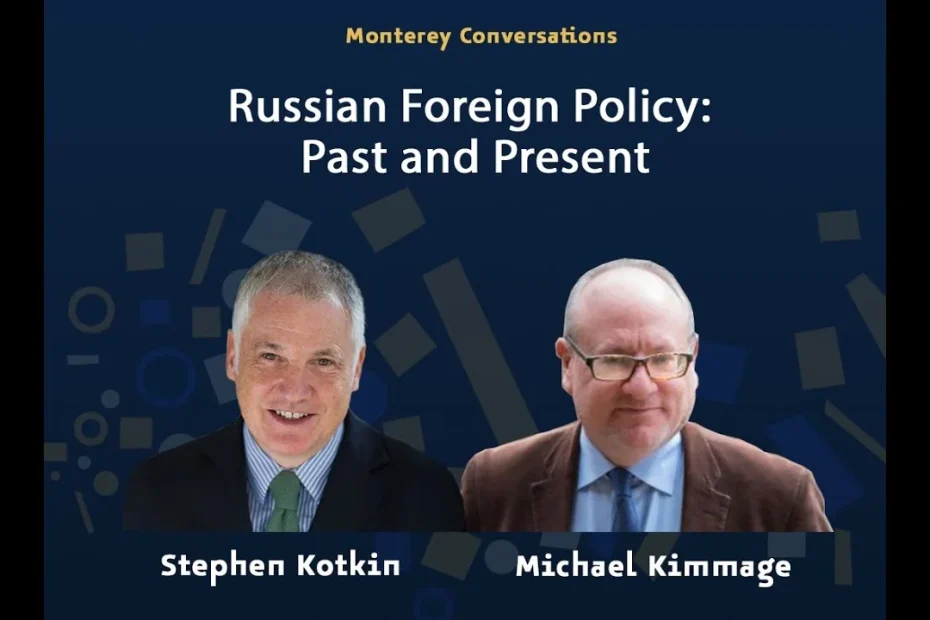
Read the full transcript of a conversation between Michael Kimmage and historian Stephen Kotkin titled “Monterey Conversations: Russian Foreign Policy, Past and Present” premiered on Oct 22, 2022.
Listen to the audio version here:
TRANSCRIPT:
Introduction
MICHAEL KIMMAGE: Hello, and welcome, everybody. I’m Michael Kimmage, professor of history at the Catholic University of America. Before I introduce today’s guest and speaker, I would like to thank the Carnegie Corporation for its generous support for the Monterey Conversations and thank as well Anova Siljevo of the Middlebury Institute and Altonai Junosova for all of their help in putting this and the other conversations in our series together. For those who are curious, there will be several upcoming Monterey conversations in November and December, and these will be publicized through our usual channels.
Today, it gives me great pleasure to introduce Professor Stephen Kotkin, who’s the Kleinheinz senior fellow at the Hoover Institution and a fellow as well at the Stanford Freeman Spogli Institute and Brookings professor in history and international affairs, Emeritus at Princeton University.
Now I could go through the very long list of Professor Kotkin’s many pathbreaking books and articles and public addresses, but I wanted to introduce Professor Kotkin in a somewhat different manner. To my mind, Professor Kotkin stands in very illustrious company, as somebody who brings to bear historical knowledge and insight to matters of policy formation, not just as a scholar of policy formation, but as somebody who addresses the contemporary dilemmas of policy formation. Certainly, under the dark star of the current war in Ukraine, there are many dilemmas of policy formation to be contemplated.
I believe that Professor Kotkin stands in an illustrious line with George Kennan, Arthur Schlesinger Junior, and in the nineteenth century of Henry Adams and George Bancroft as scholars who moved across that elusive divide between the world of academe and the world of politics and policy formations. And I think that for anybody working in the domain of policy formation or trying to comment and influence on that world, the manner in which Professor Kotkin brings historical learning to parents is a revelation in terms of his existing public publications and a continuing revelation.
The format for my questions is to walk through different stages in the history of Russian and Soviet foreign policy and to plant us by the end of this walk at the current war in Ukraine and to understand the historical background and the patterns that inform the present moment. With that general program in mind, let me ask my first question about the Russian empire on the eve of World War One and if it’s possible to characterize, with an emphasis on Europe, the main lines of Russian foreign policy before the First World War was a reality.
The Russian Empire Before World War I
STEPHEN KOTKIN: Thank you, Michael, for the honor of the invitation, and thank you for the over the top introduction. It’s great to be here. These are complicated issues, so we’re going to be simplifying a little bit or, I like to say, getting to fundamentals quickly rather than a narration.
I think you have to start Russian foreign policy in the pre-World War One period with a discussion of the unification of Germany and the Meiji restoration in Japan. Germany was many states prior to Bismarck’s unification in 1870-71 and the announcement of a unified Germany, which changed the game radically for the Russian empire. Now there was a new power on the continent greater than Prussia alone that Russia had to be concerned with on its flank. The new Germany industrialized really quickly and became a force to be reckoned with not just during the unification period, but in the decades that followed.
On the other side, the Meiji Restoration in Japan, which happened around the same time, the 1860s, just prior to the German unification, didn’t create a new state, but it created a much more dynamic Japan, which also went on to industrialize quickly and became a flanking power on the other side of the Russian empire. The rise of a modernized, industrialized, and well-armed Germany and Japan on either side of the Russian empire completely changed the game for Russia in terms of foreign policy and geopolitics.
In the early part of the nineteenth century, the global order—I wouldn’t emphasize the word “order” too much—was effectively a condominium between British power and Russian power. Now British power was much stronger. It was well in the ascendancy. But as a result of defeating Napoleon in an effectively hundred-year struggle between Britain and France for supremacy in Europe, Britain won, but it won only because it had Russia on its side. And, of course, as you know, Alexander got to Paris and presided over the treaty that came out of the defeat of Napoleon.
This condominium between British power and Russian power was expressed geographically. There’s something called the Eurasian spine, which extends from the Alps all the way through the Himalayas and beyond. And Russian power was north of the mountain range with the exception of the Caucasus, and British power was south of the mountain range for the most part.
Russia’s ability to maintain this position was already under question. We know from the Crimean War, which happened before either Bismarck’s unification of Germany or the Meiji restoration and the rise of Japan in the east. Already with the Crimean War, you could see that peak Russia, as it were, the defeat of Napoleon in concert with Britain and others, wasn’t sustainable for the Russian empire. But, nonetheless, despite the fact that Russia’s position was eroding compared to how it had been in the early part of the nineteenth century, there was just a radical shift with Germany and Japan as new flanking powers.
Russia lost a war against Japan, the first time a European power lost to an Asian power, as you know, in the 1904-1905 Russo-Japanese War.
So Russia lost the war to Japan and to Germany just a few generations after this eruption of German power and Japanese power on either side. And so in many ways, Russia didn’t find answers to German power and Japanese power and would continue to search for them after these military defeats on either side of it.
I’ll just add a couple more points here. One is that Russian power proceeded through cooptation of elites. So it would advance geographically and co-opt the elites or certain segments of the elites in those areas. As you know, empire means folding in certain territories through cooptation of elites. Not all the elites. You bet on one group or faction of a local elite, and they pledge loyalty to the empire. And so you kind of devolve your sovereignty, your local rule to them, but you elevate them over the other local powers. That’s the deal that empire involves.
Russia was enormously successful across multiple continents in spreading this way. But in the east, it came up against Japanese power and secondarily Chinese power. And in the west, it came up against German power and secondarily Polish power. And now we would add to that Ukrainian power. And so the borders of Russian power, the borders of Russian expansionism, the limits of Russia were Germany/Poland on one side and Japan/China on the other and then British power underneath it and that big mountain range, the Eurasian spine.
One final point, which is to say that, after the defeat of Napoleon, Russia was very comfortable with the settlement because there was something called the Holy Alliance where like-minded regimes, which were monarchies, where the church played a predominant role, you might call them traditionalist. They were against the eruption of constitutionalism and the rule of law states that the French Revolution brought to a certain extent. This concert, this Holy Alliance, this ability to conduct foreign policy in a coalition with like-minded regimes, broke down for Russia. And it broke down in a way that Russia found itself in alliance with the parliamentary rule of law orders on the eve of World War One, Britain and France, as opposed to an alliance with the like-minded regimes, like, for example, Wilhelmine Germany or the Japanese or other regimes which were more akin, not identical, but more akin to the Russian regime.
And so this inability to align domestic politics with foreign policy was a really big problem for Russia prior to World War One. And Pyotr Durnovo, the great interior minister who saved the tsarist regime during the Russo-Japanese war with massive successful repression and cooptation, predicted, as you know, in February 1914, that going to war against Germany was a big mistake, that Russia could lose, and moreover that there could be domestic upheaval and social revolution of the kind that Durnovo had been able to prevent in the previous war against Japan but was no longer in power as interior minister when he wrote this memo in February 1914 to the tsar.
And, of course, he was right. He had no answer. His diagnosis was correct, but he had no answer because the conservative’s answer was more autocracy, more repression, no concessions to constitutionalism, which was a dead end for the tsarist regime. But his diagnosis that a war against Germany would potentially destroy the monarchy, and not only the monarchy, but destroy the constitutionalists who were pushing the monarchy for constitutionalism and bring a social socialist revolution—Durnovo was spot on there.
So this is the picture well before Stalin gets anywhere near power or Lenin. Stalin is obviously in exile, as Lenin is, during World War One, and they have fantasies potentially about gaining power, but it looks absurd until it’s not absurd.
Lenin’s Foreign Policy
MICHAEL KIMMAGE: Well, it’s a very helpful mention of Lenin and Stalin because that’s where the next suite of questions is going to go. And I wanted to start naturally with Lenin and not so much with a focus on the civil war, but again with aspirational and other kinds of strategies that Lenin developed to the question of Europe. And no doubt, he inherited many of the same challenges and problems of the previous empire, but certainly in his own mind, was unique and original in the solutions he proposed.
STEPHEN KOTKIN: The tsarist empire was self-defeating. It attempted to fortify Russia’s geopolitical position, and it bungled into wars that it lost. This is going to be a familiar pattern that we’re going to talk about throughout this discussion. And so managing Russian power in the world has been complicated largely because Russian aspirations have always exceeded Russian capabilities except for these few moments like the defeat of Napoleon that we were talking about, prior to that, the defeat of Charles the Twelfth in Sweden by Peter the Great in the eighteenth century, and something else we’ll get to—Hitler and Stalin later on. But except for these high tide moments, Russia has tried to be a power of the first rank without the capabilities to do so.
And so that was the tsarist problem, which the successors to the Romanov dynasty will inherit. Lenin was a wild man. Lenin believed that he could bring down the whole global order, not just an order in which Russia was a power of the first rank recognized by others and arbitrated world affairs, kind of Alexander’s dream, but instead a complete destruction of the so-called capitalists or imperialists, that is to say, the great powers of the day, and their replacement by a Soviet-led order, that is an order centered on Moscow, which would be socialist in orientation. Not only did Lenin believe this, but he went out and tried to implement it. And so you get a radical revolutionary impulse in foreign affairs.
In many ways, tsarist Russia was a status quo power. Now, yes, it tried to move the status quo on its behalf slightly in East Asia, which led to the conflict with Japan and in the straits, that is to say, the Bosphorus and Dardanelles, the so-called Turkish straits, where Russia was definitely revisionist trying to move the international order. But Russia was not a hundred percent all-out expansionist revisionist power under the tsars. But under Lenin, anything went. At the same time, Lenin needed the capitalist powers for trade.
He needed their technology. He needed some of their money. And so he was in favor of diplomatic relations with the very powers that he was seeking to overthrow. And this was part of the paradox of the early Soviet state and of Leninism more generally, and Stalin would continue this, which is to say, “We want to have diplomatic relations with you, and we want to stab you in the face, let alone the back at the same time.” And the other powers didn’t really know what to make of this.
They thought it was transient or transitory. That is to say, it wouldn’t last. It couldn’t last. It was too crazy. And this ragtag group of people around Lenin known as the Bolsheviks would dig themselves, bury themselves in their own grave.
But Lenin felt that he would destroy the capitalists with the capitalists’ own hand, as he famously put it, to paraphrase many times over. This, of course, was completely unsuccessful. Lenin had no ability to overturn the world order. He had no ability to destabilize the world order, and he had very little ability to gain access to Western technology and investment at scale. There were some, but not very much.
Stalin’s Technological Isolation and Leninist Contradictions
And so Russia became a technology desert, a backward country, a technology desert, much more so than previously. In the short period of Lenin’s rule—remember, Lenin got sick already. He had strokes in 1922. Before 1922, he had significant neurological disorders, so he was only in power a few years before he was disabled, and he died in January 1924. But he set a pattern here, which was this pattern of wanting to take advantage of the capitalist world while wanting to bury it at the same time.
It was a contradiction that Stalin would inherit.
MICHAEL KIMMAGE: Well, there we are with Stalin, about whom I have three separate questions in part because of your work on his biography, but also in part because of the longevity of his rule and how consequential it was. And so following the contours of your biography, let me ask my first question about Stalin from the moment he claims power to the eve of Operation Barbarossa. And if it’s possible, I mean, this itself is a long and complicated period, but if it’s possible to compress a set of claims or generalizations about his aspirations and his view of Europe in these very tumultuous years.
Stalin’s Foreign Policy and the Interwar Period
STEPHEN KOTKIN: Well, Stalin inherited this Leninist revolutionary opportunism, but he also inherited the czarist era problem of German power and Japanese power flanking Russian power on both sides. The entire interwar period, in many ways, globally, was a contest to woo Germany. Who was going to get Germany on their side? The Versailles powers, Britain and France, had defeated Germany, and they imposed the Versailles treaty on Germany. And they did the Versailles treaty on Germany without Russian Soviet participation.
So you have this anomalous period in 1919 where both Russia and Germany are flat on their back because of the destructive consequences of the First World War, the end of the Romanov dynasty in Russia, the end of the Hohenzollern dynasty in Germany, both of them become republics. One is the Weimar Republic, a rule of law, an unstable rule of law, aspirational republic, and the other was Lenin’s Soviet Republic, which was expressly not rule of law. And these two powers, Russia and Germany, find common cause against the Versailles treaty that’s either been imposed on them or they’ve been excluded from. And so they come together in this period.
However, you need to understand that it wasn’t Russia and Germany that were the initiators of Versailles revisionism. It was the British. The British understood, certainly Lloyd George, the prime minister, that their own Versailles order was unstable without Germany integrated in it. And so he called a conference in the early 1920s, a conference to try to do some kind of deal to revise their own Versailles treaty by incorporating Germany.
At this conference, to which the Russians were also invited, so there was a hint that potentially the Russians might be incorporated into this treaty. It was negotiations at Genoa, and it did produce a big meeting. The German delegation was housed in Rapallo, and the German delegation at Rapallo entered into secret conversations with the Russian delegation that Lenin’s regime had sent, even though Lenin at this time is disabled and not really in charge. He’s intervening, but he’s intervening in a way that he’s not really able to write, and his speech is impaired. But certainly, they have to deal with him because he is the de facto leader.
They send a delegation, and at Rapallo, the Germans and the Soviets cut a side deal. The two pariah powers cut a side deal against Versailles to try to cooperate with each other and allow the Germans and the Soviets to push against the Versailles limits, for example, the limits on German military power that Versailles imposed.
And so the British lose out. The Soviets get Germany at this 1923 dance, Genoa versus Rapallo. However, the British never give up on trying to recruit Germany into the international order. Moreover, the Soviets never give up trying to keep Germany out of a coalition with the British and the French so that, quote, “the imperialist powers cannot gang up on the Soviet Union” to divide the imperialist powers.
Even after Hitler comes to power in 1933, the British do not give up on trying to recruit Germany to their side. This will become known as appeasement under Neville Chamberlain. And Stalin doesn’t give up despite the enmity between Hitler’s regime and Stalin’s regime since, according to Nazi doctrine, according to Mein Kampf, the Slavs are subhumans, and Germany has this drive to the east.
Both the British and the Soviets continue to compete for recruiting of Germany, the British to bring the Germans on side so that they’re not part of an anti-Versailles coalition with the Soviets, and the Soviets to keep the Germans out of a Western anti-Soviet coalition.
The Japanese Factor and the Nazi-Soviet Pact
Japan factors into this as well as a secondary player. The British have ceded a lot of power to the Japanese already in a treaty, allowing the Japanese a kind of free hand in the Pacific. And, of course, the Japanese are using this to emulate the British and build a British-style Japanese empire in East Asia, which bumps up against Stalin, and Stalin will militarize heavily after 1931-32 when the Japanese seize Manchuria from China and convert it into the puppet state Manchukuo. So there’s a Japanese piece area even though the primary theater is the German one, the European one.
The result of all of this is that Stalin manages to win Hitler over to a deal in August 1939. And so for Poland, Hitler wants to take Poland, and he doesn’t want a two-front war. And so he wants to intimidate the British and the French by showing he has a nonaggression pact with Stalin.
So all the recruitment, the wooing of Stalin only works at the very last minute because Hitler chooses Stalin over Chamberlain, surprising London and Paris, not the same Moscow. And then Stalin gets a neutrality pact with the Japanese on top of this. So he’s neutralized in some ways with the nonaggression and the neutrality pact, the two biggest problems he inherited from the czarist regime, which is German power, Japanese power flanking the Soviet Union.
And he’s done it in a way without giving up his revolutionary opportunism. So he’s going to take back czarist era territories that he didn’t get, like the Baltic states, for example, like Bessarabia, Northern Bukovina, and he’s going to get them back in the deal with Hitler.
And so he’s going to keep the revolutionary opportunism. He’s going to manage the flanking powers. He looks like a genius. It looks like one of the greatest foreign policy coups in Russian history. Of course, we know it doesn’t turn out like that, but you can see that Stalin is true to the Leninist legacy, the Leninist inheritance, and he’s mindful of the czarist inheritance.
And you have to consider that as difficult as it was and as underhanded and as criminal as his regime was in its foreign policy dealings that he outwitted the Western powers in this competition.
World War II and the Postwar Order
MICHAEL KIMMAGE: Well, and this, you know, brings us to the Second World War and its aftermath, and so I’ll pose this as sort of two questions simultaneously, that no doubt the war, the exigencies of war imposed a great deal upon Stalin as he responded to those crisis exigencies. And I’m curious to get your thoughts about the prosecution of the war itself, but then, of course, it’s a period from 1945 to 1953 where Stalin is really constructing a new Europe, you can say, and through that, a new version of Soviet power and new version of Soviet foreign policy. So to ask the question first about the Second World War and then about the postwar order in which the Soviet Union is so prominent. I’m curious to get your interpretation of these two sequential moments.
STEPHEN KOTKIN: Yes. To do justice, we would have to speak a little bit about the Winter War with Finland when Stalin attempts to acquire territory nominally for the defense of Leningrad, in a diplomatic deal, of course, through pressure and bargaining coercion and bargaining, and doesn’t get the deal he wants and instead invades Finland and badly messes up the war plan. And a country of four million people, Finland is able to resist a country of 170 million people, the Soviet Union. The Soviets have the largest arsenal in the world at the time in 1939-40. And so it’s rather astonishing the Finns’ successful resistance, but then, of course, Stalin internally admits his mistake.
Perhaps the only time in his life he ever admitted a mistake, that the war plan was wrong. They changed the war plan. They bring to bear incredible mass and heavy weapons on a single point and puncture the Finnish lines and end up winning the war after the black eye of having been unable to defeat the Finns in the first several months of the war. And it takes much longer to defeat the Finns, and the black eye remains even after the Soviet victory because internationally, he’s damaged the reputation of the Red Army, which has emboldened his enemies, including Hitler.
Stalin’s Strategic Miscalculations
But the even bigger strategic miscalculation he makes prior to June 1941, is he doesn’t pivot away to balance his non-aggression pact and trade deal with Hitler after Hitler destroys France unexpectedly in six weeks in the Western Front in the spring of 1940.
And so Stalin has been instrumental in Hitler’s ability to wage that war and to crush French power, and that enables Hitler to turn his attentions to the east. And there are feelers from the British. We can argue about how sincere those feelers were from new prime minister Winston Churchill’s government and the ambassador, the UK ambassador in Moscow who was freelancing to a certain extent, trying to pull the Soviets back on side to the British side or at least distance them a little bit from the Nazi regime. But it comes to nothing.
Because Stalin leaks the British approaches to the Nazis instead of responding to the British approaches and rebalancing because he’s lost France after six weeks, not after four years and three months like in World War I. So he thinks he’s going to benefit from a long war between France and Germany and avoid a war himself. But after six weeks, the French capitulate. It’s catastrophic.
Stalin fails to understand that the world has changed, and he needs to pivot. And instead, he doubles down on the nonaggression pact and trade deals with Hitler, refuses the British entreaties, however serious or unserious they might be. He doesn’t test them to see if they might be serious. And so we end up with a Soviet Union, a Stalin, who had looked like a genius with the pact with Hitler in ’39 and looks like a bumbler, a strategic bumbler already in 1940 prior to the invasion of June, the Nazi invasion of June 22, 1941.
The Nazi Invasion and Allied Response
When the invasion happens, Stalin fully expects the British to pile on. Even though Germany and Britain are still at war, Germany has pulled back from an attempt to invade across the channel. The channel is not very large compared to the Taiwan Strait, but Germany pulls back from an attempted amphibious landing across the channel. That should tell you quite a bit about the Taiwan Strait today.
And even though they’re technically still at war, Germany has not invaded the UK. Stalin fully expects Germany and Britain to come to a deal now with Soviet expense and Britain to join the war, with Nazi Germany against the Soviet Union. He’s shocked when the British reach out and want to support the Soviet Union in the war against Nazi Germany.
In fact, Stalin is quite suspicious of this gesture and thinks it’s a trick. Nonetheless, we do end up with an alliance of British and Soviet power against the Germans, the very thing Stalin should have explored in 1940 and was suspicious was potentially real even after June 22, 1941.
And, of course, the US will join this when the Japanese attack Pearl Harbor and bring the US into the war, and Hitler declares war, in some ways, gratuitously, against America not long after the Japanese destruction of Pearl Harbor in December 1941. And so you now have this Western coalition that Stalin moves to belatedly, but that really moves to him. And that is a gift to him on a silver platter even though it’s never really without profound distrust, hypersuspicion, and there are never really coordinated military operations of the so-called Western alliance against Hitler and Japan.
The Japan problem has been exacerbated in many ways by the fact that the British had to cede power to the Japanese. This brought a clash of Japanese and American interests in the Pacific. You can argue that Roosevelt didn’t manage this really well. You can also argue that the Japanese were incredibly aggressive about it as well as paranoid, and so you had miscommunication as well as ambition in the Far East bringing that clash. And we all know the consequences of that, the defeat of Japan, and everything else that comes with it.
The Soviet Victory on the Eastern Front
But just to finish up on the Stalin piece here and answer to your question, The Soviets win the war on the Eastern Front in the sense of destroying the Nazi land army. They kill more Germans by far than Britain and the United States do. And it’s normally seen as an outright incredible victory, and the Soviets are the predominant reason for the victory, for the destruction of the German land army, German power, and the British American contribution is seen as significantly less. Sure, there’s the landing on Normandy, which is a miracle in the summer of 1944, but by then, a lot of the German army is dead or seriously wounded, unable to return to the field.
# Monterey Conversations: Russian Foreign Policy, Past and Present
The Destruction of German Military Capability in World War II
STEPHEN KOTKIN: The piece here that gets overlooked is the destruction of the capabilities of Germany, the ability of Germany to actually continue fighting, everything from weapons to uniforms to electricity to the whole story. And it’s predominantly American power that destroys Germany’s ability to fight. And so had Germany been more successful on the Eastern Front and had fewer of its soldiers been killed or seriously wounded, German power was due to be destroyed by American air power. America ended World War Two with three hundred thousand aircraft after losing a huge number of aircraft during the war. The same applies to Japanese power in East Asia and the ability to wage war.
So the destruction of the ability to wage war, the destruction of the military industrial base is actually more significant over the long term in a war than the destruction of your soldiers, which is also important and tragic, but that so many people had to die because of Hitler. But we can’t underestimate the contribution of the US and the British, both naval power and air power, in the European theater and in the Asian theater where it’s all islands.
Nonetheless, Stalin is the victor. He presides over this victory parade in Moscow where they throw the Nazi banners at his feet while he’s standing on the mausoleum. And it is the greatest peak of Russian power, the greatest extent of Russian power ever, greater than even the victory over Napoleon or the victory over Charles XII of Sweden.
Even though when Stalin gets to Berlin for the peace conference and Harriman congratulates him, Stalin snaps at Harriman and says, “Alexander got to Paris.” So it’s no great achievement for Stalin to get to Berlin. Even though Stalin says that, it’s really incredible, the degree of Soviet power. But the war is fought almost entirely on Soviet soil for years before the destruction of Germany by American air power. And so the Soviets have lost something like a third of their GDP, some of it destroyed by Germany, a lot of it destroyed by the Soviets themselves.
The Devastation of Ukraine and Soviet Reconstruction
Hitler dreamed about Ukraine. He dreamed about the riches of Ukraine, the grain, the metals, the coal. He didn’t get it. It was all destroyed either by the Germans in their attack or by the Soviets in their retreat. And the Nazis had to import grain into Ukraine.
The bonanza, the Eldorado never came for the Nazis. They had to import grain into the breadbasket of Europe, Ukraine, because of the destruction. We could talk about what’s happening today in this similar context, although the Nazi regime is very different. But the destruction of Ukrainian assets as well as other areas of the Soviet Union was a deadly blow. Reconstruction partly brought back a standard of living above the minimum. But in some ways, the Soviets never fully recovered from the fact that they won the war, but the war was fought on their territory.
So there was a sense of defeat and victory even before you get to the politics and geopolitics where Germany is no longer fascist, Japan is no longer quasi-fascist, instead, they’re dynamic open market economies with rule of law. They’re folded into an American alliance. There’s an American-led order with something called the West, which you’ve written about so elegantly, which is not a geographic term, but which is an institutional term and includes the so-called first island chain in Asia, which is Southern Korea Peninsula, through Japan, Taiwan, and down into the Philippines. And then, of course, there’s a second island chain behind that and then Hawaii farther on. But that’s the West, and the West forms after World War Two.
And it’s not capitalist depression. It’s not imperialism. It’s not the Nazi regime. It’s not Hirohito’s regime. It’s instead a rule of law, open and dynamic market economy, capitalist economic boom, no Great Depression.
And for the Soviets, the world has radically changed. And they’re still a Stalinist regime, but the context around them is very, very different, and they’re in big trouble despite winning the war.
MICHAEL KIMMAGE: Wonderful. And I’m delighted to see we have—I’ve never seen quite so many questions already. We have, I think, twelve that have come in, and anybody who wishes to contribute further can just use the question and answer function. But I still have a few more of my own.
I’d like to, in a sense, rush ahead to the 1970s to 1980s. And you mentioned 1945 being a period where Russian/Soviet power was at its apex. I want to ask also about 1975 in the Helsinki Final Act because that seems like another high point in terms of not just the scope and extent of Soviet power, but also the stability seemingly behind it. And then, of course, that takes us to the 1980s, and I don’t think we need to rehash the story of the Soviet Union’s collapse. But, if we could just go to this moment, and then, my final questions will be about the post-Soviet period.
The Transformation of German and Japanese Power
STEPHEN KOTKIN: You’ll notice, Michael, that the United States has folded in German power and Japanese power into the US-led international order. The transformation of post-World War II Germany, Western Germany, and the transformation of post-World War II Japan are the two biggest, most important things that happened in our lifetime before we get to the transformation of China. And if German power hadn’t been transformed that way and Japanese power hadn’t been transformed that way and they hadn’t been folded in as allies, as treaty allies to the American-led order, we would not have won the Cold War. And in fact, there would not have been a successful Cold War even to be prosecuted, let alone won. The Cold War was not a mistake.
It was not a misunderstanding. It was absolutely necessary. And instead of blaming Truman for the Cold War, we need to give him credit that he mounted the Cold War against this menace, the Soviet Union, and that he did so by creating an international order that folded in Germany and Japan. Yes. Mistakes. Yes. Hypocrisies. Yes. We know the history. We know it right through the Vietnam War and beyond.
We understand all of that, and that history is really important. At the same time, on the big stuff, on the really big stuff, the Americans got this right. The Soviets and Stalin got this wrong, and Stalin’s successors had no answer. And so they looked to try to stabilize their position. How could they stabilize their position?
The 1970s: Soviet Peak and American Weakness
The big moment for them was the miscalculation of the US in the Vietnam War and the defeat, the defeat of the United States, the greatest power in recorded history, its defeat in Vietnam, which coincided with the Watergate scandal in Washington, coincided with the energy shock imposed after the Arab-Israeli war of 1973, which raised the price of oil four hundred percent in a few months and helped precipitate the Rust Belt, destruction of American manufacturing, energy-greedy industries could no longer afford to consume that kind of energy. The products were worth less than the inputs now, and it didn’t make economic sense. So you got the Rust Belt stagflation, where you had inflation plus declining growth. You had the scandal in Washington with Richard Nixon and Watergate and the self-doubt that arose over American institutions then, and you had the defeat in a war by the Vietnamese, just as shocking in some ways as the Japanese defeat of the Russians in 1904-05. And in that moment of American weakness, the Soviets and the Americans pursued something called détente.
And détente was a policy from weakness. The Soviets felt strong vis-a-vis America because America had weakened. And the Soviets had the great fortune of discovering West Siberian oil from 1958 through the sixties. It came online in the sixties. And so when the oil shock hit in ’73, the Brezhnev regime was flusher than any regime that had ever ruled Russia.
And it sold oil globally at a four hundred percent markup from a few months before, and it sold weapons to the Arab states that were also flush with oil money. And so the Soviets peaked. In some ways, they reached parity with the United States military in the seventies, and the United States entered into these détente negotiations. Didn’t last. It was a very brief moment.
You can argue that détente was over almost before it started, although it set a model for some type of management of superpower relations short of nuclear annihilation, which the Cuban Missile Crisis had put on the agenda in the decade before. So détente certainly was more important than the fact that it almost didn’t exist. It was such a short period of time, but the idea was deep and fundamental.
The Helsinki Final Accords and International Law
MICHAEL KIMMAGE: Wonderful. That frames in so many—
STEPHEN KOTKIN: The Helsinki Final Accords, if I could just say one thing because you asked about that, it’s very important, and it applies to today.
So the UN Charter from 1945, which the Soviet Union is a founding member of, upholds state sovereignty and the right of any country to pursue any foreign policy it wants and also to enter into any alliances that invite it to enter as a member. That principle was reaffirmed in the Helsinki Final Accords of 1975 by the Soviet Union. It was also reaffirmed in 1990 in the Paris Charter for a New Europe. Russia is the legal successor state of the Soviet Union in all the treaties it signed. After all, Russia was granted the Soviet permanent seat on the UN Security Council with a veto.
And inherited all those treaty obligations, the UN Charter, the Helsinki Final Act, the 1990 Paris Charter for New Europe. In addition, Russia signed the 1997 NATO-Russia Founding Act, which—and this is not something inherited. This is a Russian government fully sovereign—reaffirmed yet again, the principle of state sovereignty and of any country’s ability to enter into alliances freely and imposed, as you know, no restrictions whatsoever on NATO expansion. And so all of that is really important and deep and foundational. The idea that Russia has some kind of claim to Ukraine because of history, that Ukraine needs to be neutralized or needs to have its foreign policy dictated by Moscow, that would be in complete violation of the treaty agreements that were signed in Moscow, inherited by the current regime in Russia, and signed again by the current regime in Russia.
So that Cold War history, which looks like ancient history, in the sphere of international law could not be more pertinent. And it tells you that these international agreements are really important and should be pursued vigorously.
The 1990s and Post-Soviet Russia
MICHAEL KIMMAGE: I’m going to ask just one final question. I’m going to leave out my Putin questions because I think that the audience is going to sort of do that job and take us to the very important question of where Putin fits in this trajectory. And, of course, the holy grail of our questions today is the decision to invade and implications and consequences and how we can begin to understand the extraordinary developments that we’re living through at the present moment.
But I do want to ask a final question about the 1990s, in part because of the book that you’ve written on the period “Armageddon Averted,” and that’s a word that President Biden used just a few weeks ago, I think, in hopes of averting other kinds of Armageddons. But I’m curious how, where, in a sense, the narrative goes in the 1990s. I think that we’re familiar with some of the public narratives in Russia of dispossession, disorientation, a sort of time of troubles or period of humiliation, and the sort of rival narrative on the other side of the barricades that this is the moment of Russia’s democracy kind of emergence from its dark past. I’m sure neither of those narratives holds up very well to true historical scrutiny. So I’m curious how you would fit the 1990s into this larger trajectory.
STEPHEN KOTKIN: As I’ve written, the Soviet collapse didn’t end in 1991. The Soviet collapse continued well after ’91, and post-Soviet Russia inherited everything from the Soviet Union, including the collapse. And so it’s very hard to rebuild something new when you’re rebuilding it with the shards of the Soviet empire. Right? The Soviet empire’s collapse, the Soviet empire’s implosion, whichever metaphor you prefer, the Soviet empire’s dissolution by Boris Yeltsin and the presidents of Ukraine and Byelorussia at the time.
Whichever word you prefer, those were the shards with which to build a new Russia. And so the 1990s are a story of continued collapse. Yes. There are aspirations for a new order. Yes. There are aspirations for democracy, rule of law, an open and dynamic market economy. There are aspirations to join the West, not as a subordinate member to the West, but in the same way Russia always imagines joining the West as an arbiter of Western affairs, as a condominium like the one they had with the British over Napoleon or the one that Gorbachev imagined he would have with Reagan, right, where they have a veto just like at the UN and where they are an equal power nominally with whatever the other superpower is in the condominium, even if they don’t merit that status by their capabilities. That’s what the nineties were. And so this collapse was arrested by Vladimir Putin. He stopped the collapse, and he stabilized the situation.
And he began to rebuild the Russian state, and this was enormously important for Russia. Not only was it enormously important, it was well recognized inside Russia at the time that this was an historic achievement by Putin for which the Russian people were grateful. In the West, we interpret it as the overturn of Boris Yeltsin’s democracy as a return to autocracy. And, certainly, there’s some truth to that if you think Boris Yeltsin’s regime was a democracy. It certainly was not a stable rule of law order.
Russia’s Stabilization and Destabilization Under Putin
STEPHEN KOTKIN: But if you believe that Russia was on that path and you watch some of the methods that Putin used to stabilize the state in Russia, you could see where there’s a kernel of truth that the experiments of the nineties throughout a period of chaos and collapse did aspire to a new political order domestically, which was more Western in orientation and institutions. However, that was not on the cards such an order in the nineties.
Putin did stabilize the situation, but the methods he used would be his undoing. Because to get to a stable place, he expropriated the property of people who had stolen the property in the first place, and then he awarded the property to his own friends. He stole back the TV stations.
He began to statize much more of the economy that had been in private hands, but to statize it was not to make it work for the people as a whole in whose name the state ruled, but to work for those who were closest to Putin personally. And so the methods he used for the stabilization meant that he wasn’t stabilizing ultimately in the longer term. He was destabilizing the stabilization itself.
People had a hard time understanding this, that Putin sowed the seeds of his own destruction, although he had historic achievements within his first two terms. But when you use methods that cut against the long-term stability, it’s going to come back to haunt you.
People talk about Xi Jinping and how, “Well, he’s reigned in the tech companies. Isn’t that something we would like to do?” But if you rein in the tech companies in extra-legal fashion through dictatorial power, you’re not reining in anything. You’re just rearranging the cards on the deck, the chairs on the Titanic’s deck or whatever the metaphor is that eludes me right at this moment.
And so there’s a tragedy in the Putin story, and that tragedy is weakness. It’s once again a sense that there’s a gap between Russia and the West, and that gap is widening. There’s a gap between Russian aspirations and capabilities, and that gap is worsening.
History as Geopolitical Competition
And so what do we get? And we get this across Eurasia. We get this in Iran. We get this in China. We get a story of unfairness, injustice. The West is just a few centuries old. Eurasian civilizations predate the West by a millennium, if not two. Who is the West to dictate the world order against these ancient civilizations of Eurasia?
And so we get history as a principal aspect of the geopolitical competition. We get a history of once great empires, and then we get a history of Western cheating, Western lying, Western betrayal, Western attempts to hold down and humiliate the greatness of these ancient civilizations. There’s a version in Iran. There’s a version in China. And, of course, there’s a version under Putin, which includes the World War II victory.
They’re obsessed with history because history is the way not only that they manipulate to legitimize their autocratic rule without free and fair elections, but it’s a way in which they tell a story to oppose Western power, the Anglo-American model, the US-led order because it’s been imposed on them by the upstart United States, which has two centuries plus of history rather than a millennium or two millennium of history.
And so it’s a failing move out of weakness that can’t work. You need to invest in your human capital instead of hemorrhaging your human capital so that it’s in Yerevan and everywhere else. You need to invest in your infrastructure, not degrade further the Soviet-era infrastructure that you inherited. You need to improve your governance.
You need to import technology and not become a technology desert once again as they are now. Stalin had the luck of the Great Depression and was able to import all the highest level Western technology without rapprochement with the West because the West was in great depression, and he was really the only customer. Putin didn’t have that luxury. And so being antagonistic towards the West turns you as a commodity exporting power dependent on technology imports. It turns you into a technology desert.
And so the gap with the West is wider, and the anger at the West is even deeper. The resentment is roiling, and the manipulation of history to try to fill this vacuum is failing. And, of course, we have the aggression against Ukraine.
Ideology in Putin’s Foreign Policy
MICHAEL KIMMAGE: Well, in a sense, the answer that you’ve just given addresses and anticipates one of our audience members’ questions, which is about the role of ideology in Putin’s contemporary foreign policy. You mentioned Lenin as a wild man and Stalin bending over backwards to keep his commitment to revolution while navigating the geopolitical landscape of the 1930s and then projecting a Soviet ideology outward when there was the power to do so.
It does feel that there are historical precedents to what Putin is trying to do, but it also feels to me at least as if the ideology of Putinism such as it is is thinner and much flimsier than the ideology available to Lenin and to Stalin. But this is the audience member’s question: to what degree does ideology play a role in contemporary Russian foreign policy, either in decision making or in the justification of decision making to Russians?
STEPHEN KOTKIN: Anti-Westernism is one of the most globally resonant ideologies ever. Anti-Westernism is resentment at the power of the West. It can coincide with envy and desire to acquire the attributes of the West, the freedoms of the West, the wealth of the West.
Every US embassy, as P.J. O’Rourke once said, has two characteristics, two phenomena associated with it, every American embassy abroad. One is a kind of permanent anti-American demonstration out front, and the other is the longest line for visas you’ve ever seen. And that combination folds into the anti-Westernism, which is both resentment and envy or aspiration to share in some of those fruits.
That’s the ideology of the Putin regime, anti-Westernism. It’s a mishmash. It’s an incoherent mashup of all sorts of things. Berdyaev and Ilin and Alexander and Nicholas the First. You understand the mishmash, all these shards of history that they fold in that make no sense when they’re all stapled together as they are in the Putin regime. And is it Eurasianism? Is it Ilin’s religious philosophy? What is it?
It’s anti-Westernism. Anti-Westernism is not a very successful ideology in practice. You can ask, oh, I don’t know, Nazi Germany how it worked out. You can ask Hirohito’s Japan how it worked. You can ask the Soviet Union how it worked. And you can ask Putin’s Russia how it’s going, the anti-Westerners. And now Xi Jinping’s China as well.
It’s a really tall order to go up against the West, not because the West is perfect, not because the West has always got the high moral ground, not because the West should be celebrated uncritically. Quite the opposite. The Western tradition allows you to criticize the Western tradition. But the West is just superior in terms of geopolitical power and has been for some time. So the anti-Westernism is very costly.
Now there’s a limit to anti-Westernism in Russia because Russia, although it’s not Western institutionally, is European culturally. Just as you’ve heard me say often that Japan is not European culturally, but it’s Western institutionally. Russia’s European culture means that the anti-Westernism has a ceiling. It doesn’t work after a certain point. Russia is not culturally akin to China. There’s a limit on Russia-China rapprochement at the societal cultural level, which lacks very serious depth.
And so Russia can be anti-Western up to a point, but not to the point that Putin is. And so he’s losing the society. He’s losing part of the elites who worry about the fact that the West is now closed off to them. Right? They don’t send their children to Harbin or Pyongyang to get educated. They don’t buy property on Hainan Island for vacation holidays. This is a European country, and so Putin’s anti-Westernism has hit a wall. Yes, it works for a certain base of the population and the regime, but it’s not a winning strategy. It’s a losing strategy. It’s yet another example of Russian weakness making itself even weaker.
All the attempts to overcome weakness only have worsened the geopolitical dilemma for Russia over time. We talk about Gorbachev and how he unwittingly destroyed the Soviet Union. You referred to Armageddon averted. And, certainly, Gorbachev did not set out to diminish Russian power the way he did. But who’s done more damage to Russian power? Gorbachev or Putin? I think the answer is pretty clear now.
Who’s done more damage in the name of saving Russian power, in the name of rescuing Russia, of diminishing that gap with the West, of bringing capabilities somewhat closer to aspirations? It’s been Putin who’s been the destroyer of Russian power and interest much worse than Gorbachev.
Authoritarianism and Russia-China Relations
MICHAEL KIMMAGE: So I have three questions from our audience, as my last questions for you today, and I’m going to combine two of them into a sort of larger question. And since the last one is a witty question, it’s, I think, a nice note on which to conclude, but more on that in a moment.
So to ask a two-piece question, one of our audience members asked whether the authoritarian impulse and, of course, in your comments today, the rule of law has been a thread through many of them from 1914 really down to the present moment. But the question is whether the authoritarian impulse, the authoritarian quality of Russian politics predetermines certain outcomes in foreign policy and whether I suppose the kind of baggage of the past is in a way too heavy to escape in this regard.
STEPHEN KOTKIN: Yeah. They asked this about the Tudor-Stuart regime in England in the seventeenth century. Divine right of kings, a kind of cultural proclivity, authoritarianism, then they killed the king, and they ended up with a parliament. And we don’t talk anymore about some inherent British tradition, divine right of kings or proclivity towards absolutism, do we? So, yeah, there’s history, and there’s also breaking with history. But, anyway, I cut you off. Go ahead, Michael.
MICHAEL KIMMAGE: I wanted to throw in the second part of this person’s question, which was about Russia and China. I think here too was implicit to your comments that the Japan-Germany framing is valid up to a certain point, but then the rise of China changes the dynamic. And, of course, China is among the most important pieces, I would argue, of the puzzle of the war in Ukraine.
And so the question is what will keep that relationship going or present conflicts. Obviously, it’s transactional on both sides, but that’s the second part of the question. The first about a kind of essential authoritarianism, and the second about the nature of the Russia-China relationship. I don’t think the questioner is asking you to make predictions, but just to assess the nature of it.
STEPHEN KOTKIN: Yeah. We began with Germany and Japan, but we also put Poland and China into that equation as the boundaries, limits on Russian power. We didn’t talk about the history with Poland, but we could have, and now Poland-Ukraine as an axis, as a limiting factor on one side of Russia and China as a limiting factor on the other.
So just very briefly, there are two axes of the Russia-China relationship, and they’re two separate and mutually exclusive directions that they pull in, and the two different directions are reinforced.
One axis is anti-Westernism, which is deep and fundamental and has not been properly understood by those who predicted that this was an ephemeral relationship. Anti-Westernism is so deep and so profound. It’s the anchor of this relationship. You can throw in Iran in this picture as well.
But cutting the other way are clashes of state interests. And so to the extent you believe that the anti-Westernism will diminish and the clash of state interests will increase, you see this relationship between Russia and China as weakening. But to the extent that you see the anti-Westernism as remaining strong or strengthening and the clash of state interests being managed, you see this relationship of so-called strategic partnership continuing.
But there’s a second axis that overlays the first, and that is the bromance between Xi and Putin. They are very similar people, birds of a feather. They have very interesting similar backgrounds of losers and resentment and then coming to power and marinating in the stories of humiliation, how the greatness has been betrayed by the West of failed promises, etcetera. That bromance is really powerful, deep, and fundamental, kind of like the anti-Westernism, which it reinforces.
Then on the other side, you have the superficiality of the societal relations and the cultural relations, which cuts the opposite direction. So to the extent to which the bromance continues or Xi and Putin remain in power, you’ll predict that the strategic partnership, as they call it, will continue. But to the extent that there’s a diminishment, a diminution in the bromance or one of them leaves the scene, the superficiality of the societal and cultural relations could trump the so-called strategic partnership over time.
So the superficiality and the clash of state interests work in the same direction and could increase over time, but the anti-Westernism and the bromance work in the same direction and could increase over time. So those are the axes by which to understand the relationship, and you predict the future by your analysis, your predictions of which way those axes are going to turn.
Let me add the final point, which is the military stuff. So the Chinese are contemptuous of weakness. That’s one thing you can say about the Chinese is they smell weakness and they despise it.
Russia’s Military Weakness and China’s Strategic Calculations
STEPHEN KOTKIN: And Russia was weak across the board. So in addition to the anger that Russia destroyed communism at home, which the Chinese will never forgive and which they’ve gone to school with and will never let happen at home in China, there is the contempt for weakness. But there was one area where Russia was not weak seemingly, and that was on the military side. And so, sure, Russia was a basket case. Its economy was a joke.
It was a solely undiversified commodity exporter, and so on. Except it had this incredible vaunted military and military industrial complex, which China rescued in the nineties. You talked about the nineties. China rescued the Soviet era military industrial complex by becoming Russia’s best customer. And the PLA bought everything that they could from the Russians.
The Russians held back at first the best technology, but gradually over time, they sold more and more of their best technology to the Chinese. You can sell anything to the Chinese once. And then, of course, they reverse engineer it. So the entire PLA was based on the Soviet era inherited by Russia, revived by China military industrial complex. And how’s that looking now?
Sure. You reverse engineered it. Sure. You’ve improved some of it. Sure. You’ve stolen technology from the US and US partners. The Predator drone, which is twenty years old now, US Predator drone, which fires the Hellfire missiles. The Chinese copied that, and it’s one of the main drones in their arsenal. So it’s not just the Russian stuff that the Chinese have.
But nonetheless, the PLA is basically an X-ray of the Russian military industrial complex in many ways. And so now that’s been exposed, and you’re not looking too good. You know, it’s like doing a merger where you buy another company, and it looks like a great thing, and your stock goes up in the short term. And then fifteen years later, it turns out that you didn’t buy what you thought you bought. There were a lot of issues there.
That’s roiling China right now to a very significant degree, and it will affect the relationship with Russia because the Chinese don’t need the Russian military industrial complex anymore except for airplane engines. That’s really it. That’s fifty-three percent of the trade of the military trade between China and Russia is just the engines. And the Chinese will soon have their own engines, so that’ll disappear. Once that disappears and now that you have the humiliation of the stuff doesn’t seem to work very well against the Western prototypes, you have a lot less ballast to the relationship than you had before.
Sure. You’re buying hydrocarbons at discounted prices, but is that really strategic for you? And so I’m not making a prediction, but I’m just saying that some of the foundations of the so-called strategic partnership are shifting, shifting radically. And in addition, the Russians have no answer for China’s grand strategy, which is the Greater Eurasia dominated by China, not dominated by Russia. We’ve seen Kazakhstan flip recently.
Turkmenistan is a wholly owned subsidiary of the Chinese state already. Kyrgyzstan is worried. They’re all worried. They’re all worried because Russian power is in decline thanks to Putin and Ukrainian valor and ingenuity and because China’s power is on the rise even though some of the fundamental attributes of power in China are being destroyed by the Chinese regime. They still retain a huge number of assets and an aggressive posture going forward.
Russia, Ukraine, and the Future of Russian Power
MICHAEL KIMMAGE: I wanted to make sure that you had the time to address, if you wish, the question about authoritarianism. Maybe I could just tack on one little question to that before we go to our final question, which is about where Ukraine might fit if one wishes to tell a sort of essential story about Russia and its foreign policy. The authoritarian component is significant certainly, but I think there’s also the Zbigniew Brzezinski phrase that Russia is not an empire unless it has Ukraine. And I think implicit to that phrase is the sense that Russia will always be pursuing control over Ukraine or sort of Ukrainian suzerainty. I’m wondering, if you find that a sustainable story to be told about Russian foreign policy or if it perhaps has some holes in it.
STEPHEN KOTKIN: Yeah. I think there’s something to that simplistic characterization. I would just say that, Russian power is not going to vanish. Every time it’s collapsed, it’s come back in some form. And even though it’s weaker than it wants to be and weaker than the West and weaker than sometimes we think, it’s still there.
And it will likely be a force to be reckoned with post Putin, post our lives, and post a potentially reconstructed sovereign Ukraine. And so the answer was always, let’s transform Russian power. Let’s make Russian power western. That was the dream of the nineties. The IMF, the Clinton administration, Jeffrey Sachs, and other people.
The dream will persist of transforming Russian power into something western Pygmalion style. Right? This missionary impulse in America, Pygmalion from George Bernard Shaw, where you change the personality completely. It hasn’t worked, and maybe it’ll work the same way that maybe socialism will work someday. And it won’t be about gulags and ration tickets and so on.
So the alternative to Pygmalion to a successful external transformation of Russian power, short of an occupation of Germany and an occupation of Japan where the Germans and the Japanese wanted to transform themselves, and the Americans were there in partial control. Short of that, which is not really on the cards, it could happen but doesn’t look likely, we’re left with a relationship with Russian power and a relationship with Russian power that includes, let’s say, realistic assessment of the assets that Russia has and the interests that Russia might have. Sure. The Putin regime conflates its personal interests, the personal interests of the regime, the interests of the personal regime with the interests of Russia. And the Putin regime says if the Putin regime falls, Russia falls in this conflation.
That’s a false conflation. There’s another Russia out there, which is not reducible to the Putin regime. But the Putin regime is not hanging in a vacuum. And so coming to grips with Russia as a country that will still be there, a neighbor of Ukraine going forward, is necessary. We weren’t ready for the war, and we’re not ready for the peace.
The Challenges of Ukrainian Reconstruction
We’re not ready for the peace very broadly here, not just figuring out how to manage the continued existence of Russian power, but what to do if we have victory in Ukraine. People are talking about reconstructing Ukraine. Three hundred billion, three hundred and fifty billion, five hundred billion, seven hundred fifty billion. I’ll leave it to the money people, the financial people to figure out where that’s going to come from. But let’s remember that Ukraine’s entire GDP prewar was a hundred and eighty billion.
So you’re talking about putting double that amount of money into that country with the institutions or lack of institutions it currently has if you win the war in a Reconstruction. Where’s that money going to go? You want to talk about the nineteen nineties? Started even before the nineties when Germany paid massive sums of money for peaceful unification in the Western alliance to Gorbachev. And Gorbachev told Kohl that after the money was transferred to Russia, they couldn’t find it.
It had disappeared. That was before the Soviet Union collapsed. So I’m not saying it’s going to be the same in Ukraine. Ukraine has a very impressive society, self-organized society, and its resistance in the war has been inspirational for all of us, myself included. But I’m concerned that we’re not thinking about the kind of institutions that could potentially absorb a victory here and a reconstruction on the scale that people are talking about.
It’s not just where the money will come from. It’s how the money will be absorbed institutionally for the benefit of the Ukrainian people. And so there’s a lot to think about in addition to figuring out how Russian power is going to continue to exist in some form, and we might not be able to pull off a Pygmalion, although we’ll certainly try. If history tells us anything, it tells us that.
Armageddon Averted?
MICHAEL KIMMAGE: So we’ve arrived at the final question, which I think is quite an amusing one if it’s not also a bit of an ominous one. But, the question is whether if you were to put out another edition of Armageddon Averted, you would still title it Armageddon Averted.
STEPHEN KOTKIN: Yeah. I’ve written about this recently about the Cold War never ended, and the nuclear standoff is often said to be the defining characteristic of the Cold War, the nuclear existentialism. And that never went away. It’s still with us.
Independent of the Ukrainian war, we had that. Russia could have destroyed the world many times over before it took Crimea as well as after it took Crimea and did a full scale invasion of Ukraine in February 2022. And that’s going to be true after this war is over and after the Putin regime is gone. They have the largest nuclear arsenal in the world, not to mention the chemical weapons, which they haven’t employed yet and could be employed in this conflict. So, yeah, we averted it with Gorbachev.
The same reasons that he pulled down the Soviet Union with his socialism with a human face reforms were in some ways the reasons that inhibited him from turning to Stalinist methods or worse and pulling the world down with the country that he loved. And Armageddon was averted, and we got very lucky. And we need to get lucky again. The threat of nuclear annihilation, as I said, is not reducible to this war, this Russian aggression over Ukraine. It’s something that predates and will postdate.
As far as the Armageddon on the horizon now, when president Putin says any and all means, he means that literally. He means sabotaging pipelines. He means destroying Ukraine’s electricity grid so that they’re dark and without heat during the winter and can’t prosecute the war. There’s also satellites which provide most of the communication for the Ukrainian army that are provided by Elon Musk and his Starlink. There’s nothing to protect them if Putin decides that that’s any and all means part of the battlefield.
There’s quite a ways to go before we start talking about the employment of nuclear weapons, the damage, the spoilation that he could cause in Ukraine and beyond is immense. Ukraine struck that bridge to Crimea. It was very impressive that they did that. And now Ukraine has lost thirty percent of its power domestic power. And I think that number is going to go up very significantly.
And as I said, if they lose the power and the communications, how do they prosecute the war? So, yes, Armageddon is something to worry about, but people are dying and infrastructure is being destroyed, and Ukraine’s ability to prosecute the war successfully is being eroded right now well before any discussion of Armageddon. There’s a version of Armageddon that comes from conventional weapons, not just from nuclear weapons. And, sadly, we’re seeing some of that, and we could see more.
War Plans and Strategies
Let me end with final piece here. In some ways, the Russians stole Donald Rumsfeld’s Iraq war plan. They dusted it off, and they said, let’s put the word Ukraine in there instead of Iraq. We’ll go after a really big country with a really small peacetime army. We’ll decapitate the regime, and they’ll welcome us with flowers.
Everything will flip once we decapitate the regime. The US, of course, did decapitate the regime, but the war plan didn’t work. Rumsfeld’s war plan didn’t work. Putin never got to the decapitation of the Ukrainian regime, and the war plan didn’t work in Ukraine either. What’s very interesting is the change since then, since the failure.
Ukraine in many ways if Russia adopted Rumsfeld’s Iraq plan, Ukraine in many ways adopted the NATO Cold War war plan. The Soviets had massive superiority in troop numbers and armor stationed right on top of Europe and, in many cases, inside Europe because of the Warsaw Pact Eastern Europe. There was no way the West was going to be able to confront that frontally with similar sized forces and armor. So the Western war plan, to simplify, was destroy logistics, supply, fuel depots, command and control make the Soviets incapable of prosecuting the war by wreaking havoc behind Soviet lines rather than being able to confront the Soviets with the same size army and armor. That’s what Ukraine has been doing to Russia now.
They dusted off the NATO war plan on a smaller scale, of course, and they were able to do it because of the longer range weapons that we and other partners of the West have supplied to the Ukrainians, hitting Russian supplies, logistics, command and control, making Russia unable to fight in some ways. But now Russia’s doing that too. That’s the new Russian war plan. They’re hitting Ukraine, not necessarily the army logistics and supplies, but the civilian ones. That’s what the power station stuff is about, and that’s why I’m very concerned about the communications.
And so the Armageddon, to repeat, is necessary to keep in mind and to communicate the deterrence and to make sure that nuclear blackmail doesn’t succeed. But there’s a lot more well before that to take into consideration and to make sure that we manage. And we’re not there yet. Russia still controls fifteen, sixteen, seventeen percent of Ukrainian territory, and they have to be evicted. Those troops have to be evicted from Ukrainian soil before victory can be declared.
And you don’t win wars on Twitter, you win them on the battlefield.
MICHAEL KIMMAGE: Well, from Armageddon to averting Armageddon, we’d like to thank you, Professor Kotkin, so much for your time and erudition and insight. It’s much to be continued with this conversation as the war continues, but I want to thank you so much for joining one of our Monterey Conversations. I’ll thank as well the Carnegie Corporation and to our audience members. We will all, I think, look forward to Professor Kotkin’s next publications in both form and other forms on these topics.
So thank you once again so much for participating.
STEPHEN KOTKIN: Thank you.
Related Posts
- Transcript: Maya Angelou’s Greatest Life Lessons on Oprah Podcast
- Transcript: The Next 50 Years: Humanity, AI, Power w/ Yuval Noah Harari
- How to Stand Out in an AI World by Thinking Better, Not Faster: Sol Rashidi (Transcript)
- Modern Wisdom: w/ Alex Petkas on True Story Of The Odyssey (Transcript)
- Reconstruction: Malcolm Gladwell Interviews Barack Obama (Transcript)