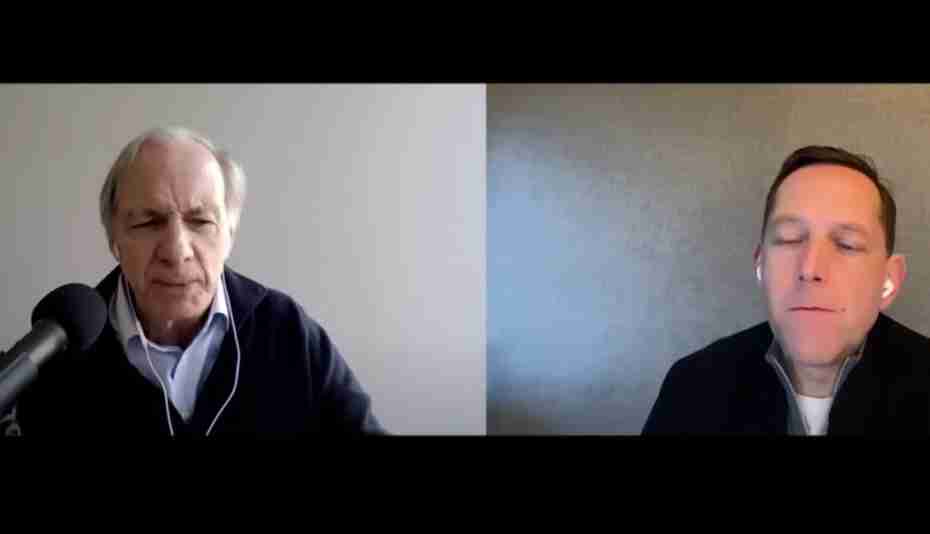
Read the full transcript of American billionaire Ray Dalio’s conversation with David Friedberg of The All-In Podcast (Jan 28, 2025).
TRANSCRIPT:
Introduction
DAVID FRIEDBERG: Ray, good morning.
RAY DALIO: Good morning.
DAVID FRIEDBERG: I’m going to start off by sharing a couple stats. Today, the US has $36.4 trillion of federal government debt and GDP of $29.1 trillion, giving a debt to GDP ratio of 125%. And this ratio has climbed steadily since the pandemic began in 2020, when the federal government debt was $20 trillion and GDP was just $21 trillion. So since the pandemic, federal government debt has risen by 80% while GDP has climbed 38%.
Steady inflation from the large stimulus of money from both central banks and the US Government caused the Federal Reserve, which is the US Central bank, to raise interest rates, driving up the cost of borrowing. And despite recent efforts to cut interest rates again, markets have traded Treasuries down, causing the long term interest rates of U.S. debt to spike up to levels that we have not felt since just before the 2008 global financial crisis.
To keep the economy growing, the US government is now running a nearly $2 trillion annual deficit, nearly 7% of GDP, while paying over a trillion dollars per year in interest alone on just the existing outstanding debt. The Congressional Budget Office, the CBO projected last week annual budget deficits are expected to be equal to 6.1% of GDP through 2035, which the CBO noted is significantly more than the 3.8% that deficits have averaged over the past 50 years.
The national debt is slated to rise by nearly $24 trillion over the next decade, a sum that does not even include the trillions of dollars in additional tax cuts that the current administration may put into place. Is the US headed for bankruptcy? What are the mechanics of the looming crisis ahead and can we avoid it?
To talk about this, what I consider to be the most important topic in the world at the moment is Ray Dalio, who I consider to be the preeminent thought leader on this matter. In 2021, as everyone knows, Ray published “The Changing World Order, Why Nations Succeed and Fail.” I declared it the book of the year, and I thought it was the most prescient and important thing that everyone should read. And unfortunately, I feel like many in politics, many in government, many have largely ignored some of the prescient warnings shared in that book.
This week, Ray is releasing a new book called “How Countries Go Broke,” in which he analyzes and shares his studies on this particular topic. And I’m really excited for Ray to join me here today. Ray, thanks for being here.
RAY DALIO: Thanks for having me here to talk about this important issue.
Why This Book Now?
DAVID FRIEDBERG: Well, so let me just start by asking why you wrote the book? Why are you putting it out now? And maybe we can just talk about the timeliness of all this from your point of view.
RAY DALIO: Through my roughly 50 years of being a global macro investor, I would keep to myself. And then now I’m 75, and I want to pass along the things that have helped me. And the bond markets, global markets I’ve been involved with all over the world for a long time. And there’s a mechanical process which is not understood about the question. When is enough debt? When does it matter? How does it work mechanistically? And I feel compelled to get that understanding out now. How do the mechanics work for countries, for the United States, for other reserve countries? I want to make sure that’s understood.
DAVID FRIEDBERG: Thanks for doing it. And the basis of the analyses is your work at Bridgewater and outside of Bridgewater, is that right? You’ve kind of gathered quite a bit of material together for this book, and you’ve shown a lot of historical context, maybe just share a little bit about where the data came from and how you’ve kind of conducted these studies over what period of time?
RAY DALIO: You know, Bridgewater and I, up until my passing along Bridgewater maybe a little over a year ago, has been indistinguishable, you know, and the same. And so over through that period of time, we’ve been involved in the markets. I’ve been involved in the markets and thinking about such things. So the data is largely public data that’s available for anybody. We just collect it from all different spots and go back through history like I did in Changing World Order. We were in some cases in the Changing World Order because we were dealing with data that was hundreds of years ago. We would go through archives and pull data out. The data is all available to everyone.
The Big Debt Cycle
DAVID FRIEDBERG: And so I think that’s really important because this isn’t just an opinion piece you’re writing as an analyst. You’re sharing quite a lot of empirical data that’s publicly available that anyone can go access. And you’re taking a look at that data and saying this is the pattern, this is the trend that we’ve seen historically. It has repeated over and over again.
I think you make a really important point at the front of the book. Only about 20% of the 750 currency debt markets that have existed since 1700 still remain. And all of them that still remain have devalued through the mechanistic process you describe in the book. That’s really important to note. We all think that we have this kind of privileged position in the United States and the US is different and this time around is different. But you highlight how so often everyone thinks they’re in a good place and then the cycle repeats.
You speak about, and the primary premise of this is what you call the big debt cycle. And you highlight that these big debt cycles typically last about 80 years.
The Mechanics of Debt Cycles
RAY DALIO: I want to emphasize, just based on what you said, that they’re mechanical, you can watch it, you can do the calculations. So if you read the book, you can see these. It’ll either make common sense to you, you see the calculations.
To me, it’s almost like the circulatory system. I think that credit is like blood that brings nutrients to all of the parts of the body and it passes through a system that is like arteries. And then credit creates debt. And the key question if it’s healthy is does the debt create an income that is more than enough to service the debt? And that’s like, I don’t know, eating vegetables or something. It’s a healthy process.
And if not, credit begins to build up this debt. It begins to become like plaque in the arteries. And you can measure it just like you could measure it in the arteries. And you can see how it constricts that circulatory system. Because as credit and debt service rise, you see that it eats up more and more consumption because you have to spend that.
So you could watch the government do that. You can see that how interest is eating up and debt service is eating up, and that means there’s less money. And then you also can see how heart attacks take place. And they’re very economic debt heart attacks.
And the way they take place is by looking at the supply and the demand. If you have a lot of debt and then you have a large supply of debt that has to be bought, somebody’s got to buy it. And so when you get to the point where there’s debt risks, there’s not only the new supply that has to be offered, but there is the possibility of holders of those debt assets selling those debt assets. And so the supply becomes overwhelming relative to the demand.
And then what that means is it’s the same dynamic for the government as it is for an individual or a company, except the government can print money. So when that debt service burden rises or there’s a big supply demand imbalance, if the government, most importantly the central bank, doesn’t print money and buy it, then there has to be a rise in the price of the debt to constrict borrowing. And that borrowing constricted that credit that is not going to come will weaken the economy and cause bad economic conditions.
And so they can let that happen, or they can print money and buy the debt and monetize it. When they do that, that’s inflationary and it lowers the value of the debt. In either case, you don’t want to hold that debt because either there’s a debt service problem or there’s a depreciation, you get paid back with a greater supply and cheaper money.
And that is the dynamics and that’s the mechanism. And because it can be measured, it can be seen in all countries, you can watch it happen. And so like you’re going to your doctor, you can measure these things, you can see them, and you can know what needs to be done.
The Current US Debt Crisis
DAVID FRIEDBERG: So, yeah, I want to just talk about two things real quick. One is just to provide an analogy for folks watching or listening on what it means to have interest levels be so high relative to one’s income. So, you know, the United States this year is expected to service debt with over a trillion dollars of interest payments on the outstanding U.S. treasury bonds. And the government’s only going to bring in just under $5 trillion of revenue.
So nearly a quarter of every dollar that’s being collected by the federal government is going out the door just to pay interest on the existing debt. So in order to fund new programs, the government needs to take on new debt. And the folks that are having to issue that cash to the government end up saying, wait, that’s pretty risky now. I need a higher interest rate. And over time, that interest rate climbs.
And then there’s this separate entity called the central bank that comes in and says, well, I’ll buy the debt ultimately to give the government the ability to continue to operate or give the economy the ability to continue to move. And the central bank. When you say the word monetized, you mean the central bank ends up. When you say monetize the debt, that means they’re buying the bonds, they’re buying the debt that’s being issued in the market. Is that the right way to correct it?
RAY DALIO: That’s right. They’re essentially making the money up.
DAVID FRIEDBERG: Right. So there’s a central in the US it’s our Federal Reserve and the US Government are the two players here. And the Federal Reserve ultimately would, in this model and historically, obviously during the pandemic and during 2008, they would go into the market, they would buy bonds by issuing cash that they’re making up effectively.
The COVID Example
RAY DALIO: Very well described. And a good example was in COVID, there were two waves. The first wave was the COVID wave in which they put out the government wanted to and actually did deliver a lot more money to people, companies. Then there was a loss of income. So they first waive a lot of that money. Where did they get the money from? They had to borrow it. The central bank then came in and lent them. That was the primary.
Then the second, when President Biden was elected, there was a second wave of that. After COVID, it was mostly like a universal basic income thing. In other words, hand people money and we’re going to be better off. And so they handed people money, doing that same exercise again.
And so naturally, all these people got a lot of money, and so they put them, they deposited them in banks, they went out and spent and so on. And it therefore shouldn’t be surprising that we had a big wave of inflation. And we also had a lot of banks buy government bonds, which they lost a lot of money on. And that was that crisis. So that’s how the mechanics work.
The Mechanics of Money Supply and Purchasing Power
DAVID FRIEDBERG: Right? And when that money gets printed, it finds its way into the economy and the money supply goes up. And the way I kind of think about it, and you’ve got a nice image in your book that I really appreciate. Here’s a kind of overview of the big debt cycle that you talk about, which is there’s small expansion and contraction waves as debt comes into the market. Debt should drive productivity, but at some point you accumulate so much debt that you can’t drive productivity anymore. And then you effectively have to monetize the debt and everything gets devalued.
But as I think about the introduction of money into the economy, the increase in the money supply, I always tell people, and everyone screams, “Oh, the markets are going up, the markets are going up.” But I say the markets are going up in dollar denominated value and there’s more dollars. So the nominal, meaning that the actual index might go up, the NASDAQ might go up, the Dow might go up, but if you’ve got a lot more dollars, a dollar is worth less. The real question is, has your purchasing power gone up? Have you actually increased your net worth as the markets go up?
And when you do the studies, it turns out that inflation goes up, meaning the cost of everything goes up when you pump money into the system. So of course it looks like the markets go up, of course it looks like asset values go up. But ultimately, if everything’s going up, your purchasing power goes down. It’s almost like I tell people, you have 100 clams and you use seashells and you’re using seashells to buy stuff, and then there’s only five things to buy. Now if you have 500 seashells to buy stuff, the price of the things you’re trying to buy goes up because everyone’s got more seashells. Doesn’t that ultimately kind of describe what happens as the money supply goes up, the inflation drives the purchasing power down of everything and everyone kind of gets inflated away?
RAY DALIO: Very well said, Dave. You can’t get richer by making money, and the value…
DAVID FRIEDBERG: The purpose of money, purchasing power is what matters at the end of the day, what your money’s worth, what you can actually buy with it.
RAY DALIO: That’s right. And there are two purposes of money, which is as a medium of exchange and a storehold of wealth. Saving is very important. And if you don’t have savers, who has it as an effective storehold of wealth, then you don’t have a viable long-term credit market.
People don’t understand that the bonds become a bad deal. You need that like any marketplace, you need purchasers and sellers to be able to have an efficient negotiation to achieve a balance without the government coming in and printing a lot of money and making a big mess. It’s like they made very severe negative real rates.
DAVID FRIEDBERG: Right.
RAY DALIO: And we know what happened with the severe negative real rates. And the government, while they were making the significant real rates, it was the government that was the big buyer. Okay? So the government takes it on and they make negative rates. So what happens is then you get everybody leveraging up.
DAVID FRIEDBERG: Yes.
RAY DALIO: Then you’ve got a problem. And so that’s how it works. And it’s a global issue, it’s not just an American issue.
Understanding the Debt Cycle and Crisis Indicators
DAVID FRIEDBERG: Well, that’s what I want to get to in a minute because I want to talk about the relative strength of the United States and how this plays out globally.
Firstly, in your book you describe the big debt cycle following five stages. You call it the sound money stage, when net debt levels are low and money is sound and the country is competitive. Then you talk about the debt bubble stage where debt and investment growth are greater than can be serviced from the incomes being produced. And then you call it the top stage, the bubble pops and the credit and debt and market contract. And then this deleveraging stage where the central bank comes in and they start buying all the debt and issuing more cash and the inflation goes up and the value goes down. And then finally the big debt crisis recedes and we start over again.
But you speak about in the top stage, a debt crisis. Can you describe the debt crisis? How do we think about the mechanics of what is a debt crisis? Where are we in the United States today with respect to facing a debt crisis? And what are the red flags that you look for?
RAY DALIO: First, when there’s a lot of borrowing to service debt, there’s what’s called the death spiral as we typically refer to that when a company has it, the government can have it too. And that is that dynamic where there’s too much debt and you have to borrow to service the debt. And then people, investors know that that’s a problem to service the debt. So the credit is worse and that means that interest rates go up, which is the worst thing that can happen to a heavily indebted entity. And then as they rise, you get that spiral. You need to borrow more and so on.
So that is also noticed when the debt service becomes large. And then like the real red flag, the biggest red flag is when there’s then the selling of the debt beyond the new supply, but the holders of it sell it. And then you can see it in the market action because you can see that long-term interest rates rise while short-term interest rates aren’t rising or go down. So it’s the free market losing its desire. You have a balance problem in the free market out there.
And then you start to see that when the currency then depreciates, particularly relative to gold or Bitcoin or other assets and sometimes other currencies. But typically these things happen, broadly speaking, together in which all currencies go down relative to other things like gold, bitcoin, or tangible values. And so that’s what it looks like. That’s that edge. Then you start to see the dynamics.
So you either see the central bank comes in very quickly and does the buying. And when that happens, you see then the currency. To take Japan, for example, if you were a holder of Japanese bonds, you lost about 80% of your money relative to gold and about 60% relative to US bonds because you received an interest rate that was 3% less than the corresponding interest rate in the United States. You lost the interest rate. And interest rates in the United States, as you know, were very low relative to inflation for most of that time. Plus you had a depreciation in the currency. So you lose, you know, you lost a ton of money in the debt that way because the central bank came in and printed the money. It’s very bad for holders of the debt. And it’s a basic thing. You don’t have to even get too technical. It’s just a supply demand thing.
DAVID FRIEDBERG: Well, so are we seeing that in the US today? So the Federal Reserve cut interest rates as of a few months ago. As they’ve cut interest rates, the market has sold off US Bonds rather than buying them, which is normal. When rates go down, the price of bonds is supposed to go up. And we are now seeing rates actually climb in the market relative to where they were while the Fed has been cutting rates. Is that a dynamic that’s a red flag for you?
RAY DALIO: While gold has gone up and bitcoin has gone up. So that is that kind of market action I’m talking about. And you’ve seen it in other countries too. The UK, very classic. The dollar has been a relatively strong currency, but not measured in gold or Bitcoin. Right. So all currencies have gone down. And then you’ve had that dynamic you’re talking about.
And you see it also in, like sterling is a good example. Sterling has gone down while UK bond rates have gone up and central banks have held it steady. And so you see it in the market action. You also see it in terms of who the buyers are and who you’ve seen central banks, for example, and Sovereign wealth funds shift to have lesser amounts of debt, bonds and so on at the same time as they’ve accumulated gold or hard values.
Now gold is the third largest reserve currency by the way. Dollars, euros, gold, and then yen. So yeah, you’re seeing that supply demand shift. And it’s partially for all the reasons we’re talking about and also partially because of issues like geopolitical issues. Countries sometimes worry about sanctions. China is worried about holding US Bonds. Japanese bought a lot of bonds. Even as a percentage of portfolios, the bonds themselves have become such a large part of the portfolio that it’s even from a portfolio rebalancing point of view, you don’t want so much concentration. All of those factors are in play for the supply and demand of bonds. That’s why I emphasize you have to look at the supply and demand of bonds.
Alternative Stores of Value in a Debt Crisis
DAVID FRIEDBERG: You’ve got a table in the book where you look at central government debt level to deficit level across these major markets. So you’ve got the US, Japan, China, France, Germany and the UK and the US is running a deficit 7% of GDP. So the federal government is spending more than it makes at a level that’s about 7% of the total size of the economy in the United States, which is the highest of all of these industrialized markets. Second is France at 6%. Third is the UK at 6% as well, and then China at 5%.
And then these countries are all approaching 100% debt to GDP. Japan obviously is at 215%. So from a relative perspective, one of the points that I’ve heard a lot of people make is everyone’s got this problem. Everyone’s got rampant spending, everyone’s got rising debt levels. They’re increasing their debt levels to pay the interest on their existing debt and to stimulate their economy.
The US is the best, strongest currency amongst the group that we just showed. Why would anyone trade out of our currency? I guess from a market perspective, Ray, where else do people go with their worth, their net worth? Where do they trade transfer their value into if it’s not dollars? And doesn’t it have to be some denominated currency? And isn’t the US ultimately the best? Maybe you can talk about what these alternatives are. Gold, bitcoin, elsewhere. But is that realistic at scale? Like is there enough of gold, enough bitcoin for everyone to transfer all their net worth into those assets versus hold some currency denominated asset? Maybe we can just talk about that dynamic of how do I make the decision about where to store my value? Where do I store my net worth?
RAY DALIO: First of all, the United States and countries like China, you see that particular dynamic. China, Japan, they’re all educational. And that means that the bonds, the debt are bad assets. So then where you store it is in those assets that benefit rather than suffer from the reduced value of money and the buying of it.
And obviously you look at money and what is an international money? That is why gold is in. And then there’s a question of Bitcoin or others are a conversation, we can digress into that. But it can be. Ideally it’s international, it’s mobile. Ideally it’s relatively private, so it’s relatively secure. Because in history there’s the value part of it and then there’s the confiscation part of it too.
In some fashion or another, that confiscation can easily take the form of taxing on holding it. For example, one of the problems with real estate, besides the fact that it doesn’t move so it’s not internationally, you know, you can’t use it internationally is it is a readily taxable asset, it’s there and therefore they’re going to get you. They won’t take it and you can get it. So we have to understand that taxes and confiscations are one and the same.
DAVID FRIEDBERG: Because during a time of a debt crisis, and I want to get to this in a minute, you talk about the four actions that can be taken: taxation, austerity, where governments cut spending, restructuring, where the debt gets restructured and then the central bank buying the debt. Obviously this notion of taxation has always played a critical role during these moments and assets are seized or taxed in different ways and transferred away. What about commodities and how did commodity markets do? Non gold? Is there a difference in commodity markets, hard, soft, et cetera.
RAY DALIO: It’s so interesting. I studied history and of course I’ve been through a bunch of these like the 70s commodities, ideally also those that might do well if the economy doesn’t do well because you’re dealing also with the inflation environment are always gone to. You don’t want economically sensitive commodities as much. Sometimes maybe the economy will do pretty well, but usually it doesn’t.
But like in the Weimar Republic, for example, rocks were used as a storehold of value. Now that sounds really funny, but they were considered building ingredients. In other words, the rocks were used to build things with and so they would store the money in rocks. But any asset, I should go store…
DAVID FRIEDBERG: A bunch of GPU chips in my garage. H100 from Nvidia.
Technology and Devaluation
RAY DALIO: Yeah, technology devalues them. The new technology devalues them. So that’s the question. It is those things that can’t be devalued. Commodities, by the way, in real terms, all commodities, every single commodity in real terms over long periods of time have declined because of productivity. Every commodity has declined in real terms because of productivity. So you would like productivity.
Producing assets that cannot be taxed can move around from place to place. So equities of a certain type tend to do that. That’s why currency depreciations are associated with that combination of things. Currency depreciation, lowering interest rates and producing money causes equity assets to go up, not necessarily in real terms. Like in the 70s, they didn’t go up in real terms, they went down in real terms. But it is those kinds of storeholds of wealth that can’t be taxed as easily that benefit from inflation rather than not.
DAVID FRIEDBERG: Right. Okay.
Gold vs. Cryptocurrency
RAY DALIO: The purest play is gold. Because gold can be transferred between countries. It’s used by central banks as a reserve. So central banks will go to it. They are going to it. It can be private, more so than crypto which is very easily taxed. In other words, the government knows where it is and who’s doing what and so on. And it’s also an effective asset to tax. But it has benefits too.
It was very interesting when we had negative rates. I was with a group of the central bankers in a discussion of how negative they can have rates. And they described that they can have negative rates only to the extent that there’s not enough capacity for paper money to be stored. So they estimated, it was funny actually, that they could have, over a short period of time, up to 400 basis points negative rates. That’s crazy, because there wasn’t enough. They calculated how much vault storage space there was and then they calculated that they would produce more vault storage space because it would be profitable to do that. And they said, “and the good thing is we can tax it.” Because if you have a digital currency, you can tax it.
DAVID FRIEDBERG: Yeah. Do you own Bitcoin?
RAY DALIO: Yeah, I have some. Not nearly as much as gold. That’s kind of my diversifier. I try to find what are the alternatives. I have to have some. But I’m a gold guy much more than I am a Bitcoin guy.
DAVID FRIEDBERG: Yeah, I’m a productive asset guy. I like owning businesses that make stuff. So in this environment, what do I own that’s a productive asset? That’s a business that can still see its revenue and its incomes grow as this inflationary effect and this devaluation occurs? As we get through a debt crisis like this, what would be the best kind of productive asset? Is it a mining business? Is it a commodity trading business? What’s the right approach?
Productivity and AI
RAY DALIO: I’m with you. That chart that we showed in the beginning has this line productivity going up, and I think that we’re in a productivity revolution. And it tends to compound on itself. And I think that’s where AI is fantastic. But it depends where you’re referring to AI.
I think the super scalers in this world have risk issues. I think that the tech war and productivity – I’m with you – but you want to invest in productivity. But there’s disruption, great disruption that’s going to take place and there are going to be the disruptors and the disruptees. And it’s not necessarily those who are producing the vehicles, but it’s those who are implementing and changing as a result of having their big impact.
I think that the tech war for the AI war is more important than profits. It’s a war that no country can lose. Because if China or the US really lose this war, it’s more important than profits. And so you have to play that war that way.
I think the Chinese are a bit behind in the chips, but they’re ahead in the applications.
DAVID FRIEDBERG: Yeah. Did you see the Deep SEQ announcement this weekend? And obviously markets are reacting.
RAY DALIO: That was known for a little while now.
DAVID FRIEDBERG: Yeah.
Chinese Manufacturing and Investment Strategy
RAY DALIO: I think the Chinese play is going to be chips, very inexpensive chips embedded into manufactured goods. You’ll see robotics. The Chinese are unbelievably good at making things inexpensively. They own 33% of all world manufactured goods, which is more than the combined U.S., German and Japanese manufactured goods. So you’re going to see that type of competition. And it may be like solar panels or something where profit doesn’t matter.
So you have to go where there’s productivity and innovation. Being long those who are benefiting themselves through usage or creating the applications that are having the big effect is certainly one thing. But you also have to look at different countries and places and things.
Most importantly is price. I think a lot of investors make the mistake of thinking, “I want to buy good things. That’s a great company.” But a great company that gets expensive is much worse than a bad company that’s really cheap.
DAVID FRIEDBERG: Totally.
RAY DALIO: So you have to look at pricing. This is all part of the cycle. Everybody says that’s great and it’s going to be great for the future. You know, like the Internet and dot com. It was great. It’s great. But the price has to be paid attention to.
And I’m particularly concerned about those companies at a time when we are in a situation with the interest rates operating as we are. In other words, this looks quite a lot like 1998 or 99, where the assets of the new hot thing, the productivity drivers, are hot, the prices are high and you have a rising interest rate environment. That is a classic issue. So we have to pay attention to the interest rates and the pricing of those assets.
The Importance of Diversification
I think diversification is very, very important because everybody’s leveraged long. Everybody thinks “I’m going to buy assets that are going to go up and if they’re good, I’m going to do that in a leveraged way.” So the world is so leveraged long, you have to pay at least as much attention to correlation.
That’s why when I look at something like gold or these uncorrelated assets, it’s interesting as you add it into the portfolio, it reduces the risk of the portfolio. So you have to pay attention to the uncorrelated assets in that kind of an environment. And those could be geographically diversified too. But that’s part of portfolio construction.
DAVID FRIEDBERG: Well, so there’s no simple answer for the audience on what to buy. But I do think this portfolio point of view is important. In the book, you actually talk about having 10 to 15 uncorrelated bets at any given time. And I would imagine in your context, truly uncorrelated. Whereas most folks buy US equities and think that they’re in different sectors. But obviously there’s a great degree of correlation when you’re buying a bunch of US equities.
Real Returns vs. Nominal Returns
RAY DALIO: Just to keep in mind, many times equity prices in inflation adjusted, therefore purchasing power terms, have declined 60 or 70%.
DAVID FRIEDBERG: Yeah, that’s incredible. That’s an incredible fact for folks to take in. So when you adjust for the value of your dollar, equity prices have really taken a hit even though the market’s gone up. And I hear this a lot.
RAY DALIO: And from 1966 until 1984, you had a negative real return.
DAVID FRIEDBERG: I think this is super important, Ray. I just want to double click on this and then we’ll talk about the US. But a lot of folks talk about markets going up without taking into account what is the denomination that those markets are measured in, in this case US Dollars. And when you look at the value of your US dollar and you look at the market going up, even if you bought equities, what you can now turn that dollar into has actually not gotten much stronger. Folks have really taken a hit and I think this is super important.
RAY DALIO: Yeah. I’m glad you’re bringing it up. I think it’s super important too. And I just want to emphasize you have to look at your returns in real dollars.
DAVID FRIEDBERG: What can you buy?
RAY DALIO: How much can you buy? It’s funny because I watch the value go up and down, even the currency go up and down. And it’s a distorted perspective. It’s like being on a boat that’s going up and down and judging the land to be volatile.
US Debt Crisis Risk
DAVID FRIEDBERG: Yeah, absolutely. Okay. I want to come back to the United States and I want to talk about your point of view on measures that the United States is going to have to take or should take going forward in order to avoid a more cataclysmic debt crisis. In fact, you use this term often, the “beautiful deleveraging” that’s possible when there’s a great deal of debt and a country faces a debt crisis.
But I first want to talk about the measure that you share of risk. You show what you call your risk gauge for US long-term government debt. And you’ve got this risk gauge on the long term and the risk gauge on the short term for U.S. government debt. On the short term, you say U.S. government debt is a zero percent risk gauge. There’s no risk. In the near term, the economy seems fairly balanced. But over the long term, your risk gauge is 100%.
And then you follow that up with an analysis of the central bank. And you say the central bank short term, 0% risk gauge, long term, 46% risk gauge, nearly the highest you’ve seen ever. But maybe you can just say, what’s the composition of these risk gauges and what does this tell us?
RAY DALIO: Just to be clear, 100% does not mean 100% probability of it happening. It means 100% is the highest that it’s ever been. It’s at the kind of maximum.
The longer term risk gauge is taking existing amounts, projecting those two things that I’ve described before, the supply, demand and the debt service, creating the squeeze. So think of it as going into your doctor and having him give you your test results and how much plaque is in there and what it’s looking like and how you did on your stress test and what your arteries are looking like and what your condition is. That’s what the first measure is.
The second is if you’re in a seizure, in other words, what’s happening now. That second measure is if the debt is exhibiting problems now. And “happening” means things like you’re seeing the selling, you’re seeing the spreads widen. In other words, the interest rates rising on the long end without the short end. You’re seeing that the central bank is put into that position of having to make the difficult choice of coming in there and monetizing everything. And then credit problems and debt monetization because you’re in the middle of it. That’s what the one on the right means.
So what we have is, if I’m speaking to you as the government policymakers, your condition is very bad.
DAVID FRIEDBERG: Right.
RAY DALIO: Okay. You’re not in the middle of it now. In other words, we’re not seeing that particular dynamic transpire. But you have to change your diet. You have to change your behavior. You have to maybe have a stent put into the equivalent. So you asked about what that is. Okay, here’s what it is.
Understanding the Debt Crisis
DAVID FRIEDBERG: Let me pull up this chart for you real quick, Ray. So I just want to highlight the CBO projection. This is the US Government’s debt as a percent of the US Government’s revenue, which you indicate in your book is more important than debt to GDP. You’ve got to look at the actual revenue being generated by the government and how much debt they have. And the CBO highlights this expansion to 700%, meaning the government is going to have a debt level that’s seven times the income it’s making every year over the next 10 years.
You propose a bunch of actions that can keep it flat over the next 10 years, which is the basis of the book. I just want to kind of voice over again. You highlight that there are four actions:
1. Increased taxes – obviously citizens are going to lose assets and lose income
2. Cutting spending or austerity – citizens are going to lose services and benefits
3. A central bank buying the debt – which will typically increase inflation because more money will come to the markets
4. Restructuring of the debt – where the currency gets devalued and everyone loses things
Maybe you could frame this up for us a little bit.
The 3% Solution
RAY DALIO: Sure. Think about that chart as being your plaque in the arteries and the debt service. You could calculate all those numbers and you know what the picture looks like. And that is a stability.
Number one is, I call it my 3% solution. The solution is you must cut the deficit, which is the equivalent of bonds selling down to 3% of GDP and it’s 7.5% expected. Now, different people have different views as to how to cut it. Forget it, I don’t really care. Just you have to have a unified agreement. Everybody in Congress and the President and so on should pledge to do that. And then the question is how to do it. But they should know that number.
DAVID FRIEDBERG: That’s about 900 billion a year roughly. And that means cutting it, as you point out, by cutting the deficit by more than half from where it sits.
RAY DALIO: Yes, because with continuing the tax cuts, that’ll be seven and a half percent and you want to get it down to three. And it sounds draconian, but we did that kind of change from 1991 till 1997.
And there are three keys to this: 1. Do it soon 2. Do it fast 3. Do it when the time is good, when the economy is good – in other words, do it now
The temptation is going to say, well, we’re going to ease into this and we’re going to do it in three years from now. But if you have a bad economy, you cannot do it, okay? And that’s the worst. So we have the best economy and the sooner you do it, the more you’re going to do it.
So 3% solution, do it now and recognize that you have to deliver it. If you’re having cost cuts in government, you have to own the number. Everybody’s got to pledge 3%. There will be arguments as to how to get there, but you have to own the number. So much so that you’d say if it’s not 3%, throw me out of office because I’ve got to deliver that number.
We all throw numbers around. You got to own the number and you got to get to three and you can’t make it any one thing. But you also have to realize if you did it spread out, nothing’s going to be that big. Nothing’s going to be insurmountable. I go through the numbers in the book. By the way, this book is online free and everybody can get it.
The Impact of Cutting the Deficit
DAVID FRIEDBERG: I read it this weekend and I used a highlighter for the first time in a long time, Ray. So there was a lot of great content to pull out of there.
RAY DALIO: Not to sell books. Anyway, it’s all free. So everybody can go through the mechanics. But the main thing is you take the things you can cut from or build from. You look at government expenditures, roughly 70% of government expenditures you can’t cut. So it comes down to a small percentage that you can cut, but you find out how much you can cut.
The important thing is 3%. The other thing about it is to realize that if you make those moves, the bond market will benefit. And so interest rates…
DAVID FRIEDBERG: Interest rates will go down, right?
RAY DALIO: And interest rates going down, interest rate expense is most important.
DAVID FRIEDBERG: So when the President does an interview the other day and he says we need to get them to cut interest rates by 1% and he’s speaking about the central bank, he’s effectively trying to force the central bank or coerce the central bank to take rate action. When, if we were to cut spending, I think this is so important. If the federal government were to cut spending significantly and quickly, the market would naturally react to lower rates.
RAY DALIO: That’s right.
DAVID FRIEDBERG: I think that is so important for everyone to hear.
RAY DALIO: He’s right. If you look at my calculations, you need 100 basis points. If you get 100 basis points cut in rates, that’s equivalent to significant cutting in spending. So he’s right. But if you do that without the other parts, you’re going to take money away, you’re going to make it less desirable to own these bonds, because that’s going to be a problem. If you do these things together, they can support each other.
The Urgency of Action
DAVID FRIEDBERG: And by the way, Ray, the longer we wait, the more interest accumulates because it’s at a higher rate, the more the debt accumulates. And ultimately this is the arithmetic death spiral that you get into. The longer we wait, the more you have to cut in the future to get out of the hole. It’s not linear, it’s a non-linear cutting that’s needed. The faster you do it, the less you have to cut.
RAY DALIO: Right.
DAVID FRIEDBERG: I think that is so important. Let me just say that again for any person in government listening, the faster you cut, the less you have to cut.
RAY DALIO: Yes. And you can do it in a manageable way, a bit here, a bit there. These bits add up and if you don’t, you’re going to have this arc of compounding.
DAVID FRIEDBERG: So let’s talk politics for a second. Is Doge enough or do we need legislative action here? And then I want to talk about the politics of the legislative action given the election cycles.
Economic Growth and Political Realities
RAY DALIO: It’s a combination. It’s not just Doge, it’s a matter of less regulation, productivity changes that might come from AI, which then translate to profits. That might be capital gains, profits, they might be profits and all of that. But when I look at it, it looks very tough.
There’s also revenue. Tariffs produce revenue. But people don’t think of taxes as inflation, but taxes are inflation, because it costs you more. So the real question as you play with the numbers is it’s very difficult to know and be precise about how much is going to come from productivity and profit increases from the efficiencies gained by AI and new technologies.
How much comes from this and that, we don’t honestly know. But the important thing is not to make it a crapshoot. The number must be 3%. And so you should have clear passage to that 3% number.
DAVID FRIEDBERG: Are we better off with Trump as president versus if Biden had won?
RAY DALIO: In this context, yes, I do believe we are in the financial context, because in terms of profitability and the likelihood of cutting, I think the Republicans are probably more likely to make these moves than the Democrats.
But you also have to take into consideration the impacts, the social impacts and the other impacts that are going to come from this. We’re at a civil war internally and we’re at an international war simultaneously. So there are second order effects.
I think the main thing is take those numbers and make them real at 3%. Not speculating. I worry honestly about the gap. Like the idea of when profits kick in from AI. I’m worried.
The AI Challenge
DAVID FRIEDBERG: That’s what I was going to ask you next. So AI takes off. We lose a lot of jobs. We have a million, five, three million, five million people that become unemployed, that work in call centers, that work on automotive lines, etc. They lose their jobs.
And before the productivity kicks in from AI that creates new markets and new parts of the economy, we have a lot of unemployed people. And the government representatives, the politicians raise their hands and say, we have to support these people, we have to introduce stimulus, we have to introduce new support programs.
Is it not likely the case that with AI coming online, we are going to see a fairly significant demand for public support on this transition that’s coming?
RAY DALIO: That’s right. But there are two dimensions. The near term is what will happen. I don’t think the profit impact and the financial impact on productivity is going to be nearly enough, near enough to deal with the supply demand issue that we now have.
Just imagine you are at risk of a heart attack, and then I say someday we’ll have the productivity conveyed to profits that will cover the budget deficit. Okay, it may be out there, but it’s not as immediate as it needs to be.
And then we have the other aspect of it, which is how is that pie divided? Which is going to be very political because the disruptive effects will be enormous. And we’re really all guessing on how those disruptive effects will be.
But you’re absolutely right. Lots of jobs are going to be lost. Lots of change is going to happen in terms of turbulence. And how do we have a plan, how can we even agree on a plan of how to deal with that?
I don’t think we’re in a time, maybe in the rest of our lifetimes, that agreement is going to be easy. I think we’re going to see fragmentation of states from the central government. I think you’re going to see big fragmentation in the world, not just in the United States, on the failure to agree on most things.
And so I’m worried about the timeline. Think of the timeline this way. There’s the first hundred days. We’re in a honeymoon period. I’ve been through this a long time. I know what the honeymoon is like right afterwards. There’s 100 days that you can change legislation. You move quickly and everybody’s there.
Then there’s the next important time horizon is two years to the midterm elections. You get in about 18 months after the election. And now not everything goes as anyone expects. You could have this supply demand situation. And think of our cycle I mentioned, the average cycle is about six years, give or take three years. And so we’re going to be later into the cycle, we have this supply demand situation.
DAVID FRIEDBERG: Right.
RAY DALIO: Are things going to stay good into the midterm elections and that mandate? I think there could be a lot of fighting in the midterm elections.
DAVID FRIEDBERG: Let me ask you two questions. The first, if we do significant cuts, there will be a lot of job loss. If AI is successful and moves quickly, there will be significant job loss. If there is significant job loss, does that not fuel the rise of socialism in the United States?
The 3% Solution and Future Challenges
RAY DALIO: I think that we can do it. When I talk about the 3% solution, I think that we can cut and make the adjustments in a few percentages to be able to do this without great trauma. So we can get to having that limitation done without great trauma. And it will be supported by interest rates moves. So that’s first. We can get this thing done. We must get that thing done.
And if we don’t, then of course, I think we are in an era that of course we’re going to have great conflict in the United States. This is not a run to nirvana. This is, you know, the moment there you’re going to have legal challenges. One state, the Democrats, you know, the blue states, the red states, and within the states, you’re going to have a lot of disruption and you’re going to have a lot of dissatisfaction and it’s going to be about money and power.
And so that’s ahead. And so like you say, there’s the socialists, the left, the right, and that’s why you’re going to. This type of civil war or internal conflict is going to be with us. This is not a straight race to nirvana and prosperity. And you have that at the same time as you have the other elements. You know, they’re the five big forces.
So what I’m calling. So you have the debt money we talked about, there’s the internal conflict that is we’re going to test the legal system and you know, and we’re in an environment now that might is right. Internationally you are going to have the same kind of conflict we touched on China, we’re going to have conflict. You no longer have a cooperative, even an attempt at a cooperative world order. Things like the World Health Organization, the World Trade Organization, all of those are obsolete. And so we’re going to have again, might is right.
So it’s going to be a period of greater conflict. You’re going to have a technology war. You can have increased military spending in this kind of environment that creates a budget issue and climate will have. It will be an economic issue as well as an environmental issue. So these things, these expenses are going to go up. So all of those coming together. So yes, left, right and conflict will be ahead of us.
DAVID FRIEDBERG: Is this a hot civil war? Do people take to the streets? I mean, how does this resolve? Obviously we’ve got historical context for social uprising, but what happens in the United States over the next 10 years?
The Future of Conflict in America
RAY DALIO: I think two important aspects of it is does the legal system work well so that the Supreme Court, you know, you asked me about the independence of the central bank. You know, does law work? And I think there’s going to be a lot of challenges. I’m not saying it doesn’t work. I’m saying that’s the question. And that’ll be very much state by state.
You’re going to see conflicts between the states and the central government. So how does that decision making system hold up? Is it might as right, you know, sanctuary city issues and such. How is or is that going to all work? Well, I mean that’s, you know, that’s the most important thing.
And then we have in a time of great stress and challenge when things get worse. Right now things are good, this is pretty good, but they’re going to get worse. And then you have the international going on at the same time. And so internally within countries, we have the same kind of conflict.
You’re seeing it happen in Europe, you’re saying the same dynamic. We talk about the problems that the United States is having regarding debt and so on you have then the expense, same problem within Europe. You’re seeing greater polarity left, right, you’re seeing economic problems cause more confrontation. And so you’re seeing this around the world.
So you’re coming into an environment that is likely to have, over a period of time, over a period of time, not immediately, greater conflict. When you talk about 10 years, there’s going to be a period in that 10 year period where it’s going to be hellacious. In that 10 year period where the coordination of dealing with our problems, our problems will be greater and the cooperation for dealing with problems will be less.
DAVID FRIEDBERG: On that point, talk about the role that you have seen external conflict play in resolving the fiscal challenges internally. So you talk in your prior book, Changing World Order about the historical relationship between external conflict as a cycle that seems to follow or flow with this financial cycle.
Maybe you can talk a little bit about what’s going to happen between the United States and China, given the condition in the US Today. Do we have a higher propensity? When things are difficult at home, folks tend to go to war. War is stimulatory. Is that a driver here? And what’s going to happen functionally with China over the next decade, do you think?
International Conflict and Power Dynamics
RAY DALIO: In the US there’s a cycle that has to do with changes in money and all of these things where you don’t have enough money, you need money to support international conflict, you need money to make domestic people happy. And then there’s no power. You know, there’s no system for making judgments internationally. You know, the United Nations doesn’t work, the World Health Organization, they don’t work. So there’s no system. So you come into this power.
So when we’re talking about the financial problems that we’re talking about that we covered and recognize that that’s worldwide. And then you have the polarity worldwide that has to do with different wealth and values. And you have that problem within the population and then you have no rule system internationally. So it is a might is right series.
You have that confluence of things, particularly now. And then there’s disruptions, big disruptions. Technology. We talked about how you can’t lose the technology war because you’ll lose the military war. All of that stress and shortage of what is perceived to be needed is incendiary. You know, it’s a risky situation.
Of course productivity helps, but it was like, you have to understand, put it in its place, the 1920s leading up to the stock market bubble. That was the decade that we had the greatest number of inventions, patents, innovation, Great productivity increases, while we simultaneously had big debt increases and we simultaneously had these wealth gap and values increases. And so you don’t get away from that.
So this is going to be a lot of tension in a world where it’s difficult to get all the parties to cooperate in wars. If you look at history, when I say wars, there are military wars and then there’s less than military wars. And I can’t tell you that we’re going to go into military wars. I think like the Soviet Union and the United States, because of the risk of mass destruction, was able to avoid those. But in history it’s going to be a very. That’s going to be a very difficult period.
DAVID FRIEDBERG: You describe in your book the difference between how the United States goes to war and how China goes to war. Correct me if I’m wrong, but you speak to the US goes to war head to head open confrontation, whereas China is much more like a Sun Tzu Art of War style. It’s a little bit more tricky, a little bit more careful. They never let you know what they’re going to do. Is that a fair characterization? Yeah.
Different Approaches to War: China vs. the West
RAY DALIO: The general belief of the Chinese on the art of war, and this has existed throughout and it exists today, is that if you’re going into a fighting war, you must not have been smart enough to win without a fighting war. And you win through deception and manipulation because fighting wars are going to damage you a lot. You don’t want to be damaged, you want to get to your objectives. So that’s how they fight wars. That sounds like a smart way to fight wars.
Also international relations. There’s what’s called the tribute system. And the tribute system was your power determines where you are in your hierarchy. If you have more power, you have more hierarchy, you’re higher in the hierarchy. It’s like Confucian and everybody should know what each other’s power is. And the lesser power should give tribute to the greater power. This is internationally. And the greater power should respect that and treat. And they should work and have harmony together rather than to have the conflict.
Because it’s all about getting what you want. Harmony and prosperity is what you want. And fighting that destroys things is not what you want. Whereas, yeah, the man who was vice president, great historian of China, a man by the name of Wang Qishan, described it to me that there’s the Mediterranean approach, right?
DAVID FRIEDBERG: That’s what it was.
RAY DALIO: Yeah. And the Mediterranean approach, which is a very different approach, really began out of that. There were families and there’s no borders and the way it worked is there were no limitations. In fact, we didn’t have countries with borders and ideas that you don’t cross borders until what’s the piece of Westphalia in the mid 17th century. I think it was like 1650 something up. They had 30 years of war and everybody would fight. So they were fighting experts and that’s what the norm was.
And then after 30 years of war, they decided, okay, let’s draw a boundary around it and try to what goes on and there’s your business. And that’s how it came about. And that’s, by the way, in history, one of the reasons that the Chinese and Japanese lost and they had what they called their hundred years of humiliation when the foreign powers came in late 1830s and they had a fight, the opium wars and so on, the western powers were strong at fighting because they were practiced at it.
And then there was 100 years of humiliation, they call it, in China, where the foreign powers came in. So anyway, I’ve given you too much history, but I’m saying that there’s a whole different attitude about how to play that game. And so that’s what I think you’re going to see when we come back now to the chips war and you took a look at today’s news. You know, there we are, there we are.
The Need for Leadership and Difficult Choices
DAVID FRIEDBERG: Well, look, Ray, I feel like I always tell people, the kid that stands up at the middle school and says, I’m going to make the vending machines free wins the presidency of the middle school. And unfortunately, in a democratic system, the electricity election process kind of follows a similar pattern. It’s very hard.
I watched these hearings this week and I was deeply frustrated when I hear senators say, I got this money for my constituents, I got this. Their initiative, their intention is to stand up and say, I’m going to get you this. They go into Congress, they get you that money, and over time, government spending swells and there is no incentive to reduce it.
And we find ourselves now on the precipice of a really difficult crisis. And I really do hope that politicians find within themselves the leadership to stand up and say we need to do difficult things. Because 10 years from now or 20 years from now, if we don’t, things are going to be very bad for all of us and convey that to people.
And I really do hope that your message gets to them and that their leadership allows them to stand up and say we need to make these really difficult changes deeply and quickly in order to preserve the Union and that they can make those changes and we can move forward and continue to build our lives. And so I really appreciate you taking the time to write this book, share this with us, and I really do hope it’s heard. I think it’s so important. So thank you so much, Ray.
RAY DALIO: We can do this. And if we don’t do this, the power of the United States is going to be greatly diminished. So it’s domestic, it’s international. So I appreciate. Yeah, I appreciate you, Dave, that we can have this kind of conversation. Just have people behave logically. That’s too much to ask.
DAVID FRIEDBERG: Yeah, well, no, look, I mean, let’s not give away the vending machines for a couple years and, you know, kind of think about keeping the school open for the next generation. But that was great. Thanks, Ray.
RAY DALIO: You know your stuff. You’re great. This is really invaluable. Thank you for doing that for your listeners.
DAVID FRIEDBERG: I think it’s so important, too. Ray and I spent a lot of time thinking about it and worrying about it. Your message is so clear and important. I think you present it well and write it well. I read your whole book this weekend and I appreciate you putting it all out there.
I really do hope that the folks that listen to our show in D.C. listen to this. I cannot tell you how disappointed I was after I spent the weekend at the inauguration. I met a lot of members of Congress. I met most of the members of the new cabinet, and it’s just not there. I’m just frustrated and I’m disheartened by it. So anyway, I think it’s important to keep harping on it, though. We’re not going to stop. And I’ll keep talking about it and appreciate your efforts here, too.
RAY DALIO: We just have to do our best.
DAVID FRIEDBERG: That’s right. Really appreciate it, Ray. Thank you.
RAY DALIO: Thank you, Dave. Bye.
Related Posts
- Michael Saylor Responds to Bitcoin Critics @ Coin Stories (Transcript)
- Why Multilingual Human Support Still Matters in Digital Banking
- To Buy Or Not To Buy Cryptocurrency? That’s The Question On Everyone’s Mind
- Ajay Banga on India, Migration and a Youth Jobs Time Bomb (Transcript)
- A Global Monetary Crisis Is Coming & AI Could Make It Worse – James Rickards (Transcript)