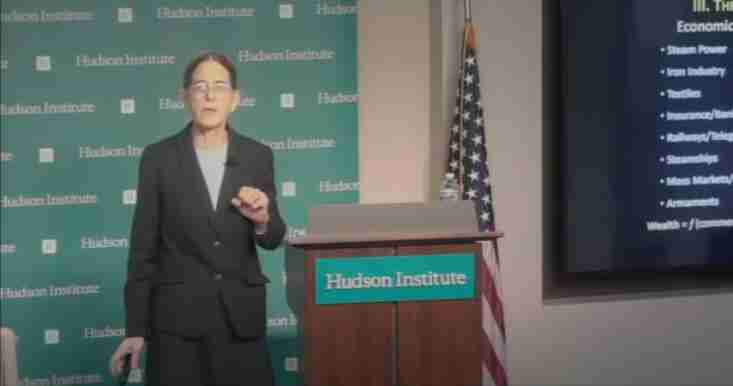
Read the full transcript of Sarah C. Paine’s lecture on “The Strategic Significance of the South China Sea: American, Asian, and International Perspectives 5”, at Hudson Institute on Feb 1, 2018.
TRANSCRIPT:
Continental vs. Maritime Security Paradigms
SARAH C. PAINE: Let’s see if I can handle the technical part of this. Ah, score. There’s a disclaimer. What you hear is from me. It has nothing to do with the U.S. Government or anything else. You’ve got problems. I’m the one you complain to.
To understand where the South China Sea should fit in U.S. Strategic calculations, let alone in China’s, I think it’s helpful to look at the very different security paradigms that apply to our country, to China, and even Russia. Because it turns out, Continental and maritime powers live in very different worlds.
I’m going to try to share with you today some of what I’ve learned over the last seventeen years teaching at the only graduate institution in the United States that studies what maritime power is and the strategic consequences and implications of being a maritime power. So I’m going to share with you what I think are the high points that are relevant for the conduct of US foreign policy.
Here is land power being met by sea power on the sixth of June 1944 when we finally opened up a second front to go after Nazis. Maritime powers can protect themselves if necessary, primarily at sea. Continental powers can’t do that. They have to do it by land. Therefore, a maritime power needs to have a large navy. Continental power needs to have a large army. And these differences have profound military, economic and political implications. I’m going to go through this with you today.
America’s Continental Origins
Now our country didn’t begin as a maritime power. It began as a continental power. And indeed, we’re all about spheres of influence, extending them, keeping other people out of them. So we invaded Canada twice in 1775, 1812. British won. Sent us back home.
But this gentleman, President Monroe, you remember his Monroe Doctrine. It says everybody stay out of the Americas. This is a US preserve. It’s a standard continental empire event. And look how we expanded across the Pacific. We fight one of the longest counter insurgencies ever against the Native American population. We fight regional wars against Mexico, and then there’s checkbook diplomacy where we’re buying things from Napoleon Bonaparte of France and Alexander the second of Russia.
We were proud of this foreign policy. We had a name for it. It was called Manifest Destiny. I’ve never seen this, but you all should go down to the House of Representatives where this painting is by one of the staircases. It’s called today by the politically correct term “Westward Ho.” Here’s the real title of that painting: “Westward, the Course of Empire Takes Its Way.” We were an empire, and we were proud of it in the nineteenth century.
But then things changed in the late nineteenth century with this gentleman, Captain and later Rear Admiral Alfred Thayer Mahan, professor at the Naval War College. And he’s looking at the world and says, I don’t think actually continental position is the origin of power and wealth in the country. He said, no, it’s based on trade.
Mahan’s Maritime Power Prerequisites
He developed six prerequisites that he thought a country needed to have in order to be a full-fledged maritime power. What are they?
1. You need a moat. You need to have broad oceans around you so no one can do a quick invasion on you. 2. A dense internal transportation network so you can get hither and yon within your own country. 3. You need reliable egress by sea. You got to be able to get out in warfare and also get out to trade. 4. You need a dense coastal population. 5. You need a population that’s involved in commerce. 6. You need a government that has stable institutions in order to promote commerce and run a decent foreign policy.
Woe to the country that tries to be a full-fledged maritime power without all six. China, beware.
Today’s Plan
Here’s my real plan for today. Three parts:
I’m first going to start talking about the continental world. This is the traditional world of land empires. This is where the great civilizations of Eurasia come from. I’ll talk about that first.
But then there was a maritime world that started emerging based on trade. And I’ll talk to you about that. Now at the Naval War College, we all like animals. And so we refer to continental powers as elephants, maritime powers as whales, and I will use this terminology.
And then I will talk about the industrial revolution, which changes the game for both traditional continental and maritime empires and has produced the global system that we live in today where trade lies at its basis, not empire.
China as a Continental Power
China is one of the greatest land powers the world has ever known. It’s one of the greatest land empires the world has ever known with its continuing occupation of Tibetan, Muslim and Mongol lands. Traditionally, it was being invaded from the North and the Chinese held that one off.
Here you see the geography of China. Very little flat land that’s really good for agriculture. And the flat places in the North are pretty cold often and pretty dry. Here you can see cultivated land. Apparently fifteen percent of China’s land is arable. It’s ten percent of the world’s arable land supporting twenty percent of the world’s population.
If you look at an ethnic map, the Han, the preponderant ethnic group of China, they’re in all those pink areas. And you’ll see that all around them, very heterogeneous, all sorts of other different ethnic groups. And here is a simplified ethnic map. And what you’ll notice is the Han seem to live where all the arable land is.
Well, turns out in the continental world, the losers do not fare well. For instance, I bet you’ve never heard of the Dzungar Empire. Chinese took care of them a long time ago. They were a very important group of Mongol people and the Han got rid of them. And this is the fate of the losers in the continental world. It’s often genocide. You’re faced with a binary choice. You either become absorbed by your conqueror or you get out of dodge and they’ll kill you. That is the world. And you can see this continental world operating in real time in places like Syria.
Chinese History Through Maps
I’m going to give you a sanitized version of Chinese history through maps. I’m going to rip through them. So the Han start out along the Yellow River Valley, they expand and expand and they build walls and expand in weird ways and more walls expand in even bigger places and then they shrink in strange ways and really shrink. And then they’re moving right along here and oops, shrinking in strange ways, consolidating, really shrinking before conquest by others.
This is the Chinese version of the Mongol conquest. And it disguises a major discontinuity that the Han don’t want to acknowledge in China, which is they were conquered by others. Mongols ran the show, and here’s how that one goes.
So the Pax Mongolica, this is the Mongol world order. What the Mongols did is they conquered not only China, but Afghanistan, Persia, Russia, all the way to Hungary. It’s the biggest empire in human history, I believe. And the way it works is you can see it goes out from concentric circles across these broad planes in another period of climate change. It was getting really cold and their herds and flocks were going to freeze if they didn’t move and get out of dodge, which is what they did.
The Chinese reasserted themselves and the Ming got rid of the Mongols. But then the second conquest dynasty, the Qing, these are Manchus. This is the second largest dynasty in Chinese history.
Here’s the takeaway: Lots of expansion, lots of shrinkage and lots and lots and lots of bloodshed in between. This stuff did not happen happily. China has been raising armies denominated in hundreds of thousands for thousands of years. The West only did this with the Napoleonic Wars. That’s the beginning of the nineteenth century. It is a lethal security world. It is a security world that is not meant for the faint-hearted.
Russia’s Continental Security Paradigm
Russia inhabits the same sort of security world. Russia, the same kind of concentric rings of expanding across large planes. These are Russia’s no-kidding security threats circa 1900, and there are loads of them. From west to east, it’s going to be Germany, Austria-Hungary, Ottoman Empire, British Empire, China and Japan.
Think about Russian history. Bitter fighting between the Russians and Germans, Austria-Hungarians, the Ottoman Empire as well. Russians have fallen to catastrophic defeats by Mongols, Swedes, initially by Napoleon, by the Germans, and most recently in the Cold War to the West. And yet each time, the central position has allowed Russia to rise again.
This security world is radically different from a maritime security world with a 360-degree “you can’t get me” moat. You have numerous neighbors that all pose threats in their own right. It’s not make-believe. It is an actual geopolitical position.
The Continental Security Paradigm
So in this world, power is a function of land. You got to insulate yourself. You’ve got to have land to protect yourself. Neighbors are dangerous. If they’re unstable, the instability can bleed over your borders. If they’re stable, it could be worse because if they’re bent on Empire, they’re going to come get you. So there’s a problem.
You absolutely require an army in this world. It is not only to protect you against foreign invasion, that would be essential, but if you’ve got an empire, you also need to garrison your empire to keep people from defecting. But the primary role of the army is internal. It’s to keep the ruling regime in power. Think People’s Liberation Army is the Praetorian Guard of the Chinese Communist Party.
In a maritime world, we in the United States like to talk about sending our forces overseas for away games. Well, this world is not about away games. Most of the fighting is going to be on your borders. And if you win, typically in this world, the winner takes the field and it becomes part of your empire and not the other person’s setup. So it is quite a lethal environment.
The Human Cost of Continental Warfare
I’m going to give you the death toll of World War II. Economists often talk about sunk cost. I’m going to talk about sunk casualties. No one’s going to breathe life back into these people.
Let us do Axis deaths, just military deaths. Look at this. 3.2 million dead Germans, 1.5 million dead Japanese, 330,000 Italians.
Now let’s look at the allied land powers. 8.5 million dead Russians, 850,000 Poles, 1.3 million Chinese, 340,000 Frenchmen.
Now let’s look at the maritime powers. Just 326,000 for Britain, 295,000 for us.
Let’s now add in the civilians who die in all this mess. Comparatively speaking, the statistics from maritime powers hardly budge, but they go to a stratosphere for the continental powers. I mean, look at Russians, 25.5 million dead Russians in this world?
No one in the right mind wants to fight on the main front if they can avoid it because the casualties look like these. If you’re a continental power, particularly if you’re losing, you’ve got enemy forces on your home territory and they’re butchering your citizens in droves. It is an absolutely lethal world.
So there are advantages if you win on the main front. This is Stalin. He pays a huge price tag, but the Red Army is all over Eastern Europe. He keeps the field there. But he has paid an enormous price for it.
Rules for Continental Powers
There are certain rules for playing to win in this sort of lethal environment:
1. First of all, no two-front wars. If your neighbors are multiple, you cannot afford to have people going at you in different places. It’s dangerous. You take on your enemies sequentially if at all possible.
2. Secondly, you don’t want great power neighbors. Why? Because today’s friend can be tomorrow’s foe and that spells trouble.
So what do you do? You take on your neighbors sequentially. You set them up to fail. You try to destabilize the rising, ingest the failing, set up buffer zones in between, and then you wait for the opportune moment to pounce and absorb. This is Vladimir Putin’s game. It’s about destabilizing all the neighbors.
Think about China and Russia’s borders. They have some of the most unstable places on the planet bordering them. Is this just bad luck or is it a result of this sort of thing?
In addition, if you can set your neighbors up to do the work for you, that’s even better. And then you can play the role of the jackal state who pounces to take a kill made by others. So you feed your neighbors’ animosities so that they are all squabbling among each other and you keep that going. And so that at the key moment you can come in and pounce and absorb them.
But think about what this does. It means all your neighbors are some of the most dysfunctional places on the planet. There are no enduring alliances. Why would there be? You spell trouble. The hegemonic power spells trouble for everybody in the long term and eventually they figure it out.
And also this strategy offers no counsel of when to stop expanding. So there is a tendency to overextend and this may help explain the repeated collapses in Chinese history and also in Russian history. Enormous mortality rates are involved. But think about it, it is a highly effective strategy prior to the industrial revolution. This is how great land powers have historically run business. And they don’t have any trouble putting down counterinsurgencies. They just kill everyone, get some extras. Who cares? It’s all about taking land and killing people to get it.
The Strategic Significance of the South China Sea: American, Asian, and International Perspectives 5
SARAH C. PAINE: And you can see it operating in real time. I believe, wasn’t it 2016 in Aleppo, 2017 in Mosul, Syria? This is why there are all those ruins in the world because this is what happens. But here’s the problem for the likes of Mr. Putin.
If you get the strategy wrong, your entire world can go down and it vanishes forever like this is a whimsical palace of a Russian aristocrat. Well, that world went down in the Russian revolution. And the communists killed every last person from certain social classes, basically, or forced them into exile in one of the greatest genocides of the twentieth century. So the Continental world is a world without insurance policies. This is how it ends if you play it badly.
Maritime World vs Continental World
Different world here, maritime world. This is a picture of the world in terms of shipping in the nineteenth century. You can see Atlantic, the heart of the world economy. It’s a very busy place.
And here’s the genesis of this maritime trading world. This is ancient Greece. You can see it’s all along the rimlands and they’re making money on this trade that’s all along the coast land. And then here you get the Roman Empire, same idea. It’s this empire along the rim lines.
And look at the name Mediterranean, meta middle, Turanian lands. It’s the sea in the middle of the lands. Think about the name Zhongguo, Zhong Central Guo Kingdom. One word emphasizes the centrality of the seas, the other the centrality of the land. China is the central kingdom.
Different ways of looking at things. Okay. The Silk Road is what links East and West, these two very different orders. And think about it, people have been coveting Chinese manufacturers for an awfully long time. That’s what the Silk Road is all about.
And you can see the Western terminus there, much fighting over that because there’s a lot of money to be made. And for a while, the Arab conquest seemed to settle the matter. They owned it and that’s the way it was. And then the Crusades tried to contest that, didn’t go so well. And then you get the Ottomans who then control the western terminus of the Silk Road.
And this is when the Europeans start getting creative, figuring out how to bypass the Ottoman tollbooth. So you have Portuguese Spanish trying to go the long way around to Asia. They bump into the New World and then they decide to reassess and go after precious metals instead. The Dutch empire really is based on trade. Unlike the Spanish and the Portuguese, they don’t try to take a lot of territory.
You look at their empire, it’s really defined in terms of their trading bases. And they’re making lots of money. But their problem is their position in Europe is vulnerable. They can’t protect their homeland. So the real pioneers of maritime empire are the British with their 360 degree moat.
Unlike every single one of their neighbors in Europe, they do not have to have a large standing army. And there are problems with large standing armies. They’re really expensive and they often run military coups. And they want to run an economy that’s designed to funding an army. The British have a simpler proposition.
They’re going to have a large and expensive navy, but what it’s going to do is prevent opposing armies from getting to Britain by sinking them at sea. And this is going to enable Britain to focus on making money. So the British are turning a weakness, their dependence on trade, to a strength. You do all this trade, makes a lot of money, can fund a navy. Now it can’t solve everything.
While the navy is good for homeland defense and keeping the money rolling in, it is insufficient to deal with Britain’s continental adversaries. And that’s problem for them. It’s good for homeland defense, but it’s not for deliver victory against continental powers. Over a period of time, the British cobble together a grand strategy that uses multiple instruments of national power to help solve this problem. Because the gentleman here on the horse with the attitude gets the British thinking during the Napoleonic Wars.
British Grand Strategy
Through much trial and much error, the British figure out ways of dealing with him. And their six failed coalitions, finally a capstone seventh alliance that finally dethrones Napoleon Bonaparte. And here is the British grand strategy, back to my animals, for elephant hunting. First, keep the economy growing. You’ve got to protect trade.
It’s all about the money to pay for these things. Secondly, do not let the elephant forage. For the continental power that’s causing you problems, you blockade them, commerce raiding, etcetera, you’re not going to let them out to get resources. Thirdly, rent an elephant. You find the continental power that is most directly threatened by your enemy and you arm and fund that power.
They’re going to be your essential friend. Fourthly, you look for a peripheral theater which is more easily accessible by sea than by land. Why? Because you’re going to fight there and the attrition rates are going to favor you. So this is both going to wear down, say, on Napoleon, but it’s also going to relieve pressure on the main front because your enemy is going to have to divide fronts and you’ve got him bleeding in a particular area.
And rule five, it’s a rule the British broke at great cost in World War I. As an opening move, do not go to the main front. The main front is the enemy’s strength. You don’t go after the enemy army immediately. Better to wear it down other ways before you go after it.
A point for maritime power, whether and when to engage on the main front is a major point of strategy. You’ve got to be thinking about this one. Don’t just do it automatically. For a continental power, if you’re France and the Germans are coming over your border, you have two choices. You have immediate capitulation or you’re going be engaging on the main front.
It’s a different story for a maritime power. All right. If the British follow these rules, what they did is they established a virtuous circle of opposing trend lines. If they can keep the economy open to trade, they’re going to keep on growing while they’re wearing the enemy down. How?
The war is going to increasingly encroach on the enemy’s territory, right? You can’t get to Britain, but it’s going to be increasingly wearing down the enemy, which is going to undermine the enemy economy and ability to maintain the sinews of war, which is going to erode the enemy’s standard of living, it will hurt morale, and together you’re going to make it impossible for the enemy eventually to keep on going. And even if you can’t get there, you can basically fight a war indefinitely as we discovered in the Cold War. That if your economy is still growing, your ability to wage conflict just continues forever whereas the other one is being gradually weakened. So you’re winning by exhausting the enemy first.
Note that the instruments of national power here are not primarily necessarily military at all. They’re all about economics. They’re about allies, coalition building. They’re also about institution building. But the prerequisites for this: Homeland sanctuary.
Access. You’ve got to be able to have access to trade. You’ve got to have access to peripheral theaters. And you’ve got to have the institutional stability to carry out a very long term foreign policy. And those characteristics that I listed were some of the things that Mahan had emphasized at the end of the nineteenth century.
The Industrial Revolution
Okay. The Industrial Revolution is probably the greatest revolution in human history. Why? Because it introduces something that was virtually unknown, economic growth. You compound economic growth and you upend the international balance of power.
Here’s how it works. Industrial Revolution is really about not just technological changes, but it’s about institutional changes. It starts out with steam, iron, textiles, insurance, banking industries. In later phases, it goes into railway and steam ships, mass trades, armaments, the works. Here’s the big change.
In the past, power was a function of land. Why? Because land produced the commodities that you could sell and this is where the peasant conscripts come from, rural areas. If you have a mass army and you have some commodities, that was power. Well, in the industrial revolution, whole new world out there.
It’s all about trade, commerce, and industry. And these changes upended the world from the point of view of traditional societies that suddenly could not defend themselves from it and had no idea on what was going on. And think about it, the industrial revolution that began in Britain during the Napoleonic Wars, it spreads to the continent after the wars settle out, it’s been making its way around the globe ever since. And I think if you look at who’s rich on this planet and who’s powerful, it’s in a large measure the degree to which they industrialized. Incredibly powerful event that has changed the world.
But it was a catastrophic event for traditional societies. And for instance, in our own day, we have ISIS or ISIL, whatever you want to call whatever what’s left of it, utterly rejects this world of liberal societies and liberal economies. Back in the nineteenth century, the Chinese rejected it. And today, they remain ambivalent about international law and institutions. All right, this man, he changed your lives.
Malcolm McLean, what did he do? He had a trucking company. That doesn’t sound exciting. He took his trucks. He put them on ships, minus the chassis.
I think they’re what you call containers. And he put them above decks and below decks. When he started, it cost $5.86 per ton to load a ship. And this is when money a dollar was worth something. He gets it down to $0.16. This also means it’s really fast.
So these ships are at sea earning lots more money. Cost of shipping plummet, particularly when they standardized the containers in the late 60s, so that in our own day, it’s one container if by truck, two if by rail car, and thousands if by sea. I understand that many shipping companies today, when they calculate prices of goods, when they’re going to ship across the world by sea, they enter in the number zero. Why? Because it’s so cheap compared to the value of the merchandise.
Take a look at this. Twenty thousand deadweight tons was the average tanker up until 1960. Okay. Nowadays, the smallest ultra large crude tankers are 250,000 deadweight tons. It’s just huge.
I think the largest trains I was having trouble figuring this out. I think it’s 600 containers. I don’t know if they’re selling down pills when you have that many containers. Who knows? But it’s thousands of containers if you’re doing it by sea.
Okay. So Xi Jinping wants to have his Silk Road economic belt. Good luck with that one. And think about it, apart from the fact that it’s just economically so much more expensive to send anything by train, it will never happen. But secondly, if you have a train route, you got to control the whole journey.
Okay, that train line’s got to run through Central Asia and the Caucasus. I believe some of most unstable places anywhere. Okay, by sea, how does it work? A, it’s cheap, we know this. But B, you got a problem?
You can just bypass it. You don’t have to go through places where people can cause you a lot of trouble because the merchandise we established is worth so much more than however much it costs to ship it around. All right. Look at how many people have been or how international trade has exploded over the last, I guess I’ve got a century or two here. And it’s really exploded since the end of the Cold War, lifting hundreds of millions of people out of poverty.
You know what? Goodbye and good riddance Soviet Union. To me, that’s an amazing chart. All right. The industrial revolution put the continental world on notice, not only because shipping costs were way down by going by sea, but also because the industrial revolution is going to introduce the possibility of positive sum global order.
And one little final footnote about the old Silk Road, it’s as if the countries on that road have never adjusted and they’re in a kind of dysfunctional time lapse. They are in incredibly poor areas of the world, what formerly used to be lucrative because the rest of the world has turned inside out around them. All right. The industrial revolution opens up a possibility positive sum global order. Let me explain what I mean.
If you’re looking at a continental global order, it’s negative sum. Why? You’re fighting over territory and the winner’s win is less than the loser’s lose. Why? Because when you ruin a place like that, you damage whatever it is you’re fighting about.
And you can see this in real time in Syria. Who knows who gets it at the end of the day, but it’s ruined. In the continental world, it’s all about spheres of influence. It’s these negative sum fights. You’re busy destabilizing your neighbors.
You are destroying wealth at a really rapid clip. It’s a problem. All right. Continental, excuse me, the maritime world, very different. With the industrial revolution, you have real possibilities for trade.
You’ve got possibilities for trade. You’ve got the transportation, all sorts of things worked out and manufacturing, where it’s a win win. It’s not the continental power thing where one side wins at the ruination of the other. This one opens a possibility for all kinds of positive sum transactions. And how is the trade going to go?
It’s going to go by sea so that freedom of navigation is important in this world, free trade is important. And if you look at the international laws and institutions that are part of our international system, it is all about regulating the rules of trade that we all participate in. This is a work in progress. It continues with negotiations about NAFTA and the TPP. It’s been a long time in coming to create this.
Maritime vs. Continental Power Dynamics
SARAH C. PAINE: But what it does, by building these institutions to the degree that you have many members and you have large alliance systems, maybe multiple alliance systems, it means that countries that are not maritime by geography can acquire or join into the security paradigm of maritime power. Why? Because if someone causes you problems, you’ve got a whole of everybody else in the maritime world who’s there with you. Why? Because they’re coming on in to uphold the rules that protect them all.
Does it mean they’re going to necessarily send their military forces? No. But it’s really problematic as Putin has discovered when he thought, “Oh, I can do the operational event and march into Ukraine.” Yes, you can. Now that you’ve kept it and you’re sanctioned, how’s that working for you?
Now this maritime world is invisible. Continental world is very visible. Why? It’s all about positive objectives. A positive objective is making things happen.
So if I take territory, you can see that I took it. The maritime world is very much about negative objectives. It’s about preventing things from happening and I will get there in a second. In the continental world, you’re seizing territory, so that’s a positive objective at a kind of operational level. But the question is at the strategic level, great.
So you’re now Syria. The place is trashed and you own it. Well, great. What good did that do you? What is the strategic level payoff here?
And that is the great question that people who have tried the visible world of continental power since World War II – it hasn’t gone well for them. They’ve lined up rather like this. Now in the maritime world, it’s all about negative objectives. And they’re invisible. If I prevent something from happening, how can I prove that I ever did anything? It’s totally invisible.
The Role of Navies in the Maritime Order
And if you look at what navies do, because navies underwrite a maritime order, they’re preventing a lot of things. Navies do positive objectives as well, but most of the time they’re focused on negative objectives, particularly in peacetime, which is most of the time. And what are they preventing? They’re preventing people from mucking up the global trading system. They’re preventing people from interfering with freedom of navigation and they’re preventing people from engaging in territorial expansion.
And then if you look at what’s going on with the maritime powers who are doing this, they’re including multiple instruments of national power and not necessarily primarily military power. It’s all about alliances, lots of them, diplomacy to manage those, preferred strategies are sanctions and embargoes and containment. If you know what navies are doing, the operational level is deterrence, blockade, commerce rating, all of that’s about preventing the elephant from foraging. So we make a big to do in our world about economic growth. It compounds and that’s terrific.
But what we don’t pay attention to are the compounding effects of growth that fails to happen when you sanction people, which is what’s going on to Vladimir Putin right now. And this is why he is so determined to undo the sanctions, has his fingerprints all over elections in Europe among other places. It’s powerful. Think about the Cold War, what the Soviet standard of living looked like at the end of that thing after you have compounding effects of some very leaky sanctions.
Strategic Objectives of Maritime Powers
And when you look at it – okay, so a lot of this is about preventing things, negative objectives, but it’s producing a positive strategic objective. What is it? It’s making those who join the maritime system wealthy. Over time, they get wealthier and wealthier and the rogues get poorer and poorer.
And this paradigm of just sanctioning people as opposed to doing the operational, self-satisfying thing of eliminating them from the planet – the idea here is about maximizing wealth. If you want to go solve the problem by having a no holds barred fight, you’re going to kill a lot of people and maybe you’re better off just doing the long term thing. This world is all about the strategic of NBN.
At the end of Cold War, the optimists thought that there would be liberal democracy for all, but the continental maritime disagreements continue.
And I’d argue that the rogue states in this world are unrepentant continental powers. And I have two of the most notorious here in their native habitat, Mr. Fit and Misfit, Putin and Kim. And they want to tear down our alliance systems. They want to weaken international law, hollow out international institutions and share with us the kind of squalor that their own populations are forced to endure.
The South China Sea Conundrum
To get back to conundrum of the day, which is the South China Sea and what to do about it. China seems to be, as far as one can tell, looking at the South China Sea or its near seas in general, the way a continental power would in terms of somehow equating seas as land that you can occupy seas in the same way that you can occupy land. That’s already a debatable concept. Secondly, they seem to be engaged in a negative sum spheres of influence event where it’s we get the entire South China Sea and our neighbors who are all much nearer to many parts of it get squat.
Well, great. That is designed to create an opposing alliance system. That is what will happen. So from our country’s point of view, it is an amazing opportunity to extend the global order deep into Asia because there are all kinds of takers. And we’ve got a very extensive alliance system and it’s not just the military NATO thing, but it’s much deeper than that.
It’s all the economic institution and the works. And it is an opportunity to deepen all of those things and that will increase the likelihood security of us all. And of course, you leave open the door to China with a standing invitation to join when they feel like finally playing by the rules.
Russia’s China Crisis
Now, if you all feel that the United States has a China problem, Russia has China crisis. Think about it.
China’s thirty year rise corresponds with Russia’s thirty year demise. Scary for Putin. Truly scary. What do you do about it?
Set up China for defeat. The best thing from Putin’s point of view might be if you could embroil China in a big war. A little war will be okay, big war might be better because it’ll derail its rise. And that would be good from Russia’s point of view. You can’t play with the big boys, maybe you bring other people down to your level.
Secondarily, if China were to do that, that would open up possibilities for Putin to start reasserting the Russian empire in Europe. Why you would want it is, of course, a great mistake, but he apparently does. And so this is where it sits with him. The great question is, do you think the Chinese will be foolish enough to follow the script? Unknown.
Kim Jong Un seems to be absolutely game. Dangerous guy. So back to geopolitics. It’s important to understand the geopolitical opportunities and limitations of whatever your nation is. Get it wrong as the Japanese got it wrong in World War II.
They’re a maritime power by geography, dependence on trade, the works. They acted as if they were continental power and it destroyed their country. We had better be a little smarter. Thank you for your attention. We probably have a few minutes for some questions if people want to jump through.
Q&A Session
UNIDENTIFIED SPEAKER: So Sally, as usual, the way you framed it in a very quick manner was just perfect. I learned a lot. Your assessment of China’s conversion given the PLAN, the Plan F, the Air Force and this move away from large standing armies, are they converting themselves from a continental power to a maritime power? And then are they willing to learn kind of those maritime objectives and the nuanced argument that you made?
SARAH C. PAINE: The Chinese have been the largest or huge beneficiaries of rejoining the global maritime order. But the bitterness over what they conceive to be the century of humiliations is just intense. And it’s almost as if their answer to the problem is any way but our way, right? Any way but you Westerners who’ve done all these horrible things to us. And the bitterness is just absolutely incalculable and it gets in their way.
So the mission for our country, China’s neighbors, is to try as best we can to engage with them and integrate them very slowly into the maritime order from which they will be huge beneficiaries. I think about Germany, World War I, decided that World War was the way to go. You’re getting so wealthy trading with everybody. Why do you want to bother doing these things? But human beings being human beings, it’s a dicey period.
Unknown what the answers will be. Think talking to them. And the other thing to point out is the Russians love to script them. The Russians have repeatedly set the Chinese up for failure over the last – oh, for under the czars as well. I could give you a whole other talk about that.
But anyway, afterwards, can ask me about the details. And the question is whether Putin is going to script them one more time. Pointing out to them that they’re being scripted is probably good for them.
UNIDENTIFIED SPEAKER: I guess this will be the last question for this section because we’re running out of time. I have studied and written about the Portuguese seaborne empire. And I must be wrong.
SARAH C. PAINE: No, no. I love your schema because the reason I feel that the Portuguese burnt out – they were at the zenith from 1500 to 1600 because the British lasted 300 years because the British were a maritime and land based part because when they got to India for example, that became a huge almost like a mini empire. So they illustrate the epitome of combining both your schema. Thank you.
UNIDENTIFIED SPEAKER: Maybe one more quick question over on this side.
AUDIENCE QUESTION: Steve Winder, Independent Consultant. You sort of said in terms of the US that at first you had this long period establishing itself as continental power. You’re going back to Monroe Doctrine and such. And then, of course, when you get to the Pacific Coast, then you get a transition to a maritime power.
So even in your own description, you have one entity had at least went from one to the other aspects of both. And then they say that I’ll be really quick. With Wilhelm II, for example, was very impressed by Mahan. Then Germany has to have a even thought he’s a continental power. So what’s he doing with the navy?
So a very intelligent person whose name I won’t mention, but used to be on the National Security Council, gave a speech. And he said, the amazing thing about the Chinese concept of the Belt and Road is that they’ve taken Mahan, Makinder, and then a third party with his open sea lines of communication and put them all in the same basket. And they’re trying to run everything at once. So I don’t think this near sea, but they’re going so I mean, it seems there’s a what about that type of way of looking at things? What they’re doing is just colluding a whole bunch of mutually exclusive things.
SARAH C. PAINE: I wouldn’t worry about them building trains all over Central Asia. I don’t think they’ll get anything out of it. It would help those countries to have train lines, so let them go at it. I wouldn’t worry about the Chinese developing all the Africa they want. It’s a good thing for Africans to get investments.
And the story is the Chinese don’t have Mahan’s six prerequisites, nor did Germany under Wilhelm II. And basically, operating being trading peacefully is the way to go. And who cares about these islands in the South China Sea? I know they’re building things to fight over them. What they’ve done is destroy the fishing grounds.
They destroyed the really valuable thing about the South China Sea. So I don’t think what these ideas are all about wanting to be great, except that’s not where China’s greatness lies. China has a great civilization. It has achievements in so many areas. They’re wasting their time in the wrong area.
Go to all these other things about Chinese civilization. It’s brilliant. Art, science is the works. So it’s great that they’re trying to collude stuff. I don’t think they can become a maritime power.
You have to have friends. Who are China’s friends anyway? North Korea? Oh, that’s great. We literally have hundreds of friends.
And our friends disagree with this and that’s fine. That’s what it’s all about. And for instance, we’re out of the TPP, but the TPP is there. We’ll join it later. We aren’t exactly doing what we’re supposed to be doing in Europe now.
We’ve got Angela Merkel. She’s running the West in a kind of a strategic way. So anyway, I’m not actually worried about China at the strategic level, although the operational level could be a total mess. Thank you very much.
Related Posts
- Transcript: Why Adaptability Beats Planning in an Unpredictable World? – Mr. Sanjeev Sanyal
- Transcript of Dr. Prathosh AP Lecture: AI Is Making Intelligence Cheap
- Transcript: Stanford’s Chad Jones on The Future of Jobs in an AI World
- Jared Isaacman: A New Era for NASA and American Space Exploration (Transcript)
- Transcript of Bill Gurley: Searching for Feynman at All-In Summit 2026