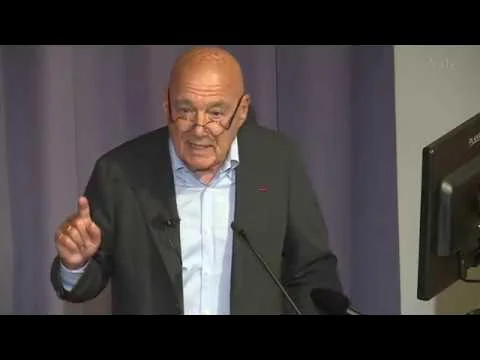
Read the full transcript of journalist Vladimir Pozner’s lecture titled “How the United States Created Vladimir Putin.” This lecture was presented at Yale’s Program in Russian, East European and Eurasian Studies, and the Poynter Fellowship for Journalism on September 27, 2018.
Introduction
VLADIMIR POZNER: Quite an introduction.
I’d like to say a couple of words about who I am and what I am, notwithstanding what we just heard. It’s important that you understand that I don’t represent anybody, or anything, any organization, political, social, whatever. I represent myself. I am an independent journalist, and that’s an animal that is disappearing in Russia and not only in Russia. I think, for me, it’s important that I say that.
And I hope I’m not going to speak long because I was told that we would have a conversation afterwards. And I think that might be the most interesting part of it because you have questions or views that you might want to share with me and I can’t guess them in advance. But there are certain things I’d like to say before we have that conversation.
Current State of US-Russia Relations
I’d like to say, first of all, that we are at an extremely dangerous moment today. Never have the relations between Russia and the United States or the Soviet Union, that’s what it was before, been at this level.
During the worst times of the Cold War, when I was living in the Soviet Union, and I remember all that very, very well, Russians were anti White House, anti Wall Street, but not anti American in their vast majority. In fact, there was a kind of a warm feeling vis a vis Americans. Today, that’s different. Today, it’s anti American at the grassroots level, and there’s a reason for it.
Another thing that is, to me, scary is that neither side seems to be afraid of nuclear weapons. Thirty years ago, those of you who are of my age certainly remember an American movie called “The Day After,” which is about what happens to you and to your country after a nuclear strike. There was fear of these weapons as there was in the Soviet Union. There was a realization that these weapons can, and if used, will destroy our country. Today, there’s a feeling when you talk to people, it’s as if there are no nuclear weapons. It really doesn’t seem to play a role in how we act.
And the danger of a not a deliberate nuclear exchange, but an accidental one has grown because the level of mistrust between the two countries has grown as well. There have been several times in the past when computers warned of a nuclear attack, but it never got to the real thing because people took the time to really check it out. Now they didn’t have a long time. If an ICBM is launched from Russia, it’ll take about ten minutes for it to hit the US. So you don’t have a long time, but you do have some. But my feeling is that if today those same computers malfunctioned and indicated on either side that an attack has been launched, the response would be immediate because the feeling is that this is what’s going to happen.
The Fall of the Soviet Union
Not that long ago, we were all very optimistic, weren’t we? Gorbachev, Gorbachev, Gorbachev, Russians, we’re going to be friends, we’re going to be… and in such a really short period of time, how did this happen? Why are we at the point that we are today? And I’m not saying who’s to blame because that’s not a productive way of looking at things. But we should try to understand exactly what did happen.
The Soviet Union, once Gorbachev took over, didn’t really last very long. He came to power in March of 1985. And by December 1991, there was no more Soviet Union.
Some people say it collapsed. It didn’t collapse. In a place called the Belarusky Pusko, which is a kind of a forest, three presidents, the president of Ukraine, the president of Belarus, and the president of Russia proper, Mr. Yeltsin, decided to part company, decided to disband the Soviet Union. Now each had his own reasons, definitely. But if we look at Mr. Yeltsin, his reason was very clear.
He was the president of Russia, so he was number two to Gorbachev because Gorbachev was president of the Soviet Union, of which Russia was part, the largest part, but only part. Get rid of the Soviet Union, and there’s no president, and you get rid of Gorbachev. And that’s precisely what he did.
Post-Soviet Relations
So no more Soviet Union. Quickly, no more Warsaw Pact, of course. That is to say, countries that were usually called Soviet satellites and part of a military alliance with the Soviet Union. That alliance disappeared. And so the United States had to figure out how do we deal with this new entity called Russia. How do we deal with it? There’s no more Soviet Union.
What is going to be US policy vis a vis this country? And, of course, Yeltsin also had to think about what is going to be Russia’s attitude towards the United States. You may remember that, soon after the Soviet Union ceased to exist, and I think it was February of 1992, Yeltsin came to the United States and he addressed the joint session of Congress. And he said the people of Russia are offering their hand to the people of the United States in friendship to build a better world, a world without war, a world without peace. And this was exactly what the vast majority of Russians wanted.
And I would even say that today, the vast majority of Russians would like to have, if not a friendship with the United States, at least a partnership. There’s no doubt in my mind that that’s the case.
America’s Response to Post-Soviet Russia
Well, the United States could have picked two ways of treating Russia. One was to say, let’s treat Russia like we did our enemies after World War II, Germany, Italy, and some of the countries that were occupied, such as France or were not occupied such as UK, but were really badly hurt, let’s find a way to see to it that in those countries, Nazis, fascists do not come back and communists do not come to power. And may I remind you that in those days, the communist party of France and the communist party of Italy were very, very powerful. And that plan turned out was called later the Marshall Plan, which was basically a financial idea to spend a lot of money, but in a very precise way to develop certain things and not to allow others to develop. Now that could be the policy to adopt vis a vis Russia.
See to it that democracy begins to develop in that country. And let me say just for the record, Russia never in its entire thousand years never had democracy, completely absent. So it wasn’t like something that once upon a time Russians had and then they lost, but they knew what it was. They didn’t know what it was. So let’s spend money on getting democracy moving in Russia and seeing to it that the communists do not get back.
And that could have been one approach. The other approach was to say, for forty years, you held a nuclear bomb over our heads. You lost the Cold War, and you’re going to pay for it. You’re going to be punished for what you did. And there were people who supported one view and people who supported the other in this country.
The Wolfowitz Doctrine
Early in 1992, a document was produced in the United States by a gentleman called Paul Wolfowitz. You may know who he was. He was Undersecretary of Defense of the United States responsible for policy. The document he produced came to be called the Wolfowitz Doctrine. Not officially, but that’s the way it was addressed.
It later was incorporated in something that is officially called the Bush doctrine. That document was leaked to the New York Times. And so it became public. And what it basically said, and you can look it up, it’s available, you know, just go to Wolfowitz doctrine and you’ll find it. What it basically said was this, the United States should never again allow any other country to challenge it.
The United States must remain the superior country, and we should tell our allies not to worry about developing their own weapons because we will do that for them. And we must watch out for Russia because we can’t know which way it’s going to go. The bear might get up on his hind legs again and growl.
When that document was leaked to the New York Times, it was an outcry by the more liberal, if you will. In America now, the word liberal and conservative has lost the meaning that it once upon a time had. So when I say liberal, I’m not sure that I’m saying the right word, but at least, many people were upset by this document. Edward Kennedy said that it was an imperialist document that no country could or should accept. It was quickly, as it were, removed and rewritten by Mr. Cheney, not a very liberal man in any sense as far as I can remember, and the secretary of defense in those days, Mr. Powell. But, basically, it retained that view.
Russia and America must remain… must be the only superpower. And, basically, that view was the one that was accepted. It was the one that would be accepted. And the attitude towards Russia was pretty much, you’re no longer a superpower. You are a second rate country. Just keep quiet, please.
NATO Expansion
This became evident and would be evident to you if you follow the policy of the United States. Now let’s begin with going back to Gorbachev and his meetings when he was asked by several people, all of them quite important, to allow Germany to reunite and take down the Berlin Wall. And he was told by James Baker and now this is not many people I mean, when I would say this, many people would say, it’s not true. It’s not true.
He was told by James Baker, if this happens, NATO will not move one inch eastward. Well, not long ago, on December 12, 2017, the National Defense Archives of George Washington University declassified the minutes of the Baker-Gorbachev discussion, and it’s there. But it’s not only Baker who said that to him. There were several people there. The German leadership did, West German at those days, and so on.
And finally, I’m not saying I don’t know whether Gorbachev could have stopped Germany from reuniting, but the fact of the matter is that they said yes and took down the Berlin Wall. And NATO stayed put. It stayed put in those days. It stayed put under Bush senior. It stayed put during the first four years of Clinton.
But in the next four years, in 1996, approximately, a decision was taken to enlarge NATO. Three countries, Poland, the Czech Republic, and Hungary.
George Kennan’s Warning
Now I’m going to read something to you. You know who Thomas Friedman is? New York Times old hand columnist. He, when this happened, this is already 1998. He called up George Kennan. I don’t know if you’re all aware who George Kennan was, but he was one, in my opinion, perhaps one of the most brilliant minds, political minds of the United States in the second half of the twentieth century, the man who devised the idea of containment of the Soviet Union rather than war against the Soviet Union, successfully did this. So, you know, a brilliant man who established the very foundation of US policy vis a vis the Soviet Union.
So Thomas Friedman called him up. The article he published in the New York Times is called “Foreign Affairs Now a Word from X.” Why X? Because in 1947, in the magazine Foreign Affairs, Mr. Kennan had published this article about containment and he signed it X. So he called him up and he asked him what did he think about this decision to enlarge NATO. Let me quote.
I think this is May 2, 1998. “I think it is the beginning of a new Cold War,” said Mr. Kennan from his Princeton home. “I think the Russians will gradually react quite adversely, and it will affect their policies. I think it is a tragic mistake. There was no reason for this whatsoever.”
That decision, and now I’m giving you my opinion, is what really started this relation turning itself, as you might say. That’s where it all began. Because the Russian reaction, and specifically this is 1998, so, this is Yeltsin, late Yeltsin, was you promised not to do this. So how do we trust you if you make a promise?
Russia’s Cooperation and America’s Response
I would also like you to perhaps try to solve a little problem. It’s not mathematical. Take the time from when Gorbachev came to power, March 1985 to 2007 when Putin has been in power for seven years. That’s 22 years. I ask you to find a single thing in foreign or domestic policies done by the Soviet Union while it still existed and then Russia proper that might in any way anger, irk, disappoint the United States? Let me answer that for you. Nothing. Not one thing during that period.
Now what did Russia get as a result of that? First, the enlargement of NATO. So that was number one.
Then the bombing of Yugoslavia that was done by NATO, and NATO is after all dependent mostly on the United States. Let’s face it. Right? The UN did not condone this. So the bombing of Yugoslavia, that’s from March 24, 1999 to June 10, 1999.
Then Kosovo and recognition of Kosovo, although it had been part of Serbia for centuries. And there were people in Russia who said, you’re letting the genie out of the bottle because if you do this, then there are other countries that will do the same. And Russia did the same vis a vis Abkhazia to begin with.
Yeltsin was very angry. He made a speech. He said, and of course, this is very Yeltsin-like. He said, “We’re not Haiti. You can’t treat us like Haiti. We’re a great country. We have a great past, and Russia will come back. Russia will come back.” He was really, really angered. Didn’t say the politically correct thing, but he spoke his mind.
Then finally, in the year 2000, Mr. Putin is elected to the presidency.
Putin’s Early Outreach to the West
VLADIMIR POZNER: And one of the first things he does is to ask for Russia to become a member of NATO. Why not be a member of NATO? NATO was created to defend Europe and perhaps not only Europe from Soviet aggression, from a country that you couldn’t predict. There is no more Soviet Union, and there is no more Warsaw Pact. Why can’t we create an organization where we are part of it, said Mr. Putin, and act together to protect from some kind of aggression.
He was told, go take a walk, basically. What about some kind of partnership or becoming part of the European Union? Again, and this is all documented. Everything I say except when I say my opinion is documented. You can look it up.
And he said they would no. You know, you’re too big. Your country is too big. You can’t. And all the while, Russia was being reminded that it’s no longer really that important a country.
Russian National Identity and Western Rejection
Now one of the things you must keep in mind is that much like the Americans, the Russians believe that they have a mission, that their country was selected by destiny. Now, you know, my being French, I laugh at that. I laugh both at you and at them because we French know that we’re the best and we have no mission. But seriously speaking, that’s a fact.
And so the sense of losing this aura of greatness, of being told, we don’t care about you. The reaction of the average Russian to that was one of, you’re insulting me. You don’t respect me. And so the anger gradually focused on Gorbachev. Many Russians figured you sold the country.
You don’t stand up to these men to the United States. And then the same thing for Yeltsin. You’d be surprised how unpopular Gorbachev and Yeltsin are today in Russia. Maybe five percent support them precisely for that reason. Well, there are some others as well that have to do with economic things, but nonetheless.
Putin’s Initial Cooperation with the US
So now here we have Putin who, as you know, as soon as 9/11 happens, calls up Bush Junior W and offers his help. And, yes, and does help in Afghanistan. And if you want to have your soldiers, your military people in Central Asia right on our borders, be my guest. And in Georgia, absolutely. So it’s not just words.
You know, we want to fight terrorism together and gets nothing in exchange. So finally, in 2007 in Munich, speaking to the Group of Twenty in Munich, Putin says this. This is February tenth:
“I think it is obvious that NATO expansion does not have any relation with the modernization of the alliance itself or with ensuring security in Europe. On the contrary, it represents a serious provocation that reduces the level of mutual trust.”
“And we have the right to ask against whom is this expansion intended? And what happened to the assurance of our Western partners made after the dissolution of the Warsaw Pact? Where are those declarations today? No one even remembers them.”
I would like to quote the speech of General Secretary Mr. Werner of Brussels on May 17, 1990. He said at the time, quote, “The fact that we are not ready to place a NATO army outside of German territory gives the Soviet Union a firm security guarantee.” Where are these guarantees?
And do you know what the answer was? The answer was yes, but that was guarantees given to the Soviet Union. And you are Russia. Well, what kind of a reaction would you expect?
Last year, I think it was, making a foreign policy speech, Putin said, “Our mistake was that we trusted you too much, and your mistake was that you tried to take advantage of that.” That is the situation today.
The Consequences of US Policy
Now it may seem to you that I’m blaming the United States. I don’t want the word blame used. It was a mistaken political decision. It was not the Russians. It was this decision that finally led to this change in Putin’s attitude towards the West and, in particular, towards the United States, which is why I say how US policy created Putin the way he is today.
And the really dangerous thing is that Russian leadership, I should be more precise and say Vladimir Putin, does not trust the West, does not trust the United States, which makes it very difficult to move away from where we are today.
So that’s something I want to underline. So we are now in a new arms race, which is terrible. We are in a new cold war, which threatens all of us. The danger of an accidental nuclear exchange has grown. We no longer seem to fear that.
There used to be demonstrations. You know, get rid of nuclear weapons. That’s not happening anymore. The possibility of a terrorist organization somehow getting a nuclear weapon has grown. And to make it look like someone used it on each side, not the terrorists.
Media’s Role in US-Russia Relations
So that, I believe, is something we should all understand. And finally, as someone who works in media, I would like to say that Russian media, mainstream media, paints America black. Russian media, mainstream media controlled directly or indirectly by the government, shows an extremely negative picture of the United States, US policy and so on.
And much to my surprise, mainstream American media does exactly the same thing vis-a-vis Russia, which to me is amazing because this is supposed to be a free media as differing from the Russian one. As someone who works in Russian media, I can say it’s hard to call it a free media.
There are some opposition newspapers and radio, but that’s not mainstream. They address a very small number of people. So there we are. I think people who call themselves journalists in my book, they’re not journalists. But those people have played and are playing a destructive role in creating the fear, the dislike, the distrust that the people in both countries have vis-a-vis each other.
And the fact that we don’t seem to question our media is really quite interesting. But there it is, nonetheless. We just take it.
A Warning from History
So I’d like to wind up with a quote from a man whose name was Hermann Göring. You all know who he was? There may be some people who are too young to know. Well, he was Hitler’s right hand man, and he commanded the Luftwaffe, the German air force. And he was, of course, at Nuremberg. He was judged, sentenced to death to hang.
But he managed to get some poison, probably from the Soviets, of course, since they poison people as we know. So as not to be hanged. But he was interviewed by an American journalist shortly before he committed suicide. And here’s what he said. And I think this is something that we should all remember:
“Naturally, the common people don’t want war, neither in Russia nor in England nor for that matter in Germany. That is understood. But after all, it is the leaders of the country who determine the policy, and it is always a simple matter to drag the people along, whether it is a democracy or a fascist dictatorship or a parliament or a communist dictatorship. Voice or no voice, the people can always be brought to the bidding of the leaders. That is easy. All you have to do is tell them they are being attacked and denounce the peacemakers for a lack of patriotism and exposing the country to danger. It works the same in any country,” said Mr. Göring.
And I think he was absolutely right. And we are being led by our media, by our politicians in that direction in both countries. I remember an ad that I saw, a famous American actor whose name I—he starred in, oh gosh, so many movies. An African American, not a young—
AUDIENCE MEMBER: Freeman.
VLADIMIR POZNER: Yes. And he says, “We are at war.” And he does it very well. He’s a wonderful actor. But he tells you, “We are at war,” and it’s very scary.
I know there’s nothing I can do about that except speak. And I speak—I’m happy to speak here today. I do this in Russia, and I’ll keep doing it as long as I possibly can because there has to be some voice raised against what’s happening. We’re being manipulated. You know, the way Putin is portrayed, well, he’s worse than Hitler.
And even Hillary Clinton compared him to Hitler. I’m not a Putin fan. Believe me. But, you know, what’s going on here? And, of course, President Trump. Well, even your own press is not too positive about him.
But, anyway, so basically that’s what I wanted to share with you. And see, I’ve only spoken for forty-five minutes. And I would very much like to discuss—I hope you have problems—that was a Freudian slip, wasn’t it? I hope you have questions.
I’m sure that what I’ve just said in the sense of what’s happened, it can’t be argued about. I mean, these are facts. But how you interpret them, that’s a whole different issue. So thank you again for listening and let’s talk.
Q&A Session
MODERATOR: So I am acutely aware of which one of us has more experience in this kind of a forum. So I think I will skip the part where I ask the first question and open it up for questions and comments with the following suggestions and guidelines. We have two microphones. Please wait for a microphone. You may think that you have a loud voice, but the people behind you will not agree. So please wait for the microphone.
Please be aware of the fact that we have some limited time for conversation and a lot of us, so please keep your questions reasonably brief and we’ll try to keep things moving and we’ll move back and forth from side to side. So I’m going to start on this side. Go ahead, sir.
AUDIENCE QUESTION: I’m very interested in your take on Russian interference. The U.S. Intelligence overwhelmingly concluded that Russia is involved in U.S. Elections. And I don’t think I’m over assuming in saying that the Russians are in favor of the Republicans. So I’m very interested in your take on that.
VLADIMIR POZNER: Well, I think that’s a question a lot of people have. I’m happy to answer it as well as I can. I wouldn’t say that the Russians support the Republicans. I mean, the Russians don’t really know who the Republicans are. It’s not part of their daily interest or the Democrats for that matter. But is this microphone working? Yeah. Okay.
But it is a fact that Republican presidents over the years have been the ones that have achieved breakthroughs with the Soviet Union. Nixon did when Jews were allowed to immigrate. This was 1972. Bush did. Reagan did. While the democratic ones such as Carter and Clinton have not been so successful. But that’s it.
Russians did support, including the Russian leadership I’m certain, did support Trump. Now look, they had a choice. Hillary Clinton or Donald Trump. Hillary Clinton said that Putin was a former KGB agent and had no soul and compared him to Hitler. Trump said, I think I can work with this man. I think we can do this. Now, yes, the Russians wanted him to win. And I think that’s normal.
Did the Russians interfere? Officially, Putin denies it. The Russians officially deny it. The US intelligence, different intelligence says it can’t furnish the exact proof, but it is certain that they did.
I’ve been reading just recently, there was this huge special issue in New York Times about pages and pages with wonderful illustrations that are supposed to really prove this kind of thing. This is journalism. Interesting, isn’t it? And when you read the article very carefully and you ask yourself, it’s not an article, it’s one, two, three, four with graphics, five, six, six pages of the New York Times. And when you read it carefully, you ask yourself, why was it published now? There’s got to be a reason for this, right?
I mean, this happened a while ago. What is the idea? And what you find at the very tail end is that over the past few years in this country, the popularity of Mr. Putin has increased by eleven percent. And the number of people who believe that the Russians interfered has gone down by five. And that’s a good reason to publish something like this. And this is a very detailed interesting story that doesn’t furnish any proof but it’s very well done as the New York Times does.
This is just one. So I said this came out September 20th. The next one comes out in Time Magazine, which is October 1st, not yet there, big story on the same thing. But this is again, the interference of the Russians. And then we have another story in the New York Times, September 26th. So I’m saying to myself, wow, this is like a kind of a salvo going. And I have to ask myself, is there a reason for this? And I would ask you, why now? Does this have to do with the midterm elections? I think it probably does.
Now, did the Russians interfere? I think they probably did. I think they probably did. Was that effective? I doubt it. I very much doubt it. They didn’t spend a whole lot of money, about one hundred thousand dollars which is really nothing when you talk about the elections. But they did some interesting stuff if you will.
I believe that to actually think that Trump won the election because of Russian interference, you have to be very naive for that. I mean, a farmer in Idaho was influenced by Russian propaganda. I mean, I worked in Russian Soviet propaganda for many years. And I’m not of the highest opinion of that propaganda.
Putin’s Role in Election Interference
VLADIMIR POZNER: It’s not something I’m proud of what I did. I mean, perhaps what I do today is because of what I did back then, trying to make up for. But, really, was Putin the man who said let’s do this? I don’t know. I can’t say yes or no to that.
I’m a journalist, give me proof. Give me proof. And I’ll say yes or no depending on that. But I think, yeah, there was probably an attempt to do it. And so what?
Does America ever interfere in the election anywhere? Never? Why is it okay for you and not okay for them? That’s the question. Well, I got an answer to that from one former CIA, high ranking gentleman.
He said, “Well, you see, yes, we do interfere, but we interfere for good and you interfere for bad.” So I thought, well, that’s it. So that’s how I’d answer your question. I would say yes. I would not exaggerate the result of that, the impact of it.
And I would say that it’s being used as a political ploy in this country now for a variety of reasons. And it only really surfaced after Hillary lost. Before that, it wasn’t there. But you had to find a reason why she lost. And of course, it was the big bad Russian bear.
And that’s part of the course, isn’t it? Let’s have the next question.
AUDIENCE QUESTION: What is your opinion of the past Trump-Putin meeting? And do you think it was for show? Or do you think it’s actually reason trying to better our relations?
The Trump-Putin Meeting
VLADIMIR POZNER: Even if it was for show, it was good. It was good for—how should I put this?—for public feeling. At last, these two men, one of whom is the president of the most powerful country in the world and the other is the president of a country that has ten thousand nuclear warheads and may not be that powerful but is very dangerous. These two men have gotten together and that in itself is positive.
Nothing was really achieved. But I would say that one of the important things is it seems to me that the two men kind of like each other. And that’s very important. Gorbachev and Reagan were completely different human beings. I mean completely, but they liked each other and they achieved some really incredible breakthroughs when you think about it.
So I think it was a good thing. I think it was a first step. Of course, here the reaction to it was very negative because supposedly well, you know what Trump said that he trusted Putin and that he trusted his intelligence. So it was how can you trust both? They’re saying opposite things.
And, there was a lot of talk about the fact that he lost to Putin. What did he lose? He gave Putin the opportunity to be on the same stage with him. That’s true. That’s true.
Did that increase Putin’s stature? I don’t think so. I don’t think so at all. And I hope that there’s a next meeting. I hope there is.
I hope that somehow there will be an attempt to break out of the situation that we’re in now. I mean, I’m not again, I’m not a big fan of Mr. Trump’s. But even if he tries to do something, the Congress, the US Congress seems hell bent on not allowing that. And I don’t know why.
Now if the American establishment wants regime change in Russia, wants Putin out and someone different in, if that is the aim of the people who run this country, let’s put it that way. That is extremely dangerous. It’s not going to happen. It’s not going to happen. Russians are living worse today than they did five years ago.
The sanctions are hurting. But the average Russian is saying, we’re being punished for things we never did. This is not fair. This is the American bully throwing his weight around and we’ll take it. We can take it.
And I think that’s true. The Russians, the tougher it is, the more tough they become. They’re pretty weak when things are good. No, it’s true. But when things are tough, that’s when they’re really strong.
American Interventionism: A Historical Perspective
I was reading this book by Arthur Schlesinger Jr. It’s called “The Cycles of American History.” And he dwells on 1850 when there were revolutions in Europe in 1848 and there was a Hungarian revolution. And the leader of that revolution was a man called Kossuth. And finally that revolution was destroyed by the Austrians and the Russians.
And so speaking in Congress, an American senator said that the United States should interfere. This is 1850. Senator Hale. And there’s this quote, he said, “the future historian might start off his chapter about the year 1850 in the following manner. At the commencement of this year, the American senate, the highest legislative body of the world, the wisest, greatest, and most magnanimous people that ever lived or ever will live, forgetting and neglecting the trifling local affairs which concerned their own limits constituted themselves into a high court and proceeded to try the nations of the earth for atrocious acts of despotism.”
1850, the idea that the United States has the right to interfere in other countries because they behave badly from the US point of view. 1850, well then you begin to understand a lot of other things because that’s what the United States has done time and time again. But when another country does that, that’s not permissible. So in Syria, if the US goes in to protect the so-called and support the so-called moderate opposition and the Russians go in to support Assad, Americans can do it, that’s okay. The Russians can’t.
Where’s your logic here? It’s a tit for tat thing, isn’t it? So that’s pretty much in my view the answer here. That’s how I look at this issue. Is there someone over on this side?
Are we done? No, no, keep going. There’s a question right over here. It’d be helpful if you would also identify yourselves before you ask your question.
AUDIENCE QUESTION: My name is Rob Foreman. I work for the medical school here. I used to listen to you on Radio Moscow. So that was a long time ago. See the gray hairs. Yes.
But I’d like to frame it a little differently that I’m not so sure I perceive Americans to be hating what Russia did in interfering, although America has some of that attitude that you described. But disliking the fact that someone who is largely considered to be an incompetent president who does not have the interest of this country at heart is beholden to the Russians, even if the Russians, what they did was comparable to what the Americans have done in Central America and who knows where else. And on that basis, I guess my question is, a, do you think that analysis is accurate and b, why not, if not? Because I don’t know that it is so much an attack on what the Russians did in 2016 as on the person who seems to be in the pocket of those who did it.
Russian Perspective on Trump
VLADIMIR POZNER: Well, I would say this, that it was Kennedy who used to say, I’ll say this to that.
I will say this. What I said initially when I compared what Trump was saying during the presidential campaign and what Hillary was saying, it’s obvious to anyone that the Russians would support Trump. It’s obvious and Americans should understand that. Not because of what Trump stands for, not because he’s a, whatever he is, not because he wants the Supreme Court to be more conservative. Russians don’t care about that.
They don’t even—it’s not part of what they think. But they think about the relationship between Russia and the United States. And judging from what he said back then, the relationship could improve. And that’s basically it on the one hand. On the other hand, you recall as well as I do, how many American senators, how many political figures said that the Russians were trying to destroy American democracy.
What does that mean? How so? That the aim of the Russians was to somehow destroy American democracy. There’s none of that. So I can understand what you’re saying, but it really is not at all.
It doesn’t correspond to what Mr. Putin or the majority of people in Russia really cared about or care about today. Today, there’s much less support for Donald Trump in Russia than there was. People are asking themselves, who the hell is this man? He comes here and he says one thing and he goes away and says something completely different.
Today he says, yes, tomorrow he says no to the same thing. So there are lots of questions. And there’s kind of—should I put this?—they don’t take him too seriously anymore except that he has enormous power.
AUDIENCE QUESTION: My name is Alexander. I’m an undergraduate. You touched on in the beginning of your talk about how there’s intense American hatred in Russia. And just now you say that most Russians would want to improve relations. Why do you think—how does that help Putin to have like a very bad relations with America or like a bad image of Americans in Russian minds? And also do you think that this hatred is reciprocal? Like is there a distrust of or dislike of Russians in America?
US-Russia Relations and Media Influence
VLADIMIR POZNER: I think the word hatred is a bit strong and I didn’t use it. I said that the attitude of Russians today towards Americans is more negative than it was back during the Cold War, the worst times. And I think it’s mutual. And I think that that’s the result of what the politicians have said, what they’ve done and what the media is doing in both countries.
And I think it’s an issue of political will because before Gorbachev came to power in Russia and Soviet Union, excuse me, the attitude was negative in this country, very negative towards Soviet Union and the Russians, “Russians are coming” this stuff. But as soon as Gorbachev started changing things, glasnost, perestroika, da da da da da, suddenly he became Gorby. He became America’s favorite guy. So I think that if there is a desire on both sides to change that attitude, it can be done very quickly. And that’s why I say that we’re manipulated.
We are manipulated. And we all say, well, I’m totally independent. It’s not true. We make our decisions and we come to certain conclusions because of what we read, because of what we see and because of what we hear.
So basically that’s it. I would say that certainly the Internet allows us to get a much broader picture. In fact, we could communicate with the other side via the Internet. It’s not happening very much, but it is a little bit. So that the, how should I put this? The ordinary citizen could do a lot to change what’s happening in both countries.
And it’s a two-way street. And I think it’s people like you, that is to say of your age. They’re the ones who for me are the reason for optimism. If you can do this, whereas people of my age and slightly younger can do far less. So I would hope that, what I’ve said today might lead you to look into this.
And I don’t say to anyone, believe me, trust me, heaven forbid, look into it. That’s all I would say.
AUDIENCE QUESTION: So I was struck in both your talking and now your sort of mutual indictment of the media on both sides. And I was—I’ve been curious for a while about how this may or may not be different to what this picture looked like, say, in the mid-1980s. I wonder if you could recall—so just take the New York Times. I mean, I wonder if you could recall what New York Times reporting about Russia, the Soviet Union was like in the eighties. And whether you see a significant difference?
Changes in Media Coverage
VLADIMIR POZNER: Let me give you an example. Back in the 1970s, 1980s, all of the major television networks, which are the most powerful in the sense of affecting—back then especially affecting people’s views. All three of the major networks, ABC, CBS and NBC had bureaus in Moscow.
The head of the ABC bureau was a woman by the name of Ann Garrels. It was a rare thing in those years for a bureau to have a woman as a chief. Not only that, she spoke Russian. And I’d like to tell you that the vast majority of American journalists did not speak Russian. They had interpreters.
She did. And one day when, and I met her at some reception and I was doing the show that I did for Moscow radio. And we talked and she said, “You should be on US television.” I said, “Well, how does that happen?” She called up Ted Koppel, you remember who he was, right? Nightline. I hope you’ve not forgotten. And she said, “Ted, instead of having dissidents on all the time, who represent zero point zero point something of the country of the Soviet Union, put on someone who can express the Soviet viewpoint and who can do it in English.”
So I got on Nightline and since I was not your typical Russian as far as the American audience was concerned. Who is this? I had great ratings. And so I was on again and again and again and then on NBC and CBS and here and there. Today, that wouldn’t happen. I was allowed to argue the Soviet viewpoint on American television. I was allowed to do that.
Ted would invite someone from the State Department to rebut me and very often the State Department would say, “We’re not going to do this because Posner is a pain in the what’s-it and we don’t want to talk to him.” That’s fine. Today, I would not get that possibility to be on a major network regularly. And that’s what’s changed. That’s what’s really changed.
And I’ve come to think that government censorship, official or not official, when the Soviet Union was official, there was an official censor, you had to go with your piece and the censor would read it, stamp it, censorship. Today, that doesn’t exist in Russia. But of course, there’s censorship when the boss says, no, you can’t say that or you can’t print that. So and I’m talking now about mainstream media, right? So I call that government censorship.
Corporate Censorship in Media
VLADIMIR POZNER: But there’s something that I call company censorship. And it’s just as effective. And what’s happened with American media much to my regret is that what used to be independent, CNN belonged to Ted Turner and he ran it. CBS was created by William Paley and he ran it. But gradually, many of these very important sources were bought by larger companies.
CNN, he sold it to NBC, NBC was bought by AOL, ABC by Disney. And so these very important media organizations became part of huge conglomerates and information was then made very different. The attitude towards what media is supposed to do changed dramatically.
I asked a group of people, I paid for it actually, to try to find in the New York Times over the past three years, 2015, 2016, 2017, any positive article about Russia, one positive article, didn’t find any, not one. Now I say to myself, if that isn’t censorship, then what is it?
I mean, there have to be people who come to Russia and say, gee, they have good ice cream or they have great theater and they do. And people are standing in line for theater tickets. And that’s a nice thing, right? Give a more or less accurate, it’s all negative. And that’s the New York Times, let alone everything else.
And to me, it’s terribly disappointing because I worked here for CNBC for quite a few years until a man by the name of Roger Ailes. I don’t know if you recall who that was. He killed our program because we were too liberal. Just didn’t renew the contract and that was that. So I know what freedom of the press is on both sides of the fence as it were.
It’s a different issue. So that’s what I’m saying that we in a strange way corporate censorship is just as effective and sometimes far more sophisticated than government censorship.
Q&A Session
AUDIENCE QUESTION: So my name is Rick Schneider. I work with Rivendell Institute at Yale. I’m also a visiting professor, have been at McGill and currently at Bueshka. So my question is, from your discussions, experience with leaders in Russia, do you sense any room for compromise on Ukraine? I mean, after all, maybe the big sticking point right now in our relations is all of the sanctions most of the sanctions other than Magnitsky, of course, but most of the sanctions are about Ukraine, and Donbas is a big problem. So is there room for compromise to fix that?
VLADIMIR POZNER: First of all, I applaud the question because the keyword is compromise. The keyword is compromise. I had asked for the possibility to show a map. Is that still possible or is that not possible anymore? I want to answer your question because I want to show something that I think is important.
I asked that a map of Russia with Ukraine be put up on the screen and hopefully this will take a couple of seconds. And a map of the United States and Mexico be put up on the screen.
Now, let me go back to the Cuban Missile Crisis, 1962. Two totally independent leaders Nikita Khrushchev and Fidel Castro decide that it would be a good idea for Russia to deploy missiles on Cuban soil. Did they have the right to make that decision? Absolutely. Two independent countries. And Fidel Castro was not a satellite, for sure.
So they make that agreement and the Soviets begin bringing in the missile or the parts to assemble. And the United States discovers this. Kennedy says to the Russians, turn your ships around or we will sink them. And if that leads to World War Three, so be it.
And the Russians turned their ships around. But there was a compromise, not made public in this country at that time. Kennedy agreed to pull out American missiles that were deployed in Turkey in exchange because the Russians said, look, you have missiles in Turkey right on our border almost. You say our missiles are an existential threat, well, so are yours. Take them out and we will not deploy ours.
That was a compromise. Now, Kennedy asked that this not be made public because it would kind of be seen as a loss of face and it wasn’t made public and then it worked later. So that was a compromise. And it helped avoid World War III. Well, this is not yet happening.
NATO Expansion and Russian Security Concerns
Russian leadership sees NATO as an existential threat. Rightly or wrongly, that’s not the point. The point is that that’s the way it’s seen. And this is not politics. Why would you bring NATO closer and closer to our borders? They say.
In Latvia, it’s on the border. In Estonia, it’s on the border. Now Ukraine is moving westward. It’s a complicated issue. The United States has played a certain role in this. That’s not the point. It’s moving westward. If it ultimately goes into the western fold or whatever you want to call it, then it’s logical to surmise that Ukraine will join the European Union and will become a NATO member. Now Ukraine has a border with Russia.
Not only that, but Crimea, which was traditionally Russian, but I’m not going into the complicated thing about how Ukraine was Russian and was not Russian, the point is that Sevastopol was always the base of the navy, the Russian navy, naval fleet of the Black Sea. So if Crimea remains Ukrainian and if Ukraine becomes part of NATO, the Russian fleet won’t be in Sevastopol but the American sixth fleet might very well be there. And NATO will be on Russia’s Southwest borders. And the Russians see this as an existential danger. And they say, we will not permit it.
Now, does that correspond to international law? No, it doesn’t. But when you talk about existential threat, you say I don’t care about international law as in the Cuban Missile Crisis. You say, no, we don’t give a damn how you feel. We’re not going to allow this.
It is my opinion that had from the very outset, been some kind of internationally negotiated agreement that Ukraine would not become a member of NATO for at least the next fifty years, there would be no Ukrainian problem.
A Hypothetical Comparison
United States has a pretty large border with Mexico. Now imagine that you have a revolution in Mexico. That’s not that hard to imagine. And imagine that the government that comes to power is not a big fan of the United States of America. And I think that too is not difficult to imagine. But since it’s a little bit afraid of big brother, it asks the Russians to send over three or four or five divisions to be placed on the US-Mexican border. Think the US would accept that? So why would the Russians accept this?
That’s what it’s really all about. Does there have to be a compromise? In my opinion, yes. And the compromise has to be that Ukraine guaranteed will not become a member of NATO. And then the compromise is that the Russians get out.
We get out, but there’s the guarantee. Crimea is a different issue. There could be an agreement that let’s do another referendum under international supervision. Let’s see what the people of Crimea want. Do they really want to be part of Russia? Or do they want to be part of Ukraine? Or do they want to be an independent republic? I know what the answer will be overwhelmingly. And so does everyone, which is why no one is even suggesting that. Because the majority of the people who live in Crimea want to be part of Russia.
It’s a tradition, it’s existed that way for a long time. But basically, that’s my answer. Yes, you need a compromise. And if neither side is willing to compromise, well then we’re in deep trouble.
Putin’s Foreign vs. Domestic Policy
AUDIENCE QUESTION: I’ve been following you for many years, your work, going back to telebridges with Phil Donahue and certainly some of us remember those days and watched that back in the Soviet Union. I’m from Ukraine, just for the record.
So I certainly shared your view about a lot of things that you speak about. Today, however, I’m struggling a little bit to accept your point of view. And I can’t get rid of a feeling that it’s almost like a legal defense that is trying to explain the bad behavior of a person by the external circumstances.
I’m certainly not naive or idealistic about the policymaking in any country, including the United States. And certainly, I do agree that mistakes were made. Not being an expert in this field, it’s difficult for me to really know the exact chronological sequence of the events. So it’s difficult to argue what was the cause and what was the effect of what you’re describing.
However, in your presentation today, I think you certainly presented Mr. Putin as a positive peace-alarming person, and I’m not sure that I agree with that assessment. His actions, not just vis-a-vis Crimea, but overall Eastern Ukraine, his pretty aggressive actions in Syria certainly don’t create that position.
But to get to my question, I think while generally, if we, for discussion’s sake, agreed to accept that the U.S. and maybe the Western world contributed in a way to that image of Putin that you described. Putin is not only responsible for the foreign policy of the Russian Federation but also for its domestic policy. And who contributed to his image as the domestic leader of Russia, as somebody who is fairly authoritarian in the way he runs the country?
VLADIMIR POZNER: Well, that wasn’t a question, but I’ll answer it. I made a point of up to 2007. And up to 2007, Putin did nothing internationally that would speak of an aggression, nothing at all. It all happened after 2007. It happened in 2008 with Georgia, with the war. Officially, wasn’t Putin, it was Medvedev, but no big difference. And then all the other things that you’re talking about.
But up until 2007, until that Munich speech, when he said enough is enough, you have to respect us, you have to take into consideration our interest. The world is not unipolar. It is multipolar. And you will have to keep that in mind.
Incidentally, that’s why he’s so popular in Russia. Not because he contributed to people’s living much better, although they did, but he was lucky because the price of oil was high and so that certainly helped. But because people saw him as someone who stood up to the American bully and told him off. And that’s where his popularity comes from.
Russia is back. We’re up from our knees as people would say. And they have to take us into consideration. We don’t give a damn if you like us or you don’t like us. But Putin is our man. He is a true patriot. And that’s where his strength lies.
Now if you talk about his domestic policy, I would absolutely agree with you that a, he’s authoritarian. B, he has pretty much stymied the development of democracy in Russia. I do not agree with basically almost all of his policies in Russia, not all, but almost all. I’m much more supportive of his international views than of his domestic views. So I have no argument with you.
I did not present him as a lover of peace. I was simply making the point that up until a certain moment, you could not really blame him for anything. And that, well, I say find it, just point me, say, well, in 2006 or in 2005, Russia did this and this. I would say, okay, fine. I don’t know what we’re talking about.
And of course, Ukraine with its proximity to Russia and having been seen always as close to Russia because of the language, because of the religion. In a way, the Russians, you know, the Rus’ being where Russia was born in Ukraine. So the fact that Ukraine would leave is very painful to Russians as it would be in other countries.
But that certainly does not make Putin blameless in what’s happened in Ukraine. So I have no argument with you at all. But because of the mistakes that were made in my opinion, you have now a man who has a very different outlook than he did many years ago, and that’s too bad. I think that there was a huge window of opportunity and it was missed. And it’s too bad for everyone.
Russia’s Future
AUDIENCE QUESTION: Hi, my name is Anastasia. I’m from Moscow. So I grew up in Russia, but I’ve lived in the U.S. now for five years. So we’ve talked a lot about Putin and how powerful he is and his international policy. But being a Russian myself, I ask myself, is there a future for Russia? Should we hope for anything better? Because, you know, now I feel like there is a big division in terms of what people think.
Audience Q&A Session (Continued)
AUDIENCE QUESTION: Like, some people just think Putin is everything, all got, and there is no other future for us. But then, of course, with Navalny being in the picture, and I know you’re not a fan of him. No, I’m not. But except for him, of course, there might be someone else. But my question is, should we hope for any improvements in terms of, like, for us, for Russians? Should we hope for the future for Russia? Or should we just practice our American accent and forget about it?
VLADIMIR POZNER: Well, you know, when you ask that question, I would have to ask, well, what do you mean? What would you like to change? What is it that makes you ask that question?
And my answer to that is, of course, there’s a future. And the future is—let me back up a little bit here. The main problem from my point of view in Russia is that the leadership, all the leadership is Soviet. All the people who are at the head of politics and all the rest of it, they’re all Soviet. They were born in the Soviet Union. They went to Soviet schools. They were members of the young pioneers. They were members of the young communist league. They were members of the communist party, most of them. They were created, formed by a system that no longer exists.
They’re trying to run a system that they really don’t know anything about and they’re not very good at it. But whatever they do is based on the mentality that they have and that mentality is a Soviet mentality. And there’s not much you can do about that. That’s the way they were brought up. And you can’t say, well, where are the others? Because there are no others.
And what I say is, in my opinion, the hope is that people who are not born in the Soviet Union, who were born afterwards, that is to say the next generation and the generation after that, that’s when you will see real change. And you have to have patience. So I have no doubt that Russia is a great country. And during the worst times like the Tsar Nicholas during those years Russia’s greatest literature developed.
So it’s not such as you can’t just look at it from that side. I certainly have hope. I won’t see it. Not at my age. It’s going to take another twenty, thirty years.
But in all countries for democracy to develop, it took over two hundred. And I guess there were people back then saying, gee, do we have a future? Because there are all kinds of things. You had slavery in the United States less than two hundred years ago. Come on.
Since you have to look at it realistically. So my answer to you is yes. I absolutely do believe it. But it’s going to take time and you cannot do anything about that. Except that if you’re young, you can look forward to a change that is inevitable because those people will disappear and it’ll be your ballgame.
As a Yankee fan, I know what I’m saying.
On Brothers Killing Brothers
AUDIENCE QUESTION: I’m a father of Yale undergrad. My name is Oleg. We met sixteen years ago in Kazakhstan. We spent a couple of days in the media business. Remember that?
But the question that I have—and we had very interesting discussions sixteen years ago about what made my family move to America from Odessa. And, you know, I saw a lot about it. And now I know my answer, but back then, I believe I told you the story about my father who really—after this conflict in Transnistria that was like a hundred kilometers from Odessa when people all of a sudden started killing each other.
You know, geopolitics, yeah, we all understand that. Threats for that, we understand that. United States and Mexico, Russia and Ukraine, southern border, NATO fleet in Sevastopol, we all understand that. But with people going and killing each other right now in Donetsk, people who lived on the same street, it’s not—it’s not even Karabakh. It’s not like Armenians and Azerbaijanis who had some ethnic conflicts. They had some religious differences.
But whatever is going on in Donbas right now when neighbors are killing neighbors over nothing, I mean, do you really think that that whole issue of Ukrainian language is like really pressing there? Or these stories that were made up about Western Ukrainians, banderas of Nazis who’s going to move in—how do we stop that? How do we stop people from killing each other in situations like that? Because, you know, they can meet up in Minsk. They can do whatever, make agreements, they can disagree. You know better than me about money interest and kleptocracy that is so omnipresent in Russia and Ukraine and everywhere. But how do we stop that? How do we stop? How can United States and Germany and Russia get together and stop brothers from killing brothers?
VLADIMIR POZNER: Well, if I had the answers to all of those things, I probably would be in a different job. No, seriously. I mean, I can’t tell you how to solve the world’s problems. And people are killing each other in many places. In Africa, for instance, brother is killing brother and so on. This is going on everywhere.
But I would say that if the leaders of Russia, of Ukraine, of the United States, of Germany, were actually asking that question—that question they were asking—I think they’d find a way to answer it. But I don’t think they’re asking that question. I think they’re asking very different questions. And they have very different aims. And that’s why this is going on.
So to me, the answer is pretty obvious. How you make people do that, that’s a different question. Why is it that egoistic, geopolitical interests take first place over these things? That’s the real question.
And when you say “we understand,” I don’t know who you’re talking about. Most people don’t even know in this country where Georgia is, for instance, except the state of Georgia. Most people are really—and in Russia too—the level of knowledge is lower than the doorstep as they say. So there is no effort, and the media does not play that game at all. It doesn’t say “how do we stop.” It says “they are to blame” and that’s it, and on both sides.
So I think the only way to stop it is for us to talk, make our voices heard. And that’s not easy and sometimes it’s dangerous.
There was a guy by the name—his last name was Niemoller. He’s a German, who fought during World War One. He was the youngest Japanese U-boat commander or the U-boat as they were called, submarines. And when Germany lost the war, he was totally crushed by it. And he became a priest, Protestant priest in Hamburg and very anti-war.
And as he went up the ladder as it were, Hitler did too. And Hitler became the head of Germany and he became the head of the Protestant church in Hamburg at the same time. And he spoke out against war and finally he was arrested and he was sent to a concentration camp. But he survived.
And when he came back, he wrote a book. And in that book, there’s a passage that I know by heart because I think it’s one of the most important and powerful things I’ve ever heard. He wrote:
“When they came for the Jews, I didn’t say anything because I’m not Jewish. And when they came for the communists, I didn’t say anything because I’m not a communist. And when they came for the trade union members, I didn’t say anything because I’m not a member of the trade union. And when they came for the Catholics, I didn’t say anything because I’m not a Catholic. And when they came for me, there was no one to speak.”
And I very much feel that way. If we don’t speak out however we can—and not irresponsibly and not to say, “look at me,” but rather with this understanding that it’s our human duty to do this—well then, we keep saying, “they should do it.” That’s certainly very Russian. “They should do it.” And if they don’t, then what? That’s really my view. And it’s an idealistic view perhaps, but that’s the way I look at it.
On the Marshall Plan Alternative
AUDIENCE QUESTION: Hi, my name is Anastasia from Moscow. I’m a PhD student at Yale. So you started your talk by outlining two strategies the U.S. could have taken towards Russia after the Soviet Union collapsed and presented this as a cornerstone of the situation we have right now. So if we hypothesize, with your knowledge of Russian politics, economy, the Soviet mentality that you mentioned, do you believe that some version of Marshall Plan could have ever changed anything?
VLADIMIR POZNER: Well, that’s the question that regardless of how I answer, I can’t prove it because it didn’t happen. So it’s kind of, as you say, it’s very hypothetical. But do I think that that would have been better than what they did? Yes, clearly. Clearly, it would have been better. To what extent it would have succeeded, who knows? I don’t know.
But I do know that when Gorbachev announced glasnost, the media in Russia changed dramatically. And I think nobody would argue with that. Dramatically overnight, it became a different kind of media.
During the Soviet times, forty million people tuned into the Voice of America in Russian, the BBC World Service in Russian, the Deutsche Welle in Russian because they were not getting in their own media information that they were getting on these waves. And the Russians tried to block that, the Soviet government did. Spent trillions of rubles trying to block that. The people listened nonetheless.
As soon as glasnost came in, they stopped listening. They were getting it from their own source. They were getting the information. People know exactly when they’re getting it and when they’re not, or usually they do.
So that’s one example of how quickly things changed. So I do think that had there been this attitude, “let’s help them, let’s help them become democratic,” I do think that it would have been positive, the result would have been positive. I can’t tell you how positive. So that’s my hypothetical answer to your hypothetical question.
On Armenia’s Peaceful Revolution
AUDIENCE QUESTION: Thank you. My name is Assia. I’m from Yerevan, Armenia right there on the map. Yes, it is tiny, but it’s still—you see it over there, right? That tiny little country that says Armenia? Okay. So I’m a doctoral student, and I study genocide.
VLADIMIR POZNER: You study what?
AUDIENCE QUESTION: Genocide.
VLADIMIR POZNER: Wow.
AUDIENCE QUESTION: Yeah. A lot of fun. But today, I’m going to ask a question about current developments that happened right next door to Russia and are very connected to what you talked about—about speaking out, about the new generation that can change, the generation that maybe does not have the Soviet mentality can change.
And something like that recently happened in Armenia. No one ever expected that peaceful demonstrations in such a tiny post-Soviet landlocked country could lead to change, which was the collapse of the old rule and establishment of the government that is totally and fully supported by the people.
And the funny question that I always hear when I discuss this with students or at conferences is how come Russia did not intervene into these developments in any way? And I would really appreciate your opinion in this—like, how come that Vladimir Putin did not really respond in any visible way to this development? And how was this even observed, seen in Russia? Because it was next door. It was a big change, and some people were even speculating how this could serve as an example for other countries to topple their governments, etcetera.
VLADIMIR POZNER: Well, one reason might be that perhaps Putin isn’t quite the man you think he is. That’s a possibility. I’m not insisting on it.
Another reason might be that the new leader of Armenia never expressed any anti-Russian sentiment. On the contrary, said “we are an independent country, but look where we are. And we’ve always had very close ties with Russia and we want to have close ties, economic ties.” There was absolutely no sense of enmity, on the contrary.
And it was the people. There was no doubt at this time that it was the people who spoke out. Armenia is really a very small country. What’s the population now? Three million? And there was a million people that came out. Can you imagine? Thirty percent of the entire population comes out in the streets. You can’t ignore that. And that’s another reason.
But the very question “why didn’t Putin interfere” reflects the way people think about it. Because that’s the way he’s been depicted. So that’s my answer.
On the UK Poisoning Incident
AUDIENCE QUESTION: I’m a master’s student in European and Russian studies. I guess my question is about the poisoning in the UK earlier this year. Is there a way for us to respond to that strongly that doesn’t escalate the kind of confrontational paradigm?
VLADIMIR POZNER: Yes. When this took place in Salisbury, I was shocked. And I tried to figure out for myself some kind of logic. Now, why? Who would do this and why?
Now, let’s forget about the child and she’s like, she didn’t do any—Skripal. He was a military agent, right? He worked for the former GRU, not for the KGB. Putin worked for the KGB. He worked for the GRU, which is military intelligence.
# Vladimir Pozner’s Lecture: How the United States Created Vladimir Putin (continued)
The Skripal Poisoning Case
VLADIMIR POZNER: And they can’t stand the KGB and the KGB can’t stand military intelligence, that’s normal competition. So, and he betrayed his country, let’s face it, right? He went over to the other side and began to work for British intelligence. And he was caught and he was tried and he was sentenced to thirteen years.
Now, I don’t know if you’re familiar with what happens to spies who turn against their own country and are then caught, well in wartime they’re shot. But in peacetime, well, it’s usually something like thirty years, twenty-five—thirteen is a weird sentence. Not only does he get this rather short sentence considering, but he’s exchanged for Russian spies who were caught. Now if he was exchanged, that means that he really didn’t know anything at that point. He was no danger to the Russian side. So, you know, let him go and we’ll get ours back.
If Putin had wanted to kill him, he was in prison. It was easy to do it. And you could say that he had a heart attack or that he committed suicide or whatever. There was no problem killing him when he was in jail in Russia.
They let him go. They exchanged him. He could have exchanged someone else. They exchanged him. What sense would it make to poison this man under those circumstances?
I mean, logically, Putin is anything but stupid. It’s not stupid. It’s very risky. The risk of somehow this being found out is always there. Why do it? This is not a dangerous person. He can’t do anything. He can talk about what he knows, but it’s over. So I try to find—I’m not saying he didn’t do it. I’m saying I’m trying to find some kind of logic, logic, not emotions, logic as to why Putin would be involved in something like that.
All right, it’s not Putin. It’s one of those lower, one of the GRU people who think that Putin would like it if they did. But would Putin like it if it was discovered? No, of course not. They get their head chopped off.
So why would they risk it? They’re not going to get decorations for doing it because if Putin had ordered it, then yes. So why would they do it? So to me, it really remains a mystery because it’s stupid. It’s counterproductive. It doesn’t do anything positive at all. So am I denying anything? I’m not denying. I’m saying give me proof. Please just show me.
The Suspects’ Interview
Yes, there it is. Now this interview, did you see it? The interview of Rita, what’s her name? Simone Jan with those two people. Did you see it?
It was one of the most unprofessional pieces of work that I’ve ever seen. I was just—I thought, what, who, why? And it happened the day before that, Putin had said, these two men should go to the media. And so they come the next day, they’re there. It’s laughable, except that it’s not, not really.
So I would say to you that whole story is disgusting. I find it hard to believe that Putin initiated it. I really do. But somebody did. There’s no doubt about it.
Alternative Theories
Now I’ve heard a really nice story. That Mr. Skripal in Britain, every time he’d meet with his handlers as they call them, he would be paid a certain amount, not a lot, pounds five thousand or seven thousand pounds or if he felt he had something really interesting to say ten thousand pounds. But again, he was of no real interest.
So I’m thinking—and now this is John Le Carré, right? I’m thinking British intelligence gets together and says, “We don’t need this guy anymore. And he’s costing us money with more. And he’s not giving us anything now, why don’t we… and make it look like it’s Putin.” “Well, that’s brilliant, chap. You should do this.” British intelligence poisons the guy, and the whole thing works this way.
It’s not impossible. I kind of laughed at myself when I came up with that one. And I’d like to talk to Mr. Le Carré and see how he thinks. Incidentally, if you’ve not read his last two books, “The Pigeon Tunnel,” which is a story of his life as a spy, and the other one I forgot, “Legacy of a Spy.” He writes with total disgust about that profession that he was in for so long. I mean, really.
So, there it is. Answer to you is, I just don’t know. It’s such a weird thing. It really is. I see no reason for it. It’s just—invading another country, can explain, right? But this I don’t know. It makes no sense. One day we’ll know the real thing.
Salisbury’s Historical Significance
Oh, incidentally Salisbury, I don’t know if you’ve ever been there. I was there. I shot a documentary about England. And so, I went there, not because the steeple is, I don’t know how many feet high or something. I had no idea. It’s beautiful church actually. But it’s because they have there one of the three original copies of the Magna Carta.
And that’s the beginning of real democracy in the West, if you don’t count the ancient Greeks. And I really wanted to see it. And they brought it out and I can’t tell you what—when you look at that and you say, what was it, 1215? And they were already saying you can’t put a man in prison without proving that he’s committed a crime. And you have all the kings and queens and all of that.
It’s amazing. That’s why I went there. These guys didn’t even know it was there, right? They went to see the steeple. I mean, come on.
Right. Let me thank everyone for listening.
Related Posts
- Transcript: Why Adaptability Beats Planning in an Unpredictable World? – Mr. Sanjeev Sanyal
- Transcript of Dr. Prathosh AP Lecture: AI Is Making Intelligence Cheap
- Transcript: Stanford’s Chad Jones on The Future of Jobs in an AI World
- Jared Isaacman: A New Era for NASA and American Space Exploration (Transcript)
- Transcript of Bill Gurley: Searching for Feynman at All-In Summit 2026