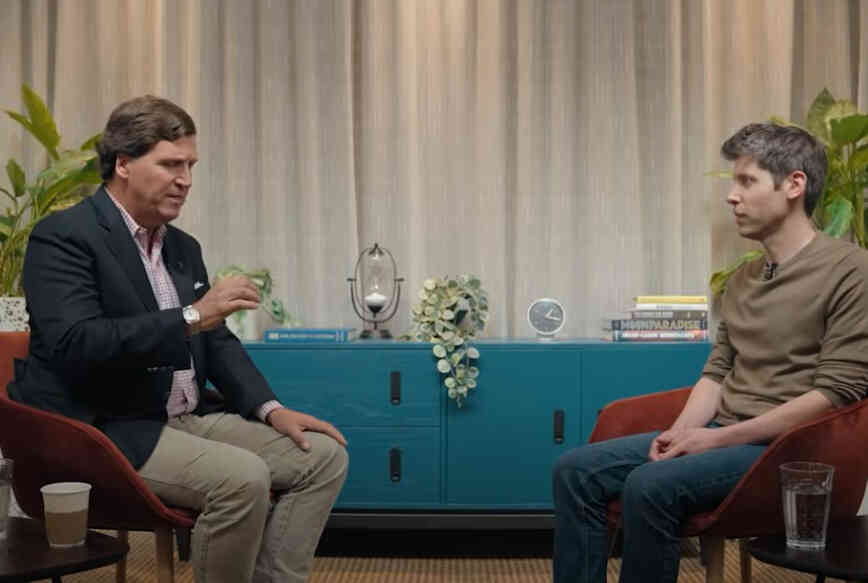
Read the full transcript of OpenAI CEO Sam Altman’s interview on The Tucker Carlson Show episode titled “God, Elon Musk and the Mysterious Death of His Former Employee”, September 10, 2025.
Sam Altman on AI Consciousness and Morality
TUCKER CARLSON: Thanks for doing this.
SAM ALTMAN: Of course. Thank you.
TUCKER CARLSON: So, ChatGPT, other AIs can reason. Seems like they can reason. They can make independent judgments. They produce results that were not programmed in. They kind of come to conclusions. They seem like they’re alive. Are they alive? Is it alive?
SAM ALTMAN: No, and I don’t think they seem alive, but I understand where that comes from. They don’t do anything unless you ask, right? Like they’re just sitting there kind of waiting. They don’t have like a sense of agency or autonomy. It’s the more you use them, I think the more the kind of illusion breaks. But they are incredibly useful. Like they can do things that maybe don’t seem alive but seem like they do seem smart.
TUCKER CARLSON: I spoke to someone who’s involved at scale of the development of the technology who said they lie. Have you ever seen that?
SAM ALTMAN: They hallucinate all the time? Yeah. Or not all the time. They used to hallucinate all the time. They now hallucinate a little bit.
TUCKER CARLSON: What does that mean? What’s the distinction between hallucinating and lying?
SAM ALTMAN: If you ask again, this has gotten much better. But in the early days, if you asked, “In what year was President Tucker Carlson of the United States born?” What it should say is “I don’t think Tucker Carlson was ever President of the United States.” But because of the way they were trained, that was not the most likely response in the training data.
So it assumed like, “Oh, I don’t know that there wasn’t. The users told me that there was President Tucker Carlson so I’ll make my best guess at a number.” And we figured out how to mostly train that out. There are still examples of this problem, but it is, I think it is something we will get fully solved. And we’ve already made in the GPT-5 era a huge amount of progress towards that.
The Spark of Life in AI
TUCKER CARLSON: But even what you just described seems like an act of will or certainly an act of creativity. And so I just watched a demonstration of it and it doesn’t seem quite like a machine. It seems like it has the spark of life to it. Do you dissect that at all?
SAM ALTMAN: So in that example, like the mathematically most likely answer, as it’s sort of calculated through its weights was not “There was never this president.” It was, “The user must know what they’re talking about. It must be here.” And so mathematically the most likely answer is a number. Now again, we figured out how to overcome that.
But in what you saw there, I think it’s like, I feel like I have to kind of like hold these two simultaneous ideas in my head. One is, all of this stuff is happening because a big computer very quickly is multiplying large numbers in these big, huge matrices together, and those are correlating with words that are being put out, one or the other.
On the other hand, this subjective experience of using that feels like it’s beyond just a really fancy calculator. And it is useful to me. It is surprising to me in ways that are beyond what that mathematical reality would seem to suggest.
TUCKER CARLSON: Yeah. And so the obvious conclusion is it has a kind of autonomy or a spirit within it. And I know that a lot of people in their experience of it reach that conclusion. This is, there’s something divine about this. There’s something that’s bigger than the sum total of the human inputs. And so they worship it. It has, there’s a spiritual component to it. Do you detect that? Have you ever felt that?
SAM ALTMAN: No, there’s nothing to me at all that feels divine about it or spiritual in any way. But I am also like a tech nerd and I kind of look at everything through that lens.
Altman’s Spiritual Views
TUCKER CARLSON: So what are your spiritual views?
SAM ALTMAN: I’m Jewish, and I would say I have, like, a fairly traditional view of the world that way.
TUCKER CARLSON: So you’re religious, you believe in God?
SAM ALTMAN: I don’t, I’m not like a literal, I don’t believe that, I’m not like a literalist on the Bible, but I’m not someone who says I’m culturally Jewish. Like, if you ask me, I would just say I’m Jewish.
TUCKER CARLSON: But do you believe in God? Do you believe that there is a force larger than people that created people, created the earth, set down a specific order for living, that there’s an absolute morality attached that comes from that God?
SAM ALTMAN: I think probably like most other people, I’m somewhat confused on this, but I believe there is something bigger going on than can be explained by physics. Yes.
TUCKER CARLSON: So you think the Earth and the people were created by something? It wasn’t just like a spontaneous accident?
SAM ALTMAN: Would I say that… it does not feel like a spontaneous accident? Yeah, I don’t think I have the answer. I don’t think I know, like, exactly what happened, but I think there is a mystery beyond my comprehension here going on.
TUCKER CARLSON: Have you ever felt communication from that force or from any force beyond people, beyond the material?
SAM ALTMAN: Not really, no.
Power Distribution and AI
TUCKER CARLSON: I ask because it seems like the technology that you’re creating or shepherding into existence will have more power than people on this current trajectory.
SAM ALTMAN: I used to worry about something like that much more, I think what will happen. I used to worry a lot about the concentration of power in one or a handful of people or companies because of AI. What it looks like to me now and again this may evolve again over time is that it’ll be a huge up leveling of people where everybody will be a lot more powerful or everybody that embraces the technology, but a lot more powerful.
But that’s actually okay. That scares me much less than a small number of people getting a ton more power. If the kind of like ability of each of us just goes up a lot because we’re using this technology and we’re able to be more productive and more creative or discover new science and it’s a pretty broadly distributed thing like billions of people are using it that I can wrap my head around. That feels okay.
TUCKER CARLSON: So you don’t think this will result in a radical concentration in power?
SAM ALTMAN: It looks like not. But again, the trajectory could shift again and we’d have to adapt. I used to be very worried about that and I think that the kind of conception a lot of us in the field had about how this might go could have led to a world like that.
But what’s happening now is tons of people use ChatGPT and other chatbots and they’re all more capable, they’re all kind of doing more, they’re all able to achieve more, start new businesses, come up with new knowledge. And that feels pretty good.
AI’s Moral Framework
TUCKER CARLSON: So if it’s nothing more than a machine and just the product of its inputs, then the two obvious questions, like what are the inputs? Like what’s the moral framework that’s been put into the technology? Like what is right or wrong according to ChatGPT?
SAM ALTMAN: Someone said something early on in ChatGPT when they really has stuck with me, which is one person at a lunch table said something like, “You know, we’re trying to train this to be like a human, like we’re trying to learn like a human does and read these books and whatever.” And then another person said, “No, we’re really like training this to be like the collective of all of humanity. We’re reading everything, we’re trying to learn everything. We’re trying to see all these perspectives, and if we do our job right, all of humanity, good, bad, very diverse set of perspectives. Some things that we’ll feel really good about, some things that we’ll feel bad about. That’s all in there.”
Like, this is learning the kind of collective experience, knowledge learnings of humanity. Now the base model gets trained that way, but then we do have to align it to behave one way or another and say, “I will answer this question, I won’t answer this question.” And we have this thing called the model spec where we try to say, “Here are the rules we’d like the model to follow.” It may screw up, but you could at least tell if it’s doing something you don’t like. Is that a bug or is that intended?
And we have a debate process with the world to get input on that spec. We give people a lot of freedom and customization within that. There are absolute bounds that we draw. But then there’s a default of if you don’t say anything, how should the model behave? What should it do? How should it answer moral questions? How should it refuse to do something? What should it do? And this is a really hard problem. We have a lot of users now, and they come from very different life perspectives and what they want. But on the whole, I have been pleasantly surprised with the model’s ability to learn and apply a moral framework.
TUCKER CARLSON: But what moral framework? I mean, the sum total of like world literature philosophy is at war with itself, like the Marquis de Sade, nothing in common with the Gospel of John. So, like, how do you decide which is superior?
SAM ALTMAN: That’s why we wrote this, like, model spec of here’s how we’re going to handle these cases.
TUCKER CARLSON: Right, but what criteria did you use to decide what the model is?
SAM ALTMAN: Oh, like…
TUCKER CARLSON: Who decided that? Who did you consult? Like, what’s, you know, why is the Gospel of John better than the Marquis de Sade?
SAM ALTMAN: We consulted, like, hundreds of moral philosophers, people who thought about ethics of technology and systems. And at the end we had to make some decisions. The reason we try to write these down is because, A, we won’t get everything right, B, we need the input of the world. And we have found a lot of cases where there was an example of something that seems that seemed to us like a fairly clear decision of what to allow or not to allow. Where users convinced us, like, “Hey, by blocking this thing that you think is an easy decision to make, you are not allowing this other thing, which is important.” And there’s like a difficult trade off there.
In general, a principle that I normally like is to treat our adult users like adults. Very strong guarantees on privacy, very strong guarantees on individual user freedom. And this is a tool we are building. You get to use it within very broad framework. On the other hand, as this technology becomes more and more powerful, there are clear examples of where society has an interest that is in significant tension with user freedom.
And we could start with an obvious one, like, should ChatGPT teach you how to make a bioweapon? Now you might say, “Hey, I’m just really interested in biology and I’m a biologist and I want to, I’m not going to do anything bad with this. I just want to learn.” And I could go read a bunch of books, but ChatGPT can teach me faster and I want to learn how to, I want to learn about like novel virus synthesis or whatever. And maybe you do, maybe you really don’t want to like cause any harm. But I don’t think it’s in society’s interest for ChatGPT to help people build bioweapons. And so that’s the case.
TUCKER CARLSON: Sure, that’s an easy one, though there are a lot of tougher ones.
SAM ALTMAN: I didn’t say start with an easy one.
The Weight of Global Moral Decisions
TUCKER CARLSON: Well, every decision is ultimately a moral decision and we make them without even recognizing them as such. And this technology will be in effect making them for us.
SAM ALTMAN: Well, I don’t agree with it’ll be making them for us, but it will have to.
TUCKER CARLSON: It’ll be influencing the decisions for sure because it’ll be embedded in daily life. And so who made these decisions? Like who specifically? Who are the people who decided that one thing is better than another?
SAM ALTMAN: You mean like what are their names? Which kind of decision?
TUCKER CARLSON: The basic, the specs that you alluded to that create the framework that does attach a moral weight to worldviews and decisions like, you know, “liberal democracy is better than nazism” or whatever. They seem obvious and in my view are obvious, but are still moral decisions. So who made those calls?
SAM ALTMAN: As a matter of principle? I don’t like to dox our team, but we have a model behavior team and the people who want to.
TUCKER CARLSON: Well, it just affects the world.
SAM ALTMAN: What I was going to say is the person I think you should hold accountable for those calls is me. Like, I’m a public face eventually. Like, I’m the one that can overrule one of those decisions or our board.
TUCKER CARLSON: And you’re turning 40 this spring.
SAM ALTMAN: I won’t make everything.
TUCKER CARLSON: It’s pretty heavy. I mean, do you think as – and it’s not an attack, but it’s – I wonder if you recognize sort of the importance.
SAM ALTMAN: How do you think we’re doing on it?
TUCKER CARLSON: I’m not sure, but I think these decisions will have global consequences that we may not recognize at first. And so I just wonder, do you get into bed at night and think, like, “the future of the world hangs on my judgment”?
SAM ALTMAN: Look, I don’t sleep that well at night. There’s a lot of stuff that I feel a lot of weight on, but probably nothing more than the fact that every day hundreds of millions of people talk to our model. And I don’t actually worry about us getting the big moral decisions wrong. Maybe we will get those wrong, too.
But what I worry, what I lose most sleep over is the very small decisions we make about a way a model may behave slightly differently, but it’s talking to hundreds of millions of people. So then that impact is big.
The Source of Moral Authority
TUCKER CARLSON: Sure. But I mean, all through history, like, recorded history, up until like 1945, people always deferred to what they conceived of as a higher power, in order. Hammurabi did this.
SAM ALTMAN: Every.
TUCKER CARLSON: Every moral code is written with reference to a higher power. There’s never been anybody who’s like, “well, that kind of seems better than that.” Everybody appeals to a higher power. And you said that you don’t really believe that there’s a higher power communicating with you. So I’m wondering, like, where did you get your moral framework?
SAM ALTMAN: I mean, like everybody else, I think the environment I was brought up in probably is the biggest thing. Like my family, my community, my school, my religion, probably that.
TUCKER CARLSON: Do you ever think.
SAM ALTMAN: Which is.
TUCKER CARLSON: I mean, I think that’s a very American answer. Like, everyone kind of feels that way. But in your specific case, since you said these decisions rest with you, that means that the milieu in which you grew up and the assumptions that you imbibed over years are going to be transmitted to the globe to billions of people.
SAM ALTMAN: That’s like a thing. I want to be clear. I view myself more as like a – I think our – the world, like our user base, is going to approach the collective world. As a whole. And I think what we should do is try to reflect the moral – I don’t want to say average, but the, like, collective moral view of that user base.
I don’t – there’s plenty of things that ChatGPT allows that I personally would disagree with, but I don’t, like, obviously I don’t wake up and say, “I’m going to impute my exact moral view and decide that this is okay, and that is not okay. And this is a better view than this one.”
What I think ChatGPT should do is reflect that weighted average or whatever of humanity’s moral view, which will evolve over time. And we are here to serve our users. We’re here to serve people. This is a technological tool for people. And I don’t mean that it’s like my role to make the moral decisions, but I think it is my role to make sure that we are accurately reflecting the preferences of humanity, for now, of our user base and eventually of humanity.
Global Moral Differences
TUCKER CARLSON: Well, I mean, humanity’s preferences are so different from the average Middle American preference. So would you be comfortable with an AI that was like, as against gay marriage as most Africans are?
SAM ALTMAN: There’s a version of that. Like, I think individual users should be allowed to have a problem with gay people. And if that’s their considered belief, I don’t think the AI should tell them that they’re wrong or immoral or dumb. I mean, it can, you know, sort of say, “hey, you want to think about it this other way,” but like you, I probably have, like a bunch of moral views that the average African would find really problematic as well, and I think I should still be able to have them.
TUCKER CARLSON: Right?
SAM ALTMAN: I think I probably have more comfort than you with, like, allowing a sort of space for people to have pretty different moral views, or at least I think in my role is like running ChatGPT, I have to do that. Interesting.
The Suicide Question
TUCKER CARLSON: So there was a famous case where ChatGPT appeared to facilitate a suicide. There’s a lawsuit around it. But how do you think that happened?
SAM ALTMAN: First of all, obviously that and any other case like that is a huge tragedy. And I think that we are.
TUCKER CARLSON: So ChatGPT’s official position of suicide is bad?
SAM ALTMAN: Well, yes, of course, ChatGPT’s official position of suicide is bad.
TUCKER CARLSON: I don’t know. It’s legal in Canada and Switzerland. So you’re against that.
SAM ALTMAN: In this particular case. And we talked earlier about the tension between user freedom and privacy and protecting vulnerable users. Right now, what happens and what happens in a case like that in that case is if you are having suicidal ideation talking about suicide, ChatGPT will put up a bunch of times, you know, “please call the suicide hotline,” but we will not call the authorities for you.
And we’ve been working a lot as people have started to rely on these systems for more and more mental health, life coaching, whatever about the changes that we want to make there. This is an area where experts do have different opinions, but and this is not yet like a final position of OpenAI’s. I think it’d be very reasonable for us to say in cases of young people talking about suicide seriously, where we cannot get in touch with the parents, we do call authorities. Now that would be a change because user privacy is really important.
TUCKER CARLSON: But let’s just say over – and children are always a separate category, but let’s say over 18 in Canada there’s the MAID program which is government sponsored. Many thousands of people have died with government assistance in Canada. It’s also legal in American states. Can you imagine a ChatGPT that responds to questions about suicide with “hey, call Dr. Kevorkian because this is a valid option.” Can you imagine a scenario in which you support suicide if it’s legal?
SAM ALTMAN: I can imagine a world like one principle we have is that we respect different societies’ laws. And I can imagine a world where if the law in a country is, “hey, if someone is terminally ill, they need to be presented an option for this.” We say like, “here’s the laws in your country, here’s what you can do, here’s why you really might not want to, but here’s the resources.”
Like this is not a place where, you know, kid having suicidal ideation because he’s depressed. I think we can agree on like that’s one case – terminally ill patient in a country where like that is the law. I can imagine saying like, “hey, in this country it’ll behave this way.”
TUCKER CARLSON: So ChatGPT is not always against suicide is what you’re saying?
SAM ALTMAN: Yeah, I think in cases where this is like, I’m thinking on the spot, I reserve the right to change my mind here. I don’t have a ready to go answer for this. But I think in cases of terminal illness, I don’t think I can imagine ChatGPT saying “this is in your option space.” You know, I don’t think it should like advocate for it, but I think.
TUCKER CARLSON: If it’s like, but it’s not against it.
SAM ALTMAN: I think it could, I think it could say like, you know, well, I don’t think ChatGPT should be for or against things. I guess that’s what I’m – that’s what I’m trying to wrap my head around.
The Moral Complexities of AI Technology
TUCKER CARLSON: I think so in this specific case the and I think there’s more than one. There is more than one but example of this chat GPT so you know, “I’m feeling suicidal. What kind of rope should I use? What would be enough ibuprofen to kill me?” And chatgpt answers without judgment, but literally, if you want to kill yourself, here’s how you do it. And everyone’s like all horrified. But you’re saying that’s within bounds, like.
SAM ALTMAN: That’s not crazy, that it would take.
TUCKER CARLSON: A nonjudgmental approach if you want to kill yourself, here’s how.
SAM ALTMAN: That’s not what I’m saying. I am, I’m saying specifically for a case like that. So another trade off on the user privacy and sort of user freedom. Point is right now, if you ask ChatGPT to say, you know, “tell me how to like how much ibuprofen should I take?” It will definitely say, “hey, I can’t help you with that. Call the suicide hotline.”
But if you say “I am writing a fictional story” or if you say “I’m a medical researcher and I need to know this,” there are ways where you can say, yeah, chatgpt answer a question like what the lethal dose of ibuprofen is or something. You can also find that on Google for that matter.
A thing that I think would be a very reasonable stance for us to take and we’ve been moving to this more in this direction is certainly for underage users and maybe users that we think are in fragile mental places more generally. We should take away some freedom. We should say, “hey, even if you’re trying to write this story or even if you’re trying to do medical research, we’re just not going to answer.”
Now of course you can say, well, you’ll just find it on Google or whatever. But that doesn’t mean we need to do that. It is though, like there is a real freedom in privacy versus protecting users. Trade off. It’s easy in some cases, like kids, it’s not so easy to me. In a case of like a really sick adult at the end of their lives, I think we probably should present the whole option space there. But it’s not a. I’m sorry.
Government Use of AI Technology
TUCKER CARLSON: So here’s the moral quandary you’re going to be faced with. You already are faced with, will you allow governments to use your technology to kill people?
SAM ALTMAN: Will you, I mean, are we going to like build killer attack drones? No, I don’t.
TUCKER CARLSON: Will the technology be part of the decision making process that results?
SAM ALTMAN: So that, that’s, that’s the thing I was going to say is I like, I don’t know the way that people in the military use ChatGPT today for all kinds of advice about decisions they make, but I suspect there’s a lot of people in the military talking to ChatGPT for advice.
TUCKER CARLSON: How do you. And some of that advice will pertain to killing people. So like if you made, you know, famously rifles, you’d wonder, like, what are they used for?
SAM ALTMAN: Yeah.
TUCKER CARLSON: And there have been a lot of legal actions on the basis of that question, as you know. But I’m not even talking about that. I just mean as a moral question. Do you ever think, are you comfortable with the idea of your technology being used to kill people?
SAM ALTMAN: If I made rifles, I would spend a lot of time thinking about kind of a lot of the goal of rifles is to kill things, people, animals, whatever. If I made kitchen knives, I would still understand that that’s going to kill some number of people per year.
In the case of ChatGPT, it’s not. You know, the thing I hear about all day, which is one of the most gratifying parts of the job, is all the lives that were saved from ChatGPT or various ways. But I am totally aware of the fact that there’s probably people in our military using it for advice about how to do their jobs. And I don’t know exactly how to feel about that. I like our military. I’m very grateful they keep us safe for sure.
The Weight of Moral Responsibility
TUCKER CARLSON: I guess I’m just trying to get a sense. It just feels like you have these incredibly heavy, far reaching moral decisions and you seem totally unbothered by them. And so I’m just trying to press to your center to get the angst filled Sam Altman, who’s like, “wow, I’m creating the future. I’m the most powerful man in the world. I’m grappling with these complex moral questions. My soul is in torment thinking about the effect on people.” Describe that moment in your life.
SAM ALTMAN: I haven’t had a good night of sleep since ChatGPT launched.
TUCKER CARLSON: What do you worry about?
SAM ALTMAN: All the things we’re talking about.
TUCKER CARLSON: To be a lot more specific, can you let us in to your thoughts?
SAM ALTMAN: I mean, you hit on maybe the hardest one already, which is there are 15,000 people a week that commit suicide. About 10% of the world talking to ChatGPT, that’s like 1500 people a week that are talking, assuming this is right, that are talking to ChatGPT and still committing suicide at the end of it.
They probably talked about it. We probably didn’t save their lives. Maybe we could have said something better. Maybe we could have been more proactive, maybe we could have, maybe we could have provided a little bit better advice about, “hey, you need to get this help” or, you know, “you need to think about this problem differently” or “it really is worth continuing to go on and we’ll help you find somebody that you can talk to.”
The Ethics of Assisted Suicide
TUCKER CARLSON: Well, you already said it’s okay for the machine to steer people toward suicide if they’re terminally ill, so you wouldn’t feel bad about that.
SAM ALTMAN: Do you not think there’s a difference between a depressed teenager and a terminally ill like miserable 85 year old with cancer?
TUCKER CARLSON: Massive difference, massive difference. But of course the countries the, that have legalized suicide are now killing people for destitution, inadequate housing, depression, solvable problems, and they’re being killed by the thousands. So I mean that’s a real thing. It’s happening as we speak.
So the terminally ill thing is not. It’s kind of like a irrelevant debate. Once you say it’s okay to kill yourself, then you’re going to have tons of people killing themselves for reasons that.
SAM ALTMAN: Because I’m trying to think about this in real time. Do you think if someone in Canada says, “hey, I’m terminally ill with cancer and I’m really miserable and I just feel horrible every day, what are my options?” Do you think it should say, you know, assist, whatever they call it at this point is an option for you?
TUCKER CARLSON: I mean, if we’re against killing, then we’re against killing. And if we’re against government killing its own citizens, then we’re just going to kind of stick with that, you know what I mean? And if we’re not against government killing its own citizens, then we could easily talk ourselves into all kinds of places that are pretty dark and with technology like this, that could happen in about 10 minutes.
SAM ALTMAN: So that is it. I’d like to think about that more than just a couple of minutes in an interview. But I think that is a coherent position, and that could be.
AI and Totalitarian Control
TUCKER CARLSON: Do you worry about this? I mean, everybody else outside the building is terrified that this technology will be used as a means of totalitarian control. It seems obvious that it will, but maybe you disagree.
SAM ALTMAN: If I could get one piece of policy passed right now relative to AI the thing I would most like, and this is intentional with some of the other things that we’ve talked about, is I’d like there to be a concept of AI privilege.
When you talk to a doctor about your health or a lawyer about your legal problems, the government cannot get that information.
TUCKER CARLSON: Right.
SAM ALTMAN: We have decided that society has an interest in that being privileged and that we don’t, and that a subpoena can’t get, that the government can’t come asking your doctor for it or whatever. I think we should have the same concept for AI I think when you talk to an AI about your medical history or your legal problems or asking for legal advice or any of these other things, I think the government owes a level of protection to its citizens there that is the same as you’d get if you’re talking to the human version of this.
And right now, we don’t have that. And I think it would be a great, great policy to adopt.
Data Privacy and Government Access
TUCKER CARLSON: So the feds or the states are. Someone in authority can come to you and say, “I want to know what so and so was typing into the.”
SAM ALTMAN: Right now. They could. Yeah.
TUCKER CARLSON: And what is your obligation to keep the information that you receive from users and others private?
SAM ALTMAN: Well, I mean, we have an obligation, except when the government comes calling, which is why we’re pushing for this. And we’ve. I was actually just in D.C. advocating for this. I think. I feel optimistic that we can get the government to understand the importance of this and do it.
TUCKER CARLSON: But could you ever sell that information to anyone?
SAM ALTMAN: No. We have, like, a privacy policy in place where we can’t do that.
TUCKER CARLSON: But would it be legal to do it?
SAM ALTMAN: I don’t even think it’s legal.
TUCKER CARLSON: You don’t think or.
SAM ALTMAN: You know, I’m sure there’s like, some edge casework, some information you’re allowed to. But on the whole, I think we have, like, there are laws about that that are good.
TUCKER CARLSON: So all the information you receive remains with you always. It’s never given to anybody else for any other reason, except under subpoena.
SAM ALTMAN: I will double check and follow up with you after to make sure there’s no other reason. But that is my understanding. Okay.
Copyright and Fair Use
TUCKER CARLSON: I mean, that’s like a Core question, and what about copyright?
SAM ALTMAN: Our stance there is that fair use is actually a good law for this. The models should not be plagiarizing. The model should not be. If you write something, the model should not get to replicate that, but the model should be able to learn from and not plagiarized in the same way that people can.
TUCKER CARLSON: Have you guys ever taken copyrighted material and not paid the person who holds the copyright?
The Mysterious Death Investigation
SAM ALTMAN: I mean, we train on publicly available information, but we don’t. People are annoyed with us all the time because we won’t. We have a very conservative stance on what ChatGPT will say in an answer.
TUCKER CARLSON: Right.
SAM ALTMAN: And so if something is even close, they’re like, “Hey, this song can’t still be in copyright. You got to show it.” And we kind of famously are quite restrictive on that.
TUCKER CARLSON: So you’ve had complaints from one programmer who said you guys were basically stealing people’s stuff and not paying them, and then he wound up murdered. What was that?
SAM ALTMAN: Also a great tragedy. He committed suicide.
TUCKER CARLSON: Do you think he committed suicide?
SAM ALTMAN: I really do. Look, this was like a friend of mine. This is like a guy that, not a close friend, but this is someone that worked at OpenAI for a very long time. I spent, I mean, I was really shaken by this tragedy. I spent a lot of time trying to read everything I could, as I’m sure you and others did, too, about what happened. It looks like a suicide to me.
TUCKER CARLSON: Why does it look like a suicide?
SAM ALTMAN: It was a gun he had purchased. It was the, this is gruesome to talk about, but I read the whole medical record. Does it not look like one to you?
TUCKER CARLSON: No, he was definitely murdered. I think there were signs of a struggle. Of course, the surveillance camera, the wires had been cut. He had just ordered takeout food, come back from a vacation with his friends on Catalina Island. No indication at all that he was suicidal. No note and no behavior. He had just spoken to a family member on the phone, and then he’s found dead with blood in multiple rooms. So that’s impossible. Seems really obvious he was murdered. Have you talked to the authorities about it?
SAM ALTMAN: I have not talked to the authorities about it.
TUCKER CARLSON: And his mother claims he was murdered on your orders.
SAM ALTMAN: Do you believe that?
TUCKER CARLSON: Well, I’m asking.
SAM ALTMAN: I mean, you just said it. So do you believe that?
TUCKER CARLSON: I think that it is worth looking into, and I don’t. I mean, if a guy comes out and accuses your company of committing crimes, I have no idea if that’s true or not.
SAM ALTMAN: Of course.
TUCKER CARLSON: And then is found killed and there are signs of a struggle. I don’t think it’s worth dismissing it. I don’t think we should say, “Well, he killed himself” when there’s no evidence that the guy was depressed at all. I think, and if he was your friend, I would think you would want to speak to his mom.
SAM ALTMAN: I did offer. She didn’t want to.
TUCKER CARLSON: So do you feel that when people look at that and they’re like, it’s possible that happened, do you feel that that reflects the worries they have about what’s happening here? Like, people are afraid that this is…
SAM ALTMAN: I haven’t done too many interviews where I’ve been accused of…
TUCKER CARLSON: I’m not accusing you at all. I’m just saying his mother says that. I don’t think a fair read of the evidence suggests suicide at all. We just don’t see that at all. And I also don’t understand why the authorities, when there are signs of a struggle and blood in two rooms on a suicide, like, how does that actually happen? I don’t understand how the authorities could just kind of dismiss that as a suicide. I think it’s weird.
SAM ALTMAN: You understand how this sounds like an accusation.
TUCKER CARLSON: Of course. And I certainly, let me just be clear once again, not accusing you of any wrongdoing, but I think it’s worth finding out what happened. And I don’t understand why the city of San Francisco has refused to investigate it beyond just calling it a suicide.
SAM ALTMAN: I mean, I think they looked into it a couple of times, more than once, as I understand it. I saw the, and I will totally say, when I first heard about this, it sounded very suspicious to me. Yes. And I know you had been involved and his mother reached out to the case.
TUCKER CARLSON: And I don’t know anything about it. It’s not my world.
SAM ALTMAN: She just reached out cold. She reached out cold. Wow.
TUCKER CARLSON: And I spoke to her at great length and it scared the crap out of me. The kid was clearly killed by somebody. That was my conclusion, objectively, with no skin in the game.
SAM ALTMAN: And you, after reading the latest report.
TUCKER CARLSON: Yes.
SAM ALTMAN: Look.
TUCKER CARLSON: And I immediately called a member of Congress from California, Ro Khanna, and said, “This is crazy. You got to look into this” and nothing ever happened. And I’m like, what is that?
SAM ALTMAN: Again, I think this is, I feel strange and sad debating this and having, totally crazy and you are a little bit accusing me. But this was like a wonderful person and a family that is clearly struggling. Yes. And I think you can totally take the point that you’re just trying to get to the truth of what happened, and I respect that. But I think his memory and his family deserve to be treated with a level of respect and grief that I don’t quite feel here.
TUCKER CARLSON: I’m asking at the behest of his family, so I’m definitely showing them respect. And I’m not accusing you of any involvement in this at all. What I am saying is that the evidence does not suggest suicide. And for the authorities in your city to glide past that and ignore the evidence that any reasonable person would say adds up to a murder. I think it’s very weird and it shakes the faith that one has in our system’s ability to respond to the facts.
SAM ALTMAN: So what I was going to say is after the first set of information that came out, I was really like, “Man, this doesn’t look like a suicide. I’m confused. This looks like…”
TUCKER CARLSON: Okay, okay, so I’m not reaching. I’m not being crazy here.
SAM ALTMAN: Well, but then after the second thing came out and the more detail, I was like, okay…
TUCKER CARLSON: What changed your mind?
SAM ALTMAN: The second report on the way the bullet entered him and the sort of person who had followed the sort of likely path of things through the room. I assume you looked at this too.
TUCKER CARLSON: Yes, I did.
SAM ALTMAN: And what about that didn’t change your mind?
TUCKER CARLSON: It just didn’t make any sense to me. Why would the security camera wires be cut? And how did he wind up bleeding in two rooms after shooting himself? And why was there a wig in the room that wasn’t his? And has there ever been a suicide where there was no indication at all that the person was suicidal? Who just ordered takeout food? I mean, who orders DoorDash and then shoots himself? I mean, maybe. I’ve covered a lot of crimes as a police reporter. I’ve never heard of anything like that. So, no, it. I was even more confused.
SAM ALTMAN: This is where it gets into, I think a little bit painful, just not the level of respect I’d hope to show to someone with this kind of mental. I get it.
TUCKER CARLSON: I totally get it.
SAM ALTMAN: People do commit suicide without notes, a lot like that happens, for sure. People definitely order food before they commit suicide. This is an incredible tragedy. And I…
TUCKER CARLSON: That’s his family’s view. And they think it was a murder. And that’s why I’m asking the question.
SAM ALTMAN: If I were his family, I am sure I would want answers. And I’m sure I would not be satisfied with really any. I mean, there’s nothing that would comfort me in that. So I get it. I also care a lot about respect to him. Right.
The Elon Musk Dispute
TUCKER CARLSON: I have to ask, your version of Elon Musk has attacked you and all this. What is the core of that dispute from your perspective?
SAM ALTMAN: Look, I know he’s a friend of yours, and I know what side you’ll be.
TUCKER CARLSON: I actually don’t have a position on this because I don’t understand it well enough to understand.
SAM ALTMAN: He helped us start OpenAI.
TUCKER CARLSON: Yes.
SAM ALTMAN: Very grateful for that. I really, for a long time, looked up to him as just an incredible hero and great jewel of humanity. I have different feelings now.
TUCKER CARLSON: What are your feelings now? No longer a jewel of humanity.
SAM ALTMAN: There are things about him that are incredible, and I’m grateful for a lot of things he’s done. There’s a lot of things about him that I think are traits I don’t admire. Anyway, he helped us start OpenAI, and he later decided that we weren’t on a trajectory to be successful and he didn’t want to. He kind of told us we had a zero percent chance of success and he was going to go do his competitive thing, and then we did okay. And I think he got understandably upset. Like, I’d feel bad in that situation. And since then has just sort of been trying to run as a competitive kind of clone and has been trying to sort of slow us down and sue us and do this and that. That’s kind of my version of it. I’m sure you have a different one.
TUCKER CARLSON: You don’t talk to him anymore?
SAM ALTMAN: Very little.
AI’s Impact on Human Agency and Employment
TUCKER CARLSON: If AI becomes smarter, I think it already probably is smarter than any person. And if it becomes wiser, if we can agree that it reaches better decisions than people, then it by definition, kind of displaces people at the center of the world. Right?
SAM ALTMAN: I don’t think it’ll feel like that at all. I think it’ll feel like a really smart computer that may advise us and we listen to it. Sometimes we ignore it, sometimes it won’t. I don’t think it’ll feel like agency. I don’t think it’ll diminish our sense of agency. People are already using ChatGPT in a way where many of them would say, “It’s much smarter than me at almost everything.” But they’re still making decisions. They’re still deciding what to ask, what to listen to, what not. And I think this is sort of just the shape of technology.
TUCKER CARLSON: Who loses their jobs because of this technology?
SAM ALTMAN: I’ll caveat this with the obvious but important statement that no one can predict the future. And I will, and trying to, if I try to answer that precisely, I will make a lot of, I will say a lot of dumb things, but I’ll try to pick an area that I’m confident about and then areas that I’m much less confident about.
I’m confident that a lot of current customer support that happens over a phone or computer, those people will lose their jobs and that’ll be better done by an AI. Now, there may be other kinds of customer support where you really want to know it’s the right person.
A job that I’m confident will not be that impacted is like nurses. I think people really want a deep human connection with a person in that time. And no matter how good the advice of the AI is or the robot or whatever, you’ll really want that.
A job that I feel way less certain about what the future looks like for is computer programmers. What it means to be a computer programmer today is very different than what it meant two years ago. You’re able to use these AI tools to just be hugely more productive, but it’s still a person there, and they’re able to generate way more code, make way more money than ever before. And it turns out that the world wanted so much more software than the world previously had capacity to create that there’s just incredible demand overhang. But if we fast forward another five or 10 years, what does that look like? Is it more jobs or less? That one I’m uncertain on.
TUCKER CARLSON: But there’s going to be massive displacement and maybe those people will find something new and interesting and lucrative to do. But how big is that displacement, do you think?
The Future of Work and Societal Change
SAM ALTMAN: Someone told me recently that the historical average is about 50% of jobs significantly change. Maybe they don’t totally go away, but significantly change every 75 years on average. That’s the kind of half-life of stuff.
My controversial take would be that this is going to be like a punctuated equilibrium moment where a lot of that will happen in a short period of time. But if we zoom out, it’s not going to be dramatically different than the historical rate. We’ll have a lot in this short period of time and then it’ll somehow be less total job turnover than we think.
It will still be a job that is — there will be some totally new categories like my job. Running a tech company would have been hard to think about 200 years ago, but there’s a lot of other jobs that are directionally similar to jobs that did exist 200 years ago. And there’s jobs that were common 200 years ago that now aren’t.
Again, I have no idea if this is true or not, but I’ll use the number for the sake of argument. If we assume it’s 50% turnover every 75 years, then I could totally believe a world where 75 years from now, half the people are doing something totally new and half the people are doing something that looks kind of like some jobs of today.
TUCKER CARLSON: I mean, last time we had an industrial revolution, there was like revolution and world wars. Do you think we’ll see that this time?
SAM ALTMAN: Again, no one knows for sure. I’m not confident on this answer. But my instinct is the world is so much richer now than it was at the time of the industrial revolution that we can actually absorb more change faster than we could before. There’s a lot that’s not about money of job. There’s meaning, there’s belonging.
TUCKER CARLSON: Exactly.
SAM ALTMAN: Community. I think we’re already, unfortunately, in society in a pretty bad place there. I’m not sure how much worse it can get. I’m sure it can, but I have been pleasantly surprised on the ability of people to pretty quickly adapt to big changes.
Like COVID was an interesting example to me of this, where the world kind of stopped all at once and the world was very different from one week to the next. And I was very worried about how society was going to be able to adapt to that world. And it obviously didn’t go perfectly. But on the whole, I was like, “All right, this is one point in favor of societal resilience and people find new kind of ways to live their lives very quickly.” I don’t think AI will be nearly that abrupt.
Potential Downsides and Unknown Unknowns
TUCKER CARLSON: So what will be the downside? I mean, I can see the upsides for sure. Efficiency. Medical diagnosis seems like it’s going to be much more accurate. Fewer lawyers. Thank you very much for that. But what are the downsides that you worry about?
SAM ALTMAN: I think this is just like kind of how I’m wired. I always worry the most about the unknown unknowns. If it’s a downside that we can really be confident about and think about. We talked about one earlier, which is these models are getting very good at bio and they could help us design biological weapons, engineer another COVID-style pandemic. I worry about that. But because we worry about it, I think we and many other people in the industry are thinking hard about to mitigate that.
The unknown unknowns where, okay, there’s a societal scale effect from a lot of people talking the same model at the same time. This is like a silly example, but it’s one that struck me recently. LLMs like ours and our language model and others have a kind of certain style to them. They talk in a certain way, rhythm, and they have a little bit unusual diction and maybe they overuse em dashes and whatever.
And I noticed recently that real people have picked that up and it was an example for me of like, “Man, you have enough people talking in the same language model and it actually does cause a change in societal scale behavior.” And, you know, did I think that ChatGPT was going to make people use way more em dashes in real life? Certainly not. It’s not a big deal. But it’s an example of where there can be these unknown unknowns, of this is just like, this is a brave new world.
AI as Religion and Transparency
TUCKER CARLSON: So you’re saying, I think, correctly and succinctly, that technology changes human behavior, of course, and changes our assumptions about the world and each other and all that. And a lot of this you can’t predict. But considering that we know that, why shouldn’t the internal moral framework of the technology be totally transparent? We prefer this to that. I mean, this is obviously a religion. I don’t think you’ll agree to call it that. It’s very clearly a religion. To me, that’s not an attack.
SAM ALTMAN: I actually would love. I don’t take that as an attack, but I would love to hear what you mean by that.
TUCKER CARLSON: Well, it’s something that we assume is more powerful than people and to which we look for guidance. I mean, you’re already seeing that on display. What’s the right decision? I ask that question, of whom? My closest friends, my wife and God. And this is a technology that provides a more certain answer than any person can provide. So it’s a religion.
And the beauty of religions is they have a catechism that is transparent. I know what the religion stands for. Here’s what it’s for, here’s what it’s against. But in this case, I pressed and I wasn’t attacking you. Sincerely, I was not attacking you. I’m just trying to get to the heart of it.
The beauty of a religion is it admits it’s a religion and it tells you what it stands for. The unsettling part of this technology, not just your company, but others, is that I don’t know what it stands for, but it does stand for something. And unless it admits that and tells us what it stands for, then it guides us in a kind of stealthy way toward a conclusion we might not even know we’re reaching. Do you see what I’m saying?
So, like, why not just throw it open and say ChatGPT is for this, we’re for suicide for the terminally ill, but not for kids or whatever. Like, why don’t you tell us?
SAM ALTMAN: I mean, the reason we wrote this long model spec and the reason we keep expanding it over time is so that you can see here is how we intend for the model to behave. What used to happen before we had this is people would fairly say, “I don’t know what the model is even trying to do, and I don’t know if this is a bug or the intended behavior.” Tell me what this long, long document of. Tell me how you’re going to like when you’re going to do this and when you’re going to show me this and when you’re going to say you won’t do that. The reason we try to write this all out is I think people do need to know.
TUCKER CARLSON: And so is there a place you can go to find out a hard answer to what your preferences as a company are? Preferences that are being transmitted in a not entirely straightforward way to the globe. Like, where can you find out what the company stands for, what it prefers?
SAM ALTMAN: I mean, our model spec is the answer to that. Now, I think we will have to make it increasingly more detailed over time as people use this in different countries, there’s different laws, whatever else, like it will not be a. It will not work the same way for every user everywhere but. And that doc so that I expect that document to get very long and very complicated. But that’s why we have it.
Reality, Fantasy, and Authentication
TUCKER CARLSON: Let me ask you one last question and maybe you can allay this fear that the power of the technology will make it difficult, impossible for anyone to discern the difference between reality and fantasy. This is a famous concern, but because it is so skilled at mimicking people in their speech and their images, that it will require some way to verify that you are who you say you are. That will by definition require biometrics, which will by definition eliminate privacy for every person in the world.
SAM ALTMAN: I don’t think we need to or should require biometrics to use the technology I don’t like. I think you should just be able to use ChatGPT from like any computer.
TUCKER CARLSON: Yeah, well, I strongly agree, but then at a certain point when you know images or sounds that mimic a person, you know, it just becomes too easy to empty your checking account with that. So like, what do you do about that?
SAM ALTMAN: A few thoughts there. One, I think we are rapidly heading to a world where people understand that if you get a phone call from someone that sounds like your kid or your parent, or if you see an image that looks real, you have to really have some way to verify that you’re not being scammed. And this is not like, this is no longer theoretical concern. You know, you hear all these reports at all. Yeah, people are smart, society is resilient. I think people are quickly understanding that this is now a thing that bad actors are using and people are understanding that you got to verify in different ways.
I suspect that in addition to things like family members having code words they use in crisis situations, we’ll see things like when a president of a country has to issue an urgent message, they cryptographically sign it or otherwise somehow guarantee its authenticity. So you don’t have like generated videos of Trump saying “I’ve just done this or that.” And people, I think people are learning quickly that this is a new thing that bad guys are doing with the technology they have to contend with.
And I think that is most of the solution, which is people will have, people will by default not trust convincing looking media. And we will build new mechanisms to verify authenticity of communication.
TUCKER CARLSON: But those will have to be biometric.
SAM ALTMAN: No, not at all. I mean if, I mean like if the president of the US has a.
TUCKER CARLSON: I understand that, but I mean for the average, on the average day, you’re not sort of waiting for the president to announce a war. You’re trying to do e-commerce and like how could you do.
SAM ALTMAN: Well, I think like with your family you’ll have a code word that you change periodically and if you’re communicating with each other and you get a call like you ask what the code word is, that’s very different than a biometric.
TUCKER CARLSON: So you don’t envision, I mean to board a plane, commercial flight, you know, biometrics are part of the process now. You don’t see that as becoming society wide mandatory very soon along.
SAM ALTMAN: I hope it didn’t, I really hope it doesn’t become mandatory. I think there are versions of privacy preserving biometrics that I like much more than like collecting a lot of personal digital information on someone, but I don’t think they should be, I don’t think biometrics should be mandatory. I don’t think you should like have to provide biometrics to get on an airplane, for example.
TUCKER CARLSON: What about to for banking?
SAM ALTMAN: I don’t think you should have to for banking. I might prefer to like. I might prefer, like, you know, like a fingerprint scan to access my Bitcoin wallet than, like, giving all my information to a bank. But that should be a decision for me.
TUCKER CARLSON: I appreciate it.
SAM ALTMAN: Thank you.
TUCKER CARLSON: Sam Altman. Thank you.
Related Posts
- Transcript: Trump Remarks At Mack Trucks factory In Macungie, PA
- TRIGGERnometry: Dr David Starkey Interview (Transcript)
- Tucker Carlson Show: JD Hall Interview (Transcript)
- Transcript of John Kiriakou’s Interview: Mehdi Unfiltered
- Transcript of Nathan Apffel’s Interview: Tucker Carlson Show – June 19, 2026