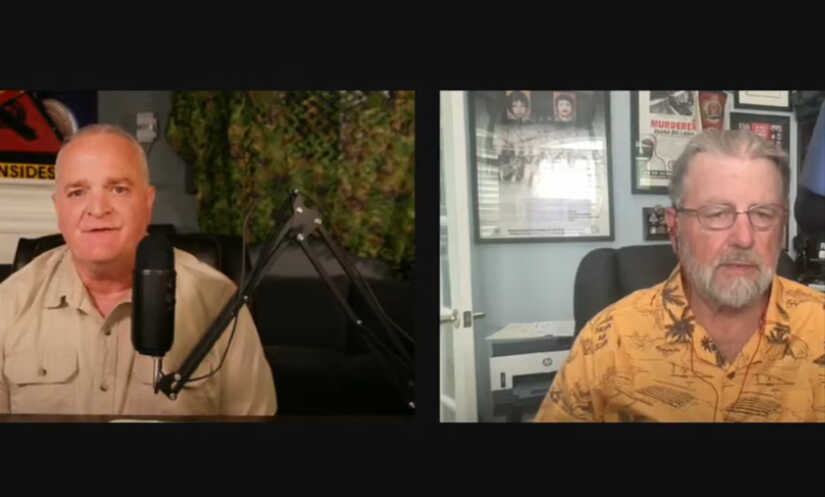
Read the full transcript of former CIA intel analyst Larry Johnson’s interview on Daniel Davis / Deep Dive podcast on “Putin & Witkoff Meet in Moscow”, August 6, 2025.
Witkoff’s Fourth Trip to Russia Yields Mixed Results
DANIEL DAVIS: Steve Witkoff has visited Russia yet again, I think his fourth trip overall. There was some hope that possibly there could be a breakthrough today, ahead of Friday’s August 8th deadline, where Trump is going to make a decision whether he’s going to impose additional tariffs on Russia, secondary sanctions on a lot of other partners to try and compel Russia to go against their own interest with an unconditional ceasefire.
The odds were pretty low against that. But the way things have shaken out today, those odds just about fell off the table and they don’t even hardly exist. We’re going to talk a little bit about how we got to this position here and what the two sides – and we’re talking primarily about Russia and the United States, Trump and Putin – what they have been saying for really for more than a year, and what that may tell us about what’s going to happen on Friday and toward the end of the war.
To do that, we have one of our favorite guests, Larry Johnson, former CIA analyst and of course of “Larry the Shirt Johnson” fame, as well as his own site, sonar21.com where he always has lots of great stuff on there as well. Larry, as always, welcome back.
LARRY JOHNSON: Always, always a pleasure and privilege, Danny.
Initial Optimism Quickly Fades
DANIEL DAVIS: And it really is. I always look forward to these every week. We always have some great guests on here, but this has kind of become one of our favorites. But as we were chatting just briefly before coming on air, this, it’s kind of a weird day and that’s saying a lot because in the Trump world of Trump World 2.0, since January 20th, that’s been kind of the norm.
But let’s just start off because first of all, Witkoff met for three hours with Putin today. So obviously some substantive conversations were going on. So it wasn’t just a kind of a short deal like some of the other meetings related to all this have gone on.
There was initially a readout coming from the Russian side, which was fairly optimistic, I think is Usikov, who is part of the meetings. He said “now the situation is such that our president has complete information, i.e. our signals, signals from President Trump. And Trump has not yet been informed about the results of this meeting. Therefore, I would refrain from making more detailed comments. We’ll see when Witkoff can report back to Trump today. After that, obviously, we’ll be able to supplement my comments with something more substantial.”
Some of the other comments coming out of Russia at the time were “dialogue will prevail” and they thought there was going to be some positive comments, but it hasn’t worked out that way since.
Russian Analyst’s Changing Assessment
DANIEL DAVIS: In fact, let me talk about that one right there. This is Sergei Markov, who is a pro-Russian analyst but also very connected and informed. He wrote this morning after the meeting. He said, “what did Putin and Witkoff discuss? Trump’s concessions. After all, an air truce would be a huge concession on the part of Russia. More on that in just a second. Because Russia makes air attacks an order of magnitude stronger than Ukraine. Therefore there should be concessions to Russia from the other side, the Ukraine regime, Europe, Trump. That is what is being discussed now. Zelensky and Europe do not want to make any concessions. More on that later too. Trump therefore must concede, that is to lift sanctions against Russia. This is what Putin and Witkoff discussed for three hours.”
Then three hours after posting that, Markov came back and it’s kind of like, whoa, hang on. “Trump just imposed sanctions, 25% tariffs against India for the purchase of Russian oil. Not 100%, he noted, not 100%, which is completely unreasonable, but a reasonable 25%.” I guess that depends on whose perspective you’re looking at, whether it’s reasonable or not.
“This is Trump slap in the face to India. The likelihood that India will bend to Trump is minimal. I would say non-existent. Russia will not do anything under pressure. Trump’s decree will begin to work in only 21 days. So Trump actually has time to give both Russia and India wiggle room to figure something out. And Trump’s behavior is becoming more and more clearly anti-Russian. Trump is turning into Biden.”
Ouch. That last comment there is one of the worst ones there. But first of all, what do you make of this whirlwind? Because it looks like that and this could be expected, Larry, because I think that Russia has been as consistent as you can get on what their positions are. So they said that they’re happy to receive Witkoff for sure. The expectation was that they were going to do exactly what Markov suggested there. How do you see it?
Russia Maintains Diplomatic Composure
LARRY JOHNSON: Russia is clearly not trying to provoke a confrontation with the United States. They are remaining calm, polite, even a little bit light hearted. As you could see in the greeting when Putin met with Witkoff, he didn’t give him an icy stare. He could have refused to shake hands. But “oh, hey Steve, good to see you, buddy. Getting a lot of frequent flyer miles in there, aren’t you,” sort of that kind of thing.
But I think once the doors are shut, Putin will again patiently explain to Witkoff what the lay of the land is. Remind him that the United States has been taking very provocative actions that threaten a nuclear war, up to and including the fact that Trump has allowed the B61-12 gravity bomb, which is a nuclear bomb. It can be dropped by the F-35. It has allowed that not only in Lakenheath, England, but at least six other bases throughout Europe. And this marks the first reintroduction of U.S. nuclear weapons into Europe since 2008. So I’m sure that came up.
And then the issue of, despite the nice, pleasant back and forth, Putin can’t point to anything tangible that the United States has done to improve relations with Russia. Still hasn’t named an ambassador, still hasn’t returned the consulates that are allowed Russian consulates in the United States to be reopened, in fact, restrict what places a US citizen can go get a visa to go to Russia, as I know full well firsthand.
DANIEL DAVIS: Yeah.
LARRY JOHNSON: They haven’t returned the property that was seized under Obama. They haven’t freed the assets that were seized, and they continue to provide weapons and intelligence to Ukraine. So Putin, I think Putin probably again, politely reminded him. So we’ve got to see some tangible movement on your part because Putin’s in the driver’s seat despite all these claims in the west that he’s running into trouble. He’s not there.
Russian Military Momentum Accelerating
LARRY JOHNSON: The pace of military advance by the Russian forces, it’s like accelerating every day, every week, it’s going faster and faster, and at this pace, it’s going to break at some point. In fact, the Russian general staff reportedly told Putin that they anticipate two to three months max. They’re going to completely break the defensive line of Ukraine, which I don’t think is – if that report’s accurate, I wouldn’t surprise me because that appears to be what we’re seeing.
DANIEL DAVIS: Yeah, I was going to say that’s, I mean, just without hearing anybody’s statement, I’ve been surprised it hasn’t happened yet. But you do see the pace, especially around Pokrovsk, Konstantinivka, even up in the Kupiansk area, where now they’re actually into the city itself in the north. So things just seem to be falling apart at a rapid pace.
The Air War Concession Proposal
DANIEL DAVIS: I said when I read that Markov statement a minute ago about the air war concession that Russia apparently, according to Markov, the day before, he said that Russia is considering giving Trump a partial victory by saying, “hey, we would concede to an air ceasefire, no more drone and missile attacks for some period of time while we work on other parts of the negotiation.”
Because apparently that’s one that would be both beneficial to Ukraine and Russia. That because Ukraine has had some success in recent days striking some really important targets inside of Russia and hitting them with drones, oil infrastructure, et cetera. Russia has returned the favor overnight, in fact, hit some really big ones in the Odessa area.
So they said we might be willing to consider that if it was going to prevent this slapping out of sanctions on Friday. That’s what apparently was also discussed in there. But now then, one wonders, is that already being turned on its head by this issue with India? Because there were threats that that was going to be put on India on Friday along with Brazil and China and some others if Russia hadn’t agreed to this deal. So this meeting today was supposed to be the last chance, I guess, to avoid that. But then now, hours later, hours after that meeting, maybe not even full hours, Trump announces that there’s going to be a 25% additional tariff levied on India.
LARRY JOHNSON: India.
India’s Strong Response to U.S. Tariffs
DANIEL DAVIS: India was not happy with that. In fact, they immediately responded. This is the official statement from the government of India: “The United States has in recent days targeted India’s oil imports from Russia. We have already made clear our position on these issues, including the fact that our imports are based on market factors and done with the overall objective of ensuring the energy security of 1.4 billion people of India. It is therefore extremely unfortunate that the US should choose to impose additional tariffs on India for actions that several other countries are also taking in their own national interest. We reiterate that these actions are unfair, unjustified, and unreasonable. India will take all actions necessary to protect its national interest.”
Additional information has come out just today from the Ministry of Foreign affairs where they’re really upset about this. And the Ministry called out the EU and the US saying it is revealing that the very nations criticizing India are themselves indulging in trade with Russia. “Unlike our case, our trade is not even such. Trade is not even a vital national compulsion for them.”
The EU’s – and this is part of the story here from CNBC – the EU’s bilateral trade with Russia stood at 67.5 billion euros in 2024, and its service sector in 2023 was 17.2 billion euros. Yet I haven’t seen any indication that Trump is going to bring any kind of sanctions on Europe.
And that was one of the things we talked about when Trump first made this threat on the first, the 50 day and then the 10 day is because, wait a minute, there’s other nations that are buying in Europe and are you going to put tariffs on them? So how can Trump, I don’t even know if you say thread this needle. How can he put this big impact, these sanctions on top of the 25% that’s already there, and that’s not even been worked out yet, and then not do anything to the Europeans?
Trump’s “Kabuki Theater” Performance
LARRY JOHNSON: He’s just doing what I call kabuki theater, performance art. You know, instead of stripping naked and having a suit painted on him to make it look like he’s wearing clothes, he’s doing this kind of stuff.
Because, look, with India, India makes, is this is a sole source of some critical pharmaceuticals and vitamins supplements in the United States that we don’t have an alternative for. India said, “fine, okay, you do that. Sorry, there’s a problem with the supply chain. You’re going to be cut off” the same way that China said, “oh, okay, those rare earth minerals, those processed rare earth minerals, you’re not getting those magnets. You’re not getting those.” Trump backed off. He abandoned, pushed it back. “Oh, we’ll wait another 90 days.” Yeah, three months.
This is unnecessarily picking a fight. And again, this is one more illustration. If he’s serious about reaching an accommodation with Russia to really bring it into the war, then don’t go punishing Russia’s partners. But Trump’s doing the exact opposite.
The BRICS Alternative Financial System
LARRY JOHNSON: And I really think this has more to do with the growing realization on the part of Scott Bessent, the Secretary of Treasury, and others around Trump about how important BRICS is because it is genuinely creating an alternative financial market. So some of the tariffs that were imposed, particularly on Brazil, Brazil, like coffee, for example. Well, Brazil turned around and said, “okay, fine,” they just cut a new coffee deal with China. China’s, “oh, we’ll buy your coffee.”
And so here’s the United States said, “okay, we’ll go for Honduras or Colombian coffee,” I guess. But it is a reminder that Trump and his team, they’re not thinking strategically at all. They are very much in reactive mode. So Witkoff’s going to come back and say, “yeah, this is what Putin said.” And but Trump, instead of waiting to hear from Witkoff before taking these actions against India, moved it up a day. It’s insane. So that’s why I say I really think there’s something mentally wrong with Trump.
The Timing Question
DANIEL DAVIS: Well, and that’s kind of what I was kind of getting towards, I guess, is because, I mean, he went from 50 days to 10 days, and then now before the expiration of that, which by his own determination was Friday, now he’s done it today. So what – probably a silly question to ask, but why would he do it today instead of on Friday?
Trump’s Erratic Behavior and Mental State
LARRY JOHNSON: Well, then Friday, he may be, you know, like an Alzheimer’s patient. He’ll say, “Okay, let’s do this,” and say, “Well, excuse me, Mr. President, you already did it.” “Oh, I did. When did I do that?” So, or he’ll reverse it again.
I don’t understand the logic of deliberately antagonizing other countries that you want at some point to cooperate with you and work with you instead. What is happening? And we’ve seen it in Brazil. If you would have asked me a year ago, I would have said Brazil was the weak sister in BRICS, the one that could most easily be peeled off from BRICS to work with the United States. Today? No, just the opposite.
This is because they are enraged, furious at this bullying behavior by Trump. But it just reminds them of US imperialism across the board. And so now they’re going out of their way to seek deals with other countries and make sure they don’t deal with dollars. And maybe this is why Trump’s team is thinking that they can bully their way through this and coerce everybody. “You’re going to play by our rules.” But I think it’s having just the opposite effect.
DANIEL DAVIS: Yeah, it does. And that’s why I don’t think, not in any jest, that it is time to consider: is there something mentally off about President Trump? I mean, some of his actions are just – they defy explanation because they’re so erratic and just kind of all over the map and don’t seem to be tied to anything, even by Trump’s standards.
LARRY JOHNSON: Right.
DANIEL DAVIS: I was looking back at some of the things on an unrelated topic yesterday about Trump from his first term, and it’s a stark comparison between him and his mental agility from Trump 1.0 to the current Trump 2.0 so far. And I think people should be paying attention to that.
Confabulation and Cognitive Decline
LARRY JOHNSON: Well, there’s a term: confabulation. Confabulation means when somebody’s telling you a lie, but they genuinely believe it is true. And we’ve seen Trump engaged in a number of confabulations, and confabulation is associated with early onset dementia.
So, you know, what’s an example? Trump: “Oh, yeah, I told Xi and Putin that I was going to bomb the hell out of their cities if they…” And he was saying that last year when he hadn’t even had any conversation with them. So he was confabulating because I actually genuinely believe he thought that was true.
DANIEL DAVIS: Is that also – and maybe it’s not the confabulation, but his couple of days ago, where he’s emphatically saying, “I brought down the price of prescription drugs a thousand percent, 1500%, 600%.” Obviously, that doesn’t even exist. You can’t do that. But he said it more than one occasion and with emphasis. What do you make of that?
LARRY JOHNSON: Yeah, no, I think again, it’s one more symptom of this disease, if you will, or his claim: “Hey, man, I’ve settled six wars. I brought peace into six different wars.” And the Indians and Pakistanis are going, “What? You weren’t even at the table.”
You know, the same with – what was the other one? Serbia he brought up, or Egypt and Ethiopia, and everyone’s going, “What are they doing? Is there a problem?” But I don’t think he’s lying in terms of he knows that what he’s saying is not true. In his mind, it is true.
Trump’s Shifting Promises on Ukraine
DANIEL DAVIS: Well, all right, well, let’s take a look at that because I want to get a kind of a running start of how we got to the Witkoff meeting today. And we’re going to look at the shifting positions of Donald Trump and the anchored positions on the Russian side.
So, first of all, let’s start with Trump. This is Trump with the British media in 2023 talking about what he was going to do with the Russia-Ukraine war.
LARRY JOHNSON: “If I were president and I say this, I will end that war in one day. It’ll take 24 hours. I know Zelensky well, I know Putin well. I would get that ended in a period of – you can break that deal 100%. It would be easy. That deal would be easy. A lot of it has to do with the money, a lot of it has to do with the military that we’re giving. But I would get that deal done within 24 hours. That war has to be stopped. That war is a disaster.”
DANIEL DAVIS: So 24 hours came and went. Nothing happened. 100 days came and went. And Cheryl Atkinson asked Trump, “Hey, you said this before the election. What gives?” Now as a candidate:
LARRY JOHNSON: “You said you would have this war settled in 24 hours.”
“Well, I was being a little bit sarcastic when I said that I would. What I really mean is I’d like to get it settled and I think I’ll be successful.”
“What’s the plan if Putin doesn’t agree to a ceasefire?”
“Bad news for this world because so many people are dying. But I think he’s going to agree. I really do. I think I know him pretty well, and I think he’s going to agree.”
DANIEL DAVIS: Okay. That whole sarcasm thing – that’s why I put that particular video from 2023. There was no sarcasm whatsoever in there. He was very specific about why he was going to be able to get it done, and now he hasn’t gotten it done.
And then when she pressed him on what would happen if there’s no ceasefire – and there hasn’t been and there’s no chance there’s going to be one – he has no answer. And I think that’s why you have all these tariffs getting ready to go, because it’s something. I mean, how do you read that?
Russia’s Unchanging Position
LARRY JOHNSON: Yeah, he thought he could do it through power, personality, you know, with his personal relationship. “They like me, they’ll do what I want.” He doesn’t understand that Russia’s got very clear – they’ve made their position quite explicit since June of 2024, when Putin went before the Foreign Ministry in Russia, spoke to the senior leaders, to Lavrov, Ryabkov and others, and said, “Here’s our position.”
And it really is pretty simple because they keep talking about the root causes. Ultimately, NATO has to go away from Russia’s borders. That’s number one. And to that end, the territory that Russia now occupies and that have voted to be part of Russia – the four oblasts: Zaporizhzhia, Luhansk, Donetsk and Kherson – that they are recognized internationally and accepted as part of Russia. That NATO gets completely out of Ukraine, and that means an end to all US and NATO military support for Ukraine. That there are new elections in Ukraine.
And Putin’s not – there’s nothing that Witkoff can say or offer him that Putin will say, “Oh, okay, we’ll forget about those things we put on the table.” No, their demands going forward are going to become more expansive. They’re not going to contract because right now they’ve got boots on the ground and they’ve captured territory in Dnipropetrovsk. They will then claim that.
This is because Putin said wherever we got boots on the ground, that territory is ours. I don’t think that’s just a negotiating position on his part. I think he’s dead serious. But from Russia’s standpoint, what they’re seeing take place in the west is growing belligerence and tangible actions that point to a nuclear war with Russia. They can’t pretend that that’s not happening.
The fact that when Trump redeployed those B61-12 gravity bombs throughout Europe just two weeks ago, three weeks ago now – we’d withdrawn those in 2008 or other nuclear weapons – now we’re actually moving nuclear weapons back to Europe. The Russians can’t sit there and go, “Oh, that’s no big deal.” Are you kidding? This is a huge deal.
But again, I’m struck with the demeanor of Putin with Witkoff. It was not angry, it was friendly, it was open. But I’m sure once they’re behind closed doors, he’s very direct with him and not going to mince words.
Putin’s June 2024 Terms
DANIEL DAVIS: Well, and you mentioned the June 2024 statement by Putin, and I want to show that here because that’s also part of the pattern of the unchanging side on the Russian position here. Here is where Putin said his terms for an end of the war:
LARRY JOHNSON: “The essence of our proposal is not some kind of temporary truce or suspension of fire as, for example, the west wants. This is not about freezing the conflict, but about its final completion. And I will say again, as soon as Kyiv agrees to a similar course of events proposed today, agrees to the complete withdrawal of its troops from the DPR and LPR in the Zaporizhzhia and Kherson regions and really begins this process, we are ready to begin negotiations without delaying them. I repeat, this is our principal position: neutral, non-aligned, nuclear-free status of Ukraine, its demilitarization and denazification.”
DANIEL DAVIS: So those are some pretty high standards, which of course, no one in the west even considered for a second. But I just got to ask, man, how many hundreds of thousands of Ukrainian men who were alive on the day he said that aren’t today, and how many more maybe in the future if we continue to ignore those?
The Human Cost of Continued War
LARRY JOHNSON: I think you’re looking at a minimum of a half a million casualties since that day, which is an enormous loss. Right now, Russia is reporting 1,200 casualties on the Ukrainian side every day. Minimum of 1,200, sometimes in excess of 2,000.
Well, you do the math. If it’s just 1,200, 365 days a year, you’re up around 400,000. So the key is that there’s nothing that Ukraine can now do militarily that can change the course of the events of the war. They don’t have a magical number of people that they can suddenly muster up. Even if they are able to recruit 200,000 people in a month, where are you going to train them? Because Russia’s already demonstrated they can hit any training facility in Ukraine anytime they want.
The weapons supply – Ukraine can’t produce what it needs and neither can the United States or Europe. And I mean, we’re not just talking one class of weapons, we’re talking across the board.
DANIEL DAVIS: Mark Rutte himself quantified that maybe two weeks ago. He said that Russia is producing the same, or actually more in three months than all of the west combined in a year of the key ammunition categories. And I mean that, as you’ve said many times, it’s years to ramp that up once a decision has been made and resources found. And none of those things have happened yet. So that is just a status quo situation which will continue to deteriorate on the Ukraine side.
And yet we don’t take the logical, rational action. So that was what Putin said in June of 2024. This is what he said in March of this year: “We agree with the propositions to stop hostilities, but we proceed from the fact that such ceasefire should be such that would lead to a permanent peace and remove the initial original causes of the crisis.”
So there’s virtually the same thing he said. The occasion on that was when Trump first said, “I want a 30-day unconditional ceasefire.” And Putin said, “I mean, we’ll talk about it, I guess, but there has to be some pretty big conditions on it.” But he always circles back around to the same conditions he said, and those were repeated in the July 3rd phone call between Putin and Trump. He didn’t change any of them, just clarified them.
And so I can’t imagine that the conversation just hours ago between Witkoff and Putin were probably another recitation of the same statement. What do you think?
Russia’s Military Capabilities and Escalation Potential
LARRY JOHNSON: No, exactly. If Putin backed away from that, if he said, “Okay, yeah, we’ll forget about denazification, we’ll forget about demilitarization,” I think he would be removed from office through a military coup, because the General Staff is certainly not going to put up with that for a minute.
What people don’t understand – and I know that Andrei Martyanov has been pretty good about trying to explain this to people – the difference between a special military operation and war is how society is mobilized to attack and to respond to the threat. Right now, Russian society is not mobilized for war. The industrial sector has received a higher priority, but they’ve stayed sort of quite level, normal life as always.
If Russia shifted into a war footing, that means there would be a clampdown on news media. There would be definite – probably 2 million reserves would immediately be called up. There would be conscription. They would go all out.
Now, one of the interesting things is it was just last week that Putin announced, “Hey, the Oreshnik is now in full production,” which means they’ve got more than just one waiting behind. And that gives them a new option in between having to use a nuke or just plain conventional force.
Russian Military Capabilities and NATO’s Response
DANIEL DAVIS: Do you have any sense at all? I mean, it’s obviously not something they’re going to publicly announce, but do you have any sense at all how many production Oreshnik missiles they can produce in any month and how many. What is their current stockpile?
LARRY JOHNSON: I don’t know. I would just be guessing, but I would think they’re certainly capable of building three or four per month. And so since we’re going on 10 months, so probably they would have 40 somewhere in that vicinity, maybe more.
But what it demonstrated it was capable of and the fact that the west has zero defense against it puts them in the driver’s seat. They can threaten something now that the west can’t defend against. The West’s only answer would be a nuke.
And Dmitry Medvedev tried to remind Trump, the Russians do have this thing called the “dead hand.” Even if you decapitate us, even if you hit us with the first strike and there’s nobody left alive in Moscow, we’ve still got this fail safe system that will launch everything we have at you and you too will cease to exist.
The Russians don’t want to go down that road. But what Putin said, the root cause of this is the expansion of NATO to the east. And even though Ukraine is not an official member of NATO, the west has treated Ukraine as a de facto member of NATO since 1997.
This includes the fact that they use the Ukrainian military base Yavariv, which is in western Ukraine near the Polish border. That’s been a de facto NATO headquarters. And NATO, actually just at the start of the special military operation, you could still go online and see NATO flags and banners and U.S. Flag at Yavariv. They were quite proud of it. Now they try to cover that up, hide and pretend that’s not there.
You’ve got that activity and then on top of it, when NATO does annual military exercises, Ukraine has been the site of more NATO and US military exercises than all of the other members of NATO, except for six. Think of that. So the 20, 24 plus members of NATO have not had as many military exercises where troops come into your country and they carry out a variety of tasks. That’s Ukraine.
And that’s what Russia is saying, “Okay, this is going to stop. You’re going to stop providing NATO training to these people. You’re going to stop bringing your NATO personnel in. You’re going to get out.”
Orban’s Criticism of Trump
DANIEL DAVIS: Well, yeah, and now then we see what we see going on the ground. I mean, with the tactical situation continue to deteriorate, as you’ve talked about, but we also see some deterioration on the Western side on the diplomatic and political fronts, because one of Trump’s biggest supporters from before the election and was really enthusiastic afterwards was Viktor Orban.
And he has continued to sing Trump’s praises. But today he’s saying something that’s a little bit different. So that’s pretty bold for him to say Trump’s just not strong enough. How do you interpret that statement there? Because that’s the first one I’ve seen where he’s pretty much called Trump straight out.
LARRY JOHNSON: Yeah, he was. And his message was he thought that Trump was going to be able to corral the Europeans and to said, “Okay, yeah, we’re going to bring an end to this.” Instead he says he’s acknowledging that Trump is completely ineffectual or ineffective in getting the Germans, French and UK to back off of the rhetoric and stop with their threats.
Now that does run a little counter to the narrative that when Trump was in Scotland, Starmer was coming up to kiss his ring, Macron was coming up to kiss his ring, that they’re all genuflecting to Trump. But I guess to me it’s not clear that Trump has actually made a demand of Europe with respect to Ukraine other than saying, “Hey, we’re not going to pay for it anymore. You want to do it, you pay, you buy the weapons from us and then you can give them to Ukraine.” So it’s just a financial deal for him.
Trump’s Ineffective Diplomacy
DANIEL DAVIS: So yeah, I think the most he got out of that Scotland visit was more business for his personal golf course than any kind of benefit for the United States or a change on the other side. And I think a lot of this genuflecting and ring kissing is just the Western leaders figuring out they know how to manipulate Trump to do what they want. So they’ll make it look like they’re kowtowing to him.
But then you look at the policies and I mean we got to go back to what that Sergei Markov said just a couple of hours ago on Telegram. Trump is becoming Biden because he didn’t end anything. And now he just seems to be going down the same path that Biden did, both with sanctions, giving stuff to Ukraine, talking about increasing more aid. I mean, can you argue with that?
LARRY JOHNSON: No. And we’ll find out. Supposedly at 4:30 today, Trump is supposed to provide a speech and I’m presuming by then he will have been on the phone with Witkoff, he would have got fully briefed on what was said and then they will come up with a response.
But what is so odd is that instead of him adhering even to his Friday deadline, he bumped it up two days. And we’ve not seen any comment out of the White House indicating some conciliation, some willingness to accommodate Russia’s demands.
Trump is surrounded with all of these neocons and people like Jack Keane and General Kellogg that think all we have to do is put those submarines out there. That’ll scare Putin.
DANIEL DAVIS: Yeah, we did actually have, we showed Jack Keane’s comments on that very thing, claiming that that was going to be some impetus for pucker factor going up for Putin. And the Russians just said there’s submarines in the water every day. So I don’t really know what this means. It sure isn’t scaring us into anything.
LARRY JOHNSON: Yeah, all Trump is doing with this behavior is reinforcing the views of the hardliners in the Kremlin, because Russia is not a monolith. There are some real hardliners with people like Medvedev that don’t want to give the United States the benefit of the doubt at all. And all this does is it gives them more ammunition to make their case.
And it actually narrows Putin’s options for trying to find a diplomatic or peaceful solution to this. So I think it’s tipping towards more dangerous, not less dangerous.
Ukraine’s Deteriorating Military Situation
DANIEL DAVIS: And let me actually just show real quick here on the screen. You mentioned the tactical situation here a minute ago. Just look, we’ve been covering this about every two or three days. And you see that now there is a firm Russian position all the way into the heart of the city of Pokrovsk and then up here on the supply route up around Rodinska. Russia has also now made nearly up into the outskirts of here.
They have expanded the gray zone up north of this route here. So now then this route here is under full fire control. And then you swing over here to the Konstantinivka side and there’s been additional area turn from the gray zone now into full Russian control here. And then when you come over into the northern part, there’s been additional expansions here. So Konstantinovka is becoming more and more troubled.
But then when you take a look at the manpower issue, you have this report from Ukraine just a couple of days ago that says there’s an alarm now. They have a lower casualty rate that they claim. They say Ukraine’s military is suffering daily casualties of 300 dead and 750 injured and about 500 deserters every single day.
And Maria Berlinska said she was concerned that Russian forces could be in Kiev by winter if we don’t change something. And there’s been others who’ve made that same warning.
So if there’s this idea that, “Well, I’ll just try this issue of more sanctions” and even though by Trump’s own admission, even he said this a couple of days ago, probably won’t make any difference, probably won’t force Russia to change anything, but we’ll see. Well, here’s the problem. The clock is ticking.
You mentioned at the outset that there is commentary that reports that the Russian general staff thinks that the Ukraine army could collapse within three months. That’s mirrored by this one here, three to four months before there could be a break. And you can’t just keep going the status quo.
If Trump doesn’t take proactive measures to bring the war to an end under even the ugly conditions that Putin laid out earlier this year, then the specter is then you’ll just get a military victory by the Russians outright and they’ll simply be terms of surrender. How do you see that playing out?
Ukraine’s Logistical Collapse
LARRY JOHNSON: Well, note in her casualty figures, they almost match what the Russians are reporting. So I think she’s a rare bird there in Ukraine, one of the few honest reporters about what’s going on.
Through your own experience, no matter how well trained the troops are, if the logistics aren’t in place to sustain them in the field, the training and capability falls apart pretty rapidly. And if you’ve watched what Russia’s been targeting, particularly over the last three weeks, they’ve really been going hard after the lines of communication.
Because once they’re cut off or you’ve got a limited supply of ammunition, then you’ve run through it, you don’t have anything else to load into your rifle or into your howitzer, that’s problematic. Getting food, getting resupplied with water, those are legitimate issues. And accompanying that then is if you get wounded, can you be extracted and get some reasonable hope that you’re going to get medical treatment and survive?
And so all of that weighs in on this. And I think Russia, it’s more like the coiling of an anaconda, just compressing, compressing, compressing, compressing. And at some point Ukraine’s going to break and it’s going to come quickly.
The Risk of Sudden Collapse
DANIEL DAVIS: Yeah, that’s the big thing. A lot of these things, sometimes they’ve held together for so long, there’s this really unchallenged and unexamined belief that they have stayed together this far and they will always stay together and like it’ll be a linear kind of thing. Well, it took Russia three and a half years to get up to this point here and so another three and a half years. But it doesn’t work like that because there could come a moment where there’s even a mental and a psychological break to where you’re like, “I just can’t do this anymore.”
That article that I put up there, when I read further into it, one of their concerns was that a lot of these guys have been there since the beginning when the original mobilization or volunteers and they’ve never been demobilized and they’re just wiped out emotionally and you just never know when all this is going to conspire together.
But what is your view before we shift gears here on to a different topic? What is your view of what will happen politically for Trump, for Europe, etc, if this, if they continue on with their fiction that this can go on forever, but there is a collapse at some point and the thing just breaks. How will they react to that?
LARRY JOHNSON: Well, you mean how would the Europeans react or how Europeans and Trump?
DANIEL DAVIS: Europeans and Trump.
NATO’s Potential Collapse and Escalation Risks
LARRY JOHNSON: Well, I think it’s going to ultimately threaten the survival of NATO because it will have, NATO will have been proven to be completely ineffective in preventing this outcome.
The danger, though, is Germany, France and England verbally are escalating, being verbally belligerent and there are, we just had the leak the other day or at least the report come out of Russian intelligence that the Brits are preparing some sort of false flag or to start attacking Russian oil tankers.
Any further attacks now on Russia like that, it’s going to escalate. I think we’ll get to a stage where now based upon what Putin has said this week, that if there’s an attack inside Russia either against Russian assets at sea or in places like Moscow and St. Petersburg that cause significant damage, it can be traced to either Germany, France or England. Germany, France or England will then get hit by an Oreshnik missile. They will target the specific military base or factory.
So yeah, the collapse of Ukraine is not going to bring an end to the danger is what I’m saying.
Gaza Occupation and Relocation Plans
DANIEL DAVIS: It could, yeah, there’ll be the potential for it could actually could even get higher or it could finally they could just accept it and move on. We’ll see how that works out.
I want to shift gears in the time we have left here to some other additional information. Apparently yesterday at a cabinet meeting in Israel, Netanyahu pitched an idea that he wants to completely occupy. Now he made the decision to completely occupy the Gaza Strip and apparently the full Knesset will vote on it tomorrow. But he is definitely saying he wants a full occupation right now.
And then we also have Trump at the same time saying that he wants to take over the responsibility to be feeding the Palestinian people. He wants to run that because he said hadn’t been done very well. So he wants to insert the United States actually into that, which is just, I think, just crazy. Why would we want to get involved in something like that? And then why would we want to green light what Netanyahu is doing?
LARRY JOHNSON: Well, probably wants to get involved with this so that we get first dibs on the real estate in Gaza so he and his son in law, Jared Kushner can develop a real estate deal.
DANIEL DAVIS: It could be. I’m sorry, Gary, I just forgot. Would you pull that first article there about the Netanyahu up again? Because there was one part in that article I wanted to get your reaction to, Larry. He’s, Gary’s pulling back up. I changed it up on him. If you roll down there to. I think the third paragraph says that it is. Let’s see.
Yeah. Netanyahu is adopted as a formal war goal. US President Donald Trump’s February plan for the relocation of Gazans to undefined places elsewhere that has been, so it says, has officially adopted a formal war goal is to adopt President Trump’s plan for the relocation of Gaza. That, that’s just kind of a, that should have been the headline, but it’s kind of buried in the article there somewhere. But that, that’s kind of a big deal. Well, how do you view it?
Real Estate Deals and Propaganda Operations
LARRY JOHNSON: Yeah, yeah. Well, it goes along with what Trump said at the outset and with Gerald, you know, Kushner, his son in law involved with financial deals in Israel, multi, you know, multi billion dollar deals. You know, I’m sure he’s saying that, you know, clear out Gaza and going under the guise of humanitarian aid, but they still haven’t solved the problem of where are they going to send these Palestinians. Either they kill them, starve them to death, or find some country that’ll take him. And there’s no other takers in the region so far. Not Jordan, not Egypt.
But I mean, this is, this is so damn cynical and so evil. But we’ve seen, you know, Rupert Murdoch and his company have kicked into full propaganda gear because they’ve sent Fox News, Fox News got to go into Gaza and oh, they’re saying, “oh, it’s not as bad as what we’re being told.” You know, they’re doing the whole propaganda thing and ignoring, you know, there are other videos out there of some other aid workers. You can see bullets skipping off the ground around him that the Israelis are shooting.
But then we got the testimony of Colonel Aguilar and what a terrific officer he is and his courage and he didn’t hesitate to speak. And, you know, he was well schooled in the Geneva Convention and the rules of war. So you could understand that if you had a man like that in charge of your troops, your troops aren’t going to be out engaged with mayhem. You know, they’re going to be, they’re going to conduct themselves in an orderly manner. And that’s, that’s one of the things that his testimony revealed. There’s, there’s no, there’s no good leadership in the Israeli army to speak of. And, and that’s why you get all of these abuses and, and human rights atrocities.
Contradictory Testimonies
DANIEL DAVIS: Yeah, I felt that it was such a sharp, sharp contradiction between what Colonel Aguilar said and what he reported, which we did a show on a couple of days ago and we, we did kind of a deep dive on, on some of the things he said on the Tucker Show. And then right after that, when you had Ambassador what’s his Face, I just went by Huckabee when he went into the Gaza Strip and then he came out after a whopping five hours and said, “yeah, it’s not that bad.” And in fact, if anybody’s at fault, it’s those darn Hamas guys, etc, no blame whatsoever for the Israeli side and just say, “hey now, I’m not saying it’s, there’s not some danger there, whatever.”
I mean, it’s, it’s just horrible because Aguilar categorically said this is an intent to starve people. It is the plan. They put these things all the, the, they changed from 400 what originally was being used to feed people in Gaza down to four, four with three of them in the, all the way to the south so that everybody would have to walk the entire length of the Gaza Strip to get to the food. And so he said this is an intentional plan. And then they’re shooting them, not by accident when they start to go, when they clear them out to go to the, to the food aid anyway.
And then you have the ambassadors of the United States saying it’s Hamas’s fault and not mentioning any of those things. And that is, I think, going to be a long term shame on this country, however this works out.
LARRY JOHNSON: Yeah, no, exactly right. It’s because none of these people are getting shot or carrying firearms. You know, the, the rule, the rule of thumb is if you’re going to shoot somebody, they need to pose an immediate threat to your life and limb that you can and that you have no other option but to shoot to kill.
Well, the, the, the Israelis shoot for, shoot for the pleasure of it because they treat these people like they’re insects, like there’s some lower life form that can just easily be snuffed out. And fortunately there’s still some in Israel with a conscience. And the unfortunate part about them is they’re killing themselves or they’re suffering from PTSD for the horrors that they’re inflicting upon these people.
International Response and Historical Parallels
DANIEL DAVIS: Yeah, we’ve actually had a couple of prime ministers, Ehuda Olmert, I think was one, and I can’t recall the second one, but they’ve both been pretty outspoken that this is wrong, this is not going to help Israel, and it’s just morally out of bounds, etc. So there are at least some voices, but unfortunately the ones that matter, both in Washington and in Jerusalem are still where they are. And I guess it’s going to take some kind of concerted effort from people around the world to finally stand up and take some action or this nightmare is just going to continue on.
And I just, I mean, I, I, I couldn’t imagine, I thought, I, I remember, Larry, I was thinking about this just a couple of days ago when, when this war first started off, I said, I mean, I think as early as November of 2023, I said, “Netanyahu has set his nation on a course to try and provide security for Israel that cannot succeed.” And I said, “unless you literally wipe out everybody.” And of course they’re not going to do that. This can never succeed and it will just cause problems.
Well, since then I’ve come to realize, holy crap, he, he could actually envision wiping everyone out. And, and you look at what they’re methodically doing and it’s, I just cannot fathom, you know, “never again” after World War II. And then now, then it’s happening again with our of assistance. It’s just hard for me to get my head around that.
LARRY JOHNSON: Yeah, yeah, no, we’ve, we’re in the process of losing our soul. And, you know, this, that’s why, you know, seeing these efforts to try to affect public opinion because the images of these starving children, they are penetrating social media. People, people are starting to react and it’s, it is poisoning the well for any sort of good feelings or good relations with Israel.
And, you know, I, I still think there’s still a lot that can be done. Countries like India, Russia, China, they need to cut, they need to break diplomatic relations with Israel, they need to cut off economic ties with Israel, shut down, no more trade relations. If Israel is going to persist with this other countries, if the country started doing that, Israel would be compelled to stop. But, but right now, everyone’s enabling them by doing nothing.
Information Warfare and Historical Context
DANIEL DAVIS: And you know that from Hamas’s perspective, Huckabee was blaming Hamas. Well, Hamas did themselves no favors and was one of the worst things they could possibly have done. When they share these video images of some of these hostages, that they are basically starving as well. And from the one hand, you can understand, you know, from their perspective, well, why should we give them a lot of food when our own people aren’t? But to think that they’re going to cause some kind of reaction that’s going to get anything for their side.
They just gave a huge information, Operation Victory to Israel because they have just been blasting that everywhere. And that’s all anyone’s talking about. They. And so now a lot of people are going, “well, look, the Hamas side, they are animals. Look what they’re doing to the hostages,” et cetera. And you can argue the fundamentals of it, but the imagery is working against the Palestinian people. How do you see that?
LARRY JOHNSON: Well, yeah, but, you know, again, with this whole information operation, all it’s designed is to create a narrative to justify our own war crimes. And so we say, “see what they’re doing? So we’re okay with what we’re doing?” Well, no, we’re not. So this isn’t, you know, what, what Hamas is doing is candidly what my ancestors did in 1776 to get rid of the Brits, you know, fighting a foreign occupier.
And so, you know, some of, some of those people participating in that revolution on the U.S, on the what we now call the US Side, you know, they committed some atrocities too. You know, they, they weren’t all, you know, armed with righteousness and the light shining upon them. But, you know, what, what has brought this about has been the illegal occupation of a people and a subjugation of a people. And when they finally fight back, then we want to attack and destroy them for fighting back.
And, you know, when you, when you look the evidence of what Israel has done to these people. It’s, you know, it’s on par with some of the most heinous acts in history against an ethnic minority.
DANIEL DAVIS: Yeah, I mean, there’s, there’s, it’s just black and white. It’s just there for anybody to see this. Unfortunately, there’s a lot of people seem to be concerned by that. But anyway, we’ll continue to follow this and we’ll certainly look to see what President Trump says this afternoon when he apparently makes the public comments on issue here. And I’m sure we’ll be bringing you that. So in any case, thanks for coming on today, Larry. Always a pleasure to have you on.
LARRY JOHNSON: Thanks for having me. I’ll be back.
DANIEL DAVIS: Yes, you will. And also a reminder, hey, if you have any friends that like to get their information via pipe podcast instead of on video, be sure and share with them that we’re actually out there right now. You can go to Apple, Spotify, Podcast Addict, really anywhere you get your podcast, type in Daniel Davis Deep Dive and you’ll find us there. And be sure and share that with your friends because I’m sure they’ll be grateful for it and so will we. Thank you very much.
We’ll look forward to seeing you this afternoon on Daniel Davis Deep Dive. We have Jennifer Kavanaugh back again with us today and we’re going to be looking at an evolving situation in the the Indo Pacific with Taiwan and China. A lot of, a lot of angst going on over there and a lot of people concerned that there may be a conflict about ready to blow up there, too. And we’re going to look at what can we do to keep that lid on and keep that cauldron from blowing up to this afternoon at 3:00pm with Jennifer Kavanaugh. We’ll see you then on the Daniel Davis Deep Dive.
Related Posts
- Transcript: Vice President JD Vance Remarks At TPUSA’s AmericaFest 2025
- AmericaFest 2025: Tucker Carlson on America First Movement (Transcript)
- Prof. John Mearsheimer: Unintended Consequences of a Meaningless War (Transcript)
- “It’s Really Not About Drugs” – Max Blumenthal on Mario Nawfal Podcast (Transcript)
- Erika Kirk’s Interview on Honestly with Bari Weiss (Transcript)