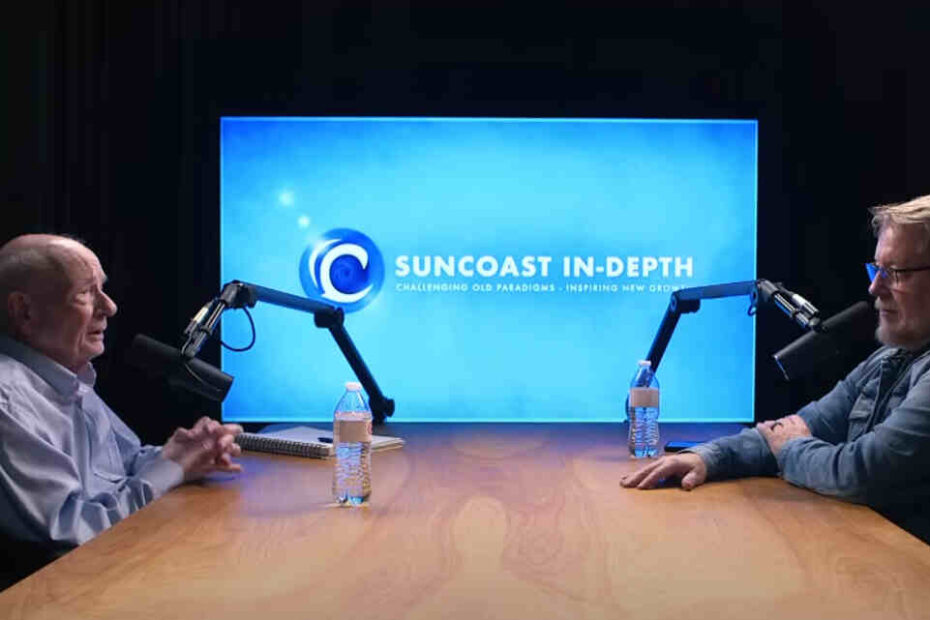
Read the full transcript of psychiatrist and philosopher Dr. Raymond Moody’s interview on Suncoast In-Depth Podcast with host pastor Brett Watson, on “Life After Death?”, March 27, 2024.
Introduction to Dr. Raymond Moody
BRETT WATSON: Welcome to Suncoast In-Depth Podcast. My name is Brett Watson and today I am joined by a very special guest and a new friend, Dr. Raymond Moody. Dr. Moody is an MD psychiatrist. He is a philosopher. You have your PhD in philosophy, specifically Greek philosophy.
RAYMOND MOODY: Well, Greek philosophy and analytic philosophy.
BRETT WATSON: Okay.
RAYMOND MOODY: Yeah, and everything. I just love philosophy.
BRETT WATSON: Yeah, yeah. And you said you did a residency in forensic psychology as well.
From Forensic Psychiatry to Comedy
RAYMOND MOODY: Yeah, I was. You know, forensic psychiatry was my favorite thing to do. I just had a situation in life in 1976 when I graduated from medical school. My comedy career was reaching its height and I’d been doing this little stick for years and years and it was getting more and more invitations. So I had to choose whether to become a comedian or a forensic psychiatrist. So I chose murder over laughter.
BRETT WATSON: I guess it’s not a choice too many people have to make, I got to say.
RAYMOND MOODY: It’s like the forensic psychiatry enables you to see some of the weirdest phenomena in the universe. And it’s like people who chop their mother and father up in a meat grinder and stuff. And then you quickly realize that the weirdest ones you deal with are the people who were in the sane state of mind when they committed murder. That’s harder to figure than the people who did it because of delusions.
BRETT WATSON: The sane ones were more creative.
RAYMOND MOODY: Yeah, were just more hard to figure.
BRETT WATSON: That’s how they start out, all of them.
RAYMOND MOODY: That’s how I can figure this out. And they are wrong.
Near-Death Experiences and Life After Life
BRETT WATSON: So that’s fascinating. You’ve had a lot of really wild experiences, but you’re best known for your research into near-death experiences, a term you actually coined, if I’m not mistaken. Your best-selling book was “Life After Life” that was published in ’75. Yeah. I remember my friend Kevin O’Hara. You’ve met him. He said, “I read that book when I was 15 years old.” So I recently read “Proof of the Afterlife” and enjoyed it very much.
RAYMOND MOODY: Thank you.
BRETT WATSON: Yeah, it was great. In fact, because of your—I don’t know if you knew this, but in the Audible version of the book at the end, there’s an excerpt from Rajiv’s and that’s how I got turned onto that one.
So I wanted to talk with you about some of the aspects of “Proof of the Afterlife,” because what I noticed there is that this is—well, I guess the title kind of gives it away. You’re looking at the more objective evidence that comes from these different experiences. And there’s more emphasis, it seems, on what you’re calling SDEs, shared death experiences, because of the more objective nature of it.
So tell us what you mean when you talk about shared death experience. I think a lot of people have the impression that it’s about, “Oh, my friend died and I was there and I experienced his death.” But it’s not just that.
Understanding Shared Death Experiences
RAYMOND MOODY: Well, it’s a very complex thing, Brett, and basically it’s—I was a professor of logic, all right? I first became known for these near-death experiences when I was a professor of philosophy at East Carolina University, because I’d known about it when I was a graduate student, undergraduate student, then I began to talk to people.
And when I was a professor at East Carolina was when I first became known publicly for this subject, because every little civic club in town needs a speaker everywhere. So I was it. And so I became known as the guy who studies this. And ever since then, Brett, there’s been a steady stream of very likable people come up to me and they ask, “Dr. Moody, can we have a proof of life after death?”
And I am embarrassed to say that for years I would compute that. I would go back to logic and I would think, well, Bertrand Russell and Alfred North Whitehead and their Principia, you know, and that Wittgenstein talks about the difficulties of proof. And I mean, and then people would just kind of drift away. And I never really got at what they were getting at.
And I finally kind of realized a few years ago that what people are asking me when they ask that question is not anything to do about logic, as I would understand as a professional logician, but rather that they are asking a simple question and they want to know, “Is it a rational thing to expect and anticipate that when we die that there is a further extension?”
And I say absolutely it is. And I also will say that the reason I’m confident in saying that is that I know that the essential logical problems have been solved. Classically, the logical difficulties with the question of an afterlife were formulated by the great skeptic David Hume, who pointed out that it’s incommensurate with the logic we use, but that has now been solved. There’s a way to think about this that is perfectly rational and logical.
And so I can now say from what I know personally that, yeah, there is an afterlife, folks, and I am a skeptic in the real sense. You know, the skeptical movement was formulated by Pyrrho, who was a Greek philosopher around the, just shortly after the death of Aristotle. And he was the person who formulated skepticism. And what that is, is the skeptical movement. They knew logic very well, so they ask every question, they really bear down, but in the end they refrain from drawing a conclusion. That’s what it means.
So when somebody tells you, “Oh, I’m a skeptic about these near-death experiences, I think it’s just the chemistry of the brain,” what that person is saying is, “I’m a person who doesn’t draw conclusions and my conclusion is such and such.” But as a skeptic, I realize the difficulty in drawing a conclusion, but I just give up.
The Case of Dr. Anthony Cicoria
You know, I just have so many medical friends that I would absolutely trust. For example, I am an addicted walker. I mean, I ran 10 to 14 miles every day in medical school. Okay, it’s not a virtue. I got to do it, all right. Now, I hate even to say this, but if, horror of horrors, something were to happen to my foot, okay, what would I do?
Well, I have this friend and his name is Anthony Cicoria. And Anthony is a PhD in physiology, an MD and a professor of orthopedic surgery at NYU. Very distinguished. Well, in 1994, Tony got hit in the head by a bolt of lightning, had a cardiac arrest, was resuscitated on the scene, but in the interim had an out-of-body experience.
Went all around this resort center where his family was having a family reunion, was able to tell everybody what they were doing while he was there. He said, “We went into this hyperreal environment.” He said, “This is not like a dream, this is more real than real.”
And then after this, Tony, who had never any interest in music, suddenly starts developing an interest in the piano, had this recurrent dream in which he was playing the same piece of music on a piano on a concert stage, learned how to transcribe music, to transcribe the piece, and learned how to play the piano. And now, in addition to being a renowned orthopedic surgeon, is also a concert pianist.
Now, in ordinary consensual reality, Brett, that doesn’t happen, right? Now, would I take my foot to Tony? Yes. Now, how can I trust my colleague’s medical judgment entirely, and they’ve all told me from their own near-death experiences, “Yeah, this is not a dream. This is more real than reality.” So I give up. I mean, I just—it’s not a logical conclusion. I just don’t know what else to say. I’ve run out of ways to think my way out of this. So there is an afterlife.
The Hyperreality of Near-Death Experiences
BRETT WATSON: So the—that’s one of the common threads, it seems to me, that they talk about hyperreality.
RAYMOND MOODY: Yeah.
BRETT WATSON: That what they experience out of the body is they’re much more conscious.
RAYMOND MOODY: That’s right.
BRETT WATSON: And things take on a different realness.
RAYMOND MOODY: That’s right. More real than real.
BRETT WATSON: Yeah. More real than real. Yeah. Yeah. So that story actually is in the book. That guy who became a concert pianist. I was just telling somebody about that, in fact.
RAYMOND MOODY: Yeah, it’s amazing. And he’s such a great guy too. I mean, he’s Italian and you know, it’s just the sweetest, warmest guy. Oh my God, what a story he has to tell too.
Common Threads in Near-Death Experiences
BRETT WATSON: It seems like most people that I talk to know someone or know someone who knows someone who has had a near-death experience. And what has fascinated me over the years is what I’m calling the common threads that show up in so many of these. So they are very—at least the positive ones, as we were talking earlier, are very homogenous, right?
RAYMOND MOODY: That’s right.
BRETT WATSON: They’re many similar experiences between all of these folks. How many near-death experiences have you actually researched?
RAYMOND MOODY: I just can’t even estimate. It’s literally thousands. I mean, I’ve talked to several people just in the last two weeks. I mean, it’s just been that way constantly.
BRETT WATSON: You get those stories by email or do they call you or what?
RAYMOND MOODY: Well, I’m not so good at computers, but I—a lot of phone calls. Some people can reach me over the email when it’s like my son gives it to me or something. But I’m not much on computers. But yeah, I mean, it’s just—and you know what happened, I can see very clearly in retrospect, Brett, was these things have always happened. Plato wrote about them, Democritus wrote about them.
But in the old world they were extremely rare because the chance of somebody reviving after being dead and apparently dead in those ages was practically nil. So it was very rare. But what happened, I gather, was in the ’60s and ’70s, the advent of cardiopulmonary resuscitation. Now these things are in every department store, right? And so since the ’60s and ’70s, there’s an enormous number of people who were brought back from a close call with death. So what we’re seeing is something that has always been around but was very rare, but is now very common.
Out-of-Body Experiences as Proof
BRETT WATSON: Yeah, yeah. So in “Proof of the Afterlife,” you had seven proofs for believing, and the one that most people—well I would say it’s not the most unbelievable for people, but it is one of the most, I guess—is the OBE, the out-of-body experience. Why does the OBE constitute a proof?
RAYMOND MOODY: Well, because this was first observed in ancient Greece, actually. There was a guy named Hermodamus. This is about 600 BC and he was so well known that Aristotle mentions him 280 years later. And he had the ability to leave his body at will. And this was what got the early philosophers thinking about the difference between the mind and the body. And that if Hermodamus could go to a distance, then that means that we’re made up of two things, which is more real.
But it’s just part and parcel of human nature that that happens to people. You don’t have to be near death. Sometimes it happens in nature, for example, when people are ecstatic over the natural beauty or whatever. Sometimes it happens just—we don’t know why—just people will suddenly pop out of their bodies. And so it does seem to be part of human nature.
And that is, you know, it indicates on a superficial level at least or at the first level that there’s at least two parts of us, right? Part of us is the body is different metaphors. You know, some people say it’s like a vehicle, right? Or a vessel, a prison is what Plato’s analogy.
And I’ve always kind of intuitively sensed this, I mean, since I was a kid, because I realized when I looked through a telescope at age 7 or 8 that number one, I’m never going to know much of anything as curious as I am. But also that it’s a lot of fun trying and that I realize, you know, it’s like the external world. You can only know by inference.
This thing, I have the same experience of this thing sitting here over and over. So I never infer, but some infer that therefore it is out there. I’ve never been able to make that inference myself. But it’s the fact that there is that separation between the idea of how we are inside and an objective physical world. See, that’s a big leap, but most people just make it instinctively.
I’m—no, I just can’t. You can’t do it. You can’t infer from the seeming persistence of external physical objects that therefore there is an external physical world. We can be aware of the reality of our consciousness. You know, that’s indubitable. But to infer from that—you can’t really do it.
The Most Compelling Out-of-Body Experience
BRETT WATSON: Yeah. So the OBE that stands out to me from the book, I think his last name was Richie. It was the one that you called the best out-of-body experience that you ever heard.
RAYMOND MOODY: Was that George Richie?
BRETT WATSON: Maybe, yeah. George Richie.
RAYMOND MOODY: Yeah. George was. I was. George was from Richmond, Virginia, and I am from Porterdale, Georgia. My mom and dad from Porterdale. And George Richie’s experience took place December 20, 1943 at Camp Berkeley, Texas, when he was a recruit in the army. And he was dead at least for nine minutes, according to Dr. Franci, the doctor there.
BRETT WATSON: Two signed death certificates.
RAYMOND MOODY: Yeah, yeah. And so the ward boy, who had never seen anybody his age die, talked Dr. Francie into trying something. So Dr. Francie injected adrenaline into George’s heart and he came back and he was talking about leaving his body and trying to go all the way across the country back to Richmond. But he got there, he realized nobody’s going to be able to see me there anyway.
And it’s, you know, I hear a lot of similar. I mean, people do get out of their body, you know, they have a hard time finding the words to express it, but it’s a very common human experience. By the way, I first heard Dr. Ritchie in 1965 at University of Virginia. He was the first living person I heard these near death experiences from.
BRETT WATSON: Is that the same guy?
RAYMOND MOODY: Yeah, oh, yeah. He was the first living person I knew who had an experience. And I met him. I was a philosophy student at UVA and he was talking to philosophy groups at student groups.
Now, years later, I graduated from medical school in Georgia, where I’m from. Then I decided to go back to Charlottesville for my residency. So in March of ’76, I flew up to Charlottesville to do my interviews for my residency. And at that point I just called Dr. Richie. Oh, come on over. We had a nice conference.
The next night I went back to Macon, Georgia, where my parents lived. And I just mentioned casually to my dad that this Dr. Richie, the first living person I heard this from, that I’d been with him the day before. By then my dad had heard a tape of Dr. Richey’s experience. And he said the following words. He said, “Huh? George Ritchie, Camp Barkley, Texas, December 1943. You know, I was there and so were you.”
My mom and dad had moved to Camp Barkley in early September 1943 so my dad could go to Officers Candidate School. I was conceived in late September. George’s experience was December 20th. My mom and dad moved away December 29th. So I was there in utero when this experience that changed my life. I mean, what can you say? And it gets even weirder.
BRETT WATSON: Some things are just serendipitous.
RAYMOND MOODY: No, no. I mean, God is so, you know, I mean, holy mackerel. I just feel so sorry for people who are afraid of God. I tell you, he is the greatest entertainer there is, no doubt.
BRETT WATSON: No doubt. Okay, so when you look at a story like George Richie’s, what is it about his out of body experience that makes it a shared death experience?
Understanding Shared Death Experiences
RAYMOND MOODY: Well, I’m not sure that his was a shared one. But what I’m talking about is shared death experiences, pretty much. Now we all know what we call near death experiences. People say they get out of their body and they go through a passageway into a light and they see their life in review and they come back, they are rejoined with their body.
But what people don’t know generally is that same experience takes place quite frequently. Not to people who almost die and return, but rather to the bystanders who are not ill or injured themselves, but who empathically participate in the dying person’s near death experience.
For example, people will say, as Grandma died, I myself got out of my body and went part way up toward this light. Or people will say that as grandma died, I saw Aunt Ethel, who had died, you know, come into the room, or they see the apparitions, or they say the room fills up with light.
And incredibly, to me, Brett, is I have quite a number of cases I’ve accumulated over the years of people who were at the bedside of a dying person who say they empathically co-lived the dying life review of the person who passed away. And this is very emotional to me because to tell you the truth, I’m hoping to be able to recuse myself from my own life review. I mean, much less had the idea of a spectator there, like pass the popcorn or whatever.
But, you know, for years I thought this had to be only people who were intimate with the person. Like a woman in Carrollton, Georgia, in about 1992 was telling me about how as her husband, they had literally grown just like one house away. They grew up, you know, from kids and the marriage, and you can imagine that bond. And as he was dying in the hospital, she said that she participated in his life review. And for a long period of time, I thought that has to be somebody intimate.
But, oh, a few years ago, Cheryl and I got a communication from an emergency room doctor who was called to the ER to resuscitate a patient he had never laid eyes on. And he said as he was resuscitating this guy, this guy’s life just came up around him in a hologram kind of.
So, you know, this is stuff. And people are, you know, I’ve been talking about shared death experiences for 30 years now, Brett, and this just doesn’t catch on. And I think I know why. And that is when it’s a near death experience, it’s a story of this other guy. He almost died and he came back. And so that was something that happened to other guy.
But I think people find it easier to imagine that they might be there at the death of someone else. So this is uncomfortable to them. And we don’t have, you know, Plato and Democritus set out the framework for how we still think about these near death experiences. Some people say, like Plato did, oh, this is indicator of an afterlife.
Democritus, who had figured out that contrary to our experience of solidity, this thing is made up of tiny little bits he called atoms. And once he realized that from reasoning it out, they could see it like the statue over there, you know, is gradual attrition. So there’s little particles coming off it that we don’t see.
But because of the power of that framework, see, people don’t want to hear about the shared death experiences. It doesn’t fit into the framework. But this is just as common, maybe more common than near death experiences, but it’s something that for some reason, people just can’t make this step. But they got to pursue it soon because this is a very common thing.
BRETT WATSON: Well, I feel like there’s, generally speaking, there’s more and more openness to talking about these things, because years ago when I first started reading on near death experiences, even people, they’d cock their head and look at me like I had a screw loose. Despite the, what I would say is a lot of evidence. You know, you said yourself, you just can’t. You just can’t not believe.
RAYMOND MOODY: I can’t figure out any way of thinking otherwise. I mean, it’s not the oxygen deprivation to the brain, because why would the bystanders have the same experience, right? Not ill or injured.
BRETT WATSON: I remember a couple years ago when we first met, I asked you about an experience that I had. I had the opportunity to interview Mike McHarg. He’s known as Science Mike. He has a podcast. He came here for an event that we had and he spoke and I asked him about near death experiences. He’s had a mystical experience himself and he wrote a book about it. But when I asked him about near death experiences as, you know, as evidence for an afterlife, he said, “Oh, no, those are all just constructive memories.”
RAYMOND MOODY: I don’t think so.
BRETT WATSON: No.
RAYMOND MOODY: And they are threatening to people.
BRETT WATSON: Yeah, they are. They are. And I get that. I don’t think it was threatening to him, but it kind of surprised me, actually, his ideology. He blew it off. I don’t know. He just kind of blew it off. I don’t know. It really surprised me.
But anyway, I want to go back to the George Ritchie story because what I meant by a shared death experience, and maybe I’m misunderstanding the definition really, what he experienced in his out of body journey, he was later visiting one of the towns with another traveler.
RAYMOND MOODY: That’s right.
BRETT WATSON: And he told the traveler, there’s a diner right around the corner.
RAYMOND MOODY: That’s right.
BRETT WATSON: What city was it?
George Richie’s Verification
RAYMOND MOODY: Vicksburg, Mississippi. He said a year later, he and his friend were coming back from Texas and going to the east and they went through Vicksburg, Mississippi. And he said, “There’s a diner right around the corner.” And the friend said, “I thought you said you never been here.” “I haven’t.” But it was where he had seen, where he went through on his out of body trip, trying to get back to Richmond.
BRETT WATSON: And he said several other. His friend kind of tested him, right?
RAYMOND MOODY: That’s right.
BRETT WATSON: And he knew where to go for this or that. I mean, he could. So does that constitute a shared death experience?
RAYMOND MOODY: You know, you’re right, it does. I mean, in the sense that it was a year later, but I mean, it was shared in the sense that his friends obviously participated in that. Yeah.
BRETT WATSON: Okay, so another question that I have, what I’ve been doing in this class is trying to draw the common threads that I see between near death experiences, shared death experiences, and regressive hypnosis therapy. And all the cases that have been collected by guys like Dr. Michael Newton and Dr. Weiss, who both, by the way, mention your books. So they were contemporaries of yours. Really? Yeah. Dr. Weiss is still working.
RAYMOND MOODY: Do you know them personally? I know Brian. Haven’t met Michael much.
BRETT WATSON: Okay, so in those. One of the common threads, or several of the common threads between those deep hypnotic, those trance states. And it doesn’t just happen in hypnosis. It seems to happen in deep meditation, too.
RAYMOND MOODY: Yeah. Or sometimes just spontaneously.
BRETT WATSON: But one of the things that keeps popping up there is people are living these other lives. They’re remembering these other lives. How often do NDEs, the stories that come in of near death experiences include past life?
Past Life Memories in Near Death Experiences
RAYMOND MOODY: In my experience, it’s rare. And I will say the first years I was doing this research, I was living in the deep south. And even in that circumstance, there were two particular people I remember who had. Both of them had been Baptists, my background, but both of them, as part of their near death experiences, recalled past lives.
And this one woman I got to know very well, her name was Vi Horton. And she had one of the most astonishing experiences I’ve ever heard. Her doctor, Dr. Nelson told me, he said, you know, it just totally changed his life. He said, “Raymond, she was dead for 40 minutes.”
BRETT WATSON: She was dead 40 minutes.
RAYMOND MOODY: Yeah. And it was the strangest story about how he chose to try and resuscitate. I mean, it’s just basic. I don’t think any of these folks are still around anymore. But it’s basically what happened was that the doctor was, his daughter was a friend of Vi’s daughter, and they had grown up together.
And so the doctor just couldn’t face going to tell Vi’s daughter that she was dead. So he said to the nurse, “We’ll try one more time.” And he did. And she came back. And he said, she came back with a laugh. And Dr. Nelson told me, said, “That was the weakest and the best laugh I’ve ever heard.”
Yeah, yeah. And she got out of her body and she was, her relatives were there at the hospital and she was out of her body watching all this, and she saw her brother-in-law standing there by himself. But she said, then a friend of his happened to come by and said, “Oh, what are you doing in the hospital?” to the friend.
And her brother-in-law said, “Well, I was going to Athens today to visit Uncle Henry, but it looks like Vi is going to kick the bucket. Oh, I remember I got to be a pallbearer at her funeral.” And when he came into the room a couple of days later, she said to him, “Well, the next time I die, I want you to go on and be with Uncle Henry, because I’m going to be fine.”
BRETT WATSON: So again, that becomes a shared death experience because there are other people that can cooperate.
RAYMOND MOODY: That’s a good point.
BRETT WATSON: Okay. But the more fantastic shared death experiences were. I think this was your story, if you don’t mind sharing it. When your mother passed.
The Shared Death Experience at His Mother’s Passing
RAYMOND MOODY: Yeah, that is the strangest thing too. I was getting ready. I was out west and I was with a group of folks where we were thinking about some way to investigate shared death experiences. And then it was Mother’s Day of 1994, it would have been. And just after the conference was over at a shopping mall, I called on the pay phone. I called my mom to wish her a happy Mother’s Day. How are you doing? Oh, I’m doing great. Yesterday though, I developed a rash.
My brother and sister taken her to the doctor. He didn’t think there was anything wrong. But next day, like Monday, come back for another appointment. So on Sunday everything was fine. On Monday, when she went to the doctor, he said, “You have non-Hodgkin’s lymphoma and you have two days to two weeks to live.” And she did. Two weeks later to the day she expired.
But as she did, I, and my wife and my brother-in-law and my sister, like my sister, felt the presence of my father who had died 18 months before. My brother-in-law had this profound experience. And to me, I don’t know how to describe it except like the room changed configuration. It’s like you were in a double funnel, just hard to describe.
And the light quality changed and there was an energy, like the whole geometry of the room changed. And I heard mom talking, but not through these ears. It was just, you know, I heard her voice, but she was not speaking.
BRETT WATSON: Now, did you all see your father there?
RAYMOND MOODY: I think my sister did, but I didn’t. My main fascination with it was this whirling or the energy shift and how you hear your mother not talking through her voice box, but through something else. You know, this sounds so crazy, but a lot of people listening to us are going to say, yeah, that happen to me too. It’s just very common.
Terminal Lucidity: When Clarity Returns Before Death
BRETT WATSON: I’ve been at several deathbeds as a pastor, and one of the things that I’ve witnessed personally is what you refer to as terminal lucidity. My own grandmother went through a period of terminal lucidity when she was in hospice, where she actually graduated out of hospice. It lasted so long. And that’s kind of rare, isn’t it, that it would last that long. Usually they’re gone that day.
RAYMOND MOODY: That’s right.
BRETT WATSON: But she, you know, the doctor said, well, okay, she can go into, you know, she needs to go into another home because we don’t know how long she’s going to hold on. But when she had fallen in her apartment and she, when they finally found her, I think it was my mother that was calling and calling and couldn’t get her. And so she had been on the floor for like two days or something like that.
And she had experienced a heart attack. And she, as a result, she was somewhat demented, you know, but when she came into this terminal lucidity, the dementia…
RAYMOND MOODY: Seemed to just be gone and be more than her normal.
BRETT WATSON: Yes, yeah, yeah, yeah. I mean, I’ve seen it so many…
RAYMOND MOODY: Times that when people, you describe this to people, they don’t believe it, but it happens.
BRETT WATSON: And then even more fascinating to me, this wasn’t my grandmother. But are those cases where people who are born blind, they can describe what they see when they have their out of body experience?
The Blind Woman Who Could See
RAYMOND MOODY: Yeah, I have a great memory about that. In 1976, shortly after my book was published, they called me to Long Island to an Episcopal church and they were going to have us. They were going to get me to talk about the near death experiences. So I was introduced by this very distinctive English surgeon who was affiliated with the hospital.
And he began his introduction. What’s this kind of guy say? He said, you know, two weeks ago they came and asked me to, told me about this, got me to read this book. And they said they wanted me to introduce this guy and say what I thought. Well, I never heard of this, you know, after all these years.
And he said, and so I just started asking, he said, I asked this woman who had been blind since the age of 18 that he had recently resuscitated. And he said, and I asked her, “You didn’t have one of them experiences?” And she said, “Well, if I did, doctor, I wouldn’t tell you.” But then she loosened up and she said, yeah, and she told him all about getting out of her body and seeing.
And he said she was able to describe things in the room. And so, you know, he was blown away because it’s like this is not something people notice until they bring it, you bring it to their attention. And then once they can, they, you know.
One of the funniest things happened to me and my first lecture on this to a medical society was in November of ’73. No, November. Yeah, it must have been ’73. And no, no, no. The first lecture in the medical, when I was in medical school, my first lecture on this was to the Milton Medical Society. I was still a first year medical student in Augusta, Georgia.
And so the, so they asked me just to talk about what I’d found. And so, you know, I talked about the experience and then the hand went up from one of my own professors, Professor Yoder. And he said, “Well, I’ve been in medicine for a long time.” He said, “I’ve never heard of this.”
Well, and so by then I knew that some little audience this side somebody was. So I said, “Well, has anybody else heard of this here?” And I swear to God, his wife held up her hand and started talking and everybody laughed. But I mean, it’s just like people don’t notice this, really, because it’s too threatening for many people.
The Power of Intellectual Honesty
BRETT WATSON: Yeah, Yeah. I can’t relate to that. To me, all of this is so hope filled.
RAYMOND MOODY: Yeah, me too.
BRETT WATSON: So.
RAYMOND MOODY: Because, Brett, because you have the wonderful capacity that I do too, of being able to say, “I don’t know.” There are some people that are just terrified to say, “I don’t know.” So they will do anything to have…
BRETT WATSON: To not get painted into a corner. If you let fear strip you of your intellectual honesty and you pretend to have certainty about things that you really don’t have certainty about, then you paint yourself, especially religious folks, they paint themselves into these dogmatic corners and they can’t let go of that for fear that the reality that they have constructed will crumble around them.
And I get that. It is. It is, but it would. You know, talking to Christian groups, you know, I’ll often say, well, do you think that God would call you to be an honest person? And they always say, yes, then why not be honest about this? I realize it’s difficult, but be honest. Just admit when you don’t know something.
Curiosity and the Divine
RAYMOND MOODY: Because I know. I mean, to me, it’s curiosity really drives me, and you too. I just, I can’t understand why anybody would be afraid to know something. It makes no sense to me because at age 7 or 8, I was an avid astronomer and still am. And I remember at 7 or 8, looking through that telescope, I was a very curious, driven person. Curiosity drove me all my life.
And I looked through that telescope and I remember having the thought that, number one, I’m never going to know much of anything, but that, number two, you can know a little bit and that’s fun. And to me, knowledge is fun. But some people are just so threatened, and I never have been able to get it. I just don’t understand it.
Maybe it has to do with God because, you know, some people are afraid that God is like their harsh Daddy or something. But dad, you know, God is, I tell you, man, it’s, I just talk to God every day. He’s never said a word to me about religion, by the way, or the Bible. And he seems to sort of take me where I am. And he has a great sense of humor, too.
And you learn at a certain point in your life that you got to turn it over. See, it’s just like my prayer is God, I just surrender it to you. I was some years ago, this was back in the ’70s. I’d been stewing about some obsessive thing. This situation is just tormenting me over and over and over. And I’ve been going on for a couple of weeks. I just find I just, you take care of it, all right?
And then, of course, as you know, next day at 101. So a couple of days later, I was talking to George and I mentioned that series of events. And he said, “Surrender is the most powerful prayer.”
BRETT WATSON: Yeah, I believe that.
RAYMOND MOODY: Me too.
BRETT WATSON: Yeah. I think the notion of prayer for most people is about asking for what you perceive as your needs or things that you want. But I think it was Richard Foster who said, no. To pray is to change.
RAYMOND MOODY: Yeah. Just leading me in. God, you show me how to do it. And I’m just letting myself go. And it always works. But it’s still scary to think about.
Reincarnation and Life Reviews
BRETT WATSON: It is the last thing that I want to talk about while I have you here. I hope we can do this again, because there’s something.
RAYMOND MOODY: Oh, absolutely. I have a long time. Next time I’ll bring my Amway samples. Hey, I’m just kidding. I’m just kidding. I’m just kidding. Just kidding.
BRETT WATSON: I forgot to turn this off earlier. Now my wife will yell at me later because I won’t answer it when she calls. Well, actually, I did start to ask about this, but you said that in near death experiences you don’t usually run into reincarnations stories.
RAYMOND MOODY: Not commonly, but, oh, I got off on the thing about Vi. But Vi, who was a Southern Baptist, when she had her very profound near death experience, she said that this life review she had. And she said, coming off from specific little events in her life, there were these filaments, she called them, of light, that would go back and touch on things that had happened in other lifetimes.
BRETT WATSON: Interesting.
RAYMOND MOODY: And there was this one thing. Vi lived in this same house on Laurel Street in Augusta all her life. And I knew her. Everybody in her family, who older sisters and her father, her mother was dead at that time. But when Vi was three years old, as her father and her sisters told me, she ran out in the street in front of her house on Laurel Street. And a car coming by had to slam on brakes. This was before seat belts and a child standing in the front seat who was three years old was killed.
BRETT WATSON: Oh, gee.
RAYMOND MOODY: Now, I said, in that event, in her life review, she said there was like a filament like that was going back and touching on this thing. She said she had no idea where it was, but it was like the horse and buggy day. And she said this time she was sitting on the front seat as a three year old on the buckboard, where you call it, and a child that she recognized as the child who was killed and came running by and the driver had to hold back on the reins and by was killed.
Wow. You know, and that doesn’t make any sense in terms of retribution or it has. It makes sense in terms of you always want to see how, how something happened was how you were involved in how it affected other people. You know, you want to see that and God has arranged for it. I mean, it’s just the most amazing thing.
BRETT WATSON: So then why do you want to recuse yourself of your life? Regarding?
RAYMOND MOODY: Well, it’s so embarrassing. I mean, it really is. I just, oh my gosh.
BRETT WATSON: I’d be willing to bet that almost everybody would like to avoid some of that. Yeah, yeah, yeah. And this is where I was talking to you earlier about this was the other thing I wanted to ask you about was the hellish experiences. And you said that they’re very infrequent. First of all, usually they don’t have hellish experience.
Hellish Near-Death Experiences: Rare and Varied
RAYMOND MOODY: That’s right. But you can’t tell for sure whether that’s because it’s just people are more relaxed, reluctant to say a hellish experience, I don’t know. But I mean, it seems to me that they’re very rare and they’re also very variegated. It’s like, whereas the positive ones have a more homogeneity, the negative ones are spilled all over the place.
And a lot of the ones I’ve talked to have been obviously to me, delirium. It’s, delirium is described in a certain very surrealistic way. And the way these people were describing to me it sounded like a delirium. Whereas a near death experience is not a delirium. It’s almost the opposite of a delirium.
BRETT WATSON: And to be religiously fixated like more fundamentalist groups are on hell, it would make sense then, wouldn’t it, that the only near death experiences that I’ve watched or read that had a hellish component with one exception, which was Rajiv Party, were fundamentalist Christians, a fundamentalist Muslim and an angry atheist, I call them.
The Villain’s Applause
RAYMOND MOODY: Yeah, well, I tell you the truth, I was in 1967 or 68, Brett. Now I was a graduate student in Philosophy at the University of Virginia. And one of my best friends was the guy who got the entertainment for UVA, so always had good seats.
And this one time, this Broadway musical comedy came through like a touring group and they came for a one night show in Charlottesville, and I was on the front row, okay? And this, I don’t remember which comedy it was, but it had a really great comic villain, complete with a hot black high top hat and a black cape, okay?
And so this, you know, I don’t remember much about the play except the villain was just so terrific. And then the curtain went down, you know, and then the hero and heroine came out and, you know, and then the supporting actors and actresses swooped down and, right. And then the villain came out.
And since I was sitting on the front row, it was very palpable, almost silence. And it seemed like it went on for an eternity, I’m sure just a couple of seconds, but it seemed like so long. And then since I was on the front row, all of a sudden from the back, you hear simultaneously from different parts of the auditorium, like the sound like as people are coming back to reality, and then you hear scattered applause and it grows louder and louder and louder and louder and precious. He got the greatest applause of all, right?
And I think, to me, that’s how the villains in my life now, I don’t know about Hitler or Stalin, you know, I’m not. I’m just talking about the normal run of the mill villains that we all encounter. And I, the older you get in life, the more you see the roles the villains played in your life were pretty good too.
BRETT WATSON: Yeah. Yeah. So that kind of, yeah, that’s kind of a good old version of things.
The Problem with Hell
RAYMOND MOODY: Yeah. God, my son, I just think hell is nonsense. You know, the idea of punishment implies justice, right? It’s like that the blind woman with the scale, right? And the idea that somebody could be burned eternally, infinite torment, infinite eons after eons for a brief human life spell, which, and normally why they want to send you there is some ideological infraction, right?
You don’t believe in the Trinity, you’re going to hell, you know, and it makes sense. Even Athanasius said that it’s like, you know, the idea of an eternal punishment for a brief is nonsensical. It doesn’t make any sense.
BRETT WATSON: It really doesn’t. It really doesn’t. Even from a theistic, what most theists believe about God, right? If you just play it out, if he’s all loving, perfectly loving, he’s Omniscient, he, she, it, whatever is omniscient, then that means that God is also foreknowing. And they all believe that. Any theist I’ve ever talked to believes that or read.
So that means that God decided to create someone that he foreknew would spend eternity in torment. It’s almost like they unknowingly make God the worst of villains.
RAYMOND MOODY: I know. It’s just, I mean, I just know. I mean, I don’t quite get it, but it’s, to me, I just tell you the truth. It’s like there’s a hateful component in that behavior. That’s the fact. And it’s like, how can we overlook that? That these people who tell you, because you know that you don’t understand the fourth chapter of Matthew as well as they do, you’re going to hell. I mean, I’m sorry, that’s just human meanness that doesn’t have anything to do with God.
BRETT WATSON: And I think fear too.
RAYMOND MOODY: Fear.
BRETT WATSON: They get mean because they’re afraid. But it’s interesting in Matthew, what is it? 25. It’s probably the most quoted passage about when people are defending this notion of hell. And it’s where it’s the parable of the sheep and the goats. And Jesus says, the kingdom of heaven is like this. And he has several parables there, but this one says, the goats are those who are on his left and the sheep are on his right, and the goats are those who did not take care of those in need.
And Jesus says, when you didn’t do for the least of these, you didn’t do for me. And when you did, and when these did do for the least of these, they also did it for me. And those on my left, the goats will, or those on my right will go to eternal life. Okay. Aionios. Zoe. Those on my left will go to aionios. Colossus.
So the Greek word colossus, Colossus, used by Matthew there, whoever that is, has its roots in agriculture for pruning. Okay, so colossus was never used in Greek literature that I know of, unless it was used to speak of corrective punishment or reform.
RAYMOND MOODY: Well, I sure need some of that, I tell you. Yeah, right.
BRETT WATSON: All of us do. Right? So I remember talking to a seminary student who was touring. He was the brother of one of my volunteers. He came to Holy Cross where I was youth pastor, and he did a little concert to raise money for school and whatnot. And afterwards I was talking to him, and those were my more fundamentalist days.
And so I was talking to him about the more liberal aspects of the school that he was attending. He was at the Chicago Seminary. And I said, well, you know, this whole notion of universalism, you know, what do you do with passages like Matthew 25? He said, well, I don’t know about you, Brett, but I got some goat in me that I’d like to see go away.
RAYMOND MOODY: Yeah, yeah, me too.
BRETT WATSON: Right. That was the first time.
RAYMOND MOODY: It’s a nice little thing that there’s some way to straighten all this out after you get out of here.
Research at the University of Virginia
BRETT WATSON: Yeah, yeah. And I think that that’s what this research that you’ve done and others have done. You said the University of Virginia, right?
RAYMOND MOODY: Yeah.
BRETT WATSON: That’s where Bruce Grayson is.
RAYMOND MOODY: Bruce is there still? Is he now?
BRETT WATSON: Oh, he is. Okay. Did an enormous amount of research into near death experiences also.
RAYMOND MOODY: And I met Bruce right at the time. That was, I went to there, to my residency in July 76 at UVA, and Bruce was then the emergency room and psychiatry director there. So that’s how I met. Okay. And I had done my book, and he, you know, he was interested in it, and he had found a patient, too, at that time.
BRETT WATSON: So I guess that your research there changed his career trajectory.
RAYMOND MOODY: Well, I mean, it did, but I mean, I, you know, it’s, we were all in this together. I mean, I just happened to be the, but, and, you know, it’s, I’m so grateful to that. My colleagues, like Bruce and Michael Sabaum and others, they, rather than just saying I’m crazy, they looked around among themselves and they think the same thing.
BRETT WATSON: Yeah. Well, I appreciate all that you’ve done and all that they’ve done and are doing, and I just think that it’s worth sharing this stuff with people, because the truth is that most people fear their mortality. And what all of this points to is that you really don’t need to be afraid of it.
Understanding the Fear of Death
RAYMOND MOODY: No. And, you know, it’s like, I have, over the years, a lot of people have come to me from fear of death. Right. And so the first question is, what is it that you fear? It’s like, there’s a lot of different things. Some people, and I put myself in this category, pain. And I don’t want any pain. I’ve had kidney stones. I’ve had gall stones. I’m finished with pain. Hope I get through it without pain.
Other people are afraid of, you know, separation from their loved ones. Count me in. You know, I want to stay with my family, but I, you know, I know that, you know, I want to make things good for them before I leave here. But then other people are afraid of the unknown. You know, some people are afraid of hell. And, you know, there’s different things that people are afraid of about death, but obliteration is one of them. Some fear. But no, that’s not going to happen.
BRETT WATSON: No.
RAYMOND MOODY: No.
BRETT WATSON: That’s a funny one to be afraid of.
RAYMOND MOODY: It is because you’re not going to care what you’re obliterated.
BRETT WATSON: That’s right. That’s right. And David Hume pointed that out. He said, why are people afraid of death? He said, you just go back to where you were before. But that itself is a fallout. You know, people say, well, you just go back to where you were before, but you weren’t anything before. Right.
BRETT WATSON: So I guess Brian Weiss wouldn’t agree with that.
RAYMOND MOODY: Oh, that’s right.
BRETT WATSON: Yeah. Yeah. Well, this has been so fun.
RAYMOND MOODY: It has been, Brett. I hope we can do this again.
BRETT WATSON: I mean, you were on Oprah, weren’t you? You were on Oprah.
RAYMOND MOODY: I’ve been on Oprah a few times, but, you know, I never, those talk shows, I just, I mean, I, I never liked being on them.
BRETT WATSON: No.
RAYMOND MOODY: No. Well, I’ve been on here one in Sarasota. This is wonderful woman here. But it’s normally those big things that’s like, too show like for me.
BRETT WATSON: Well, I appreciate you being willing to come on to our little church.
RAYMOND MOODY: This is like a conversation.
BRETT WATSON: Yeah, I enjoy it. Well, thank you so much for what you do and the hope that you bring many through your own curiosity about all this.
Knowledge, Vanity, and Love
RAYMOND MOODY: I think you might be interested to know. Bernard of Clairvaux said, “Some people seek knowledge for the sake of knowledge, and that is curiosity. Some people seek knowledge to be known, and that is vanity. And some people seek knowledge to help others, and that is love.”
BRETT WATSON: Oh, that’s beautiful, isn’t it?
RAYMOND MOODY: You know, my wife is definitely that third type. I’m the first type. I’ve never been able to be of the second type because I realized when I was seven years old I’m never going to know much of anything. You know, the vanity part. My vanity is displaced to other things, but the, you know, that’s so true.
And what I find myself in my own life is that I, as time goes on, I’m getting more, the curiosity is still there, but I’m getting more and more toward the other side, too, of the love, because you realize anything you learn can potentially help somebody else, especially if you’re in psychiatry or medicine.
BRETT WATSON: I’ll confess something. Maybe I won’t have to go over this in my own life review, you having done this. But for many years, I struggled with, I realized about myself that I wanted to know things that other people didn’t know, so that I knew more things than other people. And that’s the vanity thing.
RAYMOND MOODY: Yeah, well, see, I never gotten into that because to me, it’s like anybody can know. It’s just a tiny.
BRETT WATSON: That’s right. No, that’s true. But I wasn’t smart enough to realize that. But I was conscious of the fact that I was doing that. And I worked for years in my own prayer life. I want to know in order to love people, to pass on things that would be seen as helpful and hopeful.
Wisdom from Experience
RAYMOND MOODY: I think that’s part of development, Brett. I’ve noticed, for example, that phrase, “the happiest life is a life of service to others.” You remember hearing that as a kid, and it’s an ideal. You hear it as an ideal, then you get into midlife, and it’s more like an aspiration. But by the time you get to age 79, it’s a fact of experience because you learn that whenever you’re in it for yourself, you’re always miserable.
BRETT WATSON: It’s true.
RAYMOND MOODY: It’s so true. It is like, all around the world, I’ve said the same thing. It’s like I learned as a psychiatrist several things. I learned number one, what normal is. Normal is somebody you don’t know very well. Right.
BRETT WATSON: I like that.
RAYMOND MOODY: And the other one is ego. And the simple formula is ego equals pain. You know, if I had said that I’m finished with ego because I burned the incense and I laid down on the bed of nails and I went up on the mount to talk to Guru. That’s vanity.
But to me, the way I just, like, I just almost killed myself with ego is where I got out of it. And, you know, mine was jealousy. You know, one ego trip is enough is what I’ve learned, because they all have that same struggle. And once you get out of that, you like that. Ego itself is pain. But that’s not highfalutin sound. It’s just a fact of experience. Everybody knows that when they’re 70 something years old.
BRETT WATSON: I think you’re right.
RAYMOND MOODY: Yeah.
BRETT WATSON: I think everybody knows it at some point in their life, usually when they’re older, that ego is pain. I like that. That sounds like something the Buddha would have said. He said, “Life is pain.”
RAYMOND MOODY: Yeah.
BRETT WATSON: Well, thank you so much for doing this. I really appreciate you and all the time.
RAYMOND MOODY: Me too, Brett. This is just delightful. I’ve been sick for about three years, but I’m just so glad to get back with you. I’ve just been through a terrible ordeal from one point of view, although, you know, it’s just—I’m trying to think up, I’m getting me set up a Somalia sympathy line.
So I’m going to hire three or four little Somali kids, and they’re going to sit there in front of a computer, and all of us Americans are going to be able to complain about our troubles to them, and they’re going to offer us sympathy.
BRETT WATSON: They’ll probably be good at it. Thanks again.
RAYMOND MOODY: Thank you.
Related Posts
- Joe Rogan Experience: #2429 with Tom Segura (Transcript)
- This Past Weekend: #630 with Stephen Wilson Jr. (Transcript)
- Shawn Ryan Show: SRS #264 with Hunter Biden (Transcript)
- Tucker Carlson Show: Matt Gaetz on ADL, Israel Policy, and Identity Politics (Transcript)
- TRIGGERnometry: Christina P on Woke Culture, Feminism, and More (Transcript)