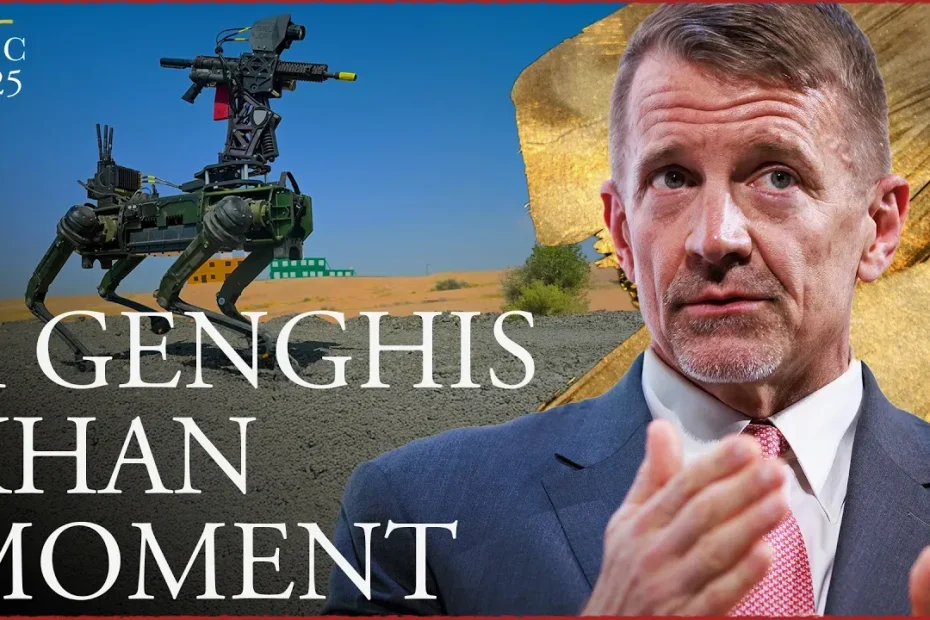
Read the full transcript of a conversation between interviewer Melissa Chen and interviewee Erik Prince at ARC Conference 2025 on Feb 28, 2025 — “The Terrifying Future of War (And What We Can Do About It).”
Listen to the audio version here:
TRANSCRIPT:
MELISSA CHEN: Welcome to ARC, Erik.
ERIK PRINCE: Nice to be here.
MELISSA CHEN: So I heard a wise man on a podcast say that the battlefield is the ultimate cauldron of learning and that war separates good ideas from bad ideas really quickly.
ERIK PRINCE: Well certainly as we’ve seen in the Ukraine fight, the latency between an idea developed in a garage to being tested in the battlefield to being either working or not working is extremely quick. Don’t listen to the idiot politicians that say that we’re actually degrading the Russian army. They have gotten significantly faster. If you shot at the Russians a year and a half ago, it would have taken them an hour and a half to shoot back and now they do it in three minutes.
The innovation that is happening with drones, being able to take a cheap drone, 3D printing a beer can size charge with a copper cup and now I can carry six of those, you can carry six and you can hit a target 15 kilometers away. So it is a massive acceleration of lethality and innovation and now as you put AI literally on the edge of that device where it is autonomous and it’s going out to seek a target it recognizes, it is a brave and dangerous new world.
The West’s Military Preparedness
MELISSA CHEN: As a student of military history and also a former Navy SEAL and founder of Blackwater, I suppose you have a frontline view of a lot of these conflicts brewing around the world and how conflict has kind of changed in a lot of places.
ERIK PRINCE: I would say in the defense industry we suffer from almost an affluenza. We’ve gotten very fat and lazy and woke. I would say some of the cultural afflictions that have affected the rest of society are certainly in the military as well.
Again the revolution in technology, the acceleration, it’s like when Genghis Khan put stirrups on horses and it enabled instead of walking into battle now you’re galloping at the speed of a horse while standing up in the saddle firing arrows rapidly. What happened? Created an empire from the Pacific Ocean all the way to Hungary. And it wasn’t that he was beaten in Hungary, they just got sick of it and turned around.
So that kind of change in warfare is going to cause a lot of other black swan events around the world. And at the same time this industry has been massively too expensive, uncompetitive, un-innovative and so we’re way behind. And so the same kind of talk we hear with re-industrialize, with diffusing that decision-making, that innovation down to the lowest level, we absolutely have to do that because the centralized solution to this has clearly failed and it’s way too expensive.
Global Hotspots and Strategic Concerns
MELISSA CHEN: What in your assessment is the next hot zone to worry about when you survey the global scene?
ERIK PRINCE: Well look, China’s been very deliberate. They’re saying they’re going to retake Taiwan at some level, whether they do it demographically in 10 years because Taiwan’s demography, their baby-making is deficient as well. Even more so than it is on the mainland.
Again, Taiwan should actually have a home guard. That is the best way. Again, not centralized solution, a diffused solution because if Xi decides to go for Taiwan, it’s an all-or-nothing decision. And so if Taiwan has the means to resist at the ground level, at the citizen level, remember when America was fighting for its independence only 3% of our citizens took up arms. Sometimes that’s enough.
I think, I’m hoping, President Trump can actually make some kind of a ceasefire deal and some kind of reasonable resolution because the pointless grind of Ukraine is just going to wipe out the next generation of demographics because there’s about a 0% chance that Ukraine is able to take back all of its terrain.
And it is the long-term interest of the West to pull Russia away from the orbit of China. Because remember, it was a hundred years policy to keep German industry from combining with Russian resources. And all we’ve done is push Russian resources into a very subservient role with China.
I met a head of state a few months ago who’d been to every BRICS meeting and he said all the previous BRICS meetings, it was always a very equal relationship between Xi and Putin. This last one, Xi was clearly in charge, clearly in a dominant position and that is not in our interest either. So Russia, they don’t have to be our best friends, but we don’t have to have such a combative relationship with them and we have much more in common with them that we have to fight about.
The BRICS Alliance and Global Currency Dynamics
MELISSA CHEN: Speaking of BRICS, I remember that the acronym has actually expanded quite rapidly. It’s now BRICS-I-E-A-S. They’ve expanded faster than LGBTQ-I-S plus plus, 2-P. What do you make of this new alliance that is challenging the West?
ERIK PRINCE: Look, when the reserve currency of the world was the pound, the transition to dollar was fairly smooth. If the United States loses its status as the world’s reserve currency, it is a catastrophic change for American society and so it is certainly not in our interest to enable that change and certainly that’s what the CCP wants is for the RMB to displace that.
So let’s prevent that from happening. And the overuse of sanctions by previous administrations, I think, makes it that much harder for people to want to use the dollar.
Future Frontiers: AI, Cyber, and Space
MELISSA CHEN: So in terms of the frontier of the next conflict, it’s probably going to be AI, cyber and maybe space. Could you say something about how you foresee, how should the U.S. move, make moves to kind of get better in these domains and actually how far are we behind or if we are behind at all?
ERIK PRINCE: Well, I think it’s important to talk about the surveillance capitalism, right? Because first, I guess, let’s think about first principles and how does it affect individual liberty in our society.
When 9-11 happened, the U.S. government got into the business of buying a lot of personal data, commercial data from the advertising industry and it created an entire segment called surveillance capitalism. And as you shifted, so you went from analog advertising information to all the digital world and then when iPhones come out, smartphones in 2009-10, all the apps are developed around organizing, collecting and exporting your data to be able to sell advertising.
So by 2027, digital advertising will be a trillion dollar industry and so big tech is very hooked on that. And so if you think about that much data of all your exhaust being all over the web and you combine that with AI, now you can have effectively digital grooming by AI. In America, the average kid by the time they reach the age of 13 has had 72 million data points collected on them.
I think it’s extremely important. China has gone the way of the ultimate surveillance state with social credit scores to debank you, to block you from tickets, from entry to buildings or whatever based on your social credit score. We stand the risk of that and giving it away by letting big tech own and control that much of our data.
In the United States, you know, we have the 10 amendments. First amendment guarantees free speech, freedom of religion, freedom of assembly. Fourth amendment, the right to privacy. When you’re carrying a device around that is literally leaking all of your exhaust, where you go, what you buy, who you call, what you browse, and you’re turning that over to the hands of people that really don’t necessarily subscribe to your value system. It is the makings of a very Orwellian society if we’re not careful.
Technology and Privacy Concerns
MELISSA CHEN: We already have, you know, TikTok on our phones, which is essentially, you might as well be attached to a Chinese spy balloon at all times, right? So I read somewhere that you have actually created a phone, your own phone to kind of counter this.
ERIK PRINCE: Well, yeah, it resulted after a very angry phone call after the 2020 election when big tech was throwing people off of certain platforms, censoring free speech, not even allowing you to question what was going on in the vaccine craziness or election recounting or any of that. And I said, we’re never going to make big tech better by complaining about it, only if we can compete. And so we actually set out to build an independent platform outside of the Google and Apple universe that they couldn’t cancel.
ERIK PRINCE: And we’ve done that. It’s called an unplugged phone. The difference is we don’t have an advertising ID, so we’re not collecting all your data. All the things that big tech collects on you now, we prevent that from happening. And it’s working. Why did I wake up four years ago and decide to take on not one but two multi-trillion dollar industries? Because we can. And someone had to. And I think it’s extremely important going forward because the amount of AI that can literally digitally groom us and shape our reality, shape our education, we ignore that at our peril.
MELISSA CHEN: So I recall reading that this phone has a very special dating app on it.
ERIK PRINCE: Yeah, because we tend to be the ultimate not woke platform. We even have a dating app for people that have not been vaccinated, which was thrown off of all the other app stores.
MELISSA CHEN: Well, you know, especially in this country, in the UK, where Apple has actually, if you’ve been reading the news, the UK government has actually requested for Apple to actually have a backdoor into their iCloud because they want to be able to actually peer into your encrypted messages. So I couldn’t think of anything more important than your project, Unplugged, which is something that you’ve developed.
ERIK PRINCE: Again, it’s impossible for them to ask for that on our device because all of our stuff is peer-to-peer encryption. So they could demand the company to give them the keys to your phone. We don’t have it because the keys on your device are generated by you. When you call someone else, it’s a peer-to-peer call with your own encryption that we, the company, have no backdoor to. And if someone does grab your phone, your Unplugged phone, you can unlock it with a certain code and you hand them a paperweight. It’s literally a brick function. It is the ultimate. We did this for individuals to communicate freely and securely as a thumb in the face of a big brother in big tech.
Supply Chain Security and Manufacturing
MELISSA CHEN: Can you also say something about how important it is to have a vertically integrated supply chain? From what I understand, your phone, you actually control the components or where they’re manufactured, especially we saw with Israel, the Hezbollah pagers situation, and right now with, say, DJI drones. And I know in the United States that we’re unable to actually build a single drone by ourselves completely in the United States.
ERIK PRINCE: Yeah, look, the outsourcing driven by some of the free trade agreements in the 90s certainly had a very damaging effect on America or the West’s ability to manufacture. We have certainly sought to make a supply chain that is not controlled or influenced by the Chinese Communist Party because I think we’re at a period in time where it’s a very clear competition between governments based on individual rights and liberty versus an absolute maximum state where we are just not even subjects but serfs. And so we wanted a platform that was outside of that, that they didn’t control. And, you know, certainly our beef is not with the Chinese people, but certainly with the Chinese Communist Party.
MELISSA CHEN: So where do you manufacture?
ERIK PRINCE: Indonesia. And eventually we’ll do it in America, but, you know, volume, crawl, walk, run, because again, taking on the very big guys, but I’m kind of an insurgent at heart, so.
Advice for Europe
MELISSA CHEN: So on a final note, what would be your advice to actually, let’s focus on Europe because America seems to be going down the right track right now, at least on matters of defense technology. What would be your one thing that Europe needs to do?
ERIK PRINCE: I would say empower their entrepreneurs, because if you keep looking to the big industries, you know, when Hitler had his time in Germany, he had massively over-consolidated the industries. And so it was much easier to control centralized, socialized industries. You know, the real mission of the U.S. military at the end of World War II was to denazify, decartelize, and make German industries small and competitive. That’s one of the reasons German industry did so well coming out of the 40s, 50s, and 60s, because it broke up big industry and it let people compete.
As Europe has to wake up to, I think, a realistic call from the U.S. that you have to defend yourselves. I think NATO should be an alliance, not a protectorate. And there’s plenty of innovation that can be done at the small-scale level. What really saved Ukraine was innovations, innovators, smart people working out of their garages, like you opened the interview with. Developing, testing, fielding immediately, that short flash-to-bang innovation is very, very possible, it’s very, very necessary, and it costs massively less than the nonsense of the usual pricing they’re used to paying.
MELISSA CHEN: Thank you. Thank you, Erik, for your time.
ERIK PRINCE: Thank you. Thank you.
Related Posts
- The Dark Subcultures of Online Politics – Joshua Citarella on Modern Wisdom (Transcript)
- Jeffrey Sachs: Trump’s Distorted Version of the Monroe Doctrine (Transcript)
- Robin Day Speaks With Svetlana Alliluyeva – 1969 BBC Interview (Transcript)
- Grade Inflation: Why an “A” Today Means Less Than It Did 20 Years Ago
- Why Is Knowledge Getting So Expensive? – Jeffrey Edmunds (Transcript)