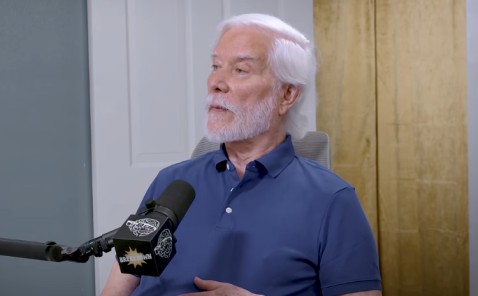
EDITOR’S NOTE: In this episode of The Breakdown, Dr. Mayim Bialik sits down with physicist and consciousness researcher Thomas Campbell, author of My Big TOE, to explore his view that reality is a virtual information system generated by consciousness. Campbell discusses out-of-body experiences, remote viewing, the role of intention in healing and changing probabilities, and why lowering entropy through love and cooperation is central to growth and purpose. Read the full transcript of the interview below:
Introductions
MAYIM BIALIK: (00:00:01) Hi, I’m Mayim Bialik.
JONATHAN COHEN: (00:01:11 – 00:01:12) And I’m Jonathan Cohen.
MAYIM BIALIK: (00:01:12 – 00:01:58) And welcome to our breakdown. This is an unbelievable conversation with Dr. Thomas Campbell. We’ve had Dr. Campbell on before. We did a 2-part episode. He’s a physicist, a systems analyst, and a longtime explorer of consciousness. He’s best known for his 3-volume work, My Big TOE. TOE stands for Theory of Everything. His website explains everything about how he came to be an expert in consciousness and a practitioner of remote viewing, telepathy, and how his understanding of our entire existence as one giant data stream impacts everything about what he studies, what he teaches, and how we experience reality.
JONATHAN COHEN: (00:01:59 – 00:02:16) This episode bridges the theory and also the practice. We talk about intuition, unbelievable ways to heal through energy work, and simply setting your intention. He talks about the placebo and how powerful it is and how we can move through the world in a totally new way.
MAYIM BIALIK: (00:02:17 – 00:02:31) He’s going to talk about how healing over decades of experience is more about tuning into a data stream and less about what many of us think healing actually looks like.
JONATHAN COHEN: (00:02:31 – 00:02:45) We also explore how each one of our consciousness is actually rendering reality in real time and how we can start to change how we experience the world. We also touch on telepathy and mind-to-mind communication.
MAYIM BIALIK: (00:02:46 – 00:02:51) Let’s welcome in person to The Breakdown again, Dr. Thomas Campbell.
THOMAS CAMPBELL: (00:02:52 – 00:03:01) Thank you. Glad to be here, but leave the doctor off. Just Tom works fine. Or Thomas if you feel it needs to be formal.
MAYIM BIALIK: (00:03:01 – 00:03:33) Usually the first time I want to remind people of your credential, but now I’ll just call you Tom. So much has changed even in the time that we spoke to you to now in terms of the public conversation surrounding anything from telepathy, with the popularity of the telepathy tapes, to conversations about UAPs, government disclosure. We’re in a very different age. So we’re looking forward to diving into some of the things that have changed, and what that delta is.
THOMAS CAMPBELL: (00:03:34 – 00:03:36) And don’t forget, AI.
MAYIM BIALIK: (00:03:36 – 00:03:37) Yes.
THOMAS CAMPBELL: (00:03:37 – 00:03:38) And consciousness.
MAYIM BIALIK: (00:03:38 – 00:03:38) That’s right.
THOMAS CAMPBELL: (00:03:39 – 00:03:41) That’s a big topic right now as well.
MAYIM BIALIK: (00:03:42 – 00:04:03) Our plan is to get to all of it, but I wonder if we can start, and I hate to make you sort of tell us who you are on one foot, but can you explain to people the career that you’ve had, the work that you set out to do, and where your life has taken you in terms of the studies that you do?
Tom Campbell’s Path Into Consciousness Research
THOMAS CAMPBELL: (00:04:04 – 00:13:09) I’m a physicist, and that probably describes me better than anything else. I am a physicist, a scientist. Being logical is very important to me and only saying things that I am sure of. When I say this is the way it is, that’s not a belief. That’s because I’ve studied it a long time.
So in graduate school, I had a paranormal experience of being able to debug software in my mind, and that opened up a whole new world to me. What physicists do is they model reality, and I realized there was another whole part of reality that I knew nothing about, and that was within consciousness. And there was no doubt that that was real because the things that I did with my mind then were impossible, just completely impossible.
So I had a kind of a mission then to find out how does this work? What is this mind thing and consciousness and why does it work that way? Because I’m a physicist and that’s what physicists do. We model reality.
I left graduate school and got a job. And that job just materialized out of thin air. That was at a time that we were in kind of a depression. I don’t know what they call it. Recession, I guess, is the right word. And jobs were just hard to get in any field at any time. This one never got to the point that it was ever advertised. So I guess it was just for me.
I took the job and within 3 months, I was on my way out to Bob Monroe’s house with other people where I worked. And if I hadn’t taken that job, I would never have met Bob Monroe.
So when I met Bob Monroe, he had just built a building, a laboratory he called it, but it was just an empty shell. He hadn’t done anything with it, but it had 3 booths in it that were in a row and all acoustically isolated one from the other. Myself and another guy that worked at the same place I did, we told Bob we’d be his scientists. He was looking for some science and engineering types to help him tell the world that the out-of-body things he was having weren’t just hallucinations, but they had some kind of science behind them. So that was his goal.
And from that day on, I spent somewhere between 15 and 20 hours a week with Bob Monroe.
And there’s a big difference between proving that to yourself intellectually, which we did. The things we were able to do was, 1 in 100,000 that we were just good guessers because we seem to be really good guessers a whole lot. And we missed the mark seldom. So I knew that intellectually that it was a real thing. I was investigating a phenomenon that existed outside of me. I wasn’t just wandering around in my own mind, making something that was entirely internal to me. Seemed like it was something that was external to me.
And then about 2 years in or so with Bob, I had an experience where my friend Dennis Menarik and I went out of body together. This was an experiment that Bob Monroe thought up. He says, “You 2, meet in the air up above the lab in an out-of-body state and then go someplace together. The key thing here is stay together.”
So we did, and I was in booth 1, he was in booth 3, so there was another isolation booth between us. My booth actually was also a Faraday cage. It was metal, grounded metal all the way around all the walls and the ceiling and everything, so no electromagnetic signals could get in or out. Acoustically, since there was an empty acoustically isolated booth between us, if you screamed somebody might have heard a little muffled sound if they were paying attention, but it was very silent.
Bob taught us to speak into a microphone while we were out of body. Now that sounds a little difficult, but with practice we did that, and he insisted on that because otherwise he didn’t know how to teach us. He had to know what we were experiencing so that he could guide us and give us some instructions and things to do while we were there. So we had this mic that was maybe a quarter of an inch from our lips, because when we spoke to it, we didn’t speak very loudly. We were still in an out-of-body state, or we would jump back and forth. I was more of a jump back and forth, and Dennis was more of a speak from within the state.
So I would drop where I was, come back, explain what I’d been doing, what I’d been saying, and just pop back. And going back and forth was trivial. It happened in tenths of seconds. You could just flip from one to the other. So I’d come back and talk, and then I’d go back to exactly where I was. So if I talk to some non-physical entity, I’d be telling him about the entity and what I was saying, and then I go back and continue the conversation where it left off. So that’s the way I worked.
And so at the end of this rather almost 2-hour adventure, Dennis and I went to the control room and there was Bob. And Bob, of course, had recorded all the things that he had said to both of us and all the things that we said to him. So he rewound both tapes.
Now, this was cassette tape days. Probably a lot of your listeners never even heard a cassette tape. They don’t know the sound they should be getting. But anyway, this was on cassette tapes, and unfortunately they were on the cheapest cassette tapes that money could buy. Bob was very frugal, so he bought all of his tapes at Radio Shack, and that means they didn’t last very long. They get brittle. And it was about 20 years later when they found this big box full of tapes and tried to get as much as they could, and they did. They got quite a bit. You can go to TMI now and listen to 10 or 15 or 20 of Tom Campbell speaking back in 1972 and ’73 on tape. So some of them they were able to save. That one of Dennis and I, they did not find that. That one probably turned to dust before they were able to locate it.
Anyway, that was an event that made me stop asking, is it real? So then I had an emotional, being-level understanding that this is real. Before, it was in my intellect. Oh yes, of course it’s real. All the statistics say that it’s a real thing that’s outside of me. But at that point, I didn’t ask, is it real anymore? That was it.
Because when he rewound these tapes, that synchronized our adventure together, because both tapes were started at exactly the same time. So when he played those back together, back to us, Dennis and I were carrying on conversations where I’d ask him a question, he’d respond, he’d say something to me and I would respond. We obviously were together and we were talking to the same entities and we were telling the same stories. “Oh, look at that. Look at that tower over there.” “You mean the one that’s kind of orange?” “Yes, that one.” “And you see the round building next to it?” “Of course. It’s this way and that way.” So we had a lot of conversation going on that made it obvious that the two of us were having the same out-of-body experience. Well, I wouldn’t say the same. There were two perspectives, but we were at the same place seeing the same things.
JONATHAN COHEN: (00:13:10 – 00:13:15) So there was an objective experience in non-physical reality that the two of you were sharing.
THOMAS CAMPBELL: (00:13:16 – 00:13:21) Yes, exactly. That’s a good way to put it. So that’s a hard one to explain away.
The Question of Internal vs. External Experience
JONATHAN COHEN: (00:16:32 – 00:16:43) The biggest criticism of this is someone to say you can’t base an external worldview on an internal experience, right?
THOMAS CAMPBELL: (00:16:43 – 00:16:44) Yes.
JONATHAN COHEN: (00:16:44 – 00:17:04) If we meditate, we see something that’s an internal experience. We can’t then take that and extrapolate and say, this is how the world works based on my first-person internal experience. But this is challenging that. This is 2 people having a seemingly objective experience of an internal experience that is actually external somehow.
MAYIM BIALIK: (00:17:05 – 00:17:15) If we think of it in terms of data, right, the data exists. You can have any number of people experience that data because it’s data.
THOMAS CAMPBELL: (00:17:16 – 00:28:04) That was a big turning point for me because then that was to me kind of the final evidence that it wasn’t just an internal game that I was playing with myself. Although the ability to remote view, to heal, to get it correct mind to mind, all of that said the same thing, that it was external to myself. The ability to do things in the mental state, in an altered state with my mind that would affect things here in the physical world. I was able to do that. Well, healing does that, but so does communication. Somebody else gets what you’ve said. So does remote viewing. Those 6 digits on the blackboard in another room are in this physical reality. So the fact that from consciousness I was interacting with the physical reality and I could change things here. Now that told me that the arrow of causality goes from consciousness to the physical world. The logical consequence of that is consciousness is fundamental, and everything else is derived from consciousness.
So knowing that, I spent the next 33 years doing physics, doing experiments inside of consciousness in order to understand how did this work. And I knew there were answers to the question, how does this work, because it wasn’t random. The things I did were quite purposeful. So if it’s just random, then there are no rules. But if things work purposefully, if I do this, I get that response, there’s rules. There’s logic, there’s process going on there. So as the physicist, I wanted to understand that process. How did that work?
33 years later, I thought I had an understanding, and the big aha moment came. And I say that in the sense that many years went by when it was like, well, I understood how this piece of consciousness worked, and understand how that piece of consciousness worked. But the two of them, the understandings didn’t really work with each other. And I understood how the physical world worked and trying, I was trying to come up with some overarching idea that would then explain all these. So all these various pieces of the puzzle needed to come together into one picture, one understanding.
And I knew that had to be there because consciousness was fundamental. I knew that if consciousness is fundamental, then there has to be a logical process that produces the physical world and the consciousness world, which is non-physical. Apparently, it seems like it’s non-physical to us. There has to be rules that explain how that works. Sometimes people can remote view and sometimes they can’t. Why is that? Here you either can pick up a rock or you can’t pick up the rock. It’s very simple, but it’s not that simple. There’s other things, other variables playing when it comes to consciousness.
So coming to that conclusion, I started looking. I started looking for this one overarching thing. And basically I found it. I found it, and the key idea is that everything is information. And if you look at reality in that sense, it makes sense. If you look at consciousness in that way, it makes sense. What are we conscious of? What are the 3 of us now conscious of? We’re conscious of what we take in through our 5 senses. Our 5 senses are just sensors. Call them senses. They’re sensors. And they take in data. They take in that data and they process it. They compare it to memory, try to make sense of it in more context with memory. They process it a little more and then they have an output, which is how we react to that data that we just got. Well, something that takes in data, processes, compares to memory, processes, has an output, that’s about as classic a definition of an information system as you can get. So seeing consciousness as an information system is pretty obvious. That’s what it is.
But that was the key idea then that pulled everything together for me. As I saw that, I started seeing the bigger picture also of how the physical world works. Because if you find a particle physicist, these are the guys that smash particles together and see what comes out the other side, then you will find that they will tell you that reality is information-based. And the reason they say that is because if they try to model, say, a particle like an electron, as a piece of mass with a charge, which is kind of the physical view of an electron, they cannot compute the right answer. That doesn’t work. That’s not the way electrons are. But if they look at an electron as a point with the attributes of mass and the attribute of charge, ah, now they can do a good computation and come out with what comes out the other end after the particles smash together. So that tells them that an electron is not a little piece of mass with a charge. It’s information. And from that, they come to the conclusion that our reality is information-based.
Then you go to quantum physics, which says the same thing. They said that reality is information-based. My understanding of quantum physics explains why quantum physics is just a logical science, not a weird science like everybody says, once you understand consciousness and how it works. And yes, it has to be based in probability. That’s the only possible way. And quantum physics says, yes, it’s probability.
And then the physicists today, they have this big problem with their sense of how does it work. They have this issue that you’ve probably heard of. It’s that the probability wave collapses to a physical particle. You’ve probably heard that said. Well, that’s a ridiculous thing to say. Probability is mathematics. So they’re saying a piece of mathematics in our computer collapses to a physical particle, which doesn’t make any sense at all. Of course, that doesn’t happen. But that’s a metaphor for what seems to be happening.
But if you understand consciousness, you can understand how it actually works. And that is, there are, let’s put it this way, there are a lot of possibilities of how something might be next, in the next moment. What’s going to be there if you make a measurement? What’s going to be there? And the way that the larger consciousness system works is that all of these possibilities have probabilities. Some are more likely than others. A random draw is taken from the probability distribution of the possibilities, and that’s what happens next. So that’s how the system decides what that measurement is going to see.
Now, in quantum physics, they say, well, that’s just mostly applies to little things. When you scale it up to big things, because their mass is so big, the differences are so small that it looks like everything is like Newton said it was. But that’s not the case at all. Everything in our reality works that way. So if you have someone with a big telescope, and they’re going to look further than anybody’s seen before, and they point it out to space, they turn it on, and there’s a probability distribution of all the possibilities, and that random draw is taken, and that’s what they see in that telescope. And what was out there before was really nothing, just probability of what could be out there. So there is no “out there.” The reality is computed. So when you make the measurement, that random draw from the probability distribution of possibilities, that’s what the rendering engine renders to be there.
So it’s this idea, which is really the basis of quantum physics, is you take the random draw and you get what’s measured, is true for everything. If you go out in your backyard and dig a hole with a shovel, what’s going to come up out of there? Well, nobody knows. So there is a lot of possibilities. Let’s say you live down on the Gulf Coast. One of the possibilities may be a gold doubloon. It may be mostly sand or dirt or roots or rocks. Now those are real high probabilities. The gold doubloon is maybe 1 in 100,000, but they’re all in there.
And when I say a random draw from a probability distribution of the possibilities, that probably confuses a lot of people because they’re not very mathematical, but think of it like a raffle. Okay, so there’s a raffle, somebody’s going to win the prize, and 1,000 tickets have been sold. Well, there’s one guy who bought 500 of those, somebody else bought 20, somebody else bought 10, somebody else bought 2. So every one of those people have a different probability. Okay, now they put them all in there, mix them up, and you take a random draw from the probability distribution, which is the probability of each possibility, which is everybody that bought a ticket is a possibility. So if you just bought one ticket, it’s 1 in 1,000. If you bought 500 of them, your probability of getting picked is 0.5. So anyway, that’s what I mean by a random draw from a probability distribution of the possibilities. Don’t confuse that with a random draw from the possibilities because that would make our world really crazy.
MAYIM BIALIK: (00:28:04 – 00:28:08) In this system, the only thing in there are raffle tickets.
THOMAS CAMPBELL: (00:28:09 – 00:28:09) Yes.
MAYIM BIALIK: (00:28:09 – 00:28:19) You don’t also throw in like, but what if there’s 6 million gumballs in there? Right? Like we’re dealing with a system where we have a set of rules. There’s 1,000 raffle tickets.
Quantum Physics, Information, and a Rendered Reality
THOMAS CAMPBELL: (00:28:20 – 00:32:35) Yes. Well, there’s 1,000 raffle tickets. That makes it simple for people to understand what I mean. But here, everything that is unknown becomes known by this random draw. So that’s the basic idea behind quantum physics as well. So quantum physics isn’t for the small things. It’s the way our reality works. Everything that’s unknown is simply in probability space. It’s not the physical world, that the physical world is physical and it’s all there. And somewhere out there in that piece of space, there is something. And if we have the right telescope, we can see that something. But that’s not the way it works. There’s nothing outside there other than probability. And we get to collapse that probability to a thing when we take the measurement.
So anyway, this then makes quantum physics not a weird science, but a science that’s very understandable, and it leads us to this position that we live in a virtual reality computed by consciousness. So consciousness, being the information system, takes part of itself and turns it into a computer that’s rendering this. So now think of a video game where it’s a virtual reality. A computer is rendering it, and there’s not just raffle tickets in the video game. There’s trees and elves and barbarians and tar pits and all kinds of things in there. And as people look at them, as people turn their heads to this direction, they see the tree or the lake. They turn their heads someplace else, they don’t see it. So they only get a data stream that shows them what they’re experiencing from whatever they’re doing and looking.
We’re the same way. So we humans with flesh here, we are the avatars. Our consciousness, a piece of consciousness, is the player. And that player is getting a data stream from the larger consciousness system, from the rendering engine. It takes that data in, interprets it into this reality, and it does that interpretation in terms of its own beliefs, its own biases, its own experience. So the reality it ends up with is its own reality. But because this is a multiplayer game, we all get, we can interact with each other. I do something that affects you. Same thing happens in the video game. You do things, it affects other players. So it’s a big game.
Now, why would we have a game like that? What’s the point? Well, the point is that we are pieces of consciousness. And a little derivation here is that any information system, just general information systems, evolve by lowering their entropy. Entropy is a thermodynamics word that basically is a measurement of disorder. So if you have an information system and all the bits in this information system are random, you don’t have any information. But if you order some of those bits, then that ordering can symbolize something. It can be something. It could be the letter A or the number 6. So you can create information by ordering things. So information systems evolve by lowering their entropy. Creating information. That information is the meaning, the significance. If you have a couple of bits that make something, then you make that mean something to you. It’s not just there for its own sake, but you build things. So this information system obviously is going to do real well in building mathematics because here’s a lump, there’s a lump. Oh, now we have 2 lumps, another lump. Now we have 3 lumps. Mathematics is no more than the logic of quantity. That’s all it is, the logic of quantity.
MAYIM BIALIK: (00:32:36 – 00:32:43) But sometimes 2 things become one. I have one pile of laundry and you have one pile of laundry and we put them together and they make one pile of laundry.
THOMAS CAMPBELL: (00:32:43 – 00:32:48) Exactly, they can make one bigger, one different. But see, it’s a different pile. So it’s a different thing.
JONATHAN COHEN: (00:32:48 – 00:32:49) Yep.
THOMAS CAMPBELL: (00:32:49 – 00:32:51) So yes, we can do that.
Evolving Toward Love: The Entropy of Consciousness
THOMAS CAMPBELL: (00:35:46 – 00:42:31) So this is kind of the big picture. We’re pieces of consciousness, and because we need to evolve rather than devolve, we need to lower our entropy. We individuated units of consciousness is what I call the pieces of consciousness we are. We’re pieces of the larger system. Well, we make a social system. We interact with each other in this game. And the whole reason for the game is we need to learn to lower our entropy.
And in a social system, what does lower entropy mean? In a social system, lower entropy means caring, sharing, cooperation, being helpful. How can I help rather than what’s in it for me? On the opposite side, I call that the love side. On the opposite side is fear. It’s all about me. What do I get? How can I get it? How can I keep it? How can I keep somebody else from taking it away from me? So you have basically chaos on that side. Anything starts to build up, somebody else wants it, and we fight over it. That’s where we live over on that other side, on the fear side of things. But where we’re going in our evolution of consciousness is toward the love side.
And why was this virtual reality created? Because I define consciousness as awareness with a choice. That’s it. Whether you evolve or de-evolve depends on that choice. Awareness is the function. Choice is the evolution, drives the evolution of that. So if your choices are low entropy, then you evolve. You move toward becoming love, caring, sharing, cooperation. If you are fear-based, you’re de-evolving, moving toward chaos, destruction. Things that fall apart. So that kind of gives the whole ball of wax.
So you end up with a couple of interesting things. One, you end up with a more general physics, an explanation now that is much better than the scientists have because it explains the things that they don’t understand. It solves a lot of paradoxes in all fields. It is just a better physics. And one day, this idea of mine is going to be accepted as the big paradigm shift that everybody’s been looking for since quantum physics started in 1920 to ’25. During those 5 years, quantum physics evolved and all of the physicists, the Schrödingers and the Born and the whole group of those, including Einstein eventually. Einstein was a latecomer. But all of those, Planck, they all were looking for this big paradigm shift because suddenly quantum physics didn’t play by the rules. Quantum physics said the reality is not material because the reality, when you dig down to it, is probability-based. It’s based on what the observer knows and what the observer doesn’t know. So it’s based on information. So they had that idea, and to a man, every one of them came to the conclusion that consciousness was at the root. Consciousness was behind it all.
And if that amazes you, you can go to my website, you can pick up a video there that’s called Breakthrough, and it does the history, and it gives all the quotes from these guys, and every one of them said consciousness is at the root of this. Even Albert Einstein said that. In a letter to David Bohm, he said, “I know that consciousness has to be at the root.” And that was because of the idea that what the experimenter knew, what knowledge he had, changed the result of the experiment. That was the big weird thing about quantum physics. So they knew that consciousness was at the root, but they had no concept of how to put that together. In this letter, Einstein says to David, he says, “I know consciousness has to be at the base, but I don’t have any way of structuring that into a rational model.” Well, that’s because consciousness is subjective.
Now you end up then with a better physics, and you end up with now also a model of the subjective world, so that if somebody’s life is just full of challenge and full of struggle, this model of the subjective world will tell you why and what’s wrong and what they need to do differently. So you understand the subjective also has rules. It’s not just anything for anybody anytime. There’s rules that apply. If you are this way, your life, and you have these ideas, the life is going to be difficult. You’re going to find struggle and whatever because you’re on the fear side, making your choices to the fear side, that’s antithetical to the way the system evolves. If you’re making choices to the love side, then your life is good. You smile a lot. You’re happy. Everything you need falls at your feet just as you need it, and you have a very positive experience here.
So that’s it. And what did I do, about 20 minutes? I hope it’s not too long. But that’s basically where Tom Campbell comes from now is an understanding of how consciousness works. And if you understand how consciousness works, then you understand how everything else works because everything else is created within consciousness. So that’s why I end up with a theory of everything, because once you understand consciousness, you understand literally everything. It totally rewrites theology. It rewrites psychology, physics, metaphysics, philosophy, all of those, all the paradoxes that are in those become known.
Healing, Intention, and Changing the Odds
JONATHAN COHEN: (00:42:32 – 00:45:04) I think there are people who are listening who heard healing, telepathy, out-of-body experience at the beginning, and then heard that we’re simulating our reality, that consciousness is basically rendering our version of the experience that we’re having. And they’re like, okay, I can kind of get my head around the fact, theoretically, of what you’ve shared. And I can kind of get my head around the fact that it’s possible that the reality I’m experiencing is being rendered by my consciousness. And then they kind of get a little stuck with, well, if more is possible because I can change the render of my consciousness, maybe I can have telepathy. Maybe I can also experience remote viewing and out-of-body experiences. Maybe I can have a different perspective on what it means to no longer be here in physical form and pass over. Maybe the veil between these lives is not so fixed as we once thought, which we explore a lot on this show.
Can we start to unpack that a little bit? How do we start to change the rendering of our experience to, for example, heal? Healing is definitely one that I think maybe the most misunderstood and the highest curiosity rate. There was recently research that we were made aware of, the Bengston Method, that they did — you know more about the study than I do, but my understanding is this is a legitimate scientific study where they have cancer cells in Petri dishes and they’re using this healing modality on the cancer cells and the cancer cells start to reduce. Which doesn’t sound strange to you, but to someone in the material world, they may be like, okay, wait a second. You’re sending energy and intention and that’s impacting a cell. How does that scale?
For me, when I first started learning energy work when I was 17, 18, 19, I started volunteering at a cancer support center in Toronto, Canada at the hospital. They offered — I didn’t think I was healing cancer. I was offering treatments to people who were going through cancer and they had a relaxing experience and their body would go into a process of deep, deep relaxation. But I think we can, with your theory and people’s interest in changing the reality that they are rendering, I think we can push these ideas even further.
THOMAS CAMPBELL: (00:45:05 – 00:45:51) Sure. First of all, everyone is a piece of consciousness. Because you are consciousness, and not a physical form, you have certain capabilities. You have certain things that you can do if you learn how. Everyone, every human and other — we have a couple of dogs wandering around here — dogs are conscious as well. Dogs are very good at telepathy. A dog knows what you’re thinking and feeling. If you’re really upset, and has had a really bad day and you come home, that dog will crawl up in your lap and give you the peace and the quiet and the love that you need then.
MAYIM BIALIK: (00:45:52 – 00:45:54) I think they just sense that you’re not strong enough to push them off of you.
THOMAS CAMPBELL: (00:45:55 – 00:46:31) Yeah. If you’re sitting in your chair and the idea comes to you that, oh, I should get up and take a walk and take the dog for a walk, before you move a muscle, that dog is running around in circles, very happy because of the walk that he’s going to get. So it’s not — it’s any consciousness. All consciousness has the ability to do all of the — what we call paranormal things, the things that aren’t explained by a theory that is materialistic.
JONATHAN COHEN: (00:46:32 – 00:46:38) Every single person has the ability to do paranormal or psi phenomenon.
THOMAS CAMPBELL: (00:46:38 – 00:48:59) Yes, absolutely. Everyone, it’s part of being consciousness. You are a piece of consciousness and all of this is available to you. Besides that, there’s information. Consciousness is an information system. There’s information within that conscious system that is available to you. And we can maybe talk about that a little later, but you mentioned healing.
Now, healing is accomplished because of one of the rules of this larger conscious system is that it decides what happens next because of that random draw from a probability distribution of the possibilities. You can change those probabilities with your intent. That’s how people heal. They basically change the probabilities so when that random draw is taken the next day, well, the probability that that cancer is less rather than more, you have a higher chance of coming up with less because somebody has been using their mind to modify those probabilities to come up with less. So you come up with less because that’s the way the system works. You can modify future probability.
Now, a lot of people know that. There was even this thing went around years back called The Secret, where you manifest things with your mind. Well, it’s based on that as a way reality works. If your family is going to have a picnic next Saturday, then you can put in your mind sunshine next Saturday, no rain. Well, here in California that wouldn’t make much difference, but other places that might make a big difference. And you will indeed change the probability of sunshine versus rain. But of course there is another farmer someplace that wants rain, and that farmer’s saying, oh, I need it to rain this weekend. Well, so you’re pushing this direction and he’s pulling the opposite direction, and all of that sums up and that’s what happens. When you get to the point of the random draw Saturday, then whether it’s going to rain or not has to do with those random draws from the probability distribution.
JONATHAN COHEN: (00:48:59 – 00:49:11) The external events, or what we consider external, are being influenced by all the collection of the consciousness. The external system, the Earth, the weather, doesn’t have its own consciousness?
THOMAS CAMPBELL: (00:49:11 – 00:49:58) No, it doesn’t have its own consciousness. Consciousness is awareness, with a choice. So first you have to have awareness, and then you get choice. That makes something that’s conscious. So we take the proverbial doornail that’s as dead as a doornail, and that doornail has no awareness, makes no choices. It just is. So that’s not conscious. So dogs and cats and people and bumblebees, yes, they’re conscious. They make choices. Yeah, then we get the trees. Now, that falls someplace in between because we’ve learned that root systems tend to talk to each other. We’ve learned things like that.
MAYIM BIALIK: (00:49:58 – 00:49:59) It’s the fascia of the earth.
THOMAS CAMPBELL: (00:49:59 – 00:50:14) Yeah, the more we learn about them, the more we kind of come to the idea they do make choices. But now all awareness is not the same. A dog’s awareness is different than your awareness. Is different than an AI’s awareness.
MAYIM BIALIK: (00:50:14 – 00:50:19) Wait, but why? If it’s all information, explain the difference in processing.
Decision Space: Why Not All Consciousness Is Equal
THOMAS CAMPBELL: (00:50:20 – 00:51:07) Okay, it’s all information to every consciousness, but the amount of that information, the detail in information, what that particular platform, dog or human or bumblebee, only has certain capacities to deal with that information. So according to the capacity, every consciousness has what I call a decision space. The decision space is all the choices that you know that you have. You get to the fork in the road, you have a choice. Okay, so you have — that choice might be just between 2 things. That’s your decision space. But you actually have other choices. You could turn around and go back. You could camp right there. There’s other choices you have, but maybe you don’t think of those, then they’re not in your decision space.
JONATHAN COHEN: (00:51:07 – 00:51:20) It’s like the difference between a sensor that turns on a light when you walk in a room versus the LiDAR on the front of an autonomous car that is scanning?
THOMAS CAMPBELL: (00:51:20 – 00:51:45) It’s a matter of several things. How much data do you take in? How much processing can you do on that data? And then how many choices do you have for your action? A bumblebee is conscious. I came to that conclusion because I watched one stalk my father. Once. And in any case, the bumblebee acted very intentionally.
JONATHAN COHEN: (00:51:45 – 00:51:46) What’d your father do?
THOMAS CAMPBELL: (00:51:46 – 00:51:50) My dad swatted at that bumblebee, I think with a newspaper.
JONATHAN COHEN: (00:51:50 – 00:51:50) Whap!
THOMAS CAMPBELL: (00:51:51 – 00:52:49) He missed, and the bumblebee came back. He swatted 3 or 4 times, and because he was unsuccessful in hitting it, he thought it would be better to step inside because he didn’t want to get stung. So he stepped inside, and that bumblebee went up above the door about a foot above the top of the door and, you know how bumblebees can hover, it just hovered there and it hovered there. And I thought, well, maybe that was accident, but it hovered there for at least 2 minutes, 3 minutes, just hovered there. My dad looked out, he didn’t see the bumblebee anymore, so he stepped outside the door and whap, a bumblebee stung him right on the back of the neck. To me, that was very planned. That was purposeful. That bumblebee was vengeful. Now, a bumblebee probably doesn’t have a very big decision space. My guess is the choices that it can make are extremely limited. Its processing is extremely limited.
JONATHAN COHEN: (00:52:50 – 00:52:53) Its loving-kindness meditation practice had fallen off.
THOMAS CAMPBELL: (00:52:54 – 00:55:29) Fallen off. Yes, it was very vengeful. So, and everything, including the bumblebees and the dogs and cats and horses and people, are in the same game. They evolve by the choices they make. But on the other side, you look at it, everything that is here, everything that has an avatar here, that makes choices and is aware, has an individuated unit of consciousness. So everything that’s aware and makes choices is conscious to some level, but all consciousness is not the same. Some of it is teeny weeny with a little bit decision space, and maybe there are only 3 or 4 decisions that they have in their whole lifetime that they make. And others, like people, are very complex, and there’s lots and lots of choices in their decision space. And each thing that’s here is limited, is constrained by the science — we’ll say the physics — of its avatar. So humans cannot wave their arms and fly, flap their arms and fly. The physics says no, that won’t work. Bumblebees can. So every platform, you might say, every avatar is limited to what the science, what runs this place, the rule set is what I call it. What the rule set says is possible, what it can do, what it can’t do for reasons of its biology and so forth.
So if we talk about AIs later, this concept that everything that’s here that has choice and awareness is conscious, then that affects the way we think about computers and AIs as well. So we can maybe talk about that later, but not right now. We’re unpacking this notion of healing. This tension of healing. So you can heal just by having an intention which modifies future probability in this database. There’s a big database out there that’s basically the probable future, all the things that can happen and the probability they might. The system needs that database because that’s what it uses to render things. It needs to know what the possibilities and probabilities are. That’s how it renders. The ancients called that database the Akashic Records, but it’s the same thing. That’s the database.
The Recipe for Setting Intention
JONATHAN COHEN: (00:55:29 – 00:56:11) But practically speaking, if someone is, for example, having Crohn’s disease or having intense physical issues of some kind, it feels a little vague. Like, I can understand set an intention, but it can feel a little vague. Do they set up an intention in the morning and then forget about it? Is it something that they need to implement throughout every single moment of their day? Are we talking — people are like, give me the recipe, because I’m going to wake up, I’m going to feel bad, I’m going to maybe do my first thing in the morning, I’m going to adjust it, then I’m going to go through my day, get busy, feel bad again, and then I’m going to get to the end of my day and I’m going to be like, well, did it work or not? I guess it may not have worked.
THOMAS CAMPBELL: (00:56:11 – 01:01:37) Right. Right. So the thing here is that it has to do with your intent. Now, your intent can be a strong intent or a weak intent. Your intent can be more or less powerful. There’s a lot of variables in this intent. If you learn to clear your mind of all thoughts, then your focus is a lot tighter. Your intent is a lot stronger. That’s why people often learn to meditate, and that’s part of their process, because they learn to make their intention much more powerful by reducing the noise in their mind. If their mind is like most people’s minds, they’re doing a whole lot of stuff all the time. If you put one of those scans, or I guess, nuclear magnetic resonance on or something, and watch people’s minds, you see stuff going every which way. You get somebody who’s in a really good meditation state and you’ve got something that’s a lot less jumpy and a lot more focused. So anyway, that has a lot to do with it.
So you drop a dime in the wishing well and make a wish, very weak intention. It doesn’t do much. Now, also think about the opposite side of your intention. You have Crohn’s and you’re worried about that. Oh no, I have Crohn’s. That can be really serious. People die with Crohn’s. It’s a very serious thing and you start being frightened about the possibilities. Now, that fear that the Crohn’s is going to get worse and worse and worse and maybe will kill you is modifying future probability to the negative side. You’re making it more likely that it’s going to get worse and worse and worse. Now we add everybody else. If everybody in your family is going, oh no, this could be really bad, this could be awful, they are also adding to that negative side. Probabilities are getting more and more negative.
So a lot of it has to do with your attitude, how you feel. Are you a positive person? “Oh, I got Crohn’s. That’s not good, but I’m going to get better.” If you have that attitude, you will get better. That’s how the placebo effect works. Tell a lot of people, take this pill and you’ll get better. They will get better because they’re modifying future probability. If they don’t believe you and they’re very jaded and they say, “You’re just telling me that this pill is going to work. It’s probably not going to work.” Then they don’t get better. That’s why the people who have to beat the placebo effect in order to put their medicine out into the world, they find that they can’t do that very well here. So they go to some other country where the people are less jaded and more naive, do their research there, and, yes, their medicine is better than the placebo effect. You see? So that’s just the way things work. The placebo is just one of the things, one of the points that this explained. I told you it explains all the paradoxes. Well, the placebo effect’s been a paradox.
Yes, you can use your intent to modify the probability so that when that random draw is taken, which defines our reality, you’re more likely to get an event. Now you’re just more likely. It doesn’t mean you’re going to get the prize. You may not. You may change that probability from 1 in 100 to 1 in 50, but you’re still not likely to get it at 1 in 50. And there may be other people, like your whole family, that is very negative about the fact that you’ve got Crohn’s or you’ve got cancer or something, that are pushing it in the opposite direction. They’re making it more likely that bad things will happen because they’re all worried about the bad things and they’re all thinking about the bad things. “Well, what are we going to do if George gets worse and dies? What’s that going to do?” And they have all this negative stuff. Well, that moves the probabilities.
But healing, I will tell you, is the easiest of the paranormal things to do. Of all the paranormal things, healing is the simplest. And the reason for that is your ability to modify the probability has a lot to do with how much uncertainty there is in that probability. If there’s a lot of uncertainty, it’s much easier to modify that probability to a point that you change things. If there’s very little uncertainty, it’s really hard to change that probability. If there’s very little uncertainty, that means there’s, let’s say, 10,000 to 1 that you’re going to get the 1. It’s not easy. But if it’s a lot of uncertainty, then it’s around 50-50 or 40, anyway, it’s easier. It’s easier. So uncertainty is a key part of this. You have to have something that has enough uncertainty so that if you can change it this much, that matters.
JONATHAN COHEN: (01:01:37 – 01:02:29) What would you say to someone who’s like, well, I want realistic expectations, right? I don’t want to delude myself, right? There’s a line between I can influence things and I’m sort of being delusional or I’m having magical thinking and I’m going to set myself up. I mean, I’m going to even expand that a little bit because even when I say that, I’m like, the whole notion of reality seems to be more complex, right? If I have an illness, do I not tell other people so that their perspectives are not influencing what is real? But then I’m isolated and I’m sort of holding — like there’s something about human connection where it can be very positive and uplifting and I can feel supported, but then also they could spiral into worry about me that I don’t want projected at me.
MAYIM BIALIK: (01:02:29 – 01:02:31) Is that why you never tell me things?
JONATHAN COHEN: (01:02:31 – 01:02:33) I don’t want you worrying.
THOMAS CAMPBELL: (01:02:33 – 01:02:39) If they are people who are going to have a very negative attitude toward it and very fearful, then it’s best to not tell them.
JONATHAN COHEN: (01:02:40 – 01:02:45) I know people who won’t tell if they have a really good idea, for example, or they want to start something.
MAYIM BIALIK: (01:02:45 – 01:02:46) You’re like this.
JONATHAN COHEN: (01:02:46 – 01:04:14) I don’t like to tell people things before the time is ready because it’s incubating. Right. I don’t want all that static influencing me. I actually was thinking about this the other day, and you’re the perfect person to talk about it. I was thinking about just making some short content, and I was trying to — I often feel like I have a lot to explain and it’s too unwieldy to try to package it up. But one of the things that I think is important that I don’t even do enough, and I think most people don’t ever consider it, is to close your eyes to become aware of what’s around you. And what are the first couple thoughts that you have? Who do you become aware of if you close your eyes? Is it an internal voice? Do you immediately think of a family member or a friend? Because that’s what’s in your field. And if we don’t have, let’s say, a few inches, a couple feet, maybe 5 or 6 feet around us that is just ours, then we’re constantly being bombarded and the ability for us to quiet our minds, to actually feel. So it’s just a field maintenance. It’s energetic field maintenance that I think should be a part of everyone’s daily ritual. Just like brushing your teeth, you do a quick scan and say, what’s impacting me right now? Am I taking on worries of other people? Can I push that out so it’s not impacting my probability pull?
Intuition vs. Intellect
THOMAS CAMPBELL: (01:04:15 – 01:06:31) The first things that come into your mind are the things that are most important. And the reason for that is because as soon as those first things come into your mind, your intellect gets in the way and starts processing those first things that come into your mind. Now, everything paranormal happens in the intuitive channel, not in the intellectual channel. When you get into your intellect, the intuitive channel goes to smoke. It disappears. Now you’re processing. You’re thinking, well, if I do this, then that, and if and then, and you’re analyzing. You’re trying to figure out the right thing to do. Then your intuitive channel’s shut off. You don’t have it anymore. So that’s why you get that first thing, because that’s the real stuff. That’s intuitive. And you don’t worry about the stuff later, because now you’re in the intellectual space, and you don’t have that intuitive channel open anymore. It’s closed. You’ve forced it closed. So that’s what’s going on there. That’s why you do the first thing.
Now, your intention to kind of isolate yourself in a way from being bombarded all the time, that’s good because every consciousness is netted to every other consciousness. And that includes you and your dogs. Every consciousness is netted. So there is a potential for communications between any 2 or 4 or 6 consciousnesses. They all interact. As you think about George, “oh, George, gee, I’m going to” — he invited me to something, but I really don’t want to go there. George is not the kind of person I want to hang out with or whatever. George gets that because you’re thinking about George, but he doesn’t get it in your verbal speech. He just gets it in a feeling, in a sense, if George is in an intuitive state. If George is in an intellectual state, he’ll get it, but not at the cognitive level where he’s aware of it. He’ll just get a feeling about that, but it won’t be something that’s in his intellect.
MAYIM BIALIK: (01:06:32 – 01:06:59) One of the things that materialists will bring to the table, or people who want data, right? They want data on telepathy. They want data on remote viewing. They want data on UFOs and UAPs and all these things. But the problem is, if the examination is intellectual, it is increasingly difficult to analyze something that is not intellectual by nature.
THOMAS CAMPBELL: (01:06:59 – 01:07:00) Absolutely.
MAYIM BIALIK: (01:07:01 – 01:07:22) That’s why you can’t pluck a kid who claims that they have telepathy and put them in a room with a bunch of scientists that they’ve never met in an environment that smells different, feels different. They don’t have their caregiver. They don’t have their mother. They don’t have the person who helps them communicate. And we wonder why we can’t produce the data. And then I end up fighting with my children who are like, “Nothing’s real, Ima.” This is partly why.
THOMAS CAMPBELL: (01:07:22 – 01:11:49) Absolutely. Is the reason why. We started out mentioning that if there’s a rock on the ground, either you can lift it or you can’t. It’s very clear, right? It’s simple. That’s in the objective physical world. Now, in the world of consciousness, things are not that simple. There’s 100 variables about what you can do with your mind. One of them is your emotional state. Are you happy? Are you sad? Are you stressed? Whatever, makes a huge difference. If you’re stressed, you’re not going to be very good at doing these things. That’s why the meditation relaxes you. It tries to put you in a place where you can be more effective.
So most people are in their intellect most of the time and they’re jumping around. They’re in their intuitive space a very small amount of the time, intellect most of the time. And they’re not coherent enough at their intuitive space that they can actually get information that’s functional. Little bits and pieces may come, little flashes here and flashes there, but that intuitive space may open up for 3 seconds and close again, as people’s thoughts and what they’re doing and what they’re thinking. So, if you want to be able to modify these probabilities, then you want to do that with some ability, then you have to learn how to quiet the noise. You have to learn how to focus and stay in the intuitive side, not the intellectual side.
And like you mentioned, somebody says, “Well, okay, I’m going to do this, but am I just making this up? Is it just a thing I’m doing in my mind?” Well, that’s the intellectual side doing analysis. Intuitive side’s gone. As long as they’re thinking in the intellectual side, their intuitive side is not going to be able to change the probabilities very much. So a person gets this and they say, “Well, I could give it a try, but it probably won’t work.” They’ve already sabotaged the process to the point that they’re right. It probably won’t work. So it’s your attitude, how you feel, what state your mind is in, how clear is your mind, how focused is your mind. All of those things are key.
So you take a child who is telepathic with their mom, take him off and put him in a room and say, “All right, tell me what’s on this card,” or “Tell me what’s going on behind the screen or what I’m thinking.” They can’t do that. But most people, of course, don’t develop their intuitive side to the point that they can just turn it on and turn it off. Now you can develop it like that, but most people don’t. So that intuitive side just kind of grows out of experience and it grows out of a situation. So when you’re here and your mom’s there cooking dinner, you can read what she’s thinking. But if somebody else walks in the door, it’s gone.
So people learn their own methodologies of how to make it work. That’s why you have all of these — if you go and look at alternate modalities of healing or something, you’ll get 1,000 different things. And that’s because people have taken their methodologies that they use to quiet their own mind and to be effective, and then they say, “Oh, well, this is the way to do it.” And then they teach that, and that’s way A, and somebody else gets there differently, and that’s way B. They’re all doing the same thing, modifying probabilities, but they’ll have all sorts of different ways to approach it because that’s the way they did it and that’s the way they learned. Well, everybody’s like that. If you understand how it really works, now you can just focus on doing what works rather than on, well, if I light some incense and have a statue of the Buddha and put this music on and turn off all the lights, then —
JONATHAN COHEN: (01:11:49 – 01:11:50) It’s not about the formula.
THOMAS CAMPBELL: (01:11:50 – 01:14:24) Yeah, then this will work. Yeah. You see, but all of that stuff is just ritual that people go through, that ritual helps them focus their mind to the point that it works. So in their minds, all that ritual is necessary. You take it away — now these children have the same thing. They’ve created their own little rituals, the way they do, the way they think, the way they connect, and the circumstances under which it works. So they’re not just, sure, I’m telepathic, think something, I’ll tell you what you’re thinking. It’s not like that. That’s what people expect because that’s like, can you pick up the rock or not? Well, from a viewpoint in the physical world, everything either just is or isn’t. In the world of the subjective world, it’s not like that. There’s variations, there’s subtleties, there’s beliefs, there’s just all kinds of things that get in the way. If you have a very strong belief that this is all nonsense and you sit down and try to heal something, it’s not going to work because your mind is not open to the possibility. You’re in your intellect knowing that it isn’t going to work. You won’t be able to do it. So sure enough, it doesn’t work.
No, everybody can’t just do it whenever. One has to develop that intuitive side to where they can do it. And then you get better at it. It doesn’t mean you get perfect at it because the variables are subtle. What did you have to eat before you did that? That will make a difference. What’s going on in your emotional state? Where are you as far as your peace and calm? Are you there or are you not there? So even from hour to hour, minute to minute, your ability to do these things is going to be more or less based on you and your emotional, mental feeling, your beliefs, your biases, all of that stuff figures in. So you see, on the intuitive side, in the side that is subjective, there’s lots and lots of variables that most people cannot and do not control. So sometimes you do it, sometimes you don’t, sometimes — aha, I got it. Intuitive. That intuitive window maybe was only open for 5 seconds and you got it, but you can’t repeat it.
Turning the Connection On and Off
JONATHAN COHEN: (01:14:25 – 01:14:30) Can you tell us a little bit more about the interconnection of the consciousness nodes?
THOMAS CAMPBELL: (01:14:31 – 01:15:16) Yes, you can turn that connection on and off. It’s like, we’re all connected on this web of consciousness, all consciousness connected, but it’s just like our web. You can reach up and click the X on the upper right-hand corner, and that’s gone. So you can have an intention. Intention is what is the motive force. It’s what changes things. It’s the thing that changes everything. So you can turn that off. So if this person is giving you a lot of negativity, you can just turn that off. Now you won’t find that negativity.
JONATHAN COHEN: (01:15:16 – 01:15:18) It can be a loving turn-off.
THOMAS CAMPBELL: (01:15:18 – 01:16:30) It could be, “I acknowledge it, I hear it, and I’m asking it to step back.” Yes, as a matter of fact, that is going to work much better. If it’s not a loving turn-off, then you’re going to have part of your mind saying, “Well, I hope that worked. I hope they’re not at that —” you see, and that’s all counterproductive. So the loving turn-off is one that doesn’t have that tail to it that gets in the way. It just turns it off. So of course, anything done in the loving sense is going to be more effective than anything done, “Oh, I’m going to keep that so-and-so from” — so already you’re creating the problem of being able to do that because of the negativity that you’re bringing here and because the intellect is engaged and so on. So it’s not going to work very well.
So anybody can turn that on, turn that off. You can enhance it. People notice it a lot in the sense that let’s say you’re sitting here and suddenly an old friend that you haven’t seen for 20 years comes to your mind. “Ah, yeah, I wonder what Sam is doing. Geez, I haven’t seen him for a long time.” And when you do that, a lot of times within the next week, Sam calls.
MAYIM BIALIK: (01:16:30 – 01:16:32) It had been 6 years for us.
JONATHAN COHEN: (01:16:32 – 01:16:32) Yep.
THOMAS CAMPBELL: (01:16:32 – 01:16:49) And it was like, “I was just thinking about you.” Well, that’s why he called, because you were thinking about him. That triggered in his mind, “Oh, my friend Jonathan. Yeah, I haven’t seen him in a long time.” And between the two of those resonating back and forth, somebody picks up the phone.
MAYIM BIALIK: (01:16:50 – 01:16:51) So there’s no such thing as coincidence.
THOMAS CAMPBELL: (01:16:52 – 01:19:40) Well, there is such thing as randomness. Yes, there can be coincidence, but there’s a lot less coincidence than we imagine. There’s a lot of things going on behind most coincidences, but there’s a lot of randomness in this world too. I can do something that affects you, and if I just go off on some kind of whatever and you happen to be my mother or my sister or something, it may affect you. Or my spouse. And then you will respond to that. And that response will affect me and maybe other people. Maybe, that’s why we’re here. We interact with each other. It’s the quality of our interactions and the choices we make is why we either evolve or devolve.
So this is a very — this is a multiplayer game where we create choices for ourselves and for everybody else. Things change. Decision spaces change. I make a choice. All these things that I could have done but didn’t, their probability decreases. All these things that I didn’t even know I was going to get involved in, the probabilities grow. So as you make your choices, the whole system is very dynamic and interactive. And that’s good because that way it’s impossible to game the system. You just interact with it, stuff happens, you get to deal with it. And by the quality of your choice, you evolve or devolve.
So yes, all consciousness is netted. You get to turn it on or off or amplify it or quiet it down. You can do any of those. This is kind of a goofy example, but you could walk into a busy store like a Walmart and you could say, “I’d like to connect to everybody in Walmart that has a birthday today.” And then you could just get that sample. Everybody else would go away and only the birthday people would you make a connection with. Or “I only want to connect with people who have blue eyes.” You can do those things. That’s your intention. Your intention can set up logical parameters, and those logical parameters will affect you.
You can also say, well, a good friend of mine, I’ve been working on them and helping them, and now they’re on the other side of the world. They’re just visiting the Great Wall in China, but they’re having problems. And when they have a problem, I need to know it so I can send them some love and caring energy. You can set that up. And even if you’re asleep, or in a conversation or doing this, when they have the trouble because you’ve set up that logic, you will actually help them.
Intention Setting as an Everyday Practice
JONATHAN COHEN: (01:19:40 – 01:20:22) How often are you setting your intention in a given day? Because it seems like what I’m hearing is intention setting is like cueing an AI system. If anyone has ever interacted with an AI system, if you don’t give it the parameters by which you want it to respond or you want it to understand what your objectives are, it’s wildly often an unwieldy conversation. The same seems to be true with life. If I go into things and just be like, well, we’ll see what happens, I mean, that seems like a much riskier and less clear way of navigating the world.
THOMAS CAMPBELL: (01:20:23 – 01:20:27) So how often do I do it? Never. I just see what happens.
JONATHAN COHEN: (01:20:27 – 01:20:27) Okay.
THOMAS CAMPBELL: (01:20:28 – 01:21:47) And why that is, is because when you’re on this path, and I’ve been on this path for a very long time, okay, and I find out that if I — and earlier I did this — if I try to make reality be more the way I want it, I can do that. But the cost is I’m creating a bubble around myself. Now I’m living in a bubble that I’m creating. And okay, things work more the way I want when I get to work. Somebody pulls out of that parking space and I get to park my car there. All right, that’s nice. I can help modify those probabilities. But you start living in a bubble that isn’t as — it isn’t as rich. It isn’t as full of opportunities to make good choices because you’ve made all the choices kind of plain vanilla the way you like them. So what you do is you just stop doing that and you say, whatever happens, happens. It doesn’t matter that much what happens. What matters is how you respond to it. That’s the choice that you make. So that’s the choice-making that’s important. What happens? Eh, it’s whatever happens. So let that happen.
JONATHAN COHEN: (01:21:48 – 01:22:25) But you’ve kind of set a macro intention or guardrail for your existence, meaning you wanted to figure out the nature of reality. You wanted to create the Big TOE. And so from there, I would assume there’s an intention of being of service, trying to share this work. And so the micro-intention on the daily level is less important than sort of the macro parameters that have already been set. So it’s not like we’ll just see what happens. There’s still sort of an organizing principle for your existence.
THOMAS CAMPBELL: (01:22:25 – 01:23:25) Of course. At that level, then you need to have focus. If you don’t have focus, then you kind of wander around in the woods. So you need that focus. You need to know what you’re about. Your focus may be partly, I want to make all my choices as low entropy as possible for me and for the entire system. And that can be a focus. That’s a very good focus to keep very active. But I was talking about all the day-to-day details of who does what to who, and why, and you just let that go and you deal with it because that’s that rich flow of challenge. That’s that rich flow of dealing. If you make your life — everything kind of works just the way you’d like it to, and you can’t do that because you can’t master all those probabilities. You can just modify them a little. It’s not like you can make everything happen you want. But you can modify them so that most of the time everything kind of bumps along.
JONATHAN COHEN: (01:23:26 – 01:23:28) It’s fun to get a parking spot when you need to every now and again.
THOMAS CAMPBELL: (01:23:28 – 01:24:47) Yeah, right. But mostly you just don’t do it. You don’t use it. You let it go and you deal with life on a daily basis. But yet, big picture focus, where you’re going, that you are trying to make always low entropy choices, which means you have to think about all the possibilities. If I make this choice, how does that affect other people? Not just make it because that’s what I want, that’s what’s good for me, but how does it affect others? And how do those others affect others? What is the long-term effect of my choices, not just on me, but on everybody, on the system? And you try to optimize those to low entropy choices. So that’s something that always is in your mind and in your focus that you want to do that. So you have to have the big picture because otherwise you don’t focus. You’re kind of scattered. But the little picture you just let fall out however it falls out and you deal with it. And sometimes dealing with it may be very hard. But those things that are very hard give you opportunities to learn something that you really need to learn. Whereas those things that are really easy, you don’t learn a whole lot from those. So shutting out the hard things is not a good idea.
Healing Stories: The Stepmother, the Dying Pastor, and the Baby
MAYIM BIALIK: (01:24:48 – 01:25:09) Can you talk a little bit about what you learned about the capacity to heal and where in your life you choose to use it? And there is this one example of this baby. Can you talk a bit about what the intention setting is like to heal on this level?
THOMAS CAMPBELL: (01:25:09 – 01:26:32) Yes, the intention, as you get better at it, you can have a more powerful intention and use it over a much smaller amount of time. When you’re not as good at it, you may work on something for an hour a day for a couple of weeks in order to be effective. It’s additive. What you do is an additive thing. So in the beginning, you work a lot more, and you maybe accomplish a lot less, right? But eventually you can do a whole lot more and a lot quicker.
And in my lifetime, I’ve had dozens of rather dramatic healings that I’ve been a part of. And to me, it’s not really a big deal. I don’t think of it as wow or that sort of thing. And the baby issue was just one of them, and it was kind of more complex. I have 3 or 4 people in the car. We’re all chatting, and the phone, cell phone rings, and the person next to me says, so-and-so called. Their stepmother is in the hospital bleeding to death, and she doesn’t have much longer. Can you help? And I immediately pick up the stepmother, look at what’s going on.
MAYIM BIALIK: (01:26:32 – 01:26:34) What does that mean, you immediately pick up the stepmother?
THOMAS CAMPBELL: (01:26:34 – 01:28:44) My intention goes to the stepmother. So she is now in my mind. She is in my intuitive scope. That’s all. So I just pick her up because I can focus my intent after almost 60 years of practicing focusing my intent. So I pick her up, I see her, I locate the bleeding, I stop the bleeding, and I say, oh, I shouldn’t stop it because the doctors are in a panic trying to find it right now. She’s bleeding and they can’t find the bleed. I need to open it up again and let it at least drip, a little small, not the gushing that it’s doing, so that they will find it and do the proper thing by sewing it up or whatever it is they have to do to stop it. So then I let it bleed just a little bit more and I drive on. Now all of that took place in probably 30 seconds, maybe a minute.
I get to where I about, well, about 15 or 20 minutes later, the phone rings again. Oh, they found the bleed and she’s going to be okay. Okay. Now that could have just happened anyway, right? Might not have been me. Could have happened anyway. But I’ve had lots of those things.
There’s a lady who was on her deathbed, had already been given her final rites. She was bleeding internally and they couldn’t stop it. So she had about 20 minutes left. I got a phone call from a mutual acquaintance, told me about that, worked on her. But my work on her was different because it wasn’t just a mechanical thing. She was not being able — they weren’t able to stop the bleeding because this lady didn’t want the bleeding stopped. She was done. So I had a conversation with her. And in that conversation, I attempted to change her mind about being done.
MAYIM BIALIK: (01:28:45 – 01:28:45) How do you know?
THOMAS CAMPBELL: (01:28:46 – 01:28:46) Hmm?
MAYIM BIALIK: (01:28:47 – 01:28:50) How do you know if she’s done or not?
THOMAS CAMPBELL: (01:28:50 – 01:28:59) Oh, I talked to her. I went into her mind. Right. It’s a mind-to-mind part of it. I go into her mind. I see what’s going on. And she’s done.
MAYIM BIALIK: (01:28:59 – 01:29:20) No, but what I’m saying is, if you’re in a position to heal or not, with all due respect, you can’t play God. Because if you speak to someone and they say, “I’m done,” who are you literally to challenge that? Because you don’t know their whole experience.
THOMAS CAMPBELL: (01:29:20 – 01:31:00) Exactly. So I needed to know her experience. So that was the first thing I did. I went in and found out why she was there. And she was a pastor of some sort. She was into religious service. Her faith had been challenged. She’d kind of lost her way with that and just was feeling useless and done. So I found out first. I do not heal anyone before I find out whether that healing is good for them or not good. Sometimes an illness is part of a learning process, and you let that go. You don’t heal them.
Sometimes, in this case, she was just confused and upset and wasn’t — it was more of an emotional process. And what I did was I went in and just gave her some, “Well, what about this? And what about that? Here are the things you do that are very, very helpful to people. People depend on you for the gifts that you have.” She was a very caring person. And I just talked with her. And after I talked with her for a while, she kind of thought, “Oh, I’m really not done. A lot of people do depend on me. And this dropping out is not a good thing.” So she changed her mind. After she changed her mind about it, then I stopped the bleeding. I didn’t stop the bleeding to begin with.
MAYIM BIALIK: (01:31:00 – 01:31:03) Is she aware of any of this on a cognitive or intellectual level?
THOMAS CAMPBELL: (01:31:03 – 01:31:46) Well, in this particular case, this lady was aware that she heard the voice, so to speak. So she heard this conversation that I was giving her. Later, these friends that knew her very well, who also knew me and called me up, were in conversation with her, and she told them, while I was there, she said — well, I hate to say this because it’ll sound very bad — she said, because she was a religious person and a pastor, she said, “I had a conversation with God.”
MAYIM BIALIK: (01:31:46 – 01:31:47) I knew it.
THOMAS CAMPBELL: (01:31:48 – 01:32:06) And that was her viewpoint. And she then said that she realized that leaving was more of a self-centered thing, that she wanted to escape rather than deal and be helpful. And she was a very good person.
MAYIM BIALIK: (01:32:07 – 01:32:11) I think people might be more interested in the fact that she met God and it was you.
THOMAS CAMPBELL: (01:32:12 – 01:32:40) She did. But the thing is, when you talk mind to mind, it depends on how aware the person is. If the person is not aware at all, they’ll have no idea you even talked to them. If they have some awareness, but not a lot, they will think it’s their own idea. They will think it’s their own thing coming out of their own head. And if they’re a little more aware, they’ll realize it’s something else, but they will fill in that something else with whatever seems most probable to them.
JONATHAN COHEN: (01:32:40 – 01:32:41) Right.
THOMAS CAMPBELL: (01:32:41 – 01:36:46) And then if they’re really, really aware, they’ll say, “Oh, George is talking to me.” And they will know. So it depends on the level of awareness of that person, given her profession, and given that this was a talk about how really she had a lot to offer and a lot to learn, and it was fine and so on. And anyway, that just gave her more of a, “No, I don’t want to go. I want to be here.” But she interpreted it as God, not because I’m God-like, but because that was just her way of justifying what her experience was.
So, if you talk to your teenager because your teenager runs away from home, or something, well, you have to always talk with love. You have to always talk with caring. You don’t talk to somebody and say, “Well, you shouldn’t run away like that. You need to come home.” That’s you telling somebody else what to do. You never do that. That’s abuse of this. You always have to say things that help them understand a bigger picture to where they want to come home. You can’t, otherwise you are, yes, playing God, trying to manipulate somebody else somewhere. And that is on the fear side. That’s on the negative side. You have to always stay on the positive side. With paranormal things, there’s ethics involved that you have to be aware of. And when I teach people to heal, I say, you don’t want to heal everybody. Some people need that illness and you have to find that out first. Well, that makes it a little more difficult, but they have to work on that. So that’s part of it. It has to be ethical.
This one with the baby was, again, usually these things come to me through friends of friends. And this particular one was a little baby who was born and it had a brain tumor of some sort. And the diagnosis wasn’t good. The baby was likely to die. It was a brain cancer, I think, and the baby was likely to die. And this was a relative of somebody who knew somebody who knew me. So I go there and I see the situation. The baby’s not likely to survive. The entity that was that baby, the consciousness, that belonged to that baby wasn’t interested in going through life. If it did survive, it wasn’t interested in being disabled in any way. It wasn’t looking for that. So it was like, no, I’m not interested anymore. And I could have let that be, just let that work out that way. But because this was a friend of somebody and it was their family and so on, the baby dying seemed like a bad idea.
So I thought if I could change that, so I did. I found some other consciousness that was willing to take that on. The baby wasn’t going to die like in a day. It was going to probably deteriorate over a year or two. So I found somebody who was willing to take that on, be the consciousness for that individual. They said, “Yes, I’ll accept that.” And after I got an acceptance, then I tried to heal the cancer, which was successful. And the baby survived, and the mother was happy, and the baby was happy. And I got a fill-in on that when the baby was now something like 14 or 15 years old. Doing really well. A wonderful young lady. It was a girl.
JONATHAN COHEN: (01:36:47 – 01:36:48) How long a process was that?
THOMAS CAMPBELL: (01:36:48 – 01:37:06) That process probably took, oh, maybe 5 or 6 sessions, about 20 minutes apiece to go through with that. So, I’ve been doing this for a very long time.
JONATHAN COHEN: (01:37:07 – 01:38:01) But there’s a process embedded in that that I think is worth just repeating, which is each one of us has a soul or consciousness entity, call it a soul, that has agreed to whatever life experience is this physical incarnation. And in that scenario, the soul animating force of that baby was not in alignment with what the physical experience was going to be. So you had to get a replacement. So there was a job application sent out to the ethers, to the afterlife, which we can get to in a minute because we have a lot of questions on the afterlife. And then there was a soul swap that then animated, and there was a reintegration of that change that happened. And only then, once there was basically coherence between the soul and the physical experience, could the physical experience be changed to create healing.
THOMAS CAMPBELL: (01:38:02 – 01:38:25) Well, yeah, I don’t know if it was only because of that that it could be changed, but that was my choice. I wasn’t going to force that healing if there wasn’t any entity to take that up. So somebody had to agree to do that first before I decided to do the healing. That’s just kind of part of the ethics of the choice.
JONATHAN COHEN: (01:38:25 – 01:38:27) Is there a Zip Recruiter for souls?
Old Rituals and Why They Work
MAYIM BIALIK: (01:38:29 – 01:39:16) My mother was raised by Eastern Europeans who did not believe in Western medicine. And my mom was very sick as a child. She had a neurological disorder. She had a choreatic disorder and she was for about a year. And one of the techniques is to rename the child so that the evil spirits cannot find them. And there were also exorcisms that were done in this community that my mom grew up in. But it’s kind of interesting because that’s such an old world, right? It’s such an old world, folksy, crazy, primitive thing that people say that kind of process is. But this notion that there is something that has latched onto someone, and that we need to distract it. It’s not that far from what you’re describing.
THOMAS CAMPBELL: (01:39:17 – 01:39:54) A lot of the old ways were created and were passed on, family, on and on in the families for one reason: they worked. If they didn’t work, they would have disappeared with time. So much of that, even though there was lots of unnecessary ritual surrounding it, much of that worked in the sense that when they were doing this, their intention was activated to an outcome.
MAYIM BIALIK: (01:39:54 – 01:41:08) Well, I think that’s interesting because I think that literally is the structure of religion as we know it, right? It’s trying to dress up all these things in ways that either unite people or make them feel part of — I mean, they also, there’s a ceremony where they would fling a chicken around my mother’s head before — it’s Shlogn Kapores, we call it. And the idea is that the chicken takes your sins, and then they slaughter the chicken, and then your sins are gone. And my mother grew up going to public school in the Bronx, and this was just like a normal day, is like, that would happen, and then you just go to school. And she said, it wasn’t part of her religious belief system. It was her parents’, right? They believed that to save you from your sins, you would put them on the chicken. But I think that’s interesting because so much of what we do in religious structure, we think is the way to God, right? We’ve got the fast track, we’ve got the direct line. And much of it is probably left over from a time when people were also in touch with themselves and God in ways that we are simply not anymore.
THOMAS CAMPBELL: (01:41:09 – 01:41:53) Yeah, well, that’s true. The more we get into an intellectual culture and an intellectual society, then the more that is lost. Now, there’s lots of rituals. There’s lots of — what happens, people find something, it works. They don’t understand it, so they make up a story. That story explains it to the best of their ability, and maybe over the next couple of months they see if they couldn’t come up with a better one, but they can’t, so that’s their story. A little bit later, sometimes just weeks, sometimes years, that story is no longer a story, it’s a fact. It’s a belief. It’s a fact.
MAYIM BIALIK: (01:41:53 – 01:41:54) It’s a belief system.
THOMAS CAMPBELL: (01:41:54 – 01:43:22) Yeah, it’s part of a belief system. But the process of whether it has chickens or not in it, the process is one that helps the people doing it focus their intent in a way that actually is helpful. So, and you have different cultures, one, maybe it’s not a chicken, maybe it’s you stand on one foot and howl at the full moon. There’s something else. But if you have, you could take a simple thing like a screwdriver and you can say, “This is a magic screwdriver. And when things are wrong, you talk to the screwdriver and the screwdriver will help fix it.” And if you believe that to the point that you are actually putting that intent focused on that idea, then the magic screwdriver will be a very useful tool and will help heal someone.
So the ritual is just stuff that people make up. It comes out of a story that somebody thought up. “Oh, I know we could make the bad things go into the chicken and then kill the chicken. Oh, that ought to work.” And they tried it, things like that. And because of the way it fixed their intent, it works. So now they tell their kids who tell their kids. And the reason, like I say, that it persists for 10, 20, 100 generations is because it works. If it didn’t work, it would fizzle out. It wouldn’t keep going.
Looking Ahead to Part 2
JONATHAN COHEN: (01:43:26 – 01:44:00) We’re going to hit pause here, but there is so much more to talk about with Dr. Thomas Campbell. Part 2 is really — I hate to say it — unbelievable. We start talking about artificial intelligence, the afterlife, and are aliens actually just signs from the larger consciousness system? Have we evolved away from being able to sense aliens and angels? But as humanity wakes up, are we regaining that access? What is disclosure really about?
MAYIM BIALIK: (01:44:01 – 01:44:18) We’re also going to ask Dr. Campbell to explain his experience as what he describes as being the Walmart greeter at the intersection of life and death, and how his encounters with individuals on the other side have changed the way he sees life.
JONATHAN COHEN: (01:44:18 – 01:44:30) From our breakdown to the one we hope you never have, we’ll see you in part 2 of this episode. It’s Mayim Bialik’s Breakdown.
Related Posts
- Transcript of President Zelenskyy Interview: Diary Of A CEO Podcast
- Transcript of Megyn Kelly Interview: Cornell 7 Case on Tucker Carlson Show
- Transcript: Suhel Seth Interview – WTF Is Going On With India? – Azzallure Podcast
- Transcript: TRIGGERnometry Interview w/ Historian Andrew Roberts on Napoleon
- Transcript of This Past Weekend #688: w/ Candace Owens