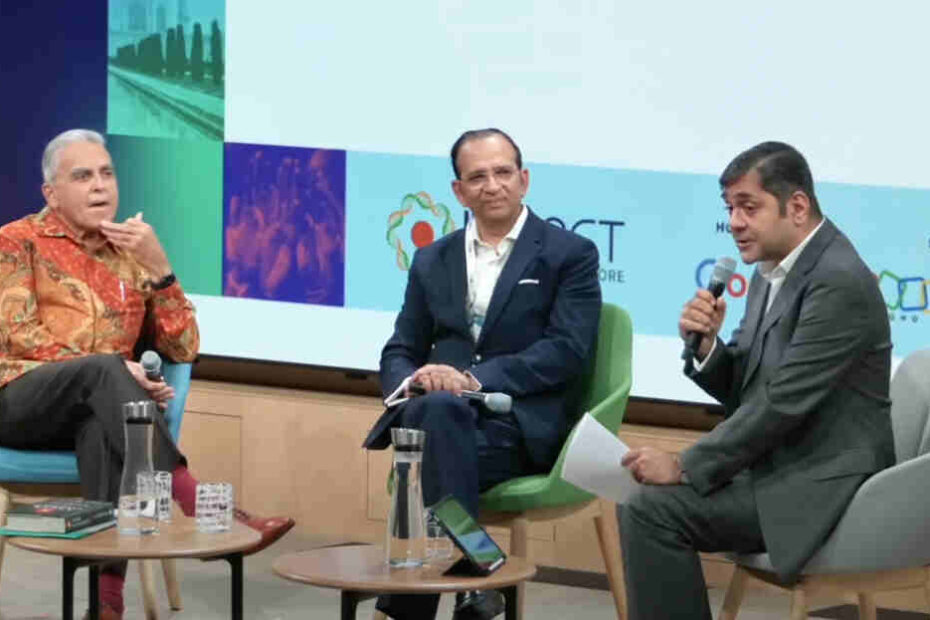
Read the full transcript of a conversation between international strategy experts, Kishore Mahbubani and Ajay Bisaria moderated by Rajen Makhijani on “What Will Geopolitics Look Like In The Next 10 Years?”, Oct 7, 2025.
Introduction
RAHUL: A lot of time has passed since the last IIMPact took place, and the world, as we knew, has changed. Politics, trade, markets, planet, everything has changed. Peace has stopped being the status quo and wars have become the new normal. The world has stopped worrying about greenhouse emissions and has started worrying about White House emissions. Remember, you heard it here first. Crypto has moved from being the gawky teenager with pimples to the prom queen of the investment circles. Artificial intelligence seems to be capable of replacing almost every job, except that of the MC. So we have, of course, all seen wars, trade tussles, technology shifts, and we have been in similar situations before, but never all happening at the same time. In these shifting sands and changing winds, where do India and Singapore stand, and what does it mean for us collectively and as well as independently?
Reviewing the Global Map
Taking this thought further, I would like to now welcome you to our first session of the day. It’s called Reviewing the Global Map. To deliberate on this, I would like to invite two gentlemen to the dais. To introduce them, the first speaker, he has been often labeled as the Henry Kissinger of Asia, known for his frank, fearless, and forthright views. He has had a ringside view of the global stage and has been long known as one of the few Singaporeans, few Singaporean voices, which resound globally. Professor Kishore Mahbubani, distinguished fellow at NUS’s Asia Research Institute, and former Singapore ambassador to the UN and past president of the UN Security Council. Welcome, Professor Mahbubani.
During him, company is another remarkable individual. One of us, I mean, and I am alumnus, is one of the few individuals who has had a rather unique career. He was stationed in Moscow during the Soviet breakup. A seasoned diplomat, he was also in Berlin post the reunification, and has served as the last Indian ambassador to Pakistan, giving him a rather unique perspective of world affairs from an Indian view. He’s also written a book called Anger Management on the Indo-Pak relationships, which I encourage you to look it up. So, Ambassador Ajay Bisaria, former High Commissioner of India to Canada and Pakistan.
Moderating them is a quite eloquent individual himself, a two-time TEDx speaker and a coach to the coaches, and a nominated screenwriter, the eloquent Rajen Makhijani. So while our guests take their seats, I would like to remind the participants to send in their questions by scanning the QR code. The QR code is the same for all the sessions, and attendees can send in their questions anytime during the session. Rajen, over to you.
Setting the Stage
RAJEN MAKHIJANI: Thank you, Rahul. I’m just looking around the room at the stage, and just marveling at this opportunity. What an afternoon. On stage here, I have 35 and an indeterminate number of years of diplomatic experience. I’d like you to look around to the people that are sitting next to you, behind you, in front of you. In the audience, we have CXOs. We have decision makers. We have influencers. We have thinkers. We have government. Easily, this little room here accounts for decisions that are worth multiple billions of dollars. Now, we could use, and in between the two of you, is me. So I see my job here as a bridge.
As Rahul mentioned, I work as a top team coach. So I work with boards. I work with investors. I work with top teams in getting them to get to big, hairy, audacious goals, business transformation through personal transformation. And that’s the bridge I’d like to make today between this eminent panel and yourselves.
So here is an invitation for you. Geopolitics can often be approached as a spectator sport, almost like the analysis of cricket. Oh, this one should have done this. Oh, that one, that was a great move, and so on and so forth. Now, if we approach today like that, we could have an interesting panel and an interesting time. But I think that’s too low a bar. Here’s my invitation to each one of you. I ask you to reflect upon how you are not in a spectator sport called geopolitics. You’re a player on the pitch with the multiple billions of dollars that you control and influence. Your decisions make real impact. Geopolitics makes real impact.
My last point of reflection for you, for those of you who are from India, and I see that there is a substantial number here. Treat this like a cricket commentary. Okay. But think about the real impact. Today, so 35 years and 35 plus years. Today we are celebrating 35 years of India’s economic liberalization, a macroeconomic and a geopolitical shift.
And look around yourself, look at your own lives. I bet 90% of this room would not be in this country, in these positions, living the life that you live. So this is real. So I invite you to approach today’s conversation. And as you think about, as you hear them, as you think about the questions that you want to pose to them, think not just in terms of interesting questions to ask about the world, but about your own role in this world. And how do you face the balls that the geopolitics is throwing at you? And how do you be a leader that leads it?
With that invitation, let me start with you, Kishore, the provocateur in the room. What are the two or three biggest structural changes in the global order that business leaders, government leaders must understand and separate the noise, as you call it, from the real structural changes?
KISHORE MAHBUBANI: First of all, Rajen, thank you very much for inviting me.
It’s a great honor to address this very august audience. I’m impressed on a Saturday afternoon you can fill a room. That’s very impressive. And I’m glad to be here with Ambassador Ajay Bisaria.
The Greatest Structural Shifts in 2,000 Years
On the structural shifts, it’s important to emphasize that the scale of structural shifts we are witnessing today are among the greatest possibly, maybe even in 2,000 years of history. And it’s important to understand that in our times, you must be prepared for some big surprises. So what I’m going to do is mention two structural shifts and two recent short-term surprises that have in some ways been a shock to global geopolitics.
China’s Rise: From One-Tenth to Double Europe’s Size
The first structural shift, of course, let’s say we compare, let’s look at the two biggest giants in Asia, China and then India. In the case of China, in the year 1980, the combined GNP of the European Union was ten times bigger than China, 1980. Today, the European Union and China are about the same size. And by 2050, the European Union will be half the size of China. So in one human lifetime, the European Union goes from being ten times bigger than China to becoming half the size of China. Just one structural shift. But the Europeans haven’t woken up and realized that that’s where they are today. They’re on holiday. That’s right, they are still on vacation.
India’s Reversal: From Ruled to Ruler of Economic Fortunes
In the case of India, I like to compare India to the United Kingdom, right? Because, I mean, that’s a natural comparison. It’s hard to believe that 100 years from now, 300 million of our ancestors from India were ruled by 100,000 Englishmen. Right? 100 years ago. Amazingly. And today, if you send 100,000 Englishmen to India, it would be massacred. So, and even if you compare the British and UK and India, as recently as the year 2000, the British economy was close to four times bigger than India’s. 3.6 times bigger. Year 2000. Today, UK is smaller than India. And by 2050, India will be four times bigger than UK. So, look at that. 2000, the British are four times bigger. 2050, India is four times bigger. That’s a major structural shift.
Time for UK to Give Up Its UN Security Council Seat to India
Which is why I wrote a Financial Times article saying it’s time for UK to give up its permanent seat in the Security Council to India. I mean, the British should be gracious about it, right? They got to rule India for 200 years, so the least they can do is repay back India by giving their permanent seat to India. I’m surprised that that suggestion wasn’t picked up in India by more people, you know? So, those of you who have connections in Delhi, please call them and say, please echo that call.
And I want to emphasize that this is not a frivolous point. This is actually a serious point. The one thing I learned after being ambassador to the UN for over 10 years is that the founders of the UN intended the veto to be given to the great powers of the day and not the great powers of yesterday. That is why the French are very aware that their seat is hard to justify. That is why they have not used their veto for more than 40 or 50 years. They don’t dare use their veto. When they use their veto, they will be asked, “Why are you using your veto?” That is why they don’t dare. They are very aware that their time has come. That is structural change.
But at the same time, even in the last 6 months, if you had asked me about these two things in January, would these two surprises happen? In January, I would have said no. Not possible.
But both these surprises have happened. The first surprise, you know, when Donald Trump launched the trade war against China in his first term in 2018, the Chinese had no defense. They didn’t know what to do. They were running around trying to figure out how to respond to Donald Trump. They couldn’t fight back. They just had to take whatever was dished out by Trump. By this time, the Chinese were able to draw a red line in the sand and say, careful. If you hurt me, I’ll hurt you equally painfully. And as you know, when they cut off rare earth and magnet supplies, the pain was very real. Suddenly, you’ll notice that the Trump administration is being very careful with China. Watch their tone when they speak to China.
So, in the last six months, the big change is suddenly, the U.S. has accepted China effectively as its peer. This has just happened in the last few months. Big change. And the other surprise, if you had told me in January this year that, you know, India, which has been cultivated by every U.S. president, from Bill Clinton to George W. Bush to Barack Obama to Donald Trump to Joe Biden, 27 years of this cultivation would be undone in a few weeks, I would have said it’s impossible. This is a deep bipartisan U.S. commitment to the India-U.S. relationship. It’s one of the few bipartisan things. It will survive no matter what happens.
But you’ve seen how toxic that relationship has become. And it’s very painful because there’s been a lot of unnecessary toxicity towards India. Like calling India a “dead economy.” Like imposing additional tariffs on India for buying Russian oil. Sorry, China buys Russian oil. How much tariff increase on China? None. See? That’s what I mean about double standards. And then, look at the way Asim Munir was invited to the White House. Very calculated. So, all these things show that sometimes in politics, the unexpected can also happen.
Thank you. So, taking your point about a few weeks. They also say what happens quickly can also reverse quickly. And I know, Ajay, you’ve been watching and you’ve been saying wait for three months, is what you said. So, talk to us about India, India’s position and what do you expect in the recalibration that India sends out with respect to its diplomatic position, priorities, and ultimately, pointing to the business ecosystem.
AJAY BISARIA: Yes. Thank you, Rajen. Thank you. Delighted to be here. Delighted to be in Kishore’s company. It’s an honor and privilege to be part of this panel discussion. And, you know, congratulations and kudos to this group of 3,000, which is a living business bridge between India and Singapore and actually having this discussion.
So, I’ll speak today as an alumnus who’s just moved to geopolitics for 35 years. But, now I occupy the grey space at the intersection between geopolitics and business. So, I think to Kishore’s last point about changes in geopolitics, I’ll submit that the larger game remains the same. You know, there are some long trends which are very important. For instance, I would say the China-U.S. competition probably began in Trump 1.0 when they started the trade war between the U.S. and China.
But, in the India-U.S. change, I think what we saw in Trump’s second coming this year is a very capricious and volatile America that we as a country, so we had a bad August in our relationship with the U.S. because July was good. In August, you suddenly had 26% duties and then 27% duties. So, this is in Trump’s mind, in Trump’s second coming, changing the art of the deal. So, there was, and then he tried to get a deal from Putin on Russia and India became collateral damage. So, things have changed in September and part of the reason is India also made long term optics to not push this relationship too much, so India just has to live in a world that goes beyond America and India can afford to do that.
So I think the message is clear. And now in September, we are in an interesting and intriguing space, which is that in three months, there will be a deal that will be done with America. And don’t be surprised if Trump shows up in November in India for a summit. And I want to emphasize the deal that will happen in two months. And that’s why India needs to play that game and also play geopolitics in a way that I think India’s strategic partners will take care of America in the coming times. In short, politics is such that America is not a fully trusted partner. India is an emerging country, and India will have its own strategy. And for China, to take care of the country called Pakistan, they have $18 billion in trade and dependency on its replacement value. So India will continue to take care of China, and not just ceremonially.
India’s Leverage in Negotiations
RAJEN MAKHIJANI: And India, because you spoke about the chips that China has created on the negotiating table, right, with the rare earth minerals and so on, so what chips does India have to put on the table to get Donald Trump to act differently?
AJAY BISARIA: Well, you know, India’s used some of the chips already, as we said, the optics of India saying that we could be aligning with a different set of countries if the US proves too volatile. And that had an impact in US domestic politics where the question was being raised: has Trump lost India? And therefore, you see the better noises coming from Marco Rubio and others, and Trump’s key aide coming as ambassador to India and very explicitly and kind of simplistically saying that he said in his Senate confirmation hearing that we don’t want India to go too close to China, and we want to pull it back. So, you know, that is a chip.
But what Kishore mentioned, China, India does not have that kind of leverage that China has because, you know, China demonstrated its ability to weaponize the trade and weaponize their dependence on the value chain. So by rare earth minerals, and we’ve seen that in the Indian context as well, you know, the Foxconn engineers being withdrawn, trade magnets, and so on. So I think the chips that India holds are not in the trade domain, but certainly in the domain of geopolitical alignments that India could change. The emphasis it would place on the US relationship. And as Kishore mentioned, this is a relationship that is 27 years on a trajectory which has been positive. And Trump 1.0 himself took this forward in, you know, in giving the Quad content and raising it to the summit level.
So I feel that once we review Trump 2.0 three years later, it won’t be a story that will be as pessimistic as it appeared in August. It might be a better story.
Future Scenarios for Global Order
RAJEN MAKHIJANI: Okay, so then a peek into the future beyond November. This is a question to both of you. Whoever chooses can go first. Is what scenario is most plausible in the global world order? Is it alternative blocks? Is it, you know, India’s tilt towards China being not just tactical but a series of tactical which perhaps has a different future? Is it a fundamental redrawing of India-US relationships? What are the scenarios that you think that might play out in this world?
Understanding the Complexity of Current Geopolitics
KISHORE MAHBUBANI: Well, I mean, I want to emphasize that the current situation, the key word you’ve got to understand, is complexity. And it’s extremely complex because there are a lot of moving parts all the time, you know. So for a start, clearly, at the highest strategic level, you know, in the Cold War, it was bipolar. The Cold War ended, became unipolar. And now we have what you have, a strange combination of both a bipolar and multipolar world. Because clearly now, there’s no doubt that China is effectively the number two power in the world. And the fact that they were able to, you know, check President Trump so clearly shows that they are aware of their leverage and what they can do. And increasingly, people also recognize China as a peer competitor of the US.
And I want to emphasize that the hold that China has over the US is not just in rare earths and minerals. That’s just the first shot. But the Chinese have decided a long time ago that to ensure that the United States is strategically dependent on China, they must increase their share of global manufacturing. And as you know, China’s share of global manufacturing in 2000 was five or six percent, but by 2030 will be 45%. And I’ve spoken to some American CEOs, you know, who told me that it is now the situation where if you want to manufacture almost anything in the world, in one way or another, you need some parts from China. And if those parts don’t come, then the US is in trouble too.
So this CEO told me, if the Chinese just stop exporting everything, watch what happens to the American economy. And I think that realization means that the United States has to treat China with a far greater degree of caution than it did in the past. So that’s the bipolar dimension. But at the same time, it’s clear that other poles are also emerging and have to be accepted.
Clearly India is going to be the third pole. India is in theory the fifth largest economy. By 2030 it will be the third largest economy. It will overtake Japan and Germany without any doubt whatsoever. So India has the capacity to be the third pole, but to function as the third pole, it’s best for India to be like the animal on the seesaw somewhere in the middle. So if on one side you have China, on the other side you have US, where India puts his foot determines where the seesaw goes. So that’s an ideal position for India to be in that competition, which means that you want to have some degree of functioning relationship with both and the capacity to talk to both.
But there are also other powers that are clearly changing the situation. Again, clearly Russia matters, right? And the biggest strategic mistake that the Europeans made in dealing with Russia is that they only look at the size of its economy and didn’t look at the overall national strength and their military capability. So the Ukraine war could have been avoided if the Europeans had just shown some degree of respect for Russia’s own long-term strategic interest.
And the tragedy of the Europeans trying to punish the rest of the world for buying Russian oil is that they could have avoided this war with Russia if they had shown some strategic common sense in dealing with Russia. And the last surprise, by the way, and this is something that is just happening again, if you had told me a year ago that we would live in a world where Israel could choose to bomb any country in its neighborhood and get away with it and no one can stop it, I said no, no, there must be some restraints. But it’s actually quite amazing what Israel has done.
First, you know, in its bombing of Iran, incredibly successful. And the Israeli intelligence is absolutely amazing. How did they manage to kill the nuclear scientists in their bedrooms at night? What kind of intelligence is that, right? And then now I must say when they started to bomb Qatar, this bombing of Qatar I think is going to lead to some significant shifts also, because all along the Gulf countries thought that the number one threat is Iran and maybe we should try and get closer to Israel. And now they suddenly realize, hey, be careful, Israel now has the capacity to hurt us. So that also leading to new thinking that is going on.
Understanding Complexity in Global Politics
So all these, you know, so that’s what I mean about complexity. It’s not a simple black and white chessboard. You know, it’s extremely complex and you’ve got to watch all the moving parts. And the people who can get the big picture are the ones who will succeed and thrive. And those who don’t, like the Europeans, sadly the Europeans live in a delusionary world, you know. And I mean that quite seriously because they, you know, if you just look at the photograph of the European leaders sitting on sofas in front of the schoolteacher Donald Trump at his desk lecturing these European leaders, they look like schoolchildren.
I mean, the optics itself captured what had happened. And for a respected Prime Minister of the Netherlands, Mark Rutte, when I met him, he’s a very thoughtful intelligent guy, by the way. For him to call Trump “Daddy,” I mean it shows you that something has gone wrong. So that in this, actually I must tell you, in my last conversation with Kissinger, he told me candidly. He said the quality of mind of these Europeans has gone down so much. They don’t understand how much the world has changed.
So this is an example of where if you understand the world, you can navigate through it. But if you don’t understand the world, like the Europeans don’t, they seem they’re in trouble.
Audience Poll on Business Impact
RAJEN MAKHIJANI: So let me then, before I come to, just do a quick audience poll here. So you spoke about complexity and the need to understand it so that you navigate it. So raise your hand if you feel that your business, if you’re a business leader, or if you’re a government leader, then your day-to-day, your life, your world is already being affected by these shifts or is likely to get affected in a short time. So raise your hand. Raise your hand.
Okay, now keep that raised, keep that raised, keep that raised. Now continue to keep that hand raised if you believe that you and your team have the mindset to navigate this complexity. You’re equipped with those mindsets. Continue to keep that raised or else put it down.
Okay, so there’s a sufficient number of people that actually put that down. So now again, that’s a bit of a reflection for you, that if this is the world that we are coming into, this is not just a spectator spot. We need to be doing something about our own mindsets and navigating that. So thank you so much for pointing out that complexity. I do want to go to the India-Singapore partnership topic. Is there something that you might want to add about the multipolar nature or the scenarios of the world? And then I’d love to go to the India-Singapore partnership.
AJAY BISARIA: Sure, so you know, I would agree with Kishore on much of what he said on Russia, for instance, and on Europe. And I would endorse your suggestion that the United Kingdom should give up its seat and offer it to India. I think it’s a great idea because if you look at the global system now, there are, let’s say, four major poles, the US, China, and Russia, and the European Union. And you know, if you give them each a seat, the fifth candidate certainly becomes India.
But you know, just a quick comment on another issue that Kishore mentioned, which was China-US. The China-US contestation is here to stay. And if I was advising Trump today, I’d tell him to do the same thing India is doing, which means that you have a strategic contest with a rising China, which has an ambition to displace you in the next 30 years, but do your tactical adjustments with them. Don’t get into a fist fight with China at this stage.
And in the US, there are multiple strands of views, including one which says that we are an isolationist power. We are, it’s called the Monroe Doctrine, light. We are a Western hemispheric power. And elsewhere, we’ll be an external balancer rather than a resident power. So in the contest with China, we are not really interested at this point. But you know, that would be a reality they would face.
From India’s point of view, both the extremes of a US-China contest are not good for us. A US-China G2, as it used to be called, a grand deal, deal which Trump hopes to get, is not a great thing for us, because that collusion doesn’t help us. Nor is it very good for us to have a bipolar world again, with contestation and needing to choose because we lose our strategic autonomy in doing these tactical adjustments with China, while continuing the relationship with the US.
So for India, the ideal world would be where India continues to be a pole. And the multilateralism that defined the world, which is becoming defunct, and Kishore has written about it extensively, is something that we reform for those institutions to recognize the world as it is, rather than as it used to be in 1945, which means this is more a G20 world than a P5 UN world.
The India-Singapore Strategic Partnership
RAJEN MAKHIJANI: That’s very well said, a G20 world than a P5. I want to go into the India-Singapore sort of partnership and corridor. Ajay, I’ll stay with you. Recently, Prime Minister Modi was in, sorry, Prime Minister Lawrence Wong was in Delhi. I had the unique opportunity of translating between the two of them and being the voice of Prime Minister Modi in Prime Minister Lawrence Wong’s ears. One of the significant ones that caught my eye, one of the pacts was the cyber security defence pact between Singapore and India, which Singapore doesn’t even have a China. What do you think is cooking here? What do you think is the future here?
AJAY BISARIA: Yes, I think what India is recognizing is Singapore’s role, not just as an economic behemoth, but also politically in the region. So we saw Modi come to Singapore and sign the strategic partnership agreement last year, but we had a pretty good relationship going even before that. And now the two prime ministers set out a roadmap, which included, as you said, cyber security, digitalization, you know, economic skill building and so on. So I think it’s recognizing the reality.
Already, Singapore is the largest source of FDI in India, 15 billion dollars. From 2000 to 2025, it’s 175 billion dollars of FDI has gone into India. And therefore, you know, it’s a quarter of the all the FDI that has come in. So Singapore is punching well above its weight in a political sense when India has looked east and act east as a policy. Singapore is the fulcrum of the ASEAN where India does that dealing. So I think it’s a critical relationship and I think it’s going to get even closer, even better.
RAJEN MAKHIJANI: Sure.
Bringing in the ASEAN India and then, of course, Singapore is going to be the ASEAN chair in 2027. So what do you see as the unrealized potential here?
KISHORE MAHBUBANI: Well, I think on India, Singapore, in addition to all these sort of objective measures, one important key dimension is that there’s a high level of strategic trust within India and Singapore. And it goes back a long way, because way back in the 1990s, long before India emerged into the position where it is today, there was some resistance of bringing India in as a partner of ASEAN Regional Forum and the Singapore Prime Minister then Goh Chok Tong successfully engineered India’s entry against the opposition of Malaysia and Indonesia. And that people in Delhi still remember that Singapore got us, helped us. So that strategic trust takes decades to develop. And that’s a key foundation of the India-Singapore relationship.
But what we need to see is the similar degree of strategic trust now within India and ASEAN as a whole. And here, the one relationship which clearly has the tremendous potential is the India-ASEAN relationship, because if you look at it historically, for the last 2000 years again, the two countries that had the greatest influence in Southeast Asia were China and India. But what’s significant is that out of the 10 Southeast Asian states, nine have an Indic base. Only one has a Sinic base, Vietnam. Wow. Right.
And many people are not even aware that the largest Hindu kingdom ever in human history was not in India. It was in Cambodia a thousand years ago. Right. So the traditional links between Southeast Asia and India are very deep, very powerful, but they are today unrealized. Relatively speaking, of course, China’s now role and presence in Southeast Asia is much greater. But this goes against the 2000 year pattern. So I think it will be in India’s national interest to try and step up its links with Southeast Asia, given this big historical base.
The New CIA: China, India, and ASEAN
And I would say that it’s a mistake to underestimate ASEAN’s potential, because there are three growth poles in Asia, China, India and ASEAN. I call it the new CIA, not Central Intelligence Agency. And one statistic we should all know is that if you look at the one among the 1.4 billion people in China, 1.4 billion people in India, 700 million people in ASEAN, out of these 3.5 billion people in the year 2000, there were only 150 million enjoying middle class living standards, only 150 million. By 2020, the number exploded 10 times to 1.5 billion. And by 2030, it’s going to hit 2.5 to 3 billion.
Now, this is the largest increase in middle class populations. So instead of looking for growth outside these regions, China, India and ASEAN, if we can work together, can easily be by far the biggest growth pole in the world.
RAJEN MAKHIJANI: That’s brilliant. I’m going to shortly go into audience questions. I just have one for I have a one show of hands again. So you’re hearing this now. Raise your hands if your bosses, if you’re in an MNC or your investors, there’s somebody out there that you report to or is important in your decision making, but sits in the Western hemisphere. So raise your hand if that’s that’s the life, that’s what you have. OK, now, they are continue to keep those hands raised. Now, continue to keep your hands raised if you think that they understand these nuances.
Influencing Western Decision-Makers
Okay, so there’s a big influencing job for the people in this room to do with the investors, decision-makers that sit in the West. So Ajay, you now have a consulting role as well and you’re advising companies. What language would you equip them with such that their Western bosses, investors and boards can understand them?
AJAY BISARIA: Yes, so I think it’s fairly clear that the India growth story is real and will be real. There will be a 6 to 7% growth rate, but the ambition with reform is to go up to the 8 to 9% growth rate and therefore achieve that objective of 2047. And I would argue that now India used to be, or the conversation in the last five years was the China plus one opportunity. Now it is the US plus one and the EU plus one opportunity as well. Because given the volatility in both the US and a bit in the EU, added to the China volatility, there is an opportunity in a reforming, growing India, which is much greater than it used to be.
So I think this is the point that I hear from boards in Canada now, which are hugely exposed to the US markets and the US system. And I think it’s valid even for Singapore. I think that’s very empowering language, risk management language and a new language, at least I’ve not heard it before, which is, guys, can we think of US plus one?
RAJEN MAKHIJANI: Yes. So now we’ll just one is it the counter says differently here. It says there’s more time. I’ve been timing myself to the counter. OK, and I need some help with this. Can you just help me with the pigeonhole questions? OK. All right. So I’m going to ask a question from Suresh, not because he is who he is in Pan IM, but because it’s got the maximum votes. OK, so this is a democracy here.
US Tariff Threats on Software and Outsourcing
RAJEN MAKHIJANI: Will the US carry out the threats of tariffs on software and outsourcing? Or is it just posturing to get a great deal out of India? Your thoughts? And we’ll do this rapid fire so we can.
AJAY BISARIA: My guess is it won’t at all. It’s posturing. It’s posturing. OK, what do you think?
KISHORE MAHBUBANI: Yeah, I think it’s in those specific areas. It’s unlikely to carry out those tariffs, but I would say be careful of Donald Trump, because, you know, you never know from what corner he’s going to come and hit you. And a lot of people make the mistake of underestimating this guy, Donald Trump. In his own way, he’s quite shrewd.
Understanding Trump’s Strategic Calculations
KISHORE MAHBUBANI: So for example, I’ll give you a simple example. The Europeans think that Donald Trump is being absolutely stupid in trying to cultivate Putin. He’s being taken in by Putin. He’s naive and so on and so forth. Actually, Donald Trump is the one who believes that in the long run, if the United States is going to succeed against China, it’s better to have Russia on the side of the United States than to have Russia with China. So he’s playing a long term game, but the Europeans don’t see it. And they keep trying to sabotage the Trump-Putin relationship, thinking, you know, they’re just trying to save Donald Trump, this naive fella from this wily, cunning Putin. But it shows you the Europeans don’t get it. There’s a bigger long term game that Donald Trump is playing.
KISHORE MAHBUBANI: So in the case of Donald Trump, be careful, especially because when you read the liberal media, they rubbish him, they dump him, and then you forget that there’s someone. He has to be incredibly canny to have moved the political center of the U.S. so dramatically in the way that he has in six months. People are underestimating Donald Trump. He’s playing in his own way a big game in which, frankly, he’s demolished the Democrats. So don’t underestimate Donald Trump.
The Future of Global Innovation Leadership
RAJEN MAKHIJANI: So that’s certainly you playing the provocateur there. Because I think if we took a poll, we would get all kinds of views on Donald Trump. Let me build on that question and ask both of you. There’s a question from Alok, which is quite interesting. There’s a whole lot of questions around can India and China really trust each other and become strategic partners? I’m going to skip that because I think you have actually addressed that in terms of the tactical versus the strategic and so on. But there’s an interesting question from Alok here, which is, where do you see the center of global thought and innovation leadership shifting over the coming years, given that the U.S. and I would kind of provoke this back to you, given that U.S. seems to be bent upon giving up its leadership in scientific innovation, thought, research and being the place for the best talent? Where do you think the centers would come?
KISHORE MAHBUBANI: Well, my answer is two-part. Part one, never underestimate the U.S. Because in the history of the U.S., it shows that whenever everyone thinks it’s down, it bounces back. So the American political system thrives on Darwinian contestation. And right now, the Darwinian contestation in the American political system is at an all-time high. And that actually strengthens the American system. So even though the universities are clearly being pummeled, they’ll bounce back and the U.S. will be very extremely innovative.
KISHORE MAHBUBANI: But the other pole of growth and innovation clearly, again, a mile ahead of anybody else will be China. And I was in Shenzhen last week or two weeks ago, and I went to visit the robotics factory there. And I watched the robots dance. I mean, what the Chinese are capable of doing in many of these areas is, again, quite stunning.
China’s Leadership in AI and R&D Investment
KISHORE MAHBUBANI: And as you know, no one expected in AI that the Chinese would come up with DeepSeek. And so the amount of investment, I mean, in terms of the sheer volume of investment in R&D, in science and technology, China is going to be ahead of everybody else.
AJAY BISARIA: I would endorse that. You know, it’s absolutely bang on.
Regional Instability in South Asia
RAJEN MAKHIJANI: Okay. I think I have one more minute, the counter says. I’m going to go for the question from, oh, here we go. Sriram’s question. And this is a somber question if it’s the last one. But nevertheless, it’s real. So let’s get real about it. Sri Lanka, Bangladesh, Indonesia, and now Nepal, they’re all looking similar. Is there something deeper brewing that the world needs to take note of? Perhaps we start with you, Ajay.
AJAY BISARIA: Yes, there is a lot of disaffection and we’ve seen this story repeat itself in India’s neighborhood. We saw it in Sri Lanka, in Bangladesh, now in Nepal. There is youth disaffection with the system. From India’s standpoint, you know, India is in a tough neighborhood. It’s the island of relative stability in a sea of ferment. And, you know, to add to that, we also saw in 2022 two coups, one in Myanmar in February and the other in Afghanistan when the Taliban took over.
So I think there’s a lot of ferment. Many of these dynamics were specific and individual to these countries. But I think it is also, at one level, a search for prosperity among youth who are connected globally and are complaining against their political systems, which are shortchanging them because they are either corrupt or misgoverning their countries. So search for prosperity.
Closing Reflections: The Role of Business in Creating Prosperity
RAJEN MAKHIJANI: And going back to the billions of dollars that are in this room, you have a role in that search for prosperity. So I ask you as a reflection, as we wind up this first panel, what role do you see in the search for prosperity for yourselves, for the youth? Because many of us were that youth at some point. We got an opportunity. What are the opportunities that you are prepared to create? And how are you prepared to navigate complexity in this multidimensional chess? Thank you so much. Can we have a round of applause, please?
Related Posts