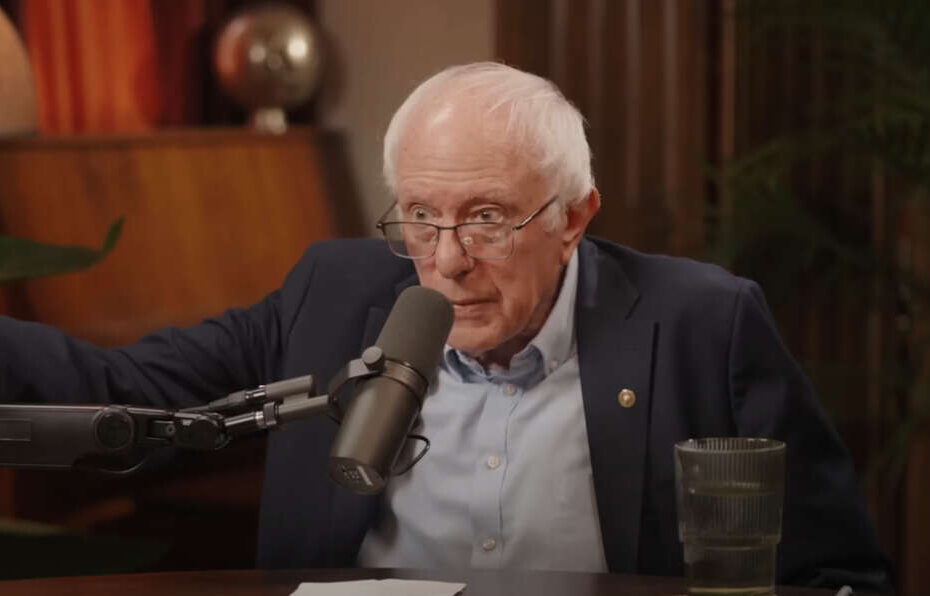
Read the full transcript of U.S. senator and activist Bernie Sanders’ interview on What Now? With Trevor Noah podcast on “Who Owns America?”, Oct 9, 2025.
The Revolution of Long-Form Conversation
BERNIE SANDERS: Take a look and see. My wife is going to yell at me being totally disheveled.
TREVOR NOAH: Yeah, that’s funny.
BERNIE SANDERS: I want to be half as good looking as Trevor. I don’t want him dominate the whole thing.
TREVOR NOAH: They account for age. It’s like golf with a handicap. How long have you been in town?
BERNIE SANDERS: Oh, about a half hour.
TREVOR NOAH: Oh, wow. Okay. How long you stay in town?
BERNIE SANDERS: Oh, about a day. And then doing an event with Mamdani tomorrow night.
TREVOR NOAH: Oh, that’s exciting. Oh, that’s really exciting.
BERNIE SANDERS: And presumably we’re doing a parade in the morning if it doesn’t rain, so we’ll see.
TREVOR NOAH: It said it was going to rain today and then it didn’t. So I hope that’s a good sign. Every day it’s switching around, you know.
BERNIE SANDERS: So you do these things, what, five days a week?
TREVOR NOAH: I try and do as many as I can, when we can, you know, so it depends on when people are around when we can.
BERNIE SANDERS: So you kind of enjoy this stuff.
TREVOR NOAH: I love it because I love that we get to spend time.
BERNIE SANDERS: Yeah. You know, well, that’s the revolution and it’s people are tired of seeing seven second sound bites.
TREVOR NOAH: Exactly.
BERNIE SANDERS: And I’m amazed. I mean, podcasts have exploded, haven’t they? Yeah.
TREVOR NOAH: So I think it’s nice for a book, for a conversation, for politics, for anything.
BERNIE SANDERS: Yeah. How the hell do you understand anything in a few minutes? All good.
TREVOR NOAH: All settled. Everything. Then we jump into it.
BERNIE SANDERS: Great to be with you.
America’s Broken Promise
TREVOR NOAH: Do you take requests that are going to be in New York just so you can get back to New York?
BERNIE SANDERS: Not really, no. We have some important engagements tomorrow. We’re going to be working to see that Mr. Mamdani becomes the next mayor of this great city, and we’ll be working with him tomorrow.
TREVOR NOAH: That’s exciting. That’s actually really exciting. And I feel like it ties into everything that you’re here to talk about today, because, you know, I was reading through your new book that’s coming out, and I was reading about your life, and I was just thinking to myself, you know, there’s one part of the book where you make your dedications and you dedicate the book to your grandchildren.
And there’s another part of the book where you talk about the teachers that you’ve spoken to and the struggles that they face in America today. You know, just the cost of living, the cost of teaching, the cost of being. And as I was reading through my notes and everything, I went, wow, Bernie Sanders, 83 years old.
And I was looking for time markers in and around what 83 means. And I was like, Social Security is 90 years old. And I don’t know why I felt like that was particularly significant thing, because I felt like you are somebody who has lived long enough to see America through different stages and through different phases.
And so maybe that’s where I’d like to start as we move through this journey, getting into the fight against oligarchy and what you’re trying to get people on board with now. How far do you think America is off from the promise it’s given to its people?
BERNIE SANDERS: I think you have a president who is way, way off, who is, in my view, the most dangerous president in American history, taking us in the wrong direction in every area. On the other hand, I think you got a whole lot of people who would love to see a very, very different America than we have today.
So Trump is what Trump is saying, and this is, I think, an important political point. He says the system is broken.
TREVOR NOAH: Yeah.
BERNIE SANDERS: And you know what? He’s right. System is broken. Problem is, his solutions will make a bad situation worse. And from a political point of view, the Democrats say, well, you know, we got to tinker around the edges on this. Do a little bit over here, but basically, we’re doing okay.
TREVOR NOAH: Yeah, that’s wrong.
BERNIE SANDERS: So I think you have millions of people who understand that in the richest country in the history of the world, we should be doing a hell of a lot better than we are doing today.
Identifying the Problem
TREVOR NOAH: You know, it’s interesting you just said that because I was talking to the team, and you know, my friend and I were walking, chatting about this episode, and one of the things that struck us was exactly what you said is Trump always identifies that there is a problem.
BERNIE SANDERS: Right.
TREVOR NOAH: His solutions oftentimes seem absurd, and they are. But he identifies that there is a problem.
BERNIE SANDERS: Exactly right. And not only him. If you talk to his people in education, they say the system is broken. You talk to people who work on healthcare, they say the system is broken. So they tap the anger and the frustration. People say, yeah, the system is broken.
TREVOR NOAH: Yeah.
BERNIE SANDERS: Then you hear their solutions. Half the time they’re totally crazy and will make the situation worse. But it is important. And what I try to do in the book is to lay it on the table. What the hell is going on in America right now? But you tell me, is the system working?
TREVOR NOAH: Why do you think you’re comfortable doing that when so many of your, you know, fellow senators and congresspeople aren’t? Because I think of AOC. I don’t know if you ever saw. This was right after the election. AOC did a poll. I think it was on Instagram.
BERNIE SANDERS: Yep.
TREVOR NOAH: And she said, how many of you voted for me and voted for Donald Trump? Which seemed crazy.
BERNIE SANDERS: No, it did not seem crazy.
TREVOR NOAH: And a lot of people said, I voted for you, and I voted for Donald Trump. And the main thing they said was, I voted for both of you. Because although you’re very different, you both acknowledge that this thing doesn’t work.
Wealth Inequality and Power
BERNIE SANDERS: That’s exactly right. And the people are right. Look, I mean, I think one of the things I try to do in the book is to raise issues that you’re not going to see on corporate media, and you’re certainly not going to hear discussed very much in that US House or US Senate. Politicians don’t talk about it.
And that is, okay, who has the wealth and who has the power? Simple question, right? Do you ever talk of it? We ever hear much discussion about it? We don’t. But the reality is that today in America, we spend a lot of time talking about this in the book is we have more income and wealth inequality than we’ve ever had in the history of the United States.
Okay, now you tell me if it’s not crazy. I think it’s crazy that you have one guy, Elon Musk, owning more wealth than the bottom 52% of American households.
TREVOR NOAH: Bottom 52%?
BERNIE SANDERS: Yes. Is that insane? I think it is. But here’s another point. Who determines what we should get outraged about? All right, so some kid with a gun walks into a shop down here and shoots somebody, we’re all outraged, and we should be, okay. Crime is a serious problem.
But if the heads of the fossil fuel industry lie to us day after day and are jeopardizing the well being of billions of people on this planet, should we get outraged? Or should we give them an award for being great humanitarians? In other words, you understand what I’m saying? Yeah. No, I controlled the culture, what we’re supposed to respond to.
So to me, you lay it right on the table. It is insane that one person owns more wealth than the bottom 52%. Top 1% owns more wealth than the bottom 93%. CEOs make 350 times what their workers make. So you just put that on the table. Should we be discussing that day in and day out? I think we should.
Defending the Billionaires
TREVOR NOAH: Some people say we’re going after the wrong people, though. You know, I’ve heard so many people when I have these conversations with them, they go, why are you getting angry that Elon made money? I mean, Elon’s made electric cars and Elon has made this fantastic space Internet, and Elon has made so much money for the American public.
And Elon hires people and Elon has factories and why are you hating on him, Bernie? Why are you hating on the guy who’s bringing ingenuity and he’s bringing money? Why he’s not good?
BERNIE SANDERS: That is exactly right. And millions of people share that view. So should we be, quote unquote, punishing Elon? No. But should we be having a living in a society which allows so few to have so much wealth and so much power? And it gets to a whole other issue which we try to raise in the book.
All right, everybody wants to make money, right? You want to make money, I want to make. Everybody wants to live comfortably. Elon Musk wants to live comfortably. Is enough enough? When is enough enough? How much do you need and how far are you willing to go to destroy the environment? All right, to get more or to do things like recently, you know, Trump’s big, beautiful bill, a trillion dollars in tax breaks to the 1%, massive cuts to Medicaid, nutrition and education, and these guys will go further.
In other words, they do not look at economics as something well, you know, I’ve made it. I got $3 billion, man. I couldn’t spend that in a thousand years. How lucky am I? It’s not what they think. They want more and more and more. More wealth and more power, and that has got to be stopped.
Understanding Oligarchy
TREVOR NOAH: When you look at the way the system is built right now, you know, I know it’s easy for a lot of people to say, we hate oligarchs. And then other people say, oh, America doesn’t have oligarchs. They go, America has a democracy, and America just has some very rich people who have made some important things that make the world go round.
So we shouldn’t call them oligarchs. We should call them business people. And that’s what America’s founded on. It’s founded on business. How do you respond when somebody says, well, Bernie, you’re just trying to interrupt a very natural thing that is capitalism and it’s the greatest system in the world?
BERNIE SANDERS: Well, you’re in a hyper capitalist situation. When we talk about oligarch, oligarchy, you’re talking about a small number of people with incredible wealth and power. So what is their power about? Their power is not only that they control, to a significant degree, the entire economy.
So today, not only do you have more income and wealth inequality that we’ve ever had, you have more concentration of ownership. Okay. That means fewer and fewer large corporations own and control what is produced, what their workers make, what you pay at the grocery store.
TREVOR NOAH: Yeah. Okay.
BERNIE SANDERS: And then on top of that, these corporations themselves are owned by huge Wall Street firms. So you have companies like BlackRock, Vanguard, State Street. These three corporations combined are the dominant stockholders in 95% of American corporations. Got that? So it’s…
TREVOR NOAH: They’re the dominant.
BERNIE SANDERS: Yes. Add the three together, you look up. Go to Google, look up any corporation you want to. Almost any. You will find Vanguard, State Street, BlackRock, major stockholders. I know you’re looking at me in a quizzical way here. It’s true. Check it out.
So what it is, give you an example. I was the chairman of the Health, Education, Labor and Pension Committee. Now I’m the ranking member. So we hear from and reach out to workers all over this country who are involved in labor struggles. They call, Bernie, we’re on strike, and you give us support.
So we get on the phone and we call up the guy who’s nominally the head of the company, says, you talking the wrong guy, Bernie. Somebody else owns us. And you find that somebody else owns somebody else. That’s what a conglomerate is about. Somebody owns something, but it’s owned several times over.
TREVOR NOAH: Yeah.
BERNIE SANDERS: All right. It’s a relatively small number of people who control the economy. That’s called oligarchy. But it’s not just that. How do you get the information? How do you… Now you’re in the information business, right? Or the entertainment. But that’s what you do for a living. Correct. So who owns the media? You tell me.
TREVOR NOAH: It’s a few companies now, right? And everything’s getting consolidated. It’s becoming smaller and smaller. It’s fewer and fewer people.
The Concentration of Media Power
BERNIE SANDERS: You got it? Yeah. So what my understanding is you have six large international conglomerates, media conglomerates that control about 90% of what the American people see here and read. All right, so look, take a look. Look, about oligarchy. Mr. Musk. Is that all he does is make electric vehicles? Not quite. He owns Twitter, right?
TREVOR NOAH: Yeah.
BERNIE SANDERS: Oh, what about Mr. Bezos? Well, he owns the Washington Post, which is a very influential newspaper. And he owns Twitch. What about the Ellison family? Well, they just bought Paramount, which happens to own CBS movie. All right, and then you got Mr. Zuckerberg, of course, who owns Meta, which controls Facebook and Instagram.
So you got four of the wealthiest guys in America owning us. Just those. Not to mention Rupert Murdoch, obviously, who owns Fox, the Wall Street Journal, the New York Post. Right wing newspapers all over the world. You check out who owns newspapers in the United States. Billionaires, by and large.
So you add up income and wealth inequality, concentration of ownership, control over the media. Let me throw out another one. We talked about democracy. Well, Trevor, that we live in a democracy.
TREVOR NOAH: People would say yes, and the answer.
Democracy and the Influence of Money
BERNIE SANDERS: Is yes and no. We have elections. Right. So who plays the influential role in elections? All right, let’s go back just to the last election. Mr. Musk, the wealthiest guy on earth spent $270 million to help elect Donald Trump, right? $270 million. That’s true.
TREVOR NOAH: Yeah.
BERNIE SANDERS: And his reward? These guys don’t make investments without getting something in return. True. I mean, they don’t do it out of the goodness of their heart. So forget all the tax breaks and other breaks that he got. He got to run the government for three or four months and impose his right wing extremist ideology on the American people.
I’ll give you another example. There was this so-called “big beautiful bill.” What happens if a Republican were to stand up and say, “You know what, I looked at this bill, it ain’t a good bill.” And it happened. There’s a guy named Thom Tillis. I didn’t bring a bill to you. He’s a senator from North Carolina, not the world’s most famous senator, just kind of a typical conservative Republican.
He made the mistake of actually reading the bill and he discovered that several hundred thousand people in North Carolina were going to lose their health insurance. He says, “You know what, I can’t support that.” You know what happened to him? Literally within hours, Trump was on social media ripping the hell out of this guy. Billionaires were saying, “We are going to, you know, we got a primary opponent against you.” And I think in a day, he said, “Forget it, I’m out of here. I’m not running for reelection.”
So right now, what oligarchy is about is not only controlling the economy, controlling the media, it is also controlling the political process.
TREVOR NOAH: Yeah.
BERNIE SANDERS: And it’s not just Republicans. Kamala Harris had some 80 billionaires contributing to her campaign. And I think that resulted in her running a much more conservative campaign than she should have run. It was an election that should have, that she should have won. In my view, she lost it because of conservative influence from the billionaires who told her not to speak up for working families. That’s called oligarchy. Does that sound like an oligarchy to you?
The Ecosystem Out of Balance
TREVOR NOAH: It sounds like an oligarchy. The only thing that comes to my mind is that I think of an ecosystem, any ecosystem goes out of balance when one species is sort of allowed to thrive by itself without a natural predator of some sort. So it’s a weed or a plant that moves, and then all of a sudden it just proliferates over and over. You get what I’m saying?
It can be a rabbit that goes from one island to another, and all of a sudden it can just breed to infinity and wipe things out. I wonder if America can get out of this place, because as you just said, there’s something really interesting to what you just said. The Republicans have very openly said, especially under Trump, we’re pro business and we’re with these people. Democrats say they’re on the side of the people, but then a lot of the time their actions don’t seem to match up. It seems like they…
BERNIE SANDERS: Trevor, let’s not be naive. No, I don’t think anyone in America believes that Democrats are on the side of working class people. I mean, there’s some rhetoric occasionally, but most working people don’t know it.
And in fact, the dynamics of American politics is over the last 40 or 50 years, the Democratic Party, which once was the party of the American working class, is now, you know, a corporate party which has done, in fairness, and I always say this, we have made significant advances in civil rights, in women’s rights, in gay rights, and at least in environmental consciousness. Democrats deserve a lot of credit for that.
But in terms of representing the needs of the working class. If they represented the needs of the working class, you would not have this massive income and wealth inequality. And equally important today, you know, I talked about the rich getting richer and all that stuff. Yeah. What’s going on for the, you tell me what’s going on for the working class in America today? How are they doing?
TREVOR NOAH: Earning less than ever before.
BERNIE SANDERS: That’s right.
TREVOR NOAH: Income’s not matching up with inflation.
The Reality for Working Class Americans
BERNIE SANDERS: You got it. Yeah. So here’s a startling fact. We put it in the book, and that is, over the last 50 or so years, real inflation accounted for wages. Weekly wages for the average American worker is lower today than it was 50 years ago.
TREVOR NOAH: Lower today than it was 50 years ago.
BERNIE SANDERS: Think about the explosion in technology, right? Workers are far more productive. They’re producing a lot more. And yet during that entire period, despite increases in worker productivity, real inflation accountable wages are lower.
Meanwhile, during that same period, there was a $75 trillion transfer of wealth that went from the bottom 90% to the top 1%. So you add all of that stuff up, it’s not hard to. You know, I think people instinctively understand it. The very rich are doing phenomenally well. Massive transfer of wealth. Working families struggle.
60% of people in America today live paycheck to paycheck. We have the highest rate of childhood poverty of almost any major country on Earth. Highest rate of senior poverty of almost any major country on Earth. That is where we are as a nation today.
Trump’s Inauguration: A Board Meeting
TREVOR NOAH: In the book, you tell a story about being at Trump’s inauguration.
BERNIE SANDERS: No.
TREVOR NOAH: And you…
BERNIE SANDERS: You’re reminding me of that. Right. You wrote it in the book. I know.
TREVOR NOAH: And you talk about looking around at the people who are gathered there, and obviously there’s everyone you know who works in the government, senators, et cetera. But you notice there’s an outsized collection of the richest people in, the way you describe it, it sounds less like an inauguration, more like a board meeting. You know?
BERNIE SANDERS: That’s true.
TREVOR NOAH: It seems like. I want to know if you think this is the worst it’s been. Was it growing to this? Because it truly didn’t just happen overnight, of course. When do you think, what do you think was the first domino? If we were to take a step back and go, okay, Bernie, when do you think you remember seeing the first domino where you went, “Oh, man, this is not how it’s supposed to be?”
BERNIE SANDERS: I don’t know if I know the answer to that, but I will tell you, I mean, again, going back to the inaugural.
TREVOR NOAH: Yeah.
BERNIE SANDERS: You had the three wealthiest guys, Musk, Bezos and Zuckerberg sitting right behind Trump. And right behind them were another, I think, 15 billionaires who Trump had nominated to head up major federal agencies. Okay. That’s the reality. This is a government of the billionaire class, by the billionaire class, and for the billionaire class.
When did this begin? Did it just start under Trump? Of course not. But I think the brazenness, what you got to give Trump credit for. In the past, money always played an important role. No secret there, but he’s right out, open. I don’t give a damn. The whole world knows it. I got the richest people in the world sitting right beside me and they’re going to generously give to my inauguration fund and oh, my goodness, they’re going to give me gifts. Oh, my goodness.
TREVOR NOAH: Library, my. Yeah, right.
BERNIE SANDERS: And the guy from Qatar, whatever, is, you know, decided to give us a $3.4 million plane. Just a generous person, so nice to me, you know, and on and on to go. You know, he’s made billions of dollars from crypto, et cetera, et cetera.
When did it begin? I think, I’m not an expert on this. I think early 1970s, when Democrats were saying, “Hey, Republicans get all this corporate money, why don’t we start getting some of that money as well?” And in politics, the truth is, you know, see, there’s an old Woody Guthrie song, which is, “Which side are you on?”
So if you’re taking money from billionaires and large corporations, at the end of the day, you may say nice things, you may occasionally do good things, but you’re not going to be on the side of the working class. And the results are pretty clear.
The AI Super PACs and Political Intimidation
TREVOR NOAH: So when you’re in Washington D.C. and you’re surrounded by all these people, I always wonder, sort of what the inner conversations are, because I read articles and obviously, you know, I’m on the outside and so I’m trying to understand what’s happening.
And I remember one of the articles I read that really got me was it was talking about the upcoming midterms and then thinking forward to the next election. And I’m sure you’ve seen this, but it was AI related, tech investors and, you know, the likes of Zuckerberg and you name it, and they are putting together these massive, massive super PACs. Yes.
And their only goal is to go after politicians who suggest any type of regulations against AI, and they go, “We are going to destroy you before you get in.” And then some politicians have commented, either on or off the record, saying, “Well, I don’t want to cross them because I don’t think this AI thing is that big a deal in what I’m doing anyway, so I’m just not going to cross them.”
BERNIE SANDERS: That’s true, but that’s what I’m talking about. So do we live in a democracy? Yeah, but if you vote away, if I’m a crypto guy, or I’m an AI guy, or I’m a fossil fuel guy, you can run for office. But I’m going to put huge amounts of money in a super PAC as a result of this disastrous Citizens United Supreme Court decision. And I’m going to beat you now.
Will I beat you every single time? No. But you know what? If I put tens and tens of millions of dollars into your opponent, Trevor, I will beat you most of the time. And that’s called a corrupt political system. And that’s what we’re living under.
Breaking the Cycle: Where Do We Begin?
TREVOR NOAH: So where do we begin? You know, in the book, you lay out all these facts. And I won’t lie. When I was reading through some of the numbers, I was like, Bernie, this is insane. The numbers are so overwhelming.
BERNIE SANDERS: Yes, they are.
TREVOR NOAH: It’s impossible. It just seems like this monumental task. And then you talk about, which I think is important, all the people who are coming out to support. You know, you’ve got 30,000 people coming to your rallies at a time when the media tells people that no one wants to be engaged in politics.
BERNIE SANDERS: You got it.
TREVOR NOAH: The media says, no one cares about politics anymore. No one wants to read it. But they’re coming out to your rallies. You know, people are showing up. People are showing up for Mamdani, People are showing up for certain politicians who are saying a certain thing.
And I wonder what the first steps are. Maybe that’s what we should be talking about is, you know, you go through the book, and I love how you take us through some of the historical fights, for instance, that once seemed unwinnable. If you were to start with one thing today, where do you think we start? Because it seems like a cycle right now. It’s like they have the money so they can put the ads out. The ads get their people in. When their people are in, they make the laws to favor them. So then how do you break it? Because it seems like a chicken and the egg cycle.
The Mamdani Campaign: A Microcosm of American Politics
BERNIE SANDERS: Look, I wish I could tell you there was a magical solution, but you mentioned the Mamdani campaign is a very good example. It seems to me like a microcosm of what we’re looking at. Give you an example. So this guy, who no one ever heard of, starts off at 1% of the polls right here in New York City, 2%. He suddenly starts raising issues that are on everyone’s mind. Nobody can afford housing in New York City. Working class people can’t do that. Transportation is expensive. Childcare is off the charts. Working class people have a hard time getting decent quality food for their kids at a price they can pay. Among other things, he starts raising these issues, gets more and more support.
Comes into the primary, he generates, as I understand it, he gets 50,000 volunteers. 50,000 volunteers. That is insane. Totally insane. So to everybody’s shock and surprise, he beats a former governor, Mr. Cuomo.
TREVOR NOAH: Right.
BERNIE SANDERS: You would think, now, in terms of politics, let’s just talk about politics. Democratic Party with leadership would say, “Whoa, here we are. Our people are demoralized. Trump was elected. We got a young guy, a smart guy. He has 50,000 volunteers raising small dollar donors. This could not be better. Oh, my God, we’re off and running. There’s a revolution. Thank God.”
Well, not quite. The four major Democratic leaders in the state of New York, as of today, no one’s supporting him. Now, doesn’t that sound a little bit weird when the Democratic Party, according to the polls today, is at the lowest point that has been in decades? One candidate generates enormous enthusiasm, pulls up a major upset, but they don’t support them. Why is that? And what does this have to do with oligarchy?
Meanwhile, at the same time, you have people, and this is, you know, this to me, is kind of new. Money always played a role in politics, no question. But you got people like, was it Bill Ackman? Is that his name?
TREVOR NOAH: Yeah.
BERNIE SANDERS: This guy, he says, “We are oligarchs, we are billionaires, and we are now going to spend as much money as it takes to defeat Mr. Mamdani.” Really? That’s called democracy? I mean, and they’re out in the open about it. It’s not like he’s putting money underneath. Front page is the news. We will. So who the hell runs the city?
Democracy Under Threat
And then what you’re really looking at, I’m trying to not want to take this too far a stretch. You got a president of the United States, you know, he gets into sometimes squabbles with Mr. Putin. But the idea, you know, in Russia there are elections, you know, that Putin always gets 80, 90% of the vote.
TREVOR NOAH: He does very well.
BERNIE SANDERS: Only his people can run for office. So Saudi Arabia, where you will remember, Trump made his very first trip. That’s where he went to Qatar, Saudi Arabia, UAE. These are zillionaires. I mean, some of the wealthiest people in the world running autocratic governments.
So what is true, in my view, is many of the, coming back here to the United States, many of these big tech guys, they don’t believe in democracy. I mean, read what they say. It’s not just that they want to even support this or that opponent. At the end of the day, they think democracy is an impediment to their God given right to make as much money as they want. That’s what we’re looking at right now. Scary stuff.
Is the Democratic Party Still the Vehicle for Progressivism?
TREVOR NOAH: So I can’t help but wonder where America goes from here, because New York is like the perfect example. Everyone was shocked at how Mamdani rose. I mean, his ascendancy was nothing short of spectacular. Andrew Cuomo seems like it’s a done deal. The next thing you know, Mamdani has it. Andrew Cuomo is dropping out, and then he’s not dropping out, and then nobody’s supporting Mamdani.
I won’t lie to you. It felt reminiscent, and it feels reminiscent of your campaign in 2016, you know, 2012.
BERNIE SANDERS: But also.
TREVOR NOAH: But I, yeah, sorry, yeah, going back. But when I think of your campaign where everyone assumed Hillary was winning and people went, “Well, this is the next line in the succession. This is how it’s going to go.”
BERNIE SANDERS: She was the anointed one.
TREVOR NOAH: The anointed one, right. This senator from Vermont comes along, Bernie Sanders, people go, “Oh, it’s silly summer.”
BERNIE SANDERS: It happens.
TREVOR NOAH: It’ll go.
BERNIE SANDERS: Exactly.
TREVOR NOAH: The people on the ground start swelling up, and the people say, “I think this Bernie guy could be the one.” But then the Democratic Party are the ones that stand in the way. And I then ask a question that I think a lot of people are asking on the ground, and that is, is the Democratic Party still the vehicle for liberalism in America?
BERNIE SANDERS: Well, I don’t like the word liberalism, but I would for progressivism.
TREVOR NOAH: Ah, progressivism. Okay.
BERNIE SANDERS: Better word. And the answer is to be God’s honest with you, I don’t know. I don’t know. We are supporting candidates who are running as independents and as progressive Democrats right now.
What I will tell you, Trevor, is that around the world, what’s going on here, around the world, there are similar political situations that there are here in the United States. So centrist parties like the Democratic Party are in decline in Germany, in France, in the UK. Right wing extremist bodies like Trump’s MAGA movement are on ascendancy. With some exceptions, that’s the trend.
And the reason is that all over the world, in the global economy, working people, rural people are feeling left behind while the rich get richer. And right wing extremists like Trump have something to say to them. Centrist bodies do not.
So I think where the Democratic leadership is right now is way, way, way out of touch with where working families and the majority of the people are. So either they get replaced, either there is a movement that says, “Thank you for what you’ve done. You’re gone. Now we need a new party that represents working people,” or else they hang on so tightly that they force the creation of another party, which is not easy in the United States. It’s easier in the UK and other countries.
But the current leadership of the Democratic Party is, as I mentioned, New York State is a perfect example where there should be enthusiasm and excitement. There is fear that working class people, that ordinary people are going to get involved and threaten the existence of the leadership here, their power.
The Natural Conclusion of Globalization
TREVOR NOAH: When I read about the history of the world, I sometimes worry that this is the natural conclusion, right? It feels like globalization was the thing and the corporations got rich and, you know, money gets centralized, a few people get everything, and then that leads to strife and turmoil. That strife and turmoil leads to populism. That populism oftentimes, if we look at history, then leads to some of the worst periods. And that’s when people like Bernie Sanders actually get listened to. That’s when people are most likely.
How do you think people break through in this moment? How do we break through before it’s too late? How do we break through before it’s world wars and before it’s massive recessions and before people are literally scrounging for…
BERNIE SANDERS: Let me go back. I should have said this a moment ago in response to your good question about the Democratic Party. I think the Democratic leadership is way out of touch. The dilemma that we face right now is I think there’s got to be, for the moment at least, something like a united front between progressives like myself and Democrats in order to defeat Trump.
So we’re fighting two fights. We’re fighting to either open up the Democratic Party to become a working class party or start a new party. But at the same time, it is absolutely imperative that we keep our eyes on Trump, who is clearly moving this country into an authoritarian society. So we got two fights on our hands, and that’s the political moment that I find myself in.
The Power Struggle Within the Democratic Party
TREVOR NOAH: How are they out of touch? I don’t understand that. So let’s use the Mamdani example. For me, it seems like a simple one, right? Andrew Cuomo gets trounced. He gets trounced in a way where on the night he can go home, he doesn’t have to delay anything. Generally that’s a trouncing in politics.
To your point, in my head, in many people’s heads, you’d go, “Okay, it’s obvious.” And this seems like the popular route to go down, which is what politics is supposed to be, as in popular of the people. The people are choosing what they would like, right? How do they not see that? What do they say to you when you’re talking to them? What do they not see?
BERNIE SANDERS: These are not dumb people. And that’s the first thing. Oh, people don’t understand. They understand everything. These are not dumb people. They have power and they want to keep their power. And they are, what Mamdani has done and what I have done in past presidential election is to threaten that power.
So if you’re sitting, if your power base is that you can raise a whole lot of money from wealthy people, you go to nice cocktail parties, you walk out with $100,000, you can hire a consultant, the consultant puts 30 second ads on television. That’s your world. And then somebody else comes along and mobilizes tens of thousands of people, doesn’t ask the rich for campaign contributions. That is a real threat to your existence. That is the bottom line.
And the pity of it is these folks are not evil people. The Democratic leaders that I know, they are certainly not dumb people, but they are more interested in clinging to power than to allow to support a grassroots mobilization which has the potential to transform America. They become an impediment to that process.
Parallels with the Entertainment Industry
TREVOR NOAH: You know, it’s funny, when you were saying that, I was thinking about the entertainment industry and I look at the shifts that are happening in the entertainment industry. They mirror a lot of what you’re saying. For so long, Hollywood had a centralized idea of who said what and who got to say it. A few people decided who was in a movie, who was on TV and who got famous.
BERNIE SANDERS: That’s right. That’s right.
TREVOR NOAH: And they did this for so long and they squeezed so hard that from the cracks of that little squeeze of theirs, you know, from the crevices of their fist, new media started emerging, new talents, new voices. And so in the world of podcasts it was the Joe Rogans. In the world of streaming, it’s the Kai Cenats, et cetera. And you see this happening everywhere and they have now lost the ability to define.
And funny enough, they’ve come around. So now if you want to promote a movie, you have to go on, you know, a streamer’s platform. If you want to get somebody pushing your content, you have to go on YouTube now you have to go. So the power is slowly moving in that way to the people. But it seems like Hollywood sort of understands it and I don’t know if they’ll change, but it seems like they understand it.
When you talk to Democrats who are establishment and they go, “This is the way it is,” is there anything you say to them that convinces them? Is there any moment where you’ve seen them go, “Ah, Bernie, you’re right”?
Popular Ideas, Unpopular Leadership
BERNIE SANDERS: Well, you do see that actually, you know, polling, they’re not oblivious to polls. And what polls show is that people like myself are popular. But more importantly, that the ideas that we are talking about resonate extraordinarily strongly among working people.
So I ask you, the United States, the richest country on earth, is the only major country not to guarantee health care to all people. How many Democrats do you think are talking about the need for a Medicare for all? Well, I introduced the bill in the Senate. We got I think 15 co-sponsors. Out of 15 out of 47. Why would you not be prepared to take on the insurance companies and move to a cost effective quality health care system guaranteeing health care to all people? Well, it’s the power of the insurance companies.
For years, you know, we’ve been fighting to lower the outrageous cost of prescription drugs. You know what, the American people, they hate the drug companies probably more than anything in the world. They really do. They’re getting ripped off every day. They know it. Have the Democrats, they’ve done a little bit in fairness, but if they’ve gone anywhere near as far as they should.
Here’s something, and I’m talking about basic necessities like health care, medicine. What about education? Psychologists tell us that 0 through 4 are the most significant years of human development intellectually and emotionally in the richest country on earth. Don’t you think we would have the best childcare system in the world?
TREVOR NOAH: You’d hope so.
BERNIE SANDERS: Well, you tell me. I don’t know if you have any kids or not.
TREVOR NOAH: No, I don’t. But I have friends who do and I’ll, I mean, it’s pretty obvious that it’s not. It’s far from it.
BERNIE SANDERS: It’s outrageously expensive.
TREVOR NOAH: Yeah.
The Cost of Education: Then and Now
BERNIE SANDERS: And the workers themselves get paid, you know, starvation wages. Here’s something that’s again, quite remarkable and showing the direction in which the country is going. You ask me, you know, because I am going to be 84. You know what the world, the changes that I’ve seen in my life when I was a kid, young man, graduated James Madison High School here in Brooklyn, New York. And I went my first year of college to Brooklyn College. Do you know what tuition was back then?
TREVOR NOAH: Oh, I feel like you’re going to shock me.
BERNIE SANDERS: Not going to shock you. It was. If it wasn’t, then it was a few years before it was tuition free.
TREVOR NOAH: Oh, that shocked me.
BERNIE SANDERS: Does it shock you really?
TREVOR NOAH: Yeah, that really shocked me. I thought you were going to say like maybe a few thousand dollars or something.
BERNIE SANDERS: City University of New York.
TREVOR NOAH: You just said tuition was free, Bernie. Yeah, yeah.
BERNIE SANDERS: Yes. Are you shocked?
TREVOR NOAH: That’s, that’s shocked. That’s shocking to me that it was free.
BERNIE SANDERS: Free. Yeah. University of California, one of the great university systems in the world.
TREVOR NOAH: That’s shocking to me.
BERNIE SANDERS: That was, I don’t know, the exact year, 60 years ago, 70 years ago, was tuition free. Yeah. You’re looking at me like I’m, I’m. You’re at a state of shock here, right? Because at that point, you know, people said, okay, you know, you’re working class kids. We want them to get the best education they can. We’re a growing nation. We need, you know, the best educated workforce. Sure, no big deal. That’s what we’re going to have.
In fact, City College, before it was the City University, was tuition free for a very, very long time. And it was one of the great universities in the world. Wasn’t some dumpy place in Vermont. We had state colleges that if you were a Vermonter, tuition free. And again, all over the country.
So we have regressed in saying that if, you know, some 19 year old kid goes to college today, doesn’t have any money, leave school $50,000, $70,000 in debt, go to medical school, come out $500,000 in debt. All right. All that I’m saying here is that the entire system, broadly defines economic and political, is working phenomenally well for the people on top of it is screwing working class families who are struggling and in many ways are in desperate shape.
The Problem with GDP and Economic Measures
TREVOR NOAH: Yeah. And what’s sad about that is all of the information that comes out, as you said, is oftentimes coming out from media that’s attached to those people.
BERNIE SANDERS: Yes.
TREVOR NOAH: So they’ll say the stock market is up.
BERNIE SANDERS: That’s right.
TREVOR NOAH: They’ll say GDP is better than ever before. They’ll say it’s up and to the right. And the weirdest thing for me, for people to understand, and I mean, it took me. It’s not like I studied economics. I had to go and read and learn, was to realize GDP is one of the strangest measures of how well the place is doing. Because we can be in this room right now if Elon Musk walks in. The GDP of this room is doing insanely well. Do you know what I mean?
BERNIE SANDERS: The three of us together.
TREVOR NOAH: Oh, the three of us together. We are the wealthiest people that have ever lived.
BERNIE SANDERS: Elon Musk, not so much.
TREVOR NOAH: Exactly. All of a sudden, it goes down. And I think that’s what. That’s what a lot of people don’t seem to understand. And I wonder. I wonder if that is part of the problem is people are being sold the success of the idea of an American corporation or company as if it’s their own, but it’s not really attached to them.
Demagoguery and Scapegoating
BERNIE SANDERS: The answer is yes and no. I think that’s part of it. Oh, we all can. You work hard, you’re going to make the American dream something. You’ll become a billionaire as well. I think people believe that less now than they used to.
But here’s what I think. Trumpism does very well from their perspective. Trump is a demagogue. What does that mean? It means that he is smart enough and he is nobody’s fool to recognize that people are hurting, all right? That the system is not working. So if you’re in the average person and you can’t afford to pay your rent or send your kid to college and you’re hurting, you want an explanation. Why is that? Right? It’s kind of natural. You want to. Why is the world the way it is? Everybody really searches for an answer.
Trump has an answer. And his answer as a demagogue is the answer the demagogues have always given. And that is you place the blame on powerless minorities. Right. In the ’30s in Germany, it was the Jews were the cause of mass unemployment and so forth and so on. Gypsies in America, there were problems. Our schools, it was the gay people who were the problems, caused the problems. You know, for many years in this country, you know, if you’re a white working class person, well, the reason you’re not making more money is a blacks taking your job. Nothing to it.
TREVOR NOAH: In the UK, they blamed people from, you know, they were like, oh, it’s the Polish. They said, In Pakistan.
BERNIE SANDERS: Pakistan.
TREVOR NOAH: That’s India. It’s always moved a generation.
BERNIE SANDERS: Exactly. Yeah. You pick the Jews. I mean, they must sit around say, who do we blame today?
TREVOR NOAH: Yeah.
BERNIE SANDERS: And it works because people are hurting. And then you have the entire media structure saying, well, it’s the fault of the undocumented people in this country. It’s the undocumented now. So we’re going to throw them all out and we’re going to make life miserable for them. All right? Thank God my life is going to improve. That is. That is what oligarchy. That is what not only oligarchy is, but it’s what demagogues do. And that is Trumpism in spades. That’s what he’s doing.
So he’s what he’s doing rather than. I was at his state. I wasn’t only at his inauguration, I was at his State of the Union speech. Guy gets up there, gives one of the longest State of the Union speeches in history. Did you have one word to say about the health care crisis in America? No. Did you have one word to say about the housing crisis in America? No. One word to say about the high cost of prescription drugs?
TREVOR NOAH: No.
BERNIE SANDERS: One word to say about how college is unaffordable? No. What did he spend his time thinking about? He spent probably 10 minutes on blaming, on describing how a trans. So whether this is true or not, who the hell knows? But his description was a transgender athlete in a volleyball game smashed a ball into a young woman’s face and hurt her. We heard that, right? One of the great crises is what happened on a volleyball court to one young woman. Okay?
And the rest was terrible crimes, and they were committed by undocumented people against young women. Okay? Because we know. And then the verbiage thoughts. They’re not really human, Trevor. They’re really not. They are. They are subhuman people. I mean, and FOMO’s language, they’re “poisoning,” quote, unquote, “poisoning the blood of America.” These are people who don’t share human values. They’re savages, I think is the word. Describe it. Yeah. Well, that terminology sound familiar? We’ve heard it before. Yeah. All right.
When you demonize a person and you make that person less than human, there’s not telling what you could do to that person. And then that is. If you go after those people, that is improving life for everybody else. So that’s the big lie. That’s what demagoguery is about. That’s the move to authoritarianism. And that is what I stay up nice worrying about.
Corporate Consolidation and Its Consequences
TREVOR NOAH: You know, when I, when I was reading through the book, one of the things I hope, I hope really gets to people is something that oftentimes isn’t front page because it’s boring, and yet it’s front page in everybody’s lives. And it’s how the consolidation of power comes to cost you at home in your life, you know, and you, you talk through, like food, for instance, in America, and how all the meat is basically, what, four companies?
BERNIE SANDERS: Yes.
TREVOR NOAH: You know what I mean? And I just want you to walk me through that, because what you do really well in the book is you break down why this is a problem. Because some people would go, well, Bernie, I don’t know what your issue is. It’s consolidation. And what it does is it enables a company to work more efficiently. They love that it’s more efficient. And it means we can expand our capability and we can get out there and lower prices for all Americans. What’s so wrong with only having four major companies that control all the meat in and around America?
BERNIE SANDERS: Well, what’s wrong is that in capitalist terms, there is minimal amount of competition. And if you think these guys are not, you know, working with each other to keep prices artificially high, they are. So what? The theory of capitalism is some new upstart comes in, produces the product at a lower rate, people are going to go, forces prices to go down. It’s a good theory, and occasionally it works. But right now, whether it’s big tech or major industry after major industry, that is not the case. They are controlled by large conglomerates who can control prices to a large degree and how they treat their workers.
TREVOR NOAH: It’s not just that. It’s also terrifying for diseases because, you know, if you look at, like, some of the biggest diseases that have gone through the US like in the food, it’s oftentimes because it goes through one plant, it goes through one company. You know, it’s not one area that gets affected.
Like, the baby food was an example of that. I remember when there was a baby food shortage. I read through the story and I was like, what is going on here? How can there be a baby food shortage in the United States? Come to find out, there’s basically almost like one company that’s running the baby food, and if their plant gets one contamination, every single mother in the United States now doesn’t get baby food. And then you can’t bring more baby food into the country because they’ve lobbied correctly to make it so that you can’t import baby food.
It feels like this every time you read about these things, it feels like it’s a never ending story of impossible mountains to climb. And then I found myself thinking, I was like, where does Bernie get the energy? Genuinely, I was like, you’re 83 years old and not once have I ever seen you be like, well, that’s all folks. I guess we tried. I genuinely want to know from you, like on a personal level, like, what, what keeps you hoping and then what keeps you pushing? What. What do you see that many people don’t when they, when they give up?
Finding Hope in the People
BERNIE SANDERS: I will tell you what I see. And it’s, it’s part of this Fighting Oligarchy tour, some of which I did with Alexandria Ocasio-Cortez, Greg Casar from Texas. I have, I am extraordinarily fortunate as someone who has been to every state in this country. And I say this not to be rhetorical or to be overly romantic here, but I have met so many unbelievably wonderful people, you know, and I have worked with local unions where you have blacks and whites and Latinos standing together taking on corporate greed.
I have talked to young people who have a vision for this country that is so different than the one up today, which is based on greed and selfishness. They want a very different America. So talking to a lot of young people, talking to working people, it really does inspire me. I, you know, I was, you know, if you go to a rally, as we had, I describe it in the book, if you go to a rural area in California, Folsom, California. Have you heard of Folsom, California?
TREVOR NOAH: I’ve never heard of Folsom California, no.
BERNIE SANDERS: All right, how I had heard of Folsom, many of your viewers will have heard of it. That’s where Johnny Cash did a song, “Folsom Blues.” So a prison is a prison, big prison there. That’s all I had heard of Folsom. It was a rural area controlled by Republicans in the Congress. We had 30,000 people coming out. It was an insane thing. I mean, people was all over the place. Into LA, there were 36,000 people. Denver, 34,000 or something like that.
And you see that energy of people saying, you know what? We want real change. How can you not walk away from that and say, whoa, man, we can do it, we can do it. And then I talk to kids. And that also inspires me. So the advantage that I have as somebody who’s been to every state in the country and I’ve had the opportunity to talk to, you know, in this particular tour, we’ve been now to over 20 states. We did 35 events. I’ve talked to over 300,000 people. That inspires me, that gives me the energy to keep going.
The Power of Economic Issues Over Identity Politics
TREVOR NOAH: You said something a while ago that has stuck with me for years actually. And it was in and around one of the elections, you were talking about how people should campaign and you said, and I’ll paraphrase you, forgive me, but you said something to the effect of we need to stop focusing so much on basically selling it as a race issue and selling it more as a living wage issue, as a survivability issue.
And I remember at the time, some people didn’t get what you were saying. People were like, “No, but this is a race thing.” And it’s funny because it took me back to some of the things that happened in and around the civil rights movement, whether it was Dr. Martin Luther King Jr. et cetera, who said basically that poor doesn’t know a color.
Do you think that that’s been some of the problem in the way politics, especially in the Democratic Party? It feels like a lot of the Democrats who go out there will spend a lot of time being like “Black people, come on, you’re good, you’re black. And Latinos, Latinos.” But they don’t seem to go into the heart of what they do.
BERNIE SANDERS: That’s not an accident. What you’re talking about is identity politics. So we are so proud that for the first time we have a judge from this state who is black, Latino, Asian, you name it. Really? We have a woman this, we have a gay that.
Look, all of us want to see parts of our society have good representation in Congress and we’re making some progress. Donald Trump has, surrounding him a whole lot of women. There are right wing women governors all over this country. Are we all very proud? “Oh, man, thank God we got a woman in politics who does not believe in woman’s right to control her own body, who is terrible to workers and so on, but we’re proud that she’s a woman.”
The issue is, and this is what I meant earlier, Democrats have retreated from class issues, from economic issues, from a desire to take on big money, to “Oh, isn’t it wonderful? We have a woman here and we have a gay person here and we have a black person here and a Latino person over there.”
And King, you remember now, I was in Washington for the March on Washington. King’s March on Washington. I heard Dr. King speak. You know what that march was called? It was called, if my memory is correct, “Jobs and Freedom.” Jobs and Freedom. Jobs actually went first.
King understood that exactly as you described it. What good, and he would, this is what he said. He said, “What does it matter if a restaurant which was segregated, is opened up if you don’t have enough money to afford the hamburger?” You got open housing. That’s great. You can’t afford the rent.
So for a myriad of reasons, some of which we have discussed, the Democrats have chosen to say, “Isn’t it great? We have a woman this, we have a gay that, black that.” Rather than saying, “Hey, we got an economy that works for all of us, not just the few, that all of our people are earning a living wage, all of our people have health care, all of our kids, regardless of color, are able to get a good quality education. That together we’re taking on climate change and creating jobs to save the planet for all of us.”
So to some degree, look, it goes without saying, there has been discrimination, as everybody knows, bigotry all over the place. And we got to fight that every day. We got to open up the process to all of our people. But it’s not just that somebody is a woman candidate or a gay candidate. What do they stand for?
Understanding Class and Classism in America
TREVOR NOAH: What do you think people misunderstand about class and classism? I asked this because I remember one day reading a book. I forget who the author was, but it was a really poignant line, and it basically said, “I cannot wait for America to get over racism, because racism is the first stage. And then they will discover that classism is what they’ve been fighting all along.”
BERNIE SANDERS: That’s right. Because today, when we talk about the working class of America, who do you think we’re talking about? Disproportionately. I mean, there are millions and millions and millions of whites in the American working class. Disproportionately, it’s black, it’s Latino, and women, as a matter of fact.
The class issue, though, is if you’re the head of a large corporation, likelihood is you have a good education, you have gay friends, maybe your wife or your girlfriend has had an abortion. You’re tolerant on all of those issues. You don’t stay up nights worrying about black people getting a job. But what do you worry about? What you worry about is that you may have to stop paying your fair share of taxes, that you may have to stop paying your workers a living wage and you will fight that.
So I find that many of these, quote unquote, great liberal corporate types, we struggle with them to make sure that they respect unions or they allow unions to be formed, et cetera. But at the end of the day, in my view, Trevor, if we’re going to transform America, which is the question on everybody’s mind, how do we do it? It has to be a mass movement of people, it has to be a growth in the trade union movement and that is the way forward and that’s what we’re working on.
TREVOR NOAH: Do you think democratic socialism is the dirty word that it once was in America today?
BERNIE SANDERS: Now it’s actually quite popular among young people. And I think despite the fact that no one quite knows what it means. But I mean, I think what increasingly people do know is that you have countries, for example, in Scandinavia. You got Norway, Denmark, Sweden. If you go to those countries, the most right wing politician would not for a minute suggest that health care is not a human right.
TREVOR NOAH: A lot of the time their right wing politics is more about the politics of other. But it doesn’t question the classist ideals that the country holds.
BERNIE SANDERS: It doesn’t question what they call their social welfare system.
TREVOR NOAH: They believe that’s the bedrock.
BERNIE SANDERS: And nobody questions that you’re right and the right wing will play off against immigrants and so forth. But in those countries, healthcare is a human right. Higher education is often free. Childcare is often high quality, free. Workers earn quite good wages. Unions are much stronger than they are in the United States.
And I think a lot of young people especially are looking around and saying, “How does that happen?” You go to Germany, you graduate college, you’re not in debt. And in this country, you know, you’re fifty, eighty thousand dollars in debt.
So I think without even getting into the essence of what socialism means, which to me means democracy by the way, not just the right to vote every two or four years, but having a say on the job, wouldn’t life be a lot better if you weren’t just a cog in the machine?
And we’re seeing, by the way, one of the nice things we are seeing in America, in Vermont, pretty strong about worker owned companies where workers themselves own the companies, select their own leadership. And what all of the studies show is that people feel much better about their job. Absenteeism is less, productivity is up. People are good. It’s our company. Pretty good.
Creating Fairness Through Policy
TREVOR NOAH: Could there ever be laws written to sort of entrench those types of ideas? And I know even saying that right now sounds crazy to most people, but the other day, I was thinking about sports, and I was going, I know you’re an avid basketball player.
BERNIE SANDERS: You know, avid might be too strong, but I played a lot of basketball.
TREVOR NOAH: I’ve seen you shoot, Bernie. I’ve seen you shoot. You drain them. I remember when it was in the primaries, you would go to the gyms beforehand, and you were just draining them.
I found myself thinking about how sports and everyone who watches sports seems to understand in a basic concept of fairness. And this is what I mean. Shaquille O’Neal comes into the NBA. The man is completely dominant. You throw in the ball, he puts it in the hoop. You throw in the ball, he puts it in the hoop. You can’t do anything to him. He stands under that rim, and he puts the ball in the hoop.
And then they change the rules of the game. They say, “You know what? You can’t stand in the paint in this little section for longer than, what is it, three seconds?” I think it is. And they go, “You have to keep moving.” Why? Because otherwise, Shaq can just do this forever, and it’s not fair.
And I look at this in every sport. In fact, golf, you know, golf might be my favorite sport. Not, I don’t play it. I don’t like playing it. But I love the rules of golf, because golf, contrary to the people who play it, is one of the most egalitarian, fair sports that has ever been created. It’s the only sport where you can come in as a terrible golfer and you can beat the best golfer in the world because the handicap system acknowledges that your position coming into the game should be accounted for in order to get you to a level playing field as somebody else.
That always blows my mind. Do you know what I mean? And I wonder if politics can get to that place. Is it a crazy thought that I have? The right laws that say people should own a piece of companies if they work in it?
BERNIE SANDERS: Look, it is not a crazy idea. And there are countries around the world to some degree already doing that. Look, is it a crazy idea? 1948, a few years ago in Great Britain, the Labor government said, “Health care, 1948, health care is a human right. I don’t care if you’re rich, you’re poor, you’re young or old, you go to the doctor, you don’t take out your wallet.”
In the early seventies, Canada said the same thing all over the world. That could be a law signed tomorrow by the President of the United States. And think, Trevor, for a moment what that would mean. We got a half a million people go bankrupt every year because of medical bills. People die because they don’t get to a doctor on time.
You know how transformative that would mean if people go to the doctor when they wanted to, if they weren’t worried about going into a hospital and not coming out bankrupt. A lot of people have cancer, getting cancer treatment today, they’re going to go bankrupt. You know that. That’s a fact.
What would that mean if we made sure that every parent in America knew that his or her kids would be able to get all the education they wanted, great schools. What would that mean? Just do the, forget anything else. Not to mention having wages which were livable. Is this a radical idea? It is not a radical idea.
But what the system tells you and that’s what drives me crazy and I try to get into it in the book. The system tells you this is communist. This is, I mean, this is impossible to do. Why? What’s crazy is not that everybody has health care. It’s crazy that Elon Musk owns more wealth than the bottom 52% of households. That’s crazy. That’s how we got to rethink things.
The Possibility of a Third Party
TREVOR NOAH: How crazy is it to think of the possibility that another political party is what will help America? Because you know what it’s like from the inside. Is it absolutely out there or is it?
BERNIE SANDERS: It’s not. It may well happen. The two major parties are deeply, deeply flawed and in many ways out of touch with ordinary people. Republican parties become right wing extremist. Democratic Party is corporatists tinkering around the edges and there’s a hunger for real change.
If the Democratic Party can’t deliver, I think there is a real possibility that there will be a third party. Problem is that in this country to start a third party, being on the ballot in fifty states, to overcome all of the regulations, anti third party efforts in states is very difficult, but it’s certainly a possibility.
TREVOR NOAH: You don’t think it’s impossible?
BERNIE SANDERS: No, it is not impossible by any means. It could happen. It could happen.
TREVOR NOAH: So when you look at the Democratic Party today, what would you change if you could change something tomorrow? What would you say to all of your colleagues who have been with you where they say, “Bernie, we are on your side, but we just don’t agree.” What’s the one thing you would change?
Taking on Corporate Power and Tax Reform
BERNIE SANDERS: Well, I would. What I would make it clear is that we are prepared to take on powerful special interest in the corporate world and the oligarchs. And that means a strong, progressive tax system which says to Mr. Musk and to the corporate world that they’re going to have to start paying their fair share of taxes. Okay, that’s number one and by the way, widely popular. People understand the need for that.
You need campaign finance reform if you want to run for office. We need public funding of elections and ending these super PACs. Citizens United. You need health care for all educational opportunities.
TREVOR NOAH: Let’s pause and go back on that one. That’s a really interesting idea. Public funding for elections. Let’s talk about. Let’s get into that. Let’s break it down. Why is that so important? What do you think it provides us?
The Case for Public Funding of Elections
BERNIE SANDERS: It provides people who don’t have a lot of money and who are standing up for the working class to run for office and to get elected under the present circumstance. You want to run for governor. I’m going to run for governor. I have a super PAC behind me that’s prepared to give me 50, $100 million. I will beat you nine times out of ten. Yeah, okay, but if the laws are that in order to get on the ballot, I need to have at least x thousands of small contributions. Right.
And if I do that, I will. They will. I will get public funding for my elections. Could only spend a certain amount. That’s the rule. I will beat you. In other words, it’s a. Equal playing field. If I can demonstrate that I have strength, can get on the ballot.
TREVOR NOAH: It’s like salary caps, in a way.
BERNIE SANDERS: Yeah, right. That’s a. That’s right. Exactly.
TREVOR NOAH: Yeah.
BERNIE SANDERS: That’s what they do in, in the. Major League Baseball.
TREVOR NOAH: Yeah, Major League Baseball. You know, basketball, football.
BERNIE SANDERS: So the Yankees can have 10 times more money than the Red Sox. Right. You want to beat me? Good. Let’s do it. Fair fight. $10 million each.
TREVOR NOAH: That’s it.
BERNIE SANDERS: Unfair if I have $100 million because I will always beat you.
TREVOR NOAH: Do you worry, though, that those types of systems are limited by how well the government is running at that time? And this is what I mean. I love that idea and I’ve always been pro it, but then sometimes I go, oh, man. If the people running have to get their campaigns funded by the government. And then the government is in the hands of somebody like a Donald Trump, who then pulls every lever, as we’ve seen.
I mean, Donald Trump has made me think a president is way more powerful than we were ever told they were. You know, when Biden was in power, when Obama was in power, they always said, oh, there’s only so much a president can do. And then Trump goes, no, no, no. There’s everything a president can do. This man has spare keys that open doors I didn’t even know existed.
And so I wonder now, in that system, do you ever worry that then it means the government is in control of who can get into a race? How do we find the balance?
BERNIE SANDERS: Well, look, there’s always manipulation and illegal activity, but everything being equal. And it exists. It exists. Here in New York City, you have public funding of elections that exist in other states. Not a whole lot, but it does exist.
Bottom line is, if you can demonstrate, I mean, each state and community will do it differently, but if you can demonstrate you have a certain amount of support by getting X numbers of small contributions. So you’re not a flake, hey, give me $9 million. I’d like to work in New York, New York City. You got to show support. I think that can be administered fairly, and that’s the direction we’ve got to go.
TREVOR NOAH: Public funding. The next one you were going to say was…
A Progressive Agenda for Democracy
BERNIE SANDERS: Well, I mean, essentially make the American people know that our goal is a vibrant democracy, making it easier for people to vote, not harder, and making it clear to people that government can act in ways to improve their lives.
So it’s what we would call a progressive agenda, whether it’s health care, education, a fair tax system, you know, dealing with many of the crises that we face, climate change, et cetera. But what I think people don’t see is an agenda that they can nod their heads to and say, yeah, that makes sense to me. I want to support candidates who will move us in that direction.
Leadership vs. Movement Building
TREVOR NOAH: One of the things that people always use against you is they’ll say, well, Bernie, you say all these things, but, you know, your bill doesn’t get support. Or, Bernie, you say this, but you can’t bring the Democrats along. And I was wondering about this the other day, because we have these blips in these moments where some of the most progressive politicians come out and they always bring up your name, you know, so whether it was AOC or now, you have Mamdani, they’ll say, oh, Bernie inspired me and I’m now doing this because of Bernie.
And it made me want to borrow from basketball. When you came into the game, were you trying to be Michael Jordan who wins all the rings, or do you think you were trying to be like Allen Iverson who changes how the game is perceived?
BERNIE SANDERS: A lot more Iverson. Look, what I’ve always believed is it’s not a question of great leaders. It’s a question. It’s a question of large numbers of people participating at the grassroots level. And Trevor, that is in fact how change always takes place, right? It’s not one opposite. It’s the leaders follow the people.
If you had millions of people saying, you know what? You’re running profits, you damn well better give me health care as a human right. And I want that in the first month of your presidency, you know what millions of people say, you’ll have it. If people are dormant and not active, they won’t. So our job is to create that kind of movement around an agenda that speaks to the needs of working class people and an agenda that is really prepared to take on the oligarchs.
The Challenge of Progressive Community Building
TREVOR NOAH: You know, I was wondering about when I was looking through your history and I see all these pictures of you at rallies, at gatherings, throughout time, you know, being arrested, you name it. There’s one thought that came to my head. I was like, man, I wonder if part of the problem, and not the only problem, but just one of the problems that, you know, progressive politics has in a way, is that progressives are very distracted.
And what I mean by that is if I look at, you know, when I do comedy shows around the country and I go to what people call a red state, I mean, to be honest with you, I’ve seen states have everyone in them, but they’ll go red states. I’ll find oftentimes people are more conservative. They go to church, they’re in tight knit communities. They’re in groups that bring them together around ideas. And oftentimes those ideas then spill into politics or they overlap somewhere.
And, you know, and it feels like progressives have less and less of that. They’re watching their own TV, they’re listening to their own music. There’s no more big gatherings, no one’s going to church. And I wonder how much of that you think affects movements.
BERNIE SANDERS: You know, I think you’re right. There was a time. Well, let me just tell you what we’re trying to. I’m trying to do in my own state. We have had a. We’re a small state. We only have 630,000 people. I have had. And we pay for this out of campaign funds. I think a dozen events. You know what they are? They are foul shooting contests. And we give away free basketballs. Okay. And we’ve given away, you know, I don’t know, well over a thousand basketballs. Good basketballs, I should say.
Why do I do that? Well, then one on one, kids to play ball and be active. Right, boys and girls. But you know what else we do when we do those events? The whole community often comes out. So there’ll be 100, 200 people coming out in the town. Right. And people are getting together.
We have had now two. We’re going to do this more often. We had a walk in Morrisville, Vermont, small town. Do you know how many people took a walk? Couple of mile walk on a beautiful rail trail. 600 people. 600 people just went out for a nice walk. We had some music, we had some discussion, went out for a walk. We do dances. I’m a United States Senate senator that sponsors dances. And we have hundreds of people coming out dancing.
Why do I do all these things? They’re non-political. There’s no political, no partisanship, no nothing. It is to bring people together in a time when we desperately need community. And what worries me very much, we didn’t even get into it. And it’s a huge issue is AI and robotics. And some of these guys are almost prepared to replace humanity if you like.
And I worry very much that at this particular moment, for so many reasons, we need each other. We need each other. We got to come together. And when we come together, you know what, you talk to people. And again, you know, I go to most of the rallies we’ve had. I’ve been in conservative areas. People understand the health care crisis and they understand the education crisis and they understand the importance of us being there for each other.
The AI and Robotics Dilemma
TREVOR NOAH: Yeah. So you know what I’ve never understood when you talk about the AI and robotics thing is I don’t understand if I’m maybe too stupid to get it or if the people who run these corporations have a different idea of what the world would be. Because I don’t understand the end goal.
They want to build a factory full of robots. And the robots will do the work, the robots will pack the boxes and then a robot will deliver the thing. And then a robot will be cleaning a house and then a robot will be reading an email. A robot will be responding to that email. And then an AI will be advertising, and then an AI will be responding to a social media post. And AI, and then I go, well, if all of this is just a loop of the machines, when are people getting the money to buy your product?
BERNIE SANDERS: That’s one of the issues.
TREVOR NOAH: Do you know what I mean? When are people actually involved in the equation?
BERNIE SANDERS: I often use, and to be honest with you, it’s an issue that needs an enormous amount of study and I haven’t had the time to get into it as deeply as I should. But this is what is pretty clear to me. Number one, robotics and artificial intelligence are going to replace millions and millions of workers in this country.
Now, the contra argument is, well, Bernie, you’re just a Luddite, you know. Yeah, the blacksmith went out of business. Right. But you had an automobile mechanic replacing him. Right. It’s an evolution. That’s the way it is. I could be wrong. I don’t think so.
TREVOR NOAH: No, it’s funny you say that because we had Mustafa Suleiman on who founded DeepMind. One of the first AIs that, you know, beat the champion of AlphaGo and AlphaFold for the proteins. He said that on the podcast. He said, I don’t know why everyone’s lying about this. There will be a mass displacement of jobs now.
BERNIE SANDERS: So that’s number one, and that’s kind of easily understood. Robot is going to do the job in a factory, not a worker. You want a. You’re a young person and you want an entry level job. AI is there. Yeah, that I think we can understand.
What else. What are even the greater threats of AI? Again, something easily understood is that AI requires an enormous amount of energy, electricity and water. Okay. And you’re seeing these data centers being fought in community after community. People’s electric bills are going to go up for the privilege of getting. Losing their jobs. All right, so you got what that does to the environment is. And a lot of young people are conscious about that.
Then you got the other issue. You asked me why and it’s not just your point is you’re not going to have anybody making money to buy the products.
TREVOR NOAH: Yeah. I don’t get why they’re doing it.
BERNIE SANDERS: That’s a good point. But I worry even more about human action. I’ll give you an example. My office is in the Dirksen office building in the Senate. And it just happened to me the other day. I go down to the cafeteria every now and then and it’s quite a good cafeteria. And the people behind the care churches they’re really nice people and I enjoy seeing them. I know them. I’ve known them for years. Well, guess what? What do you think is happening?
TREVOR NOAH: They’re being replaced.
BERNIE SANDERS: You got it.
TREVOR NOAH: Cashless registers.
The Value of Human Connection
BERNIE SANDERS: You got it. You know what I miss? That I know their families. Yeah, you know, I know a woman there has been there for years. Her grandson died. I heard about that. That’s a human interaction. I used to at Burlington Airport, I used to drive out, say hello to the person, pay my fee, and all that stuff.
What does it mean? Really deeply. You go to a restaurant, a robot comes up to you, says, you know, what’s your order? Thank you. Gets cooked well, comes back. What do we lose without having that human interaction? Is that something we should be thinking about?
So you go to a nursing home and you’ll have robots turning you over, changing a bed. Is that the same as having a smiling face and another human being, they’re talking to you? So I worry very much. And these guys, like Musk and Altman and all these guys, that’s not their thing. They are not what I call terribly sociable people. They are into the point. You raise efficiency.
TREVOR NOAH: It’s all about efficiency. All right, great.
BERNIE SANDERS: It reminds me very much of that well-known saying, “the operation was a success. Unfortunately, the patient died.” You could have the most efficient operation in the world, but humans will become more and more alienated and more and more in pain.
And already in America, we have a major mental health crisis. Everybody knows that kids are struggling. COVID was part of that. But it’s more than that. So the goal is not just economics, is how do you create a human society? Not easy, but those are the questions we got to ask.
Rethinking the Purpose of Our Systems
TREVOR NOAH: Yeah, I think in many ways it oftentimes for me means we’ve forgotten the purpose of something. You know, I remember watching you in one of the debates. This was when I was at the Daily Show. We’d watch all of it, obviously, but I remember turning to my team, this is when I was first in America, and I said, how does anyone know what’s real or not?
Because we had a fact checker in the building. But I remember going, what is the point of this? And they said, well, it’s so that American people can watch. And I said, yes, but one politician can stand up there, say whatever the number they want. And if you’re at home, you don’t know which number is right or not. There’s no… You know what I mean? I was like, what is the purpose of a debate?
And then you extend that further and I go, business is an example. Even when people talk about capitalism, I say, oh, capital. I go, but yes, if you go back and even read it, what was its purpose? All right, you know what I mean?
BERNIE SANDERS: Good. Now you’re asking a deep question. Yeah. All right, so you start off with, what is the goal of human life? Now you’re getting pretty deep, right?
TREVOR NOAH: Exactly.
BERNIE SANDERS: All right. Is it to make… I mean, for the Trumps of the world, you can lie, you can cheat and you steal, and the goal is money and power, right? That’s what it is, money and power. That’s what these oligarchs love.
I don’t know that most people are there. I mean, people want to be comfortable, but I think people want to live long, happy and productive lives. Now, what the hell does that mean? But you know, that’s what I kind of think. But that’s the kind of discussion that we have.
Do you want this ultra-efficient society which by the way, will make the Musks of the world even richer than they are right now and cost working people their jobs? Is that really who determined that that’s the goal, really?
TREVOR NOAH: You know, so, yeah, we’ve made it the only measure that defines how people are successful.
Redefining Success and Value
BERNIE SANDERS: Exactly. So you have this insanity which drives me crazy, and I mentioned in the book is you’re a billionaire. You made your money no matter how you made it. Maybe you sold it, corrupt whatever it may be, or you made it honestly. And you are a wonderful human being.
And you are, think about this, a kindergarten teacher making, you know, you’ve been a teacher for 30 years, you’re making $50,000 a year. You know what you are in the Trump world? You’re a loser. Damn. Imagine spending 30 years working with kids. You’re making $50,000. Meanwhile, you’ve enriched the lives probably of hundreds and hundreds of children. Right? Yeah, I think that’s important. Yeah.
TREVOR NOAH: You know, it’s funny you say that. I remember talking to someone who was pro-crypto and remember when NFTs were big, they were touted as the next new thing. Oh, NFT this. And it was the little monkeys and everyone, do you have a monkey? I have a monkey. And everyone was running around and I was talking to somebody about NFTs, and I said, you know what? I actually don’t think NFTs are terrible, but it’s interesting that you’ll have that idea for digital art, but you won’t have it for everything else in life.
Because I always thought it would be great if teachers had NFTs. Like, why shouldn’t teachers get a tiny fraction from every child that goes on to do something in their lives? Because they’ve invested in you, they’ve gone on to do something. Shouldn’t they get some sort of… I always think it’s crazy to what you just said how many teachers go through their lives impacting. I wouldn’t be here without my teachers.
And then I go like, who are they? Where are they? Why do we not think about those people and giving back? But then I’m more than willing to pay a subscription to an app or to a service and, you know, to Jeff Bezos and Amazon Prime. Amazon Prime. I’ll go like, yeah, of course I should pay him. But if you said to me, Trevor, pay your teacher subscription, I’d be like, I don’t know, that seems a bit crazy, but it shouldn’t be.
BERNIE SANDERS: But now you’re back to very basic questions. I mean, really deep stuff. Who does more important work? Some guy who gets up 4 o’clock in the morning, looks at the stock market, sees what’s going on in Japan, starts selling and trading stuff. You can make $5 million in a day. Right. Doing all that crap.
TREVOR NOAH: Yeah.
BERNIE SANDERS: Or somebody who is a primary care doctor who’s out on the countryside helping keep young kids healthy. Yeah, yeah, we have got to… This gets back to a value system in the midst of everything else.
TREVOR NOAH: Yeah.
BERNIE SANDERS: The value system is backward. Teachers, primary care doctors, you know, these are some of the most important people in our country.
TREVOR NOAH: Society stops functioning without them.
BERNIE SANDERS: Of course it does.
TREVOR NOAH: Yeah.
BERNIE SANDERS: They enrich us. So we got to, you know, there’s so much to rethink, but that’s the kind of debate and discussion that we need to have, which is hardly ever having. And I’m glad to have the opportunity to at least raise some of these issues with you.
A Message to Young People
TREVOR NOAH: Before I let you go, there’s one thing I wanted to ask you because I think it’s really important. Bernie Sanders the man was once Bernie Sanders the boy. And when I look at the images of you and I’ve gone back and seen footage of you on a kid’s show talking about, you know, these ideas and these ideals and see you trying to inspire young people.
I’d love for you to talk to young men who are disillusioned, young men out there who are isolated, young men who feel like the whole system has failed them and they’re angry and they feel like nothing works. What would you say to them that isn’t just a platitude? Because some people would just say to them, oh, be your best self and do your thing. What would you say to them that they could do today in their communities and in their systems to try and make the world better because they feel so angry about what they’re not getting?
BERNIE SANDERS: People have a right to be angry. All right? The system is broken. Just one, let me throw out my umpteenth fact here. Everything being equal, the younger generation will have a lower standard of living than their parents. Buy their own home, if they’re lucky, at a later age than their parents. People have a right to be angry. Young people have a right to be angry.
Nothing wrong with being angry, but know who you’re taking your anger out on. Be smart, okay? Okay. Just don’t lash out at anybody and everybody. And also understand what makes you happy and what makes you feeling fulfilled.
And my personal experience is that, you know, I always got to fight it. If I isolate myself. I’m not out with people. Sometimes you got to force… Oh, God, do I really? You probably do that, right? Yeah. Do I got to do the show today? Oh, please, give me an excuse. Bob, write me a note, right? I mean, it happens to everybody. Yeah, but you know, ultimately, when you’re out there on the playing field, doing what you do and you’re with… At the end of the day, we are human beings.
TREVOR NOAH: Yeah.
BERNIE SANDERS: I need you. You know what? You need me. We need each other.
TREVOR NOAH: Yeah.
BERNIE SANDERS: That’s the bloody world. And each of us sitting back looking at the, you know, bloody computer all day long and AI and all that stuff. It ain’t going to do it, I don’t think. You know, I’m not anti-technology, but, you know, you got to… We got to work together to figure out what makes us feel better as human beings. That’s what I would say. Yeah.
The Commercialization of Community
TREVOR NOAH: You know, to that last point, I was talking to my younger brother about this. Obviously, we play video games. I’ve loved it my whole life. And my brother said to me, do you think video games is the problem for young men? They stay at a video game screen all day.
And I said, no, you know what? I find the differences funny enough to your point. It’s the way the money has started to work. Back in the day, you bought a video game, you owned the video game, you played the video game and it was done. Now they give you the video game for free. And then they loop you in and they start draining your money, and they start draining your money.
And you see kids playing Fortnite. You see kids playing Call of Duty. And they just keep draining that money slowly and they keep you hooked in an addictive cycle. And the worst thing… I’m so glad you brought up the point about walking together, going to community spaces and listening to music, shooting basketballs together, is because that’s the thing they rob you of.
They’ve made it so that you cannot afford to be part of a community. And if we don’t find ways to get back to the idea of a park in Brooklyn, the idea of a little rec center, the idea of a basketball court that’s free for people to go and play together in.
BERNIE SANDERS: Look, I played when I was a kid. I did play a lot of basketball. You know where I played? Aha.
TREVOR NOAH: I got you.
BERNIE SANDERS: You got me. I did. I admit it. I played. Actually, I was on a very good team. We won the borough championship. We played after school in an after-school program. A city of New York after-school. You know what you cost? Nothing. Yeah. All right.
Right now you want your kids to be a basketball player. You know what you do? You know, it’s all kind of private thing, cost a thousand bucks a season or more or whatever. Every bloody thing is commercialized.
TREVOR NOAH: Yes.
BERNIE SANDERS: Everything.
TREVOR NOAH: Yeah.
BERNIE SANDERS: And that’s what we got to take on.
TREVOR NOAH: Well, Bernie, thank you for spending your time with us.
BERNIE SANDERS: I appreciate you. And let me just say this, thank you for what you do. You allow your listeners and your viewers the opportunity to hear a serious discussion about serious issues. So keep up the great work and thanks for what you’re doing.
TREVOR NOAH: Thank you so much. Thank you so much for watching the episode. If you enjoyed it, pass it on to a friend. If you didn’t enjoy it, pass it on to your friend. Still, let them suffer for a change. And don’t forget to engage with us in the comments if you want to suggest a guest. Maybe there’s questions you want, maybe there’s ideas that you have. You can chat to us. We will read through the comments and we’ll get into it. Either way, I appreciate you taking the time. Thank you for hanging out with us on What Now. And remember, we do this for you, so we would like to hear from you. Till next time. Thank you.
Related Posts
- Joe Rogan Experience: #2429 with Tom Segura (Transcript)
- This Past Weekend: #630 with Stephen Wilson Jr. (Transcript)
- Shawn Ryan Show: SRS #264 with Hunter Biden (Transcript)
- Tucker Carlson Show: Matt Gaetz on ADL, Israel Policy, and Identity Politics (Transcript)
- TRIGGERnometry: Christina P on Woke Culture, Feminism, and More (Transcript)